
Monthly Archives: March 2021

News: Income verification is white-hot right now, and Plaid wants in

Fresh off the termination of its planned merger with Visa, Plaid announced Thursday a new income verification product, which it said is aimed at “improving the lending lifecycle” with payroll data. Dubbed simply Income, the new product — which is currently in beta — is designed to make it easier for people to verify their

Fresh off the termination of its planned merger with Visa, Plaid announced Thursday a new income verification product, which it said is aimed at “improving the lending lifecycle” with payroll data.

Dubbed simply Income, the new product — which is currently in beta — is designed to make it easier for people to verify their income in order to do things like secure loans, qualify for mortgages, rent apartments and lease cars, among other things.

Plaid Income gives lenders — both at fintech companies and financial institutions — verified and permissioned data on the income, employment status and tax liabilities of individual users.

The San Francisco-based company says it has been developing its Payroll product suite for more than a year. Last month, Plaid launched its other product in that suite, Deposit Switch, which is designed to allow people to “quickly” switch their direct deposits to a new or existing bank account by linking their payroll account via Plaid.

Notably, Plaid opted to build out its own income verification offering rather than partner with another fintech.

A spokesperson told TechCrunch via email that the company is “always” looking to provide people with the most holistic view of their financial lives. 

“Over the past few years, we’ve added support for several additional different types of consumer-permissioned data, including liabilities, investments, mortgage data and more,” the spokesperson added. “It’s become clearer that payroll data has huge potential value for enabling new or more streamlined services that help people better manage their financial lives, and we knew we wanted to bring that to market ourselves.”

Historically, the process of providing information so that lenders can verify employment status, income and ability to pay can place a heavy burden on applicants.

“They often need to retrieve and then share multiple documents or PDFs, which then a lender must process and review,” Plaid points out. With Income, the process is streamlined, the fintech infrastructure provider claims.

Using Plaid Link, applicants have the choice to share their payroll information using one of two methods:

  • Authenticating using their employer or payroll provider account 
  • Uploading payroll documents including paystubs, W2s and supported types of 1099s 

To provide a more “familiar and secure” experience for applicants, Plaid is developing credential-less authentication capabilities. This means that, say, an applicant for a credit card could supply key identifying information to the lender that Plaid would then use to locate his or her income information. Or maybe another bit of explanation of why this matt Also, an applicant will have the chance to review the information they are sharing and opt out of sharing it at any time.
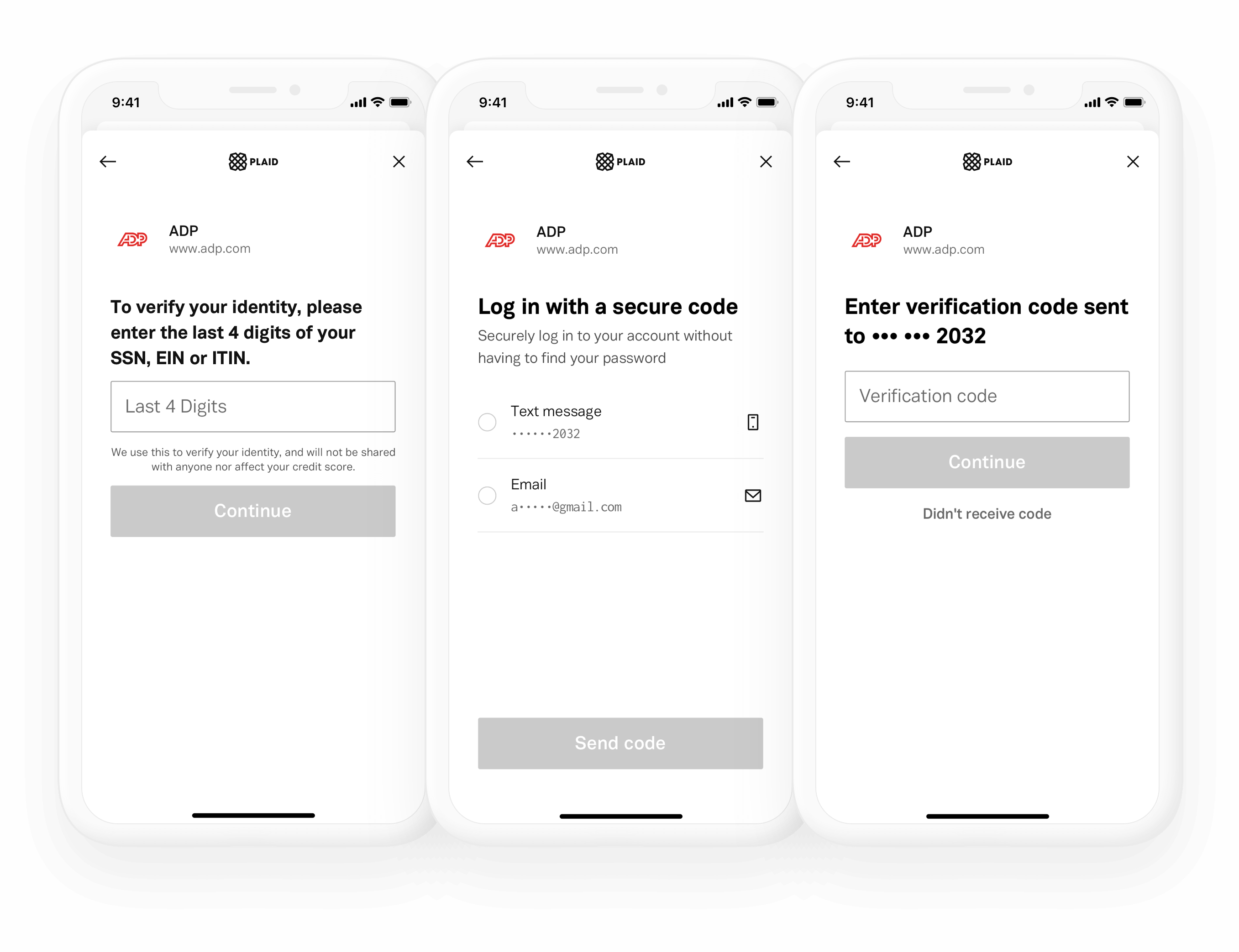
Image Credits: Plaid

Kate Adamson, product lead at Plaid, said the company views access to payroll data as the next area of opportunity in financial services.

“The past decade of fintech innovation has shown that people can make better financial decisions more easily with better access to and control of their own financial data,” she told TechCrunch.

The income verification space is an increasingly crowded one. Last June, TechCrunch wrote about Pinwheel, an API layer for payroll data that handles everything from income and employee verification to easily switching and managing direct deposit. The company officially came out of stealth last year, announcing that it had raised a $7 million seed round from Josh Kopelman at First Round Capital and Greg Bettinelli at Upfront Ventures.

There’s also Argyle, which is building a “gateway to access employment records.” In October, that startup announced a $20 million Series A funding round led by Bain Capital Ventures. Ironically, Argyle’s name was inspired by Plaid, according to Argyle CEO and co-founder Shmulik Fishman. At the time, he told me that the company intentionally named Argyle after a pattern.

“I’m a huge fan of Plaid, and make no secret about it,” Fishman had said. “Plus, there’s a number of other successful companies such as Stripe and Checkr named after patterns. We went through a list of patterns and polka dots didn’t sound very good. So we settled on Argyle. And ultimately, we want to be the Plaid for employment records.”

News: Square buys majority of Tidal, adds Jay Z to its board in bid to shake up the artist economy

This morning Square, a fintech company that serves both individuals and companies, announced that it has purchased a majority stake in Tidal, a music streaming service. The deal, worth some $297 million, will Tidal allow artist-partners to keep their ownership in the music company. Square CEO Jack Dorsey used his other company, Twitter, this morning

This morning Square, a fintech company that serves both individuals and companies, announced that it has purchased a majority stake in Tidal, a music streaming service. The deal, worth some $297 million, will Tidal allow artist-partners to keep their ownership in the music company.

Square CEO Jack Dorsey used his other company, Twitter, this morning to explain the deal. Dorsey seemed to expect the transaction to generate skepticism – which it definitely has. In his opening message, he asked a rhetorical question: “Why would a music streaming company and a financial services company join forces?!”

Why indeed. Dorsey’s expectation is that his company can replicate the success of Cash App and other Square products in the world of music. Noting that “new ideas are found at the intersection,” Dorsey argued that the confluence of “music and the economy” is one such point of convergence.

The deal also installs musician and businessperson Jay Z on Square’s board.

Some early reaction to the deal has proved negative. It’s not hard to riff on the seeming-strangeness of Square and Tidal as a pair. And Square has made acquisitions in the past that appeared adjacent and failed to stick. The company bought food-delivery service Caviar in 2014 before selling it to DoorDash in 2019, for example; that Square appears to have made a venture-level return on the transaction is immaterial to the focus argument.

But the bull-case for the Square-Tidal tie-up is easy to make as well. The American fintech just spent a minute fraction of a single percent of its market capitalization on the smaller company, and through its choice to let artists keep their stake, has effectively onboarded a host of ambassadors for its brand.

And Dorsey is not wrong that Square did shake up the commerce game for many offline businesses with its original card reader. Why not take a swing at a part of the economy — music — that has migrated from the physical world to the digital in the past few years, much like small businesses in recent quarters?

Square’s business users, it’s “seller ecosystem,” as it likes to call it, are increasingly digital. In its most recent quarterly earnings report, “in-person only” usage is falling as a percentage of seller gross payment volume (GPV), while “online only” and “omnichannel” GPV are taking up the slack.

Square has a known win in its consumer-focused Cash App service, which reached 36 million monthly actives in December of 2020, up from 24 million in the same period one year prior. You can imagine tie-ups between the music company and the youth-skewing Cash App audience. And having Jay Z at the Square boardroom table will hardly make the company less innovative; he may bring fresh perspective.

And then there’s the question of NFTs, or non-fungible tokens, a new form of digital asset that have recently become the cause célèbre of the cryptocurrency community. Given that Square has a growing cryptocurrency business via Cash App, and has invested hundreds of millions of dollars into bitcoin itself. If there is space in the market for Square to bring music-based NFTs to its larger consumer user base is an interesting question. If the answer is yes, Square could now be in a leading position to create that market.

Perhaps the Square-Tidal deal won’t generate the future growth that Square imagines. But the deal is cheap, snagging Jay Z as a leader is a win, and it’s hard to win by only playing corporate defense.

News: SpaceX launches 60 new Starlink satellites, while Starship moves closer to being able to launch up to 400 at a time

SpaceX has launched another batch of its Starlink satellites – the usual complement of 60 of the low Earth orbit spacecraft, which will join the more than 1,000 already making up the existing constellation. This is the fifth launch of Starlink satellites for SpaceX this year, and the 20th overall. Earlier this year, SpaceX opened up

SpaceX has launched another batch of its Starlink satellites – the usual complement of 60 of the low Earth orbit spacecraft, which will join the more than 1,000 already making up the existing constellation. This is the fifth launch of Starlink satellites for SpaceX this year, and the 20th overall.

Earlier this year, SpaceX opened up Starlink access to anyone in a current or planned service area via a pre-order reservation system with a refundable up-front deposit. The company aims to continue launches like this one apace throughout 2021 in order to get the constellation to the point where it can serve customers over a much larger portion of the globe. SpaceX COO and President Gwynne Shotwell has previously said that the company expects it should have coverage over much of the globe at a constellation size of around 1,200 satellites, but the company has plans to launch more than 30,000 to fully build out its network capacity and speed.

While SpaceX is making good progress on Starlink with its Falcon 9 launcher, it’s also looking ahead to Starship as a key driver of the constellation’s growth. Starship, SpaceX’s next-generation launch vehicle currently under development in South Texas, will be able to deliver 400 Starlink satellites at a time to orbit, and it’s also being designed with full reusability and fast turnaround in mind.

The ability to launch more than six times as many satellites per mission would help SpaceX a lot in terms of the speed with which they can deploy the Starlink network, as well as the overall cost of the endeavor – assuming their cost projections about Starlink’s general affordability are even close to accurate once it becomes a high-volume production rocket. That’s definitely still at least a few years off, but SpaceX did mark a milestone on Wednesday that bodes well for its chances of making that happen.

The company’s latest Starship prototype performed its most successful test launch to date on Wednesday, taking off from SpaceX’s Boca Chica, Texas development site and flying to around 32,000 feet before executing a ‘flop’ maneuver and then reorienting itself for a soft vertical landing. The test rocket also blew up after sitting on the pad for just under 10 minutes, but despite that spectacular ending, the test proved out a lot of the basic engineering work that SpaceX needs to make Starship a reality.

Starlink is a huge, multi-year effort, so even if Starship is still a few years away from high-volume production and flight, it should still have a significant impact on the project overall. And Starlink, once operational and fully deployed, will require regular maintenance – individual satellites in the network are only really designed to be operational for ups to five years max, with regular replacements required to keep things running smoothly.


Early Stage is the premier “how-to” event for startup entrepreneurs and investors. You’ll hear firsthand how some of the most successful founders and VCs build their businesses, raise money and manage their portfolios. We’ll cover every aspect of company building: Fundraising, recruiting, sales, legal, PR, marketing and brand building. Each session also has audience participation built-in — there’s ample time included in each for audience questions and discussion.

News: Hopin confirms $400M raise at $5.65B valuation

This morning Hopin, a virtual events platform and video-focused software service, announced that it has closed a $400 million Series C. The new capital values Hopin at $5.65 billion. Both numbers match prior TechCrunch reporting that the company was targeting a $400 million raise at a valuation of between $5 billion and $6 billion. Andreessen

This morning Hopin, a virtual events platform and video-focused software service, announced that it has closed a $400 million Series C. The new capital values Hopin at $5.65 billion. Both numbers match prior TechCrunch reporting that the company was targeting a $400 million raise at a valuation of between $5 billion and $6 billion.

Andreessen Horowitz (a16z) and General Catalyst (GC) co-led the round, as TechCrunch reported was likely. Prior investor IVP also took part in the round.

For Hopin, the round is another rapid-fire funding event in a string of such transactions. The company has seen scorching revenue growth in recent quarters, reaching $70 million ARR today, its CEO and founder Johnny Boufarhat told TechCrunch in an interview.

As part of the transaction, recent a16z hire Sriram Krishnan will join Hopin’s board. According to Boufarhat, Hopin had hoped to hire Krishnan before he took his job at the venture firm.

Hopin has scaled rapidly from its now-dated $20 million ARR milestone that it announced in Q4 2020. But not all of that growth has been organic. Hopin recently bought StreamYard, a company that brought $27 million worth of ARR to the combined entity. Hopin spent $250 million on that deal, a transaction that was announced in January of this year.

The company has raised $565 million since February of 2020, it said in an email.

According to Boufarhat, Hopin intends to invest heavily in its product and engineering functions. The CEO stressed during a call that he intends to keep his company’s product spend high as a percentage of revenue; TechCrunch’s read of the sentiment is that Hopin has no intention of letting other companies carve into its core market while it solidifies its virtual event service and adds other capabilities.

The StreamYard deal may provide some guidance as to where Hopin is headed. The acquisition brought to Hopin a company that was already in use by some of its own users, but also added a business line to its collection not wholly component to the event work for which Hopin is best-known. Boufarhat told TechCrunch that his company is open to making more acquisitions.

Perhaps we’ll see Hopin extend its reach to other products that fit into its video-first perspective. It certainly has the capital and equity value to buy a plethora of smaller companies.

At $70 million ARR, Hopin is worth around 81x its current annual recurring revenue. When the company last raised, a $125 million round in November of 2020, the company had $20 million in ARR and a valuation of $2.125 billion valuation. At the time the company was worth a little over 106x its ARR. In light of the company’s recent growth, investors in that round now paid a far-smaller 30.4x ARR multiple, contrasting the company’s new revenue mark and its now-dated valuation.

Provided that Hopin can continue its rapid growth, its current ARR multiple could appear closer to norms in a few quarters.

Closing, Hopin does not appear ready to answer the siren-song of the SPAC. Boufarhat told TechCrunch that he receives regular outreach from SPACs, something we’ve heard from a number of late-stage technology CEOs. Hopin’s founder, however, noted that great companies can go public regardless of the market, and that his company intends on being operationally IPO-ready next year. It appears that a more traditional IPO for Hopin could be in the cards for 2022 or 2023.

News: Jungle Scout raises $110M, acquires Downstream Impact to help 3rd parties sell on marketplaces like Amazon

There has been a rapid proliferation of roll-up companies armed with wallets full of money to consolidate promising smaller merchants that sell on Amazon and other marketplaces, the idea being to create economies of scale to help them sell more effectively and grow. Today, a company that is somewhat doing the opposite — building tools

There has been a rapid proliferation of roll-up companies armed with wallets full of money to consolidate promising smaller merchants that sell on Amazon and other marketplaces, the idea being to create economies of scale to help them sell more effectively and grow. Today, a company that is somewhat doing the opposite — building tools to help Amazon sellers work better on their own — is announcing significant funding to keep growing its business.

Jungle Scout, an Austin-based company that builds tools covering services like search and market analytics, inventory management, and sales intelligence for companies selling on Amazon, has raised $110 million in equity that it is using in part to make an acquisition — Downstream Impact, a specialist in Amazon advertising founded by two ex-Amazon execs who did early work on Amazon’s in-house advertising efforts — and in part to continue growing its business.

You may not know the name but Jungle Scout it is quietly huge. It says that its tools impact some $8 billion in Amazon revenue with around 500,000 brands and entrepreneurs already using it. Its data engine ingests search, purchasing, and other information for some 500 million Amazon products, which it then turns into data to help customers sell on Amazon better.

Jungle Scout began life in 2015 focusing primarily on providing optimizing search tools for sellers solely on Amazon — if you didn’t guess that already by the “Jungle” and “Scout” in its name. Tools for improving business on Amazon still make up the bulk of its business, with its functionality covering not just Amazon.com but nine other regional Amazons. But now, the startup is slowly starting to expand its services beyond that. That could include Google Shopping, Facebook’s many social platforms, and more — whichever marketplace platforms consumers happen to be using.

“We are starting with Walmart.com, which will be live in near future,” CEO Greg Mercer said in an interview, “and the vision is to expand beyond that. We’re bullish on the future of Amazon, but if we think beyond that, my prediction would be that besides those platforms where people primarily go to purchase things, there are places where consumers spend their time — such as Google or social channels like Instagram — that could be other areas where we could provide tools to sell through.”

The startup is also building out its business on the ground in China, he said. The country represents one of the fastest growing source countries not just for goods, but merchants, too.

Summit Partners, the venture capital and private equity firm, is the primary investor in this funding round, with Mercer himself also contributing. It’s not clear how much Jungle Scout has raised to date: PitchBook notes that Summit had backed it previously, in 2017, at an undisclosed sum and valuation. I’ve confirmed that the $110 million being disclosed today is the first time that Jungle Scout has revealed how much money it has raised over the years, although it’s still not disclosing its valuation.

You might notice that in the first paragraph of this story I mentioned that Jungle Scout is “somewhat” taking a different approach to the roll-up companies, companies like Thrasio, SellerX, Branded, HeydayHeroesPerch, Berlin Brands Group, and doubtless others that are raising giant sums of money to source, and then partner with or buy up, third party sellers.

Jungle Scout does indeed provide a valuable service to Amazon retailers who are leveraging the giant’s FBA platform to manage a range of services like inventory, shipping and marketing (in the form of appearing on Amazon to sell things), and who want to remain independent and not be “rolled up.”

However, that’s not actually the full story. Mercer tells me that his company also provides its technology as a white label service to most of the big roll-up players — which of these, he did not note — and so you might also say that even if third-party merchants are not working directly with Jungle Scout, they might well end up doing so indirectly.

The opportunity for building out more tools to address the Amazon economy is a massive one. As we’ve pointed out before, it is estimated that the number of third-party sellers on Amazon currently stands around 5 million, a number that appears to be growing exponentially at the moment, with more than 1 million sellers joining the platform last year. That includes not just smaller retailers who are looking to extend their consumer touch-points, but also increasingly a number of big brands that are now looking at how they can leverage Amazon better to sell directly to consumers on the platform, rather than via third-party merchants.

Within that, advertising remains a huge and growing part of the equation.

If you are an Amazon user, you’ll notice that ads search pages have been growing in number over the years (these are the sponsored results that come up at the top of searches you might make for a product), and so you will be unsurprised to know that advertising, as a result, is really growing fast for Amazon itself.

Ads alone accounted for $21.5 billion in annual revenue for Amazon in 2020, up 66% year-over-year.

Connor Folley, Downstream’s CEO who co-founded the company with another ex-Amazonian, Salim Hamed (who is Downstream’s CTO), told me that ads “within the walls of Amazon itself” still make up the majority of that figure, although it will continue to invest in areas like its DSP to expand beyond its own ecosystem. That makes it somewhat of a dark horse in the world of advertising, which up to now has been more concerned with the rise of Facebook among “new” players.

“The explosive growth of Amazon advertising over the last five years has surpassed many people’s expectations,” he said. “It might be a $50 billion dollar platform by 2023 — and much bigger than Facebook.”

While there are a lot of companies out there building tools and alternatives for sellers to get a better grip to sell on Amazon, the attraction here has been in part the size of Jungle Scout and its prescience in building this market in the first place.

“Jungle Scout was one of the first companies to identify the opportunity to provide SaaS-based tools to help businesses and brands expand their ecommerce footprints on Amazon and beyond, and the company has built on this leadership position over the last several years,” said Neil Roseman, Technologist-in-Residence at Summit Partners and Jungle Scout Board Director, in a statement.

It’s a strong vote of confidence when you consider that Roseman himself is also an ex-Amazonian, having been its VP of technology between 1998 and 2007 working on marketplace technology among other things. “We believe Jungle Scout’s technology is robust and highly scalable, designed to help a company to grow as the Amazon third-party selling ecosystem has expanded. We believe the addition of Downstream Impact will add to this product and engineering strength, and we are thrilled to be a part of the company’s growth journey.”

News: Wipro to buy London’s tech consultancy firm Capco for $1.45 billion

Wipro said on Thursday it has reached an agreement to buy 22-year-old British tech consultancy firm Capco for $1.45 billion as the major Indian software exporter looks to win customers in Europe and Asia. The Indian firm, which identifies U.S. as its biggest market, said the two companies share “complimentary business models” and expects the

Wipro said on Thursday it has reached an agreement to buy 22-year-old British tech consultancy firm Capco for $1.45 billion as the major Indian software exporter looks to win customers in Europe and Asia.

The Indian firm, which identifies U.S. as its biggest market, said the two companies share “complimentary business models” and expects the deal to close by the end of June.

London-headquartered Capco’s clients include “many marquee names” in the global financial services industry including “Boards and C-Suites” in the banking, capital markets, wealth and asset management and insurance sectors, the Indian firm said in a filing (PDF) to the stock exchange in the country.

Privately-held firm Capco, which employs about 5,000 consultants and had raised about $80 million from investors 20 years ago, is “widely acknowledged for its deep domain and consulting expertise, risk and regulatory offerings and thought leadership around key industry technology challenges and opportunities. In addition, Capco services clients in the energy and commodities trading sector,” the two firms said in a joint press release.

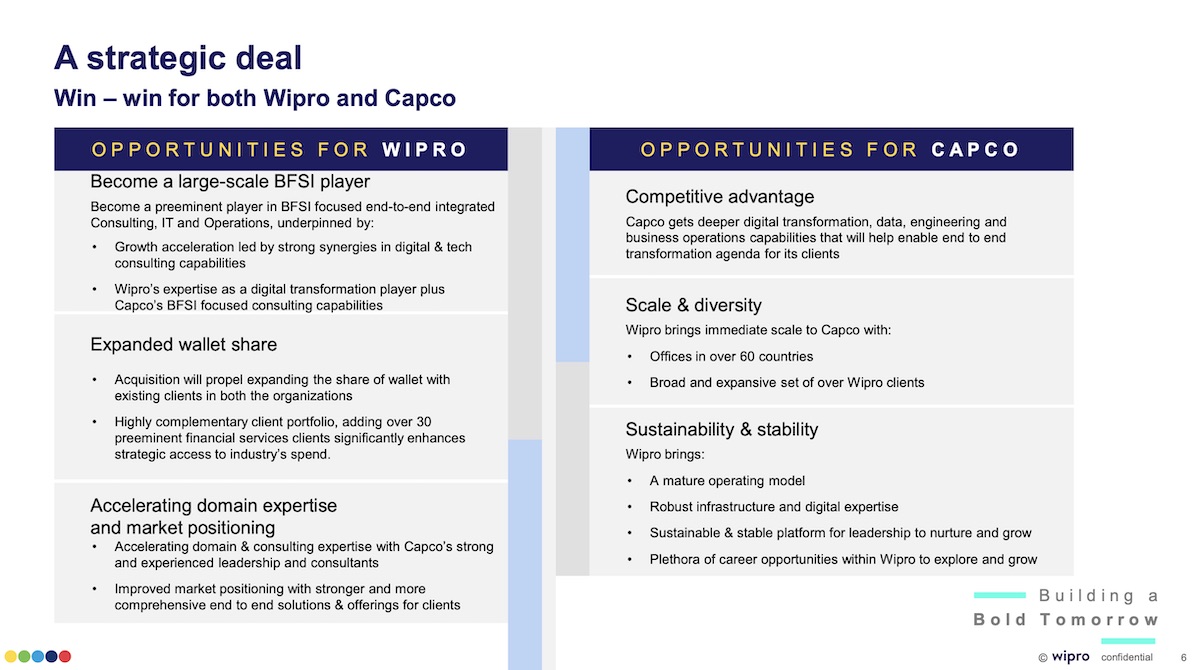
A slide from Wipro’s stock exchange filing. (Wipro)

“Together, we can deliver high-end consulting and technology transformations, and operations offerings to our clients. Wipro and Capco share complimentary business models and core guiding values, and I am certain that our new Capco colleagues will be proud to call Wipro home,” said Thierry Delaporte, CEO and Managing Director of Wipro, who assumed the top role last year.

Delaporte replaced Abidali Neemuchwala, who led the company for four years and fell short of delivering Wipro’s target of becoming a $15 billion firm by 2020. The company’s revenue at the end of March last year was $8.1 billion.

Under the new leadership, Wipro is increasingly chasing clients in Europe and Asia. The firm last year landed orders from European clean energy firms Fortum and E.On. It has publicly stated that it is also looking to acquire firms.

“Together, we will offer bespoke transformational end-to-end solutions, now powered by innovative technology at scale, to create a new leading partner to the financial services industry. We look forward to leveraging the complementary capabilities and similar cultures of both companies to drive industry change and offer exciting opportunities for both our clients, and our people,” said Lance Levy, CEO of Capco, in a statement.

News: Apple’s App Store is now also under antitrust scrutiny in the UK

Apple is facing another antitrust investigation in Europe into how it operates the iOS App Store. The UK’s Competition and Markets Authority (CMA) announced today that it’s opened an investigation following a number of complaints from developers alleging unfair terms and as a result of its own work in the digital sector. “The CMA’s investigation

Apple is facing another antitrust investigation in Europe into how it operates the iOS App Store.

The UK’s Competition and Markets Authority (CMA) announced today that it’s opened an investigation following a number of complaints from developers alleging unfair terms and as a result of its own work in the digital sector.

“The CMA’s investigation will consider whether Apple has a dominant position in connection with the distribution of apps on Apple devices in the UK — and, if so, whether Apple imposes unfair or anti-competitive terms on developers using the App Store, ultimately resulting in users having less choice or paying higher prices for apps and add-ons,” it wrote in a press release.

“This is only the beginning of the investigation and no decision has yet been made on whether Apple is breaking the law,” it added.

In a statement, Andrea Coscelli, chief executive of the CMA, also said: “Millions of us use apps every day to check the weather, play a game or order a takeaway. So, complaints that Apple is using its market position to set terms which are unfair or may restrict competition and choice — potentially causing customers to lose out when buying and using apps – warrant careful scrutiny.”

An Apple spokesperson sent us this statement in response to the CMA action:

We created the App Store to be a safe and trusted place for customers to download the apps they love and a great business opportunity for developers everywhere. In the UK alone, the iOS app economy supports hundreds of thousands of jobs, and any developer with a great idea is able to reach Apple customers around the world.

We believe in thriving and competitive markets where any great idea can flourish. The App Store has been an engine of success for app developers, in part because of the rigorous standards we have in place — applied fairly and equally to all developers — to protect customers from malware and to prevent rampant data collection without their consent. We look forward to working with the UK Competition and Markets Authority to explain how our guidelines for privacy, security and content have made the App Store a trusted marketplace for both consumers and developers.

The European Union already has an open antitrust investigation into a number of elements of Apple’s business — after announcing a probe of the App Store and the iPhone maker’s payment offering, Apple Pay, last summer.

US lawmakers have also been questioning Apple as part of a major antitrust probe into big tech. And a bill has just advanced in Arizona that aims to force both Apple and Google to allow third party payment options in their smartphone stores.

The EU’s Apple investigation, meanwhile, remains ongoing. The video games publisher Epic Games — which has been engaged in a vicious public battle with Apple over what it decries as Cupertino’s unfair ‘tax’ on developers — recently sought to join the EU’s case by filing a complaint with the European Commission last month.

Epic also previously filed the same complaint in the UK — so it’s one of the unhappy developers the CMA cites.

With the UK now outside the bloc (post-Brexit), the CMA looks set to take on a more prominent role as a regional regulator. It’s now free to investigate the same issues as the Commission (whereas under EU rules national regulators are supposed to avoid duplicating effort).

If it can move faster than the bloc’s competition commission it may have the opportunity to mould the standards that apply to tech giants. Although the CMA said today that it “continues to coordinate closely” with the Commission and other agencies to tackle what it described as “global concerns”.

Last fall the UK announced a plan to establish a pro-competition regulation regime aimed at tackling the market power of big tech — following a major market study of online platforms and digital advertising carried out by the CMA. The regulator published its advice to the government on shaping that regime in December.

“As the CMA works with the Government on these proposals – which will complement its current enforcement powers – the CMA will continue to use its existing powers to their fullest extent in order to protect competition in these areas,” it said today.

“Our ongoing examination into digital markets has already uncovered some worrying trends. We know that businesses, as well as consumers, may suffer real harm if anti-competitive practices by big tech go unchecked. That’s why we’re pressing on with setting up the new Digital Markets Unit and launching new investigations wherever we have grounds to do so,” Coscelli added.

In other recent actions scrutinizing tech giants, the CMA has opened an investigation into Google’s plan to phase out third party tracking cookies and launched an inquiry into Uber’s planned acquisition of UK SaaS maker Autocab.


News: Boss of Chinese gaming titan NetEase calls for shared parental leave

China’s relaxation of its one-child restriction has not delivered the population targets set by its policy planners. In 2019, the birth rate in China slumped to a seven-decade low, which experts attribute to changes in social attitudes, skyrocketing living costs as well as a demanding work culture. One way to fix China’s demographic crisis is

China’s relaxation of its one-child restriction has not delivered the population targets set by its policy planners. In 2019, the birth rate in China slumped to a seven-decade low, which experts attribute to changes in social attitudes, skyrocketing living costs as well as a demanding work culture.

One way to fix China’s demographic crisis is to lighten mothers’ burden, said Ding Lei, founder and CEO of NetEase, the second-biggest gaming company in China which also runs a popular music streaming service.

Ding made the proposal at China’s annual parliament session this week, comprising the meetings of the National People’s Congress (NPC) and the Chinese People’s Political Consultative Conference (CPPCC). Each spring, delegates from a wide range of backgrounds, including political elites and tech billionaires, gather in Beijing for the legislative meetings informally known as the “two sessions.”

Ding is a member of the CPPCC, which includes other tech bosses like Tencent’s Pony Ma, Xiaomi’s Lei Jun and Baidu’s Robin Li. Ding suggested efforts should be directed to address costly childbearing, short maternity leave, an undersupply of children’s healthcare, an underdeveloped childcare system and other “practical pain points” to take burdens off women’s shoulders.

Ding further advocated for shared parental leave “at one’s discretion” to “give men more responsibilities in parenting.” The country, he argued, should bear women’s reproductive costs and the number of nursery facilities should be increased.

Most provinces in China have introduced paternity leave in recent years, but the length and implementation efforts vary across regions. In Guangdong, home to NetEase and Tencent, fathers are entitled to up to 15 days of paid paternity leave. Shanghai, on the other hand, falls on the lower end of the spectrum with 10 days.

But some experts argue the one-week average for fathers is far from enough to liberate new mothers, who receive a minimum of 98 days of paid maternity leave but could get more depending on where they reside. NetEase’s family leave policy is in line with national and regional regulations, a company representative told TechCrunch.

Occasionally, China’s tech giants disclose or give hints about their gender ratio. In 2019, 35% of NetEase’s 20,000 employees were women, the company says, and about 25% of its top management were female in the year. Online travel agent Ctrip, which prides itself on benefits for female employees, said in 2018 that over 60% of its staff were female. Jack Ma, a frequent speaker at female leadership forums, pledged in 2019 that females must make up more than 33% of Alibaba staff.

News: Deliveroo confirms anticipated £8bn floatation in London, will be among first to use ‘dual shares’ structure

Food delivery start-up Deliveroo has today confirmed its £8bn ($11bn) stock market floatation in London, something which was on the cards previously. The eight-year-old company will use the “dual-class” innovation which has been introduced to the London Stock Exchange by the UK government in a bid to keep UK companies from being lured over to

Food delivery start-up Deliveroo has today confirmed its £8bn ($11bn) stock market floatation in London, something which was on the cards previously.

The eight-year-old company will use the “dual-class” innovation which has been introduced to the London Stock Exchange by the UK government in a bid to keep UK companies from being lured over to the NASDAQ, as well as attract continental European listings.

The listing will be on the London Stock Exchange’s “premium” segment. Dual-class shares are popular in the US – where it is used by companies such as Facebook and Alphabet – because it allows founders to take a longer view of strategy and retain more control of their companies during decisions such as mergers and acquisitions.

Will Shu, CEO of Deliveroo, said in a statement: “Deliveroo was born in London. This is where I founded the company and delivered our first order. London is a great place to live, work, do business and eat. That’s why I’m so proud and excited about a potential listing here.”

Deliveroo’s business has boomed during pandemic-related lockdowns – it posted six-months of consecutive profits throughout this period – and now plans to expand.

Although Deliveroo’s listing came comes just a day after the British government gave the green light to recommendations for the dual-class shares, Deliveroo’s listing was always expected to be in London, given it’s UK base, so this news looks to have a political tinge attached to it. Indeed, the press release was handily issued with a supportive statement from the Chancellor of the Exchequer.

Claudia Arney, Chair of Deliveroo, said: “The time-limited dual-class structure would provide Will and his team with the certainty needed to execute against their ambitious growth plan to become the definitive online food company.”

Deliveroo’s plans include expanding its ‘ghost’ kitchens; on-demand grocery; extending its Plus subscription service; and offering its Signature service to restaurants, which allows customers to order delivery via a restaurants’ own website.

The multibillion-pound IPO will be a shot in the arm for The City after Amsterdam overtook London as Europe’s largest share trading center in January, post-Brexit.

Deliveroo pegged a $7 billion valuation in January after raising $180 million from investors.

News: IFC backs Bolt with $24M to expand its transportation network in emerging markets

Bolt, an Uber competitor that is building an international on-demand network of services to transport people, food and other items in cars, scooters and bikes across Europe and Africa, has picked up some strategic funding today to continue expanding its business in emerging markets. The International Finance Corporation, a division of the World Bank, is

Bolt, an Uber competitor that is building an international on-demand network of services to transport people, food and other items in cars, scooters and bikes across Europe and Africa, has picked up some strategic funding today to continue expanding its business in emerging markets.

The International Finance Corporation, a division of the World Bank, is investing €20 million ($24 million) in the Tallinn, Estonia-based startup to open up more services across Eastern Europe and Africa, with a specific mention of more services in Ukraine and Nigeria, two of those regions’ biggest economies, and more innovative services to target demographic groups that might be under-represented or under-served, such as women. 

Funding from the IFC is a significant endorsement of a company, if at the same time a relatively small amount compared to Bolt’s wider fundraising efforts.

Most recently, it raised $182 million in December at a significant hike to its previous valuation (which had been $1.9 billion). A Bolt spokesperson tells us that, once again, “our valuation has grown with the latest funding round, but we’re not disclosing the updated number.” (For the record, in December we calculated that the valuaton was probably around $4.3 billion, based on a 1.5x multiple on GMV of €3.5 billion, figures provided to us by CEO and co-founder Markus Villig. That figure wasn’t disputed, nor confirmed, though.)

People may not consider the IFC in the same breath as more typical VCs like SoftBank, Sequoia, Index Ventures, or Andreessen Horowitz, but it’s a significant player when it comes to backing startups around the world. Last year alone it invested $22 billion in companies, it said.

Backing a transportation startup is a notable move for it, considering that a lot of the IFC’s interest in tech has typically been around financial services. For example, it has also invested money into CurrencyCloud, Remitly, CompareAsiaGroup, and Kreditech, among others.

But improving transportation is another development target — in particular when you consider that companies like Bolt are built like marketplaces that provide income to people, infrastructure to businesses (in the form of delivery), on top of its most obvious service helping consumers get around.

“We are looking forward to partnering with IFC to further support entrepreneurship, empower women and increase access to affordable mobility services in Africa and Eastern Europe,” said Villig, in a statement. “Together with the investment from the European Investment Bank last year, we are proud to have sizable and strategically important institutions backing us and recognizing the strategic value Bolt is providing to emerging economies”.

Bolt’s efforts in emerging markets have long been one the key ways that the company differentiates itself from Uber — perhaps logical, considering that the company itself was founded in an emerging economy. Since launching in 2013, it has picked up over 50 million customers and more than 1.5 million drivers in 40 countries, including 400,000 drivers in 70 cities on the African continent.

That strategy has also grown over time to include services for under-represented groups in these under-represented markets. Bolt is piloting a “Women Only” ride-hailing service in South Africa, with female drivers and passengers to improve job opportunities and general safety, one of the programs that the IFC funding will support, it said.

“Technology can and should unlock new pathways for sustainable development and women’s empowerment,” said Stephanie von Friedeburg, IFC Senior Vice President of Operations, in a statement. “Our investment in Bolt aims to help tap into technology to disrupt the transport sector in a way that is good for the environment, creates more flexible work opportunities for women, and provides safer and more affordable transportation access in emerging markets.”

WordPress Image Lightbox Plugin