Monthly Archives: March 2021

News: Understanding how investors value growth in 2021

We’re not digging into another IPO filing today. You can read all about AppLovin’s filing here, or ThredUp’s document here. This morning, instead, we’re talking about an old favorite: software valuations. The folks over at Battery Ventures have compiled a lengthy dive into the 2020 software market that’s worth our time — you can read

We’re not digging into another IPO filing today. You can read all about AppLovin’s filing here, or ThredUp’s document here.

This morning, instead, we’re talking about an old favorite: software valuations. The folks over at Battery Ventures have compiled a lengthy dive into the 2020 software market that’s worth our time — you can read along here; I’ll provide page numbers as we go — because it helps explain some software valuations.


The Exchange explores startups, markets and money. Read it every morning on Extra Crunch, or get The Exchange newsletter every Saturday.


There’s little doubt that there is some froth in the software market, but it may not be where you think it is.

The Battery report has a lot of data points that we’ll also work through in this week’s newsletter, but this morning, let’s narrow ourselves to thinking about rising aggregate software multiples, the breakdown of multiples expansion through the lens of relative growth rates, and cap it off with a nibble on the importance, or lack thereof, of cash flow margins for the valuation of high-growth software companies.

We’ll look at the changing public market perspective, and then ask ourselves if the aggregate image that appears is good or not good for software startups.

I chatted through pieces of the report with its authors, Battery’s Brandon Gleklen and Neeraj Agrawal. So, we’ll lean on their perspective a little as we go to help us move quickly. This is our Friday treat. Or at least mine. Let’s get into it.

Rising multiples

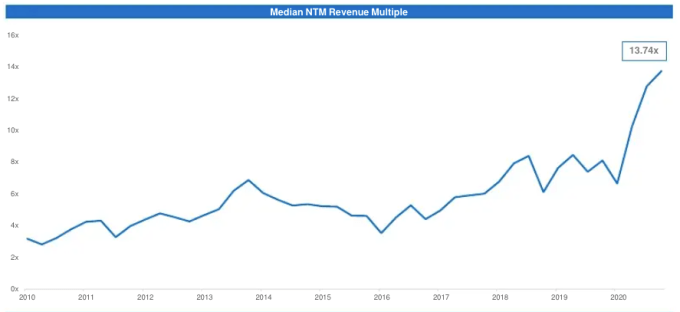
Let’s start with an affirmation. Yes, software valuations have risen to record-high multiples in recent years. Here’s the Battery chart that makes the change clear:

Page 31, Battery report

News: SoftBank makes mountains of cash off of human laziness

Hello and welcome back to Equity, TechCrunch’s venture capital-focused podcast, where we unpack the numbers behind the headlines. Natasha and Danny and Alex and Grace were all here to chat through the week’s biggest tech happenings. It was yet another crazy week, but did our best to get through as much of it as we could. Here’s the rundown, in case you

Hello and welcome back to Equity, TechCrunch’s venture capital-focused podcast, where we unpack the numbers behind the headlines.

Natasha and Danny and Alex and Grace were all here to chat through the week’s biggest tech happenings. It was yet another crazy week, but did our best to get through as much of it as we could. Here’s the rundown, in case you are reading along with us!

  • Square is buying Tidal in a deal that some are skeptical of, but one about which we found quite a lot to like.
  • How capital-as-a-service can get you your first check in 2021, and a nod to Indie.VC, a pioneer in alternative financing for startups that announced it is shutting down net new investments this year.
  • Oscar Health priced its IPO above its raised range, which was good for it in terms of fundraising. However, since its debut the company has lost pricing altitude. Its declines mimic those of other public neo-insurance proivders in what could be a new trend.
  • And sticking to the insurtech beat, Hippo is going public via a SPAC. Because everyone else is?
  • Compass filed its S-1, which triggered a debate on how its different than OpenDoor.
  • Coupang’s IPO is also coming, replete with huge growth, an improving profitability picture, and a massive valuation. This is one to watch.
  • There was also a whole global news circuit around grocery delivery startups, with Instacart raising at a $39 billion valuation.
  • And we wrapped with the Surreal seed round that we found to be more than a little spicy. As it turns out, commercialized deepfakes are not merely on the way; they are here.

And with that we are back on Monday. Have a rocking weekend!

Equity drops every Monday at 7:00 a.m. PST, Wednesday, and Friday at 6:00 AM PST, so subscribe to us on Apple PodcastsOvercastSpotify and all the casts!


Early Stage is the premier “how-to” event for startup entrepreneurs and investors. You’ll hear firsthand how some of the most successful founders and VCs build their businesses, raise money and manage their portfolios. We’ll cover every aspect of company building: Fundraising, recruiting, sales, product-market fit, PR, marketing and brand building. Each session also has audience participation built-in — there’s ample time included for audience questions and discussion.

News: Virgin Galactic Chairman Chamath Palihapitiya sells off remaining personal stake in the space company

The man who arguably ushered in the current SPAC rush with the merger of Virgin Galactic with his Social Capital Hedosophia holding company has divested the remainder of his personal holdings in the space tourism company. Chamath Palihapitiya, who serves as the Chairman of Virgin Galactic’s board, still holds 6.2% ownership in the company in

The man who arguably ushered in the current SPAC rush with the merger of Virgin Galactic with his Social Capital Hedosophia holding company has divested the remainder of his personal holdings in the space tourism company. Chamath Palihapitiya, who serves as the Chairman of Virgin Galactic’s board, still holds 6.2% ownership in the company in partnership with investor Ian Osborne, but his solo holdings are now at zero.

Palihapitiya sold 3.8 million shares in December 2020, noting that he was selling that equity “to help manage [his] liquidity” in order to provide funding for “several new projects starting in 2021.” At the time, Palihapitiya said he “remained committed and excited fore the future of SPCE [Virgin Galactic’s stock ticker on the NYSE].”

Please note that I filed a Form 4 for the sale of 3.8M shares of SPCE. I sold these shares to help manage my liquidity as I fund several new projects starting in 2021. I remain committed and excited for the future of SPCE. Just wanted to be transparent.https://t.co/OsUaVgVwKF

— Chamath Palihapitiya (@chamath) December 17, 2020

The sale this week comprised 6.2 million shares, netting Palihapitiya roughly $213 million in the process. He has yet to comment on this most recent sale, and we’ve reached out to Virgin Galactic for additional context, and will update if we hear back.

Virgin Galactic has had some setbacks in its testing program that pushed the projected date of its first paying commercial tourists flights out into 2022, from an earlier target of sometime this year. The company installed Disney Parks leader Michael Colglazier as its new CEO last July, replacing George Whitesides, who moved into a Chief Space Officer role, before it was revealed Thursday that he’s departing the company.

Space as a sector has been a hotbed of SPAC activity of late, with mergers from a number of companies including Astra, Spire, Rocket Lab, BlackSky, and Momentus announced over the course of the past year. Virgin Galactic, as one of the earliest, will be closely watched by anyone looking for a yard stick by which to measure the tactic. The company’s share value is down just over 5% pre-market, and has been on a steady decline since reaching an all-time peak around mid-February.

News: Scrum Ventures launches new program to connect startups with Japanese corporations

Headquartered in San Francisco and Tokyo, Scrum Ventures is known for its accelerator programs focused on sports, food and smart city tech. Today it announced the launch of a new incubator program that will help startups from business partnerships with Japanese corporations. Called Scrum Studio, it will be spun out as an independent entity from

Masami Takahashi, the president of Scrum Studios

Masami Takahashi, the president of Scrum Studios

Headquartered in San Francisco and Tokyo, Scrum Ventures is known for its accelerator programs focused on sports, food and smart city tech. Today it announced the launch of a new incubator program that will help startups from business partnerships with Japanese corporations.

Called Scrum Studio, it will be spun out as an independent entity from Scrum Ventures, and headed by Masami Takahasi, who was previously strategy officer and general manager for WeWork Japan. Before that, he led Uber’s operations in Japan.

Takahasi told TechCrunch that Scrum Studio is currently focused on the startups in its current accelerator programs (Sports Tech Tokyo, SmartCityX and Food Tech Studio), but plans to launch new programs in the future that also center on specific verticals. Through Scrum Studio, startups will be able to establish subsidiaries in Japan, or form joint ventures with Japanese companies.

Scrum already has more than 50 Japanese corporate partners, including Aioi Nissay Dowa Insurance, energy company Idemitsu Kosan Co and East Japan Railway Company for Smart City X, and Fuji Oil Holdings, Nissin Food Holdings and ITO EN for Food Tech Studio.

“We are looking to work with startups and technology that can help solve some of the challenges that our society faces today,” Takahasi said in an email. “These include, but are not limited to, sustainability, health, safety, waste reduction, and efficiency of cities and their people.”

News: How Pariti is connecting founders with capital, resources and talent in emerging markets

According to Startup Genome, Beijing, London, Silicon Valley, Stockholm, Tel Aviv are some of the world’s best startup ecosystems. The data and research organisation uses factors like performance, capital, market reach, connectedness, talent, and knowledge to produce its rankings. Startup ecosystems from emerging markets excluding China and India didn’t make the organisations’ top 40 list

According to Startup Genome, Beijing, London, Silicon Valley, Stockholm, Tel Aviv are some of the world’s best startup ecosystems. The data and research organisation uses factors like performance, capital, market reach, connectedness, talent, and knowledge to produce its rankings.

Startup ecosystems from emerging markets excluding China and India didn’t make the organisations’ top 40 list last year. It is a known fact that these regions lag well behind in all six factors, and decades might pass before they catch up to the standards of the aforementioned ecosystems.

However, a Kenyan B2B management startup founded by Yacob Berhane and Wossen Ayele wants to close the gap on three of the six factors — access to capital, knowledge, and talent.

These issues, specifically that of access to capital, is heightened in Africa. For instance, only 25% of funding goes to early-stage startups in Sub-Saharan Africa compared to more than 50% in Latin America, MENA, and South Asia regions.

“We wanted to build a solution that will help startups be successful that otherwise would not have been able to get the resources they needed,” said CEO Berhane to TechCrunch. “This problem is especially acute in Africa because it’s particularly nascent, but this platform is designed for founders across emerging markets. So basically anywhere that doesn’t have a mature, healthy startup ecosystem.”

So, how is the team at Pariti setting out to solve these problems? Ayele tells me that in one sense, Pariti is like an unbundled accelerator.

In a typical accelerator, founders will need to go through an intense program where they are loaded with information on all the things a startup will likely need to know at some point in their growth. Whereas with Pariti, founders get the needed information or resources that are immediately relevant to helping them get to the next stage of the business.

A three-way marketplace

When a founder joins Pariti, they run their company through an assessment tool. There, they share pitch materials and information about their business. Pariti then assesses each company across more than 70 information points ranging from the team and market to product and economics.

After this is done, Pariti benchmarks each company against its peers. Companies in the same industry, product stage, revenue, fundraising are some of the comparisons made. The founder gets a detailed assessment with feedback on their pitch materials, the underlying metrics that they can use to develop their business and, their ability to raise capital down the line.

“This approach gives us an extremely granular view of their businesses, its strengths, weaknesses and allows us to triage the right resources to the founder based on their particular needs.”

It doesn’t end there. Pariti also connects the founders for one-on-one sessions with members of its global expert community. Their backgrounds, according to Ayele, run the gamut from finance and marketing to product and technology across a range of sectors. Pariti also provides vetted professionals for hire from its community if a founder needs more hands-on support building a product.

Ayele says founders can continue to go through this process multiple times, getting assessed, implementing feedback, and connecting with resources and talent.

On another end, Pariti allows investors to sign up on its platform, thereby collating data on their preferences. So once a startup wants to raise capital, the platform matches them with investors based on their profile and preferences.

“We’ve built an algorithm-based matching platform where we curate relevant deals to VC investors. We also simplify the investor reach-out process for founders, which is a huge pain point — especially in this ecosystem.”
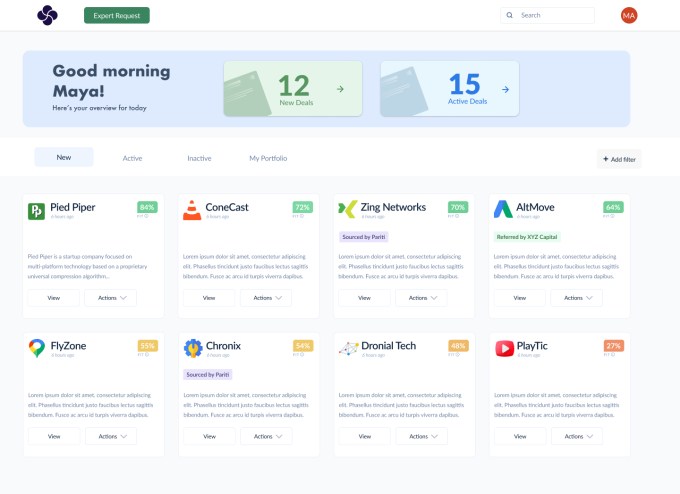
Pariti’s investor platform

In a nutshell, Pariti helps founders connect with affordable talent, access capital and develop their businesses. Professionals can find interesting opportunities to mentor startups and get paid gig opportunities. They also get more exposure to the early stage ecosystem while tracking their progress, verifying their skills and increasing earning potential. Investors can run extremely lean operations with access to proprietary deal flow, automated deal filtering and on-demand experts to support due diligence, research and portfolio support.

According to the COO, the company has seen a tremendous amount of value built through the platform so far. A testament to this is an experience shared by Kiiru Muhoya, founder of Kenyan fintech startup Fingo Africa with TechCrunch, on how the platform helped him raise a $250,000 pre-seed round.

He said that after going through Pariti’s assessment ahead of a planned fundraiser, he realized that the market he was targeting was too small. Also, he needed to learn more about what VCs were looking for to be successful.

Muhoya decided to switch to being at the other end of things. Joining the expert platform on Pariti, he began to review companies and provided feedback to other founders. This led him to take some months off to pivot his business based on Pariti’s first feedback and what he had learned from the expert platform. He took his startup through another assessment on the platform and thus closed the round.

The company has made significant strides since launching in 2019. It has over 500 companies across 42 countries, 100 freelance experts, and 60 investors using its platform. Berhane also adds that five funds currently use Pariti’s operating system for their deal management.

“For us, I think we’re building the rails for how ventures are built and scaled in emerging markets. We have partners in place across emerging markets, including Latin America and India. We also have a strong interest in the United States, where we see a real need for our platform.” Berhane said.

It charges a subscription model for investors, but Berhane wouldn’t disclose the numbers. He says that Pariti will begin to charge a subscription fee for founders as well. Another revenue stream comes when investors or founders pay a certain transaction fee when using Pariti’s freelance experts for projects. The same happens when there’s any fundraise executed from the platform.

Talking about fundraising, the company recently secured an undisclosed pre-seed capital from angels and VCs like 500 Startups, Kepple Africa and Huddle VC.

But it hasn’t been smooth sailing for Pariti as one issue that has stood out in dealing with founders and investors is trust. Berhane says founders have shared some horror stories about engaging with investors, while investors have shared trust concerns about founders reporting false numbers.

Pariti tries to address this by providing NDAs for both parties where the company will not share founders data with investors until they want it to be.  And investors won’t get deals that Pariti hasn’t thoroughly vetted.

Both founders of East African descent — Berhane from Eritrea and Ayele from Ethiopia — crossed paths a couple of times but took different routes to be where they are now.

Wossen Ayele (COO) and Yacob Berhane (CEO)

Ayele started his career at a consulting shop with offices across East Africa before moving back to the U.S. for law school. There, he got his first exposure to the early-stage startup world and worked with an emerging markets-focused VC fund.

“I could see how technology and innovation could play a role in helping communities – whether it’s through financial inclusion, access to essential goods and services, connecting people at the base of the pyramid to markets,” he said.

Upon graduation and completion of his legal training, Ayele headed back to Nairobi to get involved with its growing African startup ecosystem, where he and Berhane founded the company.

The CEO who studied finance and investment banking in the U.S. moved back to Africa to start a pan-African accelerator in Johannesburg, South Africa. While he has worked in managerial positions for companies like the African Leadership University and Ajua, Berhane spent most of his time brokering deals for them which ultimately led him to start Pariti. 

“After helping businesses raise more than $20m and seeing how that money led to job creation and upward mobility for employees, I knew there was a path I could have that would be meaningful within finance. I continued to think about the growing asymmetry of access to capital, talent and knowledge in the startup ecosystem and the lack of infrastructure addressing it. Pariti was how we wanted to solve it.”


News: What China’s Big Tech CEOs propose at the annual parliament meeting

The annual meetings of the Chinese parliament and its advisory body are underway in Beijing this week. Top executives from some of China’s largest tech firms are among the thousands of delegates who attend and put forward their opinions. Here is a look at what the tech bosses are proposing for China’s digital economy. Pony

The annual meetings of the Chinese parliament and its advisory body are underway in Beijing this week. Top executives from some of China’s largest tech firms are among the thousands of delegates who attend and put forward their opinions. Here is a look at what the tech bosses are proposing for China’s digital economy.

Pony Ma

More regulatory scrutiny is needed for the country’s budding internet economy, Tencent’s founder and CEO Pony Ma says in one of his proposals, according to a report from the state-backed People’s Posts and Telecommunications News. As a delegate of the National People’s Congress, Ma has submitted over 50 proposals during the parliament meetings over nine consecutive years, said the report.

Specifically, Ma calls for strict governance on peer-to-peer finance, bike-sharing, long-term apartment rental and online grocery group-buying, fledgling areas that have also seen businesses go bust amid cash-hemorrhaging competition.

Ma’s comment comes at a time when regulators are tightening their grips on the country’s tech giants. In recent months, the government has launched probes into Alibaba and other tech firms over anti-competitive practices and proposed a sweeping data law that will limit how platforms collect user information.

Lei Jun

In China’s grand plan to move up the manufacturing value chain, Xiaomi, which makes smartphones and a slew of other hardware devices, has been keen to help factories upgrade.

Xiaomi CEO Lei Jun, a delegate of the NPC, recognizes China is late to smart manufacturing, lacks home-grown innovation and is overreliant on foreign technologies, he says in his proposal. Research and development efforts should be directed to key components such as cutting-edge sensors and precision reducers for factory robots, he says.

China also lacks the talent for advancing factory innovation, Lei points out, thus government policies should support corporations in attracting foreign talent and cultivating collaboration between industries and academia.

Robin Li

As part of its artificial intelligence pivot, Baidu, China’s biggest search engine service, has invested heavily in smart driving tech. Regulation is a major hurdle for autonomous driving firms like Baidu that need large volumes of data to train algorithms, and the rate at which testing permits are issued varies greatly across regions.

Robin Li, CEO of Baidu and a member of the Chinese People’s Political Consultative Conference, urges regulators to be more innovative and pave the way for legal and at-scale commercialization of autonomous driving. A mechanism should be created for various government agencies, industry players and academia to collectively promote the commercial deployment of autonomous driving.

In addition, Li calls for more senior-friendly technologies, greater public access to government data, and better online protection for underage users in China.

News: Indonesian logistics startup SiCepat raises $170 million Series B

SiCepat, an end-to-end logistics startup in Indonesia, announced today it has raised a $170 million Series B funding round. Founded in 2014 to provide last-mile deliveries for small merchants, the company has since expanded to serve large e-commerce platforms, too. Its services now also cover warehousing and fulfillment, middle-mile logistics and online distribution. Investors in

SiCepat, an end-to-end logistics startup in Indonesia, announced today it has raised a $170 million Series B funding round. Founded in 2014 to provide last-mile deliveries for small merchants, the company has since expanded to serve large e-commerce platforms, too. Its services now also cover warehousing and fulfillment, middle-mile logistics and online distribution.

Investors in SiCepat’s Series B include Falcon House Partners; Kejora Capital; DEG (the German Development Finance Institution); Telkom Indonesia’s investment arm MDI Ventures; Indies Capital; Temasek Holdings subsidiary Pavilion Capital; Tri Hill; and Daiwa Securities. The company’s last funding announcement was a $50 million Series A in April 2019.

In a press statement, The Kim Hai, founder and chief executive officer of SiCepat’s parent company Onstar Express, said the funding will be used to “further fortify SiCepat’s position as the leading end-to-end logistics service provider in the Indonesian market and potentially to explore expansion to other markets in Southeast Asia.” SiCepat claims to be profitable already and that it was able to fulfill more than 1.4 million packages per day in 2020.

The logistics industry in Indonesia is highly fragmented, which means higher costs for businesses. At the same time, demand for deliveries is increasing thanks to the growth of e-commerce, especially during the COVID-19 pandemic.

SiCepat is one of several Indonesian startups that have raised funding recently to make the supply chain and logistics infrastructure more efficient. For example, earlier this week, supply chain SaaS provider Advotics announced a $2.75 million round. Other notable startups in the space include Kargo, founded by a former Uber Asia executive, and Waresix.

SiCepat focuses in particular on e-commerce and social commerce, or people who sell goods through their social media networks. In statement, Kejora Capital managing partner Sebastian Togelang, said the Indonesian e-commerce market is expected to grow at five-year compounded annual growth rate of 21%, reaching $82 billion by 2025.

“We believe SiCepat is ideally positioned to serve customers from e-commerce giants to uprising social commerce players which contribute an estimated 25% to the total digital commerce economy,” he added.

News: InsurGrid raises pre-seed financing to help modernize legacy insurance agents

Insurance agents spend hours handling paperwork and grabbing client information over the phone. A new seed-stage startup, InsurGrid, has developed a software solution to help ease the process, and make it easier for agents to serve existing clients — and secure new ones. InsurGrid gives agents a personalized platform to collect information from clients, such

Insurance agents spend hours handling paperwork and grabbing client information over the phone. A new seed-stage startup, InsurGrid, has developed a software solution to help ease the process, and make it easier for agents to serve existing clients — and secure new ones.

InsurGrid gives agents a personalized platform to collect information from clients, such as date of birth, driver’s license information and policy declaration. This platform helps agents avoid sitting on long calls or managing back-to-back emails, and instead gives them one spot to understand how all their different clients function. It is starting with property and casualty management.

The startup integrates with 85 insurance carriers, serving as the software layer instead of the provider. Using the InsurGrid platform, insurers can ask clients to upload information and within seconds be registered as a policyholder. This essentially turns into a living Rolodex that insurers can use to access information on the account, and offer quotes on a faster rate.

Image Credits: InsurGrid

There’s a monetary benefit in providing better service. Eden Insurance, a customer of InsurGrid, said that people who submit information through the platform converted at an 82% higher rate than those who don’t. Jeremy Eden, the agency owner of Eden Insurance, said they were able to show consumers that its plan was $300 cheaper than its existing rate.

At the heart of InsurGrid is a bet from the founding team that legacy insurance agents aren’t going anywhere. Co-founder/CEO Chase Beach pointed out that the majority of the $684 billion of annual property and casualty insurance premiums in the United States is distributed by approximately 800,000 agents working in 16,000 brokerages. So far, InsurGrid works with more than 150 of those agencies.

When asked if InsurGrid ever had plans to offer its own insurance, similar to insurtech giants Hippo, Lemonade and Root, Beach said that it is solely working on innovating around the sales process for now. He said that these big companies, which have either recently gone public or are planning to, still rely on agents to be successful.

“Instead of us replacing the insurance agent, what if we gave them that same level of technology of a Hippo or large carrier,” Beach said. “And provide them with the digital experiences so they can compete in 2021.”

As time goes on, he sees insurance agents taking the same role that financial advisors or real estate agents take: “very much involved in the process because they are that expert.”

Other startups that have popped up in this space include Gabi, Trellis and Canopy Connect. The differentiator, the team sees, is that Beach comes from a 144-year-old insurance legacy, giving him key insights on how to sell to agents in a successful and effective way. It is starting with sales, but expect InsurGrid to expand to other parts of the insurance process as well.

To help them compete with new and old startups, InsurGrid recently raised $1.3 million in pre-seed financing to help it fulfill its goal to be the “underdog for the underdogs,” Beach said. Investors include Engineering Capital, Hustle Fund, Vess Capital, Sahil Lavingia and Trevor Kienzle.

News: Backed by Blossom, Creandum and Index, grocery delivery and dark store startup Dija launches in London

Dija, the London-based grocery delivery startup, is officially launching today and confirming that it raised £20 million in seed funding in December — a round that we first reported was partially closed the previous month. Backing the company is Blossom Capital, Creandum and Index Ventures, with Dija seemingly able to raise pre-launch. In fact, there

Dija, the London-based grocery delivery startup, is officially launching today and confirming that it raised £20 million in seed funding in December — a round that we first reported was partially closed the previous month.

Backing the company is Blossom Capital, Creandum and Index Ventures, with Dija seemingly able to raise pre-launch. In fact, there are already rumours swirling around London’s venture capital community that the upstart may be out raising again already — a figure up to £100 million was mooted by one source — as the race to become the early European leader in the burgeoning “dark” grocery store space heats up.

Image Credits: Dija

Over the last few months, a host of European startups have launched with the promise of delivering grocery and other convenience store items within 10-15 minutes of ordering. They do this by building out their own hyper-local, delivery-only fulfilment centres — so-called “dark stores” — and recruiting their own delivery personnel. This full-stack or vertical approach and the visibility it provides is then supposed to produce enough supply chain and logistics efficiency to make the unit economics work, although that part is far from proven.

Earlier this week, Berlin-based Flink announced that it had raised $52 million in seed financing in a mixture of equity and debt. The company didn’t break out the equity-debt split, though one source told me the equity component was roughly half and half.

Others in the space include Berlin’s Gorillas, London’s Jiffy and Weezy, and France’s Cajoo, all of which also claim to focus on fresh food and groceries. There’s also the likes of Zapp, which is still in stealth and more focused on a potentially higher-margin convenience store offering similar to U.S. unicorn goPuff. Related: goPuff itself is also looking to expand into Europe and is currently in talks to acquire or invest in the U.K.’s Fancy, which some have dubbed a mini goPuff.

However, let’s get back to Dija. Founded by Alberto Menolascina and Yusuf Saban, who both spent a number of years at Deliveroo in senior positions, the company has opened up shop in central London and promises to let you order groceries and other convenience products within 10 minutes. It has hubs in South Kensington, Fulham and Hackney, and says it plans to open 20 further hubs, covering central London and Zone 2, by the summer. Each hub carries around 2,000 products, claiming to be sold at “recommended retail prices”. A flat delivery fee of £1.99 is charged per order.

“The only competitors that we are focused on are the large supermarket chains who dominate a global $12 trillion industry,” Dija’s Menolascina tells me when I ask about competitors. “What really sets us apart from them, besides our speed and technology, is our team, who all have a background in growing and disrupting this industry, including myself and Yusuf, who built and scaled Deliveroo from the ground up”.

Menolascina was previously director of Corporate Strategy and Development at the takeout delivery behemoth and held several positions before that. He also co-founded Everli (formerly Supermercato24), the Instacart-styled grocery delivery company in Italy, and also worked at Just Eat. Saban is the former chief of staff to CEO at Deliveroo and also worked at investment bank Morgan Stanley.

During Dija’s soft-launch, Menolascina says that typical customers have been doing their weekly food shop using the app, and also fulfilling other needs, such as last-minute emergencies or late night cravings. “The pain points Dija is helping to solve are universal and we built Dija to be accessible to everyone,” he says. “It’s why we offer products at retail prices, available in 10 minutes — combining value and convenience. Already, Dija is becoming a key service for parents who are pressed for time working from home and homeschooling, as one example”.

Despite the millions of dollars being pumped into the space, a number of VCs I’ve spoken to privately are skeptical that fresh groceries with near instant delivery can be made to work. The thinking is that fresh food perishes, margins are lower and basket sizes won’t be large enough to cover the costs of delivery.

“This might be the case for other companies, but almost everyone at Dija comes from this industry and knows exactly what they are doing, from buying and merchandising to data and marketing,” Menolascina says, pushing back. “It’s also worth pointing out that we are a full-stack model, so we’re not sharing our margin with other parties. In terms of the average basket size, it varies depending on the customer’s need. On one hand, we have customers who do their entire grocery shop through Dija, while on the other hand, our customers depend on us for emergency purchases e.g. nappies, batteries etc.”

On pricing, he says that, like any retail business, Dija buys products at wholesale prices and sells them at recommended retail prices. “Going forward, we have a clear roadmap on how we generate additional revenue, including strategic partnerships, supply chain optimisation and technology enhancements,” adds Menolascina.

Dija testing on Deliveroo

Image Credits: TechCrunch

Meanwhile, TechCrunch has learned that prior to launching its own app, Dija ran a number of experiments on takeout marketplace Deliveroo, including selling various convenience store items, such as potato chips and over-the-counter pharmaceuticals. If you’ve ever ordered toiletry products from “Baby & Me Pharmacy” or purchased chocolate sweets from “Valentine’s Vows,” you have likely and unknowingly shopped at Dija. Those brands, and a number of others, all delivered from the same address in South Kensington.

“Going direct to consumer without properly testing pick & pack is a big risk,” Menolascina told me in a WhatsApp message a few weeks ago, confirming the Deliveroo tests. “We created disposable virtual brands purely to learn what to sell and how to replenish, pick & pack, and deliver”.

News: Daily Crunch: Square acquires Tidal

Square buys a majority stake in Jay-Z’s Tidal, WhatsApp improves its desktop app and Hopin raises even more funding. This is your Daily Crunch for March 4, 2021. The big story: Square acquires Tidal Square announced this morning that it has purchased a majority stake in Tidal, the music streaming service founded by Jay-Z. It

Square buys a majority stake in Jay-Z’s Tidal, WhatsApp improves its desktop app and Hopin raises even more funding. This is your Daily Crunch for March 4, 2021.

The big story: Square acquires Tidal

Square announced this morning that it has purchased a majority stake in Tidal, the music streaming service founded by Jay-Z. It sounds like an odd fit at first, which Square CEO Jack Dorsey acknowledged in a tweet asking, “Why would a music streaming company and a financial services company join forces?!”

His answer: “It comes down to a simple idea: finding new ways for artists to support their work. New ideas are found at the intersections, and we believe there’s a compelling one between music and the economy. Making the economy work for artists is similar to what Square has done for sellers.”

Square is paying $297 million in cash and stock for the deal, which will result in Jay-Z joining Square’s board.

The tech giants

WhatsApp adds voice and video calling to desktop app — This should provide relief to countless people sitting in front of computers who have had to reach for their phone every time WhatsApp rang.

Apple’s App Store is now also under antitrust scrutiny in the UK — The U.K.’s Competition and Markets Authority announced that it’s opened an investigation following a number of complaints from developers alleging unfair terms.

Google speeds up its release cycle for Chrome — Mozilla also moved to a four-week cycle for Firefox last year.

Startups, funding and venture capital

Hopin confirms $400M raise at $5.65B valuation — For Hopin, the round is another rapid-fire funding event.

Coursera is planning to file to go public tomorrow — The company has been talking to underwriters since last year, but tomorrow could mark its first legal step in the process to IPO.

Luxury air travel startup Aero raises $20M — The startup describes its offering as “semi-private” air travel.

Advice and analysis from Extra Crunch

As activist investors loom, what’s next for Box? — A company with plenty of potential is mired in slowing growth.

Unraveling ThredUp’s IPO filing: Slow growth, but a shifting business model — ThredUp is a used-goods marketplace approaching the public markets in the wake of Poshmark’s own strong debut.

(Extra Crunch is our membership program, which helps founders and startup teams get ahead. You can sign up here.)

Everything else

SITA says its airline passenger system was hit by a data breach — Global air transport data giant SITA has confirmed a data breach involving passenger data.

How to successfully dance the creator-brand tango — What makes creators succeed, and how should brands work with them?

Announcing the Early Stage Pitch-Off Judges — On April 2, TechCrunch will feature 10 top startups across the globe at the Early Stage Pitch Off.

The Daily Crunch is TechCrunch’s roundup of our biggest and most important stories. If you’d like to get this delivered to your inbox every day at around 3pm Pacific, you can subscribe here.

WordPress Image Lightbox Plugin