Monthly Archives: March 2021

News: How and when to hire your first product manager

In the world of early-stage startups, job titles are often a formality. In reality, each employee may handle a dozen responsibilities outside their job description. The choose-your-own-adventure type of work style is part of the magic of startups and often why generalists thrive here. However, as a company progresses and the team grows, there comes

In the world of early-stage startups, job titles are often a formality. In reality, each employee may handle a dozen responsibilities outside their job description. The choose-your-own-adventure type of work style is part of the magic of startups and often why generalists thrive here.

However, as a company progresses and the team grows, there comes a time when a founder needs to carve out dedicated roles. Of these positions, product management might be one of the most elusive — and key — roles to fill.

Product management might be one of the most elusive — and key — roles to fill.

We spoke to startup founders and operators to get their thoughts about how and when they hired their first product manager. Some of the things we talked about were:

  •  Which traits to look for.
  •  Why it’s important to define the role before you look for your best fit.
  •  Whether your new hire needs to have a technical background.
  •  The best questions to ask in an interview.
  •  How to time your first hire and avoid overhiring.

Don’t hire for the CEO of a product

Let’s start by working backward. Product managers often graduate into a CEO role or leave a company to become a founder. Like founders, talented product managers have innate leadership skills and are able to effectively and clearly communicate. Similarly, both roles require a person who is a visionary when it comes to the product and execution.

David Blake was a product manager before he became a serial edtech founder who created Degreed, Learn In, and most recently, BookClub. He says that experience helped him launch the first prototype of Degreed and attract first clients.

“The must-have skill is the ability to put the team’s best wisdom in check and inform the product decisions with users and potential clients to inform what you are building,” he said. The person “must also be able to take the team’s mission and develop and sell that narrative to users and potential clients. That is how you blaze a new trail, balance risk, while avoiding building a ‘faster horse.”

The overlapping synergies between PMs and founders is part of the reason why the role is so confusing to define and hire for. Ken Norton, former director of product at Figma who recently left to solo advise and coach product managers, says companies can start by defining what PMs are not: The CEO of the product.

“It’s about not handing off the product responsibilities to somebody,” he said. “You want the founder and the CEO to continue to be the evangelist and visionary.” Instead, the role is more about day to day “blocking and tackling.” Norton wrote a piece more than 15 years ago about how to hire a product manager, and it’s still an essential read for anyone interested in the field.

Define the role and set your expectations

Product managers help translate all the jugglers within a startup to each other; connecting the engineer with marketing, design with business development and sales with all the above. The role at its core is hard to define, but at the same time is the necessary plumbing for any startup that wants to be high-growth and ambitious.

While a successful product manager is a strong generalist, they have to have the ability to understand and humanize technical processes. The best candidates, then, have some sort of technical experience as an engineer or otherwise.

News: UK’s MHRA says it has ‘concerns’ about Babylon Health — and flags legal gap around triage chatbots

The UK’s medical device regulator has admitted it has concerns about VC-backed AI chatbot maker Babylon Health. It made the admission in a letter sent to a clinician who’s been raising the alarm about Babylon’s approach toward patient safety and corporate governance since 2017. The HSJ reported on the MHRA’s letter to Dr David Watkins

The UK’s medical device regulator has admitted it has concerns about VC-backed AI chatbot maker Babylon Health. It made the admission in a letter sent to a clinician who’s been raising the alarm about Babylon’s approach toward patient safety and corporate governance since 2017.

The HSJ reported on the MHRA’s letter to Dr David Watkins yesterday. TechCrunch has reviewed the letter (see below), which is dated December 4, 2020. We’ve also seen additional context about what was discussed in a meeting referenced in the letter, as well as reviewing other correspondence between Watkins and the regulator in which he details a number of wide-ranging concerns.

In an interview he emphasized that the concerns the regulator shares are “far broader” than the (important but) single issue of chatbot safety.

“The issues relate to the corporate governance of the company — how they approach safety concerns. How they approach people who raise safety concerns,” Watkins told TechCrunch. “That’s the concern. And some of the ethics around the mis-promoting of medical devices.

“The overall story is they did promote something that was dangerously flawed. They made misleading claims with regards to how [the chatbot] should be used — its intended use — with [Babylon CEO] Ali Parsa promoting it as a ‘diagnostic’ system — which was never the case. The chatbot was never approved for ‘diagnosis’.”

“In my opinion, in 2018 the MHRA should have taken a much firmer stance with Babylon and made it clear to the public that the claims that were being made were false — and that the technology was not approved for use in the way that Babylon were promoting it,” he went on. “That should have happened and it didn’t happen because the regulations at that time were not fit for purpose.”

“In reality there is no regulatory ‘approval’ process for these technologies and the legislation doesn’t require a company to act ethically,” Watkins also told us. “We’re reliant on the healthtech sector behaving responsibly.”

The consultant oncologist began raising red flags about Babylon with UK healthcare regulators (CQC/MHRA) as early as February 2017 — initially over the “apparent absence of any robust clinical testing or validation”, as he puts it in correspondence to regulators. However with Babylon opting to deny problems and go on the attack against critics his concerns mounted.

An admission by the medical devices regulator that all Watkins’ concerns are “valid” and are “ones that we share” blows Babylon’s deflective PR tactics out of the water.

“Babylon cannot say that they have always adhered to the regulatory requirements — at times they have not adhered to the regulatory requirements. At different points throughout the development of their system,” Watkins also told us, adding: “Babylon never took the safety concerns as seriously as they should have. Hence this issue has dragged on over a more than three year period.”

During this time the company has been steaming ahead inking wide-ranging ‘digitization’ deals with healthcare providers around the world — including a 10-year deal agreed with the UK city of Wolverhampton last year to provide an integrated app that’s intended to have a reach of 300,000 people.

It also has a 10 year agreement with the government of Rwanda to support digitization of its health system, including via digitally enabled triage. Other markets it’s rolled into include the US, Canada and Saudi Arabia.

Babylon says it now covers more than 20 million patients and has done 8 million consultations and “AI interactions” globally. But is it operating to the high standards people would expect of a medical device company?

Safety, ethical and governance concerns

In a written summary, dated October 22, of a video call which took place between Watkins and the UK medical devices regulator on September 24 last year, he summarizes what was discussed in the following way: “I talked through and expanded on each of the points outlined in the document, specifically; the misleading claims, the dangerous flaws and Babylon’s attempts to deny/suppress the safety issues.”

In his account of this meeting, Watkins goes on to report: “There appeared to be general agreement that Babylon’s corporate behaviour and governance fell below the standards expected of a medical device/healthcare provider.”

“I was informed that Babylon Health would not be shown leniency (given their relationship with [UK health secretary] Matt Hancock),” he also notes in the summary — a reference to Hancock being a publicly enthusiastic user of Babylon’s ‘GP at hand’ app (for which he was accused in 2018 of breaking the ministerial code).

In a separate document, which Watkins compiled and sent to the regulator last year, he details 14 areas of concern — covering issues including the safety of the Babylon chatbot’s triage; “misleading and conflicting” T&Cs — which he says contradict promotional claims it has made to hype the product; as well as what he describes as a “multitude of ethical and governance concerns” — including its aggressive response to anyone who raises concerns about the safety and efficacy of its technology.

This has included a public attack campaign against Watkins himself, which we reported on last year; as well as what he lists in the document as “legal threats to avoid scrutiny & adverse media coverage”.

Here he notes that Babylon’s response to safety concerns he had raised back in 2018 — which had been reported on by the HSJ — was also to go on the attack, with the company claiming then that “vested interest” were spreading “false allegations” in an attempt to “see us fail”.

The allegations were not false and it is clear that Babylon chose to mislead the HSJ readership, opting to place patients at risk of harm, in order to protect their own reputation,” writes Watkins in associated commentary to the regulator.

He goes on to point out that, in May 2018, the MHRA had itself independently notified Babylon Health of two incidents related to the safety of its chatbot (one involving missed symptoms of a heart attack, another missed symptoms of DVT) — yet the company still went on to publicly rubbish the HSJ’s report the following month (which was entitled: ‘Safety regulators investigating concerns about Babylon’s ‘chatbot”).

Wider governance and operational concerns Watkins raises in the document include Babylon’s use of staff NDAs — which he argues leads to a culture inside the company where staff feel unable to speak out about any safety concerns they may have; and what he calls “inadequate medical device vigilance” (whereby he says the Babylon bot doesn’t routinely request feedback on the patient outcome post triage, arguing that: “The absence of any robust feedback system significant impairs the ability to identify adverse outcomes”).

Re: unvarnished staff opinions, it’s interesting to note that Babylon’s Glassdoor rating at the time of writing is just 2.9 stars — with only a minority of reviewers saying they would recommend the company to a friend and where Parsa’s approval rating as CEO is also only 45% on aggregate. (“The technology is outdated and flawed,” writes one Glassdoor reviewer who is listed as a current Babylon Health employee working as a clinical ops associate in Vancouver, Canada — where privacy regulators have an open investigation into its app. Among the listed cons in the one-star review is the claim that: “The well-being of patients is not seen as a priority. A real joke to healthcare. Best to avoid.”)

Per Watkins’ report of his online meeting with the MHRA, he says the regulator agreed NDAs are “problematic” and impact on the ability of employees to speak up on safety issues.

He also writes that it was acknowledged that Babylon employees may fear speaking up because of legal threats. His minutes further record that: “Comment was made that the MHRA are able to look into concerns that are raised anonymously.”

In the summary of his concerns about Babylon, Watkins also flags an event in 2018 which the company held in London to promote its chatbot — during which he writes that it made a number of “misleading claims”, such as that its AI generates health advice that is “on-par with top-rated practicing clinicians”.

The flashy claims led to a blitz of hyperbolic headlines about the bot’s capabilities — helping Babylon to generate hype at a time when it was likely to have been pitching investors to raise more funding.

The London-based startup was valued at $2BN+ in 2019 when it raised a massive $550M Series C round, from investors including Saudi Arabia’s Public Investment Fund and a large (unnamed) U.S.-based health insurance company, as well as insurance giant Munich Re’s ERGO Fund — trumpeting the raise at the time as the largest-ever in Europe or U.S. for digital health delivery.

“It should be noted that Babylon Health have never withdrawn or attempted to correct the misleading claims made at the AI Test Event [which generated press coverage it’s still using as a promotional tool on its website in certain jurisdictions],” Watkins writes to the regulator. “Hence, there remains an ongoing risk that the public will put undue faith in Babylon’s unvalidated medical device.”

In his summary he also includes several pieces of anonymous correspondence from a number of people claiming to work (or have worked) at Babylon — which make a number of additional claims. “There is huge pressure from investors to demonstrate a return,” writes one of these. “Anything that slows that down is seen [a]s avoidable.”

“The allegations made against Babylon Health are not false and were raised in good faith in the interests of patient safety,” Watkins goes on to assert in his summary to the regulator. “Babylon’s ‘repeated’ attempts to actively discredit me as an individual raises serious questions regarding their corporate culture and trustworthiness as a healthcare provider.”

In its letter to Watkins (screengrabbed below), the MHRA tells him: “Your concerns are all valid and ones that we share”.

It goes on to thank him for personally and publicly raising issues “at considerable risk to yourself”.
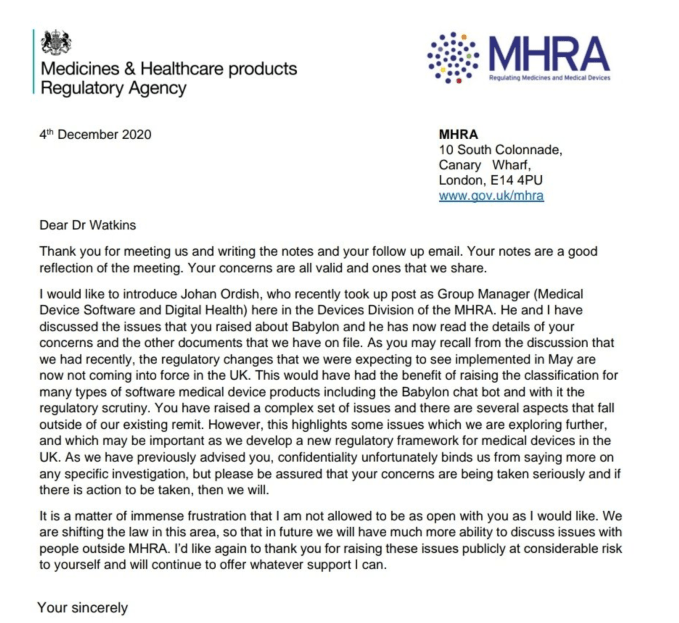
Letter from the MHRA to Dr David Watkins (Screengrab: TechCrunch)

Babylon has been contacted for a response to the MHRA’s validation of Watkins’ concerns. At the time of writing it had not responded to our request for comment.

The startup told the HSJ that it meets all the local requirements of regulatory bodies for the countries it operates in, adding: “Babylon is committed to upholding the highest of standards when it comes to patient safety.”

In one aforementioned aggressive incident last year, Babylon put out a press release attacking Watkins as a ‘troll’ and seeking to discredit the work he was doing to highlight safety issues with the triage performed by its chatbot.

It also claimed its technology had been “NHS validated” as a “safe service 10 times”.

It’s not clear what validation process Babylon was referring to there — and Watkins also flags and queries that claim in his correspondence with the MHRA, writing: “As far as I am aware, the Babylon chatbot has not been validated — in which case, their press release is misleading.”

The MHRA’s letter, meanwhile, makes it clear that the current regulatory regime in the UK for software-based medical device products does not adequately cover software-powered ‘healthtech’ devices, such as Babylon’s chatbot.

Per Watkins there is no approval process, currently. Such devices are merely registered with the MHRA — but there’s no legal requirement that the regulator assess them or even receive documentation related to their development. He says they exist independently — with the MHRA holding a register.

“You have raised a complex set of issues and there are several aspects that fall outside of our existing remit,” the regulator concedes in the letter. “This highlights some issues which we are exploring further, and which may be important as we develop a new regulatory framework for medical devices in the UK.”

An update to pan-EU medical devices regulation — which will bring in new requirements for software-based medical devices, and had been originally intended to be implemented in the UK in May last year — will no longer take place, given the country has left the bloc.

The UK is instead in the process of formulating its own regulatory update for medical device rules. This means there’s still a gap around software-based ‘healthtech’ — which isn’t expected to be fully plugged for several years. (Although Watkins notes there have been some tweaks to the regime, such as a partial lifting of confidentiality requirements last year.)

In a speech last year, health secretary Hancock told parliament that with the government aimed to formulate a regulatory system for medical devices that is “nimble enough” to keep up with tech-fuelled developments such as health wearables and AI while “maintaining and enhancing patient safety”. It will include giving the MHRA “a new power to disclose to members of the public any safety concerns about a device”, he said then.

In the meanwhile the existing (outdated) regulatory regime appears to be continuing to tie the regulator’s hands — at least vis-a-vis what they can say in public about safety concerns. It has taken Watkins making its letter to him public to do that.

In the letter the MHRA writes that “confidentiality unfortunately binds us from saying more on any specific investigation”, although it also tells him: “Please be assured that your concerns are being taken seriously and if there is action to be taken, then we will.”

“Based on the wording of the letter, I think it was clear that they wanted to provide me with a message that we do hear you, that we understand what you’re saying, we acknowledge the concerns which you’re raised, but we are limited by what we can do,” Watkins told us.

He also said he believes the regulator has engaged with Babylon over concerns he’s raised these past three years — noting the company has made a number of changes after he had raised specific queries (such as to its T&Cs which had initially said it’s not a medial device but were subsequently withdrawn and changed to acknowledge it is; or claims it had made that the chatbot is “100% safe” which were withdrawn — after an intervention by the Advertising Standards Authority in that case).

The chatbot itself has also been tweaked to put less emphasis on the diagnosis as an outcome and more emphasis on the triage outcome, per Watkins.

“They’ve taken a piecemeal approach [to addressing safety issues with chatbot triage]. So I would flag an issue [publicly via Twitter] and they would only look at that very specific issue. Patients of that age, undertaking that exact triage assessment — ‘okay, we’ll fix that, we’ll fix that’ — and they would put in place a [specific fix]. But sadly, they never spent time addressing the broader fundamental issues within the system. Hence, safety issues would repeatedly crop up,” he said, citing examples of multiple issues with cardiac triages that he also raised with the regulator.

For crying out loud @babylonhealth!

This dangerously flawed #ChestPain algorithm has been flagged to you on countless occasions.

You really don’t care, do you…

Another; 59yr old 20/day smoker with Sudden onset Chest Pain & Nausea suffers #DeathByChatbot pic.twitter.com/ton5VPxP1U

— Dr Murphy (aka David Watkins) (@DrMurphy11) August 16, 2019

“When I spoke to the people who work at Babylon they used to have to do these hard fixes… All they’d have to do is just kind of ‘dumb it down’ a bit. So, for example, for anyone with chest pain it would immediately say go to A&E. They would take away any thought process to it,” he added. (It also of course risks wasting healthcare resources — as he also points out in remarks to the regulators.)

“That’s how they over time got around these issues. But it highlights the challenges and difficulties in developing these tools. It’s not easy. And if you try and do it quickly and don’t give it enough attention then you just end up with something which is useless.”

Watkins also suspects the MHRA has been involved in getting Babylon to remove certain pieces of hyperbolic promotional material related to the 2018 AI event from its website.

In one curious episode, also related to the 2018 event, Babylon’s CEO demoed an AI-powered interface that appeared to show real-time transcription of a patient’s words combined with an ’emotion-scanning’ AI — which he said scanned facial expressions in real-time to generate an assessment of how the person was feeling — with Parsa going on to tell the audience: “That’s what we’ve done. That’s what we’ve built. None of this is for show. All of this will be either in the market or already in the market.”

However neither feature has actually been brought to market by Babylon as yet. Asked about this last month, the startup told TechCrunch: “The emotion detection functionality, seen in old versions of our clinical portal demo, was developed and built by Babylon‘s AI team. Babylon conducts extensive user testing, which is why our technology is continually evolving to meet the needs of our patients and clinicians. After undergoing pre-market user-testing with our clinicians, we prioritised other AI-driven features in our clinical portal over the emotion recognition function, with a focus on improving the operational aspects of our service.”

“I certainly found [the MHRA’s letter] very reassuring and I strongly suspect that the MHRA have been engaging with Babylon to address concerns which have been identified over the past three year period,” Watkins also told us today. “The MHRA don’t appear to have been ignoring the issues but Babylon simply deny any problems and can sit behind the confidentiality clauses.”

In a statement on the current regulatory situation for software-based medical devices in the UK, the MHRA told us:

The MHRA ensures that manufacturers of medical devices comply with the Medical Devices Regulations 2002 (as amended). Please refer to existing guidance.

The Medicines and Medical Devices Act 2021 provides the foundation for a new improved regulatory framework that is currently being developed. It will consider all aspects of medical device regulation, including the risk classification rules that apply to Software as a Medical Device (SaMD).

The UK will continue to recognise CE marked devices until 1 July 2023. After this time, requirements for the UKCA Mark must be met. This will include the revised requirements of the new framework that is currently being developed.

The Medicines and Medical Devices Act 2021 allows the MHRA to undertake its regulatory activities with a greater level of transparency and share information where that is in the interests of patient safety.

The regulator declined to be interviewed or response to questions about the concerns it says in the letter to Watkins that it shares about Babylon — telling us: “The MHRA investigates all concerns but does not comment on individual cases.”

“Patient safety is paramount and we will always investigate where there are concerns about safety, including discussing those concerns with individuals that report them,” it added.

Watkins raised one more salient point on the issue of patient safety for ‘cutting edge’ tech tools — asking where is the “real life clinical data”? So far, he says the studies patients have to go on are limited assessments — often made by the chatbot makers themselves.

“It’s one quite telling thing about this sector is the fact that there’s very little real life data out there,” he said. “These chatbots have been around for a good few years now… And there’s been enough time to get real life clinical data and yet it hasn’t appeared and you just wonder if, is that because in the real-life setting they are actually not quite as useful as we think they are?”


News: Dan Siroker’s new startup Scribe automates Zoom note-taking

Optimizely co-founder Dan Siroker said the idea for his new startup Scribe goes back to a couple of personal experiences — and although Scribe’s first product is focused on Zoom, those experiences weren’t Zoom-related at all. Instead, Siroker recalled starting to go deaf and then having an “epiphany” the first time he put in a

Optimizely co-founder Dan Siroker said the idea for his new startup Scribe goes back to a couple of personal experiences — and although Scribe’s first product is focused on Zoom, those experiences weren’t Zoom-related at all.

Instead, Siroker recalled starting to go deaf and then having an “epiphany” the first time he put in a hearing aid, as he recovered a sense he thought he’d lost.

“That really was the spark that got me thinking about other opportunities to augment things your body naturally fails at,” he said.

Siroker added that memory was an obvious candidate, particularly since he also has aphantasia — the inability to visualize mental images, which made it “hard to remember certain things.”

It may jog your own memory if I note that Siroker founded Optimizely with Pete Koomen in 2010, then stepped down from the CEO role in 2017, with the testing and personalization startup acquired by Episerver last year. (And now Episerver itself is rebranding as Optimizely.)

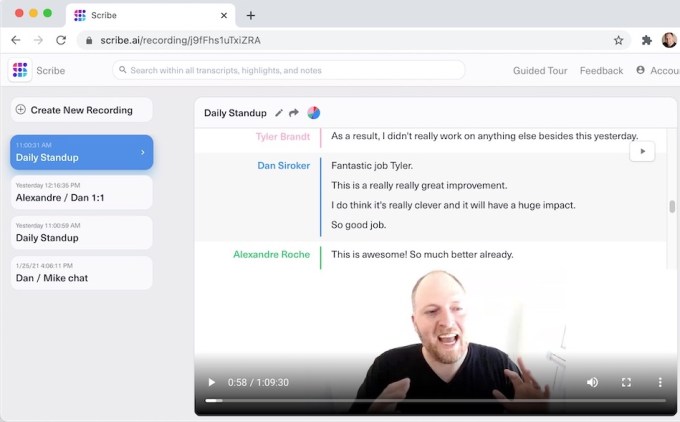
Fast forward to the present day and Siroker is now CEO at Scribe, which is taking signups for its first product. That product integrates into Zoom meetings and transforms them into searchable, shareable transcripts.

Siroker demonstrated it for me during our Zoom call. Scribe appears in the meeting as an additional participant, recording video and video while creating a real-time transcript. During or after the meeting, users can edit the transcript, watch or listen to the associated moment in the recording and highlight important points.

From a technological perspective, none of this feels like a huge breakthrough, but I was impressed by the seamlessness of the experience — just by adding an additional participant, I had a full recording and searchable transcript of our conversation that I could consult later, including while I was writing of this story.

Scribe screenshot

Image Credits: Scribe

Although Scribe is recording the meeting, Siroker said he wants this to be more like a note-taking replacement than a tape recorder.

“Let’s say you and I were meeting and I came to that meeting with a pen and paper and I’m writing down what you’re saying,” he said. “That’s totally socially acceptable — in some ways, it’s flattering … If instead, I brought a tape recorder and plopped in front of you and hit record — you might actually have this experience — with some folks, that feels very different.”

The key, he argued, is that Scribe recordings and transcripts can be edited, and you can also turn individual components on and off at any time.

“This is not a permanent record,” he said. “This is a shared artifact that we all create as we have a meeting that — just like a Google Doc — you can go back and make changes.”

Scribe screenshot

Image Credits: Scribe

That said, it’s still possible that Scribe could record some embarrassing comments, and the recordings could eventually get meeting participants in trouble. (After all, leaked company meeting recordings have already prompted a number of news stories.) Siroker said he hopes that’s “not common,” but he also argued that it could create an increased sense of transparency and accountability if it happens occasionally.

Scribe has raised around $5 million in funding, across a round led by OpenAI CEO Sam Altman and another led by First Round Capital.

Siroker told me he sees Zoom as just the “beachhead” for Scribe’s ambitions. Next up, the company will be adding support for products like Google Meet and Microsoft Teams. Eventually, he hopes to build a new “hive mind” for organizations, where everyone is “smarter and better” because so many of their conversations and knowledge are now searchable.

“Where we go after that really depends on where we think we can have the biggest positive impact on people’s lives,” he said. “It’s harder to make a case for personal conversations you have with a spouse but … I think if you if you strike the right balance between value and privacy and control, you could really get people to adopt this in a way that actually is a win-win.”

And if Scribe actually achieves its mission of helping us to record and recall a information in a wide variety of contexts, could that have an impact on our natural ability to remember things?

“Yes is the answer, and I think that’s okay,” he responded. “Your brain has limited energy … Remembering the things somebody said a few weeks ago is something a computer can do amazingly. Why waste your precious brain cycles doing that?”

News: How Rani Therapeutics’ robotic pill could change subcutaneous injection treament

A new auto-injecting pill might soon become a replacement for subcutaneous injection treatments. The idea for this so-called robotic pill came out of a research project around eight years ago from InCube Labs—a life sciences lab operated by Rani Therapeutics Chairman and CEO Mir Imran, who has degrees in electrical and biomedical engineering from Rutgers

A new auto-injecting pill might soon become a replacement for subcutaneous injection treatments.

The idea for this so-called robotic pill came out of a research project around eight years ago from InCube Labs—a life sciences lab operated by Rani Therapeutics Chairman and CEO Mir Imran, who has degrees in electrical and biomedical engineering from Rutgers University. A prominent figure in life sciences innovation, Imran has founded over 20 medical device companies and helped develop the world’s first implantable cardiac defibrillator.

In working on the technology behind San Jose-based Rani Therapeutics, Imran and his team wanted to find a way to relieve some of the painful side effects of subcutaneous (or under-the-skin) injections, while also improving the treatment’s efficacy. “The technology itself started with a very simple thesis,” said Imran in an interview. “We thought, why can’t we create a pill that contains a biologic drug that you swallow, and once it gets to the intestine, it transforms itself and delivers a pain-free injection?”

Rani Therapeutics’ approach is based on inherent properties of the gastrointestinal tract. An injecting mechanism in their pill is surrounded by a pH-sensitive coating that dissolves as the capsule moves from a patient’s stomach to the small intestine. This helps ensure that the pill starts injecting the medicine in the right place at the right time. Once there, the reactants mix and produce carbon dioxide, which in turn inflates a small balloon that helps create a pressure difference to help inject the drug-loaded needles into the intestinal wall. “So it’s a really well-timed cascade of events that results in the delivery of this needle,” said Imran.

Despite its somewhat mechanical procedure, the pill itself contains no metal or springs, reducing the chance of an inflammatory response in the body. The needles and other components are instead made of injectable-grade polymers, that Imran said has been used in other medical devices as well. Delivering the injections to the upper part of the small intestine also carries little risk of infection, as the prevalence of stomach acid and bile from the liver prevent bacteria from readily growing there.

One of Imran’s priorities for the pill was to eliminate the painful side effects of subcutaneous injections. “It wouldn’t make sense to replace them with another painful injection,” he said. “But biology was on our side, because your intestines don’t have the kind of pain sensors your skin does.” What’s more, administering the injection into the highly vascularized wall of the small intestine actually allows the treatment to work more efficiently than when applied through subcutaneous injection, which typically deposits the treatment into fatty tissue.

Imran and his team have plans to use the pill for a variety of indications, including the growth hormone disorder acromegaly, diabetes, and osteoporosis. In January 2020, their acromegaly treatment, Octreotide, demonstrated both safety and sustained bioavailability in primary clinical trials. They hope to pursue future clinical trials for other indications, but chose to prioritize acromegaly initially because of its well-established treatment drug but “very painful injection,” Imran said.

At the end of last year, Rani Therapeutics raised $69 million in new funding to help further develop and test their platform. “This will finance us for the next several years,” said Imran. “Our approach to the business is to make the technology very robust and manufacturable.”

News: Address cybersecurity challenges before rolling out robotic process automation

The security aspect of RPA isn’t implemented in the early stages of development — leaving organizations vulnerable to cybercriminals.

Alan Radford
Contributor

Alan Radford is regional CTO of One Identity and has a passion for helping organizations solve unique challenges in the identity and access management space.

Robotic process automation (RPA) is making a major impact across every industry. But many don’t know how common the technology is and may not realize that they are interacting with it regularly. RPA is a growing megatrend — by 2022, Gartner predicts that 90% of organizations globally will have adopted RPA and its received over $1.8 billion in investments in the past two years alone.

Due to the shift to remote work, companies across every industry have implemented some form of RPA to simplify their operations to deal with an influx of requests. For example, when major airlines were bombarded with cancellation requests at the onset of the pandemic, RPA became essential to their customer service strategy.

Throughout 2021, security teams will begin to realize the unconsidered security challenges of robotic process automation.

According to Forrester, one major airline had over 120,000 cancellations during the first few weeks of the pandemic. By utilizing RPA to handle the influx of cancellations, the airline was able to simplify its refund process and assist customers in a timely matter.

Delivering this type of streamlined cancellation process with such high demand would have been extremely challenging, if not impossible, without RPA technology.

The multitude of other RPA use cases that have popped up since COVID-19 have made it evident that RPA isn’t going away anytime soon. In fact, interest in the usage of RPA is at an unprecedented high. Gartner inquiries related to RPA increased over 1,000% during 2020 as companies continue to invest.

However, there’s one big issue that’s commonly overlooked when it comes to RPA — security. Like we’ve seen with other innovations, the security aspect of RPA isn’t implemented in the early stages of development — leaving organizations vulnerable to cybercriminals.

If the security vulnerabilities of RPA aren’t addressed quickly, there will be a string of significant RPA breaches in 2021. However, by realizing that these new “digital coworkers” have identities of their own, companies can secure RPA before they make the headlines as the latest major breach.

Understanding RPA’s digital identity

With RPA, digital workers are created to take over repetitive manual tasks that have been traditionally performed by humans. Their interaction directly with business applications mimics the way humans use credentials and privilege — ultimately giving the robot an identity of its own. An identity that is created and operates much faster than any human identity but doesn’t eat, sleep, take holidays, go on strike or even get paid.

News: Eco raises $26M in a16z-led round to scale its digital cryptocurrency platform

‍Eco, which has built out a digital global cryptocurrency platform, announced Friday that it has raised $26 million in a funding round led by a16z Crypto. Founded in 2018, the SF-based startup’s platform is designed to be used as a payment tool around the world for daily-use transactions. The company emphasizes that it’s “not a

‍Eco, which has built out a digital global cryptocurrency platform, announced Friday that it has raised $26 million in a funding round led by a16z Crypto.

Founded in 2018, the SF-based startup’s platform is designed to be used as a payment tool around the world for daily-use transactions. The company emphasizes that it’s “not a bank, checking account, or credit card.”

“We’re building something better than all of those combined,” it said in a blog post. The company’s mission has also been described as an effort to use cryptocurrency as a way “to marry savings and spending,” according to this CoinList article.

Eco users can earn up to 5% annually on their deposits and get 5% cashback on when transacting with merchants such as Amazon, Uber, and others. Next up: the company says it will give its users the ability to pay bills, pay friends and more “all from the same, single wallet.” That same wallet, it says, rewards people every time they spend or save.

After a “successful” alpha test with millions of dollars deposited, the company’s Eco App is now available to the public.

A slew of other VC firms participated in Eco’s latest financing, including Founders Fund, Activant Capital, Slow Ventures, Coinbase Ventures, Tribe Capital, Valor Capital Group, and more than one hundred other funds and angels.  Expa and Pantera Capital co-led the company’s $8.5 million funding round.

CoinList co-founder Andy Bromberg stepped down from his role last fall to head up Eco. The startup was originally called Beam before rebranding to Eco “thanks to involvement by founding advisor, Garrett Camp, who held the Eco brand,” according to Coindesk. Camp is an Uber co-founder and Expa is his venture fund.

For a16z Crypto, leading the round is in line with its mission.

In a blog post co-written by Katie Haun and Arianna Simpson, the firm outlined why it’s pumped about Eco and its plans.

“One of the challenges in any new industry — crypto being no exception — is building things that are not just cool for the sake of cool, but that manage to reach and delight a broad set of users,” they wrote. “Technology is at its best when it’s improving the lives of people in tangible, concrete ways…At a16z Crypto, we are constantly on the lookout for paths to get cryptocurrency into the hands of the next billion people. How do we think that will happen? By helping them achieve what they already want to do: spend, save, and make money — and by focusing users on tangible benefits, not on the underlying technology.”

Eco is not the only crypto platform offering rewards to users. Lolli gives users free bitcoin or cash when they shop at over 1,000 top stores.


Early Stage is the premier “how-to” event for startup entrepreneurs and investors. You’ll hear firsthand how some of the most successful founders and VCs build their businesses, raise money and manage their portfolios. We’ll cover every aspect of company building: Fundraising, recruiting, sales, product-market fit, PR, marketing and brand building. Each session also has audience participation built-in — there’s ample time included for audience questions and discussion.

News: Early-stage investor Mayfield shows how to scale up your biotech startup at TC Early Stage in April

Founders in the earliest stages of startup life face a hefty learning curve. Just some of the core competencies you need to lock down include how to raise VC funding, recruiting the right people, finding product-market fit and building a killer go-to-market team. The list goes on and on…and on. You’ll learn about all those

Founders in the earliest stages of startup life face a hefty learning curve. Just some of the core competencies you need to lock down include how to raise VC funding, recruiting the right people, finding product-market fit and building a killer go-to-market team. The list goes on and on…and on. You’ll learn about all those topics and more at TechCrunch Early Stage Operations & Fundraising taking place on April 1-2. 

Do you science? Are you inspired to use biology as technology? If your entrepreneurial interests lean toward the scientific side of the startup equation, you don’t want to miss this special session — brought to you by Mayfield — at TC Early Stage 2021 on April 1-2.

Scientist Entrepreneurs — Scaling Breakout Engineering Biology Companies 

Arvind Gupta and Ursheet Parikh, early-stage investors, company builders and Mayfield partners, along with Po Bronson, NYT bestselling author and managing director of IndieBio, will discuss scaling startups and touch upon three seminal areas that influence trajectory: fundraising, hiring and product design. Their insights draw on their experience with companies including ingredients-as-service leader Geltor (which raised a $91 million Series B in 2020); CRISPR platform Mammoth Biosciences (its dream team includes co-founder and Nobel Laureate Jennifer Doudna); and Endpoint Health (started by GeneWEAVE’s founding team and former YC Bio Partner Diego Rey).

Whether you’re a biotech entrepreneur, a researcher or a scientist tackling the daunting challenges of human and planetary health, this session will help you build a stronger, more successful startup as you take your product to market.

Mayfield will follow up this session with even more content at Disrupt 2021 in September. These sessions will reveal company-building insights from entrepreneurs, investors, industry leaders and policymakers. Mayfield invests in exceptional people whose mission in life is to create a better world — not just for our generation  but for future generations as well. If you science, don’t miss your opportunity to learn from leading investors who have partnered with iconic biotech and health IT entrepreneurs — from Amgen and Genentech to Mammoth Biosciences.

Get your ticket for the April TC Early Stage event here. Or get a dual-event ticket for the April and July events for double the knowledge across operations, marketing, recruiting and fundraising — and save up to $100.

Is your company interested in sponsoring or exhibiting at Early Stage 2021 — Operations & Fundraising? Contact our sponsorship sales team by filling out this form.

News: Albertsons taps Tortoise for remote-controlled grocery delivery robots

Albertsons Companies, the grocery giant that owns Safeway and Jewel-Osco, has launched a pilot program that will test grocery delivery using remote-controlled delivery robots developed by Silicon Valley startup Tortoise. The pilot will start at two Safeway locations in Northern California, although Tortoise co-founder and president Dmitry Shevelenko said if successful, he expects the pilot

Albertsons Companies, the grocery giant that owns Safeway and Jewel-Osco, has launched a pilot program that will test grocery delivery using remote-controlled delivery robots developed by Silicon Valley startup Tortoise.

The pilot will start at two Safeway locations in Northern California, although Tortoise co-founder and president Dmitry Shevelenko said if successful, he expects the pilot to continue to scale to other stores in the state and possibly throughout the West Coast.

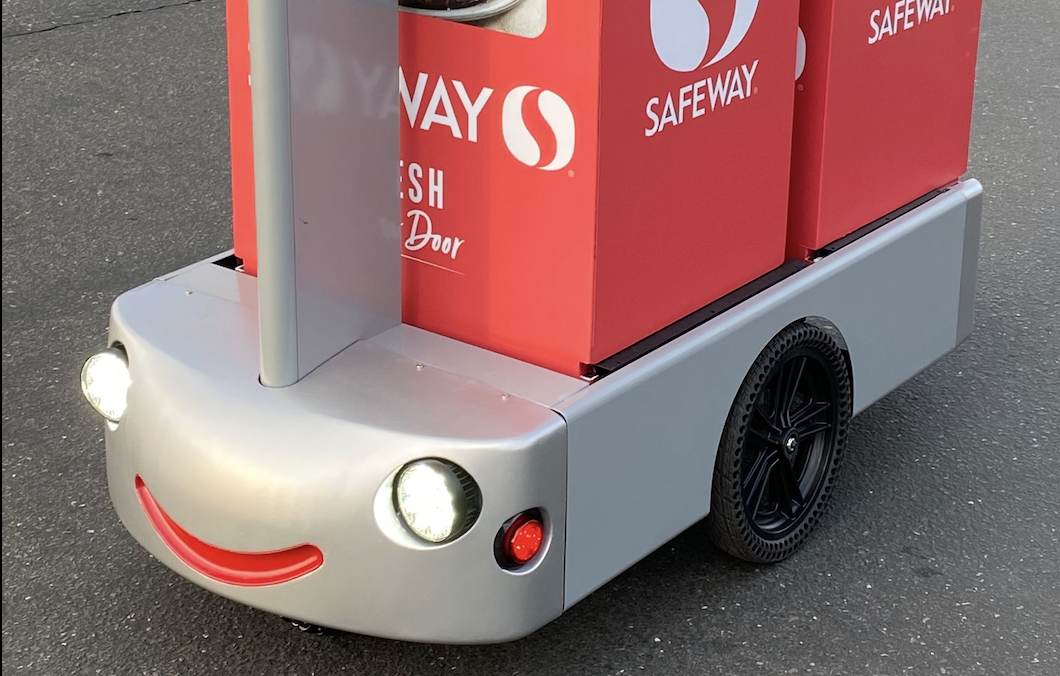
Safeway-branded delivery carts equipped with Tortoise’s sensors and software will be able to deliver goods to customers up to three miles from the store location. Remote-control operators located thousands of miles away will guide the delivery cart to its destination.

The delivery carts, which can hold up to 120 pounds of groceries in four lockable containers, will initially have a human escort. The aim is the remove the extra guide once the pilot is established. Once the delivery cart arrives, the customer receives a text to come outside and pick up their groceries. 

Safeway Tortoise

Image Credits: Tortoise/Albertsons

The pilot is the latest example of large retailers adopting technology in a bid to get goods to customers faster. Amazon, Kroger and Walmart are just a few that are experimenting with delivery robots and using autonomous vehicles to shuttle goods to customers or within its distribution network.

“Our team is obsessed with trying new and disruptive technologies that can bring more convenience for our customers,” Chris Rupp, EVP and Chief Customer and Digital Officer said in a statement. “We are willing to quickly test, learn and implement winning innovations that ensure we are offering the easiest and most convenient shopping experience in the entire industry.”

The deal is also a validation of Tortoise’s move into delivery carts, a business pursuit that it kicked off less than a year ago.

“The idea didn’t hit us until April,” Shevelenko said in a recent interview, who added that the first delivery cart was launched in Los Angeles in late October.

Tortoise got its start by equipping electric scooters with cameras, electronics and firmware that allow teleoperators in distant locales to drive electric scooters and bikes to a rider or deliver it back to its proper parking spot. Last spring, as the COVID-19 pandemic raised demand for delivery services, Tortoise adapted its technology to a cart that could shuttle groceries.

“I think about [Amazon] Prime, after that launched everyone expected 2-day delivery, and seven days felt like a lifetime.” Now, two days feels like a lifetime as expectations shift to same-day delivery, he added.

Tortoise initially focused on neighborhood stores and specialty brand shops, through a partnership with an online grocery platform. Shevelenko’s strategy is to land contracts with big retailers while continuing to partner with online commerce platforms, which would allow it to reach smaller, independent stores.

News: The technology selloff is getting to be somewhat material

Tech stocks are getting hammered today, with previously high-flying shares of software companies taking even more damage. For a sector that has enjoyed a year in the sun, recent trading sessions have punctured a period of market adoration. It is too soon to say that the market is repricing tech stocks, but the selloff has

Tech stocks are getting hammered today, with previously high-flying shares of software companies taking even more damage.

For a sector that has enjoyed a year in the sun, recent trading sessions have punctured a period of market adoration. It is too soon to say that the market is repricing tech stocks, but the selloff has reached the point of materiality and is therefore something we need to note.

As we write, the tech-heavy Nasdaq Composite is off another 1.2% today after previous declines. The now-infamous ARK Innovation ETF is off 6.5% and the list of individual declines worth noting in the tech sector is very long indeed.

The change in sentiment is clear in recent results. Here’s the tech-heavy Nasdaq Composite:

  • Nasdaq Composite recent high: 14,175.12
  • Nasdaq Composite today: 12,561.13
  • Percent change: -11.4%

And the damage intensifies if we consider just SaaS and cloud stocks. Here’s the Bessemer cloud index:

  • Bessemer cloud index recent high: 2,884.23
  • Bessemer cloud index today: 2,185.62
  • Percent change: -24.2%

In more prosaic terms, the Nasdaq is in a technical correction, while SaaS stocks have reached bear-market territory. That’s quite a turnabout from recent all-time highs for both.

Not just software

Lost on the TechCrunch editing floor from late yesterday is a post we wrote noting the sharp declines in the value of insurtech stocks ahead of the impending public debut of Hippo, another neo-insurance company. The SPAC-led Hippo flotation will not touch down in a warm market. Instead, its contemporaries look like this today:

  • Lemonade 52-week high: $188.30
  • Lemonade current price: $84.72
  • Change: -55.0%
  • Root Insurance 52-week high: $29.48
  • Root Insurance current price: $12.38
  • Change: -58.0%
  • MetroMile 52-week high: $20.39
  • MetroMile current price: $10.04
  • Change: -50.8%

The damage is widespread. Hell, recent IPO success-story Snowflake announced yesterday that it grew from revenues of $88 million in its year-ago quarter to $190 million in its most recent. And its stock is off more than 7% today.

We’ll leave it to you whether the changing public valuations are just a blip or a more staid change in the winds. But it does feel different out there.

For startups, this is all somewhat poor news. Valuations for public comps were strong in 2020. To lose that halo in 2021 could crimp late-stage valuations, perhaps even reaching back to Series A and B rounds to limit some upside for growing upstarts. But such an impact will lag the public markets, so don’t expect things to change quite yet.

Still, every private investor has their eye on the exit when it comes to their deals. And if that exit is suddenly shrinking, so too might their interest in paying for quite so great a markup on their next deal.

News: YC-backed Pangea discusses growth, fundraising ahead of demo day

Pangea, a marketplace startup that wants to connect college freelancers and companies in need of digital help, is seeing its growth rate accelerate as it races toward the impending Y Combinator demo day. It’s traditional around this time that startups in the accelerator reach out to say hello. Provided that they are willing to chat

Pangea, a marketplace startup that wants to connect college freelancers and companies in need of digital help, is seeing its growth rate accelerate as it races toward the impending Y Combinator demo day.

It’s traditional around this time that startups in the accelerator reach out to say hello. Provided that they are willing to chat growth metrics, we’re willing to listen.

Pangea, based in Providence, Rhode Island, is one such company. TechCrunch previously covered the company when it announced a $400,000 pre-seed round last April. Now most of the way through the YC accelerator, the company dished regarding its recent growth and the fact that it added more capital to its accounts late last year.

The Pangea team, from their shared house/office. Via the company.

On the growth side of the coin, Pangea CEO Adam Alpert told TechCrunch the company has grown its gross merchandise volume (GMV) sequentially by 35% in each of the last two months. That’s a steep pace of GMV expansion. And the growth is adding up to real numbers, with Pangea facilitating $50,000 in transactions between college freelancers and businesses in the last four weeks.

Alpert said that its year-ago number was around $3,000 or $4,000.

And the company has managed to expand its market take rate to around 25%, tinkering with how it charges for its service. The result is a model that might resonate with anyone familiar with Fiverr, and may help the company more rapidly expand its net revenue.

The company’s recent growth comes after it secured another $350,000 in November 2020 at a higher cap to its previously known pre-seed round. And, of course, it raised $125,000 from Y Combinator, funds that landed in its accounts this January.

Pangea is now active in 600 campuses, Alpert said. And it has found where its service is most in-demand, namely among emerging brands and smaller tech startups. Those firms often need the types of services that college kids are good at — social media, design, etc. — making them a good fit.

The company was somewhat coy on upcoming product news but was clear that it’s looking for investing partners as it works toward Series A scale. Let’s see how Pangea does in a few weeks.


Early Stage is the premier “how-to” event for startup entrepreneurs and investors. You’ll hear firsthand how some of the most successful founders and VCs build their businesses, raise money and manage their portfolios. We’ll cover every aspect of company building: Fundraising, recruiting, sales, product-market fit, PR, marketing and brand building. Each session also has audience participation built-in — there’s ample time included for audience questions and discussion.

WordPress Image Lightbox Plugin