Monthly Archives: March 2021

News: McAfee sells enterprise biz to Symphony Technology Group for $4B

Security firm McAfee announced this morning that will be selling its enterprise business to a consortium led by the private equity firm Symphony Technology Group for $4 billion. It should pair well with RSA, another enterprise-focused security company the private equity firm purchased last February for $2 billion. McAfee President and Chief Executive Officer, Peter

Security firm McAfee announced this morning that will be selling its enterprise business to a consortium led by the private equity firm Symphony Technology Group for $4 billion.

It should pair well with RSA, another enterprise-focused security company the private equity firm purchased last February for $2 billion.

McAfee President and Chief Executive Officer, Peter Leav says that his company has decided to direct the firm’s resources to the consumer side of the business. “This transaction will allow McAfee to singularly focus on our consumer business and to accelerate our strategy to be a leader in personal security for consumers,” he said in a statement.

The company has been some moves in the last year, returning to the public markets after a decade as a private company. In January, the company reportedly laid off a couple of hundred employees and shut down its software development center in Tel Aviv.

Although Symphony did not point directly to the RSA acquisition, the two investments create a large combined legacy security business for the firm, both of which have strong brand recognition, but might have lost some of their edge to more modern competitors in the marketplace.

Looking at McAfee’s latest earning’s report, Q42020, which the company reported on February 24, 2021, the consumer business grew at a much brisker rate than the enterprise side of the house. The former was up 23% YoY, while the latter grew at a far slower 5% rate.

As for the entire year, the company reported $2.9 billion in total FY2020 revenue, up 10% YoY. That broke down to $1.6 billion in consumer net revenue up 20% YoY, and $1.3 billion in enterprise net revenue, an increase of just 1% for the full year.

The company has a complex history, starting life in the 1980s selling firewall software. It eventually went public before being purchased by Intel for $7.7 billion in 2010 and going private again. In 2014, the company changed names to Intel Security before Intel sold a majority stake it to TPG in 2017 for $4.2 billion and changed the name back to McAfee.

The transaction is expected to close by the end of this year subject to regulatory oversight.

News: PayPal to acquire cryptocurrency custody startup Curv

PayPal has announced that it plans to acquire Curv, a cryptocurrency startup based in Tel Aviv, Israel. Israeli newspaper Calcalist originally reported the move. And PayPal has now made an official announcement. Curv is a cryptocurrency custody company, which means that it helps you store your crypto assets securely. The company operates a cloud-based service

PayPal has announced that it plans to acquire Curv, a cryptocurrency startup based in Tel Aviv, Israel. Israeli newspaper Calcalist originally reported the move. And PayPal has now made an official announcement.

Curv is a cryptocurrency custody company, which means that it helps you store your crypto assets securely. The company operates a cloud-based service that lets you access your crypto wallets without any hardware device.

Curv also lets you set up sophisticated policies so that the new intern cannot withdraw crypto assets without some sort of approval chain. Similarly, you can create allow lists so that regular transactions can go through more easily.

Behind the scenes, Curv uses multi-party computation to handle private keys. When you create a wallet, cryptographic secrets are generated on your device and on Curv’s servers. Whenever you’re trying to initiate a transaction, multiple secrets are used to generate a full public and private key.

Secrets are rotated regularly and you can’t do anything with just one secret. If somebody steals an unsecured laptop, a hacker cannot access crypto funds with the information stored on this device alone.

As you can see, Curv isn’t a cryptocurrency wallet for end users. The company offers its services to exchanges, brokers and over-the-counter desks. If you’re running a fund and you plan on buying a large amount of cryptocurrencies, you could also consider using Curv.

Finally, financial institutions that are looking for a solution to store digital assets and diversify their balance sheet could also work with Curv.

PayPal says that the Curv team will join the cryptocurrency group within PayPal. The payment giant has been gradually rolling out cryptocurrency products. It has partnered with Paxos so that users in the U.S. can buy, hold and sell cryptocurrencies from their PayPal account.

In the near future, PayPal also plans to let you buy and sell items using cryptocurrencies. During its most recent earnings release, the company also said that it plans to launch cryptocurrency products in other countries and in Venmo, the consumer fintech super app owned by PayPal.

Terms of the deal are undisclosed and the transaction should close at some point during the first half of 2021. Calcalist reported that PayPal was paying between $200 million and $300 million for the acquisition. A person close to the company says that the transaction was under $200 million. I guess we’ll find out what happened exactly in the next earnings release.

News: The rise of the tech workers union and what comes next

While not entirely non-existent, the union has been an elusive phenomenon in Silicon Valley. More recently, however, big names like Google and Kickstarter have taken key steps toward forming unions, as have smaller startups like Glitch, which made history this week by signing a collective bargaining agreement – the first team of software engineers to

While not entirely non-existent, the union has been an elusive phenomenon in Silicon Valley. More recently, however, big names like Google and Kickstarter have taken key steps toward forming unions, as have smaller startups like Glitch, which made history this week by signing a collective bargaining agreement – the first team of software engineers to do so. Amazon warehouse workers in Alabama, meanwhile, are currently on the cusp of forming their own historic union. In this panel from TC Sessions: Justice, we discuss how we got here, what comes next and steps tech employees can take.


On Why Now?

As has been the case with management throughout history, tech companies have long fought tooth and nail against labor organizing. Over the course of the last couple of years, however, we may have seen something of a critical mass that could represent the beginnings of a sea change for the industry.

Redwine: It seems like tech workers are reacting to some of the maturity of tech and the expansion of the platforms that we all work on, and also more worker instability in general in the US, especially. I think it’s sort of a response that workers are becoming more formal in their organizing efforts. (Timestamp: 1:08)

Parul Koul (Google):

Koul: A variety of tactics and strategies have been tried, and we’ve been able to analyze the successes and failures of past movements and arrive at a point where we’ve developed enough institutional and organizational knowledge to try something new and – in some ways – more complex. (Timestamp: 3:25)


On Whether The Pandemic Will Spur More Organizing

Covid-19 has radically transformed where – and how – we work. It’s upended many industries and cause millions to lose jobs. Could the pandemic prove to be yet another inflection point for a growing movement.

Koul: In our case, what we saw was companies moving to work from home and then, in certain categories of employees, not really receiving the same benefits […] whether it’s a stipend to buy equipment or even having the benefit from working from home […] We also saw a mass movement and social and political protests against police brutality erupt right in the middle of the pandemic. For me, and many other organizers at Google, it really galvanized us to do something and respond to that in the streets and in our own way. (Timestamp: 6:56)


On How – or if – Unions Can Protect Against Layoffs

For many industries, layoffs have become all but an inevitability during the pandemic. In a number of the aforementioned cases, they’ve continued even in the wake of employee unionizing. Ultimately, how much protection does a union give workers against layoffs?

Reckers: Kickstarter won its union on February 18, 2020. The pandemic hit in mid-March. The company announced that they were going to have pretty massive layoffs in early-April. That was a very difficult time. We looked at the numbers and did see that a number of the people they were proposing to layoff were advocates for the union or union members. That was very hard to stomach. What happens, though – and where the union comes into play – is that the company was not able to just lay people off like that. Especially under the terms that they wanted to impose unilaterally, without any consultation with staff. The difference was that when the company proposed these layoffs, because there was already a union in place, Kickstarter had to negotiate with the group of employees about the terms of that layoff. (Timestamp: 9:10)


On How to Get Started

First steps toward unionization are often difficult in an environment where organizing is frowned upon management. Many early conversations happen after hours and off-the-clock for fear of repercussion. This can be doubly difficult in an environments like white collar workers tech company, where some employees don’t tacitly understand the benefits of organizing.

Reckers: You can best support each other by getting into conversations with your coworkers and understanding what’s been going on with them. The first question I often get from people is how to first start having conversations. I think that’s a challenge, especially since we’re not taught how to do that. But starting a conversation about what their experiences have been like at the organization or company, how long they’ve been there, how has there changed? What did they want to see when they were hired? What sort of workplace were they looking for? And how can we make sure that we have some way of achieving that? (Timestamp: 24:04)


On Whether Expressions of Support From Management Are Always Positive

Management often adopts the narrative that they support unions following hard fought battles. In the wake of support from certain tech executives and political leaders like Joe Biden, the question arises about whether such sentiments can ultimately have negative repercussions for organizing.

Redwine: First and foremost, it’s really important to remember that the things that people in power say do not matter. All of the power that you have doesn’t come from people at the top giving it to you. It comes from linking arms with the people next to you and taking that power and influence for yourself. (Timestamp: 28:27)

You can read the entire transcript here.

News: Last-mile delivery robotics company Refraction AI raises $4.2M

Ann Arbor-based Refraction AI announced today that it has raised a $4.2 million seed round. The startup, which debuted on the TechCrunch Sessions: Mobility stage back in 2019, was founded by a pair of University of Michigan professors (Matthew Johnson-Roberson — now CTO — and Ram Vasudevan) seeking to solve a number of issues posed

Ann Arbor-based Refraction AI announced today that it has raised a $4.2 million seed round. The startup, which debuted on the TechCrunch Sessions: Mobility stage back in 2019, was founded by a pair of University of Michigan professors (Matthew Johnson-Roberson — now CTO — and Ram Vasudevan) seeking to solve a number of issues posed by many delivery robots.

With an initial prototype built on a bicycle foundation, the company’s REV-1 robot is designed to operate in bike lanes and roads, rather than the standard sidewalk ‘bot. The different approach allows the robot to travel at higher speeds (topping out at 15 miles per hour) and removes some of the messy pedestrian-dodging issues that come with sidewalk use (while introducing some new ones on that narrow sliver of asphalt shared by cyclists).

Refraction is currently testing a small fleet in its native Ann Arbor. The seed round, led by Pillar VC, will be used for R&D, expanding the company’s reach and recruiting more customers, with a focus on grocery store and restaurant deliveries. Other investors include, eLab Ventures, Osage Venture Partners, Trucks Venture Capital, Alumni Ventures Group, Chad Laurans and Invest Michigan.

Another key differentiator is the use of cameras, versus LIDAR. The decision comes with some technological trade-offs, but benefits include a lower price point and the ability for the company to more quickly scale its fleet. The technology is also not easily districted by weather conditions encountered in the upper midwest, though it has limitations, too. As the company puts it, if you’re not comfortable walking out in it, the robot probably won’t be, either.

“Our platform uses technology that exists today in an innovative way, to get people the things they need, when they need them, where they live,” CEO Luke Schneider said in a release tied to the news. “And we’re doing so in a way that reduces business’ costs, makes roads less congested, and eliminates carbon emissions.”

With this new funding, the company plans to expand operations beyond its native Ann Arbor, though no additional test markets have been announced.

News: Amazon expands its food delivery service across Bangalore

Amazon said on Monday it has expanded its food delivery service, called Amazon Food, across 62 zip codes in Bangalore, in what is the first public update since entering the new category in India last May. The American e-commerce group said Amazon Food now reaches key localities in Bangalore such as Whitefield, HSR, Sarjapur, Koramangala,

Amazon said on Monday it has expanded its food delivery service, called Amazon Food, across 62 zip codes in Bangalore, in what is the first public update since entering the new category in India last May.

The American e-commerce group said Amazon Food now reaches key localities in Bangalore such as Whitefield, HSR, Sarjapur, Koramangala, Indiranagar, MG Road, Jayanagar, JP Nagar, Frazer Town, Malleshwaram, Rajajinagar, and Vijayanaga.

At the time of the launch in May last year, Amazon Food was available in just four zip codes in Bangalore.

Even as Amazon Food remains limited to one key market in India, the company is aggressively trying to undercut the competition — heavily funded startups Zomato and Swiggy — in the city.

Food delivery is free to Prime members, while others have to pay a fee of 19 Indian rupees (26 cents) — cheaper than fees levied by Swiggy and Zomato.

The company, which has committed to investing $6.5 billion in its India operations, said it has amassed 2,5000 restaurants and cloud kitchens in Bangalore — also referred as Bengaluru. Amazon Food customers can enjoy “offers” from these restaurants as well as cashbacks from Amazon, the company said.

It, however, did not share why it has been uncharacteristically so slow with the expansion of Amazon Food in the country.

(Well, I mean, there is a global pandemic — but Amazon also makes a number of what its employees say “one-way door” and “two-way door” bets. Two-way door bets are those that the company has not fully committed to and is just attempting to test the waters before making a concrete decision. Think of Amazon Prime as a one-way door bet. So it’s not clear from day 1 how committed Amazon is to any new service.)

“With the expansion of Amazon Food in Bengaluru, we continue in our endeavor to offer unmatched convenience and value while being a part of their everyday lives. Amazon Food brings some of the city’s top restaurants including national outlets and as well as local favorites which are popular and follow strict delivery and safety protocols,” said Sameer Khetarpal, Director of Category Management at Amazon India, in a statement.

Ant Financial-backed Zomato and Prosus Ventures-backed Swiggy have established duopoly in the food delivery market in India, with analysts at Bank of America estimating their combined market share to be over 90%. (Uber exited the Indian food delivery market early last year after selling its local food business to Zomato.)

The expansion of Amazon Food also comes at a time when Zomato, which according to analysts leads the market, is preparing to file for an IPO.

India’s food delivery market is especially tough to crack because of local conditions. Unlike in the developed markets such as the U.S., where the value of each delivery item is about $33, in India, a similar item carries the price tag of $4, according to research firms. Both Zomato and Swiggy have significantly improved their unit economics in the past year.

News: New clinical trial data from Locus Biosciences shows promise in CRISPR-Cas3 technology

Antibiotic resistance is one of the biggest potential threats to global health today. But Locus Biosciences is hoping that their crPhage technology might provide a new solution. Based in North Carolina’s Research Triangle, the startup recently announced promising phase 1b clinical trial results for their use of CRISPR-Cas3-enhanced bacteriophages as a treatment for urinary tract

Antibiotic resistance is one of the biggest potential threats to global health today. But Locus Biosciences is hoping that their crPhage technology might provide a new solution.

Based in North Carolina’s Research Triangle, the startup recently announced promising phase 1b clinical trial results for their use of CRISPR-Cas3-enhanced bacteriophages as a treatment for urinary tract infections caused by escherichia coli. Led in part by former Patheon executive and current Locus CEO Paul Garofolo, the startup launched in 2015 with the goal of using a less popular application of CRISPR technology to address growing antimicrobial resistance.

CRISPR-Cas3 technology has notably different mechanisms from its more well-known CRISPR-Cas9 counterpart. Where the Cas9 enzyme has the ability to cleanly cut through a piece of DNA like a pair of scissors, Garofolo describes Cas3 more like a Pac-Man, shredding the DNA as it moves along a strand.

“You wouldn’t be able to use it for most of the editing platforms people were after,” he said, noting that meant there wouldn’t be as much competition around Cas3. “So I knew it would be protected for some time, and that we could keep it quiet.”

Garofolo and his team wanted to use CRISPR-Cas3 not to edit harmful bacteria found in the body, but to destroy it. To do this, they took the DNA-shredding mechanism of Cas3 and used it to enhance bacteriophages—viruses that can attack and kill different species of bacteria. Together, co-founder and Chief Scientific Officer Dave Ousterout—who has a Ph.D. in biomedical engineering from Duke—thinks this technology offers an extremely direct and targeted way of killing bacteria.

“We armed the phages with this Cas3 system that attacks E. coli, and that sort of dual mechanism of action is what comes together, essentially, as a really potent way to remove just E. coli,” he said in an interview.

That specificity is something that antibiotics lack. Rather than targeting only harmful bacteria in the body, antibiotics typically wipe out all bacteria they come across. “Every time we take antibiotics, we’re not thinking about all the other parts of us that are impacted by the bacteria that do good things,” said Garofolo. But the precision of Locus Biosciences’ crPhage technology means that only the targeted bacteria would be wiped out, leaving those necessary to the body’s normal function intact.

Beyond offering this more specific approach to treatment of pathogens, or any bacteria-based disease, Garofolo and his team also suspect that their approach will also be extremely safe. Though deadly to bacteria, bacteriophages are typically harmless to humans. The safety of CRISPR in humans is well-established, too.

“That’s our secret sauce,” said Garofolo. “We can build drugs that are more powerful than the antibiotics they’re trying to replace, and they use phage, which is probably one of the world’s safest ways to deliver something into the human body.”

While this new technology could certainly help treat pathogens and infectious diseases, Garofolo hopes that indications in immunology, oncology, and neurology might benefit from it too. “We’re starting to figure out that some bacteria might promote cancer, or inflammation in your gut,” he said. If researchers can identify the bacteria at the root cause of those conditions, Garofolo and Ousterout think the crPhage technology might prove to be an effective treatment.

“If we’re right about that, it’s not just about infections or antimicrobial resistance, but helping people overcome cancer or delay the onset of dementia,” Garofolo said. “It’s changing the way we think about how bacteria really help us live.”


Early Stage is the premier ‘how-to’ event for startup entrepreneurs and investors. You’ll hear first-hand how some of the most successful founders and VCs build their businesses, raise money and manage their portfolios. We’ll cover every aspect of company-building: Fundraising, recruiting, sales, product market fit, PR, marketing and brand building. Each session also has audience participation built-in – there’s ample time included for audience questions and discussion.

News: Egypt’s customer engagement platform for F&B brands in MENA, Koinz, raises $4.8M seed

As the restaurant industry across different cities was massively hit by the pandemic-induced lockdowns last year, food aggregator platforms helped by driving online customers to them. Koinz is one such startup in Egypt. Its value for food and beverages brands before, during and after the lockdowns has bagged the startup a $4.8 million seed round.

As the restaurant industry across different cities was massively hit by the pandemic-induced lockdowns last year, food aggregator platforms helped by driving online customers to them.

Koinz is one such startup in Egypt. Its value for food and beverages brands before, during and after the lockdowns has bagged the startup a $4.8 million seed round.

Founded in 2018 by Hussein Momtaz, Ahmed Said, and Abdullah Al Khalidi, Koinz set out to solve two major problems in Egypt’s food aggregation industry.

The offline and online food and restaurant experience in the country are totally separate. Most food aggregators who deal with delivery tend to focus on the online customer, and there’s no sophisticated experience for the offline customer.

Next, the unit economics of the food aggregation industry is quite challenging. According to Momtaz, the startup’s CEO, the food aggregation industry usually takes about 25%-30% average commission from F&B players for business to start to make sense.

“This is not because they want to squeeze money from the hands of restaurants or brands,” Momtaz said to TechCrunch. “But the cost of acquiring customers and retaining them for the food aggregator itself is very high; that’s why they need very high commissions from the brands or restaurants.”

This is where Koinz comes in. The company developed a mobile app for takeout and delivery orders that manages offline customer experiences while delivering an engagement platform to manage loyalty programs, customer feedback and analytics about the online and offline customer base.

Abdullah Al Khalidi (CRO), Hussein Momtaz (CEO), and Ahmed Said (CTO)

Online food experience for Koinz customers is like a treasure hunt, and Momtaz claims the company’s business model has cracked the industry’s unit economics. This, alongside providing brands with insights, differentiates the platform from other aggregators and makes its customer acquisition cost and retention cost 60% less than most of them.

Here’s how the platform works. When customers visit a brand using for the first time, they collect their phone numbers and store them in the application. The customers, on the other hand, get points for making orders via text message. After various restaurant visits and making orders, they accumulate enough points. They’ll need to download the Koinz mobile application to redeem them, thereby converting these offline customers to online ones.

Furthermore, these offline customers can now discover new places to eat, read and leave reviews, and order delivery or takeout.

“None of the small or big brands in the region had something like this before. The offline customer is like a ghost. He walks into the brands, takes his orders, and leaves without the brands knowing anything about him. Koinz is changing that,” the CEO remarked.

Building its platform this way, Koinz tries to be different from other online aggregators that erode restaurant owners’ profit margins while delivering limited customer access and interaction. How? By collecting real-time data and leveraging a digital rewarding system designed to drive customers to deepen their relationship with restaurants.

Image Credits: Koinz

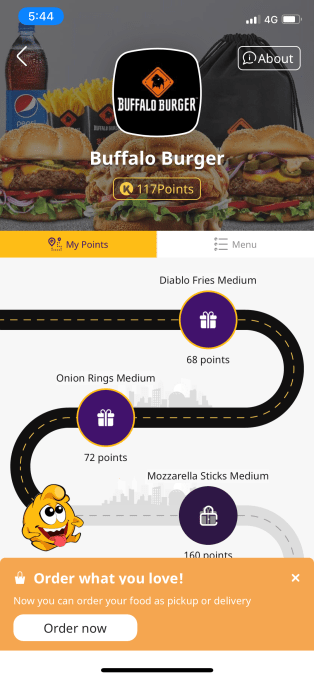
Brands can configure their gifts lists and determine what customers can redeem their points for. For instance, customers in an Egyptian restaurant called Buffalo Burger can exchange 68 points for a Diablo Fries Medium; or wait till they get to 160 points to get a Mozzarella Sticks Medium; or 236 points for a Double Diggler.

Similarly, every brand has its own configuration. A customer cannot get points in Buffalo Burger and redeem them at Hamburgini. Koinz charges subscriptions to the brands for its engagement and feedback platform and collects commission whenever an order is made via its platform, which varies across its markets.

Because of its original business model, Koinz had to iterate several times. Before using phone numbers to collect customers’ information, the company used QR codes and NFC tags. Momtaz says this was highly ineffective, and the move to phone numbers helped skyrocket its growth and value.

The six-man team back in 2018 is now 80, and the platform, which is basically powering the growth of restaurants in the Middle East, claims to have had up to 4 million consumers earn points on its platform. These consumers have redeemed almost 300,000 rewards, while almost 800,000 customers have left reviews.

Since launching in Egypt, Koinz has expanded to Saudi Arabia and the UAE. Like Egypt, these markets have similar dynamics and demographics. They have also witnessed one of the highest rates of new or increased users in online deliveries — restaurant products and groceries — during the pandemic.

Besides, consumers in the Middle East are outpacing the global appetite in food delivery, with 64% ordering in at least once a week compared to 40% made by global consumers. And with the fast-food industry in MENA was estimated at nearly $31 billion in 2020 and is expected to reach nearly $60 billion by 2025, there’s so much room for Koinz to grow in the region. Momtaz says the company is also considering a move to Sub-Saharan Africa in the nearest future despite them having distinct demographics.

Entrepreneur and investor Justin Mateen led this seed round. Since leaving Tinder in 2014, Mateen has been an active investor in early-stage companies. Koinz is his first investment in the MENA region. According to him, Koinz’s ability to allow food and beverages brands to understand their customers’ needs and simultaneously increase their profit margins was one of the reasons he invested in the Egyptian-based startup.

“The company’s unique business model will continue to scale as the food delivery space evolves. Hussein’s drive and excitement for what the team is building are what convinced me to lead a round in the Middle East for the first time,” Mateen added.

African-focused VC 4DX Ventures and strategic angel investors from Egypt, Turkey and Saudi Arabia participated as well.

Peter Orth, co-founder and managing director of the firm, said of the investment that with restaurants in the region suffering under the traditional aggregator model, especially during the pandemic, Koinz has quickly become a win-win for both consumers and restaurant owners across the Middle East.

As the three-year-old company plans to use the capital to hire more talent and fuel its expansion across the Middle East, Mateen and Orth will join its board of directors.


Early Stage is the premier ‘how-to’ event for startup entrepreneurs and investors. You’ll hear first-hand how some of the most successful founders and VCs build their businesses, raise money and manage their portfolios. We’ll cover every aspect of company-building: Fundraising, recruiting, sales, product market fit, PR, marketing and brand building. Each session also has audience participation built-in – there’s ample time included for audience questions and discussion.

News: The Station: Another Uber spinout is born and EVs dominate SPACs

The Station is a weekly newsletter dedicated to all things transportation. Sign up here — just click The Station — to receive it every weekend in your inbox.  Hi friends and new readers, welcome back to The Station, a newsletter dedicated to all the present and future ways people and packages move from Point A to

The Station is a weekly newsletter dedicated to all things transportation. Sign up here — just click The Station — to receive it every weekend in your inbox

Hi friends and new readers, welcome back to The Station, a newsletter dedicated to all the present and future ways people and packages move from Point A to Point B.

Our transportation desk is taking shape. Two new reporters, Aria Alamalhodaei and Rebecca Bellan started Monday and have already provided some new and interesting coverage. Tamara Warren, a former editor at the Verge who has been writing about automotive and tech for two decades, reviewed the Aston Martin DBX. This week, Abigail Basset, a World Car Juror former CNN producer who writes about cars, tech, business — pretty much everything — break down the new VW ID. 4.

We’re just getting started. Vamos.

Please help welcome them and follow them on Twitter and maybe even drop them a DM. You can find them @RebeccaBellan and Aria over @breadfrom.

Micromobbin’

the station scooter1a

Scooter clutter has prompted a number of entrepreneurs to start companies, all aiming to solve the problem. Tortoise has its repositioning software, companies like Swiftmile offer docking stations that also charge scooters.

But what about a solution that works across brands? Paris aims to find out.

The city is testing universal charging infrastructure for electric scooters in a pilot project that will kick off in the second quarter of this year. DUCKT, which was awarded the pilot, will install 150 dock and charge points that can be plugged into bus stations and street lighting to provide the power source.

DUCKT was one of 15 companies that were named Urban Innovation District winners. Each winner is testing a different urban project in the 13th arrondissement. The competition, which is run by Paris & Co.’s urban innovation lab, includes pilots focused on food waste, rainwater collection, revegetation and waterproofing as well as several mobility projects. Ezymob will test a mobile app that helps visually impaired people navigate public transit, Mobilypod is launching a subscription-based cargo bike service and bike shelters and the LaCroix Lab is piloting 4SafeMobilities, a system designed to streamline traffic at intersections and pedestrian crossings.


Meanwhile, Porsche is taking its electrification ambitions to two wheels. The German automaker unveiled this week two electric bikes alongside the global debut of the Porsche Taycan Cross Turismo, the latest variant to its EV flagship. These bikes cost between $8,000 and more than $10,000 — prices one might expect from the luxury performance brand.

Deal of the week

money the station

Forget the “deal of the week.” How about we take a stroll down memory lane and look at all the deals of 2020? CB Insights, released March 3 its State of Mobility report that looks at 2020 investment data and trends surrounding all things transportation.

The upshot: The COVID-19 pandemic did help push total funding down 5% year-over-year to $27.19 billion, although CB Insights saw recovery in the second half of the year. There were 522 deals, a 21% drop from the previous year.

Total funding only tells part of the story though. If 2020 will be known for anything — aside from the whole global pandemic thing — it’ll be for the incredible number of SPAC deals across auto and mobility. There were 107 exits last year with 22 of them from startups going public via a merger with a special purpose acquisition, or “blank check” company. Having trouble gauging if that’s a big deal? Here’s some help: there were five auto and mobility SPACs between 2015 and 2019. Five. Electric vehicle companies and those with technology that supports EVs made up 68% of those SPAC deals in 2020.

The SPAC spree isn’t stopping either with Joby Aviation, Hellbiz and Otonomo are just a few that have reached merger agreements and will go public in 2021.

Electric vehicle tech and autonomous vehicle tech both reached peaks in 2020. EV tech companies raised $12.8 billion across 193 deals, while AVs brought in $7.3 billion across 105 deals, according to CB Insights. It’s worth noting that the AV industry appears to be maturing — at least in a funding perspective — with the average deal size rising 16.8% from the previous year to $104 million.

Connected car tech and auto commerce both saw dips in funding last year. For the second straight year, connected car tech saw a drop in funding and total number of deals. Funding plummeted 52% to $1 billion in 2020 compared to the previous year. CB Insights said the drop is because connectivity solutions have been widely adopted and investors have shifted their attention and money to other areas of auto tech such as electrification and autonomy.

Perhaps to no one’s surprise, bike and scooter companies saw funding rise 52% year-over-year to $2.4 billion in 2020. That’s still below funding seen in those heady days of 2017 and 2018 when scooters won over the hearts and minds of investors. Scooter and bike companies raked in $3.2 billion in 2017 and $4.9 billion in 2018.

And finally, funding to shared mobility companies (MaaS) fell 20% in 2020 to $6.3 billion across 116 deals.

Other deals that got my attention …

Aero, a startup backed by Garrett Camp’s startup studio Expa, raised $20 million in Series A funding round led by Keyframe Capital, with Keyframe’s chief investment officer John Rapaport joining the Aero board. Cyrus Capital Partners and Expa also participated.

Boom Supersonic, the aerospace startup building supersonic jets, landed a strategic investment from American Express Ventures. The funds will be used for the development of the company’s flagship product, the supersonic airliner Overture.

Fluid Truck,  a Denver-based app-based platform that lets users make short-term rentals of commercial vehicles, raised $63 million in a Series A funding round. The truck sharing platform is aimed at mid-mile and last-mile delivery companies, which use it to remotely manage an on-demand rental fleet via web or mobile app. Private equity firm Bison Capital led the round, with participation from Ingka Investments (part of Ingka Group, the main Ikea retailer), Sumitomo Corporation of Americas and Fluid Vehicle Owners.

Instacart, the n-demand grocery delivery platform, raised $265 million in funding from existing investors Andreessen Horowitz, Sequoia Capital, D1 Capital Partners and others. The new funding pushed the company’s valuation to $39 billion — more than double its $17.7 billion valuation when it raised $200 million just six months ago.

As TechCrunch’s Darrell Etherington writes: What’s behind the massive increase in the value investors are willing to ascribe to the business? Put simply, the pandemic. Last year, Instacart announced three separate raises, including a $225 million round in June, followed by a $100 million round in July. The rapid sequence of venture capital injections were likely designed to fuel growth as demand for grocery delivery services surged while people attempted to quarantine or generally spend less time frequenting high-traffic social environments like grocery stores.

Loggi Tecnologia, the Brazilian delivery company backed by SoftBank and Microsoft Corp., raised 1.15 billion reais ($205 million) in a round led by CapSur Capital, Bloomberg reported. The company is now valued close to $2 billion.

Rollick, the online powersports, RV and boat buying marketplace, raised $8.5 million in a funding round that included investors Sandbox Insurtech Ventures, TechNexus Venture Collaborative, Dallas Venture Capital, Alumni Ventures, and London Technology Club. Existing investors LiveOak Venture Partners, Silverton Partners, Autotech Ventures, ManchesterStory, Anthem Venture Partners and Capital Factory also participated.

Volocopter, a startup out of southern Germany that has been building and testing electric VTOL (vertical take-off and landing) aircraft, raised €200 million (about $241 million) in a Series D round of funding. New investors include funds managed by BlackRock, global infrastructure company Atlantia SpA., Avala Capital; Tier 1 supplier Continental AG, Japan’s NTT via its venture capital arm, Tokyo Century and multiple family offices.. Volocopter also said that all of its existing investors — a list that includes Geely, Daimler, DB Schenker, Intel Capital, btov Partners, Team Europe and Klocke Holding and more — also contributed to the round.

Alongside its aircraft, Volocopter has also been building a business case in which its vessels will be used in a taxi-style fleet in urban areas. CEO Florian Reuter told TechCrunch editor Ingrid Lunden that live services are now two years out for the two vehicle models it has been developing.

Policy salmagundi

the station electric vehicles1

Policy: it’s what for dinner.

I’m trying out a new, semi-regular section in the newsletter that will cover notable legislative activity around electric vehicles, autonomous vehicles, public transit and personal mobility.

This week, let’s head on over to California, where State Sen. Dave Min introduced a bill that would require all autonomous vehicles to also be zero emission by 2025. The bill was sponsored by the Union of Concerned Scientists, a group says it doesn’t want to see future means of transportation married to the technology of the past. Proponents point out the potential for AVs to either help or hurt attempts to cut emissions.

While the amendment is in line with the state’s goals to reduce emissions, it also adds a wrinkle to the plans of any AV developer that doesn’t currently use electric vehicles. Cruise and Zoox, for instance, only use electric vehicles. AV giant Waymo and numerous others use a mix of vehicles, notably the Chrysler Pacifica Hybrid minivan.

As Rebecca Bellan notes in her article, this proposed bill is in its infancy stages, so there are plenty of opportunities for it to be quashed.

The responses from the industry offered up the kind of political neutrality that aims to placate everyone. My interpretation of the various comments and statements — both on record and more informal on background chatter — is that work will soon begin to modify the language of the proposed bill to be more accommodating to the industry while hanging onto its original intent. That might mean pushing the deadline, adding hybrids and creating an exception for long-haul trucks.


Meanwhile, over in the land of passenger electric vehicles, work is underway to pass laws that would allow direct sales in at least eight states. Passage of such legislation would clear the way for EV giants like Tesla, along with newcomers Lucid and Rivian, which have yet to bring a vehicle to market, to sell directly to consumers.

Tesla, Rivian and other EV entrants are working together to pass these laws. Industry alliances are not unheard of on issues in which all the parties stand to benefit. Tesla’s cooperation is notable because it would end its monopoly on direct sales in some states.

Notable reads and other tidbits

the-station-delivery

Here are a few other stories that are worth sharing.

Aston Martin CEO Tobias Moers’ interview with Automotive News Europe is a complementary side dish to Tamara Warren’s review of the DBX.

Postmates X, the robotics division of the on-demand delivery startup that Uber acquired last year for $2.65 billion, has officially spun out as an independent company called Serve Robotics. (Y’all might recall I previously reported that a deal was being shopped to investors.)

Serve Robotics raised seed funding in a round led by venture capital firm Neo. Other investors included Uber as well as Lee Jacobs and Cyan Banister’s Long Journey Ventures, Western Technology Investment, Scott Banister, Farhad Mohit and Postmates co-founders Bastian Lehmann and Sean Plaice.

Tesla is closing its forums and launching a new social media platform called the Tesla Engagement Platform. The move has raised the ire of a community of its most ardent supporters.

Tortoise landed another deal, this time with Albertsons Companies, the grocery giant that owns Safeway and Jewel-Osco. Albertson said it has launched a pilot program that will test grocery delivery using remote-controlled delivery robots developed Tortoise. The pilot will start at two Safeway locations in Northern California, although Tortoise co-founder and president Dmitry Shevelenko said if successful, he expects the pilot to continue to scale to other stores in the state and possibly throughout the West Coast.

Toyota Motor said it plans to sell 500 billion yen ($4.7 billion) in “Woven Planet Bonds” to fund a variety of renewable energy and transportation projects, including  assisted mobility vehicles, and increased use of 

Volkswagen said it plans to launch an electric sedan in 2026. The company said that the vehicle, dubbed Project Trinity, will set “new standards” with its charging speed, battery range, and in other technology, Car and Driver reported.

Volvo Cars said it will only make and sell all-electric vehicles by 2030 as part of a broader transformation of the automaker that will include shifting sales online. The announcement was tied to the launch of the C40 Recharge, a low-slung crossover based on the company’s CMA vehicle platform.


News: Swiss maker of meat alternatives Planted will expand and diversify with $18M Series A

Planted, a startup pursuing a unique method of creating a vegetarian chicken alternative, has raised an $18M (CHF 17M) Series A to expand its product offerings and international footprint. With new kebabs and pulled-style faux meats available and steak-like cuts in the (literal) pipeline, Planted has begun to set its sights outside central Europe. The

Planted, a startup pursuing a unique method of creating a vegetarian chicken alternative, has raised an $18M (CHF 17M) Series A to expand its product offerings and international footprint. With new kebabs and pulled-style faux meats available and steak-like cuts in the (literal) pipeline, Planted has begun to set its sights outside central Europe.

The company was a spinout from ETH Zurich and made its debut in 2019, but has not rested on the success of its plain chicken recipe. Its approach, which relied on using pea protein and pea fiber extruded to recreate the fibrous structure of chicken for nearly 1:1 replacement in recipes, has proven to be adaptable for different styles and ingredients as well.

“We aim to use different proteins, so that there is diversity, both in terms of agriculture and dietary aspects,” said co-founder Christoph Jenny.

A woman bites into a artificial pulled pork sandwich.

Image Credits: Planted

“For example our newly launched planted.pulled consists of sunflower, oat and yellow pea proteins, changing both structure and taste to resemble pulled pork rather than chicken. The great thing about the sunflower proteins, they are upcycled from sunflower oil production. Hence, we are establishing a circular economy approach.”

When I first wrote about Planted, its products were only being distributed through a handful of restaurants and grocery stores. Now the company has a presence in more than 3,000 retail locations across Switzerland, Germany, and Austria, and works with restaurant and food service partners as well. No doubt this strong organic (so to speak) growth, and the growth of the meat alternative market in general, made raising money less of a chore.

The cash will be directed, as you might expect for a company at this stage, towards R&D and further expansion.

“The funding will be used to expand our tech stack, to commercialize our prime cuts that are currently produced at lab scale,” said Jenny. “On the manufacturing side we look to significantly increase our current capacity of half a ton per hour to serve the increasing demand coming from international markets, first in neighboring countries and then further into Europe and overseas.”

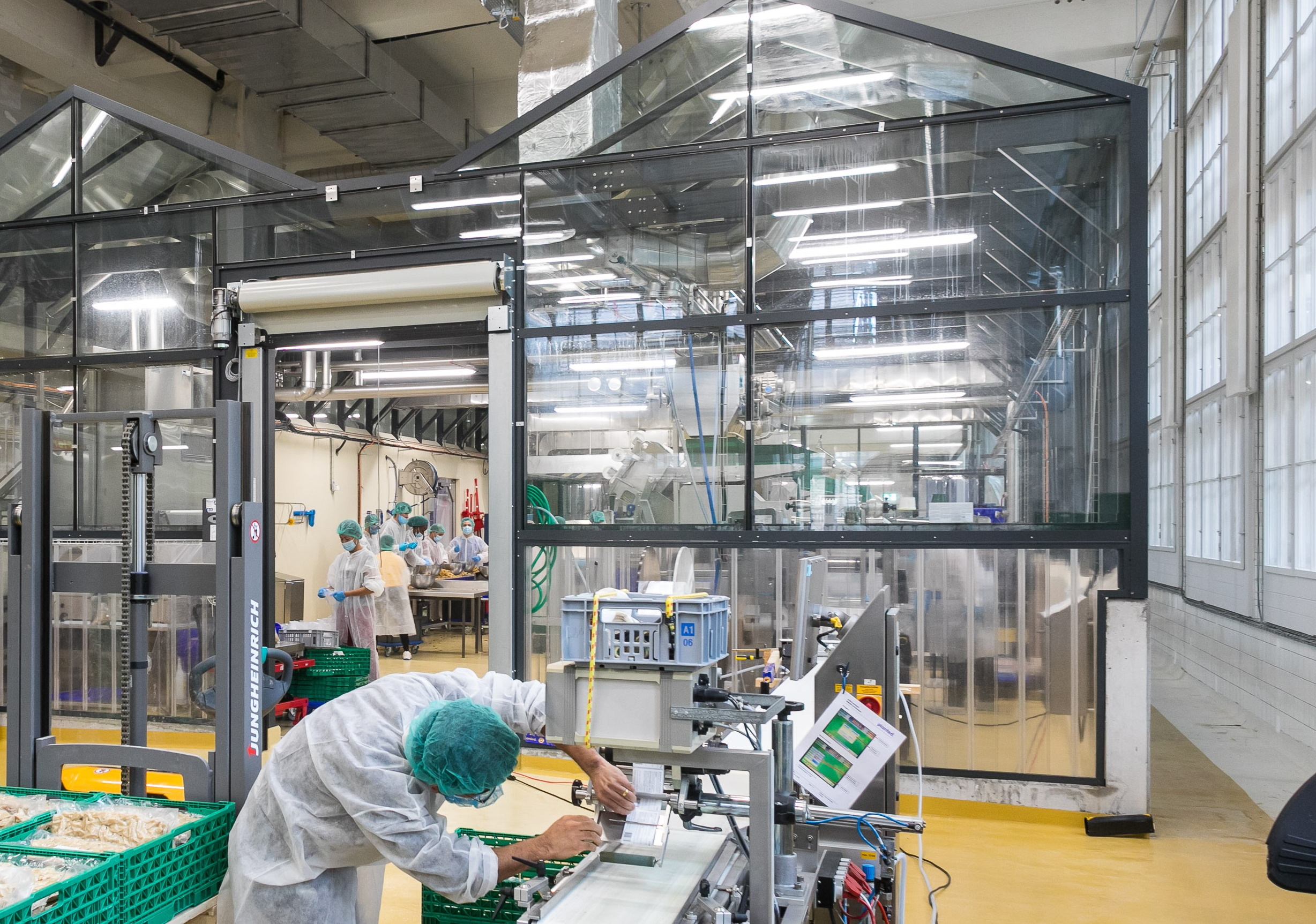
A large laboratory environment with clear walls. A person works at machinery in the foreground.

Image Credits: Planted

“We will further invest in our structuring and fermentation platforms. Combining structuring technologies with the biochemical toolboxes of natural microorganisms will allow us to create ultimately new products with transformative character – all clean, natural, healthy and tasty,” said co-founder Lukas Böni in a press release.

No doubt this all will also help lower the price, a goal from the beginning but only possible by scaling up.

As other companies in this space also raise money (incidentally, rather large amounts of it) and expand to other markets, competition will be fierce — but Planted seems to be specializing in a few food types that aren’t as commonly found, at least in the U.S., where sausages, ground “beef,” and “chicken” nuggets have been the leading forms of meat alternatives.

No word on when Planted products will make it to American tables, but Jenny’s “overseas” suggests it is at least a possibility fairly soon.

The funding round was co-led by Vorwerk Ventures and Blue Horizon Ventures, with participation from Swiss football (soccer) player Yann Sommer and several previous investors.

News: UK challenger bank Starling raises $376M, now valued at $1.9B

Challenger banks continue to see huge infusions of cash from investors bullish on the opportunity for smaller and faster-moving tech-based banking startups to woo customers from their larger rivals. In the latest development, UK-based Starling announced that is has closed £272 million ($376 million at current rates), at a pre-money valuation of £1.1 billion. This

Challenger banks continue to see huge infusions of cash from investors bullish on the opportunity for smaller and faster-moving tech-based banking startups to woo customers from their larger rivals. In the latest development, UK-based Starling announced that is has closed £272 million ($376 million at current rates), at a pre-money valuation of £1.1 billion.

This means that the round, a Series D, values the company at £1.372 billion ($1.9 billion) post-money.

Starling — which competes against incumbent banks, as well as other challengers like Monzo and Revolut — said it will be using the money to continue its growth. The bank is already profitable. In updated financials posted today, Starling said it generated revenue of £12 million ($16.6 million) in January of this year, up 400% compared to a year ago, with an annualized revenue run rate of £145 million. It posted operating profits for a fourth consecutive month, and net income currently exceeds £1.5 million per month.

Starling, founded in 2017, has now pased 2 million accounts, with 300,000 business accounts among them. It’s not clear how many of those accounts are active: the figures are for opened accounts, Starling said. Gross lending has passed £2 billion, with deposits at £5.4 billion.

Starling said it plans to use the funding both to expand its lending operations in the UK, to expand into other parts of Europe, and make some strategic acquisitions.

“Digital banking has reached a tipping point,” said Anne Boden, founder and CEO of Starling Bank, in a statement. “Customers now expect a fairer, smarter and more human alternative to the banks of the past and that is what we are giving them at Starling as we continue to grow and add new products and services. Our new investors will bring a wealth of experience as we enter the next stage of growth, while the continued support of our existing backers represents a huge vote of confidence.”

The round is being led by Fidelity Management & Research Company, with Qatar Investment Authority (QIA); RPMI Railpen (Railpen), the investment manager for the £31 billion Railways Pension Scheme; and global investment firm Millennium Management also participating, and it comes on the heels of us reporting in November that it was raising at least £200 million.

The funding comes at a critical time in consumer banking. The trend in the UK — the market where Starling is active — for the last several year has been a gradual shift to online and mobile banking, with those trends rapidly accelerating in the last year of lock-downs and enforced social distancing to slow down the spread of Covid-19.

Challenger (neo) banks have been some of the biggest winners of evolving consumer habits. Using rails provided as white-label services by way of APIs from banking infrastructure providers (another startup category in itself with companies like Rapyd, Plaid, Mambu, CurrencyCloud and others all involved) they will offer the same basic services such as checking and deposit, but they will typically do so with considerably  more flexibility, and additional savings and financial tips, and savings services to customers — all carried out over digital platforms.

Big, incumbent banks have scrambled to keep up with innovation, but newer generations of users are less beholden to their brands and incumbency, not least a result of the banking crisis last decade that revealed many of them to be cosiderably less competent and solid than many might have assumed.

That bigger market picture has also meant a surge of many neobanks, and so Starling competes with more than just the incumbents. Others include Monese, Revolut, Tide, Atom and Monzo — the latter a particularly acute competitor, founded by the ex-CTO of Starling.

WordPress Image Lightbox Plugin