Monthly Archives: March 2021

News: Learn how to build a strong board of directors at TC Early Stage this April

Building a strong board for your startup is key. It’s important to have folks on your board who have both the founder’s and the company’s best interests in mind, and are able to help the company navigate the many stages of a startup’s lifecycle. At TechCrunch’s Early Stage event on April 1 – 2, Generation

Building a strong board for your startup is key. It’s important to have folks on your board who have both the founder’s and the company’s best interests in mind, and are able to help the company navigate the many stages of a startup’s lifecycle.

At TechCrunch’s Early Stage event on April 1 – 2, Generation Investment Management Partner Dave Easton will talk about board composition, what it takes to make a great board and board governance as a startup scales.

At GIM, Easton has invested in startups like Asana, Andela, Gusto, DocuSign, Toast and others. Meanwhile, he serves on the boards of solar company M-KOPA and has previously served on the boards of Jumia Group and Narayana Health up until their respective initial public offerings.

Easton’s workshop is just one part of a two-day event exploring the many aspects of early-stage startups – check out the entire agenda line up here!  Be sure to grab your ticket to TC Early Stage — Operations and Fundraising on April 1-2 and save $100 or more when you get the dual-event ticket for both the April and July events.

News: TC Sessions: Mobility 2021 is coming, save the date!

Buckle up, startup and tech fans. Save the date and get ready to rub virtual elbows with mobility’s best and brightest minds — the movers, shakers and policy makers that are shaping the future of transportation. TC Sessions: Mobility returns for its third year on June 9, 2021. Can you say mobility three-peat? Yes, you

Buckle up, startup and tech fans. Save the date and get ready to rub virtual elbows with mobility’s best and brightest minds — the movers, shakers and policy makers that are shaping the future of transportation.

TC Sessions: Mobility returns for its third year on June 9, 2021. Can you say mobility three-peat? Yes, you can!

We’re excited to host another day dedicated to the people — and the technology they’re developing — that’s changing transportation. TC Sessions: Mobility 2021 goes beyond hunting for the next unicorn or showcasing the gee-whiz distraction of the moment. We’ll explore the latest trends, discuss regulatory, technical and ethical challenges and look at the costs and long-term effects on towns and cities.

Pro tip: Early bird pricing is now in play on all pass levels and June will be here before you know it. Keep your hard-earned money in your pocket. Buy your passes now and save 35% before the prices increase.

We’re building out the day’s agenda, and we’ll pack it with presentations, interviews and Q&As with founders, investors and inventors. Enjoy breakout sessions, dozens of exhibiting startups and plenty of time to network and recruit — with attendees from around the world.

Take a look at some of the mobility mavens and transportation titans who joined us on the virtual stage at last year’s event to get a sense of the quality programming you should expect on June 9.

  • JB Straubel, co-founder, CEO of Redwood Materials, co-founder and former Tesla CTO
  • Tekedra Mawakana, COO, Waymo
  • Matthew Johnson-Roberson, co-founder, Refraction AI
  • Nancy Sun, co-founder and chief engineer, Ike
  • Shin-pei Tsay, director of policy, cities and transportation, Uber
  • Peter Rawlinson, CTO and CEO, Lucid Motors
  • Margaret Stewart Nagle, head of policy and government affairs, Wing
  • Paul Ajegba, director, Michigan Department of Transportation
  • Celina Mikolajczak, vice president, battery technology, Panasonic Energy of North America, Panasonic
  • Reilly Brennan, founding general partner, Trucks Venture Capital

Will you benefit from attending TC Sessions: Mobility 2021? Take it from Rachael Wilcox, creative producer at Volvo Cars, who completed a TechCrunch hat trick in 2020 by attending Disrupt, TC Sessions: Robotics/AI and TC Sessions: Mobility.

Going to TechCrunch events, whether it’s Disrupt or TC Sessions, helps me stay ahead of emerging trends, technologies and startups that affect the future of mobility.”

TC Sessions: Mobility 2021 takes place on June 9, 2021. Learn from and engage with the industry’s mightiest minds, makers, innovators and investors. Buy your early bird pass, connect with your world-wide community and help build a new age of transportation.

Is your company interested in sponsoring or exhibiting at TC Sessions: Mobility 2021? Contact our sponsorship sales team by filling out this form.

News: A bug in a popular iPhone app exposed thousands of call recordings

A security vulnerability in a popular iPhone call recording app exposed thousands of users’ recorded conversations. The flaw was discovered by Anand Prakash, a security researcher and founder of PingSafe AI, who found that the aptly named Call Recorder app allowed anyone to access the call recordings from other users — by knowing their phone

A security vulnerability in a popular iPhone call recording app exposed thousands of users’ recorded conversations.

The flaw was discovered by Anand Prakash, a security researcher and founder of PingSafe AI, who found that the aptly named Call Recorder app allowed anyone to access the call recordings from other users — by knowing their phone number.

But using a readily available proxy tool like Burp Suite, Prakash could view and modify the network traffic going in and out of the app. That meant he could replace his phone number registered with the app with the phone number of another app user, and access their recordings on his phone.

TechCrunch verified Prakash’s findings using a spare phone with a dedicated account.

The app stores its user’s call recordings on a cloud storage bucket hosted on Amazon Web Services. Although the public was open and lists the files inside, the files could not be accessed or downloaded. The bucket was closed by press time.

At the time of writing, the cloud storage bucket had more than 130,000 audio recordings, amounting to some 300 gigabytes. The app says it has more than 1 million downloads to date.

TechCrunch contacted the app developer and held this story until the flaw was fixed. A new version of the app was submitted to Apple’s app store on Saturday. The release notes said the app update was to “patch a security report.”

Despite a brief response to our initial email acknowledging the security issue, the app developer Arun Nair has not returned several requests for comment.


Send tips securely over Signal and WhatsApp to +1 646-755-8849. You can also send files or documents using SecureDrop.

News: Could Valo Health become one of Flagship Pioneering’s biggest companies yet?

The investment firm Flagship Pioneering has incubated a lot of life sciences companies since it was founded in 2000. In fact, while a general partner with Flagship Pioneering over the last 15 years, David Berry has started more than 30 companies, five of which trade publicly right now: Seres Therapeutics, Sensen Bio, Evelo Biosciences, T2

The investment firm Flagship Pioneering has incubated a lot of life sciences companies since it was founded in 2000. In fact, while a general partner with Flagship Pioneering over the last 15 years, David Berry has started more than 30 companies, five of which trade publicly right now: Seres Therapeutics, Sensen Bio, Evelo Biosciences, T2 Biosystems, and Axcella Health.

Berry is often a company’s first CEO, then transitions out of the company within 18 months. But he has no plans to leave his post as CEO of Valo Health, a three-year-old, Boston-based, 110-person drug discovery company that Berry and Flagship seem to think could become one of the firm’s most important companies yet. That’s notable, considering that Flagship incubated 11-year-old Moderna, which currently boasts a $50 billion market cap thanks in large part its coronavirus vaccine.

Perhaps it’s no surprise, given Berry’s and Flagship’s track record that Valo has attracted believers. Notably, today it is announcing a fresh $110 million in extended Series B financing from Koch Disruptive Industries that brings the round total to $300 million and the overall amount the young company has raised to more than $450 million.

Still, given that there are hundreds of drug discovery companies in the world seizing on the latest advancements in AI, machine learning and computation, it’s easy to wonder what’s so special about this one. We got Berry’s take during a chat with him yesterday, parts of which we are featuring below edited for length and clarity.

TC: Valo is trying to accelerate the creation of drugs, and it has a computational platform called Opal to do it faster and more effectively than many rivals. Is there a way to make it clearer to outsiders why this platform is so unique? 

DB: First, from day one, we were operating on a different scale [than past Flagship Pioneering companies]. Typically, when you look at Flagship companies, there’s an [exclusive] initial commitment by Flagship of plus or minus $50 million. But because of the scale of the opportunity that we saw ahead of us with Valo, we actually started out by bringing in external financing partners as part of a Series A that was right around $100 million.

[Also unique is the] breadth of what we’re trying to achieve through our systematic approach to R&D, as opposed to a targeted approach to thinking about it. There’s been an historical challenge in life sciences in that companies are primarily viewed based on what their lead therapeutic asset looks like. But if you have the potential to change the scope, the scale, the potential, the speed, the probability of success, [and] the cost of developing drugs, you’re not going to look like a typical therapeutics company.

TC: So your focus on multiple therapeutic areas at once — oncology, neurodegenerative, and cardiovascular diseases — is a distinguishing element of the company. How are you tackling so much simultaneously?

DB: The legacy biopharma model is basically this point-to-point system [where up to 15 groups] do some work, and then they basically take the result of it and they throw it over a wall to another group that has its own framework. The model is intrinsically disintegrated. They use mice. They use cell lines. They use extracted organs. And those just don’t represent what a full, intact living human actually looks like, and they don’t reflect what the disease looks like in the context of that human.

What we’re doing is what I would call that next transformation . . . enabled by high-quality human-centric data [that we analyze] in an end-to-end, but componentized manner. What I mean by that is we’ve created a single underlying architecture so that we’re using the same species, we’re using the same decision-making criteria. we’re using the same KPIs throughout the entirety of the R&D cascade, [and] we’re using the same bases of the core computation. We’re using the same self-reinforcing model to learn as we go. We have a local expression, because we have to perform a certain set of tasks in order to comply with the regulatory environment. But by doing it in this way as we do those tasks, we’re learning a lot more and we’re keeping that human centricity, so when we uncover, for example, a new target in cardiovascular disease or neurodegenerative disease, it’s based on our human data. It’s not based on a dog model or mouse model or something along those lines. It’s not based on cells adapted to plastic in a lab.

TC: Where is that human data coming from? Is the data you’re feeing into Opal somehow better or different than what others are using?

DB: We haven’t we haven’t yet disclosed where our datasets are coming from, but we have reason to believe that the scale and quality of the data sets are substantially high. We have not seen data sets that compare in scope and size. We have announced one subset of our data lake, but I would call it a small subset through a data partnership we announced earlier. [Editor’s note: this is with a company called Global Genomics Group, which gives Valo access to a cardio-metabolic dataset.]

TC: You’ve been at this for a few years. Have you had any major breakthroughs?

DB: I believe what we’ve done over the last two years is build an incredibly strong technology basis and foundation [for] transformation. We’ve announced four therapeutic programs that we’ve launched thus far, and each represents not only something where we’ve been able to develop a therapeutic candidate in very short periods of time, but we’ve also been able to overcome historical barriers that made developing those sorts of candidates much more difficult, and we were able to overcome those barriers in weeks.

TC: Can you elaborate on one of those therapies to underscore your point?

DB: One of the programs we announced is called NAMPT. What was really interesting about it is it’s a very powerful cancer target. The downside of it is it’s known to cause a very particular toxicological effect — it causes retinal toxicity — and we wanted to figure out whether we could get the benefit of the molecule by targeting the target but avoid getting that molecule into the retina, which required a very specific design. Long story short, in a couple of weeks, we were able to achieve a molecule that had enough differentiation between the blood in the eye that it shouldn’t have any substantial effects.

TC: Are any of these four candidates heading into the market any time soon?

DB: I would love them to be in the market soon, but they’re not yet there. We are expecting that with the financing in hand, we should ultimately have molecules in clinical trials, and ultimately, we’re very excited to be able to transition some of the drugs that we are developing into [viable offerings in the market].

TC: Would you sell then sell these to a big pharma company, or would Valo be marketing these itself?

DB: Both are viable potential paths. Because we’re developing a number of different therapeutics, it gives us flexibility in the way we think about our ultimate business model.

News: French startup lobby targets Apple with ‘privacy hypocrisy’ complaint

Apple is facing another privacy complaint in Europe: A startup lobby group, France Digitale, has asked the country’s data protection watchdog to investigate alleged breaches of EU rules. The complaint, reported earlier by Politico, follows two similar complaints lodged in Germany and Spain by EU privacy campaign group noyb last year. All these complaints are

Apple is facing another privacy complaint in Europe: A startup lobby group, France Digitale, has asked the country’s data protection watchdog to investigate alleged breaches of EU rules.

The complaint, reported earlier by Politico, follows two similar complaints lodged in Germany and Spain by EU privacy campaign group noyb last year.

All these complaints are (directly and indirectly) targeting Apple’s IDFA — aka its mobile device Identifier for Advisers — with noyb arguing Apple should be gathering consent from users in the EU prior to assigning this unique device (whose purpose is, as the name suggests, to enable device tracking for ad targeting).

France Digitale’s complaint also raises competition concerns, pointing to a looming switch by Apple — to require opt in for third party apps to track users — and contrasting that with a ‘personalized advertising’ setting in iOS which it says lets Apple track users and is switched on by default.

It suggests that default is contrary to requirements under EU law (citing consent standards in the European Union’s General Data Protection Regulation; GDPR).

The France Digitale complaint also raises questions over the level of data access Apple provides iOS users related to the ad targeting it carries out — saying users are only provided with “generic data (year of birth, sex, location)”, rather than fuller targeting data.

In a statement responding to the complaint, an Apple spokesperson told us:

The allegations in the complaint are patently false and will be seen for what they are, a poor attempt by those who track users to distract from their own actions and mislead regulators and policymakers. Transparency and control for the user are fundamental pillars of our privacy philosophy, which is why we’ve made App Tracking Transparency equally applicable to all developers including Apple. Privacy is built into the ads we sell on our platform with no tracking. We hold ourselves to a higher standard by allowing users to opt out of Apple’s limited first-party data use for personalized advertising, a feature that makes us unique.

The CNIL has also been contacted for comment on the complaint.

The latest IDFA-related complaint against Apple is a little unusual as it’s not coming from a privacy group — but a startup lobby.

Evidently, though, Apple’s decision to switch to requiring opt-in from iOS users to third party tracking (rather than opt out) is ruffling feathers. (The move also led to a publisher lobby group in France to file a competition complaint last year). The not-so-subtle subtext, here, is Apple is being accused of privacy hypocrisy.

Asked why France Digitale is making a privacy complaint against Apple, a spokesman told TechCrunch: “Startups play by the rules. We expect the world’s largest tech company to do so. We believe no scale-up can thrive without a regulatory level-playing field.”

“We are merely asking the CNIL to enforce the law. Privacy watchdogs investigate our startup members all the time. Lets them use their expertise on the bigger cats,” he added.

While the group has attracted some quick publicity with the complaint to the CNIL, under GDPR’s one-stop-shop mechanism the matter would have to be referred to Ireland’s Data Protection Commission — which is Apple’s lead data supervisor in the EU — which would then take a decision on whether or not to investigate. So there’s unlikely to be any quick regulatory action on this issue.

News: Meet SeekOut, a profitable diverse hiring startup that just raised $65M

Most companies claim they want a diverse staff but at the same time, complain they don’t know how to go about recruiting more diverse candidates. Enter SeekOut — a startup that is out to give companies no excuses with its AI-powered platform. A group of former Microsoft executives and engineers —  Anoop Gupta, Aravind Bala,

Most companies claim they want a diverse staff but at the same time, complain they don’t know how to go about recruiting more diverse candidates.

Enter SeekOut — a startup that is out to give companies no excuses with its AI-powered platform.

A group of former Microsoft executives and engineers —  Anoop Gupta, Aravind Bala, John Tippett, Vikas Manocha — founded SeekOut in 2016. The team started out building a messaging platform that provided a deep level of information about people that others might be emailing. When they realized that what customers really were after was the information they were uncovering, and not so much the messaging capability, the company pivoted in 2017.

Today, SeekOut’s goal is to help talent acquisition teams to recruit “hard-to-find and diverse talent.” The startup wouldn’t name names but said it is working with 6 out of the 10 “most highly valued companies” by market cap in the U.S. Overall, it had about 500 customers as of January across a range of industries from technology to pharmaceutical to aerospace and defense to banking.

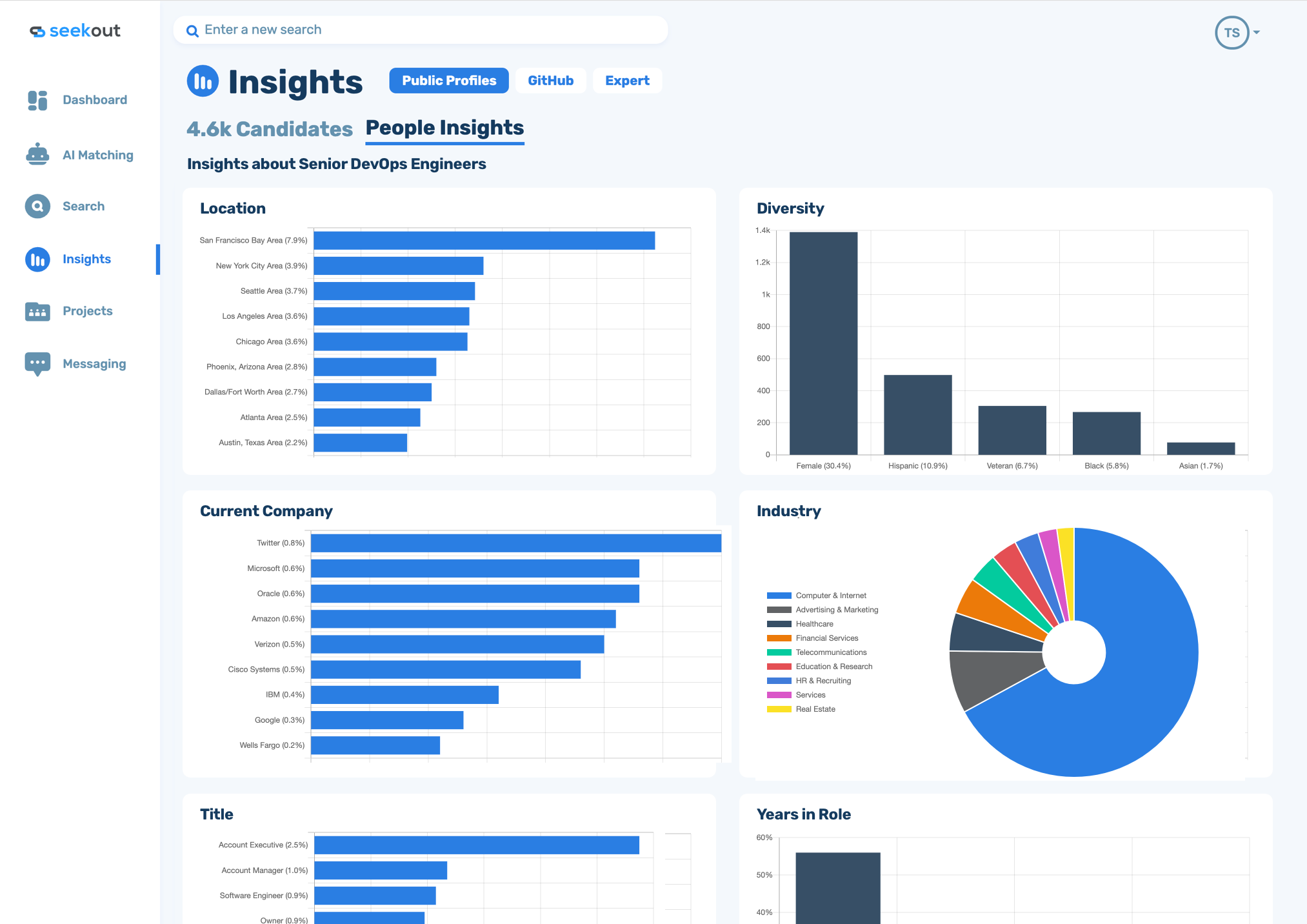
Over the years, SeekOut has built out a database with hundreds of millions of profiles using its AI-powered talent search engine and “deep interactive analytics.” It finds talent by scouring public data and using natural-language and machine-learning technologies to understand the expertise of each candidate and build a complete 360-degree view of each potential employee. Specifically, it blends info from public profiles, GitHub, papers and patents, employee referrals, company alumni, candidates in ATS systems.

While SeekOut initially focused strictly on technical talent, it has since broadened its base to helping recruiters and sources find more diverse candidates in general as well as people with simply “hard-to-find” skill sets. And it claims to do it with “unprecedented speed and precision” via a blind hiring method designed to reduce bias. SeekOut then gives recruiters a way to engage with candidates instantly by getting access to the right contact information in a “single click.”

SeekOut co-founders (left to right) Anoop Gupta, Aravind Bala, Vikas Manocha and John Tippett. Image courtesy of SeekOut

The startup is hitting such a sweet spot that it attracted the attention of Tiger Global Management, the global investment firm that just led a $65 million Series B that values SeekOut at around $500 million.

Existing backers Madrona Venture Group and Mayfield also participated in the financing, which brings SeekOut’s total funding since inception to $73 million.

In a world where so many startups have yet to turn a profit, SeekOut is a refreshing exception. Since its $6 million Series A raise in May 2019, the SaaS company says it has grown its subscription revenue (ARR) by “more than 10-fold” (although it declined to reveal hard revenue figures). And it’s been profitable, or cash-flow positive, each of the last two years.

Gupta, who serves as the company’s CEO, said its platform (dubbed Talent-360) helps companies not only find diverse talent, but helps them improve retention by finding the “right” candidate to begin with.

While there was a pause almost across the board in hiring when the COVID-19 pandemic began, the emergence of remote work as a new normal has forced companies to think more creatively about hiring — especially since they are not constricted by geography as in the past — according to Gupta.

“This freedom also means their need for tools like SeekOut increased and we have seen our business take off as a result,” he told TechCrunch. “The focus on diversity hiring and our unique approach to finding the talent and offering blind hiring features has super charged the adoption.”

SeekOut’s Insights dashboard. Image courtesy of SeekOut

Mario Linares, head of talent acquisition at Aviatrix, acknowledges that competition for talent among software companies is fiercer than ever

“SeekOut’s innovative AI-powered search, global power filters, diversity filters, and talent pool insight have been critical components of Aviatrix’s global growth plan,” he said in a written statement.

For Tiger Global Partner John Curtius, SeekOut’s platform has the potential “to transform the world of HR.”

“We are impressed by the customer love and traction SeekOut is experiencing,” he said in a written statement.

Looking ahead, SeekOut plans to use its new capital to speed up the development and expansion of its platform and build customer success, engineering, sales and marketing teams in Seattle. And it plans to use its own platform to do it.

The company also plans to double its headcount of 50 over the next year.

News: Fueled by the pandemic, Daily raises $15M Series A for its real-time video platform

Daily, the makers of a developer platform for real-time audio and video, has been booming in recent months — in part, due to the pandemic’s impact on remote work, virtual events, telehealth and more. Over the past year, Daily saw around a 20x increase in the number of paying customers and a 30x increase in

Daily, the makers of a developer platform for real-time audio and video, has been booming in recent months — in part, due to the pandemic’s impact on remote work, virtual events, telehealth and more. Over the past year, Daily saw around a 20x increase in the number of paying customers and a 30x increase in revenue, it says. Though the team was initially hesitant to raise funds in light of this growth, they have now closed on $15 million Series A funding.

The new round was led by early Stripe employee-turned-investor Lachy Groom, who became connected with the startup via his portfolio company Interval.com, a Daily customer. Tiger Global, other angels and most of Daily’s seed investors also participated, bringing Daily’s total raise to date to $22 million.

Daily itself was founded in 2016 as a big bet on video, and WebRTC in particular, but has been boosted by the pandemic and the market shifts that resulted.

“We believed back then and have believed for a while that video would be everywhere. It would be a crucial part of how we live and work and engage with all sorts of products,” explains Daily co-founder Nina Kuruvilla. “We thought that this shift would require new platforms and tools to make working with video as easy as possible,” she says.

As it turns out, Daily’s bet was a good one — though it took a few years and a global pandemic to see the hockey stick growth that startups aspire to.

Today, Daily is used by a number of companies focused on the future of work, like virtual office startup Tandem, virtual HQ platform Teamflow, presentation startup Pitch, pair programming tool GitDuck, virtual recruiting startup Flo Recruit and others. It’s also been adopted by enterprises in spaces like healthcare and customer support.

With Daily’s platform, developers can either use a prebuilt UI to integrate video calls with just two lines of code, or they can opt to build out their own custom video UI and UX. With the former, developers can embed a video call widget that features video chat, screen sharing and recording capabilities. Meanwhile, the latter gives developers more control over the layout, workflow and video and audio tracks.
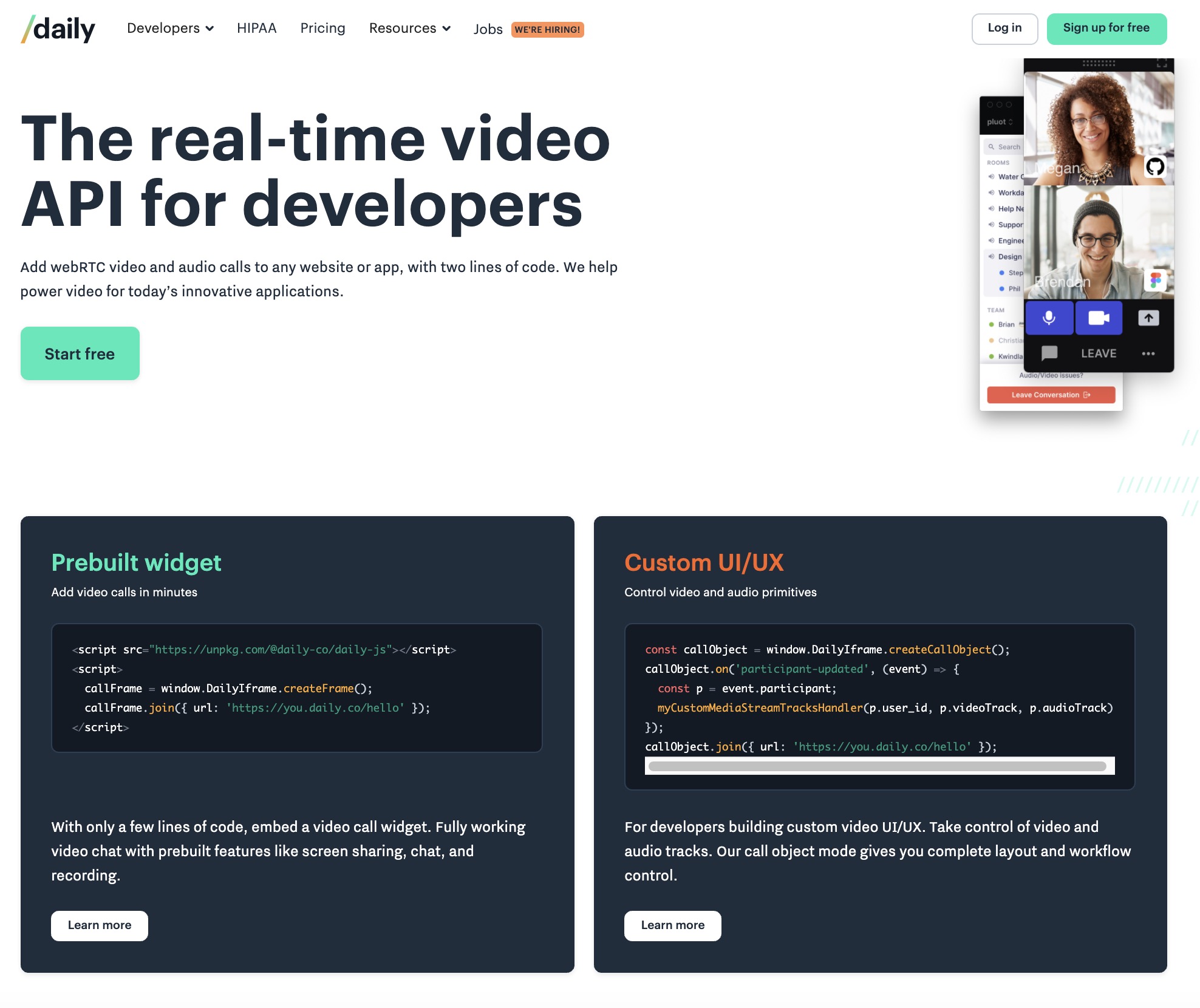
Image Credits: Daily website

“Video is a big challenging problem — real-time video and real-time audio. You need some set of tools to help you do it — especially if you’re going to roll it out quickly and you’re going to then scale it,” explains Daily co-founder Kwindla Kramer. “We give you the APIs that let you develop really quickly, [that are] flexible enough for you to keep improving the product over time. And then we also have this global infrastructure that makes it possible for our customers to scale without having to, you know, build a whole equivalent of AWS themselves,” he says.

With Daily, developers gain access to servers spread out in different regions all over the world, to protect against latency issues. Daily also does the heavy lifting in terms of making sure the product works well across all platforms and devices.

From a security and privacy standpoint, it’s HIPAA compliant and doesn’t capture customer data. It’s also transparent about when and how encryption is applied. For example, Daily’s peer-to-peer calls are end-to-end encrypted, while calls routed through media servers are encrypted to and from the servers, but are decrypted on the servers in order to do things like forwarding and recording.

The technology itself is flexible, too. Daily lets customers specify if they don’t want audio and video packets to move outside the EU, for regulatory reasons. Customers can choose to integrate with their preferred transcription engine or other major recording and live streaming APIs.

Through Daily’s developer dashboard, customers can view call quality insights and visualizations.
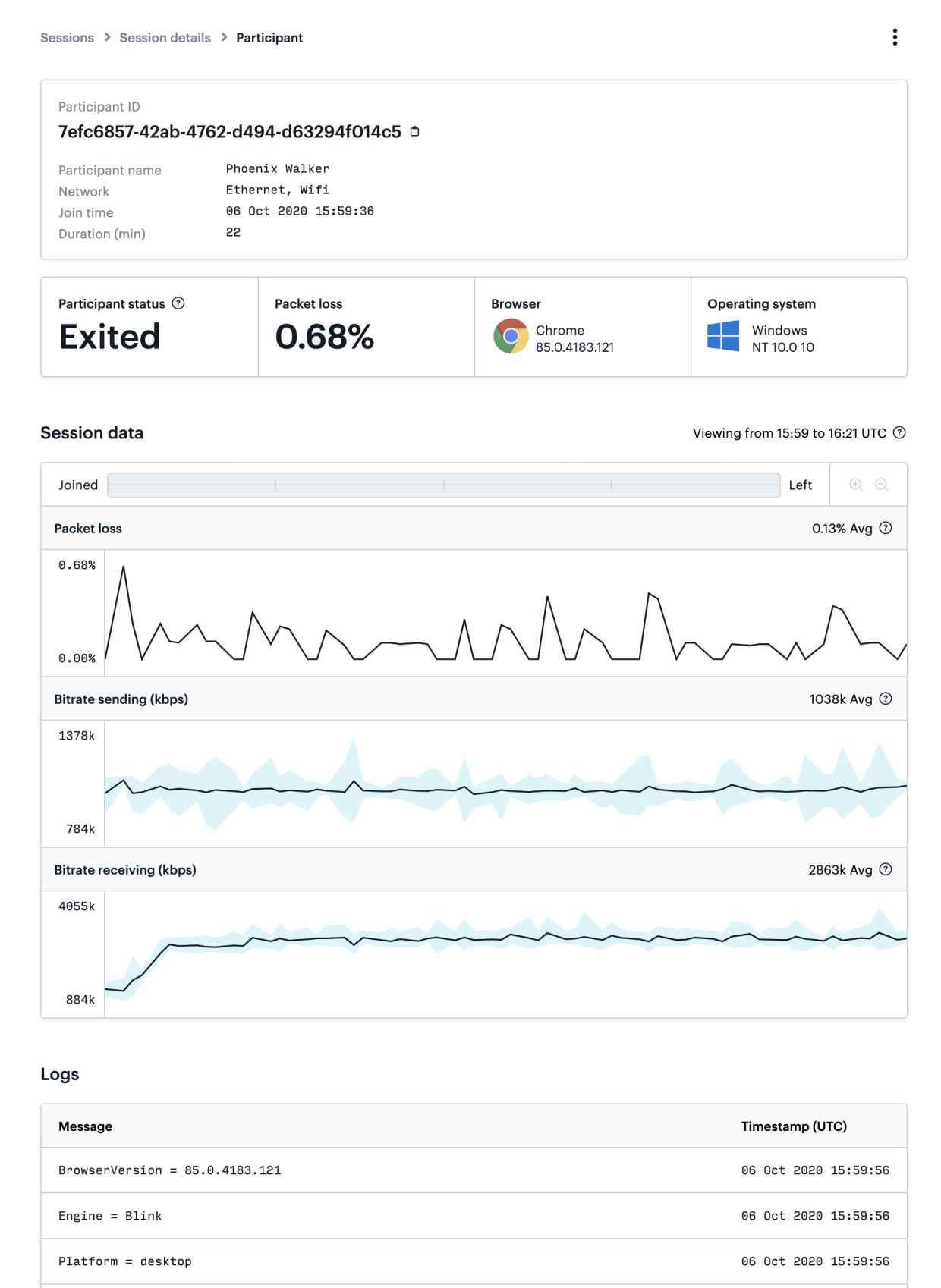
Image Credits: Daily

To attract customers, Daily kept its pricing model simple. It has introductory plans for smaller customers that grow to the larger “Scale” plan at $199 per month for 10,000 minutes. From there, customers just pay an additional rate per minute as they grow.

The company was already seeing steady demand for video ahead of COVID, particularly in areas like remote work and healthcare. But COVID accelerated those use cases and impacted others, as well. After March 2020, the world quickly woke up to the need to prioritize video.

“Productivity and the future of work is rapidly changing. Online events, healthcare, customer support, interactive live streaming. IoT and robotics use cases. Social and gaming,” Kuruvilla says, rattling off the various Daily use cases.

During the first six months of the pandemic, Daily’s adoption grew as customers looked to get up-and-running with video quickly. Later, they began to shift toward innovating around what it means to build a digitally native service with video.

That’s helped to advance new models for how video can be used — like virtual fitness classes where people not only see the instructor, but also their friends who signed up with them. Or hybrid video and audio experiences for live events; real-time video conversations during livestreams; live e-commerce events; and more.

The company believes that this leap forward means Daily has a future even when, post-pandemic, things “go back to normal.”

“I think some traditional video call usage is probably going to stagnate or go down, but all of these new use cases just feel like they’re ramping up — because it’s early innings and they’re really genuinely useful,” notes Kramer.

The team says they chose to work with Lachy Groom because — unlike the dozens of investors they pitched during their seed stage who thought video was a niche market — Lachy understood what Daily was doing.

“It’s only after we got to know Lachy that we really felt like there was another investor, like [seed investor] Jenny [Lefcourt from Freestyle], who really understood what we needed to do as a company to be the best possible company we could be. And that was worth raising a round with,” says Kramer.

With the additional funds, Daily will hire more engineers and focus on various product initiatives around call quality and reliability, expanding its global infrastructure and supporting larger calls and more hybrid use cases.

In addition to Lachy Groom and Tiger, Daily is backed by Freestyle Capital, Root Ventures, Y Combinator, Slack Fund, Moxxie Ventures, Haystack Ventures, TenOneTen Ventures, Ground Up Ventures, Offline Ventures, Work Life Ventures, Basement Fund, Compound, and numerous angel investors.

News: Global-e files to go public as e-commerce startups enjoy a renaissance

While Global-e is not a U.S.-based company, its recent growth underscores that the e-commerce boom we’ve seen domestically is hardly unique.

Global-e, an e-commerce platform that helps online sellers reach global consumers, filed to go public this morning. The company’s F-1 filing is here, if you’d like to read along.

While Global-e is not a United States-based company — it also has offices in the UK and Israel, among other countries — its recent growth underscores that the e-commerce boom we’ve seen domestically is hardly unique. Indeed, Global-e’s growth has been rapid and impressive.


The Exchange explores startups, markets and money. Read it every morning on Extra Crunch, or get The Exchange newsletter every Saturday.


Hell, the company is profitable while scaling, a rare sight among recent technology IPOs.

We care about the Global-e IPO because it’s a venture-backed former startup. Reading its filing, we can see that Red Dot Capital Partners has a material stake. Logistics giant DHL also put money into the company, along with money managed by Apax Partners and Vitruvian Partners, both private equity players.

Regardless, here’s a company that represents a bucket of private cash going public during a period of intensive flotation activity. Let’s get acquainted with what it does, dig into its numbers and add it to our IPO list.

Recall that Roblox is expected to begin trading tomorrow and Coupan on Thursday, after pricing Wednesday. Olo will price and trade next week. Coinbase is somewhere in the wings ahead of its own direct listing. And there are others: It’s going to be a regular IPO run for the next few weeks, not counting the other filings that will surely drop.

So let’s get our heads around Global-e. Into the tables!

What is Global-e?

Selling and shipping across borders can prove difficult and is probably hardest for smaller online sellers. And the global market is just that, so if you want to reach it, you have to do extra work. Global-e provides services to sellers to make selling around the world a bit easier. Things like, per its F-1 filing, localized browsing, pricing and checkout, shipping options, locally friendly payment solutions and returns support.

Given the e-commerce boom of the COVID-19 era, the company’s business exploded in 2020.

A few metrics make that plain. From 2018 to 2020, the company’s processed gross merchandise volume, or GMV, rose from $211 million to $382 million to $774 million. As you can imagine, its revenues grew as well, scaling from $38.6 million to $65.9 million to $136.4 million across the same time frame.

News: Designing with accessibility in mind: a conversation

At TechCrunch Sessions: Justice, we examined the importance of ensuring products are designed to be accessible from the beginning. And how building the expertise of disabled technologists and advocates and into the DNA of your company from the start is vital not only to produce better products but also in the pursuit of a functioning

At TechCrunch Sessions: Justice, we examined the importance of ensuring products are designed to be accessible from the beginning. And how building the expertise of disabled technologists and advocates and into the DNA of your company from the start is vital not only to produce better products but also in the pursuit of a functioning and more equitable society.

On the panel were Cynthia Bennett of Carnegie Mellon University’s Human-Computer Interaction Institute, Srin Madipalli who founded accessible travel marketplace Accomable (which exited to Airbnb), and Mara Mills, Associate Professor of Media, Culture, and Communication at New York University and a co-founder and co-director of the NYU Center for Disability Studies.


On a defining accessibility

Any nuanced discussion on designing for accessibility first requires a definition of accessibility. What do we mean by accessible products and how should founding teams and those involved in designing product frame internal thinking about accessibility.

We learned that on one level the notion of accessibility is very simple: making products that everybody can use. However, from a company building point of view, it’s also important to think about accessibility from an internal tooling and processes perspective. It’s not enough to have accessible products for your users. If the software tools or ways of working at your startup exclude people with various disabilities, it’s infinitely harder to design accessible products anyway as prospective or existing employees with disabilities will be prohibited from doing their best work.

There was one other caveat, too: Disability is not an umbrella category and what works for one group may not work for another. And in fact, some accessibility features or culture and process changes might even be inaccessible to a specific group and this sense there isn’t a quick technological fix and you’re done.

Madipalli: It’s just simply a way of designing products and services to make sure that anybody could use them regardless of disability. And it’s very simple level. And, of course, there are nuances to that, and to what specific things one needs to do in order to achieve that. But at its most basic, it’s just making sure that we design things that everybody can use. (Timestamp: 1:24)

Bennett: Accessibility is not just about making sure that the products that leave the door are accessible, but also the tools and the processes, and the cultures are accessible. So if the products are accessible, are the tools used to create those products able to be used by everyone. (Timestamp: 2:18)

Mills: It’s important to remember that access technologies are not inherently accessible themselves, whether we’re talking about software or a physical ramp, they have to be affordable, they have to be discoverable, people need to know that they exist, they often require training to use… they have to be employed in welcoming settings, the culture has to be there too. (Timestamp: 3:04)

Mills: Disability is an umbrella category, and it’s really internally diverse. And we sometimes see access efforts that work for one group, creating new forms of inaccessibility for other groups. And I think that’s been really true in this moment of video conferencing where certain tools like Zoom work for certain groups and then they don’t really work that well for deaf and hard of hearing people or they haven’t before automated captioning became available. So just keeping in mind the diversity of disability and the diversity of access needs. (Timestamp: 3:51)


Medical and social models

Entrepreneurs like to fix problems, they’re wired that way. But what is the “problem” you’re trying to solve. This is where it’s useful to take the time to understand different models of disability, namely the medical versus social models.

The social model, which has overwhelmingly been adopted by disabled people themselves, says that a person isn’t made disabled by their medical impairment alone but by the way society is often arranged, including how the world is designed but also the societal attitudes towards people with disabilities and the barriers to inclusion this creates.

This means that disability is everybody’s problem and that the solution is to fix society not the individual.

Mills: Disability activists in the 70s, were pushing back against what you just said, they’re pushing back against this dominant medicalised perception of disability, that they called the medical model, which imagines disability only as a so called defect or a disorder, something that requires a cure (Timestamp: 6:19)

Mills: According to the social model of disability, the intervention required is not medical, and it’s not individual, it’s a matter of social justice. So things like new architecture, new designs, new laws, new software. (Timestamp: 7:27)


What’s the right time to begin thinking about accessibility?

If you’re a founder or product team aiming to bring a new product or service into the world, hopefully by now you’re already wondering when the right time is to start thinking about accessibility. The answer, of course, is now. If there’s pushback within your organisation, you’re missing the opportunity to build a best in class product and remain competitive in just the same way that you wouldn’t neglect things like being mobile-friendly, security or designing for privacy etc. And, of course, leaving money on the table.

Bennett: It’s never too early… If we say no to accessibility, which sometimes might be said explicitly, and other times it might be said implicitly through the technologies we design not being accessible, you are kind of deciding that a swath of humanity is not going to be able to use whatever you’ve developed. And that to me should never be okay (Timestamp: 9:38)

Madipalli: It’s an opportunity rather than a problem, it is something that actually, if it’s baked into the very beginning, and it’s seen as part of the workflow of building a product, doesn’t have to be of a different challenge. (Timestamp: 12:32)

Madipalli: It’s really important for founders to not see this as a problem to be solved, that this can be something that is just part of making our product or service kind of usable by our customers and delivering a great customer experience. And, and again, at a fundamental level, a startup can only survive by building a product that customers like, and I would see making sure the product is accessible is central to that in the first place. (Timestamp: 13:26)


Nothing about us without us

The need to involve disabled people in the design process, both as internal employees but also externally, was a recurrent theme of our discussion. “Nothing about us without us” is a political slogan used historically by the disability rights movement and its simplicity acts as a useful reminder of the importance of co-design. And while the aim of accessibility is simple, in practice designing for accessibility is nuanced and can often be imperfect. Luckily, our panelists shared a number of practical tips, such as using flexible language or feature or disability aid specific when recruiting for user testing.

Mills: Nothing about us without us is like this century old political slogan that was taken up by disability activists in the 80s, and the 90s. And if you think about that phrase, initially, the goal behind it was inclusion, and self representation. So like wrenching discourse about disability away from rehabilitation specialists who weren’t disabled and centering disabled people in discussions of disability. (Timestamp: 14:57)

Bennett: Part of bringing everyone to the table is recognizing that we all come to the table with histories. And it’s likely that when we work with people, they’ve probably tried to solve the problem that we think they have, in many different ways. And so sometimes, that is amplifying a solution. Or sometimes it’s recognizing there might not be a solution. But we’re here to listen, and design can be kind of an amplifier of this tension or conflict that is probably unsolvable. But that we can kind of chip away. (Timestamp: 17:53)

Bennett: People with disabilities need to be in all positions of power in these processes. They’re both people on the inside, but you know, also people who can give that fresh perspective from those of us who might be on the inside and remember, kind of outsider or more diverse perspectives
(Timestamp: 18:37)

Bennett: I am a disabled person, and I’m very proud of that identity. But not everyone who experiences discrimination based on the way their body or their mind works, uses that language. So often, when I’m trying to talk to folks, I’ll use terms like chronic illness or impairment or mental health condition or the deaf community. And so I try to have educated myself and I’m still learning about the different words that people use. (Timestamp: 19:00)

Bennett: When you’re looking to reach out to folks I also sometimes specify the type of interaction I’m looking for. So for example, you might recruit blind people to kind of take part in a design process with you, when really maybe what you’re looking for is people who use screen readers or people who use Braille or people who use magnification. Being specific about the interaction technique or accessibility feature can help you make sure you get the more specific group that you’re looking for. (Timestamp: 19:36)

Madipalli: It’s really important to make sure disabled people are at the table in that decision making process, from the more kind of entrepreneurial or the industry perspective, it also just makes really good sense to make sure that the people that you are building solutions for help you co-create those solutions in the first place, just as a fundamental efficiency. If you’re trying to make your product better for disabled people, you can do that so much better if disabled people are helping you build that in the first place. (Timestamp: 20:17)


How do companies avoid paying lip service to accessibility?

Talk is cheap, so how do we avoid just paying lip service to accessibility? The answer is deceptively simple, have accessibility be “non-negotiable from the top down”. That includes resourcing accessibility efforts properly and incorporating it into performance reviews. And by doing this from the get-go, you have the opportunity to build an inclusive design and company culture that can scale and will last.

Bennett: [By] putting material commitments and money toward this, having accessibility be non negotiable from the top down, I’ve talked about kind of incorporating it into performance reviews, like when people are being great allies, and are incorporating accessibility, that should count and there should be consequences when that’s not happening. So I’m really into like, putting the power and the money and having consequences when it’s not happening. (Timestamp: 27:36)

Madipalli: There are decisions that can be implemented from the get go, that does create a more inclusive culture from the beginning. And when you do have that buy in from the very top from the beginning, this doesn’t have to be the afterthought. And if it is there from the beginning, hopefully that is embedded. And as the company and organization scales, this is just something that is ingrained into into the organization. (Timestamp: 28:42)

You can read the full transcript from this session here.

News: Tech leaders discuss how social media is broken and what we can do about it

Toxic culture, deadly conspiracies and organized hate have exploded online in recent years. At TechCrunch Sessions: Justice we talked about how much responsibility social networks have in the rise of these phenomena and how to build healthy online communities that make society better, not worse with Color of Change’s Rashad Robinson, Accountable Tech’s Jesse Lehrich and

Toxic culture, deadly conspiracies and organized hate have exploded online in recent years. At TechCrunch Sessions: Justice we talked about how much responsibility social networks have in the rise of these phenomena and how to build healthy online communities that make society better, not worse with Color of Change’s Rashad Robinson, Accountable Tech’s Jesse Lehrich and Naj Austin, of Somewhere Good and Ethel’s Club.


On building intentional social spaces that cultivate positive behavior

When we think of social networks, we think of the huge platforms that dominate that conversation today. But those aren’t the only models for how digital communities can grow. Alternative social networks designed with specific communities in mind could cultivate healthier, more positive experiences for the people who need those spaces most.

Austin: One of the aspects that was really important to us when we got started was size. And so one of the factors of somewhere good is kind of connecting people with smaller, more intimate communities, because people tend to behave better in smaller networks. One of the things that we use in our product meetings to kind of base a lot of our decisions off of is mimicking a real life dinner party. Who would you invite to that party? How do people interact when they’re in those kinds of smaller intimate spaces, it tends to, again, be a lot more aligned with better behavior. And then that’s, you know, that’s our perspective in terms of the many ways in which social networks can sort of be more user friendly and a multitude of ways. (1:26)

“… Even with Ethel’s Club, the physical location in Brooklyn, we built it out, so that it necessitated smaller, more intimate interactions with our members. And so we took that same little nugget of knowledge and used it digitally and Somewhere Good is now our technology platform that allows us to build that out on a much larger, faster scale, but still at that level of intention that people want to be connected in a more intimate manner with one another.” (2:49)


On tech industry exceptionalism

Tech, in spite of its historic wealth and power, lobbying efforts, addictive products and global effects would never liken itself to something like the oil and gas or tobacco industries. But now that we’re seeing some of the society-wide ills Silicon Valley has sown, tech’s exceptionalism is looking more misguided than ever.

Robinson: I do think that in Silicon Valley, there’s… a tendency for people to be maybe a lot more impressed with themselves and impressed with their politics and impressed with their sort of like, ability to believe in something bigger…

Sometimes it’s a lot easier to deal with a Coca Cola where like I go in, and I know that these people think that they’re making soda, not making like a new society for all of us. And I can like, deal with the impacts of something that they’re doing. And we can all be on the same page, because they don’t think that they should get a Nobel Peace Prize. But in tech world, they people think that they can code, we can code our way out of structural racism, when in fact, the code is just amplifying structural racism. (8:15)


On lessons about online hate and disinformation from the Clinton campaign

In 2021’s pandemic-ravaged world, 2016 feels like a world away but Donald Trump’s successful campaign for president, the Russian disinformation scandal and an open embrace of white supremacy in mainstream politics gave a telling glimpse of what was to come in the next four years — and beyond.

Lehrich: Did I see QAnon coming? Probably not. But did I see this, like, horrifying crawl toward more and more explicit, you know, racism that’s always been there, obviously, but had been sort of at least relegated to the corner… You know, like, out and out racists like proud to be part open out in the open being part of these kinds of communities? That was that we definitely saw that on the horizon.

And I don’t think we necessarily grappled with it the right way. I don’t know, it was a really challenging thing to try to navigate at the time, but I very much felt like something really ugly is coming. And I definitely poured every hour of my waking time during the year and a half into that campaign, in part because I was like, terrified of where the country was headed if we didn’t win the election, and everything and more that I shared has definitely come to fruition. (13:07)


On how social platforms mirrored entrenched racism in society

Like more traditional sectors, the tech industry is dominated by white men who have created wealth by building what they know. The industry may be ahistorical by definition, but without looking back and grappling with the ugly side of societal power structures like misogyny and white supremacy, tech is doomed to perpetuate those same inequities at scale.

Austin: I don’t think the issues we’re seeing come from the internet and social platforms being free. I think it’s deep embedded systemic problems, as Rashad mentioned, that have haunted this country since day zero, think the people that are creating these platforms are creating what they know, which is to create, patriarchal, you know, systems that live within platforms that look glossy, and have illustrations and use fun, human centric language, but at the heart of it don’t make space for what marginalized communities feel on those platforms. And so I think that’s just embedded in almost every platform we use. As Rashad mentioned, we’ve got… the fact that [Zoom] didn’t recognize that there are people who want to purely cause terror to black people and people of color, for fun — it is a big issue. (16:35)


On how lived experience influences design

One way to build social networks that allow a diverse range of communities flourish is to have those people in the room to begin with, building together on day one. Imagining online social spaces that feel safe and enriching is a natural process when your community has had to deal with online hate and harassment everywhere else for years.

Austin: How do you get in front of these issues that my team which is composed of black people, Latino people, Asian American people, queer people, non binary people, the things that we experience every single moment of being online and sort of a larger explanation of that, right? That can be Tumblr, it can be Twitter, it can almost be can every platform. All the things that we’ve lived through, we are saying, What if we didn’t have to? (16:35)


On how the government should hold social platforms accountable

Federal and state governments are interested in cracking down on tech’s outsized power for the first time. A good place to start might be looking at tech like we already look at regulation on issues like food safety.

Robinson: We need some sort of CFPB, FDA version of infrastructure at the government level. Because anyone who has watched some of the hearings, knows that the hearings on nuclear power, or even keeping our milk safe, would look the same if we didn’t actually have government infrastructure, people who we elect to be in Congress or Senate can’t be experts on all these issues.

And so part of having that infrastructure is the same way I talked about having buildings that meet code. It’s not because of our elected officials or experts. It’s because we build the infrastructure at the government level, and that we actually have fines and accountability that’s at scale to make sure that they’re that they’re that there’s consequences. (22:19)

The big challenge in regulating big tech companies is that they’ve become so large and so powerful that financial punishments can’t even make a dent at this point. Meaningful change needs to realign the industry’s incentives by examining the structures that allowed these companies to grow so powerful with no oversight to begin with.

Lehrich: The fundamental incentive structure around large social media platforms right now is so perverse, they are incentivized to amplify the most toxic content, disinformation, hate speech — like that stuff drives engagement. And so long as they have platforms that where they have no accountability… talking about Section 230 reform, there’s no way to hold them liable from a legal standpoint, the FTC is not hitting them with fines that really hurt them. They don’t have ends and, and there’s just no friction anywhere.

… Until we fundamentally, fundamentally upend that incentive structure, they’re gonna continue profiting off hate and distortion and deceit and delusion and discrimination. And that’s just the reality.” (24:39)

You can read the entire transcript here.

WordPress Image Lightbox Plugin