Monthly Archives: March 2021

News: Twitter is testing better image previews and fewer cropped photos

Twitter says it’s running a test with a small subset of iOS and Android users to “give people an accurate preview” of what an image will look like without the trial and error that process involves now. As it stands now, the platform automatically crops images to make them display in a more condensed way

Twitter says it’s running a test with a small subset of iOS and Android users to “give people an accurate preview” of what an image will look like without the trial and error that process involves now. As it stands now, the platform automatically crops images to make them display in a more condensed way in the timeline, where users often scroll through without clicking on an image preview. But that approach has created some problems.

Today we’re launching a test to a small group on iOS and Android to give people an accurate preview of how their images will appear when they Tweet a photo. pic.twitter.com/cxu7wv3Khs

— Dantley Davis (@dantley) March 10, 2021

The biggest one, historically, is that Twitter’s algorithm that decides which part of an image gets the focus was demonstrated to have baked-in racial bias. The algorithm prioritized white faces over Black ones in its image preview, even cropping out the former president of the United States in one person’s tests.

Twitter’s automatic image handling is also hassle for photographers and artists, who generally prefer to have total control over how an image is presented. If the crop is off, that small misfire can be the difference between a photo attracting a ton of attention or getting ignored outright. It also ruins narrative tweets, as Twitter notes in its example of the tweet about a dog who is conspicuously absent from one of its crops.

It sounds like Twitter is also trying out showing more full images in the timeline. In tweets, Twitter’s Chief Design Officer Dantley Davis said that anyone testing the new image cropping system will find that most single image tweets in normal aspect ratios won’t get a crop at all, though super wide or super tall images will get a crop weighted around the center.

For photographers (present company included) tired of toggling between Instagram’s preference for portrait-oriented images and Twitter’s insistence on landscape crops, that’s good news too. As you can see in the sample image, the change could actually make Twitter a richer visual platform. That would likely mean more scrolling past images that take up multiple tweets worth of vertical space, but we’d be happy to trade the time spent clicking through images for a prettier Twitter timeline.


News: Dear Sophie: What are the pros and cons of the H-1B, O-1A, and EB-1A?

I’m an entrepreneur who wants to expand my startup to the U.S. What are the benefits and drawbacks of various types of visas and green cards?

Sophie Alcorn
Contributor

Sophie Alcorn is the founder of Alcorn Immigration Law in Silicon Valley and 2019 Global Law Experts Awards’ “Law Firm of the Year in California for Entrepreneur Immigration Services.” She connects people with the businesses and opportunities that expand their lives.

Here’s another edition of “Dear Sophie,” the advice column that answers immigration-related questions about working at technology companies.
“Your questions are vital to the spread of knowledge that allows people all over the world to rise above borders and pursue their dreams,” says Sophie Alcorn, a Silicon Valley immigration attorney. “Whether you’re in people ops, a founder or seeking a job in Silicon Valley, I would love to answer your questions in my next column.”

Extra Crunch members receive access to weekly “Dear Sophie” columns; use promo code ALCORN to purchase a one- or two-year subscription for 50% off.


Dear Sophie:

I’m an entrepreneur who wants to expand my startup to the U.S. What are the benefits and drawbacks of various types of visas and green cards?

The ones I’ve heard the most about are the H-1B, O-1, and EB-1A.

— Intelligent in India

Dear Intelligent:

I’m happy to hear you’re considering the O-1A extraordinary ability visa and the EB-1A extraordinary green card! Individuals often assume they need to have won a Nobel Prize or some other major award or be well-known in their field to qualify for either the O-1A or the EB-1A—and that’s simply not the case.

A composite image of immigration law attorney Sophie Alcorn in front of a background with a TechCrunch logo.

Image Credits: Joanna Buniak / Sophie Alcorn (opens in a new window)

“Particularly for folks from Asia, being a self-promoter is massively looked down upon. Humility is important,” says Navroop Sahdev, a pioneering economist and blockchain expert whom I recently interviewed for my podcast. Sahdev is founder and CEO of The Digital Economist, a Connection Science Fellow at Massachusetts Institute of Technology, and a partner at NextGen Venture Partners.

She spoke with me about her immigration journey to the United States, which included two H-1B visas, an O-1A visa, and an EB-1A green card.

Here are the pros and cons of each visa and green card that you listed.

H-1B visa

Overall, the requirements for the H-1B specialty occupation visa are not as stringent as those for the O-1A visa and the EB-1A green card, which is why many employers sponsor international students who are on an F-1 visa and recently graduated or on OPT (Optional Practical Training) or STEM OPT for an H-1B.

Because demand for the H-1B far exceeds the annual supply of 85,000, U.S. Citizenship and Immigration Services (USCIS) holds a random lottery to determine who can apply for an H-1B. (That random lottery is slated to switch to a wage-based selection process next year.)

News: Arist adds $2M to its seed round to grow its SMS-based training service

This morning Arist, a startup that sells software allowing other organizations to offer SMS-based training to staff, announced that it has extended its seed round to $3.9 million after adding $2 million to its prior raise. TechCrunch has covered the company modestly before this seed-extension, noting that it was part of the CRV-backed Liftoff List,

This morning Arist, a startup that sells software allowing other organizations to offer SMS-based training to staff, announced that it has extended its seed round to $3.9 million after adding $2 million to its prior raise.

TechCrunch has covered the company modestly before this seed-extension, noting that it was part of the CRV-backed Liftoff List, and reporting on some of its business details when it took part in a recent Y Combinator demo day.

Something that stood out in our notes on the company when it presented at the accelerator’s graduation event was its economics, with our piece noting that the startup “already [has] several big ticket clients and [says it] will soon be profitable.” Profitable is just not a word TechCrunch hears often when it comes to early-stage, high-growth companies.

So, when the company picked up more capital, we picked up the phone. TechCrunch spoke with the company’s founding team, including Maxine Anderson, the company’s current COO; Ryan Laverty, its president; and Michael Ioffe, its CEO, about its latest round.

According to the trio, Arist raised its initial $1.9 million around the time it left Y Combinator, a round that was led by Craft Ventures at a $15 million valuation. Following that early investment, the company’s business with large clients performed well, leading to it closing $2 million more last December. The founders said that the new funds were raised at a higher price-point than its previous seed tranche.

The second deal was led by Global Founders Capital.

The company’s enterprise adoption makes sense, as all large companies have regular training requirements for their workers; and as anyone who has worked for a megacorp knows, current training, while improved in recent years, is far from perfect. Arist is a bet that lots of corporate training — and the training that emanates from governments, nonprofits and the like — can be sliced into small pieces and ingested via text-message.

For that the company charges around $1,000 per month, minimum.

Arist did catch something of a COVID wave, with its founding team telling TechCrunch that pitching its service to large companies got easier after the pandemic hit. Many concerns better realized how busy their staff was when they moved to working from home, the trio explained, and with some folks suffering from limited internet connectivity, text-based training helped pick up slack.

We were also curious about how the startup onboards customers to the somewhat new text-based learning world; is there a steep learning curve to be managed? As it turns out, the startup helps new customers build their first course. And, in response to our question about the expense of that effort, the Arist crew said that they use freelancers for the task, keeping costs low.

Recently Arist has expanded its engineering staff, and plans to scale from around 11 people today to around 30 by the end of the year. And while Anderson, Laverty and Ioffe are based in Boston, they are hiring remotely. The startup serves global customers via a WhatsApp integration. So Arist should be able to scale its staff and customer base around the world effectively from birth. (This is the new normal, we reckon.)

What’s ahead? Arist wants to grow its revenues by 5x to 10x by the end of the year, hire, and might share if it wants to raise more capital around the end of the year.

Oh, and it partners with Twilio to some degree, though the group was coy on just what sort of discounts it may receive; the founding team merely noted that they liked the SMS giant and deferred further commentary.

All told, Arist is what we look for in an early-stage startup in terms of growth, vision and potential market scale — the startup thinks that 80% of training should be via SMS or Slack and Teams, the latter two of which are a hint about its product direction. But Arist feels a bit more mature financially than some of its peers, perhaps due to its price point. Regardless, we’ll check back in at the mid-point of the year and see how growth is ticking along at the company.

News: There have never been more $100M+ fintech rounds than right now

“Today, there is a greater number of mature fintech companies, so this could be slowing down the pace at which seed- or angel-stage fintech companies are forming or receiving funding.”

We’re putting aside the IPO news cycle this morning to check in on the venture capital world and the fintech market in particular.

As we all know, fintech is booming: Between Robinhood and Public and M1 Finance raising competing rounds, payment-tech startup Finix moving to diversify its cap table, and ideas that work in one market finding purchase and capital in others, it’s a damn good time to build financial technology.

But perhaps even with all that recent knowledge, we’re still missing the point.


The Exchange explores startups, markets and money. Read it every morning on Extra Crunch, or get The Exchange newsletter every Saturday.


A provisional report from data and research group CB Insights indicates that we’re not merely in a warm period for fintech funding —we are in a period of all-time record investment for so-called mega-rounds, or investments of $100 million or more inside the fintech realm.

The first quarter of 2020 had stiff competition to overcome to set a mega-round record. The preceding period, Q4 2020, for example, saw 30 fintech rounds across the globe that were worth nine figures. But, to date, Q1 2021 is ahead and is thus guaranteed to set a new record, having already bested the preceding all-time high.

This morning we’re talking big money and fintech, with a splash of early-stage digging. I asked a CB Insights analyst about what appears to be falling fintech seed deal volume. Is this the result of data reporting delays inherent to seed data, the impact of SAFEs and other sorts of notes limiting visibility into the earliest stages of venture, or just a plain-old slowdown? Let’s find out.

Big, bigger, small, fewer

Per the interim CB Insights dataset, there have been some 33 fintech mega-rounds so far in 2021. For context, it’s more than 50% more such rounds in Q1 2020 and Q1 2019. Via the preliminary report, here’s the data:

News: Rent the Runway’s first iOS team launches Runway, an easier way to coordinate app releases

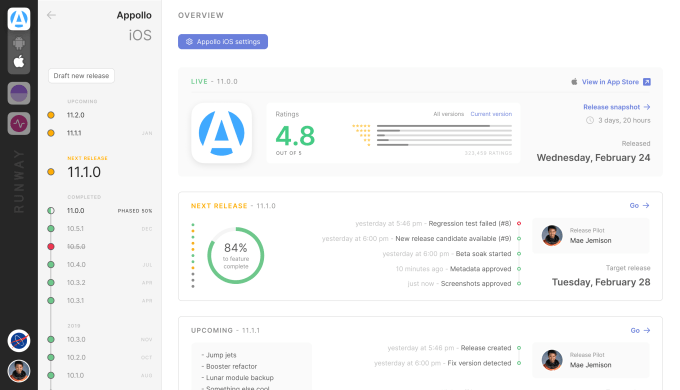
A team of mobile app engineers and designers from companies like Rent the Runway, ClassPass, Kickstarter and others, are now launching their own startup, Runway, to address the common pain points they experienced around the mobile app release cycle. With Runway, teams can connect their existing tools to keep track of the progress of an

A team of mobile app engineers and designers from companies like Rent the Runway, ClassPass, Kickstarter and others, are now launching their own startup, Runway, to address the common pain points they experienced around the mobile app release cycle. With Runway, teams can connect their existing tools to keep track of the progress of an app’s release, automate many of the manual steps along the way, and better facilitate communication among all those involved.

“Mobile app releases are exercises in herding cats, we often say. There’s a lot of moving pieces and a lot of fragmentation across tools,” explains Runway co-founder Gabriel Savit, who met his fellow co-founders — Isabel Barrera, David Filion, and Matt Varghese — when they all worked together as the first mobile app team at Rent the Runway.

“The result is a lot of overhead in terms of time spent and wasted, a lot of back and forth on Slack to make sure things are ready to ship,” he says.

Typically, interdisciplinary teams involving engineers, product, marketing, design, QA, and more, will keep each other updated on the app’s progress using things like spreadsheets and other shared documents, in addition to Slack.

Meanwhile, the actual work taking place to prepare for the release is being managed with a variety of separate tools, like GitHub, JIRA, Trello, Bitrise, CircleCI, and others.

Runway is designed to work as an integration layer across all the team’s tools. Using a simple OAuth authentication flow, the team connects whichever tools they use with Runway, then configure a few settings that allow Runway to understand their unique workflow — like what their branching strategy is, how they create release branches, how they tag releases, and so on.

In other words, teams train Runway to understand how they operate — they don’t have to change their own processes or behavior to accommodate Runway.

Once set up, Runway reads the information from the various integration points, interprets it and takes action. Everyone on the team is able to log into Runway via its web interface and see exactly where they are in the release cycle and what still needs to be done.

“We’re forming this glue, this connective tissue between all of the moving pieces and the tools, and creating a true source of truth that everybody can refer to and sync or gather around. That really facilitates and improves the level of collaboration and getting people on the same page,” Savit says.

Image Credits: Runway

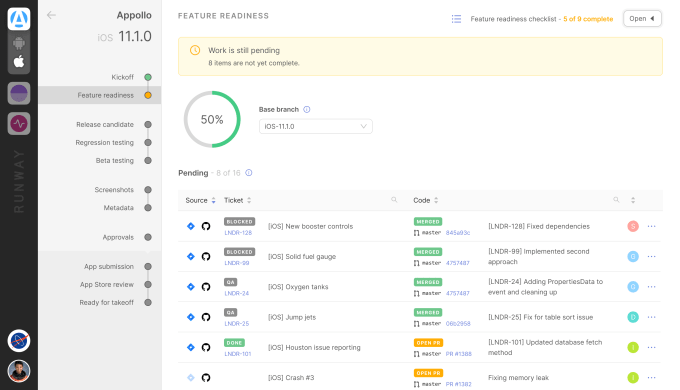
As the work continues, Runway helps to identify problems, like missing JIRA tags, for example. It then automatically backfills those tags. It can also help prevent other mistakes, like when the incorrect build is being selected for submission.

Another automation involves Slack communication. Because Runway understands who’s responsible for what, it can direct Slack notifications and updates to specific members of the team. This reduces the noise in the Slack channel and ensures that everyone knows what they’re meant to be working on.

Currently, Runway is focused on all the parts of the mobile app release cycle from kickoff to submission to the actual app store releases. On its near-term roadmap, it plans to expand its integrations to include connections to things like bug reporting and beta testing platforms. Longer-term, the company wants to expand its workflow include launching apps on other platforms, like desktop.

Image Credits: Runway

The startup is currently in pilot testing with a few early customers, including ClassPass, Kickstarter, and Capsule, and a few others. These customers, though not yet paying clients, have already used the system in production for over 40 app release cycles.

The startup’s pricing will begin at $400 per app per month, which allows for unlimited release managers and unlimited apps, access to all integrations, and iOS and Android support, among other things. Custom pricing will be offered to those who want higher levels of customer support and consulting services.

The startup doesn’t have an exact ETA to when it will launch publicly as it’s working to onboard each customer and work closely with them to address their specific integration needs for now. Today, Runway supports integrations with the App Store, Google Play, GitHub, JIRA, Slack, Circle, fastlane, GitLab, Bitrise, Linear, Jenkins, and others, but may add more integrations as customers require.

Runway’s team of four is mostly New York-based, and is currently participating in Y Combinator’s Winter 2021 virtual program. The company hasn’t yet raised a seed round.

News: America’s small businesses face the brunt of China’s Exchange server hacks

As the U.S. reportedly readies for retaliation against Russia for hacking into some of the government’s most sensitive federal networks, the U.S. is facing another old adversary in cyberspace: China. Microsoft last week revealed a new hacking group it calls Hafnium, which operates in, and is backed by, China. Hafnium used four previously unreported vulnerabilities

As the U.S. reportedly readies for retaliation against Russia for hacking into some of the government’s most sensitive federal networks, the U.S. is facing another old adversary in cyberspace: China.

Microsoft last week revealed a new hacking group it calls Hafnium, which operates in, and is backed by, China. Hafnium used four previously unreported vulnerabilities — or zero-days — to break into at least tens of thousands of organizations running vulnerable Microsoft Exchange email servers and steal email mailboxes and address books.

It’s not clear what Hafnium’s motives are. Some liken the activity to espionage — a nation-state gathering intelligence or industrial secrets from larger corporations and governments.

But what makes this particular hacking campaign so damaging is not only the ease with which the flaws can be exploited, but also how many — and how widespread — the victims are.

Security experts say the hackers automated their attacks by scanning the internet for vulnerable servers, hitting a broad range of targets and industries — law firms and policy think tanks, but also defense contractors and infectious disease researchers. Schools, religious institutions, and local governments are among the victims running vulnerable Exchange email servers and caught up by the Hafnium attacks.

While Microsoft has published patches, the U.S. federal cybersecurity advisory agency CISA said the patches only fix the vulnerabilities — and won’t close any backdoors left behind by the hackers.

CISA is aware of widespread domestic and international exploitation of Microsoft Exchange Server vulnerabilities and urges scanning Exchange Server logs with Microsoft’s IOC detection tool to help determine compromise. https://t.co/khgCR2LAs0. #Cyber #Cybersecurity #InfoSec

— US-CERT (@USCERT_gov) March 6, 2021

There is little doubt that larger, well-resourced organizations have a better shot at investigating if their systems were compromised, allowing those victims to prevent further infections, like destructive malware or ransomware.

But that leaves the smaller, rural victims largely on their own to investigate if their networks were breached.

“The types of victims we have seen are quite diverse, many of whom outsource technical support to local IT providers whose expertise is in deploying and managing IT systems, not responding to cyber threats,” said Matthew Meltzer, a security analyst at Volexity, a cybersecurity firm that helped to identify Hafnium.

Without the budget for cybersecurity, victims can always assume they are compromised – but that doesn’t equate to knowing what to do next. Patching the flaws is just one part of the recovery effort. Cleaning up after the hackers will be the most challenging part for smaller businesses that may lack the cybersecurity expertise.

It’s also a race against the clock to prevent other malicious hackers from discovering or using the same vulnerabilities to spread ransomware or launch destructive attacks. Both Red Canary and Huntress said they believe hacking groups beyond Hafnium are exploiting the same vulnerabilities. ESET said at least ten groups were also exploiting the same server flaws.

Katie Nickels, director of intelligence at threat detection firm Red Canary, said there is “clearly widespread activity” exploiting these Exchange server vulnerabilities, but that the number of servers exploited further has been fewer.

“Cleaning up the initial web shells will be much easier for the average IT administrator than it would be to investigate follow-on activity,” said Nickels.

Microsoft has published guidance on what administrators can do, and CISA has both advice and a tool that helps to search server logs for evidence of a compromise. And in a rare statement, the White House’s National Security Council warned that patching alone “is not remediation,” and urged businesses to “take immediate measures.”

Patching and mitigation is not remediation if the servers have already been compromised. It is essential that any organization with a vulnerable server take immediate measures to determine if they were already targeted. https://t.co/HYKF2lA7sn

— National Security Council (@WHNSC) March 6, 2021

How that advice trickles down to smaller businesses will be watched carefully.

Cybersecurity expert Runa Sandvik said many victims, including the mom-and-pop shops, may not even know they are affected, and even if they realize they are, they’ll need step-by-step guidance on what to do next.

“Defending against a threat like this is one thing, but investigating a potential breach and evicting the actor is a larger challenge,” said Sandvik. “Companies have people who can install patches — that’s the first step — but figuring out if you’ve been breached requires time, tools, and logs.”

Security experts say Hafnium primarily targets U.S. businesses, but that the attacks are global. Europe’s banking authority is one of the largest organizations to confirm its Exchange email servers were compromised by the attack.

Norway’s national security authority said that it has “already seen exploitation of these vulnerabilities” in the country and that it would scan for vulnerable servers across Norway’s internet space to notify their owners. Slovenia’s cybersecurity response unit, known as SI-CERT, said in a tweet that it too had notified potential victims in its internet space.

Sandvik said the U.S. government and private sector could do more to better coordinate the response, given the broad reach into U.S. businesses. CISA proposed new powers in 2019 to allow the agency to subpoena internet providers to identify the owners of vulnerable and unpatched systems. The agency just received those new powers in the government’s annual defense bill in December.

“Someone needs to own it,” said Sandvik.


Send tips securely over Signal and WhatsApp to +1 646-755-8849. You can also send files or documents using SecureDrop.

News: How Coupang is “out-Amazoning even Amazon,” according to Goodwater Capital

Korean e-commerce giant Coupang is expected to hold one of the biggest tech IPOs of the year on March 11. The company disclosed earlier this month that it is seeking up to $3.6 billion at a potential $51 billion valuation on the New York Stock Exchange. Founded in 2010, Coupang is sometimes described as the

Korean e-commerce giant Coupang is expected to hold one of the biggest tech IPOs of the year on March 11. The company disclosed earlier this month that it is seeking up to $3.6 billion at a potential $51 billion valuation on the New York Stock Exchange. Founded in 2010, Coupang is sometimes described as the Amazon of South Korea, but for years it has managed the impressive feat of achieving an even higher dollar retention rate than Amazon, according to a report by Goodwater Capital.

Goodwater’s S-1 teardown of Coupang, released today, is based on a combination of proprietary consumer research and information from Coupang’s S-1 filing. Before launching Goodwater, co-founder Eric Kim was managing director at Maverick, an early investor in Coupang, and served on the company’s board from 2011 to 2017. Neither he nor Goodwater have holdings in Coupang, however, and are releasing the teardown as third-party research.

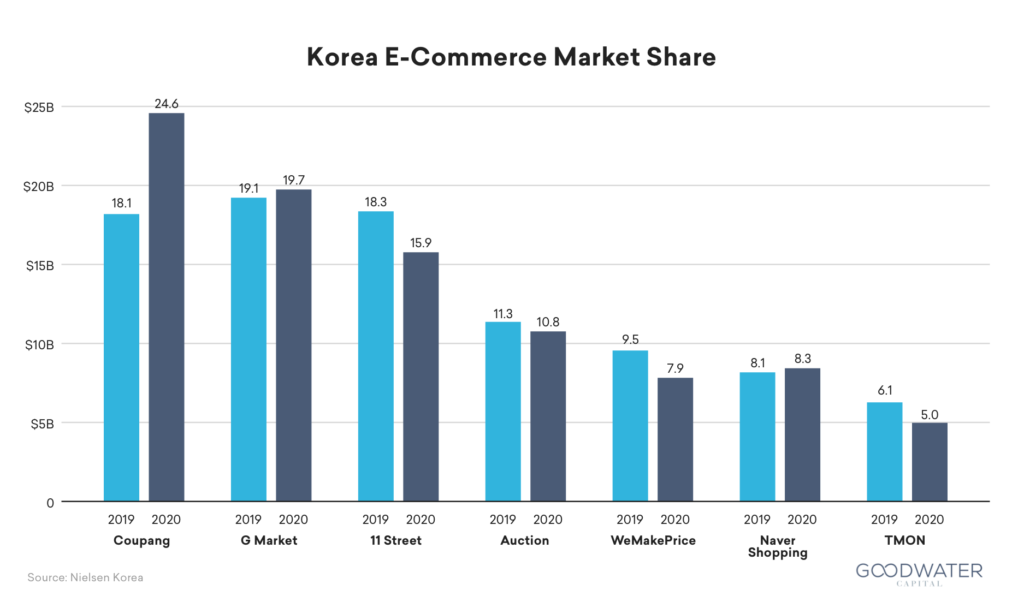
According to the report, Coupang is not only the current market leader in South Korea, but also “the only player making major market share gains, widening its lead over competitors” like G Market, 11 Street, Auction, WeMakePrice, Naver Shopping and TMON. In 2020, it increased its market share to 24.6%, up from 18.1% in 2019.

Coupang market share

Coupang market share

Notably, Goodwater’s research found that shoppers are more likely to return and spend money on Coupang than other e-commerce sites—not just compared to its South Korean competitors, but also other major e-commerce players around the world. Based on dollar retention rate (or the amount of money a group spends each year after they first use a platform), Coupang customers return and spend more money than shoppers on eBay, Etsy, Walmart or Alibaba in the U.S.

“Customers are coming back and spending at a rate that easily exceeds those platforms and closely matches the behavior on Amazon,” the report says. “But more surprising is that as early as 2017, Coupang’s performance already started to exceed Amazon, with year 3 dollar retention of 346% with Amazon at 278%. Later cohorts have already improved on that. The value of these customers are not only best-in-class in Korea, but likely the highest in the world.”

Coupang's dollar retention rate compared to other e-commerce players

Coupang’s dollar retention rate compared to other e-commerce players

This is due in large part to Coupang’s heavy investment in logistics. When the company was founded in 2010, there were no major third-party logistics providers in South Korea comparable to UPS or FedEx in the U.S. Coupang had to build its own infrastructure and now has 100 fulfillment and logistics centers in 30 cities and 15,000 delivery drivers.

As a result of this aggressive focus, about 70% of South Korea’s population now lives within seven miles of a Coupang logistics center. This means it can offer free next-day delivery, same-day deliveries for items like groceries, and its trademark Dawn Delivery (order by midnight for packages that arrive before 7AM) for millions of products. This makes it especially attractive to shoppers in a country where “the work culture rivals that of the 996 work culture in China,” the report says.

Coupang consumer research by Goodwater Capital

Coupang consumer research by Goodwater Capital

In order to catch up, Kim told TechCrunch in an email that “a competitor would need to figure out a way to invest billions into logistical and technical infrastructure to try to compete with Coupang. Even with the necessary resourcing, you’ll notice that in South Korea, similar to other developed geographies, market leaders tend to build on their leads over time. We’ve seen this with Kakao, Naver, and now Coupang.”

“The moats from scale are quite strong in a market like South Korea because you’ve done something right to win over the South Korean consumer,” he added. 

Despite its high market penetration already, Kim said Coupang still has two main areas of growth. These are Rocket Fresh, its fresh grocery delivery business, and Coupang Eats, similar to Uber Eats. “Both leverage Coupang’s vast logistics network and Coupang has the largest directly employed delivery fleet in South Korea with over 15,000 directly employed drivers.”

Coupang was also able to grow quickly thanks to South Korea’s very high internet penetration rate of 96% and relatively high gross domestic product per capita. In addition, its logistics infrastructure benefits from the country’s geography.

Coupang’s model is very unique because of the density of South Korea. You have 50 million+ people in the landmass the size of the state of Indiana, but when you look specifically at just inhabitable land, it’s really the size of Rhode Island, about 2,700 square kilometers,” Kim said. “This allows Coupang to innovate on delivery in a way the world has never seen before.”

Coupang’s IPO is drawing comparisons to Alibaba’s debut on the New York Stock Exchange in 2014, since both are Asian e-commerce giants. But there are also several noteworthy differences between the two companies including “the amount of capital intensity between the two at the time of the IPO, where Alibaba had a capital-light model that didn’t require having a lot of infrastructure investment at the time,” Kim said. “That shows mainly in the operating margins at the time, where it was 31% for Alibaba vs. -4% for Coupang (Coupang was still operating cash flow positive from in 2020 with $302M).”

A major commonality is that both companies became pioneers by focusing on making it easier to buy from their platforms in their respective markets, he added. “The road to solving for the consumer experience in China was different than the road for solving it in Korea, where the biggest friction points for consumers are different. This led Alibaba to embrace initiatives like digital payments early on, and why Coupang went to solve consumer logistics.”

News: Apple to invest $1.2 billion in silicon design center in Germany

Apple has announced that it plans to increase its corporate spendings in Germany. In particular, the company wants to set up a new facility in Munich, Germany. Called the European Silicon Design Center, the team will focus on 5G and potentially future wireless technologies. The company said that Munich is already its largest engineering hub

Apple has announced that it plans to increase its corporate spendings in Germany. In particular, the company wants to set up a new facility in Munich, Germany. Called the European Silicon Design Center, the team will focus on 5G and potentially future wireless technologies.

The company said that Munich is already its largest engineering hub in Europe. There are already 1,500 engineers working there. In particular, Apple has been putting together its own team of engineers working on power management chips.

Overall, half of Apple’s engineers working on power management are located in Germany. Since then, Apple’s teams in the country have expanded beyond power management to work on other chip designs.

Now, Apple plans to invest $1.2 billion (€1 billion) over the next three years on a new building and new R&D investments. While Apple is partnering with Qualcomm for the 5G modems in the iPhone 12 lineup, the company has also acquired most of Intel’s smartphone modem business.

In addition to in-house chip development, Apple’s teams also work on integrating third-party hardware with its devices, such as the iPhone, iPad and Apple Watch.

The company is also using this announcement to remind everyone that it is investing a lot of money in Germany as a whole. Apple works with many German providers, such as DELO, Infineon and Varta. Overall, Apple has spent $17.8 billion (€15 billion) with 700 German companies over the past five years

Here’s a rendering of the new building in Munich’s Karlstrasse. It should open in late 2022:

Image Credits: Apple

News: Lawmakers want to empower publishers to collectively negotiate with Facebook

On the heels of a heated standoff between platforms and publishers in Australia, U.S. lawmakers reintroduced a piece of legislation that would allow the news industry to collectively negotiate content deals with tech companies. The Journalism Competition and Preservation Act is sponsored in the Senate by Amy Klobuchar (D-MN) and John Kennedy (R-LA) and in

On the heels of a heated standoff between platforms and publishers in Australia, U.S. lawmakers reintroduced a piece of legislation that would allow the news industry to collectively negotiate content deals with tech companies.

The Journalism Competition and Preservation Act is sponsored in the Senate by Amy Klobuchar (D-MN) and John Kennedy (R-LA) and in the House by David Cicilline (D-RI), Ken Buck (R-NY) and Mark DeSaulnier (D-CA.). The legislation was first introduced in 2019, but the bipartisan cluster of lawmakers hope to breathe new life into it during the Biden era.

The bill would create an exemption from existing antitrust laws that would allow news organizations to collectively negotiate favorable terms with tech companies like Facebook and Google. That special treatment would open a 48-month window for publishers, in theory boosting their leverage to better the industry as a whole.

The U.S. isn’t the only country grappling with tech platforms’ publishing dominance. Last month, Facebook dramatically pulled links to news content in Australia as it pushed back against new regulations that could force tech platforms to pay for more content. Specifically, Facebook objected to a final arbitration clause that would set the price for news automatically if tech platforms and news publishers couldn’t agree on terms.

“We must enable news organizations to negotiate on a level playing field with the big tech companies if we want to preserve a strong and independent press,” Sen. Klobuchar said of the bill, which she argues would give publishers a “fighting chance” in dealing with tech platforms.

“A strong, diverse, free press is critical for any successful democracy,” Rep. Cicilline said. “Access to trustworthy local journalism helps inform the public, hold powerful people accountable, and root out corruption.”

Both Cicilline and Klobuchar sit in powerful positions, chairing the House and Senate’s respective antitrust subcommittees. In the coming months, those committees will play a major role in shaping legislative proposals that could rein in big tech’s many excesses. Balancing the power of colossal tech platforms against the priorities of a shrinking news industry is just one piece of that puzzle.

News: SoftBank-backed Volpe Capital raises $80M to invest in LatAm

In recent years, the tech and venture scene in Latin America has been growing at an accelerated pace. More global investors are backing startups in the region and certain sectors in particular, such as fintech, are exploding. Global investors are not only pouring money into companies. They’re also investing in funds. Today, Volpe Capital  announced

In recent years, the tech and venture scene in Latin America has been growing at an accelerated pace. More global investors are backing startups in the region and certain sectors in particular, such as fintech, are exploding.

Global investors are not only pouring money into companies. They’re also investing in funds.

Today, Volpe Capital  announced the $80 million first close of its fund targeting high growth technology investments in Latin America. Notably, Japanese investment conglomerate SoftBank, BTG and Banco Inter affiliates are anchor investors in the new fund, which is targeting aggregate commitments of $100 million with a hard cap of $150 million. Volpe also received a “large anchor investment” from its management team.

Andre Maciel, Gregory Reider and Milena Oliveira are the fund’s founding partners, and are based in Sao Paulo, Brazil. Notably, Maciel is the former managing partner at SoftBank’s $5 billion Latin America-focused innovation fund. He launched Volpe in 2019 primarily with SoftBank’s backing. Reider formerly invested at Warburg Pincus.

Maciel said the fund’s raise was “significantly oversubscribed with firm commitments” and believed to be “among the best capital raises for a first-time fund in its asset class in Latin America.”

Volpe Capital plans to invest in about 15 companies over a two and half year time span, according to Maciel, who expects its average check size to be around $5 billion.

So far, it’s backed Uol Edtech, a subsidiary of Grupo Uol that aims to redefine the digital learning experience in Brazil. 

“We are in no rush,” Maciel told TechCrunch. “We are happy with our first deal and will take capital preservation in consideration. We believe markets are hot now and plan on taking advantage of the cycle by being patient.”

The fund’s strategy is to go after the companies that are not actively raising capital.

We want to invest in companies that are not necessarily raising capital when we approach them,” Maciel said.

The fund views itself as agnostic regarding stage and primary versus secondary.

It is seeking to back early-stage companies with less than $50 million in valuation as well as some later stage, high growth companies. The fund’s first investment — Uol Edtech — falls in the latter category with EBITDA margins above 30%, according to Maciel.

Volpe plans to avoid capital intensive industries, even if related to tech.

“Those are more suitable to investors with deeper pockets than Volpe,” Maciel said. 

Instead it’s eyeing edtech, healthtech, software and fintech investments (that are not credit-related).

“We like sectors that are prone for disruption in Latin America and that require local customization,” Maciel said. “Given the stage of the vc/growth industry in Latin America, we believe it is better to be a generalist.”

SoftBank International CEO Marcelo Claure describes Maciel as one of his “amazing founding partners for SoftBank in Latin America.”

“We are very happy to be one of Volpe’s anchor investors and look forward to continuing our relationship with them,” he added in a written statement.

Another anchor investor has a SoftBank tie. João Vitor Menin, CEO of Inter, a publicly traded fintech platform in Brazil with a market cap of over  $7 billion, points out that Maciel led an investment in Inter’s platform through SoftBank. He also “made valuable contributions” as a board member, according to Menin.

WordPress Image Lightbox Plugin