Monthly Archives: March 2021

News: Chatbot startup Heyday raises $5.1M

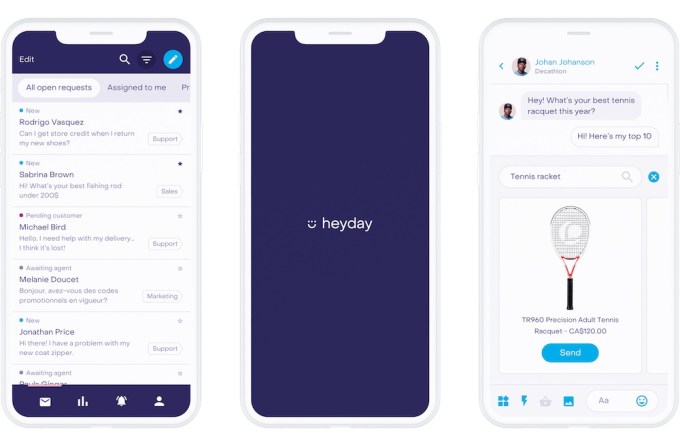
Montreal-based Heyday announced today that it has raised $6.5 million Canadian ($5.1 million in US dollars) in additional seed funding. Co-founder and CEO Steve Desjarlais told me that the startup’s goal is to allow retailers to support more automation and more personalization in their online customer interactions, while co-founder and CMO Etienne Merineau described it

Montreal-based Heyday announced today that it has raised $6.5 million Canadian ($5.1 million in US dollars) in additional seed funding.

Co-founder and CEO Steve Desjarlais told me that the startup’s goal is to allow retailers to support more automation and more personalization in their online customer interactions, while co-founder and CMO Etienne Merineau described it as an “all-in-one unified customer messaging platform.”

So whether a customer is sending a message from Facebook Messenger, WhatsApp and Google’s Business Messages or just via email, Heyday brings all that communication together in one dashboard. It then uses artificial intelligence to determine whether it’s a customer service or sales-related interaction, and it automates basic responses when possible.

Heyday chatbots can provide order updates or even recommend products (it integrates with Salesforce, Shopify, Magento, Lightspeed and PrestaShop), then route the conversation to a human team member when necessary.

There are other platforms that combine customer service and sales, but at the same time, Merineau said it’s important to treat the two categories as distinct and trust that a good service experience will lead to sales in the feature.

Heyday screenshot

Image Credits: Heyday

“We believe that helping is the new selling,” he said.

Desjarlais added, “We’re really against the ticket ID system. A customer is not a ticket …
I truly believe that every single customer is a relationship with a brand that needs to be nurtured over time and that will give more value to the brand over time.”

Heyday was founded in 2017 and says that over the past two quarters, it has doubled recurring revenue. Customers include French sporting good company Decathlon, Danish fashion house Bestseller to food and consumer product brand Dannon — Merineau noted that the platform was “bilingual out of the box” and has seen strong international growth.

“Retailers who believe that [the changes brought about by] COVID-19 are temporary are in the wrong mindset,” he said. “The new mantra of future-forward brands is ‘adapt or die.’ … Brands obviously want to delvier great service, but they care about the bottom line. We help them kill two birds with one stone.”

The startup had previously raised $2 million Canadian, according to Crunchbase. This new round comes from existing investors Innovobot and Desjardins Capital. Merineau said the money will help Heyday “double down on the U.S. and scale.”

News: Daily Crunch: Apple announces a chip design center in Germany

Apple is making a big investment in Germany, Russia takes aim at Twitter and Roblox goes public. This is your Daily Crunch for March 10, 2021. P.S. Don’t forget to sign up for TC Early Stage 2021, a virtual event focused on operations and fundraising that we’re holding on April 1 and 2! Apple announces

Apple is making a big investment in Germany, Russia takes aim at Twitter and Roblox goes public. This is your Daily Crunch for March 10, 2021.

P.S. Don’t forget to sign up for TC Early Stage 2021, a virtual event focused on operations and fundraising that we’re holding on April 1 and 2!

Apple announces a chip design center in Germany

Apple said it will spend $1.2 billion to create its European Silicon Design Center, which will be based in Munich and focus on chip design for 5G and other wireless technologies.

This is not Apple’s first facility in Munich — in fact, it says it already employs 1,500 engineers in the city, making it the company’s largest engineering hub in Europe. These teams were initially focused on power management, but have subsequently expanded their focus to other areas of chip design.

You can see a rendering of the planned building above.

The tech giants

Russia is trying to throttle Twitter — Russian state agency Roskomnadzor said it’s taking the action after Twitter did not remove banned content.

Adobe delivers native Photoshop for Apple Silicon Macs and a way to enlarge images without losing detail — Adobe has been moving quickly to update its imaging software to work natively on Apple’s new in-house processors for Macs.

Facebook challenges FTC’s antitrust case with Big Tech’s tattered playbook — Facebook has challenged the FTC’s antitrust case against it using a standard playbook that questions the agency’s arguably expansive approach to defining monopolies.

Startups, funding and venture capital

Why Terry Crews is launching a social currency — With the help of social currency startup Roll, Crews is launching his own social currency, $POWER.

EV subscription service Onto partners with Shell to expand access to charging — The partnership will give Onto customers access to more than 3,400 Shell Recharge charge points in the U.K.

Rent the Runway’s first iOS team launches Runway, an easier way to coordinate app releases — With Runway, teams can connect their existing tools to keep track of the progress of an app’s release, automate many of the manual steps along the way and better facilitate communication among all those involved.

Advice and analysis from Extra Crunch

Welcome to Bloxburg, public investors — As Roblox began to trade today, the company’s shares shot above its reference price of $45 per share.

Dear Sophie: What are the pros and cons of the H-1B, O-1A and EB-1A? — The latest edition of “Dear Sophie,” the advice column that answers immigration-related questions about working at technology companies.

Proactive CEOs should prioritize European expansion — FrontlineX Partner Brendan O’Donnell argues that the EMEA region is your best growth lever.

(Extra Crunch is our membership program, which helps founders and startup teams get ahead. You can sign up here.)

Everything else

NFTs are changing cultural value creation — The latest episode of Equity is all about non-fungible tokens.

Passive collaboration is essential to remote work’s long-term success — The adjustment to a fully remote workforce has been challenging for everyone.

ADL CEO Jonathan Greenblatt dives into tech’s reckoning with online hate — We spoke with Anti-Defamation League CEO Jonathan Greenblatt on proposed policy solutions and tech’s coming era of accountability.

The Daily Crunch is TechCrunch’s roundup of our biggest and most important stories. If you’d like to get this delivered to your inbox every day at around 3pm Pacific, you can subscribe here.

News: Could Marc Benioff be the next CEO to move to executive chairman?

Last month Jeff Bezos announced he would step down as CEO of Amazon later this year, moving into the executive chairman role, while passing the baton to AWS CEO Andy Jassy. Could Marc Benioff, co-founder, chairman and CEO at Salesforce be the next big-name executive to make a similar move? A Reuter’s story published on

Last month Jeff Bezos announced he would step down as CEO of Amazon later this year, moving into the executive chairman role, while passing the baton to AWS CEO Andy Jassy. Could Marc Benioff, co-founder, chairman and CEO at Salesforce be the next big-name executive to make a similar move?

A Reuter’s story published on Monday suggested that could be the case. Citing unnamed sources, the story indicated that Benioff’s CEO exit could happen this year. Further those same sources suggested that current Salesforce president and COO Bret Taylor is the likely heir apparent.

We wrote a story at the end of last year speculating on possible successors to Benioff, were he to step away from the CEO role. There were a number of worthy candidates, several of whom, like Taylor, came to the company via an acquisition. All the same, we thought that Taylor seemed to be the most likely candidate to replace Benioff.

We asked Salesforce for a comment on the Reuter’s story. A company spokesperson told us that the company doesn’t comment on rumors or speculation.

While the entire scenario fits firmly in the rumor and speculation column, it is not entirely unlikely either. What would it mean if Benioff stepped away and what if Taylor was truly the next in line? And how would that swap compare with the Bezos decision were it to happen?

Similar yet different

Salesforce and Amazon are both companies founded in the 1990s, each looking to shake up its industry.

For Amazon, it was changing the way goods (starting with books) were bought and sold. And for Benioff the goal was changing the way software was sold. Bezos famously founded his company in his garage. Benioff built his in a rented apartment. From these humble beginnings both have built iconic companies and accumulated enormous wealth. You could understand why either could be ready to step away from the daily grind of running a company after all these years.

Bezos announced that veteran executive Andy Jassy, who runs the company’s cloud arm, would be his replacement when the handoff comes. Jassy knows the organization’s priority mix as he’s been working at the company for more than two decades. He’s locked into the culture and helped take AWS from idea to $50 billion juggernaut.

While Benioff hasn’t made any actual firm pronouncement, we have seen Bret Taylor — who joined the company in 2016 when Salesforce purchased his startup Quip for $750 million — move quickly up the ladder.

Laurie McCabe, co-founder and analyst at SMB Group, who has been following Salesforce since its earliest days, says that if Benioff were to leave, he would obviously leave big shoes to fill. But she agreed that everything seems to point to Taylor as his successor should that happen.

“Salesforce has been grooming Taylor for awhile. He has some stellar credentials both at Salesforce, his own start-up, Quip, that Salesforce acquired, and at Facebook. There’s no doubt in my mind he can lead Salesforce forward, but he’ll bring a different more low-key style to the role. And I’m sure Benioff will stay very involved […],” McCabe said.

Two different situations

Brent Leary, founder and principal analyst at CRM Essentials says that while he believes Taylor could be chosen as Benioff’s successor, and would be qualified to lead the company, he’s taken a very different path from Jassy.

“I think Benioff moving on could be different from Bezos in the sense that Jassy has been at Amazon for over 20 years and was there to basically see and be part of most of the story. […] But if Taylor were to succeed Benioff there’s not as much [history] at Salesforce with him not being on board until the Quip acquisition in 2016,” Leary said.

Leary wonders if this relatively short history with the company could create some political friction in the organization if he were chosen to succeed Benioff. “I’m not saying that this would happen, but choosing one of the many possible heirs that have come via a number of high profile acquisitions could possibly lead to high level turnover from those not picked to succeed Benioff,” he said.

But Holger Mueller, an analyst at Constellation Research says that if you look at the range of candidates available, he believes that Taylor would be the best choice. “I don’t expect any issue because there is no one with a similar or even better background, which is when there are problems — that or when people are in an open competition as it used to be at GE,” he said.

We don’t know for sure what the final outcome will be, but if Benioff does decide to join Bezos and takes the executive chairman mantle at the company, it makes sense that the person to replace him will be Taylor. But for now, it remains in the realm of speculation, and we’ll just to wait and see if that’s what comes to pass.

News: The Department of Defense is establishing a working group to focus on climate change

The U.S. Department of Defense is setting up a working group to focus on climate change. The new group will be led by Joe Bryan, who was appointed as a special assistant to the Secretary of Defense focused on climate earlier this year. The move is one of several steps that the Biden administration has

The U.S. Department of Defense is setting up a working group to focus on climate change.

The new group will be led by Joe Bryan, who was appointed as a special assistant to the Secretary of Defense focused on climate earlier this year.

The move is one of several steps that the Biden administration has taken to push an agenda that looks to address the dangers posed by global climate change.

Bryan, who previously served as deputy assistant to the Secretary of the Navy for Energy under the Obama administration, will oversee a group intended to coordinate the Department’s responses to Biden’s recent executive order and subsequent climate and energy-related directives and track implementation of climate and energy-related actions and progress, according to a statement.

The Department of Defense controls the purse strings for hundreds of billions of dollars in government spending and is a huge consumer of electricity, oil and gas, and industrial materials. Any steps it takes to improve the efficiency of its supply chain, reduce the emissions profile of its fleet of vehicles, and use renewable energy to power operations could make a huge contribution to the commercialization of renewable and sustainable technologies and a reduction in greenhouse gas emissions.

The Pentagon is already including security implications of climate change in its risk analyses, strategy development and planning guidance, according to the statement, and is including those risk analyses in its installation planning, modeling, simulation and war gaming, and the National Defense Strategy.

“Whether it is increasing platform efficiency to improve freedom of action in contested logistics environments, or deploying new energy solutions to strengthen resilience of key capabilities at installations, our mission objectives are well-aligned with our climate goals,” wrote Defense Secretary Lloyd Austin, in a statement. “The department will leverage that alignment to modernize the force, strengthen our supply chains, identify opportunities to work closely with allies and partners, and compete with China for the energy technologies that are essential to our future success.”

News: Superpowered lets you see your schedule and join meetings from the Mac menu bar

A newly launched Mac app called Superpowered aims to make it easier to stay on top of all your Zoom calls and Google Meets, without having to scramble to find the meeting link in your inbox or calendar app at the last minute. Instead of relying on calendar reminders, Superpowered offers a notification inbox for the

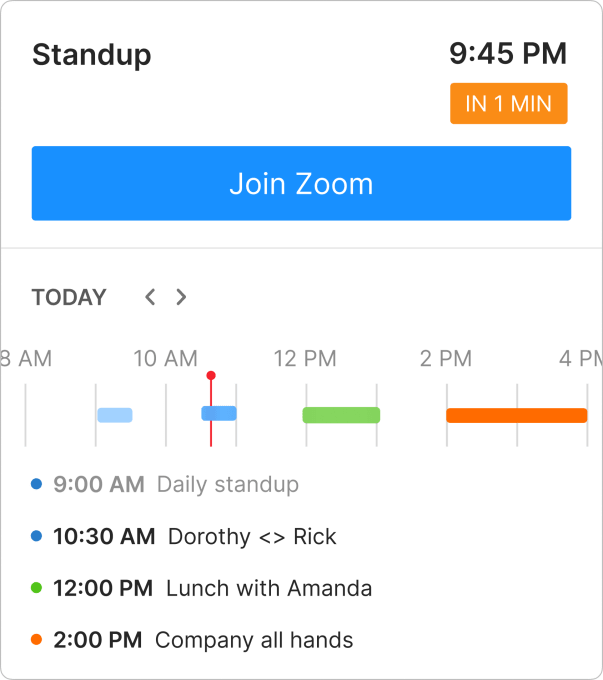
A newly launched Mac app called Superpowered aims to make it easier to stay on top of all your Zoom calls and Google Meets, without having to scramble to find the meeting link in your inbox or calendar app at the last minute. Instead of relying on calendar reminders, Superpowered offers a notification inbox for the Mac menu bar that alerts you to online meetings just before they start, which you can then join with a click of a button.

To use Superpowered, you first download the app then authorize it to access to your Google Calendar. The app currently works with any Google account, including G Suite, as well as your subscribed calendars.

Once connected, Superpowered pulls all your events into the menu bar, which you can view at any time throughout the day with a click or by using the keyboard shortcut Command+Y.

When you have a meeting coming up, Superpowered will display a drop-down notification to alert you, or you can opt for a more subtle halo effect instead to have it get your attention. You can also configure other preferences — like whether you want a chime to sound, how far in advance you want to be alerted, whether you want a meeting reminder as text to appear in the menu bar ahead of the meeting and so on.

When it’s time for the meeting, all you have to do is click the button it displays to join your Zoom call or Google Meet. The solution is simple, but effective. The startup plans to add support for more integrations going forward, including Microsoft Teams, Cisco WebEx and others.

The idea for the app comes from four computer science and software engineering students from the University of Waterloo, who previously interned at tech companies like Google, Facebook, Asana and Spotify.

Team photo. Image Credits: Superpowered

Wanting to build a startup of their own, the team applied to the accelerator Y Combinator with an idea to build a lecture platform for professors. But they soon faced issues in keeping up with their own calendar appointments as they began to conduct user research interviews.

“We were struggling to keep up with each other’s calendars and balance all these meetings throughout the day,” explains Superpowered co-founder Jordan Dearsley, who built the service alongside teammates Nikhil Gupta, Ibrahim Irfan and Nick Yang. “We would be at lunch and be like, ‘Oh shoot, we have a meeting now — I have to run!’ or just completely miss it altogether,” he says.

Irfan had the idea to just put a button in the Mac menu bar to make it easier to join Zoom meetings and soon the team pivoted to work on Superpowered instead.

The product itself is very new. Development work began roughly two months ago and Superpowered opened up to users just last month — a quick pace that Dearsley says was possible because three of the four team members are engineers, and the other, Yang, is the designer.

Image Credits: Superpowered

Although it’s a paid product offered at $10 per month, Superpowered already has hundreds of users who are interacting with the app, on average, 10 times per day. Busier users, like product managers, are clicking on Superpowered as many as 20 to 40 times per day — an indication that it’s found a place in users’ workflows. In the month since its launch, the app has connected users with over 10,000 online meetings, the company says.

Superpowered is not the first to add calendar appointments to the Mac’s menu bar. It competes with a range of products, like MeetingBar, Meeter, Next Meeting and others. But users have been responding to Superpowered’s sleek, clean design.

The company also has a vision for the product’s future that extends beyond meetings. After solving this particular pain point, Superpowered plans to broaden its scope to fix other annoyances for knowledge workers — like Slack notifications, for example.

“It’s really annoying to be pinged all the time while I’m coding … and I don’t know if it’s something that’s worth seeing because Slack doesn’t really give me those controls or ability to peek,” explains Dearsley. Meanwhile, Mac’s built-in Notification Center isn’t smart enough to show you just those items that you really need to know about.

To address this, the team is now working on a Slack integration that will let you quickly check your messages and reply without having to launch the Slack app. Further down the road, the team wants to integrate support for other platforms — like Google Docs, JIRA and GitHub — which would all be pulled into Superpowered’s universal notification inbox.

For the time being, Superpowered is $10 per month for Mac users or $8 per month for those who sign up with a team. Annual pricing is not yet available.

News: Why Terry Crews is launching a social currency

Actor Terry Crews is going in on the blockchain. With the help of social currency startup Roll, Crews is launching his own social currency, $POWER. But first, let’s break down what that means. Anyone can create a social currency, which hundreds of creators have already done via Roll, to change their relationships with fans and

Actor Terry Crews is going in on the blockchain. With the help of social currency startup Roll, Crews is launching his own social currency, $POWER.

But first, let’s break down what that means. Anyone can create a social currency, which hundreds of creators have already done via Roll, to change their relationships with fans and users. Roll enables creators to mint and distribute their own social currency under the ERC20 standard and then determine the ways in which their communities can earn and spend that social currency.

“Anyone, anywhere, anytime can create their own content,” Roll founder and CEO Bradley Miles told TechCrunch. “We refer to this as mass personalization of content. Right now, Roll is experiencing the same thing with money itself. Anyone, anywhere, anytime can create their own money.”

The way I think of it is it’s almost like the process for earning and redeeming credit card points but minus the credit card company and plus the blockchain and creators. I haven’t run this analogy by Miles, but I’m going with it. Just how your credit card provider gives you points for using your card and then you can redeem those points for cash, airline tickets, etc., creators give fans social currency for engaging with their work in a variety of ways. Then, fans can redeem that social currency for more art, content or what have you.

Currently, there are about 300 creators, including Crews, using Roll. Roll, which has $2.7 million in funding from investors like Balaji Srinivasan, Trevor McFederies and others, recently saw its social currency market cap surpass $1 billion. Bradley Miles gifted me .10 $WHALE (worth about $3) so I could get a better understanding of how creators are already using Roll. $WHALE is backed by tangible and rare non-fungible token assets, which means that I can use my $WHALE to buy NFTs. And because Roll enables users to trade their social currency for over 600 other digital assets, that means I could buy the below NFT over on NFT marketplace OpenSea.

Image Credits: Screenshot/OpenSea

However, you’ll see that the Podmork Pix 35 WS cost 28 $WHALE, so I will not be buying this NFT.

In the case of Crews, he envisions folks earning $POWER via blockchain art purchases, NFTs, physical goods and experiences. Initially, Crews is engaging with his $POWER community through Discord. Folks with 50 $POWER, for example, can access a special channel within Discord. To date, Crews had distributed $POWER to about 100 people, he said.

“If I give you $POWER, you own a piece of me,” Crews said. “There’s no other way to put it. And I want to be very careful about who is holding me, no puns intended.”

It’s still early days for $POWER, but Crews says he eventually wants to offer interest-free microloans to artists. The ultimate goal with $POWER is to empower artists.

“That’s our long-term plan,” Crews said. “To become this thing that this community can live and exist in. You could use it anywhere you are — at Target, the grocery store.”

Crews attributes his interest in this space to something that happened to him about four years ago.

While in Milan, Crews said he was trying to buy designer furniture from an artist he respected at Salone del Mobile. He realized he needed extra money to complete the purchase, but didn’t have enough cash in his checking account to cover it. So he got on the phone with American Express, he said, who told him to go to a local bank. American Express, on Crews’ behalf, then tried to explain the situation to the local bank manager so that Crews could get the funds he needed to complete the transaction. Crews said the local bank manager took one look at him and said, “no.”

“And I’m watching all these white men and women pass me in line, and they’re looking at me strangely,” Crews said. “I’d been standing there for 15 minutes and it slowly dawns on me that because I’m Black, I was not going to get my money,” he said. “That was the moment I knew everything had to change for me.”

Crews ended up going to a check-cashing place, in an area where he said his Uber driver refused to go, and got the funds to pay the fees.

“Bringing it up still makes me angry,” he said. “What I love about this new world of finance is that cryptocurrency does not know what race you are, how old you are.”

Through $POWER, Crews hopes to put power back in the hands of artists and creators, Crews explained.

“There’s no gatekeeper to tell us no,” he said.

Crews says he’s also going to start putting out his own content into the $POWER community, where the community will collectively own it together.

“This is bigger than me,” he said. “This is a new future.”

For Miles, he envisions a world in which $POWER is accepted at movie theaters or at Paramount Pictures properties.

“[Social currency] is not to replace the dollar,” Miles said. “It’s to complement [money] and do work that probably the dollar is not suited to do.”

I asked Crews if this means he’s leaving Hollywood and will solely focus on producing his own content for his $POWER community. But Crews said he left Hollywood when he sued William Morris Endeavor in 2017 alleging an executive from the firm groped him. Crews and WME settled the suit in 2018.

“And they were done with me,” he said. “But the deal is, is that I had my power. I still had my talent. William Morris threatened to end everything I’m doing. But everything I’m doing right now, you can’t take. So that’s when I separated from Hollywood. I’ve never felt like a Hollywood person, even to this day. But every artist out there probably feels the same way. They want their power.”


 

News: Facebook challenges FTC’s antitrust case with Big Tech’s tattered playbook

Facebook has challenged the FTC’s antitrust case against it using a standard playbook that questions the agency’s arguably expansive approach to defining monopolies. But the old arguments of “we’re not a monopoly because we never raised prices” and “how can it be anti-competitive if we never allowed competition” may soon be challenged by new doctrine

Facebook has challenged the FTC’s antitrust case against it using a standard playbook that questions the agency’s arguably expansive approach to defining monopolies. But the old arguments of “we’re not a monopoly because we never raised prices” and “how can it be anti-competitive if we never allowed competition” may soon be challenged by new doctrine and the new administration.

In a document filed today, which you can read at the bottom of this post, Facebook lays out its case with a tone of aggrieved pathos:

By a one-vote margin, in the fraught environment of relentless criticism of Facebook for matters entirely unrelated to antitrust concerns, the agency decided to bring a case against Facebook that ignores its own prior decisions, controlling precedent, and the limits of its statutory authority.

Yes, Facebook is the victim here, and don’t you forget it. (Incidentally, the FTC, like the FCC, is designed to split 3:2 along party lines, so the “one-vote margin” is what one sees for many important measures.)

But after the requisite crying comes the reluctant explanation that the FTC doesn’t know its own business. The suit against Facebook, the company argues, should be spiked by the judge because it fails along three lines.

First, the FTC does not “allege a plausible relevant market.” After all, to have a monopoly, one must have a market over which to exert that monopoly. And the FTC, Facebook argues, has not done so, alleging only a nebulous “personal social networking” market, and “no court has ever held that such a free goods market exists for antitrust purposes,” and the FTC ignores the “relentlessly competitive” advertising market that actually makes the company money.

Ultimately, the FTC’s efforts to structure a crabbed “use” market for a free service in which it can claim a large Facebook “share” are artificial and incoherent.

The implication here is not just that the FTC has failed to define the social media market (and Facebook won’t do so itself), but that such a market may not even exist because social media is free and the money is made by a different market. This is a variation on a standard Big Tech argument that amounts to “because we do not fall under any of the existing categories, we are effectively unregulated.” After all you cannot regulate a social media company by its advertising practices or vice versa (though they may be intertwined in some ways, they are distinct businesses in others).

Thusly Facebook attempts, like many before it, to squeeze between the cracks in the regulatory framework.

This continues with the second argument, which says that the FTC “cannot establish that Facebook has increased prices or restricted output because the agency acknowledges that Facebook’s products are offered for free and in unlimited quantities.”

The argument is literally that if the product is free to the consumer, it is by definition not possible for the provider to have a monopoly. When the FTC argues that Facebook controls 60% of the social media market (which of course doesn’t exist anyway), what does that even mean? 60% of zero dollars, or 100%, or 20%, is still zero.

The third argument is that the behaviors the FTC singles out — purchasing up-and-coming competitors for enormous sums and nipping others in the bud by restricting its own platform and data — are not only perfectly legal but that the agency has no standing to challenge them, having given its blessing before and having no specific illegal activity to point to at present.

Of course the FTC revisits mergers and acquisitions all the time, and there’s precedent for unraveling them long afterward if, for instance, new information comes to light that was not available during the review process.

“Facebook acquired a small photo-sharing service in 2012, Instagram … after that acquisition was reviewed and cleared by the FTC in a unanimous 5-0 vote,” the company argues. Leaving aside the absurd characterization of the billion-dollar purchase as “small,” leaks and disclosures of internal conversations contemporary with the acquisition have cast it in a completely new light. Facebook, then far less secure than it is today, was spooked and worried that Instagram may eat its lunch, so it was better to buy than compete.

The FTC addresses this and indeed many of the other points Facebook raises in a FAQ it posted around the time of the original filing.

Now, some of these arguments may have seemed a little strange to you. Why should it matter if a market has money from consumers being exchanged if there is value exchanged elsewhere contingent on those users’ engagement with the service, for instance? And how can the depredations of a company in the context of a free product that invades privacy (and has faced enormous fines for doing so) be judged by its actions in an adjacent market, like advertising?

The simple truth is that antitrust law has been stuck in a rut for decades, weighed down by doctrine that states that markets are defined by the price of a product and whether a company can increase it arbitrarily. A steel manufacturer that absorbs its competitors by undercutting them and then later raises prices when it is the only option is a simple example and the type that antitrust laws were created to combat.

If that seems needlessly simplistic, well, it’s more complicated in practice and has been effective in many circumstances — but the last 30 years have shown it to be inadequate to address the more complex multibusiness domains of the likes of Microsoft, Google and Facebook (to say nothing of TechCrunch parent company Verizon, which is a whole other matter).

The ascendance of Amazon is one of the best examples of the failure of antitrust doctrine and resulted in a breakthrough paper called “Amazon’s Antitrust Paradox” that pilloried these outdated ideas and showed how network effects led to subtler but no less effective anti-competitive practices. Establishment voices decried it as naive and overreaching, and progressive voices lauded it as the next wave of antitrust philosophy.

It seems that the latter camp may win out, as the author of this controversial paper, Lina Khan, has just been nominated for the vacant fifth commissioner position at the FTC.

Whether she is confirmed (she will face fierce opposition, no doubt, as an outsider plainly opposed to the status quo), her nomination validates her view as an important one. With Khan and her allies in charge at the FTC and elsewhere, the decades-old assumptions that Facebook relies on for its pro forma rejection of the FTC lawsuit may be challenged.

That may not matter for the present lawsuit, which is unlikely to be subject to said rules given its rather retrospective character, but the gloves will be off for the next round — and make no mistake, there will be a next round.

Federal Trade Commission v Facebook Inc Dcdce-20-03590 0056.1 by TechCrunch on Scribd

News: Passive collaboration is essential to remote work’s long-term success

As we look ahead to a hybrid work world, we must find new ways to continue supporting employee productivity and creativity. It’s only when we’re able to fully realize passive collaboration virtually that we’ll have unlocked the full potential of remote and hybrid work situations.

Mohak Shroff
Contributor

Mohak Shroff is head of engineering at LinkedIn. He leads the engineering teams responsible for building, scaling and protecting LinkedIn.

In 1998, Sun Microsystems piloted its “Open Work” program, letting roughly half of their workforce work flexibly from wherever they wanted. The project required new hardware, software and telecommunications solutions, and took about 24 months to implement.

Results were very positive, with a reduction in costs and the company’s carbon footprint. Despite this outcome, long-term remote work never really caught on more broadly. In fact, the 2010s were focused on going the other direction, as open offices, on-site perks and co-working spaces sprung up around the idea that in-person community is an essential component of innovation.

In 2020, companies of all sizes, in all corners of the world, were forced to shift to remote work with the onset of COVID-19. While some companies were better positioned than others — whether it be due to a previously distributed workforce, a reliance on cloud apps and services, or already-established flexible work policies — the adjustment to a fully remote workforce has been challenging for everyone. The truth is that even the largest companies have had to rely on the heroics of employees making sacrifices and persevering through numerous challenges to get through this time.

Technology like high-quality video conferencing and the cloud have been integral in making remote work possible. But we don’t yet have a complete substitute for in-person work because we continue to lack tooling in one critical area: passive collaboration. While active collaboration (which is the lion’s share) can happen over virtual meetings and emails, we haven’t fully solved for enabling the types of serendipitous conversations and chance connections that often power our biggest innovations and serve as the cornerstone of passive collaboration.

Active versus passive collaboration

Those outside of the tech industry may think that software engineers only need a computer and a secure internet connection to do their work. But the stereotype of the lone engineer coding away in solitude has long been shattered. The best engineering work isn’t done in isolation, but in collaboration, as teams discuss, wrangle and brainstorm through problems. Video conference platforms and chat applications help us collaborate actively, and tools like Microsoft Visual Studio Code and Google Docs allow for dedicated asynchronous collaboration, too.

But what we currently lack are the moments of spontaneous engagement that energize us and invite new ideas that otherwise wouldn’t have been part of the conversation. The long-term impact of not having access to this has not yet been measured, but it’s my belief that it will have a negative effect on innovation because passive collaboration plays such a critical role in fostering creativity.

The whiteboard

The best way to think about the differences between passive and active collaboration is to look at a whiteboard. Someone recently asked me, “What is it with people in tech and whiteboards? Why are they such a big deal?” Whiteboards are simple and “low-tech,” yet have become quintessential in our industry. That’s because they represent a source of multi-modal collaboration for engineers. Let’s think back to before COVID. How many times have you walked by (or been a part of) a scrum meeting of engineers huddled around a whiteboard?

Have you ever stopped by because you overheard a snippet of a conversation and wanted to learn more or share your perspective? Or maybe something on a whiteboard caught your eye and caused you to start a conversation with another colleague, leading to a breakthrough. These are all moments of passive collaboration, which whiteboards so excellently enable (in addition to being a tool for real-time, active collaboration). They’re low-friction ways to invite new ideas and perspectives to the conversation that otherwise wouldn’t have been considered.

While whiteboards are one mode of facilitating passive collaboration, they aren’t the only option. Serendipitous meetings in the break room, overhearing a conversation from the next cubicle over, or spotting someone across the room who’s free for a quick gut-check are also examples of passive collaboration. These interactions are a critical piece of how we work together and the hardest to recreate in a world of remote work. Just as silos in the development process are detrimental to software quality, so too is a lack of passive collaboration.

We need tools that will help us peek over at what other people are working on without the pressure of a dedicated meeting time or update email. The free and open exchange of ideas is a birthplace for innovation, but we haven’t yet figured out how to create a good virtual space for this.

Looking forward

The future of work is one in which teams are more distributed than ever before, meaning we need new tools for passive collaboration not just for this year, but for the future, too. Our own internal survey results tell us that while some employees prefer the option to be fully remote once the pandemic is behind us, the majority want a more flexible solution in the future.

Crucially, the answer is not to create more meetings or email threads, but instead to reimagine virtual spaces that can function like the classic whiteboard and other serendipitous modes of collaboration. As we all still look for ways to solve this challenge, we at LinkedIn have been thinking about how to encourage cross-team conversations and open Q&As to share resources, as a start.

For decades, the tech industry has paved the way for innovations in employee experience, creating spaces and benefits that reduced friction in collaboration and productivity. Now, as we look ahead to a hybrid work world, we must find new ways to continue supporting employee productivity and creativity. It’s only when we’re able to fully realize passive collaboration virtually that we’ll have unlocked the full potential of remote and hybrid work situations.

News: Welcome to Bloxburg, public investors

As Roblox began to trade today, the company’s shares shot above its reference price of $45 per share. Currently, Roblox is trading at $71.10 per share, up just over 60% from the reference price that it announced last night. That effort finally set a directional value of sorts on Roblox’s shares before it floated on

As Roblox began to trade today, the company’s shares shot above its reference price of $45 per share. Currently, Roblox is trading at $71.10 per share, up just over 60% from the reference price that it announced last night. That effort finally set a directional value of sorts on Roblox’s shares before it floated on the public markets. 

Roblox, a gaming company aimed at children and powered by an internal economy and third-party development activity, has had a tumultuous if exciting path to the public markets. The company initially intended to list in a traditional IPO, but after enthusiastic market conditions sent the value of some public-offering shares higher after they began to trade, Roblox hit pause.

The former startup then raised a Series H round of capital, a $520 million investment that boosted the value of Roblox from around $4 billion to $29.5 billion. TechCrunch jokes that, far from IPOs mispricing IPOs, that $4 billion price set in early 2020 was the real theft, given where the company was valued just a year later. Sure, the pandemic was good for Roblox, but seeing a 5x repricing in four quarters was hilarious.

Regardless. At $45 per share, Roblox’s direct listing reference price, the company was worth $29.1 billion, per Renaissance Capital, an IPO-focused group. Barron’s placed the number at $29.3 billion. No matter which is closer to the truth, they were both right next to the company’s final private price.

So, the Series H investors nailed the value of Roblox, or the company merely tied its reference price to that price. Either way, we had a pretty clear Series H direct listing reference price handoff.

The company’s performance today makes that effort appear somewhat meaningless as both prices were wildly under what traders were willing to cough up during its first day of trading; naturally, we’ll keep tabs on its price as time continues, and one day is not a trend, but seeing Roblox trade so very far above its direct listing reference price and final private valuation appears to undercut the argument that this sort of debut can sort out pricing issues inherent in more traditional IPOs.

To understand the company’s early trading activity, however, we need to understand just how well Roblox performed in Q4 2020. When we last noodled on the company’s valuation, we only had data through the third quarter of last year. Now we have data through December 31, 2020. Let’s check how much Roblox grew in that final period, and if it helps explain how the company managed that epic Series H markup.

Gaming is popular, who knew

News: EV subscription service Onto partners with Shell to expand access to charging

British electric vehicle subscription service Onto has partnered with Shell to give its users access to charging stations in preparation for a wave of new EVs coming to market over the next several years.  The partnership, which Shell announced Tuesday, will give Onto customers access to more than 3,400 Shell Recharge charge points in the

British electric vehicle subscription service Onto has partnered with Shell to give its users access to charging stations in preparation for a wave of new EVs coming to market over the next several years. 

The partnership, which Shell announced Tuesday, will give Onto customers access to more than 3,400 Shell Recharge charge points in the UK, plus over 17 charging partners within Shell’s network. 

“Buying an electric car is a big, scary switch for most drivers,” Onto CEO Rob Jolly told TechCrunch in a recent interview. “Charging anxiety is an issue for them, so we’re trying to make EVs as accessible and affordable as possible, and the Shell partnership is a step up from that.”

This isn’t Onto’s first partnership. The company, which is an “all-inclusive” subscription model that covers servicing, road tax, insurance and charging in its monthly fee, has already locked up network partnerships with BP and Tesla. Onto has been expanding its electric fleet beyond its base of Tesla, BMW, Jaguar and Renault vehicles to Hyundai, which joined last month.

Sales of electric vehicles and plug-in hybrids climbed to more than 3 million and reached a market share of more than 4%, according to preliminary estimates from the IEA. While 4% can hardly be considered market saturation, automakers, charging network companies and energy experts expect existing infrastructure to be squeezed as new electric vehicles come to market. VW, GM, Ford, Hyundai and Rivian are just a few of the automakers that are introducing new electric vehicles in 2021. 

A subscription (ev)olution

In the UK, more than 90% of new car buyers finance their vehicles, a transition from a decade ago when the common practice was to buy a car outright. Jolly believes the EV subscription model is going to be the next evolution in the auto market, especially as the UK and other countries move to ban gas and diesel cars and drivers cozy up to the idea of having a flexible, accessible, all-inclusive means of getting into an electric car. Jolly’s pitch to consumers is that the startup’s EV subscription prices are competitive with premium financing deals, but they don’t include the big upfront deposits or the hassle of having to locate and pay for charging. 

“Forty percent of the UK population doesn’t have access to off road parking,” said Jolly. “They’re going from knowing exactly how and where to refuel to being unsure of how charging works. Will they leave it on a street nearby their house or will they charge it on the way to work, or will they charge it at work? That’s the ambition of working with Shell. It’s making the options available to them and making sure our charging infrastructure footprint is as far and wide as possible.”

Shell’s British network includes more than 950 charge points, including Shell Recharge rapid and high-powered chargers (50 kWh and 150 kWh respectively), which are powered by renewable energy sources, and the Shell Recharge and Ionity network of ultra-high power (350 kWh) charge points. Customers can find all of Onto’s participating charging stations through the company’s app or online map, and all customers have been issued Shell Recharge cards so they have fast access to energy company’s network. 

Shell’s move to partner with the EV subscription startup is in line with the company’s plans to move away from gas stations and towards charging stations. The energy giant made its first move in this space in 2019 when it acquired Los Angeles-based EV charging developer Greenlots. Earlier this year, Shell also acquired Ubitricity in the U.K. and announced its plans to launch 500,000 new EV charging stations in the next four years.

WordPress Image Lightbox Plugin