Monthly Archives: March 2021

News: Daily Crunch: NFT artwork sells for $69M

The artist Beeple scores a huge NFT sale, Twitter Spaces are coming soon and Seth Rogen’s weed startup launches in the U.S. This is your Daily Crunch for March 11, 2021. The big story: NFT artwork sells for $69M For the first time, auction house Christie sold a digital-only artwork: “Everydays — The First 5000

The artist Beeple scores a huge NFT sale, Twitter Spaces are coming soon and Seth Rogen’s weed startup launches in the U.S. This is your Daily Crunch for March 11, 2021.

The big story: NFT artwork sells for $69M

For the first time, auction house Christie sold a digital-only artwork: “Everydays — The First 5000 Days,” a collage of several years of sketches from the artist Mike Winkelmann, who’s known online as Beeple.

Yes, it’s another one of those NFT (non-fungible token) sales you’ve been hearing so much about for the past few weeks. And this one came with the most eye-catching price tag so far, with bids in the final two hours escalating from $14 million to $69 million.

While crypto and NFT enthusiasts likely drove much of that bidding, this is certainly going to make the art world sit up and take notice — not just when it comes to selling digital art, but also potentially as a means to record and transfer proof of ownership for any art.

The tech giants

Twitter Spaces to launch publicly next month, may include Spaces-only tweets — The social network’s Clubhouse rival is working toward a public launch in April.

Facebook is bringing ads to shorter videos and Stories — Facebook is expanding its monetization options for video creators, which probably means more ads for viewers.

Google paves way to monetize Pay users’ data in India — Google says it will roll out an update to Google Pay next week asking users to choose whether they wish to share data with the company.

Startups, funding and venture capital

Seth Rogen and Evan Goldberg want to be your weed dealer — Seth Rogen and four friends-turned-co-founders have been building Houseplant for close to 10 years, and its products are now available in the United States.

Epidemic Sound raises $450M at a $1.4B valuation to ‘soundtrack the internet’ — Epidemic’s audio marketplace currently features around 32,000 music tracks and 60,000 sound effects.

Indy-based High Alpha Capital launches new $110M fund — The firm focuses on B2B SaaS startups.

Advice and analysis from Extra Crunch

Five takeaways from the Coursera IPO filing — The company is still unprofitable, despite the pandemic’s boost to its business and customer base.

Does your VC have an investment thesis or a hypothesis? — OpenVC has identified six common patterns of how VCs articulate their theses and some best practices in doing so.

Bessemer’s 2021 cloud report provides context for soaring software startup valuations — Growth rates among cloud companies should prove more durable than nearly anyone expected.

(Extra Crunch is our membership program, which helps founders and startup teams get ahead. You can sign up here.)

Everything else

Everything you missed from TC Sessions: Justice — If you didn’t have a chance to join us last week, you can still catch up on all the conversations.

The 2021 Volkswagen ID. 4 ticks all the boxes, except one — The electric crossover offers plenty of range at an affordable price.

Eye, robot — Our latest robotics roundup covers the surgical, food delivery and ocean mapping robots, as well as the return of an adorable friend.

The Daily Crunch is TechCrunch’s roundup of our biggest and most important stories. If you’d like to get this delivered to your inbox every day at around 3pm Pacific, you can subscribe here.

News: Coupang follows Roblox to a strong first day of trading

Coupang’s IPO was a success, no matter how you slice it, even if you have valuation quibbles. And it was a huge win for SoftBank.

Another day brings another pubic debut of a multibillion dollar company that performed well out of the gate.

This time it’s Coupang, whose shares are currently up just over 46% to more than $51 after pricing at $35, $1 above the South Korean e-commerce giant’s IPO price range. Raising one’s range and then pricing above it only to see the public markets take the new equity higher is somewhat par for the course when it comes to the most successful recent debuts, to which we can add Coupang.

The company’s mix of rapid growth and slimming deficits appear to have found an audience among public money types, so let’s quickly explore the price they paid. What was the company worth at its IPO price, and what is worth now? And, of course, we’ll want to calculate revenue run rates for each figure.

Oh — we’ll also need to calculate how much money SoftBank made. Inverted J-Curve indeed!

Coupang’s IPO and current value

As Renaissance Capital notes, Coupang boosted its share allocation to 130 million shares from 120 million. This made the value of both primary and secondary shares in its public offering worth a total of $4.55 billion. That’s a lot of damn money.

At its IPO price of $35, the same source pegged the company’s fully diluted IPO valuation at $62.9 billion. By our accounting, the company’s simple valuation at its IPO price came to $60.4 billion. Those numbers are close enough that we’ll just stick with the diluted number out of kindness to the company’s fans.

Doing some quick math, Coupang is worth around $92 billion at the moment. That’s a huge number that nearly zero companies will ever reach. Some do, of course, but as a percentage of startups that start it’s an outlier figure.

News: GM partners with startup SolidEnergy Systems to pack more energy in its batteries

GM’s venture arm invested in battery startup SolidEnergy Systems five years ago. Now, GM is tapping the MIT spinout to help it pack more energy into its batteries, the latest in a string of moves by the automaker aimed at accelerating its shift to electric vehicles. GM president Mark Reuss, who announced the partnership Thursday

GM’s venture arm invested in battery startup SolidEnergy Systems five years ago. Now, GM is tapping the MIT spinout to help it pack more energy into its batteries, the latest in a string of moves by the automaker aimed at accelerating its shift to electric vehicles.

GM president Mark Reuss, who announced the partnership Thursday at a Washington Post Live conference, said the work with SolidEnergy Systems to improve the energy density of lithium-ion batteries will hopefully drive mass adoption of EVs. As part of the agreement, the two companies plan to build a prototyping facility in Woburn, Massachusetts, aiming to have a high-capacity, pre-production battery by 2023. 

SolidEnergy Systems, or SES, has developed an “anode-free” lithium metal battery that improves overall life. According to MIT, material advances in SES’s batteries make them twice as energy-dense while maintaining safety comparable to the lithium-ion batteries used in today’s smartphones, EVs, wearables, drones and other devices. With less weight and more space from a smaller battery pack, vehicles could become more lightweight or have more room for additional technology. 

That technology, combined with GM’s own IP, could give the automaker with a competitive edge over Tesla, the automaker with the cheapest lithium battery cells and EV battery packs, according to a new report from Cairn Energy Research Advisors

“We already have a lot of critical IP in regards to lithium metal batteries with 49 patents granted and another 45 pending,” said GM spokesperson Philip Leinert. “The work we’re going to do with SES in regards to lithium battery prototypes will help accelerate that work.”

GM has grand ambitions for EVs. The company plans to introduce 30 EVs globally by 2025 and sell only EVs by 2035. 

GM’s announcement comes one year after the company revealed its Ultium battery platform— the batteries, cells, modules, drive units and power electronics that are the heart of its EV strategy. The Ultium platform that will be used in a broad range of EVs across its Cadillac, Buick, Chevrolet and GMC brands, as well as the Cruise Origin autonomous shuttle that was revealed in January 2020. The all-electric GMC Hummer, which should go into production at the end of the year, will be the first car to be built with the first-generation Ultium batteries.

Reuss also discussed breakthroughs with GM’s next-generation of Ultium batteries. He didn’t provide specifics, but GM aims to push performance while slashing costs. By mid decade, the company wants to increase the energy density twofold and reduce the cost of the batteries by 60%, and they’re hoping the partnership with SES will help them get there.

“Affordability and range are two major barriers to mass EV adoption,” said Reuss. “With this next-generation Ultium chemistry, we believe we’re on the cusp of a once-in-a-generation improvement in energy density and cost. There’s even more room to improve in both categories, and we intend to innovate faster than any other company in this space.”

This isn’t GM’s only venture into the world of battery development. The company invested $3.2 million in solid-state battery company Sakti3 back in 2010, and is currently in talks to construct a second large battery factory in the United States.

News: Beeple’s $69 million NFT sale marks a potentially transformative moment for the art world

Today, the auction of an NFT digital art collage from a relatively unrecognized digital artist ended with a purchase price above $69 million. The work, called Everydays – The First 5000 Days, chronicled several years-worth of daily sketches from the artist Mike Winkelmann — known online as Beeple. Unlike every other work the auction house

Today, the auction of an NFT digital art collage from a relatively unrecognized digital artist ended with a purchase price above $69 million. The work, called Everydays – The First 5000 Days, chronicled several years-worth of daily sketches from the artist Mike Winkelmann — known online as Beeple. Unlike every other work the auction house Christie’s has listed in its 250+ year history, this was a purely digital work.

It’s a crazy dollar amount sure, but it’s also a tacit endorsement from the stratospherically wealthy patrons of the fine art world that blockchain-minted digital art is an acceptable medium. Beeple may have attracted a higher premium than other artists of his class thanks to crypto-enthusiasts aiming to use this wave of enthusiasm to prop up a new market for crypto assets and a new medium for blockchain, but it’s still a historic moment for the art world.

Christie’s auction notes that the sale makes Beeple one of the world’s three most valuable living artists. Christie’s detailed that the bids exploded in the artwork’s final two hours at auction, moving from nearly $14 million to over $69 million as the bids poured in.

.@beeple ‘s ‘The First 5000 Days’, the 1st purely digital NFT based artwork offered by a major auction house has sold for $69,346,250, positioning him among the top three most valuable living artists. Major Thanks to @beeple + @makersplaceco. More details to be released shortly

— Christie’s (@ChristiesInc) March 11, 2021

Beeple had embraced NFT artwork for months, making several million dollars off the artwork late last year before a slightly more mainstream embrace of the tech by the art world drove his works’ valuations to the moon. NFTs — or non-fungible tokens — are essentially minted assets with mathematically defined contracts that can indicate true ownership of a digital good. For digital artists who had struggled to define a sense of scarcity for digital files that could be downloaded, uploaded and shared freely, NFTs seem to be a coup of the medium that feel custom-built for the art world.

Internet-embracing meme art has been fusing with street art and eating the fine art world over the past decade, much to the chagrin of many of the existing tastemakers and stakeholders in that world who have struggled to find a shared definition of what these works mean in terms of artistic value. Christie’s embrace of the NFT for this singular sale is perhaps the most impactful evolution here. The FOMO for other auction houses may push them to quickly embrace a technology they otherwise would have been more reticent to.

The impact of the blockchain may have long-term effects on art auction houses beyond pure NFTs sales, namely it’s highly possible that these entities embrace NFTs as a trusted solution for indicating and transferring proof of ownership. The future of NFTs in the art world is certainly far from certain, but this is an explosive start.

News: Does your VC have an investment thesis or a hypothesis?

We’ve identified six common patterns of how VCs articulate their theses, and some best practices in doing so.

David Teten
Contributor

David Teten is founder of Versatile VC and writes periodically at teten.com and @dteten.
Stéphane Nasser
Contributor

Stéphane Nasser is co-founder of OpenVC, an open-source initiative to collect and analyze all VC theses.

Venture capitalists love to talk investment theses: on Twitter, Medium, Clubhouse, at conferences. And yet, when you take a closer look, theses are often meaningless and/or misleading.

OpenVC is a new, open-source initiative to collect and analyze all publicly available VC theses to help founders more efficiently find the right investors — and vice-versa. For the first time, we are sharing here our initial conclusions. We hope you’ll upload your own thesis to benchmark yourself. We’ve identified six common patterns of how VCs articulate their theses and some best practices in doing so.

Our analysis is based on two complementary datasets:

  • 125 theses so far submitted by investors into the OpenVC database.
  • 36 theses pulled directly from U.S. VC websites by David Teten and Sam Sabin, co-founder of Hireblue.

Our four primary conclusions:

  1. Public theses are often inconsistent with how firms actually deploy capital.
  2. VC theses are often so vague that they’re meaningless.
  3. We found seven categories of VC theses, plus an eighth: the non-thesis.
  4. Investment theses are just hypotheses; the portfolio shows how accurate the hypothesis was.

For the sake of simplicity, we will consider “investment thesis” and “investment criteria” as equivalent terms moving forward, although we argue that the thesis leads to the investment criteria. We summarize how they interrelate in the table below.

1. Public theses are often inconsistent with how firms actually deploy capital

A typical VC thesis: “We invest in tech startups in Europe at an early stage.” However, our experience shows that in many cases “Europe” means a handful of countries, for instance, France, U.K. and Germany; and “tech” means B2B SaaS/fintech or consumer apps.

Thirty-four VC firms in OpenVC call themselves “early stage.” Yet 30% of those don’t actually invest in pre-revenue startups. The phrase is quite ambiguous; we suggest quantifying check size so that your investment preference is clearer.

Almost every VC says that they invest in the “best” founders. However, according to PitchBook Data, since the beginning of 2016, companies with women founders have received only 4.4% of venture capital deals. Those companies have garnered only about 2% of all capital invested. This is despite the fact that the data show you’re better off investing in women.

This lack of transparency results in confused founders who chase the wrong investors. In turn, investors are overwhelmed with poorly qualified opportunities.

2. VC theses are often so vague that they’re meaningless

Christoph Janz from Point Nine Capital wrote on Twitter:

The modal VC thesis is: “We invest in great teams addressing large markets with disruptive solutions.” Who invests in lousy teams addressing tiny markets with outdated solutions? Theses also tend to use the same words across many firms, e.g., “daring” and “bold.”

In particular, in our second dataset, we found a disproportionate number of theses focused on “technical” companies (vaguely defined) and focused on companies attacking “problems of the future rather than the present,” in various permutations of that language.

Top Visible Heuristics (in dataset of 36 U.S. VCs) Occurrences
“Technical” companies (i.e., any mention of a focus on tech companies) 26
Local affinity or bias 10
Attack problems of the future rather than the present (or some variant) 9
Technical founders 7

Why are the investment criteria so imprecise on the VC websites? We have three theories, in descending order of importance:

  • Option value. Investors don’t want to be too restrictive and miss out on a deal. However, we’d argue that for most smaller managers who are not brand names, it’s better to be highly identified in your niche than being a generalist. Most limited partners we speak with agree.
  • A desire to look “sexy” and politically correct as opposed to being honest. This is probably a major reason. For example, saying publicly, “We invest mostly in white/Asian men who went to Stanford like us” accurately describes numerous VCs, but doesn’t sound very politically correct.
  • VCs are afraid to give out their secret sauce. We think this doesn’t make much sense; you can share your criteria without telling the whole logic behind them. Many top-tier VCs share detailed public theses.

3. We found seven categories of VC theses, plus an eighth: the non-thesis

News: Regenerative agriculture is the next great ally in fight against climate change

Backed by innovations in science, big data, financing and farmer networking, investing in regenerative agriculture promises to slash farming’s carbon footprint while rewarding farmers for their stewardship.

Nancy Pfund
Contributor

Nancy Pfund is founder and managing partner of DBL Partners, a venture capital firm whose goal is to combine top-tier financial returns with meaningful social, environmental and economic returns in the regions and sectors in which it invests.

It seems that every week a new agribusiness, consumer packaged goods company, bank, technology corporation, celebrity or Facebook friend announces support for regenerative agriculture.

For those of us who have been working on climate and/or agriculture solutions for the last couple of decades, this is both exciting and worrisome.

With the rush to be a part of something so important, the details and hard work, the incremental advancements and wins, as well as the big, hairy problems that remain can be overlooked or forgotten. When so many are swinging for the fences, it’s easy to forget that singles and doubles usually win the game.

As a managing partner and founder of DBL Partners, I have specifically sought out companies to invest in that not only have winning business models but also solve the planet’s biggest problems. I believe that agriculture can be a leading climate solution while feeding a growing population.

At the same time, I want to temper the hype, refocus the conversation, and use the example of agriculture to forge a productive template for all business sectors with carbon habits to fight climate change.

First, let’s define regenerative agriculture: It encompasses practices such as cover cropping and conservation tillage that, among other things, build soil health, enhance water retention, and sequester and abate carbon.

The broad excitement around regenerative agriculture is tied to its potential to mitigate climate impact at scale. The National Academies of Sciences, Engineering, and Medicine estimates that soil sequestration has the potential to eliminate over 250 million metric tons of CO2 per year, equivalent to 5 percent of U.S. emissions.

It is important to remember that regenerative practices are not new. Conservationists have advocated for cover cropping and reduced tillage for decades, and farmers have led the charge.

The reason these practices are newly revered today is that, when executed at scale, with the heft of new technology and innovation, they have demonstrated agriculture’s potential to lead the fight against climate change.

So how do we empower farmers in this carbon fight?

Today, offset markets get the majority of the attention. Multiple private, voluntary markets for soil carbon have appeared in the last couple of years, mostly supported by corporations driven by carbon neutrality commitments to offset their carbon emissions with credit purchases.

Offset markets are a key step toward making agriculture a catalyst for a large-scale climate solution; organizations that support private carbon markets build capacity and the economic incentive to reduce emissions.

“Farming carbon” will drive demand for regenerative finance mechanisms, data analytics tools, and new technology like nitrogen-fixing biologicals – all imperatives to maximize the adoption and impact of regenerative practices and spur innovation and entrepreneurship.

It’s these advancements, and not the carbon credit offsets themselves, that will permanently reduce agriculture emissions.

Offsets are a start, but they are only part of the solution. Whether generated by forestry, renewable energy, transportation or agriculture, offsets must be purchased by organizations year after year, and do not necessarily reduce a buyer’s footprint.

Inevitably, each business sector needs to decarbonize its footprint directly or create “insets” by lowering the emissions within its supply chain. The challenge is, this is not yet economically viable or logistically feasible for every organization.

For organizations that purchase and process agricultural products – from food companies to renewable fuel producers – soil carbon offsets can indirectly reduce emissions immediately while also funding strategies that directly reduce emissions permanently, starting at the farm.

DBL invests in ag companies that work on both sides of this coin: facilitating soil carbon offset generation and establishing a credit market while also building fundamentally more efficient and less carbon-intensive agribusiness supply chains.

This approach is a smart investment for agriculture players looking to reduce their climate impact. The business model also creates demand for environmental services from farmers with real staying power.

Way back in 2006, when DBL first invested in Tesla, we had no idea we would be helping to create a worldwide movement to unhinge transportation from fossil fuels.

Now, it’s agriculture’s turn. Backed by innovations in science, big data, financing and farmer networking, investing in regenerative agriculture promises to slash farming’s carbon footprint while rewarding farmers for their stewardship.

Future generations will reap the benefits of this transition, all the while asking, “What took so long?”

News: The 2021 Volkswagen ID. 4 ticks all the boxes, except one

Volkswagen, once a dabbler in electric vehicles, is now betting its future on the technology. And the new Volkswagen ID.4 — a five-passenger, fully-electric crossover with a starting price of $33,995 (before federal or state incentives) — is its first global effort to make EVs a mainstream product and part of its larger goal to

Volkswagen, once a dabbler in electric vehicles, is now betting its future on the technology. And the new Volkswagen ID.4 — a five-passenger, fully-electric crossover with a starting price of $33,995 (before federal or state incentives) — is its first global effort to make EVs a mainstream product and part of its larger goal to become carbon neutral by 2050.

The upshot: The VW ID.4 offers a balanced blend of technology, comfort and design for a more affordable price and seeks to capture some of the market left vacant by the lack of an affordable Tesla Model Y. The VW ID.4 offers solid technology without being so out-of-this-world that your average crossover buyer will balk with one exception. The lack of seamless charging makes finding and then connecting to a third-party charging station a clunky, even complex experience.

As Mark Gillies, Senior Manager of Product at VW said during our interview, “We want to be the company that builds electric cars for the millions, not just for the millionaires.”

While that may be true, there are a few niggling concerns like a somewhat laggy infotainment system that should improve with updates coming soon, and the previously mentioned miss of seamless charging. If Volkswagen can address those problems, the VW ID.4 could take a solid bite out of the booming crossover market. But will the masses flock to a fully-electric future that delivers a near-to-gasoline driving experience and become the “car for the millions?”

vw id 4 electric crossover

Image Credits: Volkswagen

The 2021 Volkswagen ID.4 crossover might be the first global, dedicated all-electric vehicle from the VW brand, but it’s not the first consumer-available electric vehicle from the VW Group as a whole. It launched the California-only Volkswagen e-Golf back in 2013 (discontinued last year), and the company’s luxury performance brand Porsche began sales of its all-electric Taycan in 2019.

When it launched, e-Golf represented more of a fringe case for the company. It was targeted specifically at the California market, where incentives for electric vehicles and charging infrastructure, as well as environmental regulations, are more robust. The ID.4, in contrast, represents one of the “most important Volkswagen debuts since the Beetle,” and it will be available across the country.

The tech that stands out
volkswagen id 4 crossover electric

Image Credits: Volkswagen

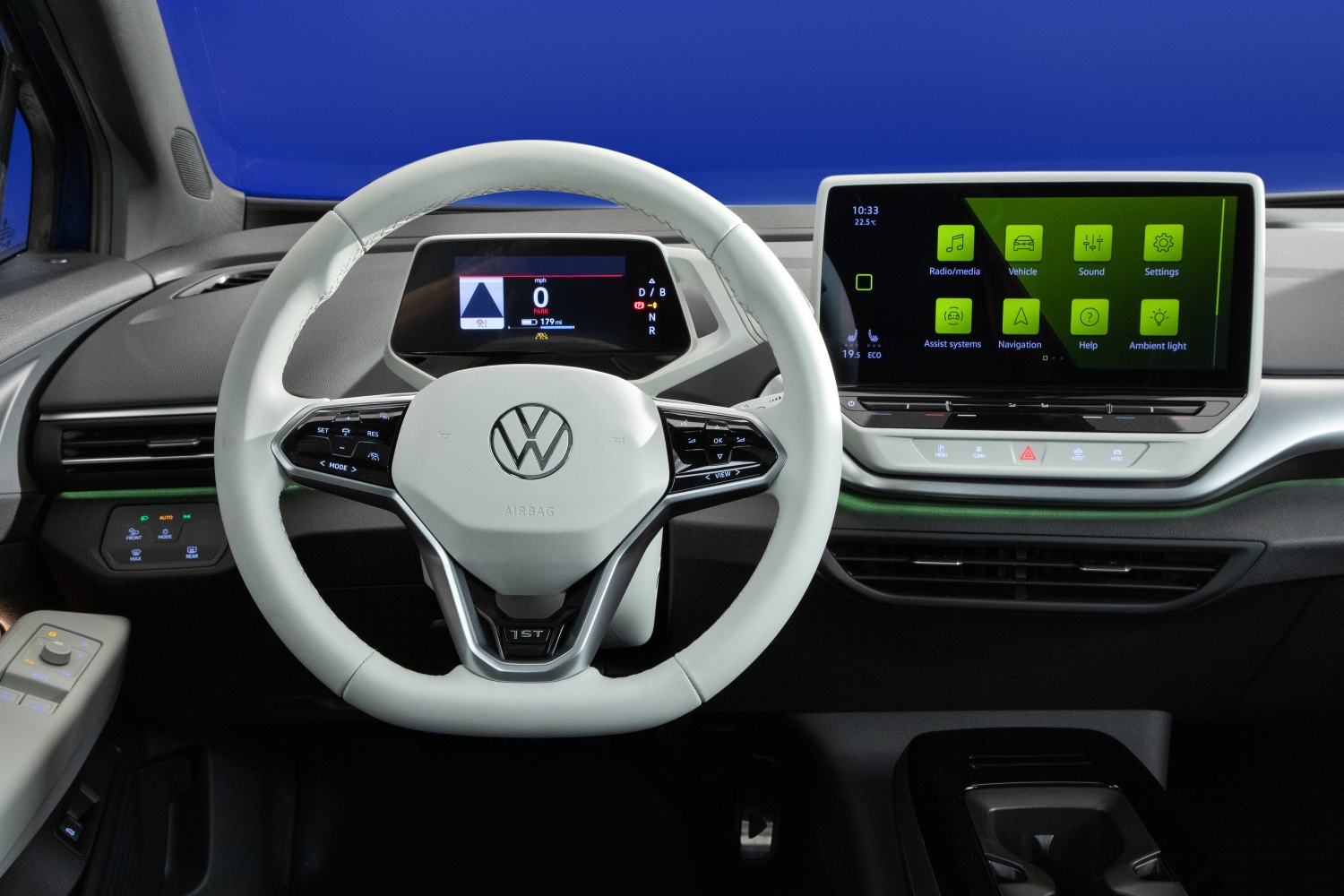
Rather than try to fit a gasoline-shaped peg into an electric-shaped hole, Volkswagen appears to have taken a page from Tesla’s book in its approach to the dash layout and cabin feel in the ID.4.

The interior design of the ID.4 feels like a glimpse of a self-driving future as you could visualize a day when both the steering column and even the infotainment system could simply be deleted. Even the center console, complete with modular cupholders, cubbies and NFC charging pad could eventually be modified to create more passenger space, making the interior of the ID.4. feel even more open and airy than it already does.

The ID.4 launches with three trims: the Pro, Pro S and 1st Edition. The Pro comes with a 10-inch touchscreen. The Pro S and 1st Edition trims come with a 12-inch infotainment touchscreen mounted at the center of the dashboard.
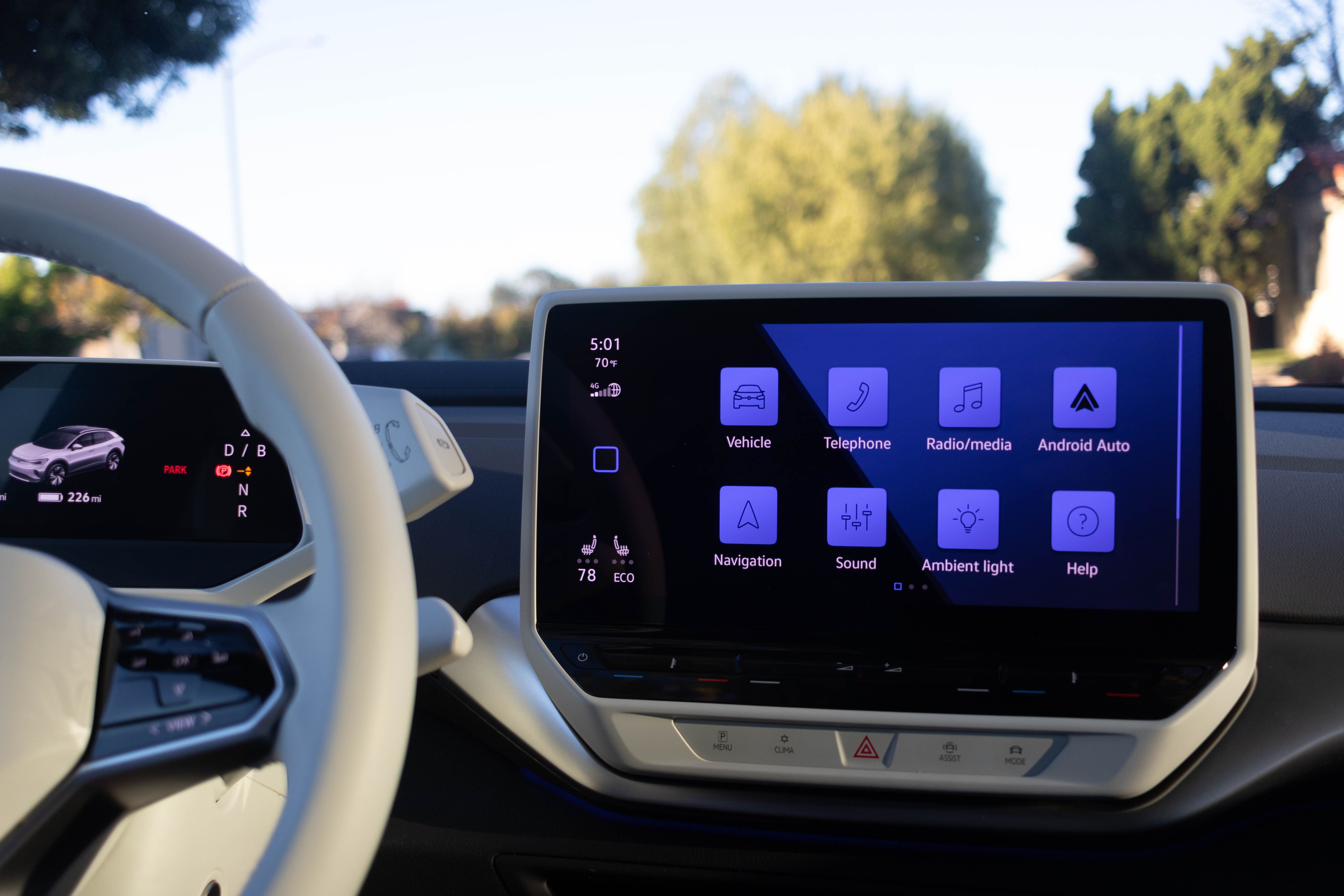
As you reach towards the center screen, the icons respond thanks to an in-cabin camera that tracks hand motion towards the system. There are very few hard-touch buttons inside the ID.4, and those that do exist are more like medical-grade haptic buttons used to control everything from climate and audio to the opening and closing of the shade on the optional panoramic fixed-glass roof and even driving modes and driver assistance features. They take a little getting used to, but once familiar they tend to work like slider buttons, allowing you to adjust volume or temperature with slight pressure changes and small slides from left to right.

Hello I.D.

Instead of buttons, Volkswagen has decided to leverage hands-free voice control in the new ID.4, but during our time with the vehicle, the system felt like it was still in beta.

Both driver and passenger use the touchscreen or specific voice commands to many of the common features and infotainment of the ID.4.  Say “Hello I.D.” and a light strip along the base of the windshield lights up based on which side of the vehicle the voice came from (passenger or driver), indicating that it’s ready to receive the command you say next.
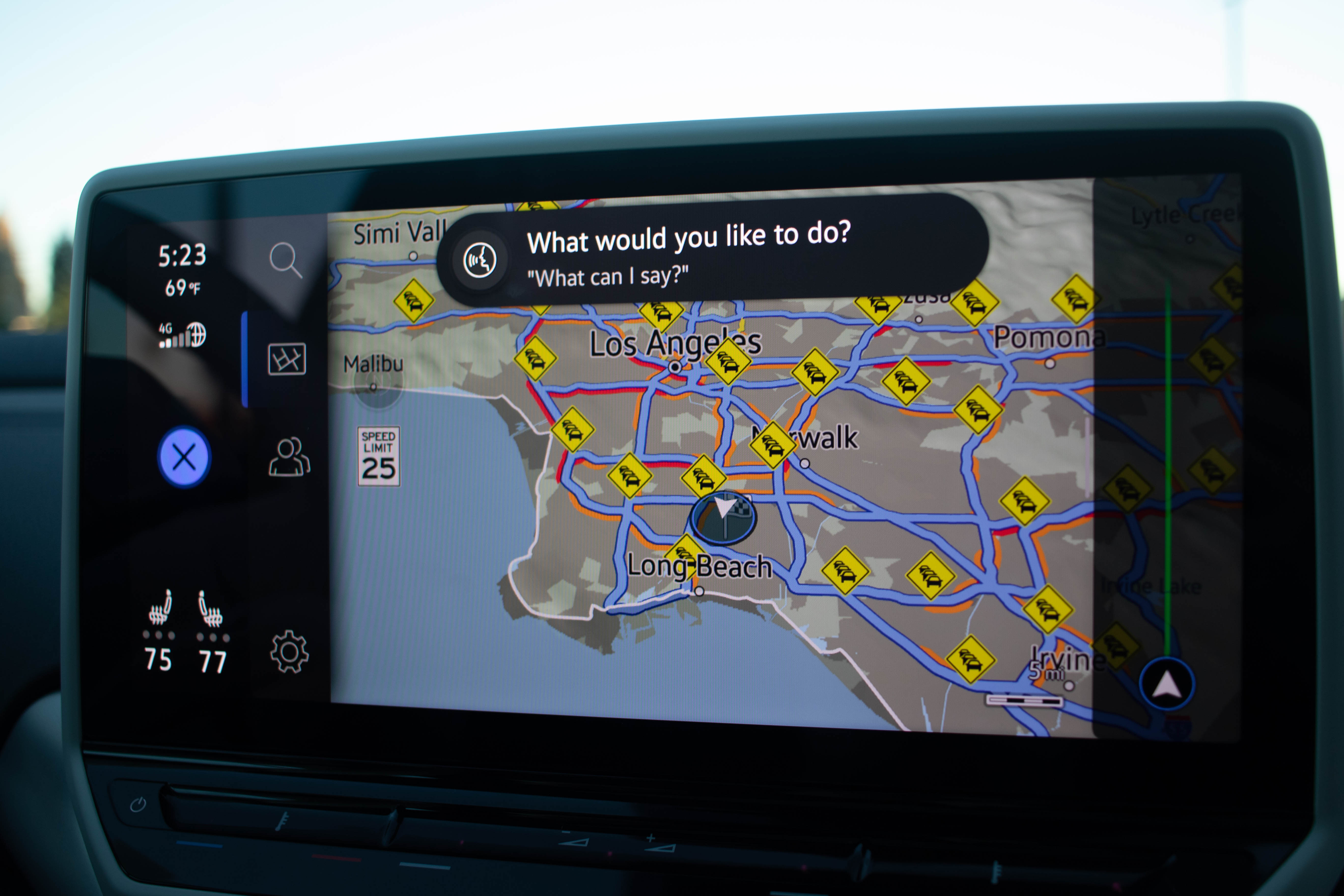
Commands are rather limited at this time and must be initiated by either saying the key phrase (“Hello I.D.”) or pushing the voice control button located on the steering wheel. You can say basic things like navigation commands but you can also say things like “I’m cold,” or “tell me a joke,” and the ID.4 system will respond by raising the temperature on that side of the car, or telling a seatbelt joke.

During the test drive, the response time from the system was very slow compared to other voice systems on the market, and it struggled to find connectivity to do things like change a Sirius XM channel, (repeatedly saying that it couldn’t find a specific channel number or name) even though my test drive didn’t stray beyond the bounds of Los Angeles and Long Beach. It also failed more often than naught, taking around ten seconds or more to finally cancel out of the voice control systems when it either couldn’t understand the command or it couldn’t get connectivity.

Laggy nav

The navigation system in the ID.4 was also a bit laggy and imprecise, which meant I reverted to using Google maps and the wireless Android Auto system (included along with Apple CarPlay throughout the ID.4 lineup) to get directions. One neat feature of the ID.4’s on-board navigation system, however, is that the light strip along the windshield illuminates on either side of the vehicle as you approach a turn to indicate which direction you should go.

The infotainment screen looks just like your phone or tablet screen: Swipe through the pages of apps or various windows to get to the page you want. Unfortunately, the combination of a laggy connection to the network (despite having three to five bars of 4G connectivity according to the infotainment system), and a laggy load time, the screens would occasionally freeze while swiping between pages, showing half of one page while still loading the next.

As a caveat: I was lucky enough to get three separate opportunities to spend extended time in different ID.4s in the Los Angeles press fleet and only experienced the lag/freeze with one of the vehicles, however. Volkswagen PR says that the software in the test vehicles is not the final version that customers will receive and it will be updated before getting to owners, which should solve for the strange stuttering and voice command issues that I experienced.

The ID.4 will also get Alexa capability later this year through their Car-Net service which includes an app that can help you monitor your vehicle from afar. The app is simple enough to use: Owners login and can see the location, charge level, and status of their ID.4.

VW made a multitude of interesting design choices inside the ID.4 including the placement of the main instrument panel and the transmission selector. Rather than attaching these items to the dash or center console like you’d find in a typical vehicle, they’re attached directly to the steering column. When you move the steering wheel, the instrument panel and transmission rocker move with it. Volkswagen uses a 5.3-inch screen attached to the steering wheel to provide information about everything from speed and direction of travel to range, trip, and basic navigation information. You use a rhombus-shaped rocker at the right side of the steering wheel to toggle through driving modes rather than a standard button or shift lever.

There’s a start/stop button located in a rather hidden spot on the right side of the column to start the ID.4, but it’s largely superfluous. When you unlock the vehicle and sit in the driver’s seat, the ID.4 powers on and is ready to drive. When you unlatch your seatbelt and climb out, the ID.4 powers down. That makes things a bit complicated if you have friends or family in the vehicle while you dash into a place to run an errand, but the ID.4 allows passengers to keep things like the AC and heat going for a short period of time by using controls that appear on the infotainment screen, even if the driver isn’t in the vehicle.
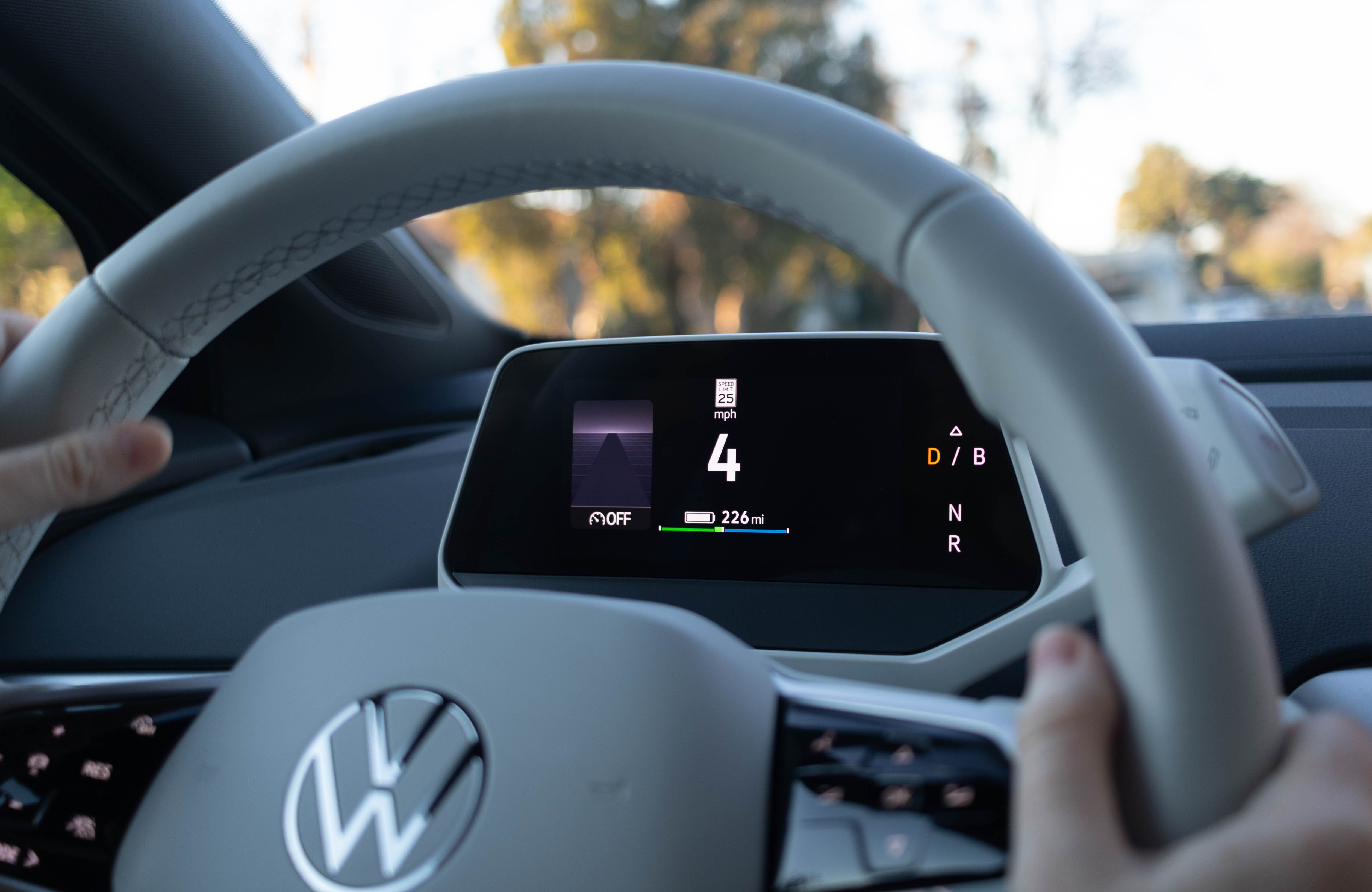
Image Credits: Abigail Basset

Converting drivers to EVs

Volkswagen says that its research has shown that roughly 30% of crossover owners would consider an electric crossover. There’s no denying that the ID.4 enters a crowded crossover market complete with extremely popular gasoline and hybrid competitors like the Toyota RAV4 and Honda CR-V. Volkswagen says that, based on its research, consumers shouldn’t feel any range anxiety since most crossover owners drive around 60 miles per day and the battery system offers an EPA-estimated 250 miles of range. You can charge the ID.4 from 5% to 80% in 38 minutes at a 125 kW.

A full charge at home is estimated to take around 7.5 hours but, if you’re out and about, Volkswagen is offering free, unlimited charging at DC fast chargers by Electrify America at no additional cost for the first three years of ID.4 ownership, which sounds great, but comes with some caveats. VW says that it expects most people to charge overnight on typical residential power, and it’s clear that the company doesn’t expect owners to use public chargers all that frequently because the process of locating an available charger is not seamless, at least not at the ID.4’s launch.
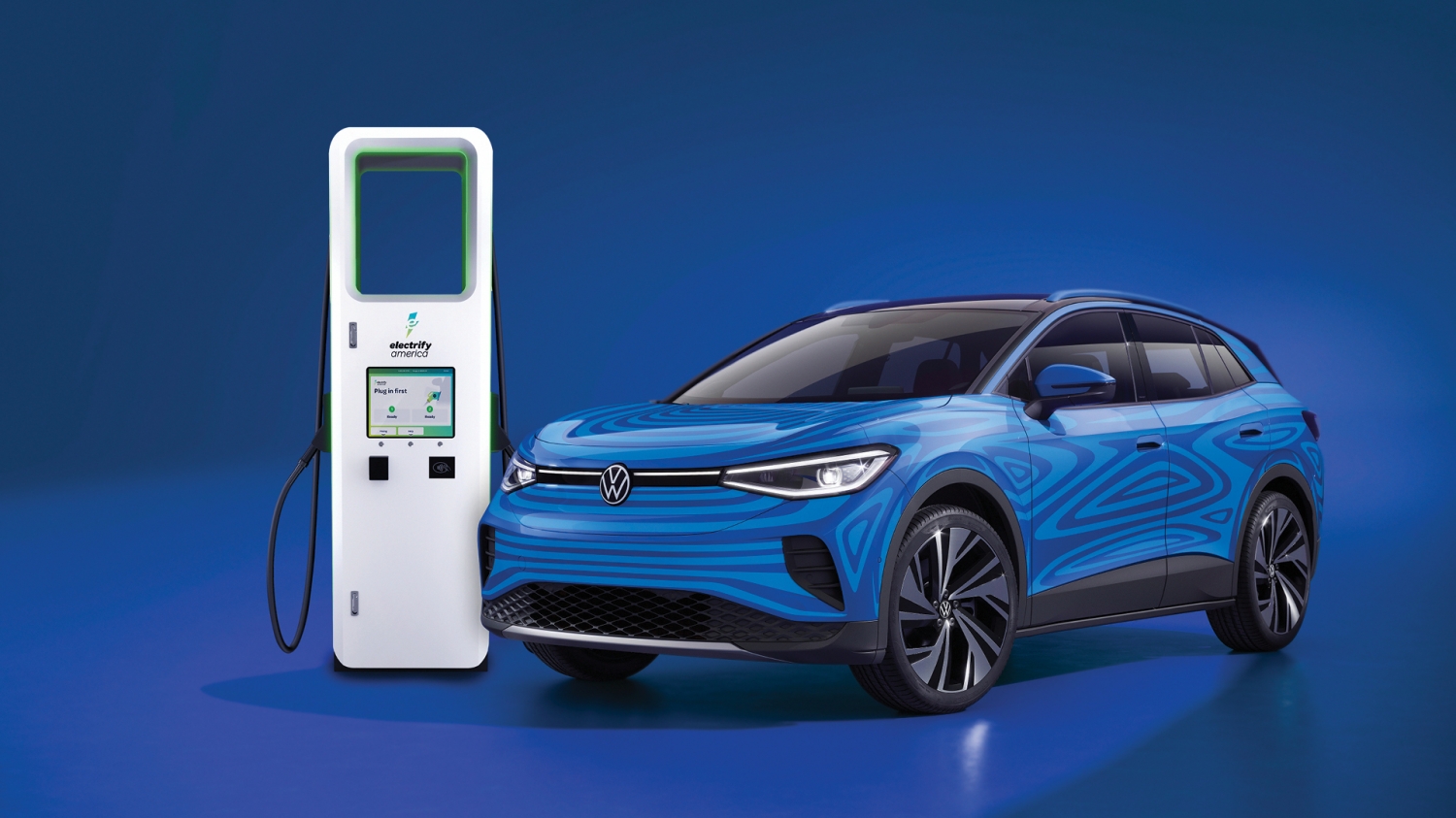
Image Credits: Volkswagen

Electrify America is a subsidiary of VW, yet they operate completely separately from Volkswagen. The company operates 550 charging stations and more than 2,400 DC fast chargers, across the country.  You can search for “charging stations,” through the on-board nav but the system brings up all charging stations in the vicinity and doesn’t show which are online and available and which ones are not. In order to find specific Electrify America chargers, owners have to pull out their phones and open the Electrify America app to see which stations are online and available. You can then send the location of a specific charger to AndroidAuto or Apple CarPlay to navigate. Unfortunately, at this point, the Electrify America app does not show up in Android Auto.

This process is rather clunky and would require owners to pull over and park to safely complete it before heading to the charging station–at least at this point in time. Volkswagen says that an over-the-air update coming later this year will further integrate Electrify America stations into the on-board nav in a more seamless way.

The good news is that the EPA-estimated fuel economy equivalent for the Pro S and 1st Edition models is 104 MPGe for city driving, while highway driving is rated at 89 MPGe, for a combined city/highway rating of 97 MPGe.

One of the striking features of the ID.4 is how it drives. Transmission modes on the ID.4 include a B or brake mode–a common and exceedingly convenient setting that allows for one-pedal driving on electric vehicles. Take your foot off the brake and the ID.4 slows slightly, regenerating electricity and sending it back into the battery. It’s a great feature in stop-and-go traffic and Volkswagen intentionally tuned the one-pedal driving to be less aggressive than those in other electric vehicles, with the aim of making the feel more familiar for first-time electric vehicle owners.

On the road, the ID.4 feels well planted and not nearly as large as it looks. It’s nimble but not exactly quick off the line (VW has not released 0-60 mph times) though it doesn’t leave you sweating to make a short merge. It’s certainly no tire-smoker or rocketship, however.

Since it’s a rather bulbous shape, there is some very minor wind noise at speed on the road, but the ride is comfortable and confident. At speeds below 20 miles an hour (and when you put it into reverse), it does make that characteristic electric car sound to alert pedestrians. It’s not noticeable inside the cabin when the windows are raised, but pass a neighbor who is working on a car in his garage, and you’ll be sure to arrive home to a text asking if that was you driving around in the car that sounds like a spaceship.

ADAS form & function

 

VW’s Travel Assist is the branded name for the company’s Level 2 autonomous driving system, which works at speeds that range from 0-95 mph. Travel Assist uses both the adaptive cruise control and the lane-keeping systems to follow the road and other vehicles ahead. When a motorcycle suddenly hops into your lane, the instrument screen shows an image of a motorcycle directly in front of the vehicle. If said motorcycle decides to randomly slam on the brakes, the ID.4 responds and brakes automatically. If traffic comes to a stop ahead, the ID.4 Travel Assist waits until traffic moves again. It approximates a human response to traffic motion very well–neither waiting inordinately long and leaving huge gaps (which causes rubberbanding in traffic) nor accelerating aggressively.

The system makes long stints in heinous traffic bearable. I spent an hour commuting on the dreaded 405 freeway in Los Angeles during rush hour and only had to keep my hands lightly on the capacitive steering wheel to keep the system engaged.

The skateboard powertrain

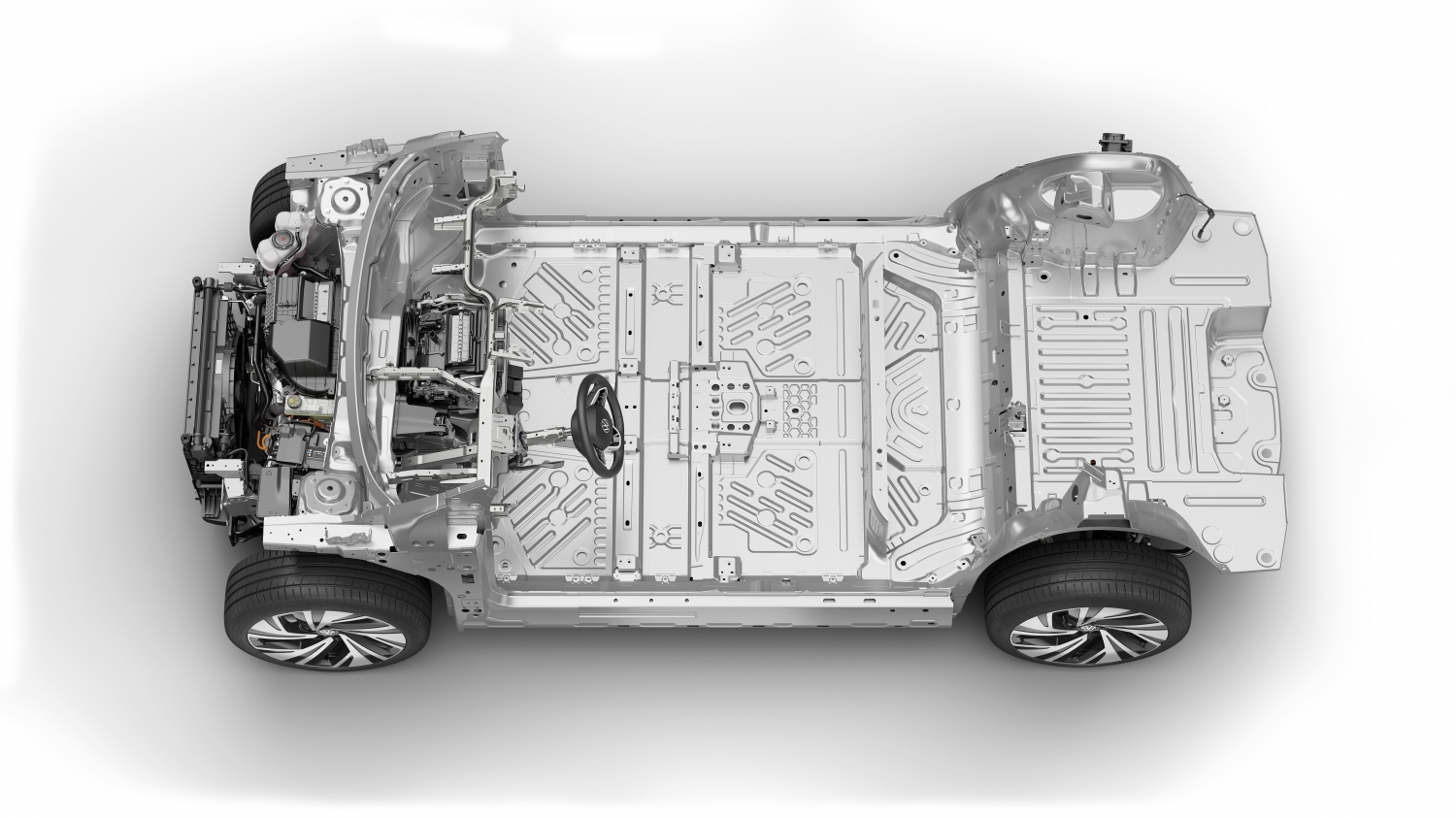
The VW ID.4 is built on a new skateboard architecture called MEB or modular electric drive matrix, with an AC permanent-magnet synchronous motor that makes 201 horsepower and 229 lb-ft of torque mounted at the back of the vehicle, above the rear axle–much like the old Beetle. At launch, VW is only offering a rear-wheel-drive version, but an all-wheel-drive version will be available by the end of the year, offering 302 horsepower.
Volkswagen is purchasing batteries from Panasonic for the ID.4 and assembling the 82-kWh, 12-module, 288-pouch-cell battery packs themselves at plants in China and Germany. There are plans to begin production in the U.S. soon. Volkswagen also builds its own electric motors.
All in, the VW ID.4 makes electric vehicles more attainable for the crossover buying public who can’t afford the high price tags for the other luxury all-electric crossovers like a Jaguar I-Pace, Tesla Model Y, Polestar or Audi E-tron.

Yet it also competes well with popular gasoline-powered crossovers like the Honda CR-V and the Toyota RAV4, especially when you add in the potential for as much as $7500 in rebates. Where the VW ID.4 truly stands out is in its blending of advanced technology and affordability in a good-looking EV, that won’t give you range anxiety. Will it be the “car for the millions?” We’ll have to wait and find out.


News: Sequoia Capital puts millions of dollars into Gather, a virtual HQ platform

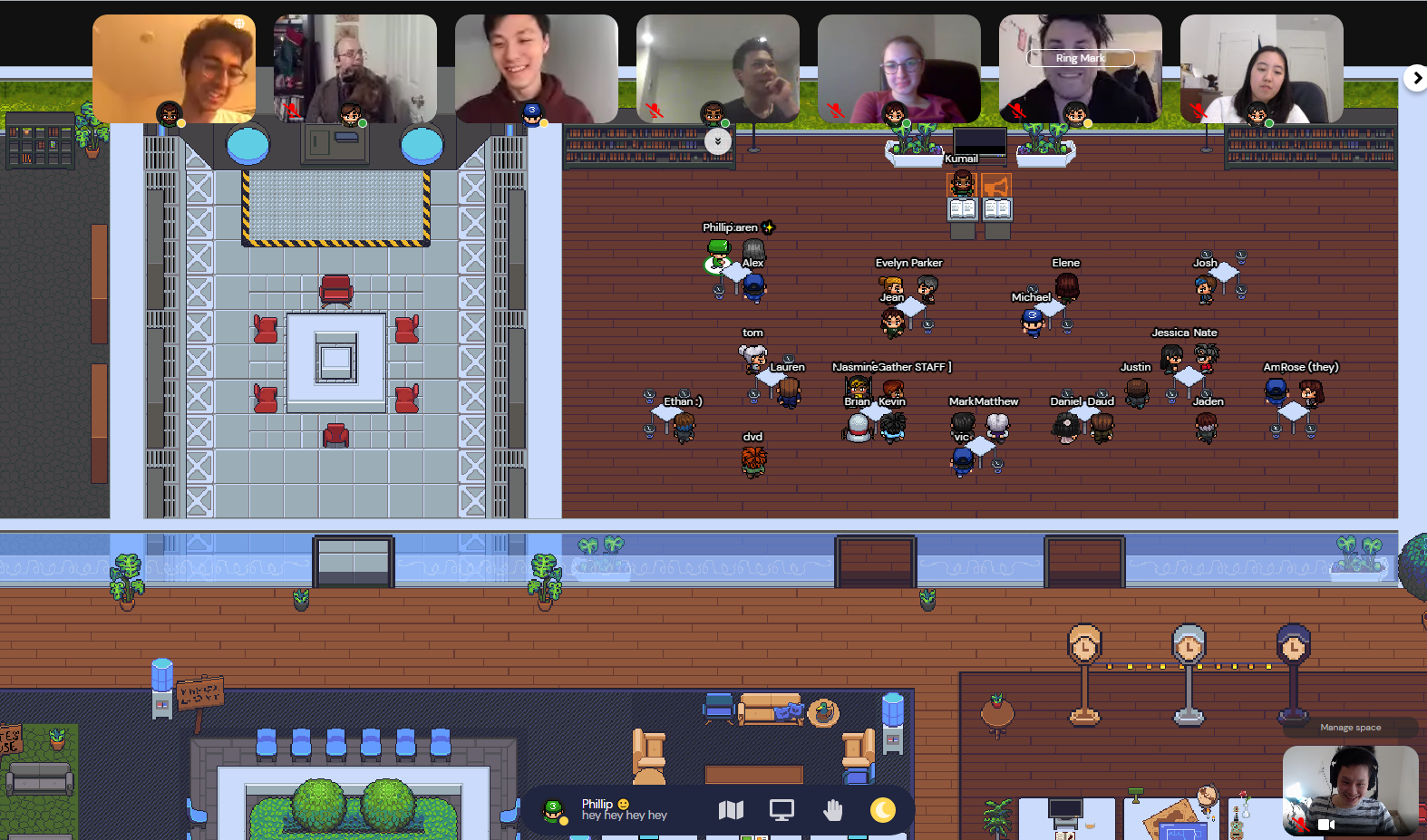
Gather helps people, well, gather in virtual spaces for any reason, whether it be for weddings, magic conventions, or, just a regular day at work. Over the past few months, as remote workers look for better ways to interact with each other, the startup has quietly amassed more than 4 million users, and today, an

Gather helps people, well, gather in virtual spaces for any reason, whether it be for weddings, magic conventions, or, just a regular day at work. Over the past few months, as remote workers look for better ways to interact with each other, the startup has quietly amassed more than 4 million users, and today, an investment from the same elite Silicon Valley firm that has backed Zoom and Slack.

Gather CEO Phillip Wang tells TechCrunch that his startup has raised $26 million in a Series A round led by Sequoia Capital. Other investors include Index, YC Continuity and angels including Dylan Field, Jeff Weiner and Kevin Hartz.

Wang says his goal for the startup, which he began with friends after they all graduated from Carnegie Mellon, is simple: Focus on serving its most consistent users, bring in customization elements to make virtual spaces feel homey and hire a lot of engineers.

“We’re a much broader communication platform that is going to be used across all things, but we are leaning heavily into the virtual HQ [use case],” Wang said. The 37-person team has embedded features to promote spontaneity, such as “shoulder taps” to prompt a co-worker to chat, or pool tables where employees can circle around and start a virtual game of pool.

Image Credits: Gather

The platform also uses spatial audio technology, which is popular in video games, so that users can get the feel of running into each other. The technology basically allows you to hear someone’s voice louder when you are near them, and softer as you walk away. Wang says that it built its own video-conferencing system from scratch because other solutions didn’t work well with spatial technology.

Wang wouldn’t point to any challenges within the company, but instead said that every startup has bugs it has to deal with. No (virtual) fires yet.

Gather is working on helping its users add in more customization to its platform so it’s easier for users to recreate their office space or apartments in real life. The office tour included seeing a corgi on the desk, jack-o’-lanterns and this reporter even added some floor plants to the setup.

Even though work is Gather’s current focus, a majority of its current monthly revenue, which hovers around $400,000, is coming from one-off events. The end goal, says Wang, is a world where someone can leave their Gather office and enter a Gather bar. If the company can successfully get remote teams to join its platform, it can then help those same teams have off-sites, team-building activities or networking events under its platform.

One of the challenges of building a community platform is figuring out monetization without extracting value. This is one of the reasons that Wang, when I first talked to him in November, always wanted to avoid venture capital money (because the incentives might rush the platform into pursuing business models that weren’t user-friendly).

Months later, Wang said his mind changed when he met with Sequoia Capital’s Shaun Maguire and saw an opportunity to scale the metaverse with venture dollars.

“Sequoia in particular helped Unity, the game engine company, figure out their business model and [that model] is unorthodox,” he said. “I’ve always looked at them [thinking] it would be great if we could do something like that.”

As for if Gather is simply a pandemic phenomenon, Maguire says that him and the Sequoia team believes that “work-from-anywhere is here to stay.”

“Phillip and [his] team’s motivations to create Gather precede the pandemic,” he said. “They realized that certain constraints in the physical world hinder your ability to stay connected with people outside of your immediate community — this was merely intensified during the pandemic.”

It’s true: Gather has been in the works for more than 18 months, since Wang and his friends graduated college. The team first tried to create custom wearables that would show you who was available to talk so you could tap into a conversation. When that didn’t work, they pivoted into apps, VR and full-body robotics. With new capital and millions of users, perhaps “Sims for enterprise” might be the route to go.

News: Sports trading card platform Alt launches with $31 million in funding and plenty of market hype

The alternative asset market showed promise pre-pandemic but amid a broader rally among traditional asset classes, the number of investors searching for and promoting value in the space has exploded. That has, in turn, promoted a pretty major influx of VC dollars into startups building platforms that wrangle these buyers into specific communities. Enter, Alt.

The alternative asset market showed promise pre-pandemic but amid a broader rally among traditional asset classes, the number of investors searching for and promoting value in the space has exploded. That has, in turn, promoted a pretty major influx of VC dollars into startups building platforms that wrangle these buyers into specific communities.

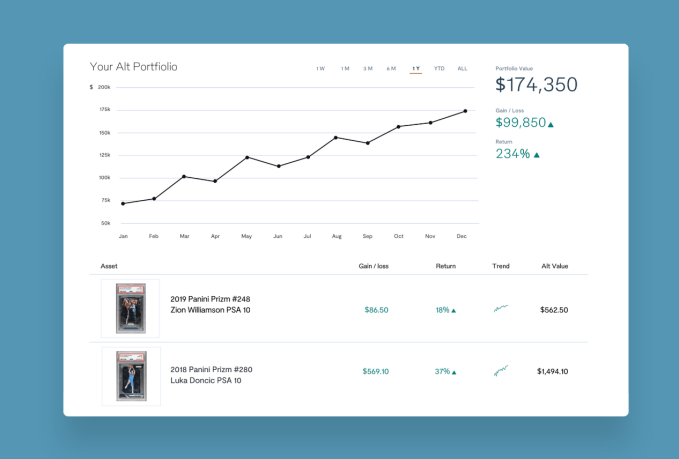
Enter, Alt. The young startup has received more than $31 million from top investors intrigued by the particularly hot space it has bulked up its expertise in — physical sports trading cards. The company provides a Goat-like marketplace for the cards, authenticating the transactions and providing buyers with the peace of mind that the slice of cardboard they’re dropping several thousands of dollars on is no fake. While entities like NBA Top Shot have rallied a new generation of buyers around blockchain era digital trading cards, its success has been enabled by the excitement that traditional collectibles markets have been garnering recently.

After years of stocking up on sports trading cards, Alt CEO Leore Avidar is just happy to have more people to talk about his obsession with. Like many in the sports card community, Avidar has spent years collecting cards and engaging with forums online, but it’s been an interest he hasn’t been able to share with friends and family given its somewhat fringe appeal. This isn’t the case today, Avidar says, with old collectors re-entering the market as they dust off aged collections and new collectors intrigued by skyrocketing prices and a more connected online community.

“I’ve talked with a lot of people in the community and one of the things I love is how intergenerational this is, I see a lot of like kids and their parents doing this together,” Avidar tells TechCrunch.

As the market has moved more mainstream, platforms like Alt have also begun seeing more investor interest. In the span of a few months, Alt wrapped a pair of funding rounds from investors hungry to embrace a play in the market — a seed round led by First Round and a Series A led by Reddit co-founder Alexis Ohanian’s new firm Seven Seven Six. Other Alt investors include John and Patrick Collison, Kevin Durant, SV Angel, BoxGroup, Sue Wagner, and Jeff Morris’s Chapter One.

Avidar wants Alt’s platform to increase transparency and liquidity in the alternative assets space and make acquiring assets here just as easy as platforms like Robinhood have made buying and selling stocks. Avidar’s central strategy to capturing this market and bringing it to his platform is by significantly undercutting the fees structure of other sites, with Alt charging 1.5% of the total sales price including processing fees.

In addition to authenticating its stock, Alt has had to build some infrastructure that’s somewhat custom to the trading cards market. Users that are less concerned with holding their physical cards and more worried about them being lost or damaged over time can opt to have Alt store their physical cards in a temperature and light-controlled vault (for a fee), ensuring that physical degradations of the card don’t affect its value. One of Alt’s key features that Avidar expects to be popular with collectors is their Zestimate-like Alt Value rating which will give card buyers and sellers a closer idea of what the market value of their card is based on historic transactions and the trending growth metrics.

The team is launching the Alt market with sports trading cards, but plans to expand its reach to other alternative assets as the marketplace matures further, with Avidar highlighting markets like watches, sneakers and art as potential growth areas.

News: Pakistan bans TikTok again over ‘immoral and objectionable’ videos

Pakistan has banned TikTok again in the country after reviewing a complaint that said the popular video app hosted immoral and objectionable content. A high court in the city of Peshawar on Thursday ordered the nation’s telecom authority — Pakistan Telecom Authority (PTA) — to ban TikTok. In a statement Thursday evening, Pakistan Telecom Authority

Pakistan has banned TikTok again in the country after reviewing a complaint that said the popular video app hosted immoral and objectionable content.

A high court in the city of Peshawar on Thursday ordered the nation’s telecom authority — Pakistan Telecom Authority (PTA) — to ban TikTok.

In a statement Thursday evening, Pakistan Telecom Authority said it was complying with the order and had “issued directions to the service providers to immediately block access to the TikTok app.”

TikTok had about 33 million users in Pakistan last month, according to mobile insight firm App Annie (data of which an industry executive shared with TechCrunch). There are about 100 million internet users in the South Asian nation.

The Peshawar High Court’s Chief Justice Qaiser Rashid Khan described some videos on TikTok as “unacceptable for Pakistaini society,” and said these videos were “peddling vulgarity,” according to local media reports.

TikTok did not immediately respond to a request for comment.

This isn’t the first time ByteDance’s app has been banned by Pakistan. PTA had briefly banned TikTok in the country last year, saying at the time that the Chinese social app hadn’t addressed concerns about the nature of some videos on its platform despite warnings spanning several months.

Pakistan’s move follows its neighboring nation, India, also banning TikTok last year. New Delhi banned TikTok — and eventually 200 additional apps with links to China — over cybersecurity concerns. Prior to the ban, India was the biggest international market for TikTok, which had amassed over 200 million users in the world’s second largest internet market.

Like India, the government in Pakistan has also sought to assume more control over content on digital services operating in the country in recent years.

While global tech giants, most of which count India as a key overseas market, haven’t made much fuss about New Delhi’s new rules for social media, they banded together in Pakistan late last year and threatened to leave the country over rules proposed by Islamabad.

Through a group called the Asia Internet Coalition (AIC), the tech firms said in November that they were “alarmed” by the scope of Pakistan’s new law targeting internet firms.” In addition to Facebook, Google and Twitter, AIC represents Apple, Amazon, LinkedIn, SAP, Expedia Group, Yahoo, Airbnb, Grab, Rakuten, Booking.com, Line and Cloudflare.

WordPress Image Lightbox Plugin