Monthly Archives: March 2021

News: Startup founded by ‘Survivor’ champ debuts airless bike tires based on NASA rover tech

As NASA is quick to remind people, the investments it funnels towards space exploration often winds up improving life on Earth – and it’s now in the business of speeding up some of that work through startups. SMART, a startup founded in 2020, has a partnership with NASA through the Space Act Agreement and is

As NASA is quick to remind people, the investments it funnels towards space exploration often winds up improving life on Earth – and it’s now in the business of speeding up some of that work through startups. SMART, a startup founded in 2020, has a partnership with NASA through the Space Act Agreement and is part of the agency’s formal Startup Program that aims to commercialize some of its innovations. The young company today revealed its first product: An airless bicycle tire based on technology NASA engineers created to make future lunar and Martian rovers even more resilient.

SMART’s METL tire is the the first fruit of the startup’s work with NASA’s Glenn Research Center, where NASA engineers Dr. Santo Padula and Colin Creager first developed their so-called ‘shape memory alloy’ (SMA) technology. SMA allows for a tire constructed entirely of interconnected springs, which requires no inflation and is therefore immune to punctures, but which can still provide equivalent or better traction when compared to inflatable rubber tires, and even some built-in shock absorbing capabilities.

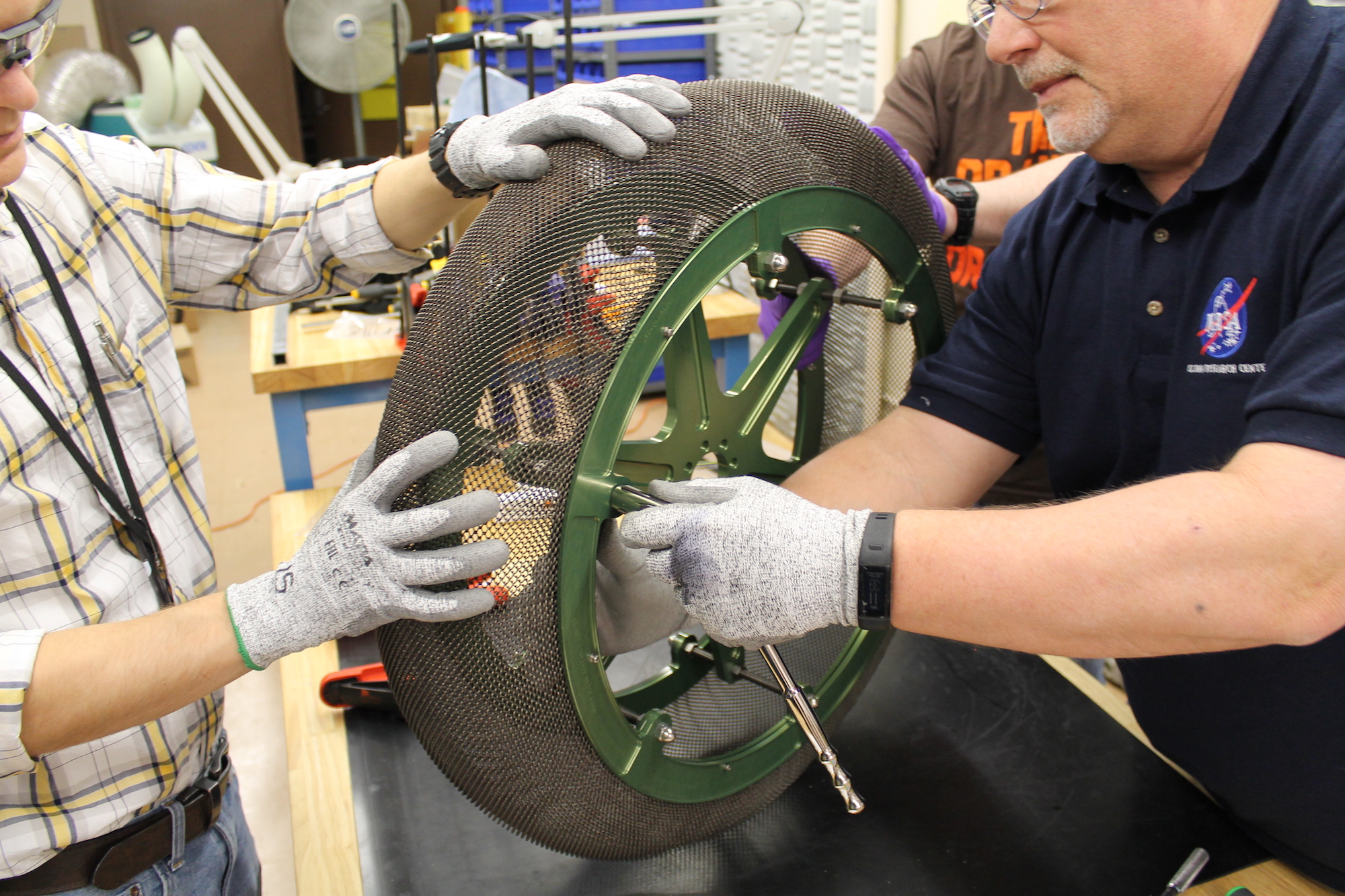
Engineers at NASA’s Glenn Research Center assemble the new shape memory alloy rover tire prior to testing in the Simulated Lunar Operations Laboratory.

Dr. Padula and Creager’s key development was creating an alloy that can return to their shape at the molecular level, meaning they can deform to adapt to uneven terrain, including obstacles like gravel and potholes, and return to their shape without losing structural integrity over time.

SMART, which is co-founded by Survivor Fiji champion Earl Cole and engineer Brian Yennie, worked with Padula and Creager, along with former NASA intern Calvin Young, to apply the benefits of SMA to the consumer market. They’re targeting the cycling market first with their METL tire, which is set to become available to the general public by early next year. Following that, SMART intends to also pursue bring SMA tires to the automotive and commercial vehicle industries, too.

SMART's METL tire close up

Image Credits: SMART Tire Company

Already, SMART has a partnership in place with Ford-owned Spin, the bike and scooter-sharing company focused on novel micro-mobility models. SMART’s technology has the potential not only to make flat tires or under inflation a thing of the past, but could reduce cost and waste long-term by supplementing the need for rubber tires, which need frequent replacement and can be a danger to riders or drivers when used without proper pressure.

SMART is also using WeFunder to seek crowdsourced equity investment, with SAFEs currently available at an $8 million valuation cap.

News: The global inequity in venture financing is staggering

I am surprised that more VCs aren’t investing in Africa. It smells like investing arbitrage. The pandemic has ripped the Band-Aid off investing via Zoom, making Africa is precisely as close to your in-house office as Europe, North America, Latin America or anywhere else.

The global venture capital ecosystem is inequitable. In the United States’ mature venture capital market, an entrepreneur’s race, gender and age help determine who has access to capital.

But there are other limiting factors: geography, for example. While it has been encouraging in recent years to cover what has felt like a boom in Latin American and European fintechs, or a general rise in VC activity in a host of Asian countries, the landscape remains imbalanced.

The pragmatist in you is already forming complaints. Yes, the world is not uniformly developed. Yes, venture capital-startup hubs can take decades to reach maturity. And, yes, progress is being made in some regions.


The Exchange explores startups, markets and money. Read it every morning on Extra Crunch, or get The Exchange newsletter every Saturday.


But as the world grows more connected, the tech gap between nations isn’t narrowing fast enough. And yet, given rising populations of people ready to jump into a more digital future, investment in some less-mature startup markets is lower than you’d think. (Less investment into less-mature startup markets is not a tautology; you can get to ecosystem maturity faster with easier capital access because it allows for quicker startup formation cycles.)

The wild imbalance of the world’s venture capital came up yesterday over on the public forum. Dauda Barry, CEO of U.K.-based startup Adaplay Esports, tweeted that African startups had “already raised $500 [million] in 2021,” which he contrasted positively to what he described as a full-year 2020 result of $1.4 billion.

Using his figures, African startups are on pace to raise $2.5 billion in 2021 if current trends hold, a healthy increase from the 2020 figure. Clayton Collins, a media exec, pointed out an interesting contrast: Stripe raised more yesterday than Barry had reported for the entire African continent this year.

Put another way: A single U.S.-Irish company outraised an entire continent’s year-to-date venture capital sum in one day.

Taking numbers from Twitter is never the best way to be informed, however. So this morning, let’s do a little digging. I’ve pulled Crunchbase and PitchBook data to peek at what they say about African startup investment thus far in 2021. And we also have our prior look into the 2020 African startup ecosystem to point to. (For more on African startups in general, we also chatted with the CEO of public African e-commerce player Jumia here.)

Ready to get into some startup numbers after weeks of nonstop IPO coverage? I am. Let’s go!

The African startup market

Barry’s number of $500 million felt directional when we were discussing it, as all round numbers are. So let’s poke at it a bit.

PitchBook data of African investments thus far in 2021 includes 72 deals worth $750.6 million, though if we drill down to just companies with African headquarters, the number dips. Crunchbase lists $746.1 million in total equity funding for African companies so far in 2021, but if we filter out private equity along with all non-equity investments, the number falls to around $136.2 million.

News: Overwolf raises $52.5M for its platform to build, distribute and monetize in-game user-generated content

Roblox, the gaming company that went public this month with a strong debut, changed the game (so to speak) for the role that creative input can play in making a game more loved, more engaging, and even more enterprising. Today, a startup that is taking a version of that model — focused on in-game apps

Roblox, the gaming company that went public this month with a strong debut, changed the game (so to speak) for the role that creative input can play in making a game more loved, more engaging, and even more enterprising. Today, a startup that is taking a version of that model — focused on in-game apps and modifications — is announcing some funding and the launch of a new toolkit to double down on that opportunity.

Today, a startup called Overwolf, which has built a popular platform for gaming fans to build modifications (mods) and additional tools for all kinds of PC games, is announcing $52.5 million in growth funding and the launch of a new content creation SDK — underscoring its growth and more specifically the demand in the market to bring more user-generated content variations into the gaming universe.

The company’s platform has some 30,000 creators, 90,000 mods and add-ons, and 18 million monthly users across thousands of games, including Fortnite, World of Warcraft and Minecraft. In the last year, which has seen a surge of gaming activity as more people stay home throughout the pandemic, Overwolf’s revenue has grown by 300%, it said.

“We want to be what YouTube is for YouTubers,” said Uri Marchand, the CEO and co-founder of Tel Aviv-based Overwolf, in an interview with TechCrunch. “Just as YouTube is a one-stop shop for video, we want to be a one-stop shop for creating apps and mods.”

The Series C is being co-led by Insight Partners and Griffin Gaming Partners, a VC that specialists in gaming content. Other investors in the round include Ubisoft, Warner Music Group, Meg Whitman, and Gen.G Co-Founder, Kevin Chou. Valuation is not being disclosed.

Importantly, alongside the funding, Overwolf is introducing a new service called CurseForge Core, an SDK that can be integrated directly into a game itself to make it easier for gaming enthusiasts and developers to build user-generated content for it. CurseForge Core is essentially the next iteration of CurseForge, the mods platform that Overwolf acquired from Amazon’s Twitch last year for an undisclosed sum.

The buyer and acquirer here continue to have a close relationship, even as Overwolf also looks to work more closely with others like Discord, which says something about what makes up the bigger ecosystem of communication and activity among gamers outside of the core experience of a game itself.

Prior to launching this SDK, Overwolf already had built out a large community of users — both on its own steam and by way of its acquisition of CurseForge. While that is entirely focused on PC games at the moment, the plan will be to expand its reach to other platforms, including Macs, console games and mobile gaming, in the next year.

The gap in the market that Overwolf has identified and built for is the demand from avid gamers for more tools to improve their experience of the game, sometimes very specific ones that might not be core to everyone’s experience but definitely wanted by enough people to merit their creation.

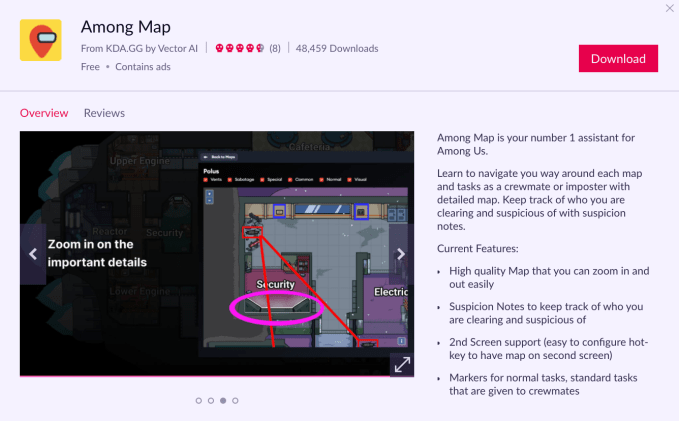
These can be, for example, maps to navigate your way around a game, or dashboards or leaderboards to keep better track of various statistics of characters and other players, tools to modify characters, or apps to communicate with other players when you’re inside a game. Marchand points out that he first got into this world as a mod maker himself, years ago creating a Skype app for World of Warcraft years ago.

“We pivoted from making mods to making a platform for others to make mods and additions,” he said. “When you think about all the aspects that need to be addressed — they include telemetry, the interactive UI, analytics, installers — they can be very complicated. So we provided platform essentials to help developers figure it all out.”

While games developers might have a very specific vision of how they would like their games to look at play, as Marchand described it to me, it’s also a big part of PC gaming culture to be able to play around with those experiences to make them unique to each player. But handling the work of third-party ecosystems is not typically in their core competencies.

“The scale and diversity of that content makes it impossible for a game maker to capture and do it all,” said Marchand. “History has proven that while game makers would like to encourage UGC they can’t and that is why we exist.”

Even if building an SDK that sits inside games themselves is a logical next step, it also represents a kind of increased trust between Overwolf and games publishers.

“Overwolf is developing the holy grail of frameworks for UGC for both publishers and in-game creators. Enabling all major publishers like us, to allow the creation of mods in a safe, secure, authorized, and profitable manner; is a game changer for all creators and IP holders,” said Oscar Navarro, Head of Corporate Development for Ubisoft, in a statement.

Indeed, the tradeoff for games publishers are more tools that will potentially keep users further engaged. The SDK will cover tools such as cross-platform modding, to let players discover and install mods in-game, across all platforms and storefronts; an analytics dashboard to have better visibility on how well various mods are performing; moderation tools to better vet what third-party content gets submitted; and monetization tools to bring in more creators. As with other platforms that incentivize creators, these include an Author Rewards Program, fund investments, developer contests, and hackathons.
“We’ve been following UGC in gaming for many years and believe Overwolf has established itself as a leader in this category,” said Teddie Wardi, MD at Insight Partners, in a statement. “AAA game studios will want to allow creators to build and express themselves, and Overwolf is positioned as the platform to make this possible by ensuring that creators are recognized for their contributions, and easily integrating creations into games. Overwolf has proved themselves to be strong champions of the creator community and we look forward to helping them scale up in 2021.”

Financial incentives will continue to stand out for these creators, who today make most of their money not from paid mods and apps, but from in-mod or in-app advertising, a network that is run by Overwolf itself. Marchand said that the most successful developers can bring in revenues of $100,000 each month.

While Marchand likens Overwolf aims to YouTube, investors see a parallel in Unity, another key toolkit for the games developer community.

“Similar to how developers use Unity to build a game, we see Overwolf as the framework for everything UGC related to games. Overwolf allows for one of the only means of monetization for the thousands of creators, in turn, this translates to increased engagement for the publishers and more content for gamers.  Services like Overwolf set the stage for the industry to see a new generation of user-generated content and we are excited to invest in the leading company moving this space forward,” commented Nick Tuosto, Co-Founder of Griffin Gaming Partners and Managing Director at LionTree, in a statement.


News: Google’s Family Link updates reflect the pandemic’s impact on how parents view screen time

Google is making changes to its parental control system, Family Link, that aims to better reflect parents’ changing views on children’s screen time. In the pre-pandemic world, parents were more likely to see screen time as something in need of restriction — they’d rather their kids get offline or go outside to play with friends,

Google is making changes to its parental control system, Family Link, that aims to better reflect parents’ changing views on children’s screen time. In the pre-pandemic world, parents were more likely to see screen time as something in need of restriction — they’d rather their kids get offline or go outside to play with friends, perhaps. But the challenges of a locked-down world and the push towards virtual learning have impacted parents’ views. Google says today’s parents are more concerned about how kids are spending time on their devices, not how much time is being spent.

It’s a concession to a world where devices have become a savior of sorts to families who’ve stayed at home to avoid Covid — where they’ve been restricted from seeing extended family and friends, and where schools are closed and playdates and parties were cancelled. Parents came to realize that screen time in and of itself isn’t necessarily something to be avoided; they just wanted more control over how it’s used.

With the Family Link update, parents can now choose to make remote learning apps “always allowed,” so they don’t count toward overall screen time daily limits. This could include not only those apps that are used to attend school or communicate with teachers, but others that have popped up to help kids learn and be entertained, like the supplemental resources the school suggests — or the apps parents allow during break times from virtual class.

Parents will also now have access to more detailed daily, weekly and monthly activity reports that provide both an overview of how the child is spending their time in apps, as well as how screen time usage has changed over a week or month, and what portion of time was spent in the “always allowed” apps. This gives parents a better idea of what screen time was used for education versus play.

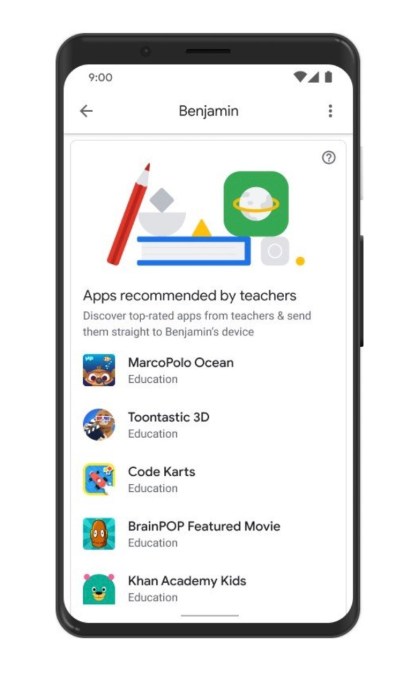
On Android, Family Link users will also be able to browse through a selection of teacher-recommended apps from the Google Play catalog for kids under 13 in the U.S. And parents can also now set screen time limits directly from the child’s device on Android.

Image Credits: Google

Though these updates will remain useful in a post-pandemic world where parents hold a more nuanced view of screen time, it’s unfortunate that Google waited until so late in the pandemic to roll these changes out. As more people in the U.S. are being vaccinated, restrictions are lifting — including the re-opening of schools in many places. That means parents’ stress over kids’ increased screen time usage will soon become a moot point. The devices will be replaced with in-person learning, and screen time may become villainized yet again.

Related to today’s news, Google has launched a new website for families whose kids are beginning to use technology at families.google. The company also launched a new content series with meditation app Headspace that will help families with kids practice mindfulness together. Again, that’s a resource that was desperately needed in 2020 during the pandemic’s heights, more so than it is today as the world begins reopening.

Still, the pandemic has forced families to think more about screen time and what sort of on-device experiences they want their children to have. As a result of this increased scrutiny, social apps like TikTok and Instagramthe latter just today, in fact — have rolled out more family-friendly safety features, aimed at encouraging parents to see their apps in a better light, rather than being the first to go when screen time gets locked down. It has also encouraged new hybrid learning and education startups to launch, hoping to build out a new category of edutainment apps that can avoid screen time lockdowns.

News: $5.7M stolen in Roll crypto heist after hot wallet hacked

A security breach at cryptocurrency platform Roll allowed a hacker to obtain the private key to its hot wallet and steal its contents — worth about $5.7 million. In a statement, the company said it was investigating the breach, which happened early Sunday. “As of this writing, it seems like a compromise of the private

A security breach at cryptocurrency platform Roll allowed a hacker to obtain the private key to its hot wallet and steal its contents — worth about $5.7 million.

In a statement, the company said it was investigating the breach, which happened early Sunday.

“As of this writing, it seems like a compromise of the private keys [sic] of our hot wallet and not a bug in the Roll smart contracts or any token contracts,” the statement said. Roll said the attacker had already sold the tokens for Ethereum.

“There is no further user action suggested at this stage. We are temporarily disabling withdraw from the Roll wallet of all social money until we have migrated our hot wallet,” the statement added.

It’s not clear how the attacker broke in and obtained the private key — akin to the password for Roll’s hot wallet. Hot wallets are designed to be connected to the internet to send and receive cryptocurrency, but typically only store a fraction of a cryptocurrency owner’s total reserves, given the inherent security risk of an internet-connected wallet. A cold wallet, or storage device that isn’t connected to the internet, is typically used for holding the bulk of an owner’s cryptocurrency for longer-term periods.

Roll allows creators to mint and distribute their own Ethereum-based cryptocurrency, known as social tokens, under which the creators can decide how the currency is spent. There are hundreds of different kinds of social currency on the platform, including $WHALE, $RARE, and $PICA tokens — which plummeted in value in the aftermath of the breach.

The creator of the $WHALE token said in a tweet more than 2% of its tokens were stolen in the Roll breach, but that the hack was “minimally detrimental” to the project.

Others weren’t so lucky. One person said they had “lost everything,” while others criticized Roll’s new $500,000 fund to help affected creators for not going far enough.

Roll said it will hire a third-party to audit its security infrastructure to prevent another breach. “We will also run a forensic analysis to figure out how the key was compromised,” the statement said.

News: Rising Team, with $3 million seed, is a platform that combines management tools with training

Jennifer Dulski has held her fair share of leadership positions, from being president and COO of Change.org to serving as head of product for Google’s shopping and product ads to leading the team responsible for Facebook Groups. But she’s identified a problem that most people managers will all too clearly understand: training and tools to

Jennifer Dulski has held her fair share of leadership positions, from being president and COO of Change.org to serving as head of product for Google’s shopping and product ads to leading the team responsible for Facebook Groups.

But she’s identified a problem that most people managers will all too clearly understand: training and tools to be a great manager are at a shortage.

That’s why she founded Rising Team, which is today announcing the raise of a $3 million seed round led by Female Founders Fund, with participation from Peterson Ventures, Burst Capital, Xoogler Ventures, 500 Startups, Roble Ventures, Supernode Ventures and several angels.

Dulski explained that there are some tools for managers, like surveys from Gallup and Glint, and there are training options, like executive coaches. But there aren’t many options out there that combine the two.

“I was lucky enough to have the benefit of getting executive coaches or being sent to training, and those felt like being taught how to fish,” said Dulski. “But then it was like being dropped off at the lake with no fishing pole or bait, because I had learned all these things about how to be a good leader but I had no tools to implement what I had learned.”

Rising Team is a platform that combines tools and training to help managers motivate, organize and ultimately effectively lead their team.

The first layer of the platform is the tools suite, which includes proprietary assessments and 1:1 templates. Most employee surveys focus so heavily on the actual job, with questions like “I’m able to do my best work.” With Rising Team, the assessments are geared toward who team members are personally, with a look at how they want to be appreciated or what they believe their talents and skills are.

This helps managers understand how to pair team members together, what tasks they should be assigned to, and truly grasp what motivates each individual that works for them. Alongside these assessment tools, Rising Team also offers training in the form of videos, articles, and audio resources. In the future, the company plans to build out AI-based custom training tips that are powered by data from the assessments.

Rising Team is also building out a community that lets managers communicate with one another.

Interestingly, the startup is taking a bottom-up approach when it comes to revenue, pricing the product in a way that will allow individual managers to personally purchase the software, and hopefully spread the word to the rest of their team. But the door is open for organizations to get the full employee base on the product as well.

For now, Rising Team is in a free beta, so pricing has not yet been announced.

The team is currently made up of 8 people, 60 percent of whom are female and 50 percent of whom are BIPOC.

“It’s really, really important to me and to our team as a whole that we build a diverse team from the start,” said Dulski. “I believe in that so firmly and all the data is really clear that more diverse teams are more successful.”


Early Stage is the premier ‘how-to’ event for startup entrepreneurs and investors. You’ll hear first-hand how some of the most successful founders and VCs build their businesses, raise money and manage their portfolios. We’ll cover every aspect of company-building: Fundraising, recruiting, sales, product market fit, PR, marketing and brand building. Each session also has audience participation built-in – there’s ample time included for audience questions and discussion. Use code “TCARTICLE” at checkout to get 20 percent off tickets right here.

News: Farmland could be the next big asset class modernized by marketplace startups

A growing number of companies are revolutionizing the way farm and forestland is acquired, developed and commercialized across the United States.

Jim Jackson developed timber and farmland in Eastern Washington, protected from coastal rains by the peaks of the Cascade mountains, building out a clutch of apple farms and other properties on the state’s sunny side for 40 years.

Traditionally, he raised money to expand operations for his farms through his existing network, which meant asking previous investors to pool together and come up with the cash.

But more recently, Jackson turned to a fundraising platform that operates entirely online. Like hundreds of other farmers, he’s using a service called AcreTrader to raise money for agricultural development projects. AcreTrader is one of a growing number of companies revolutionizing the way farm and forestland are acquired, developed and commercialized across the United States.

There’s lots of farmland in the U.S. Bill Gates, Microsoft founder and the world’s third-richest man, is the nation’s largest owner of farmland, holding roughly 242,000 acres. That number seems high until you compare it with the 897.4 million acres of land that are currently arable and used for farming in the U.S.

Another 823 million acres of forests dot the United States, the majority of which are privately owned.

Taken together, that’s a massive amount of real estate with economic potential that’s traditionally been accessible only to the ultra-wealthy to acquire and finance for development. Now, startups like AcreTrader and others including Tillable, ($8.3 million) FarmTogether ($3.7 million), and Harvest Returns are bringing marketplace models to the farming world — potentially bringing hundreds of thousands of investable acres to financiers looking to diversify.

News: Instagram adds new teen safety tools as competition with TikTok heats up

Earlier this year, TikTok made an update to its privacy settings and defaults to further lock down the app for its teenage users. This morning, Instagram followed suit with teen-focused privacy updates of its own. But the Facebook-owned social app didn’t choose to add more privacy to teen accounts by default, as TikTok did —

Earlier this year, TikTok made an update to its privacy settings and defaults to further lock down the app for its teenage users. This morning, Instagram followed suit with teen-focused privacy updates of its own. But the Facebook-owned social app didn’t choose to add more privacy to teen accounts by default, as TikTok did — it largely made it more difficult for adults to interact with the app’s teen users.

The company said it’s rolling out new safety features that would restrict adult users from being able to contact teens who didn’t already follow them. The exception to this rule would still allow the teen to interact with adult family members and other trusted adults on the platform, like family friends. In the case that an adult tried to DM a teen who didn’t follow them, they’d receive a notification informing them this wasn’t possible.

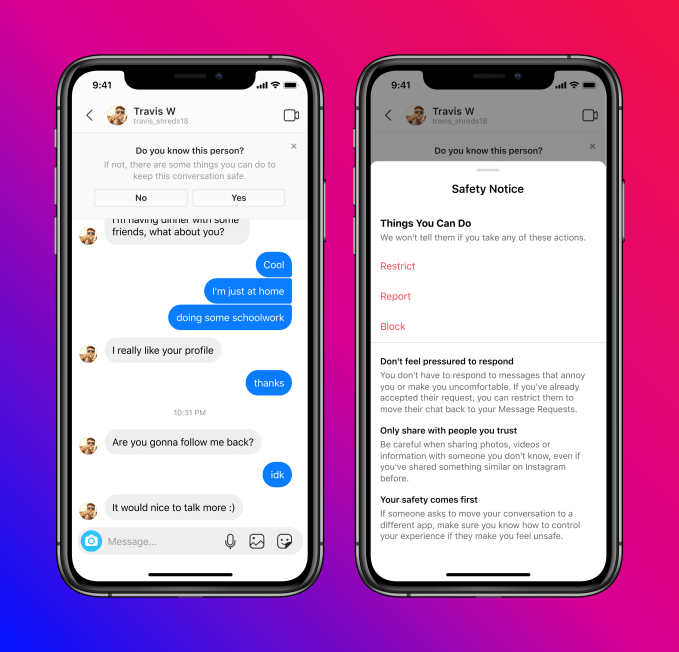
And if the teen has already connected with an adult and is DM’ing with them, they’ll be notified if that adult is exhibiting suspicious behavior — like sending a large amount of friend requests or messages to users under 18. This tool will also then allow the teen to end the conversation, block, report or restrict the adult from further contact.

Image Credits: Instagram

In addition, Instagram said it will make it more difficult for adults to find and follow teens in other places within the Instagram app, including Explore, Reels, and more. This will include restricting adults from seeing teen accounts in the “Suggested Users” section of the app, as well as hiding their comments on public posts.

The company also noted it’s developing new A.I. and machine learning-based technology that would make it possible to find teens lying about their age on the app. This could result in these features being applied, even if the teen in question had lied about their birth date when signing up for the app, but the technology isn’t fully live yet.

Other additions rolling out as part of today’s updates include new safety resources for parents in the app’s Parents Guide and educational material for teens that will better explain what it means to have a public account on the app, and encourage them to choose private options.

Image Credits: Instagram

The launch timing here is notable, as TikTok has recently focused on making its platform safer for teens — not only with the changes to its default settings, but also with the addition of parental controls last year. The company last year took the unusual step of bundling a parental control mechanism directly into its app that lets a parent link to a child’s TikTok account to control their profile’s privacy, what they’re allowed to do on the app, and even which feed they can view. The company has continued to expand these controls following their launch, indicating that it considers these core features. By making privacy and parental controls a key part of the experience, the app is more likely to be blessed by parents who would otherwise restrict their teens’ social media access — and that helps TikTok grow its user base and teens’ time spent in the app, sometimes at Instagram’s expense.

News: Google’s Soli radar returns to track sleep on the new Nest Hub

Talk about surprise comebacks. This morning Google announced the arrival of the next-gen Nest Hub. In spite of rebranding from Google Home Hub back in 2019, the smart screen hasn’t seen many changes since its 2018 introduction. Today’s arrival doesn’t represent a huge upgrade from its predecessor, but it does support a familiar — and

Talk about surprise comebacks. This morning Google announced the arrival of the next-gen Nest Hub. In spite of rebranding from Google Home Hub back in 2019, the smart screen hasn’t seen many changes since its 2018 introduction. Today’s arrival doesn’t represent a huge upgrade from its predecessor, but it does support a familiar — and largely forgotten — face.

We haven’t heard a peep from Project Soli since the technology was introduced with the Pixel in late-2019. The miniature, motion-sensing radar tech was positioned to be a major selling point, finally arriving on a device some four years after being announced. Applications were relatively few and far between — including gesture detection and a weird, one-off Pokémon app.

And then it just sort of went away. The Pixel 5 arrived the following year, without a trace of Motion Sense. Abandoning features certainly isn’t unheard of in consumer electronics, but it seemed odd for something in which Google had clearly invested time and resources.

Image Credits: Google

Soli’s reemergence in the new Nest Hub is certainly unexpected, but may ultimately make more sense than any of its attempted mobile applications. The primary use here is sleep tracking, the biggest update between the new Nest Hub and the original. As for why Soli, the answer goes deeper than the fact that Google was looking for a new home for its existing tech (though that no doubt also played a role).

Like the first-gen product, there’s no camera on the new Nest Hub. Google’s decision to keep the tech off the device is a breath of fresh air in a world where the new Amazon Echo uses figure tracking to actually follow you around the room. As before, you can always opt for the Nest Hub Max if that feature’s important to you. But the company rightfully noted that the first-gen model was often deployed at bedsides.

That means:

  1. Sticking a camera on the connected device raises some major privacy concerns.
  2. It’s an ideal spot for doing some sleep tracking.

Which leads us to:

  1. How do you do sleep tracking without a camera?

The easy answer is a wearable device. Google now has a much stronger foothold in that world now that its Fitbit acquisition has cleared. But that deal is going to take some time to fully take root. And besides, as someone who has tested a lot of wearables in my day, I can definitely say that, no matter how comfortable, I sleep better without one on my wrist. Certainly the irony of being kept awake by a sleep tracker has not escaped me.

Quick refresher on Soli tech, per Google:

Soli consists of a millimeter-wave frequency-modulated continuous wave (FMCW) radar transceiver that emits an ultra-low power radio wave and measures the reflected signal from the scene of interest. The frequency spectrum of the reflected signal contains an aggregate representation of the distance and velocity of objects within the scene. This signal can be processed to isolate a specified range of interest, such as a user’s sleeping area, and to detect and characterize a wide range of motions within this region, ranging from large body movements to sub-centimeter respiration.

Image Credits: Google

So, basically, you’re trading camera-based sensing for mini-bedside radar. It’s a weird thing to wrap your brain around, certainly. The biggest thing here is that the motion-tracking data is not collecting any images, just data based on movement.

The Sleep Sensing system was trained on more than 100,000 hours of sleep data, according to the company, with TensorFlow being used to analyze data. Among other things. It’s able to eliminate external movement like ceiling fans, after the initial calibration process is completed. In addition to tracking, the system leverages other sleep-centric features that were rolled out to the last Nest Hub via software update, including Sunrise Alarm and the ability to snooze your wake-up call with a gesture.

There are other software updates on-board as well, including a new smart home interface. On the whole, however, there really aren’t too many improvements beyond sleep tracking — which is actually okay, since the original remains one of the better smart screens on the market. The speaker got a little bit of love, with added bass, but even that is largely the same. The screen size remains the same at 7-inches, while the overall device footprint is a bit larger to accommodate the slight speaker improvement. The body is made from 54% post-consumer plastic.

At $99, the price is certainly right. Google shaved off $49 from the original Hub. It’s up for pre-order starting today and will be available for sale on the 30th.

Google Nest Hub Max review

News: Appfire, provider of Atlassian apps, raises $100M to continue its buying spree

Appfire, a Boston-based provider of software development apps, announced Tuesday that it has received a $100 million investment from growth private equity firm TA Associates. Founded in 2005, Appfire was bootstrapped until it got $49 million from Silversmith Capital Partners last May. Since that time, Appfire has acquired six companies in the Atlassian “ecosystem,” including

Appfire, a Boston-based provider of software development apps, announced Tuesday that it has received a $100 million investment from growth private equity firm TA Associates.

Founded in 2005, Appfire was bootstrapped until it got $49 million from Silversmith Capital Partners last May. Since that time, Appfire has acquired six companies in the Atlassian “ecosystem,” including Botron, Beecom, Innovalog, Navarambh, Artemis and Bolo.

The Boston-based company has been profitable for over a decade, according to Randall Ward, co-founder and CEO of Appfire. And while Ward declined to reveal valuation or hard revenue numbers, he did say that Appfire has seen its ARR more than double over the past year.

Since last June alone, the company says it has experienced:

  • A 103% year over year increase in ARR.
  • A 258% YOY increase in enterprise subscription revenue (data center only). 
  • A 182% YOY increase in all subscription revenue (data center and cloud).  

So why the need for institutional capital? With the latest funding, Appfire intends to extend its buying spree of complementary apps. 

Appfire has been acquiring businesses every six to eight weeks, and it plans to continue scooping them up at that pace, according to Ward.

It’s also looking to let shareholders cash in on their options.

Fun fact: Atlassian itself was bootstrapped for nearly a decade. The Australian enterprise software company was profitable from its inception in 2001 before taking its first round of external capital, a $60 million financing led by Accel, in July 2010. The financing was primarily secondary.

Some context

Appfire was initially a professional services company before transitioning into products in 2013. The company says it has “developed domain expertise in creating, launching and distributing apps” through the Atlassian marketplace. Today, the company has 85 products on that marketplace and more than 110,000 active installations globally spanning workflow automation, business intelligence, publishing and administrative tools. 

Specifically, the company’s Bob Swift, Feed Three and Wittified brand apps aim to help companies like Google, Amazon and Starbucks streamline product development through improved collaboration, security, reporting and automation.

“We started this business 15 years ago with the goal of building software applications for customers,” Ward told TechCrunch. “At that time, there were no marketplaces, so iTunes marketplace didn’t exist, Google Play didn’t exist, but yet we were seeing that applications were getting smaller in size, Mozilla was putting out plugins. My co-founder and I were sitting on the floor of a warehouse in Maynard, Massachusetts and we conceived of this company called Appfire, and boy did we pick the right name.”

The pair then stumbled upon a project by which a friend of a friend was looking for them to integrate two pieces of software with software from Atlassian.

“It was brand new to us — we had never heard of it — a software called JIRA and another piece of software called Confluence,” Ward recalls. “About three months later we launched a project and then got introduced to the co-founders of Atlassian.”

In 2017, Appfire decided it wanted to focus full time on becoming “the biggest app platform and aggregator.”

“So we decided to wind down all the other little special side projects for Atlassian delivering services to customers, and really put all of our eggs in this marketplace basket,” Ward recalls. 

It was at that point the company began looking for external capital. With this last raise, though, Ward says Appfire was not necessarily looking for more cash.

When approached by TA, Appfire asked if it could create more employee equity programs so the company could be an employee-led business. It also asked if it could take 1% of its equity and contribute to the Pledge 1% initiative.

“They said yes,” Ward said. “So that led us to this latest funding.”

Appfire is also moving into business intelligence and data analytics apps for Tableau and Microsoft Power BI.

As mentioned above, some of its latest funding will go back to existing shareholders, Ward said. The remainder will go into continuing to grow the business.

“We have a lot of organic and inorganic growth opportunities,” he added. “…That obviously takes some momentum.”

Michael Libert, a principal of TA Associates, said his firm had been tracking Appfire’s progress for “quite some time.” The company’s apps, he said, do not require complex training, allowing customers to improve productivity “at a low cost,” leading to further customer adoption and enabling “a solid land-and-expand strategy.”

“We found the company’s high-quality business model, impressive organic growth and recent significant acquisitive activity particularly attractive,” Libert told TechCrunch.

WordPress Image Lightbox Plugin