
Monthly Archives: March 2021

News: Trading platform eToro to go public via SPAC merger in $10B deal

Multi-asset investing and trading platform and Robinhood competitor eToro announced Tuesday it will go public via a merger with SPAC FinTech Acquisition Corp. V in a massive $10.4 billion deal. Once the transaction closes sometime in the third quarter, the combined company will operate as eToro Group Ltd. and is expected to be listed on

Multi-asset investing and trading platform and Robinhood competitor eToro announced Tuesday it will go public via a merger with SPAC FinTech Acquisition Corp. V in a massive $10.4 billion deal.

Once the transaction closes sometime in the third quarter, the combined company will operate as eToro Group Ltd. and is expected to be listed on the Nasdaq exchange.

The 14-year-old Israeli company was founded on a “vision of opening up capital markets.” It launched its platform in the U.S. just over two years ago and has seen rapid growth as of late. Last year, eToro said it added over 5 million new registered users and generated gross revenues of $605 million, representing 147% year over year growth. In January alone, the company added over 1.2 million new registered users and executed more than 75 million trades on its platform. That compares to 2019 when monthly registrations averaged 192,000 and 2020, when they grew to 440,000.

eToro said its platform is capitalizing on a number of secular trends such as the rise of digital wealth platforms, growing retail participation and mainstream crypto adoption. The company no doubt benefitted from the recent rise in retail investment interest, and in consumer investment apps and services specifically, which resulted from the so-called ‘meme stock’ activity that began with Redditors trading GameStop stock in order to frustrate institutional short-sellers.

The platform, which spans “social” stock trading and cryptocurrency exchange, in November 2019 acquired Delta, the crypto portfolio tracker app. eToro claims to be one of the first regulated platforms to offer cryptoassets. Its platform is regulated in the U.K., Europe, Australia, the U.S. and Gibraltar.

The transaction includes commitments for a $650 million common share private placement from leading investors including ION Investment Group, SoftBank Vision Fund 2, Third Point LLC, Fidelity Management & Research Company LLC and Wellington Management. The overall $10.4 billion implied equity value of the merger arrangement includes an implied enterprise value for eToro of $9.6 billion.

eToro currently has over 20 million registered users across 100 countries, and its social community is rapidly expanding due to the growth of its total addressable market, supported in part by secular trends such as the growth of digital wealth platforms and the rise in retail participation.

It expects to receivedapproval from FINRA for a broker dealer license, with plans to launch stocks in the U.S. in the second half of 2021. In a written statement, FinTech V chairman Betsy Cohen said that its sponsor platform Fintech Masala seeks out companies “with outsized growth, effective controls and excellent management teams.”

“eToro meets all three of these criteria,” she added. “In the last few years, eToro has solidified its position as the leading online social trading platform outside the U.S., outlined its plans for the U.S. market, and diversified its income streams. It is now at an inflection point of growth, and we believe eToro is exceptionally positioned to capitalize on this opportunity.”

News: Socure raises $100M at $1.3B valuation, proving identity verification is hotter than ever

The COVID-19 pandemic has accelerated digital adoption in a way that no one could have ever anticipated, and as more people conduct more services online and via mobile devices, businesses have had to work even harder to validate users and security. One company working to serve that need, Socure — which uses AI and machine

The COVID-19 pandemic has accelerated digital adoption in a way that no one could have ever anticipated, and as more people conduct more services online and via mobile devices, businesses have had to work even harder to validate users and security. One company working to serve that need, Socure — which uses AI and machine learning to verify identities — announced Tuesday that it has raised $100 million in a Series D funding round at a $1.3 billion valuation.

Given how much of our lives have shifted online, it’s no surprise that the U.S. digital identity market is projected to increase to over $30 billion by 2023 from just under $15 billion in 2019, according to One World IdentityThis has led to skyrocketing demand for the services provided by identity verification companies. 

Historically, Socure has been focused on the financial services industry, but it plans to use its new capital to further expand into “every consumer-facing vertical” including online gaming, healthcare, telco, e-commerce and on-demand services.

The startup’s predictive analytics platform applies artificial intelligence and machine-learning techniques with online/offline data intelligence (from email, phone, address, IP, device, velocity and the broader internet) to verify that people are, in fact, who they say they are when applying for various accounts.

Today, Socure has more than 350 customers including three top five banks, six top 10 card issuers, a “top” credit bureau and over 75 fintechs such as Varo Money, Public, Chime and Stash.

Accel led Socure’s latest financing, which included participation from existing backers Commerce Ventures, Scale Venture Partners, Flint Capital, Citi Ventures, Wells Fargo Strategic Capital, Synchrony, Sorenson, Two Sigma Ventures and others. 

The round comes less than six months after the company raised $35 million in a round led by Sorenson Ventures, and brings the New York-based company’s total raised to $196 million since its 2012 inception.

Socure founder and CEO Johnny Ayers says his company’s identity management products can help B2C enterprises achieve know-your-customer (KYC) auto-approval rates of up to 97%. This means that financial institutions can more easily capture fraud, for example, via Socure’s single API. The company also claims that by more easily verifying thin-file (those without much credit history) and young consumers, it can help reduce the underbanked population.     

The company plans to use its new capital to also enhance its product offering as it continues to develop patents. 

Accel partner Amit Jhawar will join Socure’s board as part of the funding round.

In a blog post, Jhawar described Socure as “a purpose-built solution designed to handle the wave of new online users because its machine learning models have learned from every identity it has already seen.”

As former COO at Braintree and general manager at Venmo, Jhawar knows a thing or two about the importance of identity verification, especially in the financial services space.

He wrote: “I knew immediately that the Socure solution would be a game-changer because the solution can be used in every step of the customer lifecycle, from account creation to login to transaction.”

Socure also has hinted that it has an IPO in its future.

In a written statement, Ayers said: “We are incredibly grateful for the chance to innovate and partner to solve this problem with some of the greatest companies in the world and are energized for the opportunities that lay ahead for Socure, especially as we make our march to a potential IPO.”

TechCrunch has reached out to Socure and will update this story with more details.

News: In new round, Dutchie, focused on smoother cannabis retail, sees its valuation soar by eight times

Dutchie, a nearly four-year-old, Bend, Oregon company that charges cannabis dispensaries a monthly fee to create and run their websites, process their orders, and track what needs to be prepped for pick-up, has raised $200 million in Series C funding at a $1.7 billion valuation. That’s roughly eight times the valuation the company was assigned

Dutchie, a nearly four-year-old, Bend, Oregon company that charges cannabis dispensaries a monthly fee to create and run their websites, process their orders, and track what needs to be prepped for pick-up, has raised $200 million in Series C funding at a $1.7 billion valuation. That’s roughly eight times the valuation the company was assigned last August, when it closed on $35 million in Series B funding.

Why the massive jump in so short a period? Aside from general frothiness in startup investing, Dutchie just acquired two companies, Greenbits and Leaflogix, that will enable it become even more of an all-in-one tech platform for its customers. Dutchie isn’t disclosing how, or how much, it paid for either outfit, but the two concerns — which make enterprise resource planning and point-of-sale software, respectively — are being folded into Dutchie along with their collective 150 employees, effectively doubling the size of Dutchie, which now employs 300 people altogether.

Dutchie is also benefiting from some fairly strong tailwinds. In addition to a lockdown that has driven many new users to cannabis, five more states voted to legalize recreational marijuana in the November elections, and the federal government, which still categorizes marijuana as an illegal Schedule I drug and has thus denied cannabis companies access to commercial banking and insurance, appears closer to decriminalizing marijuana than any administration previously.

Given the way the company is evolving, and regulations are evolving, we talked with Dutchie cofounder and CEO Ross Lipson yesterday about whether Dutchie eventually begins to sell directly to consumers, rather than work with dispensaries. Once people no longer have to pay cash to the brick-and-mortar shops to which Dutchie sends them, will those outfits become less necessary?

Lipson insists they will not. While online orders have soared over the last year for obvious reasons and more shoppers grow accustomed to the ease of picking out products virtually, Lipson says that, “Longer term, this is a retail-first model. The nature of this industry lends itself to a hyper-local model largely because of the way that plants are cultivated and processed, so I believe retail will remain intact and continue to be successful.”

We’ll see. In the meantime, Dutchie has $200 million more dollars from top backers to develop new products — including discovery and education tools —  and to begin to expand internationally, says Lipson.

Tiger Global Management led its newest round, joined by Dragoneer and DFJ Growth, two firms that are just now making their first forays into cannabis-related investing.

Dutchie’s earlier investors Casa Verde Capital, Thrive Capital, Gron Ventures and former Starbucks CEO and founder Howard Schultz also participated.

Asked if becoming publicly traded could be next for Dutchie as investor interest in the industry rises, Lipson says that Dutchie is right now “focused with what’s on our plate.”

As for any discussions with special purpose acquisition companies that might want to take the outfit public through a merger, Lipson says it “isn’t engaged in those talks right now,” but adds that the company will “weigh out the business opportunities as they come. We look at how does this decision bring value to the dispensary and the customer. If it brings value, we’d embark on that decision.”

News: Talking product-market fit with Sean Lane, whose company tore through 28 products to become a unicorn

Occasionally, it’s easy for startups to achieve so-called product-market fit, but more often, it’s a struggle. Perhaps no one knows this as well as Sean Lane, co-founder and CEO of Olive, a company whose software completes so many tedious administrative healthcare tasks for hospitals that it is currently valued by investors at $1.5 billion. Somewhat

Occasionally, it’s easy for startups to achieve so-called product-market fit, but more often, it’s a struggle. Perhaps no one knows this as well as Sean Lane, co-founder and CEO of Olive, a company whose software completes so many tedious administrative healthcare tasks for hospitals that it is currently valued by investors at $1.5 billion.

Somewhat amazingly, the nearly nine-year-old company raised $380 million of the $445 million it has raised altogether just last year. In fact, Olive is now growing so fast, and clicking along so well, that Lane just raised $50 million in funding last month for a second startup that uses Olive’s same tech platform. He’s CEO of that startup, called Circulo, too.

It’s impressive. It also took Lane around 28 big and small pivots to build the kind of high-growth, fast-scaling businesses that he always wanted to create — moves he’s going to discuss with us at TechCrunch’s upcoming two-day, all-virtual TC Early Stage event coming up April 1 and 2.

The idea: to save other founders from having to undergo the same anguishing twists and turns by sharing what he learned along his own path.

Lane had some help. Specifically, he has long credited one of his early investors, Mark Kvamme of Drive Capital, for helping identify a big opportunity amid of sea of smaller opportunities. As Lane told the outlet Columbus CEO a few year ago, before meeting Kvamme, he had a nice life in Baltimore, with a house on the water with his wife. Lane, who was once a U.S. Air Force and National Security Administration intelligence officer, was angel investing, co-running a tech incubator and had co-founded a company called CrossChx to link fingerprints to electronic medical records.

A chance encounter with Kvamme, a Silicon Valley VC who had moved to Columbus, would change everything. To wit, after Lane talked with him about his endeavors in Baltimore, as well as having bigger ambitions to create an “internet of healthcare,” Kvamme persuaded Lane to abandon his various projects, relocate to Columbus, and focus entirely on a newer, better CrossChx.

That’s now looking like a smart bet by Kvamme, who wrote CrossChx — later renamed Olive — its first check. But even with Kvamme’s support, Olive’s success hardly happened overnight. Lane has said he met with plenty of resistance as he tried and scrapped numerous products. As with many growing startups that veer in a new direction, there were painful layoffs. He also eventually parted ways with his co-founder, Brad Mascho, who left the company in late 2017 in an apparent cloud of exhaustion. He’d “worked his butt off for a good four years,” as Lane told Columbus CEO.

It’s many of these tough points in Olive’s trajectory — and particularly those product pivots — that we’ll be talking about in a few short weeks at our upcoming event. Indeed, for those who’ve struggled with their own ambitions, or their own product roadmaps, or who’ve wondered what they could be doing better or smarter or faster to grow their own companies, this is one conversation that should not be missed.

Even better, our talk with Lane is just one part of a two-day event exploring the many aspects of early-stage startups — check out the entire agenda line up here.

It’s coming up fast, so be sure to grab your ticket to TC Early Stage on April 1-2 — and, by the way, you can save $100 or more when you get the dual-event ticket for both our April and July events. The latter is coming up July 8 and 9. You can learn more here.


News: Aiming to become the definitive source for location data, SafeGraph raises $45M

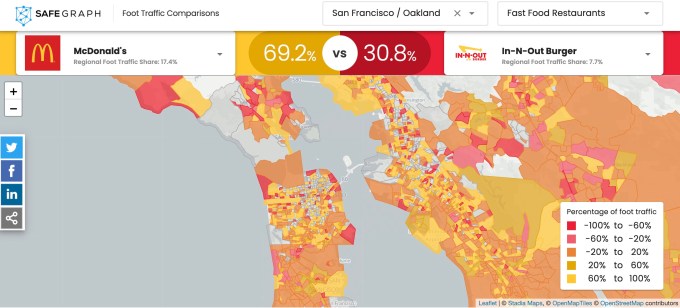
While there are plenty of companies selling data about physical locations, SafeGraph CEO Auren Hoffman said his startup is “one of the few companies to sell this data to data science teams.” For the most part, location data has traditionally been sold to marketers, and Hoffman said, “In the marketing world, if your data is

While there are plenty of companies selling data about physical locations, SafeGraph CEO Auren Hoffman said his startup is “one of the few companies to sell this data to data science teams.”

For the most part, location data has traditionally been sold to marketers, and Hoffman said, “In the marketing world, if your data is like 40% or 50% true, that’s actually amazing.” But that doesn’t cut it for the data scientist who needs to use it to build complex models and algorithms.

So SafeGraph takes what Hoffman described as a “very, very rigorous approach,” crawling and merging data like business listings, foot traffic and building polygons from 20,000 sources. He also noted that while other businesses treat this data as “an exhaust that they sell on the side of their core business,” it represents “100%” of SafeGraph’s revenue.

Hoffman told me that SafeGraph’s customers are using its data in sectors as varied as GIS/mapping, local search, financial services and logistics. Customers include investment company Ares Management, food distribution company Sysco and Choice Hotels — in a statement, Sysco’s senior manager of market, customer and competitive intelligence Ben Anderson described SafeGraph as “the most comprehensive and actionable POI dataset.”

The startup also says that its data is being used by more than 7,000 data scientists and has been cited in more than 300 academic papers.

SafeGraph screenshot

Image Credits: SafeGraph

Today, SafeGraph announced that it has raised $45 million in Series B funding led by Sapphire Ventures, bringing its total funding to $61 million. Previous investors including Alex Rosen of Ridge Ventures, DNX Ventures and Peter Thiel also participated.

“What stands out about SafeGraph is how they’ve been able to quickly position themselves into a major player in the geospatial data industry,” said Sapphire Partner Cathy Gao in a statement. “By singularly focusing on providing the highest-quality places data to data science teams, they’ve earned the trust of some of the largest public and private institutions.”

Hoffman noted that the startup has been “extremely cash efficient,” only losing $3 million over the past two years, and that it raised the funding simply to “grow much faster.” Growth plans include international expansion — SafeGraph has been focused on the United States and Canada thus far, with a U.K. launch planned in April — as well as possible acquisitions.

He added that particularly with the pandemic forcing many businesses to close or change their hours, “having really accurate data is going to be a lot more important in a post-COVID world.”

News: Get feedback on your pitch deck from tech leaders on Extra Crunch Live

The importance of the pitch deck can’t be underestimated. It is often the first point of contact between a company and venture investors, but how investors consume a pitch deck (and what they really think) is also a bit of a black box. Are they speed-flipping through the slides or taking their time? Do they prefer

The importance of the pitch deck can’t be underestimated. It is often the first point of contact between a company and venture investors, but how investors consume a pitch deck (and what they really think) is also a bit of a black box.

Are they speed-flipping through the slides or taking their time? Do they prefer more information on the team or context on the industry? More numbers or more words? How many slides is the right number of slides?

There are too many questions to count, and often very few answers. But we’re popping the lid off of that black box with the Pitch Deck Teardown. We’ve done Pitch Deck Teardowns at events like Disrupt and Early Stage 2020, and this year we’re cranking it up a notch on Extra Crunch Live.

Anyone can submit their pitch deck and hear what our guests, tech leaders across the industry, think of them. (Important note: Extra Crunch members will be prioritized on the list of decks we choose to show during the episode.)

We’ve already gotten some amazing feedback from our guests.

/1 Some of the lessons we’ve learned so far from the ECl Pitch Deck Teardown: (a thread) https://t.co/NtC9fNU4jW

— Jordan Crook (@jordanrcrook) March 1, 2021

So what are you waiting for? Submit your pitch deck or grab yourself a ticket to our next episode of Extra Crunch Live.

See you there!


Early Stage is the premier ‘how-to’ event for startup entrepreneurs and investors. You’ll hear first-hand how some of the most successful founders and VCs build their businesses, raise money and manage their portfolios. We’ll cover every aspect of company-building: Fundraising, recruiting, sales, product market fit, PR, marketing and brand building. Each session also has audience participation built-in – there’s ample time included for audience questions and discussion. Use code “TCARTICLE” at checkout to get 20 percent off tickets right here. 

News: London’s Jiffy picks up £2.6M seed to enter the grocery dark store race

Another online grocery delivery and “dark store” operator breaks cover today: London-based Jiffy, which aims to deliver fresh groceries and household essentials in around 15 minutes, has raised £2.6 million in seed funding as it readies for launch. Backing the upstart, which already faces a plethora of better funded competitors, is venture capital fund LVL1

Another online grocery delivery and “dark store” operator breaks cover today: London-based Jiffy, which aims to deliver fresh groceries and household essentials in around 15 minutes, has raised £2.6 million in seed funding as it readies for launch.

Backing the upstart, which already faces a plethora of better funded competitors, is venture capital fund LVL1 Group, with participation from AddVenture, TA Ventures, Vladimir Kholiaznikov, and angel investors Oskar Hartmann, Alexander Nevinskiy and Dominique Locher.

Jiffy says it will use the injection of capital to launch its first stores in London, as early as this month. It plans to make the service available in Westminster, Waterloo, Lambeth, Battersea, Clapham Town, Shoreditch, Bethnal Green, Hackney, Whitechapel, Stepney Green, and Leytonstone.

The company will then launch a further 20 local fulfilment hubs across the U.K. later this year, and I understand is already out fundraising again. On its deck is likely a slide highlighting an executive team with online and offline retail chops, including former managers from Sainsbury’s and Deliveroo.

“We live in 2021 when you can purchase a ticket to Mars, but you still can’t get your groceries delivered on demand when you need them,” says Jiffy founder Artur Shamalov, who has previously started several companies in the food and delivery space. “The online grocery shopping experience is frustrating for most U.K. customers, as slots are often unavailable for days and weeks in advance, and some stores charge a premium fee for a ‘rapid’ delivery that still takes up to two hours. We believe it shouldn’t be this way, and that getting your groceries should be as accessible and affordable as shopping at an offline grocery store, but with the convenience of an ultrafast delivery service”.

To that end, Shamalov says that Jiffy is creating a service it believes will partially replace the traditional daily grocery shop. This will see it offer a variety of fruits and vegetables, meats, meals, and household essentials from popular brands and local suppliers, with a total product range “exceeding” 2,000 SKUs per store.

“Our goal is to make it as accessible as possible for a very wide audience: from busy parents juggling work, raising children and an active social life to busy professionals in urban areas for whom saving time on essential shopping means they are free to use it for activities they really enjoy,” says the Jiffy founder. “We also think of the many vulnerable people who don’t feel safe going to supermarkets these days. They shouldn’t have to worry about their safety when they run out of bread or milk, nor should they have to wait several hours or days for their order to arrive”.

Jiffy joins a host of European startups that have raised money on the promise of delivering grocery and other convenience store items within 10-20 minutes of ordering. They do this by building out their own hyper-local, delivery-only fulfilment centres — so-called “dark stores” — and recruiting their own delivery personnel. This full-stack or vertical approach and the visibility it provides is then supposed to produce enough supply chain and logistics efficiency to make the unit economics work, although that part is far from proven.

On how competitive the grocery and convenience dark store market is already becoming in the U.K. and elsewhere in Europe, Shamalov notes it’s still a relatively new space, and that all players are creating the infrastructure required to make instant grocery delivery possible. “We believe that within a couple of years, instant grocery delivery will become an essential part of urban infrastructure, in the same way water pipes, broadband lines and telecoms are now,” he says. “So, in a sense, we are all building this new infrastructure together, and we are all competing jointly against the traditional grocery distribution channels”.

The growing (though not definitive) list includes Berlin’s Flink, which has raised $52 million in seed financing in a mixture of equity and debt, and Berlin HQ’d Gorillas, which has raised $44 million in Series A funding and recently expanded to London in addition to Germany and Netherlands. Also operating in London are Weezy, Getir, Dija and Zapp. The U.S. unicorn goPuff is also reportedly looking to expand into Europe and has held talks to acquire or invest in the U.K.’s Fancy.

It’s not just a land grab but a capital grab, too, since the model is an infrastructure play as much as anything. Large amounts of financing will be needed to build stores and run loss leading customer acquisitions campaigns, something that is already ramping up in London. In contrast to competitors, although it is yet to launch, Jiffy appears underfunded.

“We don’t think we are underfunded,” says Shamalov, pushing back. “We take as much capital as we think is efficient considering dilution of the founders and building the company step by step rather than missing out on overpromised ambitions.

“We don’t necessarily agree that having the most funding and overspending on acquisition and expansion will automatically lead to a greater success in this industry. Hyperlocal business models require a hyperlocal approach to everything, so our focus is on expanding within just one market, instead of going globally”.

In addition, Shamalov claims that Jiffy is seeing strong inbound interest from investors, which he says is surprising since the startup is still operating in a stealth mode. “We are confident the next funding round will be a solid step forward,” he adds.

News: Google Play drops commissions to 15% from 30%, following Apple’s move last year

Google will lower its Play commissions globally for developers that sell in-app digital goods and services on its marquee store, the company said, following a similar move by rival Apple late last year. The Android-maker said on Tuesday that starting July 1, it is reducing the service fee for Google Play to 15% — down

Google will lower its Play commissions globally for developers that sell in-app digital goods and services on its marquee store, the company said, following a similar move by rival Apple late last year.

The Android-maker said on Tuesday that starting July 1, it is reducing the service fee for Google Play to 15% — down from 30% — for the first $1 million of revenue developers earn using Play billing system each year. The company will levy a 30% cut on every dollar developers generate through Google Play beyond the first $1 million in a year, it said.

Citing its own estimates, Google said 99% of developers that sell goods and services with Play will see a 50% reduction in fees, and that 97% of apps globally do not sell digital goods or pay any service fee.

Google’s new approach is slightly different from Apple, which last year said it would collect 15% rather than 30% of App Store sales from companies that generate no more than $1 million in revenue through the company’s platform. That drop doesn’t apply to iOS apps if a developer’s revenue on Apple platform exceeds $1 million.

“We’ve heard from our partners making $2 million, $5 million and even $10 million a year that their services are still on a path to self-sustaining orbit,” wrote Sameer Samat, VP of Android and Google Play, in a blog post.

“This is why we are making this reduced fee on the first $1 million of total revenue earned each year available to every Play developer that uses the Play billing system, regardless of size. We believe this is a fair approach that aligns with Google’s broader mission to help all developers succeed.”

The move comes months after changes in Google billing system charges rattled many startups in India. More than 150 startups banded together last year after Google said it will collect as high as 30% cut on in-app purchases in a range of categories made by Android apps.

Following the backlash, Google delayed mandating the planned Play Store payments rule in India to April 2022 and had reached out to several firms in recent months in the country to better understand their concerns, people familiar with the matter told TechCrunch.

Vijay Shekhar Sharma, founder and chief executive of mobile payments provider Paytm, India’s most valuable startup, dismissed Google’s move today as a “PR stunt.”

In an interview with TechCrunch, Sharma said established firms like his will still have to pay an exorbitant amount of fee to Google. Today’s announcement by Google, he said, further raises the question whether Google plans to address concerns raised by serious internet firms at all.

The biggest concern firms face today is the inability to use a third-party payments service for billing, he said. “They are basically saying that as soon as you build a business larger than $1 million — which is a very low bar — you are going to pay a 30% fee, which after taxes, becomes 44%,” he said.

A 30% sales cut and the inability to use third-party billing system have been points of contention between many developers and app store operators — Apple and Google — and led to a lawsuit by Fortnite-maker Epic Games against the iPhone-maker last year. Epic CEO Tim Sweeney had alleged that Apple’s move to lower the App Store fee for smaller developers was orchestrated to sow division among app creators.

Sharma said he was hopeful that Google will address other concerns, especially because in a country like India “we don’t have any other operating system, or distribution platform. They effectively control the destiny of every app developer in the country.”

Android commands 99% of the smartphone market in India, according to research firm Counterpoint. “Earlier India was powered by Android, then we became dependent on Android, and now it is controlled by Android,” said Sharma, whose payments app competes with Google Pay in the world’s second largest internet market.

Google’s Samat said,”We look forward to seeing more businesses scale to new heights on Android, and to further discussions with the Indian developer community to find new ways to support them technically and economically as they build their businesses.”

“Once developers confirm some basic information to help us understand any associated accounts they have and ensure we apply the 15% properly, this discount will automatically renew each year,” he wrote.

News: Docker nabs $23M Series B as as new developer focus takes shape

It was easy to wonder what would become of Docker after it sold its enterprise business in 2019, but it regrouped last year as a cloud native container company focused on developers, and the new approach appears to be bearing fruit. Today, the company announced a $23 million Series B investment. Tribe Capital led the

It was easy to wonder what would become of Docker after it sold its enterprise business in 2019, but it regrouped last year as a cloud native container company focused on developers, and the new approach appears to be bearing fruit. Today, the company announced a $23 million Series B investment.

Tribe Capital led the round with participation from existing investors Benchmark and Insight Partners. Docker has now raised a total of $58 million including the $35 million investment it landed the same day it announced the deal with Mirantis .

To be sure, the company had a tempestuous 2019 when they changed CEOs twice, sold the enterprise division and looked to reestablish itself with a new strategy. While the pandemic made 2020 a trying time for everyone, Docker CEO Scott Johnston says that in spite of that, the strategy has begun to take shape.

“The results we think speak volumes. Not only was the strategy strong, but the execution of that strategy was strong as well,” Johnston told me. He indicated that the company added 1.7 million new developer registrations for the free version of the product for a total of more 7.3 million registered users on the community edition.

As with any open source project, the goal is to popularize the community project and turn a small percentage of those users into paying customers, but Docker’s problem prior to 2019 had been finding ways to do that. While he didn’t share specific numbers, Johnston indicated that annual recurring revenue (ARR) grew 170% last year, suggesting that they are beginning to convert more successfully.

Johnston says that’s because they have found a way to turn a certain class of developer in spite of a free version being available. “Yes, there’s a lot of upstream open source technologies, and there are users that want to hammer together their own solutions. But we are also seeing these eight-to-ten person ‘two pizza teams’ who want to focus on building applications, and so they’re willing to pay for a service,” he said.

That open source model tends to get the attention of investors because it comes with that built-in action at the top of the sales funnel. Tribe’s Arjun Sethi, whose firm led the investment, says his company actually was a Docker customer before investing in the company and sees a lot more growth potential.

“Tribe focuses on identifying N-of-1 companies — top-decile private tech firms that are exhibiting inflection points in their growth, with the potential to scale towards outsized outcomes with long-term venture capital. Docker fits squarely into this investment thesis[…],” Sethi said in a statement.

Johnston says as they look ahead to post-pandemic, he’s learned a lot since his team move out of the office last year. After surveying employees, they were surprised to learn that most have been happier working at home, having more time to spend with family, while taking away a grueling commute. As a result, he sees going virtual first, even after it’s safe to reopen offices.

That said, he is planning to offer a way to get teams together for in-person gatherings and a full company get-together once a year.

“We’ll be virtual first, but then with the savings of the real estate that we’re no longer paying for, we’re going to bring people together and make sure we have that social glue,” he said.

News: Ford expands robotics research with $75 million U-M facility

Ford Motor Company will be embedding 100 of its researchers and engineers in a new $75 million robotics and mobility facility on the University of Michigan’s Ann Arbor campus. This is not the first collaboration between the automaker and the university. Ford is UM’s single largest corporate donor and the two entities have previously teamed

Ford Motor Company will be embedding 100 of its researchers and engineers in a new $75 million robotics and mobility facility on the University of Michigan’s Ann Arbor campus.

This is not the first collaboration between the automaker and the university. Ford is UM’s single largest corporate donor and the two entities have previously teamed up to open the UM Ford Center for Autonomous Vehicles. But this is the first time Ford is co-locating part of its team on a university campus.

Ford clarified to TechCrunch that the arrangement is not an incubator, but “an extension of our global research and advanced engineering network.”

The arrangement will give Ford space to conduct robotics research and access to students – and vice versa – from the top floor of the four-floor, 134,000 square-foot building. Ford will also have access to the research labs located throughout the rest of the building, including four high-bay garage spaces to test autonomous vehicles and a walking robots laboratory.

Nearby, Ford will be able to drive its cars at the Mcity Test Facility, a simulated Main Street for testing vehicles in real-world environments. Ford was the first automaker to test an autonomous vehicle at Mcity in 2015.

The automaker’s research areas will not be limited to autonomous driving tech.

“The whole field of robotics has applications beyond the vehicle, that’s very clear to us,” Ford CTO Ken Washington said Tuesday. “We made the decision quite some time ago that we wanted to create a capability in robotics to apply to our vehicles, but also to have a broader potential application base, including manufacturing, including rethinking how we’re showing up in the market with our commercial vehicles, and possibly other solutions, like aerial robotics.”

In January of 2020, Agility Robotics’ first order came from Ford, for the Digit – a humanoid robot equipped with sensors to work in human spaces. Ford will be experimenting with the Digit in the new building as well as Boston Dynamics’ infamous Spot, the four-legged robot that can navigate unpredictable terrain. Ford will be conducting experiments with both these robot models at the new UM facility.

The general robotics and engineering research will be led by Mario Santillo, and Tony Lockwood, Ford’s technical manager in AV Research, will lead on the AV side.

Ford and UM as part of the arrangement will be developing an inclusive curriculum “to open more opportunities for underserved students,” according to a statement. Alec Gallimore, the Dean of Engineering at UM, said the new Robotics Institute aims to push the field to be more equity-centered. To that end, students from historically black schools in Atlanta, Georgia will be able to enroll remotely in a Robotics 101 course, which doesn’t require calculus, to “level the playing field” for students from high schools that did not offer advanced courses.

WordPress Image Lightbox Plugin