Monthly Archives: March 2021

News: Nigeria’s Plentywaka gets backing from Techstars, plans expansion to Canada

Plentywaka, a Nigerian bus-booking platform, today announced that it has been accepted into the Techstars Toronto accelerator program. It will join nine other startups in the class of 2021 and secure funding from the accelerator as it sets its sights on global expansion. The Lagos-based company, founded by Onyeka Akumah, Johnny Ena, John Shaibu and

Plentywaka, a Nigerian bus-booking platform, today announced that it has been accepted into the Techstars Toronto accelerator program.

It will join nine other startups in the class of 2021 and secure funding from the accelerator as it sets its sights on global expansion.

The Lagos-based company, founded by Onyeka Akumah, Johnny Ena, John Shaibu and Afolabi Oluseyi, operates an ‘Uber-for-buses’ model connecting commuters with buses via an app.

Plentywaka launched in September 2019, and in the first two months, moved an average of six people daily, according to CEO Akumah. By its sixth month, this number increased to about 1,500 daily, and the company completed more than 100,000 rides within that timeframe.

Then in March 2020, the pandemic-induced lockdown hit businesses across Lagos and other states within Nigeria. Due to the nature of its business, Plentywaka had to make a slight pivot and began transporting essential services across Lagos, especially food items. It also opened a logistics service.

As the lockdown eased across the city and commuting resumed, the company moved 60% capacity while the operational cost remained the same. Although growth was steady and picking up, the company started seeking external investment. It received $300,000 pre-seed from its parent company, EMFATO and other early-stage investors like Microtraction and Niche Capital in August.

Backed with the new funding, Plentywaka has since doubled down on its core offering — transporting people via buses. The logistics arm that it launched, as well as a car service, have since been shuttered.

Akumah says the focus on a primary offering has paid a dividend. The company has expanded its intrastate services into two other cities in Nigeria including the country’s capital city, Abuja and has moved about 300,000 people. Following this announcement though, there are immediate plans to launch an interstate service across different cities in Nigeria.

This service will see Plentywaka partner with some major bus travel companies, which collectively have more than 2000 buses and ply over 100 routes in the country. Plentywaka acts as an aggregator, and commuters can see options of various transport companies, compare fares, and book on its platform.

“Plentywaka is getting to a point where we’re now becoming more like an aggregator as we onboard transportation companies on our platform. Interstate travel in Nigeria is data insufficient, and we want to be the first company to solve this.” Ena, co-founder and president of Plentywaka, said to TechCrunch. 

In addition to this and the new capital from Techstars, Plentywaka is looking to scale its platform across Africa and North America. Akumah says this global expansion plan will start with a city in Canada, most likely Toronto, on or before Q4 2021.

Sunil Sharma, the managing director of Techstars Toronto, confirmed this to TechCrunch. According to Sharma, Techstars is backing the Nigerian mobility startup because it’s solving a massive problem in Nigeria that can be likened to urban transportation challenges in other populated cities worldwide.

“We know that Western cities have legacy transportation systems. However, there are many transportation challenges, even in a city like Toronto,” he said. “And we think that Plentywaka’s technology and approach in improving the lives of citizens and their daily commute needs can be brought over to cities in the West just as they are in Africa.”

Plentywaka plans to launch its intracity service first after engaging the country’s necessary stakeholders before introducing the intercity model. Sharma thinks that most cities in Canada aren’t well serviced by buses, leading to a broken intercity transit infrastructure. Plentywaka’s presence will bring the much-needed option the city deserves, he says.

“Cities and towns here should have bus connectivity, but they quite simply don’t have it, and my view is that the arrival of Plentywaka will be an immediate option to the status quo. It will also resonate with people as a way to supplement existing transportation options,” he said.

Techstars’ relationship with Akumah also proved crucial in Plentywaka’s acceptance into the accelerator. A second-time Techstars-backed founder, Akumah co-founded Farmcrowdy, a Nigerian digital agriculture platform in 2016. Having gone through the accelerator’s Atlanta program four years ago with the agritech startup, Akumah is doing the same with Plentywaka. He doubles as CEO at both companies

The serial founder said the relationship with Techstars is one reason the company is expanding to Canada instead of neighbouring African countries.

“If the opportunity we have in Toronto right now to expand was similar to what we had in Ghana or South Africa, of course we’ll be having those conversations already. But when we have the support system from Techstars, Sunil, and regulators in Toronto without even putting feet on the ground, I mean that makes it exciting for us to expand to Canada,” the CEO remarked.

Nigerian or African startups, in general, rarely make their way into Canada. Plentywaka is on the verge of doing so, and it will be looking to close a seed round from investors to carry out these expansion plans and further improve its technology.

News: Norrsken Foundation is closing on an oversubscribed impact venture fund at 125 million euros

About four years ago, social impact organization Norrsken Foundation launched a small program investing around EUR30 million in capital it had received from its wealthy patron, Klarna co-founder Niklas Adalberth. Now, that initiative has become its own impact investment firm, Norrsken VC and, according to people familiar with the firm, is about to close on

About four years ago, social impact organization Norrsken Foundation launched a small program investing around EUR30 million in capital it had received from its wealthy patron, Klarna co-founder Niklas Adalberth.

Now, that initiative has become its own impact investment firm, Norrsken VC and, according to people familiar with the firm, is about to close on its first independent investment vehicle — a 125 million euro fund focused on investing in startups that are, as its website suggests, “solving the world’s biggest problems”

Norrsken VC did not respond for a request for comment about the firm’s fundraising plans.

Already, the young firm has invested in companies that would be standouts among any venture capital portfolio. Norrsken VC is one of the early backers behind Northvolt, which just received a $14 billion order for its batteries for electric vehicles from Volkswagen.

Electrification is actually a big theme for the early-stage firm, which counts the electric plane technology developer, Heart Aerospace, and autonomous electric vehicle developer Einride, and the battery monitoring and data management startup, Nortical, among its other portfolio companies.

Einride scored another huge coup recently. TechCrunch reported that the company was close to closing on $75 million in new funding even as it explored a potential SPAC for its business.

Indeed, Norrsken Foundation’s work in investing presaged a surge in climate and sustainability-focused activity from both venture investors, public markets and entrepreneurs looking at how to aid in the transition from fossil fuels to renewable resources and other zero carbon sources of energy.

That thesis on energy consumption extends to other areas of the firm’s portfolio, including companies like the energy efficient data center designer and technology developer, Submer.

If electrification and efficiency are one area of focus in the climate fight, Norrsken has also made moves to combat waste and improve efficiency in the food chain, as well. It’s probably the largest area of focus for the firm’s current portfolio outside of electrification, and there appear to be some early winners emerging in that category.

Those range from startups focused on agriculture like WeFarm and Ignitia, to consumer waste in the food industry through investments in Olio, Matsmart and Whywaste.

Taken together the climate and sustainability thesis has been the largest and most opportune investment target, but healthcare and wellness are also within the firm’s investment mandate. Startups like Winningtemp are an interesting indication of the firm’s thesis. That startup provides ways to monitor and support employees’ mental health.


News: Uber says it will treat UK drivers as workers in wake of Supreme Court ruling

Uber said Tuesday that drivers in the UK who use its ride-hailing app will be treated as workers, a designation that will give them some benefits such as holiday pay. However, even as Uber seemingly concedes to a Supreme Court ruling last month, a new fight could already be brewing over the company’s decision to

Uber said Tuesday that drivers in the UK who use its ride-hailing app will be treated as workers, a designation that will give them some benefits such as holiday pay. However, even as Uber seemingly concedes to a Supreme Court ruling last month, a new fight could already be brewing over the company’s decision to calculate working time from the point a trip commences — rather than when drivers log on to the app.

Uber said that beginning Wednesday all drivers in the UK will be paid holiday time based on 12.07% of their earnings, which will be paid out every two weeks. Drivers will also be paid at least the minimum wage (called the National Living Wage) after accepting a trip request and after expenses, Uber said in a statement. Eligible drivers in the UK will automatically be enrolled into a pension plan with contributions from Uber. These contributions will represent approximately 3% of a driver’s earnings.

In the UK, there are three designations: self-employed, employed and worker. The “workers” designation doesn’t make them employees, but it is still entitles them to the minimum wage, holiday pay, and, if eligible, a pension.

Uber said Tuesday that based on current expectations, the company is not changing its previously announced expectations for Adjusted EBITDA for the first quarter or for 2021.

Uber has been entangled in fight over worker classification in the UK since 2016. Last month, the UK’s Supreme Court dismissed Uber’s appeal, which reaffirmed earlier rulings that drivers using the app are workers and not independent contractors. With no place to turn, Uber has conceded — sort of. Uber will only guarantee that drivers’ working time and other benefits will accrue once they accept a trip and not based on when they have signed into the app to begin working. That already has labor activists fuming.

“While we welcome Uber’s decision to finally commit to paying minimum wage, holiday pay and pensions we observe that they have arrived to the table with this offer a day late and a dollar short, literally,” according to a statement from the App Drivers & Couriers Union and signed by James Farrar and Yaseen Aslam, the two drivers who brought a case against Uber. “The Supreme Court ruled that drivers are to be recognized as workers with entitlements to the minimum wage and holiday pay to accrue on working time from log on to log off whereas Uber is committing only to these entitlements to accrue from time of trip acceptance to drop off. This means that Uber drivers will be still short-changed to the tune of 40-50%. Also, it is not acceptable for Uber to unilaterally decide the driver expense base in calculating minimum wage. This must be subject to collective agreement.

While Uber undoubtedly has made progress here, we cannot accept anything less than full compliance with legal minimums. We would also expect to see Uber make progress towards trade union recognition, a fair dismissals appeals process and a data access agreement.”

Farrar told TechCrunch that the issue has not been resolved. The next step will be to go back to the Employment Tribunal to ensure that drivers are paid what they are legally entitled to,

Even as Uber deals with continued labor issues in the UK, the company will likely turn much of its attention to cases are still playing out in courts in other European countries — decisions which could put pressure on Uber’s bottom line. Meanwhile, EU lawmakers are also consulting on how to improve conditions for gig workers so Uber’s concession in the UK is likely feed into pan-EU negotiations.

News: Investors Clara Brenner, Quin Garcia and Rachel Holt are coming to TC Sessions: Mobility 2021

The transportation industry is abuzz with upstarts, legacy automakers, suppliers and tech companies working on automated vehicle technology, digital platforms, electrification and robotics. Then there are shared mobility companies from cars to scooters and mopeds to ebikes. And who can forget the emerging air taxi companies? At the center of this evolving industry are the

The transportation industry is abuzz with upstarts, legacy automakers, suppliers and tech companies working on automated vehicle technology, digital platforms, electrification and robotics. Then there are shared mobility companies from cars to scooters and mopeds to ebikes. And who can forget the emerging air taxi companies?

At the center of this evolving industry are the investors. Simply put: TechCrunch can’t hold an event on mobility without hearing from the people who are hunting for the best opportunities in the industry and tracking all of its changes. That’s why we’re happy to announce investors Clara Brenner of Urban Innovation Fund, Quin Garcia of Autotech Ventures and Rachel Holt of Construct Capital will join us on our virtual stage at TC Sessions: Mobility 2021. The virtual event, which features the best and brightest minds in the world of mobility, will be held on June 9.

p.s. Early Bird tickets to the show are now available – book today and save 35% before prices go up.

Brenner, Garcia and Holt will come on stage to discuss their near and long-term investment strategies, overlooked opportunities, and challenges that face startups trying to break into the transportation sector. They’ll lean on their considerable experience to provide the advice and insight that will help attendees understand the state of the industry and where it is headed.

Brenner is a serial co-founder. She is co-founder and managing partner of the Urban Innovation Fund, a venture capital firm that provides seed capital and regulatory support to entrepreneurs solving urban challenges. Urban Innovation Fund has backed curbflow, Electriphi and Kyte among others. She also co-founded Tumml, a startup hub for urban tech that provided 38 startups with seed funding and mentorship, and hosts events around urban innovation. In 2014, Forbes listed her as one of its “30 Under 30” for Social Entrepreneurship.

Garcia, a lifelong ‘car guy’ with an MS degree in management science and automotive engineering from Stanford University, is managing director at Autotech Ventures. He’s also a board director, board observer and advisory board member to a number of mobility companies including Lyft, Peloton Technology, and Connected Signals.

Garcia has been on the ground floor of startups, notably as part of the initial team at the electric vehicle infrastructure startup Better Place, where he was responsible for partnerships with automakers and parts suppliers while living in Israel, Japan and China.

Holt is co-founder and Managing Partner of early-stage venture firm Construct Capital, which is focused on finding founders that are trying to change foundational industries such as manufacturing and supply chain, logistics and transportation. The company’s transportation-focused investments include ChargeLab. Holt also sits on the board of MotoRefi.

Prior to Construct, Holt was at Uber, where she was one of the company’s first 30 employees. During her 8.5-year stint at Uber, Holt rose through the ranks of the company, including roles running the U.S.  and Canada “Rides” business as well as global marketing and customer support. She was a longtime member of the company’s executive leadership team. Her last position at Uber was leading the company’s new mobility organization, which focused on its e-bike and scooter businesses as well as running its incubator, which funded and developed new products and services.

Rachel began her career at Bain & Company, advising companies in the private equity, financial services and healthcare industries. She was ranked No. 9 on Fortune’s 40 under 40 and was named by Fast Company as One of the Most Creative People in Business.

We can’t wait to hear from this investor panel at TC Sessions: Mobility on June 9. Make sure to grab your Early Bird pass before May 6 to save 35% on tickets and join the fun!

News: Daily Crunch: Google Play halves commission on developers’ first $1M

Google is letting developers keep more of their Play revenue, Instagram adds teen safety features and we examine the global distribution of venture funding. This is your Daily Crunch for March 16, 2021. The big story: Google Play halves commission on first $1M Following a similar move by Apple last year, Google said that it

Google is letting developers keep more of their Play revenue, Instagram adds teen safety features and we examine the global distribution of venture funding. This is your Daily Crunch for March 16, 2021.

The big story: Google Play halves commission on first $1M

Following a similar move by Apple last year, Google said that it will be reducing its fee from 30% to 15% for the first $1 million that developers earn through Google Play annually.

This is slightly different from Apple’s approach, in that it applies to all developers — although the fee goes back to 30% for any money earned beyond that first million dollars.

“We’ve heard from our partners making $2 million, $5 million and even $10 million a year that their services are still on a path to self-sustaining orbit,” wrote Google’s Sameer Samat. “This is why we are making this reduced fee on the first $1 million of total revenue earned each year available to every Play developer that uses the Play billing system, regardless of size.”

The tech giants

Instagram adds new teen safety tools as competition with TikTok heats up — Instagram says it’s rolling out new safety features that will restrict adult users from being able to contact teens who didn’t already follow them.

Google’s Soli radar returns to track sleep on the new Nest Hub — We haven’t heard a peep from Project Soli since the technology was introduced with the Pixel in late-2019.

China wants to dismantle Alibaba’s media empire: reports — Over the years, Jack Ma has accumulated a media portfolio in China that rivals that of Jeff Bezos in the United States.

Startups, funding and venture capital

Socure raises $100M at $1.3B valuation, proving identity verification is hotter than ever — Socure uses AI and machine learning to verify identities.

Overwolf raises $52.5M for its platform to build, distribute and monetize in-game, user-generated content — The company’s platform has some 30,000 creators, 90,000 mods and add-ons, and 18 million monthly users across thousands of games.

Aiming to become the definitive source for location data, SafeGraph raises $45M — While there are plenty of companies selling data about physical locations, SafeGraph CEO Auren Hoffman said his startup is “one of the few companies to sell this data to data science teams.”

Advice and analysis from Extra Crunch

The global inequity in venture financing is staggering — There’s been a boom in Latin American and European fintechs, as well as a general rise in VC activity in a host of Asian countries, but the landscape remains imbalanced.

The NFT market is just getting started, but where is it headed? — Part one in a three-part series.

Farmland could be the next big asset class modernized by marketplace startups — Startups like AcreTrader and others including Tillable, FarmTogether and Harvest Returns are bringing marketplace models to the farming world.

(Extra Crunch is our membership program, which helps founders and startup teams get ahead. You can sign up here.)

Everything else

Ford expands robotics research into $75 million University of Michigan facility — Ford Motor Company will be embedding 100 of its researchers and engineers in a new robotics and mobility facility on the University of Michigan’s Ann Arbor campus.

Talking product-market fit with Sean Lane, whose company tore through 28 products to become a unicorn — Occasionally, it’s easy for startups to achieve so-called product-market fit, but more often, it’s a struggle.

Get feedback on your pitch deck from tech leaders on Extra Crunch Live — The importance of the pitch deck can’t be underestimated.

The Daily Crunch is TechCrunch’s roundup of our biggest and most important stories. If you’d like to get this delivered to your inbox every day at around 3pm Pacific, you can subscribe here.

News: SoftBank, Tencent backs IP analytics platform PatSnap in $300M round

As enterprises around the world pour more money into research and invention to stay competitive, the need for analyzing the worthiness of R&D expenses also grows. One company serving that function is PatSnap. When co-founder Jeffrey Tiong was working in the medical devices industry more than a decade ago, he realized how critical intellectual property

As enterprises around the world pour more money into research and invention to stay competitive, the need for analyzing the worthiness of R&D expenses also grows.

One company serving that function is PatSnap. When co-founder Jeffrey Tiong was working in the medical devices industry more than a decade ago, he realized how critical intellectual property and patents were in the tech world.

In 2007, Tiong launched PatSnap in Singapore to build a global patent search database and over time pushed the firm into adjacent realms. PatSnap’s more recent software, which Tiong dubs “innovation intelligence,” helps enterprises analyze their R&D strategies, keep track of competitors and identify potential partners by crunching data around the likes of scientific papers, government R&D grants and startup funding news.

“What we found is that a lot of companies [treat] innovation as a department, as a function, as a KPI in an organization,” said Tiong. “Many companies are hiring people … who have to find out what kind of technology is out there and who is doing what. You cannot do everything by yourself nowadays. You need to partner.”

Investors are paying attention to the R&D boom. In PatSnap’s latest funding round, the company attracted SoftBank’s Vision Fund II and Tencent as lead investors. The Series E round totals $300 million, with participation from CITIC Industrial Fund, which is part of Chinese state-owned conglomerate CITIC Group; Sequoia China; Xiaomi founder Lei Jun’s Shunwei Capital; and Vertex Ventures.

Masayoshi Son spent less than half an hour on a call with Tiong before the billionaire founder of SoftBank hammered out a deal for PatSnap. In his early twenties, Son invented and patented a device that he sold for $1 million, so “he understands the importance of inventions, IP and innovation,” Tiong said.

Tiong declined to disclose PatSnap’s post-money valuation in an interview with TechCrunch but said the number has crossed $1 billion.

The United States is PatSnap’s largest market, although China is rapidly growing as a revenue stream amid the country’s patent filing spree. In 1999, the World Intellectual Property Organization (WIPO) received just 276 applications from China. By 2019, that number rose to 58,990, surpassing that of the United States.

But compared with their western counterparts, Chinese corporations are less inclined to pay big bucks for software, which makes it challenging for SaaS companies to monetize in the country. PatSnap operates under the brand Zhihuiya in China, with customers ranging from retail brands, research institutes, AI firms to pharmaceutical giants.

The sheer number of patents doesn’t translate conveniently into technological clout. The U.S. is still ahead of China in terms of R&D expenditure, Tiong observed. Furthermore, “the quality of the patents in China is not as strong and a lot of them are increment innovation instead of groundbreaking types of invention,” he added.

PatSnap says it now has more than 10,000 customers in over 50 countries, with a 700-person workforce spread across the U.S., Europe, Canada, Japan and China. Some of its notable customers include Tesla, General Electric, Siemens, Dyson, PalPal, Spotify and Megvii. With the fresh capital, the company plans to further develop products, acquire more domain expertise, expand global sales presence and invest in human capital.

News: A crypto company’s journey to Data 3.0

Having worked at tech companies like LinkedIn and eBay, I’ve observed firsthand the evolution from Data 1.0 to Data 3.0. In Data 1.0, data is seen as a reactive function providing ad-hoc manual services or firefighting in urgent situations.

Michael Li
Contributor

Michael Li is VP of Data at Coinbase.

Data is a gold mine for a company.

If managed well, it provides the clarity and insights that lead to better decision-making at scale, in addition to an important tool to hold everyone accountable.

However, most companies are stuck in Data 1.0, which means they are leveraging data as a manual and reactive service. Some have started moving to Data 2.0, which employs simple automation to improve team productivity. The complexity of crypto data has opened up new opportunities in data, namely to move to the new frontier of Data 3.0, where you can scale value creation through systematic intelligence and automation. This is our journey to Data 3.0.

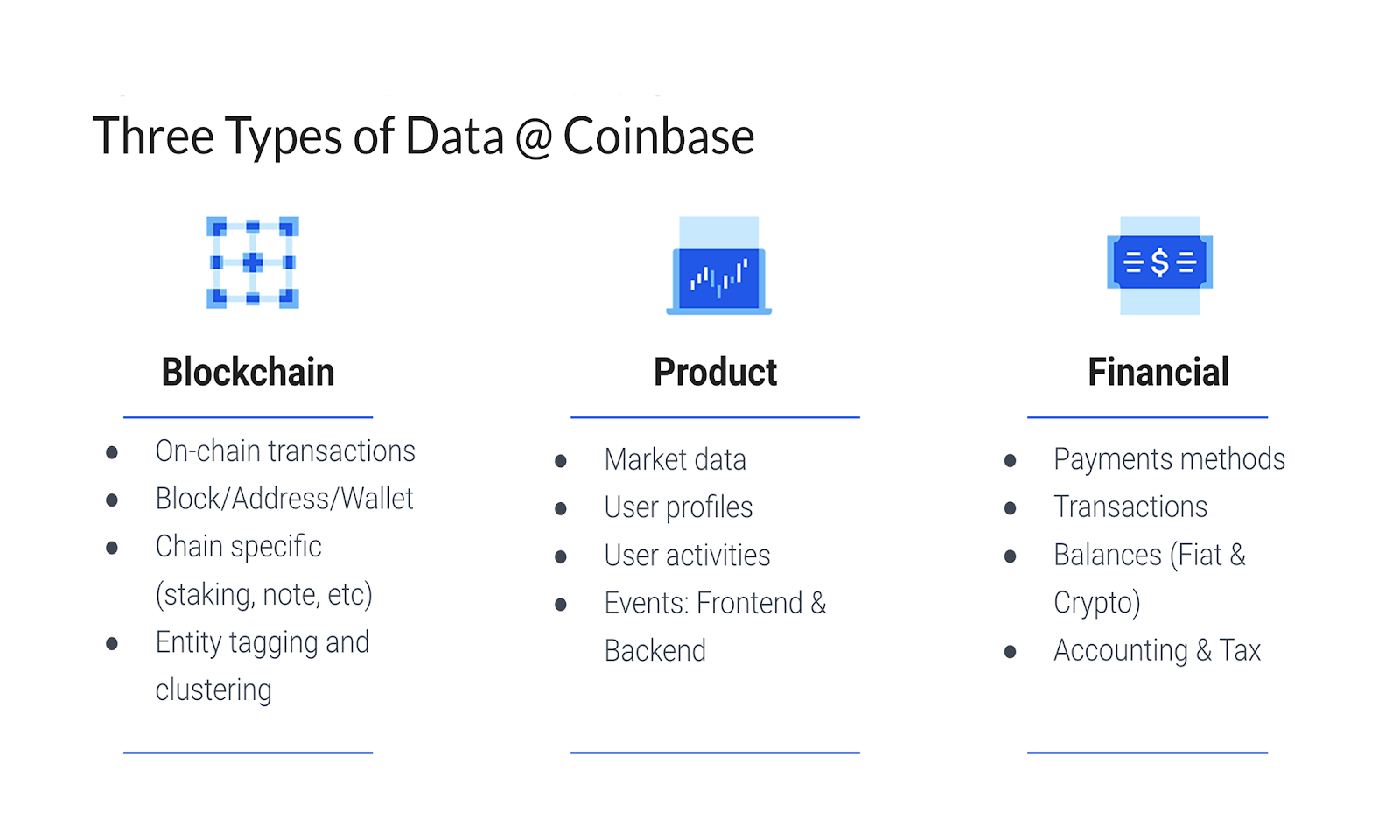
Coinbase is neither a finance company nor a tech company — it’s a crypto company. This distinction has big implications for how we work with data. As a crypto company, we work with three major types of data (instead of the usual one or two types of data), each of which is complex and varied:

  1. blockchain: decentralized and publicly available
  2. product: large and real-time
  3. financial: high-precision and subject to many financial/legal/compliance regulations.

Our focus has been on how we can scale value creation by making this varied data work together, eliminating data silos, solving issues before they start and creating opportunities for Coinbase that wouldn’t exist otherwise.

Having worked at tech companies like LinkedIn and eBay, and also those in the finance sector, including Capital One, I’ve observed firsthand the evolution from Data 1.0 to Data 3.0. In Data 1.0, data is seen as a reactive function providing ad-hoc manual services or firefighting in urgent situations.

News: Squarespace raises $300M at staggering $10B valuation

Squarespace has raised $300 million in a round of funding that values the company at a staggering $10 billion valuation. New backers include Dragoneer, Tiger Global, D1 Capital Partners, Fidelity Management & Research Company, funds and accounts advised by T. Rowe Price Associates, Inc. and Spruce House. Existing backers Accel and General Atlantic also participated. 

Squarespace has raised $300 million in a round of funding that values the company at a staggering $10 billion valuation.

New backers include Dragoneer, Tiger Global, D1 Capital Partners, Fidelity Management & Research Company, funds and accounts advised by T. Rowe Price Associates, Inc. and Spruce House. Existing backers Accel and General Atlantic also participated. 

Squarespace Founder & CEO Anthony Casalena said the fresh capital will advance the company’s growth initiatives and help it scale its product suite.

The move comes less than two months after the company filed confidentiality to go public via a direct listing or initial public offering.

Squarespace, which has helped millions create their own websites, was founded in 2003 and bootstrapped until a $38.5 million Series A in 2010 that was co-led by Accel and Index Ventures.

The online website creation and hosting service — which has now expanded into e-commerce by hosting online stores — then raised another $40M round in 2014. But it is perhaps best known for its epic 2017-era $200 million secondary round that General Atlantic financed. 

At that time, TechCrunch reported that Squarespace was a profitable company, with revenues increasing 50 percent in the prior year to about $300 million. Squarespace is declining to comment on its latest funding round beyond a post on its website.

New York City-based Squarespace has over 1200 employees spread across its headquarters and offices in Dublin, Ireland; Portland, Oregon and Los Angeles, California. 

News: Wise accuses former Brazil banking partner of smear campaign after ‘unfounded’ accusations of fraud

Wise, the London headquartered company that made its name offering international money transfers and is reportedly planning an IPO, has accused its former banking partner in Brazil of a “smear campaign” after it was accused of fraud — claims that Wise says are “false and unfounded”. The war of words between Brazil’s MS Bank and

Wise, the London headquartered company that made its name offering international money transfers and is reportedly planning an IPO, has accused its former banking partner in Brazil of a “smear campaign” after it was accused of fraud — claims that Wise says are “false and unfounded”.

The war of words between Brazil’s MS Bank and Wise appears to have followed Wise securing its own FX broker license from Brazil’s Central Bank in January, meaning that its partnership with MS Bank would soon come to an end. The following month, without prior notice, MS Bank terminated its contract with Wise and informed customers that it was launching its own transfer service called CloudBreak.

Without a banking partner and before it had time to begin testing transfers under its own FX broker licence, Wise was forced to temporarily suspend its Brazil corridor. On the 12th of March, Wise was able to open its Brazilian real (BRL) to U.S. dollar (USD) corridor again, under its own license, and then things got hostile.

In an email sent to customers the same day — and shared with TechCrunch earlier this week — MS Bank alleges that Wise had been committing fraud via customer accounts. Those allegations were also repeated in a YouTube video and text published on MS Bank’s own website and focussed on a discrepancy in the way transactions are registered on a customer’s account and with the Brazilian Central Bank.

In a subsequent blog post, Wise gives a detailed and robust explanation of the discrepancy in the way transactions are recorded, categorically denying any wrongdoing, and calls out MS Bank for launching an alleged “defamation campaign”.

In a statement provided to TechCrunch, Wise says the accusations “have been timed to raise awareness of the launch of that ex-partner’s competing product”. “We are not aware of any investigation or accusations against Wise by any regulator or other authority, either in Brazil or anywhere else,” adds the fintech company. “We are certain that we are not responsible for any fraudulent or improper activity using customer data and / or funds. Wise is taking legal measures to address this matter”.

Wise’s statement in full:

In recent weeks Wise has been the subject of a smear campaign by a former business partner in Brazil. The accusations have been timed to raise awareness of the launch of that ex-partner’s competing product. We are not aware of any investigation or accusations against Wise by any regulator or other authority, either in Brazil or anywhere else.

Wise maintains its commitment to the transparency and security of our operations for our more than 10 million customers around the world. We are certain that we are not responsible for any fraudulent or improper activity using customer data and / or funds. Wise is taking legal measures to address this matter.

News: Three energy-innovation takeaways from Texas’ deep freeze

Unpredictability and complexity are quickening, and technology has its place, but not simply as an individual safeguard or false security blanket.

Micah Kotch
Contributor

Micah Kotch is the managing director at URBAN-X.

Individual solutions to the collective crisis of climate change abound: backup diesel generators, Tesla powerwalls, “prepper” shelters. However, the infrastructure that our modern civilization relies on is interconnected and interdependent — energy, transportation, food, water and waste systems are all vulnerable in climate-driven emergencies. No one solution alone and in isolation will be the salvation to our energy infrastructure crisis.

After Hurricane Katrina in 2005, Superstorm Sandy in 2012, the California wildfires last year, and the recent deep freeze in Texas, the majority of the American public has not only realized how vulnerable infrastructure is, but also how critical it is to properly regulate it and invest in its resilience.

What is needed now is a mindset shift in how we think about infrastructure. Specifically, how we price risk, how we value maintenance, and how we make policy that is aligned with our climate reality. The extreme cold weather in Texas wreaked havoc on electric and gas infrastructure that was not prepared for unusually cold weather events. If we continue to operate without an urgent (bipartisan?) investment in infrastructure, especially as extreme weather becomes the norm, this tragic trend will only continue (with frontline communities bearing a disproportionately high burden).

A month after Texas’ record-breaking storm, attention is rightly focused on helping the millions of residents putting their lives back together. But as we look toward the near-term future and get a better picture of the electric mobility tipping point on the horizon, past-due action to reform our nation’s energy infrastructure and utilities must take precedence.

Emphasize energy storage

Seventy-five percent of Texas’ electricity is generated from fossil fuels and uranium, and about 80% of the power outages in Texas were caused by these systems. The state and the U.S. are overly dependent on outdated energy generation, transmission and distribution technologies. As the price of energy storage is expected to drop to $75/kWh by 2030, more emphasis needs to be placed on “demand-side management” and distributed energy resources that support the grid, rather than trying to supplant it. By pooling and aggregating small-scale clean energy generation sources and customer-sited storage, 2021 can be the year that “virtual power plants” realize their full potential.

Policymakers would do well to mandate new incentives and rebates to support new and emerging distributed energy resources installed on the customers’ side of the utility meter, such as California’s Self-Generation Incentive Program.

Invest in workforce development

For the energy transition to succeed, workforce development will need to be a central component. As we shift from coal, oil and gas to clean energy sources, businesses and governments — from the federal to the city level — should invest in retraining workers into well-paying jobs across emerging verticals, like solar, electric vehicles and battery storage. In energy efficiency (the lowest-hanging fruit of the energy transition), cities should seize the opportunity to tie equity-based workforce development programs to real estate energy benchmarking requirements.

These policies will not only boost the efficiency of our energy systems and the viability of our aging building stock, creating a more productive economy but will also lead to job growth and expertise in a growth industry of the 21st century. According to analysis from Rewiring America, an aggressive national commitment to decarbonization could yield 25 million good-paying jobs over the next 15 years.

Build microgrids for reliability

Microgrids can connect and disconnect from the grid. By operating on normal “blue-sky” operating days as well as during emergencies, microgrids provide uninterrupted power when the grid goes down — and reduce grid constraints and energy costs when grid-connected. Previously the sole domain of military bases and universities, microgrids are growing 15% annually, reaching an $18 billion market in the U.S. by 2022.

For grid resiliency and reliable power supply, there is no better solution than community-scale microgrids that connect critical infrastructure facilities with nearby residential and commercial loads. Funding feasibility studies and audit-grade designs — so that communities have zero-cost but high-quality pathways to constructable projects, as New York State did with the NY Prize initiative — is a proven way to involve communities in their energy planning and engage the private sector in building low-carbon resilient energy systems.

Unpredictability and complexity are quickening, and technology has its place, but not simply as an individual safeguard or false security blanket. Instead, technology should be used to better calculate risk, increase system resilience, improve infrastructure durability, and strengthen the bonds between people in a community both during and in between emergencies.

WordPress Image Lightbox Plugin