Monthly Archives: March 2021

News: Digitail, an app for vets and their customers, raises $2.5M Seed round led by byFounders

Digitail, a cloud service for veterinary surgeries and customers, has raised $2.5M in a Seed round led by byFounders and Gradient Ventures (Google’s AI fund), joined by Partech and a series of angels including as Dr. Ivan Zakharenkov (Smartflow). The startup was already backed (pre-seed round in 2019) by Fast Track Malmo. Digitail is currently

Digitail, a cloud service for veterinary surgeries and customers, has raised $2.5M in a Seed round led by byFounders and Gradient Ventures (Google’s AI fund), joined by Partech and a series of angels including as Dr. Ivan Zakharenkov (Smartflow). The startup was already backed (pre-seed round in 2019) by Fast Track Malmo. Digitail is currently used by 2,000 veterinarians in 16 countries.

Digitail says its “all-in-one” practice management system for animal hospitals and veterinary practices “helps vets simplify their workflow, drive automation, and engage with pet parents, even when they are not at the practice.”

For pet owners Digital had a Health Card for pets, a customer app that is directly connected to the PIMS and acts as a digital ID for the pets. This holds the pet’s medical history, and allows the owner to communicate with the vet through the in-app chat, book their next appointment, and store any other important information about their pet.

The founders are Sebastian Gabor (CEO and co-founder), Ruxandra Pui (CPO and co-founder). They are joined by Alexandru Gheorghita, DVM, in-house veterinarian specialist.

Gabor said in a statement: “Pet care is still being run like in the 90s. Because of the lack of a holistic vision and approach, there is no data unification and no collaboration between the key players of the industry. As a result, vets still need to rely on outdated tools while collaboration and innovation is stopped.”

Competitors include Rhapsody.vet which has raised an $8M Series A, Ezyvet, and Hippo Manager, among others. But Digitail says its all-in-one approach has an edge on the others.

According to some estimates, some 39% of pet owners in the United States are millennials. Digitail is thus finding business among veterinarians surfing a new generation of customers who expect to be able to make bookings and arrangements with their vet via an app. Just as with apps aimed at doctor’s surgeries, Digitail’s platform handles that incoming customer data and also allows the surgery to run. The pet care industry is predicted to reach a value of $200 billion by 2025.

News: Vulcan Cyber raises $21M Series B for its vulnerability remediation platform

Tel Aviv-based Vulcan Cyber, a cybersecurity startup that helps businesses prioritize and fix security vulnerabilities, today announced that it has raised a $21 million Series B funding round led by Dawn Capital. Wipro Ventures and existing investors YL Ventures and Ten Eleven Ventures also participated in this round. The company says it will use the

Tel Aviv-based Vulcan Cyber, a cybersecurity startup that helps businesses prioritize and fix security vulnerabilities, today announced that it has raised a $21 million Series B funding round led by Dawn Capital. Wipro Ventures and existing investors YL Ventures and Ten Eleven Ventures also participated in this round. The company says it will use the new funding to roll out new remediation solutions and launch a free risk-based vulnerability management platform under the Vulcan Free monicker.

With this new round, Vulcan Cyber’s total funding to date is now $35 million. The company says it saw 500% growth in annual recurring revenue and new customer account metrics in 2020, with each user typically having between 10 and 100 users on the platform.

Image Credits: Vulcan Cyber

The company’s emphasis has always been on not just warning its customers about potential vulnerabilities but also helping them prioritize them based on the severity of the risk and the threat to a company’s business assets. Security teams, after all, are often overwhelmed by alerts and not every vulnerability a scanner represents is a high-priority risk for a business. The promise of Vulcan Cyber’s platform is that it helps these teams figure out where to best focus their resources.

While the funding is the headline news today, Vulcan’s new free offering is also worth a closer look.

Cybersecurity pros have used open-source vulnerability scanners like Nessus for almost two decades. More recently, vulnerability management programs have used risk-based vulnerability management tools to prioritize scan results to determine specific risk to the business and focus the remediation effort. The scan and prioritize functions are fundamental, necessary elements of any mature remediation program,” Yaniv Bar-Dayan, Vulcan Cyber’s CEO and co-founder said about the new free offering. “But now the industry has a free vulnerability prioritization engine to complement the scanners. This round of funding allows us to provide the Vulcan Free service to the cybersecurity industry to help businesses achieve cyber hygiene. This move shifts the economics of our market and will push CISOs and CIOs to dedicate more budget and resources not just on simple scan and prioritize paper pushing, but on driving actual remediation outcomes. We hope this will help the industry get fix done more effectively.”

With this new free offering, Vulcan’s freemium portfolio now includes Vulcan Free, which provides some of the company’s core prioritization and vulnerability management features, and its existing free vulnerability intelligence database.

News: Cohere raises $3.1 million for its remote control solution for web apps

Existing remote desktop solutions like LogMeIn and TeamViewer can be complicated to set up and use, and can feel dated. A new startup called Cohere, now backed by $3.1 million in seed funding, aims to improve on the remote desktop and screen-sharing experience. With Cohere’s technology, businesses can help customers in seconds by taking instant

Existing remote desktop solutions like LogMeIn and TeamViewer can be complicated to set up and use, and can feel dated. A new startup called Cohere, now backed by $3.1 million in seed funding, aims to improve on the remote desktop and screen-sharing experience. With Cohere’s technology, businesses can help customers in seconds by taking instant control of their screen without any downloads or setup on the customer’s end.

That ease-of-use has already gained the startup over 50 paying customers for its product, including TechCrunch Disrupt 2020 winner Canix, CopyAI, Ramp and others. It also signed its first enterprise client with Podium.

Cohere’s three co-founders, Yunyu Lin, Jason Wang and Rahul Sengottuvelu, first met while attending Duke University. Lin later left to work for corporate card startup Ramp, but the others graduated during the pandemic.

The idea for Cohere actually emerged during the pandemic, during a hackathon focused on remote work. The team won the event and decided to take their project to Y Combinator for further development.

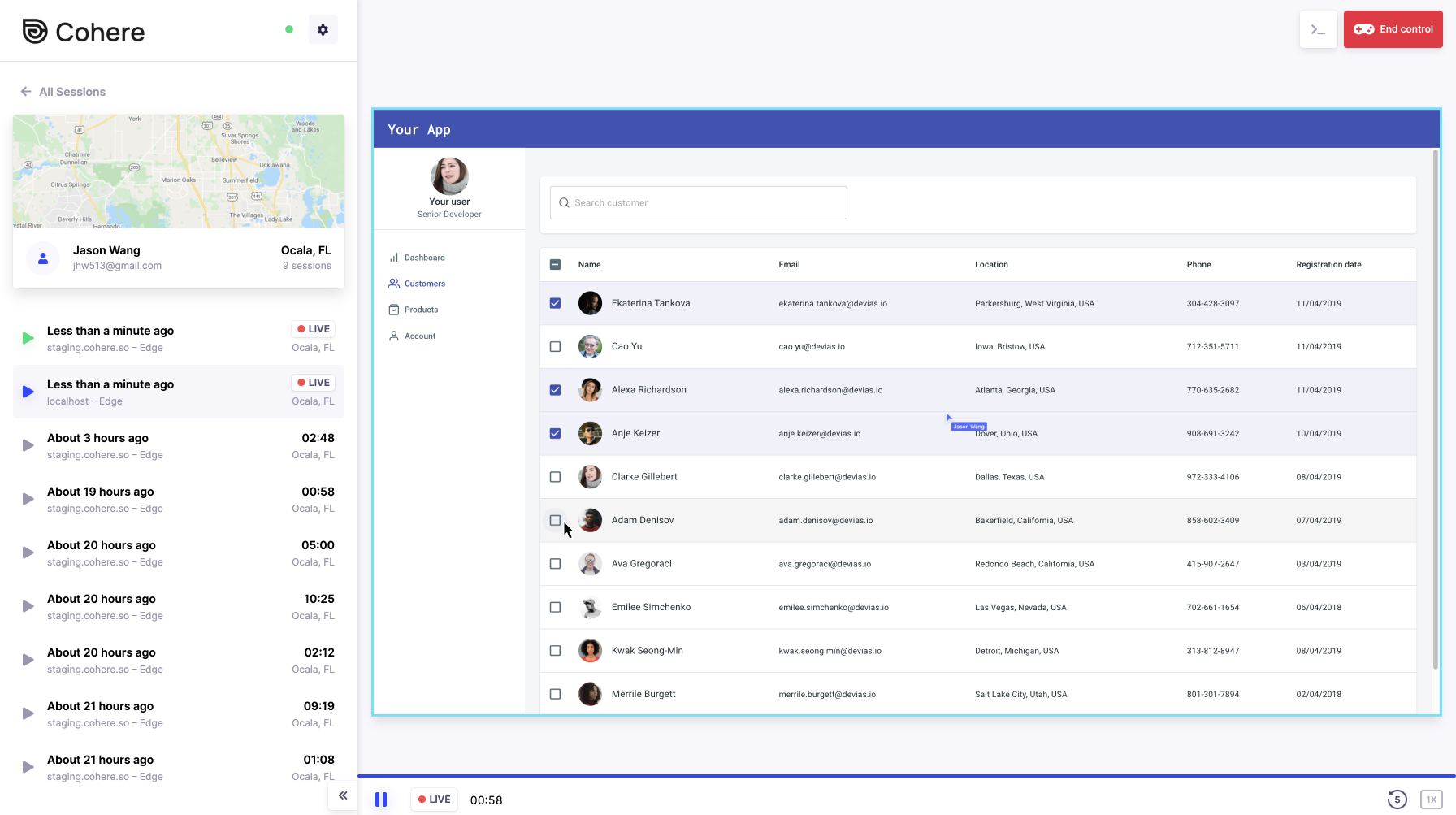
Essentially, Cohere is designed to make it easier for teams, whether small founders or large enterprises, to help solve their customers’ issues. Instead of requiring a software download or complicated install process, customers can just click a button on a website to allow remote control of their screen. This can save time, as the support person on the other end doesn’t have to ask a million questions about which screen the customer is on or what they see, or direct them where to click — they can just take over.

“It lets you see what people are seeing just like that, with no setup,” says Sengottuvelu. “You can just show them — just like you’re sitting next to them.”

Image Credits: Cohere

But what makes Cohere different is it’s not a full remote desktop solution where the person on the other end is taking over someone’s computer — the service instead only forwards the contents of the individual web page the person is currently viewing. The application developer, that is, can only view what a user is doing on their own website. They can’t switch tabs or minimize the browser to poke around in the user’s PC more broadly.

“We don’t operate on the pixel level, like a normal screen share does, where they take a picture of your screen 60 times a second and try to send it over the wire,” explains Lin.

The startup’s technology itself is based on capturing the web page’s state — a picture of the DOM, so to speak, for those who understand the terminology. It then leverages things like MutationObservers and WebSockets to make it possible to quickly see changes to the web pages in real time. Cohere also spent time to make sure it works with a range of web technologies and frameworks, including React, Iframe, Canvas, Vue, Angular and others. In time, it wants to expand support to more platforms and technologies.

“We capture the content of the page,” Lin says. “So, we are able to selectively filter out sensitive information like credit card info, passwords or Social Security numbers — any personally identifiable information,” he adds.

Image Credits: Cohere

The remote viewer also can’t take control until the user accepts, and then the user can boot them at any time with a click of an “X” button at the top of the screen.

In addition to these security controls, Cohere is SOC 2 Type 1, GDPR and CCPA compliant.

At present, Cohere works on both desktop and mobile browsers, including Chrome, Firefox, Edge and Safari. And it’s designed to be integrated with a business’s existing tools, like Zendesk, Slack, Salesforce and Intercom, with more to come.

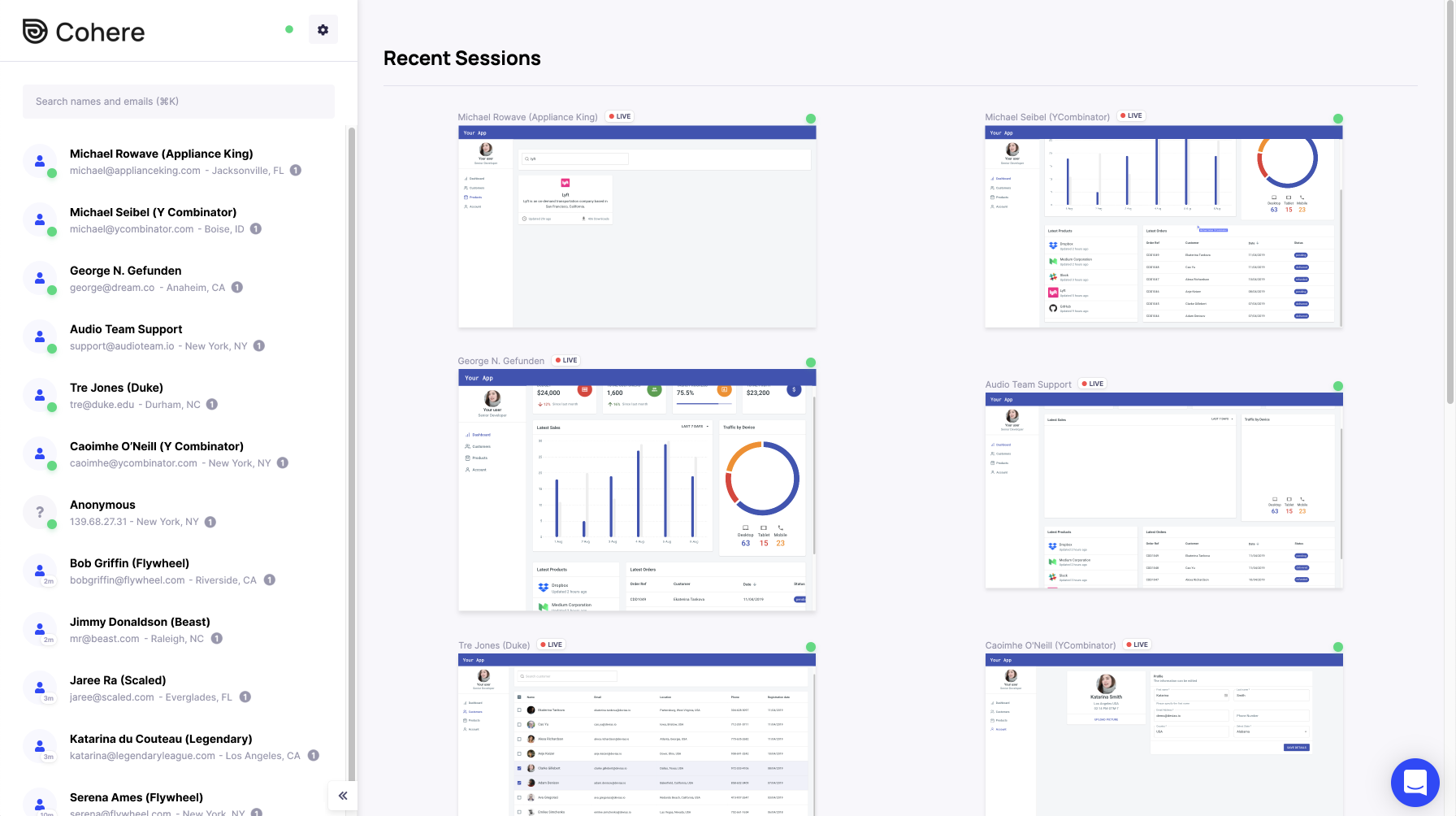
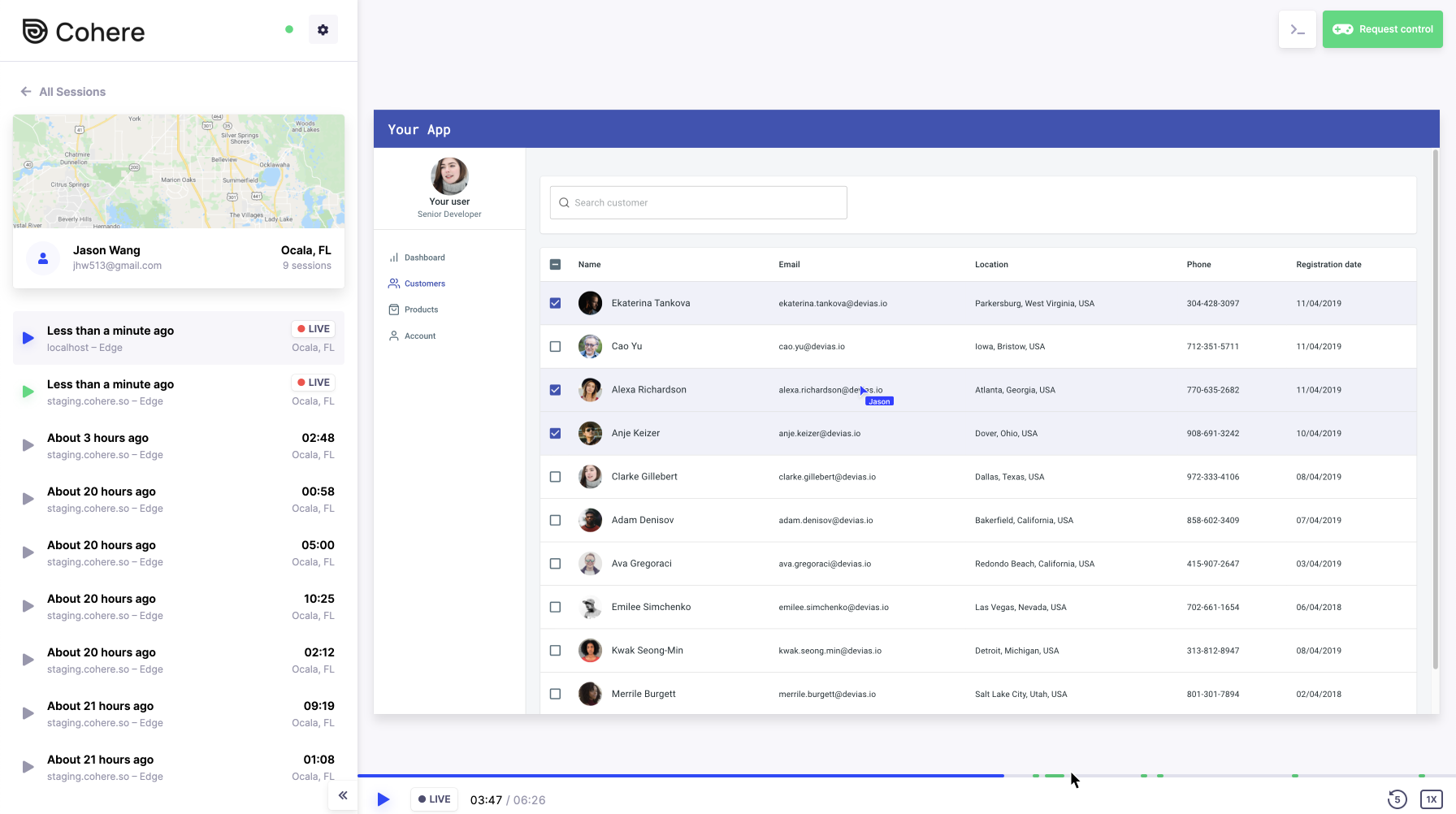
While the product to some extent competes with older remote desktop apps, its newer Cohere Replay feature allows businesses to go back in time to view their customer sessions retroactively.

Image Credits: Cohere

Because the product is limited to web apps and is not a full remote desktop solution it tends to be used primarily for things like customer support and user onboarding. Early-stage startups have also used it as they give tours to their first customers and learn from how the customers use the product in real time.

The paid service begins at $49 per user per month and is $39 for larger teams.

Cohere first launched around seven months ago, during its Y Combinator batch.

It’s now raised $3.1 million in seed funding, led by Initialized Capital. Other investors in the round include Y Combinator, BoxGroup, Soma Capital, Shrug Capital, Chapter One and various angels like Zach Perret, Elad Gil, Naval Ravikant, Eric Wu, Prasanna Sankaranarayanan, Eric Glyman, Jack Altman, Todd Goldberg, Rahul Vohra, Karim Atiyeh, Vivek Sodera, Dan Romero, Shrav Mehta and Oscar Hong.

New York-based Cohere, currently consisting only of the three co-founders, will use the additional funds to hire in sales, engineering and product. It will also devote some capital to building out the enterprise sales process, and expand its integrations and use cases.


News: PayFit raises $107 million for its payroll and HR platform

French startup PayFit has raised a $107 million series D funding round (€90 million). Eurazeo Growth and Bpifrance’s Large Venture fund are leading today’s round. Existing investors Accel, Frst and Xavier Niel are participating once again. PayFit has been building a payroll and HR software-as-a-service platform. It lets you manage your payroll from a web

French startup PayFit has raised a $107 million series D funding round (€90 million). Eurazeo Growth and Bpifrance’s Large Venture fund are leading today’s round. Existing investors Accel, Frst and Xavier Niel are participating once again.

PayFit has been building a payroll and HR software-as-a-service platform. It lets you manage your payroll from a web browser and automate as many steps as possible. For instance, you can configure automate payslip generation, export your payroll data to your accounting software and get a list of payments you need to make when it comes to pensions, health insurance, etc.

Given that it’s a software-as-a-service platform, everything remains up to date. For instance, if there are some regulatory changes that require some adjustments, PayFit can update its platform so that you remain compliant from day one without having to think about it.

Over time, the startup has expanded beyond payroll to tackle a bigger chunk of the HR stack. Each employee gets its own PayFit login to access their payslips. But the company doesn’t stop there as you can request time off and enter how much time you’ve worked this week if you’re paid on an hourly basis. PayFit automatically notifies the manager for approval.

PayFit can also become your central repository for expenses and receipts. The company already has everyone’s bank information, which makes it easier to transfer money back to an employee for a cash expense.

Employees can also view the company’s directory and management chain from PayFit. The HR department can set up an onboarding flow in PayFit so that employees can request a computer, a badge, and enter personal information as soon as they join the company.

If you work for a big company that uses something like Workday, all of this probably sounds familiar. But PayFit targets small and medium companies that don’t want to sign expensive contracts with enterprise companies. It has attracted 5,000 clients that employ 100,000 employees overall — that’s an average of 20 employees per company. Some of the biggest clients include Revolut, Starling Bank and Treatwell.

The company is currently live in France, Germany, Spain, Italy and the U.K. It currently has 550 employees and it plans to hire another 250 employees in 2021 to support its growth.

News: Incredibuild gets $140M to speed up games and other software development with distributed processing tech

Many of us are working in distributed environments these days, and in the best scenarios, it might actually have improved rather than impeded our productivity. Today, a company that has built technology that taps into that concept as it applies to computing is announcing a large round of funding to boost its growth after a

Many of us are working in distributed environments these days, and in the best scenarios, it might actually have improved rather than impeded our productivity. Today, a company that has built technology that taps into that concept as it applies to computing is announcing a large round of funding to boost its growth after a strong year of business.

Incredibuild, an Israeli startup that provides a way for organizations to implement distributed computing architecture to speed up the processing needed for intensive tasks like software development by tapping into a company’s network of idle CPUs, has picked up $140 million in funding.

“Startup” might be overstating what Incredibuild is: yes it’s a privately backed tech company, but it has been around since 2000, and although it counts substantial companies like gaming giants Epic (the company behind Fortnite), Microsoft and Nintendo, as well as Amazon, Citibank, Adobe, Disney, Intel and Samsung among its 800 customers, it’s been somewhat quiet and under the radar.

The company will be using the funding to continue building out its technology and its business model to apply to a wider range of enterprises and use cases.

CEO Tami Mazel Shachar said in an interview that the key concept that Incredibuild created was an efficient way of tapping CPU power in a network of computers regardless of whether they are on-premises or in the cloud. That technology is priced on a per-use basis but implementing it, Shachar said, brings down a company’s overall computing and equipment costs, and can speed up builds by 8X.

As you can see here, you Incredibuild not available to punters in easy-to-understand tiers: you need to get in touch with the company to sign up. The plan will be to device and list new pricing tiers, including a freemium tier to bring in more and smaller developer teams.

This round of financing is the first substantial outside investment made in the company since it was picked up by private equity firm Fortissimo in 2018. It comes from a single backer, Insight Partners, and represents a partial spinning out of the business, effectively back into startup mode. From what we understand, Incredibuild was already generating a lot of cash — hence no big fundraising history — and while it is not disclosing its valuation now, we understand from reliable sources that it is between $300 million and $400 million.

Incredibuild was started by two engineers, Uri Mishol and Uri Shaham, who first thought of the concept of speeding up software development processing through a distributed model when they were still in the Israeli army, working in the special forces and finding the processing times for their work to be much too slow, even on the most advanced machines (both are no longer actively involved in the company although both support it, Shachar said).

The company found early traction with games companies, whose heavy use of media required lots of code processing; longer term other companies that deal in with graphics, AR, VR, artificial intelligence and other work-intensive loads came to the company as well.

Of course, there are a number of other solutions being built to speed up workloads, from improving processors on devices, through to other devops and workload plays such as CircleCI, CloudBees, and many more. Nor is distributed computing a new concept: it’s the basis of a lot of peer-to-peer architectures such as those devised early on by the likes of BitTorrent, and it’s equally something that has been taken up by the blockchain community.

Interestingly, Shachar told me that Incredibuild itself does not own any patents on what it has built.

“The barriers are in the technology itself,” she said. “At the end of the day, the IP is in how good we do what we do. It would take many years to try to copy what we have built and we are building on those hooks more now.” It’s also adding in more integrations to improve and expand on all of the use cases for its technology.

For now, the basic idea is predicated on networks of computers that are idle within a specific team of users, and there are no plans for bringing that concept into a wider network of users as you might find in P2P networking models. The privacy issues, for one thing, are a non-starter, Shachar noted.

But, she hinted that there are some concepts in the works to improve processing power using its technology for some of its current partners’ customers. It’s interesting to remember that Microsoft, owner of Azure, and Amazon, owner of AWS, are both in Incredibuild’s client list. Watch this space.

Insight is notable for its other investments in DevOps — its portfolio includes both containerization leader Docker and JFrog — and so it will also be interesting to see whether we see more alignment with these.

“We firmly believe that Incredibuild has built a crucial technology for any business that wants to develop better software, radically faster,” said Teddie Wardi, MD at Insight Partners, in a statement. “With our long history of investing in the development ecosystem, we are confident that Incredibuild will continue to innovate and build upon their recent momentum.”  Both Wardi and MD Lonne Jaffe as well as senior associate Brad Fiedler are joining Incredibuild’s board.

Fortissimo is staying on as a shareholder in the company.

“Fortissimo bought Incredibuild in 2018 with belief in the enormous potential of distributed processing,” said Yoav Hineman, Partner at Fortissimo Capital and board member of Incredibuild, in a statement. “The investment by Insight Partners is a great milestone in delivering unparalleled acceleration for software developers.”

News: Capdesk raises £5m Series A extension led by Fidelity International Strategic Ventures

Capdesk, an equity management platform, has raised a £5m Series A extension led by Fidelity International Strategic Ventures and MiddleGame Ventures. This followed a first raise of £3 million in 2020, led by Fuel Ventures, and brings the Series A total to £8 million, and total funding raised to £11.7m. Capdesk’s clients include startups such

Capdesk, an equity management platform, has raised a £5m Series A extension led by Fidelity International Strategic Ventures and MiddleGame Ventures. This followed a first raise of £3 million in 2020, led by Fuel Ventures, and brings the Series A total to £8 million, and total funding raised to £11.7m.

Capdesk’s clients include startups such as Gousto, Secret Escapes, Privitar, Voi Technology and Billie.

The platform allows founders, employees and investors to digitize their equity, options, and warrants transactions. This gives shareholders access to a private secondaries market via a partnership with the Seedrs crowd-equity platform.

Capdesk now wants to build a ‘seed to post-IPO’ equity platform, for this normally underserved European sector by onboarding established private and publicly listed companies.

Christian Gabriel, CEO and Co-Founder, Capdesk said in a statement: “Today’s announcement makes Capdesk the best-funded equity management solution in Europe. More importantly, it combines the fintech expertise and capital support from MiddleGame Ventures and Fidelity, paving the way for Capdesk to build an equity solution never before seen in Europe.”

News: Dija acquires Cambridge-based Genie to expand its 10 minute grocery service across UK

Dija, the London-based grocery delivery startup backed by Blossom Capital, Creandum and Index Ventures, has acquired Cambridge, U.K.-based Genie, in what looks in part like an acqui-hire. The deal, for which terms remain undisclosed, will see Genie founders Tim Chan and Callum MacBeth join the Dija team and also includes company assets. Having launched Genie

Dija, the London-based grocery delivery startup backed by Blossom Capital, Creandum and Index Ventures, has acquired Cambridge, U.K.-based Genie, in what looks in part like an acqui-hire.

The deal, for which terms remain undisclosed, will see Genie founders Tim Chan and Callum MacBeth join the Dija team and also includes company assets. Having launched Genie in Cambridge, a U.K. city known for its university, they’ll be tasked with supporting Dija’s growth outside of London.

Founded by Alberto Menolascina and Yusuf Saban, who both spent a number of years at Deliveroo in senior positions, Dija launched in London earlier this month and is just one of a host of European startups that promise to deliver grocery and other convenience store items on-demand. They do this by building out their own hyper-local, delivery-only fulfilment centres — so-called “dark stores” — and recruiting their own delivery personnel. This full-stack or vertical approach and the visibility it provides is then supposed to produce enough supply chain and logistics efficiency to make the unit economics work, although that part is far from proven.

Other dark store operators include Berlin’s Flink, which has raised $52 million in seed financing in a mixture of equity and debt, and Berlin HQ’d Gorillas, which has raised $44 million in Series A funding and recently expanded to London in addition to Germany and Netherlands. Also operating in London are WeezyGetir, and Zapp, with Jiffy expected to launch soon. The U.S. unicorn goPuff is also reportedly looking to expand into Europe and has held talks to acquire or invest in the U.K.’s Fancy.

Dija currently has four warehouse hubs operating in South Kensington, Fulham, Islington and Hackney that deliver groceries and other convenience products within a claimed 10 minutes. It plans to open 20 further hubs, covering central London and Zone 2, by the summer. Each hub carries around 2,000 products, claiming to be sold at “recommended retail prices”. A flat delivery fee of £1.99 is charged per order.

In a statement, Dija co-founder and CEO Alberto Menolascina said: “Our ambitions aren’t limited to inside the M25. I’m delighted that Tim and Callum are joining the Dija family to ensure more people can access this reliable and efficient service across the UK and Europe.”

Adds Genie co-founder and CEO Tim Chan: “We’re excited to join forces with the team at Dija and continue our shared mission to bring everyday items to your door in a matter of minutes. For our existing customer base this deal means access to more products, better prices and even faster delivery times. We’ve had a tremendous response in Cambridge so far, and look forward to bringing Dija to many more regions across the U.K. in the coming months.”

News: Whereby, which allows more collaboration over video calls, raises $12M from Point Nine and 20 Angels

Zoom, Microsoft and Google all rocketed to the top of the charts in the virtual meetings stakes during the pandemic but a plucky startup from Norway had others ideas. Video meeting startup Whereby has now raised $12 million from German VC Point Nine, SaaStr fund and a group of more than 20 angel investors. Angels

Zoom, Microsoft and Google all rocketed to the top of the charts in the virtual meetings stakes during the pandemic but a plucky startup from Norway had others ideas. Video meeting startup Whereby has now raised $12 million from German VC Point Nine, SaaStr fund and a group of more than 20 angel investors.

Angels investors include Josh Buckley(CEO, Producthunt), Elizabeth Yin (Hustlefund) and Jason M. Lemkin (founder of Saastr).

Øyvind Reed, CEO at Whereby said in a statement: “The past year has led many of us to question the future of work, with video meetings set to remain a big part of our lives. More than ever, the tools we use to connect have to enable effective and enjoyable meetings, providing focus, collaboration and wellbeing. .”

Whereby’s platform has three pricing plans (including free) and allows users to embed tools like Google Docs, Trello and Miro directly in their meetings, unlike other video platforms.

Whereby was demonstrated to me by co-founder Ingrid Ødegaard on a coffee table during 2016’s Oslo Innovation Week. I immediately set-up my username, which has existed even as the startup changed it name from Appear.in. Ingrid told me during an interview that they “tried to be much more human-centric and really focus on some of the human problems that come with collaborating remotely. One of the big mistakes that a lot of people making is just replicating the behavior that they had in the office… whereas we think that you actually need to work in a fundamentally different way. We want to help people do that and by making it really easy to jump in and have a meeting when you need to. But our goal is not to push people to have more meetings, quite the opposite.”

The startup’s secret weapon is enterprise integrations. If you had a video meeting with a UK GP over video in the last year it was probably over Whereby (indeed, mine was!). Whereby won a contract with the NHS for its remote video patient consultations during the pandemic. Competitors for this include Jitsi and AccurX. The company claims it saw a 450% increase in users across 150 countries last year.

“Last year we saw the mass adoption of video meetings,” said Christoph Janz, Partner at Point Nine. “Now it’s about taking the user experience to the next level and Whereby will be leading that charge. It’s amazing to see a Scandinavian startup playing in the same league as the tech giants.”

News: How localization leader Iyuno Media Group opens entertainment to international audiences

Video streaming platforms have signed up more subscribers during Covid-19 lockdowns, and that growth is expected to continue after the pandemic, showcasing more international content. When subtitles are well done, they don’t take audiences out of the immersive experience of a good show or movie. This means as content providers tackle worldwide expansion, demand for localization

Video streaming platforms have signed up more subscribers during Covid-19 lockdowns, and that growth is expected to continue after the pandemic, showcasing more international content. When subtitles are well done, they don’t take audiences out of the immersive experience of a good show or movie. This means as content providers tackle worldwide expansion, demand for localization services, including translated subtitles, is also growing. Iyuno Media Group is one of the largest media localization companies, and works with clients including Netflix, Apple iTunes, DreamWorks, HBO and Entertainment One.

A lot has changed since Iyuno was started in 2002 by executive chairman David Lee while he was an undergraduate in Seoul. Back then it provided mainly English to Korean subtitles for television networks. “I started the business in my last year of university and, of course, back then we didn’t have any video streaming services,” he said. “Our client base was mostly local and some regional broadcasters.”

Now Iyuno, whose investors include SoftBank Ventures Asia, provides localization services for about 600,000 hours of content on an annual basis, including translation, subtitling, dubbing, accessibility features and compliance with local content regulations, in more than 80 languages. It operates 35 facilities across 30 countries in the Americas, Asia Pacific, Europe and the Middle East. Iyuno also announced in January that it has entered into an agreement with Imagica Group to acquire SDI Media, another localization provider.

In order to make the current scale of its services possible, Iyuno built its own cloud-based enterprise resource planning software. The platform enables uploading of files from content providers, and includes features for time coding, translation, content and technical quality control, and distribution back to Iyuno’s clients. It onboards, trains and assesses new freelancers, and gives teams working on the same project a central base.

Iyuno also built its own neural machine translation engines, which are trained on data from specific genres (for example, drama, animation, comedies, horror and documentary), and help its teams work more accurately and quickly.

Localizing entertainment in a more connected world

Being able to guarantee consistent results with fast turnaround times is especially important now that OTT services are erasing international and cultural barriers between audiences, and the shows and movies they watch.

“Good shows, even in non-English languages, perform well in other countries,” said Lee. “Because of Covid, productions have been majorly affected. OTT providers need fresh content to keep subscribers and are licensing non-U.S. content in countries where it hadn’t been licensed a lot in the past.”

Parrot Analytics recently told Axios that non-American shows accounted for nearly 30% of demand in the United States during the third-quarter of 2020. That trend began before the pandemic, but production shutdowns meant many networks and streaming services began showing more international content to meet audience demands.


This means localization services are not only working with more shows and movies that were originally filmed in non-English languages, but also translating it into a wider array of languages, which involves a lot of teamwork.

“In a single language for a single hour of video running time, it usually takes around five or six different steps, and four or five different individuals,” including translators and quality control checkers, said Lee.

For content that is translated into a single other language, Iyuno hires people who can listen to the show and translate at the same time, without having to use a script. Files from Iyuno’s clients are uploaded onto its platform and proxy files are generated with watermarks and other security measures. Then the translator gets a link to the video. After they are done adding their translation, the subtitled content goes through a preset quality control process, and then is formatted and delivered back to the client.

The process for translating content into several different languages follows a similar procedure, except the original language is first transcribed into a script, and then sent to translators so they can work as a team. Then subtitled content is sent to a central quality control team to make sure it is consistent before being delivered to the client.

For some content, like live broadcasts or episodes of television dramas that are edited shortly before airing, Iyuno can provide very quick turnaround times, typically 24 hours, but sometimes as little as one or two hours. In those scenarios, Iyuno begins recording when the show starts airing. Then it divides the footage into 10-minute segments that are sent to teams of three people: a time coder, translator and quality control checker, who usually work from home and are logged into Iyuno’s ERP platform. It takes about an hour to translate each 10-minute section, so that means six teams are usually involved at the same time during an hour-long process.

Preserving an immersive experience

Quality control includes ensuring subtitles and other localization features for a show maintain consistent quality across languages, and also checking technical factors, since there are more than 100 subtitle formats. Iyuno’s quality checkers make sure subtitles are placed unobtrusively on the screen, don’t obscure important details and avoid overlapping between dialogue from different characters or scenes.

“We like to have buffers because reading speed is usually slower than hearing speed,” said Lee. Iyuno’s platform has scene detection tools, which analyzes video and automatically organizes subtitles so they don’t roll over into another scene.

Creating accessibility features currently accounts for about 5% to 10% of Iyuno’s business and is growing. That includes audio descriptions for people with visual impairments, which means adding narration that describes what is happening on screen, and closed captions with descriptions of all the sounds that are happening in a show.

“It’s a growing demand and it’s very important for clients, who are keen to serve those audiences,” said Lee.

One of the things translators need to do when working on shows is to keep the original intent of the creator in languages with different colloquialisms or cultural nuances.

“I was a subtitler, and it’s usually not a very dry job of translating the foreign language into ours, or the other way around,” Lee said. “It’s really immersing yourself into the content, so at times you forget to translate because you’re watching the show and understanding the feeling, laughs, sadness or character dynamics.”

Iyuno’s machine translation engines are able to help with the process by performing the initial translation, so human translators can focus more on a show’s creative aspects.

“It’s more a subjective and qualitative thing. It’s hard to put into technical words, but we try to find efficiencies to reinforce that creativity,” Lee added. “At the same time, most of our translators had that learning and experience before they came to the company, so they’re aware that those are aspects they need to deal with and, in many cases, I think that’s where a machine can never substitute a human.”


News: On Friday the EU will put startup-friendly legislation to member states – will they sign up?

This Friday, the European Commission will be launching a ‘legislative instrument’ called the EU Startup Nations Standard (SNS) at its annual Digital Day. Now, before you think I’m about to bore you to death, you might like to know that the SNS is a huge political initiative. It will aim to make the European Union

This Friday, the European Commission will be launching a ‘legislative instrument’ called the EU Startup Nations Standard (SNS) at its annual Digital Day. Now, before you think I’m about to bore you to death, you might like to know that the SNS is a huge political initiative. It will aim to make the European Union the most attractive place to create a startup, in comparison with obvious global leaders like the US. Therefore, its significance is not to be underestimated.

The idea is for EU Member States to implement a set of ‘best practice’ policies for startups (many of which already exist in parts of the EU), ranging from startup visas to better implementation of stock options in company law. If EU member states all sign up to the EU’s ideas, the hope is that startups get better conditions, stay in the EU rather than leaving for the US (or, now, the UK…) and the SNS will mean more peer-pressure between Member States to get all these conditions right.

Sources close to the European Commission tell me that the – yet unreleased – SNS will be wide-ranging and call on EU member states to implement several startup-friendly policies, launched during the Portuguese Presidency of the EU, a country where startups are now flourishing. Member States which become signatories of the Standard will be expected to deliver on a number of policy areas.

I have seen leaked drafts of the SNS and it clearly includes some big proposals, assuming they are all contained in the final, published draft. They include the expectation that signatories will need to change national rules around stock options to ensure employee share ownership is not subject to capital gains tax until the moment of cash receipt. They will also need to allow startups to issue stock options with non-voting rights; fast-track the process of creating a new company to within one day for 100 EUR; accelerate visa processing for tech talent from outside the EU, and incentivize the return of EU tech-talent. There is also an exhortation to leverage the €750bn of Recovery and Resilience Facility (RRF) to support startups, and reduce regulatory red tape and the create regulatory sandboxes. For many EU countries, it should be relatively easy, for others, there will be some legislative hurdles to leap. But most observers say these provisions are over-due and necessary.

EU-based campaign groups are, generally speaking, wildly in favor of the SNS. Allied For Startups tells me they are “enthusiastic about the potential of the instrument”. They say the provisions are a collection of best practices that already exist, challenge member states to do more, and set ‘binary challenges’ that states can either fulfill or not (like launch a startup online in a day). But that depends if all the things they hope for come to pass. They are waiting with bated breath to find out if the provisions have been watered down or how many Member States sign up to it all.

There are other groups that are enthusiastic but also concerned. Not Optional, a policy initiative funded by Index Ventures, has, this week, published an open letter signed by many of Europe’s leading investors, startup associations and entrepreneurs including those who founded Stripe, Personio, Klarna, Wise, Trustpilot, UiPath and Alan.

The letter welcomes the EU’s Startup Nations Standard, in particular its specific recommendations to Member States on “changes to stock options rules designed to help startups attract talent, speed up tech visas targeting and procurement.”

However, the group is also urging EU Member States to turn the recommendations into actual national legislation, and not just stay on the books at the EU Commission.

Not Optional points out that its own ranking of European nations’ stock options policies showed dramatically stark differences around how EU members states treat the issues, with, for instance, Latvia, Estonia and France ranking highly, while founders in Germany, Spain, and Belgium still face barriers when they try to use stock options to incentivize staff and attract talent.

But we are not out of the woods yet.

While there is enthusiasm emanating from the corridors of Brussels, my sources tell me that some countries, such as Germany, may be looking to water the SNS down in some aspects. In particular, Germany has been kicking up a fuss about the startup-in-a-day provision, on the grounds that identity checks may take longer. Given the UK, an EU member until only recently, has had this capability for at least 10 years, Germany’s protestations seem somewhat over-egged.

All eyes will be on the announcement on Friday.

WordPress Image Lightbox Plugin