Monthly Archives: March 2021

News: France’s competition authority declines to block Apple’s opt-in consent for iOS app tracking

Apple has fended off an attempt by advertisers in France to use a competition complaint route to derail incoming pro-privacy changes in iOS that will require third party apps to obtain users’ consent before they can track them. The French competition authority (FCA) said today it has rejected calls by IAB France, MMAF, SRI and UDECAM

Apple has fended off an attempt by advertisers in France to use a competition complaint route to derail incoming pro-privacy changes in iOS that will require third party apps to obtain users’ consent before they can track them.

The French competition authority (FCA) said today it has rejected calls by IAB France, MMAF, SRI and UDECAM for it to intervene pre-emptively and block Apple’s move, saying it does not currently consider the introduction of the App Tracking Transparency (ATT) feature to be an abuse of a dominant position.

However the regulator said it is continuing to investigate Apple “on the merits” — specifying it will be looking to ensure the tech giant is not applying less restrictive rules for its own apps vs third party developers (aka ‘self preferencing’).

Per Reuters, the competition authority worked closely with France’s privacy watchdog, CNIL, to reject the request to suspend ATT.

The CNIL has been contacted for comment.

An Apple spokesperson told us:

“We’re grateful to the French Competition Authority for recognizing that App Tracking Transparency in iOS 14 is in the best interest of French iOS users. ATT will provide a powerful user privacy benefit by requiring developers to ask users’ permission before sharing their data with other companies for the purposes of advertising, or with data brokers. We firmly believe that users’ data belongs to them, and that they should control when that data is shared, and with whom. We look forward to further engagement with the FCA on this critical matter of user privacy and competition.”

Back in January Apple said the ATT would be applied to iOS in early spring.

Since then a complaint by a French startup lobby, France Digitale, has also been filed with the country’s privacy watchdog — accusing Apple of privacy hypocrisy.

That complaint similarly invoked competition concerns — contrasting the incoming ATT requirement for third party apps to gain consent before tracking iOS users to default iOS setting for Apple’s own apps that the complaint said allow tracking. However Apple called the allegations “patently false”, saying ATT will be “equally applicable to all developers including Apple”.

The ATT switch in iOS is certainly wildly unpopular with adtech companies like Facebook, who claim it will harm developers’ ability to monetize their apps. Facebook has also conceded Apple’s move will significantly dent its own revenues.

Apple, meanwhile, has accused the adtech industry of hysteria and false claims — and continued to denounce the “data-industrial complex” for creeping on Internet users to exploit their personal data and try to manipulate people for profit.

While it’s also true that Apple can serve personalized advertising to iOS users of its own apps it argues that it holds itself “to a higher standard” than the adtech data industrial complex because it lets users opt out of what it calls its “limited first-party data use for personalized advertising” — claiming that feature “makes us unique”.

In a similar recent development involving Google, a competition complaint was filed late last year in the UK in an attempt to block changes it intends to make to how users of its Chrome browser can be tracked by third parties.

Google’s so-called ‘Privacy Sandbox‘ plan is also wildly unpopular with advertisers — who accuse the tech giant of abusing a dominant position by shutting down their ability to track users while continuing to do so itself.

Simultaneously, multiple efforts are underway across the adtech industry to devise alternative means of tracking web users’ activity — accelerating by the prospect of Chrome, the dominant browser by marketshare, depreciating support for third party trackers.

The UK’s Competition and Markets Authority announced in January it’s investigating suspected breaches of competition law by Google following a number of complaints about Privacy Sandbox.

That probe continues.
News: Riva Health wants to turn your smartphone into a blood pressure monitor

Riva, founded by scientist Tuhin Sinha and Siri co-founder Dag Kittlaus, wants to help people measure their blood pressure in a clinically-approved way. Blood pressure can help indicate at-risk patients before they are actually at risk, showing early signs of heart disease. And while other hardware solutions on the market promise the same end-goal, Riva

Riva, founded by scientist Tuhin Sinha and Siri co-founder Dag Kittlaus, wants to help people measure their blood pressure in a clinically-approved way. Blood pressure can help indicate at-risk patients before they are actually at risk, showing early signs of heart disease. And while other hardware solutions on the market promise the same end-goal, Riva wants to be a purely software solution that integrates with hardware that it thinks its end-user has anyways: their smartphone.

The company, launching out of stealth today, has raised $15.5 million in seed funding in a round led by Menlo Ventures, with participation from True Ventures. UC Health and University of Colorado Innovation Fund accounted for $5 million of the round, with other angels including GoHealth’s Brandon Cruz and Madison Industries Larry Gies. Greg Yap of Menlo, who talked to Sinha for three years before investing, will be joining the board.


Kittlaus, who also founded AI-assistant Viv, says that he began thinking about how to make a difference in digital health after undergoing his own severe health issues. Kittlaus was diagnosed with pancreatic neuroendocrine cancer in 2016, the same type of cancer that late Apple CEO Steve Jobs died from.

“I spend time researching ideas on it, but I was missing the thing that I’ve had in both my previous companies, which was some amazing technical innovation that could form a wedge that you can move the world with,” he said.

Kittlaus mentioned this internal conversation with his friend, who was the first investor in Siri, this past summer. The friend introduced him to Tuhin Sinha, the scientist who spent years developing the technology that is used to power Riva.

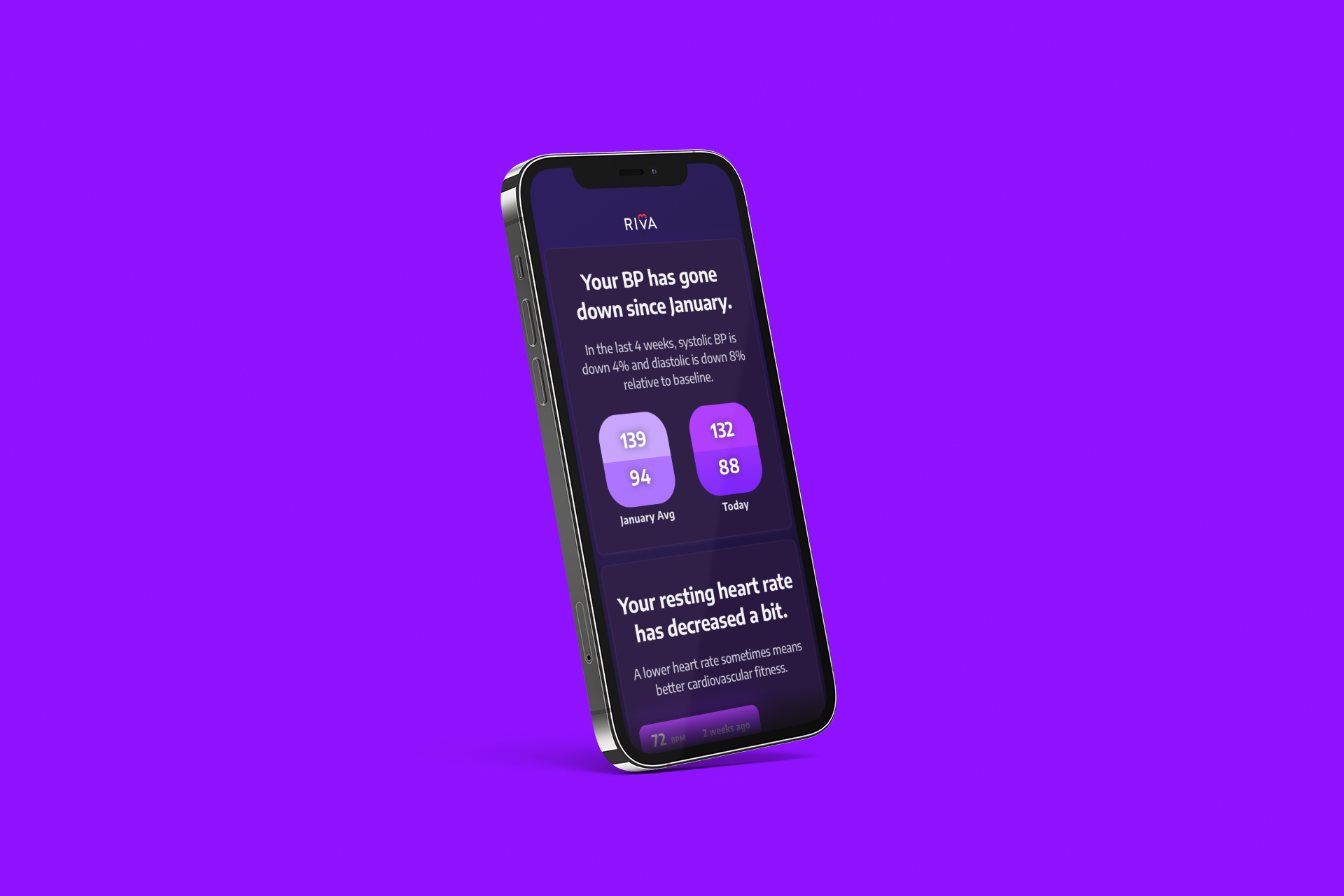
To use Riva, all a person needs to do is open the app on their phone and tap ‘Go’, which triggers the camera flash on the back of the phone. The app will then guide the user to place their finger over the right camera, and help them adjust positioning until it locks into place. After that, Riva will use the light to track blood pressure change and create a rendering of it on screen.

Riva Health planned design, subject to change.

“The well-known part of this technology is shining a light on a blood vessel and getting a wave out of it,” Sinha said. “The novelty is the shape of the wave, how it relates to blood pressure, and our secret sauce is looking at those waveshape changes and validating them in a rigorous and comprehensive way.” Sinha declined to share how they are validating exactly, but said that it is key that a startup has to measure blood pressure in a variety of different scenarios – think standing or sitting – to see if it is effective.

Once Riva tracks five to seven heartbeats worth of data, it has a comprehensive understanding of someone’s blood pressure at that moment.

The data, which is HIPAA compliant, can then be sent to a family physician or doctor’s office to be analyzed if a risk is present, starting with hypertension.

“Moving to a platform like the smartphone is mobilizing the measurement and management of [health and disease management],” Sinha said. Riva Health is a purely software solution.

The company is currently in the process of verifying its software with Android phones, but Kittalus says that “any modern phone should be able to acquire the signal needed” to work.

A big hurdle for any health tech company, and especially Riva, is whether it can get FDA approval for clinical usage. The company is currently engaged in that process with the FDA, and will ask users who pilot its free app, coming out this summer, to participate in the trial and data-gathering to bolster its approval process.

Right now, Riva is using its technology to track the changes in blood pressure in a clinical setting, and the second-half will be in a home setting. By tracking the use of its system in the real world, it can prove that it works in a laboratory and home set-up, helping it prove that its disease management technology is effective.

“There are a lot of gizmos and gadgets that will claim to do blood pressure reading,” Kiittlaus said. “I call it blood pressure as a novelty where it gives you blood pressure reading but not a clinic.” For example, a Fitbit does track blood pressure but consistently underestimates the number, a study says. Other solutions like the Apple Watch or cuffless wearables measure blood pressure for non-clinical usage, which means that it isn’t super accurate and only notifies obvious blood pressure problems.

Riva wants to be daily and precise enough to be relied on by doctors, which is part of its overall route to make money. While the team wouldn’t share any published research or proof about its scientific method, Dr. Richard Zane, the chief innovation officer of UCHealth said that it is “bulletproof” technology. Over 700 companies in the past three years have tried to work with Zane’s team, and Riva is one of the few that met the bar.

“When our team tested it, it actually worked out of the box the first time, which basically never happens,” Zane said. He added that one of the biggest barriers to entry is that people have needed devices in the past, and Riva brings “a novel technology that actually works that will be embedded in something that patients already carry around with them and allow them to manage their heart disease or hypertension.”

“The core product of the company is healthcare outcomes,” Sinha said. The company is part of the wave of startups that believe outcome-based healthcare is the future, a model where doctors are paid for results instead of the number of visits they complete in a day. With this vision, Riva plans to monetize by selling outcomes to hospital systems and providers: if it can provide a tool to help doctors keep people out of surgery and indicate issues earlier than before, it can make a solid argument as to why systems should adopt it.

Only 20% of healthcare works on the value-based model, so this will be a hurdle even with the right sentiment. In the meantime, Kittlaus says that it is working with insurers to pay for its service. Riva would get reimbursed for treating and managing hypertension.

“We want to keep it free for the consumer, free for the doctor, and insurance will cover it,” he said.

If and when the FDA clears this technology, Kittlaus says that doctors and medics “will still be skeptical about it” but will ultimately be convinced of the outcomes being more accurate, and ongoing, than the cuff.

“You’re prescribing an app,” he said. “Instead of medicine.”

The app, pending FDA approval, will be available for public late this year or early next year. The next few months for Riva will be key in determining its success and validity – and Sinha, the chief scientist, say it will be rigorous, but fast. He has a personal tie to the company’s success.

Sinha has lost five brothers, one sister, and his father before the age of 59 to heart disease. Now, his app has the ability to track the condition that made him lose these family members in the first place.

“I feel like I have a ticking time bomb in my chest,” he said. “And if anything, I’m going to do this for myself.”

News: Arrival to open a second US microfactory to build electric vans for UPS

Arrival, the UK electric vehicle startup that will soon be a publicly traded company, plans to build a second microfactory in the United States. The announcement comes several months after Arrival picked Charlotte, North Carolina for its North American headquarters. This new microfactory will be located in West Charlotte near the airport and about 32

Arrival, the UK electric vehicle startup that will soon be a publicly traded company, plans to build a second microfactory in the United States.

The announcement comes several months after Arrival picked Charlotte, North Carolina for its North American headquarters. This new microfactory will be located in West Charlotte near the airport and about 32 miles from its first U.S. factory in Rock Hill, South Carolina.

The newly announced microfactory will be producing two different classes of EV vans for our U.S. customers, expanding the zero-emissions options for fleet operators, the company’s CEO Mike Ableson said. Production is expected to begin by the third quarter of 2022. Arrival said it is investing about $41.2 million in the production center, which will have the capacity to assemble up to 10,000 electric delivery vans each year.

Many of the vehicles produced at the new Charlotte microfactory are expected to enter UPS’s North American fleet, according to the company. UPS committed to buy up to 10,000 vehicles from Arrival in the U.S. and Europe.

The company’s other, and first, U.S. microfactory in Rock Hill will be used to assemble electric buses.

Arrival was a secretive electric vehicle startup for nearly five years until January 2020 when it announced a $110 million investment from Hyundai and Kia. Over the past 14 months the company has shared more of its plans and partners, all culminating in its announcement last month to merge with a special purpose acquisition company CIIG Merger Corp., to become a publicly traded company. The SPAC merger is expected to close in the first quarter of 2021.

Arrival’s business model centers on its microfactories, which the company argues allows it to produce electric vehicles that are price competitive with fossil fuel-powered commercial vans, buses and other vehicles. The microfactories require a low capital expenditure and have a smaller footprint than conventional factories, Arrival says.

News: Olo prices IPO sharply above its target, valuing company as high as $4.6B

We’re checking in on the price investors paid for a block of Olo shares before it began trading and will look into the latest numbers in Coinbase’s new S-1/A filing

A big story in the finance world this morning is that the Nasdaq Composite index lost ground in pre-market trading while bond yields rose. The concern is that inflation could rise, which led to bonds selling off and falling valuations for expensive stocks. So, tech stocks were broadly lower this morning.

Unlike last night, when New York-based restaurant software company Olo priced its IPO at $25 per share, sharply above its raised IPO target price range.


The Exchange explores startups, markets and money. Read it every morning on Extra Crunch, or get The Exchange newsletter every Saturday.


Today, we’re checking in on the price investors paid for a block of Olo shares before it began trading. The resulting valuation and its new revenue multiples will help us answer several questions.

First, how hot is the market for high-growth tech shares that also feature profitability? And, second, is Olo pricing ahead of, or behind, known comps? If the latter is true, it could point to a cooling enthusiasm among public investors for tech IPOs, even if the headline numbers coming from the Olo IPO are impressive.

And then we’re going to chat about Coinbase’s latest S-1/A filing, which helps provide a bit of guidance regarding how its direct listing is scooting along.

Ready to get caught up on the public-private divide that the most successful startups cross? Let’s get into it!

Is Olo’s IPO pricing aggressive, neutral or a letdown?

As a quick reminder, Olo initially targeted a $16 to $18 per-share IPO price interval. That was raised, as expected, to $20 to $22 per share. Pricing at $25, then, is a strong 56.25% greater per-share value than the low end of the company’s first estimate.

As Olo featured rapid growth (an acceleration in year-over-year revenue from 59.4% in 2019 to 94.2% in 2020), and GAAP profits (a 2019-era net loss of $8.3 million became 2020 net income of $3.1 million) in its IPO filings, the first price range it rolled out felt a bit light. The second, however, felt more appropriate.

At $25 per share, we have to do new math. Using a simple share count inclusive of the company’s underwriters’ option, Olo is worth $3.62 billion. That figure swells to $4.6 billion when a fully diluted valuation is calculated, per IPO-watching group Renaissance Capital.

News: Apple Maps updated with Covid-19 vaccination locations in the U.S.

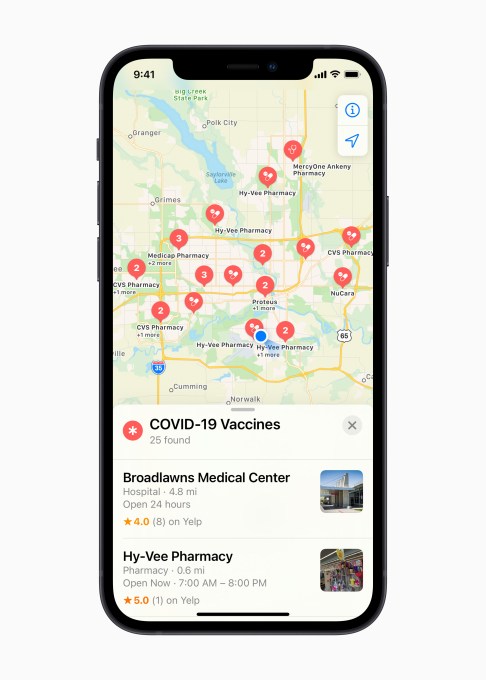
Google earlier this year announced an update to Google Maps to help people find Covid-19 vaccination sites nearby, and now Apple is doing the same. Apple device owners can either ask Siri or search within Apple Maps to find nearby Covid-19 vaccine providers within the U.S., the company says. These results will include key information,

Google earlier this year announced an update to Google Maps to help people find Covid-19 vaccination sites nearby, and now Apple is doing the same. Apple device owners can either ask Siri or search within Apple Maps to find nearby Covid-19 vaccine providers within the U.S., the company says. These results will include key information, like operating hours, addresses, phone numbers and links to the provider’s website.

To access this information through a voice command, users can ask Siri something like “where can I get a Covid vaccination?,” which will direct them to Maps.

In addition to Siri or searching directly within Apple Maps for vaccine info, the option “Covid-19 vaccinations” will also be available in Apple Maps’ “Find Nearby” menu.

Apple says its vaccination location data is being sourced from VaccineFinder, an initiative led by Boston Children’s Hospital. This data has also been helping to power Google Maps’ vaccine finding capabilities, Google earlier said. Apple notes that healthcare providers, labs and other businesses can also choose submit their information about either Covid-19 testing or vaccination locations via the Apple Business Register page. After doing so, Apple will validate the information and then display it to users who are searching for Covid-19 resources in their local area.

At launch, there’s information about over 20,000 vaccine locations being provided through Apple Maps. Apple says more sites will be added in the weeks to come.

Throughout the pandemic, Apple has integrated other Covid-related health resources into Apple Maps both in the U.S. and internationally. Last year, for example, it updated Apple Maps to display Covid-19 testing sites in Australia, Canada, France, Germany, Japan, the Netherlands, New Zealand, Portugal, Singapore, Taiwan, Thailand, and the U.S. It also added Covid-19 modules to business pages, and updated Siri with more knowledge about Covid-19, testing sites, and, now, vaccination locations.


Early Stage is the premier “how-to” event for startup entrepreneurs and investors. You’ll hear firsthand how some of the most successful founders and VCs build their businesses, raise money and manage their portfolios. We’ll cover every aspect of company building: Fundraising, recruiting, sales, product-market fit, PR, marketing and brand building. Each session also has audience participation built-in — there’s ample time included for audience questions and discussion. Use code “TCARTICLE at checkout to get 20% off tickets right here.

News: The Robinhood competitor landscape intensifies as Invstr raises $20M

One of the biggest gripes about investing apps is that they are not acting responsibly by not educating users properly and allegedly letting them fend for themselves. This can result in people losing a lot of money, as evidenced by the number of lawsuits against Robinhood. Today, an eight-year-old company that has been focused on

One of the biggest gripes about investing apps is that they are not acting responsibly by not educating users properly and allegedly letting them fend for themselves. This can result in people losing a lot of money, as evidenced by the number of lawsuits against Robinhood.

Today, an eight-year-old company that has been focused on nothing but financial education is now offering trading and banking services in the U.S..

Over the years, London-based Invstr has built out an educational platform with features such as an investing Academy. It’s created a Fantasy Finance game, which gives users the ability to manage a virtual $1 million portfolio so they can learn more about the markets before risking their own money for real. Via social gamification, Invstr has set out to make the educational process fun.

It has also built a community around users so they can learn from each other (something another Robinhood competitor Gatsby is also doing).

Over 1 million users have downloaded the platform globally.

Invstr, according to CEO and founder Kerim Derhalli, is taking a different approach from competitors by offering education and learning tools upfront. And in addition to giving users the ability to make commission-free stock trades, it’s also giving them a way to digitally bank and invest using their Invstr+ accounts “without ever needing to move money from one place to another.”

Invstr takes it all a step further for subscribers who have access to an “Invstr Score,” performance stats and behavioral analytics among other things.

Derhalli said moving in this direction with the company was part of his business plan from day one.

“I think the most powerful trend in the U.S. is self directed investing,” Derhalli told TechCrunch. “Younger generations have grown up in an app world and they expect to be autonomous and do things for themselves. Many distrust the banking system, and they don’t want to follow in their parents’ footsteps when it comes to banking and finance. We think this is a massive opportunity.”

In the unveiling of its new offerings, Invstr also announced Wednesday that it has closed on a $20 million Series A in the form of a convertible offering. This builds upon $20 million it previously raised across two seed rounds from investors such as Ventura Capital, Finberg, European angel investor Jari Ovaskainen and Rick Haythornthwaite, former global chairman of Mastercard.

Derhalli said he felt compelled to found Invstr after seeing firsthand how a lack of knowledge and confidence can prevent individuals from starting to invest. He worked for three decades in senior leadership roles at Deutsche Bank, Lehman Brothers, Merrill Lynch and JPMorgan before founding Invstr “so that anyone, anywhere could learn how to invest.”

Invstr is offering its new investing services in partnership with Apex Clearing, which formerly provided execution and settlement services to Robinhood. Its digital banking services are being offered through a partnership with Vast Bank. To address the security piece, Invstr said its user data is also protected by technology from Okta.

The company, which also has offices in New York and Istanbul, plans to use the new capital to launch new brokerage and analytics tools and a portfolio builder.


Early Stage is the premier “how-to” event for startup entrepreneurs and investors. You’ll hear firsthand how some of the most successful founders and VCs build their businesses, raise money and manage their portfolios. We’ll cover every aspect of company building: Fundraising, recruiting, sales, product-market fit, PR, marketing and brand building. Each session also has audience participation built-in — there’s ample time included for audience questions and discussion. Use code “TCARTICLE at checkout to get 20% off tickets right here.

News: Oso announces $8.2M Series A to simplify authorization for developers

When we think about getting access to an application, we tend to focus on the authentication side — granting or denying people (or devices) entry. But there is another piece to this, and that’s authorization. This is related to what you can do once you are inside the application, and Oso, an early stage startup,

When we think about getting access to an application, we tend to focus on the authentication side — granting or denying people (or devices) entry. But there is another piece to this, and that’s authorization. This is related to what you can do once you are inside the application, and Oso, an early stage startup, has created an open source library for developers to make it easier to build authorization in their applications.

Today, the company announced an $8.2 million Series A led by Sequoia with participation from SV Angel, Company Ventures, Highland Capital and numerous angel investors. When combined with a $2.7 million seed round from 2019, it brings the total raised to $10.9 million.

Company co-founder and CEO Graham Neray says that developers have benefited from tools like Stripe and Twilio to normalize the use of third-party APIs to offload parts of the application that aren’t core to the value prop. Oso does the same thing, except for authorization.

“We help developers to speed up their authorization roadmaps by up to 4x, and the way that we do that is by providing this library, which comes with pre-built integrations, guides and an underlying policy language,” Neray explained.

He says that authorization is a misunderstood concept, and as though to confirm this, when I tried to explain Oso to a colleague, his first thought was that it is an Okta competitor. It’s not. As Neray explains authorization and authentication are related, but are in fact different and require a different set of tools.

While tools like Okta grant you access, authorization determines what buttons can you click, what pages, can you see, what data can you access. Most developers handle this manually by writing the authorization code themselves, linking it to Active Directory (or a similar tool) and fashioning a permissions matrix. Oso’s goal is to remove that burden and provide a set of tools to abstract away most of the complexity.

The tool is open source and the startup is concentrating on building a community of users for now to build developer interest. Over time, they fully intend to build a commercial company on top of that, but are still thinking about how that will look.

For now,  the company, which launched in 2018, has 9 employees with plans to triple over the next 18 months. Naray and co-founder and CTO Sam Scott are thinking carefully about how to build a diverse, inclusive and equitable company as they grow. That means hiring from underrepresented groups, treating them fairly and making them feel like they belong. Naray says at this point, he is doing all of the hiring.

“I make a concerted effort to ensure that our pipeline is as diverse as I want the team to be — full stop — and that’s the only way to do it,” he said.

He adds that while building a diverse workforce is the morally right thing to do for him and his co-founder, there is also a practical business side to this too. “We don’t want to build an echo chamber with people from the same background, the same thought process and all the same upbringing,” he said.

When the company can return to the office, the plan is to have a home base, but let folks work where they want and how they want. “The plan is we will have an office in New York, and we will have remote team members. So in one form or another it will be hybrid,” Naray said.

News: Pixxel closes $7.3M seed round and unveils commercial hyperspectral imaging product

LA and Bangalore-based space startup Pixxel has closed a $7.3 million seed round, including newly committed capital from Techstars, Omnivore VC and more. The company has also announced a new product focus: Hyperspectral imaging. It aims to provide that imaging at the highest resolution commercially available, via a small satellite constellation that will provide 24-hour,

LA and Bangalore-based space startup Pixxel has closed a $7.3 million seed round, including newly committed capital from Techstars, Omnivore VC and more. The company has also announced a new product focus: Hyperspectral imaging. It aims to provide that imaging at the highest resolution commercially available, via a small satellite constellation that will provide 24-hour, global coverage once it’s fully operational.

Pixxel’s funding today is an extension of the $5 million it announced it had raised back in August of last year. At the time, the startup had only revealed that it was focusing on Earth imaging,, and it’s unveiling its specific pursuit of hyperspectral imaging for the first time today. Hyperspectral imaging uses far more light frequencies than the much more commonly-used multispectral imaging used in satellite observation today, allowing for unprecedented insight and detection of previously invisible issues, including migration of pest insect populations in agriculture, or observing gas leaks and other ecological threats.

Standard multispectral imaging (left) vs. hyperspectral imaging (right) Credit: EPFL

“We started with analyzing existing satellite images, and what we could do with this immediately,” explained Pixxel co-founder and CEO Awais Ahmed in an interview. “We realized that in most cases, it was not able to even see certain problems or issues that we wanted to solve – for example, we wanted to be able to look at air pollution and water pollution levels. But to be able to do that there were no commercial satellites that would enable us to do that, or even open source satellite data at the resolution that would enable us to do that.”

The potential of hyperspectral imaging on Earth, across a range of sectors, is huge, according to Ahmed, but Pixxel’s long-term vision is all about empowering a future commercial space sector to make the most of in-space resources.

“We started looking at space as a sector for us to be able to work in, and we realized that what we wanted to do was to be able to enable people to take resources from space to use in space,” Ahmed said. That included asteroid mining, for example, and when we investigated that, we found hyperspectral imaging was the imaging tech that would enable us to map these asteroids as to whether they contain these metal or these minerals. So that knowledge sort of transferred to this more short-term problem that we were looking at solving.”

Part of the reason that Pixxel’s founders couldn’t find existing available hyperspectral imaging at the resolutions they needed was that as a technology, it has previously been restricted to internal governmental use through regulation. The U.S. recently opened up the ability for commercial entities to pursue very high-resolution hyperspectral imaging for use on the private market, effectively because they realized that these technical capabilities were becoming available in other international markets anyway. Ahmed told me that the main blocker was still technical, however.

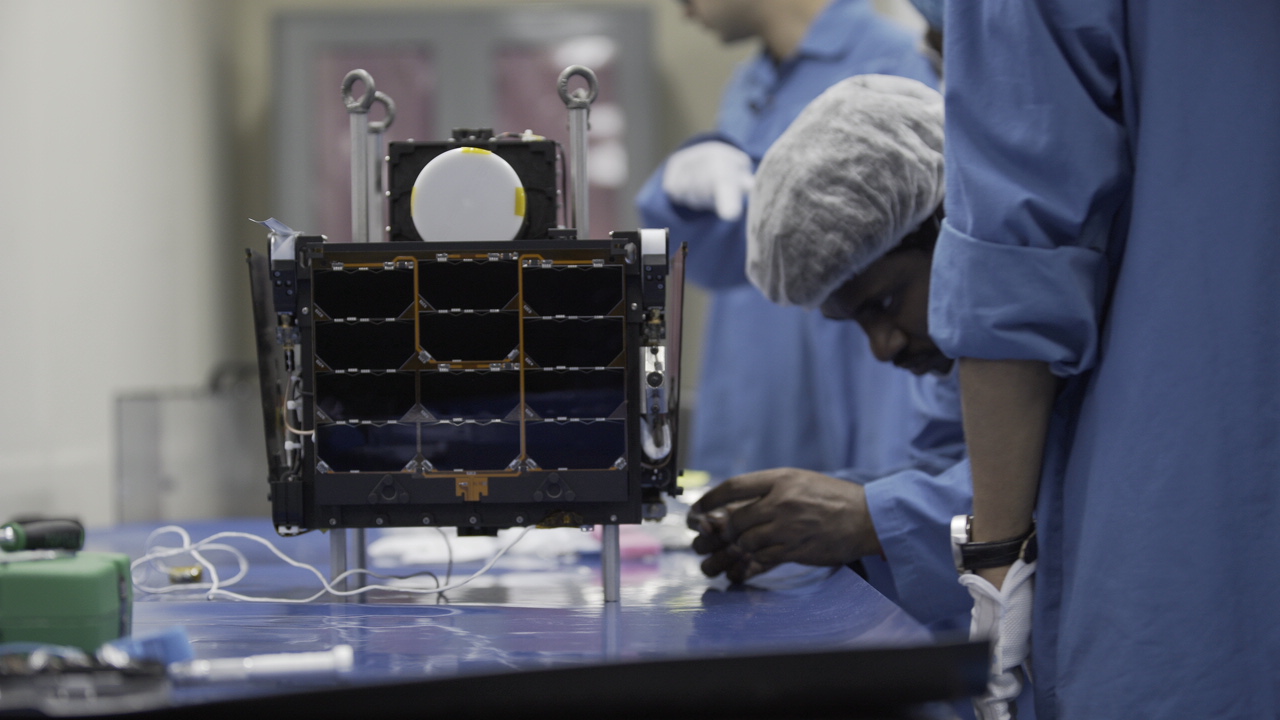
Pixxel's Hyperspectral imaging satellite at its production facility in Bangalore

Image Credits: Pixxel

“If we were to build a camera like this even two or three years ago, it would not have been possible because of the miniaturized sensors, the optics, etc.,” he said. “The advances that have happened only happened very recently, so it’s also the fact that this the right time to take it from the scientific domain to the commercial domain.”

Pixxel now aims to have its first hyperspectral imaging satellite launched and operating on orbit within the next few months, and it will then continue to launch additional satellites after that once it’s able to test and evaluate the performance of its first spacecraft in an actual operating environment.


Early Stage is the premier “how-to” event for startup entrepreneurs and investors. You’ll hear firsthand how some of the most successful founders and VCs build their businesses, raise money and manage their portfolios. We’ll cover every aspect of company building: Fundraising, recruiting, sales, product-market fit, PR, marketing and brand building. Each session also has audience participation built-in — there’s ample time included for audience questions and discussion. Use code “TCARTICLE at checkout to get 20% off tickets right here.

News: Pregame Y Combinator with Equity

 Hello and welcome back to Equity, TechCrunch’s venture capital-focused podcast, where we unpack the numbers behind the headlines. This is our Wednesday show, where we niche down and focus on a single topic, or theme. This is our sweet spot: going beyond definitions and into the dirty and deep impact of how a phenomenon could


Hello and welcome back to Equity, TechCrunch’s venture capital-focused podcast, where we unpack the numbers behind the headlines.

This is our Wednesday show, where we niche down and focus on a single topic, or theme. This is our sweet spot: going beyond definitions and into the dirty and deep impact of how a phenomenon could impact startups and tech. We are hoping to explore more than answer, and debate more than agree.

This week we’re riffing on the impending Y Combinator demo day class, all hailing from the Winter 2021 cohort. As we stated on the show, we’re not saying that these are the only startups worth looking at. They’re simply the startups from the batch that TechCrunch has already covered, as well as some crowdsourced favorites.

Here’s a brief rundown of the show, bucketed by market choice, loosely:

  • Startups serving startups: The largest group of startups in our rundown, we chatted about BrioHR, which is building HR software for Southeast Asia (TechCrunch coverage here), Firstbase, which is building a remote-work onboarding service (TechCrunch coverage here), ContentFly, which wants to use a hybrid of computer and human intelligence to provide writing services, Runway, which wants to help companies better manage app rollouts (TechCrunch coverage here), and Mono, which is building a Plaid for Africa (TechCrunch coverage here).
  • Marketplaces: Here we found two companies to discuss, the first being Providence’s own Pangea, and Queenly. Pangea (TechCrunch coverage here), is building a freelance marketplace for digitally-savvy college kids and small businesses, while Queenly is a marketplace for formalwear (TechCrunch coverage here).
  • Space: Alex demanded that we include Albedo, which is aiming to launch a satellite constellation to improve imaging of the planet using low-orbit flight paths.
  • Biotech: And then there were two biotech companies. The first, Pipe|Bio does big data management for drug development, and Nuntius Therapeutics, which is working on delivering “large genetic payloads into the correct cells.” Which sounds cool.

The actual Demo Day is happening next Tuesday, so TechCrunch and Extra Crunch will be all over day-of coverage as per usual. Talk then!

Equity drops every Monday at 7:00 a.m. PST, Wednesday, and Friday morning at 7:00 a.m. PST, so subscribe to us on Apple PodcastsOvercastSpotify and all the casts.

News: In expanded crackdown, Facebook increases penalties for rule-breaking groups and their members

Facebook this morning announced it will increase the penalties against its rule-breaking Facebook Groups and their members, alongside other changes designed to reduce the visibility of groups’ potentially harmful content. The company says it will now remove civic and political groups from its recommendations in markets outside the U.S., and will further restrict the reach

Facebook this morning announced it will increase the penalties against its rule-breaking Facebook Groups and their members, alongside other changes designed to reduce the visibility of groups’ potentially harmful content. The company says it will now remove civic and political groups from its recommendations in markets outside the U.S., and will further restrict the reach of groups and members who continue to violate its rules.

The changes follow what has been a steady, but slow and sometimes ineffective crackdown on Facebook Groups that produce and share harmful, polarizing or even dangerous content.

Ahead of the U.S. elections, Facebook implemented a series of new rules designed to penalize those who violated its Community Standards or spread misinformation via Facebook Groups. These rules largely assigned more responsibility to Groups themselves, and penalized individuals who broke rules. Facebook also stopped recommending health groups, to push users to official sources for health information, including for information about Covid-19.

This January, Facebook made a more significant move against potentially dangerous groups. It announced it would remove civic and political groups, as well as newly created groups, from its recommendations in the U.S. following the insurrection at the U.S. Capitol on Jan. 6, 2021. (Previously, it had temporarily limited these groups ahead of the U.S. elections.)

As The WSJ reported when this policy became permanent, Facebook’s internal research had found that Facebook groups in the U.S. were polarizing users and inflaming the calls for violence that spread after the elections. The researchers said roughly 70% of the top 100 most active civic Facebook Groups in the U.S. had issues with hate, misinformation, bullying and harassment that should make them non-recommendable, leading to the January 2021 crackdown.

Today, that same policy is being rolled out to Facebook’s global user base, not just Facebook U.S. users.

That means in addition to health groups, users worldwide won’t be “recommended” civic or political groups when browsing Facebook. It’s important, however, to note that recommendations are only one of many ways users find Facebook Groups. Users can also find them in search, through links people post, through invites and friends’ private messages.

In addition, Facebook says groups that have gotten in trouble for violating Facebook’s rules will now be shown lower in recommendations — a sort of downranking penalty Facebook often uses to reduce the visibility of News Feed content.

The company will also increase the penalties against rule-violating groups and their individual members through a variety of other enforcement actions.

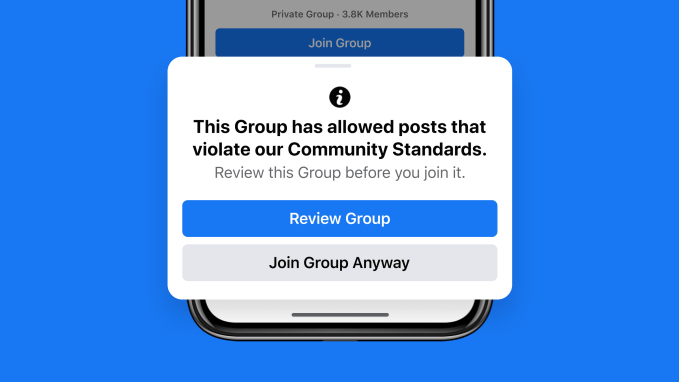
Image Credits: Facebook

For example, users who attempt to join groups that have a history of breaking Facebook’s Community Standards will be alerted to the the group’s violations through a warning message (shown above), which may cause the user to reconsider joining.

The rule-violating groups will have their invite notifications limited, and current members will begin to see less of the groups’ content in their News Feed, as the content will be shown further down. These groups will also be demoted in Facebook’s recommendations.

When a group hosts a substantial number of members who have violated Facebook policies or participated in other groups that were shut down for Facebook Community Standards violations, the group itself will have to temporarily approve all members’ new posts. And if the admin or moderator repeatedly approves rule-breaking content, Facebook will then take the entire group down.

This rule aims to address problems around groups that re-form after being banned, only to restart their bad behavior unchecked.

The final change being announced today applies to group members.

When someone has repeated violations in Facebook Groups, they’ll be temporarily stopped from posting or commenting in any group, won’t be allowed to invite others to join groups, and won’t be able to create new groups. This measure aims to slow down the reach of bad actors, Facebook says.

The new policies give Facebook a way to more transparently document a group’s bad behavior that led to its final shutdown. This “paper trail,” of sorts, also helps Facebook duck accusations of bias when it comes to its enforcement actions —  a charge often raised by Facebook critics on the right, who believe social networks are biased against conservatives.

But the problem with these policies is that they’re still ultimately hand slaps for those who break Facebook’s rules — not all that different from what users today jokingly refer to as “Facebook jail“. When individuals or Facebook Pages violate Facebook’s Community Standards, they’re temporarily prevented from interacting on the site or using specific features. Facebook is now trying to replicate that formula, with modifications, for Facebook Groups and their members.

There are other issues, as well. For one, these rules rely on Facebook to actually enforce them, and it’s unclear how well it will be able to do so. For another, they ignore one of the key means of group discovery: search. Facebook claims it downranks low-quality results here, but results of its efforts are decidedly mixed.

For example, though Facebook made sweeping statements about banning QAnon content across its platform in a misinformation crackdown last fall, it’s still possible to search for and find QAnon-adjacent content — like groups that aren’t titled QAnon but cater to QAnon-styled “patriots” and conspiracies).

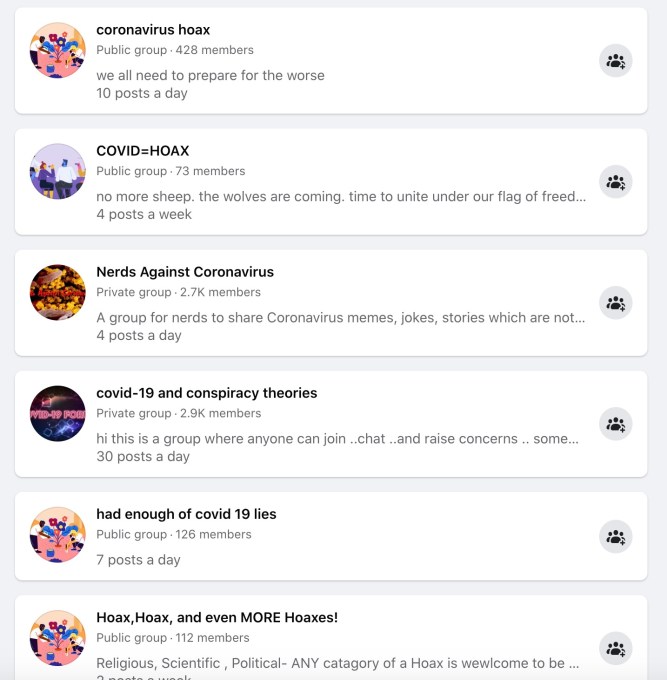
Similarly, searches for terms like “antivax” or “covid hoax,” can also direct users to problematic groups — like the one for people who “aren’t anti-vax in general,” but are “just anti-RNA,” the group’s title explains; or the “parents against vaccines” group; or the “vaccine haters” group that proposes it’s spreading the “REAL vaccine information.” (We surfaced these on Tuesday, ahead of Facebook’s announcement.)


Cleary, these are not official health resources, and would not otherwise be recommended per Facebook policies — but are easy to surface through Facebook search. The company, however, takes stronger measures against Covid-19 and Covid vaccine misinformation — it says it will remove Pages, groups, and accounts that repeatedly shared debunked claims, and otherwise downranks them.

Facebook, to be clear, is fully capable of using stronger technical means of blocking access to content.

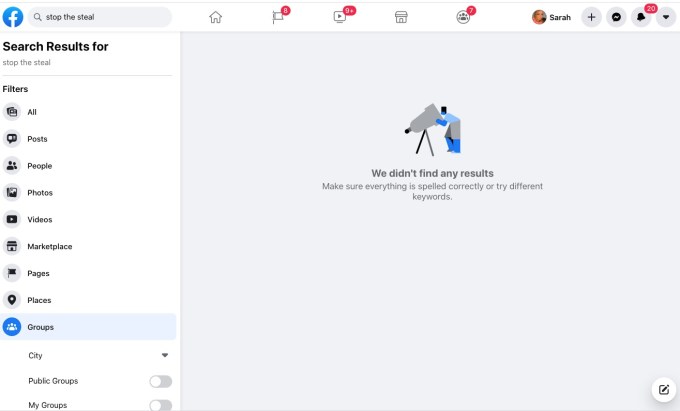
It banned “stop the steal” and other conspiracies following the U.S. elections, for example. And even today, a search for “stop the steal” groups simply returns a blank page saying no results were found.

Image Credits: Facebook fully blocks “stop the steal”

So why should a search for a banned topic like “QAnon” return anything at all?

Why should “covid hoax?” (see below)

Image Credits: Facebook group search results for “covid hoax”


If Facebook wanted to broaden its list of problematic search terms, and return blank pages for other types of harmful content, it could. In fact, if it wanted to maintain a block list of URLs that are known to spread false information, it could do that, too. It could prevent users from re-sharing any post that included those links. It could make those posts default to non-public. It could flag users who violate its rules repeatedly, or some subset of those rules, as users who no longer get to set their posts to public…ever.

In other words, Facebook could do many, many things if it truly wanted to have a significant impact on the spread misinformation, toxicity, polarizing and otherwise harmful content on its platform. Instead, it continues inching forward with temporary punishments and those that are often only aimed at “repeated” violations, such as the ones announced today. These are, arguably, more penalties than it had before — but also maybe not enough.

WordPress Image Lightbox Plugin