Monthly Archives: March 2021

News: BMW takes the wraps off the i4, its first all-electric sedan

BMW plans to have 25 electrified cars in its lineup by 2025 and it’s taking a few more steps in this direction this year with the launch of the all-electric iX SUV and the i4 sedan. Today, for the first time, the German automaker shared a few more details of what we can expect from

BMW plans to have 25 electrified cars in its lineup by 2025 and it’s taking a few more steps in this direction this year with the launch of the all-electric iX SUV and the i4 sedan. Today, for the first time, the German automaker shared a few more details of what we can expect from the i4, its first fully-electric sedan, in addition to sharing the first exterior shots of the new model.

At the top end, the i4 will have a power output of 390kW / 530HP. Going from zero to 100km/h will take four seconds.

BMW promises up to a 300 miles range, according to its own preliminary tests based on the EPA’s test procedures. Enough to go from L.A. to Las Vegas. That’s the same range as the iX will be able to cover on a single charge and a slight increase in horsepower compared to BMW’s new SUV. And while that range is less than what Tesla and some other competitors can offer, it’s still more than what’s possible with comparable all-electric Porsche and Audi models like the eTaycan and e-tron GT, which are in the lower 200s.

Image Credits: BMW

“With its sporty looks, best in class driving dynamics and zero local emissions, the BMW i4 is a true BMW. It makes the heart of the BMW brand now beat fully electric,” said Pieter Nota, member of the Board of Management of BMW AG responsible for Customer, Brands, Sales.

For now, we don’t have any pricing details or additional specs for the i4. It will become available later this year, so we’ll likely see more details in the summer.

“The iX is purpose-built, it’s spectacular and it’s a completely new BMW X product,” Frank Weber, BMW’s head of development, said at a press event earlier this week. “But what people are longing for is to see that we have a sport sedan that is fully electric. […] And the i4 has everything it takes to have a real sporty sedan from BMW that is fully electric.”

And indeed, unlike the somewhat quirky i3, BMW’s first all-electric car, the i4 is a standard, four-door sedan (with real passenger doors, unlike the i3) — something that buyers in the market for a sporty yet roomy electric car from BMW in the spirit of the existing 4-series will likely appreciate.

Earlier this week, BMW also announced version 8 of its iDrive operating system, which will feature a new dashboard layout and visual design, with two curved screens. It will make its debut in the i4 and iX.

News: Okay, the GPT-3 hype seems pretty reasonable

This morning TechCrunch covered an interesting round for Copy.ai, a startup that employs GPT-3 to help other companies with their writing projects. GPT-3, or Generative Pre-trained Transformer 3, is a piece of AI from the OpenAI group that takes text from the user, and writes a lot more for them. As part of the process of

This morning TechCrunch covered an interesting round for Copy.ai, a startup that employs GPT-3 to help other companies with their writing projects. GPT-3, or Generative Pre-trained Transformer 3, is a piece of AI from the OpenAI group that takes text from the user, and writes a lot more for them.

As part of the process of covering the Copy.ai round, I got caught up in the idea of AI-powered writing. I’ve long been more curious than afraid of automated writing. So when the Copy team described their very positive impressions of the GPT-3 AI writing tool to TechCrunch during an interview, I was intrigued.

To scratch this newly-formed itch, I doodled around this morning with a competitor of sorts to the Copy team , Headlime. And, freaking heck am I am impressed at what folks have managed to build around the GPT-3 technology.

Sure, GPT-3 can add words to a prompt. But the technology can do a lot more than that. The GPT-3-powered Headlime managed to not only write some medium-good stuff for me, but also managed bring in concepts concerning my reporting beat that were in my head but not in the prompts I provided.

I can’t do better than just show you what I mean. So, here’s what happened when I used Headlime for the first time, sans help.

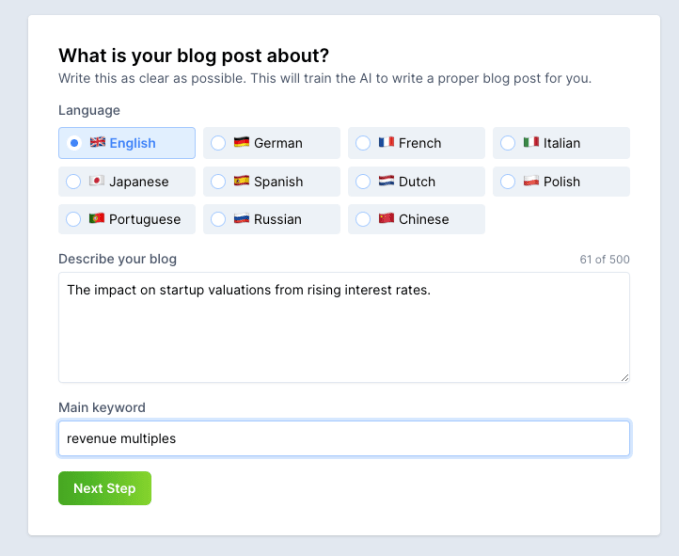
Here’s the first thing that Headlime showed me, a language selector and a request for a description of the post that I wanted to write. I decided to push the system a bit by just telling it about a piece I need to write in light of today’s market action:

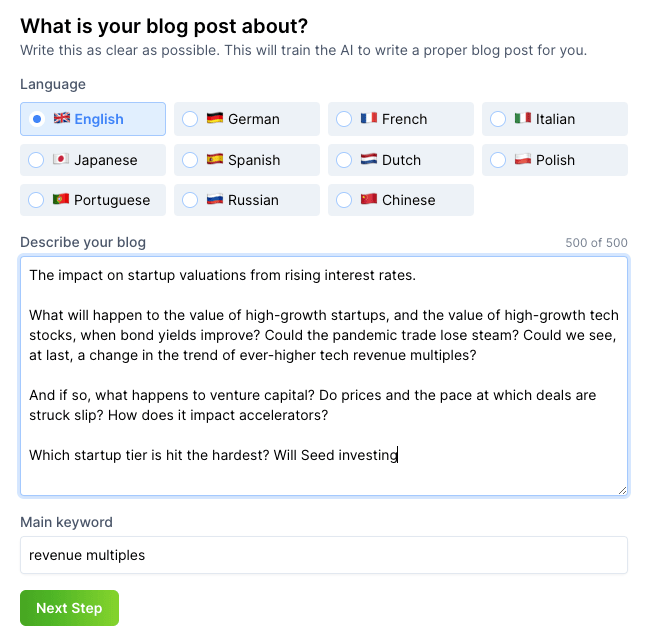
Ha ha, I thought, that will kick it in the teeth and I, a biped of intelligent meat wrapped around some calcium sticks, will feel grossly superior to the computer player. I hit go and then realized that I actually had to provide 500 characters of stuff, so I rambled for a bit to fill in required length:

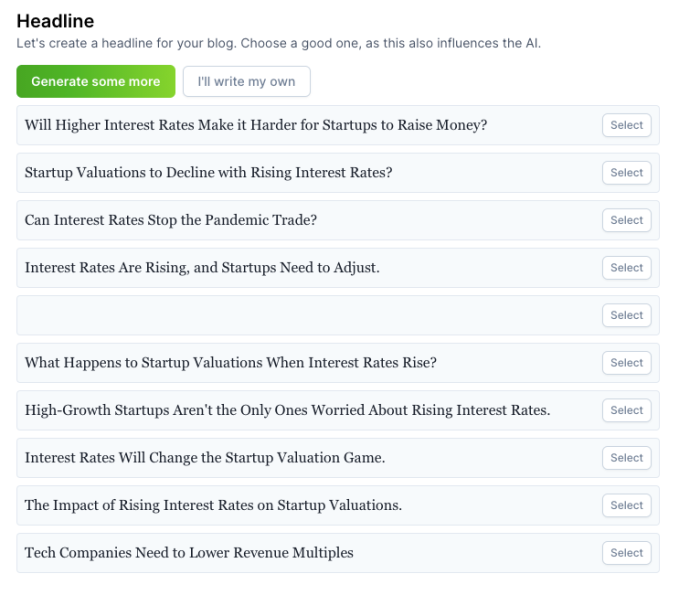
Time for the next step! Hitting the button brought up a list of possible headlines for the post I was helping create, which were honestly not terrible:

Fair enough, yeah? At this point I was starting to become impressed.

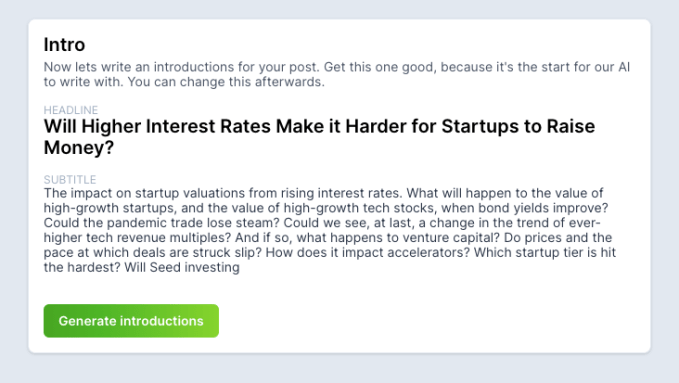
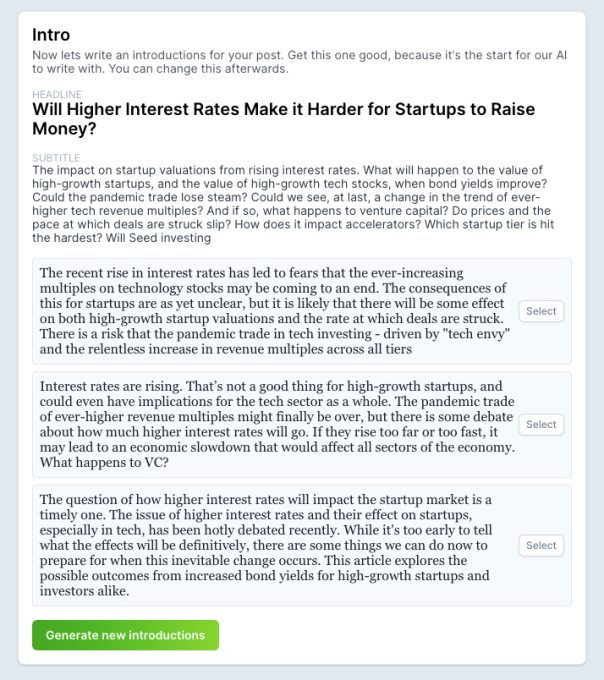
I selected the first headline as it was my favorite and moved along. Next came the work to get an intro put together for the post, a process that involved the strenuous work of clicking a button:

Here are the options proffered:

Again, not bad.

What struck me about these are not merely minor variations on each other. They are structured differently, taking various angles on what I was halfway talking about in the 500 characters of bilge I had fed into the system. I was starting to wish that I had given GPT-3 a bit more to work with up top, as it was trying its best after I had clearly not.

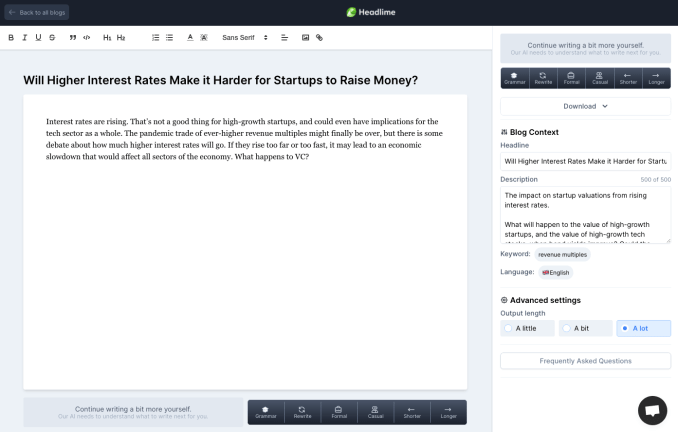
Intro selected, I was brought into a CMS of sorts, where our selected bits were included, and your humble servant was asked to do a bit more writing.

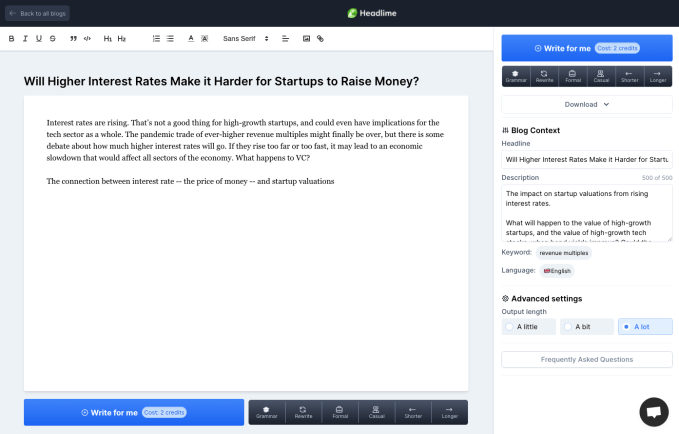
I was happy to oblige, only for the system to stop me and offer to take over:

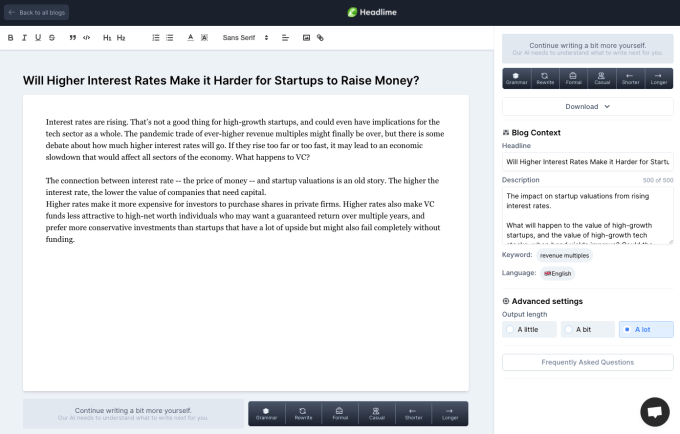
Having precisely no idea what a credit is, or what two of them cost as I was on a free trial of sorts, I hit the “Write for me” button. This is what came out:

Look at how it finished that sentence I started, even after I used em-dashes! The software gets the next sentence backwards, but is right back on the horse afterwards talking about how higher interest rates make exotic investment classes like venture capital less attractive! I was gobsmacked.

I will keep playing with the tech and the various software wrappers that are being built to productize GPT-3. More notes to come. But I wanted to pause and share my initial delight. This is cool. I can’t recall the last time that technology actually shocked me. But, well played GPT-3, you’re amazing.


News: Fraud prevention platform Seon raises a $12M Series A round led by Creandum

Seon, which lets online businesses fight online fraud like fake accounts has raised a $12 million Series A round led by Creandum, with participation from PortfoLion, part of OTP Bank. The funding appears to be one of Hungary’s larger series A rounds to date.   Seon is a fraud-detection startup that establishes a customers’ ‘digital

Seon, which lets online businesses fight online fraud like fake accounts has raised a $12 million Series A round led by Creandum, with participation from PortfoLion, part of OTP Bank. The funding appears to be one of Hungary’s larger series A rounds to date.
 
Seon is a fraud-detection startup that establishes a customers’ ‘digital footprint’ in order to weed out false accounts and thus prevent fraudulent transactions. Clients include Patreon, AirFrance, Rivalry and Ladbrokes Launched in 2017, the company claims to bave been profitable since the end of 2019, after experiencing growth through working with neobanks, esports, gaming, Forex, and crypto trading throughout the rapid digitization brought on by the pandemic.

SEON’s CEO and Founder, Tamas Kadar, said in a statement: “We’re extremely pleased to have completed our latest funding round, led by Creandum, joining its exciting tech portfolio. We feel we have found a like-minded investor to work closely with to pursue the significant global opportunity for our business as we continue to democratize fraud fighting.”
 
Simon Schmincke, general partner at Creandum, said: “At Creandum, we believe cybercrime will be one of the most serious threats of the 21st century. With SEON, we’ve found an anti-fraud solution that’s effective, affordable, flexible, intuitive, and clearly proves its ROI.”
 
Gábor Pozsonyi, partner at PortfoLion Capital Partners, added: “Seon is a fundamentally useful brand: it offers a solution to one of the greatest challenges of digitalization, not only saving hundreds of millions of euros for its partners but making the internet a safer place.”

SEON are seen as competing with Emailage, Iovation, Threatmetrix. However, SEON’s thesis is that social media is a great proxy of a legitimate user vs bot/fake fraudster, so it looks heavily at social accounts to weed out fraudsters.

As part of the funding round, Seon has brought on board the following investors as shareholders: N26 founders, Maximilian Tayenthal and Valentin Stalf; SumUp founders Stefan Jeschonnek and Jan Deepen; Tide CEO Laurence Krieger; Revolut ex-CFO Peter O’Higgins; iZettle ex-chief Product Officer Leo Nilsson; Onfido cofounder Eamon Jubawy, and ComplyAdvantage founder Charlie Delingpole.

News: To solve all the small things, look to everyday Little AI

We should be deploying simple AI tools to solve and improve upon everyday tactics so we can spend more time on strategic growth goals and long-term execution.

Maya Mikhailov
Contributor

Maya Mikhailov is a founder of SAVVI AI and previously co-founded GPShopper, acquired by Synchrony in 2017 where she was SVP and general manager for the direct-to-consumer fintech.

In a recent LinkedIn survey, I asked product and software developers if and how they were making their software smarter. A surprising 57% cited A/B testing, while another 50% reported they were still swinging from decision trees.

Why are developers still solving everyday pain points with these manual, archaic processes, as opposed to employing “Little AI”? There are millions of everyday use cases for AI, where technology is empowered to learn and decide on a course of action that offers the best outcome for consumers and companies alike. The problem is that the Big AI we’re used to has a lot of challenges that make it inaccessible for developers to employ for tasks that’d benefit from everyday AI.

What we’re missing

Take this article you’re reading right now. If TechCrunch let loose a Little AI  – essentially empowered machine learning – it could learn you prefer to read short, newsworthy articles in the morning and longer thought pieces at night. That learning informs a personalized home page, presenting you with bullet points upon awakening and feature stories at night – all without you having to laboriously enter your preferences or respond to pop-up surveys.

Little AI also learns that what your VC friend wants to see on their screen first thing is recent series funding announcements. A truly personalized experience is not only our expectation, it is the core component of the relationship between us and our content providers. And yet, it’s missing.

Let’s raise the stakes. There are multiple players in the split-pay space. A sprinkle of Little AI can teach a fintech provider that one consumer likes to finish paying off an item in less than six months and never wants any outstanding payment to exceed $250. It can also learn that they are open to revolving credit/product offers for an experience-related purchase above $1,500. This type of truly personalized financing enables both the consumer and merchant to benefit from a completed sale while lowering the risk of default to the credit provider.

Travel will be coming back in a big way, with more deals than ever. Little AI can jump in and learn how to make that experience far easier for consumers and far more successful for travel providers. Rather than showing consumers every single deal for every single location, it can take personal preferences into account.

News: Lucid Motors sees a second life for its EV batteries in energy storage

Lucid Motors has designed the battery packs in its luxury electric vehicle for two lives. The company, which is already experimenting with energy storage systems for commercial and residential customers, is also eyeing ways to repurpose batteries from its electric vehicles. While Lucid is still years from having to contend with a large number of

Lucid Motors has designed the battery packs in its luxury electric vehicle for two lives. The company, which is already experimenting with energy storage systems for commercial and residential customers, is also eyeing ways to repurpose batteries from its electric vehicles.

While Lucid is still years from having to contend with a large number of used batteries —  its first EV, the luxury Lucid Air sedan, isn’t coming to market until the second half of 2021 — the company is already planning how to give them a second life them in a yet-to-be-launched energy storage business.

The battery-cell modules that power Lucid’s vehicles are identical to the ones that will be used for energy storage, making them well-suited for “second-life” purposes, according to the company. The company has already constructed a prototype of a 300-kilowatt hour stationary battery storage system at its engineering lab, Lucid’s Chief Engineer and Senior VP of Product Eric Bach told TechCrunch. The batteries in that system are new, but there is “no technical limitation” that would prevent Lucid from swapping them out with used batteries, Bach said. While Lucid CEO and CTO Peter Rawlinson has previously discussed plans to eventually build energy storage systems like Tesla that uses new batteries, this is the first time the company has talked about second-life applications for the product. 

Batteries typically retain a charging capacity of around 70% once they’re removed from EVs, which means they potentially have another decade of useful life. Automakers like General Motors, Ford Motor, and Audi AG have already initiated second-life pilot projects aimed at extracting that remaining value. 

Bach explained the company will likely retrieve batteries used in Lucid EVs after they reach the end of their useful life through its dedicated service centers or when customers trade in their vehicles. Once batteries are returned to Lucid, the company would need to harvest the modules from the packs and run a quality check on them. Lucid’s vehicles have built-in sensors that provide data on each of its cars from the battery packs down to the module level, Bach said, which will come in handy when determining the health of each module. After physical testing, the modules could be ready to be placed in an outgoing product. 

Storage systems do contain some additional components. In a home system, that may include a DC-to-AC inverter, a cooling system and safety switches. The actual battery will remain consistent across Lucid’s products.   

Lucid hasn’t determined how it will distribute the second-life batteries between home and industrial applications.

“Personally, I feel in an industrial application, using these [second-life] modules would be more appropriate and easier because there, the key metric is really just dollars per kilowatt hour,” Bach said.

In instances where a Lucid vehicle ends up at a car dismantler, Bach suggested there may be an opportunity to incentivize the dismantler to feed the battery packs back to the company. Even if that doesn’t happen, as the price of EV battery raw materials continues to rise, dismantlers will likely make their own business of selling battery packs to companies or recyclers. 

At this point – with no product yet on the market and with an expectation that it will be low- to mid-volume – Lucid has not started branching out into recycling materials itself, he said. For the moment, Lucid is leaving recycling operations to its battery cell suppliers, like South Korea-based LG Chem.

“But in the long run, I mean, we’re just at the start of our journey [. . .] and I can envision that in multiple years we will look into cell manufacturing ourselves as well as the full value chain for everything that’s needed to make the applicable energy storage devices,” Bach said. “So in the future, absolutely it makes a lot of sense as the volume goes up, you need to try to contain more of the supply chain and that goes back into a sustainable method of harvesting the raw materials.”

Bach said the company is laser-focused on the Lucid Air and the public may be a few years out from seeing a Lucid home battery system. Until then, the Lucid Air will come equipped with bidirectional charging capabilities, meaning the customer will be able to feed the power from her car into her house. 

“Essentially, that is the first home battery system that we will have already,” Bach said.

It’s unclear what resources — in terms of people and capital — Lucid is putting towards an energy storage business. Such details are likely to remain scant until after the company officially becomes a publicly traded company. In March, Lucid Motors announced it had reached an agreement to become a publicly traded company through a merger with special-purpose acquisition company Churchill Capital IV Corp., in what was considered the largest deal yet between a blank-check company and an electric vehicle startup.

The combined company, in which Saudi Arabia’s sovereign fund will continue to be the largest shareholder, will have a transaction equity value of $11.75 billion. Private investment in the public equity deal is priced at $15 a share, putting the implied pro-forma equity value at $24 billion.

The funding will be used to bring the Lucid Air and an SUV to market as well as to expand its factory in Arizona, Lucid CEO and CTO Peter Rawlinson previously told TechCrunch. The company plans to expand the factory over another three phases in the coming years to have the capacity to produce 365,000 units per year at scale. The initial phase of the $700 million factory was completed late last year and will have the capacity to produce 30,000 vehicles a year.

News: Amazon will expand its Amazon Care on-demand healthcare offering U.S.-wide this summer

Amazon is apparently pleased with how its Amazon Care pilot in Seattle has gone, since it announced this morning that it will be expanding the offering across the U.S. this summer, and opening it up to companies of all sizes, in addition to its own employees. The Amazon Care model combines on-demand and in-person care,

Amazon is apparently pleased with how its Amazon Care pilot in Seattle has gone, since it announced this morning that it will be expanding the offering across the U.S. this summer, and opening it up to companies of all sizes, in addition to its own employees. The Amazon Care model combines on-demand and in-person care, and is meant as a solution from the search giant to address shortfalls in current offering for employer-sponsored healthcare offerings.

In a blog post announcing the expansion, Amazon touted the speed of access to care made possible for its employees and their families via the remote, chat and video-based features of Amazon Care. These are facilitated via a dedicated Amazon Care app, which provides direct, live chats via a nurse or doctor. Issues that then require in-person care is then handled via a house call, so a medical professional is actually sent to your home to take care of things like administering blood tests or doing a chest exam, and prescriptions are delivered to your door as well.

The expansion is being handled differently across both in-person and remote variants of care; remote services will be available starting this summer to both Amazon’s own employees, as well as other companies who sign on as customers, starting this summer. The in-person side will be rolling out more slowly, starting with availability in Washington, D.C., Baltimore, and “other cities in the coming months” according to the company.

As of today, Amazon Care is expanding in its home state of Washington to begin serving other companies. The idea is that others will sing on to make Amazon Care part of its overall benefits package for employees. Amazon is touting the speed advantages of testing services, including results delivery, for things including COVID-19 as a major strength of the service.

The Amazon Care model has a surprisingly Amazon twist, too – when using the in-person care option, the app will provide an updating ETA for when to expect your physician or medical technician, which is eerily similar to how its primary app treats package delivery.

While the Amazon Care pilot in Washington only launched a year-and-a-half ago, the company has had its collective mind set on upending the corporate healthcare industry for some time now. It announced a partnership with Berkshire Hathaway and JPMorgan back at the very beginning of 2018 to form a joint venture specifically to address the gaps they saw in the private corporate healthcare provider market.

That deep pocketed all-star team ended up officially disbanding at the outset of this year, after having done a whole lot of not very much in the three years in between. One of the stated reasons that Amazon and its partners gave for unpartnering was that each had made a lot of progress on its own in addressing the problems it had faced anyway. While Berkshire Hathaway and JPMorgan’s work in that regard might be less obvious, Amazon was clearly referring to Amazon Care.

It’s not unusual for large tech companies with lots of cash on the balance sheet and a need to attract and retain top-flight talent to spin up their own healthcare benefits for their workforces. Apple and Google both have their own on-campus wellness centers staffed by medical professionals, for instance. But Amazon’s ambitious have clearly exceeded those of its peers, and it looks intent on making a business line out of the work it did to improve its own employee care services — a strategy that isn’t too dissimilar from what happened with AWS, by the way.

News: From improving cancer treatments to saving the bees, these are the companies in IndieBio’s latest class

Ultra precise cancer therapies! Human-like hair grown from plants! A way to potentially save the bees! The spectrum of companies coming out of IndieBio has always been pretty wild, and its latest batch definitely doesn’t disappoint. As the early stage, biology-focused accelerator arm of SOSV, IndieBio gives the companies in its program $250,000+, mentorship, and

Ultra precise cancer therapies! Human-like hair grown from plants! A way to potentially save the bees!

The spectrum of companies coming out of IndieBio has always been pretty wild, and its latest batch definitely doesn’t disappoint.

As the early stage, biology-focused accelerator arm of SOSV, IndieBio gives the companies in its program $250,000+, mentorship, and full access to a biology lab to bring their ideas to life.

When founder Arvind Gupta left the accelerator last year to join the venture capital fund Mayfield, Mayfield and IndieBio partnered to form the Genesis Consortium, which offers IndieBio companies an additional $250,000 in optional funding.

IndieBio initially operated solely out of San Francisco, with the accelerator expanding just last year to include a New York cohort that runs in parallel. The SF program is led by Managing Director Po Bronson, while the New York program is led by Managing Director Stephen Chambers.

With its Demo Day still a ways out, IndieBio gave us a peek at the teams currently going through the program. It’s worth noting that IndieBio deliberately invests very early — in many cases, even before it’s entirely clear whether or not the scientific concepts behind a company are fully feasible. “Our program is our diligence”, Bronson tells me. The goal is to prove out concepts — and figure out how to turn them into big businesses — for hundreds of thousands of dollars, rather than millions. “We’re biting off the risk, and de-risking it for the next investors in line.”

Here are the companies currently in each program, alphabetically:

New York

Beemmunity: Humans need bees in order to survive, but bee populations are plummeting, with one of the main causes believed to be exposure to neurotoxic pesticides. Pitched as “pesticide protection for bees”, Beemmunity is working on a “micro-sponge” that, after being ingested by a bee, captures these neurotoxins and eliminates them as waste. Expected to enter field trials soon.

Brickbuilt Therapeutics: A biotherapeutic lozenge meant to help prevent and treat things like gum disease and thrush.

Bucha Leather Synthetic, animal-free leather grown from bacterial nanocellulose. Their process allows them to make “massive mats” of material that can be produced in weeks.

Free To Feed: If an infant proves allergic to something in their mother’s breastmilk, determining exactly what they’re allergic to can be a long and incredibly frustrating process. Free to Feed is developing test strips that identify different food proteins in breast milk, helping breastfeeding mothers better determine what proteins are leading to an allergic reaction.

Gypsy Basin Genomics: Developing a test, simple enough to be administered as a gargle-and-a-spit during a dentist visit, that can detect at an early stage the oral cancers caused by HPV.

Harmony Baby Nutrition: Pitched as “the only dairy-free, allergy-free, and environmentally friendly baby formula”, Harmony is producing infant formulas that “closely mirror human breast milk”.

MicroTERRA: Using duckweed water lentils to convert fish farm wastewater into protein. The duckweed helps to purify the fish waste water as it grows; once grown, this “lemna protein concentrate” can be used as a source of protein in animal feed.

Nyoka Design Labs: Non-toxic, biodegradable, and recyclable glowsticks powered by bioluminescence.

Sequential Skin: Wipe your face with their skin test kit, send it to their lab, and get a full report on the products that should work well with your skin’s microbiome.

Stembionix: With personal stem cell banking in mind, Stembionix is developing a “mailable bioreactor system” that would allow for the transporting of stem cells without the freezing/thawing that complicates things and can negatively impact viability.

San Francisco

Aja Labs: Pitched as the “beyond meat of hair extensions”, Aja Labs wants to use plants to grow fibers that look and feel like human-hair, potentially eliminating the need for chemical-heavy synthetics or human hair in the production of hair extensions.

Avalo.ai: Using interpretable machine learning to identify genes (and what said genes do) in plants at a much faster pace to help develop better crops.

California Cultured: Lab-grown cocoa. The company says it can grow cocoa that is less bitter, and as such requires far less sugar to be tasty.

Canaery: Aiming to “do for scent what machine vision has done for sight”, Canaery is building a neural interface for analyzing an object’s “scent fingerprint” to identify dangerous compounds at places like ports and inspection points without (or in addition to) x-rays or cameras.

Capra Biosciences: Finding ways to turn the otherwise detrimental biofilms that can develop during fermentation into products like motor oil or retinol for cosmetics.

Lypid: Developing vegan oils that behave like animal fats, melting at the same temperature and providing the same mouthfeel, to further improve plant-based meats.

OncoPrecision: Building a faster way to help oncologists determine which cancer drugs (of hundreds) will work best for a patient by applying drugs to patient-derived cells, with the goal of finding the best drug within 7-14 days.

Ozone Bio: Using dead cell fermentation (or “Zombiezymes”) to produce nylon in a greener way.

Panacea Longevity: Aiming to replicate the health benefits of fasting… without fasting. Identifying dietary compounds that can “mimic the body’s natural response to fasting” and develop them into a supplement.

Prolific Machines: High resolution control of cell differentiation. In lab grown meat, for example, one could use their tech to determine what bits of a steak are muscle tissue, fat, etc.

Proteinea: Using fly larva to grow “pharma-grade proteins” for use in medicine cheaper and more quickly.

Sundial Foods: Bringing “skin” to plant-based chicken, beginning with a coating that will allow for plant-based chicken wings.

Vertical Oceans: Taking the concept of vertical farming and applying it to seafood, Vertical Oceans is working on efficient, low-waste, stackable towers to make the production of shrimp more sustainable.

News: Credit-and-collect fintech start-up Diem raises $5.5M Seed led by Fasanara Capital

Diem, a London, UK-based fintech start-up has raised a seed round of $5.5 million led by Fasanara Capital, and Angel investor Chris Adelsbach, founder of Outrun Ventures. Additional investors include Andrea Molteni (early investor in Farfetch), Ben Demiri (co-chairman at fashion tech PlatformE) and Nicholas Kirkwood (founder of the eponymous brand).  Diem is a debit

Diem, a London, UK-based fintech start-up has raised a seed round of $5.5 million led by Fasanara Capital, and Angel investor Chris Adelsbach, founder of Outrun Ventures. Additional investors include Andrea Molteni (early investor in Farfetch), Ben Demiri (co-chairman at fashion tech PlatformE) and Nicholas Kirkwood (founder of the eponymous brand). 

Diem is a debit card with an app affording instant cash access, traditional banking service benefits (debit card, domestic and international bank transfers), but also allowing consumers to dispose of goods for eventual resale. The idea here is that this feeds into the so-called circular economy, making Diem attractive from an environmental point of view. Some estimates put the amount of worth of goods disposed of in the last 15 years at $6.9Tn.

Here’s how it works: You have an old time of clothing, phone, book or bag, for instance. You load the item it into the app. The app makes you an offer for what the item is worth. If you accept, cash is loaded into your account and there’s a facility to spend in the item, which is then resold. The incentive, therefore, is not to throw away the object and add to landfill, because you have now turned it into cash. Think “neo bank meets people who sell your stuff on eBay”

Geri Cupi said in a statement: “Diem’s mission is to empower consumers to value, unlock, and enjoy wealth they never knew they had. All of this while fuelling the circular economy and supporting the commitment to sustainability as our key value proposition. DIEM makes it possible for capitalism and sustainability to co-exist.”

Lead Investor and CEO at Fasanara Capital, Francesco Filia, said: “Fasanara is excited to announce our partnership with DIEM and Geri Cupi… [it’s] a new generation fintech powered by principles of circular economy and look forward to support its growth.”

News: Snap is taking a significant step into fashion e-commerce with its acquisition of Fit Analytics

“Snap, Inc. is a camera company,” Snap notes on its homepage, and while a lot of it effort up to now have been about using that camera ethos to help people share images of their lives with their social circles, today the company made an acquisition to further that camera reach in another direction: selling

“Snap, Inc. is a camera company,” Snap notes on its homepage, and while a lot of it effort up to now have been about using that camera ethos to help people share images of their lives with their social circles, today the company made an acquisition to further that camera reach in another direction: selling fashion and more generally, e-commerce and shopping.

The company today confirmed that it has acquired Fit Analytics, a startup based in Berlin that has built technology to help shoppers find the right-sized apparel and footwear from online retailers, along with a wider set of personalization tools and other analytics to help retailers figure out how to sell more overall.

Fit Analytics already works with a number of big retailers, including North Face, Asos, Calvin Klein, Patagonia, Puma, and many more — in all, some 18,000 retailers already.

In other words, Snap is adding not just a technology team — there are 100 staff at the company, based in Berlin, who will be reporting to Snap VP of Engineering Nima Khajehnouri — but a substantial e-commerce technology business into its portfolio. Fit Analytics has confirmed that it will be continuing to operate its existing business, while also working on helping Snap build out its shopping platform.

Fit Analytics’ technology lets people enter their own measurements into a tool that uses machine learning to match those dimensions up to the clothes or shoes in question to find the best fit. And although it is not the focus for the company right now, Fit Analytics also has built technology to match clothing using images that customers upload themselves — an interesting area considering Snap’s focus on the visual experience, and specifically on visuals created by its users, and of course the features it has built around lenses and other augmented reality experiences.

The terms of the deal are not being disclosed. Fit Analytics, which used to be called UpCload (and actually launched back in 2011 at a TC Disrupt event in Beijing focused mainly on “webcam” technology — this was the days before smartphone-created selfies were de rigueur) had disclosed less than $1 million in funding according to PitchBook data, although that list of customers implies that it was generating strong revenues.

Snap’s interest in the company underscores some interesting developments for the company.

For starters, it will give Snap another way to diversify its revenues. The company is now making nearly $1 billion a quarter in revenues (in its Q4 earnings, it posted sales of $911 million). The majority of that is coming from advertising on Snapchat, so Snap is naturally looking for other ways of making money.

Whether Fit Analytics is integrated into Snapchat or not, and regardless of what will happen with how Apple and Google let apps monetize on their mobile platforms, Fit Analytics is already likely pulling in a substantial amount of revenue by way of its e-commerce services for retailers. Covid-19 has led a lot of retailers to rethink how well their e-commerce experiences work, and that could have meant more activity for companies like Fit Analytics. All that will now be funneled on to Snap’s balance sheet.

Its advertising business, meanwhile, reveals that Snap already has a substantial relationship with fashion and beauty brands.

In those Q4 earnings alone, it noted augmented reality campaigns with NYX Professional Makeup and Ralph Lauren, as well as a partnership with Perfect Corp for 200 beauty brands to upload catalogs to the Snap Camera for augmented reality try-on. Fit Analytics will help it deepen those engagements, by giving Snap another range of features that it can build out for those customers. Come for the AR filter to see how you look in a Ralph Lauren sweater, and then…shop the look.

In addition to diversifying its revenues, it could be a sign of how Snap is diversifying the kinds of bells and whistles it’s providing for its audience. Again, Snap is not commenting on how and when it plans to integrate Fit Analytics’ tools, but it is notable that Snapchat’s core audience of teen and younger users also happens to be a major target for fashion retailers, too.

Clothing, fashion accessories and shoes together made up some 33% of US teenagers’ spend in Fall 2020, according to research from Piper Sandler, against other categories like video games, music, and food. (Books got a paltry 1% – I guess they didn’t survey many bookish types…)

Slicing up the pie somewhat differently, Piper Sandler said that the majority of spend, 40%, was dedicated to “How I Look (aka the Selfie Budget)” — putting what Fit Analytics enables more squarely in the same categories that Snap is also looking to address.

Sidenote: Piper Sander’s research shows that Amazon is far and away the biggest destination for fashion shopping right now for teens, which shows how fragmented the D2C market is. That also sets up an interesting opportunity for Snap, by way of Snapchat, to provide another shopping channel for those D2C brands, while also riding on the coattails, so to speak, of Instagram and its growing role in the world of social media-based commerce.

At its core, Fit Analytics’ tools are part of what you might think of as the “missing link” in fashion e-commerce.

The benefits of online commerce are pretty extensive: people can shop whenever they want; they can get a much bigger selection of items, since the retail “space” is limited only by the time shoppers want to commit to shopping; they can get more personalised experiences; and they are increasingly getting a diversified range of delivery options and times.

The biggest drawback has, of course, been in the lack of “hands-on” interaction.

Put more simply, you have no way of trying on clothes and shoes, leading to the other big pain point: returns. Fit Analytics is part of the army of startups that have been building technology to fill that gap: others have included companies that provide visualizations of how clothes can look on a person.

Notably, these are areas where Amazon has also been making significant investments — in addition to making acquisitions like the 3D modeling startup Body Labs, it has launched a plethora of services to make it easier for people to buy from it, such as its try-on-and-return feature Prime Wardrobe. The e-commerce giant has a lot of weapons in its arsenal, but technology undoubtedly has been helping it win the fashion commerce race. 

Snap has made about 20 acquisitions to date, covering areas like advertising technology, location-based services, services to further the company’s AI and augmented reality products, and forays into music. Fit Analytics appears to be the first focused on shopping and e-commerce, and specifically fashion, but if its interest in shopping continues to grow, I wouldn’t be surprised if it’s the last.


News: Dear Sophie: What type of visa should we get to fundraise in Silicon Valley?

Should we come to Silicon Valley to meet with venture capitalists? How should we begin that process? What type of visa should we get and how easy is it to get?

Sophie Alcorn
Contributor

Sophie Alcorn is the founder of Alcorn Immigration Law in Silicon Valley and 2019 Global Law Experts Awards’ “Law Firm of the Year in California for Entrepreneur Immigration Services.” She connects people with the businesses and opportunities that expand their lives.

Here’s another edition of “Dear Sophie,” the advice column that answers immigration-related questions about working at technology companies.
“Your questions are vital to the spread of knowledge that allows people all over the world to rise above borders and pursue their dreams,” says Sophie Alcorn, a Silicon Valley immigration attorney. “Whether you’re in people ops, a founder or seeking a job in Silicon Valley, I would love to answer your questions in my next column.”

Extra Crunch members receive access to weekly “Dear Sophie” columns; use promo code ALCORN to purchase a one- or two-year subscription for 50% off.


Dear Sophie:

A friend and I founded a tech startup last year. Like a lot of other startups, we’re looking for funding. Should we come to Silicon Valley to meet with venture capitalists?

How should we begin that process? What type of visa should we get and how easy is it to get?

—Logical in Lagos

Dear Logical:

Thanks for reaching out to me from the entrepreneurial hotspot of Lagos!

In a recent episode of my podcast, I spoke with Esther Tricoche, director of investments at Kapor Capital, who offered up many words of wisdom to founders. She also mentioned that in many emerging entrepreneurial markets, including Lagos, accelerator funding and Series A funding are relatively easy to find, but pre-seed and seed funding are not.

Getting yourselves and your startup in front of Silicon Valley investors that focus on pre-seed and seed funding will be important to rapidly scale. Esther mentioned that even in U.S. cities, such as Atlanta, that are entrepreneurial hotspots, investment dollars are not as plentiful as they are in Silicon Valley. Moreover, investors outside of Silicon Valley tend to be more risk-averse.

A composite image of immigration law attorney Sophie Alcorn in front of a background with a TechCrunch logo.

Image Credits: Joanna Buniak / Sophie Alcorn (opens in a new window)

So, yes, you should meet with Silicon Valley investors, but be aware that most U.S. embassies and consulates remain closed to routine visa and green card processing due to the ongoing pandemic. Given that, you can start requesting virtual meetings now; and you will have to wait until the U.S. consulate in Lagos comes back to full capacity to apply for a visa to come to the U.S. I like checking for visa availability through the Waypoint Embassy and Consulate Directory (full disclosure: I am an advisor to Waypoint).

As always, I recommend that you consult an experienced immigration attorney when you’re ready to take the step of actually applying for a visa.

Once U.S. consular offices reopen, if you aren’t eligible for ESTA, you can apply for a B-1 visitor visa for business. With a B-1 visa, you can request an initial stay of up to six months. This is a great status for business meetings such as to talk to prospective investors, negotiate contracts and incorporate a new business. However, you can’t work in the U.S. You must be aware that no hands-on work for pay (or even the chance of future remuneration) by a U.S. entity is allowed.

WordPress Image Lightbox Plugin