Monthly Archives: March 2021

News: Camunda snares $98M Series B as process automation continues to flourish

It’s clear that automated workflow tooling has become increasingly important for companies. Perhaps that explains why Camunda, a Berlin startup that makes open source process automation software, announced an €82 million Series B today. That translates into approximately $98 million U.S. Insight Partners led the round with help from A round investor Highland Europe. When

It’s clear that automated workflow tooling has become increasingly important for companies. Perhaps that explains why Camunda, a Berlin startup that makes open source process automation software, announced an €82 million Series B today. That translates into approximately $98 million U.S.

Insight Partners led the round with help from A round investor Highland Europe. When combined with the $28 million A investment from December 2018, it brings the total raised to approximately $126 million.

What’s attracting this level of investment says Jakob Freund, co-founder and CEO at Camunda is the company is solving a problem that goes beyond pure automation. “There’s a bigger thing going on which you could call end-to-end automation or end-to-end orchestration of endpoints, which can be RPA bots, for example, but also micro services and manual work [by humans],” he said.

He added, “Camunda has become this endpoint agnostic orchestration layer that sits on top of everything else.” That means that it provides the ability to orchestrate how the automation pieces work in conjunction with one another to create this full workflow across a company.

The company has 270 employees and approximately 400 customers at this point including Goldman Sachs, Lufthansa, Universal Music Group, and Orange. Matt Gatto, managing director at Insight Partners sees a tremendous market opportunity for the company and that’s why his firm came in with such a big investment.

“Camunda’s success demonstrates how an open, standards-based, developer-friendly platform for end-to-end process automation can increase business agility and improve customer experiences, helping organizations truly transform to a digital enterprise,” Gatto said in a statement.

Camunda is not your typical startup. Its history actually dates back to 2008 as a business process management (BPM) consulting firm. It began the Camunda open source project in 2013, and that was the start of pivoting to become an open source software company with a commercial component built on top of that.

It took the funding at the end of 2018 because the market was beginning to catch up with the idea, and they wanted to build on that. It’s going so well that company reports it’s cash-flow positive, and will use the additional funding to continue accelerating the business.

News: Waterfund commits $50M to OurCrowd’s water and agtech portfolio

Waterfund, an investment and trading firm that specializes in acquiring and managing water-related infrastructure assets, today announced a deal with Israel-based crowdfunding platform OurCrowd that will see the Waterfund team commit $50 million to build a water- and agtech-focused portfolio of 15 companies. The first of these investments is in Plenty, a well-funded vertical farming

Waterfund, an investment and trading firm that specializes in acquiring and managing water-related infrastructure assets, today announced a deal with Israel-based crowdfunding platform OurCrowd that will see the Waterfund team commit $50 million to build a water- and agtech-focused portfolio of 15 companies. The first of these investments is in Plenty, a well-funded vertical farming startup.

In addition to these direct investments, the two companies are also working together on a new water-focused platform called Aquantos, which aims to issue so-called Blue Bonds and other financial products related to the water industry. Comparable to Green Bonds that focus on projects with environmental benefits — and which have been around for more than a decade now — Blue Bonds are still a new idea and focus on projects that could benefit the oceans.

“We are working to issue Blue Bonds that can be both climate bonds-certified and backed by sovereign or sub-sovereign borrowers,” said Waterfund CEO Scott Rickards. “This new financial tool and others are being designed to enable water projects in the Middle East to acquire leading technologies to address water scarcity in a fundamentally new way.”

Rickards argues that a lack of private capital has held back innovation in the water sector and that this new partnership — and the equity and debt financing opportunities it brings with it — will help change this.

OurCrowd, meanwhile, currently has about $1.5 billion in committed funding and has made investments in about 250 companies across its 25 funds. Among the companies the platform has invested in are the likes of Lemonade, Jump Bikes and Beyond Meat. Its portfolio also includes a number of existing agtech startups and last November, OurCrowd partnered with Sprout Agritech (a company in its portfolio) to run a new agtech accelerator in New Zealand.

“The Abraham Accords present a huge opportunity to bring new water and agricultural technology to the water scarcity challenges of the entire Middle East,” said OurCrowd founder and CEO Jon Medved. “Alongside Waterfund, it is our mission to invest in and help build game-changing technology companies. We are excited to be working together with Waterfund to drive more private capital to address the critical challenges of water.”

News: Mithril dives into chips again with a $55M infusion to Flex Logix

The once untouchable semiconductor sector continues to attract fervent attention from VCs. The latest news this morning is that Ajay Royan of Mithril Capital has led a $55 million Series D round of financing into Flex Logix, which builds chips designed to bring AI workflows to the compute edge. That follows on earlier rounds in

The once untouchable semiconductor sector continues to attract fervent attention from VCs.

The latest news this morning is that Ajay Royan of Mithril Capital has led a $55 million Series D round of financing into Flex Logix, which builds chips designed to bring AI workflows to the compute edge. That follows on earlier rounds in the company totaling $27 million from the likes of Lux, Eclipse Ventures and Tate Family Trust, the investment vehicle of the company’s founder and CEO Geoff Tate.

This isn’t Mithril’s first foray into the chip investing world. The firm previously backed Nuvia, a promising entrant in the server chip market which was founded by several of the top chip designers of Apple’s A-line of processors. Mithril invested $240 million in Nuvia last September, just a few months before the company flipped over to Qualcomm in a $1.4 billion transaction announced in January.

Back to Flex Logix though: we last covered the company in October, when it announced the availability of its X1 AI chip. As I wrote at the time:

Flex Logix wants to bring AI processing workflows to the compute edge, which means it wants to offer technology that adds artificial intelligence to products like medical imaging equipment and robotics. At the edge, processing power obviously matters, but so does size and price. More efficient chips are easier to include in products, where pricing may put constraints on the cost of individual components.

Mithril in its statement noted the company’s strength in designing a competitive processor which meets tight power and cost requirements in a white-hot segment of semiconductors. It also was excited that Flex Logix has developed a strong well of intellectual property in the eFPGA space, where there has been energetic activity given increasing interest from customers for flexible processors that can adapt to application needs over time.

For more information on Flex Logix and its founding story, read our earlier profile.

News: Nuvemshop, LatAm’s answer to Shopify, raises $90M in Accel-led Series D

The COVID-19 pandemic has led to people everywhere shopping more online and Latin America is no exception. São Paulo-based Nuvemshop has developed an e-commerce platform that aims to allow SMBs and merchants to connect more directly with their consumers. With more people in Latin America getting used to making purchases digitally, the company has experienced

The COVID-19 pandemic has led to people everywhere shopping more online and Latin America is no exception.

São Paulo-based Nuvemshop has developed an e-commerce platform that aims to allow SMBs and merchants to connect more directly with their consumers. With more people in Latin America getting used to making purchases digitally, the company has experienced a major surge in business over the past year.

Demand for Nuvemshop’s offering was already heating up prior to the pandemic. But over the past 12 months, that demand has skyrocketed as more merchants have been seeking greater control over their brands.

Rather than selling their goods on existing marketplaces (such as Mercado Libre, the Brazilian equivalent of Amazon), many merchants and entrepreneurs are opting to start and grow their own online businesses, according to Nuvemshop co-founder and CEO Santiago Sosa.

“Most merchants have entered the internet by selling on marketplaces but we are hearing from newer generations of merchants and SMBs that they don’t want to be intermediated anymore,” he said. “They want to connect more directly with consumers and convey their own brand, image and voice.”

The proof is in the numbers.

Nuvemshop has seen the number of merchants on its platform surge to nearly 80,000 across Brazil, Argentina and Mexico compared to 20,000 at the start of 2020. These businesses range from direct-to-consumer (DTC) upstarts to larger brands such as PlayMobil, Billabong and Luigi Bosca. Virtually every KPI tripled in the company in 2020 as the world saw a massive transition to online, and Nuvemshop’s platform was home to 14 million transactions last year, according to Sosa.

“With us, businesses can find a more comprehensive ecosystem around payments, logistics, shipping and catalogue/inventory management,” he said.

Nuvemshop’s rapid growth caught the attention of Silicon Valley-based Accel. Having just raised $30 million in a Series C round in October and achieving profitability in 2020, the Nuvemshop team was not looking for more capital.

But Ethan Choi, a partner at Accel, said his firm saw in Nuvemshop the potential to be the market leader, or the “de facto” e-commerce platform, in Latin America.

“Accel has been investing in e-commerce for a very long time. It’s a very important area for us,” Choi said. “We saw what they were building and all their potential. So we pre-emptively asked them to let us invest.”

Today, Nuvemshop is announcing that it has closed on a $90 million Series D funding led by Accel. ThornTree Capital and returning backers Kaszek, Qualcomm Ventures and others also put money in the round, which brings Nuvemshop’s total funding raised since its 2011 inception to nearly $130 million. The company declined to reveal at what valuation this latest round was raised but it is notable that its Series D is triple the size of its Series C, raised just over six months prior. Sosa said only that there was a “substantial increase” in valuation since its Series C.

Nuvemshop is banking on the fact that the density of SMBs in Latin America is higher in most Latin American countries compared to the U.S. On top of that, the $85 billion e-commerce market in Latin America is growing rapidly with projections of it reaching $116.2 billion in 2023.

“In Brazil, it grew 40% last year but is still underpenetrated, representing less than 10% of retail sales. In Latin America as a whole, penetration is somewhere between 5 and 10%,” Sosa said.

Nuvemshop co-founder and CEO Santiago Sosa;
Image courtesy of Nuvemshop

Last year, the company transitioned from a closed product to a platform that is open to everyone from third parties, developers, agencies and other SaaS vendors. Through Nuvemshop’s APIs, all those third parties can connect their apps into Nuvemshop’s platform.

“Our platform becomes much more powerful, vendors are generating more revenue and merchants have more options,” Sosa told TechCrunch. “So everyone wins.” Currently, Nuvemshop has about 150 applications publishing on its ecosystem, which he projects will more than triple over the next 12 to 18 months.

As for comparisons to Shopify, Sosa said the company doesn’t necessarily make them but believes they are “fair.”

To Choi, there are many similarities.

“We saw Amazon get to really big scale in the U.S.. Merchants also found tools to build their own presence. This birthed Shopify, which today is worth $160 billion. Both companies saw their market caps quadruple during the pandemic,” he said. “Now we’re seeing the same dynamics in LatAm…Our bet here is that this company and business has all the same dynamics and the same really powerful tailwinds.”

For Accel partner Andrew Braccia, Nuvemshop has a clear first mover advantage.

Over the past decade, direct-to-consumer has become one of the most important drivers of entrepreneurship globally,” he said. “Latin America is no exception to this trend, and we believe that Nuvemshop has the level of sophistication and ability to understand all that change and fuel the continued transformation of commerce from offline to online.”

Looking ahead, Sosa expects Nuvemshop will use its new capital to significantly invest in: continuing to open its APIs; payments processing and financial services; “everything related to logistics and logistics management” and attracting smaller merchants. It also plans to expand into other markets such as Colombia, Chile and Peru over the next 18-24 months. Nuvemshop currently operates in Mexico, Brazil and Argentina.

“While the countries share the same secular trends and product experience, they have very different market dynamics,” Sosa said. “This requires an on the ground local knowledge to make it all work. Separate markets require distinct knowledge. That makes this a more complicated opportunity, but one that enables a long-term competitive advantage.”


News: Swedish fintech Zaver raises $5M to bring cardless payments and BNPL to ‘durables’ sector

Zaver, a Swedish fintech that enable merchants to accept cardless payments and offer buy-now-pay-later (BNPL) as an option, has raised $5 million in new funding. The company, which began life focused on P2P payments for marketplace transactions, is now doubling down on the durables sector (think: automotive, health & beauty, craftmanship etc.) for both online

Zaver, a Swedish fintech that enable merchants to accept cardless payments and offer buy-now-pay-later (BNPL) as an option, has raised $5 million in new funding.

The company, which began life focused on P2P payments for marketplace transactions, is now doubling down on the durables sector (think: automotive, health & beauty, craftmanship etc.) for both online and offline commerce, after claiming to have found product-market-fit.

Backing Zaver’s new round are VCs Inbox Capital (the firm that has invested in the likes of Revolut and Klarna), and Inventure. Other investors include Fredrik Österberg (founder of Evolution Gaming), Magnus Rausing (angel investor), Joen Bonnier (partner at Atomico), and Fabian Hielte, Max Hobohm and Johannes Hobohm, (owners of Ernstrom).

Founded by Amir Marandi and Linus Malmén in mid 2016, while both were students at the KTH Royal Institute of Technology in Stockholm, Zaver wants to accelerate the move away from plastic cards, to mobile payments. Its target market is “durables,” starting in Sweden. Payments functionality and features include online and offline cardless payments powered by open banking, instant payouts for merchants, BNPL and credit scoring.

“By durables, we mean goods (and services) that do not need to be purchased often, and typically last for a longer period of time e.g. automotive, a visit to the dentist clinic, or kitchen renovation,” Marandi tells me. “[These] are often higher transaction value than ‘common’ retail products or services”.

Since the launch of “Zaver for Business” two years ago, Marandi says the company has gone from zero to “hundreds of millions of dollars” in processing volume. “Today, we have a product market fit proving that the users are willing to leave old habits, and instead use their phone in order to pay for even larger items or services,” he says.

Through bypassing the card rails, Marandi argues that Zaver is able to customize pricing, user experience and product development in-house, in a way that isn’t possible until now. “The focus in on replacing legacy-solutions with a comprehensive banking and payments platform for SMEs in this sector, where BNPL plays a key role in the transition in customer behaviour,” he adds.

Meanwhile, Zaver’s main competitors are cited as legacy products, such as credit cards, and factoring companies. “What makes us different is that we focus on the shift to mobile payments in a sector with low margin sales, and high average transaction values,” says Marandi. “By focusing on new customer behaviours (e.g. BNPL, direct debit, instalments at point-of-sale) and real time settlements, we can offer the same frictionless payment experience online and offline, no matter the size of the tickets”.

News: These undergraduates left university to build Flux, a payments startup now in YC

Traditional remittance companies, while necessary, currently have two flaws in speed and exorbitant fees. It can take a long while (days to weeks) for money sent from an immigrant in the U.S. to reach a relative in Nigeria. The fees charged depend on the amount sent — and let’s not forget the extra charges for

Traditional remittance companies, while necessary, currently have two flaws in speed and exorbitant fees. It can take a long while (days to weeks) for money sent from an immigrant in the U.S. to reach a relative in Nigeria. The fees charged depend on the amount sent — and let’s not forget the extra charges for withdrawals and deposits.

Ben Eluan and Osezele Orukpe, two software engineers based in Nigeria, faced this problem in 2019. They had executed a project for a client in the U.K. and when the time came for them to get paid, they settled with Skrill. However, it took a week for the friends to get their money, and they lost a considerable chunk of it to charges.

“The experience made us think of the payments and, more importantly, cross border payments,” Eluan said to TechCrunch.The gig economy and the service economy for small businesses economy is very massive, and we care about it enough to dedicate all our time into building payments for Africa.”

Over the last three years, crypto remittance companies have emerged to fill in this need, as well. Via an application and from a wallet, people can convert fiat into crypto and send it to the wallets of people in other countries who convert back to fiat if they choose.

Image Credits: Flux

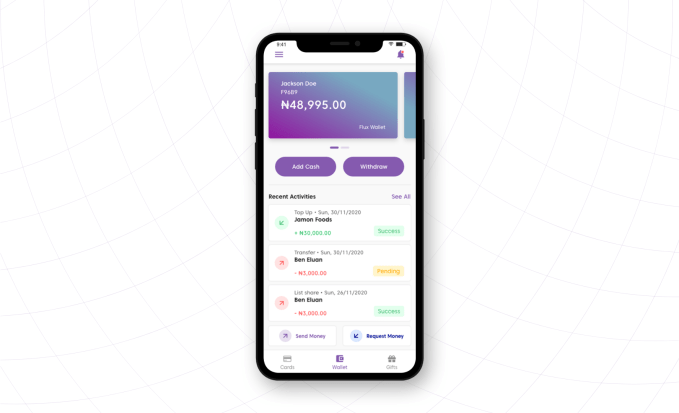
That’s the same proposition Eluan (CEO), Orukpe (CTO) and the team have with their product, Flux. The crypto remittance company was built to enable merchants to send and receive money from anywhere in the world, Eluan tells me.

He adds that what differentiates Flux from other crypto remittance startups lies in the ease and speed of the platform’s transactions. He claims that facilitating payments on Flux is 100x faster than fiat, and is cheaper too. The platform charges $0.50 for every transaction, regardless of the amount.

In May 2020, Flux got accepted into Pioneer, an accelerator launched by ex-YC partner Daniel Gross. Pioneer gives founders access to funding streams and talent hardly found outside Silicon Valley. It has already backed more than 100 founders who give up 1% equity to join the accelerator. Depending on their progress, Pioneer can decide to give either $20,000 for 5%, $100,000 for 5%, or $1 million for 10%.

After the program, Flux subsequently raised $77,000 pre-seed investment from different investors — Hustle Fund and Mozilla, among others.

Eluan says the six-month-old company has 5,000 customers who have transacted over $750,000 in payments volume. According to the CEO, the startup is growing 40% month-on-month and has made $25,000 in revenue.

The company witnessed this growth despite the Central Bank of Nigeria’s clampdown on crypto exchange activities. The country’s apex bank ordered local banks to stop aiding crypto transactions. This meant that crypto users on Flux and other crypto platforms could no longer convert fiat to crypto using their bank accounts or cards.

“We had to be compliant because of the CBN policy and our customers can’t really convert their crypto to fiat but can still transact their crypto. This is why we want to make Flux available in the US and UK, where people can use Flux and send money to Nigeria. It’s currently not available but that’s what we’re building and is the next phase of our application,” he said.

The team is also working on a peer-to-peer feature that will see users seamlessly transact crypto and fiat with one another. The company has launched Flux Merchants, a product that allows merchants to accept payments by creating payment links for their products and services.

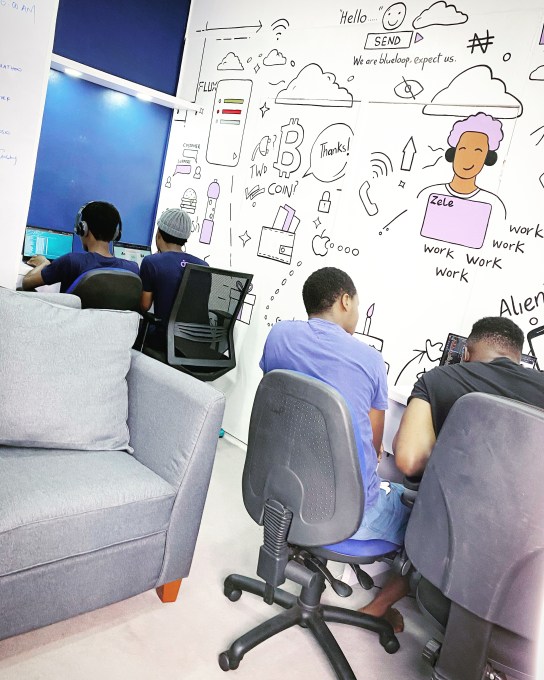
Eluan, Orukpe, Israel Akintunde (VP, Engineering) and Ayomide Lasaki (head of Marketing) — met in their freshman year at Obafemi Awolowo University (OAU) in Ile-Ife, Osun. Studying various engineering disciplines, the four friends formed a “programming club” with other software developers on campus where they would basically meet to write code and make applications. Eluan even tells me they regularly skipped class for these sessions.

Before Flux, the friends built an e-commerce platform called Joppa that helped people find merchants around them within the city. Although they had 20,000 users, Eluan says the team didn’t understand the dynamics of what it entailed to run a startup, so the business had to shut down

A factor that eventually led to founding Flux was the university’s budding tech talent ecosystem, which is teeming with stories of prominent startups launched by alumni. Some include Jobberman, Africa’s largest recruitment site; Kudi and Cowrywise, two YC-backed companies; and Techstars company Farmcrowdy among others

“These founders came from our school and it was a huge motivation for us. We always knew that we wanted to build something but we weren’t sure what this would be. We eventually landed on Joppa, then Flux,” Eluan added.

In fact, according to Techpoint Africa, OAU alumni have founded startups that have cumulatively raised $1 million more than other alumni from other universities in West Africa. Think of OAU as the region’s Stanford University.

Image Credits: Flux

However, unlike others, the founders dropped out of the university to start Flux. 

“We dropped out to focus on our startup and scaling it into a $1 billion company. We believe the opportunity here is huge. So for us, the right thing to do is to get the job done well. Startups need time so dropping out was inevitable,” he said.

Not only are they the first set of African founders that are all dropouts to get into Y Combinator, but they’re arguably the youngest. It is a feat Flux is thrilled about, and Eluan believes it will open the doors for more young founders on the continent.

“Well, we are excited about that, and it simply means brilliant young people in Nigeria and Africa can definitely go ahead to build stuff and get funded too just like founders from the U.S.,” he said.

But while their acceptance into Y Combinator is a much-needed validation for their work and sacrifice, there’s still a lot of work to be done. The startup, now based in Lagos, is playing in a competitive payments space. Different companies like Chipper Cash, Flutterwave, MFS Africa and other crypto startups are trying to fix cross-border payments, and there’s a race against time to capture market share. Hopefully, YC, Pioneer, other backers, and the team’s understanding of the market will propel Flux to dominance

News: Next Billion Users head Caesar Sengupta is leaving Google

Caesar Sengupta, the long-time head of Google’s Next Billion Users initiative, is leaving the company next month, he said Monday. Sengupta, who additionally also led the company’s payments business in the past three years, is leaving the firm after nearly 15 years. A regular fixture at Google’s events in India, Brazil, and Indonesia, Sengupta (pictured

Caesar Sengupta, the long-time head of Google’s Next Billion Users initiative, is leaving the company next month, he said Monday. Sengupta, who additionally also led the company’s payments business in the past three years, is leaving the firm after nearly 15 years.

A regular fixture at Google’s events in India, Brazil, and Indonesia, Sengupta (pictured above) is best known outside the company for leading the company’s Next Billion Users unit, an initiative to make internet and services more accessible to users in developing markets.

As part of Next Billion Users initiative, Google brought internet connectivity to hundreds of railway stations and other public places in India and other markets (then shut down Station), launched Google Pay in India (which unlike Google Pay in the U.S., wasn’t developed atop credit cards) and built several products such as Android Go, Datally, Kormo Jobs and the Files apps.

Prior to Next Billion Users unit, Sengupta served as VP and Product Lead at ChromeOS, the company’s desktop operating system that powers Chromebooks.

“After 15 years with Google, Caesar Sengupta has made a personal decision to leave the company and start something entrepreneurial outside of Google. Through his time at Google, Caesar has played a key role in starting, building and leading initiatives such as ChromeOS, Next Billion Users and Google Pay. We are excited to see what he builds next and wish him the best in his new journey,” said a Google spokesperson in a statement. Sengupta’s current position at the firm is VP and GM of Next Billion Users and Payments.

Congratulations @caesars for an amazing long innings @Google. Thank you for the tremendous contributions over 15 years. Now that you helped the #NextBillion get online, we await your next innings There are still 3 Billion humans not connected to the internet! All the best Caesar! https://t.co/vrrYtJquHO

— Rajan Anandan (@RajanAnandan) March 22, 2021

“To the many, many Googlers working in Africa, APAC, LATAM and MENA, it has been inspiring to hear your voices take more weight in the products Google builds. I know there is so much more work to do,” Sengupta wrote in an email to his colleagues, which he also shared publicly.

“But we are light years ahead of where we were just a short time ago. You’ve helped digitize your economies, made Google feel local and driven Google’s investment into your countries to unprecedented levels,” wrote the Asia-based executive. Sengupta didn’t share what he plans to do next.

Under Sengupta’s watch, Google also made several investments in startups in Asia. Some of these investments include Bangalore-based delivery startup Dunzo, Android lockscreen developer Glance, and popular news and entertainment app Dailyhunt.

News: Spark Capital decides to “sever all ties” with David Dobrik’s Dispo app weeks after leading deal

Venture capital firm Spark Capital has decided to ‘sever all ties’ with Dispo, a photo-sharing app co-created by famous YouTuber David Dobrik. The move, announced by the firm late Sunday, was triggered by a recent investigation by Business Insider that exposed allegations from a woman who said that a member of Dobrik’s Vlog Squad sexually

Venture capital firm Spark Capital has decided to ‘sever all ties’ with Dispo, a photo-sharing app co-created by famous YouTuber David Dobrik. The move, announced by the firm late Sunday, was triggered by a recent investigation by Business Insider that exposed allegations from a woman who said that a member of Dobrik’s Vlog Squad sexually assaulted her.

“In light of recent news about the Vlog Squad and David Dobrik, the cofounder of Dispo, we have made the decision to sever all ties with the company,” Spark Capital tweeted. “We have stepped down from our position on the board and we are in the process of making arrangements to ensure we do not profit from our recent investment in Dispo.

1/ In light of recent news about the Vlog Squad and David Dobrik, the cofounder of Dispo, we have made the decision to sever all ties with the company.

— Spark Capital (@sparkcapital) March 22, 2021

Hours later, Dobrik stepped down from the board of Dispo, as first reported by The Information. Dispo, in a statement to TechCrunch, said the following: “David has chosen to step down from the board and leave the company to not distract from the company’s growth. Dispo’s team, product, and most importantly- our community- stand for building a diverse, inclusive, and empowering world.”

The VC angle

Spark Capital’s decision to step back from the Dispo investment feels like a first of its kind, and if not, rare. It could trigger other investors with stakes in the company to do the same.

Spark Capital led a Series A in Dispo, a $20 million dollar financing event that valued the company at $200 million, less than one month ago. The current statement by Spark does not indicate that the investment has been pulled from the company.

Spark Capital did not immediately respond to request for comment in regards to what this process would look like, and if the shares will be sold back to the company or to another buyer. While the mechanics of the decision are unclear, the fact that the firm led a deal so recently in the company may have given it some leeway to walk away.

Unshackled Ventures, a firm that backs immigrant founders, was an early investor in Dispo and declined to comment on the record. Seven Seven Six, an early-stage venture capital firm founded by Reddit’s Alexis Ohanian, led the seed round and was unable to be reached for comment.

Other sponsors of Dobrik, including HelloFresh and Dollar Shave Club, have ended their partnerships with the creator.

Update: This story has been updated to reflect Dobrik’s departure from Diispo.

News: Indonesian savings and investment app Pluang gets $20M in pre-Series B funding

Indonesia-based fintech Pluang announced today it has raised $20 million in a pre-Series B round led by Openspace Ventures, with participation from Go Ventures and other returning investors. The company offers proprietary savings and investment products that allow users to make contributions starting from 50 cents USD. Go Ventures, the investment arm of Gojek, also

Indonesia-based fintech Pluang announced today it has raised $20 million in a pre-Series B round led by Openspace Ventures, with participation from Go Ventures and other returning investors. The company offers proprietary savings and investment products that allow users to make contributions starting from 50 cents USD.

Go Ventures, the investment arm of Gojek, also participated in Pluang’s $3 million Series A, which closed in March 2019. Pluang is available through partnerships with “super apps” like Gojek, Dana and Bukalapak, and currently claims more than one million users.

The company says it is able to maintain a low customer acquisition cost of $2 per transacting customer because it creates its own products, including investment accounts for gold, U.S equity indices and cryptocurrencies, instead of working with third-party financial service providers.

Pluang’s latest round will be used to develop proprietary financial products to cover more asset classes, including government bonds.

“Previously, these assets classes were only available to the wealthy in Indonesia,” said Pluang founder Claudia Kolonas in a statement. “However, we believe that everyone should have the opportunity to grow their savings, and our new products will reflect that.”

Pluang is among several Indonesian financial apps, including Ajaib and Bibit, that have recently raised funding. All focus on making investing accessible to more people by giving them an alternative to traditional brokerage firms that typically charge high fees.

In Indonesia, less than percent of the country’s population are retail investors, but that number is growing, especially among people aged 18 to 30. This is due to a combination of factors, including increased interest in financial planning during the pandemic and the rise of stock influencers.

In a statement, Openspace Ventures founding partner Shane Chesson said, “Pluang has demonstrated tremendous growth over the last 12 months with industry leading unit economics. We’re excited to continue supporting the team, as they sustainably accelerate their ambitions to help every Indonesian grow their savings.”

News: Singapore-based M Capital Management closes $30.85M debut fund to invest in Southeast Asian startups

M Capital Management, a Singapore-based venture capital firm, announced today it has closed its debut fund, M Venture Partners (MVP), totaling $30.85 million USD. It plans to invest in 40 early-stage startups, primarily seed and pre-Series A, with an average initial check size of about $500,000. M Capital Management was founded by Mayank Parekh, whose

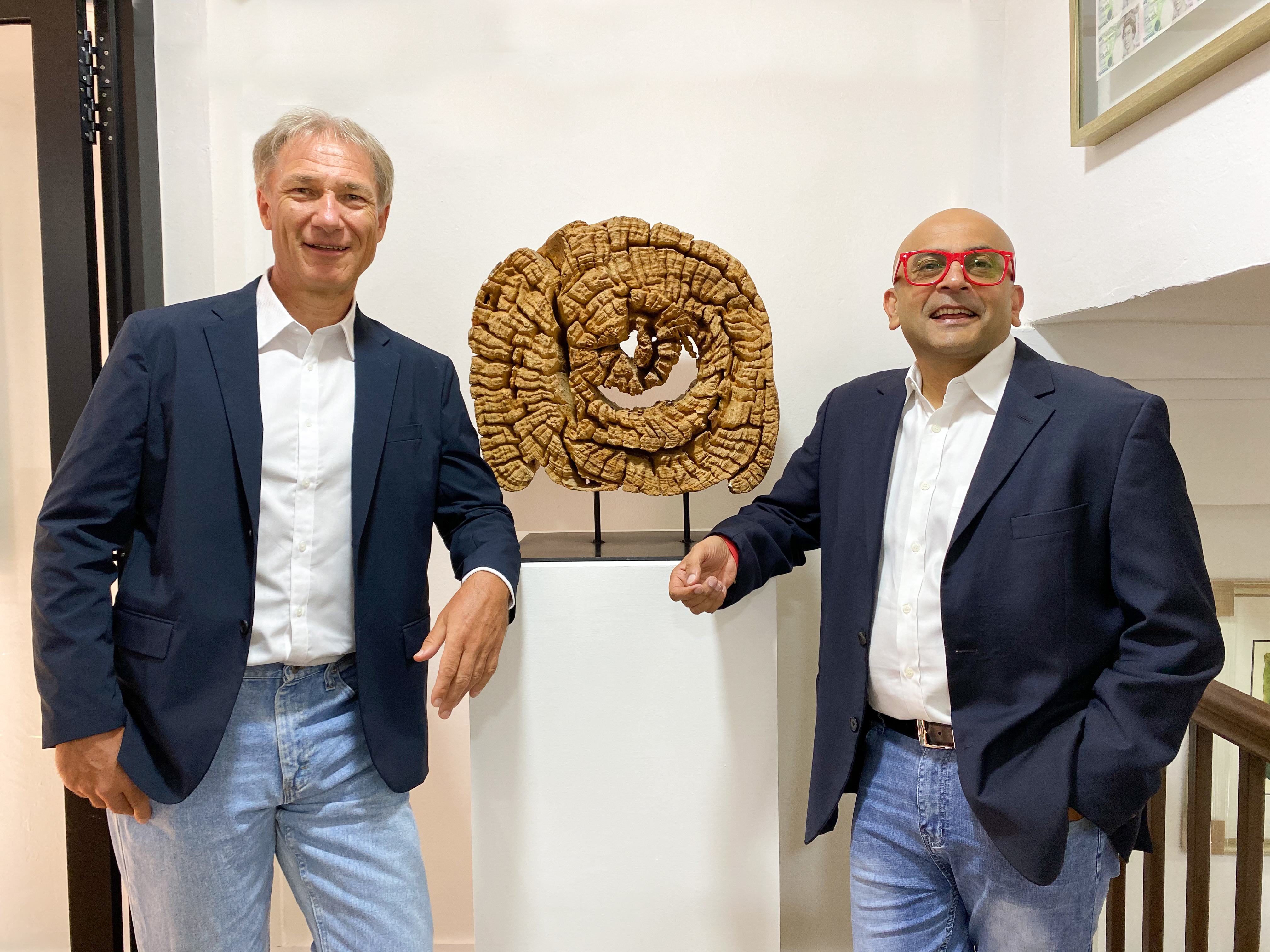
M Capital Management founding partners Joachim Ackermann (left) and Mayank Parekh (right)

M Capital Management founding partners Joachim Ackermann (left) and Mayank Parekh (right)

M Capital Management, a Singapore-based venture capital firm, announced today it has closed its debut fund, M Venture Partners (MVP), totaling $30.85 million USD. It plans to invest in 40 early-stage startups, primarily seed and pre-Series A, with an average initial check size of about $500,000.

M Capital Management was founded by Mayank Parekh, whose investment experience includes launching Grange Partners and leadership positions at Southern Capital Group and McKinsey & Company, and Joachim Ackermann, former managing director of Google Asia Pacific. Other senior team members include Dr. Tanuja Rajah, previously Entrepreneur First’s launch manager, and Chethana Ellepola, former research director at Acquity Stockbrokers.

MVP, a sector-agnostic fund, has already invested in 11 companies, including one, 3D Metal Forge, that recently went public on the Australian Securities Exchange.

Other portfolio companies include behavioral health coaching startup Naluri; AI-enabled lending and credit-as-a-service company Impact Credit Solutions; alternative investment fund aggregator XEN Capital; and Cipher Cancer Clinics, which is focused on making oncological care more affordable and accessible in India.

Parekh told TechCrunch that M Capital Management was launched because “we believe that the early-stage investing space in our region has substantial room for growth. A decade ago there were very few unicorns. This has changed substantially more recently, not only because of obvious advancements bringing online previously underserved or untapped populations, but also because they venture system has developed nicely in Singapore and, for that matter, across the region with support from institutional VCs at various stages of funding need, government agency support, the advent of local accelerators and rapidly growing network of angel investing bodies.”

Parekh added that he expects to see more unicorns and “soonicorns” (or companies expected to hit unicorn valuation in the near future) emerge.

As early-stage, sector-agnostic investors, Parekh said MVP’s focus is on founders, specifically those who have “pedigree professional experience and strong academic backgrounds.” For example, Naluri chief executive officer Azran Osman-Rani was previously founder of AirAsiaX, guiding it from launch to its 2013 initial public offering in six years.

MVP will focus mostly on Singapore-based startups because it invests primarily in B2B or B2B2C companies. “We need a fertile ground for our chosen startups to launch their business models with leading corporate or business partners,” said Parekh. “Singapore provides just that. It’s the hub for market leading institutions and it’s not uncommon to see them creating opportunities for new technology or disruptive ideas.”

Most of MVP’s portfolio companies have “regional or global aspirations, leveraging Singapore as the core launch platform,” he added. MVP has also already made investments in Malaysia and India, and is actively looking at companies in Thailand, the Philippines and Indonesia.

WordPress Image Lightbox Plugin