Monthly Archives: March 2021

News: Discord’s $10B exit; Compass and Intermedia Cloud Communications set IPO price ranges

There’s a lot of news this morning, so let’s discuss all the big dollars before YC demo day kicks off.

It’s demo day for the current Y Combinator class, so we’ll have a largely early-stage focus at TechCrunch today. But there’s also a host of late- and super-late-stage news this morning that matters.

Let’s get to all of it before we start to talk accelerators, overheated pre-seed valuations and the like.


The Exchange explores startups, markets and money. Read it every morning on Extra Crunch, or get The Exchange newsletter every Saturday.


There are three things to discuss. First, the possible $10 billion exit of Discord to Microsoft. Discord is a well-financed unicorn that has raised oodles of capital and reportedly sports rapidly expanding revenues. Our goal will be to vet whether the price tag in question makes any sense, or if it is too low.

Second: Real estate-tech company Compass has set an IPO price range we need to explore. Is its resulting valuation strong? Does it line up with its recent financial performance?

And, third, Intermedia Cloud Communications has priced its IPO. We’re behind on this entire debut, so we’ll take a second to riff on what the company does and what it is worth.

It’s a lot. But if we don’t get through it all now, we’ll fall behind and feel silly later. Let’s get to work!

Discord and Microsoft

Microsoft might be getting good at community, which is an odd thing to say about the enterprise software and cloud computing giant. The company’s Xbox gaming ecosystem has survived the test of time, Github is doing fine under Microsoft’s auspices, and Minecraft seems unharmed by Redmond’s stewardship.

That means gamers, developers and kids are all content to hang with Satya Nadella and company. Adding Discord to the mix might give Microsoft even more tooling to augment its existing communities, or perhaps tie them more closely together. But that’s all product news, which isn’t our remit. Let’s talk numbers.

The New York Times reported that Discord has “held deal talks with Microsoft for a transaction that could top $10 billion.” That figure has been widely reported, so we’ll use it for our work.

With a possible valuation in hand, we need revenue numbers to figure out if the possible sale price makes any sense. Happily, we have somewhat fresh numbers: The Wall Street Journal reported earlier this month that “generated $130 million in revenue [in 2020], up from nearly $45 million in 2019.”

News: OneTrust adds ethics to its privacy platform with Convercent acquisition

OneTrust, a late stage privacy platform startup, announced it was adding ethics and compliance to the mix this morning by acquiring Convercent, a company that was built to help build more ethical organizations. The companies did not share the purchase price. OneTrust just raised $300 million on a fat $5.1 billion valuation at the end

OneTrust, a late stage privacy platform startup, announced it was adding ethics and compliance to the mix this morning by acquiring Convercent, a company that was built to help build more ethical organizations. The companies did not share the purchase price.

OneTrust just raised $300 million on a fat $5.1 billion valuation at the end of last year, and it’s putting that money to work with this acquisition. Alan Dabbiere, co-chairman at OneTrust sees this acquisition as a way to add a missing component to his company’s growing platform of services.

“OneTrust instantly brings a proven ethics and compliance technology, team, and customer base into the OneTrust, further aligning the Chief Ethics & Compliance Officer strategy alongside privacy, data governance, third-party risk, GRC (governance, risk and compliance), and ESG (environmental, social and governance) to build trust as a competitive advantage,” he said.

Convercent brings 750 customers and 150 employees to the OneTrust team along with its ethics system, which includes a way for employees to report ethical violations to the company and a tool for managing disclosures.

Convercent can also use data to help surface bad behavior before it’s been reported. As CEO Patrick Quinlan explained in a 2018 TechCrunch article:

“Sometimes you have this interactive code of conduct, where there’s a new vice president in a region and suddenly page views on the sexual harassment section of the Code of Conduct have increased 200% in the 90 days after he started. That’s easy, right? There’s a reason that’s happening, and our system will actually tell you what’s happening.”

Quinlan wrote in a company blog post announcing the deal that joining forces with OneTrust will give it the resources to expand its vision.

“As a part of OneTrust, we’ll be combining forces with the leader across privacy, security, data governance, third-party risk, GRC, ESG—and now—ethics and compliance. Our customers will now be able to build centralized programs across these workstreams to make trust a competitive differentiator,” Quinlan wrote.

Convercent was founded in 2012 and has raised over $100 million, according to Pitchbook data. OneTrust was founded in 2016. It has over 8000 customers and 150 employees and has raised $710 million, according to the company.

News: Apple launches the ‘Apple Teacher Portfolio recognition, updates Schoolwork and Classroom apps

Apple this morning announced a handful of education-related updates to its suite of classroom apps as well as a new recognition for teachers, called the Apple Teacher Portfolio. Teachers who complete a total of nine lessons where they learn foundational skills on iPad and Mac to become an officially recognized Apple Teacher will be able

Apple this morning announced a handful of education-related updates to its suite of classroom apps as well as a new recognition for teachers, called the Apple Teacher Portfolio. Teachers who complete a total of nine lessons where they learn foundational skills on iPad and Mac to become an officially recognized Apple Teacher will be able to submit their portfolio of lesson examples to earn the Apple Teacher Portfolio recognition. They can then also share their portfolio with their colleagues or use it to showcase their work.

Teachers can work towards acquiring the badge through the Apple Teacher Learning Center, which is Apple’s self-paced learning platform for educators. This offering is designed to help teachers learn how to incorporate Apple technologies in the classroom, including by using iPad and Mac apps for creating art, videos, animations, recordings, page layouts, podcasts, data trackers, music, and more. Across the lessons, Apple provides templates as examples which teachers can customize or combine to make their own projects that use either an iPad or Mac and Apple software like Keynote, GarageBand, iMovie, and others.

Image Credits: Apple

In addition, Apple today rolled out updates across its Schoolwork and Classroom apps, as well as its “Everyone Can Create” curriculum, which has historically focused on taking advantage of Apple’s creative tools like iMovie, Clips and GarageBand.

In Schoolwork, teachers will gain the option to share Schoolwork projects with colleagues by exporting their assignments, which can then be imported back into Schoolwork or other platforms. Other improvements have been made to the sidebar navigation to make it quicker to access classes, assignments and student accounts.

Classroom, meanwhile, has been updated for remote learning — a feature that would have been more useful to have rolled out in 2020, amid the height of U.S. lockdowns during the pandemic. With the update, teachers will be able to invite remote students to Classroom sessions where they’ll be able to guide them to apps, view their screen (with the student’s permission) and track their engagement. The software has also been rebuilt using Mac Catalyst, making it work across iPad and Mac, including Macs powered by Apple’s M1 chips.

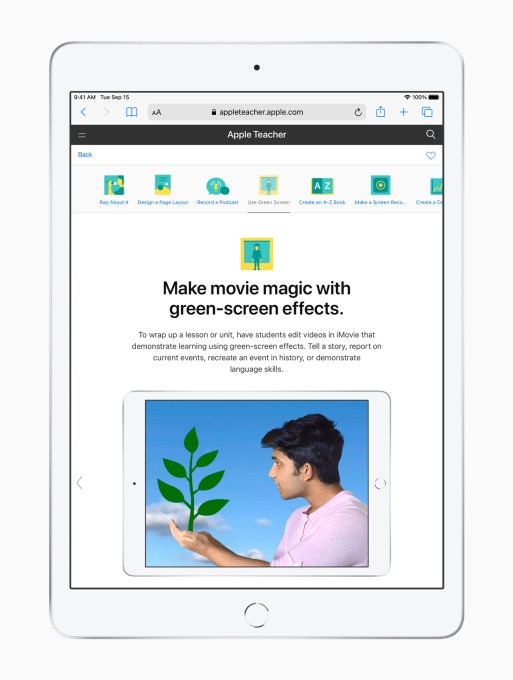
The Everyone Can Create” curriculum has had a number of smaller updates. Its Drawing guide has been updated to include motion graphics and animation in Keynote, while Photos now covers the creation of animated GIFs using Keynote, and the Camera and Photos apps. The Video guide will now explore creating short films using a green screen and other special effects, and Music adds new podcasting features using GarageBand, Apple says. Today, more than 5,000 K-12 institutions worldwide are using the curriculum.

Apple last year had updated its Schoolwork and Classroom apps, with some updates to Schoolwork to support distance learning — like managing assignments over the cloud and support for calling students via FaceTime, for example. But even as the pandemic forced schools towards remote learning, Google jumped ahead of edtech rivals by aggressively giving away its software and courting teachers. Its low-cost Chromebooks were being given out across school districts, doubling demand in 2020. Google Classroom, meanwhile, doubled to more than 100 million active users by April 2020, Bloomberg Quint reported. As of Feb. 2021, Google said the service was being used by over 150 million students, teachers and admins, up from just 40 million last year.

Apple didn’t say today how many users it has for its own educational software programs, by comparison. However, by encouraging teachers to create a portfolio which they can then share, Apple is helping to push towards greater adoption of its tools by more directly involving educators in the process.

Apple Teacher Portfolio launched today and is available in the Apple Teacher Learning Center. The “Everyone Can Create guides” are a free download on Apple Books. And new versions of both Schoolwork and Classroom are available in beta now through AppleSeed for IT.

News: After its near-death experience, AR pioneer Blippar is back with $5M in funding and a B2B model

Augmented Reality pioneer Blippar – which has had a tortuous history after early investors pulled out and the company had to scramble for new backers – has now closed a $5 million funding round, after 18 months of re-positioning as a B2B company in the AR space. The pre-Series A round was co-led by Chroma

Augmented Reality pioneer Blippar – which has had a tortuous history after early investors pulled out and the company had to scramble for new backers – has now closed a $5 million funding round, after 18 months of re-positioning as a B2B company in the AR space.

The pre-Series A round was co-led by Chroma Ventures and West Coast Capital. Canadian entrepreneur Anthony Lacavera also participated via his Globalive Capital investment firm. Chroma is the investment arm of Paddy Burns’ and Chris van der Kuyl’s gaming company 4J Studios, while West Coast is the private equity arm of Scottish entrepreneur Sir Tom Hunter and family.

The new investors join existing shareholder Candy Ventures; the multi-stage investment firm founded by British property entrepreneur Nick Candy, who came to Blippar’s rescue. This new entity acquired the company’s assets in a patent sale and managed to keep on sounder Ambarish Mitra, although he is now acting as the company’s “Chief Creative Officer”. At hits height, Blippar burned through $130 million in funding, claiming a $1.5 billion valuation, and tried to crack the consumer AR market. But Blippbuilder, its SaaS AR creation platform, is the asset that is now seeing it make a B2B comeback.

At its height Blippar employed 340 people, Now it’s 30 people. But it has all the IP and assets from its previous incarnation, and is now ‘making hay while the sun shines’.

AR technology is now being used in several areas such as live events (when they return!) retail, FMCG, automotive, healthcare and education.

Rumoured AR glasses from Apple and the inclusion of AR results in mobile search results may well help its adoption, as well as the continuing need for social distancing.

While the tech giants are developing AR tools, these are platform-dependent, whereas Blippar hopes to be the agnostic alternative.

Its two routes to market are, firstly, via its Blippbuilder SAAS platform, which enables agencies, brands and AR content creators to create communications and campaigns. It also does bespoke work with an in-house team “Studio B”.

Faisal Galaria, CEO of Blippar, commented: “We are very excited to have attracted investors of this caliber to Blippar… 2020 was a transformative year for Blippar with a 200% increase in revenue quarter on quarter, continued strengthening of the senior leadership team, and delivery of cutting-edge AR campaigns for major global brands including OnePlus, Kellogg’s and Dr Pepper. We have leveraged our 10 years of investment, provenance, and technology leadership in the AR space to come back leaner, more focussed and better than ever before.”

Burns and Van der Kuyl are best known for porting Minecraft to the Microsoft, Sony and Nintendo games consoles. The latter said in a statement: “The immersive nature of AR makes it one of the most important use cases for the gaming industry. Blippar’s AR technology is by far the most advanced and innovative that I’ve seen in years and there is huge potential for AR to power the ultimate gaming experience of the future. We look forward to being part of the Blippar journey.”

Hunter commented: “Blippar has demonstrated strong progress with the turnaround plan put in place by Faisal and the team, and the business is now well placed to maximize the opportunities presented by the growing AR ecosystem hence we are delighted to invest.”

In addition, Justin Cooke, Venture Partner at tech investor Northzone, has also been appointed to the Blippar Board this month. The UK Government also has a minority equity stake in Blippar via its Future Fund match funding scheme< which was design to assist struggling tech companies through the pandemic.

Blippar re-enters a market which includes Niantic, Unreal, Unity, 8th Wall, Zappar and Magic Leap. But as AR matures, it may be back in the right place.

Here’s an example of how brands are using the platform:

News: Arcadia steps in to Texas’ startup energy market with the acquisition of Real Simple Energy

On the third greatest television show of all time (sorry Rolling Stone), one of Texas’ most famous fictional football players once said, “When all the scared rats are leaving a sinking market, that’s when a real entrepreneur steps in — a true visionary.” If that’s the case, then the startup renewable energy retail reseller Arcadia

On the third greatest television show of all time (sorry Rolling Stone), one of Texas’ most famous fictional football players once said, “When all the scared rats are leaving a sinking market, that’s when a real entrepreneur steps in — a true visionary.”

If that’s the case, then the startup renewable energy retail reseller Arcadia may be a true visionary. Even as energy startups servicing customers throughout the great state of Texas are forced to throw in the towel, the Washington-based, consumer-focused renewable energy power provider (based on renewable energy certificates purchased on the open market), is making an acquisition to enter the Texas market.

The company is buying Real Simple Energy, which not only marks the company’s availability in all 50 states, but gives Real Simple Energy customers access to both wind and solar power generating projects. The company said it  will leverage Real Simple Energy’s platform and expertise to secure the best rates for members, monitor for better savings, and provide a smarter yet simpler energy experience.

“Recent events in the Texas market prove that customers shouldn’t be exposed to wholesale or variable rates, and want an energy advocate to protect them,” said Kiran Bhatraju, CEO and Founder of Arcadia. “Both Arcadia and Real Simple Energy recognize the challenges Texas homeowners and renters have historically faced in the energy buying process, and we remain committed to removing these confusing barriers.”

Texans have consistently paid more for power than consumers that buy their energy from regulated market participants thanks to the state’s disastrously deregulated power markets. The combined companies are pitching fixed rate contracts to Texas consumers that won’t be vulnerable to bill spikes, but will offer average savings above the flat rates regulated utilities offer.

“The deregulated energy industry, especially in Texas, has underserved customers and as a result, most customers overpay for electricity and receive poor customer service. Using technology, we are helping customers realize the promise of deregulation and always get the best fixed rates available,” said Trent Crow, CEO of Real Simple Energy, in a statement. “As industry veterans, joining forces with Arcadia will allow us to get better deals for customers and enhance our customer experience.  We manage 100% of the energy experience and become a customer’s independent agent and advocate so they never have to worry about their electricity bill again.”

The deal is Arcadia’s first acquisition and follows the company’s launch of a community solar program all the way across the country in the great state of Maine.

News: Huckleberry, offering insurance to SMBs, partners with Berkshire Hathaway

Huckleberry, an insurtech company that offers a variety of insurance to small businesses, has announced a partnership with Berkshire Hathaway GUARD. This represents the biggest partnership with a carrier for the startup to date. The startup, cofounded by Bryan O’Connell, has made some major moves in the past year. The company launched in 2017 offering

Huckleberry, an insurtech company that offers a variety of insurance to small businesses, has announced a partnership with Berkshire Hathaway GUARD. This represents the biggest partnership with a carrier for the startup to date.

The startup, cofounded by Bryan O’Connell, has made some major moves in the past year. The company launched in 2017 offering workers compensation and general liability insurance to small and medium-sized businesses through an online portal, cutting out a lot of the hassle for these businesses as they seek out the right policy.

In the last year, the SF-based company has nearly doubled its geographic footprint and added five new policies to the product suite, including cyber, automotive insurance, umbrella insurance and more.

Moreover, it’s moving to New York and opening up an office in Columbus, Ohio, called HQ2. O’Connell says that the move to New York is all about positioning the startup in the midst of NYC’s burgeoning pool of fintech talent.

With the new partnership and the company’s growth over the past year, it’s bringing on new team members, with plans to get to 100 people by the beginning of 2022. In particular, it’s brought on Bill Kaper as Chief Technology Officer. Kaper hails from Root Insurance, where he served as VP of Engineering and oversaw a team of 200+ engineers. Huckleberry also snagged Braden Davis, formerly of Jetty, as Chief Insurance Officer.

The company raised $18 million in Series A capital back in December of 2019, with investors that include Tribe Capital, with participation from Amaranthine, Crosslink Capital and Uncork Capital.

The momentum from the new hires and partnership with Berkshire Hathaway will allow Huckleberry to move into higher risk insurance categories.


Early Stage is the premier ‘how-to’ event for startup entrepreneurs and investors. You’ll hear first-hand how some of the most successful founders and VCs build their businesses, raise money and manage their portfolios. We’ll cover every aspect of company-building: Fundraising, recruiting, sales, product market fit, PR, marketing and brand building. Each session also has audience participation built-in – there’s ample time included for audience questions and discussion. Use code “TCARTICLE” at checkout to get 20 percent off tickets right here.

News: User Interviews, the CRM for qualitative user research, raises $10 million Series A

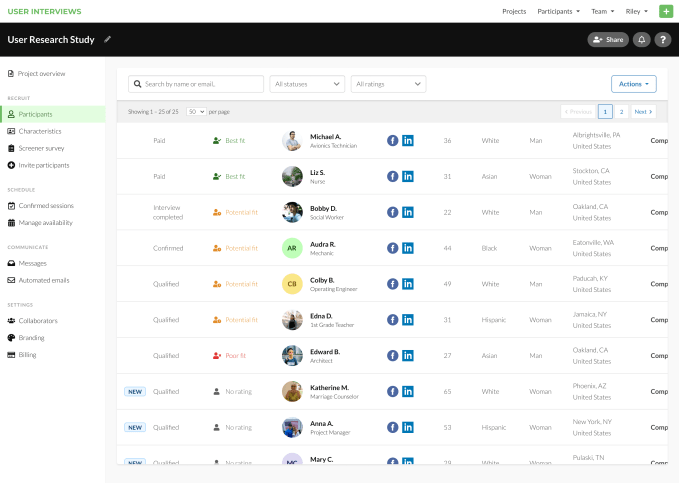
User Interviews, the Entrepreneurs Roundtable Accelerator-backed company that has built a CRM for product developers to get user feedback, has closed on a $10 million Series A round. The financing was led by Teamworthy Ventures, with participation from Las Olas, Accomplice, FJ Labs, ERA, Trestle Partners and ValueStream. The company, cofounded by Basel Fakhoury, was

User Interviews, the Entrepreneurs Roundtable Accelerator-backed company that has built a CRM for product developers to get user feedback, has closed on a $10 million Series A round. The financing was led by Teamworthy Ventures, with participation from Las Olas, Accomplice, FJ Labs, ERA, Trestle Partners and ValueStream.

The company, cofounded by Basel Fakhoury, was created out of failure, in some ways. Originally, the User Interviews team started with a project called Mobile Suites, an amenities logistics platform for hotels. It was a dud, and the team — Basel Fakhoury, Dennis Meng and Bob Saris — decided to do more user research before determining their next product.

In trying to collect that research, they stumbled upon a huge problem. It often takes companies weeks, if not months, to conduct a study around user research. The company decided to build out a platform that would procure subjects for research quickly and effectively, using an algorithm to pair qualified, engaged testers with the client.

The product became Recruit, and ran on an a la carte model. To complement Recruit, the team also launched Research Hub, which is a CRM tool for all the testing methodologies used with actual users. To be clear, User Interviews doesn’t run the surveys or A/B tests themselves, but rather helps companies manage the frequency and data of those tests, not unlike what Salesforce does for sales people.

Recently, User Interviews added a subscription layer to its product, allowing companies to purchase access to the software on an annual basis, rather than on a usage basis. Fakhoury says that this dual-model allows companies to try out the platform before they fully commit.

Image Credits: User Interviews

According to the startup, the company has experienced 140 percent annual growth, which has accelerated during the pandemic. Clients include Amazon, Microsoft, Colgate and Spotify.

User Interviews plans on using the new funding to hire more in the product department, as well as build out integrations with user testing software and their clients own data management systems.

Right now, the team is about 50 people, and is fully remote, with nearly half the workforce being female.

Fakhoury said the biggest challenge for the company is being able to do two things at once.

“We are simultaneously disrupting this legacy industry with Recruit, and we are creating a category with Research Hub,” he said. “Those are somewhat different strategies and missions and making sure that we can do both of those in tandem is one big thing for us.”


Early Stage is the premier ‘how-to’ event for startup entrepreneurs and investors. You’ll hear first-hand how some of the most successful founders and VCs build their businesses, raise money and manage their portfolios. We’ll cover every aspect of company-building: Fundraising, recruiting, sales, product market fit, PR, marketing and brand building. Each session also has audience participation built-in – there’s ample time included for audience questions and discussion. Use code “TCARTICLE” at checkout to get 20 percent off tickets right here.

News: ‘Instant needs’ delivery startup goPuff raises $1.15B at an $8.9B valuation

Last fall, delivery startup goPuff made a big splash by raising $380 million in funding and acquiring West Coast beverage retailer BevMo shortly afterwards. Just a few months later, the Philadelphia-based company is announcing that it has raised another $1.15 billion in funding at an $8.9 billion valuation (compared to $3.9 billion in October). Available in

Last fall, delivery startup goPuff made a big splash by raising $380 million in funding and acquiring West Coast beverage retailer BevMo shortly afterwards. Just a few months later, the Philadelphia-based company is announcing that it has raised another $1.15 billion in funding at an $8.9 billion valuation (compared to $3.9 billion in October).

Available in more than 650 U.S. cities, goPuff delivers a wide variety of products in under 30 minutes while charging a flat $1.95 delivery fee. Rafael Ilishayev and Yakir Gola, who serve as co-CEOs, founded the company in 2013 while they were students at Drexel University. When I first spoke to Gola last fall, he told me that the pair thought, “There has to be a better way to get convenience products delivered.”

The company now says its vertically integrated approach is a key advantage. GoPuff buys products directly from manufacturers, then distributes those products through its 250-plus “micro-fulfillment centers” and a network of independent drivers. Ilishayev said this results in rapid deliveries, strong unit economics, and a model that passes delivery fees directly to drivers.

“It’s important that we’re making our margin on product, not people,” he said.

The company continues to expand its product lineup new Better For You (healthy snacks), Beauty and Baby categories, as well as Curated Mystery Boxes. When I asked how new products fit into the larger goPuff brand and strategy, Ilishayev replied, “People, throughout our whole existence, have tried to put us into an industry: ‘Are you convenience? Are you pharmacy?’ The reality is that we’re neither. We’re in this category of instant needs, and our production innovation solely stems from consumer demand … There’s no category we offer on goPuff that consumers weren’t crying out for.”

GoPuff says that the new funding will allow it to continue expanding throughout the United States, as well as internationally, and to introduce new products. The round comes from D1 Capital Partners, Fidelity Management and Research Company, Baillie Gifford, Eldridge, Reinvent Capital, Luxor Capital and SoftBank Vision Fund 1.

In a statement, D1 founder and Chief Investment Officer Daniel Sundheim said:

goPuff is truly in a league of its own. We believe that the company’s vision and differentiated model drive industry-leading economics and sustainable growth. Since we initially invested in goPuff last fall, we have been consistently impressed by the team’s ability to successfully execute against its growth plans. The company’s potential is tremendous, and we look forward to the unique opportunities that lie ahead.

News: Facebook will bring back F8 on June 2 as a pared-back, single-day, virtual-only conference for developers

After a few twists and turns and then ultimately cancelling its F8 developer conference last year over Covid-19 concerns, Facebook today announced a return of the event in a virtual-only format it is calling F8 Refresh. The company today said that it will be holding it as a one-day event on June 2. You can

After a few twists and turns and then ultimately cancelling its F8 developer conference last year over Covid-19 concerns, Facebook today announced a return of the event in a virtual-only format it is calling F8 Refresh. The company today said that it will be holding it as a one-day event on June 2. You can sign up for F8 Refresh here.

It’s a mark of the times to be right-sizing everything to the place we are in right now. So although F8 has grown in size and scope over the years — it typically attracts around 5,000 people and many more to its in-person event — it looks like the social network is taking 2021 to be a little more modest in its approach.

Mark is maybe the operative word here: there will be no Mark Zuckerberg keynote this year, Facebook has confirmed to me. Instead of words from its founder and CEO, Facebook will have Konstantinos Papamiltiadis, VP of Platform Partnerships, delivering the opening presentation at the event, which will as usual provide some updates on new launches for the platform.

It’s another sign of the times that making plans so far in advance, and in person, just won’t cut it right now: there have been too many unexpected developments around the spread, then wane, then resurgence of the pandemic, and even one year later, in multiple parts of the world authorities are still trying to get activity under control to keep the virus in check.

In the past, Facebook has given much more lead time to people for F8, to let developers, partners and other attendees to clear their calendars and organize travel from further afield. Its 2020 two-day event, which had originally been scheduled for May 2020, was announced in November 2019 for example. Of course, in the months following, as Covid-19 took its grip, F8 2020 became one of a wave of events to be cancelled, with Facebook first looking to replace it with a series of local events, but then cancelling everything altogether.

“F8 has always brought together an incredible community of people who are building, innovating, and looking for what’s next. And over the last year, our community of developers enabled growth for businesses of all sizes to adapt to a changed world and accelerate their digital transformation,” noted Papamiltiadis in a blog post. “In recognition of this, we want to bring F8 back to its roots: a place to celebrate, inspire and help developers grow.”

The big question will be what topics Facebook will see fit to tackle in June. Some of the bigger themes hanging over it right now are how it plans to continue growing in developing markets, whether/what it will launch in response to newly rising apps like Clubhouse, how it might diversify its business model beyond advertising, whether we will ever see a launch of Novi and Diem, and how Facebook continues to tackle misuse on its platform.

For a company so huge and influential, there is indeed a lot to potentially cover. But at least for now the focus seems to be more modest as well. Rather than big launches and major announcements, it looks like Facebook will keep the F8 focus more on its ecosystem and the developers in it. Among the areas that Papamiltiadis highlighted will be addressed, he mentioned product tools for building in Facebook, Instagram, Messenger, WhatsApp and Oculus; technical deep-dive sessions; demos, and panels.

News: Trace announces $8M seed to help companies coordinate budgets

Trace, an early startup that wants to bring a taste of SaaS to the budgeting side of the house, announced an $8 million seed round today led by Greylock and Uncork Capital with participation from Nyca Partners, Redpoint Ventures and various individual angels. Mike Gonzalez, co-founder and CEO at the company describes Trace as the

Trace, an early startup that wants to bring a taste of SaaS to the budgeting side of the house, announced an $8 million seed round today led by Greylock and Uncork Capital with participation from Nyca Partners, Redpoint Ventures and various individual angels.

Mike Gonzalez, co-founder and CEO at the company describes Trace as the first service designed specifically for finance teams to deal with budgeting. “What Trace is really building is an all-in-one platform where financial decisions are made, and people can work with finance to get work done,” he explained

Trace handles all the core interactions between finance and everyone they need to work with in the business, focusing on budget owners. “In our platform, budget owners are given visibility into their financial targets, so they know what they’re working towards,” he said.

The idea is to build a more coordinated workflow between all the stakeholders in the budget process including finance, the department head, legal, security operations and so forth. Instead of cobbling together a bunch of different tools, Trace is attempting to bring this process into a single service.

Gonzalez has a deep background in this area having spent several years building custom financial systems as a consultant, and later working at Zenefits to build an internal system to track this kind of financial information. He took that knowledge, and along with his co-founders built Trace.

The company launched in 2018, spent the next year building the product and debuted the service in 2019. Although the pandemic has been challenging on a personal and company-building level, it did expose how important having a grip on the financial side of the business was when every penny counts.

For now the startup is taking aim at companies with between 200 and 1500 employees with hopes of ramping up to larger companies over time. Trace currently works with Sage Intacct, Netsuite and QuickBooks ERP financial systems.

It has a dozen employees, mostly in R&D with plans to add to that number as the business grows. As a Hispanic, who co-founded the company with his brother, he says that D&I is a cornerstone of his company building plans.

“We’re both Hispanics, and we grew up in rough neighborhoods without privilege. And so promoting an environment of equal opportunity and inclusion is something that I care deeply about,” he said. He says that they have already begun to invest to drive diversity and it’s a huge priority for the company moving forward.

The company has been distributed from the beginning, so the pandemic didn’t really change that, but as it grows, Gonzalez envisions having an office where people can come together for more collaborative work as needed.

WordPress Image Lightbox Plugin