
Monthly Archives: March 2021

News: Hub, a productivity platform for technical sales professionals, launches with $1M in funding

Hub, a productivity platform for technical pre-sales, has formally launched with $1 million in seed funding. CEO Freddy Mangum and CTO Karl Gainey founded Hub in 2020. The pair both had experience in technical sales and recognized the challenges of using spreadsheets to manage their business. They researched and surveyed sales engineers at big and

Hub, a productivity platform for technical pre-sales, has formally launched with $1 million in seed funding.

CEO Freddy Mangum and CTO Karl Gainey founded Hub in 2020. The pair both had experience in technical sales and recognized the challenges of using spreadsheets to manage their business.

They researched and surveyed sales engineers at big and small companies alike, discovering that many of these professionals were spending a lot of time doing things like “wrangling data to report to management, forcing individual contributors to enter data into a CRM (customer relationship management) system.

“Performing these kinds of mundane tasks was taking time away from them actually selling,” said Mangum. “We also came to the conclusion that technical sales professionals have been the unsung heroes of sales, behind the scenes driving enterprise.”

So they set about creating a better way for presales, solution architects and sales engineers to manage their day-to-day technical sales activities.

Then COVID hit, and obviously, as Mangum puts it, digital selling became much more real.

“That really accentuated the need for specific commercial tooling,” he said.

San Francisco-based Hub was born. The company describes its offering as a SaaS application that “securely interconnects and complements popular CRM systems and productivity applications.”

As a personalized productivity platform, Hub is designed to help individual contributors manage the sales process. By gaining greater visibility into every step, the goal is to better analyze and do more accurate forecasting so an organization can better “identify investment areas while taking corrective actions in real time,” Mangum said.

“Our tool can help them automate the mundane tasks and put the focus on high-value tasks to actually win more business,” he added.
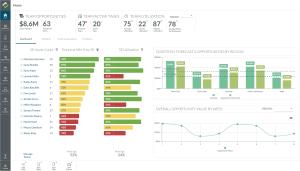
Image Credits: Courtesy of Hub

Targeting technical sales professionals is an underserved market, according to Mangum, which presents tremendous opportunity.

Investors in the company include Tom Noonan, general partner of Atlanta-based TechOperators (and former chairman and CEO of Internet Security Systems, which was acquired in 2007 by IBM for $1.3 billion) and SalesLoft CEO and co-founder Kyle Porter.

To Noonan, the pandemic presented the challenge of keeping an enterprise sales force effective while working remotely.

“The biggest concern was not that sales people couldn’t engage with customers. It was how the technical part of the sales cycle was going to be conducted remotely, such as the concepts demonstrations integrations, the modifications, all the things that have to be articulately communicated, and also aligned with the customer’s needs,” he told TechCrunch. “And to me that just made the need for this model of selling that we’re in today.”

Looking ahead, Noonan believes these teams are going to question why they spent so much time on travel and on-site activities. 

“More and more customers have actually gotten accustomed to remote interactions and even more importantly, many of the customers are not working in a place of business now either,” he said. “And that leaves a huge challenge for the solution architects, because they are the glue that bridge between a buyer saying that’s interesting, and an organization concluding that the capabilities of whatever system is being sold to them truly meets their needs both from a technical perspective and integration perspective and a functional perspective.”

Hub, he believes, can help address that challenge.

With a diverse founding team (Mangum is a Bolivian immigrant and Gainey is Black), Hub aims to reflect that diversity in its team. Its developers are based in Argentina, for example. 

“As someone who graduated from ESL when I came to this country it is important that opportunities not be closed off to people just because of language barriers,” Mangum said.
News: UIPath’s meteoric rise from unknown startup to $35B RPA juggernaut

When TechCrunch covered UIPath’s Series A in 2017, it was a small startup out of Romania working in a little known area of enterprise software called robotic process automation (RPA). Then the company took off with increasingly large multi-billion dollar valuations. It progressed through its investment rounds, culminating with a $750 million round on an

When TechCrunch covered UIPath’s Series A in 2017, it was a small startup out of Romania working in a little known area of enterprise software called robotic process automation (RPA).

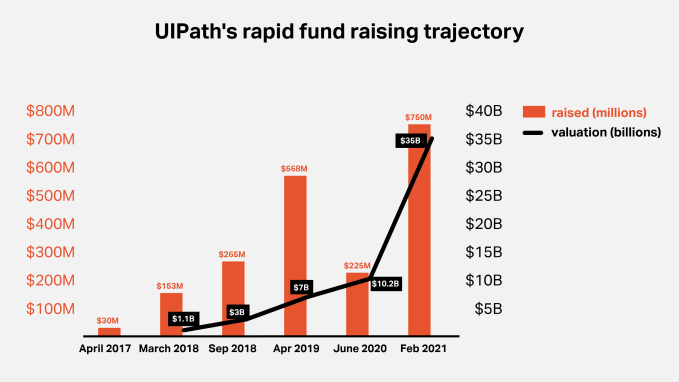
Then the company took off with increasingly large multi-billion dollar valuations. It progressed through its investment rounds, culminating with a $750 million round on an eye-popping $35 billion valuation last month.

This morning, the company took the next step on its rapid-fire evolutionary path when it filed its S-1 to go public. To illustrate just how fast the company’s rise has been, take a look at its funding history:

Chart illustrating rapid rise of UIPath through its funding rounds from 2017-2021

Image Credits: Bryce Durbin/TechCrunch

RPA is much better understood these days with larger enterprise software companies like SAP, Microsoft, IBM and ServiceNow getting involved. With RPA, companies can automate a mundane process like processing an insurance claim, moving work automatically, while bringing in humans only when absolutely necessary. For example, instead of having a person enter a number in a spreadsheet from an email, that can happen automatically.

In June 2019, Gartner reported that RPA was the fastest growing area in enterprise software, growing at over 60% per year, and attracting investors and larger enterprise software vendors to the space. While RPA’s growth has slowed as it matures, a September 2020 Gartner report found it expanding at a more modest 19.5% with total revenue expected to reach $2 billion in 2021. Gartner found that stand-alone RPA vendors UIPath, Blue Prism and Automation Anywhere are the market leaders.

Although the market feels rather small given the size of the company’s valuation, it’s still a nascent space. In its S-1 filing this morning, the company painted a rosy picture, projecting a $60 billion addressable market. While TAM estimates tend to trend large, UIPath points out that the number encompasses far more than pure RPA into what they call ‘Intelligent Process Automation.’ That could include not only RPA, but also process discovery, workflow, no code development and other forms of automation.

Indeed, as we wrote earlier today on the soaring process automation market, the company is probably going to need to expand into these other areas to really grow, especially now that it’s competing with much bigger companies for enterprise automation dollars.

While UIPath is in the midst of its quiet period, it came up for air this week to announce that it had bought Cloud Elements, a company that gives it access to API integration, an important component of automation in the enterprise. Daniel Dines, the company co-founder and CEO said the acquisition was about building a larger platform of automation tools.

“The acquisition of Cloud Elements is just one example of how we are building a flexible and scalable enterprise-ready platform that helps customers become fully automated enterprises,” he said in a statement.

While there is a lot of CEO speak in that statement, there is also an element of truth in that the company is looking at the larger automation story. It can use some of the cash from its prodigious fundraising to begin expanding on its original vision with smaller acquisitions that can fill in missing pieces in the product road map.

The company will need to do that and more to compete in a rapidly moving market, where many vendors are fighting for different parts of the business. As it continues its journey to becoming a public company, it will need to continue finding new ways to increase revenue by tapping into different parts of the wider automation stack.

News: Headless commerce startup Swell raises $3.4M

While new headless commerce platforms are emerging all the time, Swell CEO Eric Ingram told me that it remains “really hard to do something new in e-commerce.” Specifically, he told me that most headless platforms (which offer back-end infrastructure separate from the front-end shopping experience) allow businesses to build a faster shopping experience, but they’re

While new headless commerce platforms are emerging all the time, Swell CEO Eric Ingram told me that it remains “really hard to do something new in e-commerce.”

Specifically, he told me that most headless platforms (which offer back-end infrastructure separate from the front-end shopping experience) allow businesses to build a faster shopping experience, but they’re largely designed for marketplaces where you search, browse and purchase from a traditional product catalog.

“The most interesting ideas in e-commerce aren’t just another catalog,” Ingram said.

Swell, which is announcing that it has raised $3.4 million in seed funding, was designed to offer more flexibility when it comes to the underlying business models. Ingram (who founded the company with Stefan Kende, Dave Loneragan, Joshua Voydik and Mark Regal) described it as the “future-proof backend” for e-commerce companies, which can grow and adapt with them as their business models evolve.

“Typical catalogs” have been built on the platform, he said, but it also supports Spinn‘s marketplace of independent coffee roasters, B2B vacuum pump marketplace Nowvac and ethical direct-to-consumer diamond retailer Great Heights.


In fact, Voydik described Swell as “infinitely flexible.” Among other things, the company says it achieves this flexibility by offering API access to every component, as well as native subscription support and an unlimited number of product attributes.

“Every store on Swell effectively has their own database SaaS platform,” Ingram added.

Overall, he said the platform offers the flexibility that you’d normally get from an open source approach without the technical headaches: “No one wants to maintain their own code base and their own database.”

He continued, “You don’t need to be technical, you don’t need to have developers to leverage this. A lot of our customers are developers, but a lot of them are just regular marketers and ops people who know a bit of development concepts and want to have control over the systems.”

The startup’s new funding was led Jim Andelman of Bonfire Ventures, with participation from Willow Growth Partners, Andreas Klinger of Remote First Capital, Vercel CEO Guillermo Rauch, GitHub CTO Jason Warner and former Salesforce Commerce Cloud CTO Mike Micucci.

News: UiPath’s IPO filing suggests robotic process automation is booming

UiPath added its name to the list of companies pursuing public-market offerings with the release of its S-1, which details a quickly growing software company with sharply improving profitability.

Robotic process automation platform UiPath added its name to the list of companies pursuing public-market offerings this morning with the release of its S-1 filing. The document details a quickly growing software company with sharply improving profitability performance. The company also flipped from cash burn to cash generation on both an operating and free-cash-flow basis in its most recent fiscal year.

Companies that produce robotic process automation (RPA) software help enterprises reduce labor costs and errors. Instead of having a human perform repetitive tasks like data entry, processing credit card applications and scheduling cable installation appointments, RPA tools employ software bots instead.

The phrase that matters most when digesting this IPO filing is operating leverage, what Investopedia defines as “the degree to which a firm or project can increase operating income by increasing revenue.” In simpler terms, we can think of operating leverage as how quickly a company can boost profitability by growing its revenue.

The greater a company’s operating leverage, the more profitable it becomes as it grows its top line; in contrast, companies that see their profitability profile erode as their revenue scales have poor operating leverage.

Among early-stage companies in growth mode, losing money is not a sin — after all, startups raise capital to deploy it, often making their near-term financial results a bit wonky from a traditionalist perspective. But for later-stage companies, the ability to demonstrate operating leverage is a great way to indicate future profitability, or at least future cash-flow generation.

So, the UiPath S-1 filing is at once an interesting picture of a company growing quickly while reducing its deficits rapidly, and a look at what a high-growth company can do to show investors that it will, at some point, generate unadjusted net income.

There are caveats, however: UiPath had some particular cost declines in its most recent fiscal year that make its profitability picture a bit rosier than it otherwise might have proven, thanks to the COVID-19 pandemic. This morning, now that we’ve looked at the big numbers, let’s dig in a bit deeper and learn whether UiPath is as strong in operating leverage terms as a casual observer of its filing might guess.

And then we’ll dig into four other things that stuck out from its IPO filing. Into the data!

Operating leverage, cost control and COVID-19

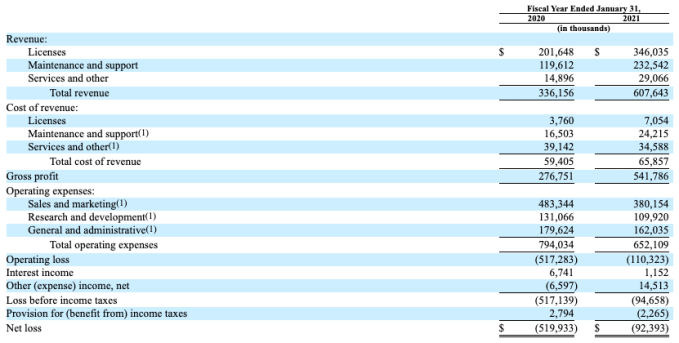
To avoid forcing you to flip between the filing and this piece, here’s UiPath’s income statement for its fiscal years that roughly correlate to calendar 2019 and calendar 2020:

From top-down, it’s clear UiPath is growing rapidly. And we can see that its gross profit grew more quickly than its overall revenue in its most recent 12-month period. As you can imagine, that combination led to rising gross margins at the company, from 82% in its fiscal year ending January 31, 2020, to 89% in its next fiscal year.

That’s super good, frankly; given that UiPath has a number of business lines, including a services effort that doubled in size during its most recent 12 months of operations, you might expect its blended gross margins to fade. They did not.

But it’s the following section, the company’s cost profile, that leads us to our first real takeaway from the UiPath S-1:

UiPath’s operating leverage looks good, even if COVID helped

Every operating expense category at the company fell from the preceding fiscal year to its most recent. That’s an impressive result, and one that is key when it comes to understanding where UiPath’s recent operating leverage came from. But how the declines came to be is just as important to understand.

News: Last chance to save on dual-event passes to Early Stage 2021

Procrastinators, last-minute decision makers and overwhelmed entrepreneurs heed this call! Your last chance to save $100 or more and attend both TechCrunch Early Stage 2021 bootcamps expires tonight! You’re dedicated to learning the essentials of building a solid early-stage startup, yes? That’s exactly what you’ll get at TC Early Stage 2021 (Operations & Fundraising: April

Procrastinators, last-minute decision makers and overwhelmed entrepreneurs heed this call! Your last chance to save $100 or more and attend both TechCrunch Early Stage 2021 bootcamps expires tonight! You’re dedicated to learning the essentials of building a solid early-stage startup, yes?

That’s exactly what you’ll get at TC Early Stage 2021 (Operations & Fundraising: April 1-2 and Marketing & Fundraising: July 8-9). Buy a dual-event pass before the early-bird deadline: Tonight, March 26 at 11:59 pm (PST). Save up to $100 and keep more feathers in your nest.

The two TC Early Stage conferences present distinct experiences — different topics, speakers, subject-matter experts and presentations. They’re highly interactive discussions, so come ready to ask questions. Don’t let qualms about virtual event quality hold you back. Here’s what Chloe Leaaetoa, the founder of Socicraft, had to say about her virtual experience.

“I wondered whether TC Early Stage 2020 was going to be just another virtual online class — long on PowerPoints and short on useful information. But it was engaging and interactive with lots of information I could implement right away.”

Here’s a quick look at what’s on tap in April. Check out the full agenda — with more than 20 presentations. Thanks to video on demand, you can catch sessions you missed after the conference ends with your complementary Extra Crunch membership with ticket purchase. We’ll have more news about the experts and topics for the July TC Early Stage soon.

How to Get an Investor’s Attention

Marlon Nichols is an expert in early-stage investments, having invested in countless successful ventures such as Gimlet Media, MongoDB, Thrive Market, PlayVS, Fair, Wonderschool and Finesse. He’ll speak on how to get noticed by investors, how to grow your business and how to survive in the crowded, competitive space of tech startups. He will provide insights on how to network, craft a great pitch and target the best investors for your success.

10 Things NOT To Do When You Are Starting a Company

With voices across the internet giving their two cents on how to run a great business, Fuel Capital’s Leah Solivan, who was CEO at TaskRabbit for 8 years, will share a list of things that a founder should NOT do. Avoid the pitfalls that could break your momentum or, worst case, your company and ask Solivan your own questions.

Don’t miss the special breakout sessions or, on day two, the TC Early Stage Pitch-Off. TechCrunch selected 10 early-stage startups to present their best pitch to a panel of VCs on April 2. We’ll open applications to compete in July soon, so keep checking back if you want a chance to practice your pitch and gain extra exposure for your startup.

Stop procrastinating and jump on this opportunity to double your knowledge and build a stronger startup. Buy your dual event pass to TC Early Stage 2021 and save $100 or more — but only if you beat the deadline: Tonight, March 26 at 11:59 pm (PST).

News: WeWork lines up for a second run at the public markets

At this point, if you aren’t going public via a direct listing, traditional IPO or SPAC, are you even a growthy business?

At this point, if you aren’t going public via a direct listing, traditional IPO or SPAC, are you even a growthy business?

Every CEO I talk to at a startup that’s doing more than Series B-level revenue tells me that SPACs are circling, hungry for a deal so they won’t have to return collected capital to their original backers. There’s an old joke: If all you have is a hammer, everything looks like a nail. Except this time, if all you have is a blank-check company, every erstwhile startup looks like a public company in waiting.


The Exchange explores startups, markets and money. Read it every morning on Extra Crunch, or get The Exchange newsletter every Saturday.


Enter WeWork. Yes, the company famous for torching a mountain of cash that would rival the Ever Given in sheer bulk is going public via a SPAC. This morning we’re going through its investor presentation, asking ourselves questions like, “Is this as nasty a business as it was a few years ago?” and “Why, oh God, why do we have to talk about WeWork again?”

But that’s not all. Axios, the rare media startup that appeared positioned for a good run, could merge with The Athletic and go public via a SPAC. At least per WSJ reporting.

It’s possible to summon arguments in favor of the deal. The Athletic has what Axios lacks and vice versa, so perhaps combining the former’s subscription base with the newsletter-and-ads prowess of the latter would make for an attractive company. Maybe.

But the main gist of this morning is that private investors in companies of all stripes are trying to get their money out while it’s still possible. That’s why we’ve seen eleventy-seven LIDAR and electric-vehicle SPACs. These aren’t usually companies that are ready to go public; they’re companies with investors that are ready to cash out.

The same momentum applies to the WeWork deal and the possible Axios combo-and-SPAC, I reckon.

Today, greed isn’t really good, to quote an old movie. It’s been good for so long among the tech-and-money class that quoting a film about a corrupt financier is too boring to warrant even warmed-over ennui. Instead, greed is god, and we’re all watching its ascension.

Now let’s digest the latest sacrifices.

WeWork

First, is WeWork a recovered company that has shown an ability to grow while losing less money? Not really.

News: Benitago Group raises $55M in combined debt and equity to buy and grow Amazon brands

Benitago Group, a startup looking to build a big portfolio of Amazon brands, is announcing that it has raised $55 million in new funding — most of it in the form of credit lines to fund acquisitions, plus an equity investment. “We want to take these brands and growth them and run them a lot

Benitago Group, a startup looking to build a big portfolio of Amazon brands, is announcing that it has raised $55 million in new funding — most of it in the form of credit lines to fund acquisitions, plus an equity investment.

“We want to take these brands and growth them and run them a lot more efficiently,” said co-founder Santiago Nestares.

Other startups have also raised big rounds to roll up Amazon FBA (Fulfillment by Amazon) businesses, but Nestares told me that Benitago is different because it’s not just focused on “financial arbitrage.” Instead, it has created a detailed, repeatable blueprint to continue growing these business.

Nestares and his co-founder Benedict Dohmen (they each gave the company a few syllables for its name) started Benitago while students at Dartmouth, with the back pain brand Supportiback. The company has subsequently expanded into categories like beauty, maternity and nutrition, but Nestares said they funded that growth with revenue, without raising much outside capital before now.

As a result, team members may not have been experts in, say, orthopedics, but they’ve succeeded because they’re “hyper-focused” on how brands can grow on Amazon, becoming what Nestares described as “Amazon natives.”

The process usually starts with a comprehensive look at the competitive landscape and what customers are saying in their reviews. Then, Nestares said, “We design everything around Amazon, from the feature selection to the way we create the colors in the packaging [to] the way the product fits in an Amazon box.”

The company said that when it acquires brands, the process only takes a few weeks, and that the previous owners retain a financial stake in the brand’s continued growth.

“This isn’t a passive financial play, it’s an an impact growth play,” Nestares added.

Amazon is unlikely to lose its e-commerce dominance anytime soon, but Nestares acknowledged that building Benitago’s business on a single platform is its “biggest risk.” At the same time, he suggested that the risks aren’t the same as, say, those faced by companies who are threatened any time Google changes its search algorithm.

“I think Amazon is different, because Amazon has the same goal as you: To sell to the customer as much as they can,” he said.

Benitago currently operates five brands with more than 100 total products. With the new funding, that number could increase dramatically — Nestares said there are 12 new brands in development, while he’s also hoping to acquire another 25 or more brands by the end of the year.

CoVenture led the equity funding and provided one of the credit lines.

News: What Silicon Valley could learn from China’s Q&A platform Zhihu

China’s largest question and answer platform Zhihu began trading in New York at $9.5 per share at the lower end of its IPO range, valuing the company at about $5.3 billion. The aggregate offering size of Zhihu’s IPO and the concurrent private placements is $772.5 million, assuming the underwriters do not exercise their option to

China’s largest question and answer platform Zhihu began trading in New York at $9.5 per share at the lower end of its IPO range, valuing the company at about $5.3 billion.

The aggregate offering size of Zhihu’s IPO and the concurrent private placements is $772.5 million, assuming the underwriters do not exercise their option to purchase additional ADSs. With Zhihu’s sizable flotation, some Silicon Valley executives and investors may start to pay more attention to this ten-year-old company from China that was once simply regarded as the “Quora of China.”

Q&A remains at the core of Zhihu, which means “do you know” in classical Chinese, but the service has become much more than the American counterpart that was founded two years before it.

“I think Quora is a good product, but I think Quora today still equals Quora ten years ago,” said Kai-Fu Lee, whose investment firm Sinovation Ventures is a seed investor in Zhihu and is the company’s largest outside shareholder with a 13% stake.

“Zhihu has already grown up and is on the path to becoming a multifaceted super app centered around knowledge, while Quora is still a question and answer website with an app,” added Lee, an AI expert and an avid Zhihu contributor himself.

Asides from facilitating Q&As, Zhihu has also dabbled in premium content, live videos and audio, online education, among other forms that it believes are ripe for sharing knowledge.

Today, Zhihu generates about 70-80% of its revenues from advertising, according to its prospectus, though other businesses like membership and e-commerce are growing financial contributors, a sign that it’s working to diversify monetization streams.

The willingness of Chinese startups to “reinvent themselves and cannibalize their own success” is what differentiates them from American companies, Lee observed.

“Because they know if they don’t do that, their challenger will, and they are ambitious towards building the super app as a dream. I think American entrepreneurs tend to build something really good and light, partner with other companies and stay in their comfort zone,” said the investor who was the president of Google China in the late 2000s.

“I really think that Silicon Valley and U.S. entrepreneurs should look to China for ideas or inspirations of doing things differently.”

Conflict of interest

From 2019 to 2020, Zhihu’s monthly active users grew from 48 million to 68.5 million, an indication that the platform has thrived beyond the small clientele of Chinese tech elites, investors and academics whom it first attracted. A new mother could be on Zhihu asking for postnatal tips and a Foxconn worker may be on the site sharing her factory stories.

Zhihu’s revenue increased from 670.5 million yuan ($102 million) in 2019 to 1.4 billion yuan in 2020, while its net loss shrank from 1 billion yuan to 517.6 million yuan. It may seem at first that commercialization is at odds with Zhihu’s principle rooted in open user collaboration. Oftentimes, answerers are not economically incentivized but simply participating for leisure. But Zhihu is for-profit from day one and needs income after all.

It’s a always delicate matter to balance a product’s commercial and user interests. The bottom line is to be vigilant and deliberate about the kind of ads or sponsored content allowed on the platform. Restrain could mean smaller advertising revenue, but a medical ad scandal that hit Chinese search giant Baidu back in 2016 showed how easily user trust could be lost. Well-placed and responsible ads, on the other hand, could bring greater returns for both advertisers and the platform.

On the innovative side, not all users have appreciated Zhihu’s new features. Zhihu has recently upped its ante on short videos, which have become the default medium through which many Chinese users receive information, thanks to more affordable connectivity and industry forerunners like Douyin and Kuaishou. But some users argue that short videos by nature verge on entertainment and are obtrusive for the more serious, text-focused Zhihu.

Zhihu has other interests to balance. Its shareholders include Tencent, Baidu and Kuaishou, which are “super apps” themselves for their extensive functionalities. They all have traffic deals with Zhihu. For example, Zhihu content is surfaced in the search results on WeChat, which has its own search engine.

While joining hands with giants could drive user growth for a smaller player, dependence on outsiders could also handcuff a startup, forcing it to give away significant shares too early and joggle the interests of multiple allies, who could be rivals themselves.

Lee declined to comment on Zhihu’s relationship with any specific partner, but he did indicate that Zhihu doesn’t currently have an “overreliance” on partners and that the firm keeps “natural working business relationships with them.”

“That also speaks to the purity and the ambition of the Zhihu team that it hopes to maintain more independence by making more friends,” said Lee.

News: A new Android spyware masquerades as a ‘system update’

Security researchers say a powerful new Android malware masquerading as a critical system update can take complete control of a victim’s device and steal their data. The malware was found bundled in an app that had to be installed outside of Google Play, the app store for Android devices. Once installed by the user, the

Security researchers say a powerful new Android malware masquerading as a critical system update can take complete control of a victim’s device and steal their data.

The malware was found bundled in an app that had to be installed outside of Google Play, the app store for Android devices. Once installed by the user, the app hides and stealthily exfiltrates data from the victim’s device to the operator’s servers.

Researchers at mobile security firm Zimperium, which discovered the malicious app, said once the victim installs the malicious app, the malware communicates with the operator’s Firebase server, used to remotely control the device.

The spyware can steal messages, contacts, device details, browser bookmarks and search history, record calls and ambient sound from the microphone, and take photos using the phone’s cameras. The malware also tracks the victim’s location, searches for document files, and grabs copied data from the device’s clipboard.

The malware hides from the victim and tries to evade capture by reducing how much network data it consumes by uploading thumbnails to the attacker’s servers rather than the full image. The malware also captures the most up-to-date data, including location and photos.

Zimperium CEO Shridhar Mittal said the malware was likely part of a targeted attack.

“It’s easily the most sophisticated we’ve seen,” said Mittal. “I think a lot of time and effort was spent on creating this app. We believe that there are other apps out there like this, and we are trying our very best to find them as soon as possible.”

A screenshot of the malware masquerading as a system update running on an Android phone. The malware can take full control of an affected device. (Image: Zimperium)

Tricking someone into installing a malicious app is a simple but effective way to compromise a victim’s device. It’s why Android devices warn users not to install apps from outside of the app store. But many older devices don’t run the latest apps, forcing users to rely on older versions of their apps from bootleg app stores.

Mittal confirmed that the malicious app was never installed on Google Play. When reached, a Google spokesperson would not comment on what steps the company was taking to prevent the malware from entering the Android app store. Google has seen malicious apps slip through its filters before.

This kind of malware has far-reaching access to a victim’s device comes in a variety of forms and names, but largely does the same thing. In the early days of the internet, remote access trojans, or RATs, let snoops spy on victims through their webcams. Nowadays, child monitoring apps are often repurposed to spy on a person’s spouse, known as stalkerware or spouseware.

Last year, TechCrunch reported on the KidsGuard stalkerware — ostensibly a child monitoring app — that used a similar “system update” to infect victims’ devices.

But the researchers don’t know who made the malware or who it’s targeting.

“We are starting to see an increasing number of RATs on mobile devices. And the level of sophistication seems to be going up, it seems like the bad actors have realized that mobile devices have just as much information on them and are much less protected than the traditional endpoints,” said Mittal.


Send tips securely over Signal and WhatsApp to +1 646-755-8849. You can also send files or documents using SecureDrop.

News: You can only invest if you promise not to read the fine print, ok?

Hello and welcome back to Equity, TechCrunch’s venture capital-focused podcast, where we unpack the numbers behind the headlines. Natasha and Danny and Alex and Grace were all here to chat through the week’s biggest tech happenings. News was right back up to a dull roar this week, so we did our best to trim and hone and just bring you the most

Hello and welcome back to Equity, TechCrunch’s venture capital-focused podcast, where we unpack the numbers behind the headlines.

Natasha and Danny and Alex and Grace were all here to chat through the week’s biggest tech happenings. News was right back up to a dull roar this week, so we did our best to trim and hone and just bring you the most important things.

Here’s the rundown:

Let’s all get some rest!

Equity drops every Monday at 7:00 a.m. PST, Wednesday, and Friday at 6:00 AM PST, so subscribe to us on Apple PodcastsOvercastSpotify and all the casts!

WordPress Image Lightbox Plugin