Monthly Archives: March 2021

News: Extra Crunch roundup: Clubhouse UX teardown, YC Demo Day favorites, proptech VC survey, more

Our reporting team watched more than 300 pitches over 8 hours at YC Demo Day and made a list of their favorite startups.

Since the pandemic began, I have been pushing the limits of my imagination to try to picture what cities will look and feel like in the coming years.

If your town looks like San Francisco, where I live, it’s a pressing question: Our once-bustling financial district is a ghost town, but even in outer neighborhoods, the number of vacant storefronts is unsettling. People are starting to emerge after sheltering in place for a year, but we are a long way from fully restoring our shared spaces.

What’s going to happen to those semi-vacant office towers, some of which are still under construction? There’s been renewed talk of converting some skyscrapers into residential housing, but there are real economic/logistic hurdles to clear before that can be broadly applied. Scores of restaurants have closed in recent months; who will take over those spaces? I spend a lot of time walking around, and it’s been a long time since I’ve noticed a “Grand Opening” sign.

Seeking answers, Managing Editor Eric Eldon interviewed 10 VCs who are active in proptech and found that most were generally “optimistic.”

Several expressed genuine uncertainty about the future of offices, but most were bullish about prospects for remote work, the rebirth of physical retail and the emergence of “third spaces” that will fill the gap between work and home.

In a companion article on TechCrunch, Eric explores these broader shifts, concluding, “you can start to see a world emerging that sounds a lot more like the fantasies of a New Urbanist than the world before the pandemic.”

Here’s who he interviewed:

  • Clelia Warburg Peters, venture partner, Bain Capital Ventures
  • Christopher Yip, partner and managing director, RET Ventures
  • Zach Aarons, co-founder and general partner, MetaProp
  • Casey Berman, general partner, Camber Creek
  • Vik Chawla, partner, Fifth Wall
  • Adam Demuyakor, co-founder and managing partner, Wilshire Lane Partners
  • Robin Godenrath and Julian Roeoes, partners, Picus Capital
  • Stonly Baptiste, founding partner, and Shaun Abrahamson, managing partner, Urban Us
  • Andrew Ackerman, managing director, Dreamit

Thanks very much for reading Extra Crunch this week. Have a great weekend!

Walter Thompson
Senior Editor, TechCrunch
@yourprotagonist


Full Extra Crunch articles are only available to members.
Use discount code ECFriday to save 20% off a one- or two-year subscription.


It’s time to abandon business intelligence tools

Image Credits: Jon Feingersh Photography Inc / Getty Images

Ideally, BI transforms raw data into actionable information, but according to Charles Caldwell, VP of product management at Logi Analytics, “a gap exists between the functionalities provided by current BI and data discovery tools and what users want and need.”

Few BI tools actually integrate with existing workflows and most offer clunky user experiences, “leaving many individuals feeling like they need an advanced computer science degree to actually be able to pull insights out.”

Instead of requiring workers to abandon workflow applications to access data, embedded analytics are more efficient and easier to use, says Caldwell.

In short, “it’s time to abandon BI — at least as we currently know it.”

Pre-seed round funding is under scrutiny: Is VC pandemic posturing here to stay?

Image Credits: nadia_bormotova / Getty Images

Amid the pandemic, investors became laser-focused on sections of the pitch deck that address monetization and business viability — signs that founders need to come to the table with better-defined businesses in order to succeed.

Investors’ heightened expectations for monetization potential and a company’s positioning within its competitive landscape are unlikely to lessen in the years to come, even in a post-COVID economy.

Clubhouse UX teardown: A closer look at homepage curation, follow hooks and other features

In this photo illustration, the Clubhouse app seen displayed

Image Credits: Rafael Henrique/SOPA Images/LightRocket via Getty Images

Clubhouse’s hockey-stick growth is something most startups would kill for.

However, it also means that UX problems can only be addressed while in “full flight” — and that changes to the user experience will be felt at scale rather under the cover of a small, loyal and (usually) forgiving user base.

Our favorite companies from Y Combinator’s W21 Demo Day

We’re not investors, so we’re not pretending to sort the unicorns from the goats.

But TechCrunch reporters spend a lot of time talking with startups, hearing pitches and telling their stories; if you’re curious about which companies stood out from Y Combinator’s W21 Demo Day, read on.

A look at 4 IPO updates and 2 late-stage funding rounds

There’s a lot going on: The venture capital market is redlining its engines while public markets remain sympathetic to growing, unprofitable companies.

Let’s round up IPO news from DigitalOcean, Kaltura, Robinhood and Zymergen, and big rounds for Lattice and goPuff.

Dear Sophie: When can I finally come to Silicon Valley?

lone figure at entrance to maze hedge that has an American flag at the center

Image Credits: Bryce Durbin/TechCrunch

Dear Sophie:

I’m a startup founder looking to expand in the U.S. I was originally looking at opening an office in Silicon Valley to be close to software engineers and investors, but then … COVID-19 🙂

A lot has changed over the last year — can I still come?

— Hopeful in Hungary

Staying ahead of the curve on Google’s Core Web Vitals

Image Credits: Aleksei Naumov / Getty Images

Aside from improved SEO, small business websites optimizing for Google’s new Core Web Vitals will reap the rewards of an improved user experience for their site visitors.

While many are looking at the Core Web Vitals as a big hoop to jump through to please the search powers that be, others are seeing — and seizing — the opportunities that come along with this change.

Steady’s Adam Roseman and investor Emmalyn Shaw outline what worked (and what was missing) in the Series A deck
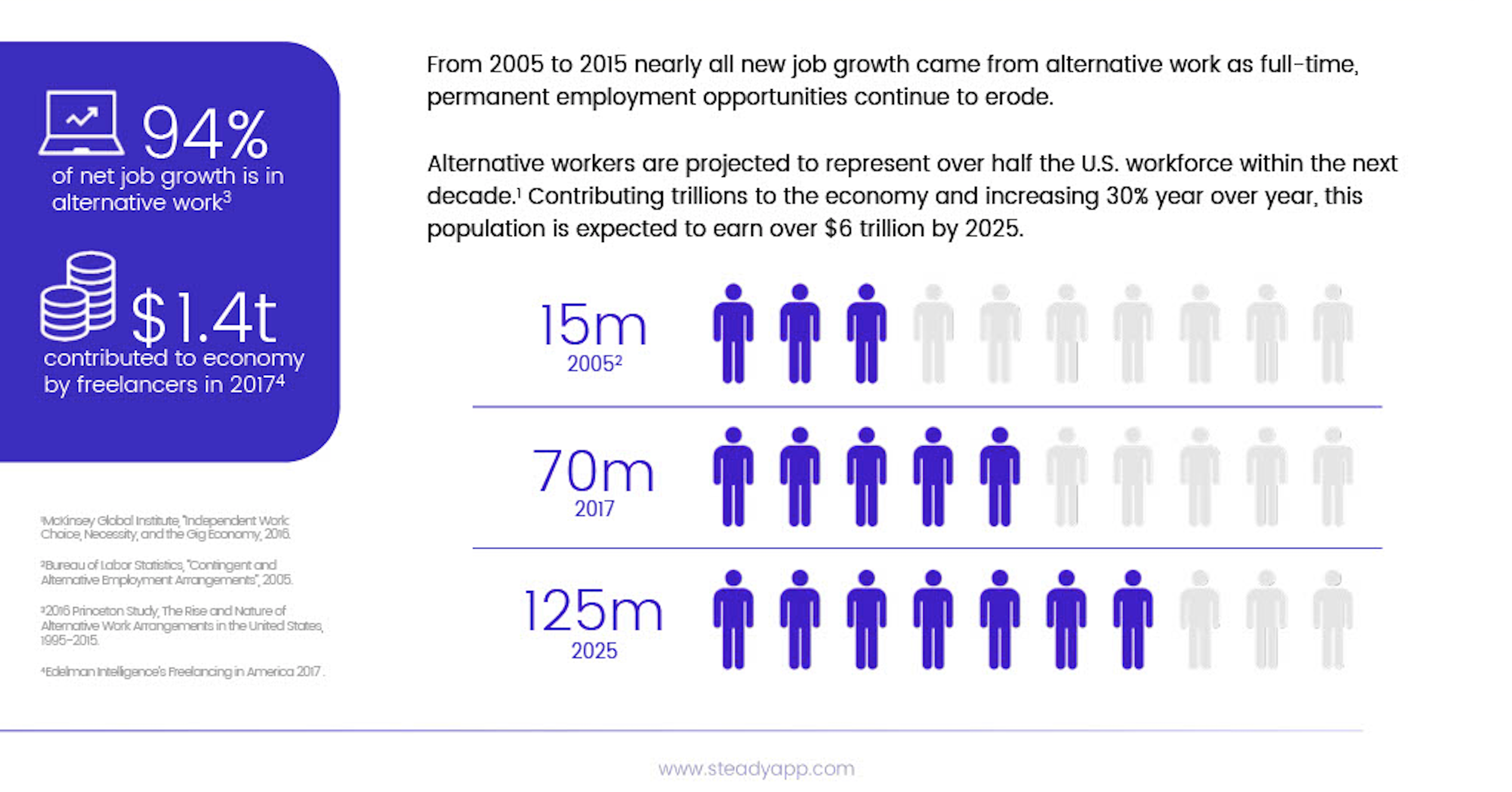
Image Credits: Steady

When it comes to Steady — the platform that helps hourly workers manage and maximize their income and access deals on things like benefits and financial services — the strengths of the business are clear.

But it took time for founder and CEO Adam Roseman to clearly define and communicate each of them in his quest for fundraising.


Discord’s reported $10B exit; Compass and Intermedia Cloud Communications set IPO price ranges

Alex Wilhelm dug into Discord’s possible $10 billion exit to Microsoft and explored IPO price ranges for real estate tech company Compass and Intermedia Cloud Communications, a unified-communications-as-a-service company.

“It’s a lot,” he noted, “but if we don’t get through it all now, we’ll fall behind and feel silly later.”

Will fading YOLO sentiment impact Robinhood, Coinbase and other trading platforms?

The consumer trading frenzy could be slowing.

What would happen to Robinhood and its cohorts if the apparent cooling in consumer trading demand continues?

How VC and private equity funds can launch portfolio-acceleration platforms

Rocket taking off

Image Credits: Miguel Navarro (opens in a new window) / Getty Images (Image has been modified)

Almost every private equity and venture capital investor now advertises that they have a platform to support their portfolio companies, “however, most of us don’t have the budget of an Andreessen Horowitz to support almost every major need” for each startup they’ve bet on, says Versatile VC founder David Teten.

If you’re prioritizing a platform buildout for your firm, consider using the framework he’s outlined.

Automakers, suppliers and startups see growing market for in-vehicle AR/VR applications

hologram-car-interface

Image Credits: Bryce Durbin

Despite all of the pomp and promises about the potential for AR and VR, there isn’t a clear understanding of market demand for bringing the technology to cars, trucks and passenger vans.

Estimates of the global market range from $14 billion by 2027 to as much as $673 billion by 2025, showing just how nascent the market currently is and how much opportunity is present.

Amid pandemic, Middle East adtech startups play essential role in business growth

yellow fish chalkboard

Image Credits: phototechno / Getty Images

The Middle East is a promising region with growing digital advertising solutions despite locals’ attachment to traditional means of advertising.

In recent years, there has been a shift to the active use of social media and online shopping, meaning the Middle East embodies great potential for adtech startups.

Social+ payments: Why fintechs need social features

Image Credits: Getty Images

Social+ products are seeing mass adoption because they marry community with functionality.

This applies even to fintech companies as taboos around money fall away.

The lightning-fast Series A that was 3 years in the making

Image Credits: Mironov Konstantin / Getty Images

It took Christine Tao, founder of Sounding Board, just over three years to recognize the value of executive coaching and get her company to a Series A.

Here’s how she did it.

NFTs could bridge video games and the fashion industry

Music companies, celebrities and fashion brands are some of the latest entities to dip a toe into the burgeoning NFT market.

In part two of a three-part series, we take a look at why NFTs are “the next chapter of digital art history.”

Where is the e-commerce app ecosystem headed in 2021?

woman in cafe with tablet and holding credit card because you know she's about to buy something

Image Credits: Charday Penn (opens in a new window) / Getty Images

The pandemic-induced growth of e-commerce is, by now, well documented.

What is happening in the app ecosystem that supports e-commerce? Is it growing, or are we more likely to see consolidations and IPOs?

Let’s explore.

ironSource is going public via a SPAC and its numbers are pretty good

You’ll want to pay attention to this one: Israel’s ironSource, an app-monetization startup, is going public via a SPAC.

It’s the second SPAC-led debut from an Israeli company in recent weeks worth more than $10 billion, and ironSource is actually a pretty darn interesting company from a financial perspective.

Coursera set to roughly double its private valuation in impending IPO

Money floating in space

Image Credits: Bryce Durbin / TechCrunch

The market views Coursera’s edtech business warmly ahead of its impending public offering.

Coursera is being valued as a software company, likely a breathe-easy moment for still-private edtech companies, since the debut could be an industry bellwether.


News: Daily Crunch: Amazon makes PR push ahead of union vote

Amazon pushes back against unionization, WeWork eyes the SPAC route and there’s new spyware on Android. This is your Daily Crunch for March 26, 2021. The big story: Amazon makes PR push ahead of union vote Workers at Amazon’s fulfillment center in Bessemer, Alabama (a suburb of Birmingham) will vote next week on whether to

Amazon pushes back against unionization, WeWork eyes the SPAC route and there’s new spyware on Android. This is your Daily Crunch for March 26, 2021.

The big story: Amazon makes PR push ahead of union vote

Workers at Amazon’s fulfillment center in Bessemer, Alabama (a suburb of Birmingham) will vote next week on whether to unionize. In the meantime, Amazon is waging an aggressive PR campaign against the effort and the politicians who support it.

For example, in a response to news that Senator Bernie Sanders would be visiting Amazon workers, executive Dave Clark tweeted, “I welcome @SenSanders to Birmingham and appreciate his push for a progressive workplace. I often say we are the Bernie Sanders of employers, but that’s not quite right because we actually deliver a progressive workplace.” Meanwhile, the Amazon News account scoffed at Representative Mark Pocan for repeating accounts of Amazon workers peeing in water bottles: “If that were true, nobody would work for us.”

In response, the Retail, Wholesale and Department Store Union (which the Amazon workers would be joining if the unionization effort succeeds) put out a statement asking, “How arrogant and tone deaf can Amazon be?”

The tech giants

A new Android spyware masquerades as a ‘system update’ — The malware can take complete control of a victim’s device.

What Silicon Valley could learn from China’s Q&A platform Zhihu — China’s largest question and answer platform, Zhihu, began trading at the lower end of its IPO range.

Startups, funding and venture capital

Crypto boom continues as Chainalysis raises $100M, doubles valuation to over $2B — The round comes just four months after the company secured a $100 million Series C round at a $1 billion valuation.

Benitago Group raises $55M in combined debt and equity to buy and grow Amazon brands — Most of the funding takes the form of credit lines to fund acquisitions, but there’s also an equity investment.

‘Link-in-bio’ company Linktree raises $45M Series B for its social commerce features —  Linktree is one of the most popular “link in bio” services, with more than 12 million users.

Advice and analysis from Extra Crunch

WeWork lines up for a second run at the public markets — If all you have is a blank-check company, every erstwhile startup looks like a public company in waiting.

Five mistakes creators make building new games on Roblox — Game developers, brands and investors alike are wondering what factors cause the most successful games on this $47 billion platform to break out.

UiPath’s IPO filing suggests robotic process automation is booming — Five takeaways from the company’s S-1.

(Extra Crunch is our membership program, which helps founders and startup teams get ahead. You can sign up here.)

Everything else

These House hearings on tech are a waste of time and everyone knows it — Devin Coldewey says the hearings need to change if lawmakers really want to put Big Tech on the spot.

Computer vision software has the potential to reinvent the way cities move — Tech provides new means of addressing the challenges of crowding, pollution and parking enforcement on dense city streets.

You can only invest if you promise not to read the fine print, OK? — Wrap up the week with an episode of Equity.

The Daily Crunch is TechCrunch’s roundup of our biggest and most important stories. If you’d like to get this delivered to your inbox every day at around 3pm Pacific, you can subscribe here.

News: How our SaaS startup improved net revenue retention by more than 30 points in two quarters

Net revenue retention is the most underrated metric out there. The greater the NRR, the quicker companies can scale. Simply put: the power of compound math.

Tim Kopp
Contributor

Tim Kopp is the chairman and CEO of Terminus, an ABM platform that powers high-performing go-to-market teams.

There’s certainly no shortage of SaaS performance metrics leaders focus on. While all SaaS companies do, and must, home in on acquisition metrics, there’s also massive revenue potential within your current customer base.

I think NRR (net revenue retention) is without question the most underrated metric out there. NRR is simply total revenue minus any revenue churn plus any revenue expansion from upgrades, cross-sells or upsells. The greater the NRR, the quicker companies can scale. Simply put: the power of compound math!

One of the biggest and most impactful changes we made was to move new business, retention and account management all under our chief revenue officer.

Over the course of two quarters, Terminus grew its NRR by more than 30 points, opening up incredible new levels of growth opportunities.

To boost our NRR for the better, I focused on three core pillars within our organization.

People

We took a holistic look at the organization and our org structure. One of the biggest and most impactful changes we made was to move new business, retention and account management all under our chief revenue officer. At the end of the day, it just makes a ton of sense to have acquisition and retention living under the same roof — why bother acquiring new customers if you can’t retain them?

We also rolled out a surround-sound team (around three or four people per customer) who onboard and help customers with their account from day one. In total, we have about a quarter of our company dedicated to this 24/7 support and hands-on guidance to ensure we’re enabling customers immediately.

Process

News: Slack wants to be more than a text-based messaging platform

Last October as Slack was preparing for its virtual Frontiers conference, the company began thinking about different ways people could communicate on the platform. While it had built its name on being able to integrate a lot of services in a single place to alleviate the dreaded task-switching phenomenon, it has been largely text-based up

Last October as Slack was preparing for its virtual Frontiers conference, the company began thinking about different ways people could communicate on the platform. While it had built its name on being able to integrate a lot of services in a single place to alleviate the dreaded task-switching phenomenon, it has been largely text-based up until now.

More recently, Slack has started developing a few new features that could bring different ways of interacting to the platform. CEO Stewart Butterfield discussed them on Thursday with former TechCrunch reporter Josh Constine, now a SignalFire investor, in a Clubhouse interview.

The talk was about the future of work, and Slack believes these new ways of communicating could help employees better connect online as we shift to a hybrid work world — one which has been hastened by the pandemic over the last year. There is a general consensus that many companies will continue to work in a hybrid fashion, even when the pandemic is over.

For starters, Slack aims to add a way to communicate by video. But instead of trying to compete with Zoom or Microsoft Teams, Slack is envisioning an experience that’s more like Instagram Stories.

Think about the CEO sharing an important announcement with the company, or the kind of information that might have gone out in a company-wide email. Instead, you can skip the inbox and deliver the message directly by video. It’s taking a page from the consumer approach to social and trying to move it into the enterprise.

Writing in a company blog post earlier this week, Slack chief product officer Tamar Yehoshua was clear this was going to be an asynchronous approach, rather than a meeting kind of experience.

“To help with this, we are piloting ways to shift meetings toward an asynchronous video experience that feels native in Slack. It allows us to express nuance and enthusiasm without a meeting,” she wrote.

While it was at it, Slack decided to create a way of just chatting by voice. As Butterfield told Constine in his Clubhouse interview, this is essentially Clubhouse (or Twitter Spaces) being built for Slack.

Yeah, I’ve always believed the ‘good artists copy, great artists steal’ thing, so we’re just building Clubhouse into Slack, essentially. Like that idea that you can drop in, the conversation’s happening whether you’re there or not, you can enter and leave when you want, as opposed to a call that starts and stops, is an amazing model for encouraging that spontaneity and that serendipity and conversations that only need to be three minutes, but the only option for you to schedule them is 30 minutes. So look out for Clubhouse built into Slack.

Again, it’s taking a consumer social idea and applying it to a business setting with the idea of finding other ways to keep you in Slack when you could be using other tools to achieve the same thing, whether it be Zoom meetings, email or your phone.

Butterfield also hinted hinted that another feature — asynchronous audio, allowing you to leave the equivalent of a voicemail — could be coming some time in the future. A Slack spokesperson confirmed that it was in the works, but wasn’t ready to share details yet.

It’s impossible to look at these features without thinking about them in the context of the $27 billion Salesforce acquisition of Slack at the end of last year. When you put them all together, you have this set of tools that let you communicate in whatever way makes the most sense to you.

When you combine that Slack Connect DM, a new feature to communicate outside the organization that was released this week to some controversy, as people wanted assurances that they could control spam and harassment, it takes the concept one step further — outside the organization itself.

As part of a larger entity like Salesforce, these tools could be useful across sales, service and even marketing as a way to communicate in a variety of ways inside and outside the organization. And they greatly expand the value prop of Slack as it becomes part of Salesforce sometime later this year.

While it began talking about the new audio and video features last fall, the company has been piloting them since the beginning of this year. So far Slack is not saying when the new features will be generally available.

News: Y Combinator-backed Vue Storefront aims to be the ‘glue’ for e-commerce

“Headless commerce” is a phrase that gets thrown around lot (I’ve typed it several times today already), but Vue Storefront CEO Patrick Friday has an especially vivid way of using the concept to illustrate his startup’s place in the broader ecosystem. “Vue Storefront is the bodiless front-end,” Friday said. “We are the walking head.” In other words,

“Headless commerce” is a phrase that gets thrown around lot (I’ve typed it several times today already), but Vue Storefront CEO Patrick Friday has an especially vivid way of using the concept to illustrate his startup’s place in the broader ecosystem.

“Vue Storefront is the bodiless front-end,” Friday said. “We are the walking head.”

In other words, while most headless commerce companies are focused on creating back-end infrastructure, Vue powers the front-end, namely the progressive web applications that consumers actually interact with. The company describes itself as “the lightning-fast frontend platform for headless commerce.”

Friday said that he and CTO Filip Rakowski created the Vue Storefront technology as an open source project while working at e-commerce agency Divante, before eventually spinning it out into a separate startup last year. The company was also part of the most recent class at accelerator Y Combinator, and it recently raised $1.5 million in seed funding led by SMOK Ventures and Movens VC.

“We had to set up a new entity in the middle of COVID, we had to raise in middle of COVID and we had to convince the agency get rid of the product in the middle of COVID,” Friday said. He even recalled signing papers with an investor one morning in early December and doing an interview with Y Combinator that evening.

Vue Storefront screenshot

Image Credits: Vue Storefront

As they’ve built a business around the core open source technology, Friday and his team have realized that Vue has more to offer than just building web apps, because it connects e-commerce platforms like Magento and Shopify with headless content management systems like Contentstack and Contentful, payments systems like PayPal and Stripe and other third-party services.

In fact, Friday said customers have been telling them, “You are like the glue. Headless was so complex to me, and then I got this Vue Storefront thing to come in on top everything else and be the glue connecting things.”

The platform has been used to create more than 300 stores worldwide. Friday said adoption has accelerated as the pandemic and resulting growth in e-commerce have driven businesses to realize they’re using “this legacy platform, using outdated frameworks and technologies from a good four or five years ago.”

Rakowski added, “We also see that many customers actually come to us deciding that Vue Storefront can be the first step of migration to another platform. WE can quickly migrate the front-end and write back-end agnostic code.”

Because it had just raised funding, the Vue Storefront team did not participant in the recent YC Demo Day, and will be presenting at the next Demo Day instead. In the meantime, it will be holding its own virtual Vue Storefront Summit on April 20.

News: Computer vision software has the potential to reinvent the way cities move

The same frustrations have plagued urban roadways for decades. But technology is finally providing new ways to address the challenges of crowding, pollution and parking enforcement on city streets.

Harris Lummis
Contributor

Harris Lummis is the co-founder and chief technical officer at Automotus.

In October 2019, The New York Times reported that 1.5 million packages were delivered in New York City every single day. Though convenient for customers and profitable for the Amazons of the world, getting so many boxes from warehouse to customer generates considerable negative externalities for cities.

As the Times put it, “The push for convenience is having a stark impact on gridlock, roadway safety, and pollution in New York City and urban areas around the world.”

Since that article was published, the global pandemic has taken e-commerce to new heights, and experts don’t expect this upward trend to slow down anytime soon. Without strategic intervention, we will find our cities facing increasingly severe traffic problems, safety issues and polluting emissions.

Without strategic intervention, we will find our cities facing increasingly severe traffic problems, safety issues and polluting emissions.

The same frustrations have plagued urban roadways for decades. However, technology is finally catching up, providing new means of addressing the challenges of crowding, pollution and parking enforcement on dense city streets.

As is almost always the case, an effective solution begins by first understanding the detailed circumstances giving rise to the problem. In this case, a simple means of assessing the problem is to observe curbside parking and street traffic using streetlight cameras.

Deploying cameras to monitor public spaces may immediately incite the ire of die-hard privacy advocates (I consider myself among them), which is why companies like mine have taken a privacy-by-design approach to product development. Our technology processes video in real time and addresses further concerns about potential misuse for surveillance purposes by blurring faces and license plates beyond recognition prior to making any kind of image data available either internally or to public officials.

The point of these cameras is not to surveil but rather to leverage concrete data from real-world city streets to generate crucial insights and power automations at the curb. Automotus’ computer vision software is already using this model to help cities manage the aforementioned flood of commercial vehicles on their streets.

This technology can also be used to optimize and incentivize parking turnover. According to one study, drivers in New York City spend an average of 107 hours per year searching for parking spots, at a cost of $2,243 per driver in wasted time, fuel and emissions, which represents $4.3 billion in total costs to the city. Similar wasteful dynamics are unfolding across America and the world. By collecting comprehensive data around the demand for curbside space, cities can design parking policies that ensure proper alignment between the supply of curb space and the way vehicles are actually using it.

In one pilot we ran on the campus of Loyola Marymount University, traffic caused by drivers searching for parking dropped by more than 20% after our data was used to adjust parking policy. Using data to optimize parking results in more efficient turnover, less time spent circling for a spot and reduced traffic delays. Real-time parking availability data can also be used to direct drivers to open parking spots via an application or API.

By arming city planners with accurate, up-to-date information on all forms of curbside activity, we empower them to fully understand the temporal and spatial patterns that rule their curbs. This gives planners the information they need to make informed decisions about curbside policy tailored to their city’s peculiarities.

Suddenly, questions such as “How many ride-hailing drop-offs occur here?” and “Whose delivery trucks are double parking on Tuesday morning?” become trivial to answer. Gone are the days of using vague heuristics to guide policy; this new wealth of information makes possible precise and impactful decisions on the locations of passenger parking, dedicated delivery zones and ride-hailing areas, as well as optimal rates to charge for parking, appropriate penalties for violations and much more.

This tech is also a win for delivery companies. When delivery fleets have data about real-time and predicted parking availability, this can improve route efficiency, saving them money. Instead of paying for curb usage via fines, delivery companies can instead receive an invoice for their time spent at the curb (a tax-deductible expense, I might add).

A study done in Columbus, Ohio, found that designated loading zones decreased double parking violations by 50% and reduced commercial vehicle time at the curb by 28%. Radically increasing the efficiency of delivery translates into savings for companies like FedEx and Amazon, which can then afford to pay fair rates for their curb access and pass on those savings to consumers.

Several interrelated trends make the current moment an especially opportune time to apply new technology to our streets and curbs. Pre-pandemic, many cities already faced declining revenue from parking as citizens shifted toward using ride-shares. Now, thousands of American municipalities are expecting major budget shortfalls in the wake of COVID-19. At the same time, a report from the World Economic Forum predicts that the number of commercial delivery vehicles will increase by 36% in inner cities by the year 2030. Our research suggests that more than 50% of parking violations are unenforced and committed by commercial vehicles.

It’s no coincidence that Columbus was the winner of the 2016 federal Smart City Challenge. When former President Barack Obama pledged over $160 million as part of his “Smart Cities” initiative in 2015, reducing congestion and pollution were among the program’s major goals. Better management of parking and curb space are crucial tools for achieving these aims. Though former President Donald Trump campaigned on a massive infrastructure plan, his delivery on promises in this area were mixed at best. Despite the lack of federal support, there are currently promising initiatives underway in cities such as Santa Monica, which is piloting a zero-emissions delivery zone in the heart of its downtown.

President Joe Biden has outlined a plan to build the infrastructure America needs both to combat climate change and modernize urban transportation. This plan includes a provision for 500,000 public charging stations for electric vehicles; changes to our cities that allow drivers, pedestrians, cyclists and others to safely share the road; and investment in critical clean energy solutions.

Curb management technology is one of a suite of options on the market that federal and local governments can leverage to reduce pollution and improve quality of life in cities. If the incoming administration is willing to champion this novel approach toward solving the problems of urban mobility, America’s infrastructure will not just be modernized but made ready for the future.

I, for one, hope this renewal is realized; our nation’s health, safety and shared prosperity depend on it.

News: E-commerce roll-ups are the next wave of disruption in consumer packaged goods

The interest in creating value through e-commerce brands is striking. So what’s the roll-up hype about?

Alanna Gregory
Contributor

Alanna is a marketing executive who is currently serving as vice president of growth and digital at Hairstory. She previously founded VIVE Lifestyle (YC S15) and was an AVP at Barclays Capital.

This year is all about the roll-ups. No, not those fruity snacks you used to find in your lunchbox; roll-ups are the aggregation of smaller companies into larger firms, creating a potentially compelling path for equity value.

Right now, all eyes are on Thrasio, the fastest company to reach unicorn status, and its cadre of competitors, such as Heyday, Branded and Perch, all vying to become the modern model of consumer packaged goods (CPG) companies.

Making things even more interesting, famed investor and operator Keith Rabois recently announced that he too is working on a roll-up concept called OpenStore with Atomic co-founder Jack Abraham.

Like any investment firm, to be successful, a roll-up should have a thesis or two providing it with a cohesive strategy across its portfolio.

Thrasio has been reaping the benefits of the e-commerce market’s Cambrian explosion in 2020, in which over $1 billion of capital was invested in firms on a mission to acquire independent Amazon sellers and brands.

This catalyst can be attributed to a few key factors, the first and most notable being the pandemic accelerating spending on Amazon and e-commerce more broadly. Next is the low cost of capital, a reflection of interest rates making markets flush with cash; this has made it easier to raise both equity and debt capital.

The third is the emerging and quantifiable proofs of concept: Thrasio is one of several raising hundreds of millions of dollars, and Anker, a primarily Amazon-native brand, went public. Both stories have provided further validation that a meaningful brand can be built on top of Amazon’s marketplace.

Still, the interest in creating value through e-commerce brands is particularly striking. Just a year ago, digitally native brands had fallen out of favor with venture capitalists after so many failed to create venture-scale returns. So what’s the roll-up hype about?

Roll-ups are another flavor of investing

Roll-ups aren’t a new concept; they’ve existed for a while. In the offline world, roll-ups often achieve much greater exit multiples, known as “multiple arbitrage,” so it’s no surprise that the trend is making its way online.

Historically, though, roll-ups haven’t been all that successful; HBR notes that more than two-thirds of roll-ups fail to create value for investors. While roll-ups are often effective at building larger companies, they don’t always increase profits or operating cash flows.

Acquirers, i.e., those rolling up smaller companies, need to uncover new operating approaches for their acquired companies to increase equity value, and the only way to increase equity value is to increase operating cash flow. There are four ways to do this: reducing overhead costs, reducing operating costs without sacrificing price or volume, increasing pricing without sacrificing volume or increasing volume without increasing unit costs.

E-commerce could present a new and different opportunity, or at least that’s what investors and smart money are betting on. Let’s explore how this new wave of roll-ups is approaching both growth and value creation.

Channel your enthusiasm: Why every roll-up needs a thesis

Like any investment firm, to be successful, a roll-up should have a thesis or two providing it with a cohesive strategy across its portfolio. There are a few that are trending in this particular wave.

The first is the primary distribution channel upon which a company grows. Evaluating companies with a common distribution channel can be helpful for creating economies of scale, focusing marketing and growth resources in a specific channel versus diluting resources across several.

On the downside, these companies become reliant on this distribution strategy and any changes could create vulnerabilities for their portfolio companies. As a study, let’s take a look at how two companies take different approaches:

News: Amazon goes on the offensive ahead of next week’s union vote counting

This week’s Amazon public relations push will no doubt go down as one of the odder public-facing strategies in tech. As some of the company’s biggest rivals were getting ready to virtually testify on Capitol Hill, the retail giant’s CEO of worldwide consumer business appeared to suggest that Amazon is not only as progressive as

This week’s Amazon public relations push will no doubt go down as one of the odder public-facing strategies in tech. As some of the company’s biggest rivals were getting ready to virtually testify on Capitol Hill, the retail giant’s CEO of worldwide consumer business appeared to suggest that Amazon is not only as progressive as self-declared democratic socialist Bernie Sanders, but also more effective in achieving those leftist policies.

Ahead of the Vermont senator’s visit to Amazon’s Bessemer, Alabama fulfillment center, Dave Clark tweeted, “I welcome [Sanders] to Birmingham and appreciate his push for a progressive workplace. I often say we are the Bernie Sanders of employers, but that’s not quite right because we actually deliver a progressive workplace.”

1/3 I welcome @SenSanders to Birmingham and appreciate his push for a progressive workplace. I often say we are the Bernie Sanders of employers, but that’s not quite right because we actually deliver a progressive workplace https://t.co/Fq8D6vyuh9

— Dave Clark (@davehclark) March 24, 2021

The statement was unsurprisingly greeted with pushback from labor groups. The Retail, Wholesale and Department Store Union (RWDSU) sent TechCrunch a lengthy response from president Stuart Appelbaum to the odd statement:

How arrogant and tone deaf can Amazon be? Do they really believe that the wage they pay – which is below what workers in nearby unionized warehouses receive and below Alabama’s median wage – gives them the right to mistreat and dehumanize their employees, put their workers’ health and safety in jeopardy, require them to maintain an unbearable pace, which even Amazon itself admits that a quarter of their workforce won’t be able to meet, and to deny working men and women the dignity and respect they deserve.

The organization, which is helping facilitate the Bessemer warehouse’s union voting, goes on to cite high turnover rates and pay cuts amid the pandemic and founder Jeff Bezos’s ballooning wealth. The founder — who is set to step down as CEO some time in Q3 — reportedly added more than $72 billion to his net worth in 2020, as Amazon employees became essential workers amid COVID-19-fueled shutdowns.

For many in the U.S., Amazon’s online delivery service provided a lifeline, as many stores were forced to close over pandemic precautions. The Bessemer facility opened on March 29, just as the first wave was cresting in the U.S. The company was anticipating a potential strain on its resources as record numbers of Americans were suddenly forced to stay home and were otherwise avoiding in-person shopping at all costs.

“Our team at Amazon is thankful for the support we have received from state and community leaders, and we are excited to be a part of the Bessemer community,” Director of Operations Travis Maynard said at the time. “We’re proud to create great jobs in Bessemer with industry-leading pay and benefits that start on day one, in a safe, innovative workplace.”

After several years of negative coverage over its warehouse working conditions, it’s not surprising that the company has become proactively reflexive when it comes to working conditions.

“When New York City became the epicenter [of COVID-19], that’s when the Bessemer facility opened up,” Christian Smalls, a former Amazon worker-turned-critic said at TechCrunch’s Justice event earlier this month. “So the union got a head start on talking to workers. So that’s a gem for anybody or any union that plans on trying to unionize the building — that you have a facility in your community that’s about to open up, when opening, that’s the best time to connect with workers. That’s what happened last year. And as a result, the workers had seen what happened to the workers that were unprotected and they don’t want that. They want better for themselves.”

Next week, the RWDSU will begin tallying votes for what has shaped up to be the largest union push since Amazon’s 1995 founding, much to the company’s chagrin. In recent months, the company has been hoping to throw a wrench in the works. In January, it unsuccessfully appealed a ruling by the National Labor Relations Board (NLRB) that allowed workers to vote by mail, as more than 350,000 COVID-19 cases had been reported in the state since the beginning of the pandemic.

Amazon expressed concerns that mail-in voting would monopolize too much time and resources. “Union avoidance” firm Jackson Lewis suggested that such rules put employers at a disadvantage, “because eligible voters are given several days after receiving their ballots to return them to the NLRB, the impact and momentum of the employer’s voter education campaign is decreased. This does not exist in connection with a manual ballot election, where the employer may educate employees one-on-one until the last moment before they vote.”

NEW: Amazon is running glossy anti-union ads to combat the organizing drive by workers at their Bessemer, AL, warehouse. An Alabama resident said this spot is one of several that Amazon is now running on Twitch. pic.twitter.com/6WlojetvzY

— More Perfect Union (@MorePerfectUS) February 23, 2021

The following month, Amazon ran anti-union ads on its streaming subsidiary, Twitch. The spots featured employees discussing why they were planning to vote no, and compelled people to visit Do it Without Dues, which blasted potential union membership fees.

“Amazon feels that it has to go to extremes like this in order to gaslight its workers about the dreadful working conditions at its Bessemer warehouse,” Appelbaum told the press in response to the ads. Twitch pulled the spots, adding that they, “should never have been allowed to run on [the] service.”

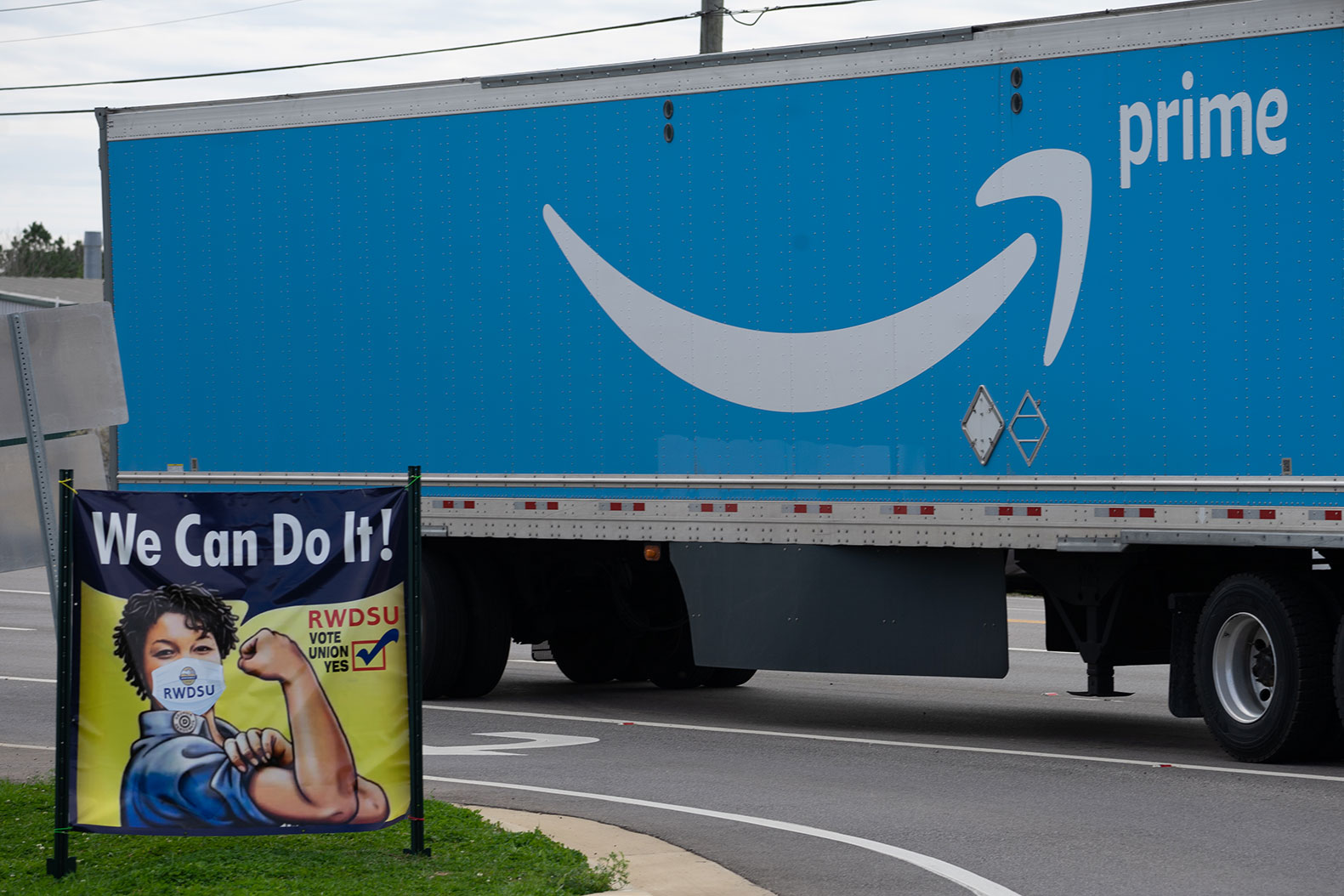
A truck passes as Congressional delegates visit the Amazon Fulfillment Center after meeting with workers and organizers involved in the Amazon BHM1 facility unionization effort

BIRMINGHAM, AL – MARCH 05: A truck passes as Congressional delegates visit the Amazon Fulfillment Center after meeting with workers and organizers involved in the Amazon BHM1 facility unionization effort, represented by the Retail, Wholesale, and Department Store Union on March 5, 2021 in Birmingham, Alabama. Workers at Amazon facility currently make $15 an hour, however they feel that their requests for less strict work mandates are not being heard by management. (Photo by Megan Varner/Getty Images)

Workers have continued to be critical of conditions in Amazon’s warehouses, frequently comparing the work to that of robots that have increasingly become their colleagues. Last week, New York Magazine published a piece from a Bessemer picker who describes long and tiring days on the floor.

“It really is not fair for employees to get fired for going to the bathroom,” the worker, Darryl Richardson, tells the magazine. “Sometimes the water in the bathrooms isn’t working on the floor, and you have to go down another flight of stairs to go to the bathroom.”

A number of similar stories have been recounted to the media over the years. Images of workers peeing in water bottles so as to not be docked pay — or worse — for taking a bathroom break have almost certainly become the most visceral.

1/2 You don’t really believe the peeing in bottles thing, do you? If that were true, nobody would work for us. The truth is that we have over a million incredible employees around the world who are proud of what they do, and have great wages and health care from day one.

— Amazon News (@amazonnews) March 25, 2021

When Wisconsin Rep. Mark Pocan called out Clark’s Sanders comparisons on Twitter earlier this week, an official account shot back, “We hope you can enact policies that get other employers to offer what we already do.”

Sanders has been a long-time critic of the company. The Vermont senator was one of a handful of progressive politicians who compelled Amazon to raise its minimum wage to $15 an hour, while criticizing massive tax breaks. In 2018, he introduced the Stop Bad Employers by Zeroing Out Subsidies (BEZOS) bill.

“The taxpayers in this country should not be subsidizing a guy who’s worth $150 billion, whose wealth is increasing by $260 million every single day,” Sanders told TechCrunch at the time. “That is insane. He has enough money to pay his workers a living wage. He does not need corporate welfare. And our goal is to see that Bezos pays his workers a living wage.” That November, the company relented, increasing minimum wage to $15 an hour — something that has since become a major talking point for Amazon.

Responding to Pocan’s comments about “union-bust[ing] & mak[ing] workers urinate in water bottles,” the Amazon News Twitter account wrote, “You don’t really believe the peeing in bottles thing, do you? If that were true, nobody would work for us. The truth is that we have over a million incredible employees around the world who are proud of what they do, and have great wages and health care from day one.”

And yes, I do believe your workers.

You don’t?

— Rep. Mark Pocan (@repmarkpocan) March 25, 2021

Pocan’s reply was simple: “[Y]es, I do believe your workers. You don’t?”

In addition to past reports of warehouse workers and delivery drivers peeing in bottles, a new report from The Intercept notes that the act is “widespread,” due to workplace pressures. It cites an email from last May that also adds defecation into the mix.

“We’ve noticed an uptick recently of all kinds of unsanitary garbage being left inside bags: used masks, gloves, bottles of urine,” the email titled Amazon Confidential reads. “By scanning the QR code on the bag, we can easily identify the DA who was in possession of the bag last. These behaviors are unacceptable, and will result in Tier 1 Infractions going forward. Please communicate this message to your drivers. I know it may seem obvious, or like something you shouldn’t need to coach, but please be explicit when communicating the message that they CANNOT poop, or leave bottles of urine inside bags.”

Pro-union demonstration signs during a Retail, Wholesale and Department Store Union (RWDSU) held protest outside the Amazon.com Inc. BHM1 Fulfillment Center in Bessemer, Alabama

Pro-union demonstration signs during a Retail, Wholesale and Department Store Union (RWDSU) held protest outside the Amazon.com Inc. BHM1 Fulfillment Center in Bessemer, Alabama, U.S., on Sunday, Feb. 7, 2021. The campaign in Bessemer to unionize Amazon workers has drawn national attention and is widely considered a once-in-a-generation opportunity to breach the defenses of the worlds largest online retailer, which has managed to keep unions out of its U.S. operations for a quarter-century. Photographer: Elijah Nouvelage/Bloomberg via Getty Images

As misguided or glib as the Amazon Twitter response may seem, it’s clear why the company has gone on the offensive here. “We’re not alone in our support for a higher federal minimum wage,” the accounted noted in the wake of the dustup with Pocan. The company adds that it has been pushing for a federal minimum wage increase following its own.

The push to unionize, meanwhile, has made strange political bedfellows, ranging from Stacey Abrams to Marco Rubio. Breaking with the customary party position, the Republican senator wrote in an op-ed, “Here’s my standard: When the conflict is between working Americans and a company whose leadership has decided to wage culture war against working-class values, the choice is easy — I support the workers. And that’s why I stand with those at Amazon’s Bessemer warehouse today.”

Rubio’s support of unionizing was tied, in part, to concerns over a “‘woke’ human resources fad,” but it’s still fairly uncommon for an event like this to find him on the side of the likes of Joe Biden, who had previously promised to be “the most pro-union president you’ve ever seen.”

Amazon will no doubt be keeping a close eye on Tuesday’s vote count, aware that the results will have a far wider ranging impact than the 6,000 workers currently employed at Bessemer. If unionization fails, the company will tout the results as vindication that its work force is perfectly happily without labor interference. A vote to unionize, on the other hand, could well embolden further unionization efforts across the company.

News: 5 mistakes creators make building new games on Roblox

Gamefam learned to develop on Roblox the hard way — by trial and error and by getting better at listening to the community’s unique gamer culture. Here are some common mistakes.

Joe Ferencz
Contributor

Joe Ferencz is the founder and CEO of Gamefam, a game publisher operating exclusively on Roblox.

With Roblox’s massive IPO this month, game developers, brands and investors alike are wondering what factors cause the most successful games on this $47 billion platform to break out from the millions of user-generated passion projects.

According to Roblox’s S-1 filing, nearly 250 developers and creators earned $100,000 or more in Robux in the year through September 2020 out of nearly 1 million creators on the platform.

From Gamefam’s first game two years ago that topped out at only 25 concurrent players to our current portfolio with 2 million to 3 million daily visits, our team learned to develop on Roblox the hard way — by trial and error and by getting better at listening to the Roblox community’s unique gamer culture and vernacular.

Even the most experienced and talented game designers from the mobile F2P business usually fail to understand what features matter to Robloxians.

For those entrepreneurs just starting their journey in Roblox game development, these are the most common mistakes I have seen gaming professionals (myself included) make on Roblox:

1. Using the established free-to-play (F2P) mobile game mechanics

In the F2P mobile games market, it’s all about layered game loops: play a match with the hero, level the hero up using resources from the match, buy more heroes to merge with the first hero, open up new matches with new rules to win more resources, and on and on. These require ongoing player tutorials across hours of play sessions. These mechanics tend to backfire on Roblox because players have no tolerance for anything but immediate, visceral fun.

Accordingly, in mobile F2P, a robust tutorial for new users is oftentimes one of the biggest investments during development. But in our Roblox game Speed Run Simulator (more than 400,000 daily visits), we saw a significant increase in D1 retention when we removed the tutorial entirely and just allowed existing players to guide new players’ understanding of the game. The differences between Roblox and mobile F2P are not only numerous but also sometimes profoundly counterintuitive.

2. Optimizing to make money off of “whales”

Roblox players spend because they’re getting something they want. They won’t be cajoled or coerced into spending like in a mobile game where progress is restricted or slowed without making an in-app purchase (think Candy Crush).

News: Woven Capital kicks off portfolio with investment in autonomous delivery company Nuro

Woven Capital, the investment arm of Toyota’s innovation-focused subsidiary Woven Planet, has announced an investment into Silicon Valley-based autonomous delivery vehicle company Nuro. This kicks off the new $800 million strategic fund, which will invest in growth-stage technology companies that could one day develop into partners or acquisitions to further a mission of building the

Woven Capital, the investment arm of Toyota’s innovation-focused subsidiary Woven Planet, has announced an investment into Silicon Valley-based autonomous delivery vehicle company Nuro. This kicks off the new $800 million strategic fund, which will invest in growth-stage technology companies that could one day develop into partners or acquisitions to further a mission of building the future of safe mobility, according to George Kellerman, Woven Capital’s head of investments and acquisitions.  

Woven Capital’s contribution was part of Nuro’s $500 million Series C funding round, which was announced last November. Chipotle also invested in the round, which also included funds managed by T. Rowe Price Associates, Inc., with participation from new investors Fidelity Management & Research Company, LLC. and Baillie Gifford. The specific amounts invested by each stakeholder were not disclosed. 

Toyota announced the $800 million investment pool in September 2020, and Woven Capital was officially formed in January 2021, with the aim of investing in technologies including as autonomous mobility, machine learning, artificial intelligence, automation, connectivity and data and analytics. 

“Nuro was a good jumping off point, because a lot of the work that we’re doing is really focused on developing autonomous passenger vehicles, so this is a way for us to learn and advance through a partner that is laser-focused on local goods delivery,” Kellerman told TechCrunch. “There’s a lot of opportunity to learn from them, and potentially over time, to collaborate and help them expand globally.”

Nuro’s fleet of cargo-only self-driving vehicles has already been approved by California’s Department of Motor Vehicles to test on public roads, delivering goods from partners like Krogers, Domino’s, Walmart and CVS. The coronavirus pandemic accelerated the need for goods delivery, giving Nuro an opportunity to become a leader in this space. Woven Capital saw an opportunity to help accelerate and strengthen that leadership position, while also setting up a strategic knowledge sharing arrangement between the two. 

“[Woven Capital] has assembled a great team with ambitious goals for the future, and we share a common objective of transforming the way people live and move to make life better,” said Nuro co-founder and president Dave Ferguson in a statement. “We’ll use this new capital, and the support of one of the largest automotive companies in the world, to continue growing our team and building a great autonomous delivery product.”

Toyota Woven City concept render.

Toyota Woven City concept render.

Automation will be a big part of Woven Capital’s portfolio, which exists to support all of parent Woven Planet’s activities, including Woven City, a testing ground for new technologies set in an interconnected smart city prototype. In February, Toyota broke ground at the Higashi-Fuji site in Susono City, Japan, at the base of Mount Fuji. 

“When we think about Woven City, we think about autonomous mobility and automation more broadly,” said Kellerman. “To facilitate that, you’re going to need artificial intelligence, machine learning, data and analytics, connectivity. So we’re going to be building a portfolio that has investments in all those areas.”

A growing trend in the mobility industry is to view mobility not just as the movement of people and goods, but as the movement of information and data. Woven Planet recognizes this and is taking a software-first approach, particularly when it comes to automobiles. This means that instead of the historical auto industry approach of designing the hardware first, and then fitting in the software to operate that vehicle, you start with the software and build hardware around it. 

Building off a software-first architecture provides a lot flexibility for future innovation. If the hardware changes, you don’t have to rewrite the code, you could just add in another application. Kellerman said all the software Woven Planet is developing as a company should be usable in as many applications as possible. 

Having really strong, integrated software is also the logical next step for connected mobility, and it opens up doors for rethinking what a vehicle has the potential to transport. A Nuro vehicle isn’t just a vehicle for whatever groceries it’s delivering, but it’s also a vehicle for all the information it picks up along the way and transmits back to the cloud, such as traffic flows and weather patterns. The value, therefore, is less in the A to B utility, and more in the interchange of information. 

Some of the information collected by Nuro that could be immediately useful to Woven City is that related to street safety. Nuro’s vehicles don’t carry passengers, so the design features focus more on the safety of people outside of the vehicle, the aggregate data of which could be useful in human-centered city planning. 

In the end, Woven Capital’s long-term view is always a potential funnel to future mergers and acquisitions, said Kellerman. 

“Toyota is not historically a very acquisitive company, but within Woven Planet we’re building a corporate development team with an eye to how we can accelerate the vision and mission of Woven Planet through strategic acquisitions, as well,” said Kellerman.

WordPress Image Lightbox Plugin