Monthly Archives: March 2021

News: To improve accountability, Norrsken VC ties partner compensation to its portfolio’s sustainable successes

With the close of its latest investment fund, Norrsken VC is is taking an unprecedented step in tying the compensation of its partners to the positive changes the firm’s portfolio companies have on the world — and not just their financial returns. The firm, which released its impact assessment for 2020 last week, has invested

With the close of its latest investment fund, Norrsken VC is is taking an unprecedented step in tying the compensation of its partners to the positive changes the firm’s portfolio companies have on the world — and not just their financial returns.

The firm, which released its impact assessment for 2020 last week, has invested in companies that address seven of the United Nations’ seventeen sustainable development goals, and is benchmarking its performance on goals that range from the tightly monitored to the slightly tautological.

In some instances, the goals are simply customer metrics (with the assumption that the more customers on a product, the better they’re doing). To be fair, these are in areas like education and healthcare where the true impact of a company’s services are harder to measure.

The firm’s portfolio has much more tangible progress in the climate change mitigation and sustainability space. Here, emissions avoided or increases in energy efficiency can be measured quite easily.  And those energy efficiency gains and emissions reductions, along with lower waste associated with the firm’s food and agtech businesses are where the firm has seen its best performance.

When they exit, this performance will matter a great deal to the partners at Norrsken, because their compensation is directly affected by it.

“For each investment that we make, we set targets pre-investment for what we want to see in terms of impact,” said Tove Larsson, a general partner with Norrsken VC. “We do that together with some of our key LPs in the fund. We need to get the advisory committee’s approval of the targets. We set thsoe targets for an individual year and then on an annual basis.”

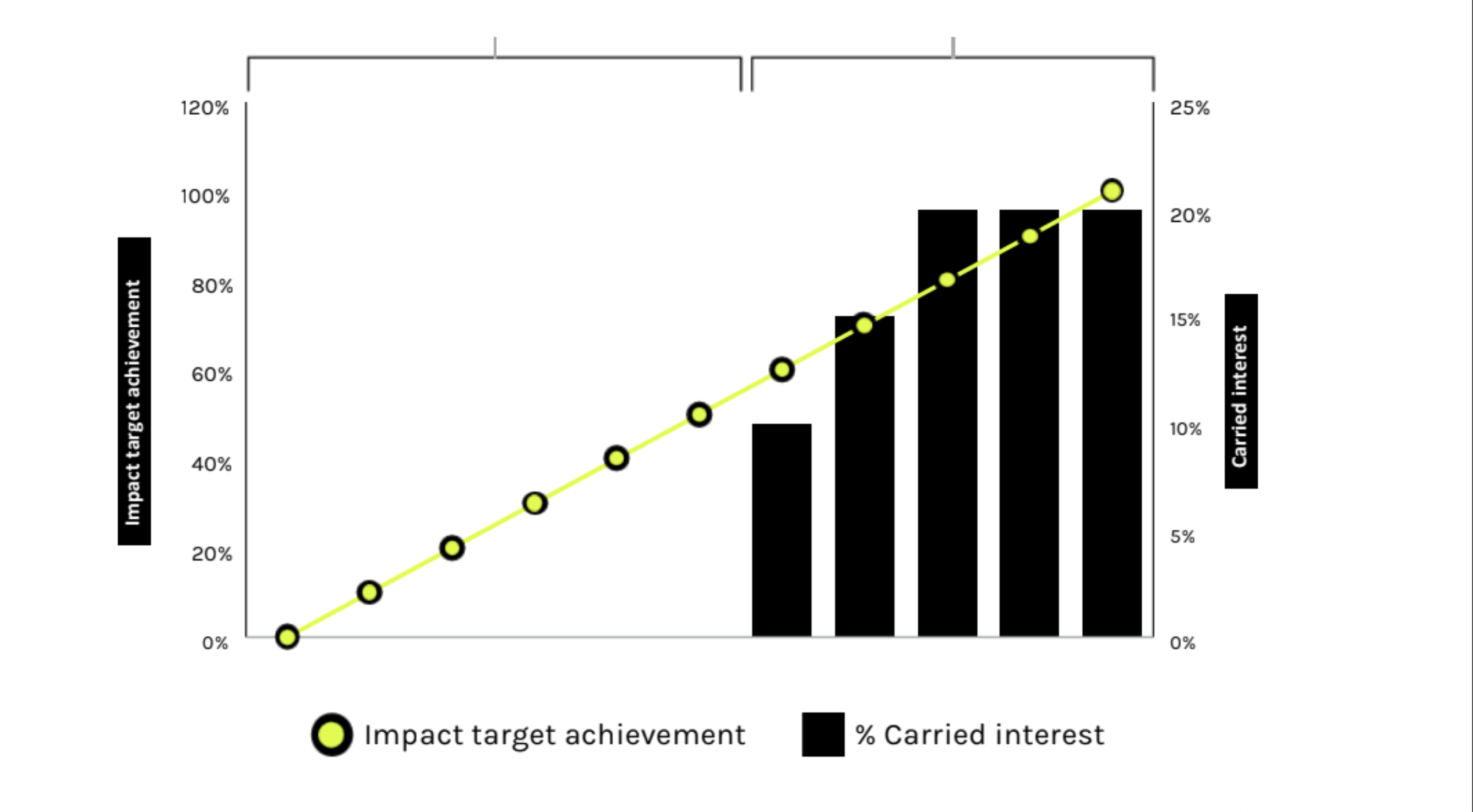
When the fund reaches the end of its cycle, the firm will look at the aggregated outcome of all of the impact KPIs and will weight the results of each company’s impact based o the amount we invested in each company. Based on that, the firm decides whether the team gets any carried interest or not.

If the portfolio companies hit sixty percent of the impact targets that have been set by the firm and its advisory board members, then they receive half of the carried interest, with the rest donated to charity. “There’s a linear escalation up to 100 percent. And if we don’t achieve that then the carried interest will be paid out to a charity organization or an NGO,” said Larsson.

Image Credit: Norrsken VC

The partners at Norrsken see their novel compensation structure as a point of differentiation, especially as the number of firms focused on themes related to the UN’s sustainable development goals continues to increase dramatically.

“We we started to invest, we were one of the first — four years ago. Then the market evolved so quickly where we got questions around how do you stand out and how do you know whether you’re truly an impact player,” said Agate Freimane, a general partner at the firm.

“This is a core part of the DNA. We need to do better and show that we can walk the talk,” Freimane said. So the firm took a page from the European Investment Fund, whose operations impose similar restrictions on compensation, she said. “When we heard about this way of doing it, we said tis make 100 percent sense, and why doesn’t everyone do it?”

So far, the team hasn’t had any problems hitting the target it had set. “We’re at 119 percent of the 2020 targets,” Freimane said. Still that’s only 12 percent of the long term targets. “At the moment, we’v e done one tenth of what we need to do over the lifetime of the fund.”

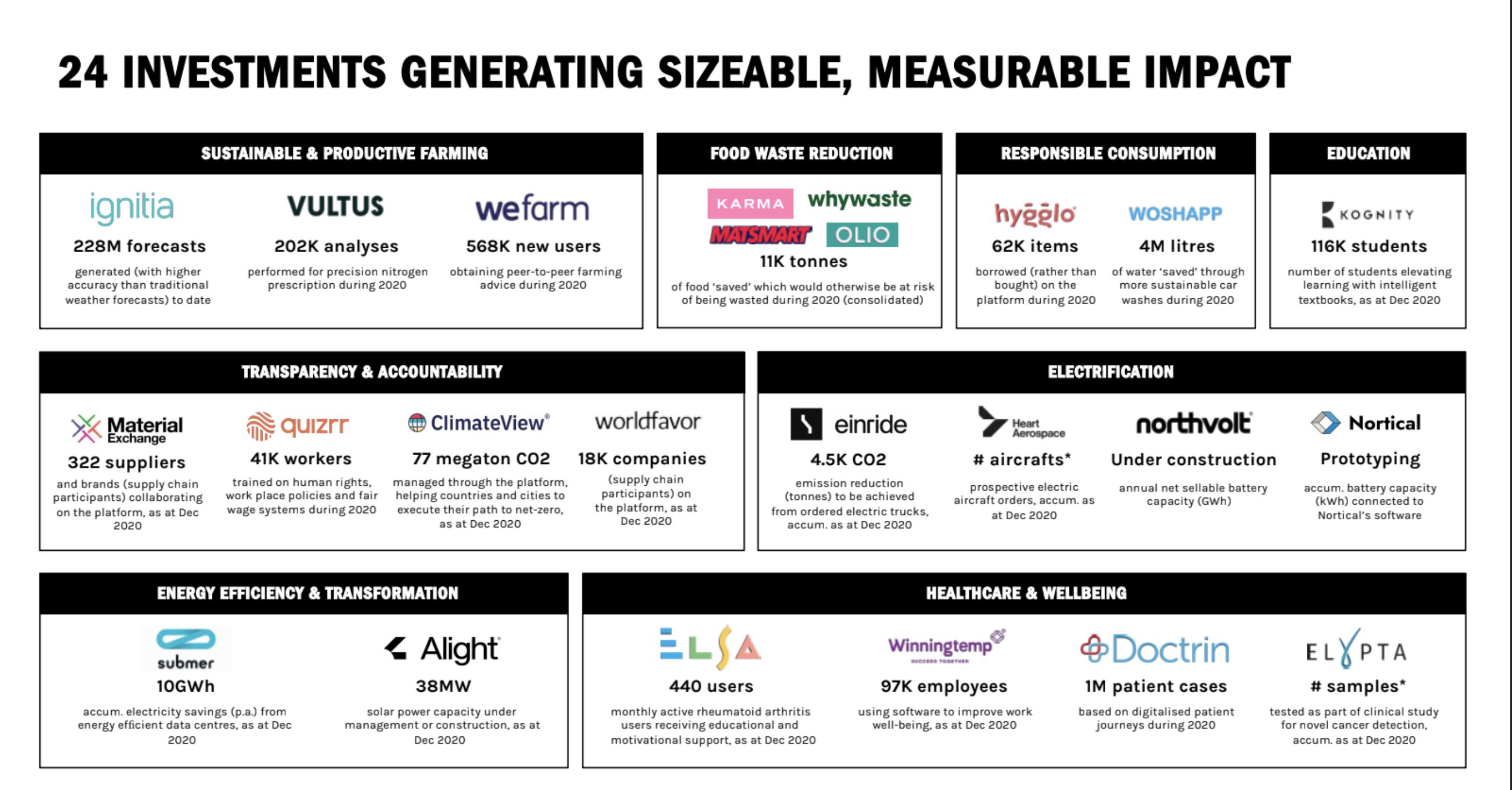
Even if some of the targets may be… imprecise… the steps that the firm’s portfolio companies have taken to reduce greenhouse gas emissions and food waste, and improving energy efficiency are having a real, measurable imapct. Whether that’s the reduction of data center energy demand by 10 Gigawatt hours thanks to the deployment of Submer technologies; reducing 11,000 tons of food waste through operations at Karma, Whywaste, Matsmart or Olio; saving 4 million liters of water from carwashes using Woshapp; or the development of 38 megawatts of solar projects thanks to the work of Alight.

Image Credit: Norrsken VC

“What we’re most proud of is that we’re actually doing this now,” said Larsson. “It’s not perfect, what we have delivered now, But we really think we need to start somewhere and it is key that the industry needs to become more transparent. The first thing we mentioned is that we think it is an achievement that we are tracking it and making it public.”

News: Apple releases iPhone, iPad, and Watch security patches for zero-day bug under active attack

Apple has released an update for iPhones, iPads and Watches to patch a security vulnerability under active attack by hackers. The security update lands as iOS 14.4.2 and iPadOS 14.4.2, which also covers a patch to older devices as iOS 12.5.2. watchOS also updates to 7.3.3. Apple said the vulnerability, discovered by security researchers at

Apple has released an update for iPhones, iPads and Watches to patch a security vulnerability under active attack by hackers.

The security update lands as iOS 14.4.2 and iPadOS 14.4.2, which also covers a patch to older devices as iOS 12.5.2. watchOS also updates to 7.3.3.

Apple said the vulnerability, discovered by security researchers at Google’s Project Zero, may have been “actively exploited” by hackers. The bug is found in WebKit, the browser engine that powers the Safari browser across all Apple devices.

It’s not known who is actively exploiting the vulnerabilities, or who might have fallen victim. Apple did not say if the attack was targeted against a small subset of users or if it was a wider attack. It’s the third time (by our count) that Apple has pushed out a security-only update this year to fix flaws under active attack. Earlier this month the company released patches for similar vulnerabilities in WebKit.

Update today.

News: How I Podcast: Science Vs’s Rose Rimler

The beauty of podcasting is that anyone can do it. It’s a rare medium that’s nearly as easy to make as it is to consume. And as such, no two people do it exactly the same way. There are a wealth of hardware and software solutions open to potential podcasters, so setups run the gamut

The beauty of podcasting is that anyone can do it. It’s a rare medium that’s nearly as easy to make as it is to consume. And as such, no two people do it exactly the same way. There are a wealth of hardware and software solutions open to potential podcasters, so setups run the gamut from NPR studios to USB Skype rigs (the latter of which has become a kind of default during the current pandemic).

We’ve asked some of our favorite podcast hosts and producers to highlight their workflows — the equipment and software they use to get the job done. The list so far includes:

Election Profit Makers’ David Rees
Welcome to Your Fantasy’s Eleanor Kagan
Articles of Interest’s Avery Trufelman
First Draft and Track Changes’ Sarah Enni
RiYL remote podcasting edition
Family Ghosts’ Sam Dingman
I’m Listening’s Anita Flores
Broken Record’s Justin Richmond
Criminal/This Is Love’s Lauren Spohrer
Jeffrey Cranor of Welcome to Night Vale
Jesse Thorn of Bullseye
Ben Lindbergh of Effectively Wild
My own podcast, RiYL

Science! It’s a thing you should trust! At least that’s what people keep telling me on Twitter. But how do you know which science to trust? Thankfully, Science Vs. from Spotify/Gimlet exists to answer the difficult questions. The show wades into scientific fads and conspiracies, ranging from 5G to vaping in order to sift out the science fiction from science fact. This week, producer Rose Rimler joins us to detail how the show has evolved during the pandemic. 

Image Credits: Rose Rimler

Before COVID, we worked out of an office in Brooklyn that had 10+ recording studios and a number of small, glass-walled meeting rooms set up for the table reads we call “edits.” We spent much of the day wandering around the office looking for one another in these offices and studios, which I guess is how I racked up an average of 6,700 steps a day in 2019 without really trying. Anyway, during the pandemic, we switched to recording ourselves and our interviews at home on portable recorders, which Gimlet provided.

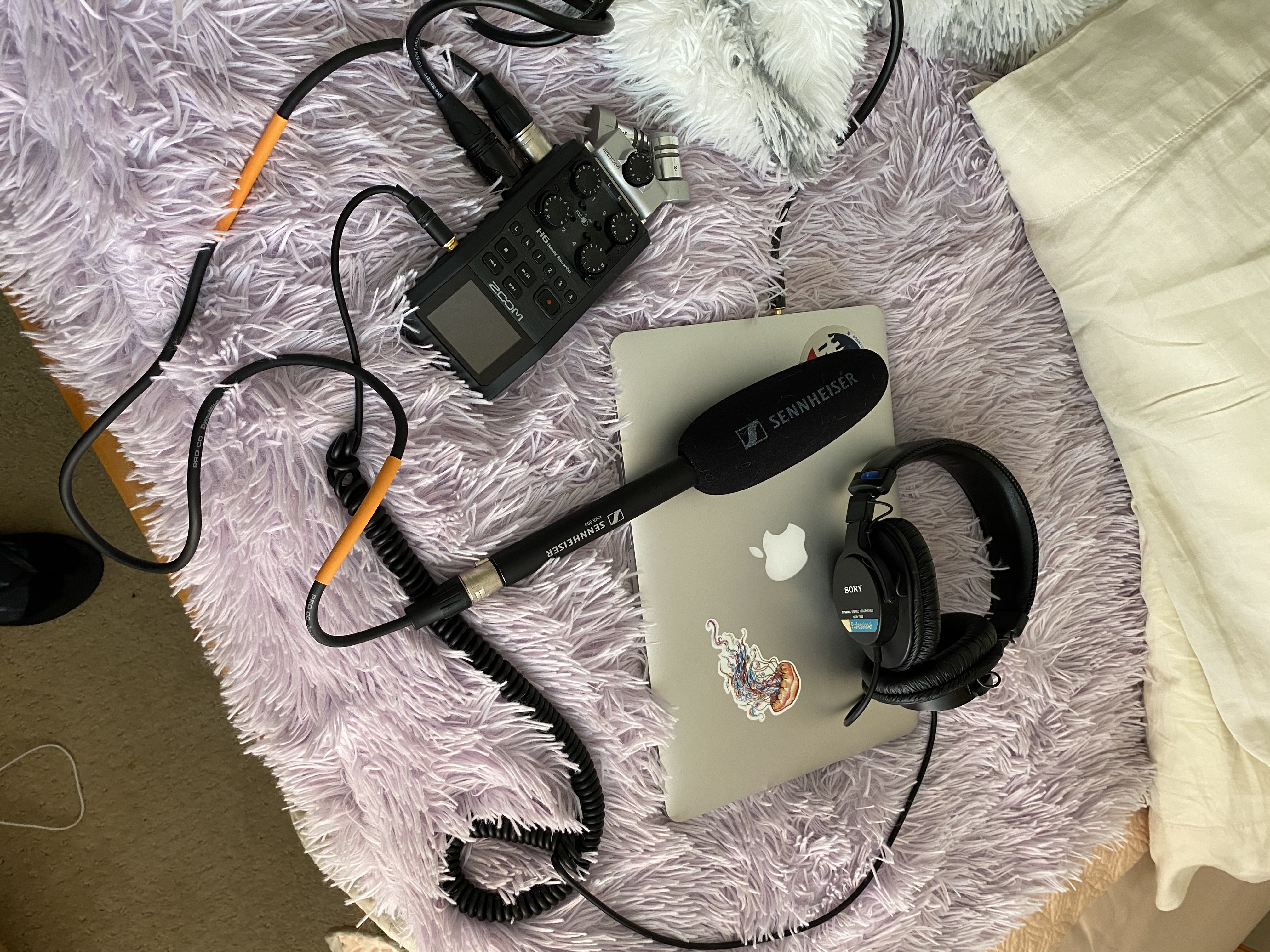
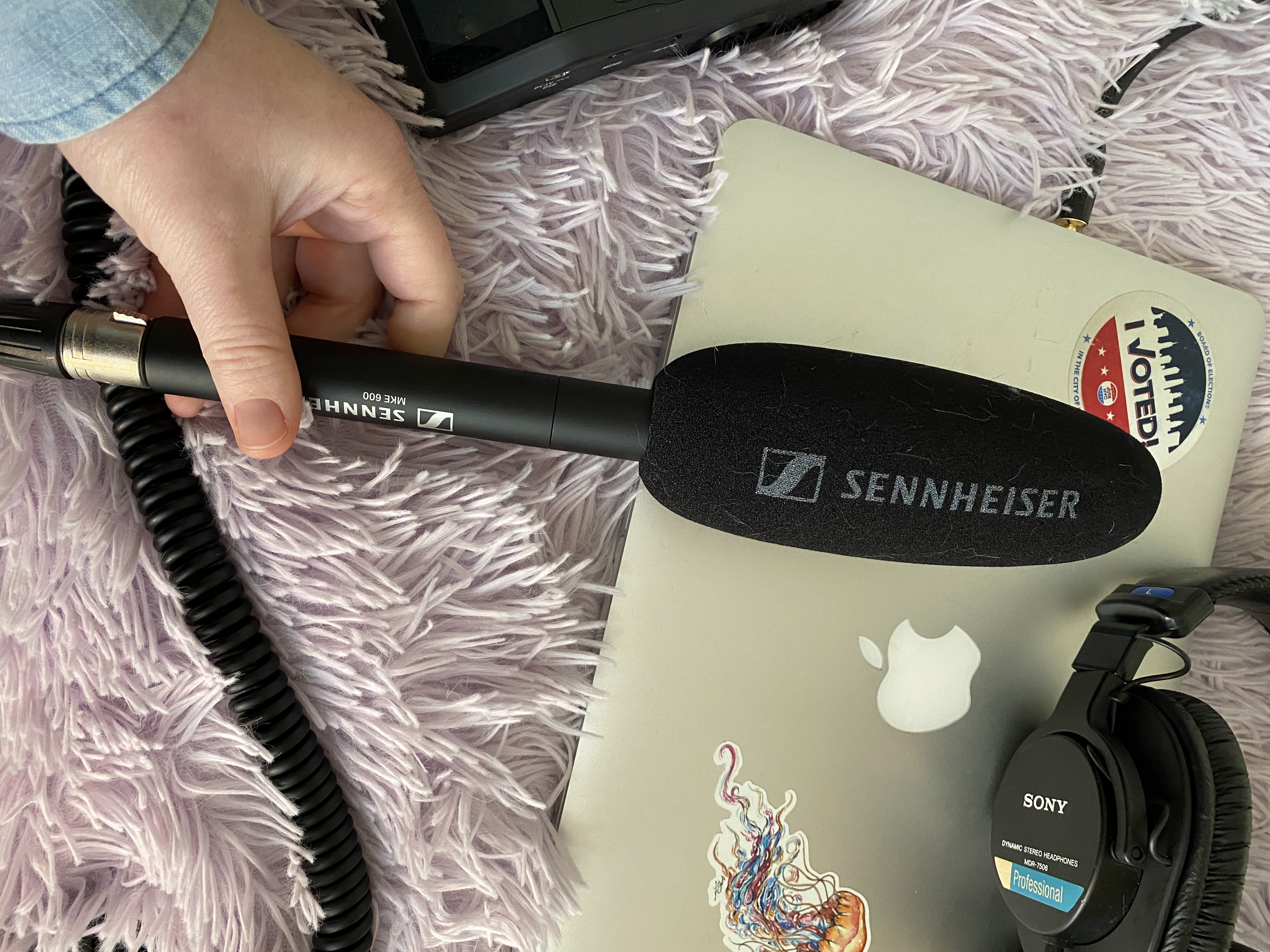
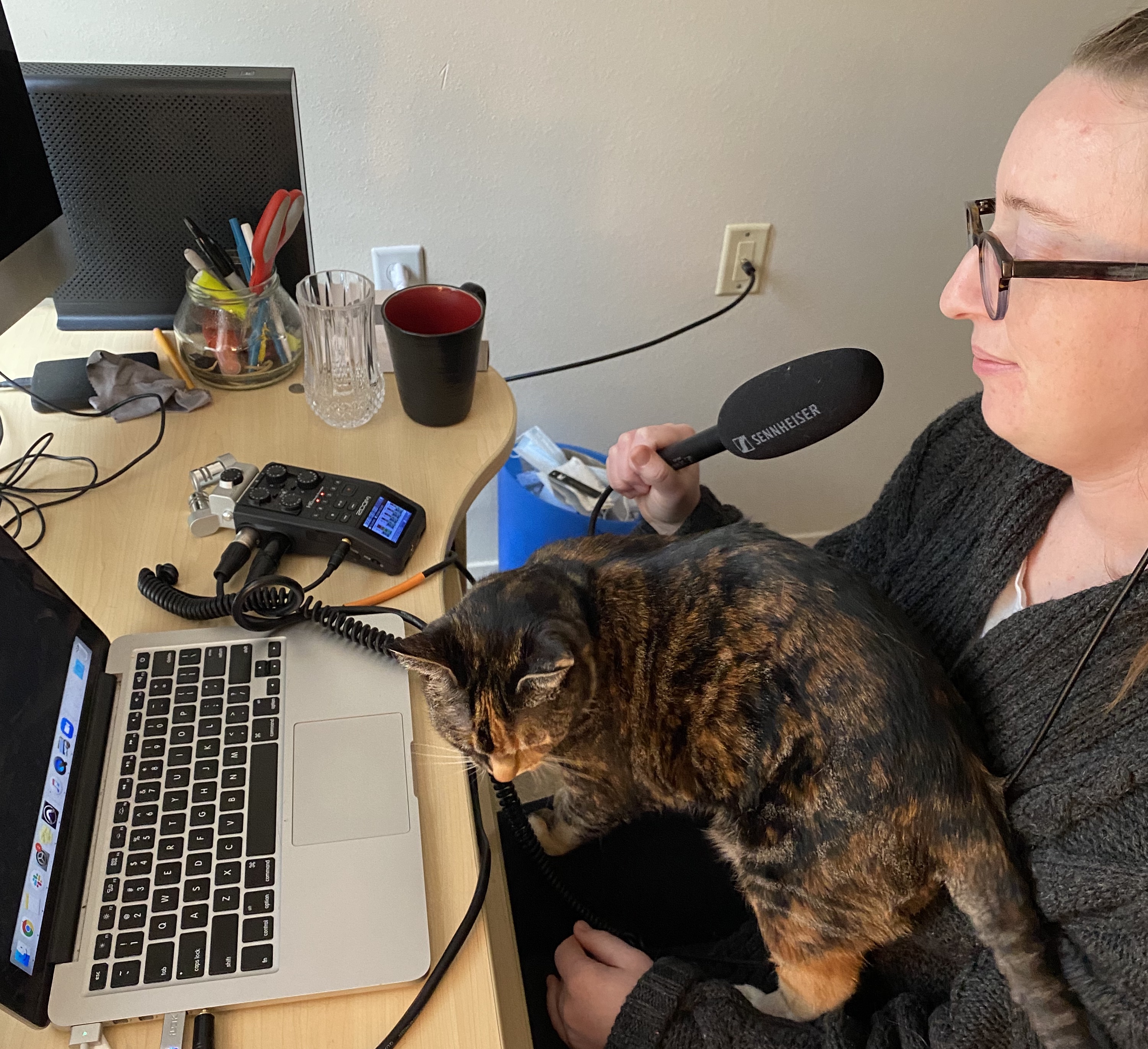
We all use Zoom recorders and directional/shotgun mics. My recorder is a Zoom H6 and my mic is a Sennheiser MKE600. I think this is a very good quality mic because I don’t find a need to go into a closet or under a blanket to record myself. I just sit in my room, hold the mic to my chin and hit record. It seems to turn out fine, although maybe the audio engineers are secretly furious with me for this. The only way to know for sure is to repeatedly tweet @petaplaysbass demanding answers.

Image Credits: Rose Rimler

It’s a different story when it comes to the audio we get from our guests. The most basic way to just grab audio from someone is to record their phone call, or Zoom/Skype/Google Hangout session. I do this with a cord that plugs in from the Zoom recorder into my laptop, or (via adaptor) into my phone. The problem with this method is that the “phone tape” audio is kind of hard to hear. I know this from personal experience because when I listen to podcasts that use phone tape off my iPhone, without headphones, I can barely hear what the person is saying. So, I think getting better audio quality from guests really does matter for the audience. How to do that? The best way we’ve come up with is to ask them to conduct the interview over a computer app while using their smartphone as a recording device.

The iPhone comes with an app called “voice memo” that most people can use, and the phone’s mic is surprisingly good quality. They record their end of the conversation and send the file to us. If I’m feeling particularly confident in my ability to direct people, I might also ask them to pick a quiet, well-furnished room, put their phone into airplane mode, and hold it in front of them as they talk so the mic isn’t too far away (or place it on a stack of books near them).

Image Credits: Rose Rimler

We’ve always been a really collaborative show, which hasn’t changed since the pandemic. While the lead producer writes the first few drafts of the script, they collaborate with the host and editor to do re-writes the last week or so before we publish. That’s why we were always huddled in various offices before the pandemic, writing through the script together. The difference now is we huddle over Google Hangout.

Also, I get many, many fewer steps.

News: Well that was a crazy week

Welcome back to The TechCrunch Exchange, a weekly startups-and-markets newsletter. It’s broadly based on the daily column that appears on Extra Crunch, but free, and made for your weekend reading. Well that was a crazy week I may be getting older, but it does seem that the pace of tech news has gotten stuck in

Welcome back to The TechCrunch Exchange, a weekly startups-and-markets newsletter. It’s broadly based on the daily column that appears on Extra Crunch, but free, and made for your weekend reading.

Well that was a crazy week

I may be getting older, but it does seem that the pace of tech news has gotten stuck in top-gear. It’s bonkers. Think about how small a splash the news that WeWork is going public via a SPAC made. It was small potatoes in the broader rush of happenings that blasted past us over the last seven days.

Y Comabinator’s Demo Day was this week, somehow, even if it feels like a few weeks have gone by since. Still, it’s what I want to riff on with you today. A nice early-stage break, we could say.

During the one-day demo day rush, a few hundred startups showed off what they are doing in single-slide format. TechCrunch covered some favorites, but we had to leave far more startups on the shelf than we got to write about. Let’s add some names to the mix, shall we?

On the fintech front, a few names stood out to me during the hours I was able to tune in. Alinea wants to build a trading app for Gen Z. I dig the idea as Zoomers seem far cooler than any other generation. Why shouldn’t they get a native investing experience aimed at their demographic?

Hapi is a similar idea, but aimed at Latin America. Again, I like it. One trend I’ve enjoyed seeing in recent quarters has been the application of startup models that have worked in the United States taken to new markets, replicated with local tweaks, and offered up to way more people. Investing has long been artificially expensive. Here’s to making it cheaper.

Atrato checks similar boxes, taking the Affirm-style buy now, pay later (BNPL) model to Latin America. I am generally less stoked about consumer credit apps than I am about consumer savings apps, but given the growth that Affirm, Klarna and others have managed, there’s real demand for their products. Let’s see what Atrato can get done.

Turning from Latin America to Southeast Asia, OctiFi is building BNPL products for that market. It’s not the only startup that we saw at demo day taking on that geographic slice — BrioHR is working there as well.

Bueno Finance fits the theme of fintech for markets other than the United States and Europe, building what it calls “Chime for India.” If you think, as I do, that Chime and other neobanks are generally doing an alright job providing lower-cost, higher-quality banking experiences to less-wealthy consumers, this is an obvious winner. Of course most startups fail, but I like where their thinking is focused. (NextPay is working on SMB digital banking for the Philippines; the list goes on.)

Another theme I had my eyes on were startups delivering their software via an API instead of as a managed service. It’s something that we’ve covered on The Exchange for ages. Some demo day names included Dyte (“Stripe for live video”), Pibit.ai (an API to help structure data), Dayra (finservices for Egyptians via an API), enode (energy provider-EV API), and so on.

Finally, there were a few startups working on services for IRL SMBs. The Third Place is building subscription services for small businesses, while Per Diem wants to bring quick shipping to companies other than Amazon.

There were a bunch of other neat companies (GimBooks! Recover! Wasp! Axiom.ai!), more than I could ever write down for you. Now it’s time to sit back and see which grow the most in the next half year. But I left this particular demo day pretty excited about global startup activity. That’s not a bad way to close a Tuesday.

Late-stage everything

Amidst all the IPO and SPAC news (here and here in case you need to catch up), there were a host of big rounds worth our time. Two came from the insurtech space, with Pie (workers’ comp insurance) and Snapsheet (claims management) raising $118 million and $30 million apiece.

ServiceTitan raised $500 million at a quadrupled valuation of $8.3 billion, Forbes reported. In about two years. That’s a chonky boi valuation differential. I suppose we’ll be covering their IPO next year. And accounting-focused Pilot raised $100 million at a $1.2 billion valuation. The pace of 2021 unicorn creation feels anything but slow.

And I can’t help but note that the UiPath IPO filing is pretty bonkers in terms of illustrating how the company turned terrifying losses into some pretty reasonable economics. It’s looking like it’s working to pull a Snowflake, at least in GAAP terms.

I could add another 17 paragraphs with news just from this month and not even get close to all the eight and nine-figure rounds. It’s bonkers! Surely the Q1 2021 venture capital numbers feel like they should be both hot and spicy. More on that as soon as we get the data.

Various and sundry

I am not here to merely feed you vegetables, however. There’s a budding story that I need to get to in the near future that involves my favorite sport, and my job. More precisely it’s about F1 (the car racing thing) and tech.

Recently Cognizant sponsored the Aston Martin F1 team. Splunk works with McLaren. Microsoft has a deal with Renault’s team, now named after the car company’s Alpine brand. Epson, Bose and Hewlett Packard Enterprise sponsor the Mercedes racing team. Oracle sponsors Red Bull racing. The list goes on!

And this week Zoom announced that it was getting into the F1 game as well. This is all very good fun for myself, and leads me to a hope. Namely that we see some tech companies begin to use F1 teams as a method of intra-industry competition. That would, one, allow me to write about F1 at work — like I am doing right now — and annoy more tech CEOs on earnings calls about why their team isn’t faster. I am sure that by now Splunk CEO Douglas Merritt is tired of my questions about his orange team. But I don’t want to stop.

So if you are a tech CEO, and you do not sponsor an F1 team, I shall from here on presume that your company is too small to matter, or too boring to be fun. And I am only mostly kidding.

Alex

News: The disconnect between Y Combinator Demo Day and due diligence

Within 48 hours, the startup world experienced two momentous events: Y Combinator’s largest Demo Day ever, and the early investor exodus of Dispo, a photo-sharing app. Both events, while seemingly unrelated, taught us a lot about the importance, and difficulty, of due diligence in our current world. For background, early investors in Dispo distanced from

Within 48 hours, the startup world experienced two momentous events: Y Combinator’s largest Demo Day ever, and the early investor exodus of Dispo, a photo-sharing app. Both events, while seemingly unrelated, taught us a lot about the importance, and difficulty, of due diligence in our current world.

For background, early investors in Dispo distanced from the startup after a key investigation unearthed allegations around co-creator and popular YouTuber, David Dobrik. Per venture capitalists I spoke to, the move to “sever all ties” with Dispo was unprecedented.

So what’s the impact here? It’s a rude awakening on the importance of due diligence. On Equity, I argued that the Dispo news should nudge venture capitalists to do a more thorough job with vetting founders in the future. Dobrik’s questionable “pranks” were always a search away.

Even though one person doesn’t represent an entire company (Dispo’s team seems great, for what it’s worth), investors still left because of what their money represented. Fast forward, this event could have a chilling effect on VCs working with celebrities or influencers. The liability just seems too huge to back a startup led by potentially problematic individuals, so either stay away or do your homework.

Well, you’d think. Ironically, 24 hours after Dispo investors backed away from the startup was YC Demo Day, one of the marquee startup events of the year. My colleague joked that founders don’t simply need to figure out how to get into Y Combinator anymore — they need to figure out how to stand out in the batch once they get there. The comment, made in jest, underscored a truth about the current startup funding environment: too noisy to handle.

Noise turned into free-for-all investments. One investor got an email from a batch company saying essentially, “thanks for your interest, if you want to invest here’s a document, no due diligence required.” The startup was valued at $100 million. Another investor I spoke to said that a company asked for an investment without meeting the VC.

While these are only anecdotes, I think these pitches are illustrative of the disconnect between the importance of due diligence and the hype cycle we are in. As Dispo showed us, it’s net positive to vet your future partner, back the right startups and bring on the right money. As YC Demo Day showed us, it’s hard to go slow when you can go fast. If the money is dangling in front of you, how do you say no?

I don’t have a solution to the disconnect, and ultimately the change comes down to the ethos of individual investors and founders. But at minimum, this week of extremes gives a dose of reality to startup mania right now.

In the rest of this newsletter, we’ll focus on a five-month unicorn, and Plaid’s harmony at Discord’s cost. As always, you can find me on Twitter @nmasc_. 

Image Credits: Getty Images

‘From launch to unicorn in 5 months’

Pacaso, a startup that wants to make it easier for people to have second home ownership, has reached a $1 billion valuation in just five months. The startup essentially wants to reinvent timeshares, with the goal of “bringing together a small group of co-owners to purchase a share of a single-family home” with access throughout the year, Mary Ann Azevedo reports.

You can get Startups Weekly in your inbox every Saturday, so subscribe here to join the cool kids

Here’s what to know: The proptech unicorns are here to stay. My colleague Eric Eldon wrote about real estate trends, from co-living to a suburban-style living boom.

Colorful bar and light trails composed on the collaged circuit boards. It’s images of big data in Cyber City. Image Credits: Hiroshi Watanabe / Getty Images

Exits, and Plaid’s lack thereof

Even an ol’ enterprise giant wants to remind you that community matters. Microsoft is reportedly trying to scoop up Discord, in deal talks that would value the latter at $10 billion. The startup was last valued at $7 billion.

Here’s what to know: The deal price feels slightly cheap, argues the Equity trio. When you consider the fact that Plaid could be valued at almost double or triple for what it was going to be sold to Visa, one has to wonder if Discord has an anti-trust discount limiting its pricing.

discord illustration

Image Credits: Discord

Around TechCrunch

  • Here’s a discount code to our TechCrunch Early Stage conference, our two-day virtual event for founders, investors and operators. Use code “TCARTICLE” to get 20% off your ticket so you can attend super-cool events like how to bootstrap with Calendly’s Tope Awotona and OpenView’s Blake Bartlett, how to pitch your Series A fundraise with Kleiner Perkins’ Bucky Moore (moderated by moi) and finance for founders with Alexa von Tobel.
  • Grab super early-bird passes to TechCrunch Disrupt for less than $100. Equity might do something fun and special, who knows.
  • The TechCrunch List is a directory of the most active and engaged investors in the VC industry today as recommended by founders.

Across the week

Seen on TechCrunch

Elon Musk declares you can now buy a Tesla with bitcoin in the US

Slack’s new DM feature Connect is thankfully opt-in

The Frankencloud model is our biggest security risk

As more artists and musicians turn their attention to NFTs, so, likely, do money launderers

Tableau CEO Adam Selipsky is returning to AWS to replace Andy Jassy as CEO

Seen on Extra Crunch

It’s time to abandon business intelligence tools

NFTs could bridge video games and the fashion industry

How VC and private equity funds can launch portfolio-acceleration platforms

Steady’s Adam Roseman and investor Emmalyn Shaw outline what worked (and what was missing) in the Series A deck

News: With an ARR topping $250 million, LA’s vertical SAAS superstar ServiceTitan is now worth $8.3 billion

Who knew building a vertical software as a service toolkit focused on home heating and cooling could be worth $8.3 billion? That’s how much Los Angeles-based ServiceTitan, a startup founded just eight years ago is worth now, thanks to some massive tailwinds around homebuilding and energy efficiency that are serving to boost the company’s bottom

Who knew building a vertical software as a service toolkit focused on home heating and cooling could be worth $8.3 billion?

That’s how much Los Angeles-based ServiceTitan, a startup founded just eight years ago is worth now, thanks to some massive tailwinds around homebuilding and energy efficiency that are serving to boost the company’s bottom line and netting it an unprecedented valuation for a vertical software company, according to bankers.

The company’s massive mint comes thanks to a new $500 million financing round led by Sequoia’s Global Equities fund and Tiger Global Management.

ServiceTitan’s backers are a veritable who’s who of the venture industry, with longtime white shoe investors like Battery Ventures, Bessemer Venture Partners and Index Ventures joining the later stage investment funds like T. Rowe Price, Dragoneer Investment Group, and ICONIQ Growth.

In all, the new $500 million round likely sets the stage for a public offering later this year or before the end of 2022 if market conditions hold.

ServiceTitan now boasts more than 7,500 customers that employ more than 100,000 technicians and conduct nearly $20 billion worth of transactions providing services ranging from plumbing, air conditioning, electrical work, chimney, pest services and lawn care.

If Angi and Thumbtack are the places where homeowners go to find services and technicians, then ServiceTitan is where those technicians go to manage and organize their own businesses.

Based in Glendale, Calif., with satellite offices in Atlanta and Armenia, ServiceTitan built its business to solve a problem that its co-founders knew intimately as the children of parents whose careers were spent in the HVAC business.

The market for home services employs more than 5 million workers in the US and represents a trillion dollar global market.

Despite the siren song of global expansion, there’s likely plenty of room for ServiceTitan to grow in the U.S. Home ownership in the country is at a ten-year high thanks to the rise of remote work and an exodus from the largest American cities accelerated by the COVID-19 pandemic.

A focus on energy efficiency and a desire to reduce greenhouse gas emissions will likely cause a surge in residential and commercial retrofits which will also boost new business. Indeed these trends were already apparent in the statistic that home improvement spending was up 3 percent in 2020 even though the broader economy shrank by 3.5 percent.

“We depend on the men and women of the trades to maintain our life support systems: running water, heat, air conditioning, and power,” said Ara Mahdessian, co-founder and CEO of ServiceTitan. “Today, as both homeownership rates and time spent at home reach record highs, these essential service providers are facing rising demand from an increasingly tech-savvy homeowner. By providing contractors with the tools they need to deliver a great customer experience and grow their businesses with ease, ServiceTitan is enabling the hardworking men and women of the trades to reach the level of success they deserve.”

News: Jeff Bezos’ investment fund is backing a startup hoping to be the AWS for SMB accounting

One of the biggest pain points for startups and small businesses is keeping up with back office tasks such as bookkeeping and managing taxes. QuickBooks, it seems, just doesn’t always cut it. Three-time co-founders Waseem Daher, Jeff Arnold, and Jessica McKellar formed Pilot with the mission of affordably providing back office services to startups and

One of the biggest pain points for startups and small businesses is keeping up with back office tasks such as bookkeeping and managing taxes.

QuickBooks, it seems, just doesn’t always cut it.

Three-time co-founders Waseem Daher, Jeff Arnold, and Jessica McKellar formed Pilot with the mission of affordably providing back office services to startups and SMBs. With over 1,000 customers, it has gained serious traction over the years. And Pilot has now also received validation from some big-name investors. On Friday, the company announced a $100 million Series C that doubles the company’s valuation to $1.2 billion.

Bezos Expeditions — Amazon founder Jeff Bezos’ personal investment fund — and Whale Rock Capital (a $10 billion hedge fund) co-led the round, which also included participation from Sequoia Capital, Index Ventures, Authentic Ventures and others. 

Stripe and Index Ventures co-led Pilot’s $40 million Series B in April 2019. The latest financing brings the company’s total funding raised to over $158 million since its 2017 inception.

The founding team certainly has an impressive track record, having founded and sold two previous companies: Ksplice  (to Oracle) and Zupli (to Dropbox).

Pilot’s pitch is about more than just software. The company combines its software with accountants to do things such as provide “CFO Services” to SMBs without a full-stack finance team. It also provides monthly variance analysis for all its bookkeeping customers, essentially serving as a controller for those companies, so they can make better budgeting and spending decisions.

It also helps companies access small business tax credits they may not have otherwise known about. 

Last year, Pilot completed more than $3 billion in bookkeeping transactions for its customers, which range from pre-revenue startups to larger companies with more than $30M of revenue a year. Customers include Bolt, r2c and Pathrise, among others.

Pilot has also inked a number of co-marketing partnerships with companies such as American Express, Bill.com, Brex, Carta, Gusto, Rippling, Stripe, SVB, and Techstars.

Ironically, Pilot says it aspires to the “AWS of SMB backoffice.” (In fact, co-founder Waseem Daher started his career as an intern at Amazon). Put simply, Pilot wants to take care of all those back office tasks so companies can focus more on growth and winning business.

Pilot strives to offer an “exceptional customer experience,” which is reflected in the fact that over 80% of the company’s business is driven by customer referrals and organic interest, according to Daher.

Whale Rock Partner Kristov Paulus said that white-glove customer service experience and Pilot’s “carefully-engineered” software make a powerful combination.

“We look forward to supporting Pilot in their vision to make back office services as easy-to-use, scalable, and ubiquitous as AWS has with the cloud,” he said.

Pilot’s model reminds me a lot of that of ScaleFactor’s, an Austin-based startup that raised $100 million in a year before it crashed and burned. But the difference in this case is that Pilot seems to have satisfied customers.

News: CEO Manish Chandra and investor Navin Chaddha explain why Poshmark’s Series A deck sings

“When the CEO sets that culture of customer obsession and customer delight, it sets the foundation for the future.”

Mayfield partner Navin Chaddha and Poshmark founder and CEO Manish Chandra met all the way back in 2003, well before Poshmark was even a glimmer in his eye. They stayed connected over the years, through Chandra’s sale of his startup Kaboodle to Hearst and after he left.

At a breakfast one morning, Chandra told Chaddha he was going to try to do everything from his iPhone for the next six months.

Over the course of that time, the idea for Poshmark started to percolate into something more concrete. Chandra, following Kaboodle, knew he wanted to do several things differently. The first was create an engagement and revenue model that was symbiotic, rather than starting with engagement and having to build out a business model later. He also knew he wanted to start with people first, and build a founding team that had deep DNA in the fashion world to pair with his technical background.

He met Tracy Sun, brought her on, and got to work.

This was back in 2011, and Chandra was absolutely adamant that he wanted Poshmark to be an app, not a website. So adamant, in fact, that during beta he actually provided 100 users with video iPods. (He recalled that he only got 20% of them back.)

“Lead with love, and the money comes.” It’s one of the cornerstone values at Poshmark. The company practiced that early on by holding IRL, and then virtual, parties, allowing users to show each other their wares and create an engagement cycle that offered instant gratification. The user base grew from 100 to 150 to 1,000 and so on.

“We still to this day use a similar kind of strategy in a much more compressed timeframe as we go to different countries,” said Chandra. “We focus on building the community first and then scale that community.”

Chaddha and Mayfield led the company’s Series A deal a decade ago. On the latest episode of Extra Crunch Live, Chandra and Chaddha sat down with us and walked us through that original Series A pitch deck (which you can check out below). They also participated in the Pitch Deck Teardown, giving their expert feedback on decks submitted by the audience. If you’d like your deck to be featured on a future episode of Extra Crunch Live, hit up this link.

Poshmark’s Series A Deck

Time stamp — 11:00

Poshmark was built on a couple fundamental premises. The first was that the iPhone would transform the way we do just about everything. The second was more pointed: That fashion, at the time underserved by technology, was a discovery process over a direct search process. A decade ago, Chandra envisioned a fashion marketplace that mimicked shopping in the real world — walk into a shop and let natural attraction do its thing — without holding any inventory.

News: This Week in Apps: App Store bills gets ghosted, Dispo drama, Facebook’s Clubhouse clone

Welcome back to This Week in Apps, the weekly TechCrunch series that recaps the latest in mobile OS news, mobile applications and the overall app economy. The app industry is as hot as ever, with a record 218 billion downloads and $143 billion in global consumer spend in 2020. Consumers last year also spent 3.5 trillion minutes using apps on Android

Welcome back to This Week in Apps, the weekly TechCrunch series that recaps the latest in mobile OS news, mobile applications and the overall app economy. The app industry is as hot as ever, with a record 218 billion downloads and $143 billion in global consumer spend in 2020.

Consumers last year also spent 3.5 trillion minutes using apps on Android devices alone. And in the U.S., app usage surged ahead of the time spent watching live TV. Currently, the average American watches 3.7 hours of live TV per day, but now spends four hours per day on their mobile devices.

Apps aren’t just a way to pass idle hours — they’re also a big business. In 2019, mobile-first companies had a combined $544 billion valuation, 6.5x higher than those without a mobile focus. In 2020, investors poured $73 billion in capital into mobile companies — a figure that’s up 27% year-over-year.

This week we’re looking at the case of the missing Arizona app store bill, the latest on the Dispo drama and Facebook’s new audio efforts, among other things.

This Week in Apps will soon be a newsletter! Sign up here: techcrunch.com/newsletters

Top Stories

So…where did that App Store legislation go?

Arizona’s Senate was supposed to vote on a controversial bill, HB2005, that would make it the first state to regulate the Apple and Google app stores. But though the vote was listed first on the Senate’s livestream agenda on Wednesday, March 24th, the vote never came up.

Basecamp co-founder and Apple critic David Heinemeier Hansson, who submitted testimony in support of HB 2005, basically called the lobbying system corrupt.

Doesn’t mean it’s guaranteed that it’s over in Arizona, but hot diggity damn. Seeing how the corru… I mean.. lobbying works this close and this brazenly is something else. But Apple can’t buy all the legislators in all the states. Refuse to believe that.

— DHH (@dhh) March 24, 2021

It’s true that Apple and Google had hired lobbyists to combat the bill, which would have threatened the companies’ ability to continue collecting their 15% or 30% commissions by allowing app developers to use third-party payment processors for sales and in-app purchases.

Apple had its own lobbyist, Rod Diridon, working on the Arizona bill, and was said to have hired Kirk Adams, a former chief of staff to Arizona Gov. Doug Ducey, to negotiate directly with the bill’s sponsor, Rep. Regina Cobb (R).

However, others countered the narrative being laid out by Hansson, saying that the bill’s existence in the first place was the result of lobbying from Epic Games and others, and many lawmakers didn’t even know what they were voting on. A similar bill was already voted down in North Dakota and HB2005 didn’t seem to have much support either, ahead of the would-be vote.

The Coalition for App Fairness (CAF), a group backing these bills, told us it didn’t know what happened to the bill, but was trying to find out.

Pretty weird that this bill ghosted!

Then again, an App Store bill getting mysteriously rejected without sufficient explanation is …fitting. https://t.co/C7ycLqTILc

— Dieter Bohn (@backlon) March 24, 2021

Dispo loses investor support, Dobrik

Once-hot mobile photos app Dispo is becoming a case study as to why partnering with high-profile influencers and YouTuber-types without due diligence is just a bad idea. When a recent investigation exposed that a member of YouTuber David Dobrik’s “Vlog Squad” sexually assaulted her, Dispo’s early investors have been distancing themselves from the app.

Initially, lead investor Spark Capital said it would “sever all ties” with the company, TechCrunch’s Natasha Mascarenhas reported earlier this week. Dobrik also left the board and the company hours later. Two other investors, Seven Seven Six and Unshackled, said they would donate any potential profits from their Dispo investment into organizations working with survivors of sexual assault. (Cynically, one could argue, the firms don’t expect there to be much left to donate with this much of a stain on Dispo’s public image and the loss of its big-name backer in Dobrik).

Dispo had been valued at $200 million after its $20 million Series A, led by Spark Capital only weeks ago. The company released a statement saying it would continue to work on the platform.

Facebook’s Clubhouse rival looks like Clubhouse

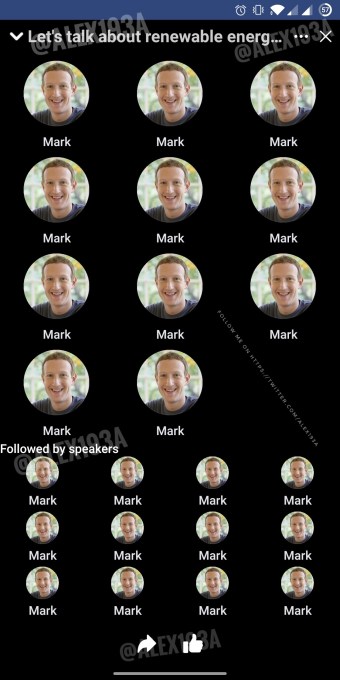
New screenshots of Facebook’s unreleased audio product, still under development, show what appears to be a live audio broadcast experience that’s more of an extension of Facebook’s existing Messenger Rooms, rather than a standalone app experience. Facebook confirmed the images are examples of the company’s “exploratory audio efforts,” but cautioned that they don’t represent a live product at this time. The images show Clubhouse-like audio rooms with rounded profile icons and a listener section led by the speakers’ friends — very much like Clubhouse.

While the company said not to jump to any conclusions about what this all means in terms of a final product, it’s interesting to see how Facebook is thinking about social audio experiences and where they could fit in on its platform. In this case, it sees it as a third option in Messenger Rooms — users could start either a private video chat with friends or a private audio chat, or they could go live to the public on audio only.

Mark Zuckerberg (rather boldly) went on Clubhouse to praise Clubhouse for what it had pioneered, saying it would end up “being one of the modalities around live audio broadcast.” It seems Facebook sees Clubhouse as just another networking format to be knocked off, like TikTok’s vertical videos or Snapchat Stories — both of which Facebook later adopted for its own platforms.

Weekly News

Platforms: Apple

People noticed that recently created Shortcuts links broke this week, displaying a message “Shortcut Not Found,” instead of opening the Shortcuts app. The issue impacted everyone who has shared shortcuts. Apple said it was aware of the issue and working on a fix.

Apple rolled out its fifth developer betas for iOS 14.5, iPadOS 14.5 and other platforms, which was then shortly followed by the release of the public betas. These may be the last betas before the public launch, though Apple has gone beyond five betas in the past.

Apple responded to Australian Competition & Consumer Commission (ACCC), which is investigating the potential anti-competitive nature of the App Store, by saying that there were other options for developers to reach iOS users — like using a website. Some developers were not amused.

brb, implementing my Apple Watch keyboard as a web app.https://t.co/iDhfvrBvCX

— Kosta Eleftheriou (@keleftheriou) March 25, 2021

“[We] face competitive constraints from distribution alternatives within the iOS ecosystem (including developer websites and other outlets through which consumers may obtain third party apps and use them on their iOS devices) and outside iOS.”

This smacks of disingenuousness. https://t.co/spMxnJDGKo

— Dan Masters – OhMDee.com (@OhMDee) March 25, 2021

Apple also defended its App Review process to the ACCC, saying that it reviews 73% of prospective apps within 24 hours of being submitted by a developer, and offers details as to why an app didn’t comply with its guidelines. It also argued that it offers a worldwide support line that facilitates 1,000 calls per week in all 175 countries where the App Store operates.

A tentative initial witness list in Apple’s courtroom battle with Epic Games over Apple’s alleged monopolist practices includes Apple CEO Tim Cook, Software Engineering SVP Craig Federighi and Apple Fellow Phil Schiller (who helped launch and run the App Store). Epic will be calling its CEO Tim Sweeney and VP Mark Rein. Executives from Microsoft, Facebook and Nvidia are also included.

Platforms: Google

Google announced the Android Ready SE Alliance to make sure that new phones will be ready to support digital alternatives to things like car keys, house keys, wallets (think national IDs, mobile driver’s licenses, passports) and more. This requires that phones include tamper-resistant hardware called a Secure Element (SE) and StrongBox, an implementation of the Keymaster HAL that resides in a hardware security module, which launched with the Pixel 3 in 2018.

A bunch of Android apps, including Gmail and Google Pay, began crashing this week due to an issue with Android System WebView. Google addressed the problem by issuing updates for the standalone WebView app and Google Chrome.

E-commerce

H&M was removed from major e-commerce apps and platforms in China, including Alibaba’s Taobao, JD.com and Pinduoduo, Meituan’s shop-listing app Dianping, map apps from Tencent and Baidu, among other major online platforms. The Swedish retailer had decided to stop buying cotton from Xinjiang, where over 1 million members of the Uyghur and other predominantly Muslim ethnic minorities have been confined to detention camps, which are accused of imposing forced labor. Nike, Adidas, Burberry, Uniqlo and Lacoste also criticized China for expressing concern over Xinjiang, leading dozen of celebs to cancel endorsement deals.

NBCU struck a deal with Facebook and Instagram to extend its “shoppable opportunities” to social media platforms. The e-commerce partnership will put pitches from the TV company’s clients on its social handles on Facebook and Instagram.

Fintech

Robinhood, the free trading app and recent home to the GameStop frenzy, confidentially filed for an IPO. The company confirmed the filing in a blog post after several media outlets broke the news.

Social

TikTok belatedly banned some Myanmar accounts that posted violent videos supporting the military’s violent coup, saying that it was aggressively cracking down on accounts promoting violence. The takedowns of the video — some of which threatened protesters with death or spread hate-fueled claims — didn’t start until early March, a month after the coup began.

TikTok added an Ad Library tool that allows marketers to view the top performing ad campaigns taking place across the app. The “top ads” feature can also be filtered by vertical and region, then by time (last seven or 30 days), and performance (CTR, impressions, video view rate).

Snapchat is developing its own take on TikTok Duets with the test of a Snap Remix feature. Duets are a core part of what makes TikTok feel like a social network, rather than just a platform for more passive video viewing. Remix — which shares the name with an Instagram Duets-style feature that’s soon to launch publicly — lets users repurpose others’ Snaps for use in their own through a variety of formats.

Facebook is testing an app for prisoners who are re-entering society, Bloomberg reports. The “Re-Entry App” was shared at the top of some users’ Instagram feeds this week, offering early access.

Axios reported that Trump was in talks with no-name app vendors about creating his own social networking app. One of the companies he spoke to was the largely unknown platform called FreeSpace, which claims its network is designed to “reinforce good habits and make the world a better place.” The app includes a news feed, user profiles and group messaging features.

Parler says it sent the FBI over 50 posts about the Capitol riot ahead of January 6, The NYT reports. If accurate, it raises the question of whether or not the FBI took the threats seriously. The FBI has refused to comment on Parler’s statement. Meanwhile, Parler is facing a lawsuit by former CEO John Matze who claims he was forced out by conservative donor Rebekah Mercer.

U.K. watchdog says Facebook’s acquisition of Giphy raises competition concerns. The Competition and Markets Authority launched the first phase of its investigation in January, and notes that Giphy had competed with Facebook outside the U.K. in digital ad deals.

Twitter seems to be working on an audience picker for its upcoming communities feature, reports Jane Manchun Wong. This would be accessible from within the tweet composer screen.

Twitter is working on audience picker for communities in the tweet composer pic.twitter.com/aqWQitUP0c

— Jane Manchun Wong (@wongmjane) March 26, 2021

Streaming & Entertainment

Spotify updated its mobile app with several changes to the Home hub. These include a way to rediscover recently played songs as far back as three months ago; a way for Premium users to view new and unfinished podcasts with a blue dot (new) and progress bar (unfinished); and a new section of personalized music recommendations. The company later in the week updated its desktop and web app, as well.

Triller forges licensing agreements with music publishers, Variety reports. The agreement with the National Music Publishers’ Association, which represents most American publishers, follows Universal withdrawing its entire library from the app last month, claiming Triller withheld payments. Triller claimed to have no idea why UMG would do this.

Clubhouse says its Android launch will “take a couple of months.” Before, the company had said it would be “soon” without promising any sort of time frame.

Gaming
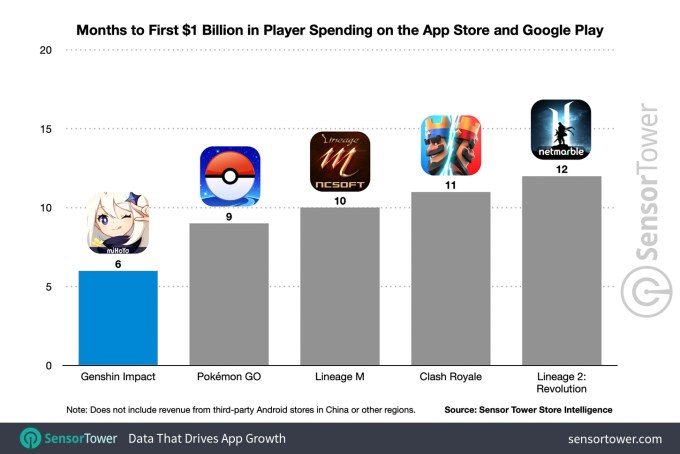
Image Credits: Sensor Tower

Genshin Impact tops $1 billion on mobile in less than six months following its September 2020 launch, says Sensor Tower. During the last 30 days, the game ranked No. 3 on the App Store and Google Play combined, behind Tencent’s PUBG Mobile and Honor of Kings.

Gaming voice and text chat service Discord, which has expanded into other forms of social networking, is said to be exploring a sale that could be worth over $10 billion. Bloomberg reported Microsoft was in talks to buy the service for more than $10 billion but no deal was imminent and Discord may choose to go public instead.

PUBG Mobile has grossed $5 billion in revenue after generating an average of $7.4 million per day in 2020, Sensor Tower reports. Like many games, PUBG Mobile’s revenue soared during the height of the pandemic with record spending of $300 million last March, during lockdowns.

Google Stadia may soon get touchscreen controls on Android, 9to5Google found by digging into the Android app’s code. The controls would allow users to use gestures like tapping, swiping and pinching.

Education
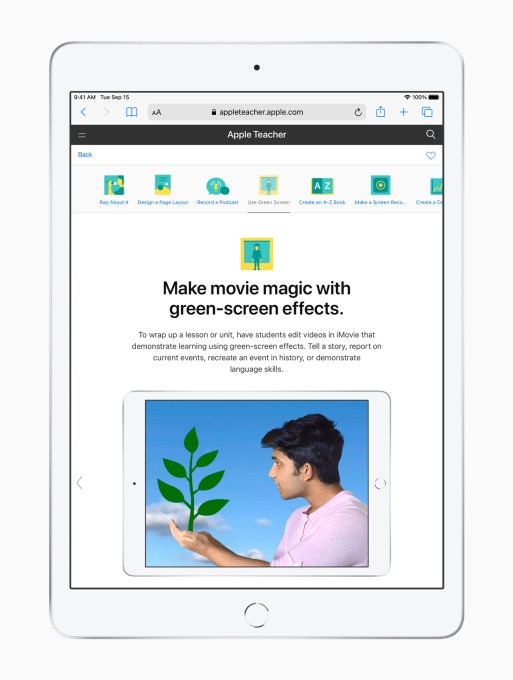
Image Credits: Apple

Apple updated its Schoolwork and Classroom apps with a few more features aimed at making it easier to share projects and support remote learning, among other things. The company also announced a Teacher Portfolio badge that would be awarded to teachers who completed a series of lessons focused on learning foundational skills on iPad and Mac.

Health & Fitness
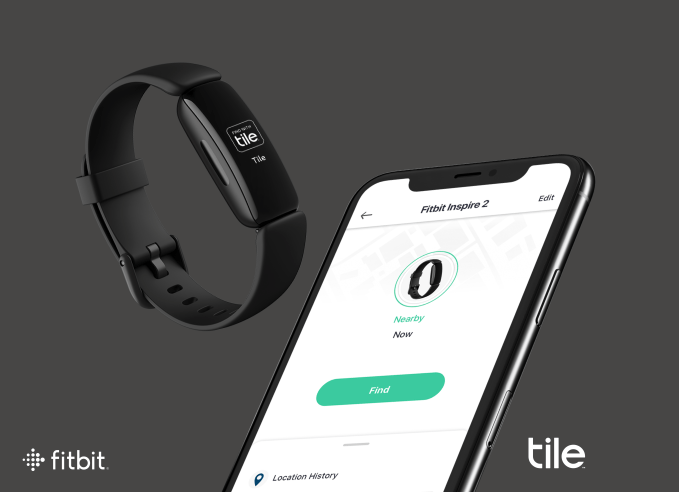
Image Credits: Tile

Tile’s lost item-tracking service arrived on wearables for the first time thanks to a new partnership with Google’s Fitbit. Through a Fitbit app update, new and existing Fitbit Inspire 2 owners will gain access to Tile’s Bluetooth-based finding network to locate their misplaced Fitbit.

Health and fitness apps’ downloads increased 20% in 2020 due to the pandemic and users shifting to at-home workouts, says App Annie. In the IoT and fitness-tracking app space, Mi Fit, Strava, MyFitnessPal, Google Fit, Fitbit, BetterMe, Runtastic, Nike Training Club, Step Tracker by Leap Fitness and Samsung Health saw the most downloads last year.

Data shared by Uswitch notes that demand for sleep apps increased by 104% during the pandemic, while demand for wellness apps grew 26% since March 2020.

Productivity

Slack CEO Stewart Butterfield teased new Slack features were in beta testing: an asynchronous audio messages feature, a Clubhouse-like drop-in voice chat and Slack Stories. The exec announced the news in the PressClub show on Clubhouse, adding “good artists copy, great artists steal.”

Slack also this week launched a new universal DM system called Connect DMs, which allows any Slack user to direct message any other Slack user. The system was immediately called out for potentially enabling harassment and abuse, leading the company to pull the ability to customize the invite message.

Cortana has begun to warn its iOS and Android users that it will be shut down on March 31st. Microsoft pulled back on Cortana last year, but Cortana is still accessible on Windows. The company is also discontinuing Cortana support on the Harman Kardon Invoke speaker, as well.

Opera’s Touch iOS web browser app, now rebranded just Opera, released a major update that modernized the UI with a more flat look, a new color palette, reworked text and new icons in the bottom bar and in the “Fast Action” button, which lets you get to favorite destinations quickly. It also adds a built-in Ethereum wallet.

Privacy & Security

China defined new rules over information apps can collect, saying that users of short video, news, browser and utility apps can access basic services on these platforms without providing their personal info. The new regulation goes into effect May 1 and covers 39 app categories — including also messaging, online shopping, payments, ride hailing, short video, livestream and mobile games — where it specifies what information is necessary to use the app (e.g. if e-commerce, a user’s phone number, name, address, and payment info).

The Indian government is trying to stop WhatsApp’s controversial privacy policy update with an antitrust investigation into the policy changes, in order to determine the full extent of the app’s data-sharing practices enabled through the “involuntary consent” of WhatsApp users.

An investigation by The NYT found that Britain’s top gambling app, Sky Bet, was compiling extensive records about users. Either the app or one of the data providers it hires to collect info on users had access to users’ banking records, mortgage details, location and gambling habits.

Apple responded to ProtonVPN’s claims that Apple was standing in the way of human rights by rejecting one of its app updates. The VPN maker attempted to tie the rejection to the coup in Myanmar, saying that people in the country use its app to bypass internet crackdowns and share information about the ongoing “crimes against humanity” taking place in the country. Apple responded to the attack by noting that it had only asked the developer to reword its description so it doesn’t read like it’s encouraging users to bypass geo-restrictions or content limitations (you know, which would be illegal). And it pointed out that all Proton’s apps have remained available in Myanmar this whole time.

Facebook caught Chinese hackers using fake personas to target Uyghurs abroad. The social network caught the network of China-based hackers using fake Facebook accounts where they posed as activists, journalists and other sympathetic figures to send the targets to compromised websites. The hacking groups are aiming to gain access to the targets’ devices by getting them to install malicious apps for surveillance purposes.

A cybersecurity review of TikTok by the University of Toronto’s Citizen Lab says it’s not worse than Facebook in either data privacy or security. This, however, may be a low bar.

Scam apps have stolen more than $400 million from users across the App Store and Google, according to a study by Avast. The company reported 204 so-called “fleeceware apps” with over a billion combined downloads that trick users into free trials but then overcharge them with subscriptions that are as high as $3,432 per year.

💯 “Apart from the financial harm… users affected by such scams will be less inclined to download apps or engage with app stores in general. Therefore, these fleeceware appls have a negative impact on legitimate developers that use the subscription model in an ethical manner.” https://t.co/4ec5AtF0s3

— David Barnard (@drbarnard) March 25, 2021

Funding and M&A

💰 Messaging app Telegram raised over $1 billion through bond sales to multiple investors, including a combined $150 million investment by Mubadala Investment Co. and Abu Dhabi Catalyst Partners, which is part-owned by the Abu Dhabi state fund. Last week, this column noted that the app had owed its creditors around $700 million by the end of April, per The WSJ’s report.

💰 Fortnite and Houseparty owner Epic Games is reportedly closing on $1 billion in new funding that will value its business at $28 billion.

🤝 Twitter acqui-hired the team from API integration platform Reshuffle to work on its own developer API platform. The team of seven, including two co-founders, will immediately begin work on building tools for Twitter developers while Reshuffle’s business is wound down.

💰 Link-in-bio company Linktree, whose mini websites get linked to by creators in your favorite social apps, raised $45 million to develop new social commerce tools. The company says a third of its 12 million users have signed up within the last four months — a trend partially driven by the pandemic.

📈 South Korea’s largest travel app Yanolja is in talks with banks to go public through a dual listing in Seoul and overseas. The company is aiming for a $4 billion valuation.

📈 ironSource, a business platform for the app economy, reached an agreement with Thoma Bravo’s blank-check firm to go public via a SPAC at a $11.1 billion valuation.

💰 Ryu Games raised a seed round of $2.3 million for its service that helps developers add cash tournaments to their mobile games. The company is aiming to be present on a few dozen games this year.

💰 Nigerian fintech Bankly raised $2 million for its app that digitizes cash for the unbanked, in a round led by led by Vault.

💰 Mumbai-headquartered Indian fantasy sports app Dream11’s parent firm, Dream Sports, raised $400 million in a round led by TCV, D1 Capital Partners and Falcon Edge, valuing the business at nearly $5 billion.

💰 Indian social network Public App raised $41 million just six months after its $35 fundraise, valuing the business at over $250 million — or more than double the valuation since the prior fundraise. The app now has over 50 million users, including over 50,000 elected officials, government authorities and citizen journalists.

💰 U.K.-based stock trading app Freetrade raised a $69 million Series B from Left Lane Capital. The Robinhood-like app offers free trades and the ability to buy fractional shares. The company is now valued at $366 million.

💰 Indonesian savings and investment app Pluang raised $20 million in pre-Series B funding led by Openspace Ventures. The company offers savings and investments products that allow users to make contributions starting at 50 cents (USD).

💰 AR pioneer Blippar returns with $5 million in funding after 18 months of repositioning as a B2B company in the AR space. Blippar’s AR Studio can help brands with AR on the web and inside their apps or Blippar’s own app.

Downloads

Avatarify
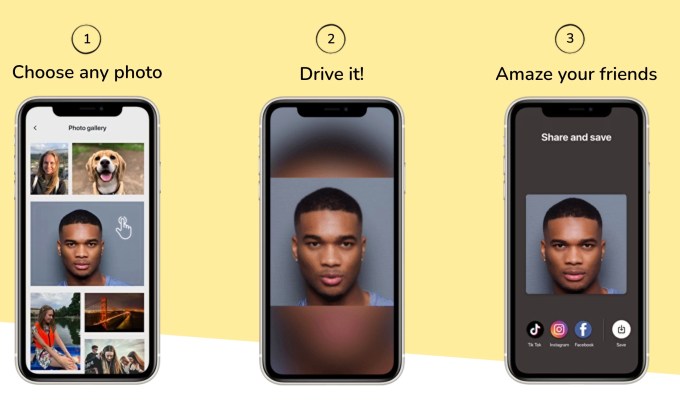
Image Credits: Avatarify

Avatarify is another app benefitting from the current interest in bringing photos to life. We’ve already seen apps like MyHeritage, TokkingHeads, Wombo and Piñata Farms introduce their own ideas in this space — whether it’s recalling long-lost relatives or just making a celeb lip sync to Michael Jackson. Avatarify, meanwhile, will let you record a short video which it then uses to animate any photo of your choice — even photos of art, babies or pets. The app is moving up the charts to now No. 28 on the App Store.

Vinyls
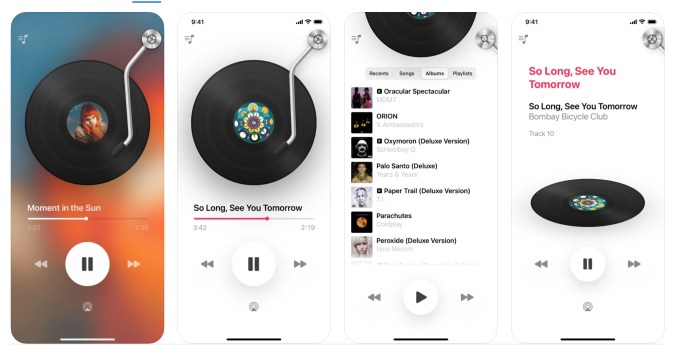
Image Credits: Vinyls

Vinyls, reviewed this week by iMore and recently by 9to5Mac as well, is a minimalist music player for Apple Music subscribers. The app was built by the developer behind the Twitter client Aviary, and displays a spinning vinyl record when music is playing. The app also animates a tonearm that aligns itself with the current playback time and moves in and out when playing and pausing the music. You can also “scrub” the vinyl to seek forwards and backwards. Vinyls is available on Mac, iPhone and iPad.

News: One of Canada’s top investors, John Ruffolo, is back from the brink with a new $500 million fund

John Ruffolo isn’t as famous as some investors but he’s very well-known in Canadian business circles. The longtime head of Arthur Andersen’s tech, media, and telecommunications practice, he joined OMERS roughly a decade ago when a former colleague became CEO and brought him aboard the pension giant to create a venture fund. The idea was

John Ruffolo isn’t as famous as some investors but he’s very well-known in Canadian business circles. The longtime head of Arthur Andersen’s tech, media, and telecommunications practice, he joined OMERS roughly a decade ago when a former colleague became CEO and brought him aboard the pension giant to create a venture fund.

The idea was to back the most promising Canadian companies, and Ruffolo steered the unit into investments like the social media management Hootsuite, the recently acquired storytelling platform Wattpad, and the e-commerce platform Shopify, among other deals. The last was particularly meaningful, given that OMERS owned around 6% of the company sailing into a 2015 IPO that valued it at roughly $1.3 billion at the time. Alas, owing to the pension fund’s rules, it also began steadily selling that entire stake, even as the company’s valued ticked upward. (Shopify’s market cap is currently $130 billion.)

Indeed, after helping OMERS subsequently get a growth equity unit off the ground, an antsy Ruffolo left to launch his own fund. Then came COVID, and as if the pandemic weren’t bad enough, Ruffolo further underwent a harrowing ordeal last summer. An avid cyclist, he last September set out to ride 60 miles one sunny morning on a country road, and was knocked far off his bike by a Mack truck in an accident that shattered most of his bones and left him paralyzed from the waist down.

That kind of one-two punch might drive someone to the brink. Instead, six months and multiple surgeries later, Ruffolo, is undergoing training and therapy and intends to bike someday again. He is also very much back to work and just taking the wraps off his new Toronto-based firm, Maverix Private Equity, which has $500 million to invest in “traditional businesses” that already produce at least $100 million revenue and are using tech to grow but could use an outside investor for the first time to really hit the gas.

We talked with Ruffolo about the accident and his new fund this morning. You can hear that conversation here (it starts around the seven-minute mark, and it’s worth a listen). In the meantime, following are excerpts from that interview, edited lightly for length.

TC: You’re surely tired of answering the question, but how are you doing?

JR: Well, when somebody says it’s great to be alive, it is. I actually never knew how close I was to death, to be honest, until about eight days after the accident. When I asked for my phone, just to kind of see what’s going on in the world, there was thousands of messages coming through. And I’m like, ‘What the hell?’

People were copying various articles. I picked off the first one, and it said, ‘John suffered a life threatening injury.’ And I’m kind of thinking, ‘Life threatening? Why are they saying that? And the doctors came in and said, ‘Because it was. We thought that you were going to die in the first 48 hours.’ I subsequently spoke to some of the top physicians [in Canada], and they don’t understand why I didn’t die on impact. That kind of scared me a little bit, but I’m so glad to be alive. And my recovery is far ahead of schedule. It was only within a couple of weeks where I started feeling my legs again.

TC: You were basically pulverized, yet a recent piece about your recovery in The Globe & Mail notes that within a month or so, you were back to thinking about your new fund. Do you think you might be . . . a workaholic?

JR: Some people call it stupid. [Laughs.] But for the two months, my first memory was worrying about my family and stuff [but] I have group of cycling friends — we’re called Les Domestiques — who have committed to cycling, and it’s a lot of folks who are investors, CEOs of big banks in Canada, we’re all close friends, [and] they all came to cocoon the family to make sure that nothing went wrong. So very quickly, all of these folks take over every element of the family, and the kids were fine, everybody was fine. I then had a lot of this time in hospital, and I do get antsy, and I started placing the calls to the investors who were committing to this fund pre COVID . . . I just really wanted to tell them, ‘Hey, I’m not dead. All my faculties are there. Are you still gonna be there when I get out of hospital?’

TC: Because they’re really investing in you and your track record.

JR: That’s exactly right. And I gotta tell you, it’s an interesting comparison. I’ve had American investors, and Canadian investors. American investors are very transactional. They’re very fast to come in if they see a great value proposition. Canada is not the same thing. In Canada, I’m extremely well-known as an investor and there, it’s actually relationship-driven, which is both good and bad. It’s tough in Canada because they’re more conservative, however, they stick with you in bad times. In my case, every single investor, everyone that had committed on pre- COVID, came in. Then one in particular doubled the size of the investment. They just felt bad for me, and I was like, ‘Hey, dude, I will take that sympathy card. Anytime.’

TC: You also see a real market for a Canadian-led firm to invest in Canadian companies versus taking money from American counterparts.

JR: So now this is going a little bit to the thesis, which is not a new thesis from a US perspective but is new from a Canadian perspective: the great firms in the U.S., like an Insight [Partners], like a Madison Dearborn, Bain Capital, General Atlantic, Summit — we don’t have any of those in Canada. We have great venture capital firms, and we have great buyout private equity firms. But what was really happening here is the entrepreneurs who are building great businesses are not really tech entrepreneurs; they’re just traditional industry entrepreneurs. And really, all I’m doing is planting a Canadian flag and saying, Hey, we have a Canadian firm that will lead or highly participate in these deals [to help you scale that business].

TC: You’re drawing a distinction between old-line industries and growth-stage tech companies, in other words, and you’re going after the former?

JR: [To me] a true technology company is one that actually builds the tool sets that are used by other businesses to make them bigger, faster, and stronger and I’ve been investing in those companies for 10 years with great success, but there’s a massive oversupply of capital in those spaces, particularly in the SaaS software space. It’s just not making mathematical sense on when it comes to a lot of these valuations. Meanwhile, when it comes to financial services, health care, travel, whatever, these are not tech entrepreneurs but they’re enlightened. We’re not introducing technology into the business, they already have it. But in one case, with a travel company we’re looking at closely, they want somebody who understands the travel space and also who understands technology and the impact as you scale globally.

The profile of the companies that I’m talking about have, on average, $100 million dollars of top line [growth], with flattish EBITDA, and that haven’t done any external financing with institutions. They’re growing at 20% to 50% a year, but they really want to become the next billion-dollar company.

TC: How much of these companies do you think you can own and for what size checks?

JR: We’re looking at 20% to 40% stakes in the business, so I’d say a significant minority, and we’re cutting checks of $50 to $75 million (U.S.)

TC: There aren’t a lot of massive companies in Canada, Shopify notwithstanding. How do you get the companies you plan to work with thinking on a different scale?

JR: Canadians might be a little bit more conservative, but the irony is, take a survey and [you’ll see] how many Canadians are running huge firms in the United States or in the Valley. It’s not inherent in Canadians [that they are risk averse].

Part of why I got into venture capital was I was so frustrated in the number of companies that were building products but couldn’t even generate revenues. Since then, I think we solved in Canada the zero to $10 million problem, then the $10 million to $100 million [challenge]. But starting around 2016 or so, I started to see companies that had $50 million, $60 million, $70 million in revenue starting to plateau, and the issue was global scalability.

In the U.S., so many companies can be a domestic company  and be a billion-dollar company. In Canada, our market is too small; you’re forced to sell on a global scale, and many Canadian companies struggle with that. So my focus now is that last part of the piece. How do we get these companies from $100 million businesses into $1 billion-plus?

WordPress Image Lightbox Plugin