Monthly Archives: March 2021

News: Equity Monday: Deliveroo, ServiceTitan, and Robinhood for everywhere

Hello and welcome back to Equity, TechCrunch’s venture capital-focused podcast where we unpack the numbers behind the headlines. This is Equity Monday, our weekly kickoff that tracks the latest private market news, talks about the coming week, digs into some recent funding rounds and mulls over a larger theme or narrative from the private markets. You

Hello and welcome back to Equity, TechCrunch’s venture capital-focused podcast where we unpack the numbers behind the headlines.

This is Equity Monday, our weekly kickoff that tracks the latest private market news, talks about the coming week, digs into some recent funding rounds and mulls over a larger theme or narrative from the private markets. You can follow the show on Twitter here and myself here.

This morning was a fun mix of news, including some early-stage and late-stage startups entries, along with the latest from the public markets and the great IPO game. Here’s the rundown:

It was a lot, but when have we started the week anything less than fully behind? Chat Wednesday!

Equity drops every Monday at 7:00 a.m. PST, Wednesday, and Friday at 6:00 AM PST, so subscribe to us on Apple PodcastsOvercastSpotify and all the casts!

News: IBM launches its first quantum developer certification

IBM today announced the launch of its first developer certification for programming quantum computers. While quantum computing may still be in its infancy, most pundits in the industry will tell you that now is the time to learn the basic concepts. And while there is little that’s immediately intuitive on the hardware side of quantum

IBM today announced the launch of its first developer certification for programming quantum computers.

While quantum computing may still be in its infancy, most pundits in the industry will tell you that now is the time to learn the basic concepts. And while there is little that’s immediately intuitive on the hardware side of quantum computing, the actual software tools that most players in the industry are developing today should feel somewhat familiar to virtually any developer.

Unsurprisingly, the ‘IBM Quantum Developer Certification,’ as it’s officially called, focuses on IBM’s own software tools and especially Qiskit, its SDK for working with quantum computers. Qiskit has already proven quite popular, with more than 600,000 installs and when IBM Quantum and the Qiskit team hosted a quantum summer school last year, almost 5,000 developers participated.

But on top of knowing their way around the basics of Qiskit (think defining and executing quantum circuits) developers also need to learn some of the basics of quantum computing itself. Once you know your way around Bloch spheres, Pauli matrices and Bell states, you’ll probably be in good shape for taking the certification exam, which will be administered on the Pearson VUE platform.

Abe Asfaw, the global lead for Quantum Education and Open Science at IBM, told me that this is just the first of a series of planned quantum certifications.

“What we’ve built is a multi-tiered developer certification,” he told me. “The first tier is what we’re releasing in this announcement and that tier gets developers introduced to how to work with quantum circuits. How do you use Qiskit […] and how do you run it on a quantum computer? And once you run it on a quantum computer, how do you look at the results and how do you interpret the results? This sets the stage for the next series of certifications that we’re developing, which are then going to be attached to use cases that are being explored in optimization, chemistry and finance. All of these can now be sort of integrated into the developer workflow once we have enabled someone to show that they can work with quantum circuits.”

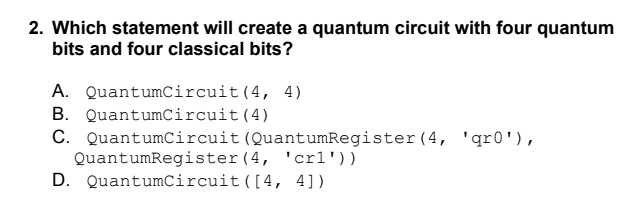
Image Credits: IBM

Asfaw stressed that IBM has focused on education developers about quantum computing for quite a while now, in part because it takes some time to develop the skills and intuition to build quantum circuits. He also noted that the open-source Qiskit project has integrated a lot of the tools that developers need to work at both the circuit level — which is a bit closer to writing in C or maybe even assembly in the classical computing world — and at the application level, where a lot of that is abstracted away.

“The idea is to make it easy for someone who is currently developing, whether it’s in the cloud, whether it’s using Python, to be able to run these tools and integrate quantum computing into their workflow,” Asfaw said. “I think the hardest part, to be very honest, is just giving someone the comfort to know that quantum computing is real today and that you can work with quantum computers. It’s as easy as opening up a Jupyter notebook and writing some code in Python.”

He noted that IBM already often helps upskill developers in its partner companies who are interested in quantum computing. So far, though, this has been a very ad hoc process. With the new certification program, developers can now formally demonstrate their skills and show that they are in a position to utilize quantum computing in their workflow.

News: The Station: Breaking down TuSimple’s S-1

The Station is a weekly newsletter dedicated to all things transportation. Sign up here — just click The Station — to receive it every weekend in your inbox. Hi friends and new readers, welcome to The Station. A few items before we jump into the news. Rebecca Bellan, who started writing for TechCrunch earlier this month,

The Station is a weekly newsletter dedicated to all things transportation. Sign up here — just click The Station — to receive it every weekend in your inbox.

Hi friends and new readers, welcome to The Station. A few items before we jump into the news.

Rebecca Bellan, who started writing for TechCrunch earlier this month, is going to be contributing to the micromobbin’ section as part of her focus on ebikes, scooters and other personal mobility vehicles. Reach out to her at rebecca.techcrunch@gmail.com if you want to share some micro news or offer up a tip.


Last week, I promised a new market maps article — those deep dives into slices of the transportation sector. The latest, written by Abigail Bassett, examines the business of augmented and virtual reality in vehicles. This is an Extra Crunch story, which requires a subscription.

As I’ve shared in here before, we’re bringing more transportation analysis to Extra Crunch. So far, we’ve had Mark Harris’ article on solid state batteries and Jason Plautz’s piece on the business of MaaS transit. This coming week we’ll have analysis on the market for second-life batteries.

Of course, my email inbox is always open. Email me at kirsten.korosec@techcrunch.com to share thoughts, criticisms, offer up opinions or tips. You can also send a direct message to me at Twitter — @kirstenkorosec.

Micromobbin’

the station scooter1a

Lime rolled out several new app features designed to get more people riding their ever-growing fleet of e-scooters. The micromobility company will make e-scooter rides available to new users who don’t have the app and aren’t particularly fussed to download it — whether it’s for personal reasons, commitment issues or lack of phone space. Instead, customers can just scan the QR code on the scooter and let Apple’s App Clips or Android’s Instant App do the work of payment. Lime says they’re already seeing impressive conversion rates for new riders coming to the scooters slowly through this coy method.

Lime also decided to do away with the fee for reserving vehicles for up to 10 minutes, a cost that developers say was not only unnecessary, but also restrictive — apparently, during tests, the percentage of people who used the reservation feature increased once the price dropped. And to make it just that much more convenient to hop off the subway and step onto a scooter, the Lime app will also highlight a path to the rider’s nearest scooter. Finally, riders now you can go into dark mode on the app if they feel like it. Lime says this makes viewing the app at night easier on the eyes. And besides, all the other apps are doing it!

Some other micromobility tidbits …

British Columbia has approved e-scooter pilot projects in four cities within Metro Vancouver, as well as Kelowna and Vernon. Municipal governments put a call out for interested local jurisdictions last year, and these localities were among those who raised their hands. It’s still not clear which companies will be dropping their dockless e-scooters on the Canadian streets, but something tells me we’ll see many of the usual players.

In other policy-related news, Washington state is thinking about installing an e-bike tax break. A state Senate committee will be holding a hearing this week on a bill that would make e-bikes exempt from the state’s 6.5% sales tax.

— Rebecca Bellan

Deal of the week

money the station

TuSimple filed an IPO, putting to rest months of speculation that the autonomous vehicle startup was going to take the trendy route to the public exchanges and merge with a special purpose acquisition company. The company did not SPAC, but instead took the traditional IPO route.

TuSimple’s S-1 is a page turner. I’ll list a few of the items that popped out.

1. TuSimple’s shares are largely held by Chinese investors. The company’s principal stockholders of Class A shares are Sun Dream Inc with 20%, Composite Capital Master Fund with 7.28% and Navistar with 6%. Navistar is now owned by Volkswagen Group’s The Traton Group. TuSimple’s co-founders Mo Chen and Xiaodi Hou hold 9.1% and 8.5%, respectively in Class A shares. The two each hold 50% of the Class B shares.

The Sun Dream is ultimately controlled by Charles Chao, who is a board member, but perhaps best known as the chairman of Sina, which owns Weibo.

While TuSimple has a large U.S. presence and a number of partnerships with U.S. companies, there’s no denying its Chinese ties.

2. At least one of TuSimple’s investors has caught the attention of the Committee on Foreign Investment in the United States. TuSimple reveals in its S-1 that CFIUS is reviewing shares held by Sun Dream, which as I mentioned above is an affiliate of Sina Corporation. CFIUS will have 45 days to conduct a review of the Investment.

3. The S-1 shows that TuSimple had a loss from operations of $177.9 million in 2020, more than double loss of $84.8 million incurred in the previous year. The company said it had net losses from operations of $45 million in 2018. Its accumulated deficit was $405.2 million as of December 31, 2020.

Net loss attributable to common stockholders sat at $198.8 million in 2020, up from a loss of $145 million a year earlier. The company’s revenue did rise to $1.8 million in 2020, up from $710,000 the previous year.

The upshot: TuSimple has lost more than $307 million in the past three years, a figure that illustrates the kind of capital that the larger, well funded autonomous vehicle companies are pouring through to try and commercialize the technology.

It makes me more confident than ever that other AV companies like Aurora will soon file to go public as well, either via the traditional path or through a SPAC merger.

Other deals that got my attention this week …

Automotus, a curb management startup that uses video analytics, raised $1.2 million in a seed round last month led by Quake Capital, Techstars Ventures, Kevin Uhlenhaker (the co-founder & CEO at NuPark, which was acquired by Passport) and Baron Davis. More investors, including Ben Bear, Derrick Ko, and Zaizhuang Cheng of micromobility company Spin, have piled on bringing its total raise to $2.3 million, CEO Jordan Justus told TechCrunch.

Baraja, Australian lidar maker, raised a $31 million in a Series B round led by Blackbird Ventures. Main Sequence Ventures, Hitachi Construction Machinery, Regal Funds Management, Perennial Value Management and InterValley Ventures also joined the round.

The company said the funds will be used to continue the deployment and development of its “unique and ingenious” imaging system. As Devin Coldewey explains in his article, Baraja’s lidar uses what the company calls Spectrum-Scan, letting physics do the hard work of directing the light. By passing its laser through a prism, different wavelengths of light go in different directions — and when it comes back, it takes the same path. Check his coverage of the company from CES last year, which lays it out in more detail.

Baton, a San Francisco-based startup that wants to set up drop zones for long-haul trucking companies, raised $10.5 million in the Series A in a Series A funding round, co-led by 8VC and Maersk Growth, the corporate venture arm of logistics giant AP Moller-Maersk. The now has a post-money valuation of $50 million, co-founders Nate Robert and Andrew Berberick told TechCrunch.

Prologis, Ryder, Lineage Logistics, Project44 CEO Jett McCandless, KeepTruckin’ CEO Shoaib Makani, Clarendon Capital operating partner John Larkin, I.S.G founder Trace Haggard and Cooley LLC all participated in the round.

Blacklane, the Berlin startup that provides on-demand black-car chauffeur service, closed a round of €22 million ($26 million at current rates). Blacklane, which took a majority stake in Havn in February, said that it will be using this latest round of funding to continue expanding sustainable travel initiatives, and to continue expanding its existing business with more flexible options for riding.

Flapper, an on-demand private aviation company based in Brazil, raised $2 million in a Series A round led by the aerospace-focused fund, Confrapar. Crowdfunding platform SMU and angel investor group Investidores.VC also participated along with a number of foreign and local investors, including three undisclosed air taxi companies. The company has previously raised $1 million Seed funding, led by Confrapar and ACE, Brazil’s largest accelerator.

Gorillas, the Berlin-based grocery delivery startup, raised $290 million in Series B funding, at a valuation that surpasses $1 billion. The round was led by Coatue Management, DST Global and Tencent, with participation from Green Oaks, Fifth Wall and Dragoneer. Previous backer Atlantic Food Labs also followed on.

Hoppin, the Canadian travel startup Hopper, raised a $170 million in a Series F round led by Capital One. The U.S. banks and credit card company is also coming on board as a strategic partner, to launch Capital One Travel, which is the first instantiation of Hopper’s new B2B platform, Hopper Cloud.

Woven Capital, the investment arm of Toyota’s innovation-focused subsidiary Woven Planet, kicked off its new $800 million strategic fund with an investment in autonomous delivery startup Nuro. Neither company shared the amount of the investment. We do know that Woven Capital’s contribution was part of Nuro’s $500 million Series C funding round, which was announced last November. Chipotle also invested in the round, which also included funds managed by T. Rowe Price Associates, Inc., with participation from new investors Fidelity Management & Research Company, LLC and Baillie Gifford.

Notable news and other tidbits

the-station-delivery

Whew, the newsletter is a bit long already, so I’ll just mention a few other items worth noting this week.

Autonomous vehicles

Cruise, autonomous vehicle subsidiary of GM, seems to be trying to appeal to the youths by creating an influencer-esque personality out of one of its vehicles. “Poppy,” who identifies with she/her pronouns according to her Twitter bio, debuted her first post Wednesday, sharing a TikTok video that shows her riding around the streets of San Francisco. Cruise began testing its self-driving car on the Bay Area streets in December.

This is how much fun weeee have driving in San Francisco. pic.twitter.com/3lpWC66PSB

— Poppy the AV (@poppytheav) March 24, 2021

Plus will be part of a pilot project with SF Express that aims to demonstrate how trucks with an automated driving system can improve logistics operations. Plus is running its supervised autonomous trucks on two long-haul routes in China.

Yandex published a blog post with details on how its autonomous vehicles development in Russia. The company said it recently passed 6 million miles of testing, with one-third of that mileage driven in Russian winter conditions. The blog describes how it uses neural networks to filter snow out of the lidar point cloud and handle condensation clouds created by car exhausts and heating vents, among other challenges.

Electric

BMW Group and California utility Pacific Gas & Electric are rolling out the next phase of a pilot that aims to test — and learn — how electric vehicles could support the integration of renewable energy on the electric grid.

Electric vehicle manufacturers are pushing back against a decision by the National Highway Traffic Safety Administration to delay penalty increases for automakers who fail to meet fuel efficiency standards.  Tesla has taken the most active role and petitioned the Second Circuit U.S. Court of Appeals to review the ruling, saying that the delay “inflicts ongoing, irreparable injury” on the company and creates an “uneven playing field” by reducing the consequences of nonadherence.

Geely Automobile Holdings is launching a new brand of premium electric vehicles called Zeekr. The vehicles will be manufactured by parent company Zhejiang Geely Holding Group. The first Zeekr vehicles are expected to be delivered in the third quarter of 2021.

Jeep has partnered with Electrify America to create the Jeep 4xe Charging Network. Jeep-branded EV charging stations will be installed at or near the trailheads of Jeep Badge of Honor off-road trails over the next year. Jeep 4xe charging stations are scheduled to open this spring at three of the most-popular off-road sites and icons for the Jeep brand: Moab, Utah as well as the Rubicon Trail and Big Bear, both of which are in California. (Sorta reminds me of the Rivian adventure network).

Rivian has been sued by Illinois car dealers over its direct-to-consumer sales model.

Tesla is now accepting bitcoin (at least for customers in the U.S.).

Ride-hailing and sharing

Uber is being challenged in the U.K for using facial recognition technology for a driver identity system. The App Drivers & Couriers Union and the Worker Info Exchange have called for Microsoft to suspend the ride-hailing giant’s use of B2B facial recognition after finding multiple cases where drivers were mis-identified and went on to have their license to operate revoked by Transport for London.

Via partnered with southeast Michigan’s public transit authority (known as SMART) to launch an on-demand public transit service in the Detroit Metro area. The on-demand public transit service, called SMART Flex, will act as a complement and extension to the existing transit system in the area.


News: How startups can go passwordless, thanks to zero trust

“There is no doubt that over time, people are going to rely less and less on passwords… they just don’t meet the challenge for anything you really want to secure,” said Bill Gates. That was seventeen years ago. Although passwords have lost some of their charm, they have so far survived many attempts to kill

“There is no doubt that over time, people are going to rely less and less on passwords… they just don’t meet the challenge for anything you really want to secure,” said Bill Gates.

That was seventeen years ago. Although passwords have lost some of their charm, they have so far survived many attempts to kill them for good.

The perception of high cost and tricky implementations has stalled some smaller businesses from ditching passwords. But alternatives to passwords are affordable, easy to implement, and safer, show industry insights gathered by Extra Crunch. The move to zero trust systems is acting as a catalyst.

First, a primer. Zero trust focuses on who you are, not where you are. Zero trust models require companies to never trust any attempt to access its network, and must verify every single time — even from logins from inside the network. Passwordless tech is a key part of zero trust models.

There are several alternatives for passwords, including:

  • Biometric authentication: widely used as fingerprint readers in smartphones and physical verification points at buildings;
  • Social media authentication: where you use your Google or Facebook IDs to authenticate you with a third-party service;
  • Multi-factor authentication: where more layers of authentication are added using devices or services, such as token authentication using a trusted device.
  • Grid authentication cards: which provides access while using a combination PIN number.
  • Push notifications: which are usually sent to the user’s smartphones or encrypted devices.
  • Digital certificates: cryptographic files stored locally on the machine or device.

Wolt, a Finnish food-delivery site is just one example of going passwordless.

“The user registers by entering their email address or a phone number. Login to the app takes place by clicking the temporary link in the user’s inbox. The app on the user’s mobile phone places an authentication cookie, which enables the user to continue from that device without having to go through any further authentication,” said Erka Koivunen, CISO at F-Secure.

In this case, the service provider is in full control of the authentication, allowing it to set expiration time, revoke service, and detect fraud. The service provider does not need to count on the user’s commitment to keep track of their passwords.

Passwordless tech is not inherently costly but may take some adjustment, explained Ryan Weeks, CISO at managed service provider Datto.

“It is not necessarily costly in terms of monetary investment, because there are a lot of easily accessible open-source alternatives for multi factor authentication that don’t require any sort of investment,” said Weeks. But some companies believe passwordless tech may cause friction to their employees’ productivity.

Koivunen also dismissed that zero trust models are unaffordable for startups.

“Zero trust recognises the futility of forcing users to authenticate themselves by presenting something they should keep as secret. Instead, it prefers to establish the user’s identity using some context-aware method,” he said.

Zero trust goes further than authenticating users; it also includes the device and the user.

“From a zero trust perspective, there is an idea that there is a continuous authentication or revalidation of trust occurring. Therefore, passwordless in a zero trust model is potentially easier for the user and more secure as the combination of the ‘something you have’ and ‘something you are’ factors are more difficult to attack,” said Datto’s Weeks.

Larger companies, like Microsoft and Google, already offer zero trust technologies. But investors are also eyeing smaller companies that offer zero trust for growing companies.

Axis Security, a zero trust provider that allows remote employees to access their company’s network, raised $32 million last year. Beyond Identity raised $75 million in funding in December. And, Israel identity validation startup Identiq raised $47 million in Series A funding in March.

News: DiDi Chuxing expands to South Africa, to take on Bolt and Uber

Chinese ride-hailing company DiDi Chuxing has started operations in South Africa today, according to Reuters. Founded in 2012, the Beijing based company operates in more than 400 cities in China. It claims to serve over 550 million users in 16 countries across Asia, Europe, Latin America, and Australia. This South African expansion (first launch in

Chinese ride-hailing company DiDi Chuxing has started operations in South Africa today, according to Reuters.

Founded in 2012, the Beijing based company operates in more than 400 cities in China. It claims to serve over 550 million users in 16 countries across Asia, Europe, Latin America, and Australia.

This South African expansion (first launch in Cape Town) marks its first presence in Africa and 17th active country.

Here’s an excerpt from the company’s website announcing the launch.

DiDi South Africa understands the challenges communities and the transportation industry face with the evolution of urban mobility (rideshare) and as a result is committed to creating the freedom and convenience to go places, open up horizons and give access to new experiences through our platforms.

Our mission is driven by a dedicated team who understand the operational landscapes of the rideshare industry. DiDi exists to help South Africans move freely and to unlock their potential and that of the cities they live in.

Although the nine-year-old company claims to understand how the ride-sharing industry works, the South African market, despite being a relatively stable environment with high economic potential compared to the rest of Africa, is a different ball game entirely.

While Uber and Bolt dominate with a few million users, they regularly face regulatory challenges from the government who feel the need to protect traditional metered taxis in the country. DiDi wouldn’t be exempt from this but the timing to expand to South Africa suggests the company is looking to explore the present challenges facing Uber as its drivers push for worker rights.

After Uber announced that it would concede employment rights to its UK drivers, SA drivers are trying to get the same treatment by filing a class-action suit against the U.S. company in collaboration with British law firm Leigh Day and Johannesburg-based Mbuyisa Moleele Attorneys.

With South Africa, DiDi currently has interests either by expansion or investments all over the world.

In 2018, DiDi acquired Brazilian ride-hailing company 99 and now claims to have 50% of the ride-hailing market share in South America. In its most dominant market, China, DiDi has almost 80% market share after buying out Uber China in 2016.

The company, whose backers include Alibaba, Apple, DST, Softbank and Tencent, also has its claws in different ride-hailing companies in markets where it doesn’t operate — Grab (Southeast Asia), Lyft (U.S.), and Ola (India). All these companies compete with Uber in their respective markets.

But having invested in Bolt as well, South Africa represents the second market after Russia, where DiDi will be going head to head with the Estonian-based company. The pair will also compete against one another when DiDi begins operations in the U.K., as reported by Bloomberg in February.

These expansion plans are geared towards increasing the Softbank-backed company’s value (currently at $62 billion) for a potential mega-IPO of $100 billion later this year.

News: This is Boston Dynamics’ next commercial robot

Boston Dynamics’ transition from a decades-long research robotics firm to a company that productizes and sells hardware has been a fascinating one to watch. There have been some tough lessons along the way, including the very real lesson that at the end of the day, most robots in the world will be deployed for mundane

Boston Dynamics’ transition from a decades-long research robotics firm to a company that productizes and sells hardware has been a fascinating one to watch. There have been some tough lessons along the way, including the very real lesson that at the end of the day, most robots in the world will be deployed for mundane tasks.

Sure, the company will continue to court the public with fun viral videos of its technology dancing to the oldies, but when it comes to actually selling robotics, the targets continue to be the dull, dirty and dangerous jobs we humans just don’t want to do. Or, as I’ve been putting it for a while now, robotics are — more often than not — cool technology performing decidedly uncool tasks.

Spot has found most of its success as an inspection robot. The quadruped has been deployed to oil rigs, nuclear plants and other places where most people would rather limit their time, given a choice. That takes care of the dangerous part of the three Ds, and you could make a reasonable argument that the company’s second commercially available robot is going after the dull bit.

Image Credits: Boston Dynamics

I’m guessing you don’t need me to cite a bunch of statistics about how massive an industry shipping and logistics is. And with so many orders moving online, things are only growing. There’s a reason, after all, so many robotics companies — including Locus, Fetch and Berkshire Grey — are devoting their entire operation to this sort of automation. As the CEO of Locus told me recently, everyone is looking for the technology that will help them compete with Amazon and its massive robotics army.

Stretch (currently a prototype) is the long-promised commercial version of Handle, a robot the company introduced via viral YouTube video a little over four years ago. In its earliest form, the wheeled robot was an extremely versatile robot with an impressive ability to maintain balance while gliding and taking on different obstacles. The robot also picked up a 100-pound crate. Little did we realize at the time that would become the foundational element of its future evolution.

In fact, Handle’s box lifting dates back even further, to a video featuring the company’s humanoid robot, Atlas. “We showed some box moving, among other things. And it got a lot of interest from people in warehouses,” Boston Dynamics VP of Product Engineering Kevin Blankespoor tells TechCrunch. “They actually wanted Atlas to come work for them. We really thought we could design a much more simple robot that could tackle a warehouse task. There’s where Handle was born. It really split off of the Atlas project at that point.”

Blankespoor says Handle was born out of the company’s long-standing desire to combine wheels with legs, forming the basis of some early experimentation with designing a robot that could help move objects in a warehouse setting.

Image Credits: Boston Dynamics

“We started experimenting with customers with Handle in warehouses. He did a couple of different tasks. The first was unloading pallets, which was pretty good. The second application was unloading trucks. Handle could do that, but it did it pretty slowly. It’s a tight space, it had to maneuver a lot and it was too slow.”

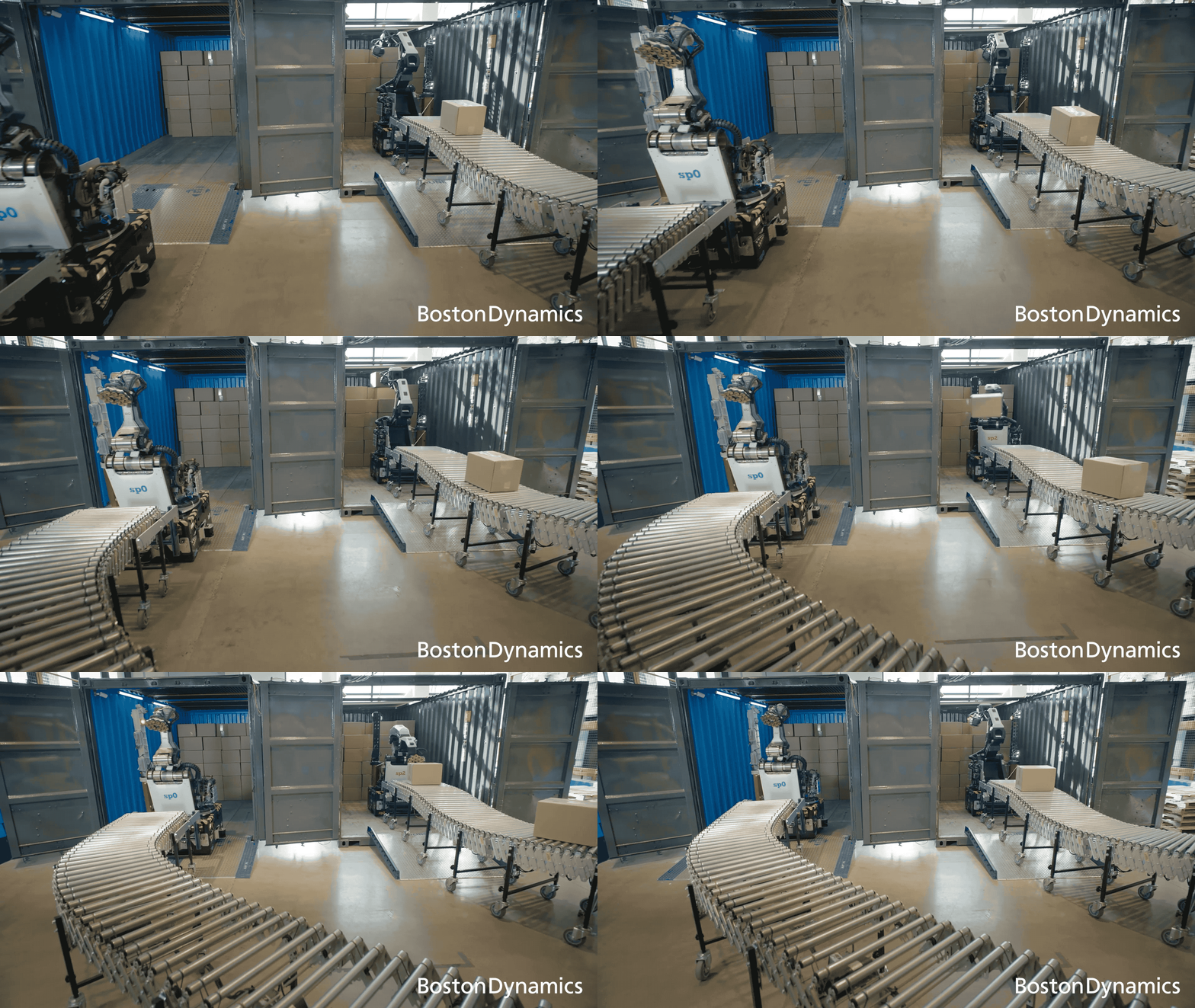
A 2019 video titled, “Handle Robot Reimagined for Logistics,” shows the wheeled robot outfitted with a large top-mounted arm and a gripper comprised of a series of suction cups. In the video, a pair of robots work in tandem, moving boxes from one pallet to another. But images of Stretch showcase how dramatically Boston Dynamics has rethought the robot in order to make it commercially viable.


Most immediately apparent is the loss of Handle’s two large wheels. In their place is a large black platform. “The mobile base is in the bottom,” Blankespoor says. “It is designed to be the size of a pallet, so it can maneuver wherever a pallet can in the warehouse.”

The unit still has wheels, though they’re far less prominent. The two wheels are now four, hidden under the corners of the base. They move in any direction, allowing for a broad range of movement and relatively tight turns for a robot of its size. Also included is a “perception mast” to the side of the arm, effectively serving as the unit’s eyes for autonomous movement and picking.

Image Credits: Boston Dynamics

The robot was designed by Boston Dynamics’ warehouse division — now numbering around 100 people. That includes those employees the company picked up as part of its Kinema Systems acquisition, back in 2019. The San Francisco-based company’s 3D vision technology has been incorporated here, as well, to improve Stretch’s picking.


Early applications include truck unloading and order building (effectively combining goods onto a single pallet). Future applications include truck loading, as well, though this is still early stages for the tech. The nature of the system is more plug and play than ground-up automation from companies like Berkshire-Grey. The company is also working to make it compatible with other warehouse systems.

Boston Dynamics plans to build the first units over the summer and will make Stretch available for sale next year. The company’s not ready to talk pricing yet, but Blankespoor says it will be “comparable to a traditional robotic system that you see in factories where you have the robot bolted to the floor.”

News: Singular is a new Paris-based VC firm with $265 million

Meet Singular, a new VC firm based in Paris that just finished raising its initial fund. The firm was founded by two former Alven partners — Raffi Kamber and Jérémy Uzan. They have some ambitious goals and an interesting investment model that could help them remain involved even during late-stage rounds. Overall, the firm raised

Meet Singular, a new VC firm based in Paris that just finished raising its initial fund. The firm was founded by two former Alven partners — Raffi Kamber and Jérémy Uzan. They have some ambitious goals and an interesting investment model that could help them remain involved even during late-stage rounds. Overall, the firm raised €225 million, or $265 million at today’s exchange rate.

If you browse Singular’s website, you’re not going to find a lot of information. Here’s what it looked like last week before the team added a list of portolio companies:

Image Credits: Singular

The Singular team doesn’t want to be secretive. But they don’t like talking about themselves. That’s why you may have seen Singular’s name in a few articles I wrote over the past few months. But now it’s time to talk a bit about what the firm has in mind when it comes to startup investment.

Jérémy Uzan and Raffi Kamber spent 11 and 8 years at Alven. They’ve been behind some of the firm’s most successful investments, such as Dataiku and OpenClassrooms. “But every time you raise another fund, you sign up for a long time,” Uzan told me.

The duo left Alven quite naturally as they felt it was time in their careers to take their destiny in their own hands. There’s no hard feeling with their previous fund.

It was the right timing personally but also the right timing for the tech ecosystem. While Singular is based in Paris, the firm plans to build a true European VC firm with its headquarters in Paris. Singular doesn’t think London should be the center of gravity for European tech investment.

Singular started fundraising in late 2019 and early 2020. Kamber and Uzan didn’t know anything about raising a fund and didn’t work with an external financial firm to handle the fundraising effort.

When asked about the coronavirus pandemic and the impact on the process, they both said that the lockdown actually helped as everyone was stuck at home. Around two-thirds of the limited partners that invested in Singular are based outside of France.

“These are historic VC investors. They really believe in tech — and Europe too. They have seen that Europe has been taking off for the past two or three years,” Kamber told me.

Just like a startup, Singular wanted to be backed by some well-known investors. And some of those investors are injecting money in a French VC fund for the first time. Limited partners include a mix of pension funds, funds of funds, sovereign funds and family offices.

Ontario Teachers’ Pension Plan, Bpifrance, Vintage Investment Partners, Axa Venture Partners, Sofina, MACSF and Mubadala Capital are some of Singular’s backers. Unless you’ve raised a VC fund in the past, you may discover some of those names for the first time. And yet, these investors are significant. For instance, while you might not be familiar with the Ontario Teachers’ Pension Plan, they have over $200 billion in net assets.

Singular started closing investment deals around October 2020. So far, the company has invested in six different startups:

  • A Series B round in Gtmhub, an OKR management service
  • A Series B round in Indy, an accounting automation software suite
  • A Series A round in Soda, an enterprise-grade data monitoring platform
  • A seed round in Moka.care, a mental health solution for employees
  • A seed round in Resilience, a full-stack software approach to improve cancer treatment
  • Another undisclosed Series A round

It’s hard to find some common trends around this list of investments, but I’m going to help you. First, let’s start with the average check size.

“We are mostly focused on Series A/B because we think there’s a lot of room to grow at that stage,” Kamber said. And Singular can invest as much as €20 million in a single round ($23.6 million at today’s exchange rate).

When it comes to verticals, Singular openly says that it doesn’t want to focus on a specific area in particular. “We are a generalist fund and we are quite opportunistic,” Uzan said. Singular doesn’t want to choose between B2B and consumer, between AI and e-commerce, etc.

Where Singular stands out is that it has a unique approach to late-stage rounds. When a portfolio company reaches the Series C or Series D stage, Singular might not have enough money under management for infinite follow-on investments.

The VC firm didn’t want to raise its own late-stage fund. So Singular will be able to structure special-purpose investment vehicles with its limited partners. A few limited partners could put some money in this investment vehicle directly and the startup could accept to raise a new round with this new investment vehicle instead of a late-stage fund.

This way, Singular remains very much involved with the portfolio company in question. It could keep a board seat and have a say when it comes to the startup’s next phases.

It’s still too early to see how it would work in real life and it’s going to happen on a case-by-case basis. But the fact that Singular can offer that kind of investments is significant — it could be appealing for some entrepreneurs. You don’t have to accept it and you’re not tied with Singular forever, but the offer is on the table.

So that’s Singular — Eva Mayoud, Alexandre Flamant and Sonia Pélisson also joined the team. It’s not that often that a French VC firm starts from zero and raises a €225 million fund in a year. It’s going to be interesting to track the firm’s upcoming investments. In the meantime, here’s some TechCrunch coverage of Singular’s past deals:

News: UK’s Cazoo will list on the NYSE by way of a SPAC, valuing it at $7B and raising $1.6B

Cazoo, the UK used-car sales portal that has been on a major fundraising tear in the last year, will be next company to pursue more growth by way of a SPAC: the company today announced that it will list on the NYSE by way of a business combination with AJAX I, a special purpose acquisition

Cazoo, the UK used-car sales portal that has been on a major fundraising tear in the last year, will be next company to pursue more growth by way of a SPAC: the company today announced that it will list on the NYSE by way of a business combination with AJAX I, a special purpose acquisition vehicle founded by hedge fund supremo Dan Och in partnership with Glenn Fuhrman and others.

The deal values Cazoo at $7 billion and will also include an extra $1.6 billion in new financing: $805 million cash from AJAX I itself and an $800 million PIPE led by the AJAX sponsors and D1 Capital Partners, with Altimeter, BlackRock, Counterpoint Global (Morgan Stanley), Fidelity Management, Marcho Partners, Mubadala Capital, Pelham Capital, Senator Investment Group and Spruce House Partnership also participating, a mix of previous and new Cazoo investors. The deal has already been approved by the boards of Cazoo and AJAX I.

“This announcement is another major milestone in our continued drive to transform the way people buy cars across Europe,” said Alex Chesterman OBE, Cazoo’s founder and CEO in a statement. “We have created the most comprehensive and fully integrated offering in the largest retail sector which currently has very low digital penetration. This deal will provide us with almost $1 billion of further funds to fuel our growth and I am delighted to be partnering with Dan and his team at AJAX to rapidly expand and deliver the best car buying experience to consumers across Europe.”

Chesterman — who already had a high profile before founding Cazoo (he had also founded LoveFilm, acquired by Amazon and used as the first step in its move into building its Netflix competitor, Amazon Prime Video; and the property sales site Zoopla) — will remain CEO of the company.

The company plans to use the proceeds of this to continue expanding across Europe after a bumper year. It said it saw sales grow by over 300% and is on track for 2021 revenues to approach $1 billion, with an ARR of $600 million in the first quarter with a business model based mostly around used-car sales but also diversifying, for example with a car subscription service.

Cazoo’s deal is a clear marker of how ubiquitous SPACs have become as an option for privately-held companies with a lot of money already on their cap tables to take the next step short of a more classic IPO on their own steam — a lengthy process that might not fit their financials or time constraints — or getting acquired.

It shows some leverage on the part of investors to bring in their own financing and strategic control to direct the companies as more than just financial backers, and indeed Dan Ochs will be joining Cazoo’s board.

“We are incredibly excited to have the opportunity to partner with Alex and the exceptional team at Cazoo. Alex has proven to be one of Europe’s most successful serial entrepreneurs and we are proud to be supporting the growth of this world-class team, brand and platform,” said Ochs in a statement. “With their constant focus on innovation, data and customer satisfaction, I have no doubt that Cazoo is going to continue to lead the way in this massive, untapped market opportunity and am looking forward to joining the Board of Cazoo and working with Alex and his team.”

But it also represents another way for them to get in on what appear to be strong businesses in the long term, at a time when technology continues to be a huge business opportunity.

“As a long-term investor in Cazoo and believer in its leadership team, we are pleased to continue supporting Cazoo’s growth as a public company,” said Daniel Sundheim, the founder of D1 Capital Partners, in a statement. “While Cazoo had many options for funding its strategy, its decision to merge with AJAX and join with Dan Och and other renowned partners was a good one that will have positive implications for the company and its future.”

In the case of Cazoo, the company has been in the right place at the right time, it seems. In a year where people stayed away from in-person shopping in the the UK, it sold and delivered 20,000 cars. It plans to expand both that sales portal and other businesses lines, such as a car subscription service it runs, which currently has 6,000+ subscribers in the UK, Germany and France. The company was founded in 2018 and in the midst of the pandemic last year raised $427 million in funding, first $116 million in March 2020 and then a further $311 million in October. The latter round valued Cazoo at just over $2.5 billion, meaning that this latest SPAC represents a big price hike.

More to come.


News: A Supreme Court ruling affirming Canada’s carbon tax opens the door for a startup explosion

Last week the Canadian Supreme Court ruled that the national government’s plan to tax carbon emissions was legal in a decision that could have significant implications for the nation’s climate-focused startup companies. The ruling put an end to roughly two years of legal challenges and could set the stage for a boom in funding and

Last week the Canadian Supreme Court ruled that the national government’s plan to tax carbon emissions was legal in a decision that could have significant implications for the nation’s climate-focused startup companies.

The ruling put an end to roughly two years of legal challenges and could set the stage for a boom in funding and commercial support for Canadian startup companies developing technologies to curb greenhouse gas emissions, according to investors and entrepreneurs representing some of the world’s largest utilities and petrochemical companies.

“The high price on carbon has the potential to make Canada a powerhouse for scaling up breakthrough decarbonization technologies and for deploying solutions like carbon capture, industrial electrification, and hydrogen electrolysis,” said one investor who works with a fund that backs startups on behalf of large energy businesses.

This 2018 Greenhouse Gas Pricing Act is the cornerstone of the Canadian climate policy pushed through by Prime Minister Justin Trudeau. It establishes minimum pricing standards that all provinces have to meet but gives the provinces the ability to set higher prices. So far, seven of the nation’s 13 provinces are currently paying the “backstop” rate set by the national government.

That price is C$30 per tonne of carbon dioxide released, but is set to rise to C$170 per tonne by 2030. That figure is just a bit higher than the current prices that Californians are charged under the state’s carbon pricing plan and roughly four times the price on carbon set by the Northeastern Regional Greenhouse Gas Initiative.

Under the plan, much of the money raised through the tax levied by the Canadian government would be used to support projects and technologies that reduce greenhouse gas emissions or create more sustainable approaches to industry.

“Climate change is real. It is caused by greenhouse gas emissions resulting from human activities, and it poses a grave threat to humanity’s future,” Chief Justice Richard Wagner wrote, on behalf of the majority, in the Supreme Court ruling.

Three provinces — Alberta, Ontario, and Saskatchewan challenged the legality of the greenhouse gas policy, and Alberta’s challenge was allowed to proceed to the high court — holding up the national implementation of the pricing scheme.

With the roadblocks removed, entrepreneurs and investors around the world expect the carbon scheme to quickly boost the prospects of Canadian startups.

“This represents underlying government support and a huge pot of money. If you wanted macro support for an underlying shift in sectoral developments that could substantiate and support tech companies working on climate change mitigation what better then when the government has told you that we care about this and money is free?” said BeZero Carbon founder, Tommy Ricketts. “There couldn’t be a better condition for startups in Canada.”

Companies that stand to directly benefit from a carbon tax in Canada include businesses like Kanin Energy, which develops decarbonization projects, including waste heat to power; CERT, which is currently competing in the carbon Xprize and is working on a way to convert carbon dioxide to ethylene; and SeeO2, a company also working on carbon dioxide conversion technologies.

Geothermal technologies like Quaise and Eavor could also see a boost as will companies that focus on the electrification of the transportation industry in Canada.

Farther afield are the companies like Planetary Hydrogen, which combines hydrogen production and carbon capture in a way that also contributes to ocean de-acidification.

“Think about the gas at the pump. That is going to get charged extra,” said one investor who works for the venture arm of one of the largest oil and gas companies in the world, who was not authorized to speak to the press.  “For cleaner energy the price will definitely be reduced. And think about where this tax is going. Most of the tax is going to go to government funding into cleantech or climate-tech companies. So you have a double boost for startups in the carbon footprint reduction area.”

News: Ajaib raises $65M Series A extension led by Ribbit Capital, increasing the round’s total to $90M

Ajaib, the Indonesian investment app, has added $65 million to its Series A, bringing the round’s new total to $90 million. The extension was led by Ribbit Capital, the fintech investor that also led Robinhood’s $3.4 billion funding last month. Ajaib is Ribbit Capital’s first investment in Southeast Asia. The extension will be used to

Ajaib, the Indonesian investment app, has added $65 million to its Series A, bringing the round’s new total to $90 million. The extension was led by Ribbit Capital, the fintech investor that also led Robinhood’s $3.4 billion funding last month. Ajaib is Ribbit Capital’s first investment in Southeast Asia.

The extension will be used to expand Ajaib’s product development and engineering capabilities. The startup, which claims to run the fourth largest stock brokerage in Indonesia based on number of trades, announced the $25 million first closing of its Series A in January. Other participants included Y Combinator Continuity, ICONIQ Capital, Bangkok Bank PLC, and returning investors Horizons Ventures, SoftBank Ventures Asia, Alpha JWC and Insignia Ventures. David Velez and SG Lee, the founders of fintech startups Nubank and Toss respectively, also invested.

Ajaib was founded in 2019 by chief executive officer Anderson Sumarli and chief operating officer Yada Piyajomkwan. It is among a new crop of fintech startups that are focused on making stock investing more accessible to first-time investors. In Indonesia, less than 1% of the population own stocks, but that number is increasing, especially among millennials.

Other investment apps in Indonesia that have also raised funding recently include Pluang, Bibit and Bareksa. Ajaib’s founders told TechCrunch in January that it differentiates as a low-fee stock trading platform that also offers mutual funds for diversification.

In a press statement, Ribbit Capital managing partner Micky Malka said, “We are witnessing an unprecedented revolution in retail investing around the world. Ajaib is at the forefront of this revolution and is on their way to building the most trusted brand in the market. Their commitment to bring transparency and serve Indonesia’s millennial investors with the best products is at par with the best companies worldwide.”

WordPress Image Lightbox Plugin