Monthly Archives: March 2021

News: NFTs are part of a larger economic development in finance capital

Before NFTs are written off as a flash in the pan, it might be worth considering that NFTs were never designed to be very useful in traditional investment frameworks.

Dominik Schiener
Contributor

Dominik Schiener is co-founder and chairman of the IOTA Foundation. He has been in the blockchain space since 2011, with several startups in Switzerland, the U.K. and Germany. His primary focus is how to improve physical infrastructure with digital infrastructure such as DLT and AI.

Non-fungible tokens (NFTs) are trending hotter than pogs right now, and the number of articles published on the subject in the last few weeks has ballooned into the thousands. So a pardon must be begged at the outset here, but the overlooked potential of token economies is simply too important to let slip away.

NFTs are but one small part of a much larger development in the world of finance capital. What leaves some scratching their heads and chuckling could, within a decade, completely transform the model of investment that has been in place since the rise of Silicon Valley.

Non-fungible what?

NFTs have had a strange first step into the spotlight, bringing wealth to a very small group of people and making most people simply perplexed. Before NFTs are written off as a flash in the pan, it might be worth considering that NFTs were never designed to be very useful in traditional investment frameworks.

It can be hard to imagine how this might all play out, but we are already seeing the outlines of this new economy begin to poke through the dried-out skin of the old model.

An auction house selling a $69 million JPEG is akin to a horse-and-buggy driver strapping a small nuclear reactor to the top of the cab and declaring, “This is an atomic buggy!” as the horse continues to chug along, doing all the work. You’ll get the attention of bystanders, but nothing has fundamentally changed here.

Each of the headline-grabbing NFT sales seen recently are instances of exactly this kind of backward thinking. And the bystanders criticizing the buggy driver and saying, “nuclear reactors are hype,” are not really seeing the long-term implications, or they just don’t like horses.

Whales, dogs and unicorns

From early conceptions of investment as a way to fund transoceanic ship voyages, to the rise of venture capital as we know it today, the entire cosmos of finance capital has remained an elite sport. This is because the current model is based on big investors getting big wins.

Almost the entire world of finance capital is structured on big whales and unicorns, mythical creatures that mere mortals consider themselves lucky to have glimpsed. The word “structured” is chosen here carefully, as the “big-dog” theory of capital is literally built on powerful intermediaries that facilitate the will of these top investors.

The invention of bitcoin is an epochal event in the development of finance. Bitcoin itself has crystallized into merely another playground of power, but the technological tremors it left in its wake are starting to emerge as the real game-changers. Primarily, distributed ledger technologies (DLTs) — of which blockchain is but one instance — are a breakthrough on par with being able to send a message instantaneously to a person on the other side of the world.

DLTs mean that finance capital no longer has a need for powerful intermediaries — or intermediaries of any kind. Middlemen are currently very necessary in order for parties to establish trust in transactions, trades contracts or investments. Paying for the services of these middlemen can be written off as the cost of doing business for large companies and wealthy individuals, but these expenses remain prohibitive barriers for many.

DLTs break down these barriers because trust is established by and built into the very architecture of the network itself. With DLTs, anybody with an internet connection can do big-dog-style business deals at whatever level they can afford, and the way that these deals are transacted is through tokens.

Token economies will be transformative

DLT economies are going to be adopted by all of the major investment players in the next few years as the advantages of decentralizing investment are too numerous to ignore — lower friction for transactions due to automation, much quicker (real-time) results and analysis of market conditions, greater security through transparency, and a higher level of customization for financial products and services. The adoption of decentralized finance by major players will have a net-positive impact for everyone else.

Tokens are the lifeblood of this new system, and non-fungible tokens are just one type of token. In this emerging model, there are payment tokens that behave like money, security tokens that are comparable to stocks, utility tokens that provide functions like space or bandwidth and hybrid tokens that mix these tokens into new forms. If it sounds a bit confusing and exciting, that’s because it is.

The main takeaway to understand here is that tokens are going to replace not just stocks and other investment products but also the entire idea of having middlemen between you and your purchases, whether that middleman is an investment broker, a credit card company, a platform provider or a bank. The decentralized economy is going to be a much more open and direct kind of market.

The rubber hits the road like this

It can be hard to imagine how this might all play out, but we are already seeing the outlines of this new economy begin to poke through the dried-out skin of the old model. These protrusions are most apparent where economic reality doesn’t really make sense.

Think of the emerging gig economy, where nobody really seems to have a steady job anymore, where each of us is some kind of professional mercenary, moving from gig to gig. Think of the huge number of subscriptions that most of us carry like millstones around our necks. Think of the paradoxically frustrating relationship of musicians to streaming platforms, or artists to galleries. Think about the amount of crushing poverty that still remains on our planet.

These are all instances of models of living and working not really fitting into old containers. We can all sense that these aspects of our lives aren’t really functioning optimally, but we can’t quite say why and we certainly don’t know what the solution might look like. Decentralized, tokenized economies have the potential to erase all of these pain points, paradoxes and kludges and replace them with something much more intuitive and elegant.

This new reality is easy to imagine in some of its attributes: Instead of nine different subscriptions, you can just pay directly for the content that you want, when you want it. Instead of artists giving up half of their earnings to galleries or musicians giving, well, all of their earnings to streaming platforms, they now just take direct payment for their work through fluid networks built by and for this type of content. Instead of paying brokers to facilitate your investments, you can now just invest directly in the enterprises that interest you, including formerly out-of-reach sectors like real estate investment. Instead of crushing poverty and fiercely protected borders between classes, we break down barriers and give everyone access to value.

Many of the other developments in a token economy have yet to be imagined, and this is probably the most exciting aspect of all. When we distribute the economy globally, in a way that allows anyone with an internet connection the ability to interact and contribute in a meaningful way, we are unlocking the value of untapped assets that are worth literally trillions of dollars. So what is holding us back, and how do we get there as soon as possible?

The work ahead is very clear

The hardest part of unlocking this new economy has already been achieved — we have the technological understanding of how to distribute and decentralize a system of consensus that combines with a system of digitizing assets for trade and investment.

The remaining work that will actually bring this system online is fairly obvious — first and foremost, we need to take a look at the ecological impacts that this new system has had in its infancy. We should absolutely outlaw mining farms or set the strictest limits for how much of their energy comes from nonrenewables. If the backbone of this new economy is destroying the planet, we need to shut it down before it grows, full stop. The system needs to be ecologically sustainable.

The second most immediate concern is that there are currently no standards, no common network, that the multitude of different cryptocurrencies and tokens agree on. It’s astounding and absolutely frustrating that the various cryptos are hardly even talking about this.

It’s as if we have a bunch of different companies not only inventing the light bulb but also inventing their own light sockets and wiring protocols, and each one is insisting that they are the best and they will win out in the end. Light bulbs are great, but can we please agree on one socket? This beautiful new economy will never get off the ground unless we build a neutral, interoperable network, and this network needs to be feeless and scalable.

The last cause of immediate concern is regulation and legal frameworks. There are too many people still in crypto that have some kind of anarchist’s deathwish to just be completely left outside, and this is not serving the long-term goals of our communities.

I’m all for knocking intermediaries out of the value chain, but this doesn’t automatically entail the establishment of a never-never land that no regulatory agencies are invited to. Legal frameworks for decentralized economies go hand in hand with our ethos of open-source, community-building, transparent operations. We all need to be advocates for thorough and precise regulation of our nascent technology.

With ecology, interoperability and regulation as our watchwords, we can begin work on building the actual apps and other infrastructure that will allow users to leverage the power of a new economy. The uses are limitless, from selling excess electricity to your regional smart power grid, to investing in your favorite artists’ network, to accepting direct payment for your own labor, to — yes — buying NFTs, which will make a lot more sense in the new economy.

News: The NFT craze will be a boon for lawyers

The best way to know which aspects of the NFT craze will outlast this trendy boom is to look at the history of comparable assets; people have been making crypto collectibles for nearly seven years.

The non-fungible token (NFT) mania has inspired Ethereum fans to spend more than $224 million on crypto collectibles so far in 2021 through marketplaces OpenSea and Rarible, but many buyers may not understand what they actually own.

“An NFT is not that different from any other crypto purchase in that you are buying control over information in an entry in a ledger,” said attorney Nelson Rosario, one of the founders of Smolinski Rosario Law.

NFT buyers don’t actually own the media files associated with their blockchain receipts, whether those files are JPEGs or GIFS or MP3s. The best way to know which aspects of the NFT craze will outlast this trendy boom is to look at the history of comparable assets. As it turns out, people have been making crypto collectibles for nearly seven years.

Zebedee co-founder Christian Moss, who has been working on blockchain-based games since 2014, said he stopped making Bitcoin-based collectibles because transaction fees shot up. To make matters worse, some buyers viewed tokens as investments instead of as toys.

“They were tokens on Bitcoin,” Moss said. “A lot of developers ended up trying to pump their tokens and prices. … It felt like people who played those games felt like they were investors on the board. I don’t want my game to be an investment vehicle. Then players might try to sue me if they lost their tokens. It changed the dynamic of the game.”

These days, Moss helps people earn small amounts of bitcoin by playing mainstream video games like “Counter-Strike.” That way, there’s no confusion about how to value virtual assets; cryptocurrency is money and in-game assets are toys.

“NFTs aren’t game items at all; they are receipts,” Moss said. “If you have the receipt, you might be able to get an item in a game, but they can’t allow a Zelda sword NFT [in “Counter-Strike”], for example, because that might be copyright infringement. There are legal implications there.”

Indeed, legal implications are the crux of the NFT trend. Whether a court would protect the receipt-holder’s ownership over a given file depends on a variety of factors.

“It’s great if the artist intends to transfer any copyright for a work of art to an NFT purchaser, but can that be perfected to the point where a court of law or copyright office would recognize that transfer? That gets into additional questions of jurisdiction,” Rosario said. “Brands and platforms need to make sure they have the right agreements in place to govern these relationships.”

With regard to NFT sellers who take screenshots of other people’s content and profit from a corresponding NFT, Rosario said it’s hard to say whether that violates any laws.

“You probably start by looking at Twitter’s terms of service and begin the investigation there. It really depends,” he said, adding that impersonation or stealing someone’s passwords are different issues entirely.

And there are still open questions beyond copyright issues and fraud, such as sanctions and porn regulations.

Finding a space for adult content

A growing number of adult content creators are selling erotic NFTs on platforms like Rarible, often earning hundreds of dollars per photo. One such artist, PolyAnnie, said she has earned more from selling NFTs on Rarible alone than her average annual earnings across platforms like OnlyFans, Patreon and ManyVids combined.

“I sold 90 NFTs, bringing in 10.11 ETH in 5 months,” she said. “I purchased 18 NFTs from other creators, too.”

Some jurisdictions have age-verification requirements for platforms with adult content, while other jurisdictions make platforms potentially liable for child porn or revenge porn if the platforms don’t heavily moderate explicit content. As such, platform providers tend to be conservative about their terms of service.

“A lot of these NFT platforms don’t want to deal with the risks of sexually oriented content,” PolyAnnie said.

That’s why some sex workers have had their content censored by platforms like Rarible. As for the most popular NFT platform, OpenSea, which raised a Series A round from a16z earlier this month, CEO Devin Finzer said his team moderates the platform and limits search results for adult content, so those NFTs can only be found by someone going directly to the creator’s profile.

“We haven’t exactly nailed it down, but one option is a separate section of our site for that type of content,” Finzer said.

News: ChargerHelp raises $2.75M to keep EV chargers working

The coming wave of electric vehicles will require more than thousands of charging stations. In addition to being installed, they also need to work — and today, that isn’t happening. If a station doesn’t send out an error or a driver doesn’t report it network providers might never know there’s even a problem. Kameale C.

The coming wave of electric vehicles will require more than thousands of charging stations. In addition to being installed, they also need to work — and today, that isn’t happening.

If a station doesn’t send out an error or a driver doesn’t report it network providers might never know there’s even a problem. Kameale C. Terry, who co-founded ChargerHelp!, an on-demand repair app for electric vehicle charging stations, has seen these issues firsthand.

One customer assumed that poor usage rates at a particular station was due to a lack of EVs in the area, Terry recalled in a recent interview. That wasn’t the problem.

“There was an abandoned vehicle parked there and the station was surrounded by mud,” said Terry who is CEO and co-founded the company with Evette Ellis.

Demand for ChargerHelp’s service has attracted customers and investors. The company said it has raised $2.75 million from investors Trucks VC, Kapor Capital, JFF, Energy Impact Partners, and The Fund. This round values the startup, which was founded in January 2020, at $11 million post-money.

The funds will be used to build out its platform, hire beyond its 27-person workforce and expand its service area. ChargerHelp works directly with the charging manufacturers and network providers.

“Today when a station goes down there’s really no troubleshooting guidance,” said Terry, noting that it takes getting someone out into the field to run diagnostics on the station to understand the specific problem. After an onsite visit, a technician then typically shares data with the customer, and then steps are taken to order the correct and specific part — a practice that often doesn’t happen today.

While ChargerHelp is couched as an on-demand repair app, it is also acts as a preventative maintenance service for its customers.

Powering up

The idea for ChargerHelp came from Terry’s experience working at EV Connect, where she held a number of roles including head of customer experience and director of programs. During her time there, she worked with 12 different manufacturers, which gave her knowledge into inner workings and common problems with the chargers.

It was here that she spotted a gap in the EV charging market.

“When the stations went down we really couldn’t get anyone on site because most of the issues were communication issues, vandalism, firmware updates or swapping out a part — all things that were not electrical,” Terry said.

And yet, the general practice was to use electrical contractors to fix issues at the charging stations. Terry said it could take as long as 30 days to get an electrical contractor on site to repair these non-electrical problems.

Terry often took matters in her own hands if issues arose with stations located in Los Angeles, where she is based.

“If there was a part that needed to be swapped out, I would just go do it myself,” Terry said, adding she didn’t have a background in software or repairs. “I thought, if I can figure this stuff out, then anyone can.”

In January 2020, Terry quit her job and started ChargerHelp. The newly minted founder joined the Los Angeles Cleantech Incubator, where she developed a curriculum to teach people how to repair EV chargers. It was here that she met Ellis, a career coach at LACI who also worked at the Long Beach Job Corp Center. Ellis is now the chief workforce officer at ChargerHelp.

Since then, Terry and Ellis were accepted into Elemental Excelerator’s startup incubator, raised about $400,000 in grant money, launched a pilot program with Tellus Power focused on preventative maintenance, landed contracts with EV charging networks and manufacturers such as EV Connect, ABB and Sparkcharge. Terry said they have also hired their core team of seven employees and trained their first tranche of technicians.

Hiring approach

ChargerHelp-07886

Image Credits: ChargerHelp

ChargerHelp takes a workforce-development approach to finding employees. The company only hires in cohorts, or groups, of employees.

The company received more than 1,600 applications in its first recruitment round for electric vehicle service technicians, according to Terry. Of those, 20 were picked to go through training and 18 were ultimately hired to service contracts across six states, including California, Oregon, Washington, New York and Texas. Everyone who is picked to go through training are paid a stipend and earn two safety licenses.

The startup will begin its second recruitment round in April. All workers are full-time with a guaranteed wage of $30 an hour and are being given shares in the startup, Terry said. The company is working directly with workforce development centers in the areas where ChargerHelp needs technicians.

News: Bunch adds $1M to its seed round to flesh out its leadership learning app

This morning Bunch announced that it has closed a total of $4.4 million in seed capital, including a new $1 million infusion this week. The company’s product, a mobile app, focuses on teaching leadership skills to the younger generations more accustomed to learning in smaller chunks, often on the go. Don’t roll your eyes, all

This morning Bunch announced that it has closed a total of $4.4 million in seed capital, including a new $1 million infusion this week. The company’s product, a mobile app, focuses on teaching leadership skills to the younger generations more accustomed to learning in smaller chunks, often on the go.

Don’t roll your eyes, all ye who attended business school. The concept has traction.

Earlier this month TechCrunch covered Arist, for example, a startup that provides corporate training delivered to end-users via text. That company added $2 million to its prior raise, bringing its round to a total of $3.9 million. To see Bunch pick up some extra cash is therefore not too surprising.

TechCrunch caught up with Bunch CEO and co-founder Darja Gutnick and M13 partner and Bunch-backer Karl Alomar to chat about the round and what the startup is up to.

Bunch claims to be an “AI coach” that provides users with daily, short-form tips and tricks to become a better leader. Given that we have all either worked for a manager who could have used some more training, or been that manager ourselves, the idea isn’t a bad one.

As you would expect, Bunch tailors itself to individual users. Gutnick told TechCrunch that her company has partnered with academics to detail different leadership style “archetypes” as part of its foundation. The Bunch system also molds its out to a user’s style and leadership goals.

Notably when TechCrunch last covered Bunch, it was working on something a bit different. Back in 2017, the company was building what we described as “Google Analytics for company culture.” Since then the startup has shifted its focus to individuals instead of companies.

Bunch’s service launched in November, leading to around 13,000 signups by the start of the year. The startup now claims nearly 20,000. And it has big product plans for the next few months. That’s why the company raised more money, and why Alomar and his firm were willing to put more capital into the startup.

What’s ahead that got M13 sufficiently excited that it put more capital into Bunch? Alomar said that community and peer-review features are coming. It was a good time, he explained, to put more money into Gutnick’s company so that it can build, and then raise more capital later on after it gets some more work done.

The company plans to make money via a freemium offering. Gutnick told TechCrunch that related apps in her category tend to struggle with retention, so they charge up front and then don’t mind limited usage later on. She wants to flip that.

And there’s more to come from Bunch, like other categories of content. But the startup wants to focus and get its first niche done right. It now has another million dollars to prove that its early traction isn’t just that.

Early Stage is the premier “how-to” event for startup entrepreneurs and investors. You’ll hear firsthand how some of the most successful founders and VCs build their businesses, raise money and manage their portfolios. We’ll cover every aspect of company building: Fundraising, recruiting, sales, product-market fit, PR, marketing and brand building. Each session also has audience participation built-in — there’s ample time included for audience questions and discussion. Use code “TCARTICLE” at checkout to get 20% off tickets right here.

News: EQT Ventures promotes Laura Yao to partner; hires Anne Raimondi as operating partner

EQT Ventures, an investment firm based in Europe, which has raised over €1.2 billion ($1.4B USD) announced that it has promoted Laura Yao to partner. At the same time, the firm announced it recently hired Anne Raimondi, former SVP of Operations at Zendesk as operating partner. The company is based in Stockholm with offices in

EQT Ventures, an investment firm based in Europe, which has raised over €1.2 billion ($1.4B USD) announced that it has promoted Laura Yao to partner. At the same time, the firm announced it recently hired Anne Raimondi, former SVP of Operations at Zendesk as operating partner.

The company is based in Stockholm with offices in London, Berlin, Paris, Amsterdam and Luxembourg. Yao is based in the U.S. office in San Francisco, where she has been working for three years prior to her recent promotion to partner. She says that the company tends to hire people with operator experience because they relate well to the founders of startups they invest in.

“Our goal is to partner with the most ambitious and boldest founders in Europe and the US and kind of be the investors that we all wish we’d had when we were on the other side of the table,” Yao told me.

Yao’s background includes co-founding a startup called The PhenomList in 2011. While she is responsible for looking for new investments, Raimondi works with the existing portfolio of companies, particularly B2B SaaS companies, helping them with practical aspects of building a startup like go-to-market strategy, organizational design, hiring executives and other components of company building.

“I joined earlier this year as an operating partner, so I’m not on the investing side but actually focused on working with existing portfolio company founders as they grow and scale,” Raimondi said.

Unfortunately, female partners like Yao and Raimondi remain a rarity in most venture firms with a Crunchbase report from last April finding that just 3% of investors are women, and that over two-thirds of firms don’t have a single woman as a partner.

EQT has a 50/50 male to female employee ratio, although the partners were all male until Yao was promoted and Raimondi hired. That makes two of 6 as the company attempts to make the investment team reflect the rest of the company and the population at large.

Part of Raimondi’s job is talking to startups about building diverse and equitable organizations and she and Yao know the company needs to model that. She says that thriving startups understand on the product side that to build a successful product, they start with a hypothesis, then develop targets and metrics to test, learn, and then iterate.

She says that they need to do the same thing to build a diverse and inclusive company. That starts with defining what diversity and inclusion looks like and setting up metrics to measure their progress.

“You evaluate [your diversity goals] and hold [the company] accountable to what you’ve signed up for. If you don’t meet them, [you look at] what can you do to improve them. Then you look at how you keep iterating, and then constantly measuring the employee experience across many dimensions, including not only diversity, but the important part of belonging,” Raimondi said.

Both women say their company does a good job at this, and their hiring/promotion proves that. Yao says that the organization as a whole has created a comfortable and inclusive culture. “It’s very collaborative and egalitarian. Anyone can say whatever’s on their mind. It’s very non-hierarchical and a comfortable place for a woman to work. I felt immediately welcomed and that my ideas were welcome immediately,” she said.

The company portfolio includes startups in the US and Europe and the firm sees itself as a bridge between the two locations. Among the companies EQT has invested in include bug bounty startup HackerOne, website building technology Netlify, and quantum computing startup Seeqc.

News: TC Early Stage will dive deep on how to fundraise for your startup

Despite the fact that capital is abundant and dozens of startups get funding every day, the process of raising institutional capital is anything but simple. From getting an investor’s attention to nailing your virtual pitch meeting to the legal aspects of your term sheet, there is plenty to navigate. Luckily, TechCrunch Early Stage is bringing

Despite the fact that capital is abundant and dozens of startups get funding every day, the process of raising institutional capital is anything but simple.

From getting an investor’s attention to nailing your virtual pitch meeting to the legal aspects of your term sheet, there is plenty to navigate.

Luckily, TechCrunch Early Stage is bringing together some of the biggest VCs to share how to manage the process proactively and successfully secure capital from the right VCs.

Just take a look at the fundraising sessions going down at TC Early Stage, which takes place later this week on April 1 – 2.

How to Get an Investor’s Attention – Marlon Nichols, MaC Venture Capital

Marlon Nichols is an expert in early-stage investments, having invested in countless successful ventures such as Gimlet Media, MongoDB, Thrive Market, PlayVS, Fair, Wonderschool and Finesse. Right now, there is more seed stage fundraising than ever before, and Marlon will speak on how to get noticed by investors, how to grow your business and how to survive in the crowded, competitive space of tech startups. He will provide insights on how to network, craft a great pitch and target the best investors for your success.

How to Nail Your Virtual Pitch Meeting – Melissa Bradley, Ureeka

The rules of the pitch meeting have changed. Instead of traveling across the country, wasting time in planes, trains and automobiles, founders can take upwards of 30 meetings in a day from the comfort of their home. Entrepreneur and VC Melissa Bradley will outline how to make the most of that half hour on Zoom and lock in the next one.

How to Kick the 10 Worst Startup Habits – Leah Solivan, Fuel Capital

With voices across the internet giving their two-cents on how to run a great business, Fuel Capital’s Leah Solivan will share a list of things that a founder should NOT do. Avoid the pitfalls that could break your momentum, or worst case, your company and ask Solivan your own questions.

Bootstrapping and the Power of Product-Led Growth – Tope Awotona, Calendly and Blake Bartlett, OpenView

Building a bootstrapped company forces you to be creative. For Calendly, it pointed the company toward a product-led growth model built on virality. Hear from Calendly’s Tope Awotona, and OpenView’s Blake Bartlett as they cover pro tips on bootstrapping, PLG, and when a profitable company should consider raising capital.

Four Things to Think About Before Raising a Series A – Bucky Moore, Kleiner Perkins

Founders looking to raise Series A capital know that it’s an entirely different ball game than seed stage funding. Hear Kleiner Perkins partner Bucky Moore outline the most important ways to mentally prepare for heading into Series A fundraising.

Fundraising Terms That Affect Your Business – Dawn Belt, Fenwick & West

With each funding round, there is an exciting opportunity for growth, but it’s important to fully understand the implications of those terms. Fenwick partner, Dawn Belt, will discuss the key legal terms to focus on in your Seed and Series A rounds and how they affect the control and operational freedom of your company.

TC Early Stage takes place on April 1 – 2 and is jam-packed with breakout sessions led by tech leaders, from VCs to operators. Each session will include audience Q&A so founders can get answers to their specific questions. On Day 2, we’ll be holding a pitch-off with some fantastic companies.

All in all, it’ll be a fantastic event. You should def come hang out! Get a ticket here.

News: Visa supports transaction settlement with USDC stablecoin

Payment card network Visa has announced that transactions can be settled using USD Coin (USDC), a stablecoin powered by the Ethereum blockchain. Crypto.com is the first company to test the new capability with its own Visa-branded cards. USDC is a stablecoin co-founded by Circle and Coinbase and managed the Centre consortium. As the name suggests,

Payment card network Visa has announced that transactions can be settled using USD Coin (USDC), a stablecoin powered by the Ethereum blockchain. Crypto.com is the first company to test the new capability with its own Visa-branded cards.

USDC is a stablecoin co-founded by Circle and Coinbase and managed the Centre consortium. As the name suggests, USDC is a cryptocurrency that follows the value of USD. One USDC is always worth one USD — hence the name stablecoin.

In order to make sure that the value of USDC remains stable, USDC partners keep USD on bank accounts every time they issue new tokens. Those accounts are audited to make sure that there are as many USDC in circulation as there as USD in those accounts.

So why do stablecoins exist even though money is mostly digital these days? Like other crypto assets, stablecoins present some flexibility when it comes to sending, receiving and storing value. You don’t need a bank account and everything can be easily programmable. And you don’t need to support legacy systems, integrate with banks and pay transaction fees to other financial institutions.

While USDC originally started as a token on top of the Ethereum blockchain, USDC also supports two other blockchains — Algorand and Stellar. Visa has chosen to focus on the Ethereum variant of USDC for now.

The payment company already supports 160 currencies across the globe. That’s why you can seamlessly use your Visa card when you travel abroad. You’ll see a card transaction in your home currency on your card statement, but the merchant gets paid in their own local currency.

Thanks to a partnership with Anchorage, Visa is adding support for its first digital currency. Anchorage recently received a federal banking charter and is positioning itself as a digital asset bank. Visa was probably looking for a trustworthy partner for this program. As Anchorage got a thumbs-up from regulators, the partnership makes sense.

For Crypto.com, it means that it can send USDC directly to Visa. For instance, if a Crypto.com customer holds USDC in their wallet and makes a card transaction, Crypto.com doesn’t have to first convert USDC tokens to USD.

It can send USDC to Visa’s Ethereum wallet address at Anchorage to settle the transaction. The merchant then gets paid by Visa in their own currency. Visa says there will be more partners down the road in addition to Crypto.com.

News: US cuts trade ties to Myanmar, risking internet outages

The U.S. government has cut trade ties to Myanmar, two months after the country’s military staged a coup overthrowing the country’s president and also its de-facto leader, Aung San Suu Kyi, and killed at least 200 protesters resulting from its offensive. In a statement, U.S. Trade Representative Katherine Tai said the trade suspension would be

The U.S. government has cut trade ties to Myanmar, two months after the country’s military staged a coup overthrowing the country’s president and also its de-facto leader, Aung San Suu Kyi, and killed at least 200 protesters resulting from its offensive.

In a statement, U.S. Trade Representative Katherine Tai said the trade suspension would be “effective immediately” and will remain in place “until the return of a democratically elected government.”

“The United States supports the people of Burma in their efforts to restore a democratically elected government, which has been the foundation of Burma’s economic growth and reform,” said Tai. “The United States strongly condemns the Burmese security forces’ brutal violence against civilians. The killing of peaceful protestors, students, workers, labor leaders, medics, and children has shocked the conscience of the international community. These actions are a direct assault on the country’s transition to democracy and the efforts of the Burmese people to achieve a peaceful and prosperous future,” the statement read.

Myanmar (also known as Burma) and the U.S. began trading in 2013 following the easing of U.S. sanctions a year earlier after elections saw Suu Kyi’s party win by a landslide.

The trade suspension is designed to target the ruling military junta, but leaves millions of internet users across Myanmar in uncertainty as U.S. cloud and internet companies wrangle with the U.S. government order, at a time where protesters are struggling to stay online amid government-ordered internet shutdowns across the country.

Myanmar already blocked Facebook, Twitter, and Instagram “until further notice.”

Sanctions are designed to prevent the shipping of goods, money and certain services to other countries. Companies operating in the U.S. have to follow U.S. sanctions or face heavy financial penalties. ZTE pleaded guilty in 2017 to violating U.S. sanctions against Iran by knowingly shipping products to the country, and agreed to pay a near-$1 billion fine.

But cloud companies fall into a gray area and have different interpretations of the rules. Quartz reported in 2016 that internet users across Syria, Cuba, and Iran — all subject to U.S. trade sanctions — couldn’t access sites hosted by IBM, because the U.S. cloud host blocked visitors from those countries from accessing its services. Rackspace and Linode, two other large cloud providers, do not block internet traffic to users in embargoed countries but instead prevented users from those countries from signing up for their service.

Myamnar has about 17 million internet users, some 30% of the wider population. A spokesperson for the Office of the U.S. Trade Representative did not immediately return a request for comment.

News: Viewing Cazoo’s proposed SPAC debut through Carvana’s windshield

Can the market hold up the optimism that many SPAC-led debuts are implying in their pricing? I do not know. But there are a lot of wagers being made in the market today that are giving me pause.

News that U.K.-based used car seller Cazoo intends to list in the United States via a SPAC is not surprising. After all, the SPAC boom we’ve seen in recent quarters means that there are a host of American blank-check companies in the market looking for deals — why would they stop at domestic borders?

But the Cazoo deal is not a surprise for other reasons as well. We’ve seen the value of related American company Carvana spike in recent years after its 2017 IPO, for example. And Carvana has shown the sort of gross-margin improvement that Cazoo intends to manage in the coming years, so there’s precedent for its sales model to show economic improvements over time.


The Exchange explores startups, markets and money. Read it every morning on Extra Crunch, or get The Exchange newsletter every Saturday.


But coming at the same time as a sunny investor deck detailing why the Cazoo-AJAX I deal is a good idea are a number of public-market trembles that could indicate uncertain risk tolerance among public investors. We can see this in the slack debut of several Chinese companies, as well as the downward pressure on the public offering for Deliveroo, a food-delivery platform.

Is the public market’s enthusiasm for tech listings slowing? If so, it would be bad news for companies that have announced SPAC-led debuts, firms like Latch that priced their combination during a particular market climate, one that won’t match well to a risk-off environment — if that’s where things are headed.

This morning, let’s parse the Cazoo deck briefly and then ask ourselves what the market tea leaves are telling us about investor appetite for risky shares.

Cazoo

After reading the Cazoo and Deliveroo news this morning, I have to ask if there’s something particularly British about companies ending in -oo. Let me know.

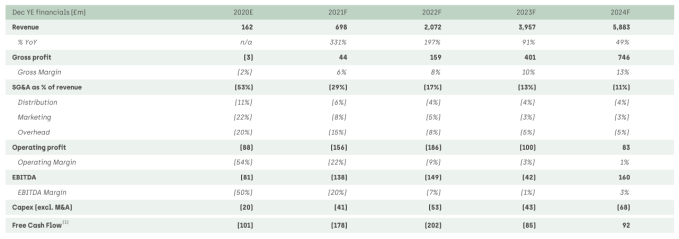
Regardless, the Cazoo investor deck for its SPAC deal is here. Follow along if you want. We’re starting on page 33, where the company discloses its 2020 results and forecasts the next several:

Image Credits: Cazoo’s investor deck

News: Prosus classifieds group OLX shuts down Berlin’s Frontier Car Group to focus OLX Autos on LatAm and Asia

Cazoo is picking up significant capital today by teaming up with a SPAC in the U.S. at a $7 billion valuation, but it’s the end of the line for another big European name in used-car sales. TechCrunch has learned and confirmed that Berlin-based Frontier Car Group, which builds used-car marketplaces with a focus on emerging

Cazoo is picking up significant capital today by teaming up with a SPAC in the U.S. at a $7 billion valuation, but it’s the end of the line for another big European name in used-car sales. TechCrunch has learned and confirmed that Berlin-based Frontier Car Group, which builds used-car marketplaces with a focus on emerging markets, is shutting down its operations in the city.

Its majority owner OLX Group, a division of Prosus (the tech holdings of Naspers that is now listed as a separate entity), said that it wants to refocus on more local operations in Latin America and Asia under its OLX Autos brand, into which it will fold in the remaining FCG operations.

The company currently has operations in Argentina, Chile, Colombia, Ecuador, India, Indonesia, Mexico, and Peru. OLX Autos independently also had three other brands: CarFirst brand in Pakistan, Cars45 in Nigeria, and webuyanycar.com in the US.

OLX took a controlling stake in Frontier as a result of an investment of about $400 million in late 2019, valuing Frontier at around $700 million at the time. There was no official announcement of the closure, but we saw the news in passing on Twitter, and Prosus spokesperson confirmed the details to TechCrunch in a statement.

“OLX Group can confirm the closure of the FCG Germany GmbH entity based in Berlin over the coming months,” said the spokesperson. “This entity represents a subset of the OLX Group workforce in Berlin – other OLX Group employees in Berlin were not impacted by this entity closure, and those operations are ongoing. This decision to close FCG Germany GmbH was not taken lightly. The decision reflects the evolution of the OLX Autos strategy to focus more strongly on the LatAm and Asia markets. In order to have our development teams closer to our customers, we will shift core product development operations to India, a key market for OLX Autos. OLX Group is committed to taking care of our people in such a difficult situation and has offered a financial runway beyond what is compulsory, to allow time and flexibility to find new roles. Effected employees are being encouraged to apply for open roles within our other entities.”

About 100 people are being impacted by the news, the company confirmed to us and it looks to be an immediate move. If you go to FCG’s site now, it automatically redirects to OLX.

Although it was founded and headquartered in Berlin, Frontier Car Group had always focused on emerging markets and taking the used-car marketplace model to those countries.

Inspired by Cazoo rival Auto1 — another Berlin-based used-car marketplace that went public via a listing in Germany in February and is now valued at $12.6 billion (likely an encouraging comparison for Cazoo investors) — Frontier founders Sujay Tyle, Peter Lindholm and André Kussmann thought they could take that model to less developed markets for a bigger opportunity.

“I fell in love with the Auto1 model,” Tyle told TechCrunch back in 2018. “I could see how it could be applied to emerging markets. Emerging markets represent nascency.” Tyle himself is a whizz-kid who hails from the U.S. and was in his early 20s when he co-founded Frontier. He left it in August 2020 and now lives in Mexico City, building a new e-commerce investor there called Merama.

Frontier, in part because of the success of Auto1 (which took hundreds of millions of dollars in investment from the likes of Sequoia, SoftBank and others), became a part of the guard of exciting new tech startups building businesses out of Berlin.

That focus on emerging markets linked up Naspers’ global expansion strategy, and so OLX, a classifieds operation that had an interest in automotive marketplaces, became a strategic investor in Frontier, first with a smaller stake, and eventually taking majority ownership and control of the operation.

It’s not clear why OLX decided to wind down the Frontier brand and to double down OLX Autos but notably, over the last year it looks like OLX was restructuring in other markets, including with the layoff of 250 people in its operations in India after shutting down marketplaces focused on real estate and used goods.

While some companies like Cazoo have apparently seen a strong surge of business in the wake of the Covid-19 pandemic, the health crisis has hit a number of economies, economic sectors and specific companies harder than others, leading to tightening costs. Overall, we’ve seen big slumps in new car sales in different markets around the world.

A Prosus spokesperson said that both OLX and OLX Autos were impacted at the start of Covid-19 but have since recovered. Prosus has remained profitable in what has been a turbulent year, but some have pointed out that those profits have declined. (It will next update its financials in June.)

WordPress Image Lightbox Plugin