Monthly Archives: March 2021

News: AWS reorganizes DeepRacer League to encourage more newbies

AWS launched the DeepRacer League in 2018 as a fun way to teach developers machine learning, and it’s been building on the idea ever since. Today, it announced the latest league season with two divisions: Open and Pro. As Marcia Villalba wrote in a blog post announcing the new league, “AWS DeepRacer is an autonomous

AWS launched the DeepRacer League in 2018 as a fun way to teach developers machine learning, and it’s been building on the idea ever since. Today, it announced the latest league season with two divisions: Open and Pro.

As Marcia Villalba wrote in a blog post announcing the new league, “AWS DeepRacer is an autonomous 1/18th scale race car designed to test [reinforcement learning] models by racing virtually in the AWS DeepRacer console or physically on a track at AWS and customer events. AWS DeepRacer is for developers of all skill levels, even if you don’t have any ML experience. When learning RL using AWS DeepRacer, you can take part in the AWS DeepRacer League where you get experience with machine learning in a fun and competitive environment.”

While the company started these as in-person races with physical cars, the pandemic has forced them to make it a virtual event over the last year, but the new format seemed to be blocking out newcomers. Since the goal is to teach people about machine learning, getting new people involved is crucial to the company.

That’s why it created the Open League, which as the name suggests is open to anyone. You can test your skills and if you’re good enough, finishing in the top 10%, you can compete in the Pro division. Everyone competes for prizes as well such as vehicle customizations.

The top 16 in the Pro League each month race for a chance to go to the finals at AWS re:Invent in 2021, an event that may or may not be virtual, depending on where we are in the pandemic recovery.

News: Facebook will pay $650 million to settle class action suit centered on Illinois privacy law

Facebook was ordered to pay $650 million Friday for running afoul of an Illinois law designed to protect the state’s residents from invasive privacy practices. That law, the Biometric Information Privacy Act (BIPA), is a powerful state measure that’s tripped up tech companies in recent years. The suit against Facebook was first filed in 2015, alleging

Facebook was ordered to pay $650 million Friday for running afoul of an Illinois law designed to protect the state’s residents from invasive privacy practices.

That law, the Biometric Information Privacy Act (BIPA), is a powerful state measure that’s tripped up tech companies in recent years. The suit against Facebook was first filed in 2015, alleging that Facebook’s practice of tagging people in photos using facial recognition without their consent violated state law.

1.6 million Illinois residents will receive at least $345 under the final settlement ruling in California federal court. The final number is $100 higher than the $550 million Facebook proposed in 2020, which a judge deemed inadequate. Facebook disabled the automatic facial recognition tagging features in 2019, making it opt-in instead and addressing some of the privacy criticisms echoed by the Illinois class action suit.

A cluster of lawsuits accused Microsoft, Google and Amazon of breaking the same law last year after Illinois residents’ faces were used to train their facial recognition systems without explicit consent.

The Illinois privacy law has tangled up some of tech’s giants, but BIPA has even more potential to impact smaller companies with questionable privacy practices. The controversial facial recognition software company Clearview AI now faces its own BIPA-based class action lawsuit in the state after the company failed to dodge the suit by pushing it out of state courts.

A $650 million settlement would be enough to crush any normal company, though Facebook can brush it off much like it did with the FTC’s record-setting $5 billion penalty in 2019. But the Illinois law isn’t without teeth. For Clearview, it was enough to make the company pull out of business in the state altogether.

The law can’t punish a behemoth like Facebook in the same way, but it is one piece in a regulatory puzzle that poses an increasing threat to the way tech’s data brokers have done business for years. With regulators at the federal, state and legislative level proposing aggressive measures to rein in tech, the landmark Illinois law provides a compelling framework that other states could copy and paste. And if big tech thinks navigating federal oversight will be a nightmare, a patchwork of aggressive state laws governing how tech companies do business on a state-by-state basis is an alternate regulatory future that could prove even less palatable.


News: Free 30-day trial of Extra Crunch included with TC Sessions: Justice tickets

TC Sessions: Justice is coming up on Wednesday, and we’ve decided to sweeten the deal for what’s included with your event pass. Buy your ticket now and you’ll get a free month of access to Extra Crunch, our membership program focused on founders and startup teams with exclusive articles published daily. Extra Crunch unlocks access

TC Sessions: Justice is coming up on Wednesday, and we’ve decided to sweeten the deal for what’s included with your event pass. Buy your ticket now and you’ll get a free month of access to Extra Crunch, our membership program focused on founders and startup teams with exclusive articles published daily.

Extra Crunch unlocks access to our weekly investor surveys, private market analysis and in-depth interviews with experts on fundraising, growth, monetization and other core startup topics. Get feedback on your pitch deck through Extra Crunch Live, and stay informed with our members-only Extra Crunch newsletter. Other benefits include an improved TechCrunch.com experience and savings on software services from AWS, Crunchbase and more.

Learn more about Extra Crunch benefits here, and buy your TC Sessions: Justice tickets here.  

What is TC Sessions: Justice? 

TC Sessions: Justice is a single-day virtual event that explores diversity, equity and inclusion in tech, the gig worker experience, the justice system and more. We’ll host a series of interviews with key figures in the tech community. 

The event will take place March 3, and we’d love to have you join. 

View the event agenda here, and purchase tickets here

Once you buy your TC Sessions: Justice pass, you will be emailed a link and unique code you can use to claim the free month of Extra Crunch.

Already bought your TC Sessions: Justice ticket?

Existing pass holders will be emailed with information on how to claim the free month of Extra Crunch membership. All new ticket purchases will receive information over email immediately after the purchase is complete.

Already an Extra Crunch member?

We’re happy to extend a free month of access to existing users. Please contact extracrunch@techcrunch.com and mention that you are existing Extra Crunch members who bought a ticket to TC Sessions: Justice. 

News: Twitter rolls out vaccine misinformation warning labels and a strike-based system for violations

Twitter announced Monday that it would begin injecting new labels into users’ timelines to push back against misinformation that could disrupt the rollout of COVID-19 vaccines. The labels, which will also appear as pop-up messages in the retweet window, are the company’s latest product experiment designed to shape behavior on the platform for the better.

Twitter announced Monday that it would begin injecting new labels into users’ timelines to push back against misinformation that could disrupt the rollout of COVID-19 vaccines. The labels, which will also appear as pop-up messages in the retweet window, are the company’s latest product experiment designed to shape behavior on the platform for the better.

The company will attach notices to tweeted misinformation warning users that the content “may be misleading” and linking out to vetted public health information. These initial vaccine misinformation sweeps, which begin today, will be conducted by human moderators at Twitter and not automated moderation systems.

Twitter says the goal is to use these initial determinations to train its AI systems so that down the road a blend of human and automated efforts will scan the site for vaccine misinformation. The latest misinformation measure will target tweets in English before expanding.

Twitter also introduced a new strike system for violations of its pandemic-related rules. The new system is modeled after a set of consequences it implemented for voter suppression and voting-related misinformation. Within that framework, a user with two or three “strikes” faces a 12-hour account lockout. With four violations, they lose account access for one week, with permanent suspension looming after five strikes.

Twitter introduced its first pandemic-specific policies a year ago, banning tweets promoting false treatment or prevention claims along with any content that could put people at higher risk of spreading COVID-19. In December, Twitter added new rules focused on popular vaccine conspiracy theories and announced that warning labels were on the way.

News: BrioHR raises $1.3M ahead of Y Combinator’s demo day

As the next Y Combinator demo day approaches, more startups from the current Winter 2021 batch are showing up in our inboxes. One of the most interesting from the mix is BrioHR, which is building human resources (HR) software for Southeast Asia. The company fits into a theme I’ve noticed amongst startups, namely a focus

As the next Y Combinator demo day approaches, more startups from the current Winter 2021 batch are showing up in our inboxes. One of the most interesting from the mix is BrioHR, which is building human resources (HR) software for Southeast Asia.

The company fits into a theme I’ve noticed amongst startups, namely a focus on taking proven software genre approaches to specific parts of the world, localizing them and building in-region winners. This theme is not new, of course, but it does feel slightly more pronounced amongst recent accelerator batches than before (TechCrunch covers Techstars, Y Combinator, 500 Startups and other accelerators as part of our startup focus). Perhaps this is the impact of so many accelerators going virtual, widening the founder pool from whom they might matriculate to include a more global group of founders.

Back to BrioHR itself, the company is announcing $1.3 million in fundraising, inclusive of its YC check. The investment was led by Global Founders Capital, and saw participation from East Ventures and angel investors.

TechCrunch caught up with Benjamin Croc, the company’s co-founder and CEO, who is located in Kuala Lumpur, Malaysia (the city pictured in the image at the top of this post). The time zones were tricky to navigate, but the company’s vision was simple enough: A software-as-a-service (SaaS) HR software suite, tailored to fit the laws of the Southeast Asian region.

Croc and his co-founder, Nabil Oudghiri, founded the company in 2018, incorporating in the second half of the year after talking over their idea for a few months. BrioHR did not launch its product until the fourth quarter of 2019, opening for what Croc described as early adopters. The startup launched more broadly in the first quarter of 2020, right in time for COVID-19 to shake up the world.

Its fundraising came in two chunks, one in the middle of 2020 and one that came in the third quarter of the year; the first chunk of the raise was larger than the second. BrioHR raised the capital using a convertible note, with terms that Croc described as near to standard.

In our conversation, TechCrunch was curious about how prevalent SaaS as a model is in Malaysia and the other countries the startups wants to sell into. The co-founder said that while SaaS is not as well known in his part of the world as it is in the United States — not a huge surprise given that the U.S. is the largest SaaS market in the world — he praised the speed at which Southeast Asian countries adopt business trends; if Croc is right, his view could point to a very active subscription software market in the region in coming years.

BrioHR competes with local companies that are more focused on providing single solutions, like payroll management. From our discussion, it appears that Croc hopes that by going broad, in a feature sense, BrioHR will surpass legacy competitors. The startup is itself still building out its regional tooling, providing payroll support in only a handful of countries. It intends to expand that service to new countries this year, and be everywhere with its payroll product in two to three years, its co-founder said.

Notably, even though it has already raised capital, BrioHR intends to take part in Y Combinator’s demo day. Croc said it is taking part for optionality. TechCrunch read that as the company isn’t actively looking to raise more capital at the moment, but wouldn’t turn down another convertible note at a comfortable cap. Then again, what company at any demo day would?

Since launching out of its early-adopter program, Croc said that the company has grown 10x. That’s not hard from a small base, so the company’s 2021 growth will be more illustrative of its true near-term potential. Let’s see what new metrics it breaks out in a few weeks’ time.


Early Stage is the premiere ‘how-to’ event for startup entrepreneurs and investors. You’ll hear firsthand how some of the most successful founders and VCs build their businesses, raise money and manage their portfolios. We’ll cover every aspect of company-building: Fundraising, recruiting, sales, legal, PR, marketing and brand building. Each session also has audience participation built-in — there’s ample time included in each for audience questions and discussion.

News: Rocket Lab CEO Peter Beck explains why the company needs a bigger rocket, and why it’s going public to build it

Rocket Lab packed a ton of news into Monday to kick off this week: It’s going public via a SPAC merger, for one, and it’s also building a new, larger launch vehicle called Neutron to support heavier payloads. I spoke to Rocket Lab founder and CEO Peter Beck about why it’s building Neutron now, and

Rocket Lab packed a ton of news into Monday to kick off this week: It’s going public via a SPAC merger, for one, and it’s also building a new, larger launch vehicle called Neutron to support heavier payloads. I spoke to Rocket Lab founder and CEO Peter Beck about why it’s building Neutron now, and why it’s also choosing to go public at the same time. Unsurprisingly, the two things are tightly linked.

“We have the benefit of flying Electron [Rocket Lab’s current, smaller launch vehicle] for a lot of customers. and we also have a Space Systems Division that supplies components into a number of spacecraft, including some of the mega constellations,” Beck told me. “So we have very strong relationships with, with a lot of different customers, and I think we get unique insight on where the industry is going, and where the where the pain points are.”

Those pain points informed Neutron, which is a two-stage reusable rocket. Rocket Lab already broke with Beck’s past thinking on what the launch market needed by developing partial reusability for Electron, and it’s going further still with Neutron, which will include a first-stage that returns to Earth and lands propulsively on a platform stationed at sea, much like SpaceX’s Falcon 9. But the market has shifted since Rocket Lab built Electron – in part because of what it helped unlock.

“The creation of Neutron came from from two discrete factors: One, the current need in the marketplace today. Also, if you project it forward a little bit, you know, Neutron will deliver the vast majority – over 90% of – all the satellites that, that are around or in some form of planning. And if you look at those satellites, 80% of them are mega constellations, by volume. So, in talking with, with a bunch of different customers, it was really, really apparent that a mega constellation-building machine is what the market really needs.”

Beck says that combining that market needs with a historical analysis that showed most large launch vehicles have taken off half-full resulted in them arriving at Neutron’s 8 metric ton (just over 17,600 lbs) total cargo mass capacity. it should put it in the sweet spot where it takes off full nearly every time, but also can still meet the mass requirement needs of just about every satellite customer out there, both now and in the future.

“We’re covered in scars and battle wounds from the development of Electron,” “The one thing that that Elon and I agree on very strongly is, by far the hardest part of a rocket is actually scaling it – getting to orbit is hard, but actually scaling manufacturing is ridiculously hard. Now, the good news is that we’ve been through all of that, and manufacturing ins’t just as product on the floor; it’s ERP systems, quality systems, finance, supply chain and so on and so forth. So all that infrastructure is is built.”

In addition to the factory and manufacturing processes and infrastructure, Beck notes that Electron and Neutron will share size-agnostic elements like computing and avionics, and much of the work done to get Electron certified for launch will also apply to Neutron, realizing further cost and time savings relative to what was required to get Electron up and flying. Beck also said that the process of making Electron has just made Rocket Lab extremely attuned to costs overall, and that will definitely translate to how competitive it can be with Neutron.

“Because electron has a $7.5 million sticker price, we’ve just been forced into finding ways to do things hyper efficiently,” he said. “If you’ve got a $7.5 million sticker price, you can’t spend $2 million on flight safety analysis, payload environmental analysis, etc – you just can’t do that. With a $60 or $80 million vehicle that you can amortize that. So we’ve kind of been forced into doing everything hyper, hyper efficiently. And it’s not just systems; it includes fundamental launch vehicle design. So when we apply all of those learnings to nNutron, we really feel like we’re gonna bring a highly competitive product to the marketplace.”

As for the SPAC merger, Beck said that the decision to go public now really boils down to two reasons: The first is to raise the capital required to build Neutron, as well as fund “other” projects. The other is to acquire the kind of “public currency” to pursue the kinds of acquisitions in terms of business that Rocket Lab is hoping to achieve. Why specifically pursue a SPAC merger instead of a traditional IPO? Efficiency and a fixed capital target, essentially.

“We were actually sort of methodically stepping towards an IPO at the time and, we were just sort of minding our own business, but it was clear we were pursued very vigorously by a tremendous number of potential SPAC partners,” Beck told me. “Ultimately, on the balance of timelines, this just really accelerated our ability to do the things we want to do. Because, yes, as you pointed out, that this kind of streamlined the process, but also provided certainty around proceeds.”

The SPAC transaction, once complete will result in Rocket Lab having approximately $750 million in cash to work with. One of the advantages of the SPAC route is that how much you raise via the public listing isn’t reliant on how the stock performs on the day – Beck and company know and can plan on that figure becoming available to them, barring any unexpected and unlikely barriers to the transaction’s closing.

“Having all the capital we need, sitting there ready to go, that really sets us up for a strong execution,” he said. “If you look at Rocket Lab’s history, we’ve only raised spend a couple of hundred million dollars to date, within all the things we’ve done. So capitalizing the company with $750 million – I would expect big things at that point.”


Early Stage is the premiere ‘how-to’ event for startup entrepreneurs and investors. You’ll hear firsthand how some of the most successful founders and VCs build their businesses, raise money and manage their portfolios. We’ll cover every aspect of company-building: Fundraising, recruiting, sales, legal, PR, marketing and brand building. Each session also has audience participation built-in — there’s ample time included in each for audience questions and discussion.

News: Cappuccino lets you share short, intimate audio stories with your friends

You might call Cappuccino the anti-Clubhouse, but the company has been iterating on its app concept for a couple of years — its CEO doesn’t have any strong opinions on Clubhouse. And it’s true that Cappuccino is an interesting social app on its own. It has been attracting a loyal user base, especially after a

You might call Cappuccino the anti-Clubhouse, but the company has been iterating on its app concept for a couple of years — its CEO doesn’t have any strong opinions on Clubhouse. And it’s true that Cappuccino is an interesting social app on its own. It has been attracting a loyal user base, especially after a TikTok video went viral.

The startup says it is building an app that helps you record podcasts with friends. Many people have discovered podcasts over the past few years. Podcasts let you subscribe to audio shows and listen to episodes on demand.

At first, people subscribe to podcasts because of their interests. But if you talk about podcasts with your friends, they’ll tell you that they like a show in particular because of the personalities of the hosts.

Listening to a podcast is a content consumption experience that feels like nothing else out there. You might watch all videos released by a particular YouTuber and you might think you know a lot about someone’s personal life by following them on Instagram.

But listening to someone for hours at a time with earbuds in your ears is a very intimate experience. When a podcast works, it feels like you’re sitting in a room with a few friends and just listening to what they have to say.

And yet, chances are your favorite podcast hosts are not your friends.

This is where Cappuccino fits. The app lets you create groups with your friends or your families. Members of the group can record a short audio message — a bean, as the startup calls it. They talk about what’s on their mind for a couple of minutes. The next morning, group members receive a notification saying that your morning cappuccino has been brewed.

When you hit play, a chill intro music starts playing followed by audio messages from your friends. It isn’t just a succession of voice memos — it feels like a relaxing mix of happy, funny, caring, thoughtful messages from your friends.

While Cappuccino is a social app, it is focused on your close friends and your family. You aren’t trying to get more followers and you are not sharing public posts. Everything is private by design and focused on groups of real-life friends.

In many ways, it reminds me of Snapchat’s group stories. But Snapchat wasn’t the main inspiration for Cappuccino — it was podcasting.
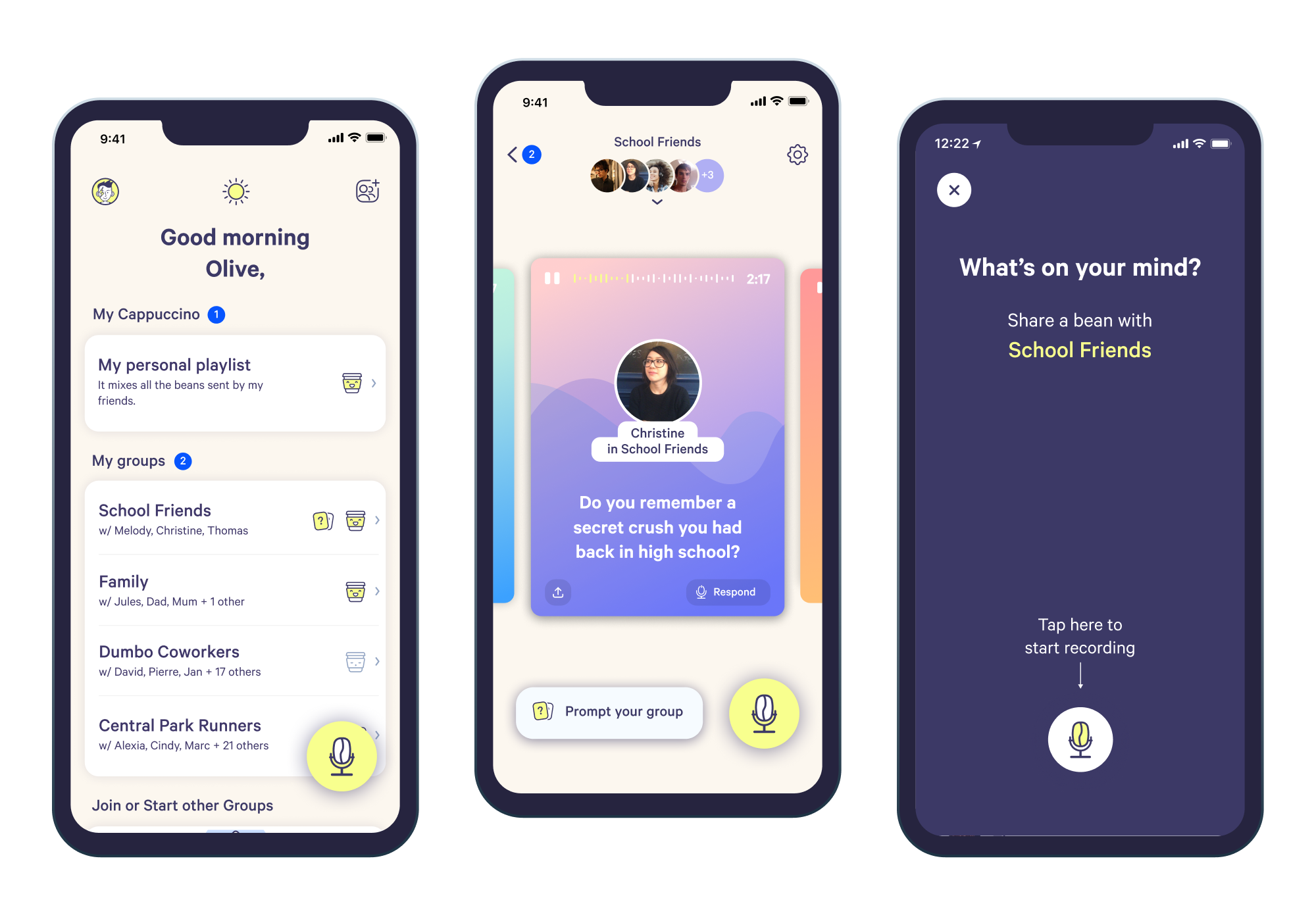
Image Credits: Cappuccino

Prototype early, iterate often

I talked with the company’s co-founder and CEO Gilles Poupardin about the origin story of the app. Cappuccino isn’t Poupardin’s first startup. He had worked on Whyd for several years and lived the full startup experience — he raised founding rounds, chose to pivot, attended Y Combinator in San Francisco, parted ways with his company’s CTO and chose to shutter the startup.

Among other things, Whyd worked on a voice-controlled connected speaker before Amazon’s Echo product lineup and Google’s Nest speakers really took off. It’s hard to compete with tech giants, even harder when you’re competing on the hardware front.

After that, the Whyd team worked on a service that lets you create your own voice assistant. That didn’t really take off as expected either.

During the summer of 2019, Olivier Desmoulin reached out to Poupardin. Back then, Desmoulin was heading design for Jumbo, an app that helps you stay on top of your online privacy.

“At the time, I didn’t know if I wanted to start a company again — I pivoted 15 times [with Whyd],” Poupardin told me.

But they started discussing about podcasts and AirPods — and audio at large — as the next frontier for social apps. The basic premise was simple. A lot of people were listening to podcasts, but very few people were creating their own podcasts.

There are three reasons why your neighbor doesn’t have its own podcast but sometimes posts stuff on Instagram and Snapchat:

  • Podcasts are long-form content
  • It’s technically complicated to record and release a podcast
  • You are trying to attract an audience of people who don’t know you.

With Cappuccino, the idea is to take a reverse stance on these three points: short content, easy to record and personal. It’s supposed to be a better experience for both people recording audio and people listening to audio.

The first version of Cappuccino isn’t an app, it’s a side project. “We created a group on WhatsApp, we invited 10 to 15 people and we asked them to record voice memos and send them all to Olivier,” Poupardin told me.

Every night, Olivier Desmoulin would fire up GarageBand and create a mix of all voice memos. In the morning, he would send a message to the group conversation on WhatsApp and write: “Hey, your cappuccino is here.”
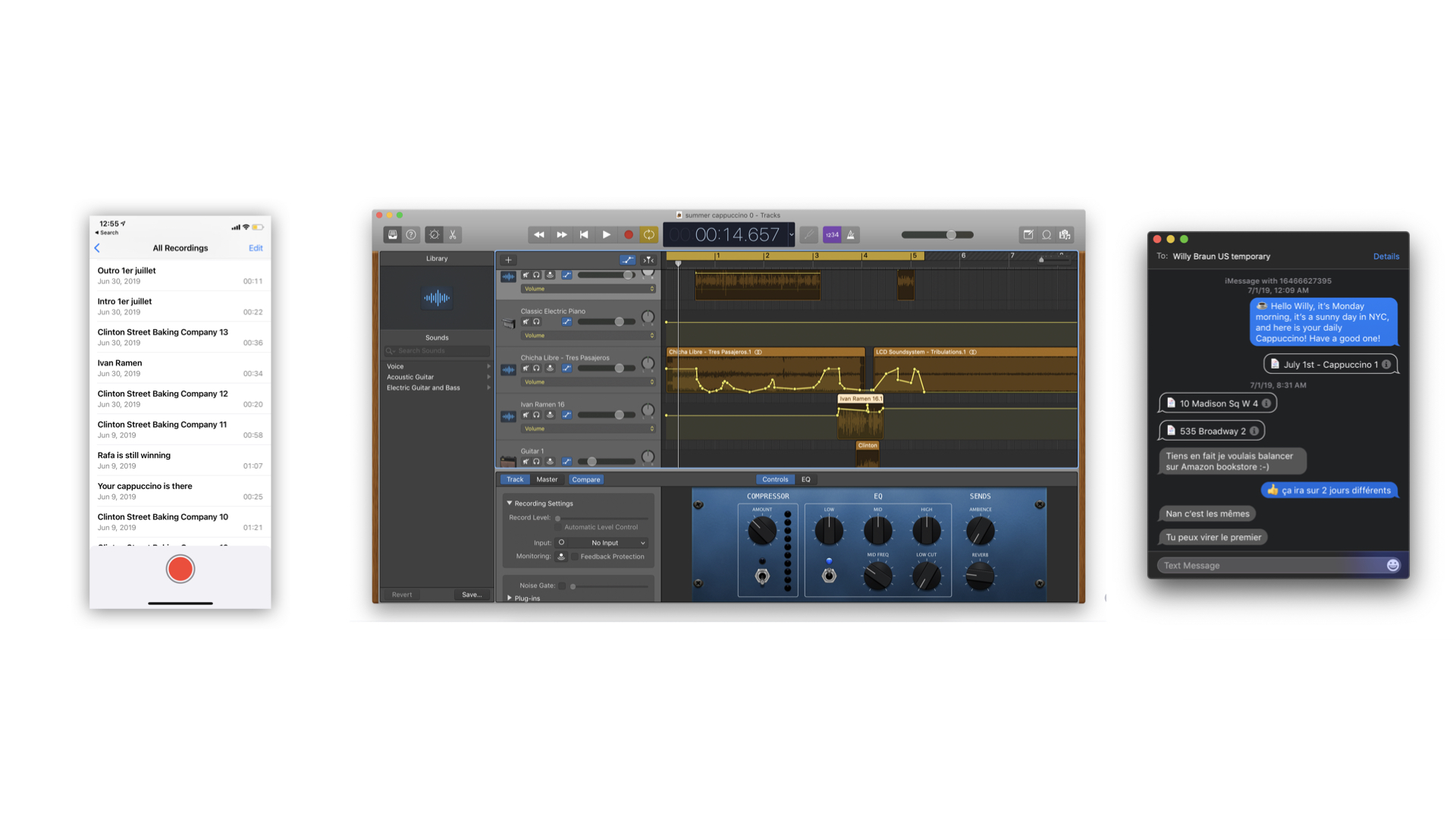
Image Credits: Cappuccino

After getting some positive feedback from group members, Pouparding and Desmoulin chose to move forward and create something that feels more like an app. But they both knew that creating a social app was incredibly hard when it comes to attracting users. They developed something quickly so that they weren’t wasting time developing something that nobody would use.

“We built the first version of the app in four days by using a hack — we were using Airtable as the backend service,” Poupardin said.

Once again, feedback from beta users was pretty good. They showed the app to some investors and ended up raising $1.2 million from Alexia Bonatsos (Dream Machine, also a former TechCrunch editor), SV Angel, Kevin Carter (Night Capital), Niv Shrug Capital, Jean de La Rochebrochard (Kima Ventures), Kevin Kuipers, Willy Braun, Marie Ekeland, Solomon Hykes (founder of Docker), Pierre Valade (founder of Sunrise and Jumbo Privacy), Moshe Lifschitz (Basement Fund), Anthony Marnell, Bryan Kim and a bunch of others.

Gawen Arab who was the CTO at Whyd teamed up once again with Poupardin, proving that time is a flat circle. He’s now co-founder and CTO at Cappuccino.

Image Credits: Cappuccino

Letting people talk about you

The Cappuccino team hasn’t been active when it comes to press relations or ads. It’s been a slow build up with some interesting spikes.

Last summer, Product Hunt super user Chris Messina created a post about Cappuccino. It was a bit of a surprise as the startup wasn’t trying to get featured on Product Hunt. Still, the co-founders diligently answered questions from the Product Hunt community.

The following day, Product Hunt’s newsletter featured Cappuccino. It was titled “The next big audio social network?” That brought some new users to the app.
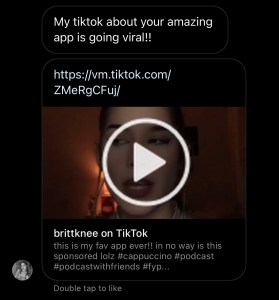
Image Credits: Cappuccino

But things really started to take off when Brittany Kay Collier shared a video on TikTok about Cappuccino a few weeks ago. She sent a direct message to Poupardin on Instagram, telling him that it was attracting a lot of views. The video ended up attracting around 3.8 million views and 850,000 likes.

Two days later, Poupardin sent her a job offer to join the team. He was secretly hoping she would say yes, and she was secretly dreaming about getting a job at a company like Cappuccino.

Over the past couple of weeks, Cappuccino attracted 225,000 new users. They created 130,000 groups and sent around one million audio stories.

When the team is reading public posts about Cappuccino on Twitter, it feels like the app has found its core user base. The most loyal users seem to be young women in their twenties. They want to keep in touch with long-distance best friends.

They might be graduating from college and moving to a different part of the country. They might be stuck at home because of the current pandemic.

I started using this app “cappuccino” and it is like a podcast for friends and I get to hear my friends’ voices every day when they record themselves just talking about anything and I go back and listen to it throughout the day bc I miss hearing them 😩

— Amelia Nelson🍋 (@ameliaesque) February 14, 2021

And it seems like new users have no issue hitting the record button and telling stories — everybody is familiar with voice messages on WhatsApp and iMessage after all.

“Something that is interesting with audio messages as a medium is that you tell different stories from what you would tell by taking a photo for Instagram, sending a Snap or creating a video on TikTok,” Poupardin said.

But what about the elephant in the room then? Clubhouse has topped 8 million downloads already. Poupardin listed all the differences in social graph, audio format and user base. According to him, there’s enough room for multiple audio apps.

“With video, you have YouTube, Twitch and TikTok — those are all different formats. Audio is potentially going to follow the same trend,” Poupardin said. Social apps first took advantage of the camera in your smartphone, because the camera was the killer hardware feature. And audio seems like the natural next step.

He feels like he isn’t competing with other audio startups for now. He wants people to wake up and listen to Cappuccino instead of random music on Spotify. “It’s going to help people who feel lonely,” he said.


News: Murmur, still in private beta, wants to help startups make private work agreements public

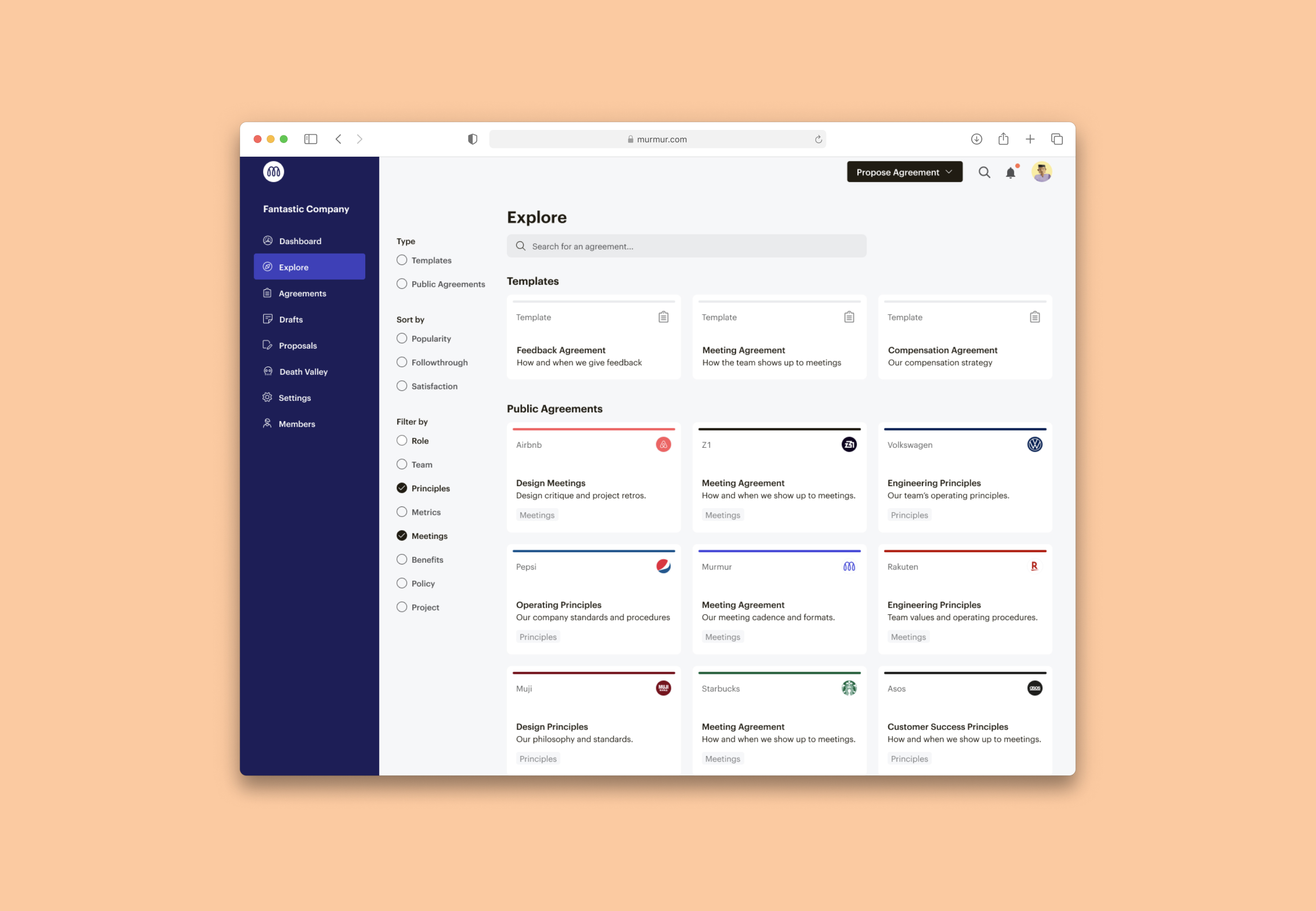
As building in public continues to gain popularity with early-stage startup founders, Murmur, coming out of stealth today, wants to leverage that natural transparency to a louder frequency. Founded by Aaron Dignan, Murmur helps startups create work agreements based on the policies of other startups. “Work agreements” is an intentionally broad phrase, but encapsulates everything

As building in public continues to gain popularity with early-stage startup founders, Murmur, coming out of stealth today, wants to leverage that natural transparency to a louder frequency.

Founded by Aaron Dignan, Murmur helps startups create work agreements based on the policies of other startups. “Work agreements” is an intentionally broad phrase, but encapsulates everything that a team decides about how work works, from paternal leave strategies to strategic priorities to how hiring works.

“It’s everything you’ve ever argued about [within your startup],” Dignan said.

It requires a healthy level of transparency within the ecosystem, meaning that a startup would have to be open with sharing its policies to the public in the first place. But, if Murmur works, it could help early-stage founders save time on the pain-staking process of figuring out how to build policies from scratch around hiring, OKR goals and vacation policies.

Instead, a new founder could just rely on other, seasoned founders, who have shared their policies for anyone to enjoy, and customize their own plan based around those practices.

Today, Murmur announced that it has raised $1.8 million to scale its working agreements platform in a round led by Lerer Hippeau, with participation from SemperVirens, Human Ventures and Remote First Capital. Other investors include Steve Schlafman, Mariano Suarez-Battan (the CEO of Mural), Brian Sugar (the CEO of PopSugar) and Adam Pisoni (the co-founder of Yammer).

The company, still in private beta, will be launching to the public in early summer 2021.

Murmur is a web-based platform that allows startups to author, customize and plan policies that will shape a team’s culture. The platform helps teams go from proposal to decision with features like voting, edits and feedback throughout the process of creating an agreement. Instead of pushing a copy and paste of another startup’s policy, Murmur prompts founders to use the outsourced policies as seeds, and add customization as they go.

“Anybody can Google and find some company’s years-old processes; the trick is in making an inclusive ‘agreement’ with real time all participating in the magic of keeping it and iterating it, and improving it,” Dignan said.

Image Credits: Murmur

Right now, it is free for anyone to see listed company public agreements. But it costs money to use the Murmur platform to create and customize your own agreements off of this information. With this format, you can see that Dignan thinks that the conversion power of the company lies more in its platform than the content.

Dignan tells me that the team is still testing pricing strategies, but the current plan is a free trial followed by a monthly per-seat fee of $12 to $15 per month, per user. One day, companies could charge a premium for a “kit” of tools on their platform.

Murmur’s initial target for customers are startups that are growing fast and already work in public, such as Buffer, Basecamp, Lattice and Blinkist, but in the future, big enterprises could also see it useful.

Murmur is launching amid a general trend of companies that are pitching themselves as best-practices-as-a-service. Companies in this space aren’t simply enabling other startups to use a fancy SaaS tool, they are not-so-gently pushing them to use those tools in the best possible way for the best possible outcome. Murmur, if it hits scale, could help the next generation of startups figure out the best way to start companies.

Dignan says that the startup “aims to do for working practices what GitHub did for code.”

Remote work is obviously a key catalyst for the company, since the transition has reminded teams that transparency, standards and communication is vital to a functioning organization.

While the startup currently only has Murmur working agreements on the platform, it plans to onboard the agreements of dozens of companies in the coming months. Even though the platform is what makes Murmur special, it’s clear that curating agreements from top companies plays a vital role in Murmur’s success.

It is not paying companies to publicly list their agreements, and the branding benefit of transparency is well worth the confidentiality cost of sharing due to recruitment benefits.

Dignan says connections from his book about the future of work will help land those agreements. Writing a book about a changing world of work before a global pandemic turned everything upside down is ironic, but Dignan, it appears, doesn’t view Murmur as a pandemic pivot.

“I’ve been thinking about this tool for seven years,” he said. But he didn’t think an opinionated tool would have a large enough total addressable market, and that anything that would scale would just reinforce the status quo. He didn’t build Murmur for a while because he thought that the ecosystem didn’t need “yet another customer engagement tool.”

So, he waited. And the pandemic, another peak of the Black Lives Matter movement and the election happened within one year.

“It was all signaling that the complexity is too much,” he said. “We need new ways of working, making decisions and organizing as people. And that felt like this huge moment where we plant the seed and in a few years’ time, the market will be huge.”

News: Why your organization needs product principles

Product principles should always evolve to keep up with the changing ways you work and what your customers need.

Ethan Eismann
Contributor

Ethan Eismann is the Vice President of Design at Slack, leading design and engineering teams to deliver exceptional product experiences.

At Slack, every one of our processes and features has been designed with the primary goal of making Slack a workplace tool that feels human. We see ourselves as our users’ hosts, and we want them to feel comfortable and happy every time they’re in Slack. Our product isn’t just built for work — it’s built for people doing work, and everything we create is meant to forward our mission of making work life simpler, more pleasant and more productive.

Our job is to understand what people want, and then translate that value through thoughtfully designed, well-functioning products and features.

Against the backdrop of an unprecedented shift to remote work, we’ve seen an influx of people turning to Slack to make the transition to a digital-first workplace. Building thoughtful, intuitive products that add value, delight and human-centric experiences into peoples’ working lives has never been more important.

Product principles are essential guidelines that help teams evaluate work across functions.

To ensure we’re meeting our customers where they’re at, we created a set of guiding “product principles” that inform everything we build, and which serve as the foundation for our entire product decision-making process.

There’s business value in improving an organization’s processes, and we’ve been able to provide better experiences for our customers by enacting ever-evolving product principles and using them to evaluate our products and features. Any company can benefit from having product principles — it’s all about how you develop and deploy them across your organization.

First, what are product principles?

Product principles are essential guidelines that help teams evaluate work across functions, as well as up and down the decision-making chain, by ensuring all work ladders up to the organization’s ultimate goals. Better alignment, in turn, leads to better and faster product decisions.

Product principles should always evolve to keep up with the changing ways you work and what your customers need. At Slack, we currently have five principles that guide us:

  1. Don’t make me think.
  2. Be a great host.
  3. Prototype the path.
  4. Don’t reinvent the wheel.
  5. Make bigger, bolder bets.

By implementing these principles into all we build across teams — design, legal, marketing and more — they provide a shared framework for decision-making that keeps us aligned and therefore able to make better decisions, faster.

The idea of having principles themselves isn’t a new concept, but the creation process behind building and promoting these principles is often overlooked or underdeveloped.

Start with your product philosophy

Before building the principles themselves, it’s important to first establish your product philosophy, which will inform how your organization will ultimately view and abide by its principles.

At Slack, we embrace an approach we call “getting to the next hill.” While there is a long-term product strategy, we don’t spend a lot of time debating exactly where we’ll be in one or two years from now. Instead, we focus on more immediate, incremental moves to improve our customers’ working lives.

We’ve found that because Slack is used in so many different ways by so many different companies, it’s better to learn from how our customers use our features than from endlessly debating aspirational future ideas.

News: Walmart drops the $35 order minimum on its 2-hour ‘Express’ delivery service

In a move designed to directly challenge Amazon, Walmart today announced it’s dropping the $35 minimum order requirement for its two-hour “Express” delivery service, a competitor to Amazon’s “Prime Now.”  With Walmart Express Delivery, customers can order from Walmart’s food, consumables or general merchandise assortment, then pay a flat $10 fee to have the items

In a move designed to directly challenge Amazon, Walmart today announced it’s dropping the $35 minimum order requirement for its two-hour “Express” delivery service, a competitor to Amazon’s “Prime Now.”  With Walmart Express Delivery, customers can order from Walmart’s food, consumables or general merchandise assortment, then pay a flat $10 fee to have the items arrive in two hours or less.

The service is useful for more urgent delivery needs — like diapers or a missing ingredient for a recipe, SVP of Customer Product, Tom Ward, noted in an announcement. They’re not meant to sub in for larger shopping trips, however — Express orders are capped at 65 items.

Today, Express Delivery is available in nearly 3,000 Walmart stores reaching 70% of the U.S. population, Walmart says. It builds on top of stores’ existing inventory of pickup and delivery time slots as a third option, instead of giving slots away to those with the ability to pay higher fees.

Like Walmart’s grocery and pickup orders, Express orders are shopped and packaged for delivery by Walmart’s team of 170,000 personal shoppers and items are priced the same as they are in-store. This offers Walmart a potential competitive advantage against grocery delivery services like Instacart or Shipt, for example, where products can be priced higher and hurried or inexperienced shoppers aren’t always able to find items or search the back, having to mark them as “out of stock.”

In theory, Walmart employees will have a better understanding of their own store’s inventory and layout, making these kind of issues less common. It will also have direct access to the order data, which will help it better understand what sells, what replacements customers will accept for out-of-stocks, when to staff for busy times and more.

In addition to grocery delivery, Express Delivery competes with Amazon’s Prime Now, a service that similarly offers a combination of grocery and other daily essentials and merchandise. Currently, Prime Now’s 2-hour service has a minimum order requirement of $35 without any additional fees in many cases — though the Prime Now app explains that some of its local store partners will charge fees even when that minimum is met, and others may have higher order minimums, which makes the service confusing to consumers.

Out: $35 minimum on Express delivery orders
In: Endless take-and-bake pizza delivered to your door

Starting today, no more $35 min. order requirement for Express delivery. Another way we’re making it easier than ever to get what you need when you need it. https://t.co/lCgQItLeRn pic.twitter.com/HONlL0SzxG

— Walmart Inc. (@WalmartInc) March 1, 2021

Walmart’s news comes at a time when Amazon appears to be trying to push consumers away from the Prime Now standalone app, too.

When you open the Prime Now app, a large pop-up message informs you that you can now shop Whole Foods and Amazon Fresh from inside the Amazon app. A button labeled “Make the switch” will then redirect you. Meanwhile, on Amazon’s website touting Prime’s delivery perks, the “Prime Now” brand name isn’t mentioned at all. Instead, Amazon touts free same-day (5-hour) delivery of best sellers and everyday essentials on orders with a $35 minimum purchase, or free 2-hour grocery delivery from Whole Foods and Fresh.

When asked why Amazon is pushing Prime Now shoppers to its main app, Amazon downplayed this as simply an ongoing effort to “educate” consumers about the option.

Walmart, on the other hand, last year merged its separate delivery apps into one.

After items are picked, Walmart works with a network of partners, including DoorDash, Postmates, Roadie and Pickup Point, as well as its in-house delivery services, to get orders to customers’ doorsteps. This last-mile portion has become a key area of investment for Walmart and competitors in recent months — Walmart, for example, acquired assets from peer-to-peer delivery startup JoyRun in November. And before that, a former Walmart delivery partner, Deliv, sold to Target.

This is not the first time Walmart has dropped order minimums in an attempt to better compete with Amazon and others.

In December, Walmart announced its Prime alternative known as Walmart+ would remove the $35 minimum on non-same day Walmart.com orders. But it had stopped short of extending that perk to same-day grocery until now.

To some extent, Walmart’s ability to drop minimums has to do with the logistics of its delivery operations. Walmart has been turning more of its stores into fulfillment centers by converting some into small, automated warehouses in partnership with technology providers and robotics companies, including Alert Innovation, Dematic and Fabric.

And because its stores are physically located closer to customers than Amazon warehouses, it has the ability to deliver a broad merchandise selection, faster, while also turning large parking lots into picking stations — another thing that could worry Amazon, which is now buying up closed mall stores for its own fulfillment operations. 

Walmart today still carries a $35 minimum on other pickup and delivery orders and same-day orders from Walmart+ subscribers.

WordPress Image Lightbox Plugin