
Yearly Archives: 2020

News: Flexible expressions could lift 3D-generated faces out of the uncanny valley

3D-rendered faces are a big part of any major movie or game now, but the task of capturing and animated them in a natural way can be a tough one. Disney Research is working on ways to smooth out this process, among them a machine learning tool that makes it much easier to generate and

3D-rendered faces are a big part of any major movie or game now, but the task of capturing and animated them in a natural way can be a tough one. Disney Research is working on ways to smooth out this process, among them a machine learning tool that makes it much easier to generate and manipulate 3D faces without dipping into the uncanny valley.

Of course this technology has come a long way from the wooden expressions and limited details of earlier days. High resolution, convincing 3D faces can be animated quickly and well, but the subtleties of human expression are not just limitless in variety, they’re very easy to get wrong.

Think of how someone’s entire face changes when they smile — it’s different for everyone, but there are enough similarities that we fancy we can tell when someone is “really” smiling or just faking it. How can you achieve that level of detail in an artificial face?

Existing “linear” models simplify the subtlety of expression, making “happiness” or “anger” minutely adjustable, but at the cost of accuracy — they can’t express every possible face, but can easily result in impossible faces. Newer neural models learn complexity from watching the interconnectedness of expressions, but like other such models their workings are obscure and difficult to control, and perhaps not generalizable beyond the faces they learned from. They don’t enable the level of control an artist working on a movie or game needs, or result in faces that (humans are remarkably good at detecting this) are just off somehow.

A team at Disney Research proposes a new model with the best of both worlds — what it calls a “semantic deep face model.” Without getting into the exact technical execution, the basic improvement is that it’s a neural model that learns how a facial expression affects the whole face, but is not specific to a single face — and moreover is nonlinear, allowing flexibility in how expressions interact with a face’s geometry and each other.

Think of it this way: A linear model lets you take an expression (a smile, or kiss, say) from 0-100 on any 3D face, but the results may be unrealistic. A neural model lets you take a learned expression from 0-100 realistically, but only on the face it learned it from. This model can take an expression from 0-100 smoothly on any 3D face. That’s something of an over-simplification, but you get the idea.
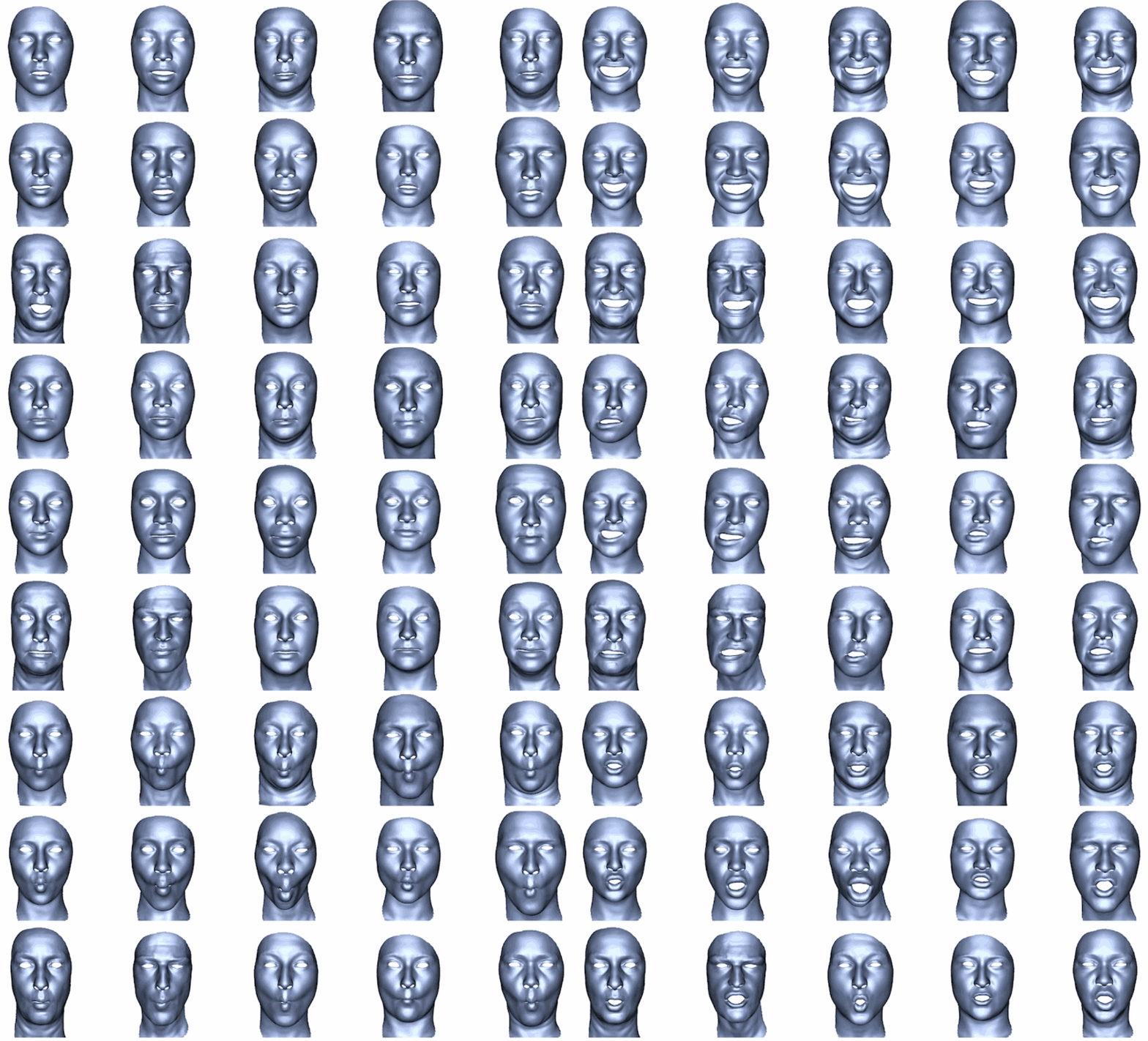
Computer generated faces all assume similar expressions in a row.

Image Credits: Disney Research

The results are powerful: You could generate a thousand faces with different shapes and tones, and then animate all of them with the same expressions without any extra work. Think how that could result in diverse CG crowds you can summon with a couple clicks, or characters in games that have realistic facial expressions regardless of whether they were hand-crafted or not.

It’s not a silver bullet, and it’s only part of a huge set of improvements artists and engineers are making in the various industries where this technology is employed — markerless face tracking, better skin deformation, realistic eye movements, and dozens more areas of interest are also important parts of this process.

The Disney Research paper was presented at the International Conference on 3D Vision; you can read the full thing here.


News: Gift Guide: 7 Smart Home gift ideas that go beyond the usual Google/Amazon smart speakers

It’s never been easier to build a smart home. Beyond the same Google/Amazon/Apple/etc. voice-powered assistant speakers you’ve probably seen on every gift guide for years, there’s a world of wonderful smart home products that can delight, surprise, and maybe make your life a little easier. The following list is void of those usual suspects and features unique products that would be perfect for anyone trying to make their home just a little bit smarter. Or for you. Whatever works.

Welcome to Techcrunch’s 2020 Holiday Gift Guide! Need help with gift ideas? We’re here to help! We’ll be rolling out gift guides from now through the end of December. You can find our other guides right here.

It’s never been easier to build a smart home. Beyond the same Google/Amazon/Apple/etc. voice-powered assistant speakers you’ve probably seen on every gift guide for years, there’s a world of wonderful smart home products that can delight, surprise, and maybe make your life a little easier. The following list is void of those usual suspects and features unique products that would be perfect for anyone trying to make their home just a little bit smarter. Or for you. Whatever works.

This article contains links to affiliate partners where available. When you buy through these links, TechCrunch may earn an affiliate commission.

Brilliant

The promise of the Brilliant Controls panel is to provide a dedicated place to control your myriad smart home devices, all while adding a few remotely controllable light switches to your walls. It’s got a built-in camera (with a physical privacy shutter) that you can use for room-to-room video chats, or to check up on your home while you are away. Supported devices include Wemo smart plugs, Ring alarms, Sonos speakers, Philips Hue and Lifx lights, as well Schlage, Yale and August locks, among others. The number of integrations keeps growing and covers most of the major brands, but if you’ve bet on other systems, this isn’t the controller for you. It comes with built-in Alexa support and works with the Google Assistant, too.

Price: Starting at $299 on Amazon

Flair Smart Vent

Image Credits: Flair

Smart thermostats are fairly ubiquitous these days, but depending on which one you’re using, you could be getting a lot more from your home heating and cooling with relatively simple DIY upgrades. The Flair Smart Vent system is one such upgrade, and though it costs a bit upfront to get going (each register is $79 to start, depending on size — and you’ll need at least one control puck to act as a hub, which adds around $100 to the cost of entry,) you won’t have to call an HVAC contractor or break down any walls to take advantage of what it offers.

Price: Around $200 for a starter kit that includes one register and one puck, direct from Flair

Flume 2

Image Credits: Darrell Etherington

Many smart home gadgets focus on convenience or automation of typically manual tasks, but Flume’s smart water sensor provides a potentially much more vital service: the ability to track how much water you’re consuming and alert you to potential leaks in your home’s plumbing. The company just released its second-generation Flume Smart Home Water Monitor ($199), and the device is easier to set up and smarter than ever.

Price: $199 on Amazon

Meural

Give the gift of art this holiday season with Netgear’s Meural. The connected screen is purpose-built to display artwork. The company offers a subscription service that provides access to the best art throughout history and even packages the art in a way that ensures nothing gets stale. Of course, the owner can also upload their own art to the display.

Price: Starting at $299 from Netgear

Sensibo

Sensibo

Image Credits: Sensibo

Think of the Sensibo as a smart thermostat for those who do not have a central heating cooling unit. If a person has a window air conditioner, portable room heater or modern heat pump — any device that has a remote control — the Senisbo will control the temperature. The latest version retails for $149 (it’s often on sale) and works great. If you have multiple heating and cooling devices, get a couple of these devices to have complete control.

The company launched in TechCrunch’s Hardware Battlefield competition in 2015 and has since evolved the product into a powerful platform that can automate a person’s heating and cooling needs.

Price: Starts at $115 on Amazon

DIY smart display

Image Credits: Adafruit

There are countless DIY smart home kits on the market and Adafruit has a great collection. The company’s PyPortal is a great jumping off point as it provides the builder with a touchscreen display and basic computing platform that allows for all sorts of uses. With just this kit, a person could build a smart alarm, smart display, or Amazon Echo clone.

Price: $55 from Adafruit

Nanoleaf

Nanoleaf products work like interactive, programmable art displays… and, for bonus points, they look like something out of a sci-fi movie. Once you’ve snapped the modular panels together, you can tie them into HomeKit, Alexa, Google Home, or if you’re feeling fancy, use services like IFTTT to programmatically recolor the lights based on the weather outside, or flash whenever you’ve got an incoming message. The kits with everything you’d need to get started (the controller, power plug, and a handful of panels) start at around $150-200 while expansion packs with more panels go for around $60-70 — so it’s not a cheap hobby, but you can start with just a few panels and build up over time if you’re so inclined.

Price: Currently starting at $180 direct from Nanoleaf

News: Remote-controlled delivery carts are now working for the local Los Angeles grocer

Robots are no longer the high-tech tools reserved for university labs, e-commerce giants and buzzy Silicon Valley startups. The local grocer now has access too. Tortoise, the one-year-old Silicon Valley startup known for its remote repositioning electric scooters, has taken its tech and adapted it to delivery carts. The company recently partnered with online grocery

Robots are no longer the high-tech tools reserved for university labs, e-commerce giants and buzzy Silicon Valley startups. The local grocer now has access too.

Tortoise, the one-year-old Silicon Valley startup known for its remote repositioning electric scooters, has taken its tech and adapted it to delivery carts. The company recently partnered with online grocery platform Self Point to provide neighborhood stores and specialty brand shops with electric carts that — with help from remote teleoperators — deliver goods to local consumers.

The companies have launched the product offering in Los Angeles with three customers. Each customer, which includes Kosher Express, has two to three carts that can be used to make deliveries up to three-mile radius from the store. Unlike the network models used by some autonomous sidewalk delivery companies, grocery stores lease the delivery carts and are responsible for the storage, charging and packing it up with goods that their customers have ordered.

The initial Self Point -Tortoise launch is small. But it has the makings of expanding far beyond Los Angeles. More importantly for Tortoise, it’s a validation of the company’s larger vision to make remote repositioning a horizontal business with numerous applications.

Tortoise started by equipping electric scooters with cameras, electronics and firmware that allow teleoperators in distant locales drive the micromobility devices to a rider or deliver it back to its proper parking spot. Now, it has taken that same hardware and software and used it to build its own delivery cart.

Tortoise co-founder and president Dmitry Shevelenko has said the company’s remote repositioning kit can be used for security and cleaning bots as well as electric wheelchairs and other accessibility devices. He’s even fielded inquiries from farmers interested in using remote repositioning scooters to monitor crops.

“From a practical point of view we’re not trying to not be everywhere overnight, but there’s really no technological constraint for us,” Shevelenko said in a recent interview.

The emergence of COVID-19, and its affects on consumer behavior, prompted Tortoise to home in on delivery carts as its second act.

“We kind of quickly realized that we’re living in a once-in-a-generation change in consumer behavior where now everything is online and people are expecting it to be delivered same day,” Shevelenko said. Tortoise was able to go from the first renderings in May to a delivery cart launch by the fourth quarter because of its ability to repurpose its hardware, software and workforce.

The company still remains bullish on its initial application in micromobility. Earlier this year, Tortoise, GoX and and tech incubator Curiosity Labs launched a six-month pilot in Peachtree Corners, Georgia that allows riders to use an app to hail a scooter. The scooters are outfitted with Tortoise’s tech. Once riders hail the scooter, a Tortoise employee hundreds of miles away remote controls the scooter to the user. After riders complete trips, the scooters drive themselves back to a safe parking spot. From here, GoX employees charge and sanitize the scooters and then mark them with a sticker that indicates they have been properly cleaned.

While partnership with Self Point is Tortoise’s next big project, Shevelenko was quick to note that the company is only focused on one slice of the on-demand delivery pie.

“Low speeds and hot foods don’t work too well,” he said. Startups such as Kiwibot and Starship have smaller robots that focus on that market, Shevelenko added. Tortoise’s delivery carts were designed specifically to hold large amounts of groceries, alcohol and other goods.

“We saw kind of a big opening in grocery,” he said, adding that relying on remote operators and its kit is a low-cost combination that can be used today while automated technology continues to develop. “We’re doing for last-mile delivery what globalized call centers did for customer support.”

News: France starts collecting tax on tech giants

France is going forward with its plan to tax big tech companies. The government has sent out notices to tech giants, as reported by the Financial Times, Reuters and AFP. There could be retaliation tariffs on French goods in the U.S. For the past couple of years, France’s Economy Minister Bruno Le Maire has been

France is going forward with its plan to tax big tech companies. The government has sent out notices to tech giants, as reported by the Financial Times, Reuters and AFP. There could be retaliation tariffs on French goods in the U.S.

For the past couple of years, France’s Economy Minister Bruno Le Maire has been pushing hard for a tax reform. Many economy ministers in Europe think tech companies aren’t taxed properly. They generate revenue in one country, but report to tax authorities in another country. They take advantage of countries with low corporate tax to optimize the bottom line.

Le Maire first pitched the idea of a European tax on big tech companies based on local revenue. But he failed to get support from other European countries — European tax policies require a unanimous decision from members of the European Union.

The French government chose not to wait for other European countries and started working on its own local tax. There are two requirements:

  • You generate more than €750 million in revenue globally and €25 million in France.
  • And you’re operating a marketplace (Amazon’s marketplace, Uber, Airbnb…) or an advertising business (Facebook, Google, Criteo…).

If you meet those two requirements, you have to pay 3 percent of your French revenue in taxes.

At the same time, the OECD has been working on a way to properly tax tech companies with a standardized set of rules that would work across the globe. But OECD members have yet to reach a compromise.

France and the U.S. have been arguing on and off for the past couple of years about the tech tax. In August 2019, then U.S. President Donald Trump and French President Emmanuel Macron reached a deal by promising that the French government would scrap the French tax as soon as the OECD finds a way to properly tax tech companies in countries where they operate.

In December 2019, the U.S. promised 100% tariffs on French wine, cheese and handbags because the previous deal wasn’t good enough. In January 2020, the two sides agreed to wait a little bit more to see if the OECD framework would come through.

And here we are. According to the French government, OECD negotiations have failed so it’s time to start collecting the French digital tax. Let’s s see how the U.S. reacts during the Trump-Biden transition.

News: As IBM shifts to hybrid cloud, reports have them laying off 10,000 in EU

As IBM makes a broad shift in strategy, Bloomberg reported this morning that the company would be cutting around 10,000 jobs in Europe. This comes on the heels of last month’s announcement that the organization will be spinning out its infrastructure services business next year. While IBM wouldn’t confirm the layoffs, a spokesperson suggested that

As IBM makes a broad shift in strategy, Bloomberg reported this morning that the company would be cutting around 10,000 jobs in Europe. This comes on the heels of last month’s announcement that the organization will be spinning out its infrastructure services business next year. While IBM wouldn’t confirm the layoffs, a spokesperson suggested that there were broad structural changes ahead for the company as it concentrates fully on a hybrid cloud approach.

IBM had this to say in response to a request for comment on the Bloomberg report, “Our staffing decisions are made to provide the best support to our customers in adopting an open hybrid cloud platform and AI capabilities. We also continue to make significant investments in training and skills development for IBMers to best meet the needs of our customers.”

Unfortunately, that means basically if you don’t have the currently required skill set, chances are you might not fit with the new version of IBM. IBM CEO Arvind Krishna alluded to the changing environment in an interview with Jon Fortt at the CNBC Evolve Summit earlier this month when he said:

“The Red Hat acquisition gave us the technology base on which to build a hybrid cloud technology platform based on open-source, and based on giving choice to our clients as they embark on this journey. With the success of that acquisition now giving us the fuel, we can then take the next step, and the larger step, of taking the managed infrastructure services out. So the rest of the company can be absolutely focused on hybrid cloud and artificial intelligence.”

The story has always been the same around IBM layoffs, that as they make the transition to a new model, it requires eliminating positions that don’t fit into the new vision, and today’s report is apparently no different, says Holger Mueller, an analyst at Constellation Research.

“IBM is in the biggest transformation of the company’s history as it moves from services to software and specialized hardware with Quantum. That requires a different mix of skills in its employee base and the repercussions of that manifest itself in the layoffs that IBM has been doing, mostly quietly, for the last 5+ years,” he said.

None of this is easy for the people involved. It’s never a good time to lose your job, but the timing of this one feels worse. In the middle of a recession brought on by COVID, and as a second wave of the virus sweeps over Europe, it’s particularly difficult.

We have reported on number of IBM layoffs over the last five years. In May, it confirmed layoffs, but wouldn’t confirm numbers. In 2015, we reported on a 12,000 employee layoff.

News: What will tomorrow’s tech look like? Ask someone who can’t see

Sight tech – or more broadly, eyes-free tech – now touches every part of our lives and the devices that we depend on. And it’s not just blind and visually impaired people who are benefitting.

Will Butler
Contributor

Will Butler is a writer, producer and podcast host from California. Legally blind since age of 19, Will has written and produced numerous stories about adjusting to vision loss. Will joined Be My Eyes as its VP in 2019 after four years at Lighthouse for the Blind and Visually Impaired in San Francisco. You can listen to Will’s interviews with leaders from the world of blindness and accessibility on The Be My Eyes podcast and the 13 Letters podcast.

When I was pronounced legally blind in 2009, I didn’t know one other person who called themselves blind – least of all “low vision” or “visually impaired.” Today, I manage the largest blindness community in the world, Be My Eyes, a support platform where more than 4 million people and companies use live video to support users in almost 200 languages. And though the growth of our collective community is a crucial step making our lives better, it’s just one piece of what makes today, as I’ve heard many others say, “a great time to be blind.”

That’s because in the past 10 years, “sight tech” has taken off. What we might have once called “assistive” or “special needs” technology has gone mainstream – and the technology developed by and for people with disabilities is now used by you, your kids, your grandparents – regardless of whether you identify as having a disability or not.

Sight tech – or more broadly, eyes-free tech – now touches every part of our lives and the devices that we depend on. And it’s not just blind and visually impaired people who are benefitting. It’s everyone. That’s why I’m pleased to be hosting the first ever Sight Tech Global conference on December 2 and 3, to sit down with the tech world’s most important figures in sight tech and talk about the past, present and future of how designing for the blind informs and affects all of our lives. Registration is free; sign up today.

What is Sight Tech?

Inventions to help the blind “see” have quietly been spurring innovation for decades. Often, idealistic inventors create with a charitable mindset – to help the needy or return something lost – but the real technological advances in sight tech have done a lot more than simply suggest a cure for human disability. They’ve created new abilities for everyone, and opened new doors to unpredictable innovation: The 12-inch record, the computer keyboard, and the text recognition software that laid the foundation for the modern database were all brought to market, initially, for blind consumers.

There was a time when a personal assistant, someone to read to you or a car at your door, were once thought of as “special” – but no longer. Today, every device shipped by Apple, Amazon, Google and Microsoft includes these capabilities and more, not as a bonus but as a necessity to compete in today’s competitive hardware and software markets. So whether you use your phone in dark mode or talk to Siri while you’re driving, you too use “sight tech” that was invented initially for the visually impaired.

Over and over again, designing for blind consumers has shown an ROI far beyond helping the needy. Audiobooks, which were heavily resisted by publishers when first developed for blind readers in 1934, now are the book industry’s only growing business. Likewise, coding your website for a blind person’s screen reader might seem like extra work until you realize it optimizes your SEO and makes your website more usable to about a billion other non-standard device users, as well. The world of sight tech is absolutely full of these types of happy surprises; unexpected synchronicities and wide applicability that started with designing for a seemingly small group.

Founded by former TechCrunch COO Ned Desmond earlier this year, Sight Tech Global provides a new venue for those who are passionate about AI, blind tech, digital inclusion and equal access for all to gather and hear from the accessibility community’s greatest thinkers and doers. Best of all, this free, all-virtual conference is a benefit for the Vista Center for the Blind and Visually Impaired which has been helping individuals with blindness or low vision for the past 75 years.

Here’s a little preview of what we’ll be unveiling, cheering, arguing and dreaming about at Sight Tech Global. I hope you’ll join us! Here is a link to the full agenda.

Achieving perfect mobility

For most, the self-driving car is a long-promised luxury. For those of us who can’t get a driver’s license, it’s the key to an unprecedented level of independence. Researchers at Waymo are intent on making sure that, when the first self-driving taxi arrives on your doorstep, it shouldn’t matter whether you can see or not: You should be able to hop in and take a ride.

Similarly, maps are much more than just a handy tool for those of us with visual impairments. In many cases, they’re the only option for finding your bearings – the difference between independence and codependence. Blind and sighted inventors alike have been pushing for better, more exact navigational tools for decades, and today the team at GOOD Maps has harnessed the power of lidar, data and and faster-than-ever processors to make sure that someone with no sight can get themselves within arm’s reach of exactly what they’re looking for.

Join product managers from Waymo, Waymap, Goodmaps and more to hear about the future of getting from point A to point B.

The next talking computer

Since the late 1980s, companies like Freedom Scientific and Humanware have laid the foundation for accessible computing, writing software and building devices that can convert visual information into sound or touch. Those devices were operating computers, rendering digital Braille and delivering audio books to readers long before there was an app for that.

Today, mainstream tech giants Apple, Amazon, Microsoft and Google are creating screen readers and assistive devices of their own, not to mention the thousands of third-party apps for navigation, sensory optimization, recognizing text and images and more. And with this new functionality native to operating systems, established assistive tech companies are evolving, too.

We’ll take a deep dive into what’s next for the “screen reader” – and how new tech from AI to AR, and headgear to haptics are shaking up interfaces and reshaping paradigms across our industry.

Over the course of two days, we’ll be hearing from the accessibility leaders at Apple, Microsoft, Google, Vispero, Humanware, Amazon and more.

Tech that doesn’t discriminate

Even the greatest new tech creates great new problems. And as AI swoops in to save the day, allowing blind and visually impaired people to overcome barriers in their work and social lives, AI can also introduce new biases that we never expected. When training our systems to recognize, categorize and interact with real people, how do we account for disability and a diverse range of functional needs? How do we make machines that don’t inherit our own cultural prejudices?

We’ll also be joined by some of the blindness and disability community’s greatest advocates: people like Lainey Feingold, Haben Girma and George Kerscher, who will take a hard look at access to information as a civil right, how far we’ve come and how far we have to go in the era of AI.

Sight Tech Global is December 2-3 – all-virtual and 100% free. All sponsorship proceeds benefit the Vista Center for the Blind. It’s not too late to sponsor – learn more here.


News: Insurtech’s big year gets bigger as Metromile looks to go public

In the wake of insurtech unicorn Root’s IPO, it felt safe to say that the big transactions for the insurance technology startup space were done for the year. After all, 2020 had been a big one for the broad category, with insurtech marketplaces raising lots, rental insurance startup Lemonade going public, Root itself debuting even

In the wake of insurtech unicorn Root’s IPO, it felt safe to say that the big transactions for the insurance technology startup space were done for the year.

After all, 2020 had been a big one for the broad category, with insurtech marketplaces raising lots, rental insurance startup Lemonade going public, Root itself debuting even more recently on the back of its automotive insurance business, a big round to help Hippo keep building its homeowners company and more.


The Exchange explores startups, markets and money. Read it every morning on Extra Crunch, or get The Exchange newsletter every Saturday.


But yesterday brought with it even more news: Metromile, a startup competing in the auto insurance market, is going public via a blank-check company (SPAC), and Hippo raised a huge, unpriced round.

So let’s talk about why Metromile might be plying the public markets, and why Hippo may have have decided to pick up more cash. Hint: The reasons are related.


A market hungry for growth

The Lemonade IPO was a key moment for neoinsurance startups, a key part of the broader insurtech space. When the rental insurance provider went public, it helped set the tone for public exit valuations for companies of its type: fast-growing insurance companies with slick consumer brands, improving economics, a tech twist and stiff losses.

For the Roots and Metromiles and Hippos, it was an important moment.

So, when Lemonade raised its IPO range, and then traded sharply higher after its debut, it boded well for its private comps. Not that rental insurance and auto insurance or homeowners insurance are the same thing. They very most decidedly are not, but Lemonade’s IPO demonstrated that private investors were correct to bet generally on the collection of startups, because when they reached IPO-scale, they had something that public investors wanted.

News: Amazon Web Services outage takes a portion of the internet down with it

Amazon Web Services is currently having an outage, taking a chunk of the internet down with it. Several AWS services were experiencing problems as of early Wednesday, according to its status page. That means any app, site or service that relies on AWS might also be down, too. (As I found out the hard way

Amazon Web Services is currently having an outage, taking a chunk of the internet down with it.

Several AWS services were experiencing problems as of early Wednesday, according to its status page. That means any app, site or service that relies on AWS might also be down, too. (As I found out the hard way this morning when my Roomba refused to connect.)

Amazon says the issue is largely localized to North America. The company didn’t give a reason for the outage, only that it was experiencing increased error rates and that it was working on a resolution. The irony is that the outage is also affecting the company’s “ability to post updates to the Service Health Dashboard,” so not even Amazon is immune from its own downtime.

So far a number of companies that rely on AWS have tweeted out that they’re experiencing issues as a result, including Adobe and Roku.

An Amazon AWS outage is currently impacting Adobe Spark so you may be having issues accessing/editing your projects. We are actively working with AWS and will report when the issue has subsided. https://t.co/uoHPf44HjL for current Spark status. We apologize for any inconvenience!

— Adobe Spark (@AdobeSpark) November 25, 2020

We are working to resolve this quickly. We are impacted by the widespread AWS outage and hope to get our customers up and running soon. Most streaming should work as expected during this time.

— Roku Support (@RokuSupport) November 25, 2020

We do apologize for the inconvenience! Unfortunately, the issue is stemming from an AWS server outage, which is affecting many companies. We hope that the issue is resolved soon!

— Shipt (@Shipt) November 25, 2020

We’ll keep you updated as this outage continues. On the bright side TechCrunch is still up, so here are a few things to read.

Extra Crunch:

News: Slack’s stock climbs on possible Salesforce acquisition

News that Salesforce is interested in buying Slack, the popular workplace chat company, sent shares of the smaller firm sharply higher today. Slack shares are up just under 25% at the moment, according to Yahoo Finance data. Slack is worth $36.95 per share as of the time of writing, valuing it at around $20.8 billion.

News that Salesforce is interested in buying Slack, the popular workplace chat company, sent shares of the smaller firm sharply higher today.

Slack shares are up just under 25% at the moment, according to Yahoo Finance data. Slack is worth $36.95 per share as of the time of writing, valuing it at around $20.8 billion. The well-known former unicorn has been worth as little as $15.10 per share inside the last year, and worth as much as $40.07.

Inversely, shares of Salesforce are trading lower on the news, falling around 3.5% as of the time of writing; investors in the San Francisco-based SaaS pioneer were either unimpressed at the combination idea, or perhaps worried about the price that would be required to bring the 2019 IPO into their fold.

Why Salesforce, a massive software company with a strong position in the CRM market, and aspirations of becoming an even larger platform player, would want to buy Slack is not immediately clear though there are possible benefits. This includes the possibility of cross-selling the two companies products’ into each others customer bases, possible unlocking growth for both parties; Slack has wide marketshare inside of fast-growing startups, for example, while Salesforce’s products roost inside a host of mega-corps.

TechCrunch reached out to Salesforce, Slack, and Slack’s CEO for comment on the deal’s possibility. We’ll update this post with whatever we get.

While Salesforce bought Quip for $750 million in 2016, which gave it a kind of document sharing and collaboration, other than that, Salesforce Chatter has been the only social tool in the company’s arsenal. Buying Slack would give the CRM giant solid enterprise chat footing and likely a lot of synergy among customers and tooling.

But Slack has always been more than a mere chat client. It enables companies to embed workflows, and this would fit well in the Salesforce family of products, which spans sales, service, marketing and more. It would allow companies to work both inside and outside the Salesforce ecosystem, building smooth and integrated workflows. While it can theoretically do that now, if the two were combined, you can be sure the integrations would be much tighter.

What’s more, Holger Mueller, an analyst at Constellation Research says it would give Salesforce a sticky revenue source, something they are constantly searching for keep their revenue engine rumbling along. “Slack could be a good candidate to strengthen its platform, but more importantly account for more usage and ‘stickiness’ of Salesforce products — as collaboration not only matters for CRM, but also for the vendors growing work.com platform,” Mueller said.  He added, it would be a way to stick it to former friend turned foe, Microsoft.

That’s because Slack has come under withering fire from Microsoft in recent quarters, as the Redmond-based software giant poured resources into its competing Teams service. Teams challenges Slack’s chat tooling, and Zoom’s video features, and has seen huge customer growth in recent quarters.

Finding Slack a corporate home amongst the larger tech players could ensure that Microsoft doesn’t grind it under the bulk of its enterprise software sales leviathan. And Salesforce, a sometimes Microsoft ally, would not mind adding the faster-growing slack to its own expanding software incomes.

The question at this juncture comes down to price. Slack investors won’t want to sell for less than a good premium on the pre-pop per-share price now feels rather dated.

News: Instead of Yule log, watch this interactive dumpster fire because 2020

The holiday seasons is upon us and with that comes stress, anxiety, and the airing of grievances. And this year is worse. Instead of watching a yule log smolder in a warm hearth, we’re all stuck in our homes watching the world burn. Try this interactive dumpster fire instead of yelling into the void. The

The holiday seasons is upon us and with that comes stress, anxiety, and the airing of grievances. And this year is worse. Instead of watching a yule log smolder in a warm hearth, we’re all stuck in our homes watching the world burn.

Try this interactive dumpster fire instead of yelling into the void. The instructions are simple. Just email a note or picture and a contraption incinerates your asseveration. It’s cathartic, but takes a minute. About 20 minutes after emailing my issues, I’m still waiting to see it burn.

Do it as a family or with your cats. Roast Covid-19. Burn politics. Send a picture of your QAnon-loving uncle. The fire doesn’t care. Everything burns eventually.

WordPress Image Lightbox Plugin