Yearly Archives: 2020

News: C3.ai’s initial IPO pricing guidance spotlights the public market’s tech appetite

On the heels of news that DoorDash is targeting an initial IPO valuation up to $27 billion, C3.ai also dropped a new S-1 filing detailing a first-draft guess of what the richly valued company might be worth after its debut. C3.ai posted an initial IPO price range of $31 to $34 per share, with the

On the heels of news that DoorDash is targeting an initial IPO valuation up to $27 billion, C3.ai also dropped a new S-1 filing detailing a first-draft guess of what the richly valued company might be worth after its debut.

C3.ai posted an initial IPO price range of $31 to $34 per share, with the company anticipating a sale of 15.5 million shares at that price. The enterprise-focused artificial intelligence company is also selling $100 million of stock at its IPO price to Spring Creek Capital, and another $50 million to Microsoft at the same terms. And there are 2.325 million shares reserved for its underwriters as well.

The total tally of shares that C3.ai will have outstanding after its IPO bloc is sold, Spring Creek and Microsoft buy in, and its underwriters take up their option, is 99,216,958. At the extremes of its initial IPO price range, the company would be worth between $3.08 billion and $3.37 billion using that share count.

Those numbers decline by around $70 and $80 million, respectively, if the underwriters do not purchase their option.

So is the IPO a win for the company at those prices? And is it a win for all C3.ai investors? Amazingly enough, it feels like the answers are yes and no. Let’s explore why.

Slowing growth, rising valuation

If we just look at C3.ai’s revenue history in chunks, you can argue a growth story for the company; that it grew from $73.8 million in the the two quarters of 2019 ending July 31, to $81.8 million in revenue during the same portion of 2020. That’s growth of just under 11% on a year-over-year basis. Not great, but positive.

News: Twitter’s Audio Spaces test includes transcriptions, speaker controls, and reporting features

Earlier this month, Twitter announced it would soon begin testing its own Clubhouse rival, called Audio Spaces. The new product will allow Twitter users to gather in dedicated spaces for live conversations with another person or with groups of people. While the company showed off a handful of screenshots of the product at the time

Earlier this month, Twitter announced it would soon begin testing its own Clubhouse rival, called Audio Spaces. The new product will allow Twitter users to gather in dedicated spaces for live conversations with another person or with groups of people. While the company showed off a handful of screenshots of the product at the time of the announcement, there were few specifics about how Audio Spaces would work. Now, we know a bit more about Audio Spaces’ feature set, thanks to some digging by reverse engineer Jane Manchun Wong. 

Wong enabled the private beta in the Twitter app and took screenshots that show how Audio Spaces and its features would look in action. Of course, these features could change before the feature later rolls out to the public, but it gives an idea about how Twitter is currently thinking about the product.

Twitter is internally testing Audio Spaces Beta, here’s another look:

– Uses Periscope as backend

– Reactions: 💯✋✊✌👋

– “Who can speak” can be adjusted in the middle

– Transcriptions available

– Spaces can be reported

– “Share feedback” sends DM to @TwitterSpaces pic.twitter.com/hbyiJuEWw5

— Jane Manchun Wong (@wongmjane) November 28, 2020

The images show that users will be able to apply the same sort of conversation controls that are today available for tweets to Audio Spaces, as well. This will allow users to configure their Audio Space to be open to anyone who wants to join, only to people they follow, or only to people they specifically invite to join.

Users can invite others to their Space in a number of ways, too, including via DM (direct message), by posting a tweet, or copying a link that can be shared elsewhere.

When joining a space, people will enter the space with their microphone disabled to limit noise. As the conversation progresses, they can react to what’s being said with a variety of emoji, like the “100,” raised hand, fist, peace sign, and waving hand.

In addition, the Audio Space’s creator will be able to adjust who can speak at any time after the dedicated room has been created. From an in-app menu, they’ll be able to manage the speakers, adjust other settings, view the rules, as well as share feedback or report the space, among other things.

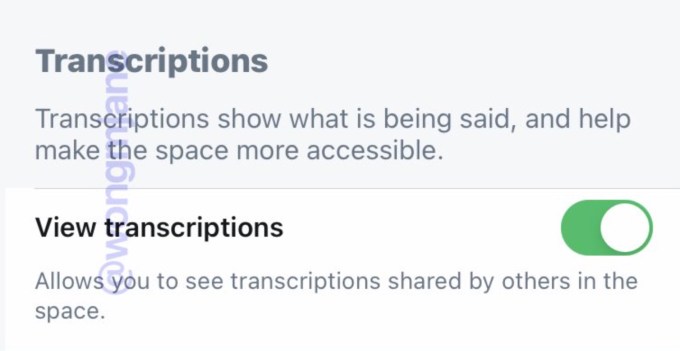
One interesting finding is that Audio Spaces will include transcriptions of the chat, according to this menu. That’s a differentiating feature, compared with some other audio chat room services. While ostensibly a feature designed for accessibility, it could also prove useful in keeping the conversations appropriate and respectful, since users would know their words were being written down.

This could help address one issue with the private chat room model, where live conversations have proven to be hard to moderate. Despite being in an invite-only beta, Clubhouse, for example, already experienced a handful of incidents of moderation failure, including the harassment of a New York Times reporter and another conversation that delved into anti-Semitism.

Twitter, which has struggled for years to combat abuse on its platform, was a questionable place to be testing this unproven new format for online socializing.

It wasn’t clear how Twitter would be approach moderation for these audio chat rooms, but it appears the transcription feature could a deterrent to toxic speech while the in-app reporting feature allows for a more direct solution to problems that crop up. When users choose the “Report this Space” option, they can then choose to report across a variety of categories, including self-harm, violence, sexual content, child safety, private information or abusive behavior.

Because Audio Spaces is in private beta, testers will also have access to a “Share Feedback” option that allows them to DM the account @TwitterSpaces.

Wong also noted Audio Spaces is using Periscope for its backend, according to her digging in the app’s code.

Twitter earlier said Audio Spaces would be launching to a small group of users. During tests, those users would include a group of people who are “disproportionately impacted by abuse and harm on the platform: women and those from marginalized backgrounds,” Twitter Staff Product Designer Maya Gold Patterson had noted, when introducing the feature in a briefing for reporters this month.

Twitter hasn’t yet commented on Wong’s findings.

News: FCC Chairman Ajit Pai will step down to make way for the Biden administration

The Chairman of the FCC, Ajit Pai, has announced he will leave his position on January 20 as President-elect Biden is sworn in. Pai’s tenure has been a controversial one, and while he would almost certainly like to be remembered for his efforts to “bridge the digital divide,” as he was fond of saying, it

The Chairman of the FCC, Ajit Pai, has announced he will leave his position on January 20 as President-elect Biden is sworn in. Pai’s tenure has been a controversial one, and while he would almost certainly like to be remembered for his efforts to “bridge the digital divide,” as he was fond of saying, it is the dismantling of net neutrality that will be his legacy.

It is traditional at the FCC for the Chairman to leave when the administration changes parties. Pai took over when Tom Wheeler, who chaired the Commission at the end of the Obama years, resigned upon Trump’s election. The Biden administration has not announced its pick for the new leader of the communications agency.

In an official FCC memo, Pai thanked his colleagues and summarized the accomplishments of his four years at the helm (as, it must also be said, the first Commissioner of Asian descent):

Together, we’ve delivered for the American people over the past four years: closing the digital divide; promoting innovation and competition, from 5G on the ground to broadband from space; protecting consumers; and advancing public safety.

I am proud of how productive this Commission has been, from commencing five spectrum auctions and two rural broadband reverse auctions in four years, to opening 1,245 megahertz of mid-band spectrum for unlicensed use, to adopting more than 25 orders through our Modernization of Media Regulation Initiative, to aggressively protecting our communications networks from national security threats at home and abroad, to designating 988 as the three-digit number for the National Suicide Prevention Lifeline, and much, much more.

Notably absent from that list is Pai’s unfortunate magnum opus and arguably the effort that got him the job: the elimination of 2015’s net neutrality rules. The tremendously dishonest and partisan campaign to overturn these popular and important curbs on broadband companies put a stink on Pai’s tenure at the outset that no amount of good work could wash out.

For as always, the bulk of the FCC’s duties fly under the public’s radar, and a great deal of work was done under Pai, as under any other administration, invisibly and thanklessly. (Though in some cases less invisibly than before — Pai’s FCC did make improvements to transparency, in some ways anyhow.)

Surely Pai’s greatest priority was, as indeed he often stated, ameliorating the “digital divide” that prevents millions of Americans from enjoying affordable, fast internet. Numerous new programs and funds were created to improve this situation, but Pai was hampered by bad information — essentially provided on the honor system by ISPs themselves — and the seemingly endless rollout of 5G, which we’re all still waiting on.

His final effort, alas, will not much improve the opinion of him at large. As Trump raged impotently about Section 230, a law that shields internet companies from liability for the actions of their users, Pai took up that flag and announced his intention to revisit and perhaps change the interpretation of it — a month before the election. The simpering, plainly political nature of the effort, almost certain now to be aborted entirely, attracted considerable criticism, makes for a poor final chapter in an already troubling story.

The next step for the FCC is the nomination and confirmation of a new Chairman and replacement Commissioners, and though several names have been floated by political insiders, no one has emerged yet as the heir apparent.

News: Facebook confirms it has acquired Kustomer, sources say for $1B

Today Facebook made one of its biggest plays yet to build services for the businesses on its platform: it has announced that it is acquiring Kustomer, a startup founded with the aim of disrupting the customer services industry with a new approach to providing agents with better data and a more unified pictures of users

Today Facebook made one of its biggest plays yet to build services for the businesses on its platform: it has announced that it is acquiring Kustomer, a startup founded with the aim of disrupting the customer services industry with a new approach to providing agents with better data and a more unified pictures of users by bringing together the many social media and other channels and longer history between them and the company in question.

Terms are not being disclosed but sources are saying it’s in the region of $1 billion. Reports of the deal were published earlier today by WSJ.

Kustomer — co-founded by CEO Brad Birnbaum and Jeremy Suriel (the two worked together across a range of other places, including Airtime and AOL and had sold a previous startup to Salesforce) — had raised around $174 million in private funding from investors that included Coatue, Tiger Global Management, Battery Ventures, Redpoint Ventures, Cisco Investments, Canaan Partners, Boldstart Ventures and Social Leverage. It was last valued at $710 million, according to estimates from PitchBook.

Facebook’s interest in Kustomer is very straightforward: the company has been slowly building up a big business providing customer services to businesses on its platform.

There are some 175 million people using Facebook this way today, covering both those who use Facebook to engage with businesses that use Facebook as their primary online “identity” — in place of a website or mobile app of their own, companies today often simply have a Page on Facebook — and those businesses that provide conversation channels on Facebook-owned messaging apps like Instagram, Messenger and WhatsApp as a complement to other ways (and sometimes the sole way) to contact them.

Considering that Facebook has upwards of 2 billion users, 175 million doesn’t sound like a lot.

But as the company starts to see more keen competition from the likes of Snapchat, TikTok and likely others over time, having a better product to sell businesses alongside their other services will give Facebook a better way of locking them into the Facebook ecosystem. It will also give the company a stronger shot at a newer revenue stream to complement advertising, which remains its biggest cash cow by a big margin.

Indeed, customer service is an interesting play for Facebook to be making. The company has been investing in and building a number of additional features for businesses on its messaging apps — most recently on WhatsApp, for example, it started to make it easier for businesses let people shop and do more on the app. Within that customer service is a huge industry that stretches well beyond the Facebook walled garden.

Indeed, the specific term Kustomer and other CRM companies use to describe what it does is “omni-channel” customer relations. That is to say, it gives the Kustomer business users a complete picture of the many disparate places where “conversations” might be happening with customers — be it on apps, on social media, in websites, via chatbots, or email, etc. The logic is that this makes the agent more efficient and gives him/her a better picture of both how the business is faring across those channels, and more context about a specific user contacting the company from one of those channels, as well as a more complete picture of the customers themselves.

For Facebook, it’s “customer relations” profile up to now has been about users within its app walls. This gives it a much bigger opportunity to essentially control that bigger picture and bigger relationship, regardless of the platform being used.

Coincidentally, it was only earlier this month that I reported that Snap acquired Voca.ai, which makes customer support voice bots.

While we have no idea how Snap will use that tech — some have speculated it could be to build more voice commands and audio-based tech for its Spectacles — I wrote at the time that it would make a lot of sense to bring this into a bigger product portfolio providing more tools to businesses already using Snapchat to market themselves. This Kustomer acquisition feels very timely in that regard.


News: French administration suspects Wish of selling counterfeit products

A French administration in charge of consumer rights and fraud has investigated on Wish, the mobile e-commerce platform that recently filed to go public. While the company generated $1.9 billion in revenue in 2019, the French administration believes Wish could be selling products, such as sneakers and perfumes, with images incorrectly showing the logos of

A French administration in charge of consumer rights and fraud has investigated on Wish, the mobile e-commerce platform that recently filed to go public. While the company generated $1.9 billion in revenue in 2019, the French administration believes Wish could be selling products, such as sneakers and perfumes, with images incorrectly showing the logos of famous brands.

In addition to those wrongly labeled products, the administration says Wish pretends products are on sale while they aren’t. The platform could be displaying -70%, -80% or -90% on some products even though the original price is completely made up.

The administration in charge of the investigation is the direction générale de la concurrence, de la consommation et de la répression des fraudes (DGCCRF), an administration that reports to the French Ministry for the Economy and Finance. They have transmitted the report to a court in Paris.

Now, it’s up to the court to decide whether the allegations are right or unfounded. “The court can subpoena Wish or offer to plead guilty. We should know in the coming days,” France’s digital minister Cédric O told me.

On Twitter, Cédric O highlighted one case in particular. “Wish already stood out during the first lockdown by selling facemasks that don’t meet safety standards. French people who are using the app to find low-cost products should know that they’ll mostly find scams,” he tweeted.

.@WishShopping s’était déjà distinguée pendant le 1er confinement en vendant des masques ne respectant pas les normes. Les Français-e-s qui utilisent l’application pour y trouver du low-cost doivent savoir qu’ils y trouveront surtout des arnaques. @alaingriset @BrunoLeMaire

— Cédric O (@cedric_o) November 30, 2020

If Wish is found guilty, the company could risk up to 10% of its annual revenue in France. In particular, it’s going to be interesting to see whether Wish is responsible for products sold by third-party merchants.

The timing of the case is a bit odd as Europe’s upcoming Digital Services Act should overhaul the e-commerce directive from 2000. All eyes are on content moderation, but the Digital Services Act should also focus on counterfeit sellers, the liability of marketplaces and more.

News: Cyber Monday: up to $12.7B will be spent online, marking biggest-ever US shopping day

Thanksgiving and Black Friday online shopping this year had big gains on 2019, but both still fell somewhat short of expectations in what is proving to be a good if more muted holiday shopping season, without the usual physical crowds to help enforce Covid-19 social distancing and many feeling the economic strain of the health

Thanksgiving and Black Friday online shopping this year had big gains on 2019, but both still fell somewhat short of expectations in what is proving to be a good if more muted holiday shopping season, without the usual physical crowds to help enforce Covid-19 social distancing and many feeling the economic strain of the health pandemic.

Now all eyes are on “Cyber Monday,” which has for the last several years has been the biggest online shopping day of the four-day stretch. Adobe predicts that it will be the biggest shopping day yet in the US, with between $10.8 billion and $12.7 billion spent, while Salesforce’s forecast is in the middle of that range, $11.8 billion. Globally, Salesforce believes the figure will be $46 billion.

Adobe figure of 40% of sales on smartphones has been relative steady all week. Shopify, which typically works with smaller merchants, has put the figure closer to 70%.

For some context, Black Friday came in at $9 billion and Thanksgiving at $5.1 billion this year according to Adobe’s figures. And last year $9.4 billion was spent on Cyber Monday 2019.

Salesforce was more optimistic: it said that digital revenues on Black Friday were $12.8 billion with global figures coming in at $62 billion, while Thanksgiving was closer to $6.8 billion in online sales in the US, with the global figure around $30.4 billion.

“Cyber Monday is on track to break all previous records for online sales. Consumers will likely take advantage of the best discounted items today like TVs, toys and computers before price levels start creeping back up throughout the rest of the season,” said Taylor Schreiner, director, Adobe Digital Insights. “Shoppers are encouraged to do their gift buying soon as shipping in time for Christmas will get more expensive in the coming weeks.”

We will continue to update these figures as we get more data in. Adobe, for example, said that it believes that a whopping 29% of today’s revenue will come only between 7pm and 11pm Pacific (after work is over for the day).

(Part of the disparity in the two companies’ figures is based on methodology. Adobe bases its figures on 80 of the top 100 retailers in the US, covering some 1 trillion transactions. Salesforce is using data gleaned from its Commerce Cloud, covering billions of engagements and millions of social media conversations, which it then combines with further analytics in its Shopping Index.)

One thing that is clear from both companies is that Cyber Monday continues to be the biggest day of them all. Why? It’s a perfect storm: the big rush of sales for the holiday season are up, but everyone is back at work, so they shop online instead of in person. Hence, big numbers on Cyber Monday.

As with the other days of the long weekend, one thing that has been impacting sales numbers is the fact that sales are starting earlier and earlier, but Adobe said that many consumers still believe that big bargains are laid on for the specific day. Some of the most popular shopping categories have included computers (marked down 30% on average), toys (20% discount), appliances (21%) and electronics (26%).

Bigger businesses continue to reap the biggest spoils in online shopping — not least because they still provide the best range of delivery, pick-up and return options to consumers, which become an even bigger set of priorities as you move further away from more amenable early adopters and into the more general population and potentially less experienced online shoppers. The conversion rates for big retailers (over $1 billion in revenues annually) are typically 70% higher than for smaller businesses.

Still, small businesses have tried to spend years catching up, boosted by various startups and companies like Shopify building tools for them to “be like Amazon” in their fulfillment, delivery and other features. Adobe said that Small Business Saturday, the newest of the Thanksgiving shopping holidays, saw $4.7 billion spent, a record for the day and up 30.2% on 2019. And to underscore just how tough times are for small businesses, Adobe said that the money small businesses were bringing in online this year was a whopping 294% higher than an average day in October.

So far some $23.5 billion has been spent during the holiday weekend.

News: Salut raises $1.25M for its virtual fitness service

This morning Salut, an app-based service that allows fitness trainers to host classes virtually, announced that it has raised $1.25 million in a new financing event. The round was led by Charles Hudson, an investor at Precursor Ventures. Founder Matthew DiPietro, formerly of Twitch, told TechCrunch that Salut soft-launched in mid-September, with a wider release

This morning Salut, an app-based service that allows fitness trainers to host classes virtually, announced that it has raised $1.25 million in a new financing event. The round was led by Charles Hudson, an investor at Precursor Ventures.

Founder Matthew DiPietro, formerly of Twitch, told TechCrunch that Salut soft-launched in mid-September, with a wider release coming today.

DiPietro thought up the concept behind Salut before the pandemic hit, he said during an interview, but after COVID-19 appeared the idea took on new urgency. The company put together what DiPietro described as a no-code alpha version of the service in May to test the market, allowing the then-nascent startup to validate demand on both sides of its marketplace — it’s famously difficult to jumpstart two-sided marketplaces, as demand tends to follow supply, and vice-versa.

The test allowed the company to get to confidence on demand existing from both trainers and exercise fans, and in its initial economic model.

With the new round in the bank and its product now formally launched, it’s up to Salut to scale rapidly. The company currently has 55 registered trainers on its platform, a reasonable start for the seed-stage startup. It will need to grow that figure by a few orders of magnitude if it wants to generate enough revenue to reach an eventual Series A.

But Salut is not focused on early-revenue generation, taking no cut of trainer revenue today. Indeed, per an email the company sent out to its users this morning, the startup is passing along 100% of post-Apple income that trainers generate, or 85% of the gross.

Currently users can donate to, or tip, trainers that host classes. DiPietro told TechCrunch that subscription options are coming in a quarter or two. The startup also announced today that trainers can now allow their classes to be replayed, what the startup called one of its “most requested features.”

Anyone familiar with Peloton understands why this matters; only a fraction of classes on the Peloton ecosystem are live at any point in time, but the bike comes with a library of content that users can simply load up whenever they like. This also allows Peloton to release more niche content than it otherwise might, as even the heavy metal-themed rides can accrete a reasonable ridership over time (something they might not be able to manage if all classes on the platform were only live once and then gone forever).

DiPietro is bullish on building income streams for trainers, especially during a pandemic that has locked many gyms, leaving fitness processionals with little to no income in many cases.

There’s some early signal that users are willing to pay, the company said, with early users willing to pay $5 or $10 for an hour of fitness training. And with a focus on the long-tail of trainers who can’t attract 10,000 fans to a single class, Salut thinks there are a large number of trainers who have enough pull to generate more income from its service, in time, than they could at a traditional studio.

Salut supports group video classes, of course, so trainers can collect monies from cohorts of users at a time.

The company’s fundraising is largely earmarked for engineering, with the company having what its founder called an ambitious product roadmap.

The startup also announced a new project with Fitness Mentors, a company that helps trainers get certified, to create what the two companies are calling “the industry’s first Virtual Group Fitness Instructor (V-GFI) course and certification.”

You can see why Salut would want the certification to exist; its existence will allow users of its service to find trainers that are worth their time on its service, and may raise the overall level of quality of classes provided.

Let’s see how far Salut can get with $1.25 million.

News: Curio Wellness launches $30M fund to help women and minorities own a cannabis dispensary

“We think of diversity as a keystone issue for the cannabis industry,” said Curio WMBE Fund managing director Jerel Registre in a conversation with TechCrunch. Registre’s conviction around this program is obvious as he explains the problem the fund is addressing. The new fund, started by the Maryland-based medical cannabis company Curio Wellness, aims to

“We think of diversity as a keystone issue for the cannabis industry,” said Curio WMBE Fund managing director Jerel Registre in a conversation with TechCrunch. Registre’s conviction around this program is obvious as he explains the problem the fund is addressing.

The new fund, started by the Maryland-based medical cannabis company Curio Wellness, aims to help underserved entrepreneurs entering the cannabis market. With $30 million to invest, the Curio WMBE Fund is looking to invest in up to 50 women, minority and disabled veterans seeking to open and operate a Curio Wellness franchise with a path to 100% ownership in three years.

Registre tells TechCrunch the goal is to create more diverse ownership through a proven business model. Participants of this program gain access to capital and operational resources.

Curio made a name for itself in Maryland, where it’s the largest cannabis cultivator by market share. Founded in 2014, the family-owned business operates dispensaries rooted in a patient-centric approach. While a legally separate but affiliated entity from Curio Wellness, the Curio WMBE Fund aims to give franchisees access to Curio’s secret sauce.

“In looking at the systemic barriers that women, minorities and disabled veterans face in accessing capital, we decided to develop a solution that directly addresses this massive economic disparity,” said Michael Bronfein, CEO of Curio Wellness. “The Fund provides qualifying entrepreneurs with the investment capital they need to become a Curio Wellness Center franchisee while ensuring their success through our best in class business operations.”

“Let’s bottle the success we have,” Registre added. He likens the franchise model to McDonald’s, where the national corporation gives operators a proven standard operating procedure and ongoing support.

“Our fund is unlike any other in the industry,” Registre said, “as eligible entrepreneurs will have a clear path to 100% ownership in as little as three years. Many other funds rely on a model that utilizes minority entrepreneurs as a vehicle to achieve licenses: The Curio approach flips this model by empowering diverse entrepreneurs and supporting them along the way. If something happens and an investment-funded franchisee defaults, they must be replaced by another minority or woman owner. This ensures these licensees can get the financial support they need to launch while ensuring that the fund’s ultimate mission of supporting diverse entrepreneurs is achieved.”

Registre explained that diversity is central to Curio Wellness, too. Of the company’s 200 employees, 40% are female, and more than half are minorities. At the leadership level, 38% of management is female, and 44% identify as a member of a minority community.

“Diversity is a core asset that we recognize as integral to our success and our future, and that is why we decided to create this investment fund,” Registre said.

The fund provides two phases of support. The first provides capital to franchisees to open their Curio Wellness Center and assist them in obtaining licenses, selecting a location and hiring and training employees. Once the location is operational, the fund intends to provide ongoing support around managing, sales and marketing, store operations, and ensuring employees stay updated on product information.

Curio sees its locations as more than cannabis dispensaries. The company calls them Wellness Centers.

“Curio locations go beyond the traditional experience people have at a medical cannabis dispensary — they are total wellness destinations, under the leadership of a licensed pharmacist,” Registre explains. “Patient wellness is at the center of everything we do and is exemplified by a diverse array of holistic health products, services and educational programming we offer. While additive to the medical cannabis patient experience, these features open the store up to the entire community, not limiting the healthcare experience to only those with a medical cannabis card. This practice, of a patient-first mindset through a pharmacist-led model, allows us to truly lead the pursuit of wellness for everyone who walks in the front door.”

As of writing, the fund has raised half of its $30 million target. The company says the fund intentionally targeted, pitched and secured an investment pool that includes women and minorities. The fund expects to close by the end of 2020, and applications are expected to open in early 2021.

News: The Station: COVID’s effect on car ownership

The Station is a weekly newsletter dedicated to all things transportation. Sign up here — just click The Station — to receive it every weekend in your inbox. Hello and welcome back to The Station, a newsletter dedicated to all the present and future ways people and packages move from Point A to Point B. For

The Station is a weekly newsletter dedicated to all things transportation. Sign up here — just click The Station — to receive it every weekend in your inbox.

Hello and welcome back to The Station, a newsletter dedicated to all the present and future ways people and packages move from Point A to Point B.

For all my American readers, I hope you’re happy and satiated from the Thanksgiving holiday in this oddest of years. My hope for all Station readers, no matter where you reside, is a safe and healthy remainder of the year (and beyond!). While I took some time off last week, the news wheel kept on turning. A few of items got my attention last week, notably an EY study that examined how views on public transit, mobility as a service and car ownership are changing due to COVID-19. Let’s get reading!

Email me anytime at kirsten.korosec@techcrunch.com to share thoughts, criticisms, offer up opinions or tips. You can also send a direct message to me at Twitter — @kirstenkorosec.

Micromobbin’

the station scooter1a

Lime is adding another 1,000 scooters in San Francisco, an action it is able to take because the company also holds Jump’s permit in the city. For those who might have forgotten, Lime now owns Jump through a complex deal with Uber.

The company also released San Francisco scooter ridership data that shows how trip start and ends have moved outside of the downtown core and into neighborhoods like the Mission, Castro and Hayes Valley. Lime said this changing ridership pattern is consistent with its findings across the country, with more trips moving to residential neighborhoods since the COVID-19 pandemic swept across the globe.

In other news …

CAKE, the Swedish maker of lightweight electric motorcycles, and the European battery supplier Northvolt have partnered to develop new battery cells for CAKE’s range of electric motorcycles. Research, development, and testing will take place in 2021 with product slated to grace 2022 models.

Deal of the week

money the station

Another day, another SPAC. Anyone else looking forward to a good old fashioned S-1 filing?

Metromile, the pay-per-mile auto insurer, is credited for disrupting some of the inefficiencies of the auto insurance business model, notably how consumers are charged. Instead of a standard flat fee, the company charges customers based on their mileage, which it is able to measure via a device plugged into the vehicle.

That sounds like the kind of business model that might see an uptick in new customers during COVID pandemic times. And that did eventually happen. However, during the space between existing customers reducing their driving time and new drivers signing up with Metromile, the company was forced to lay off about one-third of its workforce.

The company has since recovered and now it’s taking the SPAC path to the public markets. Metromile plans to merge with special purpose acquisition company INSU Acquisition Corp. II, with an equity valuation of $1.3 billion. The company raised $160 million in private investment in public equity, or PIPE, in an investment round led by Chamath Palihapitiya’s firm Social Capital.

Metromile plans to use those proceeds to reduce existing debt and accelerate growth, specifically to hire employees to support its consumer insurance and enterprise businesses, and grow beyond its eight-state geographic footprint to a goal of 21 states by the end of next year and nationwide coverage by the end of 2022.

For details on the Metromile SPAC head on over to my story. For a deeper dive into the insurance tech business, check out Alex Wilhelm’s article.

Another giant deal 

Manbang — described as the Chinese Uber for trucks — was formed in 2017 through a merger between rivals Yunmanman and Huochebang. The company’s app matches truck drivers and merchants transporting cargo and provides financial services to truckers.

Apparently, investors can’t get enough of these kinds of freight app businesses. Manbang is the latest example with a $1.7 billion haul from Softbank Vision Fund, Sequoia Capital China, Permira and Fidelity, a consortium that co-led the round. Other participants were Hillhouse Capital, GGV Capital, Lightspeed China Partners, Tencent, Jack Ma’s YF Capital and more.

This is just two years after the company raised $1.9 billion. Manbang said it achieved profitability this year. Its valuation was reportedly on course to reach $10 billion in 2018.

It’s raining dollars!

 Photo by Joe Raedle/Getty Images

For Tesla, that is.

I’m sure you’re all aware, but in case you missed it, Tesla’s market cap surpassed $500 billion last week. As of today (Monday), it sits at $547 billion — a more than fivefold increase since the start of the year.

It’s likely that price will push higher thanks to its imminent inclusion on the S&P 500 Index. When Tesla joins the S&P 500 on December 21, it will be among the most valuable companies on the benchmark. Its weighting will be so influential that the S&P DJI is mulling whether to add the stock at the full float-adjusted market capitalization weight all at once or in two tranches.

Tesla’s addition to the S&P 500 isn’t just a symbolic nod. Joining the S&P 500 has real financial benefits, as investors that have index-tracked funds will be forced to buy shares. With share prices already popping, that will mean investors will have to sell other stocks to make room for Tesla.

The rise of the car

It’s nearing December, which means I’ve been — and will continue to be — flooded with year-end surveys, studies and forecasts for 2021.

One study from EY, which examined data from nine countries, suggests that mobility as a service (MaaS) is losing momentum to the car, truck and SUV.

And millennials are driving the trend. The 2020 EY Mobility Consumer Index, which surveyed more than 3,300 consumers across nine countries, found that 31% of people without a car intend to buy one in the next six months with 45% of those will be millennials. The study also found that just 6% of non-car owners surveyed are looking to buy an all-electric vehicle.

More than three-quarters (78%) of respondents said they’re going to be more likely to use their cars for travel in a post-pandemic world with millennials making more than half of that number (52%), according to EY.

This isn’t just a U.S. phenomenon. Respondents from Italy (47%) and Germany (46%) said they’re more likely to purchase a new car. Respondents from China were most likely to increase their car usage (90% of respondents), closely followed by India (85%) and Germany (81%).

Meanwhile, public transport use is expected to decline by around 30%.

John Simlett, EY Global Future of Mobility Leader, raises several questions in the study.

“With more people buying cars and car usage expected to increase, this leaves policymakers with some very difficult questions to answer: How to accommodate all these cars on our roads aim for a more diverse mobility mix? How will this trend impact public transport investment? Quite simply, is this sustainable, and if not, what needs to be done and by whom?”

Readers: what are your answers? Send them my way.

Notable reads and other tidbits

the-station-delivery

And finally, the news smorgasbord you’ve been waiting for.

Ford’s all-electric Mustang Mach-E has an estimated EPA range of between 211 miles to 300 miles, depending on the model. While the Mach-E matched Ford’s range target, it’s well under that found in competing vehicles.

Gatik, the autonomous vehicle startup focused on the “middle mile,” is expanding into Canada through a partnership with retail giant Loblaw. The company, which also announced $25 million in fresh funding, already uses its self-driving box trucks to deliver customer online grocery orders for Walmart.

Gatik is deploying five autonomous box trucks in Toronto to deliver goods for Loblaw starting in January 2021. The fleet will be used seven days a week on five routes along public roads. All vehicles will have a safety driver as a co-pilot. This deployment, which follows a 10-month pilot in the Toronto area, marks the first autonomous delivery fleet in Canada.

General Motors changed sides in a battle over whether states — and specifically California — can set tailpipe emissions regulations and other rules meant to mitigate climate change that are stricter than the federal government. The automaker said it will no longer back the Trump administration’s lawsuit to prevent California from setting its own rules.

May Mobility, the autonomous shuttle startup backed by Toyota, has a new partnership with on-demand shuttle platform Via. (I missed this item in the last newsletter). The aim is for the companies to combine their expertise to expand services to new cities in 2021. May Mobility will use Via’s fleet platform for booking, routing, passenger and vehicle assignment and identification, customer experience, and fleet management of its autonomous vehicles.

Ola, Uber and other ride-hailing firms in India will be only able draw a fee of up to 20% on ride fares. The new rules are  a setback for the SoftBank-backed firms, which are already struggling to improve their finances in the key overseas market.

The guidelines, which for the first time bring modern-age app-based ride-hailing firms under a regulatory framework in the country, also put a cap on the so-called surge pricing, the fare Uber and Ola charge during hours when their services see peak demands, TechCrunch’s Manish Singh reports.


News: Review: Sketchboard Pro for iPad

The Sketchboard Pro is an iPad stand designed for artists.

It’s compatible with over 30 sizes of iPad. It retails for $119.

Review: Sketchboard Pro for iPad

Image Credits: Sketchboard Pro

[text] The Sketchboard Pro is an iPad stand designed for artists.  It’s compatible with over 30 sizes of iPad. It retails for $119.  There are spots for placing an Apple Pencil upright or connected to the iPad for charging as well as openings for the camera and power cable. The iPad fits snugly so the entire surface is flat.   [image: Three views of the Sketchboard Pro from overhead, one empty, one with an iPad being inserted as well as a power cord and one with an iPad in place.]
[text] There are four pop-out legs on the back so the board can stand (with two legs at a time) at an angle in any direction.  The board measures 19.5 x 17 inches (49.5 x 43.2 cm).  [image: two back views of the Sketchboard Pro, one with legs collapsed and one with legs out.]
[text] The Sketchboard Pro sits at a 20 degree angle and weighs 4.5 lbs (about 2 kg).  It can also stand upright like an easel, but I found this position to be less stable.  [image: side views of the Sketchboard Pro to demonstrate a 20 degree angle]
[text] I tested the Sketchboard Pro with a 12.9” iPad (2019). Combined, they weighed about 5.6 lbs (2.54 kg).  I found the board easy to use at a desk or table, but more cumbersome in casual settings such as a couch.  [image: illustrations of holding the Sketchboard Pro by the handle and sitting and drawing]
[text] The Sketchboard Pro is a handy accessory for artists who work extensively on the iPad.  I’d recommend it if you’re looking for a digital drawing setup to mimic a traditional drafting table and hoping to save your posture.  [image: an illustration of the Sketchboard Pro]

Sketchboard Pro

WordPress Image Lightbox Plugin