Yearly Archives: 2020

News: WhatsApp is upping its wallpapers and stickers game

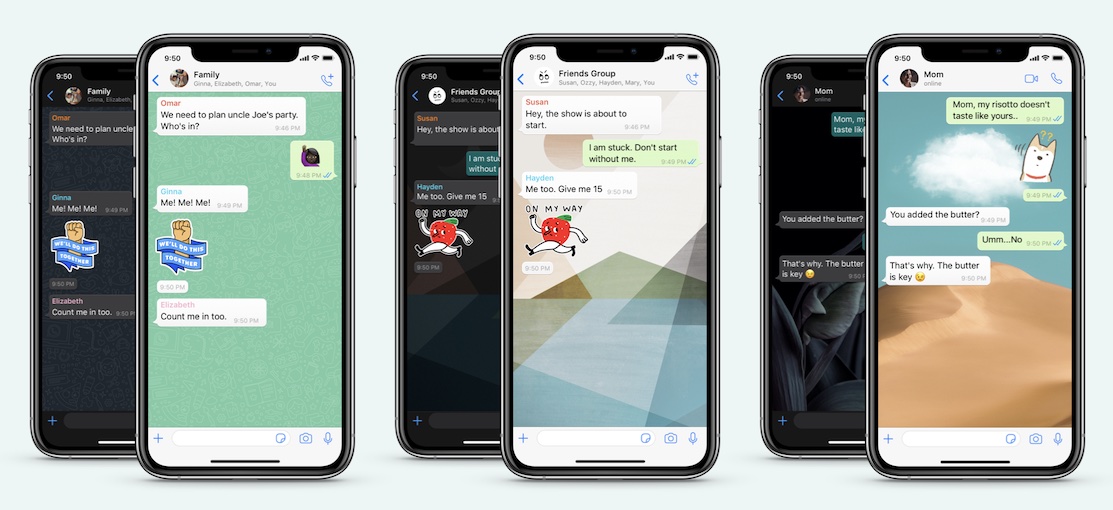
WhatsApp is finally upping its wallpapers and stickers game. The instant messaging service said on Tuesday that it will now allow users to set custom wallpapers for different chats in a bid to make it easier for users to easily distinguish the dozens or hundreds of chats they are simultaneously engaging with. There’s no limit

WhatsApp is finally upping its wallpapers and stickers game.

The instant messaging service said on Tuesday that it will now allow users to set custom wallpapers for different chats in a bid to make it easier for users to easily distinguish the dozens or hundreds of chats they are simultaneously engaging with. There’s no limit on how many custom wallpapers a user could choose to assign to different chats, it said.

“Make your chats personal and distinguishable by using a custom wallpaper for your most important chats and favorite people, and you never need worry about sending the wrong message in the wrong chat ever again,” the Facebook -owned service said.

WhatsApp, used by over 2 billion users, is also rolling out doodle wallpaper — the default wallpaper currently — in more colors, and is bulking up the selection of wallpapers with more images of nature and architecture from around the world, it said. Additionally, users can now also set a separate wallpaper which activates when their phone switches from light to dark mode.

Moving on from wallpapers, the messaging app said it is also making it easier for users to quickly search and find stickers with text or emoji, or browse through common categories.

The firm urged sticker creators to tag their stickers with emojis and text moving forward so that their stickers become more easily searchable for WhatsApp users. A company spokesperson declined to share the kind of traction stickers have received on WhatsApp, or how many sticker creators have contributed.

But if stickers are something you enjoy, there are some additional ones you will spot today. The World’s Health Organization’s “Together at Home” sticker pack is now available as animated stickers. (The two began collaborating earlier this year to raise more awareness about the coronavirus pandemic.)

“Together at Home has been one of the most popular sticker packs across WhatsApp, and will now be even more expressive and useful in its animated form. The ‘Together at Home’ sticker pack is available within WhatsApp, including with text localized for 9 languages – Arabic, French, German, Indonesian, Italian, Portuguese, Russian, Spanish and Turkish,” WhatsApp said.

News: Google Play’s Best of 2020 Awards highlight the stressful year it’s been

Continuing its annual tradition, Google today announced its Best of 2020 awards — the company’s list of the best apps, games, movies and books for the year. Not surprisingly, the top apps picked by both Google Play users and editors reflect the stressful year that 2020 has been, with a top sleep app, Loóna, winning

Continuing its annual tradition, Google today announced its Best of 2020 awards — the company’s list of the best apps, games, movies and books for the year. Not surprisingly, the top apps picked by both Google Play users and editors reflect the stressful year that 2020 has been, with a top sleep app, Loóna, winning the title of “Best App” of 2020. Meanwhile, Google Play users picked streaming service Disney+ as their choice.

Loóna is a fitting app to win the award this year. The sleep aid promises a mood-altering experience that helps its users deal with the negative emotions that accumulate during the day and are then processed during sleep. As anxiety and stress grow, people’s sleep patterns and REM sleep be disrupted, Loóna explains. To combat this, its app offers nightly “sleepscapes,” that combined activity-based relaxation, storytelling and sounds to help people shut out their stress and relax.

Unlike other sleep or meditation apps where users close their eyes and drift off, Loóna is intended to help people wind down while still on their phones. Users tap to color images while the sleep story plays. The company also this year introduced music playlists, called soundscapes.

Image Credits: Loóna

In October, the company reported its app — which is also available on iOS — was seeing daily average time spent of 34 minutes from its subscribers. And its average conversion rate from trial to paid subscriber was 52.5%. With version 2.0, Loóna plans to reposition its app from being solely focused on bedtime relaxation to become a broader mood management app that also covers the sleep to wake up cycle, among other things. It also plans to add personalized content recommendations.

In addition to Loóna, Google Play editors selected the free-to-play action role-playing game Genshin Impact as the year’s best game for giving players a “wondrous world to explore” while unraveling mysteries. The game, miHoYo’s first-ever open-world game, features battles with elemental magic, character switching, and gacha game monetization for obtaining new characters, weapons, and other additions.

Google Play users, however, selected SpongeBob: Krusty Cook-Off as the year’s best game.

Another app that benefitted from coronavirus lockdowns was Disney+, which won this year’s User’s Choice award for Best App. The streaming service helped families stuck at home to keep their kids entertained. Plus, with new shows like the “The Mandalorian,” the service has been a hit for adults in the family, too.

In addition to the top winners, Google gave a shout-out to a few other notable titles in its announcement, including Chris Hemsworth’s training app Centr, behavioral modification app Intellect, as well as games like The Gardens Between, Harry Potter: Puzzles & Spells, and Sky: Children of the Light.

The Play Store also awarded various gaming subgenres with awards of their own, like best competitive games, best indies, best pick up and play, and best game changers. These winners include Brawlhalla, Bullet Echo, GWENT: The Witcher Card Game, Legends of Runeterra, The Seven Deadly Sins: Grand Cross, Cookies Must Die, GRIS, inbento, Maze Machina, Sky: Children of Light, Disney Frozen Adventures, DreamWorks Trolls Pop, EverMerge, Harry Potter: Puzzles & Spells, SpongeBob: Krusty Cook-Off, Fancade, Genshin Impact, Minimal Dungeon RPG, Ord., and The Gardens Between.

Other top apps won awards in categories like best everyday essentials, best for personal growth, best hidden gems, best for fun, and best apps for good. These app winners include Calmaria, Grid Diary, The Pattern, Whisk, Zoom, Centr, Intellect, Jumprope: How-to Videos, Paird: Couples App, Speekoo, Cappuccino, Explorest, Loóna, Paperless Post, Tayasui Sketches, Bazaart, Disney+, Dolby On, Reface, Vita, GreenChoice, Medito, and ShareTheMeal.

Movies that won “Best of” for 2020 included Bill & Ted Face the Music, Just Mercy, Miss Juneteenth, Onward, and Parasite; while book winners included A Promised Land by Barack Obama, The City We Became by N.K. Jesmin, Riot Baby by Tochi Onyebuchi, Solutions and Other Problems by Allie Brosh, and You Had Me at Hola by Alexis Daria,

News: Ankorstore raises $29.9 million for its wholesale marketplace

French startup Ankorstore has raised a $29.9 million Series A round (€25 million) with Index Ventures leading the round. Existing investors GFC, Alven and Aglaé are also participating. Ankorstore is building a wholesale marketplace that connects independent shop owners with brands selling household supplies, maple syrup, headbands, bath salts, stationery items and a lot more.

French startup Ankorstore has raised a $29.9 million Series A round (€25 million) with Index Ventures leading the round. Existing investors GFC, Alven and Aglaé are also participating.

Ankorstore is building a wholesale marketplace that connects independent shop owners with brands selling household supplies, maple syrup, headbands, bath salts, stationery items and a lot more. That list alone should remind you of neighborhood stores that sell a ton of cutesy stuff that you don’t necessarily need but that tend to be popular.

The company works with 2,000 brands and 15,000 shops. And the startup isn’t just connecting buyers and sellers as it has a clear set of rules. For instance, the minimum first order is €100, which means that you can try out new products without ordering hundreds of items at once.

By default, Ankorstore withdraws the money 60 days after placing an order. Brands get paid upon delivery. And of course, buying from several brands through Ankorstore should simplify your admin tasks.

Ankorstore is currently live in eight countries — France, Spain, Austria, Germany, Belgium, Holland, Switzerland and Luxembourg. France is the biggest market followed by Germany. Up next, the startup plans to launch in the U.K. in 2021.

In many ways, Ankorstore reminds me of Faire, the wholesale marketplace that has raised hundreds of millions of dollars in the U.S.

“There are a number of different retail marketplaces connecting retailers with makers and brands. Where we believe we differ is in our clear focus on the independent shop owner, offering the tools and the terms that make it really easy and cost-effective to discover and access some of the most desirable up-and-coming brands,” Ankorstore co-founder Pierre-Louis Lacoste said.

Given that the startup is working with small suppliers, chances are they’re only selling their products in Europe. So there should be enough room for a European leader in that space that I would describe as wholesale Etsy-style marketplaces with a strong focus on curation.

Image Credits: Ankorstore

News: Singapore-based mental health app Intellect reaches one million users, closes seed funding

Intellect, a Singapore-based startup that wants to lower barriers to mental health care in Asia, says it has reached more than one million users just six months after launching. Google also announced today that the startup’s consumer app, also called Intellect, is one of its picks for best personal growth apps of 2020. The company

Theodoric Chew, co-founder and chief executive officer of mental health app Intellect

Theodoric Chew, co-founder and chief executive officer of mental health app Intellect

Intellect, a Singapore-based startup that wants to lower barriers to mental health care in Asia, says it has reached more than one million users just six months after launching. Google also announced today that the startup’s consumer app, also called Intellect, is one of its picks for best personal growth apps of 2020.

The company recently closed an undisclosed seed round led by Insignia Ventures Partners. Angel investors including e-commerce platform Carousell co-founder and chief executive officer Quek Siu Rui; former Sequoia partner Tim Lee; and startup consultancy xto10x’s Southeast Asia CEO J.J. Chai also participated.

In a statement, Insignia Ventures Partners principal Samir Chaibi said, “In Intellect, we see a fast-scaling platform addressing a pain that has become very obvious amidst the COVID-19 pandemic. We believe that pairing clinically-backed protocols with an efficient mobile-first delivery is the key to break down the barriers to access for millions of patients globally.”

Co-founder and chief executive officer Theodoric Chew launched Intellect earlier this year because while there is a growing pool of mental wellness apps in the United States and Europe that have attracted more funding during the COVID-19 pandemic, the space is still very young in Asia. Intellect’s goal is encourage more people to incorporate mental health care into their daily routines by lowering barriers like high costs and social stigma.

Intellect offers two products. One is a consumer app with self-guided programs based on cognitive behavioral therapy techniques that center on issues like anxiety, self-esteem or relationship issues.

The other is a mental health platform for employers to offer as a benefit and includes a recently launched telehealth service called Behavioural Health Coaching that connects users with mental health professionals. The service, which includes one-on-one video sessions and unlimited text messaging, is now a core part of Intellect’s services, Chew told TechCrunch.

Intellect’s enterprise product now reaches 10,000 employees, and its clients include tech companies, regional operations for multinational corporations and hospitals. Most are located in Singapore, Hong Kong, Indonesia and India, and range in size from 100 to more than 3,000 employees.

For many small- to mid-sized employers, Intellect is often the first mental health benefit they have offered. Larger clients may already have EAP (employee assistance programs), but Chew said those are often underutilized, with an average adoption rate of 1% to 2%. On the other hand, he said Intellect’s employee benefit program sees an average adoption rate of 30% in the first month after it is rolled out at a company.

Chew added that the COVID-19 pandemic has prompted more companies to address burnout and other mental health issues.

“In terms of larger trends, we’ve seen a huge spike in companies across the region having mental health and wellbeing of their employees being prioritized on their agenda,” said Chew. “In terms of user trends, we see a significantly higher utilization in work stress and burnout, anxiety and relationship-related programs.”

Intellect’s seed round will be used to expand in Asian markets and to help fund clinical research studies it is currently conducting with universities and organizations in Singapore, Australia and the United Kingdom.

News: China’s tech firms rush to deliver solutions for grocery shopping

Nearly all of China’s largest internet firms have established a presence in online grocery. Just this week, news arrived that Alibaba co-led the $196 million C3 funding round of Nice Tuan, the two-year-old grocery group-buying firm’s fourth round year to date. People in China shop online for almost everything, including groceries. At first, grocery e-commerce

Nearly all of China’s largest internet firms have established a presence in online grocery. Just this week, news arrived that Alibaba co-led the $196 million C3 funding round of Nice Tuan, the two-year-old grocery group-buying firm’s fourth round year to date.

People in China shop online for almost everything, including groceries. At first, grocery e-commerce appears to have caught on mainly among the digitally-savvy who have grown reliant on the convenience of e-commerce and don’t mind paying a bit more for delivery. Many elderly shoppers, on the other hand, still prefer visiting traditional wet markets where ingredients are generally cheaper.

Now tech companies in China are scrambling to capture grocery shoppers of all ages. A new business model that’s getting a lot of funding is that of Nice Tuan, the so-called community group buying.

In conventional grocery e-commerce, an intermediary platform like Alibaba normally connects individual shoppers to an array of merchants and offers doorstep delivery, which arrives normally within an hour in China.

A community group-buying, in comparison, relies on an army of neighborhood-based managers — often housewives looking for part-time work — to promote products amongst neighbors and tally their orders in group chats, normally through the popular WeChat messenger. The managers then place the group orders with suppliers and have the items delivered to pick-up spots in the community, such as a local convenience store.

It’s not uncommon to see piles of grocery bags at corner stores wating to be fetched these days, and the model has inspired overseas Chinese entrepreneurs to follow suit in America.

Even in China where e-commerce is ubiquitous, the majority of grocery shopping still happens offline. That’s changing quickly. The fledgling area of grocery group-buying is growing at over 100% year-over-year in 2020 and expected to reach 72 billion yuan ($11 billion) in market size, according to research firm iiMedia.

It sounds as if grocery group-buying and self-pickup is a step back in a world where doorstep convenience is the norm. But the model has its appeal. Texting orders in a group chat is in a way more accessible for the elderly, who may find Chinese e-commerce apps, often overlaid with busy buttons and tricky sales rules, unfriendly. With bulk orders, sales managers might get better bargains from suppliers. If a group-buying company is ambitious, it can always add last-mile delivery to its offering.

Chinese tech giants are clearly bullish about online grocery and diversifying their portfolios to make sure they have a skin in the game. Tencent is an investor in Xingsheng Youxuan, Nice Tuan’s major competitor. Food delivery service Meituan has its own grocery arm, offering both the traditional digital grocer as well as the WeChat-based group-buy model. E-commerce upstart Pinduoduo similarly supports grocery group purchases. Alibaba itself already operates the Hema supermarket, which operates both online and offline markets.

News: AWS brings the Mac mini to its cloud

AWS today opened its re:Invent conference with a surprise announcement: the company is bringing the Mac mini to its cloud. These new EC2 Mac instances, as AWS calls them, are now available in preview. They won’t come cheap, though. The target audience here — and the only one AWS is targeting for now — is

AWS today opened its re:Invent conference with a surprise announcement: the company is bringing the Mac mini to its cloud. These new EC2 Mac instances, as AWS calls them, are now available in preview. They won’t come cheap, though.

The target audience here — and the only one AWS is targeting for now — is developers who want cloud-based build and testing environments for their Mac and iOS apps. But it’s worth noting that with remote access, you get a fully-featured Mac mini in the cloud, and I’m sure developers will find all kinds of other use cases for this as well.

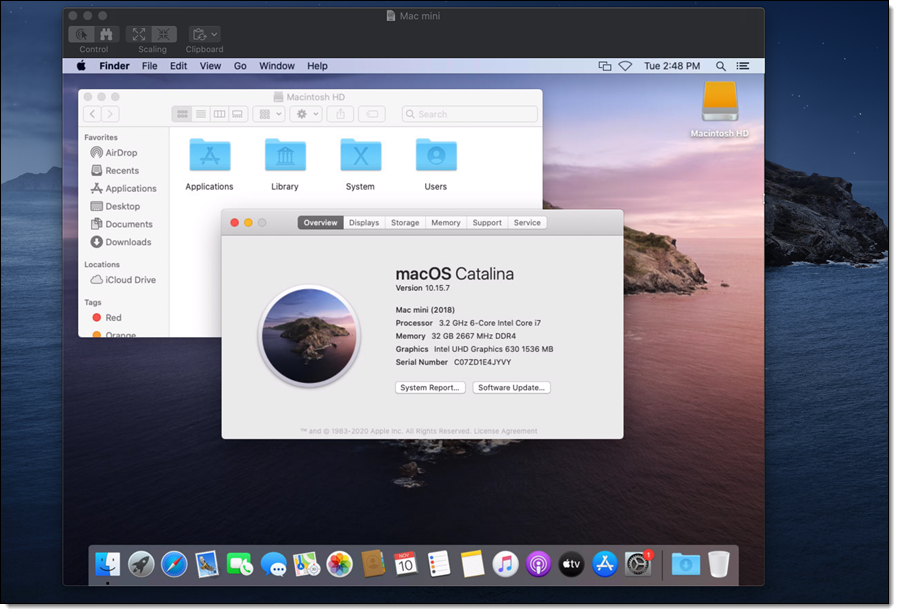
Given the recent launch of the M1 Mac minis, it’s worth pointing out that the hardware AWS is using — at least for the time being — are i7 machines with six physical and 12 logical cores and 32 GB of memory. Using the Mac’s built-in networking options, AWS connects them to its Nitro System for fast network and storage access. This means you’ll also be able to attach AWS block storage to these instances, for example.

Unsurprisingly, the AWS team is also working on bringing Apple’s new M1 Mac minis into its data centers. The current plan is to roll this out “early next year,” AWS tells me, and definitely within the first half of 2021. Both AWS and Apple believe that the need for Intel-powered machines won’t go away anytime soon, though, especially given that a lot of developers will want to continue to run their tests on Intel machines for the foreseeable future.

David Brown, AWS’s vice president of EC2, tells me that these are completely unmodified Mac minis. AWS only turned off Wi-Fi and Bluetooth. It helps, Brown said, that the minis fit nicely into a 1U rack.

“You can’t really stack them on shelves — you want to put them in some sort of service sled [and] it fits very well into a service sled and then our cards and all the various things we have to worry about, from an integration point of view, fit around it and just plug into the Mac mini through the ports that it provides,” Brown explained. He admitted that this was obviously a new challenge for AWS. The only way to offer this kind of service is to use Apple’s hardware, after all.

Image Credits: AWS

It’s also worth noting that AWS is not virtualizing the hardware. What you’re getting here is full access to your own device that you’re not sharing with anybody else. “We wanted to make sure that we support the Mac Mini that you would get if you went to the Apple store and you bought a Mac mini,” Brown said.

Unlike with other EC2 instances, whenever you spin up a new Mac instance, you have to pre-pay for the first 24 hours to get started. After those first 24 hours, prices are by the second, just like with any other instance type AWS offers today.

AWS will charge $1.083 per hour, billed by the second. That’s just under $26 to spin up a machine and run it for 24 hours. That’s quite a lot more than what some of the small Mac mini cloud providers are charging (we’re generally talking about $60 or less per month for their entry-level offerings and around two to three times as much for a comparable i7 machine with 32GB of RAM).

Image Credits: Ron Miller/TechCrunch

Until now, Mac mini hosting was a small niche in the hosting market, though it has its fair number of players, with the likes of MacStadium, MacinCloud, MacWeb and Mac Mini Vault vying for their share of the market.

With this new offering from AWS, they are now facing a formidable competitor, though they can still compete on price. AWS, however, argues that it can give developers access to all of the additional cloud services in its portfolio, which sets it apart from all of the smaller players.

“The speed that things happen at [other Mac mini cloud providers] and the granularity that you can use those services at is not as fine as you get with a large cloud provider like AWS,” Brown said. “So if you want to launch a machine, it takes a few days to provision and somebody puts a machine in a rack for you and gives you an IP address to get to it and you manage the OS. And normally, you’re paying for at least a month — or a longer period of time to get a discount. What we’ve done is you can literally launch these machines in minutes and have a working machine available to you. If you decide you want 100 of them, 500 of them, you just ask us for that and we’ll make them available. The other thing is the ecosystem. All those other 200-plus AWS services that you’re now able to utilize together with the Mac mini is the other big difference.”

Brown also stressed that Amazon makes it easy for developers to use different machine images, with the company currently offering images for macOS Mojave and Catalina, with Big Sure support coming “at some point in the future.” And developers can obviously create their own images with all of the software they need so they can reuse them whenever they spin up a new machine.

“Pretty much every one of our customers today has some need to support an Apple product and the Apple ecosystem, whether it’s iPhone, iPad or  Apple TV, whatever it might be. They’re looking for that bold use case,” Brown said. “And so the problem we’ve really been focused on solving is customers that say, ‘hey, I’ve moved all my server-side workloads to AWS, I’d love to be able to move some of these build workflows, because I still have some Mac minis in a data center or in my office that I have to maintain. I’d love that just to be on AWS.’ ”

AWS’s marquee launch customers for the new service are Intuit, Ring and mobile camera app FiLMiC.

“EC2 Mac instances, with their familiar EC2 interfaces and APIs, have enabled us to seamlessly migrate our existing iOS and macOS build-and-test pipelines to AWS, further improving developer productivity,” said Pratik Wadher, vice president of Product Development at Intuit. “We‘re experiencing up to 30% better performance over our data center infrastructure, thanks to elastic capacity expansion, and a high availability setup leveraging multiple zones. We’re now running around 80% of our production builds on EC2 Mac instances, and are excited to see what the future holds for AWS innovation in this space.”

The new Mac instances are now available in a number of AWS regions. These include US East (N. Virginia), US East (Ohio), US West (Oregon), Europe (Ireland) and Asia Pacific (Singapore), with other regions to follow soon.

News: Cyber Monday scams? Fakespot says it can identify fraudulent reviews and sellers online

The pandemic has made it all but impossible for a retail company without an online presence to survive. Yet while companies heavily dependent on foot traffic like J.Crew and Sur la Table have filed for bankruptcy this year, companies that are expert in e-commerce have thrived, including Target and Walmart. Amazon alone now attracts roughly

The pandemic has made it all but impossible for a retail company without an online presence to survive. Yet while companies heavily dependent on foot traffic like J.Crew and Sur la Table have filed for bankruptcy this year, companies that are expert in e-commerce have thrived, including Target and Walmart. Amazon alone now attracts roughly one quarter of all dollars spent online by U.S. shoppers.

Unfortunately, as more shopping moves online, fraud is exploding, too. The problem is such that startups working with enterprises on the problem — flagging transactions for banks, for example — are raising buckets of funding. Meanwhile, one New York-based startup, Fakespot, is taking a different approach. It’s using AI to notify online shoppers when the products they’re looking to buy are fake listings or when reviews they’re reading on marketplaces like Amazon or eBay are a fiction.

We talked earlier today with founder and Kuwaiti immigrant Saoud Khalifah about the four-year-old business, which got started in his dorm room after his own frustrating experience in trying to buy nutritional supplements from Amazon. After he’d nabbed his master’s degree in software engineering, he launched the company in earnest. Like many other companies,

Like many other companies, Fakespot was originally focused on helping enterprise customers identify counterfeit outfits and fake reviews. When the pandemic struck, company spied an “opening crack on the internet,” as Khalifah describes it, and began instead catering directly to consumers who are increasingly using platforms that are struggling to keep up — and whose solutions are often more focused on protecting sellers from buyers and not the other way around.

The pivot seems to be working. Fakespot just closed on $4 million in Series A funding led by Bullpen Capital, which was joined by SRI Capital, Faith Capital and 500 Startups among others in a round that brings the company’s total funding to $7 million.

The company is gaining more attention from shoppers, too. Khalifah says that a Chrome browser extension introduced earlier this year has now been downloaded 300,000 times — and this on the heels of “millions of users” who have separately visited Fakespot’s site, typed in a URL of a product review, and through its “Fakespot analyzer,” been provided with free data to help inform their buying decisions.

Indeed, according to Khalifah, since Fakespot’s official founding it has amassed a database of more than 8 billion reviews — around 10 times as many as the popular travel site Tripadvisor — from which its AI has learned. He says the tech is sophisticated enough at this point to identify AI-generated text; as for the “lowest-hanging fruit,” he says it can easily spot when reviews or positive sentiments about a company are posted in an inorganic way, presumably published by click farms. (It also tracks fake upvotes.)

As for where shoppers can use the chrome extension, Fakespot currently scours all the largest marketplaces, including Amazon, eBay, Best Buy, Walmart, and Sephora. Soon, says Khalifah, users will also be able to use the technology to assess the quality of products being sold through Shopify, the software platform that is home to hundreds of thousands of online stores. (Last year, it surpassed eBay to become the No. 2 e-commerce destination in the U.S., according to Shopify.)

Right now, Fakespot is free to use, including because every review a consumer enters into its database helps train its AI further. Down the road, the company expects to make money by adding a suite of tools atop its free offering. It may also strike lead-generation deals with companies whose products and reviews it has already verified as real and truthful.

The question, of course, is how reliably the technology works in the meantime. While Khalifah understandably sings Fakespot’s praises, a visit to the Google Play store, for example, paints a mixed picture, with many enthusiastic reviews and some that are, well, less enthusiastic.

Khalifah readily concedes that Fakespot’s mobile apps need more attention, which he says they will receive. Though Fakespot has been focused predominately on the desktop experience, Khalifah notes that more than half of online shopping is expected to be conducted over mobile phones by some time next year, a shift that isn’t lost on him, even while it hinges a bit on the pandemic being brought effectively to an end (and consumers finding themselves on the run again).

Still, he says that “ironically, a lot of [bad] reviews are from sellers who are angry that we’ve given them F grades. They’re often mad that we revealed that their product is filled with fake reviews.”

As for how Fakespot moves past these to improve its own rating, Khalifah suggests that the best strategy is actually pretty simple.

“We hope we’ll have many more satisfied users,” he says, adding: “No one else really has consumers’ backs.”

News: EV bus and truck maker The Lion Electric to take SPAC route to public markets

Canadian electric truck and bus manufacturer The Lion Electric Company said Monday it plans to become a publicly traded company via a merger with special-purpose acquisition company Northern Genesis Acquisition Corp. The combined company, which will be listed on the New York Stock Exchange, will have a valuation of $1.9 billion. The companies raised $200

Canadian electric truck and bus manufacturer The Lion Electric Company said Monday it plans to become a publicly traded company via a merger with special-purpose acquisition company Northern Genesis Acquisition Corp.

The combined company, which will be listed on the New York Stock Exchange, will have a valuation of $1.9 billion. The companies raised $200 million in private investment in public equity, or PIPE, and hold about $320 million in cash proceeds.

The deal is the latest example of an electric automaker opting to go public via a SPAc merger in an aim to access the level of capital needed to become a high-volume vehicle manufacturer. Arrival, Canoo, Fisker, Lordstown Motors and Nikola Corp., have all announced SPAC mergers in 2020.

In Lion’s case, the combined net cash will be used to fund the company’s growth, notably the planned construction of a U.S.-based factory and to further develop its advanced battery systems. Lion is evaluating more than 10 potential brownfield plant sites in nine states, including California, Illinois, Indiana, Michigan, New York, Ohio, Oregon, Pennsylvania, Washington and Wisconsin. The company told TechCrunch it plans to to pick a site and complete its industrialization plan by the end of the year. Production at this yet-to-be named factory is expected to start in the beginning of 2023.

Lion is already producing all-electric medium and heavy-duty urban trucks and buses at a 2,500-vehicle-per-year manufacturing facility. Some 300 vehicles are on the road today and the company has plans to to deliver 650 trucks and buses in 2021. It even landed a contract with Amazon to supply the e-commerce giant with 10 electric trucks for its ‘middle mile’ operations.

Completion of the proposed transaction is expected to occur in the first quarter of 2021. Lion is expected to be listed on the NYSE under the new ticker symbol “LEV.” Lion’s CEO and founder Marc Bedard will continue in his role. The combined company will have a board of directors consisting of nine directors, including Bedard, Pierre Larochelle from Power Sustainable as Chairman, and five other existing Lion board members, as well as Ian Robertson and Chris Jarratt, who are co-founders of Algonquin Power & Utilities Corp.

News: Daily Crunch: Facebook acquires Kustomer for $1B

Facebook makes a billion-dollar acquisition, we learn more about Twitter’s Clubhouse-style feature and Moderna applies for emergency authorization for its COVID-19 vaccine. This is your Daily Crunch for November 30, 2020. The big story: Facebook acquires Kustomer for $1B Kustomer says it can give customer service teams better data and a more unified view of

Facebook makes a billion-dollar acquisition, we learn more about Twitter’s Clubhouse-style feature and Moderna applies for emergency authorization for its COVID-19 vaccine. This is your Daily Crunch for November 30, 2020.

The big story: Facebook acquires Kustomer for $1B

Kustomer says it can give customer service teams better data and a more unified view of the people they’re interacting with. So with this acquisition, Facebook can improve its offerings for businesses that have a presence (in some cases, their primary digital presence) on the social network.

The terms of the deal were not disclosed, but TechCrunch has confirmed that the deal price was around $1 billion.

Facebook isn’t the only social media company making acquisitions to improve its customer service features. Earlier this month, Snap bought Voca.ai, a startup creating AI-based voice agents for call centers.

The tech giants

Alphabet’s DeepMind achieves historic new milestone in AI-based protein structure prediction — The advance in DeepMind’s AlphaFold capabilities could lead to a significant leap forward in areas like our understanding of disease, as well as future drug discovery and development.

Twitter’s Audio Spaces test includes transcriptions, speaker controls and reporting features — Earlier this month, Twitter announced it would soon begin testing its own Clubhouse rival, called Audio Spaces.

With an eye for what’s next, longtime operator and VC Josh Elman gets pulled into Apple — Elman said he will be focused on the company’s App Store and helping “customers discover the best apps for them.”

Startups, funding and venture capital

HungryPanda raises $70M for a food delivery app aimed at overseas Chinese consumers — HungryPanda makes a Mandarin-language app specifically targeting Chinese consumers outside of China.

Materialize scores $40M investment for SQL streaming database — CEO Arjun Narayan told us that every company needs to be a real-time company, and it will take a streaming database to make that happen.

Curio Wellness launches $30M fund to help women and minorities own a cannabis dispensary — The new fund, started by the Maryland-based medical cannabis company Curio Wellness, aims to help underserved entrepreneurs entering the cannabis market.

Advice and analysis from Extra Crunch

DoorDash aims to add $11B to its valuation during public offering — The delivery platform gave a range of $75 to $85 per share.

Strike first, strike hard, no mercy: How emerging managers can win — Investors at Fika Ventures argue that “Cobra Kai” offers valuable lessons for VC.

The road to smart city infrastructure starts with research — The right technology can upgrade any city, but we need to understand its impacts.

(Extra Crunch is our membership program, which aims to democratize information about startups. And until November 30 — that’s today! — you can get 25% off an annual membership.)

Everything else

Moderna claims 94% efficacy for COVID-19 vaccine, will ask FDA for emergency use authorization today — If granted the authorization, Moderna will be able to provide it to high-risk individuals such as front-line healthcare workers.

FCC Chairman Ajit Pai will step down to make way for the Biden administration — Pai’s tenure has been a controversial one.

Original Content podcast: Just don’t watch Netflix’s ‘Holidate’ with your parents — But if you avoid parental awkwardness, it’s a perfectly adequate holiday-themed romantic comedy.

The Daily Crunch is TechCrunch’s roundup of our biggest and most important stories. If you’d like to get this delivered to your inbox every day at around 3pm Pacific, you can subscribe here.

News: A tween tries Apple’s new ‘Family Setup’ system for Apple Watch

With the release of watchOS 7, Apple at last turned the Apple Watch into the GPS-based kid tracker parents have wanted, albeit at a price point that requires careful consideration. As someone in the target demographic for such a device — a parent of a “tween” who’s allowed to freely roam the neighborhood (but not

With the release of watchOS 7, Apple at last turned the Apple Watch into the GPS-based kid tracker parents have wanted, albeit at a price point that requires careful consideration. As someone in the target demographic for such a device — a parent of a “tween” who’s allowed to freely roam the neighborhood (but not without some sort of communication device) — I put the new Family Setup system for the Apple Watch through its paces over the past couple of months.

The result? To be frank, I’m conflicted as to whether I’d recommend the Apple Watch to a fellow parent, as opposed to just suggesting that it’s time to get the child a phone.

This has to do, in part, with the advantages offered by a dedicated family tracking solution — like Life360, for example — as well as how a child may respond to the Apple Watch itself, and the quirks of using a solution that wasn’t initially designed with the needs of family tracking in mind.

As a parent of a busy and active tween (nearly 11), I can see the initial appeal of an Apple Watch as a family tracker. It has everything you need for that purpose: GPS tracking, the ability to call and text, alerts, and access to emergency assistance. It’s easy to keep up with, theoretically, and it’s not as pricey as a new iPhone. (The new Apple Watch SE cellular models start at $329. The feature also works on older Apple Watch Series 4 or later models with cellular. Adding on the Apple Watch to your phone plan is usually around $10 per month more.)

I think the Apple Watch as a kid tracker mainly appeals to a specific type of parent: one who’s worried about the dangers of giving a younger child a phone and thereby giving them access to the world of addictive apps and the wider internet. I understand that concern, but I personally disagree with the idea that you should wait until a child is “older,” then hand them a phone and say “ok, good luck with that!” They need a transition period and the “tween” age range is an ideal time frame to get started.

The reality is that smartphones and technology are unavoidable. As a parent, I believe it’s my job to introduce these things in small measures — with parental controls and screen time limits, for example. And then I need to monitor their usage. I may make mistakes and so will my daughter, but we both need these extra years to figure out how to balance parenting and the use of digital tools. With a phone, I know I will have to have the hard conversations about the problems we run into. I understand, too, why parents want to put that off, and just buy a watch instead.
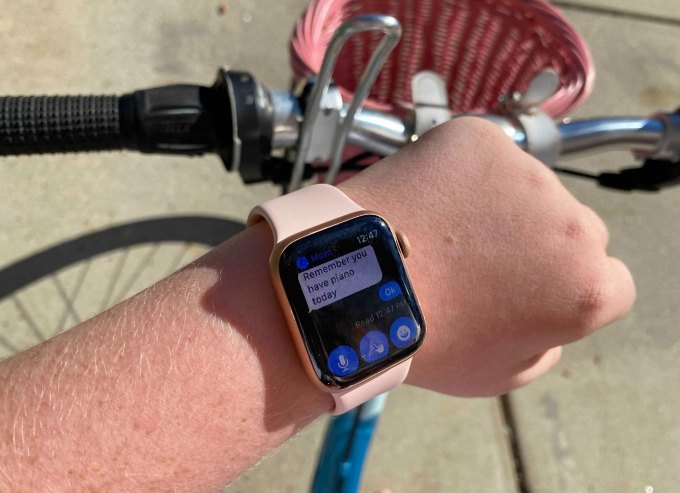
Image Credits: TechCrunch

After my experience, I feel the only cases where I’d fully endorse the Apple Watch would be for those tech-free or tech-light families where kids will not be given phones at any point, households where kids’ phone usage is highly restricted (like those with Wi-Fi only phones), or those where kids don’t get phones until their later teenage years. I am not here to convince them of my alternative, perhaps more progressive view on when to give a kid a phone. The Apple Watch may make sense for these families and that’s their prerogative.

However, a number of people may be wondering if the Apple Watch can be a temporary solution for perhaps a year or two before they buy the child a smartphone. To them, I have to say this feels like an expensive way to delay the inevitable, unavoidable task of having to parent your child through the digital age.

Given my position on the matter, my one big caveat to this review is that my daughter does, in fact, have a smartphone. Also, let’s be clear: this is not meant to be a thorough review of the Apple Watch itself, or a detailed report of its various “tech specs”. It’s a subjective report as to how things went for us that, hopefully, you can learn from.
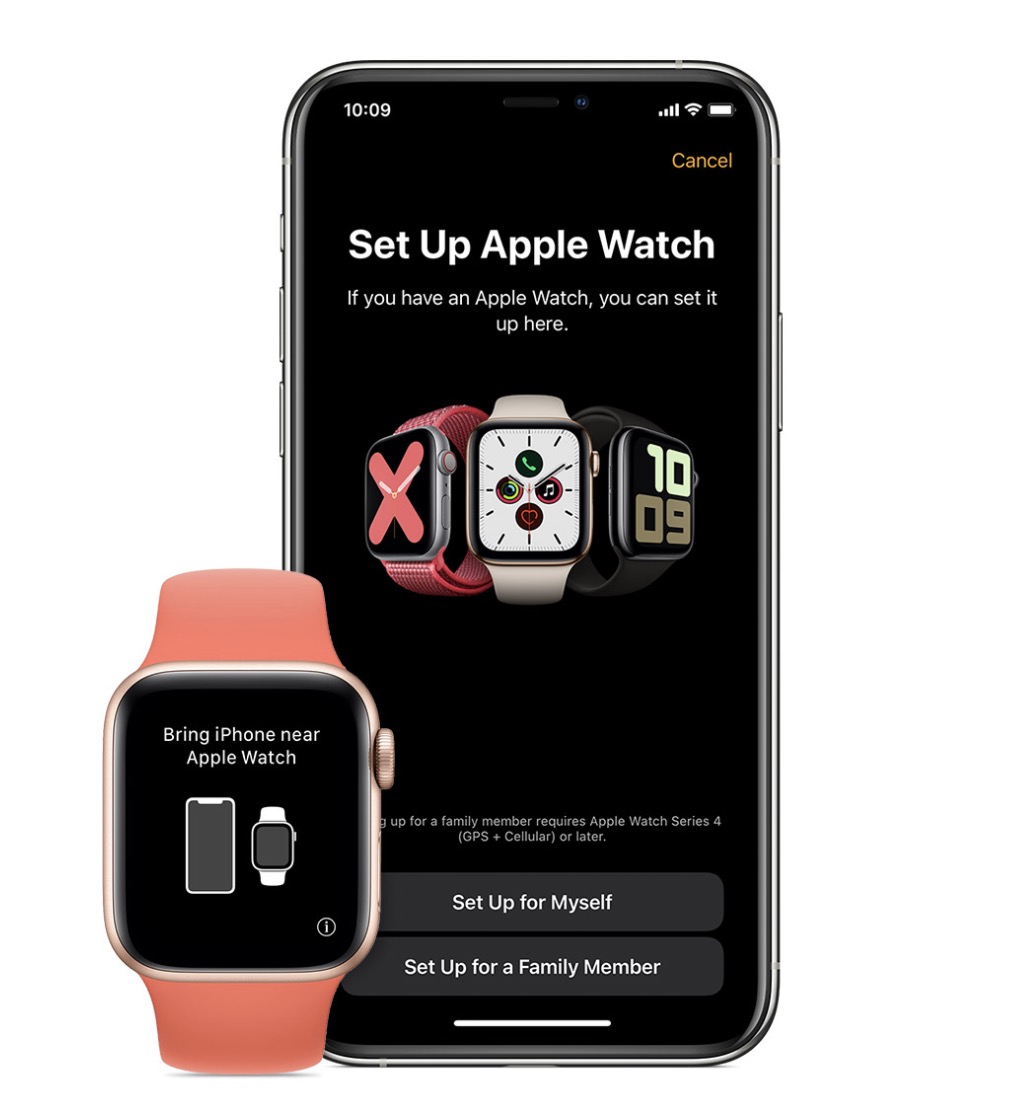
Image Credits: Apple

To begin, the process of configuring the new Apple Watch with Family Setup was easy. “Set Up for a Family Member” is one of two setup options to tap on as you get started. Apple offers a simple user interface that walks you through pairing the Watch with your phone and all the choices that have to be made, like enabling cellular, turning on “Ask to Buy” for app purchases, enabling Schooltime and Activity features, and more.

What was harder was actually using the Apple Watch as intended after it was configured. I found it far easier to launch an iPhone app (like Life360, which we use) where everything you need is in one place. That turned out not to be true for Apple Watch Family Setup system.

For the purpose of testing the Apple Watch with Family Setup, my daughter would leave her iPhone behind when she went out biking or when meeting up with friends for outdoor activities.

As a child who worked her way up to an iPhone over a couple of years, I have to admit I was surprised at how irresponsible she was with the watch in the early weeks.

She didn’t at all respect at the multi-hundred dollar device it was, at first, but rather treated it like her junk jewelry or her wrist-worn scrunchies. The Apple Watch was tossed on a dresser, a bathroom counter, a kitchen table, on a beanbag chair, and so on.

Thankfully, the “Find My” app can locate the Apple Watch, if it has battery and a signal. But I’m not going to lie — there were some scary moments where a dead watch was later found on the back of a toilet (!!), on the top of the piano, and once, abandoned at a friend’s house.

And this, from a child who always knows where her iPhone is!

The problem is that her iPhone is something she learned to be responsible for after years of practice. This fooled me into thinking she actually was responsible for expensive devices. For two years, we painfully went through a few low-end Android phones while she got the hang of keeping up with and caring for such a device. Despite wrapping those starter phones in protective cases, we still lost one to a screen-destroying crash on a tile floor and another to being run over by a car. (How it flew out of a pocket and into the middle of the road, I’ll never understand!)

But, eventually, she did earn access to a hand-me down iPhone. And after initially only being allowed to use it in the house on Wi-Fi, that phone now goes outdoors and has its own phone number. And she has been careful with it in the months since. (Ahem, knocks on wood.)

The Apple Watch, however, held no such elevated status for her. It was not an earned privilege. It was not fun. It was not filled with favorite apps and games. It was, instead, thrust upon her.

While the iPhone is used often for enjoyable and addictive activities like Roblox, TikTok, Disney+, and Netflix, the Apple Watch was boring by comparison. Sure, there are a few things you can do on the device — it has an App Store! You can make a Memoji! You can customize different watch faces! But unless this is your child’s first-ever access to technology, these features may have limited appeal.

“Do you want to download this game? This looks fun,” I suggested. pointing to a coloring game, as we looked at her Watch together one night.

“No thanks,” she replied.

“Why not?”

“I just think don’t think it would be good on the little screen.”

“Maybe a different game?”

“Nah.”

And that was that. I could not convince her to give a single Apple Watch app a try in the days that followed.

She didn’t even want to stream music on the Apple Watch — she has Alexa for that, she pointed out. She didn’t want to play a game on the watch — she has Roblox on the bigger screen of her hand-me down laptop. She also has a handheld Nintendo Switch.

Image Credits: TechCrunch

Initially, she picked an Apple Watch face that matched her current “aesthetic” — simple and neutral — and that was the extent of her interest in personalizing the device in the first several weeks.

Having already burned herself out on Memoji by borrowing my phone to play with the feature when it launched, there wasn’t as much interest in doing more with the customized avatar creation process, despite my suggestions to try it. (She had already made a Memoji her Profile photo for her contact card on iPhone.)

However, I later showed her the Memoji Watch Face option after I set it up, and asked her if she liked it. She responded “YESSSS. I love it,” and snatched the watch from my hand to play some more.

Demo’ing features is important, it seems.

But largely, the Apple Watch was only strapped on only at my request as she walked out the door.

Soon, this became a routine.

“Can I go outside and play?”

“Yes. Wear the watch!,” I’d reply.

“I knowwww.”

It took over a month to get to the point that she would remember the watch on her own.

I have to admit that I didn’t fully demo the Apple Watch to her or explain how to use it in detail, beyond a few basics in those beginning weeks. While I could have made her an expert, I suppose, I think it’s important to realize that many parents are less tech-savvy than their kids. The children are often left to fend for themselves when it comes to devices, and this particular kid has had several devices. For that reason, I was curious how a fairly tech literate child who has moved from iPad to Android to now iPhone, and who hops from Windows to Mac to Chromebook, would now adapt to an Apple Watch.

As it turned out, she found it a little confusing.

“What do you think about the Watch?” I asked one evening, feeling her out for an opinion.

“It’s fun…but sometimes I don’t really understand it,” she replied.

“What don’t you understand?”

“I don’t know. Just…almost everything,” she said, dramatically, as tweens tend to do. “Like, sometimes  I don’t know how to turn up and down the volume.”

Upon prodding, I realize she meant this: she was confused about how to adjust the alert volume for messages and notifications, as well as how to change the Watch from phone calls to a vibration or to silence calls altogether with Do Not Disturb. (It was her only real complaint, but annoying enough to be “almost everything,” I guess!)

I’ll translate now from kid language what I learned here.

First, given that the “Do Not Disturb” option is accessible from a swipe gesture, it’s clear my daughter hadn’t fully explored the watch’s user interface. It didn’t occur to her that the swipe gestures of the iPhone would have their own Apple Watch counterparts. (And also, why would you swipe up from the bottom of the screen for the Control Center when that doesn’t work on the iPhone anymore? On iPhone, you now swipe down from the top-right to get to Control Center functions.)

And she definitely hadn’t discovered the tiny “Settings” app (the gear icon) on the Apple Watch’s Home Screen to make further changes.

Instead, her expectation was that you should be able to use either a button on the side for managing volume — you know, like on a phone — or maybe the digital crown, since that’s available here. But these physical features of the device — confusingly — took her to that “unimportant stuff” like the Home Screen and an app switcher, when in actuality, it was calls, notifications, and alerts that were the app’s main function, in her opinion.

And why do you need to zoom into the Home Screen with a turn of the digital crown? She wasn’t even using the apps at this point. There weren’t that many on the screen.

Curious, since she didn’t care for the current lineup of apps, I asked for feedback.

“What kind of apps do you want?,” I asked.

“Roblox and TikTok.”

“Roblox?!,” I said, laughing. “How would that even work?”

As it turned out, she didn’t want to play Roblox on her watch. She wanted to respond to her incoming messages and participate in her group chats from her watch.

Oh. That’s actually a reasonable idea. The Apple Watch is, after all, a messaging device.

And since many kids her age don’t have a phone or the ability to use a messaging app like Snapchat or Instagram, they trade Roblox usernames and friend each other in the game as way to work around this restriction. They then message each other to arrange virtual playdates or even real-life ones if they live nearby.

But the iOS version of the Roblox mobile app doesn’t have an Apple Watch counterpart.

“And TikTok?” I also found this hilarious.

But the fact that Apple Watch is not exactly an ideal video player is lost on her. It’s a device with a screen, connected to the internet. So why isn’t that enough, she wondered?

“You could look through popular TikToks,” she suggested. “You wouldn’t need to make an account or anything,” she clarified, as these details were would fix the only problems she saw with her suggestion.

Even if the technology was there, a TikTok experience on the small screen would never be a great one. But this goes to show how much interest in technology is directly tied to what apps and games are available, compared with the technology platform itself.

Other built-in features had even less appeal than the app lineup.
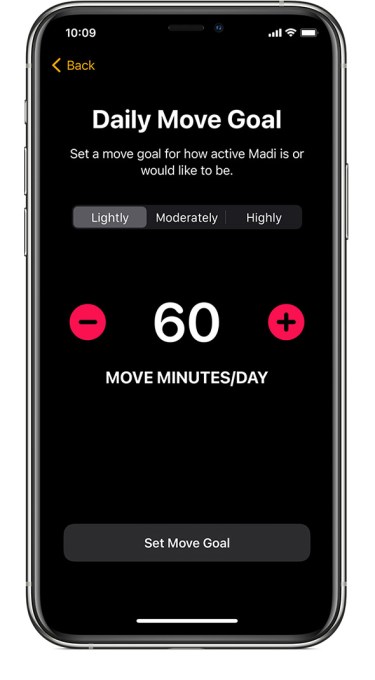
Image Credits: Apple

Though I had set up some basic Activity features during the setup process, like a “Move Goal,” she had no idea what any of that was. So I showed her the “rings” and how they worked, and she thought it was kind of neat that the Apple Watch could track her standing. However, there was no genuine interest or excitement in being able quantify her daily movement — at least, not until one day many weeks later when were hiking and she heard my watch ding as my rings closed and wanted to do the same on hers. She became interested in recording her steps for that hike, but the interest wasn’t sustained afterwards.

Apple said it built in the Activity features so kids could track their move goal and exercise progress. But I would guess many kids won’t care about this, even if they’re active. After all, kids play — they don’t think “how much did I play?” Did I move enough today? And nor should they, really.

As a parent, I can see her data in the Health app on my iPhone, which is the device I use to manage her Apple Watch. It’s interesting, perhaps, to see things like her steps walked or flights climbed. But it’s not entirely useful, as her Apple Watch is not continually worn throughout the day. (She finds the bands uncomfortable — we tried Sport Band and Sport Loop and she still fiddles with them constantly, trying to readjust them for comfort.)

In addition, if I did want to change her Activity goals later on for some reason, I’d have to do from her Watch directly.

Of course, a parent doesn’t buy a child an Apple Watch to track their exercise. It’s for the location tracking features. That is the only real reason a parent would consider this device for a younger child.

On that front, I did like that the watch was a GPS tracker that was looped into our household Apple ecosystem as its own device with its own phone number. I liked that I could ping the Watch with “Find My” when it’s lost — and it was lost a lot, as I noted. I liked that I could manage the Watch from my iPhone, since it’s very difficult to reacquire a device to make changes, once it’s handed over to someone else.

I also liked the Apple Watch was always available for use. This may have been one of its biggest perks, in fact. Unlike my daughter’s iPhone, which is almost constantly at 10-20% battery (or much less), the watch was consistently charged and ready when it was time for outdoor play.

I liked that it was easier for her to answer a call on the Apple Watch compared with digging her phone out of her bike basket or bag. I liked that she didn’t have to worry about constantly holding onto her phone while out and about.

I also appreciated that I could create geofenced alerts — like when she reached the park or a friend’s house, for example, or when she left. But I didn’t like that the ability to do so is buried in the “Find My” app. (You tap on the child’s name in the “People” tab. Tap “Add” under “Notifications.” Tap “Notify Me.” Tap “New Location.” Do a search for an address or venue. Tap “Done.”)
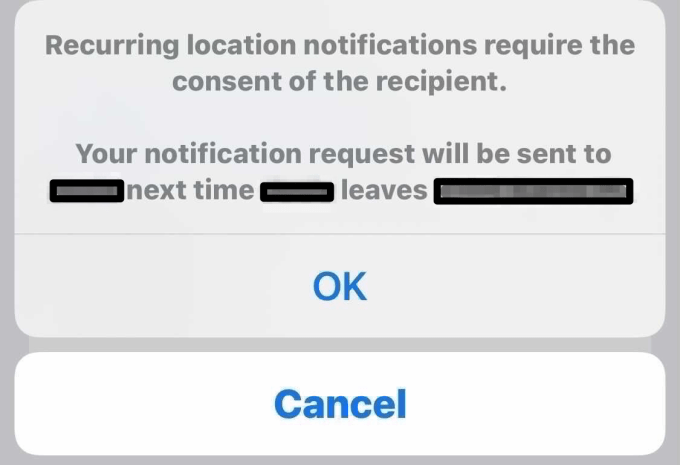
Image Credits: TechCrunch

I also didn’t like that when I created a recurring geofence, my daughter would be notified. Yes, privacy. I know! But who’s in charge here? My daughter is a child, not a teen. She knows the Apple Watch is a GPS tracker — we had that conversation. She knows it allows me to see where she is. She’s young and for now, she doesn’t feel like this a privacy violation. We’ll have that discussion later, I’m sure. But at the present, she likes the feel of this electronic tether to home as she experiments with expanding the boundaries of her world.

When I tweak and update recurring alerts for geofenced locations, such alerts can be confusing or even concerning. I appreciate that Apple is being transparent and trying to give kids the ability to understand they’re being tracked — but I’d also argue that most parents who suddenly gift an expensive watch to their child will explain why they’re doing so. This is a tool, not a toy.

Also, the interface for configuring geofences is cumbersome. By comparison, the family tracking app Life360 which we normally use has a screen where you simply tap add, search to find the location, and then you’re done. One tap on a bell icon next to the location turns on or off its alerts. (You can get all granular about it: recurring, one time, arrives, leaves, etc. — but you don’t have to. Just tap and be alerted. It’s more straightforward.)
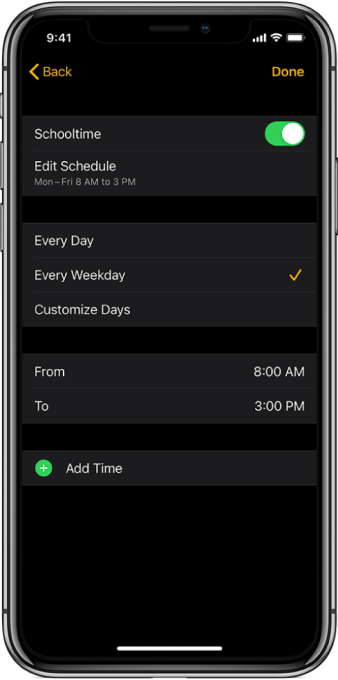
Image Credits: Apple

One feature I did like on the Apple Watch, but sadly couldn’t really use, was its Schooltime mode — a sort of remotely-enabled, scheduled version of Do Not Disturb. This feature blocks apps and complications and turns on the Do Not Disturb setting for the kids, while letting emergency calls and notifications break through. (Make sure to set up Shared Contacts, so you can manage that aspect.)

Currently, we have no use for Schooltime, thanks to this pandemic. My daughter is attending school remotely this year. I could imagine how this may be helpful one day when she returns to class.

But I also worry that if I sent her to class with the Apple Watch, other kids will judge her for her expensive device. I worry that teachers (who don’t know about Schooltime), will judge me for having her wear it. I worry kids will covet it and ask to try it on. I worry a kid running off with it, causing additional disciplinary headaches for teachers. I worry it will get smashed on the playground or during PE, or somehow fall off because she meddled with the band for the umpteenth time. I worry she’ll take it off because “the strap is so annoying” (as I was told), then leave it in her desk.

I don’t worry as much about the iPhone at school, because it stays in her backpack the whole time due to school policy. It doesn’t sit on her arm as a constant temptation, “Schooltime” mode or otherwise.

The Apple Watch Family Setup is also not a solution that adapts as the child ages to the expanding needs of teen monitoring, compared with other family tracking solutions.

To continue the Life360 comparison, the app today offers features for teen drivers and its new privacy-sensitive location “bubbles” for teens now give them more autonomy. Apple’s family tracking solution, meanwhile, becomes more limited as the child ages up.

For instance, Schooltime doesn’t work on an iPhone. Once the child upgrades to an iPhone, you are meant to use parental controls and Screen Time features to manage what apps are allowed and when she can use her device. It seems a good transitional step to the phone would be a way to maintain Schooltime mode on the child’s next device, too.

Instead, by buying into Apple Watch for its Family Setup features, what you’ll soon end up with is a child who now owns both an Apple Watch and a smartphone. (Sure, you could regift it or take it back, I suppose…I certainly do wish you luck if you try that!)

Beyond the overboard embrace of consumerism that is buying an Apple Watch for a child, the biggest complaint I had was that there were three different apps for me to use to manage and view data associated with my daughter’s Apple Watch. I could view her tracked activity was tracked in my Health app. Location-tracking and geofence configuration was in the Find My app. And remotely configuring the Apple Watch itself, including Schooltime, was found in my Watch mobile app.

I understand that Apple built the Watch to be a personal device designed for use with one person and it had to stretch to turn it into a family tracking system. But what Apple is doing here is really just pairing the child’s watch with the parent’s iPhone and then tacking on extra features, like Schooltime. It hasn’t approached this as a whole new system designed from the ground-up for families or for their expanding needs as the child grows.

As a result, the whole system feels underdeveloped compared with existing family tracking solutions. And given the numerous features to configure, adjust, and monitor, Family Setup deserves its own app or at the very least, its own tab in a parent’s Watch app to simplify its use.

At the end of the day, if you are letting your child out in the world — beyond school and supervised playdates — the Apple Watch is a solution, but it may not be the best solution for your needs. If you have specific reasons why your child will not get their own phone now or anytime soon, the Apple Watch may certainly work. But if you don’t have those reasons, it may be time to try a smartphone.

Both Apple and Google now offer robust parental control solutions for their smartphone platforms that can mitigate many parents’ concerns over content and app addiction. And considering the cost of a new Apple Watch, the savings just aren’t there — especially when considering entry-level Android phones or other hand-me-down phones as the alternative.

[Apple provided a loaner device for the purposes of this review. My daughter was cited and quoted with permission but asked for her name to not be used.]


WordPress Image Lightbox Plugin