Yearly Archives: 2020

News: Uber sells $500M stake in its freight business as the ride-hailing giant works to conserve cash

One year ago, Uber’s business model could be categorized as an “all of the above approach,” a strategy to generate revenue from all forms of transportation, including ride-hailing, micromobility, logistics, and package and food delivery. The COVID-19 pandemic upended that business strategy prompting Uber to offload its shared micromobility unit Jump, double down on delivery

One year ago, Uber’s business model could be categorized as an “all of the above approach,” a strategy to generate revenue from all forms of transportation, including ride-hailing, micromobility, logistics, and package and food delivery.

The COVID-19 pandemic upended that business strategy prompting Uber to offload its shared micromobility unit Jump, double down on delivery with its acquisition of Postmates, and now, to sell a stake in its growing, but still unprofitable logistics arm Uber Freight.

Uber said Friday that an investor group led by New York-based investment firm Greenbriar Equity Group has committed to invest $500 million in a Series A preferred stock financing for Uber Freight . The deal values the unit at $3.3 billion on a post-money basis. Greenbriar managing partners Michael Weiss and Jill Raker will join the Uber Freight board. Uber didn’t name the other investors.

Uber said it will maintain majority ownership in Uber Freight and will use the funds to continue to scale its logistics platform, which helps truck drivers connect with shipping companies.

Uber Freight launched in 2017. In August 2018, it was spun off into a separate business unit, a move that simultaneously allowed it to gain momentum and burn more cash. After spinning off of Uber, the freight company underwent an expansion. Uber Freight redesigned its app, an improvement that included adding new navigation features to make searching for and filtering loads easier to customize.

The company expanded to Canada and Europe. Uber Freight also established a headquarters in Chicago as part of its parent company’s broader plan to invest more than $200 million annually in the region, including hiring hundreds of workers. Last September, Uber said it would hire 2,000 new employees in the region over the next three years; most would be dedicated to Uber Freight.

More recently, Uber Freight signed on new API integration partnerships with cloud TMS providers, including SAP, Blue Yonder, BluJay, MercuryGate, and Oracle. The company also expanded its enterprise software offering with the launch of Uber Freight Enterprise and Uber Freight Link. Not all of its growth worked out. Uber pulled out of Europe and this month sold off its business there to Berlin-based sennder in an all-stock transaction.

The business unit has experienced a jump in revenue. Still, that growth hasn’t translated into a profit. Uber Freight took in $211 million in revenue in the second quarter of 2020, a 27% increase from the same period last year. Uber Freight reported an adjusted net loss of $49 million in the second quarter, a slight improvement from the $52 million loss in the same period in 2019.

The investment with Greenbriar is being couched by Uber Freight CEO Lior Ron as the company’s “next chapter.”

“We are tremendously proud of what we have accomplished in a few short years. We have led the industry with technology, transforming dated and analog processes to ensure that both shippers and carriers are equipped to succeed in a rapidly changing industry,” Ron said in a statement, adding that Greenbriar is a partner “with deep expertise and a shared passion for simplifying logistics.”

News: Human Capital: Coinbase and Clubhouse aside, Ethel’s Club founder wants to take us ‘Somewhere Good’

Welcome back to Human Capital, a weekly digest about diversity, inclusion and the human labor that powers tech. This week, we’re looking at a number of topics because a lot went down. Coinbase CEO Brian Armstrong took a controversial stance on social, Clubhouse found itself under scrutiny again, but this time around anti-Semitism and a

Welcome back to Human Capital, a weekly digest about diversity, inclusion and the human labor that powers tech.

This week, we’re looking at a number of topics because a lot went down. Coinbase CEO Brian Armstrong took a controversial stance on social, Clubhouse found itself under scrutiny again, but this time around anti-Semitism and a new site launched that sheds light on some of the negative experiences of underrepresented people in tech. Meanwhile, the founder from Ethel’s Club unveiled Somewhere Good, which aims to provide a safe social platform for people of color. The timing couldn’t be better.

Human Capital launches as a newsletter on Friday, October 23. Be sure to sign up here to get it sent straight to your inbox. 


Stay Woke


Coinbase CEO’s stance on societal issues stirs up controversy 

Over the weekend, Coinbase CEO Brian Armstrong said the company does not engage on border societal issues when they are not related to its core mission. On political causes, Armstrong said Coinbase also does not advocate for any causes or candidates that are not related to its mission “because it is a distraction from our mission.” In that Medium post, Armstrong recognized that some employees may disagree and even resign. 

A couple of days later, Armstrong began offering employees who don’t feel comfortable with the direction of the company a severance package, The Block Crypto reported

“It’s always sad when we see teammates go, but it can also be what is best for them and the company,” Armstrong wrote in an internal memo. “As I said in my blog post, life is too short to work a company that you aren’t excited about.”

It’s quite a statement to make just weeks away from a very important presidential election. But Armstrong’s justification seems to be that he doesn’t want the internal strife that has happened at companies like Google and Facebook to happen at Coinbase. 

Obviously, people have feelings and thoughts about Armstrong’s stance. One on side, there’s Y Combinator Founder Paul Graham saying Coinbase will push away the “aggressively conventional-minded” people but that those types of people “tend not to be good at building things anyway.”

And on another side, there’s Twitter CEO Jack Dorsey pointing out how Armstrong’s stance leaves people behind. 

#Bitcoin (aka “crypto”) is direct activism against an unverifiable and exclusionary financial system which negatively affects so much of our society. Important to at *least* acknowledge and connect the related societal issues your customers face daily. This leaves people behind: https://t.co/0LMlF1qcmG

— jack (@jack) September 30, 2020

Then, there’s also confusion around how Armstrong could say that Black lives matter in June and then go on to say that workers essentially need to leave their politics and beliefs that don’t relate to work at home. Well, GitHub Director of Engineering Erica Baker tweeted that someone probably forced Armstrong’s hand into speaking out about Black lives. 

so tl;dr

coinbase engineers walked off because brian wouldn’t say “Black Lives Matter,” he posted it so they’d get back to work, now he’s having an executive “YOU AREN’T THE BOSS OF ME!” meltdown* about it. 🙄

*executive meltdowns come in many flavors pic.twitter.com/tSYNmeOVTf

— EricaJoy (@EricaJoy) September 29, 2020

The latest Clubhouse drama

The invitation-only audio social app was home to a discussion titled, “Anti-Semitism and Black Culture” this week. During the discussion, someone reportedly said Black and Jewish communities differ because of their relationship to economic advancement, Bloomberg reported. In response, another person reportedly said, “The Jewish community does business with their enemies; the Black community is enslaved by their enemies” — to which some people pushed back, saying it perpetuates a harmful stereotype about Jewish people.

I apologize to anyone who felt threatened or harmed by anything said in the CH room I started tonight. I had no intention of negativity.

— ashoka finley (@lifesupremacist) September 29, 2020

Ethel’s Club founder teases Somewhere Good, a digital space that centers people of color

Amid private social app Clubhouse finding itself again under heavy scrutiny, there perhaps is no better time for the emergence of a platform that provides a safe space for people of color.

Naj Austin, founder and CEO of subscription-based physical and digital community Ethel’s Club, is building Somewhere Good to be a one-stop shop for people of color. Beyond being a place for people of color to connect, it’s also about creating a safe space for folks to be their authentic selves.

“A lot of how we’re talking about Somewhere Good with investors is this idea of a new online world where our identities are centered,” Austin told me. “The vision for Somewhere Good is you take your phone out of your pocket and, as a Black person or person of color, all of your needs are met there in that one place.”

Greylock teams up with Management Leadership for Tomorrow to diversify tech’s wealth cycle

Greylock is one of a number of VC firms that have kicked into action following the police killings of George Floyd, Breonna Taylor and other unarmed Black people and people of color. The multi-pronged partnership will enable Greylock to tap into MLT’s network of around 8,000 Black, Latinx and Indigenous professionals and connect them with potential roles at the firm’s portfolio companies. Additionally, Greylock and MLT will work together to support retention at those companies, as well as help MLT professionals pursue careers in venture capital.

“And look, VCs and tech startups — we just have to be honest that we’ve been really bad at getting this right,” Greylock Partner David Sze told TechCrunch. “Historically, I mean, we’ve let the system sort of evolve without much top down oversight in regards of diversity and inclusion and we just really need to change that.”

Twitter releases latest diversity report

Twitter’s most recent diversity report showed that the company has done an okay job of increasing representation of Black employees at its company since 2017. In 2017, Twitter was just 3.4% Black and in August 2020, Twitter was 6.3% Black.
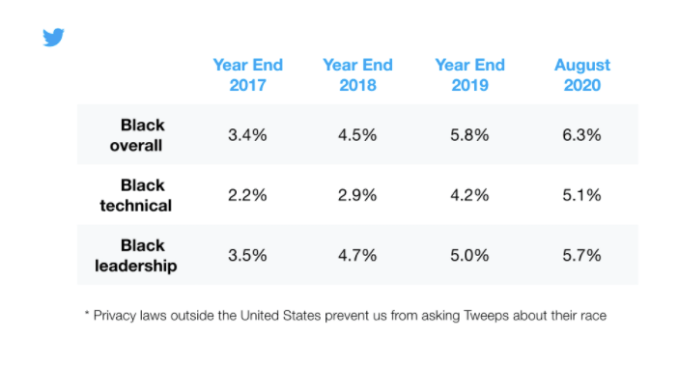
Image Credits: Twitter

By 2025, Twitter aims for at least 25% of its workforce to be underrepresented minorities, and at least 10% of that overall 25% to be Black. Overall, Twitter is 41.4% white, 28.4% Asian, 5.2% Latinx, 3.7% multi-racial and less than 1% Indigenous. 

Twitter’s technical team is also mostly white (41.4%) so perhaps it’s no wonder why Twitter has had some algorithmic bias issues

DiscoTech highlights diversity issues in tech

A new site popped up that details the discrimination people experience in tech. The folks behind DiscoTech describe themselves as “a diverse group of cross-tech organizers who are committed to ending discrimination in the workplace.”

The posted experiences — all anonymous — describe sexism, racism, ageism, sexual harassment and assault, weight discrimination, suicide and mental illness. Here are a few stories that jumped out:

On being a woman in tech:

After introducing myself to a peer at a social gathering, I was asked if I had ‘come to Microsoft to find a husband?’ The blatant question left me speechless, and I was shocked by his total disregard for my professional aspirations. My friend overheard and she quickly asked if he would pose the same question to a man, asking if he’d ‘come to Microsoft to find a partner?’ He got defensive and denied his originally offensive inquiry.

On being underpaid in tech:

This event happened prior to my joining the team, but I didn’t find out about it until years later.  The hiring manager bragged openly about how ‘little’ she hired me for while I was desperately leaving a toxic work environment. I pushed back, she was persistent and being afraid of losing the offer I took it. I ended up leaving the position for a job that paid market value. Irony.

On being a Black woman in tech:

I’m not sure where to begin with the amount of discomfort I’ve experienced in the work place. As a Black, woman in tech I’m all too familiar with being an extreme minority. I guess you could say my discomfort began at the beginning of my professional career. I accepted a position at my company in a 6 month training program for recent college graduates. Upon arrival at orientation I realized I was the only Black woman out of 70 participants. 70 other co-workers and I was the only one. I felt completely alone and as if I had no one who could relate to my unique experience. From there, it was small incident after small incident that caused my discomfort to grow. From my technical trainer referring to me as Sheba, as in the Queen of Sheba, in the middle of a training session to my colleagues constantly questioning my intelligence, work became a stressful environment. It didn’t help that when I tried to reach out throughout the company for assistance with existing in the workplace, I was often told to keep to myself and try my best to ‘fit in.’ It took me a while to find a support system but I’m glad I finally did because the amount of microaggressions I face on daily basis is often overwhelming.


Labor Organizing


Shipt shoppers protest new pay model

Shipt shoppers are organizing a handful of actions in protest of Shipt’s new pay structure that began rolling out this month. The first action is happening from Saturday, Oct. 17 through Oct. 19, when workers are calling on their fellow Shipt shoppers to walk out and boycott the company. Organizers are asking for shoppers not to schedule any hours or accept any orders during that time.

“Our goal is to draw attention to the fact that this pay scale really does affect shoppers and regardless of Shipt’s position of it taking into account effort and benefitting shoppers, we are finding it is the opposite on both fronts,” Willy Solis, a Shipt shopper in Dallas and lead organizer at Gig Workers Collective, told TechCrunch. “It’s not holding up to the true reality. We are getting paid less for more effort.”

Spin workers ratify first union contract

A group of 40 workers at Ford-owned Spin ratified their first union contract with Teamsters Local 665 this week. The group of workers consists of shift leads, maintenance specialists, operations specialists, community ambassadors, and scooter deployers and collectors.

“This new contract gives us job security and immediate money up front, with guaranteed increases each year going forward. We also got holiday pay and vacation, which we didn’t have before we organized,” Spin worker Shamar Bell said in a statement. “All this means a lot during the pandemic. We know our union will have our back if our boss or the city government tries to make changes. I can say for sure, we’re proud to be Teamsters.”

As part of the three-year agreement, Spin workers will get annual pay raises of more than 3% each year, six paid holidays (compared to zero holidays), vacation days based on years of employment (compared to no vacation days), five sick days a year, a $1,200 per employee ratification bonus, benefits accrual for part-time workers and other benefits.


In Other News


By the way, TechCrunch Sessions: Mobility is coming up next week. Since you made it to the end of this, here’s a 50% off code for you to get full access to the event. This code will get you into the expo and breakout sessions for free.


News: Singapore’s GIC to invest $752 million in Reliance Retail

GIC, Singapore’s sovereign wealth fund, will invest $752 million in Mukesh Ambani’s Reliance Retail, the Indian firm said Saturday midnight. The Government of Singapore Investment Corp is the fifth high-profile investor to back Reliance Retail, India’s largest retail chain, in the past four weeks. Reliance Retail — like its sister sibling Jio Platforms — is

GIC, Singapore’s sovereign wealth fund, will invest $752 million in Mukesh Ambani’s Reliance Retail, the Indian firm said Saturday midnight.

The Government of Singapore Investment Corp is the fifth high-profile investor to back Reliance Retail, India’s largest retail chain, in the past four weeks. Reliance Retail — like its sister sibling Jio Platforms — is a subsidiary of Reliance Industries, India’s most valuable firm.

GIC’s investment gives Reliance Retail a pre-money valuation of $58.5 billion, the Indian firm said. GIC, which has backed firms in over 40 nations, will get a 1.22% equity stake in the retail giant.

The announcement today caps a busy week for Reliance Retail, which in the past three days has revealed that Mubadala ($855 million for a 1.4% stake), Silver Lake ($254 million for a 0.38% stake), and General Atlantic ($498 million for a 0.84% stake) would be investing in it.

In total, investors have committed about $4.1 billion in Reliance Retail in the current fundraising spree. (Silver Lake committed to invest another $1 billion in Reliance Retail last month, and KKR has announced it would invest about $754 million.)

Reliance Retail, founded in 2006, serves more than 3.5 million customers each week (as of early this year) through its nearly 12,000 physical stores in more than 6,500 cities and towns in the country. Physical retail commands about 97% of all retail sales in India, according to estimates from several research firms.

“We believe Reliance Retail will continue to use its extensive supply chain and store networks, as well as strong logistics and data infrastructure, to add value to its customers and shareholders,” said Lim Chow Kiat, CEO of GIC, in a statement.

Reliance Retail operates supermarkets, electronics chain, fashion outlets, and a cash-and-carry wholesaler. In recent months, the firm has rushed to widen its dominance in the retail market. It bought several parts of Future Group, India’s second largest retail chain, for $3.4 billion in late August.

Late last year, it also entered the e-commerce space with JioMart. JioMart, a joint venture between Reliance Retail and Jio Platforms, has presence in over 200 Indian cities and towns and maintains a partnership with Facebook for a WhatsApp integration.

Facebook, which invested $5.7 billion in Jio Platforms earlier this year, has it will explore various ways to work with Reliance to digitize the nation’s 60 million mom and pop stores as well as other small and medium-sized businesses.

Jio Platforms has raised more than $20 billion in India this year from a roster of marquee investors including Facebook, Google, General Atlantic, Mubadala, Silver Lake, and KKR. Some industry executives have argued that investments in Jio Platforms make no business case and is largely foreign firms’ push to get friendly with Ambani, India’s richest man and an ally of Prime Minister Narendra Modi.

“I am delighted that GIC, with its track record of close to four decades of successful long-term value investing across the world, is partnering with Reliance Retail in its mission to transform the Indian retail landscape. GIC’s global network and track record of long-term partnerships will be invaluable to the transformation story of Indian Retail. This investment is a strong endorsement of our strategy and India’s potential,” said Mukesh Ambani, Chairman and Managing Director of Reliance Industries, in a statement.

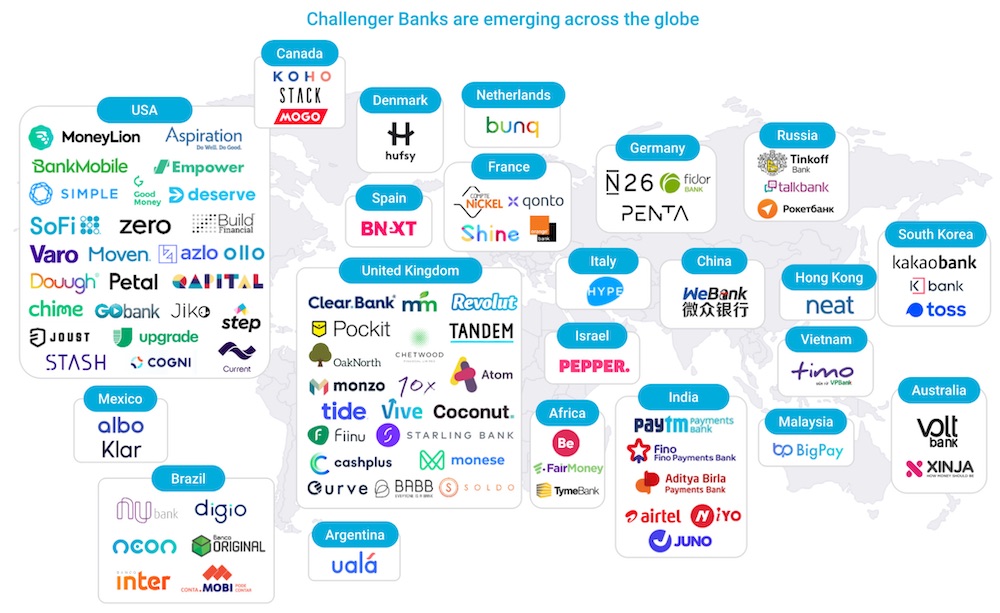
News: Which neobanks will rise or fall?

Neobanks have created a new tech stack, completely changing the services, products and speed at which they are delivered, and creating more fluidity in payments and currencies.

Denis Barrier
Contributor

Denis Barrier is co-founder and CEO of Cathay Innovation, a global venture capital firm investing across North America, Europe, Asia and Africa.

Alex Lazarow
Contributor

Alex Lazarow is an author, a global venture investor with Cathay Innovation and is an adjunct professor with the Middlebury Institute for International Studies MBA program.

The neobank, or digital bank, phenomenon continues to take the world by storm, with global winners, from Brazil’s Nubank valued at $10 billion and Berlin’s N26 valued at $3.5 billion, to Chime, now valued at $14.5 billion as the most valuable consumer fintech in the United States.

Neobanks have led the charge of the $3.6 billion in venture capital funding for consumer fintech startups this year. And as the coronavirus-fueled acceleration of digital transformation continues, it seems the digital bank is here to stay, with some estimates pointing to neobanks reaching 60 million customers in North America and Europe by the end of 2020, and surpassing 145 million by 2024.

The space is also becoming more crowded, a trend which will only accelerate with fintech eating the world and creating greater infrastructure that enables any company to include a bank account as a product extension.

As a result, neobanks are not a monolithic model and not all are created equal. Looking underneath the hood of business models across the globe reveals remarkable operational differences and highlights specific features that are more likely to succeed in the long-term.

Five global models of neobanks

Today there are five distinct models that are leading globally:

Interchange-led: Relies on payments revenue, sourced through interchange as the revenue driver. Every time a customer uses the neobank’s card as a payment method they get paid [e.g. Chime / US; Neon (hybrid of 1 & 2) / Brazil].

Credit-led: Leverages a credit-first model, starting off with a credit card or similar offering, and later providing a bank account [e.g. Nubank, Neon (hybrid of 1 & 2) / Brazil].

News: Plaid improves its account linking flow

Plaid, the company building a universal banking API that lets you connect an app or service with a bank account, has updated Plaid Link. Plaid Link is the interface that you see when you add your bank account to any app or service that uses Plaid, such as Cash App or TransferWise. Given that 3,000

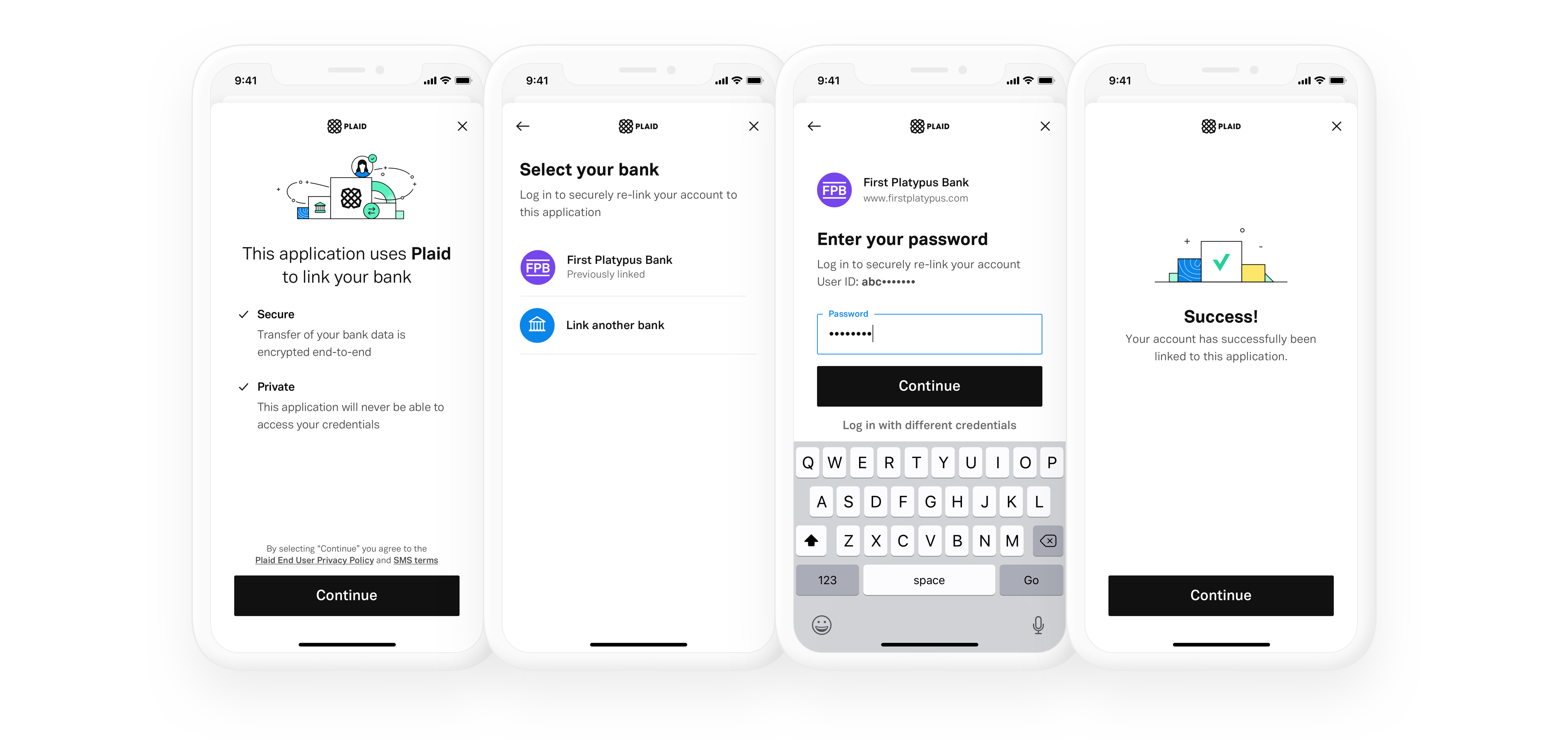
Plaid, the company building a universal banking API that lets you connect an app or service with a bank account, has updated Plaid Link. Plaid Link is the interface that you see when you add your bank account to any app or service that uses Plaid, such as Cash App or TransferWise.

Given that 3,000 apps have been using Plaid, chances are you’ve seen Plaid Link in the past. According to the company, one in four people in the U.S. have used Plaid to connect their accounts.

And today’s update is all about using Plaid with multiple apps. The first time you connect your bank account, you search for your bank, you enter your credentials and you log in.

The second time you need to add your bank account, Plaid shows you previously added bank accounts. You don’t have to scroll through a list of financial institutions and you don’t have to enter you user ID. Plaid might ask you for your password again or a one-time code.

Image Credits: Plaid

When you buy something on an e-commerce platform, you can save your card so that you don’t have to enter your card details again. With today’s update to Plaid Link, the company is doing the same thing with bank account information.

Payment cards thrived in part because it is much easier to pay with your card than connecting to your bank account to send money. Polishing Plaid Link could slowly make it easier to skip the card and use money from your bank account directly.

Plaid also says that Plaid Link is a bit faster. Each panel loads 30% faster. The list of banks now changes depending on your location. Local banks appear closer to the top of the list so that you don’t have to scroll as much.

Once you’ve added a bank account, the original app receives a Plaid token to query your bank account through Plaid.

News: Writer pens a $5M seed round for its AI style guide that flags bias and tone

Anyone who writes online or in a word processor has likely gotten used to the inevitable squiggly line denoting a misspelled word or clumsy phrase. But what if you use a word that’s loaded, a phrase that’s too formal or not formal enough, or refer to a group of people in an outdated way? Writer

Anyone who writes online or in a word processor has likely gotten used to the inevitable squiggly line denoting a misspelled word or clumsy phrase. But what if you use a word that’s loaded, a phrase that’s too formal or not formal enough, or refer to a group of people in an outdated way? Writer is a service that watches as you type, flagging language that doesn’t match up with your style guide and values, and it just raised $5M to scale up.

Both people and the companies they work for want to improve the way they write, but not just in terms of grammar and spelling. If a company says it’s inclusive, but the language in its press releases or internal blogs are peppered with anachronism and bias, it suggests their concern only goes so far.

“Companies are hungry to put actions behind their words,” said Writer founder and CEO May Habib. “They want to be able to tell a consistent story to their users everywhere that they’re interacting with them. What Writer does is let people know when they’re using insensitive language, or things that could be considered negative, and let companies set brand guidelines.”

Right off the bat let us admit that there is a whiff of the sinister about the idea of a company dictating how its employees speak, though that’s nothing new when it comes to content and official communications. But this isn’t about controlling speech for power — it’s about recognizing that we are all flawed communicators and could use a hand keeping ourselves honest. Less thought police and more a well-informed angel sitting on your shoulder whispering things like, “Hey. Are you sure you want to describe that lawyer as ‘exotic’?”

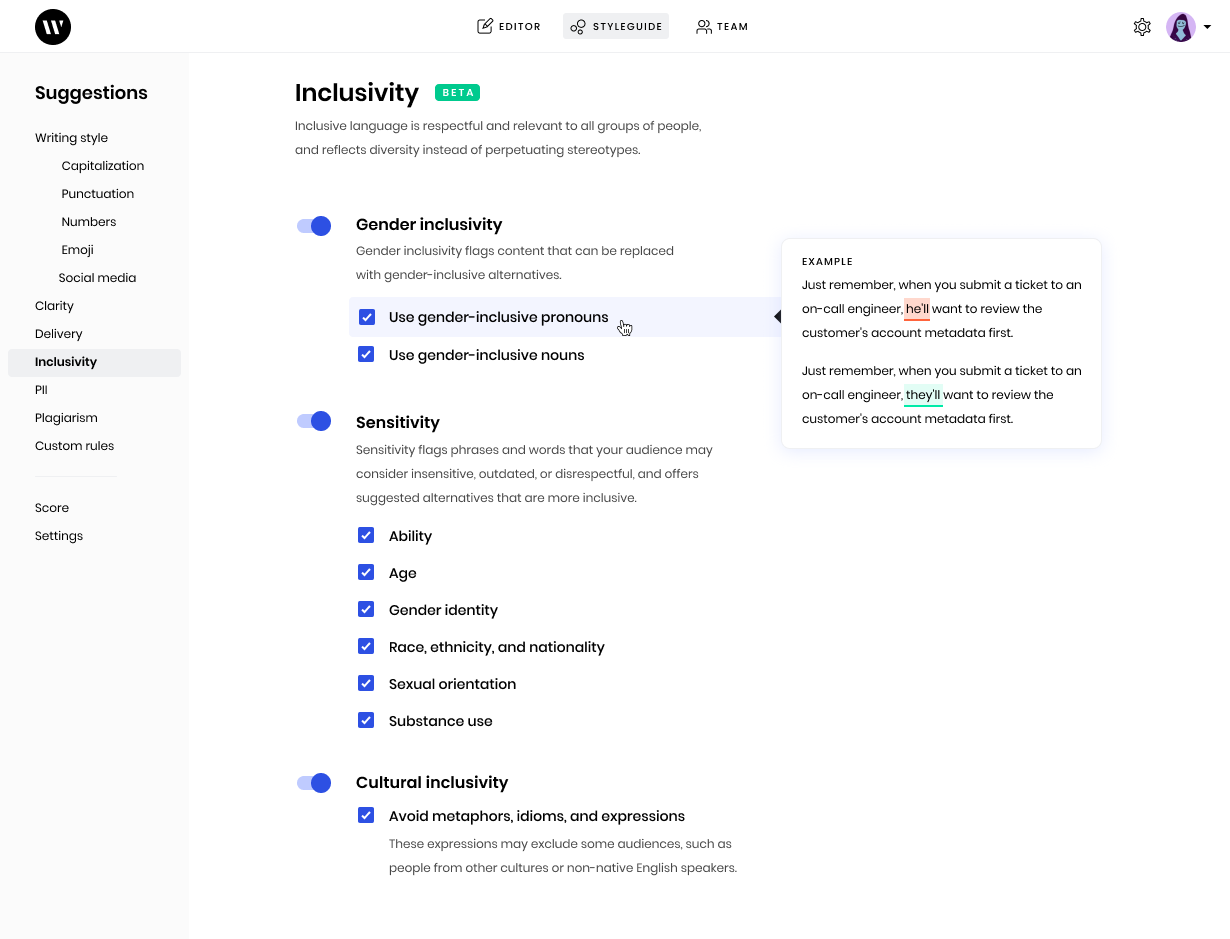
Examples of things Writer checks for.

There are tons of slip-ups we all make along those lines, less obvious but no less potentially offensive. It’s important in public communications, among other things, to refer to a group by the term they prefer, not the first one that pops into your head; Writer has up-to-date libraries of this information sourced from the communities themselves. Some phrases may have become politically loaded in the last couple years, but you’re not aware; No problem, it has alternatives. You want to avoid unnecessarily gendered language, great, but everyone slips up now and then; Writer can spot it — or make the connection with previous pronouns to make sure you don’t, for example, gender an anonymous source.

Accusations of “political correctness” will dog the service, but as Habib put it: “This is beyond politics; This is about respect for people who live a certain way, or are a certain way, and prefer to use certain terms. We’re trying to help companies create communities of belonging.” And as we’ve seen over and over again in tech, there is often a serious disconnect between the stated aspiration of a company and how people are treated within them. Just using the right words is a pretty low bar to start with, honestly.

Image Credits: Writer

Writer isn’t just a growing blacklist of words you should think twice about using, though. The natural language processing engine at the heart of it is also very concerned with things like sentence complexity, paragraph length, and tone. It has to have this deeper understanding, Habib explained, because “it’s not enough to underline — you need to know what to replace it with, and when you replace it, you need to fit it into the sentence. These are actually hard NLP problems.”

That lets it fit into a variety of roles in addition to promoting inclusive language. It can watch for the usual spelling and grammar mistakes, as well as things like formality, active voice, “liveliness” (whatever that is, I don’t have it), and other metrics that help define a brand.

And of course you can bring in your own style guide so your editors don’t have to roll their eyes at serial commas in headlines, double dashes instead of em dashes, e-mail instead of email, and all the rest of the little nips and tucks that keep a brand’s writing in a generally recognizable shape.

Image Credits: Writer

The service can also switch between style guides or adjust or disable itself in different apps and sites — so internal emails aren’t given the same guidelines as press releases, or a blog post’s style can be differentiated from a newsletter’s.

Obviously Grammarly is a big competitor here, but Habib feels that it and the growing number of in-browser or in-app checking services are very focused on the technical piece. Writer is less about preventing an individual writer’s errors, and more about creating consistency among groups of writers and making sure they are working from the same high-level linguistic standards.

Of course security is also a concern — no one wants a keylogger running on their machine, however helpful it may be. Habib was careful to emphasize that Writer runs locally in the browser as a plug-in, integrating with Word or Chrome for now but with other apps and services on the way. “None of that data ever hits a writer server, and no metadata — all the processing is done in the text area,” she said. The only data that’s sent back is the fact that a given suggestion was used, such as changing “should of” to “should have” or “illegal aliens” to “undocumented immigrants.” No user data is used to train the models and no content apart from the correction itself is sent or stored on Writer’s servers.

Writer is available now, for $11/person/month (with the obligatory free trial period, of course) for a basic version and some unspecified amount for enterprise deals with multiple style guides, plagiarism detection, and so on. It’s only available in English, and although there is of course demand for the service in other languages, the depth of the NLP model and the specificity of what it recognizes to the language mean it does not generalize well. To take on Spanish or Korean would be to develop an entirely new product. So English it is for now.

The company is new, and has been developing its NLP engine (on the back of a previous effort, which monitored user-facing language in GitHub repos) for 18 months in something like stealth. The $5M seed round, led by Upfront Ventures, Aspect Ventures, Bonfire Ventures, and Broadway Angels should help the company scale, though it already has some top-tier, household-name customers, so with that and the money its immediate future seems to be secure.

News: Propy, a blockchain-verified platform for selling houses, raises funding from Tim Draper

For several years, blockchain technology has been touted as a way to verify the sale of property. Any kind of property. And so entrepreneurs busily began the process of trying to create a startup that could complete a property deal on the blockchain. One that stood out from the start was Propy which was started

For several years, blockchain technology has been touted as a way to verify the sale of property. Any kind of property. And so entrepreneurs busily began the process of trying to create a startup that could complete a property deal on the blockchain.

One that stood out from the start was Propy which was started by Natalie Karayaneva, an experienced, real-world property developer who had subsequently joined the blockchain world. Propy’s other co-founder is Denitza Tyufekchieva (pictured). 

Propy has now raised an undisclosed funding round from venture capitalist investor Tim Draper, best known for his early investments into Tesla, Skype, Twitter, Coindesk and Robinhood. TechCrunch understands this is part of a wider, ongoing fund-raise. 

Propy’s platform uses blockchain technology to, it says, simplify the home purchasing experience and eliminate fraudulent transactions. The idea is to close a traditional real estate deal entirely online. Thus, the offer, signed purchase agreements with Docusign, secure wire payments, and title deeds are all taken care of. Propy claims its platforms saves 10 hours of paperwork, per transaction.

“My vision for Propy is to bring self-driving real estate transactions to the world, with all of the logistics seamlessly executed on the back-end”,  Karayaneva said in a statement. “Our platform offers a terminal to observe transactions in real-time, making the process transparent for real estate executives, title companies, homebuilders, buyers, and REITs. With this new investment we are excited to bring much-needed change to the industry, satisfy consumers and empower real estate professionals all over the world.”

But this is not some out-there, wacky crypto-play. Most of the transactions are done in dollars on Propy, meaning it could be used by mainstream users from day one, as it’s able to process wire transfers via integration with a money transmitter connected to 70 banks.

Speaking to TechCrunch, Karayaneva added: “We do not replace lawyers, but rather help them, closing attorney’s share documents with consumers and agents via Propy. With DocuSign integrated, they can sign the documents on Propy and all parties get notified. In the US, agents have ready forms in Propy to fill out and they don’t need lawyers in a transaction at all.”

Crucially, Propy has an enterprise play going on here as well. Its platform can provide the back-office system to real estate enterprises with real-time transaction reports and automated compliance.

Draper said: “Propy has the potential to transform Real Estate, making transactions and titles simpler, more secure, and less expensive through innovative use of blockchain technology. [It] eliminates fraud and makes the closing process more secure, effective, and streamlined.”

According to one survey, almost one-fifth of millennials have now thought about buying a home become of the lock-downs induced by the Covid-19 pandemic, meaning that many will be looking for an easy way to transact, especially if it has the ease of use Propy has. 

Propy has some fellow-travelers in the blockchain prop-tech space. ShelterZoom is Blockchain platform used for virtual and remote collaboration with offices and clients, while StreetWire is a Blockchain-based data service for the real estate industry.

News: Coinbase lets you withdraw funds to your debit card

Cryptocurrency exchange Coinbase is adding a new way to withdraw funds from your Coinbase account. If you’ve added a compatible debit card to your account, you can transfer USD, EUR or GBP to your bank account nearly instantly. There are some drawbacks, and the main one is that you’ll pay a lot of fees. In

Cryptocurrency exchange Coinbase is adding a new way to withdraw funds from your Coinbase account. If you’ve added a compatible debit card to your account, you can transfer USD, EUR or GBP to your bank account nearly instantly.

There are some drawbacks, and the main one is that you’ll pay a lot of fees. In the U.S., Coinbase deducts 1.5% from the transaction, or a minimum $0.55 if it’s a small transaction. In Europe and the U.K., you pay 2% in fees or a minimum fee of £0.45/€0.52.

You also need to have a compatible card. Not all debit cards support incoming transfers. You need to have a Visa card that supports Visa Fast Funds. In the U.S., you can also use a MasterCard card with MasterCard Send.

It’s hard to know whether your bank or card issuer support those features. The best way to figure it out is probably by adding your card to Coinbase and see what Coinbase says.

Coinbase isn’t removing other withdrawal methods. For instance, if you’re looking for a cheaper way to withdraw your funds in Europe, a SEPA bank transfer costs €0.15 per transfer. And Coinbase supports instant SEPA transfers if your bank has enabled that.

The company also lets you link your PayPal account with your Coinbase account. Your funds should hit your PayPal account within a few seconds and there are no fees on Coinbase’s side.

As you can see, there are many ways to move money from your bank account to your Coinbase account. Some of them are slower than others, some of them are more expensive than others. Crypto-to-crypto transactions are a bit simpler by comparison as you only need your recipient’s wallet address to send tokens.

Image Credits: Coinbase

News: Kaleido’s Unscreen is dead simple drag-and-drop background removal for video

Removing the background of a video you’ve shot can be a real pain if you don’t have the kind of tools and setup used by professionals — and even then it isn’t as easy as it should be. Kaleido’s one-step background removal tool for images, remove.bg, has graduated to full motion video with the company’s

Removing the background of a video you’ve shot can be a real pain if you don’t have the kind of tools and setup used by professionals — and even then it isn’t as easy as it should be. Kaleido’s one-step background removal tool for images, remove.bg, has graduated to full motion video with the company’s new product, Unscreen.

The service itself is simple enough. You drag a video onto the Unscreen webpage, and a few minutes later (depending on the size and resolution of the content) you get it back, with everything gone but the person or object in the foreground.

The company’s first product was remove.bg, which was the same sort of thing but for still images; It was a big hit on Product Hunt. As someone who has to do a bit of work in that line myself now and then, it’s nice to know there’s a very simple, effective web service for snipping out the background quickly and accurately, even though I know I could do the same thing in Photoshop with a bit of work.

After nine months out there remove.bg is serving millions of users monthly, 25,000 of which are actually paying customers. Clearly there is demand for this type of service, and going from stills to video is a natural move, though of course the amount of computing power required is many times more. Kaleido tested the waters with an experimental MVP back in March, and developed Unscreen on the back of that.

The idea is, understandably, to become the go-to tool for creators who have little time to spare or don’t want to deal with heavy-duty options like Premiere. On YouTube and other platforms, speed is paramount if you want to have the first unboxing video or reaction to news, but maintaining production value is important, and people will be put off by janky live background removal that makes the creator look like an amateur.

Speaking of which, Kaleido chose to compete in the offline video processing space because there are entrenched and competitive offerings available from Zoom, Microsoft and others in the video chat space, where “good enough” is just fine. But there are comparatively fewer options for offline video editing, and fewer still that anyone can operate with no expertise at all.

In Hollywood (which is to say in cinema and high-end video production in general) the world of compositing is changing, with LED walls like those used on The Mandalorian an attractive, though expensive and complex, alternative to the standard green screen or frame-by-frame rotoscoping. A simple one-step process to easily remove backgrounds for quick-turnaround shoots, dailies, and other situations could be a godsend for many a VFX tech or production studio.

At all events the market is evolving but clearly exists, as paying customers attest. Kaleido is totally self-funded so far, with no need or desire to take on investors, since its income scales with its expenses and exposure.

As with most media products these days, Unscreen comes in a freemium subscription model. You can try it out with clips up to 10 seconds long for free (but the watermarked, low-resolution files aren’t really suitable for publication), then there are the usual subscription tiers, from $9 to $389 per month depending on how much footage you plan on uploading. 2/3 of its income is from small businesses, but it also counts several major enterprises and media companies among its paying customers.

Of course none of that matters if the product itself doesn’t work. I tested it out on a 5-minute, 720p video of a woman with long hair, and it finished in about 45 minutes. The end result was good, with the hair nicely preserved and only a handful of small glitches that would be easy to paint out if desired. A minute and a half of myself talking into the camera in 1080p took about 33 minutes, and a somewhat clearer 23-second video of a colleague turned out very crisp in about 10 minutes.

I bet at first you thought this still was from Fashion Week too, right?

You might say, why so long? Zoom does it in real time. Yes, but at a low resolution and quality. It’s not the kind of thing you’d want to put online publicly and permanently, or use in a commercial shoot. From what I could tell, the quality of Unscreen’s removal was considerably better, but not straight-to-final good. You’ll want to watch it first to snag any issues.

Users have the option to render the video directly with a still, video, or solid color background, or a two-channel (alpha and color files) version for feeding into an editor. Other options are limited, so if you want to upscale, resize, re-render with a different color, etc, you’re out of luck. This isn’t an online video editing platform — it’s a web-hosted video effect and should be treated as such.

One thing Kaleido has been careful to demonstrate — and it’s sad to think that this is a differentiator — is that its products work with people whose skin tone and hair confound other solutions. The bare fact that some background removal processes work better with light-skinned people than dark-skinned, or with straight hair than curly, is a sad indicator of a lack of diversity in the training set that produced those tools.

Curly hair is notoriously difficult for computer vision algorithms, but Unscreen’s does a decent job of it.

Kaleido’s Bernhard Holzer told me that this was top of mind from the beginning, and that the team has been careful to assemble training data from all over the world to make sure the product works equally well no matter what country or hemisphere the user is in. They keep an eye out for unexpected issues; For instance, it was found that a person with a commencement cap on moving the tassel from one side to the other wasn’t handled well by the system — so they added a bunch of data to fix it. Users are encouraged to give feedback and the system is constantly evolving to take advantage of it.

The company itself is growing, and expects to double in size to about 30 employees this year — and as noted remains funded by its own income. The appetite for web tools is certainly considerable, and until now the idea of a single-click background removal one didn’t exactly make sense. But by being the first Unscreen hopes to become and remain the best.

News: Watch SpaceX launch a GPS satellite for the U.S. Space Force live

SpaceX is set to launch a GPS-III satellite for the U.S. Space Force using a Falcon 9 rocket, with a target launch time of 9:43 PM EDT (6:43 PM PDT). That opens a 15-minute launch window, and so far weather is looking relatively good, which will hopefully help SpaceX end a recent string of launch

SpaceX is set to launch a GPS-III satellite for the U.S. Space Force using a Falcon 9 rocket, with a target launch time of 9:43 PM EDT (6:43 PM PDT). That opens a 15-minute launch window, and so far weather is looking relatively good, which will hopefully help SpaceX end a recent string of launch scrubs, including one earlier this week for a reset Starlink mission.

The Falcon 9 used for this launch is a rarity these days – a brand new vehicle, including a booster being used for the first time. The attempt will include a landing of that first stage aboard SpaceX’s ‘Just Read the Instructions’ drone landing ship in the Atlantic Ocean.

There’s a good reason that SpaceX isn’t flying a previously flown booster for this one: The company’s contract with the Space Force stipulates that it can only use new, non refurbished vehicles for National Security Space Launch (NSSL) missions. But they recently announced an updated agreement that will allow SpaceX to use reflown first stages on future flights.

The webcast above will start at around 15 minutes prior to the opening of the launch window, so at around 9:28 PM EDT (6:28 PM PDT).

WordPress Image Lightbox Plugin