Yearly Archives: 2020

News: Google adds ‘Stories’ to its search app for iOS and Android

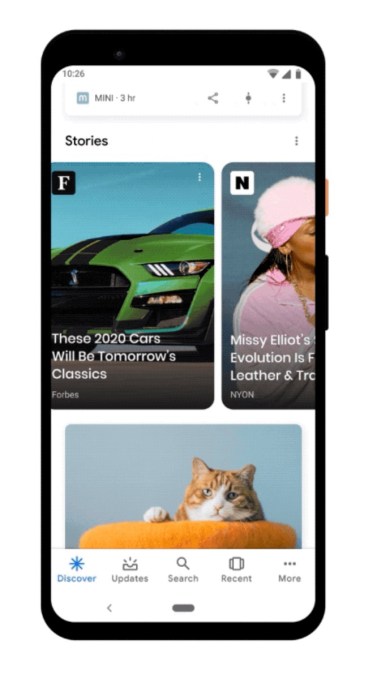
Google announced today it’s introducing a Stories feature to its Google app for iOS and Android, which now reaches over 800 million people per month. In a new carousel within the app, users in supported markets will be presented with a row of tappable visual Stories from participating publishers. These Stories can include full screen

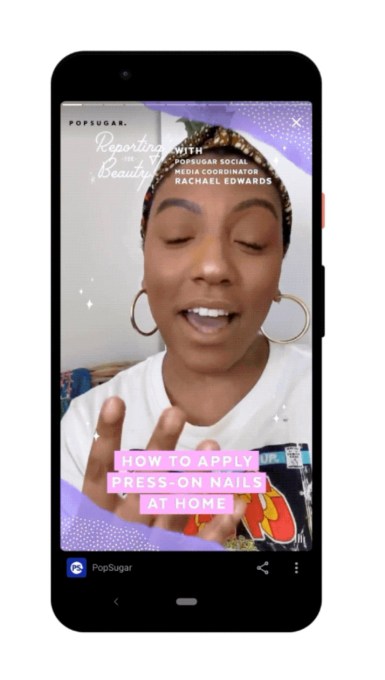
Google announced today it’s introducing a Stories feature to its Google app for iOS and Android, which now reaches over 800 million people per month. In a new carousel within the app, users in supported markets will be presented with a row of tappable visual Stories from participating publishers. These Stories can include full screen video, photos, and audio and can link out to the publisher’s other content, if desired.

The company has been developing its own Stories product for some time. In 2018, it introduced AMP Stories, based on technology developed for Google’s Accelerated Mobile Pages project. The Stories, which are already integrated into mobile Google Search, are meant to give Google its own alternative to the Stories offering found in other apps like Snapchat, Instagram and Facebook. But, in Google’s case, Stories are focused on publisher content.

Image Credits: Google

Today, Google is referring to this visual content as “Web Stories,” not AMP Stories, and is integrating the experience into the Google search app in the U.S., India and Brazil to start.

Here, users will see the row of Web Stories at the top of the Discover tab, where they can tap to enter the full-screen Story experience. Like Stories found in other apps, you can tap to move forward to the next page in a Google Web Story or swipe to move to a different Story in the carousel.

Image Credits: Google

Publishers are responsible for authoring their Stories and have control over Story monetization, hosting, and sharing and adding links to the Stories, Google notes. To create these Stories, the publishers can use drag-and-drop tools like the Web Story editor for WordPress, MakeStories, or NewsroomAI. Technical users can instead opt to code Web Stories themselves.

Early adopters of the format have been using Web Stories on their homepage, on social channels, in newsletters, and more, in addition to having them featured in Google Search, the company says.

Image Credits: Google

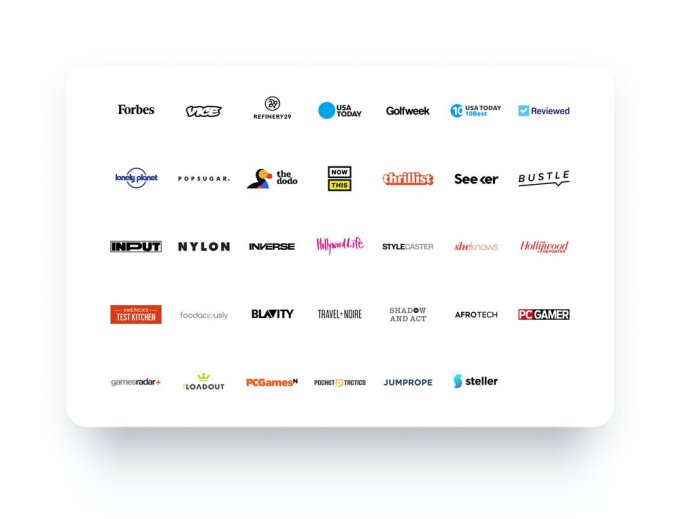
Google has been working with a number of publishers to help them create Web Stories for Search and now, its native mobile app. Partners include Forbes, Vice, Refinery29, USA Today, Lonely Planet, Now This, Thrillist, Popsugar, The Dodo, Bustle, Input, Nylon, The Hollywood Reporter, Blavity, PC Gamer, Golfweek, and many others. The publishers and Google collaborated on the new product and helped build out its features, Google says.

To date, over 2,000 websites have published Stories that have been indexed by Google.

The update to the Google app on iOS and Android is rolling out today.

News: Tone raises $4M to help e-commerce brands text with their customers

While many companies are using chatbots and other forms of automation to manage their communication with customers, Boston-based Tone is betting that humans will remain a key part of the equation. “The traditional models of bots and humans is, ‘Hello, I’m a bot, now you get to battle with me finally get to a human,’”

While many companies are using chatbots and other forms of automation to manage their communication with customers, Boston-based Tone is betting that humans will remain a key part of the equation.

“The traditional models of bots and humans is, ‘Hello, I’m a bot, now you get to battle with me finally get to a human,’” said Tone CEO Tivan Amour. “Our verison of that is, ‘I’m a human using AI to get you the answers you need more quickly.’”

Amour and his co-founder Vlad Pick previously created a bicycle startup called Fortified Bicycle, and he said they “figured out that the best way to close our customers on these $750 to $7,000 orders was to actually engage them in text message conversations.”

After all, when it comes to “high consideration” purchases like bicycles, people usually want discuss their questions and concerns with another human being. Over time, the Fortified team built what Amour said was a “semi-automated system” to help its sales team stay on top of these conversations.

“We started bragging about it to our friends about it, ‘You’ve gotta do this, it’s the future of mobile commerce,’” he recalled. “And they’d say, ‘Okay, that’s cool, but we don’t have any of the systems of doing that, we don’t have the salespeople.’”

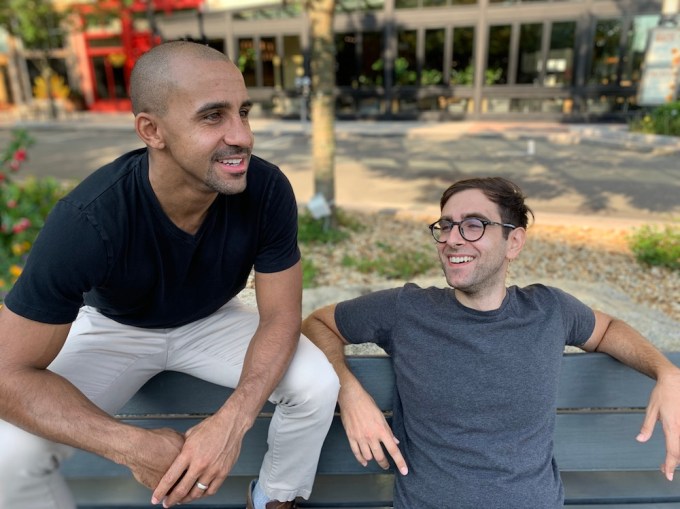
Tone’s founders

So after selling Fortified Bicycle, Amour and Pick created Tone to help any e-commerce business manage similar text message conversations. Tone employs its own team of human agents to actually do the texting, assisted by software that helps them find the information they need.

It integrates with e-commerce systems like Shopify and Magento, and it’s already working with more than 1,000 brands like ThirdLove, Peak Design and Usual Wines — who are seeing as much as a 26% increase in revenue and a 15% increase in order size.

Amour also noted that specific Tone agents are assigned to specific brands, which means that customers will be talking to the same person whenever they have a question for that business. In some cases, customers have been talking to the same agent for months or years.

“Particularly in a post-COVID world, it’s pretty clear that online shopping has become the dominant form of shoping, but I think nobody has thought about how you replace that human experience that you get in traditional retail,” he said.

Tone is announcing today that it has raised $4 million in seed funding from led by Bling Capital, with participation from Day One Ventures, One Way Ventures, TIA Ventures and executives from Google, Facebook, Dropbox and Uber.

With the new funding, Amour said Tone will be able to build out the “relationship automation” aspect of the product. He also suggested that the platform could eventually expand beyond text messaging, but it sounds like that’s not a big priority.

“In theory, we’re a conversational sales platform more than we are an SMS company,” he said. “However there are a bunch of trends right now [such as the growth of mobile commerce] that make SMS be the most obvious place for this sort of innovation.”

News: Apple will announce the next iPhone on October 13

Apple just sent out invites for its upcoming hardware event, all but confirming the arrival of the next iPhone. The event is scheduled nearly a month to the day after the its last big event, which gave us the Apple Watch Series 6 and two new iPads. A new iPhone was conspicuously absent from the

Apple just sent out invites for its upcoming hardware event, all but confirming the arrival of the next iPhone. The event is scheduled nearly a month to the day after the its last big event, which gave us the Apple Watch Series 6 and two new iPads.

A new iPhone was conspicuously absent from the proceedings — not an entirely unexpected turn of events, of course. CEO Tim Cook confirmed earlier this year that there would be a delay the arrival of the company’s new flagship, owing to COVID-19 hardware supply chain issues.

Apple invite

Image Credits: Apple /

The iPhone 12 is set to finally deliver 5G connectivity to Apple’s product line, coupled with a new design, chip and a push to OLED for all entries in the line. There are expected to be three new models in all, ranging from 5.4 to 6.4 inches. The company will, no doubt, also be using the occasion to release additional hardware. Audio seems like a pretty obvious addition — perhaps we’ll finally be seeing the company’s long-awaited over-ear headphones, the AirPods Studio.

The event kicks off virtually at 10AM PT. As ever, we’ll be bringing you the news live.


News: Google Assistant comes to gaze-powered accessible devices

People who rely on gaze-tracking to interact with their devices on an everyday basis now have a powerful new tool in their arsenal: Google Assistant. Substituting gaze for its original voice-based interface, the Assistant’s multiple integrations and communication tools should improve the capabilities of the Tobii Dynavox devices it now works on. Assistant will now

People who rely on gaze-tracking to interact with their devices on an everyday basis now have a powerful new tool in their arsenal: Google Assistant. Substituting gaze for its original voice-based interface, the Assistant’s multiple integrations and communication tools should improve the capabilities of the Tobii Dynavox devices it now works on.

Assistant will now be possible to add as a tile on Tobii’s eye-tracking tablets and mobile apps, which present a large customizable grid of commonly used items that the user can look at to activate. It acts as an intermediary with a large collection of other software and hardware interfaces that Google supports.

For instance smart home appliances — which can be incredibly useful for people with certain disabilities — may not have an easily accessible interface for the gaze-tracking device, necessitating other means or perhaps limiting what actions a user can take. Google Assistant works with tons of that stuff out of the box.

“Being able to control the things around you and ‘the world’ is central to many of our users,” said Tobii Dynavox’s CEO, Fredrik Ruben. “The Google assistant ecosystem provides almost endless possibilities – and provides a lot of normalcy to our community of users.”

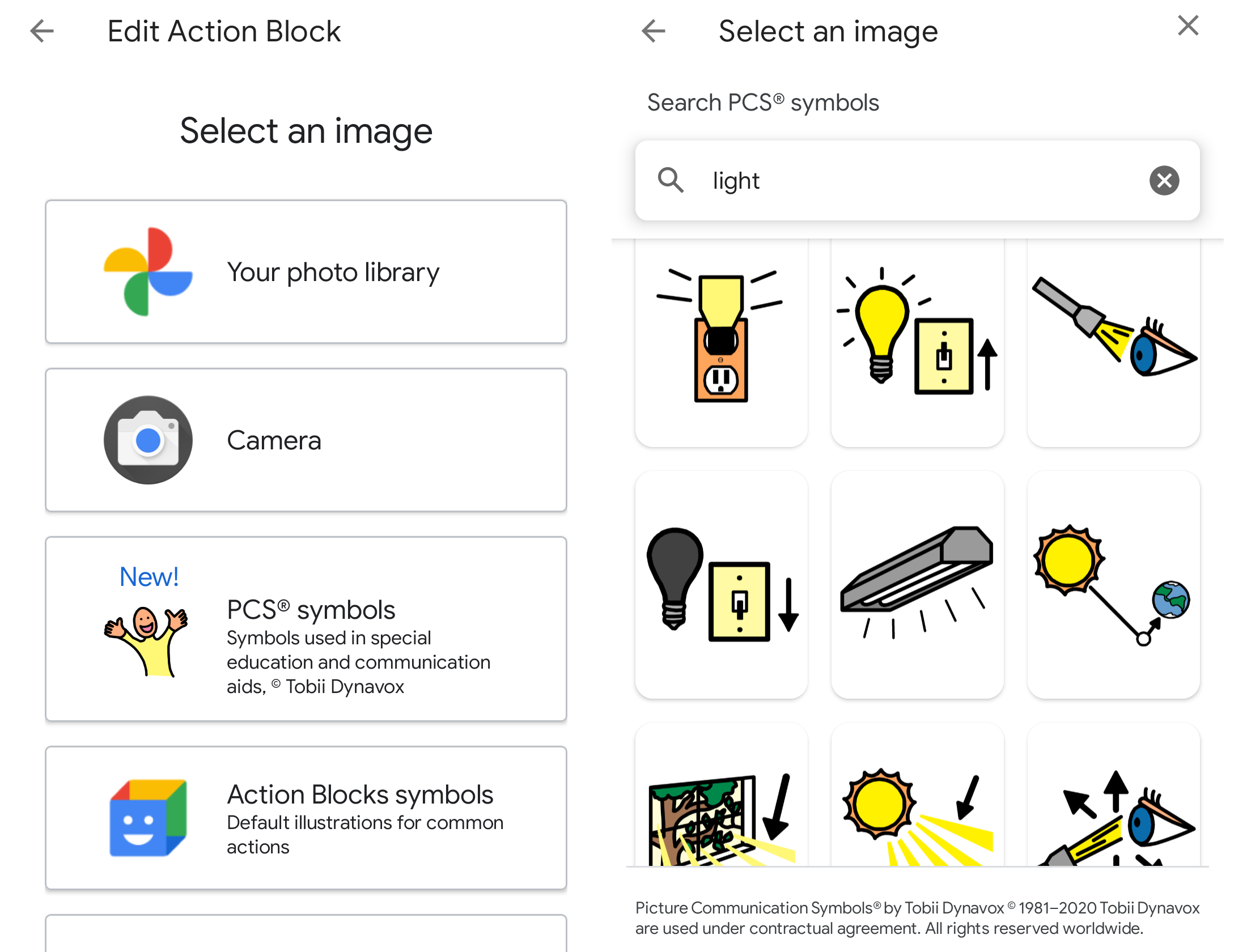
Users will be able to set up Assistant tiles for commands or apps, and automate inquiries like “what’s on my calendar today?” The setup process just requires a Google account, and then the gaze-tracking device (in this case Tobii Dynavox’s mystifyingly named Snap Core First app) has to be added to the Google Home app as a smart speaker/display. Then Assistant tiles can be added to the interface and customized with whatever commands would ordinarily be spoken.

Tobii and Google interface for adding actions using pictorial icons.

Image Credits: Google / Tobii Dynavox

Ruben said the integration of Google’s software was “technically straightforward.” “Because our software itself is already built to support a wide variety of access needs and is set up to accommodate launching third-party services, there was a natural fit between our software and Google Assistant’s services,” he explained.

Tobii’s built-in library of icons (things like lights with an up arrow, a door being opened or closed, and other visual representations of actions) can also be applied easily to the Assistant shortcuts.

For Google’s part, this is just the latest in a series of interesting accessibility services the company has developed, including live transcription, detection when sign language is being used in group video calls, and speech recognition that accommodates non-standard voices and people with impediments. Much of the web is not remotely accessible but at least the major tech companies put in some good work now and then to help.

News: Despite pandemic, Amazon Prime Day expected to generate nearly $10B in global sales

A new forecast released today estimates Amazon’s delayed Prime Day sales event will top last year’s by bringing in an estimated nearly $10 billion in worldwide sales when it runs later this month. According to eMarketer, which released its first-ever Prime Day forecast, consumers will continue to spend heavily on e-commerce and seek out deals

A new forecast released today estimates Amazon’s delayed Prime Day sales event will top last year’s by bringing in an estimated nearly $10 billion in worldwide sales when it runs later this month. According to eMarketer, which released its first-ever Prime Day forecast, consumers will continue to spend heavily on e-commerce and seek out deals ahead of the 2020 holiday season, benefitting the major sales event.

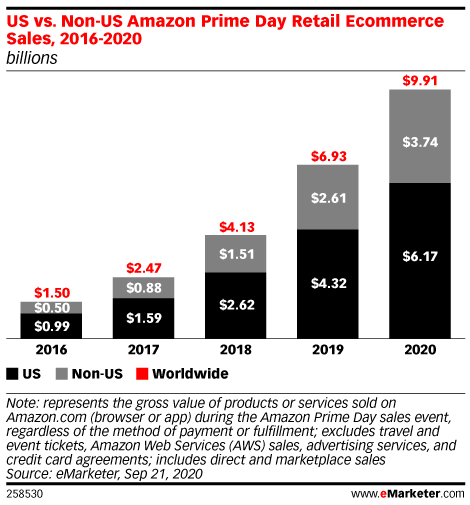
The firm says of the total $9.91 billion in Prime Day 2020 global sales, $6.17 billion will be generated by U.S. consumers.

This is ahead of what Prime Day achieved in years past. In 2019, the sales event delivered $6.93 billion in sales, eMarketer says, with $4.32 billion from the U.S.. Total Prime Day sales in 2016, 2017 and 2018, were at $1.5 billion, $2.47 billion, and $4.13 billion, respectively.

These estimates are fairly in line with those from other firms. For example, Internet Retailer had estimated Prime Day 2019 reached $7.16 billion in global sales, up from $4.19 billion in the year prior. Amazon doesn’t detail Prime Day sales volume, specifically, but last year said it had sold over 175 million items during the event.

Image Credits: eMarketer

Forecasting for this year’s Prime Day, of course, has been much more difficult due to the coronavirus pandemic’s impact on the e-commerce industry. The health crisis has disrupted supply chains, causing delays, while consumer demand can be unpredictable. Some past boosts in e-commerce spending for major retailers was also closely tied to government stimulus checks.

Due the to pandemic, Amazon this year decided to move its annual sales holiday from mid-July to October for most markets. Meanwhile, the retailer ran Prime Day in India in August — later than it had been held in prior years, but ahead of other countries’ Prime Day events planned for 2020. Following the India event, Amazon reported record seller participation, and said it gained at least 1 million new subscribers for its Prime membership program.

Despite the changes to Prime Day, the analysts at eMarketer believe Prime Day’s predictability will help to continue to drive traffic and sales this year.

“Since Prime Day’s 2015 debut, Amazon has expanded the scale and spectacle of the event in a mostly predictable fashion,” said Andrew Lipsman, eMarketer principal analyst. “The generally incremental changes from year to year gave customers and sellers a better sense of what to expect, with Lightning Deals and heavily discounted Echos and Fire TVs taking center stage. Sellers developed a playbook for their promotions and advertising strategy and could plan their inventory accordingly,” he added.

Though Prime Day doesn’t officially begin until October 13, Amazon has already started to run some early deals for Prime subscribers, including a discounted Echo Show 5 ($45 instead of $90), a discounted Echo Auto ($30 off at $19.99), cheaper Echo Dots, as well as discounts on an Amazon TV-powered Insignia 4K TV, Blink Mini devices, and others.

Prime Day has also typically inspired a range of competitive sales, given that Amazon’s event would drive an increase in online shopping that benefitted other e-commerce retailers. As of March, as many as 37% of digital retailers said their Prime Day plans were up in the air because of coronavirus, but 56% said they still expected Prime Day sales would perform well, eMarketer noted.

So far, Target has planned a massive sale, Target Deal Days, to compete with Prime Day, which promises Black Friday-like discounts on hundreds of thousands of items on the same days that Prime Day runs. Walmart, on the other hand, said it would run its event starting earlier, on Sunday Oct. 11 through Oct. 15.


News: Nivelo nabs $2.5M seed to reduce risk in digital ACH payments

As we plunge deeper into the pandemic, online transactions have become increasingly important, and ACH transactions, the ones that help us get direct deposit of our paychecks or pay our bills are growing ever more essential. Nivelo, an early stage startup from a former JP Morgan executive wants to take the risk out of ACH

As we plunge deeper into the pandemic, online transactions have become increasingly important, and ACH transactions, the ones that help us get direct deposit of our paychecks or pay our bills are growing ever more essential. Nivelo, an early stage startup from a former JP Morgan executive wants to take the risk out of ACH transactions and today the company announced a $2.5 million seed investment, which closed in mid-August.

FirstMark, Barclays and Anthemis led the round with help from Dash Fund and several individual investors. While the company was announcing its first funding, it also launched a private beta of a Risk Scoring API for payments.

Company co-founder Eli Polanco says that ACH payments are a huge business, but mostly haven’t been updated for quick and safe digital transactions “We protect digital payments in real time, but taking a step back our focus is ACH payments, which are the most ubiquitous payment channel in the U.S.,” Polanco told TechCrunch.

To give you a sense of how big this business is, more than $55 trillion worth of transactions moves through the ACH channel annually, yet Polanco says for the most part, it remains mired in legacy technology. Her company wants to update the risk component by building a set of APIs that companies can tap into and understand the risk associated with a particular transaction.

“We’re unbundling this risk assessment service and packaging it in the easiest way possible in the form of APIs and embedding it into the most critical payment use cases in the U.S.,” she said.

Polanco, who is a Black woman who grew up in the Dominican Republic, started the company in January and went to raise money. She had a lot going for her including a strong background in payments products, a working product and paying customers. While she faced a lot of due diligence, she expected that, especially as a newly minted founder at a time when she couldn’t meet with investors in person.

Still, she knows the odds for Black founders are abysmal, but she says she could only come armed with data and tell her story. “I know that discrimination and racism exist in the world, but I can just live and play offense as much as possible and come prepared,” she said. Ultimately she prevailed and got her funding.

She said that the pandemic has reinforced how important having a safe digital payment system is. “COVID really shone a light into how unprepared we are for where the world is moving to. When COVID happened and a lot of folks were no longer able to rely on checks and cash […] it elevated the prominent rise of moving to digital payments,” she said. And investors saw this too.

Polanco says that she is also building her financial services tooling with the idea of leveling the playing field for everyone. “My hyper focus on risk infrastructure is directly tied to my outsider experience as an immigrant. When you’re trying to get access to any financial service, you’re always the edge case in the risk models that they have, and you’re always going to have additional friction. So when you grow up as a product manager who has always experienced this, you always have a keen sight on building accurate, but accessible FinTech tools,” she said.

Nivelo is taking its first steps as a company with this funding, but it’s on its way with an alpha product and a future road map of products and services. The company is live with a couple of thousand customers today.

News: Google is providing cash awards to 76 startups through a racial equity initiative announced in June

In June of this year, as more of the world began to awaken to the many ways that people of color are systematically discriminated against amid months of protest, a wide number of companies announced initiatives aimed at improving the representation of underrepresented groups within their own ranks and as recipients of their investment dollars.

In June of this year, as more of the world began to awaken to the many ways that people of color are systematically discriminated against amid months of protest, a wide number of companies announced initiatives aimed at improving the representation of underrepresented groups within their own ranks and as recipients of their investment dollars.

Unsurprisingly, Alphabet, among the world’s biggest and most profitable companies, was among them. Specifically, as part of Alphabet’s commitment, Jewel Burks Solomon — who is the head of the company’s nine-year-old program Google for Startups — agreed to help steer $5 million in cash rewards of up to $100,000 to select startups.

The company didn’t waste much time. Today, Solomon is announcing that the money has been committed to 76 different startups that were chosen for their geographic diversity as well as the diversity of their companies’ mission.

Solomon and her team had some help. All the founders to receive the non-dilutive funding have participated previously in either Google’s Founder Academy in Atlanta, which is an eight-month-long program for 40 Georgia-based startups that was announced back in February, or are otherwise affiliated with one of 17 other organizations with which Google partners, including Black Founders Exchange, a four-year-old program for Black founders that’s co-hosted by Google and American Underground, a Durham, N.C., co-working outfit.

Google “didn’t open it outside of our network because we want to be able to offer support, in addition to the funding,” says Solomon. “This isn’t about just writing a check but also our ability to work with the founders through the programs over time.”

As for eligibility criteria, Solomon says Google wanted to “find companies that had a readiness for the funding” and had not already received more than $3 million in outside backing.

Though Google says it is looking to mentor, and not necessarily capitalize off, the founders who’ve received checks, many of the teams have identified sizable opportunities that are poised to grow as country’s demographics change.

Latched and Hook, for example, a 4.5-year-old Atlanta, Ga.,-based beauty startup, spied the need for non-toxic synthetic and stylish hair products and began producing and selling its own braids and twists, wigs and ponytails, and has been embraced by both beauty editors and an expanding customer base alike.

Another startup, MindRight, a year-old, Newark, N.J.-based startup provides culturally responsive mental health coaching via text message to largely teenagers in order to help them develop positive coping skills; the idea is to reach and support students who are dealing with stress and trauma to help prevent a crisis, as well as to work with them to establish goals. (“I am blown away by many of the founders, [a lot] are whom are working on big issues impacting the communities where they live,” says Solomon.)

Many of the startups also target Americans who might not be top of mind for engineering talent in Silicon Valley startups because they have less disposable income but who collectively represent a much bigger swath of the country. Among these is Courtroom5, a 6.5-year-old, Durham, N.C.-based online platform that empowers people to manage their own civil court cases without the need of a lawyer.

Asked about Google for Startups’s relationship to GV — the corporate venture arm of Google that invests many hundreds of millions of dollars each year — and whether it gets a first look at the startups that Solomon and her team identify, she says there’s a connection but not a straight line from A to B.

“We do have a relationship with the GV team,” one that sees some of the partners serving as mentors for the young startups it tracks. But the idea is to help the startups with which it is involved better prepare for “investment from GV and across the board” she adds, suggesting that she isn’t as interested in where some of these founders secure venture funding as much as she is focused on ensuring they’re able to receive it.

As for whether there is enough of that follow-on funding — many Black investors and founders have expressed concerns to TechCrunch over a continuing lack of diversity at growth-stage venture firms — Solomon says she hopes “firms are paying attention to firms that will need additional funding.”

It’s certainly the point of what she is trying to build at Google, as well as in a second role she holds as a managing partner at Collab Capital in Atlanta. Brands that understand Black customers and other underrepresented groups is a “great place to be investing,” she notes. With a little financial boost and a lot of mentoring, Google hopes these new reward recipients will have an even better story to tell that makes that next round easier to raise.

You can learn more about half a dozen of the cash-reward recipients below. You can find the complete list here.


MindRight: Newark, N.J.

Ashley Edwards created MindRght to advance mental health care equity, making it accessible and inclusive to communities of color and low-income families. This funding will be used to build capacity, supporting coaching and technical teams with the resources they need to address this urgent and ongoing need of their clients.


ShearShare: McKinney, Tex.

ShearShare is led by husband and wife co-founders Courtney Caldwell and Tye Caldwell. They created a mobile marketplace for stylists that helps them communicate directly with their clients, including about specials they might be offering. Throughout COVID-19, the startup has also been enabling stylists to rent a sanitized salon suite, station, or nearby barber chair by the day, without requiring a contract or commission.


Pharoah’s Conclave: Atlanta, Ga.

As avid gamers, wife and husband founder duo Jakita and Erich Thomas built Pharoah’s Conclave to provide career pathways for Black and Latinx youth in the massively growing esports market. As part of that effort, they recently launched virtual gaming summer camps for youth across the country with the added goal of placing more than 50 young people into professional esports careers.


Courtroom5: Durham, N.C.

Sonja Ebron is the founder of Courtroom5, an online platform that empowers people to manage their own civil court cases without the need of a lawyer. Among its offerings: it helps users maintain an online case record, manage evidence, find case law, file motions using guided document templates, and manage tasks and expenses. It also aims to help its customers represent themselves effectively by providing on-demand video courses about civil procedure and about some of the skills needed to win.


Aguagenuity: Atlanta, Ga.

Doll Avant is a data scientist and social impact strategist who decided to address the water quality health crisis after her father was diagnosed with diabetes and, curious to determine why, she discovered arsenic in the local water supply. She has since turned her passion for  researching water quality into Aquagenuity, a real-time water quality aggregator that empowers individuals and businesses with critical health information about their water.


TQ Intelligence: Atlanta, Ga.

Through his startup, TQIntelligence, Yared Alemu — a former staff psychologist at the University of Georgia and director of clinical services at Georgia State University — has developed a platform that leverages voice recognition technology to identify and predict emotional and behavioral disorders in at-risk youth. The company’s ultimate aim is to solve for the current disparity in mental health treatment outcomes for at-risk youth at the point-of-care, a disparity caused by the difficulty to measure emotional distress and level of impairment due to trauma, precipitated by poverty.


News: Top five mobility startups to showcase at TC Sessions: Mobility 2020

Tonight, 10 disruptive mobility companies pitched on the virtual TechCrunch stage for a spot at TC Sessions: Mobility 2020. Each company pitched for one minute followed by a Q&A with our expert panel of judges – Shahin Farshchi (Lux Capital), Natalia Quintero (Transit Tech Lab) and Rachel Holt (Construct Capital). The judges heard each founder

Tonight, 10 disruptive mobility companies pitched on the virtual TechCrunch stage for a spot at TC Sessions: Mobility 2020. Each company pitched for one minute followed by a Q&A with our expert panel of judges – Shahin Farshchi (Lux Capital), Natalia Quintero (Transit Tech Lab) and Rachel Holt (Construct Capital).

The judges heard each founder and then selected the top five companies to pitch on the main stage at Mobility 2020. These companies will speak on the same stage as Waymo COO – Tekedra Mawakana, Ike Robotics chief engineer and co-founder Nancy Sun, and more. The following startups made the cut:

BuuPass Kenya Limited
HyPoint
Le Car
Movel AI Pte Ltd
ONO (ONOMOTION GmbH)

Tune in to the main stage to hear an extended four-minute pitch highlighting the innovative technology these founders have create – making bold moves in mobility. To check out these startups and an action packed stage, get an all-access General Admission ticket for $195. Get premier gives you access to the main stage speakers, networking and a complementary Extra Crunch membership (worth $99).

News: Here’s what’s happening today at TC Sessions: Mobility 2020

Mobility enthusiasts from around the world, welcome to Day One of TC Sessions: Mobility 2020! Get ready for two days of programming dedicated to the people and technology behind the transformation of transportation. Mobility’s a rapidly evolving revolution, and we’re thrilled to have the community’s best founders, investors and technologists standing by ready to help

Mobility enthusiasts from around the world, welcome to Day One of TC Sessions: Mobility 2020! Get ready for two days of programming dedicated to the people and technology behind the transformation of transportation.

Mobility’s a rapidly evolving revolution, and we’re thrilled to have the community’s best founders, investors and technologists standing by ready to help you build your startup, expand your portfolio or take your career to the next level.

Ready to get your mobility mojo moving? Here’s a brief taste of today’s events — speakers, interviews and breakout sessions. Visit the TC Sessions: Mobility agenda, plan your day and don’t forget about the world-class networking — we built time for it into the schedule. Opportunity’s pounding on the door…fling it open, people!

Timing is everything: Check the agenda for exact times. It will automatically reflect the time zone in which you’re currently located. Okay, let’s get to the good stuff.

If autonomous vehicles drive you wild, don’t miss the conversation with Waymo COO, Tekedra Mawakana. She’ll talk about plans for scaling the company’s commercial deployment, directing fleet operations and developing its business path (Main stage).

Not much happens in tech without serious cash infusions. Cue leading VCs Reilly Brennan, Amy Gu and Olaf Sakkers and get ready for a great debate — the uncertain future of mobility tech and whether VC dollars are enough to push the industry forward (Main stage).

Investing’s a hot issue that generates lots of questions. Ask yours during the interactive Q&A Session with Reilly Brennan, Amy Gu and Olaf Sakkers (Breakout).

Micromobility’s a big topic and an even bigger industry. What opportunities exist in a saturated market? Find out during a discussion with Danielle Harris, director of mobility innovation at Elemental Excelerator; Dmitry Shevelenko, founder at Tortoise and Avra van der Zee, head of strategy and policy at Superpedestrian (Main stage).

Charged up over EVs? Pasquale Romano, President & CEO of Chargepoint will be discussing how software is driving a shift from buying a car to investing in an experience. (Breakout) And you’ll be positively electrified during this interview — and live audience Q&A — with Lucid Motors CEO, Peter Rawlinson. He’ll talk about the challenges of building a car company and assembling that first all-electric luxury production vehicle, as well as what the future holds (Main stage).

There you have it folks — just a smattering of the fascinating interviews, breakout sessions and discussions taking place on Day One. Don’t forget to explore the outstanding early-stage startups exhibiting in the expo. Connect, network and shift your mobility mojo into overdrive.

No FOMO allowed: Didn’t get a ticket? Don’t fret, you can still buy a pass for as little as $50. See you there!

News: Facebook’s Portal adds support for Netflix, Zoom and other features

Facebook announced this morning it’s bringing a number of new features and services to its family of Portal devices, including support for Netflix and Zoom. The company will also introduce easier ways to launch Netflix and other video streaming apps via one-touch buttons on its new remote, in addition to expanding its selection of its stories

Facebook announced this morning it’s bringing a number of new features and services to its family of Portal devices, including support for Netflix and Zoom. The company will also introduce easier ways to launch Netflix and other video streaming apps via one-touch buttons on its new remote, in addition to expanding its selection of its stories offered through its Story Time feature, adding new ways to use AR effects, and introducing Spanish-language voice control, among other things.

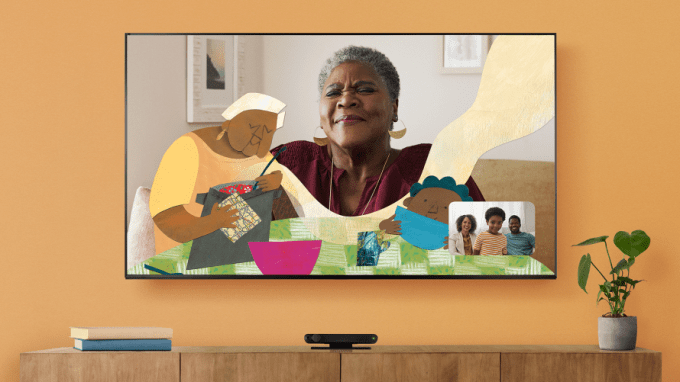
Portal TV, the media device that works with your TV at home, today offers access to a range of streaming services, including Amazon Prime Video, Showtime, and Sling TV. But, until now, one of the most important streaming services — Netflix — had been missing. Facebook says Netflix will now be introduced to Portal TV in all countries where Portal is sold.

It will also introduce a new remote that will include one-touch buttons for launching streaming apps, like Prime Video, Netflix, and its own Facebook Watch. This will ship with new Portal TV devices starting today and will be sold in stores in the coming weeks.

The news of Portal TV’s Netflix integration follows shortly after Amazon’s September announcement that it would support the popular streaming service on its own Amazon Echo Show smart displays, three years after the Echo Show line’s original debut. Google, too, recently added Netflix to its smart display lineup, with support arriving on its Nest Hub and Hub Max earlier this year.

The timing of these updates hint that negotiations with Netflix over smart display integrations had been taking place industry-wide, as Netflix worked to make to make its service available across the various platforms.

Netflix began rolling out to Portal TV units via an update late last night, so all Portal TV users should have the app available now.

Image Credits: Facebook

Facebook will also bring Zoom to its Portal devices for video-calling, it says. In August, Zoom had confirmed its plans to support smart displays, including Echo Show and Google Nest Hub Max, as well as Portal from Facebook.

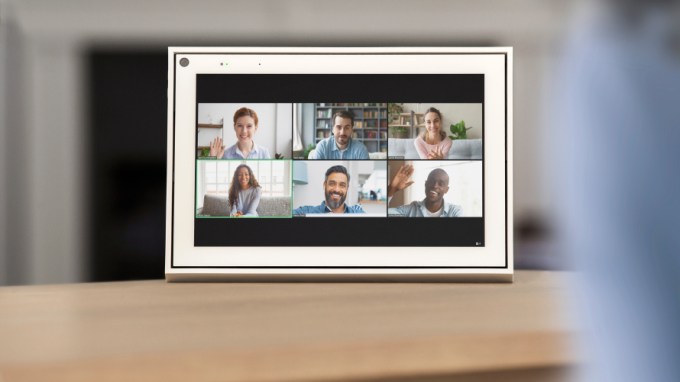
With Portal support, Zoom users will be able to host a video call with up to 25 people on the screen, while leveraging the device’s high-fidelity sound and its AI-powered Smart Camera for hands-free calling, says Facebook. The support will be added to Portal Mini, Portal, and Portal+ in all regions where the device is sold.

Image Credits: Facebook

As previously announced at Facebook Connect, the company is also expanding its collection of interactive stories in its Story Time library with more diverse content. New stories include Thank You, Omu!A Kids Book About Belonging, and Grandma’s Purse. Plus, AR features are being added to  Dr. Seuss stories, including Hop on PopMr. Brown Can Moo! Can You?The Foot Book, and There’s a Wocket in my Pocket! These will roll out sometime this fall.

Portal’s AR features are getting an update, too. Users will be able to control AR effects in Photo Booth using their voice and the “Hey Portal” command to send themed cards and take photos and video with AR effects to send to friends and family.

“Hey Portal” will also now work in U.S. Spanish, in addition to English, with more languages expected to come in the future. On-screen text on Portal can be displayed in French, Spanish, Italian, and English, however.

WordPress Image Lightbox Plugin