Yearly Archives: 2020

News: Okta adds new no-code workflows that use identity to trigger sales and marketing tasks

It seems that no-code is the tech watchword of the year. It refers to the ability to create something that normally would require a developer to code, and replace it with dragging and dropping components instead, putting the task in reach of much less technical business users. Today Okta announced new no-code workflows that provide

It seems that no-code is the tech watchword of the year. It refers to the ability to create something that normally would require a developer to code, and replace it with dragging and dropping components instead, putting the task in reach of much less technical business users. Today Okta announced new no-code workflows that provide a way to use identity as a trigger to launch a customer-centric workflow.

Okta co-founder and CEO Todd McKinnon says that the company has created a series of connectors to make it easier to connect identity to a workflow that includes sales and marketing tooling. This comes on the heels of the identity lifecycle workflows, the company introduced at the Oktane customer conference in April.

“For this release we are introducing customer identity workflows which are focused on the connectors for all the customer-specific systems, things like Salesforce and Marketo and all the customer-centric [applications] that you’d want to do with your customer identities. And you can imagine over time that we’re going to expose this to more and more areas that will cover every kind of scenario a company would want to use,” McKinnon told TechCrunch.

McKinnon says that last year the company introduced Platform Services, which pulled apart the various pieces of the platform and exposed them as individual services, which bigger company customers could tap into as needed. He says that this is an extension of that idea, but instead of having to get engineering talent to write complex code to tie the Okta service into say Salesforce, you can simply drag the Salesforce connector to your workflow.

As McKinnon describes this using early adopter MLB as an example, say someone downloads the MLB app, creates a log-in and signs in. At that point, if MLB marketing personnel wanted to connect to any applications outside of Okta, it would normally require leveraging some programming help to make it happen.

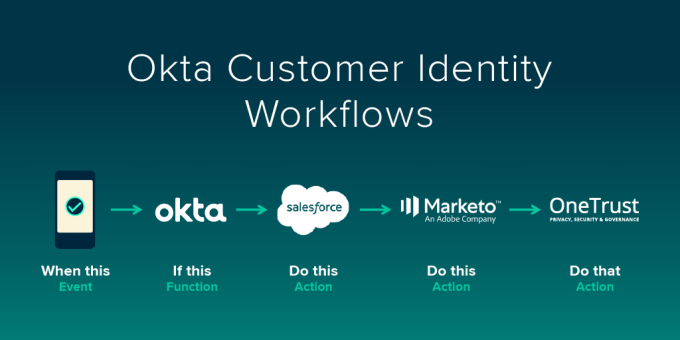
But with the new workflow tools, a marketing person can set up a workflow that checks the log-in for fraud, then sends the person’s information automatically into Salesforce to create a customer record, and also triggers a welcome email in Marketo — and all of this could be done automatically triggered by the customer sign up.

Okta workflows showing what happens when a person downloads and app and creates an identiy.

Image Credits: Okta

This functionality was made possible by the $52.5 million acquisition of Azuqua last year. As COO and co-founder Frederic Kerrest wrote in a blog post at the time of the acquisition (and we quoted in the article):

“With Okta and Azuqua, IT teams will be able to use pre-built connectors and logic to create streamlined identity processes and increase operational speed. And, product teams will be able to embed this technology in their own applications alongside Okta’s core authentication and user management technology to build…integrated customer experiences.”

And that’s precisely the kind of approach the company is delivering this week. For now, it’s available as an early adopter program, but as Okta works out the kinks, you can expect them to build on this and add other enterprise workflow connectors to the mix as it expands this vision, giving the company a way to move beyond pure identity management and connect to other parts of the organization.

News: Shogun raises $35M to help brands take on Amazon with faster and better sites of their own

E-commerce has boomed this year, with more businesses and shoppers than ever before turning to websites and apps as a safer, socially distanced alternative during the current global health pandemic. Today, a startup that has built a platform to help individual companies and brands design better websites is announcing a round of growth funding to

E-commerce has boomed this year, with more businesses and shoppers than ever before turning to websites and apps as a safer, socially distanced alternative during the current global health pandemic. Today, a startup that has built a platform to help individual companies and brands design better websites is announcing a round of growth funding to help them step up to that challenge with faster and better designed interfaces.

Shogun, which lets companies build sites that sit on top of e-commerce back-ends like Shopify, Big Commerce or Magento to let them sell goods and services, is today announcing that it has raised $35 million in funding after seeing its business growth 182% over the last year, with 15,000 companies — including Leesa, MVMT, Timbuk2, Chubbies and K Swiss, as well as household Fortune 500 brands that it declines to name — now using Shogun’s tools, up 5,000 in the last eight months.

Finbarr Taylor, the CEO who co-founded the company with Nick Raushenbush, said that the startup plans to use the company to continue enhancing its two main products — Page Builder for bigger companies and agencies; and frontend, a headless commerce solution for smaller businesses that offers faster page-load times — and to help improve its market strategy.

To date, much of the company’s growth has been organic, with a marketing team of two, and also only two sales people. “So it will be about scaling up those teams as well as our engineer and design and product teams, to deliver on the promises we made to our customers,” Taylor said.

The Series B is being led by Accel with participation from Initialized Capital, VMG Partners, and Y Combinator. The round also has a number of high-profile individuals in it, which speak to Shogun’s credibility in the worlds of e-commerce and web design. The list includes Bryant Chou (CTO at Webflow), Mark Lavelle and Mark Lenhard (former CEO and SVP of Strategy at Magento, respectively), Alex O’Byrne (CEO of We Make Websites, a leading Shopify agency), Brian Grady (CEO of Gorilla Group, a leading Magento agency), and Romain Lapeyre (CEO of Gorgias).

Growth is one marker of how hot the market is for what Shogun is doing. In addition to Shogun’s own expanding list of users, it’s estimated by the company (citing figures from Adobe) that there has been some $94 billion in extra sales online (beyond original projections, that is) since March globally.

Another marker is the funding itself. This the second round that the startup has raised in the short span of eight months: Shogun closed a $10 million Series A in February of this year led by Initialized (with participation also from YC and VMG).

And a third marker is the valuation. Taylor said that the company is valued in the “solid nine figures” but declined to say where in the regions of hundreds of millions of dollars that might be. For some context, the company was valued at $50 million in February, according to data from PitchBook.

Shogun’s news comes at a key moment in the world of e-commerce not just in terms of the wider macroeconomic trends, but in terms of who is making the wheels move.

Amazon and other marketplaces have come to dominate how a lot of people are shopping online: after all, they offer one-stop shops for whatever you might want or need, free shipping, and a familiar interface. Similarly, social media platforms have made a play as a new kind of “store” of sorts, a place where brands already are interacting with would-be customers, and are now being given the tools to sell to them there as well.

But that doesn’t tell the whole story: brands and companies want to have their own space to present things how they want them to look, to better control the customer experience, and to make sure that they are not beholden to a third party (both physically and financially) for their online survival.

Yes, some consumers might only care about where they can get what they want for the cheapest price, but others know exactly what they want, or feel loyal to a specific company, and want to shop there without the rest of the noise, and there will always be a business opportunity in building stores for them, too.

And the predictability of the interface of a marketplace like Amazon, or a “shoppable” photo on Instagram, belies how frustratingly oblique it can also be at times. I don’t want to see 15 different Danish whisks at slightly different prices; I just want one that will arrive in one piece and not break after a month of use, leading me down a rabbit hole trying to find someone to provide a refund. Similarly, I may want to buy from a brand, but perhaps not the particular item that they’re serving me in a Story or a Pin.

Shogun’s proposition to the companies it works with is to give them more choice and better speed after they have already made the decision to build their own “real estate” online using backends like Shopify’s.

The opportunity is that, even if an e-commerce business is seen as a “tech” play, that is not often its core competency.

“Merchants large and small are getting sick of maintaining their own tech stacks,” said Ethan Choi, a partner at Accel. While the platforms are getting ever more sophisticated by moving into areas like shipping and logistics alongside payments and inventory ordering and so on, they have yet to extend into web design.

“Shopify only has like 15 templates,” he said. “There is no design control and you look like 1 of one million other sites.” At the same time, if you have the funds and energy to build a custom site, he added, “that is expensive and it can take a whole day to change just a piece of text.”

The speed is an issue that Shogun has identified and fixed in another way: Taylor says that with site speed being the most important aspect of converting a browser to a buyer, it’s providing the fastest page loading times to customers.

As with so many startup stories, Taylor and Raushenbush stumbled on their gap in the market by accident.

The pair were working at Y Combinator — Taylor, an engineer originally from Glasgow in Scotland, had been devising tools for YC to help it manage the huge inbound volume of applications it was receiving for its incubator. (Sidenote: one offshoot of that was the Startup School that the company created to better address working with startups on a more regional level: Taylor built that.)

As a side project, he and Nick had come up with a page builder based on Ruby on Rails. It wasn’t getting much traction, but a friend of Nick’s, who worked for an e-commerce agency, said that if the two could tweak it for building e-commerce pages specifically, his agency would use it and even pay them.

“So we did,” he said.

That eventually took off with more customers and more use, prompting them to eventually move to the other side of the organization, becoming part of a YC cohort and eventually striking out on their own.

Looking ahead, one particular focus for Shogun, Taylor said, will be to build more tools to improve mobile commerce. Typically, mobile accounts for 80% of all e-commerce browsing but only some 20% of sales, he noted.

News: Big tech blows a collective raspberry at the House’s antitrust report

Big tech has responded to the mammoth antitrust report put out by the U.S. House Judiciary Committee yesterday with blanket denials there’s any monopolistic behaviour or competitive imbalances to see here. Below is a quick run down of Amazon, Apple, Facebook and Google’s rebuttals. Among the committee’s (many) recommendations are structural separations and prohibitions on

Big tech has responded to the mammoth antitrust report put out by the U.S. House Judiciary Committee yesterday with blanket denials there’s any monopolistic behaviour or competitive imbalances to see here.

Below is a quick run down of Amazon, Apple, Facebook and Google’s rebuttals.

Among the committee’s (many) recommendations are structural separations and prohibitions on certain dominant platforms from operating in adjacent lines of business; interoperability and data portability requirements; non-discrimination requirements and a ban on self-preferencing; and beefed up merger and monopolization enforcement, as well as better administration of antitrust laws.

Amazon

In a lengthy but punchy blog post the ecommerce giant brands the committee’s views on antitrust “fringe notions” and “regulatory spitballing” — lathering on dire predictions of doom for small business and hoards of inflated-price-enraged consumers should lawmakers deign to dabble in any “misguided interventions”.

Sample quote:

The flawed thinking would have the primary effect of forcing millions of independent retailers out of online stores, thereby depriving these small businesses of one of the fastest and most profitable ways available to reach customers. For consumers, the result would be less choice and higher prices. Far from enhancing competition, these uninformed notions would instead reduce it.

The substance of Amazon’s argument against the need for antitrust intervention is the top-line claim that retail is “thriving and extraordinarily competitive” — with the tech giant saying it accounts for a tiny fraction of global retail and isn’t even the largest US retailer by revenues (that’s Walmart). Among the grab-bag of competitors Amazon lists as evidence that it’s a mere retail minnow are Best Buy, Costco, Facebook, Kroger, Google Shopping, Home Depot, Shopify and Target. (It doesn’t mention Whole Foods because it already consumed that competitor.)

The strategy here is to claim online and offline retail are just one giant market — because of course if lawmakers slice by online retail alone there’s no denying Amazon’s oversized punch.

Another chunk of rebuttal is against what it claims is “false narrative” that its own interests don’t align with “the thousands of small and medium-sized businesses thriving as sellers in our store”.

“The opposite is true: Amazon and sellers complement each other, and together we create a better customer experience than either could create alone,” it pouts, before going on to say SME sales account for around 60% of all physical products sold on its marketplace, and that it “typically” makes the same or more revenue on third-party sales — rubbishing the idea there could possibly be any conflict of interest at all from Amazon also selling own brand rival products on the same marketplace where only Amazon gets an overview of merchants’ data.

NB: European regulators aren’t so convinced about the lack of competitive risks on dual-sided platforms.  

Apple

Asked for its response to the committee report, Apple sent us an on the record statement in which it writes that it “vehemently” disagrees with the conclusions reached — adding the beautiful kicker to the sentence “with respect to Apple”. Epic trolling Tim.

It also said it would be issuing a more “extensive refutation” of the accusations levelled at its business in the coming days.

Here’s the rest of its statement:

Our company does not have a dominant market share in any category where we do business. From its beginnings 12 years ago with just 500 apps, we’ve built the App Store to be a safe and trusted place for users to discover and download apps and a supportive way for developers to create and sell apps globally. Hosting close to two million apps today, the App Store has delivered on that promise and met the highest standards for privacy, security and quality. The App Store has enabled new markets, new services and new products that were unimaginable a dozen years ago, and developers have been primary beneficiaries of this ecosystem. Last year in the United States alone, the App Store facilitated $138 billion in commerce with over 85% of that amount accruing solely to third-party developers. Apple’s commission rates are firmly in the mainstream of those charged by other app stores and gaming marketplaces. Competition drives innovation, and innovation has always defined us at Apple. We work tirelessly to deliver the best products to our customers, with safety and privacy at their core, and we will continue to do so.

In further background comments the gist of Apple’s argument boils down to ‘Don’t mess with a good thing’.

Aka billions of users across 175 countries can’t be wrong nor unhappy — nor can the tens of millions of developers making wares for its kit, given, for example, how many (1.8M) apps are now on the App Store. (Developers whose apps get excluded are unlikely to be so happy, of course.)

It also defends the 30% commission it takes on app sales — aka the ‘Apple tax’ — pointing to a recent study by Analysis Group that the structure is “similar in magnitude to those of other app stores and digital content marketplaces” — and further noting that for in-app subscriptions the tax falls to 15% after the first year.

Lastly it invokes privacy, pointing out that by reviewing apps and curating its users access to third party software it can offer protection from surveillance, as well as keep things clean by rejecting objectionable, harmful, unsafe, and illegal content. (Albeit, even the Apple gods can’t always do that.)

Facebook

In a brief on the record statement — presumably while it prepares the next chapters of its neverending ‘hard questions‘ series of lobbyist ‘literature’ — the social media giant sought to paint its business success as American as apple pie or, er, the freely unfettered market.

Here’s what it told us in full, with remarks attributed to a faceless “Facebook spokesperson”:

Facebook is an American success story. We compete with a wide variety of services with millions, even billions, of people using them. Acquisitions are part of every industry, and just one way we innovate new technologies to deliver more value to people. Instagram and WhatsApp have reached new heights of success because Facebook has invested billions in those businesses. A strongly competitive landscape existed at the time of both acquisitions and exists today. Regulators thoroughly reviewed each deal and rightly did not see any reason to stop them at the time.

So, in sum, there’s absolutely nothing to see here but successful! business! as! usual! is Facebook’s wafer-thin claim. Sure, it bought and assimilated rival social media businesses that could have gained enough market share to challenge its dominance of the category but that’s also just totally great business! Moreover, Facebook buying those really successful rivals just made them even more great and successful! But not so great and successful that there isn’t also “strong” competition in the space Facebook has dominated for 15+ years through its sheer force of business success.

Of course Facebook’s statement makes no mention of Onavo: A VPN app it acquired and used to spy on rival app usage to figure out which apps it should be buying or, er, crushing via cloning their innovations — but that’s a whole other story Facebook isn’t at all keen to talk about for some reason. Ditto the whole paying teenagers to spy on them thing.

In any case, the social media behemoth concludes, it’s the regulators who really screwed up here because they didn’t stop it buying Instagram and WhatsApp when they could have done. So ya! boo! sucks! it’s too late suckers! (we paraphrase).

Google

We also reached out to Google for a response to the antitrust report. The adtech giant had a statement ready to go — which kicks off by emphasising how much value its “free” products pump into the economy (not to mention all the “billions” it throws at R&D), before going on to chide policymakers for making “outdated and inaccurate allegations”.

The statement also features what’s become a go-to tech giant talking point as antitrust has risen up the political agenda in recent years — which is the claim that breaking up Internet giants wouldn’t actually fix anything.

Rather, Google warns (taking a similar tack to Amazon), of economic ruin awaiting the US economy — even from a ‘lesser’ intervention of tinkering with the sacred protections enshrined in Section 230 — and geopolitical doom for America’s tech leadership (taking a similar tack to Facebook). Or, in other words, cut Google and American bleeds. But also, no we’re not a monopoly, hell no! We’re just a verrrry fleet-o-foot operator in a “highly competitive industry”. So, er, which is it?

Interestingly, Google is the only tech giant to include some soft soap for lawmakers in this first response to the antitrust committee report — writing that it “support[s] Congress focusing on areas where clearer laws would help consumers”. (Translation: Stick with the small stuff and leave the important moneymaking business stuff to big tech.)

Here it invokes interoperability (because what technology solutionist doesn’t love a technology ‘solution’ to a monopoly problem); as well as claimed support for passing “comprehensive federal privacy legislation”. (Because a weaker federal framework is the only way to unpick state-level privacy laws with teeth like CCPA).

Here’s Google’s statement in full:

Google’s free products like Search, Maps and Gmail help millions of Americans and we’ve invested billions of dollars in research and development to build and improve them. We compete fairly in a fast-moving and highly competitive industry. We disagree with today’s reports, which feature outdated and inaccurate allegations from commercial rivals about Search and other services.

Americans simply don’t want Congress to break Google’s products or harm the free services they use every day. The goal of antitrust law is to protect consumers, not help commercial rivals. Many of the proposals bandied about in today’s reports — whether breaking up companies or undercutting Section 230 — would cause real harm to consumers, America’s technology leadership and the U.S. economy — all for no clear gain.

We support Congress focusing on areas where clearer laws would help consumers, a few of which are mentioned in today’s reports: Google has long championed the importance of data portability and open mobile platforms; we are arguing a case before the Supreme Court tomorrow for the important principle of software interoperability; and we have urged Congress to pass comprehensive federal privacy legislation. We look forward to engaging with Congress on these and other issues moving forward.

TechCrunch’s Taylor Hatmaker contributed to this report 

News: Truecaller tops 250 million users

Popular caller-identification service Truecaller has amassed 250 million monthly active users and 200 million daily active users, demonstrating an accelerated pace of growth in recent quarters even as a global pandemic has hurt most businesses, it said on Wednesday. The service, run by eponymous Stockholm-headquartered firm, allows users to avoid spam calls by identifying the

Popular caller-identification service Truecaller has amassed 250 million monthly active users and 200 million daily active users, demonstrating an accelerated pace of growth in recent quarters even as a global pandemic has hurt most businesses, it said on Wednesday.

The service, run by eponymous Stockholm-headquartered firm, allows users to avoid spam calls by identifying the callers and also filters similar texts. The service is popular in many parts of the world, but India, where everyone receives dozens of such calls each month, is Truecaller’s biggest market.

Even as Apple and Google have improved the caller ID feature in their mobile operating systems in recent years and taken several other steps to curb spam calls, Truecaller’s offerings remain unmatched.

Truecaller had 200 million monthly active users in February this year, and it reached 100 million daily active users milestone in April 2018. More than 150 million of its monthly active user base are in India. In fact, Truecaller is the only app not made by Google or Facebook on the list of top 10 most used apps in the country, according to mobile insights firm App Annie (data of which an industry exec shared with TechCrunch).

In recent years, Truecaller has expanded its platform to add messaging and payments services, which has also allowed it to broaden the scope to monetize users. The company told TechCrunch that its revenue grew 90% in the quarter that ended in September, compared to the same period last year. Earlier this year, the company launched a new product that allows businesses to authenticate users on their apps without giving them a call.

The 11-year-old, Sequoia Capital -backed firm is also preparing to go public within the next two years, its co-founder and chief executive Alan Mamedi told TechCrunch in an interview early this year.

On Wednesday, Truecaller also announced it has appointed Fredrik Kjell as its new Chief Operating Officer. Kjell previously served as Chief Product Officer at Kindred Group, an online gambling company.

“With Fredrik’s strong operational background from previous consumer companies, and vast experience in a large publicly traded company, we believe he will be a great addition to the company and the global executive team. We’re on an exciting journey to take Truecaller to the next level, and this is a great step towards it,” said Mamedi in a statement.

News: Dictionary app Reverso launches desktop app

Language learning company Reverso is launching its desktop app for macOS and Windows. Like on mobile, it lets you access a translation dictionary and get examples in context. The company has attracted 40,000 downloads in two days. While Google Translate is massively successful, Reverso has managed to attract 20 million downloads on iOS and Android.

Language learning company Reverso is launching its desktop app for macOS and Windows. Like on mobile, it lets you access a translation dictionary and get examples in context. The company has attracted 40,000 downloads in two days.

While Google Translate is massively successful, Reverso has managed to attract 20 million downloads on iOS and Android. Most users come from France, Italy, Russia and the U.S. The company’s websites also attract tens of millions of unique visitors every month who generate over 500 million page views.

Thanks to the new desktop app, you can access Reverso more quickly when you’re using your computer. You can highlight a word or a few words in any app and search for those words in Reverso with a keyboard shortcut. It automatically switches to the app window with your query.

You can also access synonyms from the app and hear the pronunciation of a word. Like on mobile, the app is free and there’s an optional subscription to access more features.

In other news, Reverso recently launched Reverso Documents, a service that lets you upload your document and get a translation with your original layout. You can review and edit the translation before downloading your document. Behind the scene, the company has improved its neural machine translation technologies for this kind of products.

Reverso Documents supports Word, PowerPoint, PDF and Excel files. There are 50,000 people using Reverso Documents every month. You can pay a one-time fee or pay a subscription to access the service.

The company also works with corporate clients to help them translate user guides, internal guidelines and more. Companies can upload documents that have already been translated so that Reverso can learn about your specific vocabulary. Clients include banks and car manufacturers.

Reverso is diversifying its revenue beyond web ads. And the company has a large user base at the top of the funnel that could end up interacting with more Reverso products down the road.

News: Elvie adds a non-electric breast pump and cups to its growing femtech portfolio

Femtech hardware maker Elvie has added a softer, hands-free breast pump that uses natural suction to its portfolio two years after launching its debut ‘next-gen’ connected breast pump. The Elvie Curve is described as “a wearable, silicone breast pump that allows for gentle hands-free expression when feeding or pumping from the other breast — or

Femtech hardware maker Elvie has added a softer, hands-free breast pump that uses natural suction to its portfolio two years after launching its debut ‘next-gen’ connected breast pump.

The Elvie Curve is described as “a wearable, silicone breast pump that allows for gentle hands-free expression when feeding or pumping from the other breast — or to express full breasts” — suggesting the UK-based startup intends for it to supplement the more expensive (and electronic) Elvie Pump.

The Elvie Curve is priced at RRP £49.99 vs around £250 for the Pump. The Pump is also slightly more capacious, holding up to 5 oz of milk compared to up to 4 oz for the Curve. The Curve is similarly designed to sit discreetly inside a bra.

As the Curve uses natural suction there’s no batteries (nor connectivity) involved. But Elvie says a valve lets the user control the suction strength — for a comfortable, low effort experience.

The startup has launched another new (non-connected) device today, called the Elvie Catch (RRP £29.99). This consists of a set of two slip-proof milk collection cups to prevent leaks, also designed to fit neatly inside a bra.

Elvie says the cups can be used “during feeding, pumping or on the go”.

“Unlike many other breast shells and nipple pads, Elvie Catch sits securely in a bra to prevent leaks and is reusable, collecting up to 1 oz of breastmilk per cup so nothing goes to waste,” it adds in a press release.

Last year the London-based startup raised a $42M Series B funding round, led by IPGL, which it said would be used to support the release of four additional women’s health products. (The company’s debut product was a connected pelvic floor exerciser, which it continues to sell as the Elvie Trainer.)

Commenting on its freshly expanded portfolio in a statement, CEO and co-founder, Tania Boler, said: “Elvie Curve and Elvie Catch mark the next steps in Elvie’s mission to modernise breastfeeding and pumping products so they fit into the lives of real, modern-day mums.

“We launched the silent, wireless and wearable Elvie Pump two years ago to make pumping a hands-free experience that empowers mums to pump on their own terms. But we know that the challenges of breastfeeding go beyond pumping.

“Breast milk is liquid gold, so these products are designed to make the most of every last drop – as well as fitting seamlessly (and discreetly) into the lives of mums, like all Elvie products!”

Both new products are slated as available to buy via Elvie’s website from today — but at the time of writing they’re listed as ‘wait list’ only.

News: Helsinki rides the Slush wave toward a booming startup future

In September 2020, Helsinki’s City Council approved plans for an expansion of the existing “Maria 01 Campus,” a former downtown hospital complex. Even before it starts spreading its acreage, the facility is already home to 120 startups and 12 venture capital funds. The campus is owned by the biggest startup conference in the Nordics, Slush,

In September 2020, Helsinki’s City Council approved plans for an expansion of the existing “Maria 01 Campus,” a former downtown hospital complex. Even before it starts spreading its acreage, the facility is already home to 120 startups and 12 venture capital funds. The campus is owned by the biggest startup conference in the Nordics, Slush, the City of Helsinki and Helsinki Enterprise Agency and is slated to become one of the largest, if not — possibly — the largest tech startup campus in Europe, at 70,000 square meters (or 75,3473 square feet) by 2023.

The scale of the project speaks to the confidence and ambition of the Helsinki startup ecosystem, which has grown immeasurably over the last 10-15 years.

The fact that Slush, a conference, is involved is no accident. The event is a nonprofit created by the university. This has enabled it to scale to one of Europe’s largest tech events (pre-COVID) at over 20,000 attendees. Its success has also led to traditionally conservative Finns embracing entrepreneurship. The entire city gets involved, and thousands of university students volunteer for the good of the city and the ecosystem. The collegiate nature of the Slush experience has reflected how Helsinki has grabbed the opportunities of tech with both hands.

Born of Aalto University and its student society for entrepreneurship, AaltoES, Slush originally started as a tech meetup. Indeed, I went to some of the first ones. But with the 2010’s success of local startup Rovio, creator of Angry Birds, as well as Supercell, creator of Clash of Clans, the event took off. It helped that Peter Vesterbacka (previously a pioneer at HP Bazaar Labs) was a tireless promoter of Slush and egged it on from being a meetup into a full-blown conference that could attract the biggest names in tech.

Slush’s ability to attract VCs to a Northern European country in the middle of winter was impressive. The city rolled out the red carpet. That meant inbound VC exploded. According to the Finnish Venture Capital Association (FVCA), VC investment into Finland grew almost five times to €188 million between 2014 and 2018. Finland is now a European leader in terms of venture capital (says the FVCA) as a percentage of GDP, and foreign VC investments grew by 58% between 2017-18.

VC has grown leaps and bounds in the city itself. Crunchbase lists 54 venture funds of various guises in Helsinki. They include Conor Venture Partners, Inventure, VNT Management, Icebreaker.vc, Superhero Capital, Evli Growth Partners, OpenOcean, Loudspring, Norsepower Oy, Tesi, NordicNinja VC and Maki.vc.

Slush has even seen ex-employees go on to found big startups. Food delivery startup Wolt, co-founded by Miki Kuusi an early CEO of Slush, has raised $160 million. Other big startup companies from Helsinki’s ecosystem include Smartly, Singa, Giosg, ZenRobotics and Blok. And let’s not forget it produced MySQL and CRF Health back in the day. In 2018, Small Giant Games, was acquired by Zynga in a deal worth up to $700 million.

Startup Genome marks out Helsinki as one of the top global ecosystems. For 2020, it valued the Helsinki startup ecosystem at $5.8 billion, with total early-stage funding of $511 million, higher than the global average for emerging ecosystems.

Helsinki has around 250 gaming enterprises and 30 of them exceed $1 million in annual sales. In 2017 Finland was the first EU country to publish a national AI strategy and the University of Helsinki created a free AI education program that saw approximately 90,000 people from 80 different countries enroll in the first four months.

Over the whole country, nearly 300,000 Finns work in tech, an enormous amount when you consider the population of Helsinki is 1.3 million.

According to analysts Tracxn top startups include:

  • Canatu (transparent conductive films and touch sensors using carbon nanomaterial): Raised $74 million.
  • Kiosked (smart native advertising technology): Raised $64 million.
  • ICEYE (developer of SAR microsatellite for earth observation applications): Raised $152 million.
  • Varjo (provider of head-mounted display with resolution matching a human eye): Raised $100 million.

To learn more about Finland’s startup ecosystem, we spoke to these investors:

Pirkka Palomaki, partner, Maki.vc

What trends are you most excited about investing in, generally?
We are a generalist but are keen on deep tech and brand-driven companies both in B2C and B2B. We have been tracking closely new materials-based innovations, as well as breakthrough innovations in quantum computing. Breakthroughs happen also elsewhere and [we] have invested in B2B SaaS as well as one cloud-native massive multiplayer game company.

What’s your latest, most exciting investment?
One the latest investments is in a Swedish company called Carbon Cloud. They make it easy to discover your climate footprint and show it to the world — they can be found, for example, on the side of Oatly’s packaging. Carbon dioxide impact of consumer goods should be as visible as the nutrition values in food.

Are there startups that you wish you would see in the industry but don’t? What are some overlooked opportunities right now?
Femtech. There’s still quite little competition, but tremendous amount of work to do. Our team is keen to see more solutions on reproductive health, but also going beyond to solutions e.g., in syncing female’s personal cycle with optimal nutrition or training.

What are you looking for in your next investment, in general?
The team is always in the center and we are looking for entrepreneurs that are rewriting the future in global markets.

Which areas are either oversaturated or would be too hard to compete in at this point for a new startup? What other types of products/services are you wary or concerned about?
Free-to-play games is a tough and competitive market. There will likely be new winners, but also even greater number of companies that don’t make it compared to many other industries.

How much are you focused on investing in your local ecosystem versus other startup hubs (or everywhere) in general? More than 50%? Less?
We have a global mandate, but the Nordics is our home and where we have done most of our investments.

Which industries in your city and region seem well-positioned to thrive, or not, long term? What are companies you are excited about (your portfolio or not), which founders?
There are several, but the first on the top of mind is sustainability and new materials. Spinnova is a great example providing the textile industry with the most sustainable fibre in the world, produced with minimal harm to the environment, at a reasonable cost. With the stretch and strength qualities of cotton and the insulation of lamb’s wool, it can suit apparel, footwear, accessories, [and] home textiles to name a few applications. I’m also looking forward to seeing a great ecosystem and several startups being built around quantum computing. There are already a number of promising quantum technology companies, such as the Finnish IQM that builds world-class quantum computers and Bluefors that specialize in cryogen-free dilution refrigerator systems for quantum computing.

How should investors in other cities think about the overall investment climate and opportunities in your city?
There is strong supporting ecosystem in Finland for startups, strong engineering history and great culture of getting things done.

Do you expect to see a surge in more founders coming from geographies outside major cities in the years to come, with startup hubs losing people due to the pandemic and lingering concerns, plus the attraction of remote work?
The beauty of the startup ecosystem is that is built on innovation. We will most likely see more distributed organizations in the future, but I believe the major hubs will maintain their attractiveness in the future as well.

Which industry segments that you invest in look weaker or more exposed to potential shifts in consumer and business behavior because of COVID-19? What are the opportunities startups may be able to tap into during these unprecedented times?
Travel and hospitality has naturally taken a big hit. It will take time for the industry to fully recover and I would expect innovations in the domain in the future, whether it is in virtual travel or creating confidence in worry-free travel in the future.

How has COVID-19 impacted your investment strategy? What are the biggest worries of the founders in your portfolio? What is your advice to startups in your portfolio right now?
Extending the runway has been a general rule for many and making the company stronger and more competitive when things start picking up again.

Are you seeing “green shoots” regarding revenue growth, retention or other momentum in your portfolio as they adapt to the pandemic?
Customer support agents have been strained during the pandemic. Our portfolio company Ultimate.ai has been well-positioned to scale the customer support with their virtual agents while maintaining or even improving customer experience. I’ve been super happy to see them grow and expand rapidly.

What is a moment that has given you hope in the last month or so? This can be professional, personal or a mix of the two.


News: India approves Apple partners and Samsung for $143 billion smartphone manufacturing plan

Samsung and three major contract manufacturing partners of Apple are among 16 firms to win $6.65 billion incentives under India’s federal plan to boost domestic smartphone production over the next five years. These companies had applied for the incentive program in August. In a statement Tuesday evening, Indian Ministry of Electronics and Information Technology (MeitY)

Samsung and three major contract manufacturing partners of Apple are among 16 firms to win $6.65 billion incentives under India’s federal plan to boost domestic smartphone production over the next five years. These companies had applied for the incentive program in August.

In a statement Tuesday evening, Indian Ministry of Electronics and Information Technology (MeitY) said these companies will be producing smartphones and other electronics components worth more than $143 billion over the next five years. In return, India will offer them an incentive of 4% to 6% on additional sales of goods produced locally over five years, with 2019-2020 set as the base year.

New Delhi’s move is aimed at significantly improving India’s manufacturing and exporting capacities. Around 60% of the locally produced products will be exported, the Indian ministry said.

The move is also a precursor to how the dynamics among major smartphone makers will change in India, the world’s second largest market, over the next five years. The inclusion of Foxconn, Wistron and Pegatron underscores how rapidly Apple plans to expand its local manufacturing capabilities in India. Wistron began assembling a handful of iPhone models in India three years ago, followed by Foxconn. Pegatron has yet to start producing in India.

“Apple and Samsung together account for nearly 60% of global sales revenue of mobile phones and this scheme is expected to increase their manufacturing base manifold in the country,” the ministry said.

“Industry has reposed its faith in India’s stellar progress as a world class manufacturing destination and this resonates strongly with Prime Minister’s clarion call of AtmaNirbhar Bharat – a self-reliant India,” the ministry added.

Indian firms Lava, Bhagwati (Micromax), Padget Electronics, UTL Neolyncs and Optiemus Electronics are also among the firms that have received the approval. But missing from the list are Chinese smartphone makers Oppo, Vivo, OnePlus and Realme that had not applied for the program. Chinese smartphone vendors currently command about 80% of the Indian market.

News: Greycroft has rounded up $678 million in capital across two new funds

Greycroft, the New York and L.A.-based venture firm founded in 2006 by investors Alan Patricof, Dana Settle, and Ian Sigalow, has closed on two new funds totaling $678 million in capital commitments. One of those funds is its sixth flagship early-stage fund and it closed with $310 million dollars. The firm also collected $368 million

Greycroft, the New York and L.A.-based venture firm founded in 2006 by investors Alan Patricof, Dana Settle, and Ian Sigalow, has closed on two new funds totaling $678 million in capital commitments. One of those funds is its sixth flagship early-stage fund and it closed with $310 million dollars. The firm also collected $368 million in commitments for a third growth-stage fund that it will use to support breakout startups from its early-stage portfolio.

The venture fund invests between $500,000 and $10 million in a first check, and Greycroft will invest up to $15 million in a portfolio company over multiple rounds. Checks from its growth fund begin at $10 million and the firm says it will invest up to $50 million in any one company.

Greycroft now counts seven partners altogether across its two offices, including Settle and Sigalow.

Patricof, who early in his career founded the predecessor to Apax Partners, has since launched another new firm called Primetime Partners that announced a $32 million fund in summer that is investing in platforms and products for aging Americans.

The firm invests in both consumer and enterprise startups, with a heavier emphasis on consumer. Among the brands in its portfolio are Gwyneth Paltrow’s Goop, the consignment business The RealReal (which went public last year), and the dating site Bumble, which is reportedly gearing up for an IPO at an expected valuation of between $6 billion to $8 billion, as reported by Bloomberg.

The firm also recently co-led a $5.5 million Series A round for Sisu Cosmetics, a nearly two-year-old, Ireland-based chain of cosmetic clinics that’s expanding into the U.S.

Across its now ten investment vehicles, the firm has raised $2 billion altogether and has over 200 active investments.

Those investments are located in 23 states and 15 countries, including the Nigeria-based payment service Flutterwave, which closed on $35 million in Series B funding earlier this year, and Yeahka, a mobile payment and SMB lending provider in China that went public in June.

Greycroft’s most recent early-stage fund had closed with $250 million in 2018; its second growth-stage fund closed with $250 million in 2017.

News: Quarantine drives interest in autonomous delivery, but it’s still miles from mainstream

The prospect of truly zero contact delivery seems closer — and more important — than ever with the pandemic changing how we think of last mile logistics. Autonomous delivery executives from FedEx, Postmates, and Refraction AI joined us to talk about the emerging field at TechCrunch Mobility 2020. FedEx VP of Advanced Technology and Innovation

The prospect of truly zero contact delivery seems closer — and more important — than ever with the pandemic changing how we think of last mile logistics. Autonomous delivery executives from FedEx, Postmates, and Refraction AI joined us to talk about the emerging field at TechCrunch Mobility 2020.

FedEx VP of Advanced Technology and Innovation Rebecca Yeung explained why the logistics giant felt that it was time to double down on its experiments in the area of autonomy.

“COVID brought the term ‘contactless’ — before that not many people are talking about contactless; Now it’s almost a preferred way of us delivering,” she said. “So we see, from government to consumers, open mindedness about, maybe in the future you would have everything delivered to you through autonomous means, and that’s the preferred way.”

“If you looked up Postmates robots on Twitter or Instagram, people are always kind of questioning, what is this? What is it doing? Everything changed overnight with COVID, where people would see the robot and immediately understand, oh, this is for contactless delivery,” said Postmates VP of special projects Ali Kashani. “Everything suddenly made sense.”

He also explained how the seeming constraints of a robotic platform specific to food delivery made the engineering process, if not easier, at least naturally bounded by the data they’d collected.

“It’s kind of one of the advantages of being so close to the market, we can use data from our platform to drive certain decisions, because you don’t want to over-engineer you also don’t want to under-engineer,” Kashani said. “We actually developed simulations that would put robots in any location in the country on some date in the past. It would tell us, how many deliveries did this robot do? How many hours was it outside? How many miles did it travel? And it would use that information to decide exactly what kind of battery life do we need? Does it need to carry drinks? How many drink holders should it have to cover 99% of deliveries?”

Matthew Johnson-Roberson, co-founder and CTO of Refraction AI, noted that the pandemic has raised interest and demand, but also highlighted where things need to move forward in different ways.

“Obviously no one wants a global pandemic, but it has certainly energized this industry and put more attention on it,” he said. “Everybody is excited, oh, we’re going to have contactless delivery, it’s going to be great. But I think there are some real challenges that need to be addressed as an industry to get there. One of them is social acceptance, the other’s regulation. That’s starting to change because of COVID. I’m hopeful that this is an inflection point, and that we really do see more serious investment in this, but also widespread deployment, so it’s not a tech demo that you get to see once in one place, but it actually begins to take over some sizable bit of the market.”

Yeung also emphasized the need for the infrastructure that supports these autonomous platforms: “Thinking about the future, commercial launch, you need the dynamic routing, you need the dispatch system, you need the user interface, you need a tracking interface. We see great synergy for us to leverage for all sorts of autonomous applications.”

In discussing the danger of replacing human workers with robots, Yeung and Kashani were sanguine, suggesting like others in the robotics industry that there would be a shift in labor but it won’t kill any jobs. Johnson-Roberson disagreed.

“I think we are going to be replacing jobs, and we need to face that head on,” he said. “I think it’s important that we reckon with that, that a lot of these decisions, they have a long history of not thinking through what hte human consequences will be. So I’m an advocate for saying, look, we’re replacing jobs. Let’s think as a society: How do we address that? How do we deal with it? I think that we could live in a future with more just, fairer jobs with health insurance, more benefits. But I don’t think it is going to look how it looks today.”

WordPress Image Lightbox Plugin