Yearly Archives: 2020

News: DoorDash introduces a new corporate product, DoorDash for Work

Delivery service DoorDash is giving employers a way to feed their remote employees through a new suite of products called DoorDash for Work. There are four main products, starting with DashPass for Work, where employers can fund employee memberships to DashPass, a program that eliminates delivery fees on orders from thousands of restaurants. In fact, DoorDash

Delivery service DoorDash is giving employers a way to feed their remote employees through a new suite of products called DoorDash for Work.

There are four main products, starting with DashPass for Work, where employers can fund employee memberships to DashPass, a program that eliminates delivery fees on orders from thousands of restaurants. In fact, DoorDash says it already worked with Mt. Sinai to offer free DashPass subscriptions to 42,000 healthcare employees, and that other DashPass for Work customers include Charles Schwab, Hulu and Stanford Research Park.

DoorDash for Work also includes the ability for employers to provide credits for meal orders — there are options for day and time restrictions, so employers can be sure they’re paying for food while someone is working. For teams that are working in-person, there’s the ability to combine individual meal orders into a larger group order. And the service also includes employee gift cards (Zoom, for example, is providing these on employee birthdays).

In a blog post, Broderick McClinton, the head of DoorDash for Work, noted that COVID-19 has had “a profound impact on our daily routines, including the way we eat.”

“Instead of meeting our favorite barista on the way into the office or socializing with our colleagues in the lunch room, we’re spending a lot more time in the kitchen and eating solo at home, missing out on those moments to engage with peers and support our favorite restaurants,” McClinton wrote. “In this new normal, companies are adapting and looking for ways to support their employees’ wellbeing and productivity through new work-from-home corporate wellness benefits, including food perks.

While free food might seem relatively low on the list of priorities during the pandemic (at least for those of us who have been fortunate enough to keep our jobs), DoorDash says it conducted a survey of 1,000 working Americans last month and found that 90% of them said they miss at least one food-related benefit from the office.

So DoorDash for Work is designed to help employers continue offering benefits in this area, and also it opens up a new source of revenue for DoorDash.


News: Solvo raises $3M seed round to automatically manage cloud infrastructure permissions

Solvo, a Tel Aviv-based startup that promises to automatically generate cloud security permissions by analyzing a developer’s code, today announced that it has raised a $3 million seed funding round from TLV Partners and Surround Ventures. The idea here is to analyze the code and generate the least-privilege permissions that still allow the code to

Solvo, a Tel Aviv-based startup that promises to automatically generate cloud security permissions by analyzing a developer’s code, today announced that it has raised a $3 million seed funding round from TLV Partners and Surround Ventures. The idea here is to analyze the code and generate the least-privilege permissions that still allow the code to run.

Currently, Solvo’s focus is on AWS, with support for Python, Java and Node.js, but the team plans to expand its service to other clouds and languages over time.

The company was co-founded by its CEO Shira Shamban and its CTO, David Hendri. Shamban has 17 years of cybersecurity experience, leading security teams at Dome9 and CheckPoint, in addition to her time in the Israeli Intelligence Corps’ Unit 8200. Similarly, Hendri was one of the first R&D employees at Dome9 and served as an officer in the Israeli Intelligence Corps.

“Today, every software developer has their own AWS account — and they can scale up and entire crypto mining farm wherever in the world,” Shamban explained. “And when they do that, or when they write the next Tinder for cats they have to grant security permissions to the infrastructure because this is how it works. But there are software developers, not security engineers.”

Similarly, she argues, DevOps teams don’t typically focus on these security permissions either. At the same time, the security engineers also often don’t exactly know why a specific Lambda function in AWS communicated to a specific database, for example. Because of that, it’s often not quite clear who is in charge of infrastructure security.

“We created a solution that developers like to use […]. The developers like it, but the security team needs it — because they don’t have visibility and they don’t know the risks in their Cloud account,” said Shamban.

Because Solve creates very granular permissions, down to the row level in a database table, for example, when malicious actors do get into the system, they will only be able to access a small slice of the available data. That’s still obviously a problem, but it keeps the blast radius small.

As developers update their applications, the system automatically learns how a given company operates and updates its rules accordingly.

The company is already working with a Fortune 500 design partner to build out its service, which it offers as a SaaS product. But in addition to big enterprises, the team believes that small- and medium-sized companies can also benefit from its service.

Unsurprisingly, the company plans to use the new funding round, which it raised entirely over Zoom, to build out the team and product.

“The big problem that Solvo solves is the result of a growing trend in the market—the transfer of responsibility for code and product security in the cloud from the DevOps people to the development people,” said Shahar Tzafrir, a managing partner at TLV Partners . “In light of the enthusiastic responses we’ve received from potential customers that affirmed the necessity of the solution along with the unique ability of this particular team to offer a quick solution, we were quick to offer this seed investment to the entrepreneurs— and we are happy and proud that they chose us.”

News: Nobel laureate Jennifer Doudna shares her perspective on COVID-19 and CRISPR

CRISPR co-discoverer Jennifer Doudna was named a Nobel laureate in Chemistry today, sharing the honour with Emmanuelle Charpentier . We had the opportunity to speak to Doudna recently at our TechCrunch Disrupt 2020 event, and she shared her thoughts on CRISPR, and how it can be used to test and potentially treat COVID-19, as well

CRISPR co-discoverer Jennifer Doudna was named a Nobel laureate in Chemistry today, sharing the honour with Emmanuelle Charpentier . We had the opportunity to speak to Doudna recently at our TechCrunch Disrupt 2020 event, and she shared her thoughts on CRISPR, and how it can be used to test and potentially treat COVID-19, as well as what it may do for our ability to address future pandemics and healthcare crises.

“It’s really interesting to think about the ability to program CRISPR to be detecting not only the the current coronavirus, but also other viruses,” she explained in the interview in September. “We were already working on a strategy to co-detect influenza and coronavirus, as you know that it’s really important to be able to do that, but also to pivot very quickly to detect new viruses that are emerging. I don’t think any of us think that, you know, viral pandemics are going away – I think this current pandemic is a call to arms, and we have to make sure that scientifically, we’re ready for the next attack by a new virus.”

Much closer to hand, CRISPR has the potential to greatly expand testing capabilities in the near-term, and to do so in ways that could change the pace, frequency and nature of testing. That could translate to very different frontline care and pandemic management, across both healthcare facilities as well as any shared workspaces.

“I think from what I’ve seen that very likely before the end of the year, we’re going to see CRISPR diagnostic tests rolling out,” she said. “Whether they’re in laboratory settings – I think that may be the first format that we see – but also something that we’re working on right now at the Innovative Genomics Institute at Berkeley and UCSF and the Gladstone is a strategy for a point-of-care CRISPR tests, where we have a small device that we envision located in different floors of buildings and institutions and dormitories, where you could do very rapid surveillance-type testing of saliva or swab samples.”

Check out the full interview with Doudna above, which also ranges into the most recent advances in CRISPR science, and where it’s heading next for everything from therapeutics, to crop modification.

News: European antitrust regulators settle with Broadcom a year after ‘interim measures’ flex

A European antitrust probe of chipmaker Broadcom has been settled at an impressive clip, a little over a year after formally kicking off. The Commission announced today it has accepted commitments from the U.S. chipmaker to suspend all existing agreements containing exclusivity or quasi-exclusivity arrangements and/or leveraging provisions concerning Systems-on-a-Chip (SoCs) for TV set-top boxes

A European antitrust probe of chipmaker Broadcom has been settled at an impressive clip, a little over a year after formally kicking off.

The Commission announced today it has accepted commitments from the U.S. chipmaker to suspend all existing agreements containing exclusivity or quasi-exclusivity arrangements and/or leveraging provisions concerning Systems-on-a-Chip (SoCs) for TV set-top boxes and Internet modems.

Broadcom has also committed not to enter into new agreements comprising such terms for a period of seven years. While it has 30 days to scrub any offending contract clauses and comply with the legally binding agreement.

The development comes a little over a year after EU antitrust regulators announced their formal investigation of Broadcom’s SoC business, in June 2019 — acting then on concerns that contractual restrictions risked seriously or irreparably damage competition.

It’s also just under a year since the Commission followed that up by seeking to act preemptively by applying so-called ‘interim measures’.

In October 2019 EU lawmakers ordered the chipmaker to stop applying exclusivity clauses in agreements with six of its major customers — giving the company 30 days to do so in a bid to put a halt to suspected competitive harm while regulators continued to dig into the detail.

Now the whole case is water under the bridge with the Commission accepting commitments from Broadcom and making them legally binding under EU antitrust law. (It also specifies that it’s closing proceedings with regard to “other matters” related to the opening of the formal probe — while retaining the stick of “full discretion to investigate in the future” should it deem another intervention necessary.)

Per the Commission, an initial Broadcom proposal was tested, via a market stakeholder consultation, in April 2019 — “to verify the appropriateness” — leading to an amended proposal, in July 2020, which it describes as an “improved” offer. In this final offer the chipmaker has agreed commitments that are binding across the European Economic Area, and also some that are binding worldwide (excepting China).

Here’s the substance of its commitments as the Commission has seen fit to set it out:

At European Economic Area (EEA) level, Broadcom will:

Not require or induce by means of price or non-price advantages an OEM to obtain any minimum percentage of its EEA requirements for SoCs for TV set-top boxes, xDSL modems and fibre modems from Broadcom; and

Not condition the supply of, or the granting of advantages for, SoCs for TV set-top boxes, xDSL modems and fibre modems on an OEM obtaining from Broadcom another of these products or any other product within the scope of the commitments (i.e. SoCs for cable modems, Front End Chips for set-top boxes and modems and/or Wi-Fi Chips for set-top boxes and modems).

At worldwide level (excluding China), Broadcom will:

Not require or induce an OEM by means of certain types of advantages to obtain more than 50% of its requirements for SoCs for TV set-top boxes, xDSL modems and fibre modems from Broadcom; and

Not condition the supply of, or the granting of advantages for, SoCs for TV set-top boxes, xDSL modems and fibre modems on an OEM obtaining from Broadcom more than 50% of its requirements for any other of these products, or for other products within the scope of the commitments.

“The commitments are binding vis-à-vis all device manufacturers [OEMs] and include products not covered by the interim measures decision,” the Commission notes in a press release, adding: “The commitments also include specific provisions regarding incentives to bid equipment based on Broadcom products as well as certain additional clauses with regard to service providers in the EEA.”

Commenting on the settlement in a speech, the EU’s competition chief, Margrethe Vestager, said: “The scope of these commitments goes beyond the European Economic Area. This is necessary in light of the economies of scale that are typical in the semiconductors industry: manufacturers need to produce large amounts of chipsets in order to be competitive. Broadcom’s offer makes us comfortable that existing competitors and potential new entrants will have a sufficiently large portion of the market open to them to be credible players in these markets.”

“The commitments apply to all of Broadcom’s direct customers, that is the makers of modems and set-top-boxes, and not only to the six device manufacturers whose contracts with Broadcom were analysed in the interim measures decision. They also apply to Broadcom’s indirect customers in Europe to avoid circumvention and to prevent Broadcom from entering into similar exclusivity agreements with them. This is because very often these service providers have a say on the choice of chipsets to be incorporated in the devices they buy.”

Vestager also made a point of characterizing the case as “important” — claiming it as an example of “effective competition law enforcement” in fleet-of-foot action.

“Effective competition may not always be best achieved by imposing fines after reaching a final decision on the existence of an infringement. Accepting timely and comprehensive commitments can be an equally effective way to promote fair competition to the benefit of consumers,” she argued, adding: “When the legal requirements are met, interim measures prevent irreparable harm from happening while the Commission is investigating a case. And in so doing, they also allow for commitments discussions to take place in a more efficient manner and without the risk of the market deteriorating in the meantime.”

The EU’s ‘interim measures’ flex certainly appears to have concentrated minds at Broadcom on settling with the Commission, rather than seeking to draw things out with lawyers. Although the proof of the pudding will of course be in the eating. (Or, less figuratively, in whether or not these commitments succeed in supporting vibrant competition for these specific SoCs or not.)

When Vestager dusted off the interim measures tool last year, to wield it at Broadcom, it was the first time in 18 years that Commission regulators had done so.

“Interim measures are one way to tackle the challenge of enforcing our competition rules in a fast and effective manner. This is why they are important. And especially that in fast moving markets,” she said then, adding: “Whenever necessary I’m therefore committed to making the best possible use of this important tool.”

Beyond that, the relatively alacrity of the Broadcom case looks like a sign of where the Commission wants to get to on ‘big tech’ regulation — a very hot topic these days — given EU lawmakers have has also been consulting on antitrust regulators getting a new power to proactively intervene in digital markets to prevent tipping.

At the same time, ex ante regulation of dominant ‘gatekeeper’ platforms is also on the menu of the forthcoming Digital Services Act package which will update the EU’s long standing rules for Internet business. So it seems a fair bet to expect more alacritous Internet antitrust action across the bloc in the coming years.

News: Uber still sees micromobility and AVs in its future, and could push Prop 22 beyond California

Uber made headlines earlier this year when it offloaded Jump, the shared bike and scooter unit that once appeared to be a critical piece of its transportation. Despite that move, Uber still sees micromobility as “really important” to the company, according to Uber Director of Policy, Cities and Transportation Shin-pei Tsay, who joined TechCrunch on

Uber made headlines earlier this year when it offloaded Jump, the shared bike and scooter unit that once appeared to be a critical piece of its transportation. Despite that move, Uber still sees micromobility as “really important” to the company, according to Uber Director of Policy, Cities and Transportation Shin-pei Tsay, who joined TechCrunch on the virtual stage of TC Sessions: Mobility 2020.

“It was really hard to let go of Jump, but micromobility is a business where on the ground operations are so important,” Tsay said. “They’re vital to the success of the operations, they’re vital to the business being able to provide the service to as many people as possible. And scaling it was, is challenging for every micromobility operator. The current state of policies around micromobility is a very challenged environment. I would say where cities are really trying to get a handle on how best to manage operators and how best to manage the public right of way.”

Even though Uber offloaded JUMP to Lime, Uber is still partnering with other micromobility operators through the world. Part of that, Tsay says, means Uber can offer micromobility in more cities.

Tsay also weighed Uber’s stance on transit, autonomous vehicles and micromobility as well as its role in Propr 22, the gig workers ballot measure that is up vote in November in California.

Where Uber stands on AVs

Uber has been working on autonomous vehicles for the last five years or so. Last month, The Information published a report saying Uber is still nowhere close to achieving its AV ambitions. But Tsay said autonomous vehicles are still on the roadmap for Uber.

“I think the point here is like, there’s a transition, right?” Tsay said. “It has to be shared, it has to be electric and then we’re going to get to autonomous. And that’s still in the future of the business. But frankly, I think as a community of transportation folks, we’re still sorting out what it means to have a multimodal shared transportation system. And then what does it mean to really invest in the electrification aspect.”

Tsay pointed to how Uber recently committed to becoming a zero-emission platform by 2040. Part of that involves incentivizing drivers to transition to electric vehicles.

“So we want to increase access to transportation while we’re driving down carbon,” Tsay said. “So we felt it was really important to do that. And I think, ultimately, autonomous vehicles will have a role to play for high volume routes, for improving safety. But i think at this stage in the game, it’s like heads down, let’s focus on getting it right. Let’s focus on the cities that we have pilots in and let’s just really get it right before, you know, making additional commitments.”

Pushing Prop 22

Autonomous vehicles and Uber’s role in commercializing the tech is a distant term issue. Prop 22, which Uber is backing, could change the landscape, or more precisely protect the status quo in the near term.

Prop 22 aims to keep gig workers classified as independent contractors. The measure, if passed, would make drivers and delivery workers for said companies exempt from a new state law that classifies them as W-2 employees. If passed, app-based transportation and delivery workers would be entitled to things like minimum compensation and healthcare subsidies based on engaged driving time.

Uber, Lyft, Instacart and DoorDash have collectively contributed $184,008,361.46 to the Yes on 22 campaign. Those contributions have been monetary, non-monetary and have come in the form of loans. In September, the four companies each committed another $17.5 million to Yes on Prop 22 in monetary contributions.

As of August 24, the Yes on 22 campaign had contributed just north of $110 million, while the No on 22 campaign had put $4.6 million into its efforts. The latest influx of cash brings Yes on 22’s total contributions to more than $180 million. Of all the measures on this November’s ballot, Yes on Prop 22 has received the most contributions, according to California’s Fair Political Practices Commission.

Tsay said Prop 22 is important to Uber because of what it has found from studies and surveys. In those cited surveys, drivers said they value flexibility above anything else.

“And I think that flexibility ends up being something that’s worth protecting, but it isn’t perfect, you know,” Tsay said. “We should be supporting workers more than the existing system enables currently and so this is sort of a middle way of protecting that flexibility but also offering some benefits.”

Uber also doesn’t see a way to offer flexibility to drivers while also employing them.

“I think it’d be really challenging,” Tsay said about providing flexibility to drivers as employees. “We would have to start to ensure that there’s coverage to ensure that there’s the necessary number of drivers to meet demand. That would be this forecasting that needs to happen. We would only be able to offer a certain number of jobs to meet that demand because people will be working in set amounts of time. I think there would be quite fewer work opportunities, especially the ones that people really have said that they like.”

It’s worth noting, however, that Uber’s adamancy around keeping drivers classified as independent contractors also stems from the fact that it will be costly to reclassify drivers as employees. At one point, Uber threatened to leave California in response to a preliminary injunction that seeks to force both Uber and Lyft to reclassify their drivers as employees. In an August court hearing, Uber and Lyft maintained that an injunction would require them to restructure their businesses in such a material way that it would prevent them from being able to employ many drivers on either a full-time or part-time basis. Uber and Lyft’s argument, effectively, is that classifying drivers as employees would result in job loss.

In the event Prop 22 passes, we can likely expect Uber to pursue similar legislation in other states.

“If the principles are there then yeah, there’s a possibility of it going to other states,” Tsay said.


News: Apple brings Health Records to iPhone in the UK and Canada

Apple has added support for the Health Records feature of its Health app on iPhones in two new markets – the UK and Canada. The electronic medical records feature originally debuted in the U.S. in 2018, and the company says that it’s now supported by over 500 institutions across that country. At its debut in

Apple has added support for the Health Records feature of its Health app on iPhones in two new markets – the UK and Canada. The electronic medical records feature originally debuted in the U.S. in 2018, and the company says that it’s now supported by over 500 institutions across that country. At its debut in its two new markets, it’ll be supported by three hospitals in Canada and two in the UK, but obviously the plan is to expand support to more over time.

Apple’s EHR feature was created with its commitment to user privacy in mind. In practice, that means that any information transferred between a user’s iPhone and their healthcare provider is encrypted, and the data is transmitted directly, with no intermediary sever storage. Also, Apple Health Records data on a user’s device is fully encrypted and locally stored, unlock able only via a user’s individual passcode, as well as Touch ID or Face ID for devices that support those.

Health Records on iPhone requires institutional support, but can provide a high degree of individual ownership of health data, as well as a means of making sure that data is portable and can follow a patient to integrate with a variety of care facilities and providers. Many efforts have been made to unify and standardize EHR systems in different parts of the world, but few have gained widespread support. Apple’s has the advantage of working broadly with devices that make up roughly half the mobile representation in markets where it’s available, and a user-friendly, clear and concise design.

News: Envisics nabs $50M for its in-car holographic display tech at a $250M+ valuation

The jury is still out on what might become the most viable business models for augmented reality technology, but in the meantime a startup out of the UK is betting one big area will be in vehicles, in the form of holographic displays. And today it is announcing a significant round of funding from strategic

The jury is still out on what might become the most viable business models for augmented reality technology, but in the meantime a startup out of the UK is betting one big area will be in vehicles, in the form of holographic displays. And today it is announcing a significant round of funding from strategic investors to fill out its vision (so to speak).

Envisics, which brings together technologies like computer vision, machine learning, big data analytics and navigation to build hardware that integrates into vehicles to project holographic, head-up displays providing enhanced “dashboards” of information to drivers — with features like mapping, navigation guidance and hazard warnings — is today announcing that it has raised $50 million in a Series B round of funding.

Dr. Jamieson Christmas, the founder of the company, said in an interview that the funding is being made at a valuation of over $250 million, “significantly up” on its previous round, although Envisics, based in the town of Milton Keynes in England, has never disclosed its valuation before.

The capital is coming from a strong group of strategic investors that points to the companies that are already working with the startup. Hyundai Mobis, General Motors Ventures, SAIC Motors and Van Tuyl Companies (the family office of the Van Tuyl Group, which made a fortune in automotive dealerships and related services) all participated in the round.

Envisics is already working with car companies to integrate its technology into vehicles. Initially, it’s focusing on the higher end of the market and integrating its tech into models from Jaguar Land Rover (owned by Tata Motors), Christmas said. Mass production of vehicles using its technology is slated for 2023.

At a time when AR startups have been on somewhat shaky ground, the funding is a validation not just for Envisics, but for the wider market in which it operates.

Christmas first got into holographic displays through his first startup, Two Trees, which eventually got acquired in 2016 by Daqri, and AR glasses company that was looking for more tech to better compete with Microsoft and its HoloLens.

Christmas said that while Daqri was focused on headsets, he still saw an opportunity to work on holographic tech for automakers (indeed, when it was acquired, Two Trees already had automotive customers).

That eventually led to Christmas, two years later in 2018, spinning out Envisics (once again as a UK startup, like his previous one) to focus just on the holographic automotive opportunity.

It turned out to be a very timely move: Daqri eventually shut down in September 2019 after failing to find its footing as a business and running out of money in what was already a challenging climate for AR. It was not the only one: other casualties at that time included patent and asset sales from the Osterhout Design Group and Meta.

If Envisics managed to jump off the burning platform that was AR headset displays, it arguably went from the frying pan into the fire (excuse the mixing of a few heated metaphors): billions of dollars have been invested into the automotive sector and its hot pursuit of what it hopes will be the next generation of transportation, autonomous vehicles.

Yet if you think AR has yet to find a landing place as a business, self-driving cars are even further from their destination. Experts agree that we are many years away still from fully-autonomous vehicles capable of making decisions as reliably as humans, and some skeptics wonder if we’ll ever get there at all.

Enter technology like Envisics’. The company’s tools are not a replacement for human drivers, but they definitely enhance how a human can drive, and in the many steps that we’ll see between today and some future where cars can actually drive themselves, tech like Envisics’ will continue to play a vital and interesting role, one that you can imagine has lots of room to evolve along with the cars themselves. (For example, today it provides vital data; tomorrow it could also provide… useful diversions if you no longer have to do any driving?)

“Hyundai Mobis will jointly develop autonomous driving specialized AR HUDs with Envisics, targeting mass production by 2025,” Executive Vice President, CTO, Sung Hwan Cho said in a statement. “We will proactively present the next generation AR HUD to global automakers with increased safety and convenience to avoid distracting the driver.”

“GM is very impressed with Envisics’ holographic augmented reality-enhanced head-up display technology,” added Matt Tsien, president of GM Ventures. “This technology will help us revolutionize the in-vehicle experience with a variety of safe, highly integrated and intuitive applications, including applications that will enhance the hands-free driving experience in future EVs, like the Cadillac LYRIQ.”

“We are very excited to be part of Envisics journey to commercialize its revolutionary holographic technology and look forward to partnering with them to deploy advanced AR-HUDs in our next generation of cars for both the Chinese domestic and global markets,” said Michael Cohen, Investment Director at SAIC Capital, in his own statement.

News: Bespoken Spirits raises $2.6M in seed funding to combine machine learning and accelerated whiskey aging

Bespoken Spirits, a Silicon Valley spirits company that has developed a new data-driven process to accelerate the aging of whiskey and create specific flavors, today announced that it has raised a $2.6 million seed funding round. Investors include Clos de la Tech owner T.J. Rodgers and baseball’s Derek Jeter. The company was co-founded by former

Bespoken Spirits, a Silicon Valley spirits company that has developed a new data-driven process to accelerate the aging of whiskey and create specific flavors, today announced that it has raised a $2.6 million seed funding round. Investors include Clos de la Tech owner T.J. Rodgers and baseball’s Derek Jeter.

The company was co-founded by former Bloom Energy, Blue Jeans and Mixpanel exec Stu Aaron and another Bloom Energy alumn, Martin Janousek, whose name can be found on a fair number of Bloom Energy patents.

Bespoken isn’t the first startup to venture in accelerated aging, a process that tries to minimize the time it takes to age these spirits, which is typically done in wooden barrels. The company argues that it’s the first to combine that with a machine learning-based approach though what it calls its ACTivation technology.

“Rather than putting the spirit in a barrel and passively waiting for nature to take its course, and just rolling the dice and seeing what happens, we instead use our proprietary ACTivation technology — with the A, C and T standing for aroma, color and taste — to instill the barrel into the spirit, and actively control the process and the chemical reactions in order to deliver premium quality tailored spirits — and to be able to do that in just days rather than decades.”

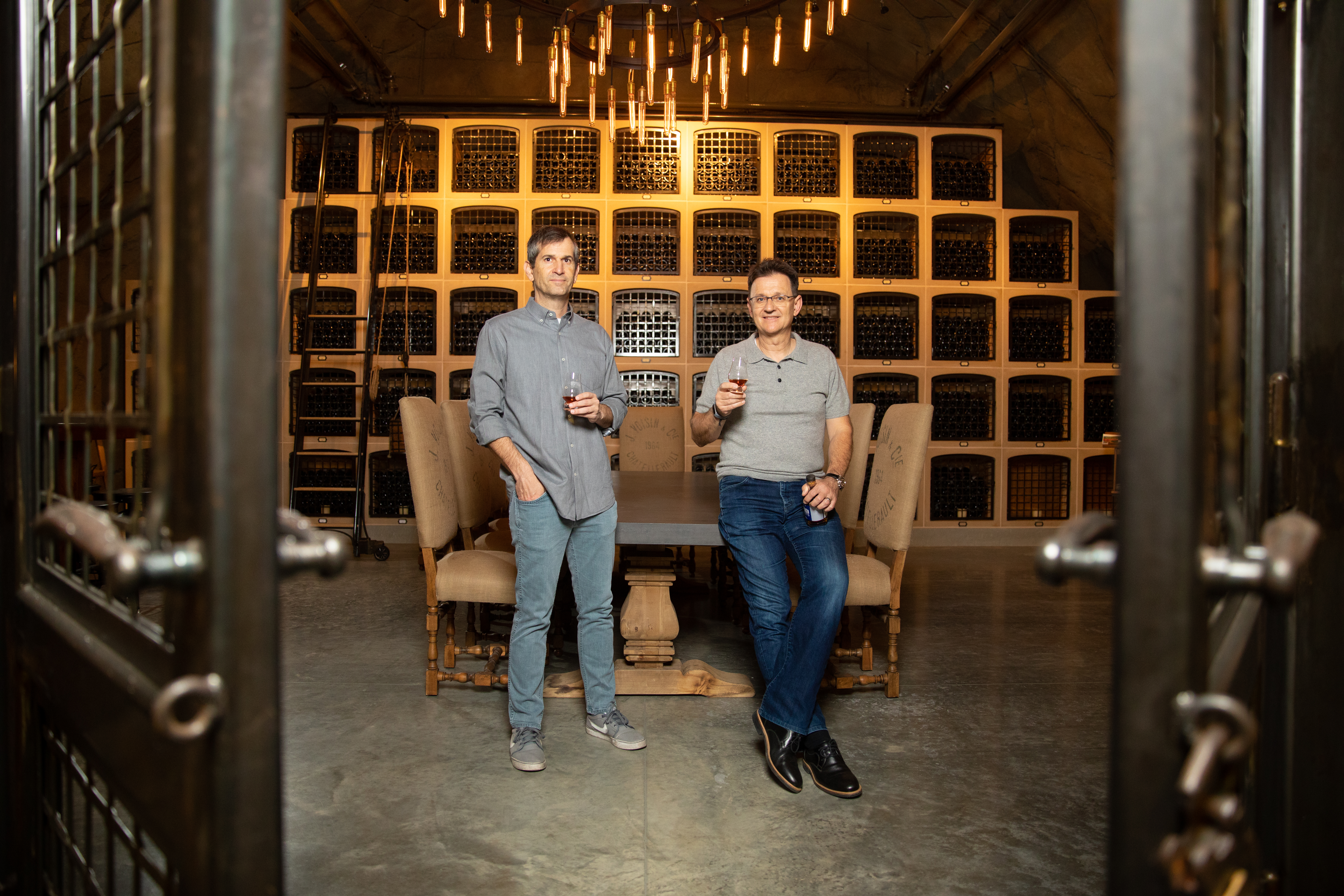
Image Credits: Bespoken Spirits

And while there is surely a lot of skepticism around this technology, especially in a business that typically prides itself on its artisanal approach, the company has won prizes at a number of competitions. The team argues that traditional barrel aging is a wasteful process, where you lose 20 percent of the product through evaporation, and one that is hard to replicate. And because of how long it takes, it also creates financial challenges for upstarts in this business — and it makes it hard to innovate

As the co-founders told me, there are three pillars to its business: selling its own brand of spirits, maturation-as-a-service for rectifiers and distillers and producing custom private label spirits for retailers, bars and restaurants. At first, the team mostly focused on the latter two — and especially its maturation-as-a-service business. Right now, Aaron noted, a lot of craft distilleries are facing financial strains and need to unlock their inventory and get their product to market sooner — and maybe at a better quality and hence higher price point — than they previously could.

There’s also the existing market of rectifiers, who, at least in the U.S., take existing products and blend them. These, too, are looking for ways to improve their processes and make it more replicable.

Interestingly, a lot of breweries, too, are now sitting on excess or expired beer because of the pandemic. “They’re realizing that rather than paying somebody to dispose of that beer and taking it back, they can actually recycle — or upcycle maybe is a better word — the beer, by distilling it into whiskey,” Aaron said. “But unfortunately, when a brewery distills beer into whiskey, it’s typically not very good whiskey. And that’s where we come in. We can take that beer bin, as a lot of people call initial distillation, and we can convert it into a premium quality whiskey.”

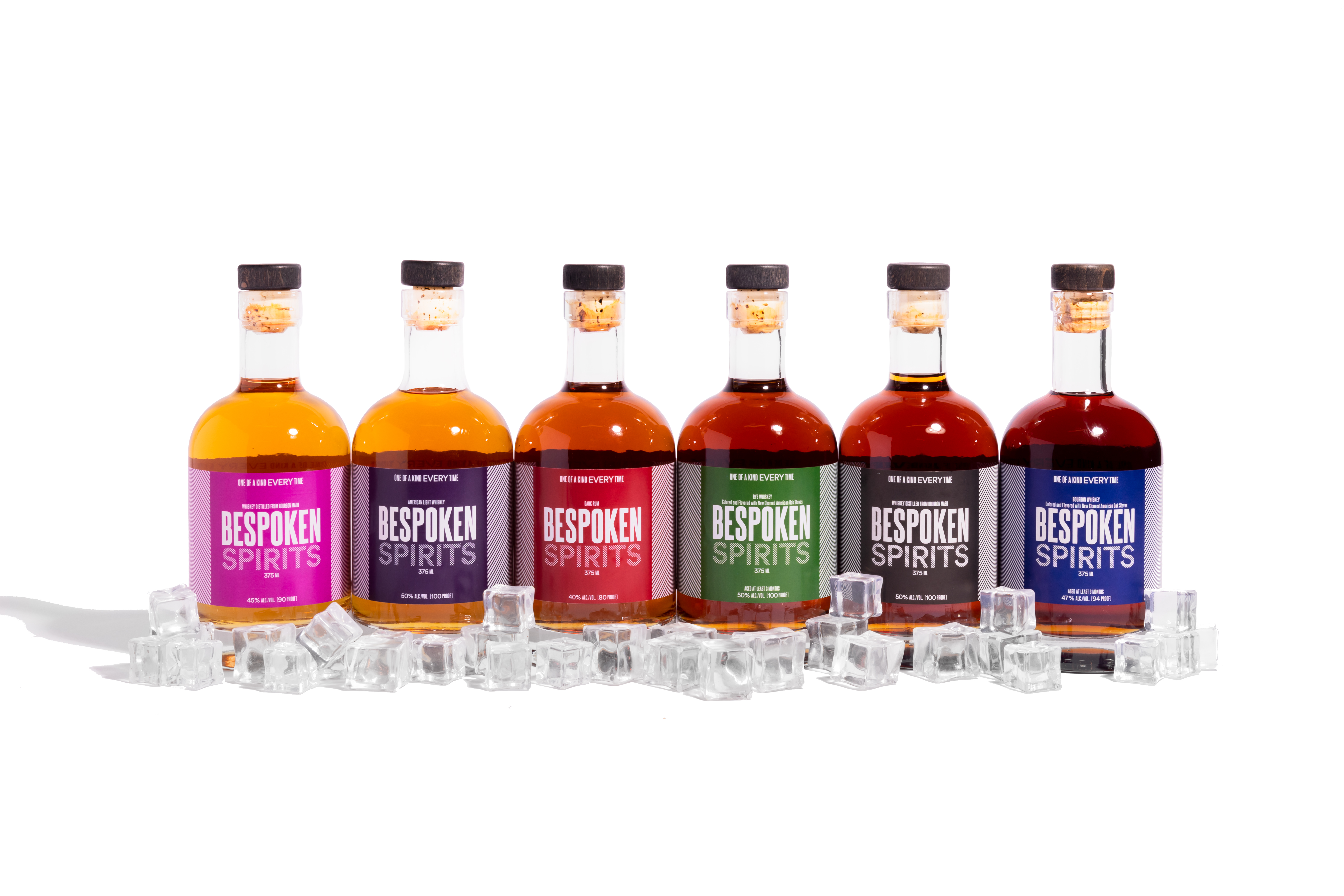
Image Credits: Bespoken Spirits

Bespoken is also working with a few grocery chains, for example, to create bespoke whiskeys for their house brands that match the look and flavor of existing brands or that offer completely new experiences.

The way the team does this is by collecting a lot of data throughout its process and then having a tasting panel describe the product for them. Using that data and feeding it into its systems, the company can then replicate the results — or tweak them as necessary — without having to wait for years for a barrel to mature.

“We’re collecting all this data — and some of the data that we’re collecting today, we don’t even know yet what we’re going to use it for,” Janousek said. Using its proprietary techniques, Bespoken will often create dozens of samples for a new customer and then help them whittle those down.

“I often like to describe our company as a cross between 23andme, Nespresso and Impossible Foods,” Aaron said. “We’re like 23andme, because again, we’re trying to map the customer to preference to the recipe to results. There is this big data, genome mapping kind of a thing. And we’re like Nespresso because our machine takes spirit and supply pods and produces results, although obviously we’re industrial scale and they’re not. And it’s like Impossible Foods, because it’s totally redefining an age-old antiquated model to be completely different.”

The company plans to use the new funding to accelerate its market momentum and build out its technology. Its house brand is currently available for sale in California, Wisconsin and New York.

“The company’s ability to deliver both quality and variety is what really caught my attention and made me want to invest,” said T.J. Rogers. “In a short period of time, they’ve already produced an incredible range of top-notch spirits from whiskeys to rum, brandy and tequila–all independently validated time and again in blind tastings and prestigious competitions.”

Full disclaimer: the company sent me a few samples. I’m not enough of a whiskey aficionado to review those, but I did enjoy them (responsibly).

News: Slack introduces new features to ease messaging between business partners

Slack is holding its Frontiers conference this week — virtually like everyone else in 2020 — and it’s introducing some new features to make it easier to message between partners. At the same time, it’s talking about some experimental features that could appear in the platform at some point (or not). Let’s start with some

Slack is holding its Frontiers conference this week — virtually like everyone else in 2020 — and it’s introducing some new features to make it easier to message between partners. At the same time, it’s talking about some experimental features that could appear in the platform at some point (or not).

Let’s start with some features to help communicate with partners outside of your company in a secure way. This is always a tough nut to crack whether it’s collaboration or file sharing or any of the things that trusted partners do when they are working closely together.

To help solve that, the company is creating the notion of trusted partners, and this has a few components. The first is Slack Connect DMs (direct messages), which allows users inside an organization to collaborate with anyone outside their company simply by sending an invite.

“You can now direct message anyone in the Slack ecosystem. That means that anyone that has a Slack license can connect to one another,” Ilan Frank, VP of product at Slack told TechCrunch. While the company is introducing the new capability this week, it won’t be widely available until next year as the company wants to make sure this is used for business purposes only in a secure and non-spammy way.

“We’re going to be focused on, before we make this widely available, a lot of different information privacy and security [components] to make sure that we account for things like spam and phishing attacks and all that. This should not be a LinkedIn or Facebook Messenger where anyone can connect with you. This is [going to focus on] business for business work,” Frank explained.

Slack is introducing a couple of concepts to help ensure that happens. For starters, it’s adding Verified Organizations, which works a bit like verified users on Twitter, to help ensure you are dealing with someone from an organization you trust and work with before you start exchanging information on Slack.

“So if someone connects to you through direct message or through a channel, before you even make that connection, [you can ensure] if they are [from] a verified Slack organization versus someone who has just signed up on the internet, and you have not heard them, don’t have a relationship with them and don’t know who they are,” Frank said.

The last piece is called Managed Connections, which lets Slack admins control which organizations and individuals can connect with people inside your organization on Slack in a streamlined manner, which helps ensure that the other two new features are used in a responsible way.

“Organizations have told us that they want to go even deeper into the granularity of control, and they want to have different policies by external organizations that they’re connected to,” he said. Managed Connections lets admins set policies around different types of relationships with outside organizations.

All of these new tools are being introduced this week, but will be released later this year or early next year.

Among the other things the company working on in is enabling customers to embed video or audio in a Slack channel, extending it beyond a pure text messaging tool. The company was careful to point out that these features are just experiments for now and may or may not end up in the product  in the future.

News: Kong launches Kong Konnect, its cloud-native connectivity platform

At its (virtual) Kong Summit 2020, API platform Kong today announced the launch of Kong Konnect, its managed end-to-end cloud-native connectivity platform. The idea here is to give businesses a single service that allows them to manage the connectivity between their APIs and microservices and help developers and operators manage their workflows across Kong’s API

At its (virtual) Kong Summit 2020, API platform Kong today announced the launch of Kong Konnect, its managed end-to-end cloud-native connectivity platform. The idea here is to give businesses a single service that allows them to manage the connectivity between their APIs and microservices and help developers and operators manage their workflows across Kong’s API Gateway, Kubernetes Ingress and King Service Mesh runtimes.

“It’s a universal control plane delivery cloud that’s consumption-based, where you can manage and orchestrate API gateway runtime, service mesh runtime, and Kubernetes Ingress controller runtime — and even Insomnia for design — all from one platform,” Kong CEO and co-founder Augusto ‘Aghi’ Marietti told me.

The new service is now in private beta and will become generally available in early 2021.

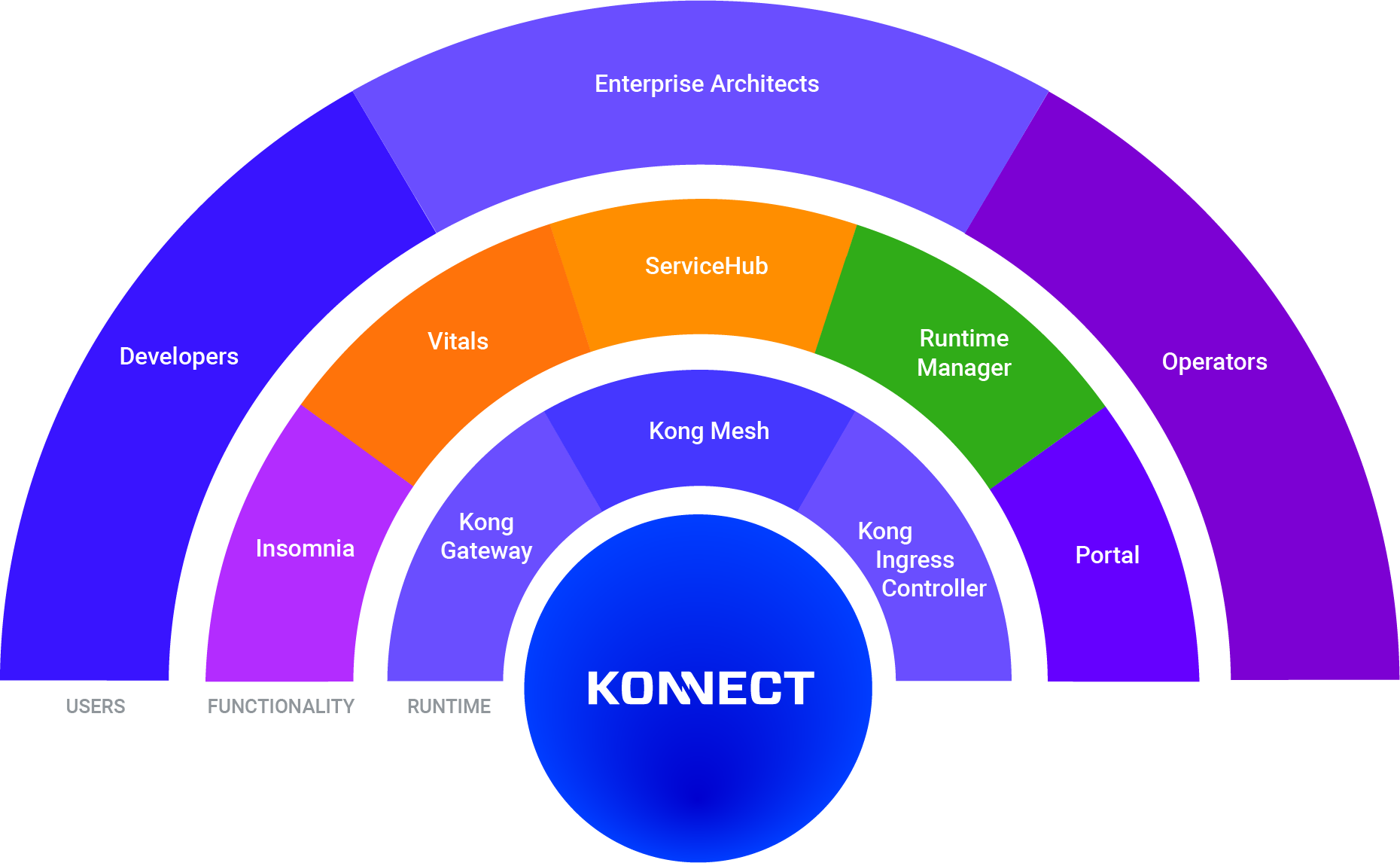
Image Credits: Kong

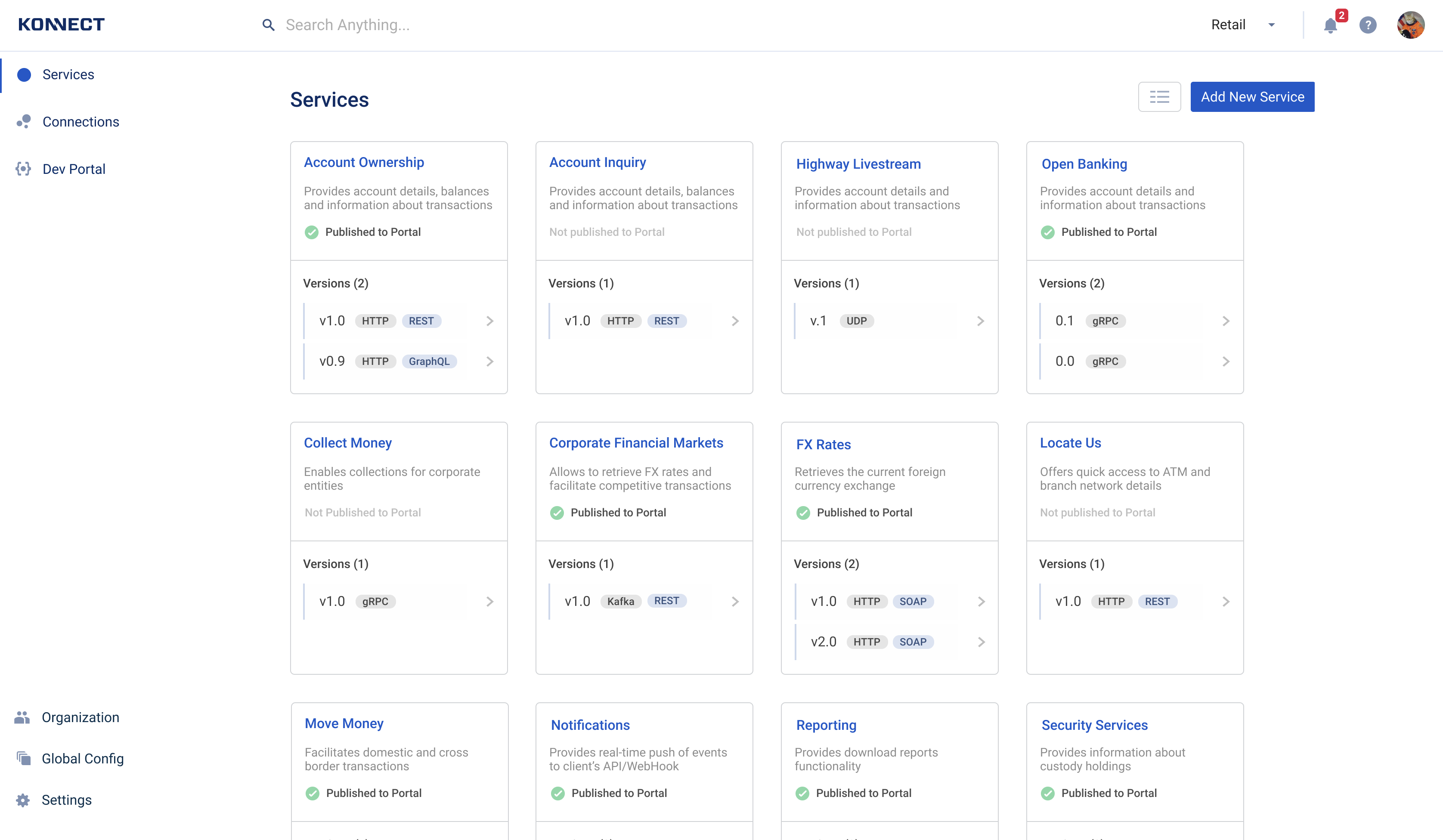
At the core of the platform is Kong’s new so-called ServiceHub, which provides that single pane of glass for managing a company’s services across the organization (and make them accessible across teams, too).

As Marietti noted, organizations can choose which runtime they want to use and purchase only those capabilities of the service that they currently need. The platform also includes built-in monitoring tools and supports any cloud, Kubernetes provider or on-premises environment, as long as they are Kubernetes-based.

The idea here, too, is to make all these tools accessible to developers and not just architects and operators. “I think that’s a key advantage, too,” Marietti said. “We are lowering the barrier by making a connectivity technology easier to be used by the 50 million developers — not just by the architects that were doing big grand plans at a large company.”

To do this, Konnect will be available as a self-service platform, reducing the friction of adopting the service.

Image Credits: Kong

This is also part of the company’s grander plan to go beyond its core API management services. Those services aren’t going away, but they are now part of the larger Kong platform. With its open-source Kong API Gateway, the company built the pathway to get to this point, but that’s a stable product now and it’s now clearly expanding beyond that with this cloud connectivity play that takes the company’s existing runtimes and combines them to provide a more comprehensive service.

“We have upgraded the vision of really becoming an end-to-end cloud connectivity company,” Marietti said. “Whether that’s API management or Kubernetes Ingress, […] or Kuma Service Mesh. It’s about connectivity problems. And so the company uplifted that solution to the enterprise.”


WordPress Image Lightbox Plugin