Yearly Archives: 2020

News: Daily Crunch: Big tech responds to antitrust report

The major tech platforms push back against the House antitrust report, Google Assistant gets a “guest” mode and we interview a freshly minted Nobel laureate. This is your Daily Crunch for October 7, 2020. The big story: Big tech responds to antitrust report The House Judiciary Committee released its tech antitrust report late yesterday, concluding

The major tech platforms push back against the House antitrust report, Google Assistant gets a “guest” mode and we interview a freshly minted Nobel laureate. This is your Daily Crunch for October 7, 2020.

The big story: Big tech responds to antitrust report

The House Judiciary Committee released its tech antitrust report late yesterday, concluding that the big tech platforms should face additional regulation. Recommendations include creating new separations to prevent dominant platforms from operating in adjacent lines of business, new requirements for interoperability and data portability and increased restrictions on mergers and acquisitions.

For now, these are just recommendations — and they weren’t endorsed by the committee’s Republican minority. But they have prompted forceful responses from four of the companies targeted by the report: Amazon, Apple, Facebook and Google.

Amazon, for example, dismissed the committee’s views as “fringe notions” and “regulatory spitballing,” while Apple said it “vehemently” disagrees with the report’s conclusions.

The tech giants

Google Assistant gets an incognito-like guest mode — With Guest mode on, Google Assistant won’t offer personalized responses and your interactions won’t be saved to your account.

Slack introduces new features to ease messaging between business partners — One new feature: Slack Connect DMs, allowing users inside an organization to collaborate with anyone outside their company simply by sending an invite.

Instagram’s Threads app now lets you message everyone, like its Direct app once did — These changes are rolling out shortly after a major update to Instagram’s messaging platform.

Startups, funding and venture capital

Envisics nabs $50M for its in-car holographic display tech at a $250M+ valuation — The startup brings together computer vision, machine learning, big data analytics and navigation to build hardware that integrates into vehicles to project holographic, head-up displays.

Shogun raises $35M to help brands take on Amazon with faster and better sites of their own — Shogun lets companies build sites that sit on top of e-commerce back-ends like Shopify, Big Commerce or Magento.

DoorDash introduces a new corporate product, DoorDash for Work — DoorDash says it conducted a survey of 1,000 working Americans last month and found that 90% of them said they miss at least one food-related benefit from the office.

Advice and analysis from Extra Crunch

Transportation VCs suggest frayed US-China ties will impact mobility markets — During TechCrunch’s annual Mobility event, we interviewed three investors who spend much of their time focused on shifts in the transportation industry.

Unqork’s $207M Series C underscores growing enterprise demand for no-code apps — The no-code/low-code world could be enjoying an even sharper tailwind than anticipated.

Media roundup: Google to cut big checks for news publishers, Substack continues to draw top creators, more — I do my best to highlight the latest trends, platform shifts and noteworthy funding rounds.

(Reminder: Extra Crunch is our subscription membership program, which aims to democratize information about startups. You can sign up here.)

Everything else

Nobel laureate Jennifer Doudna shares her perspective on COVID-19 and CRISPR — CRISPR co-discoverer Jennifer Doudna was named a Nobel laureate in Chemistry today, so it seemed like the perfect time to post video of our interview at Disrupt.

Tech-publisher coalition backs new push for browser-level privacy controls — A coalition of privacy-forward tech companies, publishers and advocacy groups has taken the wraps off of an initiative to develop a new standard that gives internet users a simple way to put digital guardrails around their data.

The Daily Crunch is TechCrunch’s roundup of our biggest and most important stories. If you’d like to get this delivered to your inbox every day at around 3pm Pacific, you can subscribe here.

News: Startups joining SK Telecom’s accelerator include AI-driven mapping and vision for delivery robots

We don’t often cover telecom technology startups, but it’s periodically worth checking in to see what’s happening in that space. We can get a good indication from the latest cohort to emerge from an accelerator associated with South Korea’s largest wireless carrier, SK Telecom. This group of startups will join the Telecom Infra Project accelerator

We don’t often cover telecom technology startups, but it’s periodically worth checking in to see what’s happening in that space. We can get a good indication from the latest cohort to emerge from an accelerator associated with South Korea’s largest wireless carrier, SK Telecom.

This group of startups will join the Telecom Infra Project accelerator in South Korea, which is part of a global program of telecoms specialist centers, and run in partnership with SK Telecom.

The cohort includes a ship berthing monitoring system; an app that turns a group of mobile phones into a TV studio; an AI-powered indoor positioning system which creates interactive maps; a vision system for delivery robots; and one which allows remote audiences to experience live events ‘together’ via a digital stadium.

The selected start-ups include:

Dabeeo: Dabeeo’s AI-powered indoor positioning system which uses vision data produced through smartphone cameras to create interactive maps, used for gaming, marketing and logistics. Crunchbase  

Neubility: Neubility develops vision-based localization and path planning technologies for last-mile delivery robots. Crunchbase

Seadronix: Seadronix is a computer vision-based ship parking monitoring solution that provides an AI-based berthing monitoring system. Through producing around-view images, distance and speed between the ship and the port to pilot or captain it assists ship parking. Crunchbase  

39degC: This is a mobile multi-camera live streaming app. It directly connects multiple smartphone feeds to each other using a technology called WiFi-Direct – turning them into a TV studio.

Kiswe: Kiswe is a supplier of entertainment broadcast technology. Its product CloudCast is a “Broadcast Studio in the Cloud” which enables partners to send a digital feed into the cloud to produce live and non-live content.  Its other product, Hangtime , allows remote audiences to experience live events ‘together’ through creating a digital stadium with chat rooms, and control over viewing angles from within the platform. Crunchbase

News: Facebook: Trump can’t recruit ‘army’ of poll watchers under new voter intimidation rules

In a blog post Wednesday, Facebook said it will no longer allow content that encourages poll watching that uses “militarized” language or intends to “intimidate, exert control, or display power over election officials or voters.” Facebook credited the update to its platform rules to civil rights experts who it worked with to create the policy.

In a blog post Wednesday, Facebook said it will no longer allow content that encourages poll watching that uses “militarized” language or intends to “intimidate, exert control, or display power over election officials or voters.” Facebook credited the update to its platform rules to civil rights experts who it worked with to create the policy.

Facebook Vice President of Content Policy Monika Bickert elaborated on the new rules in a call with reporters, noting that wording would prohibit posts that use words like “army” or “battle” — a choice that appears to take direct aim at the Trump campaign’s effort to recruit an “army for Trump” to watch the polls on election day. Last month, Donald Trump Jr. called for supporters to “enlist now” in an “army for Trump election security operation” in a video that was posted on Facebook and other social platforms.

“Under the new policy if that video were to be posted again, we would indeed remove it,” Bickert said.

The company says that while posts calling for “coordinated interference” or showing up armed at polling places are already targeted for removal, the expanded policy will more fully address voter intimidation concerns. Facebook will apply the expanded policy going forward but it won’t affect content already on the platform, including the Trump Jr. post.

Poll watching to ensure fair elections is a regular part of the process, but weaponizing those observers to seek evidence for unfounded claims about “fraudulent ballots” and a “rigged” election is something new — and something more akin to voter intimidation. Poll watching laws vary by state and some states limit how many poll watchers can be present and how they must identify themselves.

Trump has repeatedly failed to commit to accepting the results of the election in the event that he loses, an unprecedented threat to the peaceful transfer of power in the U.S. and one social media companies are anxiously keeping an eye on as election day nears.

Facebook is also making some changes to its rules around political advertising. The company will no longer allow political ads immediately following the election in an effort to avoid chaos and false claims.

“… While ads are an important way to express voice, we plan to temporarily stop running all social issue, electoral, or political ads in the U.S. after the polls close on November 3, to reduce opportunities for confusion or abuse,” Facebook Vice President of Integrity Guy Rosen wrote in a blog post. Rosen added that Facebook will let advertisers know when those ads are allowed again.

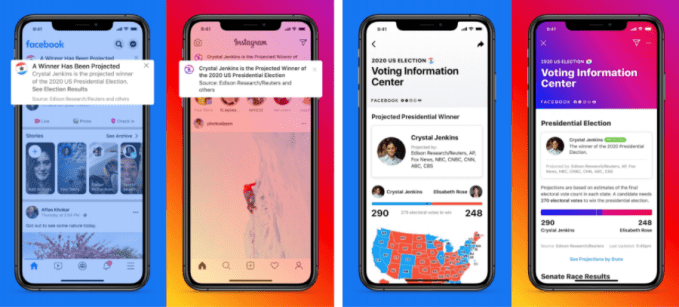
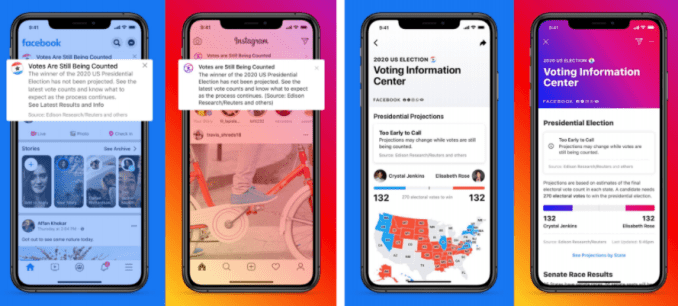
Facebook also provided a glimpse of what its apps will look like on what might shape up to be an unusual election night. The company will place a notification at the top of the Instagram and Facebook apps with the status of the election in an effort to broadly fact-check false claims.

Facebook election night messages

Facebook election night messages

Images via Facebook

Those messages will remind users that “Votes are still being counted” before switching over to a message that “A winner has been projected” after a reliable consensus emerges about the race. Because the results of the election may not be apparent on election night this year, it’s possible that users will see these messages beyond November 3. If a candidate declares a premature victory, Facebook will add one of these labels to that content.

Facebook also noted that is is now using a viral content review system, a measure designed to prevent the many instances in which misinformation or otherwise harmful content racks up thousands of views before eventually being removed. Facebook says the tool, which it says it has relied on “throughout election season,” provides a safety net that helps the company detect content that breaks its rules so it can take action to limit its spread.

In the final month before the election, Facebook is notably showing less hesitation toward policing misinformation and other harmful political content on its platform. The company announced Tuesday that it would no longer allow the pro-Trump conspiracy theory known as QAnon to flourish there, as it has over the last four years. Facebook also removed a post this week in which President Trump, fresh out of a multi-day hospital stay, claimed that COVID-19 is “far less lethal” than the flu.

News: Amazon sends legal notice to India’s Future Group over deal with Ambani’s Reliance Retail

Amazon has sent a legal notice to Future Retail, India’s second largest retail chain, for breaching the terms of its contract by selling a significant portion of the business to Ambani’s Reliance Retail. Future Group announced in late August that it was selling its retail and wholesale business, as well as its logistics and warehousing

Amazon has sent a legal notice to Future Retail, India’s second largest retail chain, for breaching the terms of its contract by selling a significant portion of the business to Ambani’s Reliance Retail.

Future Group announced in late August that it was selling its retail and wholesale business, as well as its logistics and warehousing business to Reliance Retail for $3.4 billion.

But before Reliance Retail came into the picture, Future Group and Amazon also had a deal.

Last year, Amazon acquired a 49% stake in Future Coupons, a group entity owned by Future Group’s retail business. The deal gave Amazon a 3.58% stake in Future Retail, and the right of first refusal to purchase more stake in Future Retail both directly as well as via entities, Future Group said in a filing at the time.

According to TV network ET Now, which first reported about the legal notice, the deal between Amazon and Future Retail also restricted the Indian firm from entering into a deal with certain firms.

Future Group, which kickstarted its journey as a stonewashed-fabric seller in the 1980s, served millions of customers through more than 1,500 stores in more than 400 cities as of earlier this year.

The legal notice has puzzled many in India, as Amazon is reportedly preparing to acquire a multi-billion-dollar stake in Reliance Retail, India’s largest retail chain, according to earlier reports by ET Now and Bloomberg.

With e-commerce commanding only between 3 to 7% of all retail sales in India — and Reliance Retail launching its own e-commerce business to fight Amazon and Flipkart — Amazon’s deal with Reliance Retail is seen as crucial for the American e-commerce firm’s future in India by many industry analysts. Amazon, which kickstarted its journey in India seven years ago, has invested over $6.5 billion in its local business in the country.

Amazon confirmed that it had filed a legal notice. Reliance Retail and Future Group did not comment. As of Wednesday midnight (local time), Future Group had not disclosed the notice on the stock exchange.

Founded in 2006, Reliance Retail serves more than 3.5 million customers each week (as of early this year) through its nearly 12,000 physical stores in more than 6,500 cities and towns in the country.

The retail chain, run by India’s richest man Mukesh Ambani, has raised about $5.14 billion by selling about an 8.5% stake in its business to Silver Lake, Singapore’s GIC, General Atlantic and others in the past four weeks.

Ambani’s other venture, Jio Platforms, this year raised over $20 billion from more than a dozen marquee investors including Google and Facebook.

News: Here’s the curtain raise on the Sight Tech Global agenda

The goal of Sight Tech Global, a virtual, global event on December 2-3, 2020, is to gather the world’s top experts who are applying advanced technologies, notably AI, to the future of accessibility and assistive tech for people who are blind or visually impaired. Today we’re excited to roll out most of the agenda. There

The goal of Sight Tech Global, a virtual, global event on December 2-3, 2020, is to gather the world’s top experts who are applying advanced technologies, notably AI, to the future of accessibility and assistive tech for people who are blind or visually impaired.

Today we’re excited to roll out most of the agenda. There are another half-dozen sessions and breakouts still to come, notably sessions on AI bias and civil rights. What we’ve discovered over the many weeks of research and conversation is a consistent, strong interest on the part of researchers, technologists and product and design thinkers to convene and talk over the future — its promises, challenges and even threats.

We’re delighted to have top-level talent from virtually every leading technology company, many research universities and some startups ready for fireside chats and small panel discussions with expert moderators. Some sessions will take questions from our audience as well.

When the event dates are closer, we will add dates and times to each of these sessions as well as announce additional speakers. Register today to get a free pass and please browse the first edition of the Sight Tech Global agenda below.

Seeing AI: Where does Microsoft’s blockbuster app go from here?

With ever more powerful computer and data resources available in the cloud, Microsoft’s Seeing AI mobile app is destined to become a steadily better ally for anyone with vision challenges. Co-founder Saqib Shaikh leads the engineering team that’s charting the app’s cloud-enabled future.

Saqib Shaikh, co-founder of Seeing AI, Microsoft
Moderator: Devin Coldewey, TechCrunch

The future according to OrCam

As AI-based computer vision, voice recognition and natural language processing race ahead, the engineering challenge is to design devices that can perceive the physical world and communicate that information in a timely manner. Amnon Shashua’s OrCam MyEye is the most sophisticated effort yet to merge those technologies in a seamless experience on a dedicated device.

Amnon Shashua, co-founder of OrCam and Mobileye
Moderator: Matthew Panzarino, TechCrunch

Accessibility from the wheels up: The Waymo self-driving taxi

If people who are blind or visually impaired find Uber and Lyft liberating, imagine how they will feel summoning a self-driving ride from an app on their mobile phones. But wait, how exactly will they locate the cars and what happens when they climb in? Presenter Clem Wright is responsible for the self-driving taxi’s accessibility, and he will be joined by leadership from two organizations closely involved in that effort: The Lighthouse for the Blind SF and the Foundation for Blind Children.

Clem Wright, Accessibility product manager, Waymo
Marc Ashton, CEO, Foundation for Blind Children
Bryan Bashin, CEO, Lighthouse for the Blind
Moderator: Kirsten Korosec, TechCrunch

Our AI future is already here

Whether it’s Alexa, Tesla or Facebook, AI is already deeply embedded in our daily lives. Few understand that better than Dr. Kai-Fu Lee, a scientist who developed the first speaker-independent, continuous speech recognition system as a Ph.D. student at Carnegie Mellon, led Google in China and held senior roles at Microsoft and Apple. Today, Dr. Lee runs Sinovation Ventures, a $2 billion fund based in China, is president of the Sinovation’s Artificial Intelligence Institute and has 50 million followers on social media.

Dr. Kai-Fu Lee, chairman and CEO, Sinovation Ventures
Moderator: Ned Desmond, Sight Tech Global

The future of AT devices and the companies that make them

Dedicated devices versus accessible platforms? Victor Reader Stream versus iPhones and Alexa? How will AT companies take advantage of a world with cloud data and edge computational power, AI algorithms and more demanding customers than ever? Humanware, eSight and APH are already looking far into that future.

Gilles Pepin, CEO, Humanware
Greg Stilson, head of Global Innovation, APH
Charles Lim, CTO, eSight
Moderator: Betsy Beaumon, CEO, Benetech

If the Jetsons had screen readers, would they be using keyboard commands?

The screen reader is arguably the most consequential digital technology ever for people who are blind or visually impaired. At the same time, screen readers depend on a dizzying array of keyboard commands, and — when it comes to reading websites in a browser — they struggle with the ugly reality of poor website accessibility. New technologies may lead the way to better outcomes.

Glen Gordon, Software fellow, Vispero; architect, JAWS
James Teh, Accessibility engineer, Mozilla; co-founder, NVDA
Léonie Watson, director, TetraLogical
Moderator: Matt King, Accessibility technical program manager, Facebook

Alexa, what is your future?

When Alexa launched six years ago, no one imagined that the voice assistant would reach into millions of daily lives and become a huge convenience for people who are blind or visually impaired. This fall, Alexa introduced personalization and conversational capabilities that are a step-change toward more human-like home companionship. Amazon’s Josh Miele and Anne Toth will discuss the impact on accessibility as Alexa becomes more capable.

Anne Toth, director, Alexa Trust at Amazon
Josh Miele, principal accessibility researcher, Lab126 at Amazon
Moderator: Devin Coldewey, TechCrunch

Augmented reality and perception: What’s the best way to get the message across?

It’s one thing for an AI-based system to “know” when it’s time to turn left, who came through the door or how far away the couch is: It’s quite another to convey that information in a timely fashion with minimal distraction. Researchers are making use of haptics, visual augmented reality (AR), sound and language to figure out the right solutions.

Amos Miller, Product strategist, Microsoft AI and Research
Ashley Tuan, VP Medical Devices, Mojo Vision
Sile O’Modhrain, associate professor, Performing Arts Technology, University of Michigan
Moderator: Nick Giudice, professor of Spatial Informatics, University of Maine

Wayfinding: Finding the mark

Map apps on mobile phones are miraculous tools accessible via voice output, but mainstream apps don’t announce the detailed location information (which people who are blind or visually impaired really want), especially inside buildings and in public transportation settings. Efforts in the U.S. and U.K. are improving accessible navigation.

Tim Murdoch, founder and CEO, Waymap
Nick Giudice, professor of Spatial Informatics, University of Maine
Moderator: Mike May, chief evangelist, GoodMaps

Computer vision, AI and accessibility: What’s missing from this picture?

For an AI to interpret the visual world on behalf of people who are blind or visually impaired, the AI needs to know what it’s looking at, and no less important, that it’s looking at the right thing. Mainstream computer vision databases don’t do that well — yet.

Danna Gurari, assistant professor and director of the Image and Video Computing Group, University of Texas
Patrick Clary, product manager, AI and accessibility, Google
Moderator: Roberto Manduchi, professor CS and Engineering, UC Santa Cruz

Keep an out for more sessions and breakouts later this month. In the meantime, registration is open. Get your pass today!

Sight Tech Global is eager to hear from potential sponsors. We’re grateful to current sponsors Amazon, Ford, Google, Microsoft, Mojo Vision, Waymo, Wells Fargo and Humanware. All sponsorship revenues go to the nonprofit Vista Center for the Blind and Visually Impaired, which has been serving the Silicon Valley area for 75 years.

Special thanks to the Sight Tech Global advisors — Tech Matters Jim Fruchterman, UC Santa Cruz’s Roberto Manduchi, Verizon Media’s Larry Goldberg, Facebook’s Matt King and Be My Eyes’ Will Butler — who are playing an invaluable role on this project.

News: Media roundup: Google to cut big checks for news publishers, Substack continues to draw top creators, more

Welcome back to Extra Crunch’s Media Roundup, where I round up the stories that entrepreneurs in the content and advertising business should be thinking about — trends, larger platform shifts, as well as noteworthy funding rounds. This time, we’ve got some bad news for movie theaters, the specter of antitrust regulation and a new career

Welcome back to Extra Crunch’s Media Roundup, where I round up the stories that entrepreneurs in the content and advertising business should be thinking about — trends, larger platform shifts, as well as noteworthy funding rounds.

This time, we’ve got some bad news for movie theaters, the specter of antitrust regulation and a new career path for journalists. Let’s get started!

Movie studios and theaters face a bleak fall

In the last roundup, I pointed to “Tenet”’s global opening weekend as a sign that the theatrical movie business might be coming back to life — but I may have spoken too soon.

While the latest Christopher Nolan film has continued to do reasonably well outside the United States, it’s only grossed $20 million domestically for Warner Brothers. The film’s underwhelming performance could be blamed on U.S. audiences being afraid to return to theaters — but it might simply be a reflection of the fact that theaters in major moviegoing markets like New York, Los Angeles and San Francisco remain closed.

Either way, Warner Brothers and other studios are clearly spooked by the results and have pushed nearly all of their theatrical releases until next year, with knock-on effects for the movies that were already scheduled for 2021. For example, Warner’s “Dune” is being delayed until October 2021, and Daniel Craig’s final Bond entry, “No Time To Die,” was pushed back from November until April. Meanwhile, “The Batman” has been delayed from 2021 to 2022.

At this point, there are few Hollywood blockbusters on the calendar until Christmas, when “Wonder Woman 1984” is due for release. To be honest, I’d be surprised if it actually hits that date. (Video-game comedy “Free Guy,” starring Ryan Reynolds, is scheduled for December 11, but the cast has already created a tongue-in-cheek video acknowledging that release dates aren’t exactly set in stone right now.)

In the meantime, at least one major theater chain said it can’t justify keeping its doors open. The United Kingdom’s Cineworld, which also operates Regal Cinemas in the U.S., announced that it’s closing its theaters indefinitely. For now, AMC and Cinemark said they aren’t going to to follow suit. (AMC noted that it’s bringing in additional revenue through a deal with Universal where the theatre chain gets a cut when Universal films are released early via video-on-demand.)

News: YouTube Premium subscribers get a new perk with launch of testing program

YouTube has long allowed its users to test new features and products before they go live to a wider audience. But in a recent change, YouTube’s latest series of experiments are being limited to those who subscribe the Premium tier of YouTube’s service. Currently, paid subscribers are the only ones able to test several new

YouTube has long allowed its users to test new features and products before they go live to a wider audience. But in a recent change, YouTube’s latest series of experiments are being limited to those who subscribe the Premium tier of YouTube’s service. Currently, paid subscribers are the only ones able to test several new product features, including one that allows iOS users to watch YouTube videos directly on the homescreen.

This is not the same thing as the Picture-in-Picture option that’s become available to app developers with iOS 14, to be clear. Instead, YouTube says this feature allows users who are scrolling on their YouTube homepage to watch videos with the sound on while they scroll through their feed.

Two other experiments are related to search. One lets you filter topics you search for by additional languages, including Spanish, French, or Portuguese. The other lets you use voice search to pull up videos when using the Chrome web browser.

Image Credits: YouTube, screenshot via TechCrunch

None of these tests will be very lengthy, however. Two of the three new experiments wrap up on Oct. 20, 2020 for example. The other wraps on Oct. 27. And they’ve only been live for a few weeks.

In years past, YouTube had allowed all users to try out new features in development from a dedicated site dubbed “TestTube.” In more recent years, however, it began to use the website YouTube.com/new to direct interested users to upcoming features before they rolled out publicly. For example, when YouTube introduced its redesign in 2017, users could visit that same website to opt-in to the preview ahead of its launch.

Now, the site is being used to promote other limited-time tests.

YouTube says the option to test the features was highlighted to Premium subscribers a few weeks ago within the YouTube app. It’s also the first time that YouTube has run an experimentation program tied to the Premium service, we’re told.

The company didn’t make a formal public announcement, but the addition was just spotted by several blogs, including XDA Developers and Android Central, for example.

Contrary to some reports, however, it does not appear that YouTube’s intention is to close off all its experiments to anyone except its paid subscribers. The company’s own help documentation, in fact, notes this limitation will only apply to “some” of its tests. 

YouTube also clarified to TechCrunch that the tests featured on the site represent only a “small minority” of those being run across YouTube. And they are not at all inclusive of the broader set of product experiments the company runs, according to the company.

In addition, non-Premium users can opt to sign up to be notified of additional opportunities to participate in other YouTube research studies, if they choose. This option appears at the bottom of the YouTube.com/new page. 

YouTube says the goal with the new experiments is two-fold. It allows product teams to feedback on different features and it allows Premium subscribers to act as early testers, if they want to.

Premium users who choose to participate can opt into and out of the new features individually, but can only try out one experiment at a time.

This could serve to draw more YouTube users to the Premium subscription, as there’s a certain amount of clout involved with being able to try out features and products ahead of the general public. Consider it another membership perk then — something extra on top of the baseline Premium tier features like ad-free videos, downloads, background play and more.

YouTube, which today sees over 2 billion monthly users, said earlier this year it’s converted at least 20 million users to a paid subscription service. (YouTube Premium / YouTube Music). As of Q3 2020, YouTube was the No. 3 largest app by consumer spend worldwide across iOS and Android, per App Annie data.


News: Decrypted: The major ransomware attack you probably didn’t hear about

Watching the news this past week was like drinking from a firehose. Speaking of which, you probably missed a busy week in cybersecurity, so here are the big stories from the past week. THE BIG PICTURE Blackbaud hack gets worse, as bank account data stolen Blackbaud, a cloud technology company used by colleges, universities, nonprofits

Watching the news this past week was like drinking from a firehose. Speaking of which, you probably missed a busy week in cybersecurity, so here are the big stories from the past week.


THE BIG PICTURE

Blackbaud hack gets worse, as bank account data stolen

Blackbaud, a cloud technology company used by colleges, universities, nonprofits (and far-right organizations), was hit by a data-stealing ransomware attack earlier this year. The attack was one of the biggest of the year in terms of the number of organizations affected, hitting dozens of universities, hospitals and other high-profile organizations like NPR. Blackbaud said in July that it paid the ransom — but also claimed and received “confirmation” that the stolen personal data “had been destroyed,” fooling absolutely nobody.

This week Blackbaud confirmed in a regulatory filing that the stolen data also included bank account data and Social Security numbers — far more personally identifiable information than the company first thought. “In most cases, fields intended for sensitive information were encrypted and not accessible,” the company claimed.

Despite Blackbaud’s claim that the data was deleted, these are malicious hackers driven by financial reward. Hope for the best, but assume the worst — Blackbaud’s data is still out there.

Facebook shuts down malware that hijacked accounts to run ads

Hackers spent about $4 million to run scammy ads on Facebook by hijacking the accounts of unsuspecting users, reports Wired. The hackers used malware, dubbed SilentFade, to compromise Facebook accounts using stolen passwords to use whatever saved credit card details on those accounts to buy ads for diet pills and fake designer handbags.

News: Transportation VCs suggest frayed US-China ties will impact mobility markets

On Tuesday, during TechCrunch’s annual Mobility event, we had the opportunity to interview three investors who spend much of their time focused narrowly on shifts in the transportation industry and we talked with the three — Amy Gu of Hemi Ventures, Reilly Brennan of Trucks VC, and Olaf Sakkers of Maniv Mobility — about a

On Tuesday, during TechCrunch’s annual Mobility event, we had the opportunity to interview three investors who spend much of their time focused narrowly on shifts in the transportation industry and we talked with the three — Amy Gu of Hemi Ventures, Reilly Brennan of Trucks VC, and Olaf Sakkers of Maniv Mobility — about a wide range of related issues to get their take. You can check out that interview below; in the meantime, we’re pulling out parts of the conversation that we found particularly interesting:

How the pandemic is affecting fundraising and the trends they’re watching

Olaf Sakkers: In dense cities, no one is taking transit, so you’re seeing a big shift toward micromobility, but in other cities, there’s been a big uptake in car use and secondhand and new-car demand despite of economic impacts. [You’re seeing this] trade-off between us getting out, and more goods and services that are coming to us than before, [including] food and other things. We’re also seeing a lot of geographic and culture variances, but those are things we’re seeing immediately.

Amy Gu: One thing that COVID has changed a lot is healthcare, which has become more important (during the pandemic) but also raised questions about how we make it more mobile. We’ve been looking at telemedicine companies and remote health care.

Is COVID-19 driving people to buy bikes, scooters and used cars instead of renting?

Reilly Brennan: People fell off micromobility platforms not because they didn’t like them, but they liked them so much, they wanted to buy [the scooters and bikes]. The ways a typical dealership makes money with financing, maintenance and service will come to micromobility. There isn’t much of a used market right now for e-bikes and e-scooters because there aren’t many of them, but that ecosystem will become stronger … [you can imagine] buying outright, leasing, subscriptions, wrapping in theft control … all the tricks you’ve seen carmakers bring to car financing, [meaning] not owning or renting but something in-between.

News: Adding Claire Díaz-Ortiz to its partnership, Magma Partners launches initiative to invest in female founders in LatAm

Claire Díaz-Ortiz has been many things over the course of her career — an angel investor, an early Twitter employee (who notably got the Pope on Twitter), the founder of a nonprofit, a published author and an entrepreneur. Now, the globe-trotting, multi-hyphenate polymath is adding “partner” to her list of titles as she joins the

Claire Díaz-Ortiz has been many things over the course of her career — an angel investor, an early Twitter employee (who notably got the Pope on Twitter), the founder of a nonprofit, a published author and an entrepreneur.

Now, the globe-trotting, multi-hyphenate polymath is adding “partner” to her list of titles as she joins the Latin American investment firm Magma Partners to head up its investment activities across South America’s southern cone and launch a new firm-wide initiative to invest in more women entrepreneurs.

With the appointment, Diaz-Ortiz joins a small but growing list of women investing in startups across the Latin American region, which is subject to the same woeful gender disparities as the rest of the venture world. As she’s noted, only 8% of VC investing partners are women in LatAm versus 13% in the USA

As part of her responsibilities, Diaz-Ortiz will help Magma operate the Brava Initiative, a commitment from Magma and a number of partner funds to invest in at least 20 female-founded Latin American companies over the next three years.

As Diaz-Ortiz has noted in TechCrunch, investing in female founders makes sense:

Many studies have established that female-founded companies outperform their all-male counterparts. Boston Consulting Group reports that for every dollar a female founder or co-founder raises, she generates 2.5X more revenue than a male founder.1 First Round Capital’s research held that the female-founded companies it backed performed 63% better than all-male founding teams.2 The Ewing Marion Kauffman Foundation’s showed that return on investment from women-led teams is 35% higher than their all-male counterparts.3 AllRaise, a nonprofit promoting women in VC, found that “companies with women on their founding teams are likely to exit at least one year faster compared to the rest of the market, and the number of exits for companies with at least one female founder is growing at a faster rate year-over-year than exits for companies with only male founders.”4 Jen Neundorfer, founding partner at Jane VC, succinctly explains her fund’s thesis of investing in female founders as, “investing in an overlooked asset class that is overperforming.” After all, it’s a “trillion-dollar opportunity.”5

“We’re doing this because female founded startups have better returns and to highlight the disparity in VC funding to women entrepreneurs,” Diaz-Ortiz wrote in a statement.

Claire Diaz-Ortiz. Image Credit: Jose Diaz-Ortiz

Magma has already made its first four investments into women-led or co-led startups: Jefa, a neobank focused on serving women in Central America; The Intern Group, which offers virtual internships for lifelong learning across careers; Prometeo, a startup developing open banking protocols for Latin American financial services; and Flickplay, a developer of augmented reality features for social networking.

Latin America already has several proof points to back up the assertion that money invested in female founders is money well spent. One need only look at the success of Nubank and its co-founder Cristina Junqueira to see that investing in women-led firms can make sense.

There’s still plenty of room to improve, but Latin America is already doing better than the rest of the world when it comes to backing diverse founding teams. In 2019, investments into mixed female-male founding teams represented 16% of dollars invested in Latin America, 9% in the USA and only 8% in Europe. 

“The venture capital industry in Latin America is quite young, not more than two decades. The first wave of firms was started by partners capable of raising funds from a male dominated pool of capital,” said Antonia Rojas of the new Brava Initiative from Magma, in a statement. “The next generation of VCs in the region will come from partners capable of accessing the best deals and adding the most value to founders. In this new era, where results matter more, women are playing a much bigger role. (Traditional LPs will soon realize this.)”

The Brava Initiative has also enlisted a group of mentors from around the world to provide guidance to the Latin American founders that it will back, including Maren Bannon, the founder of January Ventures.

It will also have a mentor network and an SPV so that people who want to support women founders directly can invest alongside Magma.

“When I was a female founder (who was in her 30s and a mother of two), I never walked into a VC’s office and felt it was created for me. So instead of joining one of those funds as an investor, I decided to co-found my own. I wanted to build January Ventures the way I wish a VC fund looked: open, inclusive, welcoming, accessible, transparent,” Bannon said in a statement. “Having more female investors writing checks will help get more funding to female founders.”

WordPress Image Lightbox Plugin