
Yearly Archives: 2020

News: Domestic terrorism suspects who plotted to kidnap Whitmer shared plans in Facebook groups

According to details from a shocking new affidavit, the FBI uncovered a group planning “violent action against multiple state governments,” including a detailed plot to capture or kill Michigan Governor Gretchen Whitmer. The domestic terror group organized across Facebook groups, real-life events and at least two encrypted chat apps that the FBI did not name.

According to details from a shocking new affidavit, the FBI uncovered a group planning “violent action against multiple state governments,” including a detailed plot to capture or kill Michigan Governor Gretchen Whitmer. The domestic terror group organized across Facebook groups, real-life events and at least two encrypted chat apps that the FBI did not name.

Whitmer, a Democrat, became a major target of pervasive anti-lockdown sentiment on the political right earlier this year when states imposed restrictions to slow the spread of the coronavirus. According to the affidavit, at a June in-person meeting, members of the group “talked about murdering ‘tyrants’ or ‘taking’ a sitting governor.”

Facebook says it played a “proactive” role in the FBI investigation, first reaching out to law enforcement six months ago. The FBI said it became aware of the activity through social media and also relied on an informant to collect information from within the group.

“We remove content, disable accounts and immediately report to law enforcement when there is a credible threat of imminent harm to people or public safety,” a Facebook spokesperson told TechCrunch. “We proactively reached out and cooperated with the FBI early in this ongoing investigation.”

The group sought to grow its numbers, contacting a Michigan-based militia group known as the Wolverine Watchmen that shared overlapping interests. Facebook removed the Wolverine Watchmen group from its platform in June when it purged a number of groups connected to the anti-government boogaloo movement.

“Today we are designating a violent US-based anti-government network as a dangerous organization and banning it from our platform,” Facebook wrote at the time, drawing a distinction between violent boogaloo groups and the “loosely-affiliated” boogaloo movement.

TechCrunch asked Facebook if the individuals connected with the Michigan militia through Facebook groups but the company did not provide an answer to that question.

Adam Fox, one of the group’s alleged organizers, livestreamed to a private Facebook group earlier this year, complaining that Michigan’s restrictions were keeping gyms closed. In the video, Fox “referred to Governor Whitmer as ‘this tyrant bitch,’ and stated, ‘I don’t know, boys, we gotta do something.’”

In April, Trump cheered on protests against those measures in Virginia, Minnesota and Michigan, three states with Democratic governors. Many of these early events were organized on Facebook, but anti-Whitmer sentiment quickly became ubiquitous on the right across social networks and traditional media.

By July, the group considered attacking a Michigan State Police location but landed on abducting Whitmer from her private vacation home or governor’s summer residence. The same day that decision was made, Fox wrote on a private Facebook page “‘We about to be busy ladies and gentlemen . . . This is where the Patriot shows up. Sacrifices his time, money, blood sweat and tears . . . it starts now so get fucking prepared!!”

The group alternated between planning to kidnap Whitmer for a private “trial” and killing her on sight. Over the course of the coming months, they conducted surveillance of Whitmer’s vacation home, collected supplies and planned detailed logistics for the kidnapping plot, including the idea of blowing up a nearby bridge to divert police attention. The group discussed those detailed plans in an encrypted chat.

According to the affidavit, “On several occasions, FOX has expressed his intention and desire to kidnap Governor Whitmer before November, 3, 2020, the date of the national election.”

The affidavit also details some of the training exercises the plot’s members engaged in with militias in Wisconsin and Michigan, where they practiced making IEDs “using black powder, balloons, a fuse, and BBs for shrapnel” and conducted firearm and combat training drills. They shared photos and videos of their techniques through “Facebook discussions,” according to the affidavit.

A shift at Facebook

Facebook’s attitude toward some forms of extremist activity changed radically in recent months. While armed political groups had long been flourishing on the platform, the company cracked down on what it calls “militarized social movements” in August. Just this week, Facebook announced both a broader ban on the pro-Trump conspiracy known as QAnon and a new policy for voter intimidation efforts that use militaristic language.

When asked about if the terror plot had an impact on the company’s recent spate of surprising policy changes, Facebook did not provide a direct response. It’s also not clear if the domestic terror plot used Facebook groups to recruit and connect online or just to communicate among members who already knew each other in real life.

Researchers who study extremism have long expressed concerns that Facebook’s algorithmic recommendations, particularly the groups it designed to connect like-minded people, can push users toward dangerous ideas — and dangerous behavior.

Militias and other kinds of domestic extremist groups have increasingly leaned on Facebook for recruitment in recent years. Once members are connected and vetted, often through public groups, they are allowed into an inner circle, sometimes in the form of a private Facebook group. The Proud Boys, a violent far-right group with ties to white supremacists, were a prominent example of this recruitment strategy.

Users can be ushered into these extremist groups by Facebook’s algorithmic suggestions, which previously appeared in a box next to a group’s activity. For Facebook pages, those suggestions still appear to the side of the main stream of content, directing users toward “related pages.”

Facebook banned the Proud Boys from its platform in late 2018. But groups interested in violence that kept a lower profile have maintained a large presence on the platform well into 2020, including a number of state “patriot” organizations and anti-government boogaloo groups that coordinate firearm and combat trainings through the platform.

In June, Facebook banned a “violent network” of boogaloo groups, but other groups remain, organizing under code words related to the boogaloo movement. One boogaloo page TechCrunch identified calling itself “definitely not boogaloo” was selling “Boogaloo Boys” patches and posting violent memes as recently as this week.

Unfortunately for researchers and reporters tracking this kind of activity, Facebook recently removed the option to see how many members are in a public group at a glance from the search page.

Facebook recently announced a plan to actually expand the reach of its public groups, surfacing them to more users. “Public Group posts may now get more distribution on and off Facebook so that more people can discover and join in on the conversation,” Facebook wrote in the announcement.

News: Daily Crunch: Waymo opens up driverless ride-hailing

Alphabet’s self-driving technology company hits a major milestone, Apple TV+ extends its free subscription period and Affirm files to go public. This is your Daily Crunch for October 8, 2020. The big story: Waymo opens up driverless ride-hailing Waymo hit a major milestone today: It’s offering fully driverless rides to (some) members of the public.

Alphabet’s self-driving technology company hits a major milestone, Apple TV+ extends its free subscription period and Affirm files to go public. This is your Daily Crunch for October 8, 2020.

The big story: Waymo opens up driverless ride-hailing

Waymo hit a major milestone today: It’s offering fully driverless rides to (some) members of the public.

While the Alphabet-owned company has offered plenty of self-driving rides before, they usually came with a human in the driver’s seat for safety. Members of the early rider program who’d signed nondisclosure agreements were able to try out fully driverless rides — but again, they had to sign NDAs first.

Today, the company said members of its more open Waymo One program in Phoenix will be able to go fully driverless, and to take friends and family with them. And over the next few weeks, the program will open up to even more passengers.

The tech giants

Apple is extending some Apple TV+ subs through February 2021 for free — Apple gave away a free year of Apple TV+ to new device purchasers last year; now it’s bumping those subs out to February.

Amazon debuts its first fully electric delivery vehicle, created in partnership with Rivian — The van’s unique features include sensor-based highway driving and traffic assist features.

IBM plans to spin off infrastructure services as a separate $19B business — The company said this will allow it to focus on newer opportunities in hybrid cloud applications and artificial intelligence.

Startups, funding and venture capital

Instacart raises $200M more at a $17.7B valuation — It’s not hard to trace a connection between COVID-19 and Instacart’s business results.

Affirm files confidentially to go public — The news comes after the impending debut was reported in July.

Delivery startup goPuff raises $380M at a $3.9B valuation — GoPuff delivers products like over-the-counter medicine, baby food and alcohol (basically, the stuff you’d buy at a convenience store) in 30 minutes or less.

Advice and analysis from Extra Crunch

Investors, founders report hot market for API startups — Startups that deliver their service via an API are having a moment.

Tech’s role in the COVID-19 response: Assist, don’t reinvent — Speakers at Disrupt explained how technology companies have taken a backseat to frontline workers, rather than attempting to “solve” the issues on their own.

These 3 factors are holding back podcast monetization — Fundamental fixes could unleash the channel’s revenue potential.

(Reminder: Extra Crunch is our subscription membership program, which aims to democratize information about startups. You can sign up here.)

Everything else

General Motors finally gets serious about in-car tech, taps Unreal Engine for next-gen interface — Matt Burns writes that GM’s current crop of in-car user interfaces is among the worst on the market.

Consumers spent a record $28B in apps in Q3, aided by pandemic — According to a new report from App Annie, consumers in the third quarter downloaded 33 billion new apps globally.

US Space Force is getting an immersive space sim training tool built in part by the VFX studio behind ‘The Mandalorian’ — The U.S. Space Force obviously won’t be able to train most of their service people in actual space, so the new arm of America’s defense forces has tasked Slingshot Aerospace to create a VR space sim.

The Daily Crunch is TechCrunch’s roundup of our biggest and most important stories. If you’d like to get this delivered to your inbox every day at around 3pm Pacific, you can subscribe here.

News: No-code is the new blockchain

Hello and welcome back to Equity, TechCrunch’s venture capital-focused podcast (now on Twitter!), where we unpack the numbers behind the headlines. This week Natasha was on vacation, so Danny and your humble servant had to endeavour alone. She’s back next week, so we’ll be back to full strength as a collective soon enough. But even with

Hello and welcome back to Equity, TechCrunch’s venture capital-focused podcast (now on Twitter!), where we unpack the numbers behind the headlines.

This week Natasha was on vacation, so Danny and your humble servant had to endeavour alone. She’s back next week, so we’ll be back to full strength as a collective soon enough.

But even with a depleted hosting crew, we had a mountain of news to get through. And to joke about, as Danny was in the mood for a laugh. Here’s the rundown:

That was a lot. We did our best. Hugs and chat with you next week!

Equity drops every Monday at 7:00 a.m. PT and Thursday afternoon as fast as we can get it out, so subscribe to us on Apple PodcastsOvercastSpotify and all the casts.

News: These tiny sensors can hitch a ride on mothback

Everyone is familiar with carrier pigeons, but what about carrier moths? This research project uses the nocturnal insects as a delivery service for tiny electronic packages that weigh less than a hundredth of an ounce. The system was created by graduate students at the University of Washington and its prolific tiny gadget creator Shyam Gollakota.

Everyone is familiar with carrier pigeons, but what about carrier moths? This research project uses the nocturnal insects as a delivery service for tiny electronic packages that weigh less than a hundredth of an ounce.

The system was created by graduate students at the University of Washington and its prolific tiny gadget creator Shyam Gollakota.

“This is the first time anyone has shown that sensors can be released from tiny drones or insects such as moths, which can traverse through narrow spaces better than any drone and sustain much longer flights,” said Gollakota in a UW news release. He’s made a specialty of demonstrating new capabilities at extremely small scales, such as bee backpacks and super low-power video transmission.

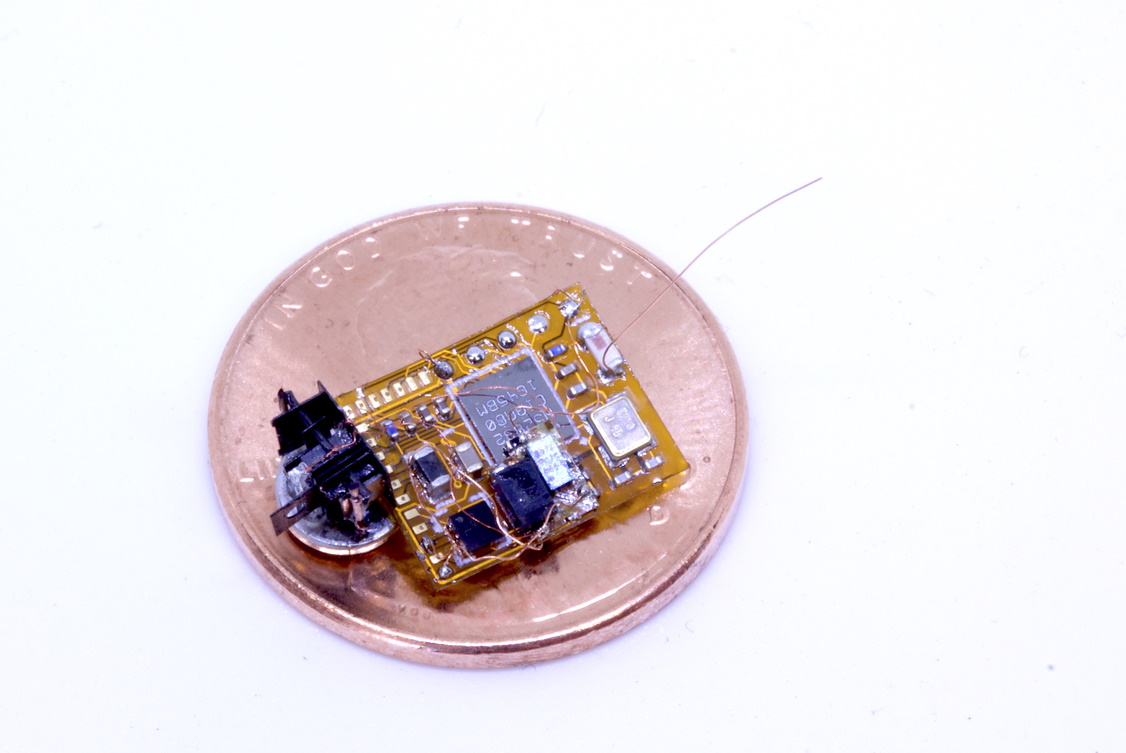
The sensor platform, which you can see below on top of a penny, could be anything from environmental monitoring to a microphone or light-sensing device. The battery could last for years on a power-sipping board like this, so it’s potentially a great match for long-term monitoring of hard-to-reach places.

A tiny sensor sitting on top of a penny.

Image Credits: Mark Stone/University of Washington

A key aspect of the setup is the release system. To keep things lightweight and simple, the little sensor is held on with a tiny magnetic pin. A wireless signal can be sent that creates a current in a coil surrounding the pin, affecting its magnetic field and dropping the gadget.

It’s small enough to be carried quiet easily by a moth — though it must be noted that the hawk moth isn’t exactly the smallest moth of all time; they get up to hummingbird size, as I’ve experienced myself. But it looks as if the tiny device would fit easily on a smaller species as well. Maybe that’s the next experiment.

Cheap, long-lasting sensors carried to every corner of an ecosystem by moths (or other insects) could produce very interesting data for those who study those ecosystems. Sure, you could also use it to sneak a mic into a top secret area, but I’m sure no one would try that.

The research, funded by the National Science Foundation, was presented at Mobicom 2020.

News: Waymo and TuSimple autonomous trucking leaders on the difficulty of building a highway-safe AI

TuSimple and Waymo are in the lead in the emerging sector of autonomous trucking; TuSimple founder Xiaodi Hou and Waymo trucking head Boris Sofman had an in-depth discussion of their industry and the tech they’re building at TC Mobility 2020. Interestingly, while they’re solving for the same problems, they have very different backgrounds and approaches.

TuSimple and Waymo are in the lead in the emerging sector of autonomous trucking; TuSimple founder Xiaodi Hou and Waymo trucking head Boris Sofman had an in-depth discussion of their industry and the tech they’re building at TC Mobility 2020. Interestingly, while they’re solving for the same problems, they have very different backgrounds and approaches.

Hou and Sofman started out by talking about why they were pursuing the trucking market in the first place. (Quotes have been lightly edited for clarity.)

“The market is massive; I think in the United States, $700-800 billion a year is spent on the trucking industry. It’s continuing to grow every single year,” said Sofman, who joined Waymo from Anki last year to lead the effort in freight. “And there’s a huge shortage of drivers today, which is only going to increase over the next period of time. It’s just such a clear need. But it’s not going to be overnight — there’s still a really long tail of challenges that you can’t avoid. So the way we talk about it is the things that are hardest are just different.”

“It’s really the cost and reward analysis, thinking about building the operating system,” said Hou. “The cost is the number of features that you develop, and the reward is basically how many miles are you driving — you charge on a per mile basis. From that cost reward analysis, trucking is simply the natural way to go for us. The total number of issues that you need to solve is probably 10 times less, but maybe, you know, five times harder.”

“It’s really hard to quantify those numbers, though,” he concluded, “but you get my point.”

The two also discussed the complexity of creating a perceptual framework good enough to drive with.

“Even if you have perfect knowledge of the world, you have to predict what other objects and agents are going to do in that environment, and then make a decision yourself and the combination knows is very challenging,” said Sofman.

“What’s really helped us is a realization from the car side of the of the company many, many years ago that that in order to help us solve this problem in the easiest way possible, and facilitate the challenges downstream, we had to create our own sensors,” he continued. “And so we have our own lidar, our own radar, our own cameras, and they have incredibly unique properties that were custom designed through five generations of hardware that try to really lean into the most kind of most challenging situations that you just can’t avoid on the road.”

Hou explained that while many autonomous systems are descended from the approaches used in the famous DARPA Grand Challenge 15 years ago, TuSimple’s is a little more anthropomorphic.

“I think I’m heavily influenced by my background, which has a tinge of neuroscience. So I’m always thinking about building a machine that can see and think, as humans do,” he said. “In the DARPA challenge, people’s idea would be: Okay, write a dynamic system equation and solve this equation. For me, I’m trying to answer the question of, how do we reconstruct the world? Which is more about understanding the objects, understanding their attributes, even though some of the attributes may not directly contribute to the entire self-driving system.”

“We’re combining all the different, seemingly useless features together, so that we can reconstruct the so-called ‘qualia’ of the perception of the world,” continued Hou. “By doing that we find we have all the ingredients that we need to do whatever missions that we have.”

The two found themselves in disagreement over the idea that due to the major differences between highway driving and street-level driving, there are essentially two distinct problems to be solved.

Hou was of the opinion that “the overlap is rather small. Human society has declared certain types of rules for driving on the highway, this is a much more regulated system. But for local driving there’s actually no rules for interaction… in fact very different implicit social constructs to drive in different areas of the world. These are things that are very hard to model.”

Sofman, on the other hand, felt that while the problems are different, solving one contributes substantially to solving the other: “If you break up the problem into the many, many building blocks of an AV system, there’s a pretty huge leverage where even if even if you don’t solve the problem 100 percent it takes away 85-90 percent of the complexity. We use the exact same sensors, exact same compute infrastructures, simulation framework, the perception system carries over, very largely, even if we have to retrain some of the models. The core of all of our algorithms are, we’re working to keep them the same.”

You can see the rest of that last exchange in the video above.

News: Tech’s role in the COVID-19 response: Assist, don’t reinvent

The pandemic has affected just about every business in the world, but tech has also geared up to fight back in its own way, as we found out from speakers at Disrupt 2020. But technology has opted to take a back seat to frontline workers and find ways to support them rather than attempt to

The pandemic has affected just about every business in the world, but tech has also geared up to fight back in its own way, as we found out from speakers at Disrupt 2020. But technology has opted to take a back seat to frontline workers and find ways to support them rather than attempt to “solve” the issues at hand.

The founders of tech-forward healthcare startups Color and Carbon Health explained their approach in one panel, emphasizing that the startup mindset is a resilient and adaptable one.

“You’re seeing, I think, the distributed nature of the U.S., where at some point it’s clear that you can’t wait for someone to solve your problem, so people just start jumping in and building the solution themselves,” said Othman Laraki, Color’s CEO.

His company took on the issue of bottlenecks in the COVID-19 testing ecosystem, finding that with a few tweaks Color could contribute a considerable amount.

“We realized that there were several assets that we could bring to bear,” he said. “We decided to build a platform to get around some of the logistical constraints and the supply chain constraints around COVID testing. We did that, got large-scale COVID testing lab online, but also repurposed a lot of our digital platforms for COVID testing … I think we’re doing approximately 75% of all the testing in SF right now.”

Carbon Health CEO Eren Bali noted that companies like theirs are important props at a time when the medical infrastructure of the country buckles under pressure.

“At this point the U.S. doesn’t have the best public health system, but at the same time we have best-in-class private companies who can sometimes operate a lot more efficiently than governments can,” he said. “We also just recently launched a program to help COVID-positive patients get back to health quickly, a rehabilitation program. Because as you know even if you survive it doesn’t mean your body was not affected, there are permanent effects.”

This type of at-home care has become increasingly important, both to take pressure off hospitals and frontline workers and to improve accessibility to resources.

“Sometimes the cost of care is a lesser problem compared to the access,” said Laraki. “Like if you need to drive for an hour and take time out of your day, etc., if you’re an hourly worker. That’s what makes healthcare inaccessible.”

News: Affirm files confidentially to go public

This afternoon Affirm, a startup focused on providing point-of-sale credit to consumers making online purchases, announced that it has filed to go public. The filing is confidential, so there’s little to be gleaned about the company’s performance from the news. That Affirm was exploring a public offering was reported by the Wall Street Journal back

This afternoon Affirm, a startup focused on providing point-of-sale credit to consumers making online purchases, announced that it has filed to go public.

The filing is confidential, so there’s little to be gleaned about the company’s performance from the news. That Affirm was exploring a public offering was reported by the Wall Street Journal back in July. In the aftermath of that news, TechCrunch tried to understand the valuation that Affirm was said to be targeting in its debut, which we placed at as much as $10 billion.

Affirm has been richly funded throughout its private life. The fintech unicorn has raised private funds in excess of $1 billion, including a $500 million Series G in September of 2020, a $300 million Series F in April of 2019, and a $200 million Series E in December of 2017. Affirm also raised more than $400 million in earlier equity rounds, and a $100 million debt line in late 2016.

Many venture bets are therefore riding on the success of Affirm and its future liquidity.

The company was valued at $2.9 billion at the time of its $300 million Series F last year according to PitchBook data. The company’s most recent valuation is not known. How much of a step-up a $10 billion public valuation would be, therefore, from its final private valuation is not clear.

Affirm will enter warm public markets if it chooses to list in short-order. The third quarter of 2020 was a bonanza of public-market liquidity, as the United States saw its most active quarter of public offerings since at least 2016, partially driven by the craze around SPACs. With retail investors and larger checkbooks alike active in their interest for growth-focused shares, unprofitable tech startups have done well in their recent debuts.

Those that make money have done even better, certain outliers like Snowflake aside.

After a confidential filing, Affirm will wait to hear back from the SEC on its application, and then will have the choice to file a non-confidential S-1 when it is ready. There is no set timeline here, but once the company’s numbers are public, we’ll be diving into them. Affirm joins other recent companies like Palantir who filed their public offerings confidentially first, before later making them public.

News: These 3 factors are holding back podcast monetization

If we want podcasting to continue to scale beyond its current and projected advertising revenue heights, we need to resolve some fundamental challenges.

Krystina Rubino
Contributor

Krystina Rubino is a marketing executive who leads the offline growth marketing practice at Right Side Up.

Grant Durando
Contributor

Grant Durando is a growth marketing leader, currently consulting on podcast and offline advertising at Right Side Up.

Podcast advertising growth is inhibited by three major factors:

  • Lack of macro distribution, consumption and audience data.
  • Current methods of conversion tracking.
  • Idea of a “playbook” for podcast performance marketing.

Because of these limiting factors, it’s currently more of an art than a science to piece disparate data from multiple sources, firms, agencies and advertisers, into a somewhat conclusive argument to brands as to why they should invest in podcast advertising.

1. Lack of macro distribution, consumption and audience data

There were several resources that released updates based on what they saw in terms of consumption when COVID-19 hit. Hosting platforms, publishers and third-party tracking platforms all put out their best guesses as to what was happening. Advertisers’ own podcast listening habits had been upended due to lockdowns; they wanted to know how broader changes in listening habits were affecting their campaigns. Were downloads going up, down or staying the same? What was happening with sports podcasts, without sports?


Read part 1 of this article, Podcast advertising has a business intelligence gap, on TechCrunch.


At Right Side Up, we receive and analyze all of the available research from major publishers (Stitcher, aCast), to major platforms (Megaphone) and third-party research firms (Podtrac, IAB, Edison Research). However, no single entity encompasses the entire space or provides the kind of interactive, off-the-shelf customizable SaaS product we’d prefer, and that digitally native marketers expect. Plus, there isn’t anything published in real-time; most sources publish once or twice annually.

So what did we do? We reached out to trusted publishers and partners to gather data around shifting consumption due to COVID-19 ourselves, and determined that, though there was a drop in downloads in the short term, it was neither as precipitous nor as enduring as some had feared. This was confirmed by some early reports available, but how were we to evidence our own piecewise sample with another? Moreover, how could you invest 6-7 figures of marketing dollars if you didn’t have the firsthand intelligence we gathered and our subject matter experts on deck to make constant adjustments to your approach?

We were able to piece together trends we’re seeing that point to increased download activity in recent months that surpass February/March heights. We’ve determined that the industry is back on track for growth with a less steep, but still growing, listenership trajectory. But even though more recent reports have been published, a longitudinal, objective resource has not yet emerged to show a majority of the industry’s journey through one of the most disruptive media environments in recent history.

There is a need for a new or existing entity to create cohesive data points; a third party that collects and reports listening across all major hosts and distribution points, or “podcatchers,” as they’re colloquially called. As a small example: Wouldn’t it be nice to objectively track seasonal listening of news/talk programming and schedule media planning and flighting around that? Or to know what the demographics of that audience look like compared to other verticals?

What percentage increase in efficiency and/or volume would you gain from your marketing efforts in the channel? Would that delta be profitable against paying a nominal or ongoing licensing or research fee for most brands?

These challenges aren’t just affecting advertisers. David Cohn, VP of Sales at Megaphone, agrees that “full transparency from the listening platforms would make our jobs easier, along with everyone else’s in the industry. We’d love to know how much of an episode is listened to, whether an ad is skipped, etc. Along the same lines, having a central source for [audience] measurement would be ideal — similar to what Nielsen has been for TV.” This would also enable us to understand cross-show ad frequency, another black box for advertisers and the industry at large.

News: Podcast advertising has a business intelligence gap

Widespread misinformation and misconceptions are delaying ad revenue growth for podcast creators, publishers and networks.

Krystina Rubino
Contributor

Krystina Rubino is a marketing executive who leads the offline growth marketing practice at Right Side Up.

Grant Durando
Contributor

Grant Durando is a growth marketing leader, currently consulting on podcast and offline advertising at Right Side Up.

There are sizable, meaningful gaps in the knowledge collection and publication of podcast listening and engagement statistics. Coupled with still-developing advertising technology because of the distributed nature of the medium, this causes uncertainty in user consumption and ad exposure and impact. There is also a lot of misinformation and misconception about the challenges marketers face in these channels.

All of this compounds to delay ad revenue growth for creators, publishers and networks by inhibiting new and scaling advertising investment, resulting in lost opportunity among all parties invested in the channel. There’s a viable opportunity for a collective of industry professionals to collaborate on a solution for unified, free reporting, or a new business venture that collects and publishes more comprehensive data that ultimately promotes growth for podcast advertising.

Podcasts have always had challenges when it comes to the analytics behind distribution, consumption and conversion. For an industry projected to exceed $1 billion in ad spend in 2021, it’s impressive that it’s built on RSS: A stable, but decades-old technology that literally means really simple syndication. Native to the technology is a one-way data flow, which democratizes the medium from a publishing perspective and makes it easy for creators to share content, but difficult for advertisers trying to measure performance and figure out where to invest ad dollars. This is compounded by a fractured creator, server and distribution/endpoint environment unique to the medium.

Because podcasts lag other media channels in business intelligence, it’s still an underinvested channel relative to its ability to reach consumers and impact purchasing behavior.

For creators, podcasting has begun to normalize distribution analytics through a rising consolidation of hosts like Art19, Megaphone, Simplecast and influence from the IAB. For advertisers, though, consumption and conversion analytics still lag far behind. For the high-growth tech companies we work with, and as performance marketers ourselves, measuring the return on investment of our ad spend is paramount.

Because podcasts lag other media channels in business intelligence, it’s still an underinvested channel relative to its ability to reach consumers and impact purchasing behavior. This was evidenced when COVID-19 hit this year, as advertisers that were highly invested or highly interested in investing in podcast advertising asked a very basic question: “Is COVID-19, and its associated lifestyle shifts, affecting podcast listening? If so, how?”

The challenges of decentralized podcast ad data

We reached out to trusted partners to ask them for insights specific to their shows.

Nick Southwell-Keely, U.S. director of Sales & Brand Partnerships at Acast, said: “We’re seeing our highest listens ever even amid the pandemic. Across our portfolio, which includes more than 10,000 podcasts, our highest listening days in Acast history have occurred in [July].” Most partners provided similar anecdotes, but without centralized data, there was no one, singular firm to go to for an answer, nor one report to read that would cover 100% of the space. Almost more importantly, there is no third-party perspective to validate any of the anecdotal information shared with us.

Publishers, agencies and firms all scrambled to answer the question. Even still, months later, we don’t have a substantial and unifying update on exactly what, if anything, happened, or if it’s still happening, channel-wide. Rather, we’re still checking in across a wide swath of partners to identify and capitalize on microtrends. Contrast this to native digital channels like paid search and paid social, and connected, yet formerly “traditional” media (e.g., TV, CTV/OTT) that provide consolidated reports that marketers use to make decisions about their media investments.

The lasting murkiness surrounding podcast media behavior during COVID-19 is just one recent case study on the challenges of a decentralized (or nonexistent) universal research vendor/firm, and how it can affect advertisers’ bottom lines. A more common illustration of this would be an advertiser pulling out of ads, for fear of underdelivery on a flat rate unit, missing out on incremental growth because they were worried about not being able to get download reporting and getting what they paid for. It’s these kinds of basic shortcomings that the ad industry needs to account for before we can hit and exceed the ad revenue heights projected for podcasting.

Advertisers may pull out of campaigns for fear of under-delivery, missing out on incremental growth because they were worried about not getting what they paid for.

If there’s a silver lining to the uncertainty in podcast advertising metrics and intelligence, it’s that supersavvy growth marketers have embraced the nascent medium and allowed it to do what it does best: personalized endorsements that drive conversions. While increased data will increase demand and corresponding ad premiums, for now, podcast advertising “veterans” are enjoying the relatively low profile of the space.

As Ariana Martin, senior manager, Offline Growth Marketing at Babbel notes, “On the other hand, podcast marketing, through host read ads, has something personal to it, which might change over time and across different podcasts. Because of this personal element, I am not sure if podcast marketing can ever be transformed into a pure data game. Once you get past the understanding that there is limited data in podcasting, it is actually very freeing as long as you’re seeing a certain baseline of good results, [such as] sales attributed to podcast [advertising] via [survey based methodology], for example.”

So how do we grow from the industry feeling like a secret game-changing channel for a select few brands, to widespread adoption across categories and industries?

Below, we’ve laid out the challenges of nonuniversal data within the podcast space, and how that hurts advertisers, publishers, third-party research/tracking organizations, and broadly speaking, the podcast ecosystem. We’ve also outlined the steps we’re taking to make incremental solutions, and our vision for the industry moving forward.

Lingering misconceptions about podcast measurement

1. Download standardization

In search of a rationale to how such a buzzworthy growth channel lags behind more established media types’ advertising revenue, many articles will point to “listener” or “download” numbers not being normalized. As far as we can tell at Right Side Up, where we power most of the scaled programs run by direct advertisers, making us a top three DR buying force in the industry, the majority of publishers have adopted the IAB Podcast Measurement Technical Guidelines Version 2.0.

This widespread adoption solved the “apples to apples” problem as it pertained to different networks/shows valuing a variable, nonstandard “download” as an underlying component to their CPM calculations. Previous to this widespread adoption, it simply wasn’t known whether a “download” from publisher X was equal to a “download” from publisher Y, making it difficult to aim for a particular CPM as a forecasting tool for performance marketing success.

However, the IAB 2.0 guidelines don’t completely solve the unique-user identification problem, as Dave Zohrob, CEO of Chartable points out. “Having some sort of anonymized user identifier to better calculate audience size would be fantastic —  the IAB guidelines offer a good approximation given the data we have but [it] would be great to actually know how many listeners are behind each IP/user-agent combo.”

2. Proof of ad delivery

A second area of business intelligence gaps that many articles point to as a cause of inhibited growth is a lack of “proof of delivery.” Ad impressions are unverifiable, and the channel doesn’t have post logs, so for podcast advertisers the analogous evidence of spots running is access to “airchecks,” or audio clippings of the podcast ads themselves.

Legacy podcast advertisers remember when a full-time team of entry-level staffers would hassle networks via phone or email for airchecks, sometimes not receiving verification that the spot had run until a week or more after the fact. This delay in the ability to accurately report spend hampered fast-moving performance marketers and gave the illusion of podcasts being a slow, stiff, immovable media type.

Systematic aircheck collection has been a huge advent and allowed for an increase in confidence in the space — not only for spend verification, but also for creative compliance and optimization. Interestingly, this feature has come up almost as a byproduct of other development, as the companies who offer these services actually have different core business focuses: Magellan AI, our preferred partner, is primarily a competitive intelligence platform, but pivoted to also offer airchecking services after realizing what a pain point it was for advertisers; Veritone, an AI company that’s tied this service to its ad agency, Veritone One; and Podsights, a pixel-based attribution modeling solution.

3. Competitive intelligence

Last, competitive intelligence and media research continue to be a challenge. Magellan AI and Podsights offer a variety of fee and free tiers and methods of reporting to show a subset of the industry’s activity. You can search a show, advertiser or category, and get a less-than-whole, but still directionally useful, picture of relevant podcast advertising activity. While not perfect, there are sufficient resources to at least see the tip of the industry iceberg as a consideration point to your business decision to enter podcasts or not.

As Sean Creeley, founder of Podsights, aptly points out: “We give all Podsights research data, analysis, posts, etc. away for free because we want to help grow the space. If [a brand], as a DIY advertiser, desired to enter podcasting, it’s a downright daunting task. Research at least lets them understand what similar companies in their space are doing.”

There is also a nontech tool that publishers would find valuable. When we asked Shira Atkins, co-founder of Wonder Media Network, how she approaches research in the space, she had a not-at-all-surprising, but very refreshing response: “To be totally honest, the ‘research’ I do is texting and calling the 3-5 really smart sales people I know and love in the space. The folks who were doing radio sales when I was still in high school, and the podcast people who recognize the messiness of it all, but have been successful at scaling campaigns that work for both the publisher and the advertiser. I wish there was a true tracker of cross-industry inventory — how much is sold versus unsold. The way I track the space writ large is by listening to a sample set of shows from top publishers to get a sense for how they’re selling and what their ads are like.”

Even though podcast advertising is no longer limited by download standardization, spend verification and competitive research, there are still hurdles that the channel has not yet overcome.


The conclusion to this article, These 3 factors are holding back podcast monetization, is available exclusively to Extra Crunch subscribers.

News: Killer Mike, former Atlanta mayor Andrew Young, and Bounce TV founder Ryan Glover launch a digital bank

A group of Black Atlanta businessmen, politicians and entertainers — including former Atlanta Mayor Andrew Young, the entertainer Michael Render (better known as Killer Mike) and Bounce TV founder Ryan Glover — have launched a new digital bank focused on developing and promoting local communities and cultivating Black and Latinx entrepreneurs and small businesses. Named

A group of Black Atlanta businessmen, politicians and entertainers — including former Atlanta Mayor Andrew Young, the entertainer Michael Render (better known as Killer Mike) and Bounce TV founder Ryan Glover — have launched a new digital bank focused on developing and promoting local communities and cultivating Black and Latinx entrepreneurs and small businesses.

Named Greenwood in an homage to the thriving Tulsa, Okla., business community known as “Black Wall Street” that was destroyed by white rioters in 1921, the digital bank has several features designed to promote social causes and organizations for the Black and Latinx community.

For every sign-up to the bank, Greenwood will donate the equivalent of five free meals to an organization addressing food insecurity. And every time a customer uses a Greenwood debit card, the bank will make a donation to either the United Negro College Fund, Goodr (an organization that addresses food insecurity) or the National Association for the Advancement of Colored People.

In addition, each month the bank will provide a $10,000 grant to a Black or Latinx small business owner that uses the company’s financial services.

For Render, the decision to launch a new digital bank alongside Young and Glover was a way to link Atlanta’s well-established, centuries-old Black business community with the technologies that are redefining wealth and creating new opportunities in the twenty first century. It was also a way to equip a new generation with financial tools that could empower them instead of undermine them.

“What I have learned about capitalism is that you’re either going to be a participant in it or a victim of it,” said Render. “The ultimate protest is focusing your dollar like a weapon.”

Young, who is also the U.S. ambassador to the United Nations, had seen the ways digital banking technologies were transforming the social order in countries like India — reducing the power of payday lenders and providing greater economic access — and wanted to bring those opportunities to communities in the U.S.

Atlanta is a perfect home for a new Black-owned digital bank. After riots in 1906 destroyed Atlanta’s own bustling Black business district in a prelude to the Greenwood Massacre 15 years later, the community rebuilt with banks like Citizen’s Trust (founded in 1921) and Carver (founded in 1946) serving the city’s Black community.

Rendon, a serial entrepreneur who owns a chain of barber shops called the SWAG Shop, some real estate, and a restaurant along with the rapper TI, said that he’s not just a founder of Greenwood, he’ll soon become a customer.

“Today, a dollar circulates for 20 days in the white community but only six hours in the Black community,” said Render in a statement.”Moreover, a Black person is twice as likely as a white person to be denied a mortgage. This lack of fairness in the financial system is why we created Greenwood.”

Greenwood will offer a physical debit card and savings and checking accounts to its customers — along with all of the digital features one would expect, including integrations with Apple, Samsung and Google Pay, the ability to make peer-to-peer payments, mobile checking deposits and free ATM usage at over 30,000 locations.

“It’s no secret that traditional banks have failed the Black and Latinx community,” said Glover, in a statement. “We needed to create a new financial platform that understands our history and our needs going forward, a banking platform built by us and for us, a platform that helps us build a stronger future for our communities. This is our time to take back control of our lives and our financial future. That is why we launched Greenwood, modern banking for the culture.”

To run the bank, the founding team hired Aparicio Giddins, who’s serving as the company’s president and chief technology officer. David Tapscott, a former executive with Combs Enterprises and Green Dot, is serving as the company’s chief marketing officer. Andrew “Bo” Young III, the managing partner of Andrew Young Investment Group and Paul Judge, the co-founder of Pindrop and TechSquare Labs, both have seats on the company’s board of directors.

The timing for Greenwood’s launch is somewhat auspicious, coming as it does nearly a century after the launch of Citizen’s Trust and days after the chief executive of Wells Fargo, Charles Scharf, said really, really dumb things about diversity in the financial services industry.

Backing the company is a $3 million commitment from undisclosed angel investors. The bank is currently taking deposits and the hope, according to Rendon, is for it to start a new wave of entrepreneurial activity among young Black and Latinx community members and their allies.

“The work that we did in the civil rights movement wasn’t just about being able to sit at the counter. It was also about being able to own the restaurant,” said Ambassador Young. “We have the skills, talent and energy to compete anywhere in the world, but to grow the economy, it has to be based on the spirit of the universe and not the greed of the universe. Killer Mike, Ryan and I are launching Greenwood to continue this work of empowering Black and brown people to have economic opportunity.”

WordPress Image Lightbox Plugin