Yearly Archives: 2020

News: Yotascale raises a $13M Series B to help companies track and manage their cloud spends

These days when you found a startup, you don’t go out and buy a rack of servers. And you don’t build an in-house datacenter team. Instead, you farm out your infrastructure needs to the major cloud platforms, namely Amazon AWS, Microsoft Azure and Google Cloud. That’s all well and good, but over time any startup’s

These days when you found a startup, you don’t go out and buy a rack of servers. And you don’t build an in-house datacenter team. Instead, you farm out your infrastructure needs to the major cloud platforms, namely Amazon AWS, Microsoft Azure and Google Cloud.

That’s all well and good, but over time any startup’s cloud setup will become more complex, varied and perhaps multi-provider. Throw in microservices and one can wind up with a big muddle, and an even bigger bill. That’s the problem that Yotascale wants to attack.

And there’s money backing the startup’s progress, including $13 million in new capital. The round, a Series B, was led by Aydin Senkut at Felicis with participation from other capital pools, including Engineering Capital, Pelion Ventures and Crosslink Capital. Yotascale has now raised $25 million in total.

The funding event caught my eye, as I’ve heard startup CEOs discuss their public cloud spends in somewhat bitter terms; it’s hard for most startups to change infrastructure direction after they get off the ground, which means that as they grow, so too does their outflow of dollars to the major tech companies. The same megacaps that might turn around and compete with the very same startups that are pumping up their revenues and margins.

So spending less on AWS or Azure would be nice for startups. Yotascale wants to be the helper for lots of companies to better understand and attribute that spend the correct part of their platform or service, perhaps lowering aggregate spend at the same time.

Let’s talk about how Yotascale got to where it is today.

The startup’s CEO, Asim Razzaq, talked TechCrunch through his company’s history, which didn’t get started until after he had wrapped up tenure at both another startup, and PayPal.

When he set out to found Yotascale, Razzaq didn’t fire up a deck, raise capital and then get right to building. Instead, he first went out to do customer discovery work. That effort led him to the perspective that current solutions aimed at understanding cloud spend were insufficient and led to data being used against infrastructure teams in arguments for lower spend when it wasn’t a good idea (cutting backup expenses, for example).

During that time he also determined who Yotascale’s target customer is, namely the head of platform engineering at a company.

The startup self-funded for a while, with Razzaq telling TechCrunch that he wanted to be completely sure that he had conviction concerning the project before moving ahead.

After starting to work on Yotascale in mid 2015, the company raised some capital in 2016. It set out to solve the spend attribution problem that companies with public cloud contracts deal with — including having to contend with modern architecture and its related issues — while earning the trust of engineers, according to Razzaq.

From its period of customer discovery to working on product market fit after raising funds from Engineering Capital, Yotascale raised a Series A in mid-2018. Why? Because, Razzaq, told TechCrunch, as ones gains conviction, one must scale their team. And thus more capital was required.

During our chat with the CEO, it was notable how sequential his company-building process has proven. From talking to potential customers, to working to understand who his buyer is, to waiting on scaling the startup’s go-to-market efforts until he was confident in product-market fit, Yotascale seems to follow the inverse of the “raise lots and spend fast and try to win right away” model that became quite popular during the unicorn era.

How did Yotascale know when it found product market fit? According to its CEO, when companies started pulling the startup into their operations and not the other way around.

Yotascale reported 4x year-over-year annual recurring revenue (ARR) growth at some point this year, though Razzaq was diffident about sharing specifics concerning the metric.

Sticking to the theme of reasonableness and caution, when asked about why his Series B is modest in size, Razzaq said that he was not interested in raising big rounds, and that $13 million is an amount of money that can move his company forward. What’s coming from the company? Yotascale wants to add support for Azure and Google Cloud in addition to its AWS work of today, to pick an example.

(You can find other hints that Yotascale is perhaps more mature than its peers at its current age. For example, in 2018 the company hired a new chief revenue officer, even putting out a release on the matter.)

That’s enough on this particular round. What will prove interesting is how far Yotascale can push its ARR up by the end of Q3 2021. And if it raises again before then.

News: Free-to-play gaming giant Roblox confidentially files to go public

The gaming company Roblox announced today that it had confidentially filed paperwork with the SEC to make its public debut. In February, the company which operates a free-to-play gaming empire with tens of million of users, was valued at $4 billion after a Series G funding round led by Andreessen Horowitz . The company has

The gaming company Roblox announced today that it had confidentially filed paperwork with the SEC to make its public debut.

In February, the company which operates a free-to-play gaming empire with tens of million of users, was valued at $4 billion after a Series G funding round led by Andreessen Horowitz . The company has raised more than $335 million in venture capital funding according to Crunchbase.

The company has not detailed the number of shares it plans to offer and furthermore notes in standard legalese that their timely debut is “subject to market and other conditions.” After a slow 2019 for tech IPOs the rebound of public markets in mid-pandemic 2020 has provided an awfully wide window for tech startups reaching for their debuts.

In the games space, we recently saw the debut of Unity Technologies, which makes a popular game engine that developers use to build and monetize gaming titles.

Roblox offers an interesting sell to both consumers and developers, shipping a free-to-play vision of the future which pushes developers away from graphics-intense game design towards building content that can be played on a wide variety of devices. The games company has been more successful than most in translating a first-party experience’s success into a robust developer network. Roblox’s platform has been particularly successful with young audiences.

News: Bumble balances gender representation of C-Suite with two new hires

Women-friendly dating and networking app Bumble announced today it’s expanding its C-Suite with two new hires: Anu Subramanian as Bumble’s Chief Financial Officer, who hails from Univision, and Selby Drummond as Chief Brand Officer, who is joining from Snap. The additions also create something of a milestone for Bumble, as the company can now claim

Women-friendly dating and networking app Bumble announced today it’s expanding its C-Suite with two new hires: Anu Subramanian as Bumble’s Chief Financial Officer, who hails from Univision, and Selby Drummond as Chief Brand Officer, who is joining from Snap. The additions also create something of a milestone for Bumble, as the company can now claim it has equal male-to-female representation across its C-Suite, which is, unfortunately, still unusual for a company of Bumble’s size.

Before the new hires, Bumble’s C-Suite included CEO Whitney Wolfe Herd, Chief Strategy Officer Sarah Jones Simmer,
General Counsel Mariko O’Shea, Chief of Staff Caroline Roache, President Tariq Shaukat, CMO Dominic Gallello, Chief Product Officer Miles Norris, CTO Ronen Benchetrit, CCO Robbie McKay, and Chief People Officer Tran Taylor.

Subramanian is joining Bumble from Univision Digital, where she had served as the Senior Vice President and Chief Financial Officer. In this position, she helped lead Univision’s digital assets, including its direct-to-consumer business. Before Univision, Subramanian had worked at VICE Media where she was the Chief Financial Officer of the company’s global digital business. She also worked in the past at Scripps Networks in various roles, including CFO of digital.

Drummond, meanwhile, had been Snapchat’s first-ever Global Head of Fashion and Beauty Partnerships. Her work at Snap included leading strategy and launch efforts for Snapchat’s new fashion and shopping features, as well as content initiatives across the Snapchat, Bitmoji, and Spectacles products. Before Snap, Drummond worked at American Vogue for eight years, where she had been a senior fashion editor. In her last role, she had risen to Accessories and Special Projects Director, working on brand partnerships with Off-White, Air Jordan, Kith, and Proenza Schouler, and was involved with the magazine, website and events like the Met Gala.

The two new additions to Bumble’s executive lineup arrive shortly after the company’s recent hires of its first-ever President Tariq Shaukat and Chief Technology Officer, Ronen Benchetrit.

Bumble says Subramanian and Drummond will partner with Bumble’s new and legacy executive leaders to support the company’s plans to expand its app to more countries and support its growth in Europe, Asia and Latin America.

The news follows what’s been a busy year for the dating and networking app. At the end of last year, Bumble took control of its business from its main backer, Badoo, valuing the now-profitable dating app at $3 billion. The deal also allowed Bumble CEO Wolfe Herd to run Bumble and other previously Badoo-backed dating apps, including Badoo, Lumen and Chappy.

According to reports, Bumble hit 100 million users this summer and is preparing to IPO in 2021, possibly at a $6 billion-plus valuation.

“The additions of Anu and Selby underscore our commitment, along with Blackstone, to strengthen our bench with world class talent that deeply epitomize our mission and values, said Wolfe Herd in a statement about the hiring news. “Not only will their contributions provide a powerful impact on our businesses, they’ve also brought equal representation of women and men on our executive leadership team — a milestone that means a great deal to me on many levels,” she added.


News: Seraphim Capital’s space tech accelerator releases details of its newest Space Camp cohort

The U.K.’s Seraphim Capital, the country’s only space tech accelerator, has released details of its newest cohort as part of its Space Camp programme, timed with the end of World Space Week last week. 4pi Lab Raised so far: Undisclosed amount / Non-Equity Assistance from Creative Destruction Lab Description: “4pi Lab is developing a Low-Earth

The U.K.’s Seraphim Capital, the country’s only space tech accelerator, has released details of its newest cohort as part of its Space Camp programme, timed with the end of World Space Week last week.

4pi Lab
Raised so far: Undisclosed amount / Non-Equity Assistance from Creative Destruction Lab
Description: “4pi Lab is developing a Low-Earth Orbit (LEO) satellite constellation providing real-time, wildfire detection, monitoring and reporting. Their unique sensor gives them the ability to detect wildfires at a 10m resolution globally helping to eradicate major catastrophic wildfire events.”

Clutch Space Systems
Raised so far: £300,000 from FSE Group Enterprise M3 Expansion Loan
Description: “Clutch Space Systems provides software-defined radio (SDR) ground stations for satellite communications. SDR ground station technology improves downlink communications, provides significant cost savings and is far more dynamic, acting as an enabler for the exponentially growing Satcoms market.”

Helix Technologies
Raised so far: N/A
Description: “Helix Technologies – enables precision GPS antennas, providing 10cm level accuracy. Through breakthroughs in manufacturing and RF technology, Helix has developed a new GNSS antenna with a ceramic core capable of precision dynamic position accuracy whilst being space efficient for demanding tel and navigation applications. The design also enables the antenna to be highly immune to reflection off infrastructure and jamming.”

Kinnami
Raised so far: Undisclosed amount / seed from ICE71 Accelerate, 25 June 2020
Description: “Kinnami uniquely secures and optimises data sharing, ongoing data migration and management across distributed systems. Kinnami has created a unique storage and security system, ‘AmiShare’, which fragments and encrypts data. By storing these encrypted fragments across a distributed network of devices, it can secure data collected on the edge and have application within Satcoms, Defence and Enterprise.”

Starfish Space
Raised so far: Undisclosed amount / seed, 1 December 2019
Description: “Starfish Space aims to create an on-demand, in-space transportation and maintenance service for orbiting satellites. Their proximity Operations software uses a combination of breakthrough orbital mechanics, Machine Vision AI, and a low-thrust electric propulsion system to enable them to use smaller and cheaper space tugs that can operate across orbits. This addresses Counter-space and Mission opportunities.”

Sust Global
Raised so far: N/A
Description: “Sust Global provides real-time geospatial monitoring at an asset-level for analyzing Climate Risk. Their platform uses data from multiple satellites and ground sources to create full-stack ‘Asset-Level Geospatial Analytics’. Sust combines this data with the latest Climate Models and Standardised Risk Assessments to analyze risk and gain quantitative actionable insights for the Financial Services sector.”

Vector Photonics
Raised so far: 2018 secured undisclosed funding from ICURe; 2019 £70,000 of funding from Engineering and Physical Sciences Research Council and £30,000 from a Glasgow company to support that award
Description: “Vector Photonics’ disruptive and revolutionary photonic crystal lasers push the boundaries of what is possible with conventional semiconductor lasers providing comparable costs and flexibility with edge-emitting laser performance. Its unique beam steering capability is industry-changing in Datacoms and aligned markets like LIDAR.”

News: Google updates Android Studio with better TensorFlow Lite support and a new database inspector

Google launched version 4.1 of Android Studio, its IDE for developing Android apps, into its stable channel today. As usual for Android Studio, the minor uptick in version numbers doesn’t quite do the update justice. It includes a vast number of new and improved features that should make life a little bit easier for Android

Google launched version 4.1 of Android Studio, its IDE for developing Android apps, into its stable channel today. As usual for Android Studio, the minor uptick in version numbers doesn’t quite do the update justice. It includes a vast number of new and improved features that should make life a little bit easier for Android developers. The team also fixed a whopping 2,370 bugs during this release cycle and closed 275 public issues.

Image Credits: Google

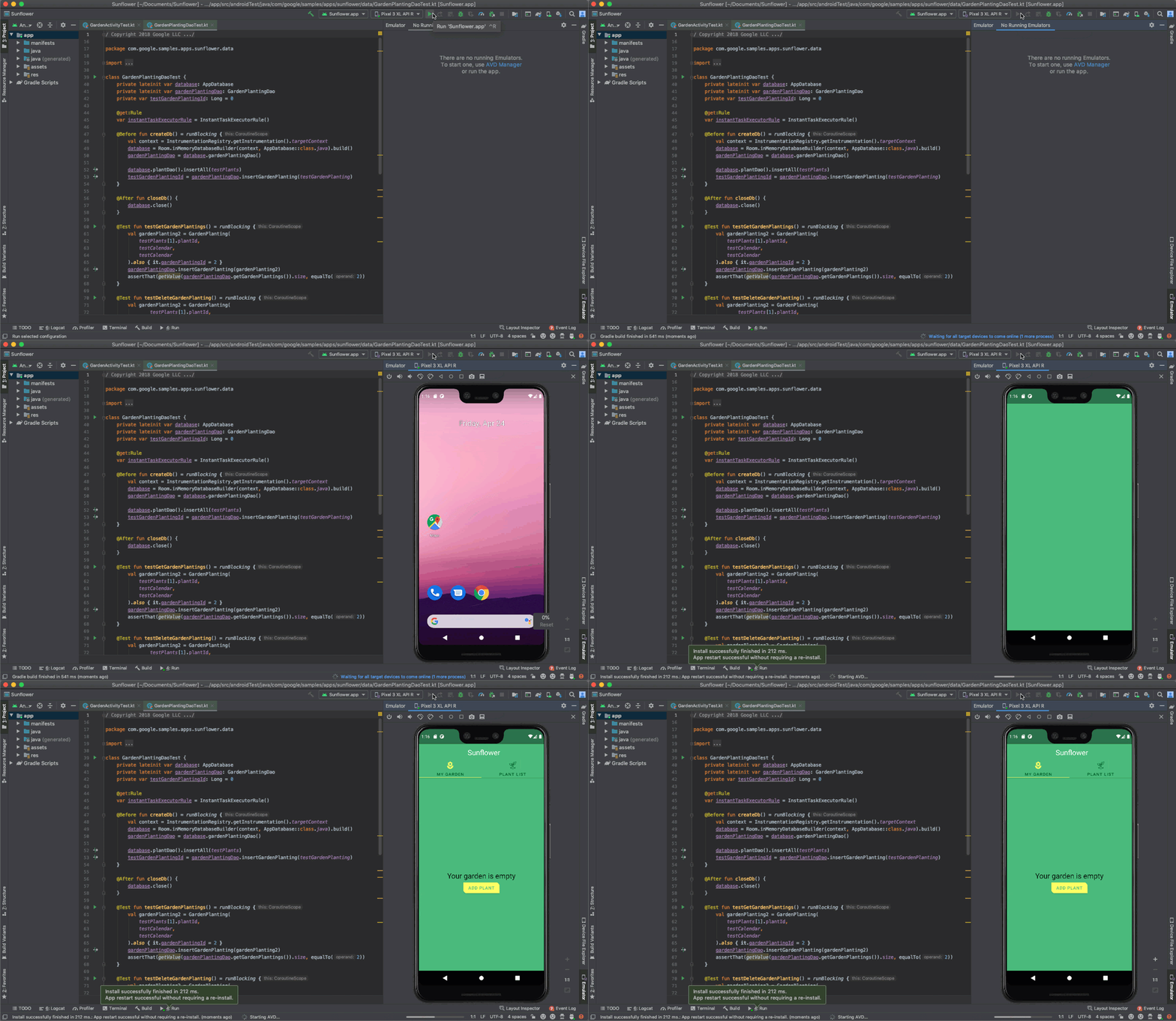
The highlights of today’s release are a new database inspector and better support for on-device machine learning by allowing developers to bring TensorFlow Lite models to Android, as well as the ability to run the Android Emulator right inside of Android Studio and support for testing apps for foldable phones in the emulator as well. That’s in addition to various other changes the company has outlined.

The one feature that will likely improve the quality of life for developers the most is the ability to run the Android Emulator right in Android Studio. That’s something the company announced earlier this summer, so it’s not a major surprise, but it’s a nice update for developers, as they won’t have to switch back and forth between different windows and tools to test their apps.

Talking about testing, the other update is support for foldable devices in the Android Emulator, which now allows developers to simulate the hinge angle sensor and posture changes so their apps can react accordingly. That’s still a niche market, obviously, but more and more developers are now aiming to offer apps to actually support these devices.

Image Credits: Google

Also new is improved support for TensorFlow Lite models in Android Studio, so that developers can bring those models to their apps, as well as a new database inspector that helps developers get easier insights into their queries and the data they return — and that lets them modify values while running their apps to see how their apps react to those.

Other updates include new templates in the New Project dialog that support Google’s Material Design Components, Dagger navigation support, System Trace UI improvements and new profilers to help developers optimize their apps’ performance and memory usage.

News: Amazon launches an AR app that works with new QR codes on its boxes

Amazon has quietly launched a new augmented reality application that works with QR codes on the company’s shipping boxes to create “interactive, shareable” AR experiences. Called simply “Amazon Augmented Reality,” the retailer describes the app as a “fun way to reuse your Amazon boxes until you’re ready to drop them in the recycling bin.” As

Amazon has quietly launched a new augmented reality application that works with QR codes on the company’s shipping boxes to create “interactive, shareable” AR experiences. Called simply “Amazon Augmented Reality,” the retailer describes the app as a “fun way to reuse your Amazon boxes until you’re ready to drop them in the recycling bin.”

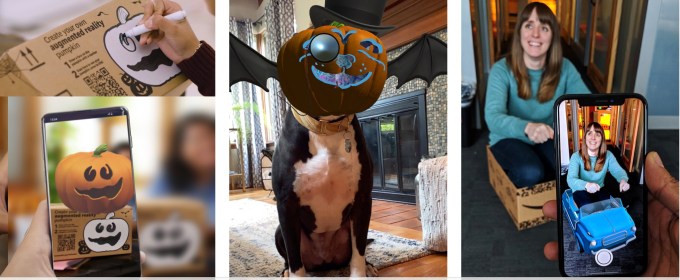
As shown in the App Store’s screenshots of the new app, different Amazon boxes will offer unique activities for the AR experience. For example, one screenshot shows someone drawing the face on a pre-printed white pumpkin to turn it into a jack-o-lantern. When they then scan the QR code, the pumpkin jumps out as an AR object. Another screenshot shows an AR pumpkin and bat wings over top an image of a dog. And one shows the Amazon box turning into a little blue AR car when the QR code is scanned.

In the accompanying App Store video, there are other animated characters, including the Amazon smile logo itself an an AR corgi dog that jumps out playfully when the QR code is scanned.

The company notes in the description that if your iPhone is also capable of TrueDepth technology, the app can also use the device’s camera to track your facial movements to enable features like a “selfie” mode.

The app, which debuted a few days ago on the iOS App Store and Google Play, offers no other functionality if not used alongside an Amazon box that supports the new QR codes. (However, you can test out the experience here if you don’t have a box to use.)

Image Credits: Amazon

At launch, however, the app appears to focus only on the pumpkin AR experience. Once you have designed and scanned your pumpkin into AR, you can then press other buttons to decorate the pumpkin further — by giving it a hat or outfit, changing its light or color, among other things. You can also flip the camera around to display the pumpkin on your selfie image, where it moves along with your face.  You can then press the Camera button in the app to snap a photo of your creation to share on social media.

The new QR code-enabled boxes are only beginning to roll out now, so you may not have received one just yet, we understand. The boxes are also made using less material, as part of Amazon’s ongoing “Less Packaging, More Smiles” campaign.

Amazon has been dabbling in AR for some time, most recently with the launch of a new AR shopping feature that allows users of its main Amazon shopping app to visualized multiple items of furniture or decor in their room at the same time. A few years ago, it had also launched a simpler version of AR shopping with a feature called AR View in its Amazon iOS app, built using ARKit.  It had also once tried out “shoppable stickers” that used AR to place basic stickers of products in your space, instead of realistic representations of the items.

With its latest launch of the AR View feature, however, Amazon had done the work to support Apple’s latest version of ARKit and likely wanted to experiment further with the possibilities. The box-scanning AR app could serve as a way to test consumer demand for more AR products. But Amazon doesn’t appear to be using this app to collect extensive research data. The App Store description notes that all the information processed using the new technology in Amazon’s new AR Player will remain on the device, and is not “stored, processed or shared by Amazon.”

The app is currently available on iOS and Android as a free download.

News: What to expect from Apple’s ‘Hi Speed’ iPhone event

For starters, iPhones, of course. That one was easy. The company skipped out on new mobile devices during its recent Apple Watch event, owing to COVID-19-related delays. And, of course, the fact that the events are all pre-taped and virtual now means companies can more easily split them up in ways that were harder to

For starters, iPhones, of course. That one was easy. The company skipped out on new mobile devices during its recent Apple Watch event, owing to COVID-19-related delays. And, of course, the fact that the events are all pre-taped and virtual now means companies can more easily split them up in ways that were harder to justify when people were expected to fly in from all over the world.

That doesn’t mean we won’t be getting more than just a phone (or, more like multiple phones). While Apple’s been more inclined to host more, smaller events, there’s a decent chance this is going to be the last major event the company hosts before the holidays. That means it’s going to want to get a lot of bang for its buck this time out.

The iPhone 12 is expected to be the centerpiece, of course. The headline feature will almost certainly be 5G. Apple’s been a little behind the curve on that front versus its Android competitors (Samsung, for instance, has several devices with next-gen wireless), though another knock-on effect from the pandemic has been a slower than expected adoption of the tech. So in some ways, Apple’s really right on time here. In the U.S., the company is said to offer both the mmWave and sub-6Ghz 5G technologies. Availability may vary depending on the needs of a given market.

Rumors point to a bunch of different models. After all, gone are the days a company like Apple could just offer up a big premium device and be done with it. Sales for high-end devices were already drying up well before the virus came along to bring smartphone sales to a screeching halt there for a bit. People were already tired of paying in excess of $1,000 for new phones when the ones they already had still did the job perfectly fine.

There are supposedly four sizes arriving. There will be higher-end devices at 6.1 and 6.7 inches, and more budget-minded devices at 6.1 and 5.4 inches. It’s a pretty broad price range, from $699 for the “mini” to $1,099 and up for the Pro Max (sandwiched between are the $799 iPhone 12 and $999 Pro). Along with its recently expanded Watch line, Apple’s all about choice this time out.

Reportedly, however, the company will be bringing OLED tech to all of the models, marking a pretty big change from the days of LCD-sporting budget models. The new models are expected to get a welcome redesign, reportedly returning to something more in line with the iPhone 5. The rounded edges are expected to be dropped in favor of a flatter design, akin to what you get on the iPad Pro.

Other interesting potential additions include the return of the company’s dearly departed MagSafe life for a pair of wireless charging pads that will hopefully finally lay to rest any memory of the failed AirPower experiment. Available for one or two devices, the new pads will reportedly leverage magnets built into the phones to snap them in place.

Music has always been a cornerstone for the company, and it’s long overdue for some updates to audio products. This time out, we may finally get the long-awaited AirPods Studio, an over-ear addition to its line of headphones. The models are set to come in two variations, the largest variation being build materials. A smaller version of its smart speaker could be on the way, as well. The HomePod has long been cost-prohibitive for many, so a mini version could finally make it a bit more accessible.

Another long-rumored addition — AirTags — could finally arrive, as well. Apple’s product-tracking Tile competitor has been in the cards for some time now, but has repeatedly been delayed. That may still be the case — and same goes for a refresh to Apple TV. With the company’s subscription service about to celebrate its year anniversary, it could really use some updated hardware. New Macs with Apple-built chips could be on the table, as well, though the company is reportedly planning one more 2020 event for that big launch.

The event kicks off tomorrow at 10AM PT/1PM ET. We’ll be watching along with you, bringing you the news as it breaks.

News: 2020 IPO report card: Are tech’s newest public companies meeting expectations?

As the American election looms and the IPO cycle slows some, it’s a good time to review how well the public offerings we have seen thus far have performed. The Exchange explores startups, markets and money. Read it every morning on Extra Crunch, or get The Exchange newsletter every Saturday. Welcome to a Monday morning

As the American election looms and the IPO cycle slows some, it’s a good time to review how well the public offerings we have seen thus far have performed.


The Exchange explores startups, markets and money. Read it every morning on Extra Crunch, or get The Exchange newsletter every Saturday.


Welcome to a Monday morning data rundown discussing how well the latest-stage startups that went public this year have performed after their first day. We’ll be awarding letter grades for post-IPO performance as well, because we can.

So, how did Snowflake do compared to Vroom, both stacked next to JFrog and One Medical? Let’s find out.

Ranking 2020’s IPOs

The fine folks at my former publication Crunchbase News have a running list of 2020 IPOs, which will help us not miss any names. Of course, we’re not going to include every possible deal; there have been some marginal debuts that we can leave behind.

But, the majors matter. So let’s get into them now:

  • Snowflake: It priced above its raised range. Then it went up sharply. From an IPO price of $120 per share, Snowflake is worth $250 per share today. That’s so expensive, compared to the data-focused Snowflake’s revenue, that I can hardly figure out what the hell its price means. The company’s valuation got so rich that we wrote that all tech companies should go public to take advantage of the rich market. This year’s standout IPO. A+
  • Unity: Unity’s IPO was a source of wonder for those curious about the economics of the gaming world. For us finance dorks, it was also a right corker. We were impressed. So were investors. After setting a $34 and $42 per share IPO range, Unity raised it to $44 and $48 per share. Then it went public at $52 per share. Today it’s worth $94.50 per share, or around $25 billion. It was priced at $6 billion, give or take, in its final private round. A huge win of an IPO. A

News: Calling Lisbon VCs: Be featured in The Great TechCrunch Survey of European VC

TechCrunch is embarking on a major new project to survey the venture capital investors of Europe, and their cities. Our <a href=”https://forms.gle/k4Ji2Ch7zdrn7o2p6”>survey of VCs in Lisbon will capture how the city is faring, and what changes are being wrought amongst investors by the coronavirus pandemic. (Please note, if you have filled the survey out already,

TechCrunch is embarking on a major new project to survey the venture capital investors of Europe, and their cities.

Our <a href=”https://forms.gle/k4Ji2Ch7zdrn7o2p6”>survey of VCs in Lisbon will capture how the city is faring, and what changes are being wrought amongst investors by the coronavirus pandemic. (Please note, if you have filled the survey out already, there is no need to do it again).

We’d like to know how Lisbon’s startup scene is evolving, how the tech sector is being impacted by COVID-19, and, generally, how your thinking will evolve from here.

Our survey will only be about investors, and only the contributions of VC investors will be included. More than one partner is welcome to fill out the survey.

The shortlist of questions will require only brief responses, but the more you can add, the better.

You can fill out the survey here.

Obviously, investors who contribute will be featured in the final surveys, with links to their companies and profiles.

What kinds of things do we want to know? Questions include: Which trends are you most excited by? What startup do you wish someone would create? Where are the overlooked opportunities? What are you looking for in your next investment, in general? How is your local ecosystem going? And how has COVID-19 impacted your investment strategy?

This survey is part of a broader series of surveys we’re doing to help founders find the right investors.

https://techcrunch.com/extra-crunch/investor-surveys/

For example, here is the recent survey of London.

You are not in Lisbon, but would like to take part? Or you are in another part of the country? That’s fine! Any European VC investor can STILL fill out the survey, as we probably will be putting a call out to your city next anyway! And we will use the data for future surveys on vertical topics.

The survey is covering almost every European country on the continent of Europe (not just EU members, btw), so just look for your country and city on the survey and please participate (if you’re a venture capital investor).

Thank you for participating. If you have questions you can email mike@techcrunch.com

News: Microsoft and partners aim to shrink the ‘data desert’ limiting accessible AI

AI-based tools like computer vision and voice interfaces have the potential to be life-changing for people with disabilities, but the truth is those AI models are usually built with very little data sourced from those people. Microsoft is working with several nonprofit partners to help make these tools reflect the needs and everyday realities of

AI-based tools like computer vision and voice interfaces have the potential to be life-changing for people with disabilities, but the truth is those AI models are usually built with very little data sourced from those people. Microsoft is working with several nonprofit partners to help make these tools reflect the needs and everyday realities of people living with conditions like blindness and limited mobility.

Consider for example a computer vision system that recognizes objects and can describe what is, for example, on a table. Chances are that algorithm was trained with data collected by able people, from their point of view — likely standing.

A person in a wheelchair looking to do the same thing might find the system isn’t nearly as effective from that lower angle. Similarly a blind person will not know to hold the camera in the right position for long enough for the algorithm to do its work, so they must do so by trial and error.

Or consider a face recognition algorithm that’s meant to tell when you’re paying attention to the screen for some metric or another. What’s the likelihood that among the faces used to train that system, any significant amount have things like a ventilator, or a puff-and-blow controller, or a headstrap obscuring part of it? These “confounders” can significantly affect accuracy if the system has never seen anything like them.

Facial recognition software that fails on people with dark skin, or has lower accuracy on women, is a common example of this sort of “garbage in, garbage out.” Less commonly discussed but no less important is the visual representation of people with disabilities, or of their point of view.

Microsoft today announced a handful of efforts co-led by advocacy organizations that hope to do something about this “data desert” limiting the inclusivity of AI.

The first is a collaboration with Team Gleason, an organization formed to improve awareness around the neuromotor degenerative disease amyotrophic lateral sclerosis, or ALS (it’s named after former NFL star Steve Gleason, who was diagnosed with the disease some years back).

Their concern is the one above regarding facial recognition. People living with ALS have a huge variety of symptoms and assistive technologies, and those can interfere with algorithms that have never seen them before. That becomes an issue if, for example, a company wanted to ship gaze tracking software that relied on face recognition, as Microsoft would surely like to do.

“Computer vision and machine learning don’t represent the use cases and looks of people with ALS and other conditions,” said Team Gleason’s Blair Casey. “Everybody’s situation is different and the way they use technology is different. People find the most creative ways to be efficient and comfortable.”

Project Insight is the name of a new joint effort with Microsoft that will collect face imagery of volunteer users with ALS as they go about their business. In time that face data will be integrated with Microsoft’s existing cognitive services, but also released freely so others can improve their own algorithms with it.

They aim to have a release in late 2021. If the timeframe seems a little long, Microsoft’s Mary Bellard, from the company’s AI for Accessibility effort, pointed out that they’re basically starting from scratch and getting it right is important.

“Research leads to insights, insights lead to models that engineers bring into products. But we have to have data to make it accurate enough to be in a product in the first place,” she said. “The data will be shared — for sure this is not about making any one product better, it’s about accelerating research around these complex opportunities. And that’s work we don’t want to do alone.”

Another opportunity for improvement is in sourcing images from users who don’t use an app the same way as most. Like the person with impaired vision or in a wheelchair mentioned above, there’s a want of data from their perspective. There are two efforts aiming to address this.

Images taken by people needing objects in them to be identified or located.

Image Credits: ORBIT

One with City University of London is the expansion and eventual public release of the Object Recognition for Blind Image Training project, which is assembling a dataset for everyday for identifying everyday objects — a can of pop, a keyring — using a smartphone camera. Unlike other datasets, though, this will be sourced entirely from blind users, meaning the algorithm will learn from the start to work with the kind of data it will be given later anyway.

AI captioned images

Image Credits: Microsoft

The other is an expansion of VizWiz to better encompass this kind of data. The tool is used by people who need help right away in telling, say, whether a cup of yogurt is expired or if there’s a car in the driveway. Microsoft worked with the app’s creator, Danna Gurari, to improve the app’s existing database of tens of thousands of images with associated questions and captions. They’re also working to alert a user when their image is too dark or blurry to analyze or submit.

Inclusivity is complex because it’s about people and systems that, perhaps without even realizing it, define “normal” and then don’t work outside of those norms. If AI is going to be inclusive, “normal” needs to be redefined and that’s going to take a lot of hard work. Until recently, people weren’t even talking about it. But that’s changing.

“This is stuff the ALS community wanted years ago,” said Casey. “This is technology that exists — it’s sitting on a shelf. Let’s put it to use. When we talk about it, people will do more, and that’s something the community needs as a whole.”

WordPress Image Lightbox Plugin