Yearly Archives: 2020

News: Dear Sophie: I came on a B-1 visa, then COVID-19 happened. How can I stay?

I had only planned to stay a couple months, but got stuck. Now my company has some real opportunities to expand. How can I stay and start working?

Sophie Alcorn
Contributor

Sophie Alcorn is the founder of Alcorn Immigration Law in Silicon Valley and 2019 Global Law Experts Awards’ “Law Firm of the Year in California for Entrepreneur Immigration Services.” She connects people with the businesses and opportunities that expand their lives.

Here’s another edition of “Dear Sophie,” the advice column that answers immigration-related questions about working at technology companies.

“Your questions are vital to the spread of knowledge that allows people all over the world to rise above borders and pursue their dreams,” says Sophie Alcorn, a Silicon Valley immigration attorney. “Whether you’re in people ops, a founder or seeking a job in Silicon Valley, I would love to answer your questions in my next column.”

Extra Crunch members receive access to weekly “Dear Sophie” columns; use promo code ALCORN to purchase a one- or two-year subscription for 50% off.


Dear Sophie:

I’m currently in the U.S. on a business visitor visa. I arrived here in early March just before the COVID-19 pandemic began here to scope out the U.S. market for expanding the startup I co-founded in Bolivia a few years ago.

I had only planned to stay a couple months, but got stuck. Now my company has some real opportunities to expand. How can I stay and start working?

— Satisfied in San Jose

Hey, Satisfied!

Appreciative for the jobs you’ll be creating in the U.S. since you desire to remain in the U.S. and expand your startup. The U.S. economy greatly benefits from entrepreneurs like you who come here to innovate. Since you’re already in the U.S., you may have options to change your status without departing.

If you were granted a stay of six months when you were admitted most recently with your B-1 visitor visa, you can seek an extension of status for another six months. There are additional alternatives we can explore that would allow you work authorization. For more details on some of the options I’ll discuss here and for additional visa and green card options for startup founders, check out my podcast on “What is U.S. Startup Founder Immigration? A Step-By-Step Guide for Beginners.”

Because most green cards (immigrant visas) take longer than nonimmigrant (temporary) visas, a conservative strategy to pursue would be to find another temporary nonimmigrant status (what is often nicknamed a “visa”) — rather than a green card, which takes longer — that will allow you to create and grow your startup in the U.S. without having to return to Bolivia.

News: True Ventures has $840 million more to invest in nascent and breakout startups

True Ventures, the now 15-year-old firm with offices in Palo Alto, Calif., and San Francisco, is taking the wraps off two new funds this morning: it has closed its seventh early-stage fund with $465 million, and capped its fourth opportunity-type fund — used to back its own breakout portfolio companies — with $375 million. It’s

True Ventures, the now 15-year-old firm with offices in Palo Alto, Calif., and San Francisco, is taking the wraps off two new funds this morning: it has closed its seventh early-stage fund with $465 million, and capped its fourth opportunity-type fund — used to back its own breakout portfolio companies — with $375 million.

It’s a lot of committed capital for True, which was founded and continues to be led by Jon Callaghan and Phil Black. It’s also a bigger firm than it once was, with 35 people across the firm, including 10 others on the investing side, as well as other colleagues across the firm’s finance, operations, and platform teams.

It’s especially easy to understand why True would raise another, slightly larger opportunity fund (its last closed with $285 million in 2018, and its last early-stage fund closed with $350 million at the same time). It was through one such vehicle that True was able to invest so much in the consumer fitness company Peloton, including its Series F round.

When the company went public last fall, pricing at $7.2 billion, True was the company’s second-largest outside shareholder. As you might have noticed, roughly one year later, Peloton is now valued at more than $38 billion by public market investors — and True is still involved with it.

We talked with Callaghan and Black earlier this week about how and when True unwinds a position like that in a publicly traded portfolio company. We also talked about the firm’s continued emphasis on creating a support network for its founders and their teams, whether they worry the center of startup investing is shifting out of the Bay Area, and more. Much of chat, below, has been edited for length.

TC: New year, bigger funds?

PB: The numbers are bigger but a function of a lot of people who would like to be a part of what we are doing, for which we’re grateful. We also have a much larger team.

JC: More than 90 percent of our LPs re-upped; we had way more demand than we had supply for, including because we think it’s important to bring in new capital from new relationships every time we raise a fund, usually from people who we’ve know for a long time. We’re actively engaged with our LP base, and it provides us with new thinking.

TC: Are many, or any, of these VC firms? It seems increasingly that everyone is an investor in everyone else’s fund.

PB: We have funds of funds, like Greenspring Associates and Foundry Group Next [as investors]. I do think you see [venture funds investing in venture funds] when it comes to smaller, sub $50 million funds, but it’s not applicable for us.

TC: Over time, you’ve written fairly small early checks for 20 percent of a company. Is that still possible to do in this market?

JC: Our core business remains exactly the same. We’re writing $1 million to $3 million from day one to a founder or small team. We’ve kind of honed it in terms of how we look at things . . .we’ve invested $15 million into our platform dating 10 years or so [to bring to bear the breadth of our team and broader network]. If I’m on your board, and I’m your only point of contact, then I’m the weak link.

TC: You have Founder Camp, True University, and numerous culture initiatives. How would you rate the firm in terms of diversity?

JC: We’re working hard to do better, but we’re not good enough as an industry, and we’re part of that industry. We’ve funded incredibly powerful women entrepreneurs and some people of color, but not enough and we’re looking at long-term solutions right now. We’re also very focused on fellowships [through which True has recruited 165 college students over the years to work at True-backed startups, half of whom have landed full-time employment with the companies afterward, says the firm].

We’ve always focused on gender equality and skewed more heavily toward women in last two classes, but we’re also focused on diverse candidates and on diverse backgrounds. We need to provide more pathways into tech and startups, and through fellowships, we can access students before they’re thinking about career tracts.

TC: One of your portfolio companies, Peloton, is having an especially good year. Have you sold out of that position? How do you think about returning money to LPs after a company goes public?

JC: We are still holders of the company’s stock and I’m still on board.

PB: It’s really case-by-case whether we sell the shares or distribute them. It takes time because we’re such large shareholders typically, that our ability to get capital back is gated by public markets and [the] volume [of what we own]. As for whether we distribute cash or shares, usually LPs like the shares. A lot of family offices and fund of funds would prefer the shares because they refer them over to their public share groups. Certain others, especially European investors, prefer cash for tax or other reasons.

TC: We’re starting to see more SPACs, or special purpose acquisition companies, launched by venture funds. What do you make of these?

PB: Jon and I have been around long enough to remember when SPACs were a four-letter word. I think they’re a better instrument today than 20 years ago. Some of our companies are thinking about them; there’s a lot of curiosity around what it means to raise a SPAC or go public via a SPAC. People are in information-finding mode. We as a firm have not thought we should raise a SPAC ourselves.

JC: I think the innovation around access to capital is really interesting. I think it’s too soon to tell how it will work out for the founders and the companies. It is pretty complicated. We’re watching it closely.

TC: I do think of True as often being ahead of the curve. You were investing in hardware companies like Fitbit and Peloton ahead of a lot of other generalist firms. The same was true of digital health and biology. What’s interesting to you right now?

JC: Our job is to listen to what our founders are sending to us, and one space we’re thinking about is the future of work — what happens not in one year but five years. The second is a theme that we’re calling the roaring ’20s, and by that I mean we’re studying post-World War I and World War II and how consumer behavior changed and what might happen after this pandemic when there is a vaccine.

TC: Can you drill down a bit more on these?

JC: We’re thinking about art, music, dining, travel, entertainment . . . What happens when Broadway opens up? You can imagine hybrid experiences. Regarding the future of work, I’m not sure we’ll spend a lot of time on Zoom initially [once the world has re-opened], but [we think about] virtual access to everything so employees who are remote have more [at their fingertips], along with what happens to suburbs versus cities, which we already have some insight into through [past and current portfolio companies] Blue Bottle [Coffee] and Sweetgreen and Madison Reed.

TC: A lot of companies are making remote work permanent. Do you think this is as sweeping a trend as it seem right now, and how does that change the Bay Area if so?

JC: We had a virtual offsite recently and in the last 30 seconds, everyone was talking about whether we could get access to COVID tests so we could get everyone together.

People thrive on human contact; I think they need to be together. And my point of view is that the Bay Area is sill Florence in the Renaissance and that it will be just fine. It’s going to take a while, but this is still where a lot of talent wants to be for all kinds of reasons.

PB: We do think remote will be easier and that we’ll see a greater democratization of opportunity. This [period] has shown all of us that you can work remotely, therefore companies will probably be more willing to incorporate remote workforces into their scaling plans. But I’m also not worried about the Bay Area.


News: Zoom to start first phase of E2E encryption rollout next week

Zoom will begin rolling out end-to-end encryption to users of its videoconferencing platform from next week, it said today. The platform, whose fortunes have been supercharged by the pandemic-driven boom in remote working and socializing this year, has been working on rebooting its battered reputation in the areas of security and privacy since April —

Zoom will begin rolling out end-to-end encryption to users of its videoconferencing platform from next week, it said today.

The platform, whose fortunes have been supercharged by the pandemic-driven boom in remote working and socializing this year, has been working on rebooting its battered reputation in the areas of security and privacy since April — after it was called out on misleading marketing claims of having E2E encryption (when it did not). E2E is now finally on its way though.

“We’re excited to announce that starting next week, Zoom’s end-to-end encryption (E2EE) offering will be available as a technical preview, which means we’re proactively soliciting feedback from users for the first 30 days,” it writes in a blog post. “Zoom users — free and paid — around the world can host up to 200 participants in an E2EE meeting on Zoom, providing increased privacy and security for your Zoom sessions.”

Zoom acquired Keybase in May, saying then that it was aiming to develop “the most broadly used enterprise end-to-end encryption offering”.

However, initially, CEO Eric Yuan said this level of encryption would be reserved for fee-paying users only. But after facing a storm of criticism the company enacted a swift U-turn — saying in June that all users would be provided with the highest level of security, regardless of whether they are paying to use its service or not.

Zoom confirmed today that Free/Basics users who want to get access to E2EE will need to participate in a one-time verification process — in which it will ask them to provide additional pieces of information, such as verifying a phone number via text message — saying it’s implementing this to try to reduce “mass creation of abusive accounts”.

“We are confident that by implementing risk-based authentication, in combination with our current mix of tools — including our work with human rights and children’s safety organizations and our users’ ability to lock down a meeting, report abuse, and a myriad of other features made available as part of our security icon — we can continue to enhance the safety of our users,” it writes.

Next week’s roll out of a technical preview is phase 1 of a four-stage process to bring E2E encryption to the platform.

This means there are some limitations — including on the features that are available in E2EE Zoom meetings (you won’t have access to join before host, cloud recording, streaming, live transcription, Breakout Rooms, polling, 1:1 private chat, and meeting reactions); and on the clients that can be used to join meetings (for phase 1 all E2EE meeting participants must join from the Zoom desktop client, mobile app, or Zoom Rooms). 

The next phase of the E2EE rollout — which will include “better identity management and E2EE SSO integration”, per Zoom’s blog — is “tentatively” slated for 2021.

From next week, customers wanting to check out the technical preview must enable E2EE meetings at the account level and opt-in to E2EE on a per-meeting basis.

All meeting participants must have the E2EE setting enabled in order to join an E2EE meeting. Hosts can enable the setting for E2EE at the account, group, and user level and can be locked at the account or group level, Zoom notes in an FAQ.

The AES 256-bit GCM encryption that’s being used is the same as Zoom currently uses but here combined with public key cryptography — which means the keys are generated locally, by the meeting host, before being distributed to participants, rather than Zoom’s cloud performing the key generating role.

“Zoom’s servers become oblivious relays and never see the encryption keys required to decrypt the meeting contents,” it explains of the E2EE implementation.

If you’re wondering how you can be sure you’ve joined an E2EE Zoom meeting a dark padlock will be displayed atop the green shield icon in the upper left corner of the meeting screen. (Zoom’s standard GCM encryption shows a checkmark here.)

Meeting participants will also see the meeting leader’s security code — which they can use to verify the connection is secure. “The host can read this code out loud, and all participants can check that their clients display the same code,” Zoom notes.

News: OpenView Venture Partners raises $450M for sixth fund, its largest to date

This morning OpenView Venture Partners announced that it has closed $450 million for its new, sixth fund. The capital pool is its largest to date, coming in at roughly 50% larger than its preceding fund five. OpenView is based in Boston, but invests globally. The $450 million fund’s future existence has been known since at

This morning OpenView Venture Partners announced that it has closed $450 million for its new, sixth fund. The capital pool is its largest to date, coming in at roughly 50% larger than its preceding fund five.

OpenView is based in Boston, but invests globally. The $450 million fund’s future existence has been known since at least November of last year, thanks to an SEC filing.

The firm’s investment focus, two of its partners told TechCrunch during separate interviews, is not changing with its new capital. Instead, OpenView will continue to focus on what it calls “expansion stage business software,” according to partner John McCullough.

That’s a way of saying business-focused software startups that have between $1 million and $10 million in annual recurring revenue, or ARR. To be more specific, OpenView’s Mackey Craven told TechCrunch that around 80% of its lead deals are into companies with $1 million to $5 million in ARR, with 60% going into companies with between $1 million and $3 million in ARR.

Given that expansion-stage startups are modest in terms of revenue scale, why did OpenView raise so much more capital in its new fund than its prior installments, if it is pursuing the same strategy?

According to McCullough, the firm ran the math on the number of investments it wanted to make — hoping to make 15 to 17, more than the 13 it did out of its preceding fund — the amount of money it needed for follow-on investing, and some constraints it ran into in prior funds when it had to decide between a net-new investment and adding more capital to an existing winner. All that added up to a larger number.

The investor told TechCrunch that OpenView had a lower bound target of $350 million, and a hard max of $450 million for the fund.

New capital is fun and all, but I wanted to know a bit more concerning how the fund views some trends in the tech space that I’ve tried to keep an eye on, namely API-delivered startups, no-code/low-code and insurtech. On the API front, Craven seemed generally bullish, saying that there has been “greater opportunity for software businesses to be built around an API as a product” in recent years, adding that as many API-delivered startups tend toward usage-based pricing, they can also sport attractive net retention metrics.

We riffed on the no-code and low-code worlds as well, noodling on the distinctions between services that allow for greater customizations by non-developers and products that allow for the creation of net new applications sans coding. Both wind up landing inside the no-code and low-code buckets despite being rather different. Regardless, are startups that sell software building in more customization and flexibility? Yes, says Craven. Expect the line of what counts as no-code capability and what is merely neat customizations to blur as time passes.

And, finally, on the insurtech point, Craven indicated that because most of the insurtech world is more financial services than business software, it largely falls outside of their purview. Perhaps Noyo would count as both insurtech and expansion-stage business software?

OpenView has lots of new capital to keep running its playbook. It’s not the only business-focused software VC out there. Shasta’s another. There are more. But with more capital than ever, OpenView has invited more scrutiny onto itself, its results and its new investments. Let’s see where it puts the money to work.

News: Toronto will trial automated shuttles from Local Motors in new pilot program

The city of Toronto is going to start operating autonomous shuttles on a trial basis, through an agreement with Local Motors that will see that company’s Olli 2.0 all-electric self-driving shuttle ferry passengers beginning in Spring 2021. The trial is being conducted with Pacific Western Transportation, a transportation operations company, and each ride over the

The city of Toronto is going to start operating autonomous shuttles on a trial basis, through an agreement with Local Motors that will see that company’s Olli 2.0 all-electric self-driving shuttle ferry passengers beginning in Spring 2021. The trial is being conducted with Pacific Western Transportation, a transportation operations company, and each ride over the course of the trial will include two full-time staffers, an operator on board from that partner, as well as a customer service rep from either TTC or Metrolinx, the company Toronto contracts for much of its commuter transportation services.

The Olli 2.0 vehicle has a passenger capacity of up to eight people at a time, and includes accessibility features like a wheelchair ramp and securing points. It also includes an AV system for providing information and updates to passengers. The safety operator onboard the vehicle has the ability to take over manual control at any time, should the need arise due to safety concerns or for any other reason.

This pilot route will provide service between West Rouge and Rouge Hill GO station, which is a neighborhood west of the city of Toronto proper in the Greater Toronto Area community of Scarborough. It’s designed to connect commuters to one of the area’s primary light rail networks for longer-distance transportation. The city says that the goal is to also ensure that the autonomous shuffle is maintained up to whatever cleanliness and sanitization standards are in place at the time in light of COVID.

Last mile use cases like this have been a target for autonomous transportation in cities, in part because they involve traveling a predictable, repeated route and doing so at relatively low speeds. This could eventually lead to the deployment of more service routes using Olli shuttles, adding infrastructure connecting the city’s light rail and subway systems to parts of the city not covered by those primary arteries right now.

News: M1 Finance closes $45M Series C mere months after it raised its $33M Series B

Just months after it announced a $33 million Series B, Chicago-based M1 Finance today disclosed a $45 Series C. The new financing event was led by Left Lane Capital, the same investor that led M1’s Series B. Bear in mind that so-called inside rounds are now a bullish sign in 2020, as opposed to in prior

Just months after it announced a $33 million Series B, Chicago-based M1 Finance today disclosed a $45 Series C.

The new financing event was led by Left Lane Capital, the same investor that led M1’s Series B. Bear in mind that so-called inside rounds are now a bullish sign in 2020, as opposed to in prior VC eras when they were viewed more cooly. Other M1 investors include Jump Capital, Clocktower Technology Ventures and Chicago Ventures, though only the first two appear to have taken part in this round.

Per M1, the Series C comes just 120 days after it raised a Series B. A good question is why M1 has raised more capital, and why Left Lane Capital wanted to lead two rounds for the consumer-focused fintech provider. Going back to our prior coverage, we can figure it out.

In February, we reported that M1 Finance had reached the $1 billion assets under management mark, or AUM.

The startup combines three different traditional fintech services into one (roboadvising, neobanking and lending), allowing it to price the package aggressively. The model appears to be working. When M1 raised its Series B a few months later in June, it had reached the $1.45 billion AUM, or about 45% growth in just over a quarter. That’s very good.

Today, the company announced that it has surpassed the $2 billion AUM mark, up more than 38% in the last four months.

M1 posted slower AUM growth in percentage terms and greater growth in raw AUM over a similar time frame heading into its Series C. But regardless of that nuance, the company’s AUM grew quickly.

That fact helps explain its new round. If you were Left Lane Capital, had just led a round into the company, and then watched it keep growing rapidly, you’d want to double-down quickly. Not only to buy more of the company, but also to get the round done before another investor could show up and buy its own piece of M1, diluting you and nabbing your ascendant position as the startup’s most recent lead investor.

So Left Lane led the Series C, hoping that M1 keeps growing like the proverbial garden irritant.

Revenue, growth

Something fun about M1 is that it shared a revenue target as a percent of AUM earlier in the year, namely that it aims to generate around 1% of its AUM in revenue each year. The company’s CEO Brian Barnes re-confirmed the number for TechCrunch this week.

So, with more than $2 billion in AUM, we can see that M1’s revenues are probably on a run rate of more than $20 million today, and could crest a $25 million run rate by the end of the year, provided that growth continues as it has for the startup.

How is M1 adding so much capital to its platform? Barnes told TechCrunch that M1 has tripled its userbase since the start of the year, and that its current users are bringing more funds in from other financial platforms. The combination is making M1 larger, and quickly.

To wrap, our notes above about Left Lane probably wanting to lead the Series C to keep some other firm from doing it — pre-emption is a regular thing in today’s hot VC market — weren’t mere idle speculation. Barnes told TechCrunch in response to a question about its Series C that his company was “fortunate to have significant investor demand for our Series C, partly due to hitting milestones as quickly” as it has. That sounds like the possibility of competing lead investors to us, at least from our present remove.

The M1 round continues the savings and investing boom we’ve tracked this year. And the round is a win for the Midwest at the same time. More when M1 reaches $3 billion in AUM. Start your countdown.

News: Lucid reveals the price of its base Air sedan — $77,400 minus $7,500 US tax credit

Electric car company Lucid finally revealed the price of its least expensive vehicle and it will start at $77,400. US buyers also qualify for a $7,500 tax credit making the vehicle eventually cost $69,900. This version of the Lucid Air comes rightfully less equipped than its more expensive counterparts. For $77,400 buyers get a 480

Electric car company Lucid finally revealed the price of its least expensive vehicle and it will start at $77,400. US buyers also qualify for a $7,500 tax credit making the vehicle eventually cost $69,900.

This version of the Lucid Air comes rightfully less equipped than its more expensive counterparts. For $77,400 buyers get a 480 HP powertrain that Lucid says is good for 408 miles — though the EPA has yet to test it. A dual-motor, all-wheel drive version is also available.

This model is critical to Lucid’s success. The company previously unveiled the specs and prices of the higher priced Air sedans. This model is significantly less expensive than the others, allowing Lucid to reach more buyers while still offering competitive features.

Before today, the company would only commit to saying it would be under $80,000.

During a recent interview with TechCrunch, Lucid CEO Peter Rawlinson told TechCrunch editor Darrell Etherington that the Air would be available at a price “surprisingly lower than $80,000.”

The Lucid Air is launching into a market dominated by Tesla. And at this price, the Lucid Air is still outclassed by the Tesla Model S, which for a similar price, offers the same range from a dual-motor, all-wheel drive affair.

News: Atlassian Smarts adds machine learning layer across the company’s platform of services

Atlassian has been offering collaboration tools, often favored by developers and IT for some time with such stalwarts as Jira for help desk tickets, Confluence to organize your work and BitBucket to organize your development deliverables, but what it lacked was machine learning layer across the platform to help users work smarter within and across

Atlassian has been offering collaboration tools, often favored by developers and IT for some time with such stalwarts as Jira for help desk tickets, Confluence to organize your work and BitBucket to organize your development deliverables, but what it lacked was machine learning layer across the platform to help users work smarter within and across the applications in the Atlassian family.

That changed today, when Atlassian announced it has been building that machine learning layer called Atlassian Smarts, and is releasing several tools that take advantage of it. It’s worth noting that unlike Salesforce, which calls its intelligence layer Einstein or Adobe, which calls its Sensei; Atlassian chose to forgo the cutesy marketing terms and just let the technology stand on its own.

Shihab Hamid, the founder of the Smarts and Machine Learning Team at Atlassian, who has been with the company 14 years, says that they avoided a marketing name by design. “I think one of the things that we’re trying to focus on is actually the user experience and so rather than packaging or branding the technology, we’re really about optimizing teamwork,” Hamid told TechCrunch.

Hamid says that the goal of the machine learning layer is to remove the complexity involved with organizing people and information across the platform.

“Simple tasks like finding the right person or the right document becomes a challenge, or at least they slow down productivity and take time away from the creative high-value work that everyone wants to be doing, and teamwork itself is super messy and collaboration is complicated. These are human challenges that don’t really have one right solution,” he said.

He says that Atlassian has decided to solve these problems using machine learning with the goal of speeding up repetitive, time-intensive tasks. Much like Adobe or Salesforce, Atlassian has built this underlying layer of machine smarts, for lack of a better term, that can be distributed across their platform to deliver this kind of machine learning-based functionality wherever it makes sense for the particular product or service.

“We’ve invested in building this functionality directly into the Atlassian platform to bring together IT and development teams to unify work, so the Atlassian flagship products like JIRA and Confluence sit on top of this common platform and benefit from that common functionality across products. And so the idea is if we can build that common predictive capability at the platform layer we can actually proliferate smarts and benefit from the data that we gather across our products,” Hamid said.

The first pieces fit into this vision. For starters, Atlassian is offering a smart search tool that helps users find content across Atlassian tools faster by understanding who you are and how you work. “So by knowing where users work and what they work on, we’re able to proactively provide access to the right documents and accelerate work,” he said.

The second piece is more about collaboration and building teams with the best personnel for a given task. A new tool called predictive user mentions helps Jira and Confluence users find the right people for the job.

“What we’ve done with the Atlassian platform is actually baked in that intelligence, because we know what you work on and who you collaborate with, so we can predict who should be involved and brought into the conversation,” Hamid explained.

Finally, the company announced a tool specifically for Jira users, which bundles together similar sets of help requests and that should lead to faster resolution over doing them manually one at a time.

“We’re soon launching a feature in JIRA Service Desk that allows users to cluster similar tickets together, and operate on them to accelerate IT workflows, and this is done in the background using ML techniques to calculate the similarity of tickets, based on the summary and description, and so on.”

All of this was made possible by the company’s previous shift  from mostly on-premises to the cloud and the flexibility that gave them to build new tooling that crosses the entire platform.

Today’s announcements are just the start of what Atlassian hopes will be a slew of new machine learning-fueled features being added to the platform in the coming months and years.

News: Databricks crossed $350M run rate in Q3, up from $200M one year ago

The Exchange regularly covers companies as they approach and crest the $100 million revenue mark. Our goal in tracking startups growing at scale is to scout future IPO candidates and better understand the late-stage financing market. Today we’re digging into a company that is a little bit bigger than that. Namely Databricks, a data analytics company

The Exchange regularly covers companies as they approach and crest the $100 million revenue mark. Our goal in tracking startups growing at scale is to scout future IPO candidates and better understand the late-stage financing market.

Today we’re digging into a company that is a little bit bigger than that. Namely Databricks, a data analytics company that was most recently valued at around $6.2 billion in its October, 2019 Series F when it raised $400 million.


The Exchange explores startups, markets and money. Read it every morning on Extra Crunch, or get The Exchange newsletter every Saturday.


The former startup reached a run rate of around $350 million at the end of Q3 2020, up from $200 million in revenue in Q3 2019, putting it on a rapid growth pace for a former startup of its size.

To better dig into the company’s performance, I got on the phone with its CEO, Ali Ghodsi, hoping to better understand how Databricks has managed to grow as much as it has in recent years. Ghodsi took over as CEO in 2016 after serving as the company’s VP of engineering. He’s also a co-founder.

Databricks is an obvious IPO candidate, but it’s also a company with broad private-market options, given its revenue expansion and attractive economics. Today, let’s talk about Databricks’ growth history, how it changed its sales process, and what’s ahead for the unicorn more than six times over.

What does Databricks do?

What does Databricks actually do? Normally I’d be content to wave my hands at data analytics and call it a day. Chatting with Ghodsi, however, clarified the matter, so let me help.

Let’s say that a company has a lot of data on its machinery and wants to know when different pieces are going to fail. Or, perhaps a company wants to find patterns in some economic data. How do they find that information?

Ghodsi reckons you need three things: First, data engineering, or getting customer data “massaged into the right forms so that you can actually start using it.” Second, data science, which Ghodsi describes as “the machine learning algorithms, the predictive algorithms that you need to have.” And third, on top, companies “more and more” also want data warehousing and some “basic analytics,” he added.

News: Zoom launches its events platform and marketplace, brings apps to your calls

Zoom is hosting its virtual Zoomtopia user conference this week. Given the attention the company has received as the de facto standard video meeting service since the start of the pandemic, it’s no surprise that the company is using the event to launch a number of new products. For the most part, though, we’re not

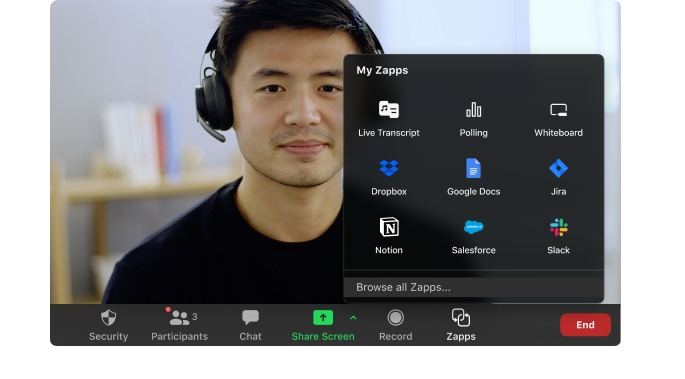
Zoom is hosting its virtual Zoomtopia user conference this week. Given the attention the company has received as the de facto standard video meeting service since the start of the pandemic, it’s no surprise that the company is using the event to launch a number of new products. For the most part, though, we’re not talking about any enhancements to the core Zoom experience here. Instead, the company is using the event to launch its OnZoom events platform and marketplace into general availability (it was previously only available as a private beta) and it is launching Zapps, which brings apps from the company’s 35 launch partners right into the Zoom experience.

Image Credits: Zoom

OnZoom allows hosts to run one-time events or event series with up 100 or 1,000 attendees (depending on their license) and sell tickets for them. The idea here is for anybody — whether a yoga teacher, nonprofit or a professional event organizer — to list and sell tickets on the OnZoom marketplace. Right now, Zoom accepts PayPal and credit card payments, with the team saying that it may look into other payment options in the future. For non-profits, Zoom is also integrating the ability to receive donations through events through its partnership with Pledgeling.

Based on the demo the team shared ahead of today’s announcement, it’s a pretty straightforward experience for both hosts and viewers.

Image Credits: Zoom

For the day-to-day Zoom user, the launch of Zapps (yeah – I don’t love that name either) is probably the more interesting announcement. The idea here is to integrate apps directly into the Zoom experience so that users don’t have to switch back and forth between multiple applications on their desktops.

“Zapps help surface all the applications you need to be productive and enable the free flow of information between teams before, during, and after the meeting,” the company writes. “Think of Zapps as an app store right where you need it most — in a Zoom meeting, chat, webinar, phone call, and even your contacts directory.”

These apps can be launched as screen shares, but more importantly, you can send them to all participants for real-time collaboration.

The 35 launch partners include the likes of Asana, Atlassian, Dropbox, Hubspot, Slack, SurveyMonkey, Wrike and Zendesk.


WordPress Image Lightbox Plugin