Yearly Archives: 2020

News: Fall sale: Get 10% off an annual Extra Crunch membership

From now until October 25, TechCrunch readers in the U.S. can save 10% on an annual plan for Extra Crunch. If you aren’t familiar, Extra Crunch is our membership program focused on startups, founders and investors with more than 100 exclusive articles published per month. You can claim the deal here. Extra Crunch helps you

From now until October 25, TechCrunch readers in the U.S. can save 10% on an annual plan for Extra Crunch. If you aren’t familiar, Extra Crunch is our membership program focused on startups, founders and investors with more than 100 exclusive articles published per month.

You can claim the deal here.

Extra Crunch helps you spot technology trends and opportunities, build better startups and stay connected. It features thousands of articles, including weekly investor surveys, daily market analysis and expert interviews on fundraising, growth, monetization and other work topics. 

You can also find answers to your burning questions about startups and investing through Extra Crunch Live, and stay informed with our members-only Extra Crunch newsletter. Other benefits include an improved TechCrunch.com experience, 20% off discounts to future TechCrunch events and savings on software services from DocSend, Canva, Crunchbase and more.

Join our growing community of founders, investors and startup teams here.

News: Microsoft reverse engineers a budget computer with the Surface Laptop Go

The Surface Laptop Go joined me in the woods last week. It lived in my backpack for a few days and came along for a 20-mile hike through footpaths and across bridges of questionable integrity. It is, without a doubt, light. It’s certainly lighter than the MacBook Air I also packed for the trip, at

The Surface Laptop Go joined me in the woods last week. It lived in my backpack for a few days and came along for a 20-mile hike through footpaths and across bridges of questionable integrity.

It is, without a doubt, light. It’s certainly lighter than the MacBook Air I also packed for the trip, at 2.45 pounds to the Apple device’s 2.8. It doesn’t sound like a ton, but when you’re devoting eight hours to hiking up and down mountains, every fraction of a pound makes a big difference to your lower back. And while (sadly) I don’t hike every day, lugging around a heavy laptop can really do damage over time.

The screen brightness, on the other hand, is lacking. Not surprising, really, for a low-powered, low-cost device. It will do the job indoors, but combined with a reflective screen finish, it’s pretty tough to see anything on the screen outside, even at the highest brightness. That’s probably not a deal breaker for most, but it does feel like one of a number of corners the company cut in an effort to bring the cost down.

At its heart, the Laptop Go is a case study in reverse engineering a budget laptop. It’s the product of an expanding focus for the Surface line. Once almost exclusively Microsoft’s attempt to showcase what its software could do on premium, custom-built hardware, the brand has evolved in a lot of different directions.

Image Credits: Brian Heater

The company’s attempts to lure creative professionals away from Apple coexist with its exploration of budget devices. The Laptop Go firmly falls within the latter category. Following in the lines of the Go, the device seeks to answer the question of whether the hardware principles it has spent years developing across the Surface line can be applied to a budget device.

It’s an understandable — and commendable — effort on that front. Delivering a truly premium laptop experience at a rock bottom price is a win-win. Of course, there’s a lot to contend with here. For starters, getting prices down is a matter of determining which sacrifices you’re willing to make. Then there’s the fact that a lot of companies have already put a lot of work into building hardware for Chrome OS and Windows 10 S.

When Microsoft launched the latter operating system a few years back, it did so on the Surface Laptop. It was a strange decision: offering its Chromebook competitor in the form of a device starting at $999. It took a few years, but the company finally has an appropriately priced devices for the operating system, starting at $549. One lesson the company learned from the original Laptop and fellow Surface brethren is the importance of design.

Image Credits: Brian Heater

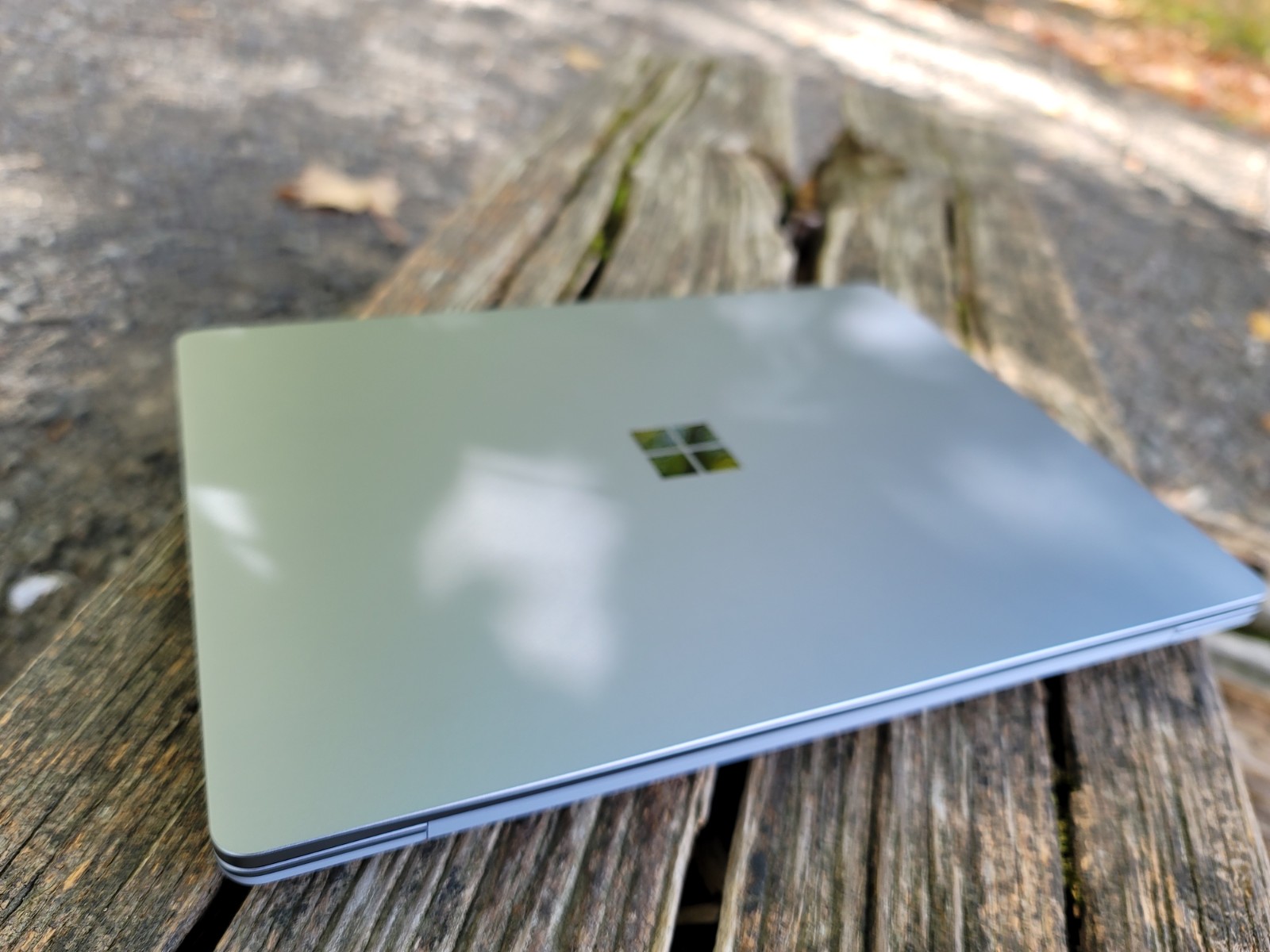
The Laptop Go is a nice-looking, budget laptop. It’s fairly sleek and sits nicely alongside other members of the Surface family. The top and keyboard case are made of aluminum. That’s coupled with polycarbonate composite resin that feels fairly plasticky to the touch. On the tactile front, the keys are a bit soft/gummy for my tastes and will take some getting used to — but it certainly beats typing on the vast majority of keyboard cases.

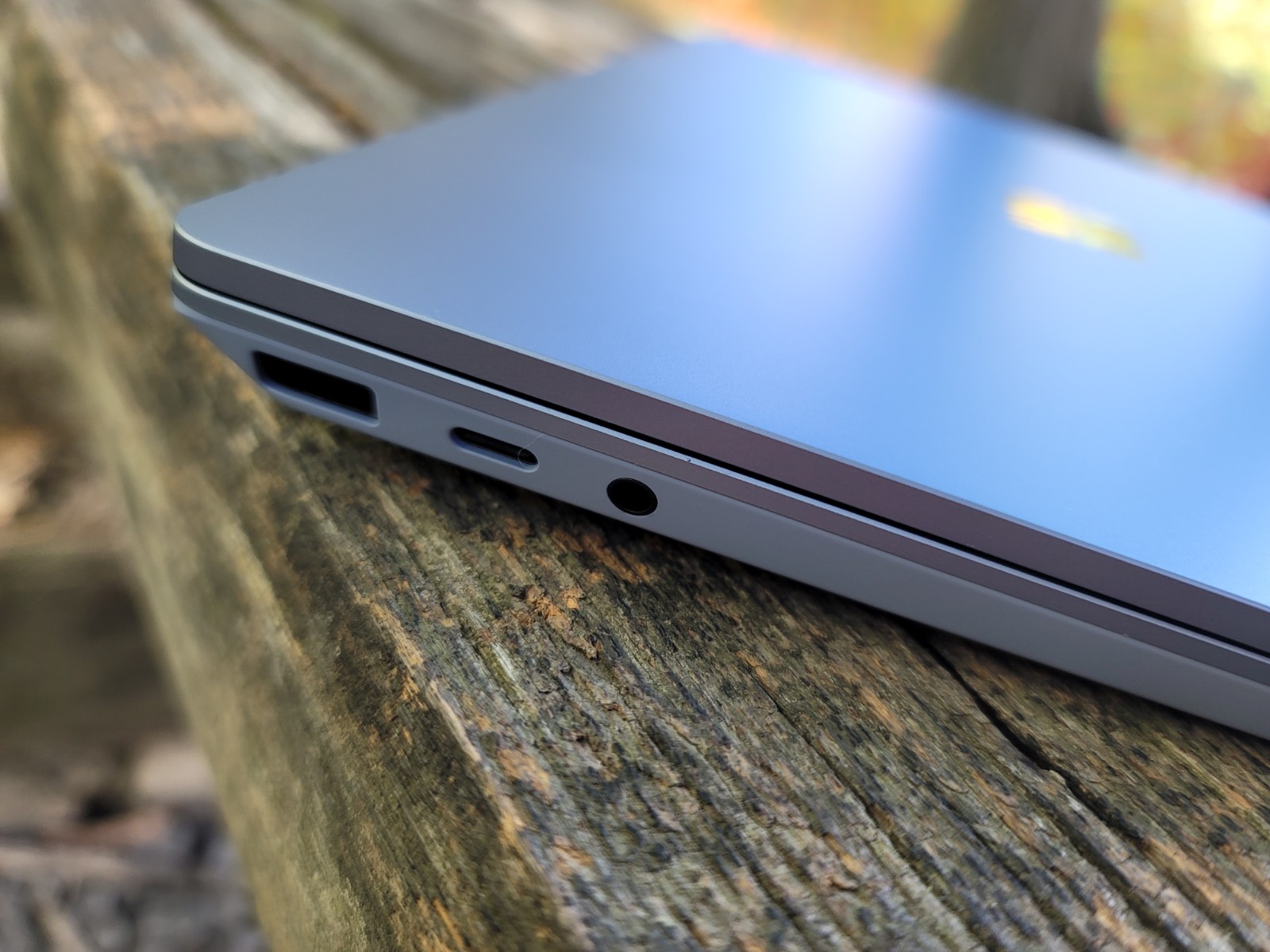
The port situation is mixed. I like that Microsoft opted to include both a USB-A and C port, straddling the line between backward compatibility and futureproofing. Though at this point, I think the safest bet is to go multiple USB-C ports. The other side sports only one port: a Surface dock connector. The company is no doubt maintaining the connection to keep the product working with existing accessories, but the time feels right to drop it in favor of USB charging.

Internally, things are kind of a mixed bag, as well. The 10th-gen Intel Core i5 chip comes standard. That’s a generous inclusion for a $550 laptop. But the base model defaults to 4GB of RAM and 128GB. You’re going to want to upgrade those — and that’s where you start losing the budget thread.

Image Credits: Brian Heater

Our review unit had 8GB of RAM and 256GB of storage — not bad. But that’s going to set you back $900. Suddenly you can see how you’ve quickly left the cheap laptop realm. The fingerprint sensor is also only tacked on as part of an upgrade for $699 and up. It’s also, weirdly, the one part of the keyboard that illuminates — albeit around the border. The exclusion of a backlit keyboard seems like an odd oversight here.

All said, the Laptop Go isn’t a bad first attempt to offer a truly budget entry. As I said with the original Surface Laptop, I’d recommend upgrading out of Windows 10 S the moment you get the device for a majority of users. But otherwise the system works reasonably well as a lightweight, good-looking secondary device. But if you’re not in a rush for such a thing, it will likely pay off to see what Microsoft can do with the device a second time around.

News: Virgin Galactic readies first spaceflight from Spaceport America for ‘later this this fall’

Virgin Galactic is getting ready to fly its first mission to space from its Spaceport America facility in New Mexico. This is the site that the company will use to host all of its commercial flights, and making it to space from this launch locale is crucial to getting to that point. Earlier this year,

Virgin Galactic is getting ready to fly its first mission to space from its Spaceport America facility in New Mexico. This is the site that the company will use to host all of its commercial flights, and making it to space from this launch locale is crucial to getting to that point.

Earlier this year, Virgin Galactic successfully flew a number of tests of its SpaceShipTwo launch craft from New Mexico, but these didn’t include a trip to space. That launch, which will be performed by two of the company’s test pilots (while also carrying a number of experiments for the passenger hatch) should happen before the year is out, hopefully putting Virgin Galactic on pace to begin offering its commercial services next year to paying passengers.

Those private astronauts will include one newly announced individual: Dr. Alan Stern, a noted and well-regarded planetary scientist who has held a number of positions, and is most recently the associate Vice President of South West Research Institute’s Space Science and Engineering Division. Dr. Stern is the first researcher named to be flying on board Virgin Galactic’s commercial spacecraft on a NASA-funded science mission.

This won’t be the first of SpaceShipTwo’s commercial flights, it seems. Stern’s trip will take place on a “yet unscheduled” suborbital flight from Spaceport America in the future. Stern will be conducting two key pieces of science aboard the spacecraft, including actually wearing instrumentation that monitors his vial signs throughout, as well as using a low light camera to see how well observing space from the vantage point of inside the SpaceShipTwo cabin works.

News: NASA loads 14 companies with $370M for ‘tipping point’ technologies

NASA has announced more than a third of a billion dollars worth of “Tipping Point” contracts awarded to over a dozen companies pursuing potentially transformative space technologies. The projects range from in-space testing of cryogenic tech to a 4G LTE network for the Moon. The space agency is almost always accepting applications for at least

NASA has announced more than a third of a billion dollars worth of “Tipping Point” contracts awarded to over a dozen companies pursuing potentially transformative space technologies. The projects range from in-space testing of cryogenic tech to a 4G LTE network for the Moon.

The space agency is almost always accepting applications for at least one of its many grant and contract programs, and Tipping Point is directly aimed at commercial space capabilities that need a bit of a boost. According to the program description, “a technology is considered at a tipping point if an investment in a demonstration will significantly mature the technology, increase the likelihood of infusion into a commercial space application, and bring the technology to market for both government and commercial applications.”

In this year’s awards, which take the form of multi-year contracts with multiple milestones, the focus was on two main areas: cryogenics and lunar surface tech. Note that the amounts provided are not necessarily the cost of developing the tech, but rather the sums deemed necessary to advance it to the next stage. Here’s a brief summary of each award:

Cryogenics

  • Eta Space, $27M: In-space demonstration of a complete cryogenic oxygen management system
  • Lockheed Martin, $89.7M: In-space demonstration of liquid hydrogen in over a dozen cryogenic applications
  • SpaceX, $53.2M: Flight demonstration transferring 10 tons of liquid oxygen between tanks in Starship
  • ULA, $86.2M: Demonstration of a smart propulsion cryogenic system on a Vulcan Centaur upper stage

Lunar surface innovation

  • Alpha Space Test and Research Alliance, $22.1M: Develop a small tech and science platform for lunar surface testing
  • Astrobotic, $5.8M: “Mature” a fast wireless charging system for use on the lunar surface
  • Intuitive Machines, $41.6M: Develop a hopper lander with a 2.2-pound payload capacity and 1.5-mile range
  • Masten Space Systems, $2.8M: Demonstrate a universal chemical heat and power source for lunar nights and craters
  • Masten Space Systems, $10M: Demonstrate precision landing an hazard avoidance on its Xogdor vehicle (Separate award under “descent and landing” heading)
  • Nokia of America, $14.1M: Deploy the first LTE network in space for lunar surface communications
  • pH Matter, $3.4M: Demonstrate a fuel cell for producing and storing energy on the lunar surface
  • Precision Compustion, $2.4M: Advance a cheap oxide fuel stack to generate power from propellants
  • Sierra Nevada, $2.4M: Demonstrate a device using solar energy to extract oxygen from lunar regolith
  • SSL Robotics, $8.7M: Develop a lighter, cheaper robotic arm for surface, orbital, and “terrestrial defense” applications
  • Teledyne Energy Systems, $2.8M: Develop a hydrogen fuel cell power system with a 10,000-hour battery life

You can read more about the proposal process and NASA’s areas of interest at the Tipping Point solicitation page.

News: Sanity, a platform to build and manage content flows on sites, raises $9.3M from Ev Williams, Threshold and more

There are more than 2 billion websites in existence in the world today, millions of apps, and a growing range of digital screens where people and businesses present constantly changing arrays of information to each other. But all that opportunity also has a flip side: how can you say what you want, just how you

There are more than 2 billion websites in existence in the world today, millions of apps, and a growing range of digital screens where people and businesses present constantly changing arrays of information to each other. But all that opportunity also has a flip side: how can you say what you want, just how you want to say it, without technical hurdle after hurdle getting in your way?

A startup called Sanity has built a platform to help businesses (and their people) do that more easily with a SaaS platform that lets developers create code and systems to manage content. Now, after picking up some 25,000 customers, from “traditional” publishers like Conde Nast and National Geographic through to hundreds of others like Sonos, Brex, Figma, Cloudflare, Mux, Remarkable, Kleiner Perkins, Tablet Magazine, MIT, Universal Health Services, Eurostar, and Nike, it is announcing funding of $9.3 million to fuel its growth.

The funding, a Series A, is being by Threshold Ventures (the VC formerly known as Draper Fisher Jurvetson, rebranded in 2019 after none of the namesakes remained at the firm), with an interesting cast of others also participating.

They include Ev Williams (who knows a thing or two about ‘content’ as the co-founder of Blogger, Twitter and most recently Medium); Adam Gross, ex-CEO of Heroku; Guillermo Rauch, inventor of NextJS and CEO and co-founder of Vercel; Stephanie Friedman (ex-Xamarin and Microsoft); and Monochrome Capital, the new firm launched by Ben Metcalfe (the co-founder of WP Engine, among many other roles).

Heavybit and Alliance Venture, which led its seed round of $2.4 million last year, also participated. Other existing investors include Matthias Biilman and Chris Bach, co-founders of Netlify; Jon Dal CEO and co-founder of Mux; and Edvard Engsæth, co-founder of NURX.

Sanity bills itself as a “content platform”, and the open-ended idea of what that could possibly mean is essentially the essence of what the company is about.

Led by co-founder and CEO Magnus Hillestad, it has crafted a set of tools that can help developers structure how and where content gets created, input and eventually presented to people, with its target audience being any organization or person that might be putting together a digital experience whose content is regularly updated and is not static.

Hillestad said that thinking of content as a separate and dynamic element in digital experiences represents a “paradigm shift” in terms of how the web and other content experiences are developing. The idea, he said, is for an organization “not to be held back by features but to have the code to make the components they want.” He described it as a progression along the same trajectories of “what Twilio did by coming in with APIs for communications, and Figma did with its concept of collaboration.”

While e-commerce has typically been a major customer of such “headless” platforms — they will use services like these to help design and manage the front end, with another service like Shopify to manage the commerce at the back end — it’s actually a basic framework that has been applied to a pretty wide range of use cases at Sanity.

They do include e-commerce experiences, but also companies building interactive tools for customers to look at, mix, and match various light fixtures from a lighting consultancy; more standard publishing services; and for helping tailor materials for emergency medical training services.

These days, the medium, as they say, is the message, and in that regard “publishing” has taken on a new meaning in the digital age. Whereas in the past it only referred to materials prepared for print, such as books, magazines and newspapers, these days it can be any kind of content prepared for the web or any other endpoint where it will not only be “read” but potentially manipulated in some way, and likely also changed by the producers as well. The very un-static nature of that content makes it fun and interesting, but also a pain to manage.

Sanity has a notable origin that speaks to how it has always given a wide berth and prime positioning to the sanctity of content. It was built originally by an agency in Oslo, Norway, as part of a remit to rethink and recast how to present works for a new website for OMA, the architecture firm co-founded by the iconic Dutch designer Rem Koolhaas. 

The information matrix and content management system concept that they put together was strong enough to use the agency to build more sites using the CMS, and eventually the firm spun Sanity out as its own independent firm, founded by Even Westvang, Hillestad, Oyvind Rostad and Simen Svale Skogsrud.

Part of the team, including Hillestad, relocated to the Bay Area to build the startup and integrate it deeper with the bigger tech ecosystem in the region and build out the concept under a SaaS model, while others remained in Oslo.

In its move to the US, Sanity has over the past few years been tapping into a growing market for services to enable those who rely on the web to do business do it in a more creative and dynamic way.

“A decade ago, I co-founded WP Engine with the goal of bringing the power of WordPress to the enterprise and small business buyer,” said Metcalfe in a statement. “Not only are we moving away from monolithic codebases to API-driven services, but the way we think about content is changing; as we create once and expect it to appear across web, apps and even IoT devices. Sanity has reimagined the headless CMS, bringing content closer to the developer where it can exist as the defacto content system of record across an entire organization. With CMS so close to my roots, I couldn’t be more delighted that Sanity is the inaugural investment for Monochrome Capital.”

It is not the only company in this wider area getting a lot of attention. Last week, Shogun — which focuses only on e-commerce and front-end design, raised $35 million. Others include Commercetools, Commerce Layer, Strapi, Contentful, and ContentStack. Sanity stands out partly by keeping its focus wider than e-commerce and by not using the words “content” or “commerce” in its name.

“We’re seeing a tidal wave of companies transform and digitize every aspect of their business, but the tools they use limit their progress,” said Josh Stein, partner, Threshold Ventures, in a statement. “Sanity’s content platform liberates content and content owners by enabling a truly collaborative and customizable experience, while treating content as data to maximize content velocity across all customer touchpoints and surfaces. We’re excited to back the Sanity team and their impressive developer-focused content management platform.”

Stein and Jesse Robbins, a partner at Heavybit, are both joining Sanity’s board of directors with this round.

News: Virgin Orbit aims for December for second attempt at orbital demonstration launch

Would-be small satellite launch service provider Virgin Orbit is aiming to redo its key orbital demonstration launch this December, which would be a remarkable turnaround after its attempt in March didn’t manage to reach orbit as the company had hoped. The company aims to offer low-cost launch services for small satellites, using its mid-air launch

Would-be small satellite launch service provider Virgin Orbit is aiming to redo its key orbital demonstration launch this December, which would be a remarkable turnaround after its attempt in March didn’t manage to reach orbit as the company had hoped. The company aims to offer low-cost launch services for small satellites, using its mid-air launch vehicle which is carried to a high altitude by a modified version of a traditional commercial jet.

This launch will hopefully mark a first for Virgin Orbit – the first time it has reached orbit, which is where it needs to be to provide the services it hopes to offer. CNBC spoke to Virgin Orbit CEO Dan Hart, who said that the December target is based on where they’re at right now with the construction of a new LauncherOne rocket to fly the test mission.

LauncherOne is docked with Virgin Orbit’s carrier craft for its launch model, which is a modified d747. The jet takes it up to around 45,000 feet, at which point it drops the rocket, which ignites its own engines after separation and then flies under its own power the rest of the way to space. A rocket has a much easier time leaving Earth’s atmosphere from that altitude, which is why Virgin hopes to be able to offer big cost benefits for dedicated small launch services vs. what’s available now.

In March, Virgin’s launch went smoothly up until just after the LauncherOne craft used on that mission fired up its engines. There was a failure that caused the engines to cut off because of a safety shutoff, and the rocket then fell back safely to Earth, but was obviously lost.

Such a mishap on a first orbital launch attempt is far from unusual – in fact, it’s almost the norm. Virgin Orbit said they gleaned a lot of great data from their attempt regardless of the outcome, and hopefully that will mean this next try goes to plan. If it does, that should put the company on track to begin offering commercial service next year.

Meanwhile, CNBC reports that the company is also in the process of tracking down up to $150 million in new funding, echoing an earlier report from the Wall Street Journal this week.

News: Plenty has raised over $500 million to grow fruits and veggies indoors

Plenty‌ ‌Unlimited‌ has raised $140 million in new funding to build more vertical farms around the U.S. The new funding, which brings the company’s total cash haul to an abundant $500 million, was led by existing investor Softbank Vision Fund also included the berry farming giant Driscoll’s. It’s a move that will give Driscoll’s exposure

Plenty‌ ‌Unlimited‌ has raised $140 million in new funding to build more vertical farms around the U.S.

The new funding, which brings the company’s total cash haul to an abundant $500 million, was led by existing investor Softbank Vision Fund also included the berry farming giant Driscoll’s. It’s a move that will give Driscoll’s exposure to Plenty’s technology for growing and harvesting fruits and vegetables indoors.

The funding comes as Plenty has inked agreements with both its new berry-interested investor and the Albertsons grocery chain. The company also announced plans to build a new farm in Compton, California.

The financing provides plenty of cash for a company that’s seeing a cornucopia of competition in the tech-enabled cultivated crop market raising a plethora of private and public capital.

In the past month, AppHarvest has agreed to be taken public by a special purpose acquisition company in a deal that would value that greenhouse tomato-grower at a little under $1 billion. And another leafy green grower, Revol Greens has raised $68 million for its own greenhouse-based bid to be part of the new green revolution.

Meanwhile, Plenty’s more direct competitor, Bowery Farming, is expanding its retail footprint to 650 stores even as Plenty touts its deal with Albertsons to provide greens to 431 stores in California.

Discoll’s seemed convinced by Plenty’s technology, although the terms of the agreement with the company weren’t disclosed.

“We looked at other vertical farms, and Plenty’s technology was one of the most compelling systems we’d seen for growing berries,” said J. Miles Reiter, Driscoll’s Chairman and CEO, in a statement. “We got to know Plenty while working on a joint development agreement to grow strawberries. We were so impressed with their technology, we decided to invest.”

News: Google Analytics update uses machine learning to surface more critical customer data

If you ever doubted the hunger brands have for more and better information about consumers, you only need to look at Twilio buying customer data startup Segment this week for $3.2 billion. Google sees this the same thing as everyone else, and today it introduced updates to Google Analytics to help companies understand their customers

If you ever doubted the hunger brands have for more and better information about consumers, you only need to look at Twilio buying customer data startup Segment this week for $3.2 billion. Google sees this the same thing as everyone else, and today it introduced updates to Google Analytics to help companies understand their customers better (especially in conjunction with related Google tools).

Vidhya Srinivasan vice president of measurement, analytics and buying platforms at Google wrote in a company blog post introducing the new features that the company sees this changing customer-brand dynamic due to COVID, and it wants to assist by adding new features that help marketers achieve their goals, whatever those may be.

One way to achieve this is by infusing Analytics with machine learning to help highlight data automatically that’s important to marketers using the platform. “[Google Analytics] has machine learning at its core to automatically surface helpful insights and gives you a complete understanding of your customers across devices and platforms,” Srinivasan wrote in the blog post.

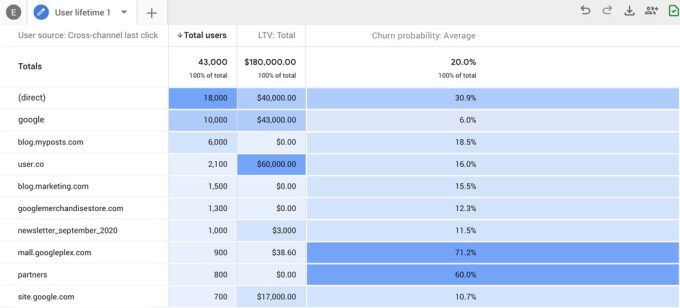
The idea behind the update is to give marketers access to more information they care about most by using that machine learning to surface data like which groups of customers are most likely to buy and which are most likely to churn, the very types of information marketing (and sales) teams need to try make proactive moves to keep customers from leaving or conversely turning those ready to buy into sales.

Google_Analytics_predictive_metric predict churn and most likely to convert to sales.

Image Credits: Google

If it works as described, it can give marketers a way to measure their performance with each customer or group of customers across their entire lifecycle, which is especially important during COVID when customer needs are constantly changing.

Of course, this being a Google product it’s designed to play nicely with Google Ads, YouTube and other tools like GMail and Google Search along with non-Google channels. As Srinivasan wrote:

The new approach also makes it possible to address longtime advertiser requests. Because the new Analytics can measure app and web interactions together, it can include conversions from YouTube engaged views that occur in-app and on the web in reports. Seeing conversions from YouTube video views alongside conversions from Google and non-Google paid channels, and organic channels like Google Search, social, and email, helps you understand the combined impact of all your marketing efforts.

The company is also trying to future proof analytics with an eye toward stricter privacy laws like GDPR in Europe or CCPA in California by using modeling to fill in gaps in information when you can’t use cookies or other tracking software.

All of this is designed to help marketers, caught in trying times with a shifting regulatory landscape to better understand customer needs and deliver them what they want when they want it — when they’re just trying to keep the customers satisfied.

News: Spotify launches an automatically updating iOS 14 widget

Spotify today has released its highly-anticipated iOS 14 widget with the latest app update. The new widget, which comes in both the small and medium sizes for the time being, allows you to quickly access your recently played artists, albums and podcasts with a tap. The smaller widget will display just your most recently listened

Spotify today has released its highly-anticipated iOS 14 widget with the latest app update. The new widget, which comes in both the small and medium sizes for the time being, allows you to quickly access your recently played artists, albums and podcasts with a tap.

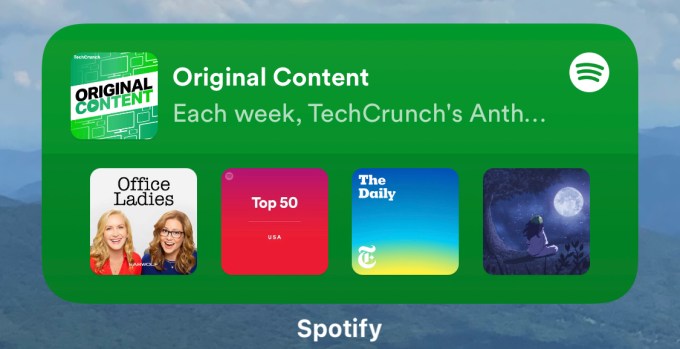
The smaller widget will display just your most recently listened to item, while the medium-sized widget will instead show the five most recent items — four in a horizontal row and the most recent at the top. In that case, you can actually tap on the small thumbnail for which of the five you want to now stream to be taken directly to that page in the Spotify app.

Image Credits: Spotify widget, screenshot via TechCrunch

Another interesting aspect to the widget is that the background color automatically updates to match the thumbnail image. If the artist is wearing red, for example, the widget changes to red. If the album is blue, the widget becomes blue. And so on.

There seem to be a limited range of colors available, however. For example, when we streamed something with a gray-and-white color scheme in the thumbnail image (e.g. Taylor Swift’s “folklore”), the widget defaulted to Spotify’s green shade.

Image Credits: Spotify widget, screenshot via TechCrunch

The widget’s colorful experience can help it to stand out on the homescreen. But it could also be problematic for those who have customized their iOS 14 homescreen with a certain aesthetic — like all app icons and widgets in neutral shades, or another favorite color, such as pink, purple, blue, or black.

Based on Etsy trends, iOS 14 packs in neutral or fall shades are currently best sellers, as are those with lighter pinks and dark themes in black. Spotify’s widget could clash with those designs, at times.

Still, the demand for a Spotify widget has been so strong that before the official release it sent a third-party music widget provider flying up the App Store charts as users customized their iOS 14 homescreens. That widget provider, TuneTrack, even got as high at No. 8 Overall and No. 1 in Music on Sept. 19, 2020, when the customization trend was driving millions of new downloads.

The new Spotify widget is live today within the updated Spotify app on the iOS App Store.


News: Harley-Davidson should keep making e-motorcycles

Harley-Davidson should continue to make electric motorcycles. That’s my big takeaway after taking home the company’s LiveWire for three weeks. I’d ridden it on a closed course in 2019, but that wasn’t enough absorb the finer qualities of the 105 horsepower machine. After nearly a month and a thousand miles on the LiveWire, I’d venture to

Harley-Davidson should continue to make electric motorcycles. That’s my big takeaway after taking home the company’s LiveWire for three weeks.

I’d ridden it on a closed course in 2019, but that wasn’t enough absorb the finer qualities of the 105 horsepower machine. After nearly a month and a thousand miles on the LiveWire, I’d venture to say it could be the most innovative motorcycle Harley-Davidson has ever produced.

That doesn’t mean perfect (particularly on the pricing). But with declining sales and the aging of the baby boomers — Harley’s primary market for chrome and steel gassers — the company needed to take a fresh turn.

HD’s first EV

Harley-Davidson did that with the LiveWire, which began as a concept and developed into the manufacturer’s first production EV, released in late 2019. The voltage powered two-wheeler is meant to complement, not replace, HD’s premium internal-combustion cruisers.

Founded in Milwaukee in 1903, Harley-Davidson opened a Silicon Valley office in 2018 with plans to add a future line-up of electric vehicles — from motorcycles to bicycles to scooters. The $29,799 LiveWire was first, though waning earnings and the Covid-19 induced recession have put HD’s electric plans in question.

On key specs, the Livewire will do 0-60 mph in 3 seconds, top 110 mph and charge to 80% in 40 minutes on a DC Fast Charger. The motorcycle’s 15.5 kWh battery and magnet motor produce 86 ft-lbs of torque.

Image Credits: Harley Davidson

The 548 pound LiveWire has an advertised city range of 146 miles (and 95 for combined city/highway riding).The electric Harley is also an IoT and app compatible vehicle, with preset riding modes — that offer different combos of power, torque and regen braking — and the ability to create custom modes.

Harley-Davidson added some premium features to the LiveWire, such as key fob operation, an anti-theft control system and a heartbeat-like vibration on the motorcycle.

That’s useful to remind the rider that the LiveWire — which goes silent at a stop — is still in run mode. In motion, the bike is basically quiet, though Harley-Davidson — famous for its internal combustion rumble — created a signature electric sound generated from the vehicle’s mechanical movements. It’s a barely audible buzz that gives the motorcycle a distinct voice as an electric Harley.

The ride

As an e-motorcycle, the LiveWire is remarkably balanced for a two-wheeler that has so much mass concentrated in one place: the battery.

At over 500 pounds, it isn’t exactly heavy by Harley cruiser standards, but the LiveWire is hefty for a naked sport bike. You definitely feel that weight pushing the EV around the garage, but fortunately — with some clever frame engineering — it fades away once the LiveWire gets rolling.

When I tested the LiveWire on a track in 2019, I noted that it brought everything that was becoming the e-motorcycle experience: huge torque and lightning-like acceleration with little noise beyond the wind moving around you.

More time and riding conditions with the LiveWire led to a stronger appreciation. I took it down the Hudson River Valley into Manhattan, up to three digits on I-95, and on the twisty backroads outside of Greenwich. The LiveWire looks and performs the part of a high-performance e-motorcycle, and in many ways, offers a more exciting ride than anything piston powered.

Image Credits: Jake Bright

The biggest rush on a LiveWire, compared to ICE peers, is the torque and acceleration. With fewer mechanical moving parts than gas bikes — and no clutch or shifting — the power delivery is stronger and more constant than internal combustion machines. You simply twist and go.

Like other high performance e-motorcycles, the LiveWire’s regenerative braking — or the extent to which the motor recharges the battery and slows the rear wheel coming off throttle — also enhances performance. Regen braking can be adjusted manually or by riding mode on the electric HD.

It takes some skill, but the end result is the ability to fly through corners in a smoother manner than a gas motorcycle — with little to no mechanical braking — by simply rolling off and on the throttle. This is complemented by the motorcycle’s lateral handling. In turns, the LiveWire holds a line as precisely as a Tron light-cycle (at least that’s how it felt conceptually).

This all translates into a riding experience of uninterrupted forward movement, without any racket and rattling. That the motorcycle also looks great— with lines and styling that hit the marks for an EV and a Harley — adds even more.

The market

With the LiveWire debut, Harley-Davidson became the first of the big gas manufacturers to offer a street-legal e-motorcycle for sale in the U.S.

The move is something of a necessity for the company, which, like most of the motorcycle industry in the U.S., has been bleeding revenue and younger buyers for years.

While HD got the jump on traditional motorcycle manufacturers, such as Honda and Kawasaki, it’s definitely not alone in the two-wheeled electric space.

Harley-Davidson entered the EV arena with competition from several e-moto startups that are attempting to convert gas riders to electric and attract a younger generation to motorcycling.

One of the leaders is California startup Zero Motorcycles, with 200 dealers worldwide. Italy’s Energica is expanding distribution of its high-performance e-motos in the U.S.

And Canadian startup Damon Motors debuted its 200 mph, $24,000 Hypersport this year, which offers proprietary safety and ergonomics tech for adjustable riding positions and blind-spot detection.

Of course, it’s not evident there’s enough demand out there to buy up all these new models, particularly given the COVID-19-induced global recession.

On the LiveWire’s market success (or failure), its tough to assess since HD’s reporting doesn’t include LiveWire-specific sales data.  One thing I (and others) have been critical of is the motorcycle’s $29,000 price. At just several thousand dollars less than a Tesla Model 3, it’s just too high — even for a premium motorcycle. But price aside, and that’s a big aside, I’d still argue the company succeeded with the LiveWire in a couple major ways. Harley-Davidson created an exciting halo motorcycle that established it as a legitimate e-motorcycle maker — in a distinctly Harley-Davidson fashion — while capturing public interest for its EV program.

What’s next?

For a company to reap the benefits of a successful halo launch, it needs to create a more accessible sequel. In July, Harley-Davidson’s newly appointed CEO, Jochen Zeitz, announced a five year plan — dubbed The Rewire — to adjust to declining sales and lead the company into the future. The strategy includes a massive restructuring and holding on (or even cancelling) some previously announced programs, such Harley’s gas powered Bronx model.

On whether the LiveWire — and producing new EVs — remain in Harley-Davidson’s future, Zeitz hasn’t been specific in confirming that in recent statements or investor calls.

Image Credits: Jake Bright

After some intimate time getting to know HD’s debut electric motorcycle, and assessing the market, my vote is for the iconic American company to continue its EV program and give us more. Offer a follow on that makes the rush, excitement and on demand capabilities of the halo Livewire available to the mases.

I could envision the company’s next EV product release including a scooter offering — registering Harley in the urban mobility space — and a more affordable e-motorcycle with broad market appeal.

What could that look like? Something priced around $10,000, lighter and more accessible to beginner riders than the 549-pound LiveWire, cloud and app connected with at least 100 miles of range and a charge time of 30 to 40 minutes. A tracker-styled EV channeling Harley’s flat-track racers — with some off-road capability — could be a winner.

Image Credits: Jake Bright

Getting it all right on specs, style and price-point will be even more critical for HD in a COVID-19 economic environment, where spending appetites for motorcycles will be more conservative for the foreseeable future.

But continuing the commitment to production EV’s is still Harley-Davidson’s bet to reach a younger market and remain relevant in the 21st century mobility world. HD’s Rewire should definitely include more LiveWire.


WordPress Image Lightbox Plugin