Yearly Archives: 2020

News: Uber is hiring hundreds of engineers in India to cut costs

Uber said on Thursday it is working to hire 225 engineers in India, strengthening its tech team in the key overseas market months after it eliminated thousands of jobs globally. The ride-hailing firm, which competes with Ola in India, said today it has hired Manikandan Thangarathnam, who spent nearly 13 years as a director of

Uber said on Thursday it is working to hire 225 engineers in India, strengthening its tech team in the key overseas market months after it eliminated thousands of jobs globally.

The ride-hailing firm, which competes with Ola in India, said today it has hired Manikandan Thangarathnam, who spent nearly 13 years as a director of engineering at Amazon, to lead the company’s rider and platform engineering teams in Bangalore. (Last month, Uber announced it would hire 140 engineers in India. Today it said it was in the process of hiring an additional 85 engineers.)

The move comes as several high-profile engineers have left Uber India in recent months to join Google and Amazon among other tech giants. A senior engineer, who recently left Uber, told TechCrunch that many of his peers had lost confidence in Uber’s future prospects in the country.

Uber said its tech expansion plans in India were in line with its vision to make mobility and delivery “more accessible” and becoming the “backbone” of transportation in thousands of cities across the globe.

The company recently also hired Jayaram Valliyur as a senior director to lead its global finance technology team. Prior to this role, Jayaram, too, worked at Amazon, where he spent 14 years.

In July, news outlet The Information described Uber chief executive Dara Khosrowshahi’s plan to move engineering roles to India as a cost saving measure. The report said Khosrowshahi’s plan had sparked internal debates.

Thuan Pham, Uber’s longtime chief technology officer, who left the company earlier this year, reportedly cautioned that hiring more engineers so quickly in India would “require accepting lower-quality candidates.”

Uber and Ola both claim to be the No. 1 ride-hailing service in India. But Rajeev Misra, the chief of SoftBank Vision Fund which is a common investor in both the companies, said last month that Ola maintained a “small lead” over Uber in India.

News: Alibaba-affiliated marketplace to leave Taiwan, again

Separated by a strait, the internet in Taiwan and mainland China are two different worlds. Even mainland tech giants Alibaba and Tencent have had little success entering the island, often running into regulatory hurdles. Less than a year after Taobao launched on the island through an Alibaba-backed joint venture, the marketplace announced it will cease

Separated by a strait, the internet in Taiwan and mainland China are two different worlds. Even mainland tech giants Alibaba and Tencent have had little success entering the island, often running into regulatory hurdles.

Less than a year after Taobao launched on the island through an Alibaba-backed joint venture, the marketplace announced it will cease operations by the end of this year, the platform said in a notice to customers on Thursday.

The decision came two months after the Investment Commission under Taiwan’s Ministry of Economic Affairs ruled that Taobao Taiwan is a Chinese-controlled company and required the firm to either leave or re-register under a different corporate structure. Under Taiwanese law, Chinese investors must obtain permission from the government to directly or indirectly acquire a stake of more than 30% in any Taiwanese company.

Taobao Taiwan is owned and operated by British-registered Claddagh Venture Investment, which is 28.77% owned by Alibaba. Nonetheless, the investment regulator ruled that the one with de facto control over Taobao Taiwan is Alibaba, which has “veto power” over Claddagh’s board decisions.

The app is currently the most downloaded shopping app in the Taiwanese Google Play store followed by Shopee, according to app tracking firm App Annie. Unexpectedly, the Chinese edition of Taobao comes in sixth in the iOS shopping category, where Shopee tops.

Taobao Taiwan is separate from Alibaba’s main marketplaces, which last boast 874 million mobile monthly users. Most of Alibaba’s shoppers are in mainland China, though customers in Hong Kong and Taiwan have long been able to shop on the Chinese Taobao app and have the goods imported to them with extra fees.

Taobao Taiwan, on the other hand, established to attract local vendors in a market of around 24 million people, competing with popular alternatives like Singapore-headquartered Shopee and the indigenous PChome 24.

This isn’t the first time Taobao has been hit by local law. In 2015, the authority ordered Taobao Taiwan, at the time set up by a Hong Kong entity of Alibaba, to leave because of its Chinese association. Even Shopee wasn’t exempt and was under investigation in 2017 for Tencent owned around 40% of its parent company Sea.

“We respect the decision by Claddagh,” an Alibaba representative said in a statement to TechCrunch. “Alibaba businesses are operating as normal in the Taiwan market, and we will continue to serve local consumers with quality products through our Taobao app.”

It’s unclear how Claddagh came to decide on its retreat rather than restructuring the joint venture. The firm has not responded to TechCrunch’s request for comment.

News: Menlo Ventures just closed its fifteenth early-stage fund with $500 million

Menlo Ventures, the 44-year-old venture firm with offices in Menlo Park and San Francisco, is taking the wraps of its fifteenth early-stage fund today, a vehicle it closed with $500 million in capital commitments. It’s the same amount that Menlo announced last year for a growth-stage fund, the second in the firm’s history. We talked

Menlo Ventures, the 44-year-old venture firm with offices in Menlo Park and San Francisco, is taking the wraps of its fifteenth early-stage fund today, a vehicle it closed with $500 million in capital commitments.

It’s the same amount that Menlo announced last year for a growth-stage fund, the second in the firm’s history.

We talked with managing director Venky Ganesan earlier this week about the new fund. It will not, notably, include longtime Menlo managing director Mark Siegel, who joined the firm 24 years ago after a business development stint at Netscape, and who — like peers Bill Gurley of Benchmark and Todd Chaffee of IVP — is now making room for some of the firm’s more recent additions.

Ganesan also said that Menlo, which invests in consumer, enterprise, frontier tech, and healthcare startups, might index a bit more on health-related bets, which is unsurprising but also interesting in an historical context.

Gilead Sciences was actually incubated at Menlo back in 1987, but the firm dropped its life sciences practice for roughly 20 years before resuscitating it in 2017, hiring Greg Yap as a partner to lead related investments. At the time, Yap’s mandate was to invest roughly 15% of the firm’s last, $450 million, early-stage fund into tech-driven life sciences, but Ganesan can imagine that even more of its new fund will be poured into tech-driven health and medical startups.

As for check sizes, Ganesan said that Menlo will continue to do the occasional seed round but that it’s far more focused on Series A and B deals, writing initial checks of between $8 million to $15 million at the Series A for a targeted 20% of each startup, and checks beginning at $12 million to $14 million at the Series B stage. (Its later-stage fund makes the bigger bets beyond that.)

Menlo has long counted Washington State as its anchor tenant, and this fund is no different, having secured a $125 million commitment from its investment board.

A newer investor, says Ganesan, is the State of New Mexico Investment Council, which is one of three new investors in the fund — all of which were introduced to Menlo through other investors, and all of which agreed to back the firm via Zoom.

Given the firm’s recent exits, institutional interest in the new fund isn’t surprising. Menlo led Uber’s Series B round back in 2011, and according to the firm, even before Uber’s IPO last year, Menlo had already earned $973 million — or a 93x return — on its $10.5 million investment by selling nearly half of its Uber stock to a syndicate led by SoftBank.

Another big win for the firm has been Roku, which makes a variety of digital media players for video streaming and went public in 2017. At the time, its shares traded at around $15 each; today its shares trade at $233 apiece.

Meanwhile, Menlo has active portfolio companies that also appear poised to produce returns for its investors. The consignment company Poshmark said late last month that it has confidentially submitted to securities regulators a draft registration statement for its IPO, for example. And Chime, a start-up that delivers banking services through mobile phone, closed a round of funding last month that valued the company at $14.5 billion.

News: Luxury watch maker Breitling issues digital certificates on the Ethereum blockchain

Breitling is partnering with Arianee to issue a new kind of certificates of authenticity for its luxury watches. Instead of relying on physical certificates, the watchmaker gives you a unique digital passport that certifies the origin of the watch. Behind the scene, Arianee is using non-fungible tokens compliant with the Ethereum’s ERC-721 standard (remember CryptoKitties?).

Breitling is partnering with Arianee to issue a new kind of certificates of authenticity for its luxury watches. Instead of relying on physical certificates, the watchmaker gives you a unique digital passport that certifies the origin of the watch.

Behind the scene, Arianee is using non-fungible tokens compliant with the Ethereum’s ERC-721 standard (remember CryptoKitties?). By using a blockchain-based solution, Breitling ensures that its digital passports remain future proof and can’t be altered — due to consensus mechanisms between nodes, nobody can connect to a centralized database, change some values or remove some data.

If you buy a Breitling watch, you get an guarantee card that you can scan. After downloading the Arianee wallet app on your phone, you can add your watch to your digital wallet. You can see the serial number and the activation date of the digital warranty.

As you may have guessed, those digital certificates can be helpful when you’re trying to sell your watch. A feature lets you prove the authenticity of the watch. You can also transfer the certificate to another owner.

Breitling can also add information over time. For instance, you can imagine a timeline of repairs with timestamps so that you can keep track of the whole story. Soon, the brand could also offer insurance products through this new channel.

When it comes to privacy, the certificate isn’t tied to your name, email address or other personal information. Your wallet address is the only unique identifier associated with you.

Arianee proves that non-fungible tokens can provide some interesting use cases in the luxury industry. Breitling also works with Dentsu Tracking to track its supply chain. With digital certificates, end customers also see the benefits of supply chain regulation.

News: South Korean startup Cochlear.ai raises $2 million Series A to detect the sounds missed by speech recognition

Sit quietly for a moment and pay attention to the different sounds around you. You might hear appliances beeping, cars honking, a dog barking, someone sneezing. These are all noises Cochlear.ai, a Seoul-based sound recognition startup, is training its SaaS platform to identify. The company’s goal is to develop software that can identify almost any

Sit quietly for a moment and pay attention to the different sounds around you. You might hear appliances beeping, cars honking, a dog barking, someone sneezing. These are all noises Cochlear.ai, a Seoul-based sound recognition startup, is training its SaaS platform to identify. The company’s goal is to develop software that can identify almost any kind of sound and be used in a wide range of smart hardware, including phones, speakers and cars, co-founder and chief executive Yoonchang Han told TechCrunch.

Cochlear.ai announced it has raised $2 million in Series A funding, led by Smilegate Investment, with participation from Shinhan Capital and NAU IB Capital. This brings its total funding so far to $2.7 million, including a seed round from Kakao Ventures, the investment arm of the South Korean internet giant. Cochlear.ai will use its Series A on hiring over the next 18 months and to increase the dataset of sounds used to train its deep learning algorithms.

The company was founded in 2017 by a team of six music and audio research scientists, including Han, who completed his PhD in music information retrieval at Seoul National University. While working on his doctorate, Han found “that everyone was really focusing on speech recognition systems. There are so many companies for that, but analyzing other kinds of sounds are technically quite different from speech recognition.”

Speech recognition technology usually recognizes one or two voices at a time, and assumes that people are engaging in a conversation, instead of talking over one another. It also uses linguistic knowledge in post-processing to increase accuracy. But with music or environmental noises, different types of sounds usually overlap.

“We have to take care about all different frequency ranges, and there are not only voices, but really thousands of sounds out there,” Han said. “So we think this will be the next generation of sound recognition, and that was the motivation for our startup.”

Cochlear.ai’s SaaS, called Cochl.Sense, is available as a cloud API and edge SDK, and can currently detect about 40 different sounds, which are grouped into three categories: emergency detection (including glass breaking, screaming and sirens), human interaction (which includes using finger snaps, claps or whistles to interact with hardware) and human status (to identify sounds like coughing, sneezing or snoring for use cases like patient monitoring or automatic audio captioning).

Han said the company also plans to add new functionality to Cochl.Sense for use in homes (including smart speakers), vehicles and music analysis. Cochl.sense’s flexibility means it can potentially fit many use cases, including turning a smart speaker into a “control tower” for home appliances by detecting the noises they make, or helping hearing impaired people by sending alerts about noises, like car horns, to wearable devices including smart watches.

The sound recognition landscape

Han notes that over the past three years or so, there has been a shift from focusing on speech recognition technology to other sounds as well.

For example, more major tech companies, like Amazon, Google and Apple, are adding context-aware sound recognition to their products. For example, both Amazon Alexa Guard and Nest Secure detect the sound of glass breaking, while iOS 14’s sound recognition enabled it to add new accessibility features.

Han said the launches by major tech companies is a boon for Cochlear.ai, because it means that the market for sound recognition technology is growing. The startup plans to work with many different industries, but is currently focused on smart consumer devices and automotive because that is where the most interest for its software is coming from. For example, Cochlear.ai is currently working on a project with Daimler AG to include its sound recognition in cars (for example, alerts if a child is locked inside), in addition to collaborations with major electronic, telecommunications and consumer good companies.

Software that can identify sounds like gunshots, glass breaking and other noises for emergency detection has been around for decades, but conventional technology often resulted in false alarms or required the use of specific microphones and other hardware, Han said.

Other companies dedicated to improving sound recognition technology include Cambridge, England’s Audio Analytica, which focuses on context-based sound intelligence, and Netherlands-based Sound Intelligence, which develops software for emergency alert and healthcare systems.

Cochlear.ai plans to differentiate by building software that can be used with a wide array of microphones, including in low-end smartphones or USB microphones, without needing to be fine-tuned, instead relying on deep learning to refine its algorithms and reduce false positives.

During the early stages of building a dataset for a specific sound, Cochlear.ai’s team records many audio samples by themselves using older smartphone models and USB microphones, to ensure that their software will work even without high-quality microphones.

Other samples are gathered from online sources. Once the sound’s initial learning model reaches a certain level of accuracy, it is then able to search online by itself for more of the same kind of audio clips, exponentially increasing the speed of data training. Cochlear.ai’s Series A will enable it to build datasets of audio samples more quickly, allowing it to add more sounds to its software.

“All of our co-founders are researchers in this field, so signal processing and machine learning techniques–we are trying many different algorithms, because every sound has different characteristics,” said Han. “We have to try many different things to make one single model that can identify all different sounds.”

News: WarnerMedia to discontinue HBO and WB TV channels in India, and select other South Asia markets

WarnerMedia will discontinue HBO and WB TV channels in India, Pakistan, Maldives, and Bangladesh later this year as the entertainment conglomerate struggles to find a sustainable business model in South Asian despite operating in the region for over a decade. The company said it will end HBO and WB TV channels in the aforementioned markets,

WarnerMedia will discontinue HBO and WB TV channels in India, Pakistan, Maldives, and Bangladesh later this year as the entertainment conglomerate struggles to find a sustainable business model in South Asian despite operating in the region for over a decade.

The company said it will end HBO and WB TV channels in the aforementioned markets, where a cable subscription costs about $4 to $5 a month, on December 15. In India, for instance, it costs less than 25 cents to subscribe to both HBO (in HD) and WB atop a monthly cable plan, which costs about $2.

While HBO is a household name in the U.S. and several other developed markets, in India and other South Asian nations, its audience size remains tiny. Times Internet’s Movies Now, Star Movies, and Sony Pix had a considerably larger viewership than HBO in India last month, according to Broadcast Audience Research Council, India’s ratings agency.

Warner Media cited a dramatic market shift in the pay-TV industry for its decision. It said it will continue to offer Cartoon Network and Pogo in India, and distribute CNN International in the country.

“After 20 years of successes for the HBO linear movie channel in South Asia and more than a decade with the WB linear movie channel, this was a difficult decision to make. The pay-TV industry landscape and the market dynamics have shifted dramatically, and the Covid-19 pandemic has accelerated the need for further change,” said Siddharth Jain, SVP and Managing Director of WarnerMedia’s entertainment network in South Asia, in a statement.

HBO also maintains a content syndication partnership with Disney’s Hotstar in India. So the streamer will continue to offer HBO’s shows such as “Curb Your Enthusiasm” and “Last Week Tonight With John Oliver” — hopefully without any censorship — in the country.

“WarnerMedia has a strong interest in India and are committed to assessing optimal opportunities to serve valued customers here,” said Jain.

News: WizVille Local Monitor helps small shops track Google Maps ratings of competitors

French startup WizVille is launching a new product called Local Monitor to help restaurant owners, haircut places, bakeries and all kinds of small shops track their Google Maps ratings and the ratings of their competitors. While there are plenty of ratings services to compare places around you, such as Foursquare, Yelp and Tripadvisor, Google Maps

French startup WizVille is launching a new product called Local Monitor to help restaurant owners, haircut places, bakeries and all kinds of small shops track their Google Maps ratings and the ratings of their competitors.

While there are plenty of ratings services to compare places around you, such as Foursquare, Yelp and Tripadvisor, Google Maps has slowly been showcasing ratings more prominently. And chances are you’re now checking ratings on Google Maps more than ever before.

“I’ve been working for ten years in customer ratings. There’s something huge happening right now — Google and Google Maps are taking over the customer relationship with small shops,” co-founder and CEO Timothée de Laitre told me

And yet, many small business owners don’t pay attention to their Google My Business rating that customers can see on Google Maps and above Google search results. WizVille thinks this is most important metric you can track. And it’s also important to know how your competitors are doing.

When you add your business to WizVille Local Monitor, the company displays other places around you that provide the same products and services. You can choose up to five competitors from that list.

After that, you receive a report with your rating, your competitors’ ratings and the evolution over time. This way, you know how you rank compared to your competitors. The service sends you a new report every month so that you can track your progress.

Google Maps ratings are really not that smart as the company is calculating the average of all your ratings to determine your overall rating. You could have opened your business ten days ago or ten years ago — all your reviews will matter.

If you have more than one shop or you need more features, you have to switch to the full-fledged WizVille customer experience management service. For that service, the startup works with bigger clients, such as Total, Etam, Naturalia and Schmidt.

Image Credits: WizVille

News: Rosita Longevity wants to teach seniors how to live long, healthy lives

Longevity, as far as startups are concerned, tends to be a moonshot-y space where technologies like biotech and AI are experimentally applied in a sort of modern day alchemical quest — and the great hope is to (somehow) ‘hack’ biology and substantially extend the human lifespan. Or even end death altogether. Coming considerably closer to

Longevity, as far as startups are concerned, tends to be a moonshot-y space where technologies like biotech and AI are experimentally applied in a sort of modern day alchemical quest — and the great hope is to (somehow) ‘hack’ biology and substantially extend the human lifespan. Or even end death altogether.

Coming considerably closer to Earth is Spanish startup Hearts Radiant, which says it’s in the “longevity tech” business but is taking a far more grounded and practical approach to addressing ageing. In short it believes it’s nailed a formula for helping people live to a ripe old age.

And — here’s the key — to do so healthily.

So its moonshot isn’t to help people get to a biblical 150 or even 120. It’s about supporting seniors to live well, up to a ‘good innings’ like 95, while (hopefully) retaining their independence and vitality through the application of technology that creates a structured and engaging lifestyle routine which works to combat age-related conditions such as frailty and social isolation.

Gently does it

The startup is coming out of stealth today to disclose a first tranche of pre-seed funding and chat to TechCrunch about its dream of supporting seniors to live a more active, fulfilling and independent life.

The €450k pre-seed round, which is led by JME.vc with participation from Kfund, Seedcamp and NextVentures, will be used for research and continued development of its Rosita Longevity digital coach. The app has been in beta testing in a limited form since January — currently only for Android devices, given seniors tend to have their relatives’ hand-me-down smartphone hardware (but iOS is on the roadmap) — offering livestreamed and on-demand video classes like cardio flamenco and age-appropriate yoga for its target 60+ year-olds. 

Rosita’s co-founders are husband and wife team, Juan Cartagena (CEO) and Clara Fernández (CCO), along with CTO David Gil. Their premise is that what humans really need, as they age, is guidance and motivation to stay as active as they can, for as long as they can — and that a digital platform is the best way to make personalized, ‘healthy habit’ forming therapy for seniors widely accessible.

“We believe that we have to be a habit engine,” says Cartagena, offering “health longevity” as another descriptor for the scope of what they’re aiming to achieve.

Fernández is drawing directly on her years of experience as CEO of Balneario de Cofrentes, a family business in Valencia, which she describes as a “longevity school” or camp for seniors — and which the website suggests is a combination of spa/hotel, physical therapy/rehabilitation and education center. There she’s been responsible for overseeing activity and education programs tailored to seniors, offering guided exercise and advice on things like disease avoidance and good nutrition.

“Over the last ten years we have developed a very comprehensive strategy on how to educate, how to create habits in the senior community so that they can increase their healthy lifespan,” she explains. “We have a specific methodology. We start with teaching seniors how to manage their current health situation and we progressively start educating them with lifestyle, prevention of the main diseases, and also education about the latest discoveries in the field of science.”

“I realized that the main way to expand this was taking it online,” she adds on the decision to package the program into a digital coaching app — “where a bigger percentage of the senior population could benefit”.

Lifestyle is a key part of the proposition. But they’re most comfortable with the badge of ‘longevity tech’.

“We are trying not to play in fitness for many reasons,” adds Cartagena. “It’s limited in scope. And we are trying to go beyond that — it’s just the starting point [for reducing frailty] and the issues related to that, including the final ‘disease’ which would be dependence.”

Since the premise underlying the Rosita app hinges on the proven health benefits of regular, moderate exercise as a means of combating a range of age-related conditions — such as muscle mass loss and reduced bone density leading to frailty (which in turn can lead to a fall, a broken hip, and a senior who’s suddenly dependent on personal care) — or, beyond that, as a general bolster for mental and brain health — they are squatting on established (rather than moonshotty) science.

Although they do still need to demonstrate that digitally delivered, personalized programs of lifestyle coaching — featuring familiar but still sometimes clunky technologies like AI and chatbots — can actually help reverse frailty (in the first instance) for seniors participating remotely, with no human physiotherapists on hand to help.
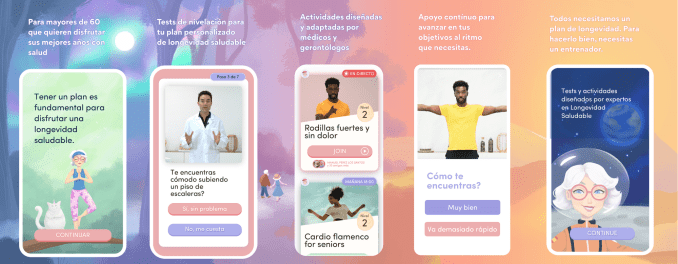
Screenshots of the digital coaching app (Image credit: Hearts Radiant/Rosita Longevity)

Hence some of the funding will go on researching how their bricks-and-mortar ‘longevity school’ program translates to a digital platform. And, more specifically, whether personalised digital coaching for 60+ year olds will yield tangible reductions in frailty (and thus gains in active years) in the same way that in-person group exercises have already been shown to. (One area that certainly merits close study is whether social human contact derived from a purely digital experience vs in-person group therapy makes a difference to treatment outcomes.)

It’s true that no smartphone in the world can transform a bog-standard bathroom into a full on luxury spa. But other elements of the Balneario’s program simply need digitizing and structuring to serve up similar benefits, is the thinking.

The sorts of digital activity programs they’re devising for the app are designed to be fun for seniors as well as beneficial and appropriate for a particular frailty level. Examples of classes currently offered include reduced mobility dance, burpee-free ‘cross fit’, and osteoarthritis-safe karate.

The onboarding process involves an assessment to determine a senior’s frailty level in order that users are offered content at an activity level that’s appropriate for their physical condition.

Long is the road

Cartagena notes they’re working with Dr. José Viña, a professor at the University of Valencia, who is renowned in the longevity field. “He has proven he can revert frailty in the earliest stages by applying a certain methodology to specific muscles with a treatment of exercise-fusion — with some lifestyle habits. Now what has not been proven is whether that is applicable to a remote environment where people do it on their own,” he adds. “And this what we are doing right now. This pre-seed round is basically to take that uncertainty, put that in front of a few thousand [app] users, take that research… and see if in the next 12 months we improve [their frailty level].”

The actual Balneario is closed at the moment, in this health-stricken year of the novel coronavirus, but the plan is to reopen in March 2021 — and then introduce the annual intake to Rosita — garnering ongoing feedback on whether or not it’s steering them toward health-supporting habits.

“It’s all about understanding the customer so well and that’s where the competitive advantage of this company really comes from,” argues Cartagena. “By having 15,000 seniors per year coming to the school, every year we understand the customer very well, their habits, what they do, what they don’t. They come every year so we can ask them what did you do last year?

“That will be for us the way to have a massive focus group — let’s say a sliding window of focus group that we can see for ten days using the product — and we can iterate much faster by seeing not people just through our analytics but people who are using the product in front of us. One hundred or 500 people a day in our resort. And I think that will be a fundamental way in which we can actually build something that people really need and use and care about.”

The current version of the app doesn’t yet include AI-powered personalized coaching. But that’s again where the pre-seed funding comes in. “The initial coach for education and frailty itineraries should be ready in three weeks (together with our iOS app),” says Cartagena. “This solves a pressing problem our users have today.

“The personalized coach (pathologies, followups, context, atomization of exercises, etc) has a lot of logic behind and testing this properly will take more time. We will release that intelligence slowly and we should feel ‘proud’ by Christmas. That will become our Habits Engine. Together with our geroscience research plan, those are the uncertainties to get right with our current funding.”

Targeting chronic pain is another key aim for the app, although he concedes there may be some types of pain they won’t be able to address. The co-founders add that the app is intended to supplement not replace traditional healthcare — pointing out it’s being designed to be more forward-looking; aka that prevention of age-related problems is exactly the strategy to live better for longer.

“Telehealth is more about managing a disease — we’re more about preventing,” adds Fernández. “We’re more about discovering what are the indicators and the tools to make sure that the senior population… understand what it happening to their body, what is going to happen over the next ten years and start to slowly develop those habits so that they can minimize, reduce the evolution, the natural ageing process.”

Cartagena notes they are also working with researchers on developing sensor hardware that could go alongside the app to enhance their ability to predict frailty — suggesting it will allow them to define a wider/more nuanced range of user categories (the first version of the app has three categories but he says they want to be able to offer nine).

Smartphone and sensor hardware combined with AI technology has, for some years now, been enabling a new generation of guided physical therapy apps that seek to offer an alternative to pharmaceutical-based management for chronic pain — such as Kaia Health and Hinge Health, to name two. And of course mindfulness/guided mediation has become a huge app business. While the broader concept of ‘digital health’ has, over the past half decade or so, seen CBT-style therapy programs packaged up to be put on tap in people’s pockets. So there’s nothing inherently strange or exotic about the idea of a longevity coach for seniors.

Albeit, getting the user experience right could well be the biggest challenge. Cartagena says the app’s tone is important — talking in terms of not wanting to be “patronizing” or make seniors feel like Rosita is giving them “homework” — so they really click with the virtual coach and stay engaged.

Fernández too emphasizes the goal is to sustain good habits. Ergo, this is a (gentle) marathon not a sprint. 

If they can design a safe and engaging experience that seniors don’t find off-putting, tedious or confusing the potential to expand access to therapies, activities and information that can improve people’s quality of life looks huge. Frailty is also only the team’s first focus. As they develop the product and grow usage they want to be able to support their users to form healthy habits that could help stave off neurodegenerative conditions like dementia, for example. Combating loneliness and social isolation is another goal. So there’s a whole range of health plans they’re hoping Rosita will be able to deliver.

“What we’re doing right now is focused especially on frailty — we’re developing the personalized AI coach on top of that — and what we’re going to do is start adding the layers of all the different health plans that we’re going to be establishing off the longevity coach,” says Fernández. “Nutrition, cognitive stimulation, relaxation and breathing, and on top of that we will put all the prevention strategies — and all the classes that we’re preparing for longevity.

“One of the things that we have tested in the clinic that is very important is to educate the user. Not just on what they need to do today — but on what is happening to their ageing process, what is happening to their metabolism, what is happening to their musculoskeletal system. How and why your body is ageing is fundamental so you can make small decisions. By empowering users through education they can understand and relate to why this specific thing that you’re telling them today is useful in the long run.”

“One of the most successful strategies that we have built is creating this whole course on longevity which is what is happening to your body — what science knows today about the field of longevity,” she adds. “And how you can minimize those symptoms. And those things we’re translating completely into the [app].”

Cartagena also points to the risk of a COVID-19 ‘4th wave’ of deaths that could result from seniors becoming more frail than they otherwise would after being forced into a more sedentary existence as a result of lockdown measures and concerns about their risk of exposure to the coronavirus.

Or, in other words, sitting at home on the sofa might help seniors stay free of virus but if abrupt inactivity risks their vitality that too could cut short a healthy lifespan. So tools to help older people stay active are looking more important than ever. And to that end he says the app will remain free throughout the pandemic — envisaging that could stretch into 2022.

The plan for the business model is b2c, likely focused on selling premium content — such as connecting users directly with a therapist to chat through their progress. In the meanwhile they’re relying on VC to get their digital “motivation engine” to market.

Right now they have 5,000 “pre-registrations” for the app and 1,000 seniors actively testing the product (all aged 60 to 80, in Spain). They’ve also just pushed out an update, moving the software out of the ‘early access’ phase — as they progress toward launching their “personalized AI coach for longevity.”

And while Rosita’s coaching is currently only available in Spanish — with the team having recorded “hundreds” of videos so far for different levels and chronic pathologies — the aim is to scale up in Europe (and perhaps beyond), starting with the U.K. market. Which makes English the next natural language for them to build out content.


News: Gogoro’s Eeyo 1s e-bike goes on sale in France, its first European market

Gogoro announced today that its Eeyo 1s is now available for sale in France, the smart electric bike’s first European market. Another model, the Eeyo 1, will launch over the next few months in France, Belgium, Monaco, Germany, Switzerland, Austria and the Czech Republic. In France, the Eeyo 1s can be purchased through Fnac, Darty

Gogoro announced today that its Eeyo 1s is now available for sale in France, the smart electric bike’s first European market. Another model, the Eeyo 1, will launch over the next few months in France, Belgium, Monaco, Germany, Switzerland, Austria and the Czech Republic.

In France, the Eeyo 1s can be purchased through Fnac, Darty or, in Paris, Les Cyclistes Branchés. The Eeyo 1s is priced at €4699 including VAT, while the the Eeyo 1 will be priced at €4599, also including VAT.

The weight of Eeyo bikes is one of their key selling points and Gogoro says they are about half the weight of most other e-bikes. The Eeyo 1s weighs 11.9 kg and the Eeyo 1 clocks in at 12.4 kg.  Both have carbon fiber frames and forks, but the Eeyo 1s’ seat post, handlebars and rims are also carbon fiber, while on the Eeyo 1 they are made with an alloy.

Based in Taiwan, Gogoro first introduced its Eeyo lineup in May, making them available for sale in the U.S. first. The e-bikes are the company’s second type of vehicle after its SmartScooters, electric scooters that are powered by swappable batteries. The Eeyo bike’s key technology is the SmartWheel, a self-contained hub that integrates its motor, battery, sensor and smart connectivity technology so it can be paired with a smartphone app.

In an interview for the Eeyo’s launch, Gogoro co-founder and chief executive Horace Luke said the company began planning for Eeyo’s launch in 2019, before the COVID-19 pandemic. While sale of e-bikes were already growing steadily before COVID-19, the pandemic has accelerated sales of e-bikes as people avoid public transportation and stay closer to home. Several cities have also closed some streets to car traffic, making riders more willing to use bikes for short commutes and exercise.

Founded in 2011 and backed by investors including Temasek, Sumitomo Corporation, Panasonic, the National Development Fund of Taiwan and Generation (the sustainable tech fund led by former vice president Al Gore), Gogoro is best known for its electric scooters, but it is also working on a turnkey solution for energy-efficient vehicles to license to other companies, with the goal of reducing carbon emissions in cities around the world.

News: Jared Leto, Scooter Braun and Troy Carter are backing Moment House, a startup recreating live events… digitally

A pitch to offer artists a way to give geo-fenced, live events to fans around the world has brought the new Los Angeles startup Moment House $1.5 million in seed funding. The money came from heavy hitters in the Los Angeles entertainment and investment scene including Scooter Braun, Troy Carter, Kygo’s Palm Tree Crew and

A pitch to offer artists a way to give geo-fenced, live events to fans around the world has brought the new Los Angeles startup Moment House $1.5 million in seed funding.

The money came from heavy hitters in the Los Angeles entertainment and investment scene including Scooter Braun, Troy Carter, Kygo’s Palm Tree Crew and Jared Leto. Patreon chief executive Jack Conte and Sequoia Capital partner Jess Lee also participated in the round.

Forerunner Ventures led the deal and the investment was made by Kirsten Green, the firm’s famous founder and managing partner. Kevin Mayer, the former chief executive of TikTok; GV chief David Krane; Aaron Levie from Box; the tech media and entertainment guru, Matthew Ball; and product maestro Eugene Wei all participated in the round as well.

Founded by Arjun Mehta, Shray Bansal, and Nigel Egrari, the company grew out of work the three men did while attending the USC Jimmy Iovine & Dr. Dre Academy for the Arts, Technology and the Business of Innovation. 

The company touts itself as the simplest way for artists to create online events for their fans.

For its first foray into live entertainment, Moment House is going to host a geo-fenced, location-specific tour for the musician Yungblud. Other ticketed events from Kygo, blackbear, Kaytranada, Denzel Curry and Ruel will follow, the company said.

For musicians, the company’s pitch of ticketing security, merchandise integrations global payments support, must have been music to their ears — because all of those features add up to one thing… cash.

And performers on the platform take all of the ticket revenues, with Moment House earning money by charging fans a small fee.

In a statement, company co-founder Arjun Mehta said that the company’s technology and service wasn’t a response to the COVID-19 pandemic, but rather a way to amplify the concert going experience with an online approximation.

“Moment House is empowering artists to deliver digital experiences that feel authentic and compelling,” said Leto, in a statement. “I was drawn to the unique design-driven approach because that’s what is needed to create a new category here.”


WordPress Image Lightbox Plugin