Yearly Archives: 2020

News: Koyeb raises $1.6 million for its serverless data-processing engine

French startup Koyeb has raised a $1.6 million (€1.4 million) pre-seed round. The company focuses on data-processing workflows across multiple cloud providers. It hides many complexities using a serverless model. Jean-David Chamboredon and Juliette Mopin from ISAI are leading the round with Plug and Play Ventures, Kima Ventures, AceCap and a long list of business

French startup Koyeb has raised a $1.6 million (€1.4 million) pre-seed round. The company focuses on data-processing workflows across multiple cloud providers. It hides many complexities using a serverless model.

Jean-David Chamboredon and Juliette Mopin from ISAI are leading the round with Plug and Play Ventures, Kima Ventures, AceCap and a long list of business angels also participating, such as Zachary Smith, Justin Ziegler, Alexis Lê-Quôc, Sébastien Lucas, Marc Jalabert, Amirhossein Malekzadeh, Philippe Besnard, Eric Ouisse, Dominique Vidal and Fabrice Bernhard.

Koyeb believes that companies will take advantage of the best cloud-native APIs and storage services going forward. In order to mix-and-match those various providers, Koyeb provides the serverless glue that ties everything together.

For instance, you can store videos on an object storage managed by DigitalOcean, transcribe the audio from those video files on Google Cloud using Google’s speech-to-text API and save the results on another object storage bucket.

You can move and process data based on a fixed schedule or based on events. For instance, when there’s a new file, you can trigger Koyeb with an API call. Everything scales automatically to process your task. And once your workflow is done, you no longer get billed for runtime.

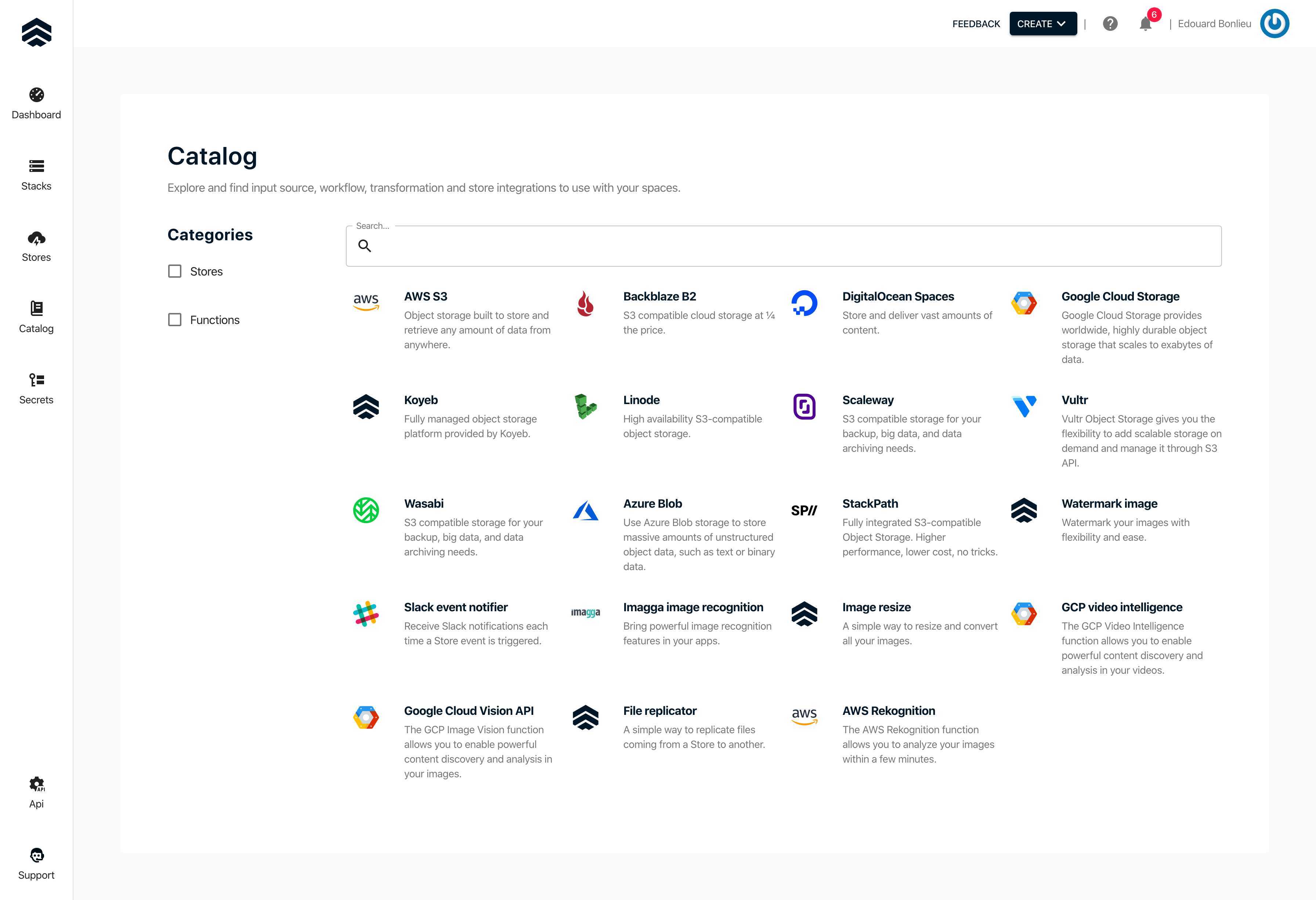
Koyeb supports many different storage providers, such as AWS, Google Cloud, Microsoft Azure, Wasabi, Backblaze B2 as well as object storage products from DigitalOcean, Linode, Scaleway, Vultr, etc.

The company has also been working on a feature that lets you deploy your own Docker container so that you can build your custom functions. You can also push your function from GitHub directly.

This way, you don’t have to spin up new servers and shut them down later. You don’t have to manage your cloud infrastructure using Terraform and Kubernetes as Koyeb abstracts your infrastructure for you.

Image Credits: Koyeb

News: Extend banks $40M to bring a new approach to the old game of extended warranties

Extended warranties — those offers to add an extra year or two to an existing product warranty to give you a little more peace of mind in case something goes wrong with something you’ve purchased — have long been a part of the sales process when you’re buying big-ticket items from large stores. Today, a

Extended warranties — those offers to add an extra year or two to an existing product warranty to give you a little more peace of mind in case something goes wrong with something you’ve purchased — have long been a part of the sales process when you’re buying big-ticket items from large stores. Today, a startup is announcing a large round of funding to help democratise the concept, using APIs to make extended warranties it into something that even the smallest retailers can offer on the least expensive items. 

Extend, which works with companies like Peloton, iRobot, ​Harman / JBL, Advance Auto Parts, Traeger Grills, BlendJet, SoClean, 1More, August Home, Balsam Hill, NewAir, Evolve Skateboards and some 150 others to build and handle extended warranties on their products, has raised $40 million in a Series B round of funding.

Woody Levin, the CEO and founder of the company, said in an interview that his ambition is to remove the roadblocks for smaller merchants (especially in the direct-to-consumer space) in offering extended warranties on their products, and for consumers, to remove the stigma attached to the concept, which some see as simply preying on people’s insecurities and not worth the paper they are written on (or in these days, the splash screen they appear on in the checkout flow of your online transaction).

“There has been a stigma around the extended warranty for way too long,” he said. “We want to create a more elegant experience. We want extend to be Apple Care for everything.”

Levin added that today, the company touches more than $27 billion in warrantable gross merchandise value. 

If Apple is where it’s aiming, Extend is working the right VCs, situated in the top shelf of investors. The round is being led by Meritech Capital — which has backed the likes of Facebook, Salesforce and Tableau, among others — with participation from PayPal Ventures and previous backers Great Point Ventures and Shah Capital Partners.

PayPal is a key investor here: it’s one of the most ubiquitous providers of online payments and other services for merchants, and will forever be on the lookout for those building technology that will lead to more conversions, especially in the current market, where social distancing has led to a boom in e-commerce, which in turn has led to a much more competitive landscape: more places to buy things, more discounts and more tech to keep people from navigating away and buying elsewhere.

“Merchants of all sizes can benefit from extended warranties but implementing and maintaining them has been too complex for many businesses,” said ​Jay Ganatra, Partner at PayPal Ventures​, in a statement. “Extend shares PayPal’s commitment to providing merchants with easy to use tools that help them better connect with and support their customers. On top of that, the Extend team has seriously improved the end-user experience through its use of their conversational chatbot. We’re excited to invest in Extend as it continues to redefine this space.”

Extend has raised $56 million to date, and it’s not disclosing valuation.

Extended warranties may pivot on the idea of providing more peace of mind to buyers who will, for example, take out Apple Care in order to make sure that their expensive iPhones don’t cost a fortune to fix or end up getting thrown away after a misadventure. But from the point of view of the merchant, they serve as a huge fillip to getting a sale over the line.

And over the last few years, as merchants have realised this, they’ve been applying the extended warranty to a lot more than just the most expensive things.

“The top 1% of merchants have been benefitting from that peace of mind,” Levin said. “If you look at Amazon, they are offering extended warranties on $40 backpacks. That’s because the purchase rate goes up when there is an extended warranty even being advertised.”

But advertising is not all: extended warranties generated a whopping $130 billion in 2019, with the figures growing at a rate of about 7.4% annually. 

The roadblock for many up to now has been that the companies that provide extended warranties are old and tend only to work with the biggest sellers. Companies like Squarespace and Assurion, Levin said, work with only the “top 1% of companies,” ignoring smaller companies. “These are legacy companies focused on one-off integrations,” he said.

Extend’s solution has been to take the modern approach: it has built an API that can be integrated into any e-commerce storefront or check-out flow (it works also with others like Affirm that are also trying to disrupt and modernise this process). The actual can cost as little as $19.99 or far more than that for one- or two-year plans.

Extend then partners with underwriters like AIG to provide the insurance backing to the warranties. Those who claim back can file claims by speaking with an agent, but it also offers an automatic chatbot 24 hours a day to deal with claims. Levin said that some 98% of claims are processed through her. (She is called Kayley.)

Those claims, in turn, are processed with as little hassle as possible: since they are tied to transactions that happened online, buyers don’t need to have kept receipts in order to claim since Extend tracks that for them. It typically issues credits back for a buyer to either re-purchase the same product, or something else of equivalent value, at the same point of sale.

“Meritech always strives to work with companies that are seeking to define the future of an industry, and that’s exactly what Extend is doing with its platform,” said ​Alex Clayton, General Partner at Meritech Capital, in a statement. ​“Extend is filling a huge gap in the eCommerce infrastructure market by streamlining the process for merchants to offer extended warranties and protection plans on their products, and providing a seamless customer experience for consumers from start to finish. We’re eager to see what’s next.”

News: Snapchat launches its TikTok rival, Sounds on Snapchat

Snapchat this summer announced it would soon release a new music-powered feature that would allow users to set their Snaps to music. Today, the company made good on that promise with the launch of “Sounds on Snapchat” on iOS, a feature that lets users enhance their Snaps with music from curated catalog of both emerging

Snapchat this summer announced it would soon release a new music-powered feature that would allow users to set their Snaps to music. Today, the company made good on that promise with the launch of “Sounds on Snapchat” on iOS, a feature that lets users enhance their Snaps with music from curated catalog of both emerging and established artists.

The music can be added to Snaps either pre or post capture, then shared without any limitations. You can post it to your Story or share directly with friends, as you choose.

At launch, the Snapchat music catalog offers “millions” of licensed songs from Snap’s music industry partners, the company says.

When users receive a Snap with Sounds, they can then swipe up to view the album art, the song title, and the name of the artist. There’s also a “Play This Song” link that lets you listen to the full song on your preferred streaming platform, including Spotify, Apple Music and SoundCloud.

This differentiates Snapchat’s music feature from rival TikTok, where a tap on the “sound” takes users to a page in the app that shows other videos using the same music clip. Only some of these pages also offer a link to play the full song, however.

To kick off the launch of the new Snapchat music feature, Justin Bieber and benny blanco’s new song “Lonely” will be offered as an exclusive in Snapchat’s Featured Sounds list today.

“Music makes video creations and communication more expressive, and offers a personal way to recommend music to your closest friends,” notes the company, in announcement about the feature’s launch.

Snap had said in August it would begin testing the new music feature and detailed the deals that made the addition possible.

To power Sounds on Snapchat, the company forged multi-year agreements with major and independent publishers and labels, including Warner Music Group, Merlin (including their independent label members), NMPA, Universal Music Publishing Group, Warner Chappell Music, Kobalt, and BMG Music Publishing.

The move to introduce a music feature is meant to counter the growing threat of the ByteDance-owned TikTok app, which has popularized short-form video sharing with posts set to music from a large catalog.

Though TikTok’s future in the U.S. remains uncertain due to the ever-changing nature of the Trump administration’s TikTok ban (and an election that could upset those plans), it still remains one of the top U.S. apps, with around 100 million monthly active U.S. users as of August. (TikTok is currently engaged in a lawsuit to challenge its ban, so the app remains live today.)

Social media companies have capitalized on the chaos surrounding a possible TikTok U.S. exit to promote their alternatives, like Triller, Dubsmash, Byte, and others, including, of course Instagram Reels.

Snapchat, meanwhile, touts its traction with a younger user base as its new music feature goes to launch.

In the U.S., Snapchat now reaches 90% of all 13-24 year-olds, which the company notes is more than Facebook, Instagram, and Messenger combined. It also reaches 75% of all 13-34 year-olds and, o average, more than 4 billion Snaps are created every day.

The feature is live now on iOS to start.

News: River, the latest venture from Wander founder Jeremy Fisher, launches with $10.4 million in funding

River, the latest venture from Wander founder Jeremy Fisher, has today announced the close of a $10.4 million funding round from Founders Fund, .406, BoxGroup, Josh Kushner and Scooter Braun. River is meant to rethink the way we consume content across the internet. The app pulls stories and content from across the entire internet, including

River, the latest venture from Wander founder Jeremy Fisher, has today announced the close of a $10.4 million funding round from Founders Fund, .406, BoxGroup, Josh Kushner and Scooter Braun.

River is meant to rethink the way we consume content across the internet. The app pulls stories and content from across the entire internet, including from publishers, Twitter and other social media, etc. and organizes that content based on the topic.

For example, the confirmation hearings for Hon. Amy Coney Barrett were in my River feed this morning, with stories from a wide variety of publishers. River clips the story down to a headline, but gives users the ability to click through to the full text of the story. The app also prioritizes video content, giving users a chance to get more context on the story without clicking through at all.

What’s most interesting about River, however, is that there is no user account or profile, and no following. That means that the behavior of an individual user (or a phone, as Fisher calls it) will be the only influence on the content they’re served, rather than their social graph playing a role. According to PEW, 55 percent of U.S. adults get their news either ‘often’ or ‘sometimes’ from social media. The combination of the social graph with information consumption can cause echo chambers and social media has been a place where misinformation can proliferate quickly.

River serves up content from publishers and across the web without using account information, a social graph, or past browsing history, which allows those users to discover a broader range of perspectives. The more users get on the platform, the better it gets at serving them the content that’s relevant to them.

Onboarding to River simply includes ticking boxes for categories that interest you and you’re off to the races.

Rather than understanding everything about the user, River tries to understand everything it can about the content itself.

“We look at things like: who published that content, whether they’re a professional or a regular consumer, whether they are part of an organization that’s a subsidiary of another organization, what placement in that publication do they typically get, how are they connected to other people, what are the topics that are in that tweet or that video or that article,” said Fisher. “We look at how all those things are related to one another.”

Fisher and his cofounders Lev Brie and Leland Maschmeyer had originally planned to launch River before the pandemic struck with a variety of social sharing features. However, as the pandemic hit and protests in the wake of George Floyd’s murder grew into a global movement, the team realized that both consumption and content sharing were evolving rapidly.

This led the team to rethink the sharing features inside River and ultimately build a standalone, separate app called Overflow.

Overflow allows users to post a selfie video alongside news content out to other social networks. Overflow has an editorially selected feed of content from users, but users can also put their videos on their Instagram Stories or TikTok.

With $10 million+ in funding, River is not currently planning any specific revenue models.

The team is made up of 12 people and Fisher says that a third of the team is “diverse,” but declined to specify the breakdown by gender and/or ethnicity.

Fisher has been building products for nearly ten years, most notably coming from Wander, which sold to Yahoo back in 2014.

When asked what he learned from Wander that carries into River, he said that it’s about building a product that fits into the gaps of already established user behavior and keeping things as simple as possible.

“Often, you start with a really overdetermined product and an attitude that ‘more is more’,” said Fisher. “What I’ve learned over the years is that a product is the average of its features and not the sum of its features. Incremental things actually detract from the experience. You want every feature to be a ’10’.”

News: Application security platform NeuraLegion raises $4.7 million seed led by DNX Ventures

Application security platform NeuraLegion announced today it has raised a $4.7 million seed round led by DNX Ventures, an enterprise-focused investment firm. The funding included participation from Fusion Fund, J-Ventures and Incubate Fund. The startup also announced the launch of a new self-serve, community version that allows developers to sign up on their own for

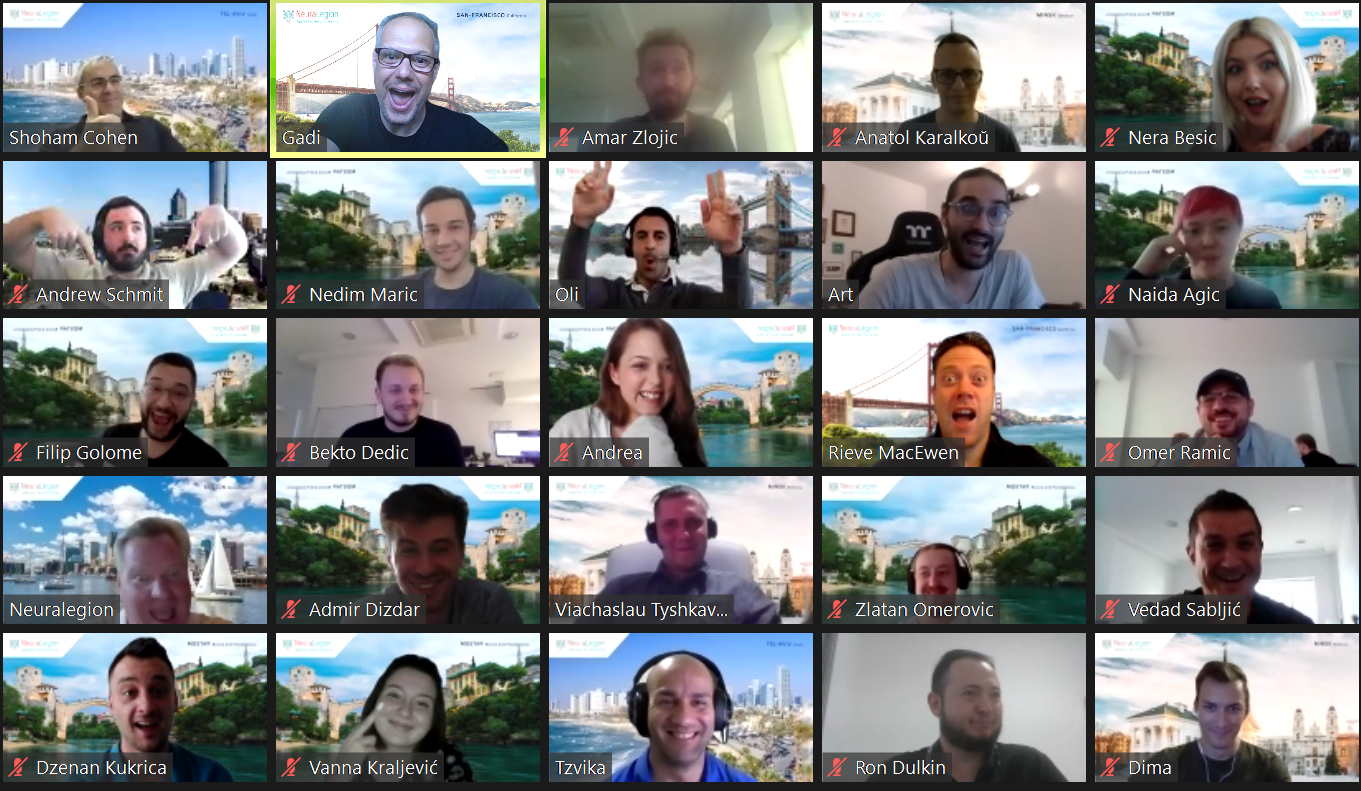
A video call group photo of NeuraLegion's team working remotely around the world

A video call group photo of NeuraLegion’s team working remotely around the world

Application security platform NeuraLegion announced today it has raised a $4.7 million seed round led by DNX Ventures, an enterprise-focused investment firm. The funding included participation from Fusion Fund, J-Ventures and Incubate Fund. The startup also announced the launch of a new self-serve, community version that allows developers to sign up on their own for the platform and start performing scans within a few minutes.

Based in Tel Aviv, Israel, NeuraLegion also has offices in San Francisco, London, and Mostar, Bosnia. It currently offers NexDAST for dynamic application security testing, and NexPLOIT to integrate application security into SDLC (software development life-cycle). It was launched last year by a founding team that includes chief executive Shoham Cohen, chief technology officer Bar Hofesh, chief scientist Art Linkov, and president and chief commercial officer Gadi Bashvitz.

When asked who NeuraLegion views as its closest competitors, Bashvitz said Invicti Security and WhiteHat Security. Both are known primarily for their static application security testing (SAST) solutions, which Bashvitz said complements DAST products like NeuraLegion’s.

“These are complementary solutions and in fact we have some information partnerships with some of these companies,” he said.

Where NeuraLegion differentiates from other application security solutions, however, is that it was created for specifically for developers, quality assurance and DevOps workers, so even though it can also be used by security professionals, it allows scans to be run much earlier in the development process than usual while lowering costs.

Bashvitz added that NeuraLegion is now used by thousands of developers through their organizations, but it is releasing its self-serve, community product to make its solutions more accessible to developers, who can sign up on their own, run their first scans and get results within fifteen minutes.

In a statement about the funding, DNX Ventures managing partner Hiro Rio Maeda said, “The DAST market has been long stalled without any innovative approaches. NeuraLegion’s next-generation platform introduces a new way of conducting robust testing in today’s modern CI/CD environment.”

News: Spain’s Savana Medica raises $15 million to bring its AI toolkit turning clinical notes into care insights to the US

Savana, a machine learning-based service that turns clinical notes into structured patient information for physicians and pharmacists, has raised $15 million to take its technology from Spain to the U.S., the company said. The investment was led by Cathay Innovation with participation from the Spanish investment firm Seaya Ventures, which led the company’s previous round, and

Savana, a machine learning-based service that turns clinical notes into structured patient information for physicians and pharmacists, has raised $15 million to take its technology from Spain to the U.S., the company said.

The investment was led by Cathay Innovation with participation from the Spanish investment firm Seaya Ventures, which led the company’s previous round, and new investors like MACSF, a French insurance provider for doctors. 

The company has already processed 400 million electronic medical records in English, Spanish, German, and French.

Founded in Madrid in 2014, the company is relocating to New York and is already working with the world’s largest pharmaceutical companies and over 100 healthcare facilities.

“Our mission is to predict the occurrence of disease at the patient level. This focuses our resources on discovering new ways of providing medical knowledge almost in real time — which is more urgent than ever in the context of the pandemic,” said Savana chief executive Jorge Tello. “Healthcare challenges are increasingly global, and we know that the application of AI across health data at scale is essential to accelerate health science.”

Company co-founder and chief medical officer, Dr. Ignacio Hernandez Medrano, also emphasized that while the company is collecting hundreds of millions of electronic records, it’s doing its best to keep that information private.

“One of our main value propositions is that the information remains controlled by the hospital, with privacy guaranteed by the de-identification of patient data before we process it,” he said. 


News: France and the Netherlands signal support for EU body to clip the wings of big tech

The French and Dutch governments have signalled support for EU rules that can proactively intervene against so-called gatekeepers, aka “structuring platforms” or “large digital platforms with significant network effects acting as gatekeepers” — or, more colloquially, ‘big tech’. They have also called for a single European body with enforcement powers over such platforms — and

The French and Dutch governments have signalled support for EU rules that can proactively intervene against so-called gatekeepers, aka “structuring platforms” or “large digital platforms with significant network effects acting as gatekeepers” — or, more colloquially, ‘big tech’.

They have also called for a single European body with enforcement powers over such platforms — and the ability to audit their algorithms.

Pre-emptive action should intervene prior to the stage where damage becomes irreversible,” French digital minister, Cederic O, and Mona Keijzer, the secretary of state for economic affairs for the Netherlands, write in a joint position paper where they also argue that: “Intervention is justified when the asymmetric bargaining power of structuring platforms leads to negative consequences.”

The two ministers went further in accompanying remarks to the press, with the Financial Times reporting that their support for intervention against big tech’s market muscle includes keeping the option of breaking up companies “on the table” — although their stated preference is for rules that prevent such an “ultimate” step being necessary.

The intervention by two high profile EU Member States comes as the European Commission is working on a major package of pan-EU legislation to update the bloc’s ecommerce rules — including devising a new regime of ex ante rules for so-called ‘gatekeeper’ platforms. 

In recent months press reports have suggested EU lawmakers are considering forcing such platforms to share data with smaller rivals and/or limiting how they can make use of data — such as via strict purpose limitation.

They are also reportedly considering rules to ban self-preferencing and apply conditions on bundling, as well as requiring annual audits of ad metrics and reporting practices.

Although the package remains at the draft stage for now, with the Commission saying only that it’s committed to introduce the Digital Services Act (DSA) by the end of this year.

Commission lawmakers are also eyeing expanded powers for competition regulators to proactively tackle the network effects that can apply in digital markets — and have, in recent weeks, been consulting on a new competition tool for this purpose. 

The French-Dutch intervention thus sends a strong signal of support to the Commission for regulating big tech — and a warning shot against watering down policy measures.

Competition chief and Commission EVP, Margrethe Vestager, who is one of the key lawmakers drafting the DSA, has previously cautioned against breaking up tech giants as a solution to competitive imbalances in digital markets — calling instead for a finer grained regulatory framework which regulates their access to data.

Such an approach would be akin to a structural separation, without the huge legal challenge involved in actually breaking up businesses, is the thinking.

The French-Dutch position paper reflects back many of the ideas the Commission is actively considering, per recent press leaks. So it may be intended to send a message that key Member States are on the same page.

The paper advocates for intervention to apply to platforms that have “considerable market power” in at least one market, while warning against imposing “unnecessary obligations” to platforms without any gatekeeper position.

It also suggests a “platform-by-platform approach” by regulators to determine whether or not a platform is a gatekeeper or not, noting: “It is important to stress that classical methods of market definition cannot always be used effectively in digital markets.”

Platform-specific factors such as the characteristics of the service and the behaviour of users should factor into the analysis of whether it holds a structural position, they also suggest — before again hitting a cautious note and urging that “a right balance” be struck between a platform-specific analysis and “the need for a reasonable level a legal certainty”.

Interventions should also be ‘case-by-case, flexible and proportionate’ in their view — with the pair suggesting regulatory authorities be empowered to “impose tailor-made remedies to a structuring platform”.

“Proportionate intervention is needed to preserve the benefits of platforms whilst enhancing competition. Too heavy-handed an intervention would hamper innovation,” they warn.

They also voice support for gatekeepers to be subject to a set of “principle-based obligations and prohibited practices” — and recent press reports have also suggested EU lawmakers are considering a laundry list of obligations and conditions on gatekeepers.

“The full set of behavioural obligations could be widened to the whole ecosystem of the platform to tackle the risks stemming from its gatekeeper position on a number of neighbouring markets (leveraging). Also, it could be adjusted over time, in light of the evolution of the business environment. The measures could be either eased or tightened depending on the actual evolution of these conditions,” they further suggest.

Among the “possible behavioral measures” listed in the position paper are beefing up the right to portability (which EU users’ already enjoy under the GDPR); rules to ensure fair contracts (and unfair contract clauses have already attracted EU antitrust enforcement action in the case of, for example, Google Android); a ban on what they describe as “disruptive” self-preferencing; and a stop on platforms yanking third party access (e.g. to APIs or data) — “without objective justification” (the EU has already agreed on some fairness and transparency rules for general ecommerce).

The position paper also voices support for access obligations — such as obligations to share data; provide interoperability; and/or proactively offer alternatives to users — as a potential intervention to ensure market openness, while cautioning of the need to properly investigate ‘pros and cons’ before such enforcement.

On sanctions for infringements, the French and Dutch ministers urge “significant enough” penalties that platforms are effectively deterred from breaking rules, i.e. rather than being able to factor them in as a line of business cost (as now).

The level of these fines or other sanctions should be significant enough to ensure the effectiveness of the rules at stake by deterring the platform from breaking them. The requirement of an efficient and deterrent mechanism of sanctions is all the more important here since any breach of the rules would be likely to induce serious and irreversible harm,” they write. 

On enforcement, the paper calls for a single “European body” outfitted with “proper tools” — including “broad investigation, audit and monitoring powers, and the ability to audit algorithms” — to be entrusted with enforcing the new regulations. 

That would mark a step-change from the EU’s data protection framework (GDPR), where responsibility for enforcement is decentralized to a patchwork of under-resourced local/national data protection agencies. Critics maintain the pace of GDPR enforcement in complex, cross-border cases against big tech is too slow to be effective. A two-year review of the regulation by the Commission this summer also found a general lack of uniformly vigorous enforcement.

That stands as a warning signal to EU lawmakers shaping the next generation of digital regulations that very careful attention needs to be paid to ensuring effective enforcement.

News: Popmenu earns raves from investors for its marketing and delivery software for restaurants

Brendan Sweeney didn’t know anything about the restaurant business before he and his co-founders launched the Atlanta-based startup Popmenu. What Sweeney did know was that it was nuts that while every other business was using incredible graphics, curated text, carefully crafted images and fancy videos to make their pitch to customers restaurants were — posting

Brendan Sweeney didn’t know anything about the restaurant business before he and his co-founders launched the Atlanta-based startup Popmenu.

What Sweeney did know was that it was nuts that while every other business was using incredible graphics, curated text, carefully crafted images and fancy videos to make their pitch to customers restaurants were — posting a text-based menu.

“It’s just crazy that restaurants present their inventory, which is their whole story, their whole selling proposition in plain text,” Sweeney said.

Popmenu, he company he co-founded with three former colleagues from software businesses around the Atlanta area (and which has closed on $17 million in new financing) offers a solution.

What the company’s software aims to do is keep customers on restaurant’s own online real estate by incorporating third party reviews, images, recommendations, and better descriptions into the webpages that it hosts for the culinary creators that use its service. “If you had all that information on a restaurant website it would probably reduce the need to bounce out so much,” Sweeney said.

Popmenu does more than just prettify webpages for the savory savants whose coding skills may not match their craft in the kitchen. The software also helps with social media management, emailing and, yes, even the all-important delivery services that have become vital in the time of a still-spreading pandemic.

It’s the pandemic that juiced the company’s growth, Sweeney said. “We saw ten years of trends in the first ten weeks of COVID-19,” he said. “A lot of people were unprepared for it.”

Sweeney and his co-founders Mike Gullo, Anthony Roy, and Justis Blasco had all worked together at either CareerBuilder or Commissions Inc. It was the experience at Commissions that actually gave Sweeney and his colleagues the idea to start Popmenu.

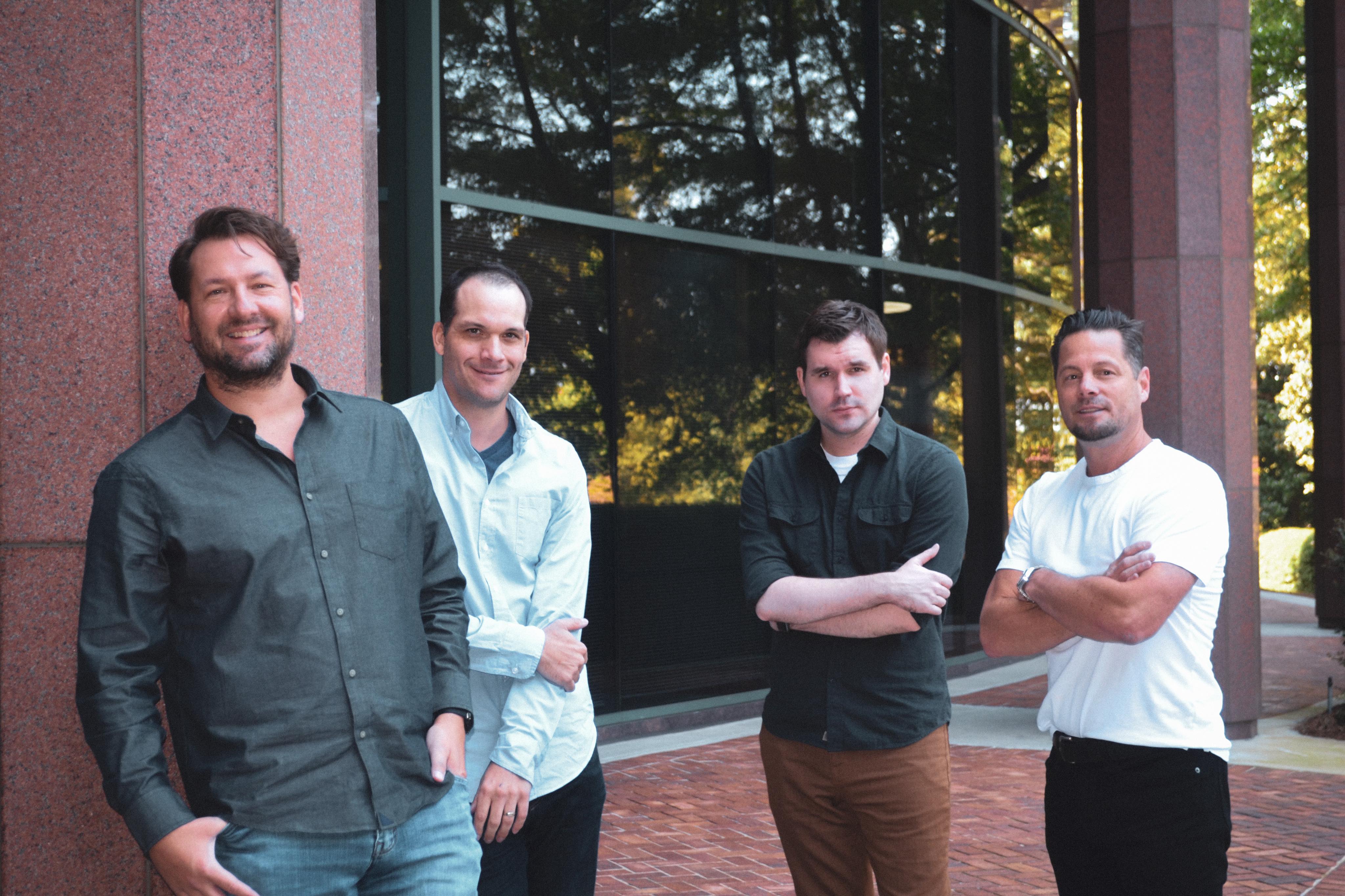
Popmenu co-founders Brendan Sweeney, Mike Gullo, Justis Blasco, and Anthony Roy. Image Credit: Popmenu

Where Commissions was about designing tools to help local real estate agents and brokers take some power back from the large online platforms that were eating their lunch, Popmenu is bringing the same tools for small businesses to restaurateurs.

“I got this playbook for helping small business with SAAS. [And we’re] helping restaurants take control back from Yelp and TripAdvisor,” said Sweeney.

Other companies around the country, like ChowNow out of Los Angeles, are trying to do something similar. But while ChowNow is focused on online ordering, Popmenu started with marketing and… well… making menus “pop”.

The company is going to use the new cash it raised to add services like on-premises contactless transactions and from there could have a connection from the front-of-the-house to the back-of-the-house operations and ordering and fulfillment services.

Existing investors like Base10 Partners and Felicis Ventures returned to finance the company’s Series B along with new lead investor Bedrock Capital. Popmenu has also received some celebrity financing in the form of a commitment from Mantis VC, the newly launched investment firm from the wildly popular Chainsmokers band.

Apparently, they wanted something just like this, according to Milan Koch of Mantis VC. “When Alex, Drew and I met the Popmenu team, it was obvious to us right away how much they really cared about restaurateurs,” Koch said in a statement. “Having close ties with owners and hospitality groups worldwide and knowing the unique challenges they face, we got excited about how Popmenu’s product could help impact their businesses in so many different ways.”

Popmenu sells its software for a monthly fee starting at $269 per-location.

“So many industries have experienced radically accelerated trends through the COVID crisis, probably none more so than the restaurant industry,” said Sweeney, in a statement. “They’ve embraced technology as key to weathering these challenging times. We are fired up to give them even more help attracting guests and reducing costs and complexity on the road to recovery.”

News: Mario Kart Live: Home Circuit review

  Nintendo’s new RC Mario Kart looks terrific

Text: Mario Kart Live: Home Circuit review by Bryce Durbin [Image: drawing of Mario Kart car next to Nintendo Switch]
Text: Mario Kart Live: Home Circuit is a remote-controlled car connected wirelessly to the Nintendo Switch. It's available for $99.99 on October 16. The game it's played with is a free download. [Image: drawing of closeup of Mario Kart toy] Text: The car has a camera above Mario (or Luigi) so you can see from his point of view on the Switch screen. Augmented reality (AR) elements are overlaid on what you see for a reality-bending cart experience. [Image: drawing of in-game play in a living room]
Text: Players build the course using four gates and optional arrow signboards. I found the more complicated you make your course, the more challenging the game will be. [Image: A drawing of a simple race setup in a living room] Text: In one-player mode, you can race against the Koopalings in a Grand Prix, do a time trial, or make a custom course. As you play, you can unlock customizations to your kart. [Image: A drawing of an in-game image of Builder Mario]
Text: Obstacles include in-game mainstays like banana peels and bombs as well as whatever hasn't been swept out of the way of your custom-made course. [Image: In-game image of living room floor including real-life toys and in-game banana peel and bob-omb] Text: Most of the course themes will be familiar if you've played Mario Kart before... [Image: In-game image of Rainbow Road course]
Text: ...but each track I tested had surprises, such as a track styled after the original Super Mario Bros or a course that sometimes becomes mirrored. [Image: In-game drawing of World 1-1 with goomba being struck by kart] Text: It's a strange and delightful game experience. Without the AR layer, it's just a relatively slow-moving RC kart. [Image: a drawing of the Mario Kart toy]
Text: I didn't have the opportunity to race against other real-life players in multiplayer mode. It requires each player to have their own additional car *and* Switch. [Image: Mario and Luigi racers, two Nintendo Switches]
Text: Overall, this is a novel toy that has replay value depending on how much time and space you want to to devote to making custom courses. [Image: dining room scene of child and Mario Kart race track]


News: Stripe acquires Nigeria’s Paystack for $200M+ to expand into the African continent

When Stripe announced earlier this year that it had picked up another $600 million in funding, it said one big reason for the funding was to expand its API-based payments services into more geographies. Today the company is coming good on that plan in the form of some M&A. Stripe is acquiring Paystack, a startup

When Stripe announced earlier this year that it had picked up another $600 million in funding, it said one big reason for the funding was to expand its API-based payments services into more geographies. Today the company is coming good on that plan in the form of some M&A.

Stripe is acquiring Paystack, a startup out of Lagos, Nigeria that, like Stripe, provides a quick way to integrate payments services into an online or offline transaction by way of an API. (We and others have referred to it in the past as “the Stripe of Africa.”)

Paystack currently has around 60,000 customers, including small businesses, larger corporates, fintechs, educational institutions, and online betting companies, and the plan will be for it to continue operating independently, the companies said.

Terms of the deal are not being disclosed but sources close to it confirm that it’s over $200 million. That makes this the biggest startup acquisition to date to come out of Nigeria, as well as Stripe’s biggest acquisition to date anywhere. (Sendwave, acquired by WorldRemit in a $500 million deal in August, is based out of Kenya.)

It’s also a notable shift in Stripe’s strategy as it continues to mature: typically, it has only acquired smaller companies to expand its technology stack, rather than its global footprint.

The deal underscores two interesting points about Stripe, now valued at $36 billion and regularly tipped as an IPO candidate (note: it has never commented on those plans up to now). First is how it is doubling down on geographic expansion: even before this news, it had added 17 more countries to its platform in the last 18 months, along with progressive feature expansion. And second is how Stripe is putting a bet on the emerging markets of Africa specifically in the future of its own growth.

“There is enormous opportunity,” said Patrick Collison, Stripe’s co-founder and CEO, in an interview with TechCrunch. “In absolute numbers, Africa may be smaller right now than other regions, but online commerce will grow about 30% every year. And even with wider global declines, online shoppers are growing twice as fast. Stripe thinks on a longer time horizon than others because we are an infrastructure company. We are thinking of what the world will look like in 2040-2050.”

For Paystack, the deal will give the company a lot more fuel (that is, investment) to build out further in Nigeria and expand to other markets, CEO Shola Akinlade said in an interview.

“Paystack was not for sale when Stripe approached us,” said Akinlade, who co-founded the company with Ezra Olubi (who is the CTO). “For us, it’s about the mission. I’m driven by the mission to accelerate payments on the continent, and I am convinced that Stripe will help us get there faster. It is a very natural move.”

Paystack had been on Stripe’s radar for some time prior to acquiring it. Like its US counterpart, the Nigerian startup went through Y Combinator — that was in 2016, and it was actually the first-ever startup out of Nigeria to get into the world-famous incubator. Then, in 2018, Stripe led an $8 million funding round for Paystack, with others participating including Visa and Tencent. (And for the record, Akinlade said that Visa and Tencent had not also approached it for acquisition. Both have been regular investors in startups on the continent.)

In the last several years, Stripe has made a number of investments into startups building technology or businesses in areas where Stripe has yet to move. This year, those investments have included backing an investment in universal checkout service Fast, and backing the Philippines-based payment platform PayMongo.

Collison said that while acquiring Paystack after investing in it was a big move for the company, people also shouldn’t read too much into it in terms of Stripe’s bigger acquisition policy.

“When we invest in startups we’re not trying to tie them up with complicated strategic investments,” Collison said. “We try to understand the broader ecosystem, and keep our eyes pointed outwards and see where we can help.”

That is to say, there are no plans to acquire other regional companies or other operations simply to expand Stripe’s footprint, with the interest in Paystack being about how well they’d built the company, not just where they are located.

“A lot of companies have been, let’s say, heavily influenced by Stripe,” Collison said, raising his eyebrows a little. “But with Paystack, clearly they’ve put a lot of original thinking into how to do things better. There are some details of Stripe that we consider mistakes, but we can see that Paystack ‘gets it,’ it’s clear from the site and from the product sensibilities, and that has nothing to do with them being in Africa or African.”

Stripe, with its business firmly in the world of digital transactions, already has a strong line in the detection and prevention of fraud and other financial crimes. It has developed an extensive platform of fraud protection tools, but even with that incidents can slip through the cracks. Just last month, Stripe was ordered to pay $120,000 in a case in Massachusetts after failing to protect users in a $15 million cryptocurrency scam.

Now, bringing on a business from Nigeria could give the company a different kind of risk exposure. Nigeria is the biggest economy in Africa, but it is also one of the more corrupt on the continent, according to research from Transparency International.

And related to that, it also has a very contentious approach to law and order. Nigeria has been embroiled in protests in the last week with demonstrators calling for the disbanding of the country’s Special Anti-Robbery Squad, after multiple accusations of brutality, including extrajudicial killings, extortion and torture. In fact, Stripe and Paystack postponed the original announcement in part because of the current situation in the country.

But while those troubles continue to be worked through (and hopefully eventually resolved, by way of government reform in response to demonstrators’ demands), Paystack’s acquisition is a notable foil to those themes. It points to how talented people in the region are identifying problems in the market and building technology to help fix them, as a way of improving how people can transact, and in turn, economic outcomes more generally.

The company got its start back when Akinlade, for fun (!) built a quick way of integrating a card transaction into a web page, and it was the simplicity of how it worked that spurred him and his co-founder to think of how to develop that into something others could use. That became the germination of the idea that eventually landed them at YC and in the scope of Stripe.

“We’re still very early in the Paystack payments ecosystem, which is super broken,” said Akinlade. The company today provides a payments API, and it makes revenue every time a transaction is made using it. He wouldn’t talk about what else is on Paystack’s radar, but when you consider Stripe’s own product trajectory as a template, there is a wide range of accounting, fraud, card, cash advance and other services to meet business needs that could be built around that to expand the business. “Most of what we will be building in Africa has not been built yet.”

Last month, at Disrupt, we interviewed another successful entrepreneur in the country, Tunde Kehinde, who wisely noted that more exits of promising startups — either by going public or getting acquired — will help lift up the whole ecosystem. In that regard, Stripe’s move is a vote of confidence not just for the potential of the region, but for those putting in the efforts to build tech and continue improving outcomes for everyone.


 

WordPress Image Lightbox Plugin