Yearly Archives: 2020

News: Temporal raises $18.75M for its microservices orchestration platform

Temporal, a Seattle-based startup that is building an open-source, stateful microservices orchestration platform, today announced that it has raised an $18.75 million Series A round led by Sequoia Ventures. Existing investors Addition Ventures and Amplify Partners also joined, together with new investor Madrona Venture Group. With this, the company has now raised a total of

Temporal, a Seattle-based startup that is building an open-source, stateful microservices orchestration platform, today announced that it has raised an $18.75 million Series A round led by Sequoia Ventures. Existing investors Addition Ventures and Amplify Partners also joined, together with new investor Madrona Venture Group. With this, the company has now raised a total of $25.5 million.

Founded by Maxim Fateev (CEO) and Samar Abbas (CTO), who created the open-source Cadence orchestration engine during their time at Uber, Temporal aims to make it easier for developers and operators to run microservices in production. Current users include the likes of Box and Snap.

“Before microservices, coding applications was much simpler,” Temporal’s Fateev told me. “Resources were always located in the same place — the monolith server with a single DB — which meant developers didn’t have to codify a bunch of guessing about where things were. Microservices, on the other hand, are highly distributed, which means developers need to coordinate changes across a number of servers in different physical locations.”

Those servers could go down at any time, so engineers often spend a lot of time building custom reliability code to make calls to these services. As Fateev argues, that’s table stakes and doesn’t help these developers create something that builds real business value. Temporal gives these developers access to a set of what the team calls ‘reliability primitives’ that handle these use cases. “This means developers spend far more time writing differentiated code for their business and end up with a more reliable application than they could have built themselves,” said Fateev.

Temporal’s target use is virtually any developer who works with microservices — and wants them to be reliable. Because of this, the company’s tool — despite offering a read-only web-based user interface for administering and monitoring the system — isn’t the main focus here. The company also doesn’t have any plans to create a no-code/low-code workflow builder, Fateev tells me. However, since it is open-source, quite a few Temporal users build their own solutions on top of it.

The company itself plans to offer a cloud-based Temporal-as-a-Service offering soon. Interestingly, Fateev tells me that the team isn’t looking at offering enterprise support or licensing in the near future, though. “After spending a lot of time thinking it over, we decided a hosted offering was best for the open-source community and long term growth of the business,” he said.

Unsurprisingly, the company plans to use the new funding to improve its existing tool and build out this cloud service, with plans to launch it into general availability next year. At the same time, the team plans to say true to its open-source roots and host events and provide more resources to its community.

“Temporal enables Snapchat to focus on building the business logic of a robust asynchronous API system without requiring a complex state management infrastructure,” said Steven Sun, Snap Tech Lead, Staff Software Engineer. “This has improved the efficiency of launching our services for the Snapchat community.”
News: Whisper announces $35M Series B to change hearing aids with AI and subscription model

A few years ago, Whisper president and co-founder Andrew Song was talking to his grandfather about his hearing aids. Even though he spent thousands of dollars on a medical device designed to improve his hearing, and in the process his quality of life, he wasn’t wearing them. Song’s co-founders had had similar experiences with grandparents,

A few years ago, Whisper president and co-founder Andrew Song was talking to his grandfather about his hearing aids. Even though he spent thousands of dollars on a medical device designed to improve his hearing, and in the process his quality of life, he wasn’t wearing them. Song’s co-founders had had similar experiences with grandparents, and as engineers and entrepreneurs, they decided to do something about it, to try and build a better, more modern hearing aid.

Today, the company emerged from stealth with a new hearing aid built from the ground up. It uses artificial intelligence to learn and adjust in an automated way to different hearing situations like a noisy restaurant or watching TV. And you don’t pay thousands of dollars up front, you pay a monthly fee on a three year subscription, and you get free software updates along the way.

While it was at it, the company also announced a $35 million Series B investment led by Quiet Ventures with participation from previous investors Sequoia Capital and First Round Capital. The startup has raised a total of $53 million to build the hearing aid system that it is announcing today.

Those discussions with his grandfather prior to starting the company led Song to wonder why he wasn’t wearing those hearing aids, what were the challenges he was having and why that wasn’t working for him — and that led to eventually forming launching a startup.

“That really inspired us to build, I think, a new kind of product, one that could get better over time and better support the needs of people who use hearing aids, and be a hearing aid that gets better, but also one that could use artificial intelligence to actually improve the sound that somebody gets,” Song explained.

While the founding team had a background in technology and engineering, they did not have expertise in hearing science, so they brought on Dr. Robert Sweetow from the UCSF audiology department to help them.

The technology they’ve built consists of three main components. For starters you have the hearing aids themselves that fit on the ear along with a pocket-sized external box that they call the Whisper Brain, which the company says, “works wirelessly with the earpieces to enable a proprietary AI-based Sound Separation Engine,” and finally there is a smart phone app to update the software on the system.

It is this AI that Song says separates them from other hearing aids. “In the day-to-day rough and tumble when you encounter a more challenging experience, what we call our sound separation engine, which is the kind of AI model that we’ve built to help with that, and that’s what’s going to be there to help do that signal processing — and we think that’s really unique,” he said.

What’s more, just like a self-driving car learns over time and benefits from the data being fed back to the company from all drivers, Song says that the same dynamic is at work with the hearing aid, which learns how to process signals better over time, based on an individual’s experience, but also all of the other Whisper hearing aid users.

The company is offering these hearing aids through a network of hearing aid professionals, rather than over the counter, because Song said that the company recognized that these are complex instruments and it is important to keep audiologists in the loop to help fit and support the hearing aids and work with Whisper customers over the life of the product.

Whisper offers these hearing aids on a subscription basis for $179 per month on a three-year contract, which includes all of the hardware, the software updates, on-going support from the hearing care pro, a 3-year loss and damage insurance and an industry-standard equipment warranty. They are offering an introductory price of $139 per month for a limited time.

At $179 per month, it comes to a total of $6444 over the three year period to essentially rent the aids. At the end of the subscription, customers can renew and get updated hardware or give the hardware back. They do not own the hearing aids.

It’s worth noting that other hearing aid companies also use AI in their hearing aids including Widex and Starkey, neither of which require an external hub. Many hearing aid companies also offer a variety of payment and subscription plans, but Whisper is an attempt to offer a different approach to hearing aids.

News: Stellar blockchain will soon support USDC stablecoin

USDC, the stablecoin co-founded by Circle and Coinbase, first started as an Ethereum-based token. After adding support for the Algorand blockchain, Centre, the consortium that manages USDC, is announcing that Stellar will be the third blockchain that supports USDC. The rollout should happen at some point during Q1 2021. USDC is a cryptocurrency that follows

USDC, the stablecoin co-founded by Circle and Coinbase, first started as an Ethereum-based token. After adding support for the Algorand blockchain, Centre, the consortium that manages USDC, is announcing that Stellar will be the third blockchain that supports USDC. The rollout should happen at some point during Q1 2021.

USDC is a cryptocurrency that follows the value of USD. One USDC is always worth one USD — hence the name stablecoin. When new USDC are issued, USDC partners keep some USD aside on bank accounts.

Those accounts are regularly audited to prove that there are as many USDC in circulation as there are USD in those accounts. There are currently 2.8 billion USDC in circulation.

Stablecoins present some flexibility when it comes to storing value as you don’t need a bank account. But Ethereum-based stablecoins suffer from the same issues that Ethereum users are currently facing — slow transaction speed and high transaction fees.

By letting you choose to send USDC on the Stellar blockchain, transactions should be faster and cheaper. Basically, you’ll have to choose the channel that you use to send USDC — Ethereum, Stellar or Algorand. If you’re sending from one exchange to another, or from one wallet provider to another, you have to make sure that both support USDC on that specific blockchain.

Circle has also developed a multichain USDC swap API. Authorized developers can leverage this API for cross-chain swaps in case there are some liquidity issues for instance.

If enough developers adopt this swap API, it should improve the experience for the end user. You won’t have to pay as much attention to the blockchain you’re using to send and receive USDC.

So this is still a workin in progress. Some products could choose to focus on one blockchain in particular, others could let you choose between USDC on top of Ethereum, USDC on top of Algorand or USDC on top of Stellar. And others might use an abstraction layer so that you can transparently send USDC from an Ethereum wallet to a Stellar wallet. There will be some swapping happening behind the scene.

News: Nvidia will power world’s fastest AI supercomputer, to be located in Europe

Nvidia is is going to be powering the world’s fastest AI supercomputer, a new system dubbed ‘Leonardo’ that’s being built by the Italian multi-university consortium CINECA, a global supercomutin leader. The Leonardo system will offer as much as 10 exaflops of FP16 AI performance capabilities, and be made up of more than 14,000 Nvidia Ampere-based

Nvidia is is going to be powering the world’s fastest AI supercomputer, a new system dubbed ‘Leonardo’ that’s being built by the Italian multi-university consortium CINECA, a global supercomutin leader. The Leonardo system will offer as much as 10 exaflops of FP16 AI performance capabilities, and be made up of more than 14,000 Nvidia Ampere-based GPUS once completed.

Leonardo will be one of four new supercomputers supported by a cross-European effort to advance high-performance computing capabilities in the region, that will eventually offer advanced AI capabilities for processing applications across both science and industry. Nvidia will also be supplying its Mellanox HDR InfiniBand networks to the project in order to enable performance across the clusters with low-latency broadband connections.

The other computes in the cluster include MeluXina in Luxembourg and Vega in Solvevnia, as well as a new supercooling coming online in the Czech Republic. The pan-European consortium also plans four more Supercomputers for Bulgaria, Finland, Portugal and Spain, though those will follow later and specifics around their performance and locations aren’t yet available.

Some applications that CINECA and the other supercomputers will be used for include analyzing genomes and discovering new therapeutic pathways; tackling data from multiple different sources for space exploration and extraterrestrial planetary research; and modelling weather patterns, including extreme weather events.

News: YouTube bans videos promoting conspiracy theories like QAnon that target individuals

YouTube today joined social media platforms like Facebook and Twitter in taking more direct action to prohibit the distribution of conspiracy theories like QAnon. The company announced that it is expanding its hate and harassment policies to ban videos “that [target] an individual or group with conspiracy theories that have been used to justify real-world violence,” according to

YouTube today joined social media platforms like Facebook and Twitter in taking more direct action to prohibit the distribution of conspiracy theories like QAnon.

The company announced that it is expanding its hate and harassment policies to ban videos “that [target] an individual or group with conspiracy theories that have been used to justify real-world violence,” according to a statement.

YouTube specifically pointed to videos that harass or threaten someone by claiming they are complicit in the false conspiracy theories promulgated by adherents to QAnon.

YouTube isn’t going as far as either of the other major social media outlets in an establishing an outright ban on videos or articles that promote the outlandish conspiracies, instead focusing on the material that targets individuals.

“As always, context matters, so news coverage on these issues or content discussing them without targeting individuals or protected groups may stay up,” the company said in a statement. “We will begin enforcing this updated policy today, and will ramp up in the weeks to come.”

It’s the latest step in social media platforms efforts to combat the spread of disinformation and conspiracy theories that are increasingly linked to violence and terrorism in the real world.

In 2019, the FBI for the first time identified fringe conspiracy theories like QAnon as a domestic terrorist threat and adherents to the conspiracy theory that falsely claims famous celebrities and Democratic politicians are part of a secret, Satanic, child-molesting cabal plotting to undermine Donald Trump.

In July, Twitter banned 7,000 accounts associated with the conspiracy theory, and last week Facebook announced a ban on the distribution of QAnon related materials or propaganda across its platforms.

These actions by the social media platforms may be too little, too late, considering how widely the conspiracy theories have spread… and the damage they’ve already done thanks to incidents like the attack on a pizza parlor in Washington DC that landed the gunman in prison.

The recent steps at YouTube followed earlier efforts to stem the distribution of conspiracy theories by making changes to its recommendation algorithm to avoid promoting conspiracy related materials.

However as TechCrunch noted previously, it was over the course of 2018 and the last year that QAnon conspiracies really took root.

As TechCrunch noted previously, it’s now a shockingly mainstream political belief system that has its own Congressional candidates.

So much for YouTube’s vaunted 70% drop in views coming from the company’s search and discovery systems. The company said that when it looked at QAnon content, it saw the number of views coming from non-subscribed recommendations dropping by over 80% since January 2019.

YouTube noted that it may take additional steps going forward as it loowks to combat conspiracy theories that lead to real-world violence.

“Due to the evolving nature and shifting tactics of groups promoting these conspiracy theories, we’ll continue to adapt our policies to stay current and remain committed to taking the steps needed to live up to this responsibility,” the company said.

News: Bipedal robot developer Agility announces $20M raise

Agility, the Oregon State University spinoff behind Digit and Cassie, announced this morning that it has raised $20 million in funding. The latest round, led by DCVC and Playground Global, brings the startup’s total funding up to $29 million. Other recent investors include TDK Ventures, MFV Partners, the Industrial Technology Investment Corporation, Sony Innovation Fund

Agility, the Oregon State University spinoff behind Digit and Cassie, announced this morning that it has raised $20 million in funding. The latest round, led by DCVC and Playground Global, brings the startup’s total funding up to $29 million. Other recent investors include TDK Ventures, MFV Partners, the Industrial Technology Investment Corporation, Sony Innovation Fund and Safar Partners.

Agility’s robots have been some of the more sophisticated I’ve seen in recent years. The original ostrich-inspired Cassie really captured the imagination of the robotics community, with a graceful, bipedal gait.

Announced last year, Digit takes things a step further, building on the Cassie base to create a package delivery robot capable of navigating stairs and other terrain that would prove difficult for a more traditional wheeled ‘bot. In fact,  the technology really struck Ford’s fancy. The automotive giant announced that it would be Digit’s first customer, with plans to use the robot in tandem with self-driving cars for delivery.

Agility plans to use the new round of funding to deliver more of their robots for a variety of different applications. “This latest infusion of capital will enable the company to meet the demand from logistics providers, e-commerce retailers and other businesses for robots that can work alongside humans to automate repetitive, physically demanding or dangerous work,” cofounder Jonathan Hunt said in a release tied to the raise. “We look forward to accelerating the development and deployment of humanoid robots across industries to automate some of the jobs that must be done in spaces designed for humans.”

Like many others in the robotics industry, Agility is likely benefiting from increased interest amid the COVID-19-related shutdown. Plenty of delivery and logistics organizations are looking for additional ways to automate their services. Currently Digit is priced at an extremely prohibitive $250,000, though scaling the robot should help reduct its cost over time.

News: Pew: Most prolific Twitter users tend to be Democrats, but majority of users still rarely tweet

A new study from Pew Research Center, released today, digs into the different ways that U.S. Democrats and Republicans use Twitter. Based on data collected between Nov. 11, 2019 and Sept. 14, 2020, the study finds that members of both parties tweet fairly infrequently, but a majority of Twitter’s most prolific users tend to swing

A new study from Pew Research Center, released today, digs into the different ways that U.S. Democrats and Republicans use Twitter. Based on data collected between Nov. 11, 2019 and Sept. 14, 2020, the study finds that members of both parties tweet fairly infrequently, but a majority of Twitter’s most prolific users tend to swing left.

The report updates Pew’s 2019 study with similar findings. At that time, Pew found that 10% of U.S. adults on Twitter were responsible for 80% of all tweets from U.S. adults.

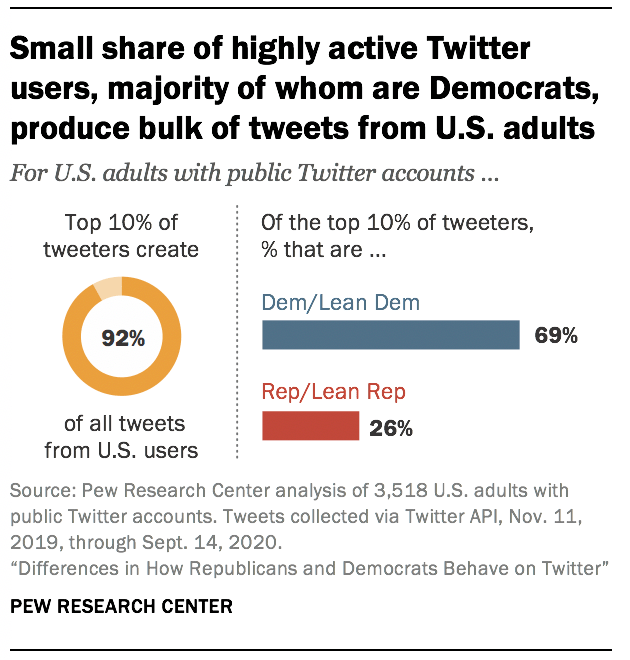
Today, those figures have changed. During the study period, the most active 10% of users produced 92% of all tweets by U.S. adults.

And of these highly active users, 69% identify as Democrats or Democratic-leaning independents.

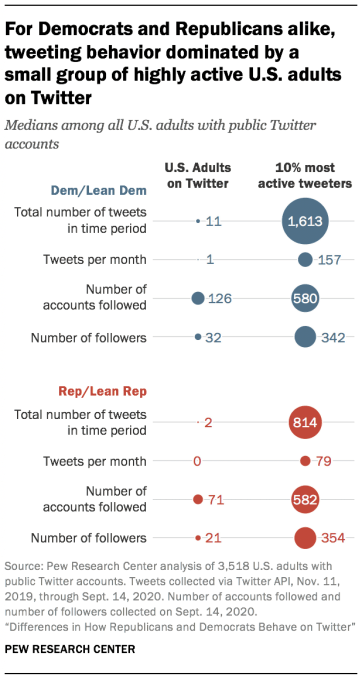
In addition, the 10% most active Democrats typically produce roughly twice the number of tweets per month (157) compared with the most active Republicans (79).

Image Credits: Pew Research Center

These highly-active users don’t represent how most Twitter users tweet, however.

Regardless of party affiliation, the majority of Twitter users post very infrequently, Pew found.

The median U.S. adult Twitter user posted just once per month during the time of the study. The median Democrat posts just once per month, while the median Republican posts even less often than that.

The typical adult also has very few followers, with the median
Democrat having 32 followers while the median Republican has 21. Democrats, however, tend to follow more accounts than Republicans do, at 126 vs. 71, respectively.

Image Credits: Pew Research Center

The new study additionally examined other differences in how members of the two parties use the platforms, beyond frequency of tweeting.

For starters, it found 60% of the Democrats on Twitter would describe themselves as very or somewhat liberal, compared with 43% of Democrats who don’t use Twitter. Self-identified conservatives on Twitter vs. conservatives not on the platform had closer shares, at 60% and 62%, respectively.

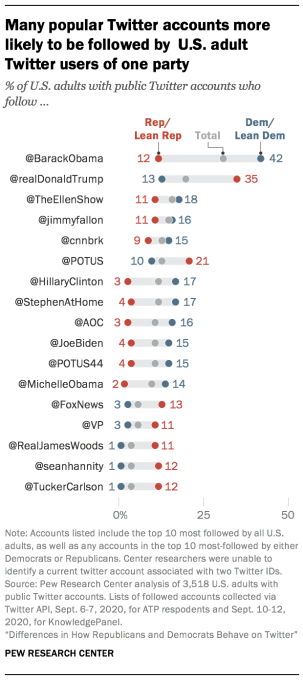
Pew also found that the two Twitter accounts followed by the largest share of U.S. adults were those belonging to former President Barack Obama (@BarackObama) and President Donald Trump
(@RealDonaldTrump).

Not surprisingly, more Democrats followed Obama — 42% of Democrats did, vs. just 12% of Republicans. Trump, meanwhile, was followed by 35% of Republicans and just 13% of Democrats.

Other top political accounts saw similar trends. For instance, Rep. Alexandria Ocasio-Cortez (@AOC) is followed by 16% of Democrats and 3% of Republicans. Fox News personalities Tucker Carlson (@TuckerCarlson) and Sean Hannity (@seanhannity), meanwhile, are both followed by 12% of Republicans but just 1% of Democrats.

Image Credits:

This is perhaps a more important point than Pew’s study indicates, as it demonstrates that even though Twitter’s original goal was to build a “public town square” of sorts, where conversations could take place in the open, Twitter users have built the same isolated bubbles around themselves as they have elsewhere on social media.

Because Twitter’s main timeline only shows tweets and retweets from people you follow, users are only hearing their side of the conversation amplified back to them.

This problem is not unique to Twitter, of course. Facebook, for years, has been heavily criticized for delivering two different versions of reality to its users. An article from The WSJ in 2016 demonstrated how stark this contrast could be, when it showed a “blue” feed and “red” feed, side-by-side.

The problem is being exacerbated even more in recent months, as users from both parties are now exiting mainstream platforms, like Twitter, an isolating themselves even more. On the conservative side, users fled to free speech-favoring and fact check-eschewing platforms like Gab and Parler. The new social network Telepath, on the other hand, favors left-leaning users by aggressively blocking misinformation — often that from conservative news outlets — and banning identity-based attacks.

One other area Pew’s new study examined was the two parties’ use of hashtags on Twitter.

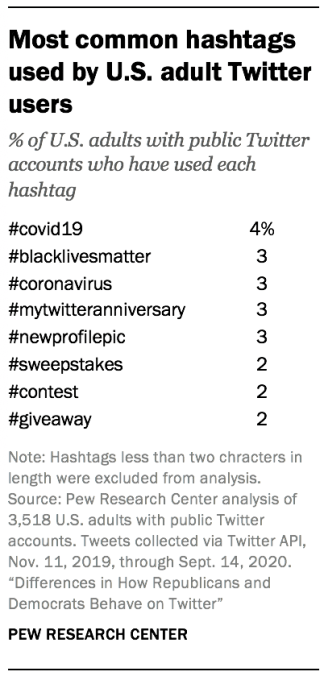
It found that no one hashtag was used by more than 5% of U.S. adults on Twitter during the study period. But there was a bigger difference when it came to the use of the #BlackLivesMatter hashtag, which was tweeted by 4% of Democrats on Twitter and just 1% of Republicans.

Other common hashtags used across both parties included #covid10, #coronavirus, @mytwitteranniversary, #newprofilepic, #sweepstakes, #contest, and #giveaway.

Image Credits: Pew Research Center

It’s somewhat concerning, too, that hashtags were used in such a small percentage of tweets.

While their use has fallen out of favor somewhat — using a hashtag can seem “uncool” — the idea with hashtags was to allow users a quick way to tap into the global conversation around a given topic. But this decline in user adoption indicates there are now fewer tweets that can connect users to an expanded array of views.

Twitter today somewhat addresses this problem through its “Explore” section, highlighting trends, and users can investigate tweets using its keyword search tools. But if Twitter really wants to burst users’ bubbles, it may need to develop a new product — one that offers a different way to connect users to the variety a conversations taking place around a term, whether hashtagged or not.


News: Alpaca raises $10M Series A for its API-powered equities trading service

This morning Alpaca, a startup that helps other companies add commission-free equities trading to their own products, announced a $10 million Series A. The new capital event was led by Portag3, and included prior investors Social Leverage, Spark Capital, Fathom Capital and Abstract Ventures. The company previously raised a $6 million pre-seed and $6 million

This morning Alpaca, a startup that helps other companies add commission-free equities trading to their own products, announced a $10 million Series A. The new capital event was led by Portag3, and included prior investors Social Leverage, Spark Capital, Fathom Capital and Abstract Ventures.

The company previously raised a $6 million pre-seed and $6 million seed round that TechCrunch covered last November.

Alpaca is a company that has cropped up in our coverage of the startup and private capital markets recently, adding its perspective to our discussion of API-powered startups and their recent success.

By our math, the new round pushes Alpaca to around $22 million in total funding.

It’s done a lot with the pre-existing funds, including driving its transaction volume sharply higher over the last year. As we’ve seen with commission-free broker Robinhood, transaction volume can be robustly lucrative. In a prior interview with Alpaca CEO Yoshi Yokokawa, the startup confirmed that it generates revenues from routing order flow through specific market makers.

So, as Alpaca’s trading volume grows, so too does its revenue. This matters as we have notes on Alpaca’s trading volume in 2020, and how some of those figures compare to its 2019 results. The data helps explain why, and how the startup attracted new capital.

Here’s the startup’s historical trading volume in dollars, generated via customers’ use of its API:

  • January: $388.1 million
  • February: $591.4 million
  • March: $999.0 million
  • April: $853.6 million
  • June: $1.59 billion
  • July: $1.58 billion
  • August: $959.3 million
  • September, 2020: ~$2 billion

Per the company, that $2 billion result in September is up 10x its year-ago performance, implying that revenue at Alpaca has soared in recent quarters. Fast revenue growth, and possible 10x revenue expansion, is investor catnip. The company’s Series A, therefore, is not a surprise event.

What’s next

Off the heels of this growth, Alpaca wants to go after more enterprise customers and double-down on building features into its API so that it can pursue a vision of providing financial services to everyone on the planet, according to Yokokawa. That hope, by the way, is why the company is building infrastructure tech and not consumer-facing tooling. Alpaca wants to sit behind the scenes, the world ’round, powering other players so that it can have maximum reach. (If it powers lots of different companies’ trading tooling, the startup might be able to reach more total end-users than trying to accrete the world’s trading population to a single, first-party service.)

To accomplish its aspirational goal, the startup needs more folks to build more things. Similar to many startups, Alpaca has gone fully remote and is taking its fresh cash to hire around the world. I asked the CEO if he was adding mostly, say, in-market salespeople as Alpaca looks to expand its customer base globally. He responded that most of its distributed hires have been developers, though some have been marketers as well.

After reducing staff to around 10 when COVID-19 arrived, Alpaca is now 35 people strong. Those folks will help Alpaca grow across two vectors, namely geographic expansion and growth into the enterprise, powered by API development. The company’s work on broker-dealer features is part of its international growth plan.

The API-space is hot. The fintech world is on fire. And inside of fintech itself, we’ve seen a savings and investing boom. Alpaca straddles all three of those worlds. Let’s see how far it can get with $10 million more.


News: AirBuddy’s AirPod integration for the Mac gets updated with more iOS-style features

The AirBuddy app is celebrating another successful Apple week by opening up preorders on v2.0. The original, which arrived in early 2019, brought a pop-up to the Mac when a pair of AirPods were brought near — bringing simple ecosystem integration to the desktop before Apple did. The update, which is set to arrive arrive

The AirBuddy app is celebrating another successful Apple week by opening up preorders on v2.0. The original, which arrived in early 2019, brought a pop-up to the Mac when a pair of AirPods were brought near — bringing simple ecosystem integration to the desktop before Apple did.

The update, which is set to arrive arrive on November 11, brings even deeper integration. At the top of the list is a quick status menu featuring all connected Apple and Beats devices. That includes the iPhone, iPad and the Apple Watch, along with other Macs that have the latest version of the $10 software installed. The devices are group together based on how they’re paired with one another — so, a set of AirPods connected to an iPhone will appear near that device in the menu.

AirBuddy 2 is now available for pre-order. Launching November 11. https://t.co/lB4Tc5ahGf pic.twitter.com/BEIqXcxAMI

— AirBuddy (@airbuddyapp) October 14, 2020

The update also brings device usage over the past 12 or 24 hours including listening time, call time and whether one of the buds in an AirPods pair is losing charge more quickly than the other. Users can also switch between AirPods Pro’s normal, noise canceling and transparency modes directly from the desktop.

Those who purchased the original version of the app will get the upgrade for free if they purchased it this year. If you bought it last year, you can get the new one for half-off.

News: News that Calm seeks more funding at a higher valuation is not transcendental thinking

Earlier this week, Bloomberg reported that meditation app Calm is looking into raising $150 million more at a valuation of around $2.2 billion, more than double its last private price. This should not surprise. Calm has raised capital at high prices before, including its 2018 Series A which valued the startup at more than a quarter

Earlier this week, Bloomberg reported that meditation app Calm is looking into raising $150 million more at a valuation of around $2.2 billion, more than double its last private price. This should not surprise.

Calm has raised capital at high prices before, including its 2018 Series A which valued the startup at more than a quarter billion dollars. Its 2019 Series B made Calm a unicorn. And the space that Calm plays in has been hot for years, so to see the company attract new capital at a higher price feels downright pedestrian.


The Exchange explores startups, markets and money. Read it every morning on Extra Crunch, or get The Exchange newsletter every Saturday.


Sure, $2.2 billion for an app company might sound silly if your head is still suck in 2009. In 2020, the app stores of the world are not just economic engines that aging monopolies are desperate to preserve past their sell-by date, they are geopolitical footballs.

Back to Calm: Let’s rewind the clock a minute and review data from 2018, 2019 and 2020 about the meditation app, its broader category’s venture capital results through Q3 2020 and how the startup and its rivals have marched forward in terms of consumer and venture interest.

Calm down for more Headspace

At the time of its Series B, TechCrunch reported that Calm had “topped 40 million downloads worldwide, with more than one million paying subscribers” and that it had “quadrupled its revenue in 2018 — the company is now profitable — and is on track to do $150 million in annual revenue.” The company announced its Series B in February 2019, making the 2018 result pertinent at the time.

Since then, data has continued to be kind to the meditation sector, where Calm and its rival Headspace — which has its own history of rapid growth — have often led the pack.

Turning to 2019 from Calm’s 2018 data, the top 10 grossing meditation apps saw revenues of $195 million, up some 52% from 2018 results. Still, in 2018 these apps grossed $128 million, hardly a small sum — even with intermediaries Apple and Google taking a huge tax for their hard, and utterly defensible work.

The downloads and resulting revenue were not missed by VCs this year.

As TechCrunch reported in August, while wellness startups didn’t excel as a group in the first half of 2020 in VC terms, inside of the category, mental health-focused apps did rather well. According to CB Insights data at the time, “in Q1 and Q2 2020 [mental health] startups saw 106 rounds worth $1.08 billion. In the year-ago period, the figures were 87 rounds worth $750 million,” we wrote.

That’s a healthy step up in venture interest in a single year.

WordPress Image Lightbox Plugin