Yearly Archives: 2020

News: Three views on the future of media startups

The Equity crew this week chewed through a trio of media stories, each dealing with private companies and their successes. The Wall Street Journal recently reported that Axios was growing rapidly and near profitability. The paper also broke news that Morning Brew might exit to Business Insider for a hefty $75 million potential payout. Meanwhile,

The Equity crew this week chewed through a trio of media stories, each dealing with private companies and their successes. The Wall Street Journal recently reported that Axios was growing rapidly and near profitability. The paper also broke news that Morning Brew might exit to Business Insider for a hefty $75 million potential payout. Meanwhile, we covered the news that The Juggernaut raised $2 million for its paywalled publication focused on South Asian news.

The conversation, as a result, was a fairly indulgent and nerdy affair. It’s always fun to celebrate other journalists finding success in different ways, and this week felt like a moment for the media news landscape. Because the topic is so near to our hearts, for better or worse, we’re fitting our broader thoughts into this post about the future of media.

Our own Natasha Mascarenhas writes about how inequity in media and who gets to succeed, Danny Crichton has some pretty strong feelings about digital advertising and Alex Wilhelm writes about how the varied methods of recent media success are themselves heartening.

So this weekend let’s pause for a minute to ruminate on the upstart media world, a place where too often private capital and media economics have had a falling out.

Natasha Mascarenhas

This week, it was announced that advertising might not be a bad idea after all. Axios is reportedly expected to become profitable this year, and Morning Brew, a free newsletter about business insights, could get acquired for between $50 million to $75 million by Business Insider. Both of these media companies make money off of newsletters. And if you end the story there, it’s clear that news isn’t simply a fundamental aspect of our democracy — it makes money, too.

But, the story shouldn’t end there.

News: Pear hosted its invite-only demo day online year; here’s what you might have missed

Pear, the eight-year-old, Palo Alto, Calif.-based seed-stage venture firm that has, from its outset, attracted the attention of VCs who think the firm has an eye for nascent talent, staged its seventh annual demo day earlier this week, and while it was virtual, one of the startups has already signed a term sheet from a

Pear, the eight-year-old, Palo Alto, Calif.-based seed-stage venture firm that has, from its outset, attracted the attention of VCs who think the firm has an eye for nascent talent, staged its seventh annual demo day earlier this week, and while it was virtual, one of the startups has already signed a term sheet from a top-tier venture firm.

To give the rest of you a sneak peak, here’s a bit about all of the startups that presented, in broad strokes:


  1. ) AccessBell

What it does: Video conferencing platform for enterprise workflows

Website: accessbell.com

Founders: Martin Aguinis (CEO), Josh Payne (COO), Kamil Ali (CTO)

The pitch: Video has emerged as one of the prominent ways for enterprises to communicate internally and externally with their customers and partners. Current video conferencing tools like Zoom and WebEx are great for standalone video but they have their own ecosystems and don’t integrate into thousands of enterprise workflows. That means that API tools that do integrate, like Agora and Twilio, still require manual work from developer teams to customize and maintain. AccessBell is aiming to provide the scalability and reliability of Zoom, as well as the customizability and integrations of Twilio, in a low code integration and no code extensible customization platform.

It’s a big market the team is chasing, one that’s expected to grow to $8.6 billion by 2027. The cost right now for users who want to test out AccessBell is $27 per host per month.


2.) FarmRaise

What it does: Unlock financial opportunities for farmers to create sustainable farms and improve their livelihoods.

Website: farmraise.com

Founders: Jayce Hafner (CEO), Sami Tellatin (COO), Albert Abedi (Product)

The pitch: Over half of American farms don’t have the tools or bandwidth they need to identify ways to improve their farms and become profitable. The startup’s API links to farmers’ bank accounts, where its algorithm assesses financials to provide a “farm read,” scoring the farms’ financial health. It then regularly monitors farm data to continuously provide clean financials and recommendations on how to improve its customers’ farms, as well as to connect farmers with capital in order to improve their score. (It might suggest that a farm invest in certain sustainability practices, for example.)

Eventually, the idea is to also use the granular insights it’s garnering and sell these to hedge funds, state governments, and other outfits that want a better handle on what’s coming — be it around food security or climate changes.


3.) Sequel

What it does: Re-engineering life’s essential products – starting with tampons.

Website: thesequelisbetter.com

Founders: Greta Meyer (CEO),  Amanda Calabrese (COO)

The pitch: Founded by student athletes from Stanford, Sequel argues that seven out of 10 women don’t trust tampons, which were first designed in 1931 (by a man). New brands like Lola have catchy brands and new material, but they perform even worse than legacy products. Sequel has focused instead on fluid mechanics and specifically on slowing flow rates so a tampon wont leak before it’s full whether they’re in the “boardroom” or the “stadium.” The company says it has already filed patents and secured manufacturing partners and that it expects that the product will be available for consumers to buy directly from its website, as well as in other stores, next year.


4.) Interface Bio

What it does: Unlocking the therapeutic potential of the microbiome with a high-throughput pipeline for characterizing microbes, metabolites, and therapeutic response, based on years of research at Stanford.

Founders: Will Van Treuren, Hannah Wastyk

The pitch: The microbiome plays a major role in a wide range of human diseases, including heart disease, kidney disease, liver disease, and cancer. In fact, Interface’s founders — both of whom are PhDs —  say that microbiome-influenced diseases are responsible for four of the top 10 causes of death in the United States. So how do they better size on the opportunity to identify therapeutics by harnessing the microbiome? Well, they say they’ll do it via a “high-speed pipeline for characterizing metabolites and their immune phenotypes,” which they’ll create by developing the world’s largest database of microbiome-mediated chemistry, which the startup will then screen for potential metabolites that can lead to new therapies.


5.) Gryps

What it does: Gryps is tackling construction information silos to create a common information layer that gives building and facility owners quick, enriched and permanent access to document-centric information.

Website: gryps.io

Founders: Dareen Salama, Amir Tasbihi

The pitch: The vast size and complexity of the construction industry has resulted in all kinds of software and services that address various aspects of the construction processes, resulting in data and documents being spread across many siloed tools. Gryps says it picks up where all the construction-centered tools leave off: Taking delivery of the projects at the end of a construction job and providing all the information that facility owners need to operate, renovate, or build future projects through a platform that ingests data from various construction tools, mines the embedded information, then provides operational access through owner-centered workflows. 


6.) Expedock

What it does: Automation infrastructure for supply chain businesses, starting with AI-Powered Freight Forwarder solutions.

Website: expedock.com

Founders: King Alandy Dy (CEO), Jeff Tan (COO), Rui Aguiar (CTO)

The pitch: Freight Forwarders take care of all the logistics of shipping containers including financials, approvals and paper work for all the local entities on both sides of the sender and receiver geographies, but communications with these local entities are often done through unstructured data, including forms, documents, and emails and can subsequently eat up to 60% of operational expenses. Expedock is looking to transform the freight forwarding industry by digitizing and automating the processing and inputting of unstructured data into various local partner and governmental systems, including via a “huan in the loop” AI software service.


7.) Illume

What it does: A new way to share praise

Website: illumenotes.com

Founders: Sohale Sizar (CEO), Phil Armour (Engineering), Maxine Stern (Design)

The pitch: The process of thanking people is full of friction. Paper cards have to be purchased, signed, passed around; greetings on Facebook only mean so much. Using Illume, teams and individuals can download its app or come together on Slack and create a customized, private, and also shareable note. The nascent startup says one card typically has 10 contributors; it charging enterprises $3 per user per month, ostensibly so sales teams, among others, can use them.


8.) Quansa

What it does: Quansa improves Latin American workers’ financial lives via employer-based financial care

Website: quansa.io

Founders: Gonzalo Blanco, Mafalda Barros

The pitch: Fully 40% of employees across Latin America have missed work in the past 12 months due to financial problems. Quansa wants to help them get on the right track financially with the help of employers that use its software to link their employees’ payroll data with banks, fintechs and other financial institutions.

There is strength in numbers, says the firm. By funneling more customers to lenders through their employers, for example, these employees should ultimately be able to access to cheaper car loans, among other things.


9.) SpotlightAI

What it does: Spotlight turns sensitive customer information from a burden to an asset by using NLP techniques to identify, anonymize, and manage access to PII and other sensitive business data.

Website: hellospotlight.com

Founder: Austin Osborne (CEO)

The pitch: Data privacy legislation like GDPR and CCPA is creating an era where companies can no longer use their customer data to run their business due to the risks of fines, lawsuits, and negative media coverage. These lawsuits relating to misuse of personal data can reach billions of dollars and take years to settle. Spotlight’s software plugs into existing data storage engines via APIs and operates as a middleware within a company’s network. With advanced NLP and OCR techniques, it says it’s able to detect sensitive information in unstructured data, perform multiple types of anonymization, and provide a deep access control layer.


10.) Bennu

What it does: Bennu closes the loop on management communication

Website: bennu.io

Founder: Brenda Jin (CEO)

The pitch: Today’s work communication is done through forms, email, Slack, and docs; the timelines are unnatural.  Bennu is trying to solve the problem with communication loops that use integrations and smart topic suggestions to help employees prepare for substantive management conversations in seconds, not hours. 


11.) Playbook

What it does: Playbook automates the people coordination in your repeatable workflows with a simple system to create, execute and track any process with your team, customers, and more.

Website: startplaybook.com

Founders: Alkarim Lalani (CEO), Blaise Bradley (CTO)

The pitch: Whether you’re collecting time cards from 20 hourly workers every week, or managing 30 customer onboardings – you’re coordinating repetitive workflows across people over email and tracking it over spreadsheets. Playbook says it coordinates workflows between people at scale by taking programming concepts such as variables and conditional logic that let its customers model any workflow, and all packaged in an interface that enables anyone to build out their workflows in minutes.


12.) June Motherhood

What it does: Community-based care for life’s most important transitions.

Website: junemotherhood.com

Founders: Tina Beilinson (CEO), Julia Cole (COO), Sophia Richter (CPO)

The pitch: June is a digital health company focused on maternal health, with community at the core. Like a Livongo for diabetes management, June combines the latest research around shared appointments, peer-to-peer support and cognitive behavioral therapy to improve outcomes and lower costs, including through weekly programs and social networks that encourage peer-to-peer support. 


13.) Wagr

What it does: Challenge anyone to a friendly bet.

Website: wagr.us

Founders: Mario Malavé (CEO), Eliana Eskinazi (CPO)

The pitch: Wagr will allow sports fans to bet with peers in a social, fair, and simple way. Sending a bet requires just three steps, too: pick a team, set an amount, and send away. Wagr sets the right odds and handles the money.

Users can challenge friends, start groups, track leaderboards, and see what others are betting on, so they feel connected even if they aren’t together in the stadium. Customers pay a commission when they use the platform to find them a match, but bets against friends are free. The plan is to go live in Tennessee first and expand outward from there.


14.) Federato

What it does: Intelligence for a new era of risk

Website: federato.ai

Founders: Will Ross (CEO), William Steenbergen (CTO)

The pitch: Insurance companies are struggling to manage their accumulation of risk as natural catastrophes continue to grow in volume and severity. Reinsurance is no longer a reliable backstop, with some of the largest insurers taking $600 million-plus single-quarter losses net of reinsurance. 

Federato is building an underwriter workflow that uses dynamic optimization across the portfolio to steer underwriters to a better portfolio balance. The software lets actuaries and portfolio analysts drive high-level risk analysis into the hands of underwriters on the front lines to help them understand the “next best action” at a given point in time.


15.) rePurpose Global

What it does: A plastic credit platform to help consumer brands of any size go plastic neutral

Website: business.repurpose.global

Founders: Svanika Balasubramanian (CEO), Aditya Siroya (CIO), Peter Wang Hjemdahl (CMO

The pitch: Consumers worldwide are demanding businesses to take action on eliminating plastic waste, 3.8 million pounds of which are leaked into the environment every few minutes. Yet even as brands try, alternatives are often too expensive or worse for the environment. Through this startup, a brand can commit to the removal of a certain amount of plastic, which will then be removed by the startup’s loal watse management partners and recycled on the brand’s behalf (with rePurpose verifying that the process adheres to certain standards). The startup says it can keep a healthy margin while also running this plastic credit market, and that its ultimate vision is to our vision is to become a “one-stop shop for companies to create social, economic, and environmental impact.”


16.) Ladder

What it does: A professional community platform for the next generation

Website: ladder.io

Founders: Akshaya Dinesh (CEO), Andrew Tan

The pitch: LinkedIn sucks, everyone hates it. Ladder (which may have a trademark infringement battle ahead of it) is building a platform around community instead of networks. The idea is that users will opt in to join communities with like-minded individuals in their respective industries and roles of interest. Once engaged, they can participate in AMAs with industry experts, share opportunities, and have 1:1 conversations.

The longer term ‘moat’ is the data it collects from users, from which it thinks it can generate more revenue per user than LinkedIn. (By the way, this is the startup that has already signed a term sheet with a firm whose team was watching the demo day live on Tuesday.)


Exporta

How it works: Exporta is building a B2B wholesale marketplace connecting suppliers in Latin America with buyers in North America.

Website: exporta.io

Founders: Pierre Thys (CEO), Robert Monaco (President)

The pitch: The U.S. now imports more each year from Latin America than from China, but LatAm sourcing remains fragmented and manual. Exporta builds on-the-ground relationships to bring LatAm suppliers onto a tech-enabled platform that matches them to U.S. buyers looking for faster turnaround times and more transparent manufacturing relationships.


Via

What it does: Via helps companies build their own teams in new countries as simply as if they were in their HQ.

Website: via.work

Founders:  Maite Diez-Canedo, Itziar Diez-Canedo

The pitch: Setting up a team in a new country is very complex. Companies need local entities, contracts, payroll, benefits, accounting, tax, compliance…and the list goes on. Via enables companies to build their own teams in new countries quickly and compliantly by leveraging  local entities to legally employ teams on their behalf, and integrate local contracts, payroll, and benefits in one platform. By plugging into the local hiring ecosystem, Via does all the heavy lifting for its customers, even promising to stand up a team in 48 hours and at less expense than traditional alternatives. (It’s charging $600 per employee per month in Canada and Mexico, where it says it has already launched.)


News: Google Assistant, Maps, and Search can now help you figure out where to vote

Election Day approaches! Still not sure where the nearest polling place or ballot drop box is? Google wants to help. This morning the company rolled out a handful of features across Google Assistant, Google Maps, and Google Search, all meant to kick in when a user seems to be looking for information on voting locations.

Election Day approaches! Still not sure where the nearest polling place or ballot drop box is? Google wants to help.

This morning the company rolled out a handful of features across Google Assistant, Google Maps, and Google Search, all meant to kick in when a user seems to be looking for information on voting locations.

On Google Search, for example, a search for “ballot drop boxes near me” will now bring up a dedicated tool for finding just that — punch in the address where you’re registered to vote, and it’ll help you find a drop box or polling place accordingly. The same tool will also pop up when you search for things like “how to find polling place” or “where to vote”, so there’s some flexibility in it.

Or if you’ve got an Assistant-powered device nearby (like a Nest Mini, Nest Hub, or an Android phone), you can say “Hey Google, where do I vote?” and Assistant should be able to figure it out accordingly based on your current location (with Assistant assuming, as it’ll note in its response, that your current location is where you’re registered to vote.)

The Maps integration is a bit more limited, but it gets the job done. Searching for “where do I vote” in the Google Maps mobile app results in a prompt that will toss you into the above web-based Google Search flow. Once you’ve found your location, tapping the “Directions” button will swing you back into the Maps app.

Google says it’s pulling its polling location information from the Voting Information Project as part of a partnership with Democracy Works. The company says they’ll be adding more polling places leading up until Election Day, expecting to have over 200,000 in the system when all is said and done.

Don’t want to get your polling place details from Google, or just want to double check things? There’s always sites like Vote.org (which, if you’re curious, is what Siri recommends when prompted with the “Where do I vote?” question), which also provides info on checking your voter registration status, becoming a poll worker, etc.

News: Daily Crunch: Twitter walks back New York Post decision

A New York Post story forces social platforms to make (and in Twitter’s case, reverse) some difficult choices, Sony announces a new 3D display and fitness startup Future raises $24 million. This is your Daily Crunch for October 16, 2020. The big story: Twitter walks back New York Post decision A recent New York Post

A New York Post story forces social platforms to make (and in Twitter’s case, reverse) some difficult choices, Sony announces a new 3D display and fitness startup Future raises $24 million. This is your Daily Crunch for October 16, 2020.

The big story: Twitter walks back New York Post decision

A recent New York Post story about a cache of emails and other data supposedly originating from a laptop belonging to Joe Biden’s son Hunter looked suspect from the start, and more holes have emerged over time. But it’s also put the big social media platform in an awkward position, as both Facebook and Twitter took steps to limit the ability of users to share the story.

Twitter, in particular, took a more aggressive stance, blocking links to and images of the Post story because it supposedly violated the platform’s “hacked materials policy.” This led to predictable complaints from Republican politicians, and even Twitter’s CEO Jack Dorsey said that blocking links in direct messages without an explanation was “unacceptable.”

As a result, the company said it’s changing the aforementioned hacked materials policy. It will no longer remove hacked content unless it’s been shared directly by hackers or those “acting in direct concert with them.” Otherwise, it will label tweets to provide context. As of today, it’s also allowing users to share links to the Post story.

The tech giants

Sony’s $5,000 3D display (probably) isn’t for you — The company is targeting creative professionals with its new Spatial Reality Display.

EU’s Google-Fitbit antitrust decision deadline pushed into 2021 — EU regulators now have until January 8, 2021 to take a decision.

Startups, funding and venture capital

Elon Musk’s Las Vegas Loop might only carry a fraction of the passengers it promised — Planning files reviewed by TechCrunch seem to show that The Boring Company’s Loop system will not be able to move anywhere near the number of people the company agreed to.

Future raises $24M Series B for its $150/mo workout coaching app amid at-home fitness boom — Future offers a pricey subscription that virtually teams users with a real-life fitness coach.

Lawmatics raises $2.5M to help lawyers market themselves — The San Diego startup is building marketing and CRM software for lawyers.

Advice and analysis from Extra Crunch

How COVID-19 and the resulting recession are impacting female founders — The sharp decline in available capital is slowing the pace at which women are founding new companies in the COVID-19 era.

Startup founders set up hacker homes to recreate Silicon Valley synergy — Hacker homes feel like a nostalgic attempt to recreate some of the synergies COVID-19 wiped out.

Private equity firms can offer enterprise startups a viable exit option — The IPO-or-acquisition question isn’t always an either/or proposition.

(Reminder: Extra Crunch is our subscription membership program, which aims to democratize information about startups. You can sign up here.)

Everything else

FAA streamlines commercial launch rules to keep the rockets flying — With rockets launching in greater numbers and variety, and from more providers, it makes sense to get a bit of the red tape out of the way.

We need universal digital ad transparency now — Fifteen researchers propose a new standard for advertising disclosures.

The Daily Crunch is TechCrunch’s roundup of our biggest and most important stories. If you’d like to get this delivered to your inbox every day at around 3pm Pacific, you can subscribe here.

News: Twitter is now allowing users to share that controversial New York Post story

Twitter has taken another step back from its initial decision to block users from sharing links to or images of a New York Post story reporting on emails and other data supposedly originating on a laptop belonging to Democratic presidential nominee Joe Biden’s son Hunter. The story, which alleged that Hunter Biden had set up

Twitter has taken another step back from its initial decision to block users from sharing links to or images of a New York Post story reporting on emails and other data supposedly originating on a laptop belonging to Democratic presidential nominee Joe Biden’s son Hunter.

The story, which alleged that Hunter Biden had set up meeting between a Ukrainian energy firm and his father back when Biden was vice president, looked shaky from the start, and more holes have emerged over time. Both Facebook and Twitter took action to slow its spread — but Twitter seemed to take the more aggressive stance, not just including warning labels whenever someone shared the story, but actually blocking links.

These moves have drawn a range of criticism. There have been predictable cries of censorship from Republican politicians and pundits, but there have also been suggestions that Facebook and Twitter inadvertently drew more attention to the story. And even Twitter’s CEO Jack Dorsey suggested that it was “unacceptable” to block links in DMs without an explanation.

Casey Newton, on the other hand, argued that the platforms had successfully slowed the story’s spread: “The truth had time to put its shoes on before Rudy Giuliani’s shaggy-dog story about a laptop of dubious origin made it all the way around the world.”

Twitter initially justified its approach by citing its hacked materials policy, then later said it was blocking the Post article for including “personal and private information — like email addresses and phone numbers — which violate our rules.”

The controversy did prompt Twitter to revise its hacked materials policy, so that content and links obtained through dubious means will now come with a label, rather than being removed entirely, unless it’s being shared directly by hackers or those “acting in concert with them.”

And now, as first reported by The New York Times, Twitter is also allowing users to share links to the Post story itself (something I’ve confirmed through my own Twitter account).

Why the reversal? Again, the official justification for blocking the link was to prevent the spread of private information, so the company said that the story has now spread so widely, online and in the press, that the information can no longer be considered private.

News: Lawmatics raises $2.5M to help lawyers market themselves

Lawmatics, a San Diego startup that’s building marketing and CRM software for lawyers, is announcing that it has raised $2.5 million in seed funding. CEO Matt Spiegel used to practice law himself, and he told me that even though tech companies have a wide range of marketing tools to choose from, “lawyers have not been

Lawmatics, a San Diego startup that’s building marketing and CRM software for lawyers, is announcing that it has raised $2.5 million in seed funding.

CEO Matt Spiegel used to practice law himself, and he told me that even though tech companies have a wide range of marketing tools to choose from, “lawyers have not been able to adopt them,” because they need a product that’s tailored to their specific needs.

That’s why Spiegel founded Lawmatics with CTO Roey Chasman. He said that a law firm’s relationship with its clients can be divided into three phases — intake (when a client is deciding whether to hire a firm); the active legal case; and after the case has been resolved. Apparently most legal software is designed to handle phase two, while Lawmatics focuses on phases one and three.

The platform includes a CRM system to manage the initial client intake process, as well as tools that can automate a lot of what Spiegel called the “blocking and tackling” of marketing, like sending birthday messages to former clients — which might sound like a minor task, but Spiegel said it’s crucial for law firms to “nurture” those relationships, because most of their business comes from referrals.

Lawmatics’ early adopters, Spiegel added, have consisted of the firms in areas where “if you need a lawyer, you go to Google and start searching ‘personal injury,’ ‘bankruptcy,’ ‘estate planning,’ all these consumer-driven law firms.” And the pandemic led to accelerated the startup’s growth, because “lawyers are at home now, their business is virtual and they need more tools.”

Spiegel’s had success selling technology to lawyers in the past, with his practice management software startup MyCase acquired by AppFolio in 2012 (AppFolio recently sold MyCase to a variety of funds for $193 million). He said that the strategies for growing both companies are “almost identical” — the products are different, but “it’s really the same segment, running the same playbook, only with additional go-to-market strategies.”

The funding was led by Eniac Ventures and Forefront Venture Partners, with participation from Revel Ventures and Bridge Venture Partners.

“In my 10 years investing I have witnessed few teams more passionate, determined, and capable of revolutionizing an industry,” said Eniac’s Tim Young in a statement. “They have not only created the best software product the legal market has seen, they have created a movement.”


News: Human Capital: Prop 22 puts the ‘future of labor’ at stake

Welcome back to Human Capital, where we look at the latest in tech labor and diversity and inclusion. Because election day is quickly approaching and given that California’s Prop 22 puts the “future of labor” at stake, as Instacart worker and co-organizer at Gig Workers Collective Vanessa Bain told TechCrunch this week, we’re paying close

Welcome back to Human Capital, where we look at the latest in tech labor and diversity and inclusion.

Because election day is quickly approaching and given that California’s Prop 22 puts the “future of labor” at stake, as Instacart worker and co-organizer at Gig Workers Collective Vanessa Bain told TechCrunch this week, we’re paying close attention to this ballot measure. Gig companies like Uber, Lyft, DoorDash and Instacart have put more than $180 million into Prop 22, which seeks to keep their drivers and delivery workers classified as independent contractors.

Before we jump in, friendly reminder that Human Capital will soon be a newsletter…starting next week! Sign up here so you don’t miss it.


Gig Work


Instacart began asking workers to pass out Yes on Prop 22 propaganda to customers

Vanessa Bain, Instacart shopper and co-founder of Gig Workers Collective, tweeted about how she was instructed to pass out Yes on 22 stickers to customers. Many people, including Bain, questioned whether it was legal or not. 

Unbelievable. @Instacart is now requiring Shoppers to do the uncompensated work of distributing Prop 22 propaganda to customers —against our own self-interests. Even *if* (big if) this is legal, it is reprehensible and establishes a dangerous precedent for workers. #NOonProp22 pic.twitter.com/NXVblutvsh

— Vanessa Bain ✊❤🛒 #BlackLivesMatter #NOonProp22 (@hashtagmolotov) October 10, 2020
Instacart, however, told CNN the initiative was allowed under campaign finance rules. Additionally, I reached out to the Fair Political Practices Commission, but was told by Communications Director Jay Wierenga that “only an investigation by FPPC Enforcement (or a DA or the AG’s Office) determines whether someone or group violated the Political Reform Act.” 

What is clear, however, is that it goes against what many workers want. We actually caught up with Bain ahead of the relaunch of TechCrunch Mixtape, where she discussed why she’s anti Prop 22. The episode goes live next week, but here’s a bit of a teaser from our conversation:

“The future of labor is at stake,” Bain told us earlier this week. “I would argue the future of our democracy, as well. The reality is that, you know, it establishes a dangerous precedent to allow companies to write their own labor laws…This policy was created to unilaterally benefit companies at the detriment of workers.”

Hundreds took to SF’s streets in protest of Prop 22

In San Francisco, there was a massive protest against Prop 22. While Prop 22 would provide more benefits than workers currently have, many drivers and delivery workers say that’s not enough. For example, Prop 22 would institute healthcare subsidies, but it falls short of complete healthcare.

Y’all there are hundreds of people here, starting our drivers caravan outside Uber’s HQ.

We’re all demanding #NoOnProp22.

Drivers deserve living wages, healthcare, & benefits.

We’re gonna fight to get them. pic.twitter.com/EEVZcVRKqX

— Gig Workers Are Voting No On Prop 22 (@GigWorkersRise) October 15, 2020

Speaking of SF, 76% of app-based workers in the city are people of color

And 39% are immigrants, according to the latest survey of gig workers conducted by the Local Agency Formation Commission and UC Santa Cruz Professor Chris Benner.

This study surveyed 259 workers who drive or deliver for DoorDash, Instacart or Amazon Fresh. Other findings were:

  • 71% of workers get at least 3/4 of monthly income from gig work
  • 57% of workers completely rely on gig work for their monthly income
  • On average, workers make $450 per week. After expenses, that averages drops to $270 per week.

California appeals court heard arguments in the Uber, Lyft gig worker classification case

California 1st District Court of Appeal judges heard arguments from Uber and Lyft about why they should be able to continue classifying their drivers as independent contractors. The hearing was a result of a district judge granting a preliminary injunction that would force Uber and Lyft to immediately reclassify their workers as employees. Uber and Lyft, however, appealed the ruling and now here we are.

As Uber and Lyft have argued drivers would lose flexibility if forced to be employees, an appeals court judge asked what part of AB 5 would require companies to take away that flexibility. Spoiler alert: there’s nothing in AB 5 that requires such a thing.

But a lawyer for Lyft, which has said it would leave California if forced to reclassify its workers, said he doesn’t “want the court to think that if the injunction is affirmed, that these people will continue to have these earnings opportunities because they won’t.”

Uber’s survey of workers on Prop 22 shows strong support for the ballot measure

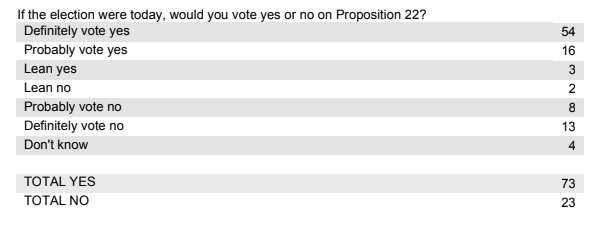
But it’s important to note that of the more than 200,000 Uber drivers in California, only 461 workers participated in the study. Uber conducted this survey from September 23 through October 5 to see how drivers felt about Prop 22 and being an independent contractor. In that survey, 54% of respondents said they would definitely vote yes on 22 if the election were today while 13% said they would definitely vote no.

Image Credits: Uber

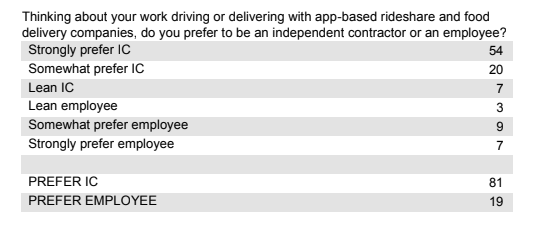
Those surveyed also weighed in on whether they prefer to be independent contractors; 54% of those surveyed said they strongly prefer being an independent contractor while 9% said they strongly prefer being an employee.

Image Credits: Uber

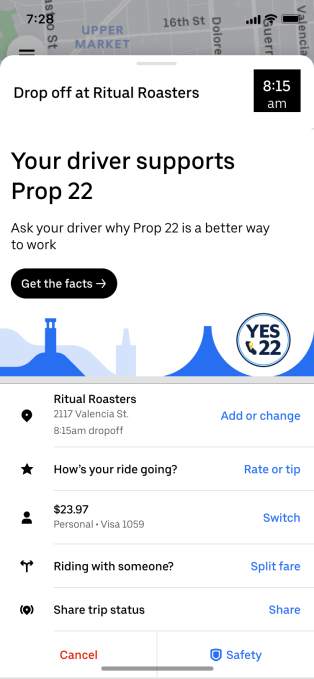
This week, Uber also encouraged riders to talk to their drivers about Prop 22 to see how they feel about it.

“First and foremost, the conversation about Proposition 22 should be about what gig workers actually want,” an Uber spokesperson said in a statement. “That’s why we are encouraging everyone who uses Uber or Uber Eats to ask their driver or delivery person how they really feel about Prop 22.”

Based on the wording of the in-app message, Uber seems confident most drivers do support Prop 22.

Image Credits: Uber


Stay woke


Facebook and Twitter ban Holocaust-denial posts 

Both Facebook and Twitter took a step in their ongoing battles against hate this week by removing posts that deny the Holocaust, the systematic and state-sponsored mass murder of around 6 million Jewish people. On Monday, Facebook announced it would block posts that deny the Holocaust. Facebook said its decision was driven by the rise in anti-Semitism and “the alarming level of ignorance about the Holocaust, especially among young people.” On Wednesday, Twitter announced a similar stance.

BLCK VC launches Black Venture Institute

In partnership with Operator Collective, Salesforce Ventures and UC Berkeley Haas School of Business, BLCK VC’s Black Venture Institute wants to help more Black entrepreneurs become angel investors. The goal is to train 300 students over the next three years to be in a position of writing checks. 

“It is these closed networks that have helped contribute to the lack of access for the Black community over the years,” BLCK VC co-founder Frederik Groce told TC’s Ron Miller. “Black Venture Institute is a structural attempt to create access for Black operators — from engineers to product marketing managers.”

GV finally has a Black female partner, Terri Burns

Terri Burns recently made partner at GV, formerly known as Google Ventures. Burns is now the only Black female partner at GV, which is wild. But, you know, progress, not perfection. 

Throwback to when Burns spoke a bit about racial justice in tech and venture capital. 

“Venture capital certainly plays a role,” Burns, then a principal at GV, told TechCrunch about the overall lack of diversity in tech. “VC is a tool that can enable businesses to scale greatly and quickly, and historically, this tool hasn’t been equally distributed. For example, VC has traditionally focused on founders from a small number of institutions and pedigrees that are not particularly diverse (in 2016 we learned from Richard Kerby, general partner at Equal Ventures, that 40% of VCs went to either Harvard or Stanford). With more equal distribution of funds across backgrounds, underrepresented people will have a greater chance at success.”

The Wing co-founder admits her mistakes 

Audrey Gelman, the former CEO of The Wing who resigned in June, posted a letter she sent to former employees of The Wing last week. In it, Gelman apologized for not taking action to combat mistreatment of women of color at The Wing. She also acknowledged that her drive for success and scaling quickly “came at the expense of a healthy and sustainable culture that matched our projected values, and workplace practices that made our team feel valued and respected.”

That meant, Gelman said, The Wing “had not subverted the historical oppression and racist roots of the hospitality industry; we had dressed it up as a kindler [sic], gentler version.”

Here are some other highlights from her letter:

  • “Members’ needs came first, and those members were often white, and affluent enough to afford The Wing’s membership dues.”
  • “White privilege and power trips were rewarded with acquiescence, as opposed to us doubling down on our projected values.”
  • “When the realization set in that The Wing wasn’t institutionally different in the ways it had proclaimed, it hurt more because the space we claimed was different reinforced the age-old patterns of women of color and especially Black women being disappointed by white women and our limited feminist values.”

Human Capital launches as a newsletter next Friday. Sign up here to get this delivered straight to your inbox. 

News: PearPop lets TikTok celebrities monetize by sharing shoutouts and screentime with fans

PearPop a new Los Angeles-based company, is on its way to racking up nearly 25,000 users in less than a month, and has already landed seed funding from the firm Rocket One Capital. The company’s premise is simple. Allow fans to bid for shared screen time with their favorite TikTok celebrities, and it’s one that’s

PearPop a new Los Angeles-based company, is on its way to racking up nearly 25,000 users in less than a month, and has already landed seed funding from the firm Rocket One Capital.

The company’s premise is simple. Allow fans to bid for shared screen time with their favorite TikTok celebrities, and it’s one that’s attracted the attention of a few of the platform’s stars with several million followers.

The company was able to hook 3,000 users with one post from Anna Shumate, a TikTok star with 6.5 million followers who goes by the handle of “annabananaxdddd,” according to the company’s founder, Cole Mason.

PearPop’s platform works by letting TikTok celebrities set a price for sharing screen time. They can accept bids and preview the content to approve to make sure it’s aligned with their persona on the platform. The payment is made through Stripe and the software verifies payment. Once paid, the celebrity posts the shared screen video.

“We built it for the influencer,” said Mason. “If you’re a fan trying to access your favorite TikTok star, then they can access them through PearPop instead of trying to contact a manager and pay for legal fees. You can simplify that and do that super easily.”

Promotional message from Anna Shumate for PearPop. Image Credit: PearPop

Mason thinks the company can rack up 100,000 users over the next three months and will head out to raise a seed round once he reaches that milestone. An Android and iOS version of the service is expected to launch in November, according to Mason

The journey to founding PearPop began on the floor of an apartment in New York City. Mason was an aspiring model and serial entrepreneur who sold homemade wooden crosses door-to-door as a child and graduated to selling gloves for gamers in high school, Mason had moved to New York when he was signed to Ford Models.

After sleeping on the floor of a friend’s apartment on St. Marks Place in Manhattan’s East Village, Mason tried to land modeling gigs but found more success as a promoter and manager of model apartments (places where young, pretty people can stay for free in exchange for making appearances at a few clubs around New York).

I hated it,” Mason said. “I always wanted to get into stuff in tech.” 

Mason took the cash from his promotion work and turned his attention to the tech industry soon after. As a struggling model who was building a network of friends in social media, he realized that the problem with the platform was breaking through.

His initial solution was to build a platform called GramEnvy, which tried to find a way to growth hack Instagram.

“The only way to grow your own Instagram was to have people post with you or about you and leverage their huge following.” Mason said. It was something easier said than done, and it was made harder by algorithmic changes that ultimately forced GramEnvy to close.

But Mason was bitten by the entrepreneurial bug, and was inspired by the growing success of Cameo to come up with another way that would enable popular minor celebrities on social media platforms (who were working a tier below the A-listers with tens of millions of followers) to monetize their performance on various platforms.

And while Cameo is a way for celebrities to monetize their following, it doesn’t create the exposure that would-be social media stars are looking for. That’s the problem that Mason thinks he’s solved with PearPop. 

Other entrepreneurs, like Spencer Markel, the chairman of the Los Angeles-based children’s clothing and entertainment brand, CubCoats, think so too.

Markel was introduced to Mason by a mutual friend from New York and has come on as an adviser to the company since Mason began working on it roughly 10 months ago. For Markel, the potential to actually share screens via TikTok’s platform makes PearPop a potentially more lucrative option for celebrities.

There’s a lot of different ways that this is going to address a gap in the market,” said Markel. He believes that the service should be a strong monetization opportunity for the TikTok stars who find themselves one level down from their higher-wattage peers with tens of millions of fans. 

News: Private equity firms can offer enterprise startups a viable exit option

Four years ago, Ping Identity was at a crossroads. A venerable player in the single sign-on market, its product was not a market leader, and after 14 years and $128 million in venture capital, it needed to find a new path. While the company had once discussed an IPO, by 2016 it began putting out

Four years ago, Ping Identity was at a crossroads. A venerable player in the single sign-on market, its product was not a market leader, and after 14 years and $128 million in venture capital, it needed to find a new path.

While the company had once discussed an IPO, by 2016 it began putting out feelers for buyers. Vista Equity Partners made a $600 million offer and promised to keep building the company, something that corporate buyers wouldn’t guarantee. Ping CEO and co-founder Andre Durand accepted Vista’s offer, seeing it as a way to pay off his investors and employees and exit the right way. Even better, his company wasn’t subsumed into a large entity as likely would have happened with a typical M&A transaction.

As it turned out, the IPO-or-acquisition question wasn’t an either/or proposition. Vista continued to invest in the company, using small acquisitions like UnboundID and Elastic Beam to fill in its roadmap, and Ping went public last year. The company’s experience shows that private equity offers a reasonable way for mature enterprise startups with decent but not exceptional growth — like the 100% or more venture firms tend to favor — to exit, pay off investors, reward employees and still keep building the company.

But not everyone that goes this route has a tidy outcome like Ping’s. Some companies get brought into the P/E universe where they replace the executive team, endure big layoffs or sell off profitable pieces and stop investing in the product. But the three private equity firms we spoke to — Vista Equity, Thoma Bravo and Scaleworks — all wanted to see their acquisitions succeed, even if they each go about it differently.

Viable companies with good numbers

News: Analogue takes on the TurboGrafx-16 with its Duo retro console

Analogue’s beautiful, functional retro gaming consoles provide a sort of “archival quality” alternative to the cheap mini-consoles proliferating these days. The latest system to be resurrected by the company is the ill-fated, but still well-thought-of TurboGrafx-16 or PC Engine. The Duo, as Analogue’s device is called, is named after a later version of the TurboGrafx-16

Analogue’s beautiful, functional retro gaming consoles provide a sort of “archival quality” alternative to the cheap mini-consoles proliferating these days. The latest system to be resurrected by the company is the ill-fated, but still well-thought-of TurboGrafx-16 or PC Engine.

The Duo, as Analogue’s device is called, is named after a later version of the TurboGrafx-16 that included its expensive CD-ROM add-on — and indeed the new Duo supports both game cards and CDs, provided they have survived all this time without getting scratched.

Like the rest of Analogue’s consoles, and unlike the popular SNES and NES Classic Editions from Nintendo (and indeed the new TurboGrafx-16 Mini), the Duo does not use emulation in any way. Instead, it’s a painstaking recreation of the original hardware, with tweaks to introduce modern conveniences like high-definition video, wireless controllers, and improvements to reliability and so on.

Image Credits: Analogue

As a bonus, it’s all done in FPGA, which implies that this hardware is truly one of a kind in service of remaking the console accurately. Games should play exactly as they would have on the original hardware down to the annoying glitches and slowdowns of that era of consoles.

And what games! Well, actually, few of them ever reached the status of their competitors on Nintendo and Sega consoles here in the U.S., where the TurboGrafx-16 sold poorly. But titles like Bonk’s Adventure, Bomberman ’93, Ninja Spirit, Splatterhouse, and Devil’s Crush should be played more widely. Shmup fans like myself were spoiled with originals and arcade ports like R-Type and Blazing Lazers. The Ys series ( also got its start on the PC Engine (if you could afford the CD attachment). Here’s a good retrospective.

I wouldn’t mind having an HDMI port on the back of my SNES. Oh, Analogue makes one…

Analogue’s consoles are made for collectors who would prefer not to have to baby their original hardware, or want to upscale the signal and play wirelessly without too much fuss. I still have my original SNES, but 240p just doesn’t look as crisp as it did on a 15-inch CRT in the ’90s.

At $199, it’s more expensive than finding one at a garage sale, but good luck with that. The original and its CD add-on cost a fortune, so if you think about it from that perspective, this is a real bargain. Analogue says limited quantities are available, and will be shipping in 2021.

WordPress Image Lightbox Plugin