Yearly Archives: 2020

News: Singapore tech-based real estate agency Propseller raises $1.2 million seed round

Propseller, a Singapore-based real estate agency that combines a tech platform with in-house agents to close transactions more quickly, announced today it has raised $1.2 million in seed funding. The round included investment from Iterative; Hustle Fund; XA Network; Rapzo Capital; Lazada co-founder Stein Jakabo; and Dot Property founder Ben Neve. Propseller also said “three

Propseller, a Singapore-based real estate agency that combines a tech platform with in-house agents to close transactions more quickly, announced today it has raised $1.2 million in seed funding.

The round included investment from Iterative; Hustle Fund; XA Network; Rapzo Capital; Lazada co-founder Stein Jakabo; and Dot Property founder Ben Neve. Propseller also said “three undisclosed highly strategic investors” and returning private investors participated.

Propseller’s last funding announcement was in December 2018, when it raised SGD $1 million (about $737,000) in seed funding.

Founded in 2018 and launched the next year, Propseller says its technology platform enables transactions to close more quickly, helping with tasks like property valuations, and reduces standard commission fees to 1% from 2% because the startup’s in-house agents are able to finish more transactions in less time.

The company claims it is currently handling about SGD $75 million worth of properties each year. During the pandemic, tech-enabled services like online dashboards and virtual viewings have allowed Propseller’s agents to continue working with clients.

Despite the economic impact of COVID-19, Singapore’s real estate market is expected to recover relatively quickly, especially the residential sector, because of demand for new condominiums and foreign investment.

Another Singaporean real estate-focused startup that recently raised funding is PropertyGuru. Last month, the property listing platform announced an investment of $220 million from KKR and TPG to expand into new Southast Asian markets. PropertyGuru’s most direct competitor is 99.co, but startups like Propseller, Ohmyhome and Greyloft, which offer agent services combined with tech platforms, all provide an alternative in the Singaporean real estate market.

In a press statement about its investment in Propseller, Iterative partner (and founder of Divvy Homes, a San Francisco-based proptech startup) Brian Ma said, “Worldwide, modern estate agencies are already taking market share at breakneck speeds. In a market like Singapore with high property prices and the need for high quality service, we believe digitalization will be inevitable. We’re excited for Propseller to lead the charge there.”

News: Ready, Set, Raise, an accelerator for women built by women, announces third class

In 2018, Leslie Feinzaig, the founder of Female Founders Alliance, launched a free, equity-free accelerator for women called Ready, Set, Raise. The goal was to provide under-networked female founders the coaching and connections needed to raise money. This year, as funding for female founders drops to 2017 levels, Feinzaig realized why accelerators, hers included, might

In 2018, Leslie Feinzaig, the founder of Female Founders Alliance, launched a free, equity-free accelerator for women called Ready, Set, Raise. The goal was to provide under-networked female founders the coaching and connections needed to raise money.

This year, as funding for female founders drops to 2017 levels, Feinzaig realized why accelerators, hers included, might not work for women as well as they work for men: demo day. A common culminating event in most accelerators, demo day is an event where founders pitch to a room to investors, angels, and journalists with the hope of raising a round and landing some coverage.

“The truth is, you don’t raise a round based on a 5-minute, highly scripted, polished and practiced on-stage pitch,” Feinzaig continued. “You raise it by being able to pitch your startup to any person, at any time, in any context, and get them excited enough to want to participate in your journey.”

So, Feinzaig says the “aha moment” led to Ready, Set, Raise changing its programming, which will run 8-weeks, to be more focused on a “realistic fundraising process” vetted by hundreds of women.

The coronavirus has impacted the way that accelerators work, Y Combinator and Techstars moved to live, virtual programming, which has the opportunity to be more accessible to parents or people who cannot relocate to Palo Alto for three months out of the year. That said, Y Combinator’s latest batch had a drop in diversity, with only 16% of the companies having a founder who identified as female. In the previous batch, nearly 21% of companies had a founder who identified as female.

The drop in access makes Feinzaig’s work even more difficult, and important. This year, as applications rolled in for Ready, Set, Raise, Feinzaig noticed that more mature companies were applying than usual. The detail led to the founder surveying female founders and discovering that women who had the ambition to start a company before the pandemic, are less likely to do so now. Still, she’s optimistic, saying that they saw the “highest caliber of applicants” to her accelerator than ever before.

Today, Ready Set Raise announced its third cohort, including a startup that digitizes retailers which sell outdoor equipment, a marketplace for ethical and legal data exchange, and a digital platform that connects Black women to culturally-aware providers.

Here’s a look at Ready, Set, Raise’s third cohort of startups:

Brightly: Founded by Laura Wittig and Liza Moiseeva, Brightly is a startup that combines commerce, content, and community with the goal of scaling conscious consumerism. It is based in Seattle, WA.

Womp.ai: Founded by Gabriela Trueba, Womp wants to help anyone explore, create, and share 3D. It is based in Brooklyn, NY

FixFake: Founded by Kathryn Harrison and Jason Law, FixFake offers decision support tools to reduce fraud in e-commerce. It is based in Bozeman, MT

tbd health: Founded by Stephanie Estey, Daphne Chen, and Sherwin Lu, tbd health is an at-home, STI screening platform made for women. It is based in New York, NY.

Gearo: Founded by Justine Barone, Gearo digitizes outdoor retailer operations and brings in adventure-seekers as customers. It is based in Denver, CO

Mary Louise Cosmetics: Founded by Akilah Releford, Mary Louise Cosmetics sells natural skincare and personal care products. It is based in Los Angeles, CA

datacy: Founded by CEO Paroma Indilo and Kaleb Wilson, Datacy is a marketplace focused on enabling ethical and legal data exchange. It is based in San Jose, CA.

Health In Her HUE: Founded by Ashlee Wisdom and Eddwina Bright, the company is a digital platform connecting Black women to culturally competent providers. It is based in New York, NY.

The class will begin October 19th. Members will receive coaching from a variety of partners including Cooley LLP, Carta, Grasshopper Bank, Madrona Venture Group, UPS and Zendesk for Startups.

News: Pakistan lifts ban on TikTok

Pakistan Telecommunication Authority said on Monday it has lifted the ban on TikTok, 11 days after the South Asian nation’s telecom authority blocked the popular short video app in the country over problematic videos on the platform. The authority, however, warned that TikTok needs to actively moderate content on its app or else it will

Pakistan Telecommunication Authority said on Monday it has lifted the ban on TikTok, 11 days after the South Asian nation’s telecom authority blocked the popular short video app in the country over problematic videos on the platform. The authority, however, warned that TikTok needs to actively moderate content on its app or else it will be permanently blocked in the nation.

The telecom authority said it was lifting the ban after engaging with TikTok’s senior management, which assured it would moderate content in accordance with “societal norms and the laws of Pakistan.” TikTok has about 20 million monthly active users in Pakistan, the authority said.

TikTok’s senior management team has also ensured that it will block users who show a repeated pattern of uploading “unlawful” content, the telecom authority said in a statement.

“The restoration of TikTok is strictly subject to the condition that the platform will not be used for the spread of vulgarity/indecent content & societal values will not be abused. PTA will be constrained to permanently block the application incase said condition is not fulfilled,” the authority warned.

Pakistan banned TikTok in the nation earlier this month and also after issuing a “final” warning to the app in July. In its warning, Pakistan had expressed serious concerns over some videos that were circulating on the platform. The nation said some videos were “immoral,” “obscene” and “vulgar.”

After the ban, TikTok had assured that it would work harder to moderate content and also offered to invest in the country if the ban were to be lifted.

The ban had also raised concerns with some (via Techmeme), who cautioned that the move was Pakistan’s ongoing attempt to enforce a top down censorship in the nation. Earlier this year, Pakistan unveiled some of the world’s most sweeping rules on internet censorship that would have severely impacted American tech firms operating in the nation. But it later retreated the rules after Facebook, Google and Twitter among other firms threatened to leave the nation.

Neighboring nation India has also banned TikTok, among hundreds of other Chinese apps. In case of India, the ban has been enforced over cybersecurity concerns. Prior to the ban, India was TikTok’s biggest market by users outside of China.

News: SpaceX successfully launches 60 more Starlink satellites, bringing total delivered to orbit to more than 800

SpaceX on Sunday launched another batch of 60 of its internet-beaming Starlink satellites, growing its constellation even further. That makes 835 Starlink satellites launched thus far, though not all of those are operational (some were test satellites that were intentionally decommissioned). The launch, from Florida’s Kennedy Space Center, also included a successful controlled landing and

SpaceX on Sunday launched another batch of 60 of its internet-beaming Starlink satellites, growing its constellation even further. That makes 835 Starlink satellites launched thus far, though not all of those are operational (some were test satellites that were intentionally decommissioned). The launch, from Florida’s Kennedy Space Center, also included a successful controlled landing and recovery of the first stage booster, as well as a semi-successful dual catch of the fairing halves used to protect the cargo during launch.

I say semi-successful because both of SpaceX’s recovery barges actually did catch the fairing halves as they parachuted back down to the surface of the Atlantic Ocean, but one of the nets on the barges gave way during the catch. SpaceX says the recovery crew is fine, but that’s obviously not an ideal outcome. Still, being positioned correctly to catch both fairing halves is definitely a win for the company’s efforts on that aspect of Falcon 9 launch vehicle reusability.

This is another impressive show of SpaceX’s ability to maintain a very fast and frequent pace of launches, which has this year focused mostly on delivering its own Starlink satellites to orbit. The company has already launched almost 300 new Starlink satellites since June, and has plans to launch at least two more batches during the next month, including a tentative launch scheduled for this coming Wednesday.

Starlink is already in the process of being tested internally by SpaceX employees and technicians, and the company is readying for a broader public beta to begin before the end of this year.

News: Instagram’s handling of kids’ data is now being probed in the EU

Facebook’s lead data regulator in Europe has opened another two probes into its business empire — both focused on how the Instagram platform processes children’s information. The action by Ireland’s Data Protection Commission (DPC), reported earlier by the Telegraph, comes more than a year after a US data scientist reported concerns to Instagram that its

Facebook’s lead data regulator in Europe has opened another two probes into its business empire — both focused on how the Instagram platform processes children’s information.

The action by Ireland’s Data Protection Commission (DPC), reported earlier by the Telegraph, comes more than a year after a US data scientist reported concerns to Instagram that its platform was leaking the contact information of minors. David Stier went on to publish details of his investigation last year — saying Instagram had failed to make changes to prevent minors’ data being accessible.

He found that children who changed their Instagram account settings to a business account had their contact info (such as an email address and phone number) displayed unmasked via the platform — arguing that “millions” of children had had their contact information exposed as a result of how Instagram functions.

Facebook disputes Stier’s characterization of the issue — saying it’s always made it clear that contact info is displayed if people choose to switch to a business account on Instagram.

It also does now let people opt out of having their contact info displayed if they switch to a business account.

Nonetheless, its lead EU regulator has now said it’s identified “potential concerns” relating to how Instagram processes children’s data.

Per the Telegraph’s report the regulator opened the dual inquiries late last month in response to claims the platform had put children at risk of grooming or hacking by revealing their contact details. 

The Irish DPC did not say that but did confirm two new statutory inquiries into Facebook’s processing of children’s data on the fully owned Instagram platform in a statement emailed to TechCrunch in which it notes the photo-sharing platform “is used widely by children in Ireland and across Europe”.

“The DPC has been actively monitoring complaints received from individuals in this area and has identified potential concerns in relation to the processing of children’s personal data on Instagram which require further examination,” it writes.

The regulator’s statement specifies that the first inquiry will examine the legal basis Facebook claims for processing children’s data on the Instagram platform, and also whether or not there are adequate safeguards in place.

Europe’s General Data Protection Regulation (GDPR) includes specific provisions related to the processing of children’s information — with a hard cap set at age 13 for kids to be able to consent to their data being processed. The regulation also creates an expectation of baked in safeguards for kids’ data.

“The DPC will set out to establish whether Facebook has a legal basis for the ongoing processing of children’s personal data and if it employs adequate protections and or restrictions on the Instagram platform for such children,” it says of the first inquiry, adding: “This Inquiry will also consider whether Facebook meets its obligations as a data controller with regard to transparency requirements in its provision of Instagram to children.”

The DPC says the second inquiry will focus on the Instagram profile and account settings — looking at “the appropriateness of these settings for children”.

“Amongst other matters, this Inquiry will explore Facebook’s adherence with the requirements in the GDPR in respect to Data Protection by Design and Default and specifically in relation to Facebook’s responsibility to protect the data protection rights of children as vulnerable persons,” it adds.

In a statement responding to the regulator’s action, a Facebook company spokesperson told us:

We’ve always been clear that when people choose to set up a business account on Instagram, the contact information they shared would be publicly displayed. That’s very different to exposing people’s information. We’ve also made several updates to business accounts since the time of Mr. Stier’s mischaracterisation in 2019, and people can now opt out of including their contact information entirely. We’re in close contact with the IDPC and we’re cooperating with their inquiries.

Breaches of the GDPR can attract sanctions of as much as 4% of the global annual turnover of a data controller — which, in the case of Facebook, means any future fine for violating the regulation could run to multi-billions of euros.

That said, Ireland’s regulator now has around 25 open investigations related to multinational tech companies (aka cross-border GDPR cases) — a backlog that continues to attract criticism over the plodding progress of decisions. Which means the Instagram inquiries are joining the back of a very long queue.

Earlier this summer the DPC submitted its first draft decision on a cross-border GDPR case — related to a 2018 Twitter breach — sending it on to the other EU DPAs for review.

That step has led to a further delay, as the other EU regulators did not unanimously back the DPC’s decision — triggering a dispute mechanisms set out in the GDPR.

In separate news, an investigation of Instagram influencers by the UK’s Competition and Markets Authority found the platform is failing to protect consumers from being misled. The BBC reports that the platform will roll out new tools over the next year including a prompt for influencers to confirm whether they have received incentives to promote a product or service before they are able to publish a post, and new algorithms built to spot potential advertising content.

News: Alibaba Group will spend $3.6 billion to take control of Chinese supermarket giant Sun Art

Alibaba Group said today it will spend about $3.6 billion to take a controlling stake in Sun Art, one of China’s largest big-box and supermarket chains. After the transaction is complete, Alibaba Group will own 72% of Sun Art. As in other countries, COVID-19 lockdowns increased demand for online food orders in China, drawing in

Alibaba Group said today it will spend about $3.6 billion to take a controlling stake in Sun Art, one of China’s largest big-box and supermarket chains. After the transaction is complete, Alibaba Group will own 72% of Sun Art.

As in other countries, COVID-19 lockdowns increased demand for online food orders in China, drawing in shoppers who had still preferred to buy groceries in person. Even though lockdowns have lifted, many have continued to purchase online. Alibaba’s new investment in Sun Art will be made by acquiring 70.94% of equity interest in A-RT Retail Holdings from France-based Auchan Retail International. A-RT Retail holds about 51% of the equity interest in Sun Art.

After the deal closes, Alibaba will consolidate Sun Art in its financial statements. Sun Art chief executive officer Peter Huang has also been named its new chairman.

Alibaba first invested in Sun Art back in 2017, spending about $2.88 billion to pick up a 36.16% share in the chain, whose brands include RT-Mart, as part of its “New Retail” strategy.

“New Retail” aims to blur the lines between online and offline commerce through steps like turning physical stores in pickup points for online orders, integrating supply chains and enabling shoppers to use the same digital payment methods on its e-commerce platforms and in brick-and-mortar stores.

All of Sun Art’s 484 physical retail locations in China are now integrated into Alibaba’s Taoxianda and Tmall Supermarket platforms for groceries, as well as Ele.me and Cainiao, its on-demand food demand delivery app and logistics businesses, respectively. For customers, this means faster deliveries and larger selections, while giving Alibaba more sources of data it can use to improve its supply chain and business operations.

Other e-commerce companies are taking a similar approach to integrating offline and online grocery shopping, including Alibaba’s main rival JD, which has similar alliances with supermarket group Yonghui and Walmart.

In press statement, Alibaba chairman and chief executive officer Daniel Zhang said, “As the COVID-19 pandemic is accelerating the digitization of consumer lifestyles and enterprise operations, this commitment to Sun Art serves to strengthen our New Retail vision and serve more consumers with a fully integrated experience.”

News: VCs reload ahead of the election as unicorns power ahead

Welcome back to The TechCrunch Exchange, a weekly startups-and-markets newsletter for your weekend enjoyment. There was a steady drumbeat of bullish news for unicorns this week.

This is The TechCrunch Exchange, a newsletter that goes out on Saturdays, based on the column of the same name. You can sign up for the email here.

It was an active week in the technology world broadly, with big news from Facebook and Twitter and Apple. But past the headline-grabbing noise, there was a steady drumbeat of bullish news for unicorns, or private companies worth $1 billion or more.

A bullish week for unicorns

The Exchange spent a good chunk of the week looking into different stories from unicorns, or companies that will soon fit the bill, and it’s surprising to see how much positive financial news there was on tap even past what we got to write about.

Databricks, for example, disclosed a grip of financial data to TechCrunch ahead of regular publication, including the fact that it grew its annual run rate (not ARR) to $350 million by the end of Q3 2020, up from $200 million in Q2 2019. It’s essentially IPO ready, but is not hurrying to the public markets.

Sticking to our theme, Calm wants more money for a huge new valuation, perhaps as high as $2.2 billion which is not a surprise. That’s more good unicorn news. As was the report that “India’s Razorpay [became a] unicorn after its new $100 million funding round” that came out this week.

Razorpay is only one of a number of Indian startups that have become unicorns during COVID-19. (And here’s another digest out this week concerning a half-dozen startups that became unicorns “amidst the pandemic.”)

There was enough good unicorn news lately that we’ve lost track of it all. Things like Seismic raising $92 million, pushing its valuation up to $1.6 billion from a few weeks ago. How did that get lost in the mix?

All this matters because while the IPO market has captured much attention in the last quarter or so, the unicorn world has not sat still. Indeed, it feels that unicorn VC activity is the highest we’ve seen since 2019.

And, as we’ll see in just a moment, the grist for the unicorn mill is getting refilled as we speak. So, expect more of the same until something material breaks our current investing and exit pattern.

Market Notes

What do unicorns eat? Cash. And many, many VCs raised cash in the last seven days.

A partial list follows. It could be that investors are looking to lock in new funds before the election and whatever chaos may ensue. So, in no particular order, here’s who is newly flush:

All that capital needs to go to work, which means lots more rounds for many, many startups. The Exchange also caught up with a somewhat new firm this week: Race Capital. Helmed by Alfred Chuang, formerly or BEA who is an angel investor now in charge of his own fund, the firm has $50 million to invest.

Sticking to private investments into startups for the moment, quite a lot happened this week that we need to know more about. Like API-powered Argyle raising $20 million from Bain Capital Ventures for what FinLedger calls “unlocking and democratizing access to employment records.” TechCrunch is currently tracking the progress of API-led startups.

On the fintech side of things, M1 Finance raised $45 million for its consumer fintech platform in a Series C, while another roboadvisor, Wealthsimple, raised $87 million, becoming a unicorn at the same time. And while we’re in the fintech bucket, Stripe dropped $200 million this week for Nigerian startup Paystack. We need to pay more attention to the African startup scene. On the smaller end of fintech, Alpaca raised $10 million more to help other companies become Robinhood.

A few other notes before we change tack. Kahoot raised $215 million due to a boom in remote education, another trend that is inescapable in 2020 as part of the larger edtech boom (our own Natasha Mascarenhas has more).

Turning from the private market to the public, we have to touch on SPACs for just a moment. The Exchange got on the phone this week with Toby Russell from Shift, which is now a public company, trading after it merged with a SPAC, namely Insurance Acquisition Corp. Early trading is only going so well, but the CEO outlined for us precisely why he pursued a SPAC, which was actually interesting:

  • Shift could have gone public via an IPO, Russell said, but prioritized a SPAC-led debut because his firm wanted to optimize for a capital raise to keep the company growing.
  • How so? The private investment in public equity (PIPE) that the SPAC option came with ensured that Shift would have hundreds of millions in cash.
  • Shift also wanted to minimize what the CEO described as market risk. A SPAC deal could happen regardless of what the broader markets were up to. And as the company made the choice to debut via a SPAC in April, some caution, we reckon, may have made some sense.

So now Shift is public and newly capitalized. Let’s see what happens to its shares as it gets into the groove of reporting quarterly. (Obviously, if it flounders, it’s a bad mark for SPACs, but, conversely, successful trading could lead to a bit more momentum to SPAC-mageddon.)

A few more things and we’re done. Unicorn exits had a good week. First, Datto’s IPO continues to move forward. It set an initial price this week, which could value it above $4 billion. Also this week, Roblox announced that it has filed to go public, albeit privately. It’s worth billions as well. And finally, DoubleVerify is looking to go public for as much as $5 billion early next year.

Not all liquidity comes via the public markets, as we saw this week’s Twilio purchase of Segment, a deal that The Exchange dug into to find out if it was well-priced or not.

Various and Sundry

We’re running long naturally, so here are just a few quick things to add to your weekend mental tea-and-coffee reading!

Next week we are digging more deeply into Q3 venture capital data, a foretaste of which you can find here, regarding female founders, a topic that we returned to Friday in more depth.

Alex

News: Solve the ‘dead equity’ problem with a longer founder vesting schedule

The four-year vesting schedule that the typical startup uses today is a problem waiting to happen. Here’s how you can fix it forever.

Editor’s note: Get this free weekly recap of TechCrunch news that any startup can use by email every Saturday morning (7 a.m. PT). Subscribe here.

The four-year vesting schedule that the typical startup uses today is a problem waiting to happen. If one founder ends up quitting a year or two before the last cliff, they still own a large share of the cap table through many rounds to come. The departing founder might consider that fair, but the remaining founder(s) are the ones adding on the additional value — and resentment is not the only issue.

“The opportunity cost of dead equity is talent and capital,” Jake Jolis of Matrix Partners explains in a guest post for us this week. “Compensating talent and raising capital are the (only) two things you can use your startup’s equity for, and you need to do both in order for your company to grow large. If you want to build a big business, the road ahead is still long and windy, and you’re going to need every bit of help you can get. If your competitors don’t have dead equity you’re literally competing with a handicap.”

Instead, he argues that founders who are just starting out should consider doubling the vesting schedule to eight years or so. In one example he gives, a founder who leaves after two and a half years on a four-year plan could end up with 22% of the company even after a big new funding round, the creation of an employee stock option pool, and additional shares set aside for a replacement cofounder-level hire. On an eight-year plan, that would be only 11%, and there would be a lot more remaining to entice new cofounders.
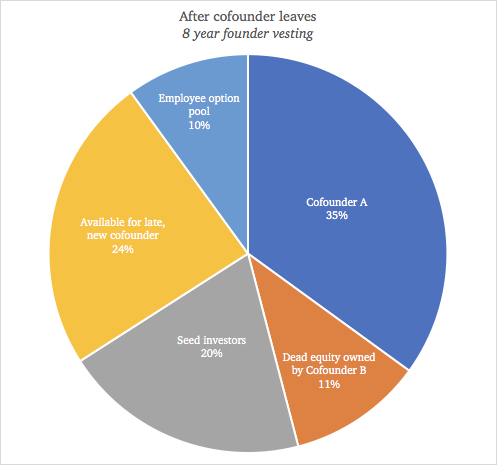
Example cap table with eight-year cofounder vesting.

The full article is on Extra Crunch, but I’m including more key parts here given the broad value:

Given the risks still ahead of the business, this level of compensation is often much more fair from a value-creation standpoint. With less dead equity on the cap table, the startup is still attractive in the eyes of VCs and well-positioned to attract a strong co-founder replacement to take the company forward. The alternative can cripple the company, and even co-founder B won’t be happy owning a larger percent of zero. While it’s better to do it when you start the company, a co-founder unit can elongate their vesting later on as well. The main requirement is that all the co-founders believe it’s in their best interest and agree to it. Most repeat founders I’ve talked to agree that four years is too short. Personally, if I started another company, I’d pick something like eight. You definitely don’t need to. You might decide four or six is better for your co-founder unit and your company.

One final thought, from my startup cofounder years. The departing cofounder should still want to see the company succeed as big as possible to maximize the value of their own shares. On the steep slope between failure and success in this business, vesting longer is a powerful way to help the company will deliver the most back to them after the hard work of the early days.
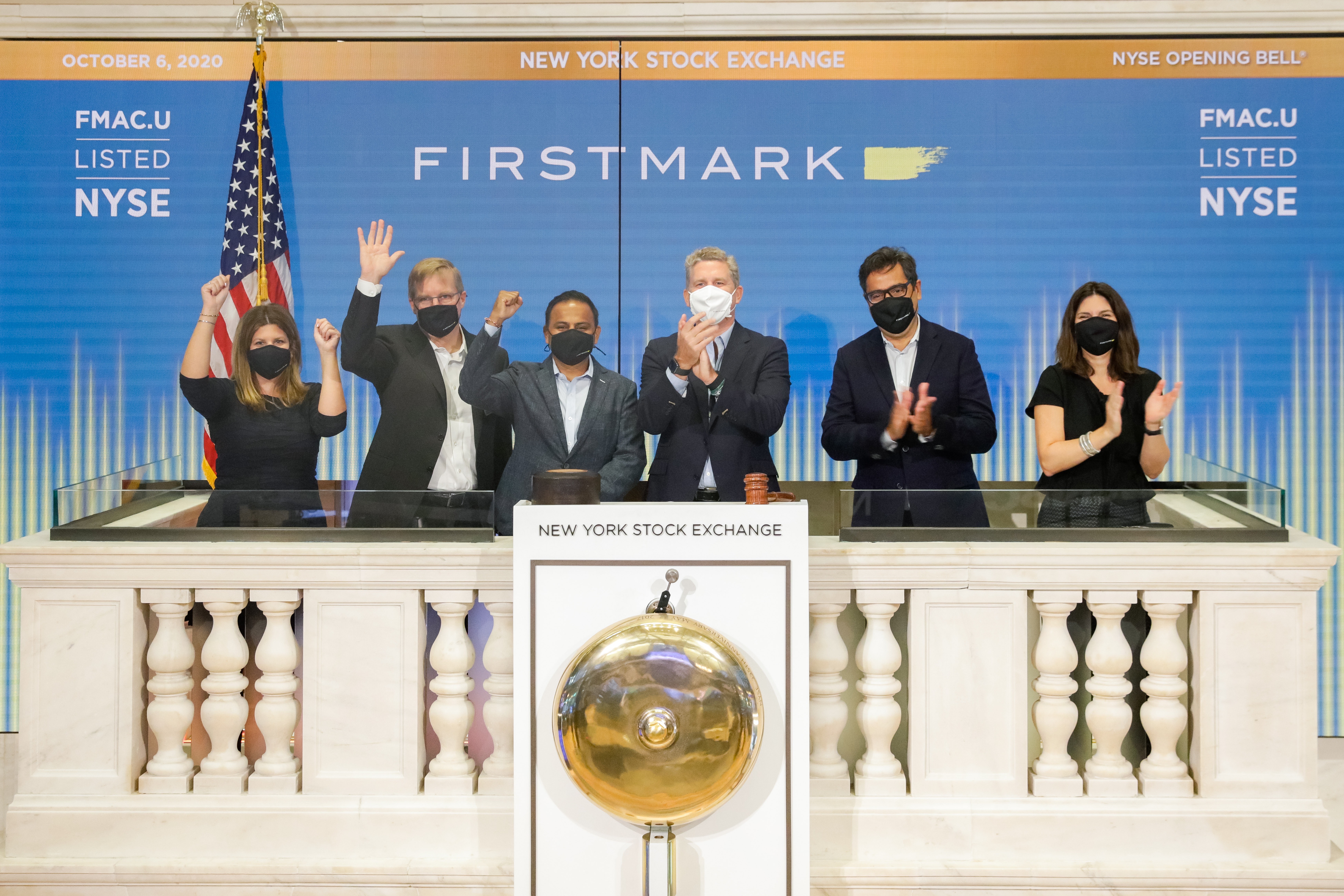
Image Credits: FirstMark

Why one successful early-stage VC firm is getting into SPACs now

SPACs are an exciting development for any type of investor, public or private, Amish Jani of FirstMark Capital tells Connie Loizos. Indeed, his firm has historically focused on writing early-stage checks, so at first it is a bit jarring to see the FirstMark Horizon Acquisition SPAC raise $360 million and head out looking for the right unicorn. But he explains it all quite well an extensive interview this week:

TC: Why SPACs right now? Is it fair to say it’s a shortcut to a hot public market, in a time when no one quite knows when the markets could shift?

AJ: There are a couple of different threads that are coming together. I think the first one is the possibility that [SPACs] work, and really well. [Our portfolio company] DraftKings  [reverse-merged into a SPAC] and did a [private investment in a public equity deal]; it was a fairly complicated transaction and they used this to go public, and the stock has done incredibly well.

In parallel, [privately held companies] over the last five or six years could raise large sums of capital, and that was pushing out the timeline [to going public] fairly substantially. [Now there are] tens of billions of dollars in value sitting in the private markets and [at the same time] an opportunity to go public and build trust with public shareholders and leverage the early tailwinds of growth.

He goes on to explain why public markets are likely to stay hot for the right SPACs far into the future.

AJ: I think a bit of a misconception is this idea that most investors in the public markets want to be hot money or fast money. There are a lot of investors that are interested in being part of a company’s journey and who’ve been frustrated because they’ve been frozen out of being able to access these companies as they’ve stayed private longer. So our investors are some of are our [limited partners], but the vast majority are long-only funds, alternative investment managers and people who are really excited about technology as a long-term disrupter and want to be aligned with this next generation of iconic companies.

Check out the whole thing on TechCrunch.

Peter Reinhardt SegmentDSC00311

SaaS continues to boom with Databricks funding, Segment acquisition

Maybe Segment would have gone public sometime soon, but instead Twilio has scooped it up for $3.2 billion this week. The popular data management tool will now be a part of Twilio’s ever-expanding suite of customer communication products. Perhaps it’s another sign of a consolidation phase taking hold in the sector, after a Pre-Cambrian explosion of SaaS startups over the last decade? Alex Wilhelm dug into the financials of the deal for Extra Crunch and came away thinking that the deal was not too expensive — in fact he thinks Segment may have been able to hold out for a little more, especially considering the multiplication of Twilio’s stock price this year.

Databricks, meanwhile, has evolved from an open-source data analytics platform that struggled to make revenues to a run rate of $350 million. Per an interview that Alex did for EC with chief executive Ali Ghodsi, the factors in this growth included a shift to focus on more proprietary code, big customers and sophisticated features. It’s now aiming for an IPO next year.

And what about that IPO market, which was a bit quieter this week? Alex gives a letter grade to each of the 18 most notable tech companies that have gone public this year, and observes that most them are continuing to stay in positive territory from their initial prices.
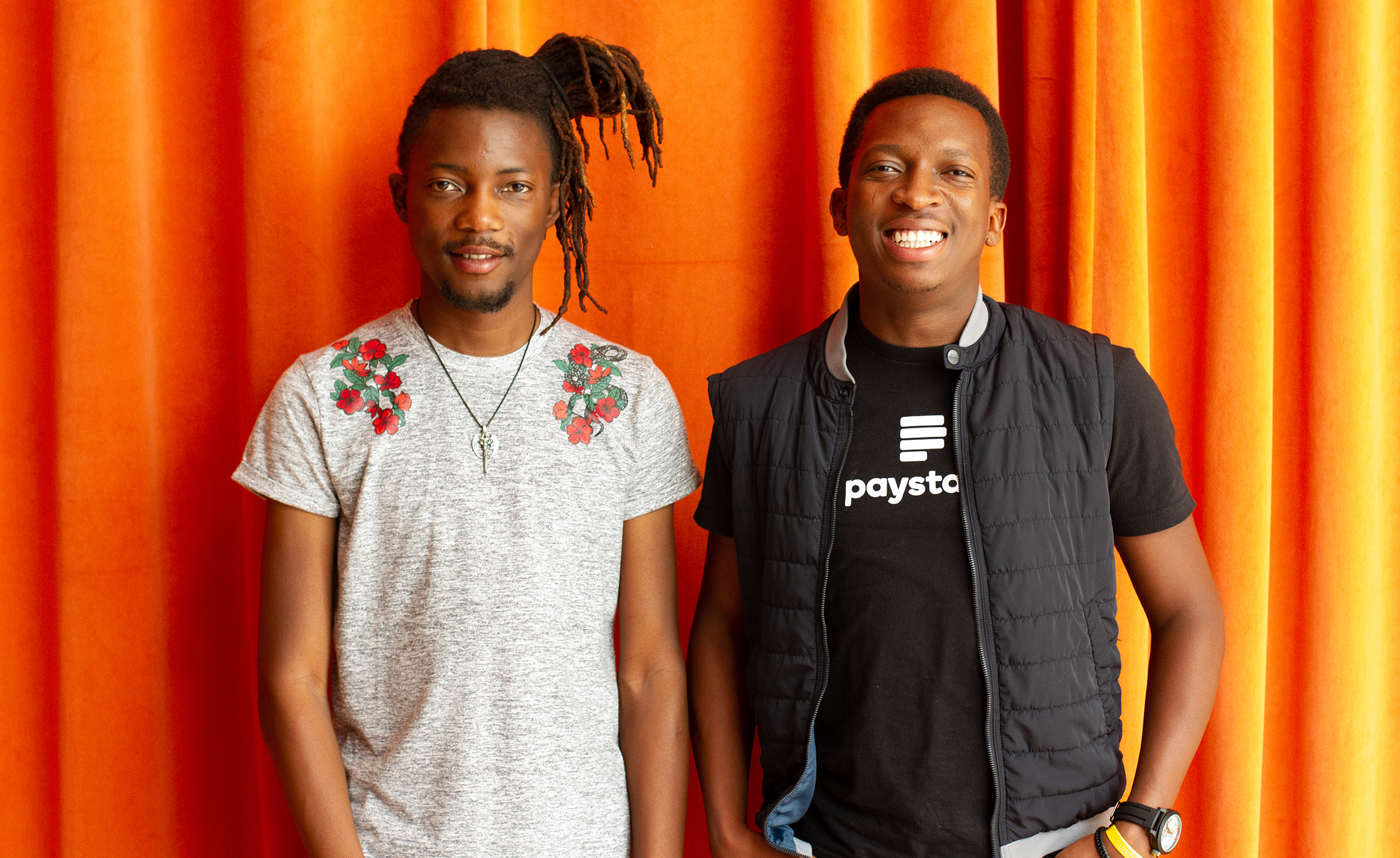
Image Credits: Brent Franson for Paystack

Nigeria startup scene gets watershed exit with Paystack deal

Lagos has been building a strong local startup scene for years, and this week that translated into a win that could mark a new era for the city, country and beyond. Stripe has agreed to acquire payments provider Paystack in a deal that Ingrid Lunden hears was worth more than $200 million. With Stripe’s own aims for a massive IPO, Paystack is poised to produce ongoing returns for the company and its investors, as well as providing Nigeria with a new generation of investors, founders and highly skilled employees who are tightly interlinked with Silicon Valley and other innovation centers.

A startup hub just needs one or two of the right deals to change everything. Readers who were paying attention when Google bought YouTube almost exactly 14 years ago today will remember the ensuing surge in fundings, foundings, acquisitions and overall consumer internet industry activity that helped the Silicon Valley internet scene get back on its feet (and helped this site get on the map, too). Stripe has said it is planning more global expansion that could include additional deals like this, so more cities around the world could be getting their moments this way.

Donau City development area - Vienna, Austria

Donau City development area – Vienna, Austria

Vienna startups finding new opportunities during the pandemic

In this week’s European investor survey for Extra Crunch, Mike Butcher checks in on Vienna, Austria, which has been tallying up growth in local startup activity recently. Here’s Eva Ahr of Capital 300, which focuses on Germanic and Central Eastern European investments, regarding about the impact of the pandemic on the local markets:

Telemedicine, online education has been accelerated. We see a shift that otherwise would have taken years, especially in the relatively conservative German-speaking area. As mentioned previously, mental health solutions, hiring and employing remotely are some of the opportunities highlighted by COVID-19. Companies that are heavily exposed are those that have been serving the long tail of companies, small merchants, and local businesses that were closed down or experienced much less traffic in past months and hence are extremely sensitive around their cost base, discontinuing services that are not 110% essential.

Mike is also working on a Lisbon survey and we’d love to hear from any investors focused on the city and Portugal in general.

Around TechCrunch

Discuss the unbundling of early-stage VC with Unusual Ventures’ Sarah Leary & John Vrionis

Across the week

TechCrunch:

If the ad industry is serious about transparency, let’s open-source our SDKs

Brazil’s Black Silicon Valley could be an epicenter of innovation in Latin America

South Korea pushes for AI semiconductors as global demand grows

The need for true equity in equity compensation

Trump’s latest immigration restrictions are bad news for American workers

Extra Crunch:

How COVID-19 and the resulting recession are impacting female founders

Startup founders set up hacker homes to recreate Silicon Valley synergy

Brighteye Ventures’ Alex Latsis talks European edtech funding in 2020

Dear Sophie: I came on a B-1 visa, then COVID-19 happened. How can I stay?

What the iPhone 12 tells us about the state of the smartphone industry in 2020

#EquityPod

From Alex:

Hello and welcome back to Equity, TechCrunch’s venture capital-focused podcast (now on Twitter!), where we unpack the numbers behind the headlines.

The whole crew was back today, with Natasha and Danny and I gathered to parse over what was really a blast of news. Lots of startups are raising. Lots of VCs are raising. And some unicorns are shooting to go public. It’s a lot to get through, but we’re here to catch you up.

Here’s what we got into:

And with that, we’re off until Monday morning. Chat soon, and stay safe.

Equity drops every Monday at 7:00 a.m. PDT and Thursday afternoon as fast as we can get it out, so subscribe to us on Apple PodcastsOvercastSpotify and all the casts.

News: This Week in Apps: Apple’s big event, lidar comes to iPhone, Android gets a new IDE

Welcome back to This Week in Apps, the TechCrunch series that recaps the latest OS news, the applications they support and the money that flows through it all. The app industry is as hot as ever, with a record 204 billion downloads and $120 billion in consumer spending in 2019. People are now spending three hours and 40 minutes per day

Welcome back to This Week in Apps, the TechCrunch series that recaps the latest OS news, the applications they support and the money that flows through it all.

The app industry is as hot as ever, with a record 204 billion downloads and $120 billion in consumer spending in 2019. People are now spending three hours and 40 minutes per day using apps, rivaling TV. Apps aren’t just a way to pass idle hours — they’re a big business. In 2019, mobile-first companies had a combined $544 billion valuation, 6.5x higher than those without a mobile focus.

In this series, we help you keep up with the latest news from the world of apps, delivered on a weekly basis.

Top Story

Apple introduces four new iPhones (and more)

Apple hosted its iPhone event this week, where it introduced the new iPhone 12… and the iPhone 12 mini, the iPhone 12 Pro and the iPhone 12 Pro Max — effectively plugging all the holes in the market. With the release of the four new iPhones, app developers will have a range of devices to build for, from small to very large — the 12 Pro Max, for example, introduces the iPhone’s biggest-ever screen and the highest resolution, at nearly 3.5M pixels.

It also, of course, includes serious camera improvements, from a redesign of the three-lens system to including a new deeper telephoto camera, now a 65 mm-equivalent instead of 52 mm, as on previous models. There’s also an improved wide-angle lens, larger sensor, the addition of sensor-level image stabilization and a revamped Night Mode. Photographers will appreciate the new Apple ProRAW format, as well. (More on that here).

The iPhone 12 mini, meanwhile, aims to serve the customer base that prefers a smaller phone, like the iPhone SE, but without sacrificing functionality.

All the devices share some key features, including 5G connectivity, the new MagSafe connector for wireless charging and snap-on magnetic accessories, OLED displays and the A14 chip. They also have a more classic look, with straight edges that allow for additional antennas, providing next-gen wireless connectivity.

One of the bigger differences, however, between the Pro models and the regular iPhone 12 is the addition of the LiDAR Scanner, which is also found in the latest iPad Pro. The scanner measures how long it takes for light to reach an object and reflect back. The new depth-sensing technology has big implications for AR, as it allows augmented reality objects to interact with objects in the real world. AR apps will be more user-friendly, too, as they won’t need to first scan the room to place the AR object in the real world. It can be placed instantly.

Apple is leveraging the sensor for the iPhone 12 Pro camera to offer up to 6x faster focus in low-light conditions. Developers, meanwhile, can leverage lidar for use cases like AR-enabled games that work in the real world, social media (like Snapchat’s new lidar-powered Lens), home design and improvement apps involving room scans, spatial layout planning (like JigSpace), better AR shopping experiences and more.

The company also announced an affordable version of its HomePod smart speaker, the $99 HomePod Mini. The item works best for those fully locked inside the Apple universe, as it will stream a handful of music services, but not one of the most popular — Spotify. However, Apple also introduced a nifty feature for the HomePod devices, Intercom, which lets you send announcements across the speakers. While Apple and Google have offered a similar feature for their smart speakers, Intercom also works across other Apple devices, including iPhone, iPod, AirPods and even CarPlay. (What, no Mac?)

If Apple isn’t too late to capture smart speaker market share, the new speaker could see more users adopting smart home devices they can voice control through the HomePod Mini.

During the event, Apple also subtly snubbed its nose at Epic’s Fortnite with the announcement that
League of Legends: Wild Rift would be coming to iPhone 12 to take advantage of its new 5G capabilities and A14 Bionic chip.

Weekly News Round-Up

Platforms

  • Lidar comes to iPhone 12 Pro. Developers can now build AR experiences that interact with real-world objects, and AR apps can now instantly place AR objects in the real world without scanning the room. The update will mean a huge increase in the usability of AR apps but is limited to the Pro model of iPhone for now. Snapchat is already using it.
  • Apple developers can now make their apps available for pre-order even earlier — up to 180 days before release on the App Store.
  • Android Studio 4.1 launches. The new, stable version of the IDE for building Android apps introduces better TensorFlow Lite support and a new database inspector. The team also fixed a whopping 2,370 bugs during this release cycle and closed 275 public issues.
  • Google introduces the Android for Cars library. The library, now in open beta, gives developers tools to design, develop and test new navigation, parking or charging apps for Android Auto. The Google Play Store will be enabled for publishing beta apps in the “coming months.”
  • Google stops selling music. The company no longer sells tracks and albums on its Play Store, shifting all its focus to YouTube Music. The latter also just launched on Apple Watch this week.

Trends

  • Shopping apps forecast. U.S. consumers were expected to spend 60M hours in Android shopping apps during Prime Day week, (which just wrapped) according to one forecast from App Annie.
  • Prime Day downloads grow. Sensor Tower estimates global installs of the Amazon app grew 23% year-over-year, to 684K, as Prime Day neared. Installs on Wednesday were up 33% to 750K. However, U.S. installs were down by 22% 10/13-10/14. Apptopia noted that app sessions, however, were up 27% year-over-year.
  • Shopping, Food & Drink app launches up more than 50% year-over-year. Shopping apps grew 52% while Food & Drink apps grew 60%, due to COVID-19 impacts, according to Sensor Tower.
  • Subscriptions. U.S. consumers spend $20.78 per month on app subscriptions, Adjust study says.
  • TikTok sale impact on ad industry. 73% of marketers said a TikTok sale in the U.S. would impact their 2021 advertising plans. 41% also believed the deal could allow Walmart to overtake Amazon in e-commerce.
  • Amazon expands AR experimentation to its boxes. The retailer launched a new AR application that works with QR codes on the company’s shipping boxes to create “interactive, shareable” AR experiences, like a pumpkin that comes to life.

Security

  • Robinhood said a “limited number” of its users’ accounts were hacked. The service itself was not hacked, but around 2,000 customers had accounts compromised by cybercriminals who first compromised users’ personal emails outside the trading app.

Other News

  • Zoom’s new events platform brings apps to video conferencing calls.
  • Messenger update brings new features, including cross-app communication with Instagram. The app gets fun features like chat themes, custom reactions and, soon, selfie stickers and vanish mode. But the bigger news is the (potentially anti-competitive) merging of Facebook’s chat platforms.
  • Life360 leverages TikTok teens’ complaints to start a dialogue and invent a new feature, “Bubbles,” which allows teens (or anyone) to share a generalized location instead of an exact one. The feature gives teens a bit more freedom to roam and make choices without so much parental oversight. Parents, meanwhile, can still be sure their teen is OK, as features like emergency SOS and crash alerts remain functional.
  • Must-read: The MacStories iOS and iPadOS 14 Review. Federico Viticci offers a 23-page deep dive into the latest version of Apple’s mobile operating system.

Funding and M&A

    • Future raises $24M Series B for its $150/mo workout coaching app amid at-home fitness boom. The app pairs users with real-life fitness coaching for personal training at home. The round was led by Trustbridge Partners with Caffeinated Capital and Series A investors Kleiner Perkins participating.
    • River raises $10.4M for its app offering news, events and other happenings from around the web, ranging from news stories from top publishers to sports to even notable tweets. The app presents the information in a real-time stream, browsed vertically. There’s also a “For You” page, similar to TikTok.
    • Roblox confidentially filed with the SEC to go public. This cross-platform gaming platform has boomed during coronavirus lockdowns. According to reports, the listing could double Robox’s $4B valuation.
    • Robo Adviser Wealthsimple raises $87M. The funding for the investing app with comparisons to Robinhood was led by Menlo Park-based Technology Crossover Ventures (TCV), valuing the business at $1B.
    • Fitness platform Playbook raises $9.3M. The company offers tools for personal trainers who want to make their own videos, which consumers then browse in Playbook’s mobile app. Backers include E.ventures, Michael Ovitz, Abstract, Algae Ventures, Porsche Ventures and FJ Labs.
    • Live streaming app Moment House raises $1.5M seed. The startup aims to recreate live events in a digital format. LA area investors invested, including Scooter Braun, Troy Carter, Kygo’s Palm Tree Crew and Jared Leto. Patreon chief executive Jack Conte and Sequoia Capital partner Jess Lee also participated.
    • Twilio acquires Segment for $3.2B to help developers build data-fueled apps.
    • E-learning platform Kahoot raises $215M from SoftBank. The Norwegian startup claims to have hosted 1.3 billion “participating players” in the last 12 months. The company’s gamified e-learning platform is used both in schools and in enterprise environments.

Downloads

Mycons

Mycons is a new app that makes it easier for users, including non-designers, to create and buy custom icons for their iOS home screen makeovers. In the app’s “Icon Studio,” users can create icons by swapping out the background, choosing a symbol and placing it on the icon accordingly. You can also create a whole set of icons in a batch export. If you don’t feel like designing your own, you can opt to purchase premade packs instead.

The app is a free download with a one-time, in-app purchase to unlock the fully functionality of the icon designer. The icon packs, which include different variations and matching wallpaper, range from $7.99-$9.99.

Spotify’s new iOS 14 widget

Image Credits: TechCrunch screenshot of Spotify widget

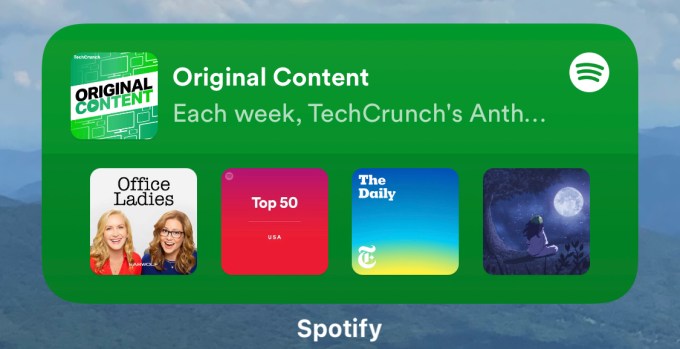
It’s here! The widget a number of people have waited for since the launch of the new version of iOS has arrived. 

The widget, which arrives in the latest version of the Spotify iOS app, comes in two sizes. The smaller widget will display just your most recently listened to item, while the medium-sized widget will instead show the five most recent items — four in a horizontal row and the most recent at the top. In that case, you can actually tap on the small thumbnail for which of the five you want to now stream to be taken directly to that page in the Spotify app. The widget also automatically updates its background color to match the thumbnail photo.

News: Original Content podcast: It’s hard to resist the silliness of ‘Emily in Paris’

“Emily in Paris,” a new series on Netflix, has provoked skeptical responses from actual Parisians who are happy to point out the abundant clichés in its story of a young American (played by Lily Collins) who takes a last-minute transfer to a marketing agency in Paris. Some fairly obvious culture clash moments ensue, along with

“Emily in Paris,” a new series on Netflix, has provoked skeptical responses from actual Parisians who are happy to point out the abundant clichés in its story of a young American (played by Lily Collins) who takes a last-minute transfer to a marketing agency in Paris.

Some fairly obvious culture clash moments ensue, along with equally implausible storylines where Emily’s extremely basic ideas about social media are treated as controversial and groundbreaking by her employer.

And yet, as we discuss on the latest episode of the Original Content podcast, we actually found the show delightful — or at the very least, highly watchable.

Yes, the show’s Paris is a fantasy, but it’s a fantasy that we’re happy to visit, particularly now. Yes, most of the show’s characters are basically cartoons, but they’re entertaining and fun cartoons. And at the end of the day, we’re all suckers for a slick, escapist romantic comedy, which is exactly what “Emily in Paris” delivers.

You can listen to our review in the player below, subscribe using Apple Podcasts or find us in your podcast player of choice. If you like the show, please let us know by leaving a review on Apple. You can also follow us on Twitter or send us feedback directly. (Or suggest shows and movies for us to review!)

And if you’d like to skip ahead, here’s how the episode breaks down:
0:00 Intro
0:31 “Emily in Paris” review
30:43 “Emily in Paris” spoiler discussion

WordPress Image Lightbox Plugin