Yearly Archives: 2020

News: Daily Crunch: Pakistan un-bans TikTok

TikTok returns to Pakistan, Apple launches a music-focused streaming station and SpaceX launches more Starlink satellites. This is your Daily Crunch for October 19, 2020. The big story: Pakistan un-bans TikTok The Pakistan Telecommunication Authority blocked the video app 11 days ago, over what it described as “immoral,” “obscene” and “vulgar” videos. The authority said

TikTok returns to Pakistan, Apple launches a music-focused streaming station and SpaceX launches more Starlink satellites. This is your Daily Crunch for October 19, 2020.

The big story: Pakistan un-bans TikTok

The Pakistan Telecommunication Authority blocked the video app 11 days ago, over what it described as “immoral,” “obscene” and “vulgar” videos. The authority said today that it’s lifting the ban after negotiating with TikTok management.

“The restoration of TikTok is strictly subject to the condition that the platform will not be used for the spread of vulgarity/indecent content & societal values will not be abused,” it continued.

This isn’t the first time this year the country tried to crack down on digital content. Pakistan announced new internet censorship rules this year, but rescinded them after Facebook, Google and Twitter threatened to leave the country.

The tech giants

Apple launches a US-only music video station, Apple Music TV —  The new music video station offers a free, 24-hour live stream of popular music videos and other music content.

Google Cloud launches Lending DocAI, its first dedicated mortgage industry tool — The tool is meant to help mortgage companies speed up the process of evaluating a borrower’s income and asset documents.

Facebook introduces a new Messenger API with support for Instagram — The update means businesses will be able to integrate Instagram messaging into the applications and workflows they’re already using in-house to manage their Facebook conversations.

Startups, funding and venture capital

SpaceX successfully launches 60 more Starlink satellites, bringing total delivered to orbit to more than 800 — That makes 835 Starlink satellites launched thus far, though not all of those are operational.

Singapore tech-based real estate agency Propseller raises $1.2M seed round — Propseller combines a tech platform with in-house agents to close transactions more quickly.

Ready Set Raise, an accelerator for women built by women, announces third class — Ready Set Raise has changed its programming to be more focused on a “realistic fundraising process” vetted by hundreds of women.

Advice and analysis for Extra Crunch

Are VCs cutting checks in the closing days of the 2020 election? — Several investors told TechCrunch they were split about how they’re making these decisions.

Disney+ UX teardown: Wins, fails and fixes — With the help of Built for Mars founder and UX expert Peter Ramsey, we highlight some of the things Disney+ gets right and things that should be fixed.

Late-stage deals made Q3 2020 a standout VC quarter for US-based startups — Investors backed a record 88 megarounds of $100 million or more.

(Reminder: Extra Crunch is our subscription membership program, which aims to democratize information about startups. You can sign up here.)

Everything else

US charges Russian hackers blamed for Ukraine power outages and the NotPetya ransomware attack — Prosecutors said the group of hackers, who work for the Russian GRU, are behind the “most disruptive and destructive series of computer attacks ever attributed to a single group.”

Stitcher’s podcasts arrive on Pandora with acquisition’s completion — SiriusXM today completed its previously announced $325 million acquisition of podcast platform Stitcher from E.W. Scripps, and has now launched Stitcher’s podcasts on Pandora.

Original Content podcast: It’s hard to resist the silliness of ‘Emily in Paris’ — The show’s Paris is a fantasy, but it’s a fantasy that we’re happy to visit.

The Daily Crunch is TechCrunch’s roundup of our biggest and most important stories. If you’d like to get this delivered to your inbox every day at around 3pm Pacific, you can subscribe here.

News: Amazon Echo Dot with Clock review: A mostly aesthetic update

It’s been a busy few weeks for smart speakers. Amazon kicked things off in late September with newer, rounder versions of both the Echo and Echo Dot. Less than a week later, Google updated the Home, after four years, with the rebranded Nest Audio. And then, last week, Apple unveiled the long-awaited $99 HomePod Mini,

It’s been a busy few weeks for smart speakers. Amazon kicked things off in late September with newer, rounder versions of both the Echo and Echo Dot. Less than a week later, Google updated the Home, after four years, with the rebranded Nest Audio. And then, last week, Apple unveiled the long-awaited $99 HomePod Mini, finally delivering an affordable version of its Siri speaker.

Amazon, for its part, has easily offered the most regular refreshes of the three. Both the Echo and Echo Dot are currently on their fourth iterations. The Echo Dot with Clock is only on its second (having just been introduced), but for all intents and purposes, the device is basically an Echo Dot — but, you know, with a clock.

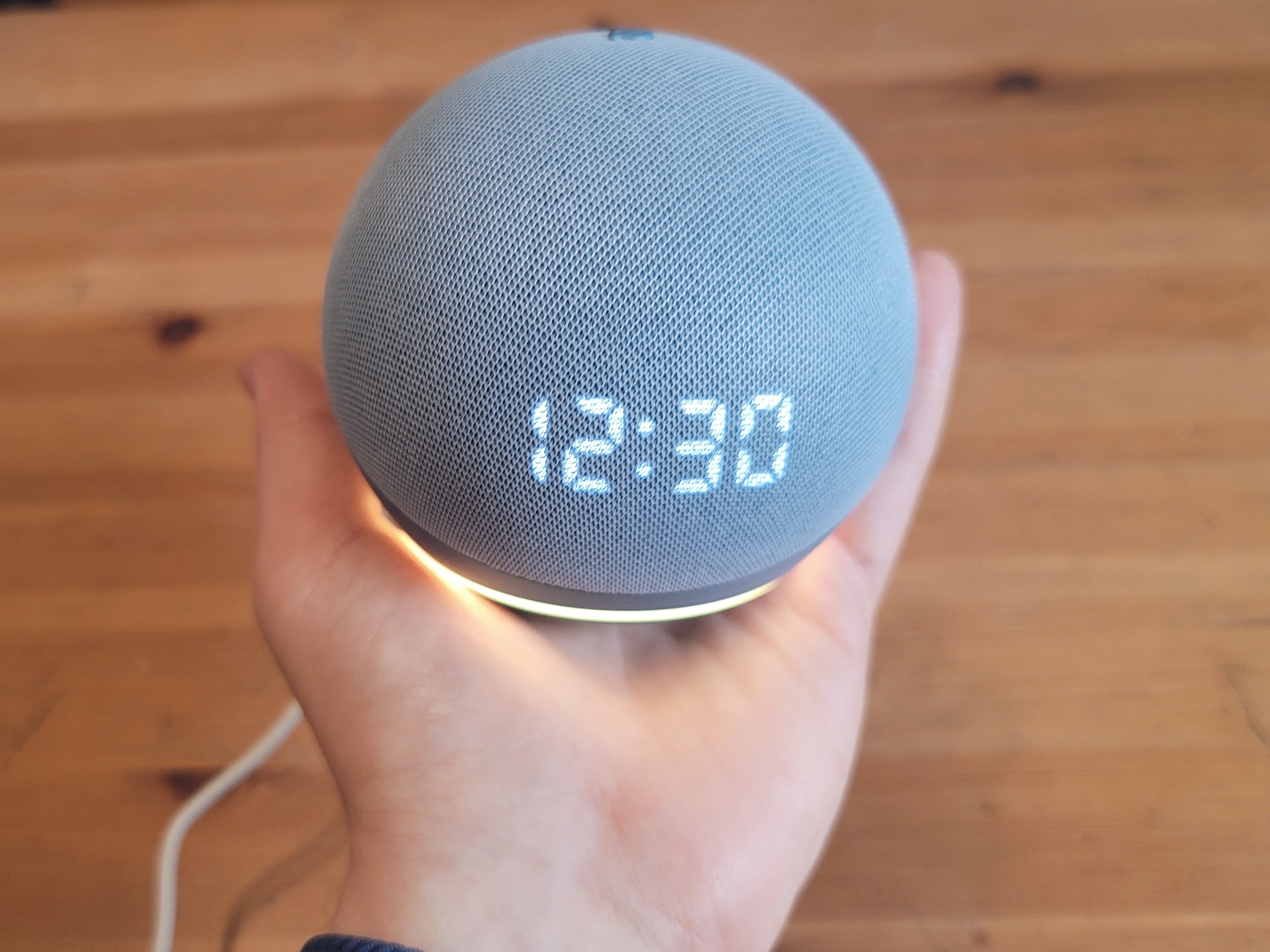
The latest update to the line finds the company offering a kind of design uniformity across the smart speakers. The Dot really does look like a diminutive version of the standard Echo. I wasn’t entirely sure how large a difference there would be between the two products, but it’s definitely pronounced. The Echo is the size of a large grapefruit and the Dot is essentially the size of a softball.

The Dot’s size lends it a good deal more flexibility in terms of placement. I could definitely see placing them in nooks and crannies throughout my place to create a kind of makeshift sound system (though the in-box cable is on the short side, so you’ll likely need an extension if you’re not close to an outlet).

Image Credits: Brian Heater

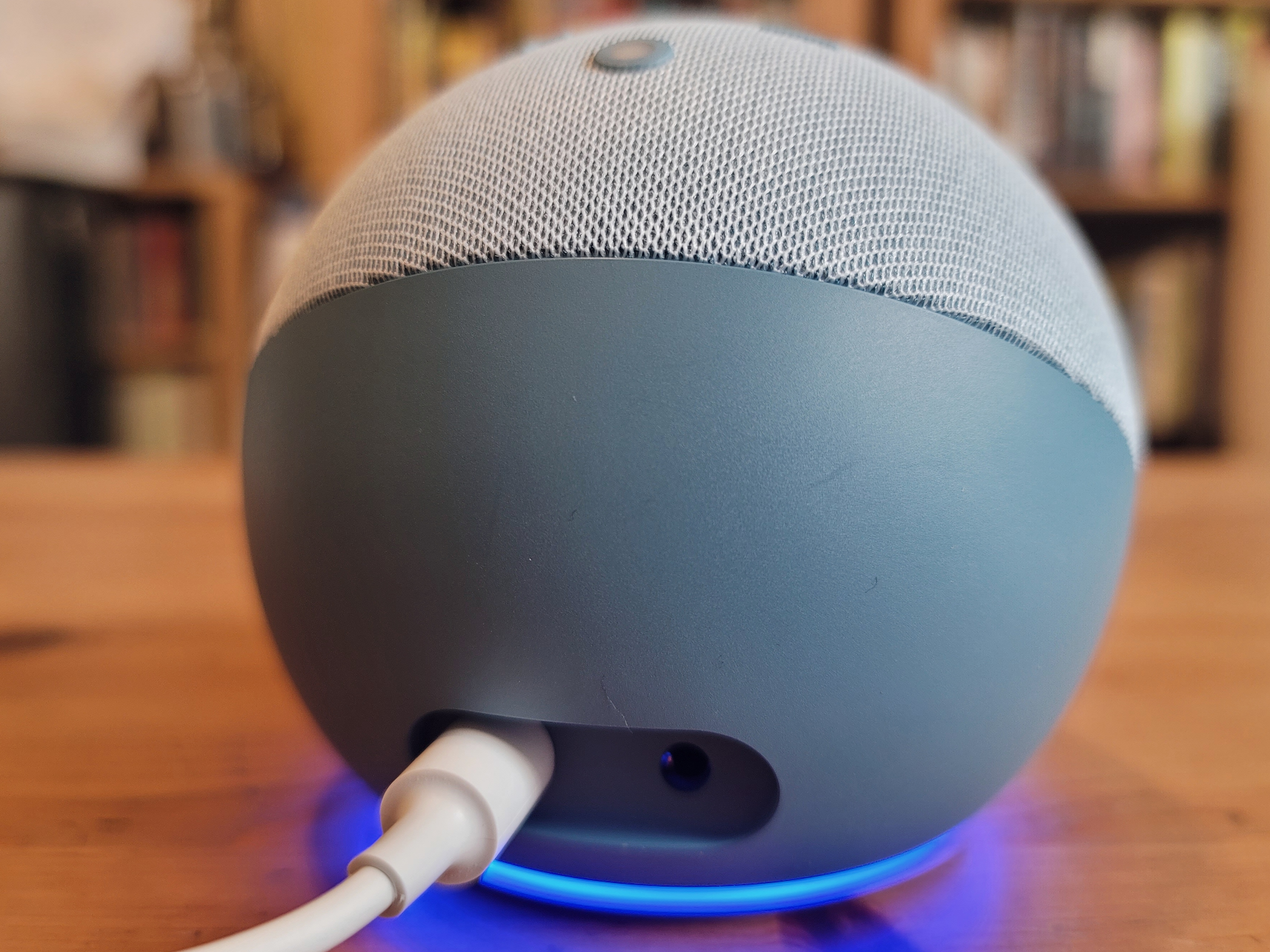
The majority of the speaker is covered in fabric, though the hard plastic bottom arcs up on the back of the device, occupying a large portion of the back. This allows for the inclusion of two ports (power and auxiliary audio out), though it also limits the speaker surface area on the device, restricting a full 360 approach unlike the older hockey puck design. As such, the speaker is just front-facing, in spite of the round design.

The new Echo devices, it’s worth noting, are one in a growing number of devices from big companies that are included as part of a push toward climate consciousness. I won’t really address Amazon’s larger overall carbon footprint here, but it’s nice to see some of that trickling down into these products. According to the company, the plastics are 50% post-consumer recycled, while the fabric and aluminum (including the capable and adapter) are both 100%.

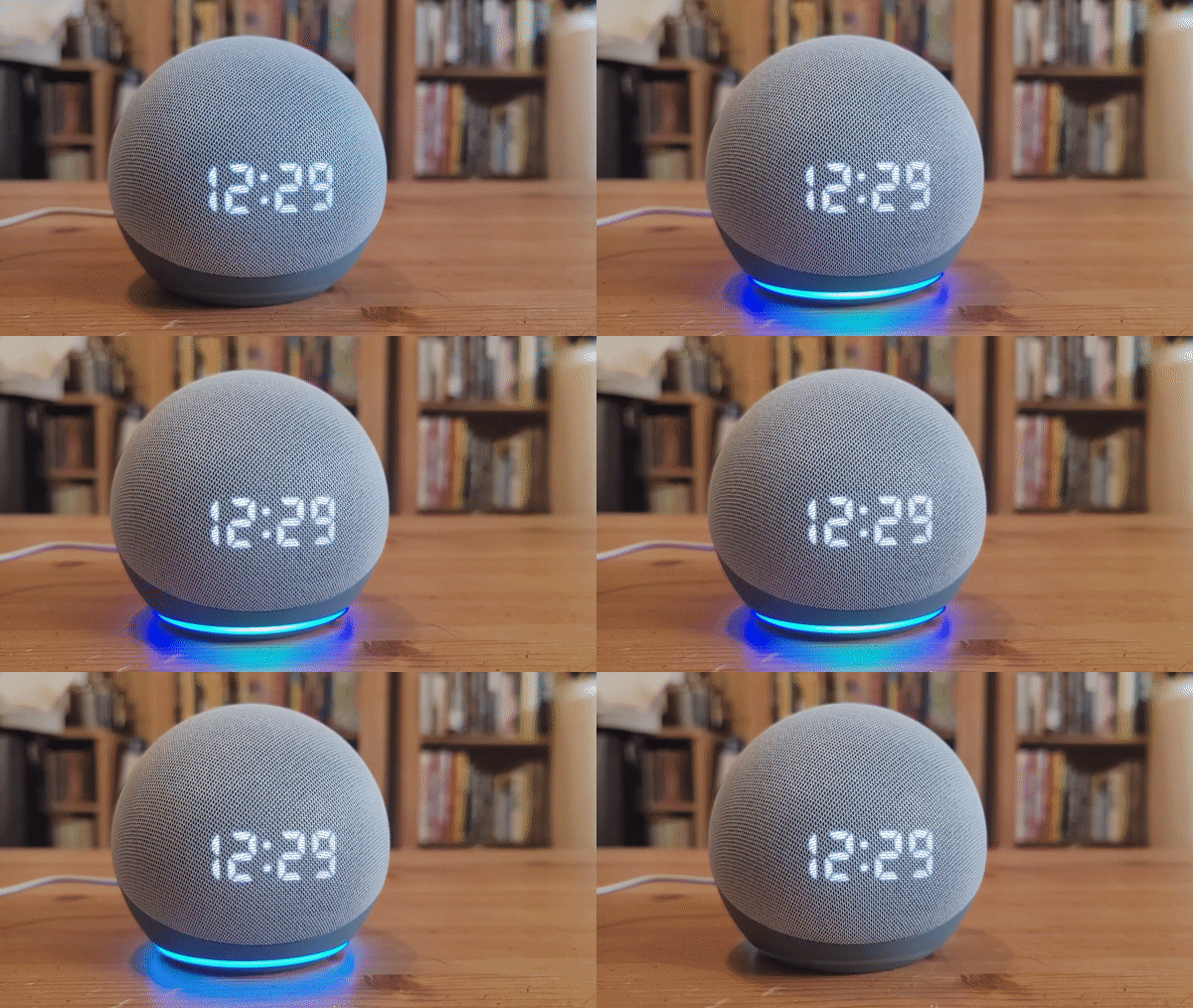
The setup process is as simple as ever. Tap a couple of buttons on the connected Echo app and you should be up and running. The status light ring has been moved to the bottom of the device — that seems to be more of a practical choice than anything. After all, the standard light ring wouldn’t really work at the top of a round, fabric-covered device.

Image Credits: Brian Heater

Whether that’s a net positive kind of depends on where you put the Echo. If it’s around eye-level, great. If it’s below that, it moves the ring out of view, and you may have to rely on seeing how it reflects off the surface it’s sitting on. For my own use, it’s a small step in the wrong direction. The digital clock (the big differentiator between the two Dots) is also a bit low on the ball, leaving a lot of blank surface area up top.

Again, I think Amazon is anticipating people will stick it around eye level, which is certainly the case if you primarily use the clock while lying in bed. The clock itself is plenty bright. And honestly, it’s nice just having a simple digital display sometimes, versus a full-on smart screen. That’s especially the case if you plan to stick it near your bed. That, after all, is supposed to be a kind of refuge from screens. That’s doubly important these days when we’re seemingly never not in front of one.

Image Credits: Brian Heater

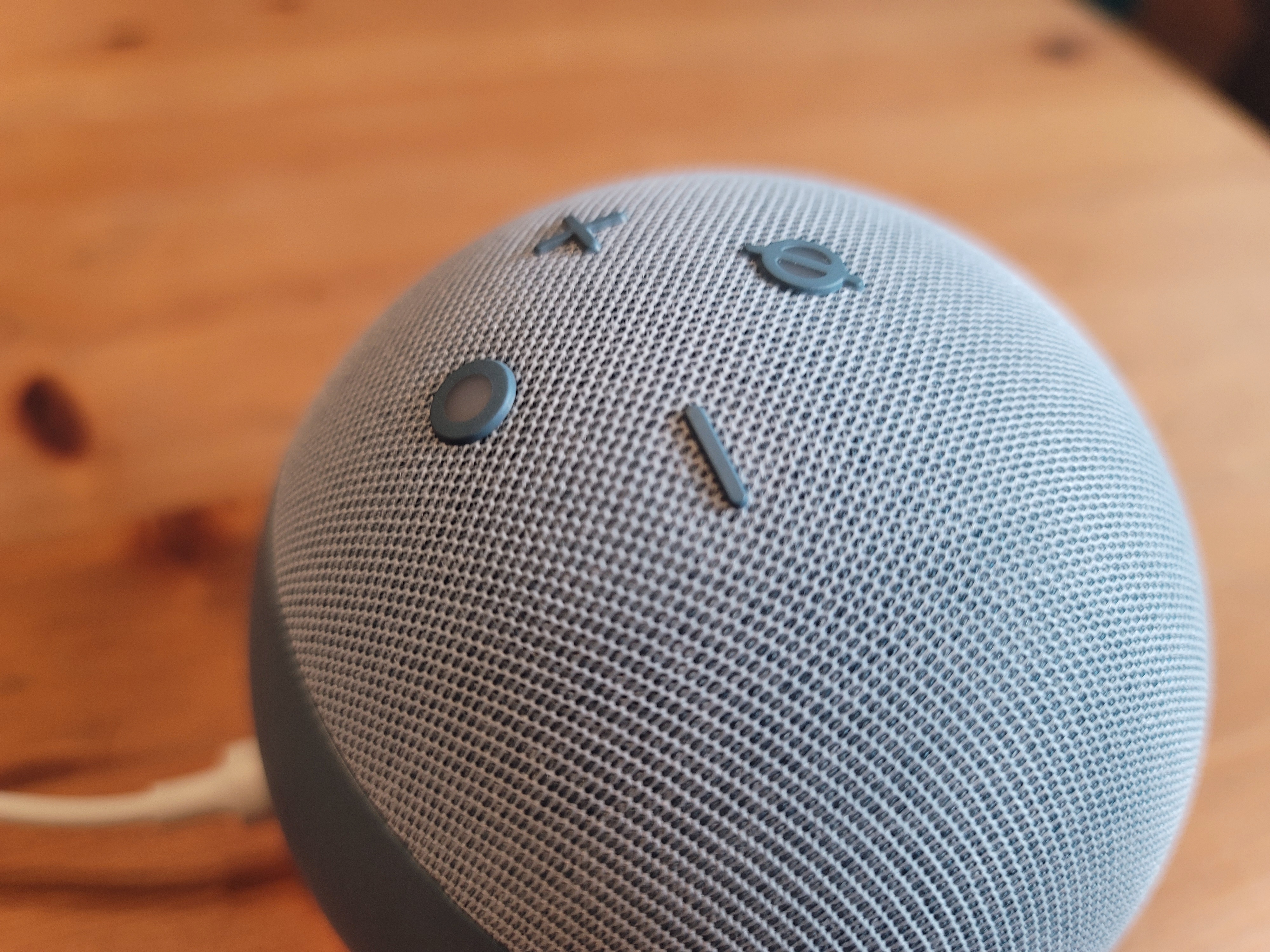
That said, the uses for the face are pretty much limited. You get a “Hello” at launch, the time (naturally), the weather when prompted and the volume level. That last bit can be adjusted with voice or with a pair of physical buttons up top. Those are joined by the Alexa button, which fires up the assistant and the always-important microphone off. That turns red when you tap it, along with a red ring on the bottom of the device to let you known the speaker has stopped listening until it’s reenabled.

The sound quality is basically the same — which is to say, kind of what you’d expect from a $50 to $60 smart speaker. It’s good for all of the voice functionality you need, but I certainly wouldn’t rely on it as my default home speaker — even with a couple of them paired up. As an alarm clock, however, sure, go for it. It certainly beats the speaker on your phone.

Image Credits: Brian Heater

The $10 price difference between the Dot and Dot with Clock is a bit of a weird one. I’d anticipate in future generations, Amazon will just combine them into one product, priced the same as the standard Dot. For now, however, telling time at a glance is going to cost you a little extra.

The new Echo arrives October 22. The Dot with Clock won’t be available until November 5.

News: Who regulates social media?

Social media platforms have repeatedly found themselves in the United States government’s crosshairs over the last few years, as it has been progressively revealed just how much power they really wield, and to what purposes they’ve chosen to wield it. But unlike, say, a firearm or drug manufacturer, there is no designated authority who says

Social media platforms have repeatedly found themselves in the United States government’s crosshairs over the last few years, as it has been progressively revealed just how much power they really wield, and to what purposes they’ve chosen to wield it. But unlike, say, a firearm or drug manufacturer, there is no designated authority who says what these platforms can and can’t do. So who regulates them? You might say everyone and no one.

Now, it must be made clear at the outset that these companies are by no means “unregulated,” in that no legal business in this country is unregulated. For instance Facebook, certainly a social media company, received a record $5 billion fine last year for failure to comply with rules set by the FTC. But not because the company violated its social media regulations — there aren’t any.

Facebook and others are bound by the same rules that most companies must follow, such as generally agreed-upon definitions of fair business practices, truth in advertising, and so on. But industries like medicine, energy, alcohol, and automotive have additional rules, indeed entire agencies, specific to them; Not so social media companies.

I say “social media” rather than “tech” because the latter is much too broad a concept to have a single regulator. Although Google and Amazon (and Airbnb, and Uber, and so on) need new regulation as well, they may require a different specialist, like an algorithmic accountability office or online retail antitrust commission. (Inasmuch as tech companies act within regulated industries, such as Google in broadband, they are already regulated as such.)

Social media can roughly defined as platforms where people sign up to communicate and share messages and media, and that’s quite broad enough already without adding in things like ad marketplaces, competition quashing and other serious issues.

Who, then, regulates these social media companies? For the purposes of the U.S., there are four main directions from which meaningful limitations or policing may emerge, but each one has serious limitations, and none was actually created for the task.

1. Federal regulators
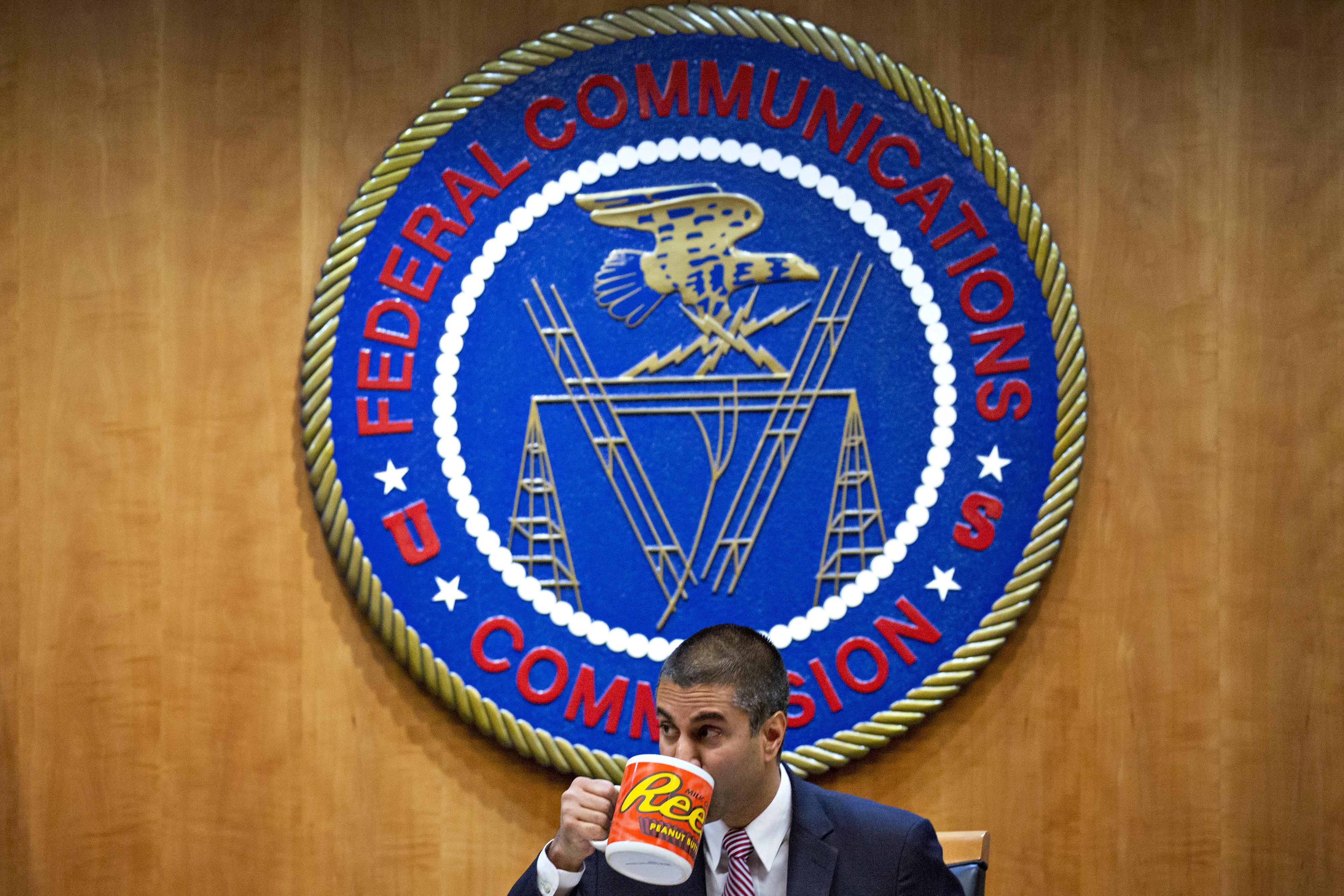
Image Credits: Andrew Harrer/Bloomberg

The Federal Communications Commission and Federal Trade Commission are what people tend to think of when “social media” and “regulation” are used in a sentence together. But one is a specialist — not the right kind, unfortunately — and the other a generalist.

The FCC, unsurprisingly, is primarily concerned with communication, but due to the laws that created it and grant it authority, it has almost no authority over what is being communicated. The sabotage of net neutrality has complicated this somewhat, but even the faction of the Commission dedicated to the backwards stance adopted during this administration has not argued that the messages and media you post are subject to their authority. They have indeed called for regulation of social media and big tech — but are for the most part unwilling and unable to do so themselves.

The Commission’s mandate is explicitly the cultivation of a robust and equitable communications infrastructure, which these days primarily means fixed and mobile broadband (though increasingly satellite services as well). The applications and businesses that use that broadband, though they may be affected by the FCC’s decisions, are generally speaking none of the agency’s business, and it has repeatedly said so.

The only potentially relevant exception is the much-discussed Section 230 of the Communications Decency Act (an amendment to the sprawling Communications Act), which waives liability for companies when illegal content is posted to their platforms, as long as those companies make a “good faith” effort to remove it in accordance with the law.

But this part of the law doesn’t actually grant the FCC authority over those companies or define good faith, and there’s an enormous risk of stepping into unconstitutional territory, because a government agency telling a company what content it must keep up or take down runs full speed into the First Amendment. That’s why although many think Section 230 ought to be revisited, few take Trump’s feeble executive actions along these lines seriously.

The agency did announce that it will be reviewing the prevailing interpretation of Section 230, but until there is some kind of established statutory authority or Congress-mandated mission for the FCC to look into social media companies, it simply can’t.

The FTC is a different story. As watchdog over business practices at large, it has a similar responsibility towards Twitter as it does towards Nabisco. It doesn’t have rules about what a social media company can or can’t do any more than it has rules about how many flavors of Cheez-It there should be. (There are industry-specific “guidelines” but these are more advisory about how general rules have been interpreted.)

On the other hand, the FTC is very much the force that comes into play should Facebook misrepresent how it shares user data, or Nabisco overstate the amount of real cheese in its crackers. The agency’s most relevant responsibility to the social media world is that of enforcing the truthfulness of material claims.

You can thank the FTC for the now-familiar, carefully worded statements that avoid any real claims or responsibilities: “We take security very seriously” and “we think we have the best method” and that sort of thing — so pretty much everything that Mark Zuckerberg says. Companies and executives are trained to do this to avoid tangling with the FTC: “Taking security seriously” isn’t enforceable, but saying “user data is never shared” certainly is.

In some cases this can still have an effect, as in the $5 billion fine recently dropped into Facebook’s lap (though for many reasons that was actually not very consequential). It’s important to understand that the fine was for breaking binding promises the company had made — not for violating some kind of social-media-specific regulations, because again, there really aren’t any.

The last point worth noting is that the FTC is a reactive agency. Although it certainly has guidelines on the limits of legal behavior, it doesn’t have rules that when violated result in a statutory fine or charges. Instead, complaints filter up through its many reporting systems and it builds a case against a company, often with the help of the Justice Department. That makes it slow to respond compared with the lightning-fast tech industry, and the companies or victims involved may have moved beyond the point of crisis while a complaint is being formalized there. Equifax’s historic breach and minimal consequences are an instructive case:

So: While the FCC and FTC do provide important guardrails for the social media industry, it would not be accurate to say they are its regulators.

2. State legislators

States are increasingly battlegrounds for the frontiers of tech, including social media companies. This is likely due to frustration with partisan gridlock in Congress that has left serious problems unaddressed for years or decades. Two good examples of states that lost their patience are California’s new privacy rules and Illinois’s Biometric Information Privacy Act (BIPA).

The California Consumer Privacy Act (CCPA) was arguably born out the ashes of other attempts at a national level to make companies more transparent about their data collection policies, like the ill-fated Broadband Privacy Act.

Californian officials decided that if the feds weren’t going to step up, there was no reason the state shouldn’t at least look after its own. By convention, state laws that offer consumer protections are generally given priority over weaker federal laws — this is so a state isn’t prohibited from taking measures for their citizens’ safety while the slower machinery of Congress grinds along.

The resulting law, very briefly stated, creates formal requirements for disclosures of data collection, methods for opting out of them, and also grants authority for enforcing those laws. The rules may seem like common sense when you read them, but they’re pretty far out there compared to the relative freedom tech and social media companies enjoyed previously. Unsurprisingly, they have vocally opposed the CCPA.

BIPA has a somewhat similar origin, in that a particularly far-sighted state legislature created a set of rules in 2008 limiting companies’ collection and use of biometric data like fingerprints and facial recognition. It has proven to be a huge thorn in the side of Facebook, Microsoft, Amazon, Google, and others that have taken for granted the ability to analyze a user’s biological metrics and use them for pretty much whatever they want.

Many lawsuits have been filed alleging violations of BIPA, and while few have produced notable punishments like this one, they have been invaluable in forcing the companies to admit on the record exactly what they’re doing, and how. Sometimes it’s quite surprising! The optics are terrible, and tech companies have lobbied (fortunately, with little success) to have the law replaced or weakened.

What’s crucially important about both of these laws is that they force companies to, in essence, choose between universally meeting a new, higher standard for something like privacy, or establishing a tiered system whereby some users get more privacy than others. The thing about the latter choice is that once people learn that users in Illinois and California are getting “special treatment,” they start asking why Mainers or Puerto Ricans aren’t getting it as well.

In this way state laws exert outsize influence, forcing companies to make changes nationally or globally because of decisions that technically only apply to a small subset of their users. You may think of these states as being activists (especially if their attorneys general are proactive), or simply ahead of the curve, but either way they are making their mark.

This is not ideal, however, because taken to the extreme, it produces a patchwork of state laws created by local authorities that may conflict with one another or embody different priorities. That, at least, is the doomsday scenario predicted almost universally by companies in a position to lose out.

State laws act as a test bed for new policies, but tend to only emerge when movement at the federal level is too slow. Although they may hit the bullseye now and again, like with BIPA, it would be unwise to rely on a single state or any combination among them to miraculously produce, like so many simian legislators banging on typewriters, a comprehensive regulatory structure for social media. Unfortunately, that leads us to Congress.

3. Congress
Image: Bryce Durbin/TechCrunch

What can be said about the ineffectiveness of Congress that has not already been said, again and again? Even in the best of times few would trust these people to establish reasonable, clear rules that reflect reality. Congress simply is not the right tool for the job, because of its stubborn and willful ignorance on almost all issues of technology and social media, its countless conflicts of interest, and its painful sluggishness — sorry, deliberation — in actually writing and passing any bills, let alone good ones.

Companies oppose state laws like the CCPA while calling for national rules because they know that it will take forever and there’s more opportunity to get their finger in the pie before it’s baked. National rules, in addition to coming far too late, are much more likely also be watered down and riddled with loopholes by industry lobbyists. (This is indicative of the influence these companies wield over their own regulation, but it’s hardly official.)

But Congress isn’t a total loss. In moments of clarity it has established expert agencies like those in the first item, which have Congressional oversight but are otherwise independent, empowered to make rules, and kept technically — if somewhat limply — nonpartisan.

Unfortunately, the question of social media regulation is too recent for Congress to have empowered a specialist agency to address it. Social media companies don’t fit neatly into any of the categories that existing specialists regulate, something that is plainly evident by the present attempt to stretch Section 230 beyond the breaking point just to put someone on the beat.

Laws at the federal level are not to be relied on for regulation of this fast-moving industry, as the current state of things shows more than adequately. And until a dedicated expert agency or something like it is formed, it’s unlikely that anything spawned on Capitol Hill will do much to hold back the Facebooks of the world.

4. European regulators
eu gdpr 1Of course, however central it considers itself to be, the U.S. is only a part of a global ecosystem of various and shifting priorities, leaders, and legal systems. But in a sort of inside-out version of state laws punching above their weight, laws that affect a huge part of the world except the U.S. can still have a major effect on how companies operate here.

The most obvious example is the General Data Protection Regulation or GDPR, a set of rules, or rather augmentation of existing rules dating to 1995, that has begun to change the way some social media companies do business.

But this is only the latest step in a fantastically complex, decades-long process that must harmonize the national laws and needs of the E.U. member states in order to provide the clout it needs to compel adherence to the international rules. Red tape seldom bothers tech companies, which rely on bottomless pockets to plow through or in-born agility to dance away.

Although the tortoise may eventually in this case overtake the hare in some ways, at present the GDPR’s primary hindrance is not merely the complexity of its rules, but the lack of decisive enforcement of them. Each country’s Data Protection Agency acts as a node in a network that must reach consensus in order to bring the hammer down, a process that grinds slow and exceedingly fine.

When the blow finally lands, though, it may be a heavy one, outlawing entire practices at an industry-wide level rather than simply extracting pecuniary penalties these immensely rich entities can shrug off. There is space for optimism as cases escalate and involve heavy hitters like antitrust laws in efforts that grow to encompass the entire “big tech” ecosystem.

The rich tapestry of European regulations is really too complex of a topic to address here in the detail it deserves, and also reaches beyond the question of who exactly regulates social media. Europe’s role in that question of, if you will, speaking slowly and carrying a big stick promises to produce results on a grand scale, but for the purposes of this article it cannot really be considered an effective policing body.

(TechCrunch’s E.U. regulatory maven Natasha Lomas contributed to this section.)

5. No one? Really?

As you can see, the regulatory ecosystem in which social media swims is more or less free of predators. The most dangerous are the small, agile ones — state legislatures — that can take a bite before the platforms have had a chance to brace for it. The other regulators are either too slow, too compromised, or too involved (or some combination of the three) to pose a real threat. For this reason it may be necessary to introduce a new, but familiar, species: the expert agency.

As noted above, the FCC is the most familiar example of one of these, though its role is so fragmented that one could be forgiven for forgetting that it was originally created to ensure the integrity of the telephone and telegraph system. Why, then, is it the expert agency for orbital debris? That’s a story for another time.
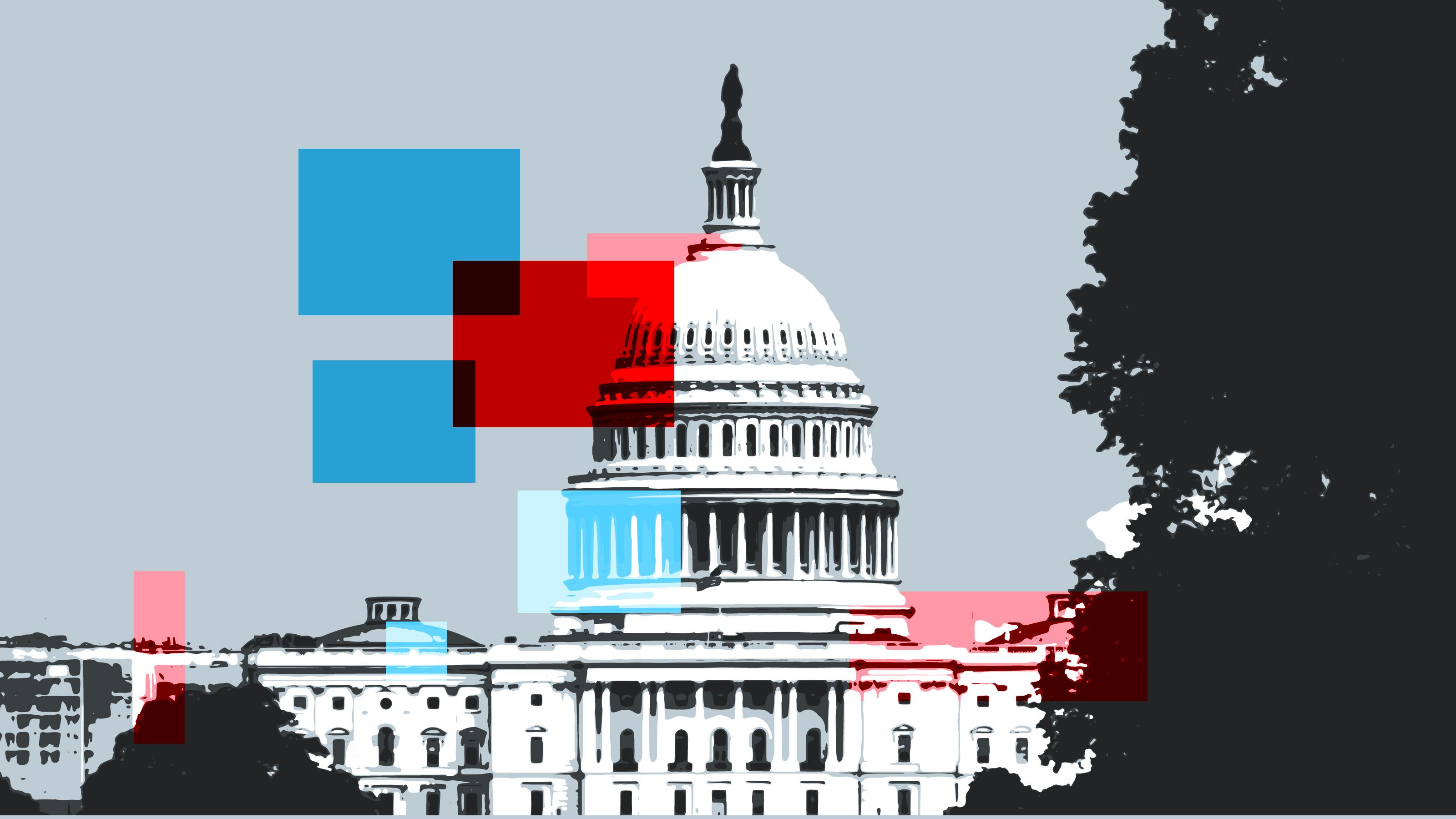
Capitol building

Image Credit: Bryce Durbin/TechCrunch

What is clearly needed is the establishment of an independent expert agency or commission in the U.S., at the federal level, that has statutory authority to create and enforce rules pertaining to the handling of consumer data by social media platforms.

Like the FCC (and somewhat like the E.U.’s DPAs), this should be officially nonpartisan — though like the FCC it will almost certainly vacillate in its allegiance — and should have specific mandates on what it can and can’t do. For instance, it would be improper and unconstitutional for such an agency to say this or that topic of speech should be disallowed from Facebook or Twitter. But it would be able to say that companies need to have a reasonable and accessible definition of the speech they forbid, and likewise a process for auditing and contesting takedowns. (The details of how such an agency would be formed and shaped is well beyond the scope of this article.)

Even the likes of the FAA lags behind industry changes, such as the upsurge in drones that necessitated a hasty revisit of existing rules, or the huge increase in commercial space launches. But that’s a feature, not a bug. These agencies are designed not to act unilaterally based on the wisdom and experience of their leaders, but are required to perform or solicit research, consult with the public and industry alike, and create evidence-based policies involving, or at least addressing, a minimum of sufficiently objective data.

Sure, that didn’t really work with net neutrality, but I think you’ll find that industries have been unwilling to capitalize on this temporary abdication of authority by the FCC because they see that the Commission’s current makeup is fighting a losing battle against voluminous evidence, public opinion, and common sense. They see the writing on the wall and understand that under this system it can no longer be ignored.

With an analogous authority for social media, the evidence could be made public, the intentions for regulation plain, and the shareholders — that is to say, users — could make their opinions known in a public forum that isn’t owned and operated by the very companies they aim to rein in.

Without such an authority these companies and their activities — the scope of which we have only the faintest clue to — will remain in a blissful limbo, picking and choosing by which rules to abide and against which to fulminate and lobby. We must help them decide, and weigh our own priorities against theirs. They have already abused the naive trust of their users across the globe — perhaps it’s time we asked them to trust us for once.


News: Juniper Networks acquires Boston-area AI SD-WAN startup 128 Technology for $450M

Today Juniper Networks announced it was acquiring smart wide area networking startup 128 Technology for $450 million. This marks the second AI-fueled networking company Juniper has acquired in the last year and a half after purchasing Mist Systems in March 2019 for $405 million. With 128 Technology, the company gets more AI SD-WAN technology. SD-WAN

Today Juniper Networks announced it was acquiring smart wide area networking startup 128 Technology for $450 million.

This marks the second AI-fueled networking company Juniper has acquired in the last year and a half after purchasing Mist Systems in March 2019 for $405 million. With 128 Technology, the company gets more AI SD-WAN technology. SD-WAN is short for software-defined wide area networks, which means networks that cover a wide geographical area such as satellite offices, rather than a network in a defined space.

Today, instead of having simply software-defined networking, the newer systems use artificial intelligence to help automate session and policy details as needed, rather than dealing with static policies, which might not fit every situation perfectly.

Writing in a company blog post announcing the deal, executive vice president and chief product officer Manoj Leelanivas sees 128 Technology adding great flexibility to the portfolio as it tries to transition from legacy networking approaches to modern ones driven by AI, especially in conjunction with the Mist purchase.

“Combining 128 Technology’s groundbreaking software with Juniper SD-WAN, WAN Assurance and Marvis Virtual Network Assistant (driven by Mist AI) gives customers the clearest and quickest path to full AI-driven WAN operations — from initial configuration to ongoing AIOps, including customizable service levels (down to the individual user), simple policy enforcement, proactive anomaly detection, fault isolation with recommended corrective actions, self-driving network operations and AI-driven support,” Leelanivas wrote in the blog post.

128 Technologies was founded in 2014 and raised over $97 million, according to Crunchbase data. Its most recent round was a $30 million Series D investment in September 2019 led by G20 Ventures and The Perkins Fund.

In addition to the $450 million, Juniper has asked 128 Technology to issue retention stock bonuses to encourage the startup’s employees to stay on during the transition to the new owners. Juniper has promised to honor this stock under the terms of the deal. The deal is expected to close in Juniper’s fiscal fourth quarter subject to normal regulatory review.

News: Lockheed picks Relativity’s 3D-printed rocket for experimental NASA mission

Relativity Space has bagged its first public government contract, and with a major defense contractor at that. The launch startup’s 3D-printed rockets are a great match for a particularly complex mission Lockheed is undertaking for NASA’s Tipping Point program. The mission is a test of a dozen different cryogenic fluid management systems, including liquid hydrogen,

Relativity Space has bagged its first public government contract, and with a major defense contractor at that. The launch startup’s 3D-printed rockets are a great match for a particularly complex mission Lockheed is undertaking for NASA’s Tipping Point program.

The mission is a test of a dozen different cryogenic fluid management systems, including liquid hydrogen, which is a very difficult substance to work with indeed. The tests will take place on a single craft in orbit, which means it will be a particularly complicated one to design and accommodate.

The payload itself and its cryogenic systems will be designed and built by Lockheed and their partners at NASA, of course, but the company will need to work closely with its launch provider during development and especially in the leadup to the actual launch.

Relativity founder and CEO Tim Ellis explained that the company’s approach of 3D printing the entire rocket top to bottom is especially well suited for this.

“We’re building a custom payload fairing that has specific payload loading interfaces they need, custom fittings and adapters,” he said. “It still needs to be smooth, of course — to a lay person it will look like a normal rocket,” he added.

Every fairing (the external part of the launch vehicle covering the payload) is necessarily custom, but this one much more so. The delicacy of having a dozen cryogenic operations being loaded up and tested until moments before launch necessitates a number of modifications that, in other days, would result in a massive increase in manufacturing complexity.

“If you look at the manufacturing tools being used today, they’re not much different from the last 60 years,” Ellis explained. “It’s fixed tooling, giant machines that look impressive but only make one shape or one object that’s been designed by hand. And it’ll take 12-24 months to make it.”

Not so with Relativity.

“With our 3D printed approach we can print the entire fairing in under 30 days,” Ellis said. “It’s also software defined, so we can just change the file to change the dimensions and shape. For this particular object we have some custom features that we’re able to do more quickly and adapt. Even though the mission is three years out, there will always be last minute changes as you get closer to launch, and we can accommodate that. Otherwise you’d have to lock in the design now.”

Ellis was excited about the opportunity to publicly take on a mission with such a major contractor. These enormous companies field billions of government dollars and take part in many launches, so it’s important to be in their good books, or at least in their rolodexes. A mission like this, complex but comparatively low stakes (compared with a crewed launch or billion-dollar satellite) is a great chance for a company like Relativity to show its capabilities. (Having presold many of its launches already, there’s clearly no lack of interest in the 3D printed launch vehicles, but more is always better.)

The company will be going to space before then, though, if all continues to go according to plan. The first orbital test flight is scheduled for late 2021. “We’re actually printing the launch hardware right now, the last few weeks,” Ellis mentioned.

The NASA Tipping Point program that is funding Lockheed with an $89.7 million contract for this experiment is one intended to, as its name indicates, help tip promising technologies over the edge into commercial viability. With hundreds of millions awarded yearly for companies pursuing things like lunar hoppers and robotic arms, it’s a bit like the agency’s venture fund.

News: Disney+ UX teardown: Wins, fails and fixes

Disney announced earlier this month that it’s going all-in on streaming media. As part of this new strategy, the company is undergoing a major reorganisation of its media and entertainment business that will focus on developing productions that will debut on its streaming and broadcast services. This will include merging the company’s media businesses, ads

Disney announced earlier this month that it’s going all-in on streaming media.

As part of this new strategy, the company is undergoing a major reorganisation of its media and entertainment business that will focus on developing productions that will debut on its streaming and broadcast services.

This will include merging the company’s media businesses, ads and distribution, and Disney+ divisions so that they’ll now operate under the same business unit.

As TechCrunch’s Jonathan Shieber reports, Disney’s announcement follows a significant change to its release schedule to address new realities, including a collapsing theatrical release business; production issues; and the runaway success of its Disney+ streaming service — all caused or accelerated by the national failure to effectively address the COVID-19 pandemic.

So what better time than now to give Disney+ the Extra Crunch user experience teardown treatment. With the help of Built for Mars founder and UX expert Peter Ramsey, we highlight some of the things Disney+ gets right and things that should be fixed. They include zero distractions while signing up, “the power of percentages,” and the importance of designing for trackpad, mouse and touch outside of native applications.

Zero distractions while signing up

If the user is trying to complete a very specific task — such as making a payment — don’t distract them. They’re experiencing event-driven behaviour.

The win: Disney have almost entirely removed any kind of distractions when signing up. This includes the header and footer. They want you to stay on-task.

Image Credits: Disney+

Steve O’Hear: This seems like a very easy win but one we don’t see as often as perhaps we should. Am I right that most sign-up flows aren’t this distraction-free and why do you think that is?

Peter Ramsey: Yeah, it’s such an easy win. Sometimes you see sign-up screens that have Google Adwords on it, and I think, “You’re risking the user getting distracted and leaving for what, half a penny?” If I had to guess why more companies don’t utilise this technique, it’s probably just because they don’t want to deal with the technical hassle of hiding a bunch of elements.

The power of percentages

Only use percentages when it makes sense. 80% off sounds like a lot, but 3% doesn’t. Percentages can be a great way of making a discount seem larger than it actually is, but sometimes it can have the reverse effect. This is because people are generally bad at accurately estimating discounts. “What’s 13% off £78?”

The fail: If you sign up to a year of Disney+, then you’re offered 16% free. But 16% isn’t easy to calculate in your head — so people guess. And sometimes, their guesses may be less than the actual value of the discount.

The fix: In this instance, it would be far more compelling (and require less mental arithmetic), if it was marketed as “60 days free.” Sixty days is both easy to understand and easy to assign value to.

Image Credits: Disney+

Percentages may be harder to process or evaluate in isolation as an end user but they are easy to compare with each other i.e., we all know 25% off is better than 10% off. Aren’t you advocating obscuring the actual saving in favour of what sounds better on a case-by-case basis and therefore actually working against the end user? Of course I’m playing devils advocate a little here.

So, it’s actually a really complex dilemma, and there’s no “easy” answer — this would probably make a great dinner time conversation. Yes, if you’re offering two discounts, then a percentage may be the easiest way for people to compare them.

News: US charges Russian hackers blamed for Ukraine power outages and the NotPetya ransomware attack

Six Russian intelligence officers accused of launching some of the “world’s most destructive malware” — including an attack that took down the Ukraine power grid in December 2015 and the NotPetya global ransomware attack in 2017 — have been charged by the U.S. Justice Department. Prosecutors said the group of hackers, who work for the

Six Russian intelligence officers accused of launching some of the “world’s most destructive malware” — including an attack that took down the Ukraine power grid in December 2015 and the NotPetya global ransomware attack in 2017 — have been charged by the U.S. Justice Department.

Prosecutors said the group of hackers, who work for the Russian GRU, are behind the “most disruptive and destructive series of computer attacks ever attributed to a single group.”

“No country has weaponized its cyber capabilities as maliciously or irresponsibly as Russia, wantonly causing unprecedented damage to pursue small tactical advantages and to satisfy fits of spite,” said John Demers, U.S. assistant attorney general for national security. “Today the department has charged these Russian officers with conducting the most disruptive and destructive series of computer attacks ever attributed to a single group, including unleashing the NotPetya malware. No nation will recapture greatness while behaving in this way.”

The six accused Russian intelligence officers. Image Credits: FBI/supplied

In charges laid out Monday, the hackers are accused of developing and launching attacks using the KillDisk and Industroyer (also known as Crash Override) to target and disrupt the power supply in Ukraine, which left hundreds of thousands of customers without electricity two days before Christmas.

The prosecutors also said the hackers were behind the NotPetya attack, a ransomware attack that spread across the world in 2017, causing billions of dollars in damages.

The hackers are also said to have used Olympic Destroyer, designed to knock out internet connections during the opening ceremony of the 2018 PyeongChang Winter Olympics in South Korea.

Prosecutors also blamed the six hackers for trying to disrupt the 2017 French elections by launching a “hack and leak” operation to discredit the then-presidential frontrunner, Emmanuel Macron, as well as launching targeted spearphishing attacks against the Organization for the Prohibition of Chemical Weapons and the U.K.’s Defense Science and Technology Laboratory, tasked with investigating the use of the Russian nerve agent Novichok in Salisbury, U.K. in 2018, and attacks against targets in Georgia, the former Soviet state.

John Hultquist, senior director of analysis at FireEye’s Mandiant threat intelligence unit, said the charges “reads like a laundry list of many of the most important cyberattack incidents we have ever witnessed.”

The alleged hackers — Yuriy Sergeyevich Andrienko, 32; Sergey Vladimirovich Detistov, 35; Pavel Valeryevich Frolov, 28; Anatoliy Sergeyevich Kovalev, 29; Artem Valeryevich Ochichenko, 27; and Petr Nikolayevich Pliskin, 32 — are all charged with seven counts of conspiracy to hack, commit wire fraud and causing computer damage.

The accused are believed to be in Russia. But the indictment serves as a “name and shame” effort, frequently employed by Justice Department prosecutors in recent years where arrests or extraditions are not likely or possible.

News: Late-stage deals made Q3 2020 a standout VC quarter for US-based startups

Remember back in March when the VC game was done for the year, checkbooks were snapping shut and startup layoffs led the headlines? So much for all that. Q3’s venture capital numbers are in and they are anything but weak. In retrospect, the Q2 VC slowdown looks more like a short-lived recharge ahead of a

Remember back in March when the VC game was done for the year, checkbooks were snapping shut and startup layoffs led the headlines? So much for all that. Q3’s venture capital numbers are in and they are anything but weak.

In retrospect, the Q2 VC slowdown looks more like a short-lived recharge ahead of a big push in Q3 than anything existential. We can see this today through the lens of data concerning what happened after June concluded and we moved into Q3.

According to data from PitchBook (data source) and CBInsights (data source), there was a lot to like about the third quarter if you were a U.S.-based startup.


The Exchange explores startups, markets and money. Read it every morning on Extra Crunch, or get The Exchange newsletter every Saturday.


I want to dig into the data and pull out most important data points for you. We’ll get you informed and out the door in around 900 words.

If you want a more global look at the venture capital world in Q3, don’t worry. We’re doing that tomorrow right here at The Exchange. Ready? This should be both fun and informative. Let’s go!

A massive third quarter

To get a clear look at the U.S. venture capital market, we’ll start from the top down. So, the biggest numbers first, followed by increasingly narrow slices of data so we can drill down into smaller startups.

First, the top-line numbers:

  • How much money was raised by U.S.-based startups in Q3 2020? $36.5 billion, according to CBInsights, $37.8 billion according to PitchBook. Those numbers are effectively the same for purposes. CBInsights calls the number a seven-quarter high, up 22% from the Q3 2019 number and 30% from the Q2 2020 result. PitchBook agrees that Q3 2020 was strong, but has its count just under Q2 2020’s own.
  • How many deals was that money spread between? CBInsights counts 1,461 VC deals in Q3 2020 for U.S.-based startups. Per its numbers, that figure is up 1% from Q2 2020 and down 11% from Q3 2019. PitchBook, in contrast, counts 2,990 total deals, inclusive of rounds that it expects to be added as information about the quarter fills in. That tally “held steady” compared to Q3 2019, per the company.

What to make of all this information? Simple: Q3 2020 U.S.-based startup venture capital dollar volume was very strong, with deal counts coming in slightly weaker.

This means that we saw fewer, larger deals in the quarter on average, right? Let’s see:

News: Raspberry Pi Foundation launches Compute Module 4 for industrial users

The Raspberry Pi Foundation is launching a new product today — the Compute Module 4. If you’ve been keeping an eye on the Raspberry Pi releases, you know that the flagship Raspberry Pi 4 was released in June 2019. The Compute Module 4 features the same processor, but packed in a compute module for industrial

The Raspberry Pi Foundation is launching a new product today — the Compute Module 4. If you’ve been keeping an eye on the Raspberry Pi releases, you know that the flagship Raspberry Pi 4 was released in June 2019. The Compute Module 4 features the same processor, but packed in a compute module for industrial use cases.

A traditional Raspberry Pi is a single-board computer with a ton of ports sticking out. Compute Modules are somewhat different. Those system-on-module variants are more compact single-board computers without any traditional port.

It lets you create a prototype using a traditional Raspberry Pi, and then order a bunch of Compute Modules to embed in your commercial products. “Over half of the seven million Raspberry Pi units we sell each year go into industrial and commercial applications, from digital signage to thin clients to process automation,” Eben Upton wrote on the Raspberry Pi blog.

Some things are strictly similar between the Raspberry Pi 4 and the Compute Module 4, such as the 64-bit ARM-based processor with VideoCore VI graphics. This is going to represent a huge upgrade for previous Compute Module customers.

In particular, you get much better video performance with 4Kp60 hardware decode for H.265 videos, 1080p60 hardware decode for H.264 videos, 1080p30 hardware encode of H.264 videos. You can also take advantage of the dual HDMI interfaces to connect up to two 4K displays at 60 frames per second.

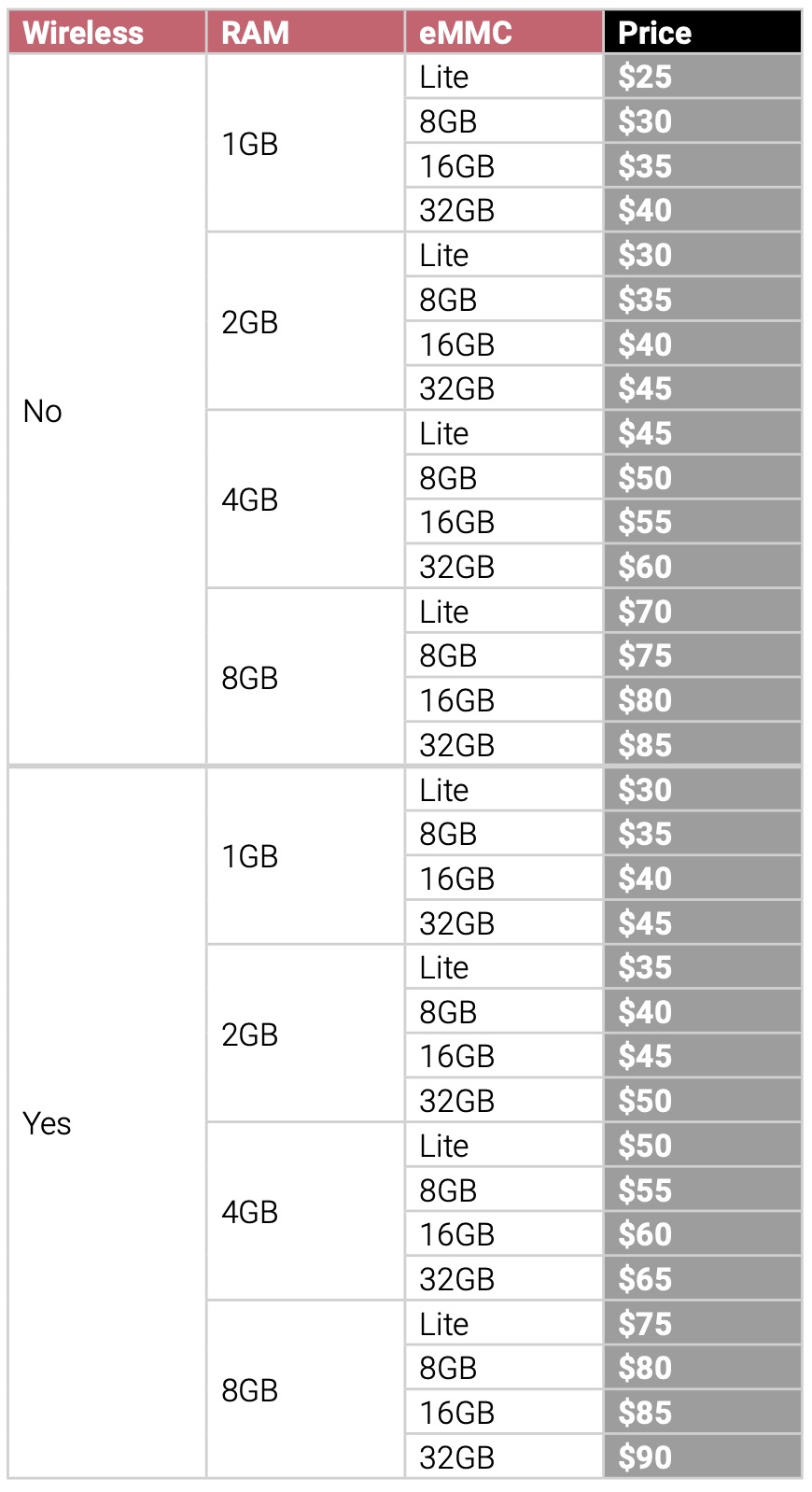
Another big change with the Compute Module 4 is that there are a ton of options. You can choose compute modules with or without wireless technologies (Wi-Fi and Bluetooth), with 1GB, 2GB, 4GB or 8GB of RAM, with 8GB, 16GB or 32GB of eMMC flash storage. There’s also a model without any eMMC flash storage in case you want to use external eMMC or the SD card interface.

You can mix-and-match those specs to keep your costs down at scale. The result is that there are 32 different versions of the Compute Module 4 ranging from $25 (no wireless, 1GB of RAM, ‘Lite’ eMMC) to $90 (wireless, 8GB of RAM, 32GB of eMMC).

The form factor has changed compared to the previous Compute Module, which means that you’ll need a new Compute Module IO Board to take advantage of all the interfaces and start developing. It costs $35.

Image Credits: Raspberry Pi Foundation

News: Stitcher’s podcasts arrive on Pandora with acquisition’s completion

SiriusXM today completed its previously announced $325 million acquisition of podcast platform Stitcher from E.W. Scripps, and has now launched Stitcher’s podcasts on Pandora across all tiers of the streaming service. The deal brings top Stitcher titles to Pandora, including Freakonomics Radio, My Favorite Murder, SuperSoul Conversations from the Oprah Winfrey Network, Office Ladies, Conan

SiriusXM today completed its previously announced $325 million acquisition of podcast platform Stitcher from E.W. Scripps, and has now launched Stitcher’s podcasts on Pandora across all tiers of the streaming service. The deal brings top Stitcher titles to Pandora, including Freakonomics Radio, My Favorite Murder, SuperSoul Conversations from the Oprah Winfrey Network, Office Ladies, Conan O’Brien Needs a Friend, Literally! with Rob Lowe, LeVar Burton Reads, and WTF with Marc Maron, among others.

On Pandora, the podcasts will be indexed using the company’s proprietary Podcast Genome Project technology. This system leverages  automated technology — like natural language processing, collaborative filtering, and other machine learning approaches — then combines that with human curation to make personalized recommendations to podcast listeners on Pandora’s app.

The podcasts will also continue to be available in the Stitcher app in North America, the company says.

The Stitcher acquisition brought with it several key assets, including its own mobile listening app, which includes a premium tier of exclusives, and the Midroll Media network for podcast advertising. Stitcher also creates its own original programs and runs multiple content networks, via Earwolf.

That means SirusXM gained thousands of top podcasts with the deal’s closure. The company also now claims it has the “largest addressable audience in North America” across all categories of digital audio, including music, sports, talk, and podcasts thanks to the combination of satellite radio service SiriusXM, streaming app Pandora, and now Stitcher.

The company believes the deal will help it to attract more creators to its platform, thanks to the enhanced production, marketing, and distribution capabilities it offers, following the deal’s close. Advertisers, meanwhile, will be able to more precisely target podcasts for better ad efficiency, and will gain access to improved measurements, says SiriusXM.

In terms of Stitcher’s execs, CEO Erik Diehn will now report to Scott Greenstein, President and Chief Content Officer of SiriusXM, who also oversees content at Pandora. Stitcher’s Chief Revenue Officer, Sarah van Mosel, will report directly to John Trimble, Chief Advertising Revenue Officer of SiriusXM.

“We are deepening our position in podcasting, the fastest-growing sector in digital audio, and with completion of this transaction, our vision is taking shape,” said SiriusXM CEO Jim Meyer, in a statement about the deal’s completion. “With Stitcher and its varied assets, we are now a one-stop shop able to meet the needs of podcast creators, publishers and advertisers, while also providing listeners with access to great shows, series and programming.”

Despite the coronavirus pandemic, which disrupted many consumer trends and accelerated others, podcasting still remains one of the fast-growing digital audio industries. Podcast downloads returned to pre-COVID levels this summer, and Spotify reported that podcast consumption more doubled in Q2 and nearly a quarter (21%) of its active users now listen to podcasts.

Stitcher was not SiriusXM’s first acquisition focused on podcasts or ad technologies. It also bought podcast management platform Simplecast this June, and before that, it acquired AdsWizz for $66.3 million to power Pandora’s advertising efforts.

WordPress Image Lightbox Plugin