Yearly Archives: 2020

News: Math learning platform Knowledgehook raises £13.5M Series A to expand globally

Given the nature of the COVID-19 pandemic, millions of students have switched to online learning. So whereas EdTech used to be somewhat of an also-ran in the venture stakes, it has now become one fo the hottest spaces on the planet. It’s therefore of title surprise that funding rounds are following. Knowledgehook, a proprietary mathematics

Given the nature of the COVID-19 pandemic, millions of students have switched to online learning. So whereas EdTech used to be somewhat of an also-ran in the venture stakes, it has now become one fo the hottest spaces on the planet. It’s therefore of title surprise that funding rounds are following.

Knowledgehook, a proprietary mathematics learning platform, has now raised £13.5m Series A with participation from Mesoamerica’s Alexandria Corp., Nelson Education, Ideal Ventures, Nicoya Ventures and an unmanned UK-based EdTech fund. Knowledgehook raised a seed round in 2006 that included John Abele’s North Point Ventures.

Knowledgehook’s platform claims to have over 100,000 schools around the world that tracks where each student is on their math journey. In 2021, it plans extend its reach to 50,000,000 students globally. The platform offers school licenses, as well as Netflix-like home subscriptions.

Their programs connect a child’s at-home learning with in-school education, providing insights on learning gaps. Teachers then use this to develop a child’s understanding of the math concepts related to their challenges, enabling them to adjust instruction and monitor progress.
 
Co-Founder and CEO Travis Ratnam (pictured) said in a statement: “Our platform is not a game, it will pull together a 360 view on a child’s learning journey enabling people around them to improve their experience and outcomes.”

Created and launched from Canada, Knowledgehook now supports schools across the US, Mexico, and the UK.

News: Dublin’s LearnUpon raises $56M for its online learning management system for enterprises

One big technology by-product of the Covid-19 pandemic has been a much stronger focus on online education solutions — providing the tools for students to continue learning when the public health situation is preventing them from going into physical classrooms. As it happens, that paradigm also applies to the business world. Today, a startup out

One big technology by-product of the Covid-19 pandemic has been a much stronger focus on online education solutions — providing the tools for students to continue learning when the public health situation is preventing them from going into physical classrooms. As it happens, that paradigm also applies to the business world.

Today, a startup out of Dublin called LearnUpon, which has been building e-learning solutions not for schools but corporates to use for development and training, has raised $56 million to feed a growth in demand for its tools, particularly in the U.S. market, which currently accounts for 70% of LearnUpon’s sales.

The funding is coming from a single investor, Summit Partners . LearnUpon’s CEO and co-founder Brendan Noud said the capital will be used in two areas. First, to add more people to the startup’s engineering and product teams (it has 180 employees currently) to continue expanding in areas like data analytics, providing more insights to its customers on how their training materials are used on via its learning management system (commonly referred to as LMS in the industry). Second, to bring on more people to help sell the product particularly in countries where it is currently growing fast, like the U.S., to larger corporate clients.

LearnUpon already has some 1,000 customers globally, including Booking.com, Twilio, USA Football and Zendesk. And notably, eight-year-old LearnUpon was profitable and had only raised $1.5 million before now.

“We’ve been growing organically pretty fast since we started but especially for the last 4-5 years using a SaaS model, but now we’re at a scale where the opportunity is vast, especially with more people working from home,” he said. “We want to give ourselves firepower.”

Corporate learning has followed similar but not identical trajectory to that of online education for K-12 and higher learning. In common, especially in the last 8 months. has been a growing need to engage and connect with learners at a time when it’s been challenging, or in some cases impossible, to see each other in person.

What’s different is that corporate learning was already a very established market, with organizations widely investing in online tools to manage training and personal development for years before any pandemic necessitated it.

Areas like employee onboarding, personnel development, customer training, training on new products, partner training, sales development, compliance, and building training services that you then sell to third parties are all areas that count as corporate learning. One researcher estimated that the corporate learning market was valued at an eye-watering $64 billion in 2019, with LMS investments alone at over $9 billion that year, and both are growing.

That has been a boost for companies like LearnUpon, which provides services in all of those categories and says that annual recurring revenues have grown by more than 50% year-on-year for each of the last 12 quarters.

But that also underscores the challenge in the market.

“It’s definitely a very crowded space, with maybe over 1000 LMS’s out there,” said Noud, although he added that it only has about 10-15 actually direct competitors (which to me still sounds like quite a lot). They include the likes of Cornerstone, TalentLMS from the Greek startup Epignosis, the Candian publicly-traded Docebo, and 360Learning from France.

But also consider those that have moved into corporate learning from other directions. LinkedIn has made big moves into learning to complement its bigger recruitment and professional development profile; and companies originally built to target the education sector, such as Coursera and Kahoot, have also expanded into business training and education. Both represent further competitive fronts for companies like LearnUpon natively built to service the business market.

Noud said that one reason why LearnUpon is finding some traction against the rest of the pack, and why it’s better, is because it’s a more comprehensive platform. Users can run live or asynchronous (on-demand) learning or training, and the SaaS LMS is designed to handle material and learning environments for multiple “students” — be they internal users, partners of the organization, or customers. In contrast, he said that many other solutions are more narrow in their scope, requiring organizations to manage multiple systems.

“And the legacy platforms are overly bloated, with bad customer support, which was a key area for us,” he said, recalling back to eight years ago when he and co-founder Des Anderson were first starting LearnUpon. “Our first hire was in customer support, and that has carried through to how we have grown.”

One area where LearnUpon not doing anything right now is in content development. It does offer tools to construct tests and surveys, but users can also import content created with other e-learning authoring tools, Noud said. Similarly, it’s not in the business of building its own live teaching platforms: you can import links from others like Zoom to provide the platform where people will teach and engage.

That’s not going to be a focus for now for the company, but given that others it competes with are providing a one-stop shop, for those that are looking to simplify procurement and have a more direct hand in building training as well as managing it, you can see how this might be an area that LearnUpon might develop down the line.

“In today’s knowledge economy, we believe corporate learning has become a key requirement for all organizations of scale – and the added challenge of remote working has only accelerated the importance of delivering learning digitally,” said Antony Clavel, a Principal with Summit Partners, in a statement. “With its modern, cloud-based learning management system, strong product development organization, demonstrated dedication to customer success and capital efficient go-to-market model, we believe LearnUpon is strongly positioned to serve this growing and increasingly critical market need. We are thrilled to support Brendan and the LearnUpon team in this next phase of growth.”

Clavel is joining the LearnUpon Board of Directors with this round. The startup is not disclosing its valuation.

News: Trilo lets merchants offer rewards to customers choosing bank-to-bank payments

Open banking enables bank-to-bank payments, meaning that (in theory) merchants should be able to accept payments without having to hand over fees to Visa or Mastercard or other payment providers, such as Stripe. The challenge, however, isn’t just implementing open-banking based payments as a checkout option — there are are already a host of open

Open banking enables bank-to-bank payments, meaning that (in theory) merchants should be able to accept payments without having to hand over fees to Visa or Mastercard or other payment providers, such as Stripe. The challenge, however, isn’t just implementing open-banking based payments as a checkout option — there are are already a host of open banking tech providers — but persuading customers to switch to a new payment option they are likely unfamiliar with.

The solution, according to fintech Trilo, is to offer customers incentives, for using open banking, such as cashback or additional perks, coupled with a user-friendly payment flow. The U.K. startup is breaking cover today with the launch of its alpha.

Image Credits: Trilo

“Businesses lose out on so much of their hard-earned money whenever a payment is made with cards, their transaction fees can be up to and above 4% in some cases,” says founder Hamish Blythe, when asked to define the problem Trilo wants to solve. “[In addition], it takes an age for businesses to receive their funds, usually up to 7 days… thanks to cards being invented back in the 50s before we even went to the moon”.

Open banking-based payments doesn’t just offer the opportunity to begin to chip away at the Visa/Mastercard duopoly, but should also reduce fraud associated with cards, leading to lower costs for merchants beyond transaction fees alone and less issues for consumers. But that requires take up of the new payment option.

“Open Banking’s great. However, me and you, consumers, have little-to-no-reason to use it,” argues Blythe. “Without an enjoyable, rewarding, and simple user flow, it’s going to be very hard to take off”.

To help remedy this, Trilo is combining an open banking payments API with incentives and rewards for consumers electing to use bank-to-bank payments. The startup is also doing away with transaction fees for merchants and will instead charge a monthly subscription akin to a SaaS model.

“Say goodbye to transaction fees, we’ve scrapped them,” says Blythe. “Our merchant partners also get their money in 5 minutes on average, so they can re-deploy it even faster… [and] consumers get a boost whenever you pay. Our main USP is that we focus on you, making your time as enjoyable, easy and rewarding as possible, whether that’s 1% off, a free beer, or an upgrade, businesses give you a serious reason to stop using your card”.

More broadly, Blythe says open banking gives a startup like Trilo the opportunity to take on “the largest duopoly on earth”.

“But to do this, we need to have the simplest and easiest way to pay out there for me and you,” he says, “while also having some serious kickback available to consumers when they pay. With our network we can also power refunds, consumer protection, and all sorts of other perks that pure open banking simply doesn’t offer”.

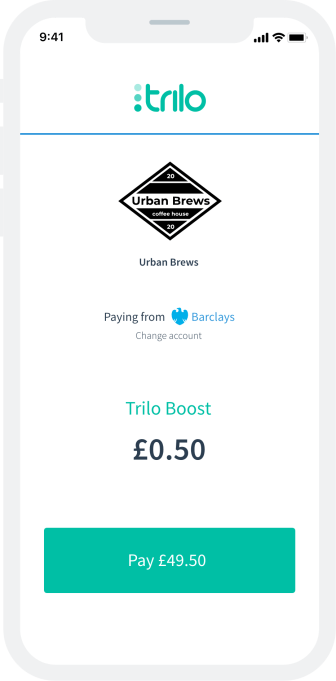
To pay with Trilo, you simply scan a QR or tap the Trilo button on a partnering merchant’s website or app. You’ll be remembered on your phone with a cookie, you’ll then see who you’re paying, what bank, and what your boost is, with the amount to pay clearly displayed beneath. “When you tap pay, you’ll hop over to your bank app, and can securely finish off the payment with a tap of the screen,” explains Blythe.

Meanwhile, to kick off Trilo’s alpha and to demonstrate the payments flow, Trilo is partnering with Make It Wild, who are reforesting large areas of the U.K. to help restore the natural eco-system. “With our alpha you’ll be able to fund a tree for a fiver with Trilo, and the best bit, because it’s using Trilo, every single penny will go on the trees,” adds the Trilo founder.

News: Eat Just partners with Proterra to launch a new subsidiary in Asia

Eat Just, the plant-based food startup, is launching a new Asian subsidiary through a partnership with Proterra Investment Partners Asia. The agreement includes building Eat Just’s first factory in Asia, which will be based in Singapore. As part of the deal, Proterra, which focuses on agri-tech, will invest up to $100 million in the facility,

Eat Just, the plant-based food startup, is launching a new Asian subsidiary through a partnership with Proterra Investment Partners Asia. The agreement includes building Eat Just’s first factory in Asia, which will be based in Singapore.

As part of the deal, Proterra, which focuses on agri-tech, will invest up to $100 million in the facility, while Eat Just will invest $20 million. The new subsidiary, called Eat Just Asia, will focus on creating a fully-integrated supply chain, working with manufacturers and distributers for Eat Just’s flagship product, vegan egg substitute Just Egg, which is made from mung beans.

Once completed, the Singapore facility will “generate thousands of metric tons of protein,” said Eat Just’s announcement. Eat Just Asia also received support from the Singaporean government’s Economic Development Board.

In addition to Just Egg, Eat Just and Proterra said they are also in talks to expand their partnership to include the development of plant-based meat alternatives.

Eat Just’s current distribution partners in Asia include SPC Samlip in South Korea, Betagro in Thailand and an as-of-yet undisclosed new partner in China, where Just Egg is already available on Alibaba’s Tmall and JD.com.

Based in San Francisco and formerly known as Hampton Creek, Eat Just has received total of about $220 million in funding, according to Crunchbase. Its investors include Khosla Ventures and Li Ka-Shing.

Eat Just announced in March that it will focus on global expansion this year, with partnerships in North America, Latin America, Europe and Asia.

Over the following months, it announced a succession of distribution deals for Just Egg, including ones with American food manufacturer and distributor Michael Foods, a subsidiary of Post Holdings, and European plant-based food manufacturer Emsland Group.

In Asia, demand for plant-based protein foods grew during the COVID-19 pandemic, due in part to concerns about the safety of meat and other animal products. In an April 2020 Reuters article, Eat Just said sales of Just Egg on JD.com and Tmall had grown 30% since the beginning of the coronavirus outbreak.

Other plant-based food startups focusing on Asian markets include Impossible Foods, which announced funding of $500 million in March to expand in Asia; Karana, a Singaporean startup that makes meat substitutes from jackfruit; and Malaysian-based Phuture Foods, which uses a variety of plants to make pork substitutes.

News: Intel agrees to sell its NAND business to SK Hynix for $9 billion

SK Hynix, one of the world’s largest chip makers, announced today it will pay $9 billion for Intel’s flash memory business. Intel said it will use proceeds from the deal to focus on artificial intelligence, 5G and edge computing. “For Intel, this transaction will allow us to to further prioritize our investments in differentiated technology

SK Hynix, one of the world’s largest chip makers, announced today it will pay $9 billion for Intel’s flash memory business. Intel said it will use proceeds from the deal to focus on artificial intelligence, 5G and edge computing.

“For Intel, this transaction will allow us to to further prioritize our investments in differentiated technology where we can play a bigger role in the success of our customers and deliver attractive returns to our stockholders,” said Intel chief executive officer Bob Swan in the announcement.

The Wall Street Journal first reported earlier this week that the two companies were nearing an agreement, which will turn SK Hynix into one of the world’s largest NAND memory makers, second only to Samsung Electronics.

The deal with SK Hynix is the latest one Intel has made so it can double down on developing technology for 5G network infrastructure. Last year, Intel sold the majority of its modem business to Apple for about $1 billion, with Swan saying that the time that the deal would allow Intel to “[put] our full effort into 5G where it most closely aligns with the needs of our global customer base.”

Once the deal is approved and closes, Seoul-based SK Hynix will take over Intel’s NAND SSD and NAND component and wafer businesses, and its NAND foundry in Dalian, China. Intel will hold onto its Optane business, which makes SSD memory modules. The companies said regulatory approval is expected by late 2021, and a final closing of all assets, including Intel’s NAND-related intellectual property, will take place in March 2025.

Until the final closing takes places, Intel will continue to manufacture NAND wafers at the Dalian foundry and retain all IP related to the manufacturing and design of its NAND flash wafers.

As the Wall Street Journal noted, the Dalian facility is Intel’s only major foundry in China, which means selling it to SK Hynix will dramatically reduce its presence there as the United States government puts trade restrictions on Chinese technology.

In the announcement, Intel said it plans to use proceeds from the sale to “advance its long-term growth priorities, including artificial intelligence, 5G networking and the intelligent, autonomous edge.”

During the six-month period ending on June 27, 2020, NAND business represented about $2.8 billion of revenue for its Non-volatile Memory Solutions Group (NSG), and contributed about $600 million to the division’s operating income. According to the Wall Street Journal, this made up the majority of Intel’s total memory sales during that period, which was about $3 billion.

SK Hynix CEO Seok-Hee Lee said the deal will allow the South Korean company to “optimize our business structure, expanding our innovative portfolio in the NAND flash market segment, which will be comparable with what we achieved in DRAM.”

News: Trump says ‘nobody gets hacked’ but forgot his hotel chain was hacked — twice

According to President Trump speaking at a campaign event in Tucson, Arizona, on Monday, “nobody gets hacked.” You don’t need someone who covers security day in and day out to call bullshit on this one. “Nobody gets hacked. To get hacked you need somebody with 197 IQ and he needs about 15 percent of your

According to President Trump speaking at a campaign event in Tucson, Arizona, on Monday, “nobody gets hacked.” You don’t need someone who covers security day in and day out to call bullshit on this one.

“Nobody gets hacked. To get hacked you need somebody with 197 IQ and he needs about 15 percent of your password,” Trump said, referencing the recent suspension of C-SPAN political editor Steve Scully, who admitted falsely claiming his Twitter account was hacked this week after sending a tweet to former White House communications director Anthony Scaramucci.

“Nobody gets hacked. To get hacked you need somebody with 197 IQ and he needs about 15 percent of your password.”pic.twitter.com/6aR8yU2MVg

— Martin (@mshelton) October 19, 2020

There’s a lot to unpack in those two-dozen words. But aside from the fact that not all hackers are male (and it’s sexist to assume that), and glossing over the two entirely contrasting sentences, Trump also neglected to mention that his hotel chain was hacked twice — once over a year-long period between 2014 and 2015 and again between 2016 and 2017.

We know this because the Trump business was legally required to file notice with state regulators after each breach, which they did.

In both incidents, customers of Trump’s hotels had their credit card data stolen. The second breach was blamed on a third-party booking system, called Sabre, which also exposed guest names, emails, phone numbers and more.

The disclosures didn’t say how many people were affected. Suffice it to say, it wasn’t “nobody.”

A spokesperson for the Trump campaign did not return a request for comment.

It’s easy to ignore what could be considered a throwaway line: To say that “nobody gets hacked” might seem harmless on the face of it, but to claim so is dangerous. It’s as bad as saying something is “unhackable” or “hack-proof.” Ask anyone who works in cybersecurity and they’ll tell you that no person or company can ever make such assurances.

Absolute security doesn’t exist. But for those who don’t know any different, it’s an excuse not to think about their own security. Yes, you should use a password manager. Absolutely turn on two-factor authentication whenever you can. Do the basics, because hackers don’t need an IQ score of 197 to break into your accounts. All they need is for you to lower your guard.

If “nobody gets hacked” as Trump claims, it makes you wonder whatever happened to the 400-pound hacker the president mentioned during his first White House run.

News: ShopUp raises $22.5 million to digitize millions of mom-and-pop shops in Bangladesh

A startup that is aiming to digitize millions of neighborhood stores in Bangladesh just raised the country’s largest Series A financing round. Dhaka-headquartered ShopUp said on Tuesday it has raised $22.5 million in a round co-led by Sequoia Capital India and Flourish Ventures. For both the venture firms, this is the first time they are

A startup that is aiming to digitize millions of neighborhood stores in Bangladesh just raised the country’s largest Series A financing round.

Dhaka-headquartered ShopUp said on Tuesday it has raised $22.5 million in a round co-led by Sequoia Capital India and Flourish Ventures. For both the venture firms, this is the first time they are backing a Bangladeshi startup. Veon Ventures, Speedinvest, and Lonsdale Capital also participated in the four-year-old ShopUp’s Series A financing round. ShopUp has raised about $28 million to date.

Like its neighboring nation, India, more than 95% of all retail in Bangladesh goes through neighborhood stores in the country. There are about 4.5 million such mom-and-pop stores in the country and the vast majority of them have no digital presence.

ShopUp is attempting to change that. It has built what it calls a full-stack business-to-business commerce platform. It provides three core services to neighborhood stores: a wholesale marketplace to secure inventory, logistics (including last mile delivery to customers), and working capital, explained Afeef Zaman, co-founder and chief executive of ShopUp​, in an interview with TechCrunch.

Image Credits: ShopUp

These small shops are facing a number of challenges. They are not getting inventory on time or enough inventory and they are paying more than what they should, said Zaman. And for these businesses, more than 73% (PDF) of all their sales rely on credit instead of cash or digital payments, creating a massive liquidity crunch. So most of these businesses are in dire need of working capital.

Zaman declined to reveal how many mom-and-pop shops today use ShopUp, but claimed that the platform assumes a clear lead in its category in the country. That lead has widened amid the global pandemic as more physical shops explore digital offerings to stay afloat, he said.

The number of neighborhood shops transacting weekly on the ShopUp platform grew by 8.5 times between April and August this year, he said. The pandemic also helped ShopUp engage with e-commerce players to deliver items for them.

“Sequoia India has been a strong supporter of the company since it was part of the first Surge cohort in early 2019 and it’s been exciting to see the company become a trailblazer facilitating digital transformation in Bangladesh,” said ​Klaus Wang, VP, Sequoia Capital, in a statement.

The startup has no intention to become an e-commerce platform like Amazon that directly engages with consumers, Zaman said. E-commerce is still in its nascent stage in Bangladesh. Amazon has yet to enter the country and increasingly Facebook is filling that role.

ShopUp sees immense opportunity in serving neighborhood stores, he said. The startup plans to deploy the fresh capital to deepen its partnerships with manufacturers and expand its tech infrastructure.

It opened an office in Bengaluru earlier this year to hire local tech talent in the nation. Indian e-commerce platform Voonik merged with ShopUp this year and both of its co-founders have joined the Bangladeshi startup. Zaman said the startup will hire more engineering talent in India.

News: SAIF Partners rebrands as Elevation Capital, secures $400 million for its new India fund

SAIF Partners has raised $400 million for a new fund and rebranded the 18-year-old influential venture capital firm as it looks to back more early-stage startups in the world’s second largest internet market. The new fund is SAIF Partners’ seventh for early-stage startups in India. Its previous two funds were each $350 million in size,

SAIF Partners has raised $400 million for a new fund and rebranded the 18-year-old influential venture capital firm as it looks to back more early-stage startups in the world’s second largest internet market.

The new fund is SAIF Partners’ seventh for early-stage startups in India. Its previous two funds were each $350 million in size, and the firm today manages more than $2 billion in assets.

SAIF Partners started investing in Indian startups 18 years ago. The firm began as a joint venture with SoftBank and its first high-profile investment was Sify. But the two firms’ joint venture ended more than a decade ago, so the firm is now getting around to rebranding itself, Ravi Adusumalli, the managing partner of SAIF Partners, told TechCrunch in an interview.

The firm — which has five unicorns in its portfolio, including Paytm’s parent firm One97 Communications, food delivery startup Swiggy and online learning platform Unacademy — is rebranding itself as Elevation Capital.

“Elevation reflects our investment ethos and re-emphasises our commitment to the founders who help redefine our future. For our existing partners, it is a commitment of continued collaboration on our path-breaking journeys together. For our new partners, it is a promise to do all we can to achieve great heights together, from day one,” said Adusumalli.

SAIF Partners has backed more than 100 startups to date. The venture firm makes long-term bets on founders and backs young firms beginning their early years when they are raising their seed, pre-Series A and Series A financing rounds.

The venture firm invests in startups operating in a wide-range of sectors and plans to continue this strategy and add more areas of interest, said Deepak Gaur, a managing director at Elevation Capital, in an interview with TechCrunch.

“Enterprise SaaS is one area where we are spending a lot of resources,” he said. “We believe the time has come for this sector and we will see many global companies emerge from India.”

More than 15 startups in Elevation Capital’s portfolio are projected to become a unicorn in the next few years, according to Tracxn, a firm that tracks startups and investments in India. These include healthcare booking platform PharmEasy, app-based platform to book home services Urban Company, insurance tech startup Acko, digital loan platform Capital Float, real estate property marketplace NoBroker and online marketplace for gold Rupeek.

A number of SAIF Partners-backed startups, including IndiaMART, MakeMyTrip and Justdial, have become publicly listed companies, too.

Mukul Arora, a managing partner at SAIF Partners, said that the state of the Indian startup ecosystem has changed for the better in the past decade. “A few years ago, we were seeing many startups replicate a foreign company’s play in India. Today, we are seeing our ideas being replicated outside of the country. Someone is building a Meesho for Brazil,” he said.

The founders have also grown more sophisticated, said Mayank Khanduja. Elevation Capital has over three dozen employees, with about two-dozen focused on the investment size.

Elevation Capital’s new fund comes at a time when many established venture capital firms have also closed their new funds for India in recent months. In July, Sequoia Capital announced two funds — totaling $1.35 billion in size — for India. A month later, Lightspeed raised $275 million for its third Indian fund. Accel late last year closed its sixth fund in India at $550 million.

All of the LPs participating in Elevation Capital’s new fund, as was the case with previous funds, are U.S.-based, and the vast majority of them are nonprofits, said Adusumalli. Without disclosing any figures, he said the firm’s previous funds have performed very well.

News: Lee Fixel is already raising a massive second fund

On Friday, former Tiger Global Management investor Lee Fixel registered plans for the second fund of his new investment firm, Addition, just four months after closing the first. In fact, according to a report on Friday by the Financial Times, Fixel has already secured a fresh $1.4 billion in capital commitments for that second fund,

On Friday, former Tiger Global Management investor Lee Fixel registered plans for the second fund of his new investment firm, Addition, just four months after closing the first. In fact, according to a report on Friday by the Financial Times, Fixel has already secured a fresh $1.4 billion in capital commitments for that second fund, which Addition reportedly doesn’t plan to begin investing until next year.

But a source close to the firm now says the fund is not, in fact, raised. That’s perhaps good news for investors who were shut out of Addition’s $1.3 billion debut fund and who might be hoping to write a check this time around.

The mere fact that Fixel is back in the market already has tongues wagging about the dealmaker, one whose reluctance to talk on the record with media outlets seems only to add to his mystique. Forbes published a lengthy piece about Fixel this summer, in which Fixel seems to have provided just one public statement, confirming the close of Addition’s first fund and adding little else. “We are excited to partner with visionary entrepreneurs, and with our 15-year fund duration, we have the patience to support our portfolio companies on their journey to build impactful and enduring businesses,” it read.

According to Forbes, that first fund — which Fixel is actively putting to work right now — intends to invest one-third of its capital in early-stage startups and two-thirds in growth-stage opportunities.

Whether that includes some of the special purpose acquisition vehicles, or SPACs, that are coming together right and left, isn’t yet known, though one imagines these might appeal to Fixel, who has longed seemed to be at the forefront of new trends impacting growth-stage companies in particular. (A growing number of SPACs is right now looking to transform some of the many hundreds of richly valued private companies in the world into public companies.)

Clearer is that Addition is wasting little time in writing some big checks. Among its announced deals is Inshorts, a seven-year-old, New Delhi, India-based popular news aggregation app that last week unveiled $35 million new funding led by Fixel.

The deal represents Addition’s first India-based bet, even while Fixel knows both the country and the startup well. He previously invested in Inshorts on behalf of Tiger; he’s also credited for snatching up a big stake in Flipkart on behalf of Tiger, a move that reportedly produced $3.5 billion in profits when Flipkart sold to Walmart.

Addition also led a $200 million round last month in Snyk, a five-year-old, London-based startup that helps companies securely use open-source code. The round valued the company at $2.6 billion — more than twice the valuation it was assigned when it raised its previous round ten months ago.

And in August, Addition led a $110 million Series D round for Lyra Health, a five-year-old, Burlingame, Ca.-based provider of mental health care benefits for employers that was founded by former Facebook CFO David Ebersman.

A smaller check went to Temporal, a year-old, Seattle-based startup that is building an open-source, stateful microservices orchestration platform. Last week, the company announced $18.75 million in Series A funding led by Sequoia Capital, but Addition also joined the round, having been an earlier investor in the company.

According to Pitchbook data, Addition has made at least 17 investments altogether.

Fixel — whose bets while at Tiger include Peloton and Spotify — isn’t running Addition single-handedly, though according to Forbes, he is the single “key man” around which the firm revolves, as well as the biggest investor in Addition’s first fund.

He has also brought aboard least three investment principals from Wall Street and a head of data science who worked formerly for Uber (per Forbes). Ward Breeze, a longtime attorney who worked formerly in the emerging companies practice of Gunderson Dettmer, is also working with Fixel at Addition.

(Correction: An earlier version of this story reported that Fixel’s newest fund was already raised, per the FT.)

News: TikTok’s QAnon ban has been ‘buggy’

TikTok has been cracking down on QAnon-related content, in line with similar moves by other major social media companies, including Facebook and YouTube, which focus on reducing the spread the baseless conspiracy theory across their respective platforms. According to a report by NPR this weekend, TikTok had quietly banned several hashtags associated with the QAnon

TikTok has been cracking down on QAnon-related content, in line with similar moves by other major social media companies, including Facebook and YouTube, which focus on reducing the spread the baseless conspiracy theory across their respective platforms. According to a report by NPR this weekend, TikTok had quietly banned several hashtags associated with the QAnon conspiracy, and says it will also delete the accounts of users who promote QAnon content.

Tiktok tells us, however, these policies are not new. The company says they actually went on the books earlier this year.

TikTok had initially focused on reducing discoverability as an immediate step by blocking search results while it investigated, with help from partners, how such content manifested on its platform. This was covered in July by several news publications, TikTok said. In August, TikTok also set a policy to remove content and ban accounts, we’re told.

Despite the policies, a report this month by Media Matters documented that TikTok was still hosting at least 14 QAnon-affiliated hashtags with over 488 million collective views. These came about because the platform had yet to address how QAnon followers were circumventing its community restrictions using variations and misspellings.

After Media Matters’ report, TikTok removed 11 of the 14 hashtags it had referenced, the report noted in an update.

Today, a number of QAnon-related hashtags — like #QAnon, #TheStormIsComing, #Trump2Q2Q” and others — return no results in TikTok’s search engine. They don’t show under the “Top” search results section, nor do they show under “Videos” or “Hashtags.”

Instead of just showing users a blank page when these terms are searched, TikTok displays a message that explains how some phrases can be associated with behavior or content that violates TikTok’s Community Guidelines, and offers a link to that resource.
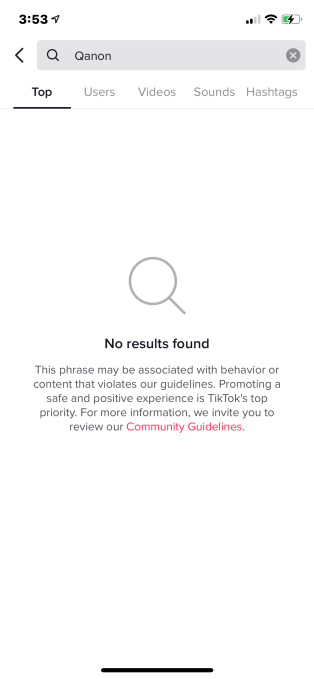
Image Credits: TikTok screenshot via TechCrunch

Media Matters praised the changes in a statement to NPR as something TikTok was doing that was “good and significant” even if “long overdue.”

While TikTok’s ban did tackle many of the top searches results and tags associated with the conspiracy, we found it was overlooking others, like Pizzagate and WWG1WGA, for instance. In tests this afternoon, these terms and many others still returned much content.

TikTok claims what we saw was likely “a bug.”

We had reached out to TikTok today to ask why searches for terms like “pizzagate” and “WWG1WGA” — popular QAnon terms — were still returning search results, even though their hashtags were banned.

For example, if you just searched for “pizzagate,” TikTok offered a long list of videos to scroll through, though you couldn’t go directly to its hashtag. This was not the case for the other banned hashtags (like #QAnon) at the time of our tests.

Image Credits: TikTok screenshot via TechCrunch

The videos returned discussed the Pizzagate conspiracy — a baseless conspiracy theory which ultimately led to real-world violence when a gunman shot up a DC pizza business, thinking he was there to rescue trapped children.

While some videos were just discussing or debunking the idea, many were earnestly promoting the pizzagate conspiracy, even posting that it was was “real” or claimed to be offering “proof.”

Above: Video recorded Oct. 19, 2020, 3:47 PM ET/12:47 PM PT

Other QAnon-associated hashtags were also not subject to a full ban, including WWG1WGA, WGA, ThesePeopleAreSick, cannibalclub, hollyweird, and many others often used to circulate QAnon conspiracies.

When we searched these terms, we found more long lists of QAnon-related videos to scroll through.

We documented this with photos and videos before reaching out to TikTok to ask why these had been made exceptions to the ban. We specifically asked about the two top terms — Pizzagate and WWG1WGA.

Image Credits: TikTok screenshot via TechCrunch

TikTok provided us with information about the timeline of its policy changes and the following statement:

“Content and accounts that promote QAnon violate our disinformation policy and we remove them from our platform. We’ve also taken significant steps to make this content harder to find across search and hashtags by redirecting associated terms to our Community Guidelines. We continually update our safeguards with misspellings and new phrases as we work to keep TikTok a safe and authentic place for our community.”

TikTok said also that the search term blocking must have been a bug, because it’s now working properly.

We found that, upon receiving TikTok’s confirmation, the terms we asked about were blocked, but others were not. This includes some of those mentioned above, as well as bizarre terms only a real conspiracy fan would know, like adrenochromereptilians.

We asked Media Matters whether it could still praise TikTok’s actions to ban QAnon content, given what, at the time, had appeared to be a loophole in the QAnon ban.

“TikTok has of course taken steps but not fully resolved the problem, but as we’ve noted, the true test of any of these policies — like we’ve said of other platform’s measures — is in how and if they enforce them,” the organization said.

Even if the banned content was only showing today because of a “bug,” we found that many of the users who posted the content have not actually banned from TikTok, it seems.

Though a search for their username won’t return results now that the ban is no longer “buggy,” you can still go directly to these users’ profile pages via their profile URL on the web.

We tried this on many profiles who had published QAnon content or used banned terms in their videos’ hashtags and descriptions . (Below are a few of examples.)

What this means is that although TikTok reduced these users’ discoverability in the app, the accounts can still be located if you know their username. And once you arrive on the account’s page, you can still follow them.

Image Credits: TikTok screenshot via TechCrunch

Image Credits: TikTok screenshot via TechCrunch

Image Credits: TikTok screenshot via TechCrunch

These examples of “bugs” or just oversights indicate how difficult it is to enforce content bans across social media platforms.

Without substantial investments in human moderation combined with automation, as well as tools that ensure banned users can’t return, it’s hard to keep up with the spread of disinformation at social media’s scale.




WordPress Image Lightbox Plugin