Yearly Archives: 2020

News: The Justice Department has filed its antitrust lawsuit against Google

The Justice Department is holding an antitrust announcement later today, apparently confirming a report this morning from The Wall Street Journal that it will publish its long-awaited antitrust lawsuit against Google. The DoJ said it that Jeffrey A. Rosen, deputy Attorney General, will be making a formal speech at 9:45am Eastern today. In the suit,

The Justice Department is holding an antitrust announcement later today, apparently confirming a report this morning from The Wall Street Journal that it will publish its long-awaited antitrust lawsuit against Google.

The DoJ said it that Jeffrey A. Rosen, deputy Attorney General, will be making a formal speech at 9:45am Eastern today.

In the suit, the Justice Department is expected to argue that Google used anticompetitive practices to safeguard its monopoly position as the dominant force in search and search-advertising, which sit at the foundation of the company’s extensive advertising, data mining, video distribution, and information services conglomerate.

It would be the first significant legal challenge that Google has faced from U.S. regulators despite years of investigations into the company’s practices.

A 2012 attempt to bring the company to the courts to answer for anti-competitive practices was ultimately scuttled because regulators at the time weren’t sure they could make the case stick. Since that time Alphabet’s value has skyrocketed to reach over $1 trillion (as of today’s share price).

Alphabet, Google’s parent company, holds a commanding lead in both search and video. The company dominates the search market — with roughly 90% of the world’s internet searches conducted on its platform — and roughly three quarters of American adults turn to YouTube for video, as the Journal reported.

In the lawsuit, the Department of Justice will say that Alphabet’s Google subsidiary uses a web of exclusionary business agreements to shut out competitors. The billions of dollars that the search giant collects wind up paying mobile phone companies, carriers and browsers to make the Google search engine a preset default. That blocks competitors from being able to access the kinds of queries and traffic they’d need to refine their own search engine.

It will be those relationships — alongside Google’s insistence that its search engine come pre-loaded (and un-deletable) on phones using the Android operating system and that other search engines specifically not be pre-loaded — that form part of the government’s case, according to Justice Department officials cited by the Journal.

The antitrust suit comes on the heels of a number of other regulatory actions involving Google, which is not only the dominant online search provider, but also a leader in online advertising and in mobile technology by way of Android, as well as a strong player in a web of other interconnected services like mapping, online productivity software, cloud computing and more.

MOUNTAIN VIEW, UNITED STATES – 2020/02/23: American multinational technology company Google logo seen at Google campus. (Photo by Alex Tai/SOPA Images/LightRocket via Getty Images)

A report last Friday in Politico noted that Democrat Attorneys General would not be signing the suit. That report said those AGs have instead been working on a bipartisan, state-led approach covering a wider number of issues beyond search — the idea being also that more suits gives government potentially a stronger bargaining position against the tech giant.

A third suit is being put together by the state of Texas, although that has faced its own issues.

While a number of tech leviathans are facing increasing scrutiny from Washington, with the US now just two weeks from Election Day, it’s unlikely that we are going to see many developments around this and other cases before then. And in the case of this specific Google suit, in the event that Trump doesn’t get re-elected, there will also be a larger personnel shift at the DoJ that could also change the profile and timescale of the case.

In any event, fighting these regulatory cases is always a long, drawn-out process. In Europe, Google has faced a series of fines over antitrust violations stretching back several years, including a $2.7 billion fine over Google shopping; a $5 billion fine over Android dominance; and a $1.7 billion fine over search ad brokering. While Google slowly works through appeals, there are also more cases ongoing against the company in Europe and elsewhere.

Google is not the only one catching the attention of Washington. Earlier in October, the House Judiciary Committee released a report of more than 400 pages in which it outlined how tech giants Apple, Amazon, Alphabet (Google’s parent company) and Facebook were abusing their power, covering everything from the areas in which they dominate, through to suggestions for how to fix the situation (including curtailing their acquisitions strategy).

That seemed mainly to be an exercise in laying out the state of things, which could in turn be used to inform further actions, although in itself, unlike the DoJ suit, the House report lacks teeth in terms of enforcement or remedies.


News: DJI’s Pocket 2 gimbal is an extremely fun way to grab impressive smartphone shots

The Pocket 2 is the kind of device that makes me wish I got out a bit more. I’ve been testing it out for a few days, and, while it’s done a reasonably good job making my life look a bit more interesting, there’s only so much such a little device can do during this

The Pocket 2 is the kind of device that makes me wish I got out a bit more. I’ve been testing it out for a few days, and, while it’s done a reasonably good job making my life look a bit more interesting, there’s only so much such a little device can do during this lockdown. That’s no fault of DJI’s of course. There’s only so much that can be done — and at the end of the day, a camera can only really work with the content you give it.

Even so, I’ve enjoyed my time with the product. As I did with its predecessor, the DJI Osmo Pocket. The device returns this week with a truncated name and a handful of improvements. Nothing on board is particularly revolutionary, but the original device was such a cool and innovative product when it first arrived roughly two years ago, the company can be forgiven for mostly focusing on refinement.

Image Credits: Brian Heater

The line builds on DJI’s know-how, developed with years of drone imaging and gimbal expertise. Unlike, say the Ronin or Osmo Mobile lines, however, the product works as a standalone, with a small built-in display that records directly onto a microSD card. But as with the original, the whole getup works a heck of a lot better when you’ve got an Android or iOS handset to work with. The Pocket still does the majority of the heavy imaging lifting, but your phone just works as a much better preview screen and control center than the measly one built into the device.

The system ships with a pair of connectors: USB-C and Lightning, depending on your device. It’s a solid setup, best controlled with two hands. I didn’t have any issues, but I don’t entirely trust the integrity of a connector enough to hold it with one. Better yet, there are wireless accessories that allow for you to control the system remotely via phone. And speaking of accessories, I highly recommend getting a mini tripod or splurging for the bonus pack that includes one. It can be tricky propping the system up correctly for those modes that require minutes-long record times. More than once a video ended when the device fell over due to a strong gust.

Image Credits: Brian Heater

The underlying imaging hardware has been improved throughout. The camera now sports a larger sensor (64-megapixels) and wider lens, shooting better videos and stills than the original. The device can zoom up to 8x — though I’d recommend sticking with the 4x lossless optical, so as to not degrade those shots you’re taking. (HDR, incidentally, is coming at a later date.)

The mics, too, have been upgraded. There are four in total on board. Definitely use that optional wind noise reduction. For even better quality, the combo pack also includes a wireless microphone with windscreen, so that, too, may be worth investigating depending on what and where you plan to shoot. The three-axis gimbal does a good job keep things steady — and moves smoothly for a variety of different image and video capturing tasks. As with the last version, I found the battery to be lacking — that’s doubly the case for the gimbal charging up an attached phone by default.

As usual, the shooting modes are the real secret sauce. In particular, I’m really smitten with timelapse and hyperlapse. The former offers a sped-up image, using the gimbal to stabilize the shot as you move:

Image Credits: Brian Heater

Hyperlapse takes it a step further, mechanically moving the gimbal from left to right in slow increments that give a sweeping shot of a space over time:

Image Credits: Brian Heater

The system also borrows subject tracking from the drone line. Draw a rectangular around an object on the smartphone display and the gimbal will move along with it. The tracking proved to be pretty accurate, though I ran into some issues in the shadows and in situations when there’s a lot of divergent movement happening — like when I attempted to capture the runner in a softball game. On the whole however, it does a pretty solid job with people and animals alike.

The gimbal is also great for stitching together panorama shots — something that can be a pain on a standard smartphone. It can either do together a standard ultra wide 180-degree shot or create a highly detailed 3×3 image by essentially stitching together nine images in one:

Image Credits: Brian Heater

The Pocket 2 occupies a strange territory. It’s essentially a $349 add-on designed to augment smartphone photography. It’s an easy shortcut for grabbing some really cool shots, but pros are going to be much more interested in shooting with, say, a Ronin and an SLR. That leaves hobbyists with cash to spend on something that will, say, really wow their friends on social media. It’s a way to capture some drone-style shots without ever having to leave the ground.

News: Soleadify secures seed funding for database what tracks 40M business using machine learning

Usually, databases about companies have to be painstakingly updated by humans. Soleadify is a startup that uses machine learning to create profiles for businesses in any industry. The first of the company’s products is a business search engine that keeps over 40 million business profiles updated, currently used by hundreds of companies in the USA,

Usually, databases about companies have to be painstakingly updated by humans. Soleadify is a startup that uses machine learning to create profiles for businesses in any industry. The first of the company’s products is a business search engine that keeps over 40 million business profiles updated, currently used by hundreds of companies in the USA, Europe and Asia for sales and marketing activities.

It’s now secured $1.5M in seed round funding from European venture firms GapMinder Venture Partners and DayOne Capital, as well as several prominent business angels, through Seedblink, an equity crowdfunding platform based out of Bucharest Romania.

The company plans to use the funds to further improve their technology, build partnerships and expand their marketing capabilities.

On top of Soleadify’s data, they build solutions for prospecting, market research, customer segmentation and industry monitoring.

The way it’s done is by frequently scanning billions of webpages, identifying and classifying relevant data points and creating connections between them. The result is a database of business data, that is normally only available through laborious, manual research.

News: Handshake raises $80M more to build a more diversity-focused LinkedIn for college students

College graduates this year (and perhaps in the near-term) have been looking for work in what is one of the most challenging job markets in a decade due to the coronavirus and its impacts on the economy and how people can interact with each other. Today, a startup that’s helping them with that job hunting

College graduates this year (and perhaps in the near-term) have been looking for work in what is one of the most challenging job markets in a decade due to the coronavirus and its impacts on the economy and how people can interact with each other. Today, a startup that’s helping them with that job hunting process is announcing a big round of funding to grow its business.

Handshake, which provides a platform for college-aged students to register their interest and skills and search for suitable work, and for recruiters to search for candidates and advertise entry-level openings, has raised $80 million in a growth round of funding.

Handshake is not disclosing its valuation but a reliable source close to the startup said that the valuation has more than doubled since its last round. That was at $275 million, putting the likely valuation now between $550 million and $600 million.

The company has been around since 2014 and has built its profile in part as a more inclusive version of LinkedIn aimed at people only start starting out in the job market, and it’s using the funding to double down on that.

It now covers 17 million job seekers, 1,000 institutions of higher learning and nearly 500,000 employers, with partnerships with some 120 minority-serving institutions, which include Historically Black Colleges and Universities, and Hispanic Serving Institutions in the U.S., to help them and their students better tackle the job-hunting-recruitment market.

And in this year, Handshake has been using its latest funding — which actually closed in November 2019 — to expand to also including community colleges in its network, and expand its virtual events services.

The Series D is being led by GGV and also includes participation from all of its existing investors. Handshake already had an illustrious list of backers: its last round, a $40 million Series C in 2018, was led by EQT and also included the Chan Zuckerberg Initiative, Omidyar Network and Reach Capital, as well as True Ventures, Kleiner Perkins, Lightspeed Venture Partners, Spark Capital and KPCB Edge.

Garrett Lord, Handshake’s CEO who co-founded the company with Scott Ringwelski (CTO) and Ben Christensen (a board member), said that the coronavirus has not just impacted the job market, but also the job-hunting market.

“The pandemic, as you can imagine, has really reshaped the hiring economy,” he said. “Companies can no longer go to campus to recruit” — traditionally a huge part of how companies connect with those just entering the job market, by way of events where they can meet many people en masse — “so we’ve seen an unprecedented shift to virtual recruiting.”

Virtual events had, he added, been gaining more popularity “prior to Covid,” but suddenly it became the only game in town. He said that currently some 20,000 employers have managed virtual recruitment events at institutions using the Handshake platform. These take the form of online mixers and fairs, where it provides five 30-minute group meetings with up to 50 students in each, with recruiters providing presentations and talking with students; and/or 10-minute 1:1 meetings with students with up to 15 recruiters.

All well and good, except that the job market itself is still rocky. Lord said that there was a 20-30% drop in listings at the start of the pandemic, with particular sectors like hospitality leading that decline, with those still hiring pulling away from proactive campus recruitment. Now, seven months on, many of those realize that they have to continue to be visible and are slowly coming back.

“They need Handshake more than ever before, to replace boots on ground experience with digital and immersive experiences,” Lord said.

While managing the macroeconomic contraction, the expansion this year to including community colleges on Handshake has been a huge deal.

There has long been a perceived prestige and expertise divide between 2-year and 4-year institutions, but as our concept of higher education continues to evolve, with many students foregoing college altogether, or opting for vocational degrees that do not extend to four years of study at a university or college, and college becomes ever more expensive, it’s about time that platforms that are helping one tier of students also helps the other.

And for its investors, at a time when companies are not just talking about wanting to build more diverse work forces, but putting money where their mouths are, and internalizing that change is something that you sometimes need to be proactive to effect, Handshake is a compelling startup to invest in.

“Since its founding, Handshake has been laser focused on delivering on its vision to democratize job opportunity by connecting employers with job seeking students at institutions of higher education, and has built a rich network of 17 million job seekers, 1,000 institutions of higher learning and nearly 500,000 employers,” said Jeff Richards, Managing Partner of GGV, in a statement. “We’re delighted to join forces with the Handshake team to help the company further expand its impact by delivering innovative, industry-leading recruitment solutions and expanding into new markets.”

News: Austin-based Verifiable raises $3 million for its api toolkit to verify healthcare credentials

Before Nick Macario launched Verifiable, the Austin-based company that just raised $3 million for its api toolkit that verifies healthcare credentials, he ran a series of other businesses designed to offer public credentials for professionals. His first foray into the world of identity management services was the personal website builder, branded.me. After that company was

Before Nick Macario launched Verifiable, the Austin-based company that just raised $3 million for its api toolkit that verifies healthcare credentials, he ran a series of other businesses designed to offer public credentials for professionals.

His first foray into the world of identity management services was the personal website builder, branded.me. After that company was sold, Macario launched Remote.com, an outsourced provider of human resources services that was constantly running background checks and verifying employee credentials.

That’s where Macario got the idea for Verifiable and struck on a market opportunity that’s exploding thanks to the proliferation of telemedicine and on-demand services, and the shortage of qualified medical candidates to fill positions and meet growing demand.

This boom in remote medical services is one reason why Macario, working with co-founder and chief technology officer, Vivekanand Rajkumar, was able to raise $3 million from investors including Tiger Global, Liquid2 Ventures, Struck Capital, Soma Capital, Jack Altman, Max Mullen, and Sahil Lavingia.

“We’re at an inflection point with healthcare,” said Macario. “There are large volumes of healthcare verifications and certifications that are being verified manually… and the lack of infrastructure and credentialing is a big part of the bottleneck holding healthcare back.”

Verifiable uses Dock, a blockchain based ledger company that issues digital credentials and anchors them to a public ledger.

Verifiable provides an API that connects to hundreds of primary sources to keep updated records on the 17 million licensed healthcare providers working in the U.S.

Companies like Talkspace, Sesame and Verge Health are already using the  API to automate real-time verifications for more than 50,000 healthcare providers.

“From a broader scale, we’re automating credentialing processes, but specifically we’re automating licensing verification and monitoring,” Macario said.

The Verifiable chief executive estimates that several billions of dollars in revenue and fines are lost every year because healthcare providers don’t keep up with the credentialing and licensing practitioners need to work in the U.S.

“It’s not a one-and-done verification,” says Macario. “You need to check on a monthly basis to make sure that providers are compliant.”

Verifiable’s management service can range anywhere from two to ten dollars depending on how deeply a potential employer wants to dive to confirm the standing and licensing of their practitioners. The price is based on the number of verifications and the number of healthcare providers that need to be verified.

And while Verifiable is starting with a specific focus on verification, the company has much bigger vision. “Where we’re excited about going is identity and healthcare provider data. It connects to many different areas of healthcare,” Macario said.

We’re starting in a specific focus with verification.. Where we’re excited about going is identity and healthcare provider data… it connects to many different areas of healthcare. 


News: Splunk acquires Plumbr and Rigor to build out its observability platform

Data platform Splunk today announced that it has acquired two startups, Plumbr and Rigor, to build out its new Observability Suite, which is also launching today. Plumbr is an application performance monitoring service, while Rigor focuses on digital experience monitoring, using synthetic monitoring and optimization tools to help businesses optimize their end-user experiences. Both of

Data platform Splunk today announced that it has acquired two startups, Plumbr and Rigor, to build out its new Observability Suite, which is also launching today. Plumbr is an application performance monitoring service, while Rigor focuses on digital experience monitoring, using synthetic monitoring and optimization tools to help businesses optimize their end-user experiences. Both of these acquisitions complement the technology and expertise Splunk acquired when it bought SignalFx for over $1 billion last year.

Splunk did not disclose the price of these acquisitions, but Estonia-based Plumbr had raised about $1.8 million, while Atlanta-based Rigor raised a debt round earlier this year.

When Splunk acquired SignalFx, it said it did so in order to become a leader in observability and APM. As Splunk CTO Tim Tully told me, the idea here now is to accelerate this process.

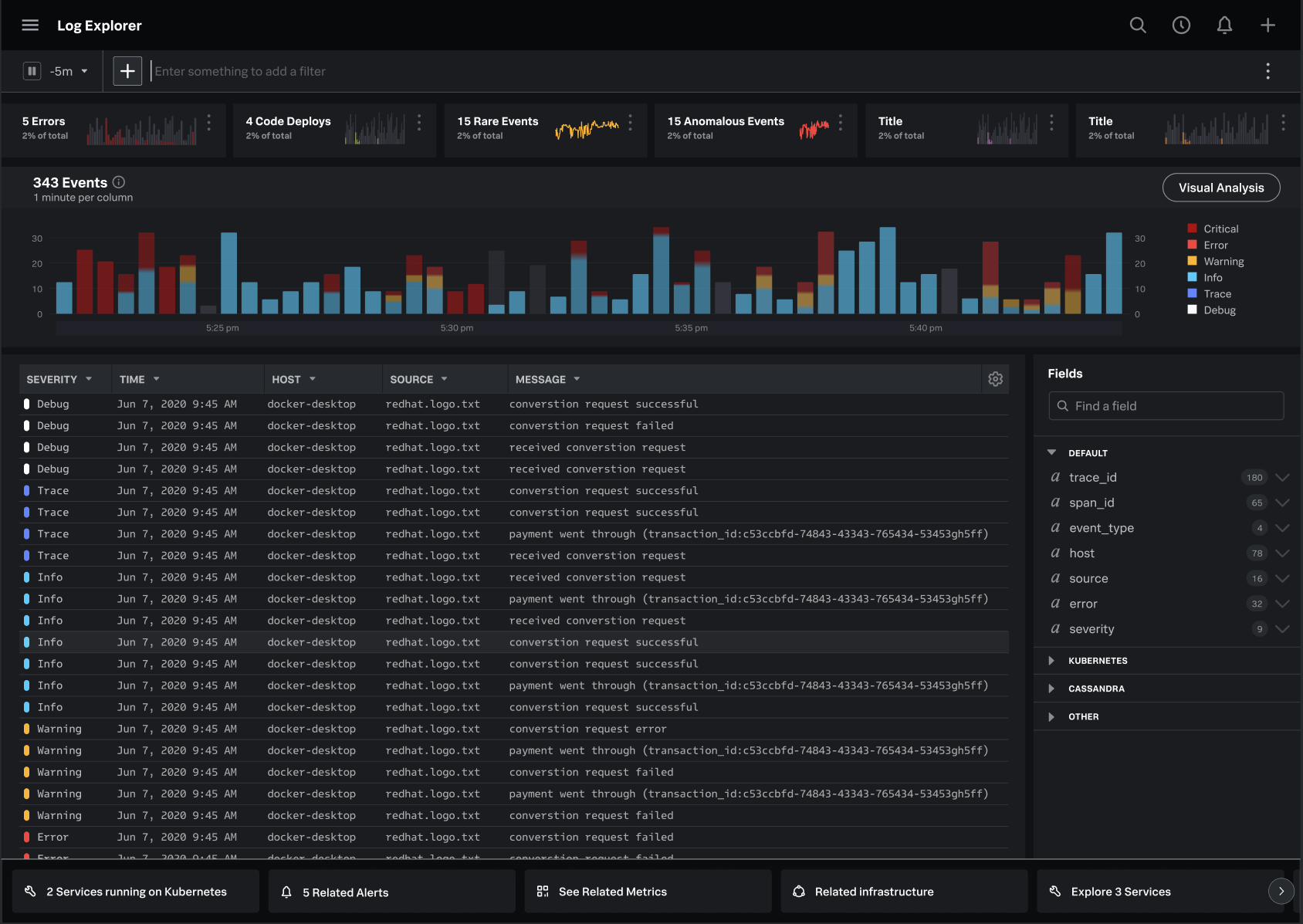
Image Credits: Splunk

“Because a lot of our users and our customers are moving to the cloud really, really quickly, the way that they monitor [their] applications changed because they’ve gone to serverless and microservices a ton,” he said. “So we entered that space with those acquisitions, we quickly folded them together with these next two acquisitions. What Plumbr and Rigor do is really fill out more of the portfolio.”

He noted that Splunk was especially interested in Plumbr’s bytecode implementation and its real-user monitoring capabilities, and Rigor’s synthetics capabilities around digital experience monitoring (DEM). “By filling in those two pieces of the portfolio, it gives us a really amazing set of solutions because DEM was the missing piece for our APM strategy,” Tully explained.

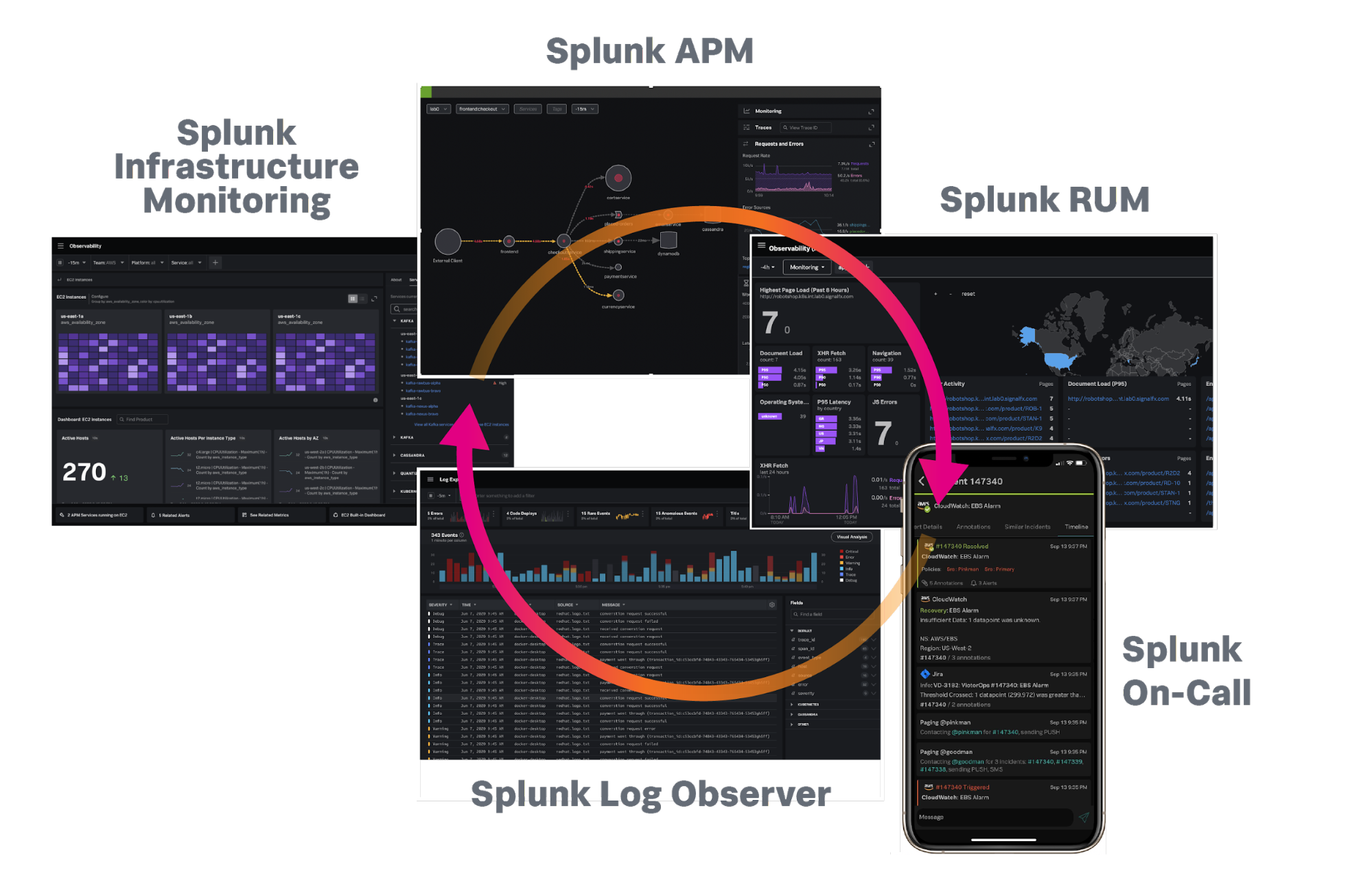
Image Credits: Splunk

With the launch of its Observability Suite, Splunk is now pulling together a lot of these capabilities into a single product — which also features a new design that makes it stand apart from the rest of Splunk’s tools. It combines logs, metrics, traces, digital experience, user monitoring, synthetics and more.

“At Yelp, our engineers are responsible for hundreds of different microservices, all aimed at helping people find and connect with great local businesses,” said Chris Gordon, Technical Lead at Yelp, where his team has been testing the new suite. “Our Production Observability team collaborates with Engineering to improve visibility into the performance of key services and infrastructure. Splunk gives us the tools to empower engineers to monitor their own services as they rapidly ship code, while also providing the observability team centralized control and visibility over usage to ensure we’re using our monitoring resources as efficiently as possible.”

News: Lux-backed Flex Logix announces availability of its fast and cheap X1 AI chip for the edge

In the computing world, there are probably more types of chips available than your local supermarket snack aisle. Diverse computing environments (data centers and the cloud, edge, mobile devices, IoT, and more), different price points, and varying capabilities and performance requirements are scrambling the chip industry, resetting who has the lead right now and who

In the computing world, there are probably more types of chips available than your local supermarket snack aisle. Diverse computing environments (data centers and the cloud, edge, mobile devices, IoT, and more), different price points, and varying capabilities and performance requirements are scrambling the chip industry, resetting who has the lead right now and who might take the lead in new and emerging niches.

While there has been a spate of new chip startups like Cerebras, SiFive, and Nuvia funded by venture capitalists in the past two years, Flex Logix got its footing a bit earlier. The company, founded in 2014 by former Rambus founder Geoff Tate and Cheng Wang, has collectively raised $27 million from investors Lux Capital and Eclipse Ventures, along with Tate himself.

Flex Logix wants to bring AI processing workflows to the compute edge, which means it wants to offer technology that adds artificial intelligence to products like medical imaging equipment and robotics. At the edge, processing power obviously matters, but so does size and price. More efficient chips are easier to include in products, where pricing may put constraints on the cost of individual components.

In the first few years of the company, it focused on developing and licensing IP around FPGAs, or reprogrammable chips that can be changed after manufacturing through software. These flexible chips are critical in applications like AI or 5G, where standards and models change rapidly. It’s a market that is dominated by Xilinx and Altera, which was acquired by Intel for $16.7 billion back in 2015.

Flex Logix saw an opportunity to be “the ARM of FPGAs” by helping other companies develop their own chips. It built customer traction for its designs with organizations like Sandia National Laboratory, the Department of Defense and Boeing. More recently, it has been developing its own line of chips called InferX X1, creating a hybrid business model not unlike the model that Nvidia will have after its acquisition of ARM clears through regulatory hurdles.

With that background out of the way, Flex Logix unveiled the availability of its X1 chip, which is currently slated to be offered at four speeds ranging from 533Mhz to 933Mhz. CEO Tate stressed on our call that the company’s key differential is price: those chips will be priced between $99-$199 depending on chip speed for smaller orders, and $34-$69 per chip for large-scale orders.

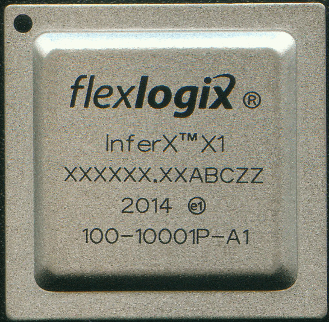
It’s a chip, alright. Ain’t a lot of great stock art. But here is the X1. Photo via Flex Logix.

The reason those chips are cheaper is that they are significantly smaller than competing chips from Nvidia in its Jetson chip lineup according to Tate, up to 1/7 the size. Smaller chips generally have lower costs, since each wafer in a chip fab can hold more chips, amortizing the cost of manufacturing over more chips. According to the company, its chips outperform Nvidia’s Xavier module, although independent benchmarks aren’t available.

“Every customer we talk to wants more processing power per dollar, more processing power per unit of power … and with our die-size advantage we can give them more for their money,” Tate explained.

Customer samples for these new chips are expected to arrive in the first quarter next year, with scale manufacturing in the second quarter.

The company’s plan is to continue both sides of its business and continue to grow and mature its technology. “Our embedded FPGA businesses is now, as a standalone, profitable. The amount of money we’re bringing in exceeds the engineering and business. And now we’re developing this new business for inference which ultimately should be a bigger business because the market is growing very fast in the inference space,” Tate explained.

The company’s board consists of Peter Hébert and Shahin Farshchi of Lux, Pierre Lamond at Eclipse, and Kushagra Vaid, a distinguished engineer at Microsoft Azure. The company is based in Mountain View, California.

News: Vectary, a design platform for 3D and AR, raises $7.3M from EQT and Blueyard

Vectary, a design platform for 3D and Augmented Reality (AR), has raised a $7.3 million round led by European fund EQT Ventures. Existing investor BlueYard (Berlin) also participated. Vectary makes high-quality 3D design more accessible for consumers, garnering over one million creators worldwide, and has more than a thousand digital agencies and creative studios as

Vectary, a design platform for 3D and Augmented Reality (AR), has raised a $7.3 million round led by European fund EQT Ventures. Existing investor BlueYard (Berlin) also participated.

Vectary makes high-quality 3D design more accessible for consumers, garnering over one million creators worldwide, and has more than a thousand digital agencies and creative studios as users.

With the coronavirus pandemic shifting more people online, Vectary says it has seen a 300% increase in AR views as more businesses start showcasing their products in 3D and AR.

Vectary was founded in 2014 by Michal Koor (CEO) and Pavol Sovis (CTO), who were both from the design and technology worlds.

The complexity of using and sharing content created by traditional 3D design tools has been a barrier to the adoption of 3D, which is what Vectary addresses.

Although Microsoft, Facebook and Apple are making it easier for consumers, the creative tools remain lacking. Vectary believes that seamless 3D/AR content creation and sharing will be key to mainstream adoption.

Designers and creatives can use Vectary to apply 2D design on a 3D object in Figma or Sketch; create 3D customizers in Webflow with Embed API; and add 3D interactivity to decks.

News: Perch raises $123.5M to grow its stable of D2C brands that sell on Amazon

While Amazon gradually builds out its own-branded line of products, third-party sellers continue to account for a significant part of the transaction volume and growth on its marketplace — by one estimate, accounting for $200 billion of the $335 billion in gross merchandise value sold on Amazon in 2019. Today, in a twist on the

While Amazon gradually builds out its own-branded line of products, third-party sellers continue to account for a significant part of the transaction volume and growth on its marketplace — by one estimate, accounting for $200 billion of the $335 billion in gross merchandise value sold on Amazon in 2019. Today, in a twist on the economies of scale that has propelled much of Amazon’s growth, a Boston startup that has built a tech platform that it uses both to buy up and then run D2C brands sold on Amazon is announcing a major round of growth funding to expand its business.

Perch, which acquires D2C businesses and products that are already selling on Amazon, and then continues to operate and grow those operations, has raised $123.5 million in funding.

Perch plans to use the capital mainly to continue acquiring D2C businesses, as well as to build out its team and invest in its platform, “but we are profitable so we plan to use cashflows from the business to build the team and the funding toward acquiring additional winning brands and products,” said Chris Bell, Perch’s CEO and founder, in an interview over email.

The company currently counts women’s athleisure brand Satina, kitchenware from Flathead and Aulett and others, health and personal care brands among its stable of companies. There are just 10 on the platform today, and the funding is coming on the back of success so far, as well as ambitious plans to grow that to 50 by the end of 2021, and eventually hundreds or thousands of brands.

And before you think that this is just about running a lot of smaller businesses together, Bell adds that “technology is the most important part of our model.”

Some 40% of the startup’s team works on its platform, which is used to onboard “eventually thousands of brands at scale in an e-commerce-native environment.” The platform is used to help run analytics on sales, determine pricing and ad strategy, and inventory positioning and other marketing decisions. Longer term it will also be used to help figure out how to sell and balance products on social and retail channels (while ultimately selling through Amazon, for now).

The funding — which brings the total raised by Perch to over $130 million — is being led by Spark Capital, with previous backer Tectonic Ventures and new investor Boston Seed also participating. The startup is not disclosing its valuation with this round.

Amazon has grown in part on the principle of economies of scale, both in terms of procurement as well as in distribution. Both in the case of physical or digital goods, small margins on sales of a huge array of products adds up to strong returns; and the same goes for working out the costs for operating a logistics and distribution network.

Perch has essentially picked up on that idea and is developing its own take on it around the D2C model.

Direct-to-consumer businesses have been one of the big stories in e-commerce in the last decade: companies are leveraging the internet and newer innovations in manufacturing to build their own products and brands that they sell direct to customers, bypassing traditional retail chains, with some like Everlane, Warby Parker and Third Love finding huge success in the process.

But while a lot of those sales have focused around D2C companies developing their own sites or via social media, a very large proportion of the smaller players are also selling through marketplaces — and specifically Amazon’s marketplace.

As a larger category, they are growing fast — up 50% year-on-year in 2020, with some 86% of third-party sellers profitable.

But on an individual basis, most of them don’t necessarily have a strategy for how they will scale or exit the business eventually, so the opportunity here is to bring a number of these more promising smaller D2C brands into a bigger operation — the idea being to bring more economies of scale both to manufacturing those products as well as to collectively distributing them over Amazon.

“We typically do not retain the entrepreneurs or founders beyond a transition period, though we are open-minded if there is the right fit, though they are often excited to take some time off or start their next adventure,” said Bell. “For staff or contractors who work with the founder on the brand, we have a discussion with the founder and those individuals throughout the process and depending on need or mutual discussion we have retained some of those relationships.”

It’s Perch’s own realization of how to expand the economies of scale for D2C that has attracted investors here.

“The Perch team has the M&A, eCommerce, and Amazon experience to understand what makes a quality and scalable consumer product and take those products to the next level post-acquisition,” said Alex Finkelstein, General Partner, Spark Capital, in a statement. “We are beyond excited to lead this round. Perch is already off to an exceptionally strong start. Given the booming eCommerce market, I expect we will continue to see record numbers and additional acquisitions this year.”

Bell added that while any company can approach it to get acquired, it has a relatively strict set of criteria for what it would seriously consider.

“We look for winning products and brands,” he said. “What that means is the products need to have a proven track record of product-market fit, as evidenced through at least 18-24 months of profitable sales, great customer reviews, low return rate, no evidence of consistent product quality issues, and a trademarked brand that is recognized and enforced by their channel partners / marketplaces.”

There have been a number of companies that are trying to muscle in on Amazon’s supremacy in online retail markplaces in the US — including the likes of Walmart and Alibaba — but for now Amazon continues to be the main game in town, Bell said. (And no surprise there: one estimate in 2018 was that it was hovering at 49% marketshare in e-commerce in the U.S.)

“Amazon has created the leading third-party seller marketplace in a really differentiated way,” he said. “Not only do they have the most consumers visiting every day, but they also have the most maturity around technical integrations, brand protections, and a best-in-class fulfillment operation.”

He added that “Walmart is making good strides in terms of developing their seller services and technical integrations, and their announcement that they will be offering fulfillment for 3rd party merchants will help considerably. I expect they will continue to gain share, but they have a really long way to go to catch up with both consumers and marketplace sellers.” In terms of others, he also noted that “Google appears to be investing in their marketplace, but we haven’t seen as much traction there. Without an integrated fulfillment option, many sellers would prefer to use their Google ad dollars to send consumers to their own page to transact rather than through Google’s marketplace. Facebook/Instagram stores have promise but still very nascent.”

Interestingly, the Perch proposition provides a very different alternative to the e-commerce landscape that others see. Some like Shogun have built their business on premise that the only way foward is to move away from a reliance on third-party marketplaces like those of Amazon, Perch has doubled down on it, seemingly confident that it’s here to stay. And indeed, the bigger that Perch grows, the more likely it is that the bulked-up company has a chance of having some negotiating power of its own.

“We have some sales through standalone brand sites, but the vast majority of our focus is on the marketplace and we expect that to continue for the immediate future,” said Bell.

News: Tiliter bags $7.5M for its ‘plug and play’ cashierless checkout tech

Tiliter, an Australian startup that’s using computer vision to power cashierless checkout tech that replaces the need for barcodes on products, has closed a $7.5 million Series A round of funding led by Investec Emerging Companies. The 2017-founded company is using AI for retail product recognition — claiming advantages such as removing the need for

Tiliter, an Australian startup that’s using computer vision to power cashierless checkout tech that replaces the need for barcodes on products, has closed a $7.5 million Series A round of funding led by Investec Emerging Companies.

The 2017-founded company is using AI for retail product recognition — claiming advantages such as removing the need for retail staff to manually identify loose items that don’t have a barcode (e.g. fresh fruit or baked goods), as well as reductions in packaging waste.

It also argues the AI-based product recognition system reduces incorrect product selections (either intentional or accidental).

“Some objects simply don’t have barcodes which causes a slow and poor experience of manual identification,” says co-founder and CEO Martin Karafilis. “This is items like bulk items, fresh produce, bakery pieces, mix and match etc. Sometimes barcodes are not visible or can be damaged.

“Most importantly there is an enormous amount of plastic created in the world for barcodes and identification packaging. With this technology we are able to dramatically decrease and, in some cases, eliminate single use plastic for retailers.”

Currently the team is focused on the supermarket vertical — and claims over 99% accuracy in under one second for its product identification system.

It’s developed hardware that can be added to existing checkouts to run the computer vision system — with the aim of offering retailers a “plug and play” cashierless solution.

Marketing text on its website adds of its AI software: “We use our own data and don’t collect any in-store. It works with bags, and can tell even the hardest sub-categories apart such as Truss, Roma, and Gourmet tomatoes or Red Delicious, Royal Gala and Pink Lady apples. It can also differentiate between organic and non-organic produce [by detecting certain identification indicators that retailers may use for organic items].”

“We use our pre-trained software,” says Karafilis when asked whether there’s a need for a training period to adapt the system to a retailer’s inventory. “We have focused on creating a versatile and scalable software solution that works for all retailers out of the box. In the instance an item isn’t in the software it can be collected by the supermarket in approx 20min and has self-learning capabilities.”

As well as a claim of easy installation, given the hardware can bolt onto existing retail IT, Tiliter touts lower cost than “currently offered autonomous store solutions”. (Amazon is one notable competitor on that front.)

It sells the hardware outright, charging a yearly subscription fee for the software (this includes a pledge of 24/7 global service and support).

“We provide proprietary hardware (camera and processor) that can be retrofitted to any existing checkout, scale or point of sale system at a low cost integrating our vision software with the point of sale,” says Karafilis, adding that the pandemic is driving demand for easy to implement cashierless tech.

The startup cites a 300% increase in ‘scan and go’ adoption in the US over the past year due to COVID-19, as an example, adding that further global growth is expected.

It’s not breaking out customer numbers at this stage — but early adopters for its AI-powered product recognition system include Woolworths in Australia with over 20 live stores; Countdown in New Zealand, and several retail chains in the US such as New York City’s Westside Market.

The Series A funding will go on accelerating expansion across Europe and the US — with “many” supermarkets set to be adopt its tech over the coming months.

WordPress Image Lightbox Plugin