Yearly Archives: 2020

News: The Polaris Slingshot R is a 3-wheel pocket rocket begging for electrification

The Polaris Slingshot has always wowed. Three wheels, open cockpit, and a design reminiscent of the Batmobile. It draws a crowd and is a blast to drive. I spent several weeks in the reworked Polaris Slingshot. The company just unveiled a new version that is finally available with an automatic transmission. Past versions were limited

The Polaris Slingshot has always wowed. Three wheels, open cockpit, and a design reminiscent of the Batmobile. It draws a crowd and is a blast to drive.

I spent several weeks in the reworked Polaris Slingshot. The company just unveiled a new version that is finally available with an automatic transmission. Past versions were limited to a standard transmission, radically limiting the 3-wheeler’s market to those who can drive a stick. But now, with a slushbox, the Slingshot is ready for the masses.

I just wish a gas engine didn’t power the Slingshot.

The Slingshot is a thrilling ride. Is it like a motorcycle? Not really. Driving and riding in the Slingshot is akin to a go-kart or side-by-side ATV. The noises and feels are similar. It shifts hard, revs to infinity, and the wind is always in your face. It’s a blast.

Let’s get this out of the way: The Slingshot is not fast. Sure, it’s quick for its size, but it’s slower than it looks.

Thrills can be had even without breakneck speed. Without doors or a top, the Slingshot offers a driving experience offered in few vehicles.

Once warmed up, the Slingshot is eager to please. The tach goes to 10k and redlines around 8,500. Mashing the go-pedal sends the needle soaring and the rear tire screeching. And off you go.

The Slingshot was seemingly designed to power slide through corners. With the power going only to the single rear tire, the Slingshot easily loses traction, allowing for dramatic slide slides.

The thrilling ride makes up for the lack of raw speed. What are normally mundane drives are elevated to mini adventures. That is if you let the Slingshot warm up a bit.

She’s a cold-hearted lady, an uncle used to proclaim about his early eighties red Chevy Custom Deluxe pickup. This truck hauled as long as you gave the truck some time to warm up. The same thing is true with the Slingshot. Mass the gas pedal after just starting it up, and you’ll be greeted with shifts as rough as a dirt road.

My first impression of the new Slingshot was not a good one. I unloaded the Slingshot from the delivery semi, hopped in, and floored it. A long second later, as the transmission shifted from first to second, I discovered this was a bad idea. I immediately thought the Slingshot’s transmission is seemingly controlled by someone changing gears with a sledgehammer.

During my first drive, I concluded the new automatic Slingshot to be terrible before reaching the top gear. I was wrong. Once warm, the Slingshot improves but still lacks the shifting refinement of even the most basic automatic car. Even when warmed up, shifts in traffic are clunky and hard. When the driver can power through each gear, shifts on the open road are better but still rough.

The transmission feel is my main concern with the Slingshot. Adding an automatic option opens the door to new buyers, but buyers must understand that the Slingshot is more ATV than a car.

Want a refined open-top roadster? Get a Mazda MX-5. Want a thrilling open ride? The Slingshot is a great option.

Polaris introduced the Slingshot in 2014, and I was lucky enough to drive one of the first in the country. That version was powered by a General Motors four-cylinder engine that provided ample power for the small frame. This time around, Polaris used its own four cylinder and mated it with an automatic gearbox.

The Slingshot in this new form is still thrilling, but the lackluster gearbox erases some of its potential and makes a case for an electric Slingshot.

Much of my hesitation about the automatic Slingshot would be erased if an electric motor powered the vehicle.

One, with an electric powertrain, the vehicle would dump the lackluster automatic transmission in favor of a direct drive system. It would still be accessible to the target market and yet gain a better driving experience. With the electric system, the Slingshot would be quicker off the line and around corners. It would be fast while still thrilling.

Two, the Slingshot doesn’t make a pleasant noise. Muscle cars deserve an exhaust note that expresses the gravitas of the motor. The Slingshot is not a muscle car, and the current exhaust note can only be described as being similar to an obnoxious go-kart. I spent much of my time in the Slingshot cruising through Michigan’s corn-lined back roads. I could smell the fresh corn while the sun beat down on my face. I love a loud exhaust as much as any dummy, but as I was driving through those backroads, I wished the Slingshot didn’t produce such a racket. An electric powertrain would improve the experience of the open-top machine.

And finally, an electric powertrain would make the Slingshot as fast as it deserves. As stated above, the Slingshot is not as fast as it looks. Quick? Sure. But it’s not fast, and an electric powertrain would address this shortcoming by offering more torque at the start giving it the speed the Slingshot deserves.

Of course, Polaris probably will not heed my electrification advice. I doubt it’s possible to make the Slingshot electric and maintain the same $30,000 price. A boy can still dream.

The Slingshot is a lot of fun, and the fun comes at a cost. In the end, with the crummy automatic transmission limits the appeal of the Slingshot. Even in the best circumstances, shifts are rough and off-putting and not up to par for passenger vehicles. ATV enthusiasts can probably live with the shifts; everyone else should cross-shop the Slingshot with something like a Mazda MX-5, or even a used BMW Z3. Or, better yet, learn a life-long skill and learn to drive a stick shift, and buy the Slingshot with the standard transmission.

Adding an electric powertrain to the Slingshot would considerably improve the vehicle. It would likely be faster and more enjoyable to drive since a smooth, direct-drive sensation would replace the hard shifts.


News: Instagram rolls out fan badges for live videos, expands IGTV ads test

Instagram is today introducing a new way for creators to make money. The company is now rolling out badges in Instagram Live to an initial group of over 50,000 creators, who will be able to offer their fans the ability to purchase badges during their live videos to stand out in the comments and show

Instagram is today introducing a new way for creators to make money. The company is now rolling out badges in Instagram Live to an initial group of over 50,000 creators, who will be able to offer their fans the ability to purchase badges during their live videos to stand out in the comments and show their support.

The idea to monetize using fan badges is not unique to Instagram. Other live streaming platforms, including Twitch and YouTube, have similar systems. Facebook Live also allows fans to purchase stars on live videos, as a virtual tipping mechanism.

Instagram users will see three options to purchase a badge during live videos: badges that cost $0.99, $1.99, or $4.99.

On Instagram Live, badges will not only call attention to the fans’ comments, they also unlock special features, Instagram says. This includes a placement on a creator’s list of badge holders and access to a special heart badge.

The badges and list make it easier for creators to quickly see which fans are supporting their efforts, and give them a shout-out, if desired.

Image Credits: Instagram

To kick off the roll out of badges, Instagram says it will also temporarily match creator earnings from badge purchases during live videos, starting in November. Creators @ronnebrown and @youngezee are among those who are testing badges.

The company says it’s not taking a revenue share at launch, but as it expands its test of badges it will explore revenue share in the future.

“Creators push culture forward. Many of them dedicate their life to this, and it’s so important to us that they have easy ways to make money from their content,” said Instagram COO Justin Osofsky, in a statement. “These are additional steps in our work to make Instagram the single best place for creators to tell their story, grow their audience, and make a living,” she added.

Additionally, Instagram today is expanding access to its IGTV ads test to more creators. This program, introduced this spring, allows creators to earn money by including ads alongside their videos. Today, creators keep at least 55% of that revenue, Instagram says.

The introduction of badges and IGTV ads were previously announced, with Instagram saying it would test the former with a small group of creators earlier this year.

The changes follow what’s been a period of rapid growth on Instagram’s live video platform, as creators and fans sheltered at home during the coronavirus pandemic, which had cancelled live events, large meetups, concerts, and more.

During the pandemic’s start, for example, Instagram said Live creators saw a 70% increase in video views from Feb. to March, 2020. In Q2, Facebook also reported monthly active user growth (from 2.99B to 3.14B in Q1) that it said reflected increased engagement from consumers who were spending more time at home.

News: Index nabs $2.6M seed to create BI dashboards without coding

Index founders, Xavier Pladevall and Eduardo Portet, have been friends since they were small children in the Dominican Republic. Both came to college in the U.S., and last year the two decided to launch a startup to help non-technical users build business intelligence dashboards without coding. Today they get to keep building on that dream

Index founders, Xavier Pladevall and Eduardo Portet, have been friends since they were small children in the Dominican Republic. Both came to college in the U.S., and last year the two decided to launch a startup to help non-technical users build business intelligence dashboards without coding.

Today they get to keep building on that dream with the help of a $2.6 million seed investment from David Sacks, Slack, Gradient Ventures, Y Combinator and other individual investors.

What has attracted this investment is a couple of young founders who are passionate about making it simple to build a data dashboard without help from experts like engineers or data analysts.

“Essentially what we do is we help companies build their business metrics dashboards with as little code or technical knowledge as possible. The byproduct of that is that anyone in the company can build their own metrics for their teams,” co-founder Xavier Pladevall told TechCrunch.

End users can connect to a growing list of data sources and Index deals with building the queries and displaying the data for the users without data scientists or data analysts to help. For now, that includes Salesforce and Hubspot for CRM data, Stripe payments data and certain databases from Postgres and MongoDB.

(Xavier Pladevall (left) and Eduardo Portet (right) founders of Inex

Company co-founders Xavier Pladevall and Eduardo Portet. Image Credits: Index

As the founders build out the product, they want to stay lean with just the two founders and perhaps two additional engineers. “We’re actually looking to hire two people full time, and that’s going to take us to the Series A, and we’ve been very clear with investors about that,” he said.

As Latino immigrant founders, they want to build a company that’s diverse and inclusive. He says that’s it’s not hard for him and his co-founder to find people of color because they have formed friendships with a diverse  network of people they can tap into.

“Our job is to keep doing what we’re doing, which is to be friends with a bunch of different people because that is genuine and people can definitely tell you’re trying to meet some diversity quota versus when you’re generally a diversity-oriented type of company because it comes back to the founders themselves,” he said.

The two founders and their families have been friends since they were children. Growing up in the Dominican Republic, they didn’t have access to computer science classes, but they did have access to the internet and they got the startup bug from reading U.S. tech publications like this one, and learned to code from YouTube videos and StackOverflow. They both came to college in the U.S. and both interned at large companies — Pladevall at Facebook and Portet worked at Metadata in New York.

The idea came together because Pladevalll was part of a team at Facebook building a similar tool for internal use. He decided that it would be a viable commercial idea for companies without the resources of Facebook. He came together with his childhood friend and began building the company in January as the pandemic hit.

He acknowledges the hardship of this year, but says it really helped them focus because there wasn’t anything else to do. While they are amazed at having $2.6 million in the bank, he says they still have the hunger that he believes is part of the immigrant founder ethos.

“It’s just hunger to just prove yourself and if coding is what it takes, learn how to code. If it’s going through an early visa process, which is by the way, way harder than raising millions of dollars and going through YC, in my opinion, [you do that]” he said. He said it’s about doing whatever it takes.

As the two friends take their first steps as a company, they have some early customers and continue to refine the product. With today’s funding they have some lofty goals for the next year, which include building out that product, reaching $1 million in ARR and building distribution for the dashboard.

If they can meet those goals, Pladevall says, they should be able to get their Series A. I wouldn’t bet against them.

News: Stampli, an invoice management software startup, launches a payments product

Stampli, a collaborative invoice management software company, introduced a payments product today called Stampli Direct Pay. The startup launched back in 2015 with a mission to simplify invoice management through collaboration (and a dash of AI). Interestingly, Stampli said it was uninterested at the time in providing a payments product alongside its collaborative suite, focusing

Stampli, a collaborative invoice management software company, introduced a payments product today called Stampli Direct Pay.

The startup launched back in 2015 with a mission to simplify invoice management through collaboration (and a dash of AI). Interestingly, Stampli said it was uninterested at the time in providing a payments product alongside its collaborative suite, focusing instead on the process of procure to pay.

This latest announcement marks a shift in the company’s thinking. Cofounder and CEO Eyal Feldman explained that conversations with customers revealed just how frustrated many organizations are with the current B2B payments landscape.

Organizations have several options: cut and mail their own paper checks, use ACH, or sign on with a payments provider to use ‘e-payments.’

Cutting and mailing checks is a pre-historic, time-intensive activity that doesn’t really belong in 2020, while ACH (which comes at a very low, flat cost) often groups multiple transactions into a single sum, making it difficult for accounting to reconcile individual line item purchases.

“Under the misleading banner of “e-payments,” [payments providers] offer AP departments a rebate and promise vendors faster payment,” explained Feldman in a blog post. “However, in order for vendors to get the payment, they must accept payments as virtual credit cards, which come with up to a 3.5% credit card fee per transaction.”

And many payments providers do not provide the data extracted from invoices and transactions back to the organization as a way to stay sticky.

Stampli’s customers illuminated these problems for the startup, which used to be payments agnostic. With the launch of Stampli Direct Pay, the company is still payments flexible, letting organizations work with their existing or different payments providers. But Stampli now offers an option that aims to resolve many of these industry issues.

Because Stampli’s core product already tracks all the contextual and relevant info for every transaction, that information is readily available during payment approval. Direct Pay also offers ACH as a payment option, but separates individual transactions out for easy reconciliation. And for customers who want to stick with checks, Stampli Direct Pay offers a service that allows customers to approve digital checks which come directly from their bank account with their signature, with Stampli handling printing, stamping, and mailing.

Stampli also offers a vendor payment portal that extracts the needed data for each vendor and lets the customer own that data, which can be downloaded and taken to another payment provider.

The company has spent the last four years solving an entirely different problem.

Usually, teams purchase products or services and those invoices end up in the finance department with little to no context, setting off a game of duck duck goose within the organization as accountants try to get the information and approvals they need to pay out that vendor.

Stampli, which has raised $32 million to date, built out a collaborative platform that allows non-accountants to participate in the invoice management process in a way that’s straightforward and simple. Each invoice becomes a communications hub, allowing folks across various departments fill in the blanks and. answer questions about the purchase. Stampli also uses machine learning to recognize patterns around allocating costs, managing approval workflows, and the data that needs to be extracted from invoices.

Each invoice is turned into its own communications hub, allowing people across departments to fill in the blanks and answer questions so that payments are handled as efficiently as possible. Moreover, Stampli uses machine learning to recognize patterns around how the organization allocates cost, manages approval workflows and what data is extracted from invoices.

With the launch of Direct Pay, Stampli is poised to take on a variety of new competitors with an obvious differentiator. The company has processed more than $13 billion in invoices annually.

The team has also grown to more than 100 employees. Fifty-six percent of the company’s US workforce is non-white and 33 percent of the executive leadership team is female, according to Feldman.

News: Gowalla is being resurrected as an augmented reality social app

Gowalla is coming back. The startup, which longtime TechCrunch readers will likely recall, was an ambitious consumer social app that excited Silicon Valley investors but ultimately floundered in its quest to take on Foursquare before an eventual $3 million acquihire in 2011 brought the company’s talent to Facebook. The story certainly seemed destined to end

Gowalla is coming back.

The startup, which longtime TechCrunch readers will likely recall, was an ambitious consumer social app that excited Silicon Valley investors but ultimately floundered in its quest to take on Foursquare before an eventual $3 million acquihire in 2011 brought the company’s talent to Facebook.

The story certainly seemed destined to end there, but founder Josh Williams tells TechCrunch that he has decided to revive the Gowalla name and build on its ultimate vision by leaning on augmented reality tech.

“I really don’t think [Gowalla’s vision] has been fully realized at all, which is why I still want to scratch this itch,” Williams tells TechCrunch. “It was frankly really difficult to see it shut down.”

After a stint at Facebook, another venture-backed startup and a few other gigs, Williams has reacquired the Gowalla name, and is resurrecting the company with the guidance of co-founder Patrick Piemonte, a former Apple interface designer who previously founded an AR startup called Mirage. The new company was incubated inside Form Capital, a small design-centric VC fund operated by Williams and Bobby Goodlatte .

Founders Patrick Piemonte (left) and Josh Williams (right). Image credit: Josh Williams.

Williams hopes that AR can bring the Gowalla brand new life.

Despite significant investment from Facebook, Apple and Google, augmented reality is still seen as a bit of a gamble with many proponents estimating mass adoption to be several years out. Apple’s ARKit developer platform has yielded few wins despite hefty investment and Pokémon Go — the space’s sole consumer smash hit — is growing old.

“The biggest AR experience out there is Pokémon Go, and it’s now over six years old,” Williams says. “It’s moved the space forward a lot but is still very early in terms of what we’re going to see.”

Williams was cryptic when it came to details for what exactly the new augmented reality platform would look like when it launches. He did specify that it will feel more like a gamified social app than a social game, though he also lists the Nintendo franchise Animal Crossing as one of the platform’s foundational inspirations.

A glimpse of the branding for the new Gowalla. Image credit: Josh Williams

“It’s not a game with bosses or missions or levels, but rather something that you can experience,” Williams says. “How do you blend augmented reality and location? How do you see the world through somebody else’s eyes?”

A location-based social platform will likely rely on users actually going places, and the pandemic has largely dictated the app’s launch timing. Today, Gowalla is launching a waitlist, Williams says the app itself will launch in beta “in a number of cities” sometime in the first-half of next year. The team is also trying something unique with a smaller paid beta group called the “Street Team,” which will give users paying a flat $49 fee early access to Gowalla as well as “VIP membership,” membership to a private Discord group and some branded swag. A dedicated Street Team app will also launch in December.

News: Robin.io launches a free version of its cloud-native Kubernetes storage solution

Robin.io, a cloud-native application and data management solution with enterprise customers like USAA, Sabre, SAP, Palo Alto Networks and Rakuten Mobile, today announced the launch of its new free(-mium) version of its service, in addition to a major update to the core of its tool. Robin .io promises that it brings cloud-native data management capabilities

Robin.io, a cloud-native application and data management solution with enterprise customers like USAA, Sabre, SAP, Palo Alto Networks and Rakuten Mobile, today announced the launch of its new free(-mium) version of its service, in addition to a major update to the core of its tool.

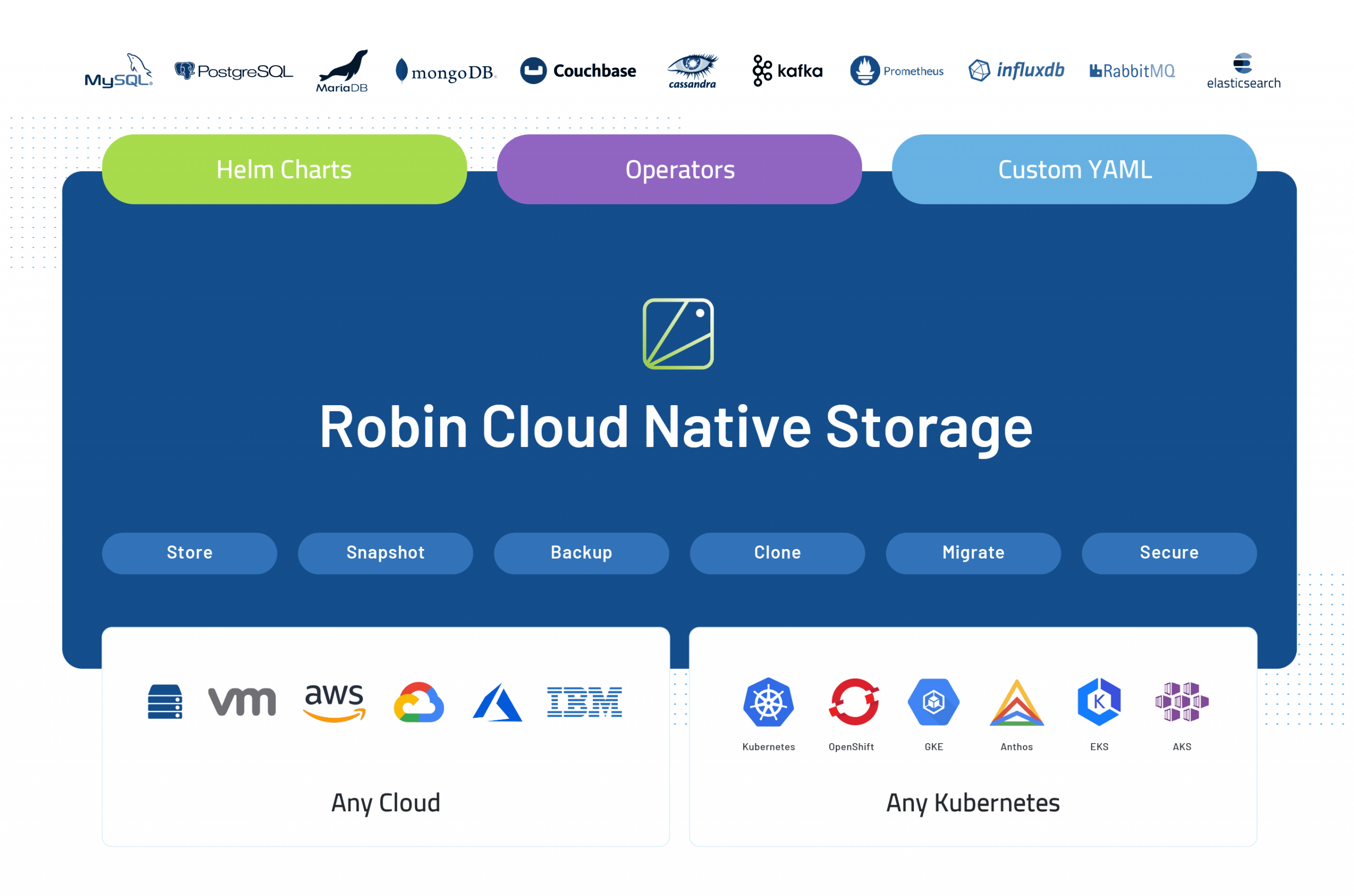
Robin .io promises that it brings cloud-native data management capabilities to containerized applications with support for standard operations like backup and recovery, snapshots, rollbacks and more. It does all of that while offering bare-metal performance and support for all major clouds. The service is essentially agnostic to the actual database being used and offers support for the likes of PostgreSQL, MySQL, MongoDB, Redis, MariaDB, Cassandra, Elasticsearch and others.

Image Credits: Robin.io

“Robin Cloud Native Storage works with any workload on any Kubernetes-based platform and on any cloud,” said Robin founder and CEO Partha Seetala. “With capabilities for storing, taking snapshots, backing up, cloning, migrating and securing data — all with the simplest of commands — Robin Cloud Native Storage offers developers and DevOps teams a super simple yet highly performant tool for quickly deploying and managing their enterprise workloads on Kubernetes.”

The new free version lets teams manage up to 5 nodes and 5TB of storage. The promise here is that this a free-for-life offering and the company obviously expects that it allows enterprises to get a feel for the service and then upgrade to its paid enterprise plans over time.

Talking about those enterprise plans, the company also today announced that it is moving to a consumption-based pricing plan, starting at $0.42 per node-hour (though it also offers annual subscriptions). The enterprise plan includes 24×7 support and doesn’t limit the number of nodes or storage capacity.

Among the new features to Robin’s core storage service are data management support for Helm Charts (where Helm is the Kubernetes package manager), the ability to specify where exactly the data should reside (which is mostly meant to keep it close to the compute resources) and affinity policies that ensure availability for stateful applications that rely on distributed databases and data platforms.

News: Genies updates its software development kit and partners with Gucci, Giphy

Genies, has updated its software development kit and added Giphy and Gucci as new partners to enable their users to create personalized Genie avatars. The company released the first version of its sdk in 2018 when it raised a $10 million to directly challenge Snap and Apple for avatar dominance. Now, with the latest update,

Genies, has updated its software development kit and added Giphy and Gucci as new partners to enable their users to create personalized Genie avatars.

The company released the first version of its sdk in 2018 when it raised a $10 million to directly challenge Snap and Apple for avatar dominance. Now, with the latest update, the company said it has managed to create a new three dimensional rendering that can be used across platforms — if developers let Genies handle the animation.

Genies has already managed to sign up many of the biggest names in entertainment to act as their official manager through their Genies talent agency. These include celebrities like Shawn Mendes, Justin Bieber, Cardi B, and Rihanna. Genies also locked in deals with the National Football League’s player’s association along with Major League Baseball and the National Basketball Association.

Now, those celebrities and athletes can monetize exclusive digital goods made by Genies on platforms like Gucci and Giphy and the fashion house and meme generator can now give users their own digital identity to play around with.

“Over the past year, our technology has been sharpened by the exacting creative demands of celebrities. This advanced Genies’ march to be the go-to avatar globally,” said Akash Nigam, Genies CEO and co-founder, in a statement. “What was previously a celebrity exclusive experience, is now broadly available for consumers to use as their virtual portable identities. By opening up to the masses, we’ve now created an opportunity for tastemakers to forge new, unique relationships with their audiences through avatar digital goods.”

The SDK integrations are still highly curated and tailored (there’s a lot of heavy lifting that Genies needs to do with each one). For instance, Gucci users can try on the latest designs and the company will sell digital goods on its platform created by Genies. Giphy users will use their avatars as gifs on its site and through its distribution network.

“Our Avatar Agency has served as the go-to platform for thousands of artists, and with our next-gen, highly expressive and dynamic 3D Genie, we will further solidify our position as the universal digital identity,” said Izzy Pollak, Director of Avatar SDK at Genies. “For celebrities and everyday users alike, it unlocks new arenas and verticals for users to cultivate their avatars in. On top of traditional 2D environments like mobile apps and websites, Genies can now live in AR/VR platforms, games, and in use cases or SDK partner platforms that demand a 360-degree rendering of the digital goods they purchase,”

News: Security testing firm NSS Labs ceases operations, citing coronavirus

Security testing company NSS Labs “ceased operations” last week, the company said in a notice on its website, citing impacts related to the ongoing coronavirus pandemic. The Austin, Texas-based company was quietly acquired by private equity firm Consecutive last October. But last week, the company was reportedly preparing for layoffs, according to Dark Reading, which

Security testing company NSS Labs “ceased operations” last week, the company said in a notice on its website, citing impacts related to the ongoing coronavirus pandemic.

The Austin, Texas-based company was quietly acquired by private equity firm Consecutive last October. But last week, the company was reportedly preparing for layoffs, according to Dark Reading, which first reported news of the company’s shuttering.

In a brief post on LinkedIn, NSS Labs’ chief executive Jason Brvenik hinted at layoffs, adding: “If you are in need of excellent people that exceed my high standards, please get in touch.” (Brvenik listed himself as a former chief executive on his LinkedIn profile.)

Former employees told TechCrunch that they had been laid off as a result of the company’s closure.

NSS Labs, founded in 2007, was one of the most well-known product security testing companies, allowing customers to use real threat data to stress-test their products and discover potential vulnerabilities and security issues.

But the last few years have been rocky. NSS Labs retracted its “caution” rating for CrowdStrike’s Falcon platform in 2019, after the two companies confidentially settled a lawsuit challenging the results. NSS Labs also dropped its antitrust suit against the Anti-Malware Testing Standards Organization (AMTSO), Symantec and ESET, after the testing giant claimed it had discovered evidence of the companies allegedly conspiring to make it harder to test their products.

Spokespeople for NSS Labs and Consecutive did not immediately return requests for comment.


Send tips securely over Signal and WhatsApp to +1 646-755-8849.

News: Stotles secures funding for platform which brings transparency to government tenders, contracts

The public sector usually publishes its business opportunities in the form of ‘tenders,’ to increase transparency to the public. However, this data is scattered, and larger businesses have access to more information, giving them opportunities to grab contracts before official tenders are released. We have seen the controversy around UK government contracts going to a

The public sector usually publishes its business opportunities in the form of ‘tenders,’ to increase transparency to the public. However, this data is scattered, and larger businesses have access to more information, giving them opportunities to grab contracts before official tenders are released. We have seen the controversy around UK government contracts going to a number of private consultants who have questionable prior experience in the issues they are winning contracts on.

And public-to-private sector business makes up 14% of global GDP, and even a 1% improvement could save €20B for taxpayers per year, according to the European Commission .

Stotles is a new UK startup technology that turns fragmented public sector data — such as spending, tenders, contracts, meeting minutes, or news releases — into a clearer view of the market, and extracts relevant early signals about potential opportunities.

It’s now raised a £1.4m seed round led by Speedinvest, with participation from 7Percent Ventures, FJLabs, and high-profile angels including Matt Robinson, co-founder of GoCardless and CEO at Nested; Carlos Gonzalez-Cadenas, COO at Go -Cardless; Charlie Songhurst, former Head of Corporate Strategy at Microsoft; Will Neale, founder of Grabyo; and Akhil Paul. It received a previous investment from Seedcamp last year.

Stotles’ founders say they had “scathing” experiences dealing with public procurement in their previous roles at organizations like Boston Consulting Group and the World Economic Forum.

The private beta has been open for nine months, and is used by companies including UiPath, Freshworks, Rackspace, and Couchbase. With this funding announcement, they’ll be opening up an early access program.

Competitors include: Global Data, Contracts Advance, BIP Solutions, Spend Network/Open Opps, Tussel, TenderLake. However, most of the players out there are focused on tracking cold tenders, or providing contracting data for periodic generic market research.

News: Venn, a network hoping to be gaming’s answer to MTV, raises $26 million

VENN , the streaming network hoping to be gaming culture’s answer to MTV, has raised $26 million to bring its mix of video game-themed entertainment and streaming celebrity features to the masses. The financing came from previous investor Bitkraft, one of the largest funds focused on the intersection of gaming and synthetic reality, and new

VENN , the streaming network hoping to be gaming culture’s answer to MTV, has raised $26 million to bring its mix of video game-themed entertainment and streaming celebrity features to the masses.

The financing came from previous investor Bitkraft, one of the largest funds focused on the intersection of gaming and synthetic reality, and new investor Nexstar Media Group, a publicly traded operator of regional television broadcast stations and cable networks around the U.S.

The investment from Nexstar gives Venn a toehold in local broadcast that could see the network’s shows appear on regular broadcast televisions in most major American cities, and adds to a roster of Nexstar properties including CourtTV, Bounce, and Ion Television. The company has over 197 television stations and a network of websites that average over 100 million monthly active users and 1 billion page views, according to a statement from Ben Kusin, Venn’s co-founder and chief executive.

“VENN is a new kind of TV network built for the streaming and digital generation, and it’s developing leading-edge content for the millennial and Gen Z cultures who are obsessed with gaming,” Nexstar Media Group President, Chief Operating Officer and Chief Financial Officer, Thomas E. Carter said in a statement. “Gaming and esports are two fast growing sectors and through our investment we plan to distribute VENN content across our broadcast platform to address a younger audience; utilize VENN to gain early access to gaming-adjacent content; and present local and national brands with broadcast and digital marketing and advertising opportunities to reach younger audiences.”

It’s unclear how much traction with younger audiences Venn has. The company’s YouTube channel has 14,000 subscribers and its Twitch Channel boasts a slightly more impressive 57.7 thousand subscribers. Still, it’s early days for the streaming network, which only began airing its first programming in September.

Since its launch a little over a year ago, Venn has managed to poach some former senior leadership from Viacom’s MTV and MTV Music Entertainment Group, which has been the model the gaming-focused streaming network has set for itself. Jeff Jacobs, the former senior vice president for production planning, strategies and operations at MTV’s parent company, Viacom and most recently an independent producer for Viacom, the NBA, Global Citizen and ACE Universe.

Venn is currently available on its own website and various streaming services as well as through partnerships with the Roku Channel, Plex, Xumo, Samsung TV Plus and Vizio.

The company has also managed to pick up some early brand partnerships with companies including Subway, Draft Kings, Alienware, Adidas and American Eagle.


WordPress Image Lightbox Plugin