Yearly Archives: 2020

News: 7 investors discuss augmented reality and VR startup opportunities in 2020

For all of the investors preaching that augmented reality technology will likely be the successor to the modern smartphone, today, most venture capitalists are still quite wary to back AR plays. The reasons are plentiful, but all tend to circle around the idea that it’s too early for software and too expensive to try to

For all of the investors preaching that augmented reality technology will likely be the successor to the modern smartphone, today, most venture capitalists are still quite wary to back AR plays.

The reasons are plentiful, but all tend to circle around the idea that it’s too early for software and too expensive to try to take on Apple or Facebook on the hardware front.

Meanwhile, few spaces were frothier in 2016 than virtual reality, but most VCs who gambled on VR following Facebook’s Oculus acquisition failed to strike it rich. In 2020, VR did not get the shelter-in-place usage bump many had hoped for largely due to supply chain issues at Facebook, but VCs hope their new cheaper device will spell good things for the startup ecosystem.

To get a better sense of how VCs are looking at augmented reality and virtual reality in 2020, I reached out to a handful of investors who are keeping a close watch on the industry:

Some investors who are bullish on AR have opted to focus on virtual reality for now, believing that there’s a good amount of crossover between AR and VR software, and that they can make safer bets on VR startups today that will be able to take advantage of AR hardware when it’s introduced.

“Besides Pokémon Go I don’t think we have seen the engagement numbers needed for AR,” Boost VC investor Brayton Williams tells TechCrunch. “We believe VR is still the largest long-term opportunity of the two. AR complements the real world, VR creates endless new worlds.”

Most of the investors I got in contact with were still fairly active in the AR/VR world, but many still disagreed whether the time was right for VR startups. For Jacob Mullins of Shasta Ventures, “It’s still early, but it’s no longer too early.” While Gigi Levy-Weiss of NFX says that the market is “sadly not happening yet,” Facebook’s Quest headsets have shown promise.

On the hardware side, the ghost of Magic Leap’s formerly hyped glory still looms large. Few investors are interested in making a hardware play in the AR/VR world, noting that startups don’t have the resources to compete with Facebook or Microsoft on a large-scale rollout. “Hardware is so capital intensive and this entire industry is dependent on the big players continuing to invest in hardware innovation,” General Catalyst’s Niko Bonatsos tells us.

Even those that are still bullish on startups making hardware plays for more niche audiences acknowledge that life had gotten harder for ambitious founders in these spaces, “the spectacular flare-outs do make it harder for companies to raise large amounts with long product release horizons,” investor Tipatat Chennavasin notes.

Responses have been edited for length and clarity.


Niko Bonatsos, General Catalyst

What are your general impressions on the health of the AR/VR market today?

We’re seeing some progress in VR and some of that is happening because of the Oculus ecosystem. They continue to improve the hardware and have a growing catalog of content. I think their onboarding and consumption experience is very consumer-friendly and that’s going to continue to help with adoption. On the consumer side, we’re seeing some companies across gaming, fitness and productivity that are earning and retaining their audiences at a respectable rate. That wasn’t happening even a year ago so it may be partially a COVID lift but habits are forming. 

The VR bets of several years ago have largely struggled to pan out, if you were to make a startup investment in this space today what would you need to see? 

Companies to watch are the ones that are creating cool experiences with mobile as the first entry point. Wave VR, Rec Room, VRChat are making it really easy for consumers to get a taste of VR with devices they already own. They’re not treating VR as just another gaming peripheral but as a way to create very cool, often celebrity-driven, content. These are the kinds of innovations that makes me optimistic about the VR category in general.

Most investors I chat with seem to be long-term bullish on AR, but are reticent to invest in an explicitly AR-focused startup today. What do you want to see before you make a play here?

In both AR/VR, a founder needs to be both super ambitious but patient. They’ll need to be flexible in thinking and open to pivoting a few times along the way. Product-market fit is always important but I want to see that they have a plan for customer retention. Fun to try is great, habit-forming is much better. Gaming continues to do pretty well as a category for VC dollars but it’d be interesting to see more founders look at making IRL sports experiences more immersive or figuring out how to enhance remote meeting experiences with VR to fix Zoom fatigue.

There have been a few spectacular flare-outs when it comes to AR/VR hardware investments, is there still a startup opportunity in AR/VR hardware?

Hardware is so capital intensive and this entire industry is dependent on the big players continuing to invest in hardware innovation. Facebook and Microsoft seem to be the main companies willing to spend here while others have backed away. If we expand our thinking for a minute, maybe the first real mainstream breakthrough AR/VR consumer experience isn’t visual. For VR, it might be the mobile experiences. For AR maybe AirPods or AirPod-like devices are the right entry point for consumers. They’re in millions of people’s ears already and who doesn’t want their own special-agent-like earpiece? That’s where founders might find some opportunity.
Tipatat Chennavasin, The Venture Reality Fund

News: Root targets $6B+ valuation in pending IPO, a boon for insurtech startups

This morning Root Insurance, a neo-insurance provider that has attracted ample private capital for its auto-insurance business, is targeting a valuation of as much as $6.34 billion in its pending IPO. The former startup follows insurtech leader Lemonade to the public markets during a year in which IPOs have been well-received by investors focused more

This morning Root Insurance, a neo-insurance provider that has attracted ample private capital for its auto-insurance business, is targeting a valuation of as much as $6.34 billion in its pending IPO.

The former startup follows insurtech leader Lemonade to the public markets during a year in which IPOs have been well-received by investors focused more on growth than profitability. In the wake of Lemonade’s strong public offering and rich revenue multiples, it was not impossible to see another, similar startup test the same waters.

Root’s $6.34 billion valuation upper limit at its current price range matches expectations for its bulk. The company is targeting $22 to $25 per share in its debut.

The startup will raise over $500 million from the shares it is selling in its regular offering. Concurrent placements worth $500 million from Dragoneer and Silver Lake raise that figure to north of $1 billion and could help boost general demand for shares in the company; Snowflake’s epic IPO came with similar private placements from well-known investors in what became the transaction of the year.

Will we see Root boost its target? And what does Root’s IPO price range mean for insurtech startups? Let’s dig into the numbers.

Root’s numbers

We’ve dug into Root’s business a few times now, both before and after it formally filed its IPO documents. This morning we will merge both sets of work, snag a fresh revenue multiple from Lemonade, apply it to Root’s own numbers, observe any valuation deficit and ask ourselves what’s next for the debuting company.

Will we see Root’s IPO price rise? Here’s how to think about the question:

News: Egnyte introduces new features to help deal with security/governance during pandemic

The pandemic has put stress on companies dealing with a workforce that is mostly — and sometimes suddenly — working from home. That has led to rising needs for security and governance tooling, something that Egnyte is looking to meet with new features aimed at helping companies cope with file management during the pandemic. Egnyte

The pandemic has put stress on companies dealing with a workforce that is mostly — and sometimes suddenly — working from home. That has led to rising needs for security and governance tooling, something that Egnyte is looking to meet with new features aimed at helping companies cope with file management during the pandemic.

Egnyte is an enterprise file storage and sharing (EFSS) company, though it has added security services and other tools over the years.

“It’s no surprise that there’s been a rapid shift to remote work, which has I believe led to mass adoption of multiple applications running on multiple clouds, and tied to that has been a nonlinear reaction of exponential growth in data security and governance concerns,” Vineet Jain, co-founder and CEO at Egnyte, explained.

There’s a lot of data at stake.

Egnyte’s announcements today are in part a reaction to the changes that COVID has brought, a mix of net-new features and capabilities that were on its road map, but accelerated to meet the needs of the changing technology landscape.

What’s new?

The company is introducing a new feature called Smart Cache to make sure that content (wherever it lives) that an individual user accesses most will be ready whenever they need it.

“Smart Cache uses machine learning to predict the content most likely to be accessed at any given site, so administrators don’t have to anticipate usage patterns. The elegance of the solution lies in that it is invisible to the end users,” Jain said. The end result of this capability could be lower storage and bandwidth costs, because the system can make this content available in an automated way only when it’s needed.

Another new feature is email scanning and governance. As Jain points out, email is often a company’s largest data store, but it’s also a conduit for phishing attacks and malware. So Egnyte is introducing an email governance tool that keeps an eye on this content, scanning it for known malware and ransomware and blocking files from being put into distribution when it identifies something that could be harmful.

As companies move more files around it’s important that security and governance policies travel with the document, so that policies can be enforced on the file wherever it goes. This was true before COVID-19, but has only become more true as more folks work from home.

Finally, Egnyte is using machine learning for auto-classification of documents to apply policies to documents without humans having to touch them. By identifying the document type automatically, whether it has personally identifying information or it’s a budget or planning document, Egnyte can help customers auto-classify and apply policies about viewing and sharing to protect sensitive materials.

Egnyte is reacting to the market needs as it makes changes to the platform. While the pandemic has pushed this along, these are features that companies with documents spread out across various locations can benefit from regardless of the times.

The company is over $100 million ARR today, and grew 22% in the first half of 2020. Whether the company can accelerate that growth rate in H2 2020 is not yet clear. Regardless, Egnyte is a budding IPO candidate for 2021 if market conditions hold.

News: Amazon launches a program to pay consumers for their data on non-Amazon purchases

Amazon has launched a new program that directly pays consumers for information about what they’re purchasing outside of Amazon.com and for responding to short surveys. The program, Amazon Shopper Panel, asks users to send in 10 receipts per month for any purchases made at non-Amazon retailers, including grocery stores, department stores, drug stores and entertainment

Amazon has launched a new program that directly pays consumers for information about what they’re purchasing outside of Amazon.com and for responding to short surveys. The program, Amazon Shopper Panel, asks users to send in 10 receipts per month for any purchases made at non-Amazon retailers, including grocery stores, department stores, drug stores and entertainment outlets (if open), like movie theaters, theme parks, and restaurants.

Amazon’s own stores, like Whole Foods, Amazon Go, Amazon Four Star and Amazon Books do not qualify.

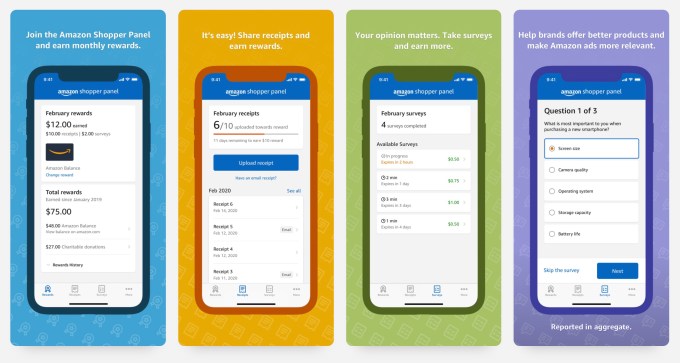
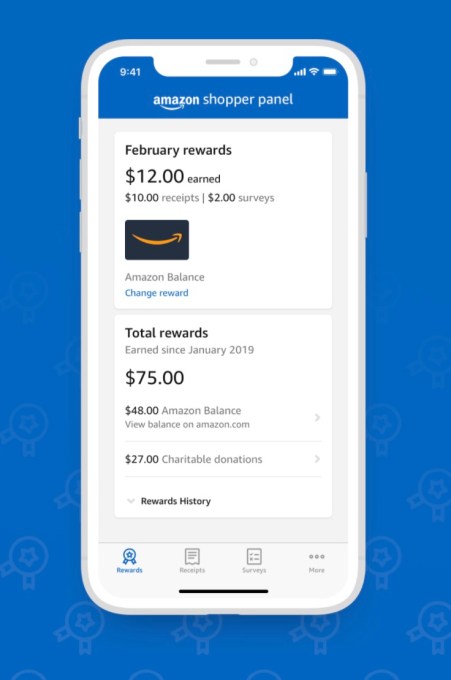
Program participants will take advantage of the newly launched Amazon Shopper Panel mobile app on iOS and Android to take pictures of paper receipts that qualify or they can opt to forward emailed receipts to receipts@panel.amazon.com to earn a $10 reward that can then be applied to their Amazon Balance or used as a charitable donation.

Amazon says users can then earn additional rewards each month for every survey they complete. The optional surveys will ask about brands and products that may interest the participant and how likely they are to purchase a product. Other surveys may ask what the shopper thinks of an ad. These rewards may vary, depending on the survey.

The program is currently opt-in and invite-only, and is also only open to U.S. consumers at this time. Invited participants can now download the newly launched Shopper Panel app and join the panel. Other interested users can use the app to join a waitlist for an invite.

Image Credits: Amazon

Amazon claims it will delete any sensitive information from the receipts users upload, like prescription information. But it doesn’t delete users’ personal information, instead storing it in accordance with its existing Privacy Policy. It will allow users to delete their previously uploaded receipts, if they choose, but it’s not clear that will actually remove collected data from Amazon’s systems.

Consumer research panels are common operations, but in Amazon’s case, it plans to use the data in several different ways.

On the website, Amazon explains it “may use” customer data to improve product selection at Amazon.com and Whole Food Market, as well as to improve the content selection offered through Amazon services, like Prime Video.

Amazon also says the collected data will help advertisers better understand the relationship between their ads and product purchases at an aggregate level and will help Amazon build models about which groups of customers are likely to be interested in certain products.

And Amazon may choose to offer data to brands to help them gain feedback on existing products, the website notes.

Image Credits: Amazon

The program’s launch follows increased scrutiny over Amazon’s anti-competitive business practices in the U.S. and abroad when it comes to using consumers’ purchase data.

Amazon came under fire from U.S. regulators over how it had leveraged third-party merchants’ sales data to benefit its own private label business. When Amazon CEO Jeff Bezos testified before Congress in July, he said the company had a policy against doing this, but couldn’t confirm that policy hadn’t been violated. The retailer may also be facing antitrust charges over the practice in the E.U..

At the same time, Amazon has been increasing its investment in its advertising business, which grew by 44% year-over-year in Q1 to reach $3.91 billion. That was a  faster growth rate than both Google (13%) and Facebook (17%), even if tiny by comparison — Google ads made $28 billion that quarter and Facebook made $17.4 billion, Digiday reported.

As the pandemic has accelerated the shift to e-commerce by 5 years or so, Amazon’s need to better optimize advertising space has also been sped up — and it may rapidly need to ingest more data that what it can collect directly from its own website.

In a message to advertisers about the program’s launch, Amazon positioned its e-commerce business as a small piece of the overall retail market — a point it often makes in hopes of avoiding regulation:

“In this incredibly competitive retail environment, Amazon works with brands of all sizes to help them grow their businesses not just in our store, but also across the myriad of places customers shop. We also work hard to provide our selling partners—and small businesses in particular—with tools, insights, and data to help them be successful in our store. But our store is just one piece of the puzzle. Customers routinely use Amazon to discover and learn about products before purchasing them elsewhere. In fact, Amazon only represents 4% of US retail sales. Brands therefore often look to third-party consumer panel and business intelligence firms like Nielsen and NPD, and many segment-specific data providers, for additional information. Such opt-in consumer panels are well-established and used by many companies to gather consumer feedback and shopping insights. These firms aggregate shopping behaviors across stores to report data like average sales price, total units sold, and revenue on tens of thousands of the most popular products.”

The retailer then explained that the Shopper Panel could help it to support sellers and brands by offering additional insights beyond its own store.

Amazon doesn’t say when the program waitlist will be removed, but says anyone can sign up starting today.

News: French TV networks team up to launch streaming service Salto

There’s a new streaming service in France called Salto. The companies behind the new service have been around for a while though. Salto is a joint initiative between TF1, France Télévisions and M6 — three major TV networks. Those companies already had their own apps with live TV and ad-supported catch-up content. And of course,

There’s a new streaming service in France called Salto. The companies behind the new service have been around for a while though. Salto is a joint initiative between TF1, France Télévisions and M6 — three major TV networks.

Those companies already had their own apps with live TV and ad-supported catch-up content. And of course, you can access content from these networks from your set-top box. But they’re trying something new with Salto.

For now, Salto is mostly an ad-free combination of all the individual apps from TF1, France Télévisions and M6. You can watch live TV from 19 different channels. You can play catch-up content from all three networks without any video ad.

It costs €6.99 per month. For €9.99, you can watch on two screens simultaneously. For €12.99 per month, you get four screens. Salto has released apps for Android, Android TV, iOS and tvOS. It also works in a web browser.

Such an offering probably won’t be enough to attract subscribers. That’s why Salto is slowly adding exclusive content to its platform as well. Salto is also going to be a good way to access content for kids in a dedicated section.

You can see some TV shows before they air on TV, such as an adaption from Agatha Christies’ ‘And Then There Were None’, the new season of Fargo. There are also some classic shows, such as Parks & Recreation and Seinfeld.

Who will be subscribing to Salto then? If you mostly watch live TV and you already know how to access catch-up content, Salto isn’t for you. If you already have access to premium content through a Canal+ subscription for instance, Salto isn’t for you.

But if you’re addicted to reality TV and daily soap operas, Salto could be a nice service to consume your favorite show. If you don’t pay for any streaming service, it could be a cheap service to get started and access some basic shows and movies.

Image Credits: Salto

News: Investors appear to shrug at antitrust lawsuit aimed at Google

Investors do not seem concerned that the Department of Justice filed an antitrust suit against Google earlier today. The suit, seen by some as a stunt near the election, is one of a multi-part push to change the face of the technology industry, which has seen its wealth and power expand in recent years. For

Investors do not seem concerned that the Department of Justice filed an antitrust suit against Google earlier today.

The suit, seen by some as a stunt near the election, is one of a multi-part push to change the face of the technology industry, which has seen its wealth and power expand in recent years. For example, technology companies now constitute nearly 40% of the value of the S&P 500, ahead of a 1999-era 37% share, according to The Wall Street Journal.

At the same time, the rising tide lifting many tech boats has provided huge gains to its largest players as well. Alphabet, Microsoft, Amazon and Apple are each worth north of $1 trillion apiece, making them historically valuable companies even amidst an economic downturn.

Those market caps do not appear to be in danger.

Today after lunch during regular trading hours the tech-heavy Nasdaq Composite index is up 0.86%, while Alphabet is up 0.91%, directly in line with broader trading. Shares of Alphabet initially rose this morning before giving back their gains. However, since those morning lows, shares of the tech giant have recovered to edge ahead of the market.

Investor reaction could shift regarding Google’s antitrust liabilities in time. The Department of Justice suit is hardly the only legal issue that the search giant is currently grappling with. But not today.

News: Meadow launches a powerful mobile marketing tool for cannabis dispensaries

Meadow was once called the Amazon of weed. Now it’s trying to be the Salesforce of weed, too. Meadow, the maker of a popular point of sale system for cannabis dispensaries, is today launching new tools for its clients. Called the Meadow Platform, it includes two key tools for dispensaries: a customer relationship manager (CRM)

Meadow was once called the Amazon of weed. Now it’s trying to be the Salesforce of weed, too.

Meadow, the maker of a popular point of sale system for cannabis dispensaries, is today launching new tools for its clients. Called the Meadow Platform, it includes two key tools for dispensaries: a customer relationship manager (CRM) and a text messaging platform for mobile marketing. As the company puts it in the news release, this system is designed to let users push a button and sell more weed.

This system is designed to help legal weed proprietors serve its client base with deep insights and targeted marketing — all while abiding by the strict regulations governing the budding industry (pun intended).

Meadow’s POS system is widely used throughout the legal cannabis industry, giving retailers inventory management, analytics, online ordering, and more. Because of regulations, retailers have a wealth of information on their clientele, which Meadow’s system can use for target marketing. Since these new features are built-into the Meadow platform, instead of through a 3rd party add-on, Meadow says it’s protected by the same security used throughout the rest of its platform.

Current regulations make it difficult for dispensaries to market their wares. These retailers cannot fully utilize modern marketing channels such as social media, leaving most retailers with limited options outside of billboards. Meadow’s new solution brings standard marketing tools to dispensaries.

“Marketing is not one-size-fits-all, especially in cannabis. Dispensaries need tools to select which customers they want to talk to in order to send relevant messages and promotions,” said David Hua, CEO and Co-Founder of Meadow, said in a released statement. “Let brand-loyal customers know when their favorite brands release new strains, products, blends, or flavors. Tell customers about new hours or delivery and pick-up options. Send re-engagement offers to customers who have dropped off. Let members of your loyalty program know when they have points to cash in and include their point balance. Tip-off VIPs when a limited-edition strain becomes available and give them first dibs. This is the level of delight and sophistication that has been missing from cannabis marketing, and we’re very excited to debut it to dispensaries across California.”

David Hua, Harrison Lee, Rick Harrison, and Scott Garman founded Meadow in 2014. Since then, the company raised $2.1M and participated in Y Combinator’s Winter 2015 class. The company currently has 14 employees.

Building this product has always been part of Meadow’s goal, Hua tells TechCrunch. COVID-19 helped accelerate the need.

“[Meadow] has always had three core priorities,” Hua said. “The first was compliance, which we had a big checkmark at the beginning of this year. The second was operational efficiency, and now marketing. These dispensary owners, especially in this COVID-19 world, can talk directly to their customers again, bring in more revenue and give them more information on what’s happening. Now they can leverage Meadow’s platform to do promo codes, automated discounts, loyalty rewards; we have all that. So you could have a customer that’s ordering an early bird special at 9:00 am, and that’s a member of your senior group that gets 10% off. You can now send them a message regarding new topicals. Marketing just becomes more engaging.”

News: Google announces slew of Chrome OS features to help extend enterprise usage

As companies have moved to work from home this year, working on the internet has become the norm, and it turns out that Chrome OS was an operating system built for cloud-based applications. But most enterprise use cases are a bit more complex, and Google introduced some new features today to make it easier for

As companies have moved to work from home this year, working on the internet has become the norm, and it turns out that Chrome OS was an operating system built for cloud-based applications. But most enterprise use cases are a bit more complex, and Google introduced some new features today to make it easier for IT to distribute machines running Chrome OS.

While the shift to the cloud has been ongoing over the last few years, the pandemic has definitely pushed companies to move faster, says John Maletis, project manager for engineering and UX for Chrome OS. “With COVID-19, the need for that productive, distributed workforce with some employees in office, but mostly [working from home] is really in the sights of businesses everywhere, and it is rapidly accelerating that move,” Maletis told TechCrunch.

To that end, Cyrus Mistry, group product manager at Google says that they want to make it easier for IT to implement Chrome OS and they’ve added a bunch of features to help. For starters, they have created a free readiness tool that lets IT get the lay of the land of which applications are ready to run on Chrome OS, and which aren’t. The tools issues a report with three colors: green is good to go, yellow is probable and red is definitely not ready.

To help with the latter categories, the company also announced the availability of Parallels for Chrome OS, which will enable companies with Windows applications that can’t run on Chrome OS to run them natively in Windows in a virtual machine. Mistry acknowledges that companies running Windows this way will need to issue higher end Chromebooks with the resources to handle this approach, but for companies with critical Windows applications, this is a good way to extend the usage of Chromebooks to a broader population of users.

To make it easier to issue machines ready to use of the box, Google is also introducing zero touch distribution, which allows manufacturers to set up machines for a domain ready to use out of the box. All the user has to do is turn it on and it’s ready to use.

“We can do what’s called zero touch, which is the devices can be already enrolled by the manufacturers, which means they will know the domain and they can now drop ship directly,” Mistry explained. That means these machines are equipped with the right settings, policies, applications, certificates and so forth, as though IT had set up the machine for the user.

In another nod to making life easier for IT, Google  is offering a new set of certified applications like Salesforce, Zoom and Palo Alto Networks which have been certified to work well on Chrome OS. Finally, the company announced that it will be enabling multiple virtual work areas with the ability to drag and drop between them, along with the ability to group tabs and search for tabs in the Chrome browser, which should be ready in the next couple of months.

As Maletis pointed out, the company may have been ahead of the market when it released Chrome OS almost a decade ago, but this year has shown that companies need the cloud to stay in operation and Chrome OS is an operating system built from the ground up for the cloud.

News: Microsoft Azure announces its first region in Austria

Microsoft today announced its plans to launch a new data center region in Austria, its first in the country. With nearby Azure regions in Switzerland, Germany, France and a planned new region in northern Italy, this part of Europe now has its fair share of Azure coverage. Microsoft also noted that it plans to launch

Microsoft today announced its plans to launch a new data center region in Austria, its first in the country. With nearby Azure regions in Switzerland, Germany, France and a planned new region in northern Italy, this part of Europe now has its fair share of Azure coverage. Microsoft also noted that it plans to launch a new ‘Center of Digital Excellence’ to Austria to “to modernize Austria’s IT infrastructure, public governmental services and industry innovation.”

In total, Azure now features 65 cloud regions — though that number includes some that aren’t online yet. As its competitors like to point out, not all of them feature multiple availability zones yet, but the company plans to change that. Until then, the fact that there’s usually another nearby region can often make up for that.

Image Credits: Microsoft

Talking about availability zones, in addition to announcing this new data center region, Microsoft also today announced plans to expand its cloud in Brazil, with new availability zones to enable high-availability workloads launching in the existing Brazil South region in 2021. Currently, this region only supports Azure workloads but will add support for Microsoft 365, Dynamics 365 and Power Platform over the course of the next few months.

This announcement is part of a large commitment to building out its presence in Brazil. Microsoft is also partnering with the Ministry of Economy “to help job matching for up to 25 million workers and is offering free digital skilling with the capacity to train up to 5.5 million people” and to use its AI to protect the rainforest. That last part may sound a bit naive, but the specific plan here is to use AI to predict likely deforestation zones based on data from satellite images.

News: Call analytics platform Invoca expands into sales, e-commerce and customer experience

Invoca, which helps companies extract and use data from customer phone calls, is expanding today with the launch of products for e-commerce, customer experience and sales teams, as well as a new Invoca Exchange, where businesses can find all of the platform’s third-party integrations. The company is making these announcements as part of its virtual

Invoca, which helps companies extract and use data from customer phone calls, is expanding today with the launch of products for e-commerce, customer experience and sales teams, as well as a new Invoca Exchange, where businesses can find all of the platform’s third-party integrations.

The company is making these announcements as part of its virtual Invoca Summit. Ahead of the event, CEO Gregg Johnson (previously an executive at Salesforce) told me that customers have been asking Invoca to expand beyond its previous focus on providing “conversation intelligence” to marketing teams.

“‘We need to get aligned on how we support the revenue journey,’” Johnson recalled businesses telling him. “We were already going down this path, but when COVID hit, we tripled down on it.”

He argued that the data that Invoca provides has become even more important during the pandemic and related lockdowns, when businesses only had “two sources of feedback” — digital interactions and customer conversations. And while there are plenty of analytics tools for tracking online behavior, Johnson said, “Customer conversations are really important because they get at why” people are behaving in a certain way.

And at the same time, Johnson said call center teams have had to shift to working at home, which meant that they had to switch to online software and “everything broke,” while supervisors “no longer had any visibility into how agents were performing.”

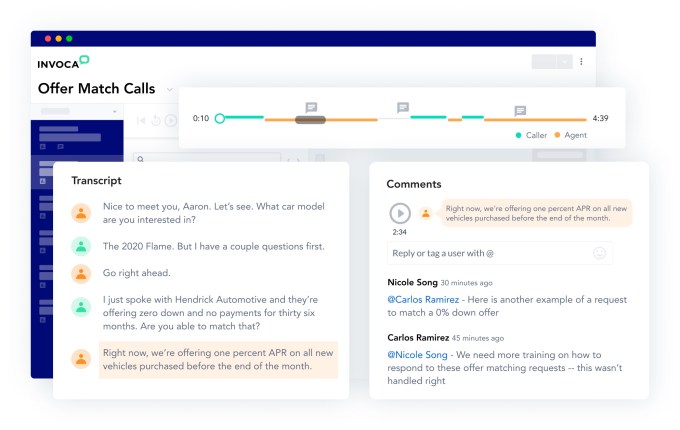
Invoca platform

Image Credits: Invoca

Invoca is trying to address these issues by making sure that marketing, sales, customer experience and e-commerce teams all have access to the same call data.

For example, he said that agents at Invoca customer BBQGuys need data to understand what products to recommend for their customers if the specific grill that they want isn’t available. Or a healthcare provider might use call data to predict and prepare when COVID cases might be rising in their area.

“We’ve always viewed ourselves as an application and a platform,” Johnson added. “We already give you ability to use this data at Invoca to automatically apply these insights without any human intervention at all. So for us, we thought through use cases to feed this data into other tools and created four solutions … that are really joined at the hip.”

Invoca for eCommerce, Invoca for Customer Experience and the existing Invoca for Marketing product are all available now, while Invoca for Sales is currently signing up beta testers for November.

The Invoca Exchange, meanwhile, already includes more than 40 integrations, including Google, Salesforce, Facebook, Adobe, Tealium, and Five9. The company is also announcing new partnerships with FullStory and Criteo.


WordPress Image Lightbox Plugin