Yearly Archives: 2020

News: PayPal to let you buy and sell cryptocurrencies in the US

PayPal has partnered with cryptocurrency company Paxos to launch a new service. PayPal users in the U.S. will soon be able to buy, hold and sell cryptocurrencies. More countries are coming soon. PayPal plans to support Bitcoin, Ethereum, Bitcoin Cash and Litecoin at first. You’ll be able to connect to your PayPal account to buy

PayPal has partnered with cryptocurrency company Paxos to launch a new service. PayPal users in the U.S. will soon be able to buy, hold and sell cryptocurrencies. More countries are coming soon.

PayPal plans to support Bitcoin, Ethereum, Bitcoin Cash and Litecoin at first. You’ll be able to connect to your PayPal account to buy and sell cryptocurrencies. Behind the scenes, Paxos takes care of trading and custody.

In early 2021, PayPal wants to let you use your crypto assets as a funding source for your PayPal purchases. This could be a good way to use cryptocurrencies for everyday purchases without having to convert cryptocurrencies on an exchange first.

There are 26 million merchants that offer PayPal around the world. For those merchants, customers paying in crypto won’t have any impact. Everything will be converted to fiat currency when a transaction is settled.

As part of today’s move, PayPal has been granted a conditional BitLicense by the New York State Department of Financial Service. It should be able to launch its crypto service in partnership with Paxos in New York.

PayPal’s crypto service isn’t live just yet. You can head over to PayPal’s website and join the waitlist. The company has already updated its fees with more details about cryptocurrency exchange fees.

The company will charge high fees on fiat-to-cryptocurrency and cryptocurrency-to-fiat exchange transactions. You can expect to pay 2.3% for transactions below $100, 2% for transactions between $100 and $200, 1.8% for transactions between $200 and $1,000 and 1.5% for transactions above $1,000. There’s a minimum fee of $0.50 for transactions below $25. The page also says that there will be some spread between buy and sell prices.

As a comparison, Coinbase charges 1.49% in conversion fees for any transaction over $200, and a fixed fee below that amount. Square’s Cash App charges variable fees and Robinhood hides its fees behind some markup on market prices.

Revolut, which also partners with Paxos in the U.S. to offer cryptocurrency trading, charges 2.5 to 3% in exchange fees for free customers. If you’re a premium user, you pay 1.5% in fees.

Many companies have been trying to build the PayPal of crypto. It turns out that the PayPal of crypto could just be PayPal.

News: Ford outs 4th-gen self-driving platform with better sensors, cleaning tech, and improved batteries

Ford and Argo AI today released details about its fourth-generation self-driving test vehicle. Built on the 2020 Ford Escape Hybrid, the vehicle has everything needed to standup a self-driving service, the Detroit automaker said. It’s equipped with an improved battery system, new sensors, and sensor cleaning technology. The previous three generations of test vehicles used

Ford and Argo AI today released details about its fourth-generation self-driving test vehicle. Built on the 2020 Ford Escape Hybrid, the vehicle has everything needed to standup a self-driving service, the Detroit automaker said. It’s equipped with an improved battery system, new sensors, and sensor cleaning technology.

The previous three generations of test vehicles used the Ford Fusion sedan.

For this latest platform, Ford upgraded the LiDAR sensor suite with an all-new system that sports a higher resolution 128-beam array to provide a 360-degree view. Ford says this helps the test vehicle better detect fix and moving objects closer to the vehicle. Near-field cameras and short-range LiDAR look ahead and to the vehicle’s side while rear-facing sensors help with objects behind the SUV.

The Escape Hybrid’s platform better serves the self-driving technology with improved battery cooling. Ford says that modified high voltage batteries help supply the self-driving system while also reducing the gasoline consumed by the vehicle.

Ford is rolling out this new testbed to its testing cities of Austin, Detroit, Miami, Palo Alto, Pittsburgh, and Washington D.C. And in each of these regions, the improved sensor cleaning technology should help the vehicle in its self-driving efforts.

Ford says it reworked the systems tasked with ensuring the sensors are free of dust, rain, snow, and ice. More spray nozzles shoot out liquid cleaning solutions at a higher pressure than previous models. The LiDAR sensors have a newly-developed hidden, forced-air cleaning system, too.

Ford said in 2018 it intended to spend $4 billion on autonomous vehicles by 2023, and recent developments make it clear Ford is pushing forward in this effort. In 2018 the automaker purchased the defunct Michigan Central Station and surrounding buildings in Detroit’s Corktown neighborhood. Since then, it has been making additional investments in the area as it retrofits the massive train station. Two months ago, it teamed with Bosch and Bedrock to announce an automated valet parking garage.

Despite’s today’s news, the company’s self-driving service is still a few years out. In April 2020, Ford said it was postponing its autonomous vehicle service until 2022, as the COVID-19 crisis caused a rethink of the strategy.

News: Review: iPad Air, smooth criminal

The 2020 iPad Air comes at an interesting time in Apple’s release cycle. The iPad Pro is still strong from a specs perspective but is now technically a half generation or so behind in CPU. The new pro models won’t arrive for (theoretical) months.  So what you end up with is a device that shares

The 2020 iPad Air comes at an interesting time in Apple’s release cycle. The iPad Pro is still strong from a specs perspective but is now technically a half generation or so behind in CPU. The new pro models won’t arrive for (theoretical) months. 

So what you end up with is a device that shares the design philosophy of the iPad Pro and inherits some of its best features while simultaneously leaping ahead of it in raw compute power. This makes the Air one of the better overall values in any computing device from Apple in some time. In fact, it’s become obvious that this is my top choice to recommend as a casual, portable computer from Apple’s entire lineup including the MacBooks. 

The clean new design has a thin, pleasantly colored simplicity to it. It matches the new iPhone 12 aesthetic quite well. The smoothly bullnosed corners and dusty blue peened finish make this one of the better looking iPads since the original. For years, Apple moved to try to “pull” the casing of the iPads around the back, making it disappear. This new design is a nice balance between the original’s frank simplicity and the new iPad Pro direction. A bit less sharp-edged and a bit more ‘friendly’ while still crisp.

One thing that I love a lot about the Air is that it lives up to its name and clocks in at the lightest weight of any of Apple’s portables at 1.0lb flat. This plus the Magic Keyboard is just such a killer portable writing machine it’s wild. 

Apple didn’t fix the camera position on this, something that still stinks about the iPad Pro because you have to use Face ID to unlock it and your hand is always in the way in landscape mode. Instead, they straight up ditched the entire True Depth camera and Face ID altogether and tucked Touch ID into the power button.

The initial scanning process to set up a finger seemed ever so slightly more reluctant to grab my fingerprint here than it used to on the home button. My guess is that it’s to do with the oblong shape of the sensor or its housing. But once it was scanned and input, I’m happy to report that it works exactly as well if not better than any iPhone home button version. I set a finger on my left hand here because I only use iPads in horizontal mode. But if you aren’t a keyboard person and are doing a lot of reading, the right hand would be appropriate. 

I actually found this to be a more natural feeling activation gesture than swiping up only to remember that my hand is in the way and having to move it and look at the camera. If the camera was placed along the horizontal edge of the iPad Pro or even in the corner I might feel differently. But as a compromise so that Apple doesn’t have to ship a True Depth camera in this unit, it works plenty fine. 

The surface of the Touch ID button is covered by an opaque sapphire crystal cover that blends well with the casing but allows the print to be read through it. 

Once you have the iPad Air unlocked, it falls right into the ‘X’ style navigation system. Swipes to open and navigate and move around. This is great because it brings near parity of navigation across Apple’s device lineup (minus the iPhone SE.)

The camera is fine. Do you shoot pictures on an iPad? Really you do? Wow, interesting, ok. Maybe buy the iPad Pro which has a full LiDAR array, a Wide and an Ultra Wide lens. Great for artists, scanning, reference work etc. On the iPad Air the camera is just fine but is really a formality. It can be used in all of those ways and the quality is on par, but it’s there because it has to be there. 

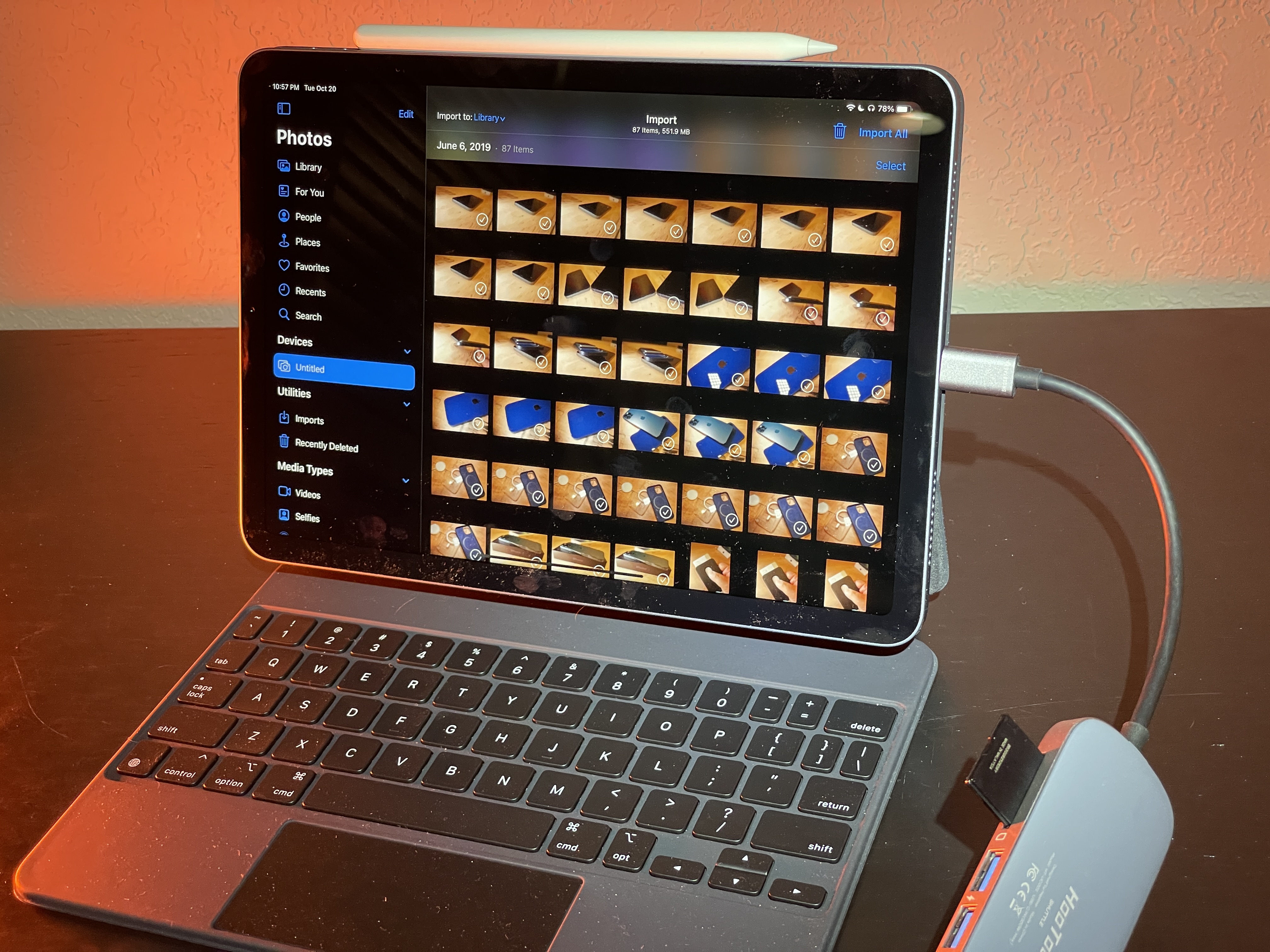
Those of you that travel with an iPad and an iPhone will be happy to know that you can charge an iPhone from the USB-C port on the iPad Air. And yep, it works fine with USB-C hubs and card readers too.

The iPad Air has 4GB of RAM where the iPad Pro 2020 has 6GB. It has a Liquid Retina display, but no ProMotion 120hz refresh. The lack of ProMotion is unfortunate but understandable. It requires another whole layer of display technology that is quite a bit more expensive. Having gotten used to it now I would say that on a larger screen like this it’s easily the best excuse for spending the extra $150-200 to bump up to the 11” Pro model. It’s just really damn nice. If you’ve never had one, you’ll be a lot less likely to miss this obviously.

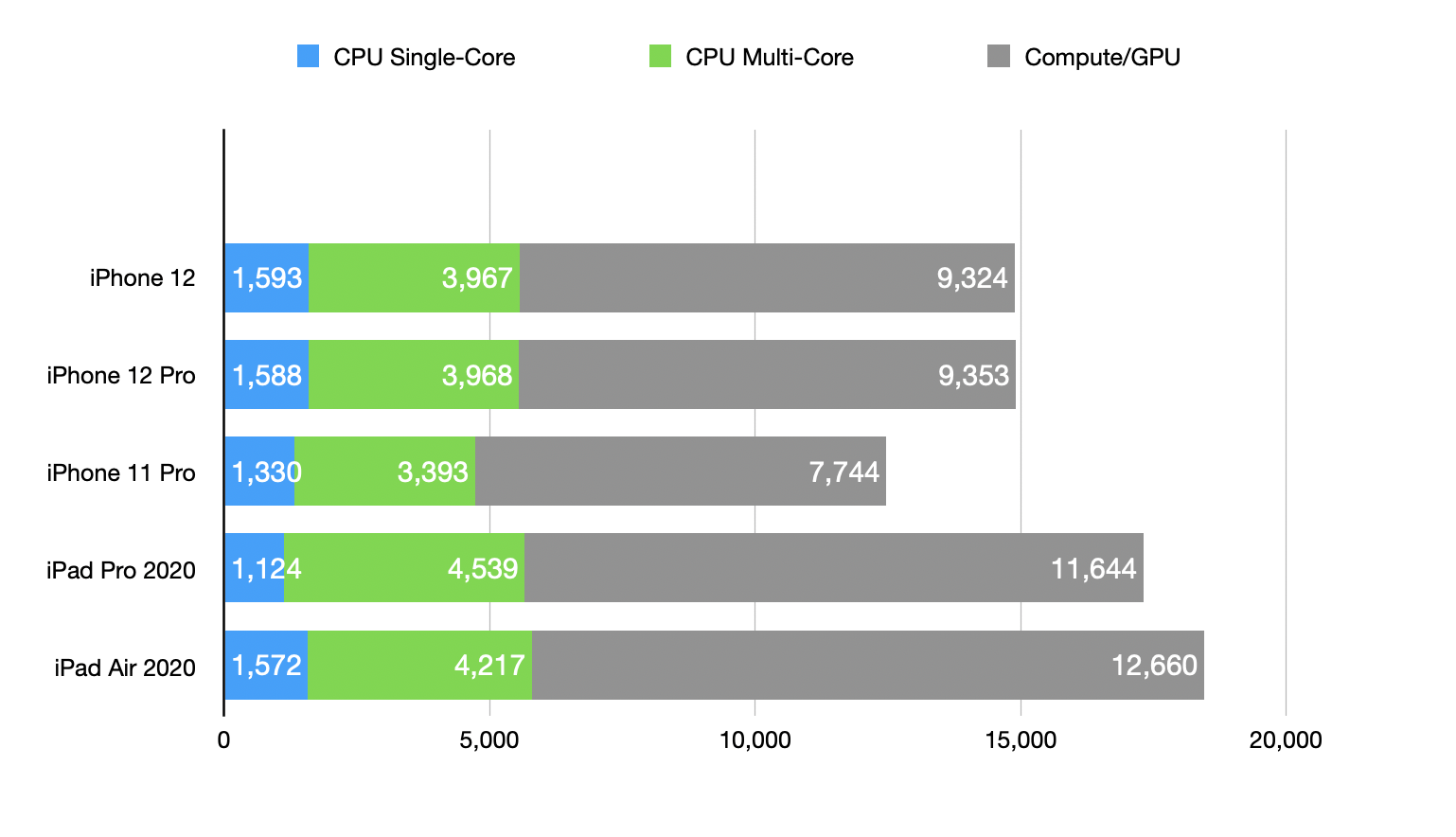
But it also has an A14 Bionic chip where the iPad Pro 2020 models are still on the A12Z. Because that ‘Z’ is related to the fact that it has an extended number of graphics cores (8-core CPU/8-core GPU), the performance gap isn’t as big as you’d think.

Though the iPad Air edges out the iPad Pro in single-core performance, the multi-core numbers are essentially on parity. This speaks to the iPad Pro being tuned to handle multiple processes in simultaneous threads for processing images and video. If you’re running Photoshop or Premiere Rush or LumaFusion on an iPad, you want the Pro. For most other uses, you’re gonna be just fine with the Air.

I do really wish that the Air started at 128GB instead of 64GB for the base $599 price. Apple has finally gotten the iPhone to a great place for minimum storage across the lineup, and I wish that the iPad Air matched that. If a ton of space is important to you, it’s important to note that you cannot get anything over 256GB in this unit, unlike the iPad Pro that is offered up to 1TB. 

The two speaker system in the iPad Air is arranged in the much better horizontal array but it’s hal the amount that are in the iPad Pro and it shows. It’s a bit less loud overall but honestly the top volume is still way more than you need for typical iPad viewing distance.

Much of what I wrote about using Apple’s iPad Pro over the course of 10,000 miles of travel applies directly here. I still find it to be a great experience that, once you’ve adjusted for workflows, is just as powerful as any laptop. The additional features that have shipped in iOS 14 since that review have only made the iPad a better platform for legitimate work. 

And now you get the Gen 2 pencil and the fantastic Magic Keyboard in an iPad outside of the Pro lineup and it honestly adds a ton of the utility. 

Here’s my advice: Buy this if you want a portable iPad Pro to use alongside a MacBook or desktop computer for those times you don’t want to carry or can’t carry it. If you want an iPad Pro as your only computer, get the big iPad Pro but probably wait until they update that one in a few months.

News: Adobe’s Project Sharp Shots uses AI to deblur your videos with one click

Every year at its MAX user conference, Adobe shows off a number of research projects that may or may not end up in its Creative Cloud apps over time. One new project that I hope we’ll soon see in its video apps is Project Sharp Shots, which will make its debut later today during the

Every year at its MAX user conference, Adobe shows off a number of research projects that may or may not end up in its Creative Cloud apps over time. One new project that I hope we’ll soon see in its video apps is Project Sharp Shots, which will make its debut later today during the MAX Sneaks event. Powered by Adobe’s Sensei AI platform, Sharp Shots is a research project that uses AI to deblur videos.

Shubhi Gupta, the Adobe engineer behind the project, told me the idea here is to deblur a video — no matter whether it was blurred because of a shaky camera or fast movement — with a single click. In the demos she showed me, the effect was sometimes relatively subtle, as in a video of her playing ukulele, or quite dramatic, as in the example of a fast-moving motorcycle below.

With Project Sharp Shots, there’s no parameter tuning and adjustment like we used to do in our traditional methods,” she told me. “This one is just a one-click thing. It’s not magic. This is simple deep learning and AI working in the background, extracting each frame, deblurring it and producing high-quality deblurred photos and videos.”

Image Credits: AdobeGupta tells me the team looked at existing research on deblurring images and then optimized that process for moving images — and then optimized that for lower-memory usage and speed.

It’s worth noting that After Effects already offers some of these capabilities for deblurring and removing camera shake, but that’s a very different algorithm with its own set of limitations.

This new system works best when the algorithm has access to multiple related frames before and after, but it can do its job with just a handful of frames in a video.

Image Credits: Adobe

News: Syte, an e-commerce visual search platform, gets $30 million Series C to expand in the U.S. and Asia

Tel Aviv-based visual search and product discovery platform Syte, already used by brands like Farfetch and Fashion Nova, plans to expand in the United States and Asia-Pacific region after its latest funding. The startup announced today it has raised a $30 million Series C, with an additional $10 million in debt. The round was led

Syte’s cofounders, chief executive Ofer Freyman, chief revenue officer Lihi Pinto-Fryman and chief operating officer Idan Pinto

Syte’s cofounders, chief executive Ofer Freyman, chief revenue officer Lihi Pinto-Fryman and chief operating officer Idan Pinto

Tel Aviv-based visual search and product discovery platform Syte, already used by brands like Farfetch and Fashion Nova, plans to expand in the United States and Asia-Pacific region after its latest funding. The startup announced today it has raised a $30 million Series C, with an additional $10 million in debt.

The round was led by Viola Ventures, with participation from LG Tech Ventures, La Maison, MizMaa Ventures, Kreos Capital, and returning investors Magma, Naver Corporation, Commerce Ventures, Storm Ventures, Axess Ventures, Remagine Media Ventures and KDS Media Fund. Syte’s last round of funding, a $21.5 million Series B, was announced in September 2019. The startup has now raised a total of $71 million.

Launched in 2015 to focus on visual search for clothing, Syte’s technology now covers other verticals like jewelry and home decor, and is used by brands including Farfetch, Fashion Nova, Castorama and Signet Jewelers. Syte says that its solutions can increase conversion by 177% on average.

The company’s platform includes three main products: Visual Discovery to let brands add camera search, recommendation engines and discovery buttons; “Searchendising,” which automatically generates tags based on visual AI to improve search and recommendation results; and a Discovery Marketplace used by publishers, smart devices manufacturers and social platforms to increase the reach of product advertisements.

Since the beginning of 2020, Syte says its customer base has grown 38%, partly because of the increase in e-commerce traffic caused by COVID-19 movement restrictions.

In the company’s press announcement, chief executive officer and co-founder Ofer Fryman said Syte will focus on developing or acquiring product discovery technology “spanning the full range of our senses—visual, text, voice, and more” to create types of personalized recommendations.

A lot of Syte’s current customers are in Europe, the Middle East and Africa, so its new funding is also earmarked to increase its presence in the U.S. and Asia-Pacific markets.

More social media platforms and e-commerce platforms, including Amazon, Target, IKEA, Walmart, eBay, Snap, and Pinterest, are using visual search and recognition technology to give users an alternative to keyword searches. By simplifying the search process or automatically generating tags, visual recognition technology can help improve search results and product recommendations, resulting in more conversions.

There is a roster of other companies that are also working on AI-based visual recognition and search technology for e-commerce. Other startups in the same space that have raised venture capital funding include Donde Search, ViSenze and Slyce.

Gal Fontyn, Syte’s vice president of marketing, told TechCrunch that it differentiates with visual AI algorithms developed by co-founder and chief technology officer Helge Voss, who previously worked as a physicist at CERN (the European Organization for Nuclear Research).

Voss’ background in neural networks and machine learning allowed Syte to build a visual search solution that can produce results with over 95% accuracy in object-matching within less than a second, Fontyn said. Its algorithms have also been trained on millions of products from vendors around the world, which Syte claims gives it the “largest vertical-specific lexicon in the industry.” This is what allows it to recognize several objects within an image, and assign them detailed tags.

Brands that use Syte see a 423% increase on average on ROI, Fontyn added.

News: June’s third-gen smart oven goes up for pre-order, starting at $599

2020 is June’s time to shine. With an increasing number of people stuck and home, trying (and often failing) to fend for themselves in their kitchen, the smart oven startup has a solid opportunity to considerably expand its users base. “The rise in at-home cooking has caused us to reevaluate June’s cook-programs to achieve more

2020 is June’s time to shine. With an increasing number of people stuck and home, trying (and often failing) to fend for themselves in their kitchen, the smart oven startup has a solid opportunity to considerably expand its users base.

“The rise in at-home cooking has caused us to reevaluate June’s cook-programs to achieve more culinary possibilities not captured by a standard home oven,” CTO and co-founder Nikhil Bhogal said in a release.

Today it announced the launch of a third-generation oven, two years after its last major update. From the sound of it, the update is a relatively minor one. There are a handful of upgrades to the oven’s hardware, including a new handle, added guard rails on top of heating elements, quieter fans and a new chipset with better wireless connection.

Image Credits: June Oven

The biggest change to its functionality is the ability to control each of its six heating elements individually (whereas the previous model only controlled them as groups) for more even roasts. The software interface has gotten an upgrade, as well, and the on-board AI camera system is capable of recognizing where the food is placed for optimal cooking and can identify hundreds of different food types.

At $599, it’s still a pricy kitchen appliance. The system amounts to a large, smart toaster oven — albeit one with a bunch of different food-cooking options, from air frying to dehydrating and broiling. The price goes up from there. There’s a $799 bundle that adds a year to the warranty and includes a one-year subscription to the June premium service and a $999 version that includes a bunch of additional add-ons, including air baskets, a pizza and grill kit and additional thermometers.

Pre-orders open today. No word on exact launch date.

News: Road trippers can rejoice as RVshare raises over $100 million to grow its RV rental business

As continentally confined Americans look for domestic vacation options that won’t expose them to too much risk of infection from the pandemic that’s still raging across the country, the RV rental company RVshare has raised over $100 million to capitalize on its historic opportunity. The company’s new cash has come from the private equity firms

As continentally confined Americans look for domestic vacation options that won’t expose them to too much risk of infection from the pandemic that’s still raging across the country, the RV rental company RVshare has raised over $100 million to capitalize on its historic opportunity.

The company’s new cash has come from the private equity firms KKR and Tritium Partners and is intended to provide operational support to meet the booming demand for RVs as Americans hit the road in unprecedented numbers.

Growth for the Akron, Ohio-based company can only be described as absurd. The company saw a 650% increase in bookings from April to May of 2020, according to a report in The Drive.

The resurgence of the RV industry isn’t just pandemically driven, but there’s no doubt that the outbreak of Sars-Cov-2 has played a role in the dramatic surge in demand for campers. Vacationers just don’t have many other options given travel restrictions and risk.

And RVshare certainly isn’t alone in reaping the benefits.

There’s Outdoorsy, a peer-to-peer RV rental company that was founded in 2015, bootstrapped by its founders for a couple of years, and has more recently attracted $88 million in venture funding. That funding included a $13 million extension to a $50 million Series B round that it quietly closed early this year, as TechCrunch reported. Cabana, another startup, launched by a former Lime executive, is merging the RV rental market with hotels. Then there’s Kibbo, which is turning RV parks into a photo worthy version of the hashtag vanlife.

Founded in 2013, RVshare connects RV owners with people who want to rent an RV. Since 2013, the company has amassed a network of over 100,000 recreational vehicles or trailers ranging from deluxe motorhomes to camper vans to trailer attachments. Led by chief executive Jon Gray, RVshare has seen bookings for the fall rising 166% year-on-year from 2019.

“As a result of the pandemic, RVshare has seen an acceleration of growth as consumers have sought out RVs as a way to travel during these challenging times. Tritium is excited to continue investing in this team, business, and a category that is just getting started. Adding the KKR team, with their fantastic set of experiences and resources, will help take RVshare to much greater heights.”

KKR made the investment through its Next Generation Technology Growth Fund II, which closed with $2.2 billion in January 2020. The investment in RVshare is actually the 10th commitment from the fund. Earlier investments include Zwift, ReliaQuest, Artlist, Darktrace, o9 Solutions and Slice.

GCA Global served as financial advisor to RVshare on the deal, according to a statement.

“RVs are the preferred accommodation for the more than 40 million US households that go camping each year,” said Ben Pederson, a Principal with KKR’s Technology Growth team. “Younger generations of travelers are discovering and embracing domestic travel and RVshare is providing a seamless marketplace experience where RV owners can share their passion for camping and unlock the value of their assets.”

News: MindLabs raises £1.4 million for its new platform, a “Peloton for mental health”

Ideally, mental wellness should be considered part of a healthy daily routine, like exercise. But even exercise is difficult to turn into a regular habit. Peloton addressed physical fitness by combining smart stationary bikes with live classes and community features to create an engaging experience. Now a new startup, MindLabs, is taking a similar approach

Ideally, mental wellness should be considered part of a healthy daily routine, like exercise. But even exercise is difficult to turn into a regular habit. Peloton addressed physical fitness by combining smart stationary bikes with live classes and community features to create an engaging experience. Now a new startup, MindLabs, is taking a similar approach to mental wellness.

Based in London, MindLabs announced today it has raised £1.4 million (about USD $1.82 million) in pre-seed investment led by Passion Capital, with participation from SeedCamp, as well as several founders of British consumer tech startups: Alex Chesterman (Cazoo and Zoopla); Neil Hutchinson (Forward Internet Group); Steve Pankhurst (FriendsReunited); James Hind (Carwow); and Jack Tang (Urban).

MindLabs was founded earlier this year by Adnan Ebrahim and Gabor Szedlak, who previously launched and ran Car Throttle, an online media and community startup that was acquired by Dennis Publishing last year. Ebrahim told TechCrunch that MindLabs’ goal is to “make taking care of your mental health as normal as going to the gym.”

Its platform will launch next year, first with a mobile app that combines live videos from mental health professionals who lead meditation and mindfulness sessions, and features to help users track their stress levels. The full platform will also include an EEG headband, called “Halo,” that measures signals, like heart and respiration rates, that can help show users how effective their sessions are.

Going from CarThrottle, sometimes described as “a BuzzFeed for cars” to mental wellness might seem like a big leap, but Ebrahim said their experience “running a media company in a tough market with a young, millennial workforce” inspired him and Szedlak to think more about the issue.

MindLabs founders Gabor Szedlak and Adnan Ebrahim

MindLabs founders Gabor Szedlak and Adnan Ebrahim

“We witnessed firsthand how there was a complete lack of investment in helping this generation with their mental health in a way that they’re used to: a community product that is mobile-first and video-led,” Ebrahim said.

“Alongside that, we had to find ways to deal with managing our own mental health given the stresses that can come when running a fast-paced, venture-backed company. And when we saw the alarming statistics in young adult suicide rates and depression, we realized that finding a solution for our own problems would help millions of others, too.”

The two left Dennis Publishing to begin work on MindLabs at the end of January. During the next few months, including time spent in COVID-19 lockdown, they began researching and developing initial concepts for the platform.

“It’s fair to say that the pandemic did end up altering the course of MindLabs,” Ebrahim said. “For example, we built more real-time community features into the app as a result of the isolation and loneliness we are all now facing as a result of lockdown. We really want to make sufferers feel less alone during the hard times, but with the added convenience now of being able to watch our videos at home.

“This has already become the new normal when it comes to physical fitness, with companies like Peloton exploding in growth, and we see the same trend happening with mental wellness, too,” he added.

The COVID-19 pandemic has also been described as a mental health crisis, and downloads of meditation and mindfulness apps like Calm, Headspace and Relax: Master Your Destiny, have grown as people try to deal with anxiety, isolation and depression at home.

Two of the main ways MindLabs’ platform differentiates from other mental wellness apps is the combination of its video classes and EEG headband. The videos will initially range in length from 10 to 40 minutes and, like Peloton’s classes, will be available on livestream or in pre-recorded, on-demand sessions.

Instead of categorizing videos by technique (for example, meditation, breathing or visualization), MindLabs decided to sort them into issues that users want to cope with, like anxiety, relationships, motivation or addiction. For example, meditation classes may include ones focused on “Overcoming COVID-19 Anxiety” or “Coping With Stress At Work.”

Community features will be linked to the classes: the number of concurrent users in a class will be displayed, along with a live feed showing subscriber achievements, like streaks or number of minutes spent in a “calm state,” that other people can react to for positive reinforcement.

Halo was developed with a hardware specialist that Ebrahim said has seven years of building and distributing medical grade wearables.

“Most importantly our headset will be going through the rigor of ISO 13485 so we can ensure the product is of the highest quality and the data we gather is the most accurate,” he added. “We want to make this technology accessible, so we expect the price of the Halo to be comparable to, say, an Apple Watch.”

Other EEG headbands, including products from Muse and Emotiv, have been on the market for a while. In MindLabs’ case, its headband will help users visualize data before, during and after their classes, including information about their brain waves, heart rates and muscle tension, and saved in the app so they can track their progress.

Turning mental wellness into a habit

One of the biggest challenges that all mental wellness apps need to address is user engagement. It can be hard staying motivated to use a self-directed mental health app when someone is already stressed, depressed or very busy. On the other hand, when they feel better, they might stop checking in.

Ebrahim sees this as a major opportunity for MindLabs, and its EEG headband and data visualization features will play a major role. “Even though there was been a proliferation of mental health apps, retention has proven difficult. But we think that is because these apps truly don’t understand their users,” he said.

“With the data we’re able to show, not just through the Halo but through syncing with Apple HealthKit, we can show our subscribers a positive progression of their mental health, similar to how you can see your weight change on a scale, or improvement in heart rate variability in an app. This helps build a powerful habit because we can finally help to close the loop when it comes to improving mental fitness.”

Participating in live classes provides accountability, too, he added. “The act of scheduling a class and tuning in with thousands of others is a powerful force, similar to having a personal trainer in the gym making sure you turn up and workout.”

MindLabs also plans to build communities around its instructors. During livestreams, instructors will welcome new subscribers and mention user achievements. After each workout, users will get a results screen they can share, similar to screenshots from fitness apps like Strava or Nike Training Club.

In terms of protecting personal privacy, Ebrahim said MindLabs is “firmly against any form of data commercialization.” Instead, it will monetize through monthly or yearly subscriptions, and user data collected through Halo or the app will only be used to make personalized content recommendations.

In a statement about Passion Capital’s investment in MindLabs, partner Eileen Burbidge said, “We’re incredibly excited to be working with MindLabs as they transform the way we look after our minds. Mindfulness is more important now than ever and we know that Adnan and Gabor’s commitment to best in class content, quality production and unparalleled user experience means they’re the best to bring this platform to market.”


 

News: EU parliament backs tighter rules on behavioural ads

The EU parliament has backed a call for tighter regulations on behavioral ads (aka microtargeting) in favor of less intrusive, contextual forms of advertising — urging Commission lawmakers to also assess further regulatory options, including looking at a phase-out leading to a full ban. MEPs also want Internet users to be able to opt out

The EU parliament has backed a call for tighter regulations on behavioral ads (aka microtargeting) in favor of less intrusive, contextual forms of advertising — urging Commission lawmakers to also assess further regulatory options, including looking at a phase-out leading to a full ban.

MEPs also want Internet users to be able to opt out of algorithmic content curation altogether.

The legislative initiative, introduced by the Legal Affairs committee, sets the parliament on a collision course with the business model of tech giants Facebook and Google.

Parliamentarians also backed a call for the Commission to look at options for setting up a European entity to monitor and impose fines to ensure compliance with rebooted digital rules — voicing support for a single, pan-EU Internet regulator to keep platforms in line.

The votes by the elected representatives of EU citizens are non-binding but send a clear signal to Commission lawmakers who are busy working on an update to existing ecommerce rules, via the forthcoming Digital Service Act (DSA) package — due to be introduced next month.

The DSA is intended to rework the regional rule book for digital services, including tackling controversial issues such as liability for user-generated content and online disinformation. And while only the Commission can propose laws, the DSA will need to gain the backing of the EU parliament (and the Council) if it is to go the legislative distance so the executive needs to take note of MEPs’ views.

Battle over adtech

The mass surveillance of Internet users for ad targeting — a space that’s dominated by Google and Facebook — looks set to be a major battleground as Commission lawmakers draw up the DSA package.

Last month Facebook’s policy VP Nick Clegg, a former MEP himself, urged regional lawmakers to look favorably on a business model he couched as “personalized advertising” — arguing that behavioral ad targeting allows small businesses to level the playing field with better resourced rivals.

However the legality of the model remains under legal attack on multiple fronts in the EU.

Scores of complaints have been lodged with EU data protection agencies over the mass exploitation of Internet users’ data by the adtech industry since the General Data Protection Regulation (GDPR) begun being applied — with complaints raising questions over the lawfulness of the processing and the standard of consent claimed.

Just last week, a preliminary report by Belgium’s data watchdog found that a flagship tool for gathering Internet users’ consent to ad tracking that’s operated by the IAB Europe fails to meet the required GDPR standard.

The use of Internet users’ personal data in the high velocity information exchange at the core of programmatic’s advertising’s real-time-bidding (RTB) process is also being probed by Ireland’s DPC, following a series of complaints. The UK’s ICO has warned for well over a year of systemic problems with RTB too.

Meanwhile some of the oldest unresolved GDPR complaints pertain to so-called ‘forced consent’ by Facebook  — given GDPR’s requirement that for consent to be lawful it must be freely given. Yet Facebook does not offer any opt-out from behavioral targeting; the ‘choice’ it offers is to use its service or not use it.

Google has also faced complaints over this issue. And last year France’s CNIL fined it $57M for not providing sufficiently clear info to Android users over how it was processing their data. But the key question of whether consent is required for ad targeting remains under investigation by Ireland’s DPC almost 2.5 years after the original GDPR complaint was filed — meaning the clock is ticking on a decision.

And still there’s more: Facebook’s processing of EU users’ personal data in the US also faces huge legal uncertainty because of the clash between fundamental EU privacy rights and US surveillance law.

A major ruling (aka Schrems II) by Europe’s top court this summer has made it clear EU data protection agencies have an obligation to step in and suspend transfers of personal data to third countries when there’s a risk the information is not adequately protected. This led to Ireland’s DPC sending Facebook a preliminary order to suspend EU data transfers.

Facebook has used the Irish courts to get a stay on that while it seeks a judiciary review of the regulator’s process — but the overarching legal uncertainty remains. (Not least because the complainant, angry that data continues to flow, has also been granted a judicial review of the DPC’s handling of his original complaint.)

There has also been an uptick in EU class actions targeting privacy rights, as the GDPR provides a framework that litigation funders feel they can profit off of.

All this legal activity focused on EU citizens’ privacy and data rights puts pressure on Commission lawmakers not to be seen to row back standards as they shape the DSA package — with the parliament now firing its own warning shot calling for tighter restrictions on intrusive adtech.

It’s not the first such call from MEPs, either. This summer the parliament urged the Commission to “ban platforms from displaying micro-targeted advertisements and to increase transparency for users”. And while they’ve now stepped away from calling for an immediate outright ban, yesterday’s votes were preceded by more detailed discussion — as parliamentarians sought to debate in earnest with the aim of influencing what ends up in the DSA package.

Ahead of the committee votes, online ad standards body, the IAB Europe, also sought to exert influence — putting out a statement urging EU lawmakers not to increase the regulatory load on online content and services.

“A facile and indiscriminate condemnation of ‘tracking’ ignores the fact that local, generalist press whose investigative reporting holds power to account in a democratic society, cannot be funded with contextual ads alone, since these publishers do not have the resources to invest in lifestyle and other features that lend themselves to  contextual targeting,” it suggested.

“Instead of adding redundant or contradictory provisions to the current rules, IAB Europe urges EU policymakers and regulators to work with the industry and support existing legal compliance standards such as the IAB Europe Transparency & Consent Framework [TCF], that can even help regulators with enforcement. The DSA should rather tackle clear problems meriting attention in the online space,” it added in the statement last month.

However, as we reported last week, the IAB Europe’s TCF has been found not to comply with existing EU standards following an investigation by the Belgium DPA’s inspectorate service — suggesting the tool offers quite the opposite of ‘model’ GDPR compliance. (Although a final decision by the DPA is pending.)

The EU parliament’s Civil Liberties committee also put forward a non-legislative resolution yesterday, focused on fundamental rights — including support for privacy and data protection — that gained MEPs’ backing.

Its resolution asserted that microtargeting based on people’s vulnerabilities is problematic, as well as raising concerns over the tech’s role as a conduit in the spreading of hate speech and disinformation.

The committee got backing for a call for greater transparency on the monetisation policies of online platforms.

‘Know your business customer’

Other measures MEPs supported in the series of votes yesterday included a call to set up a binding ‘notice-and-action’ mechanism so Internet users can notify online intermediaries about potentially illegal online content or activities — with the possibility of redress via a national dispute settlement body.

While MEPs rejected the use of upload filters or any form of ex-ante content control for harmful or illegal content. — saying the final decision on whether content is legal or not should be taken by an independent judiciary, not by private undertakings.

They also backed dealing with harmful content, hate speech and disinformation via enhanced transparency obligations on platforms and by helping citizens acquire media and digital literacy so they’re better able to navigate such content.

A push by the parliament’s Internal Market Committee for a ‘Know Your Business Customer’ principle to be introduced — to combat the sale of illegal and unsafe products online — also gained MEPs’ backing, with parliamentarians supporting measures to make platforms and marketplaces do a better job of detecting and taking down false claims and tackling rogue traders.

Parliamentarians also supported the introduction of specific rules to prevent (not merely remedy) market failures caused by dominant platform players as a means of opening up markets to new entrants — signalling support for the Commission’s plan to introduce ex ante rules for ‘gatekeeper’ platforms.

Liability for ‘high risk’ AI

The parliament also backed a legislative initiative recommending rules for AI — urging Commission lawmakers to present a new legal framework outlining the ethical principles and legal obligations to be followed when developing, deploying and using artificial intelligence, robotics and related technologies in the EU including for software, algorithms and data.

The Commission has made it clear it’s working on such a framework, setting out a white paper this year — with a full proposal expected in 2021.

MEPs backed a requirement that ‘high-risk’ AI technologies, such as those with self-learning capacities, be designed to allow for human oversight at any time — and called for a future-oriented civil liability framework that would make those operating such tech strictly liable for any resulting damage.

The parliament agreed such rules should apply to physical or virtual AI activity that harms or damages life, health, physical integrity, property, or causes significant immaterial harm if it results in “verifiable economic loss”.

News: Facebook is working on Neighborhoods, a Nextdoor clone based on local groups

Using social networks to connect with neighbors and local services has surged during the Covid-19 pandemic, and Facebook — with 2.7 billion users globally — is now looking at how it can tap into that in a more direct way. In the same week that it was reported that Nextdoor is reportedly gearing up to

Using social networks to connect with neighbors and local services has surged during the Covid-19 pandemic, and Facebook — with 2.7 billion users globally — is now looking at how it can tap into that in a more direct way. In the same week that it was reported that Nextdoor is reportedly gearing up to go public, Facebook has started to test a Nextdoor clone, Neighborhoods, which suggests Facebook-generated Neighborhood groups (with a capital N, more on that below) local to you to join to connect with people, activities and things being sold in the area.

“More than ever, people are using Facebook to participate in their local communities. To help make it easier to do this, we are rolling out a limited test of Neighborhoods, a dedicated space within Facebook for people to connect with their neighbors,” said a spokesperson in a written statement provided to TechCrunch.

Facebook said that Neighborhoods currently is live only in Calgary, Canada, where it is being tested before getting rolled out more broadly.

The feature — which appears in the Menu of the main Facebook app, alongside tiles for Marketplace, Groups, Friends, Pages, Events and the rest — was first seen widely via a post on Twitter from social media strategy guy Matt Navarra, who in turn had been tipped off by a social media strategist from Calgary, Leon Grigg from Grigg Digital.

From Grigg’s public screenshots, it appears that Neighborhood groups — that is, local groups that are part of this new Neighborhood feature — are like those on Nextdoor, based on actual geographical areas on a map.

From the looks of it, these Neighborhood groups appear to be triggered to “open” once there are enough people in the area to have joined, just like on Nextdoor. But unlike those on Nextdoor, and unlike Facebook groups, they are not created, built and run by admins, nor do they have “Community Ambassadors” (Nextdoor’s term). They are instead generated by Facebook itself.

Facebook said it will also suggest other local groups, although it’s not clear if these will simply be other Neighborhood groups, or local Groups that already exist on the platform, nor what this would mean for all those neighborhood Groups (small n) were Facebook’s new feature to launch more widely. We’re asking and will update as we hear back.

For now, Neighborhood groups require more permissions from you the user, and seem to be more presented rather than something you would organically find as you might a Group today.

Screenshots from Grigg’s Facebook post also show that after you click on Neighborhoods, you are asked to confirm your location to Facebook (sharing your location data being also a way to provide more data points for the company to profile you for advertising and marketing purposes).

It then suggests a Neighborhood to you to join, and also provides a list of other Neighborhood groups that are nearby, plus some ground rules for good behavior. If a Neighborhood isn’t live yet because not enough people have joined, you can invite more people to join it.

Facebook notes that when you post in a Neighborhood group, people see your specific Neighborhood profile and your posts there, but it doesn’t automatically mean they see your normal Facebook profile. You can change what gets seen in privacy settings.

Facebook then takes you through some suggested posts that you might make for other Neighborhoods, or to populate yours once it is live. (Examples in the screenshots include sharing pictures of carved pumpkins, and offering tips on local places.)

Tapping into an already-huge feature: Groups

Through Neighborhoods, Facebook is doubling down on one of the most popular ways that the social network is already being used — and by an increasing number of people, one of the only ways that it’s being used these days — via Groups, which bypass your own social graph and connect you with other kinds of communities.

Earlier this month during Facebook’s Communities Summit, CEO Mark Zuckerberg said that there were more than 1.8 billion people engaging with Groups at least once a month on the social network, with more than 70 million group admins and moderators putting in unpaid hours to manage them (hello, fellow mods and admins).

“We’re going to make communities as central to the FB experience as friends and family,” Zuckerberg said back in 2019 and repeated again this month.

As Sarah pointed out back in 2014, when Groups had a mere 500 million users and communities was not at the core of Facebook’s mission statement, Facebook Groups sometimes feels like you’re on a whole different social network, where you are establishing connections with people outside of your personal “social graph” of friends, family and colleagues, and are more broadly connecting with specific communities, whether they are based on where you live or a specific interest.

That role has only grown in 2020, with many people turning to local groups during the Covid-19 global health pandemic to connect with local resources, mutual aid groups, and simply to check in with each other.

Or, to complain: my own local group that I help admin did all of the above, but also a place for people to virtually hand-wring about the crowded (and illegal) festival atmosphere in the local park, and then to galvanise feedback and support, which helped us as a community present the problem to our local councillors to get the situation (sort of, finally) resolved.

A lot of Groups use is at its best organic, not prompted or productized by Facebook, so with Neighborhoods, it seems the company is now exploring ways to more proactively, inorganically dig into that role.

That may not be a surprise. On one side, consider how many people have decided to stop sharing as much on Facebook as before, and the role that Facebook has been playing in the great misinformation-disguised-as-news heist of the century. On the other, consider how Facebook has been building out its Marketplace and providing more resources for local businesses to spur them to advertise. Building an anchor for all that with Neighborhoods makes complete commercial sense.

Knocking Nextdoor

The timing of the feature is also notable for another reason. While Facebook is vast in size and scope compared to Nextdoor, the latter has found a kind of groove in recent times. The public swing towards looking for more local resources online has meant that Nextdoor, fighting its own bad reputation as a place where people go to confirm their worst fears, make racist comments in the name of public service, and look for lost pets, has found a second life.

Things like building neighborhood assistance programs and taking a public stand on social issues has helped Nextdoor reinvent itself as the good guy. Now covering some 268,000 neighborhoods, the company is riding that wave and reportedly eyeing a public listing via SPAC at a $4 billion – $5 billion valuation.

Yes, maybe that’s just a button compared to the full suit that is Facebook. But given that Facebook already has so many of the threads of a Nextdoor-type product already there on its platform, it’s a no-brainer that it would try to knit them together.

WordPress Image Lightbox Plugin