
Yearly Archives: 2020

News: Mine raises $9.5M to help people take control of their personal data

TechCrunch readers probably know that privacy regulations like Europe’s GDPR and California’s CCPA give them additional rights around their personal data — like the ability to request that companies delete your data. But how many of you have actually exercised that right? An Israeli startup called Mine is working to make that process much simpler,

TechCrunch readers probably know that privacy regulations like Europe’s GDPR and California’s CCPA give them additional rights around their personal data — like the ability to request that companies delete your data. But how many of you have actually exercised that right?

An Israeli startup called Mine is working to make that process much simpler, and it announced this morning that it has raised $9.5 million in Series A funding.

The startup was founded CEO Gal Ringel, CTO Gal Golan and CPO Kobi Nissan. Ringel and Golan are both veterans of Unit 8200, the cybersecurity unit of the Israeli Defense Forces.

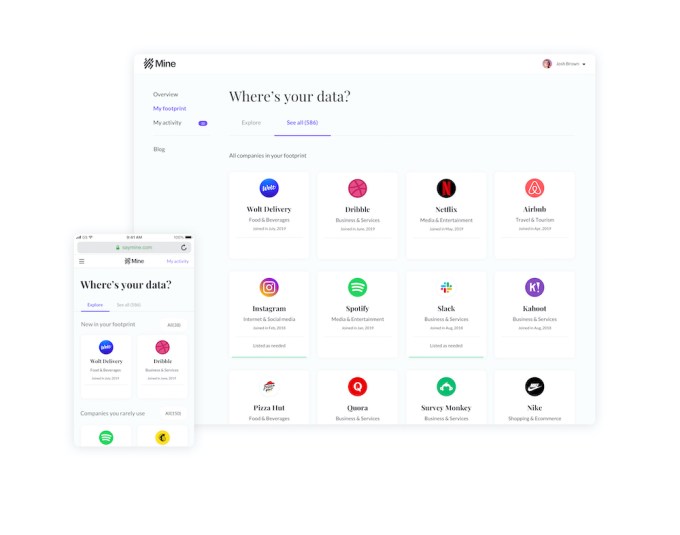
Ringel explained that Mine scans users’ inboxes to help them understand who has access to their personal data.

“Every time that you do an online interaction, such as you sign up for a service or purchase a flight ticket, those companies, those services leave some clues or traces within your inbox,” he said.
Mine

Image Credits: Mine

Mine then cross-references that information with the data collection and privacy policies of the relevant companies, determining what data they’re likely to possess. It calculates a risk score for each company — and if the user decides they want a company to delete their data, Mine can send an automated email request from the user’s own account.

Ringel argued that this is a very different approach to data privacy and data ownership. Instead of building “fences” around your data, Mine makes you more comfortable sharing that data, knowing that you can take control when necessary.

“The product gives [consumers] the freedom to use the internet feeling more secure, because they know they can exercise their right to be forgotten,” he said.

Ringel noted that the average Mine user has a personal data footprint across 350 countries — and the number is more like 550 in the United States. I ran a Mine audit for myself and, within a few minutes, found that I’m pretty close to the U.S. average. (Ringel said the number doesn’t include email newsletters.)

Mine launched in Europe earlier this year and says it has already been used by more than 100,000 people to send 1.3 million data deletion requests.

The legal force behind those requests will differ depending on where you live and which company you are emailing, but Ringel said that most companies will comply even when they’re not legally required to do so, because it’s part of creating a better privacy experience that helps them “earn trust and credibility from consumers.” Plus, “Most of them understand that if you want to go, they’ve already lost you.”

The startup’s core service is available for free. Ringel said the company will make money with premium consumer offerings, like the ability to offload the entire conversation with a company when you want your data deleted. It will also work with businesses to create a standard interface around privacy and data deletion.

As for whether giving Mine access to your inbox creates new privacy risks, Ringel said that the startup collects the “bare minimum” of data — usually just your email address and your full name. Otherwise, it knows “the type of data, but not the actual data” that other companies have obtained.

“We would never share or sell your data,” he added.

The Series A was led by Google’s AI-focused venture fund Gradient Ventures, with participation from e.ventures, MassMutual Ventures, as well as existing investors Battery Ventures and Saban Ventures. Among other things, Ringel said the money will fund Mine’s launch in the United States.


News: Join Extra Crunch Live on October 27 for a conversation on early stage and storytelling success with GV’s M.G. Siegler

If anyone knows early stage investing and startups, it’s M.G. Siegler. As a General Partner at GV, he’s personally invested in his fair share of rocket ship companies early on in their lifecycles, including Anchor, Slack, Medium and Stripe. He’s also a TechCrunch alum, and a former startup operator himself as a web dev. We’re

If anyone knows early stage investing and startups, it’s M.G. Siegler. As a General Partner at GV, he’s personally invested in his fair share of rocket ship companies early on in their lifecycles, including Anchor, Slack, Medium and Stripe. He’s also a TechCrunch alum, and a former startup operator himself as a web dev. We’re thrilled to have Siegler joining us to talk about his investment experience, and how his early career as a writer influenced his thinking about startup success on Extra Crunch Live on October 27 at 2 p.m. EDT/11 a.m. PDT.

Siegler’s career in startups began in 2005, working in web development at a startup agency focused on tech clients. He later reported on startups at both VentureBeat and later TechCrunch, before becoming a founded partner at CrunchFund and then eventually joining GV (then Google Ventures) to focus on early stage companies. In addition to the companies listed above, Siegler has led investment in other successful early stage companies including Universe, Giphy, The Players’ Tribune, CTRL-Labs and AltspaceVR.

At the outset of the current global pandemic, Siegler chatted with our own Lucas Matney about GV’s investment in mobile website-builder Universe, and about how managing a portfolio changes in light of travel and social distancing restrictions. We’ll find out from Siegler what the ensuing months of living and working in the context of COVID-19 have changed about his perspective, and about the early stage companies he’s working with and scouting for potential investment.

More broadly, Siegler also has a unique perspective, and ample experience, when it comes to early stage startups and storytelling. His work as a journalist focused specifically on looking at new and emerging technology companies and assessing their ability to communicate their ambitions, the problems they’re solving, and the technology they’re building to do. He brings that experience to his assessment of the investment potentials of startups and their founders, and their ability to tell good and compelling story about what they’re doing, and why.

All these topics, plus more questions from you, our audience. So join us if you’re an Extra Crunch member and get caught up on all the fintech goodness going on. And if you aren’t an Extra Crunch member, be sure to check out subscription options before we get started.

Meeting details are below the paywall.

Meeting Details

News: Sam’s Club will deploy autonomous floor-scrubbing robots in all of its U.S. locations

The past six months have seen a fairly aggressive acceleration in the option of robotics and automation as companies look for ways to augment (and, likely, replace in some instances) human workers. The appeal is certainly clear during massive pandemic-fueled shut downs. Sam’s Club has been on the robotic floor cleaning chain for a bit

The past six months have seen a fairly aggressive acceleration in the option of robotics and automation as companies look for ways to augment (and, likely, replace in some instances) human workers. The appeal is certainly clear during massive pandemic-fueled shut downs.

Sam’s Club has been on the robotic floor cleaning chain for a bit longer, having already deployed Tennant’s T7AMR scrubbers in a number of locations. But this week the Walmart -owned bulk retailer announced that its adding another 372 this year, bringing the technology to all of its 599 U.S. stores.

The robot can be piloted manually, but the addition of Brain Corp’s service allows for autonomous operation. That’s certainly a welcome feature, given the cavernous size of these sorts of warehouse stores. Perhaps even more interesting here, though, is that the software can do double duty, using the mopping robots to examine shelving inventory at the same time.

Sam’s Club parent company Walmart is already using robotics to perform inventory in its own stores. In January, the company announced that it would be adding Bossa Nova robots to an additional 650 locations, bringing the total up to 1,000 in the U.S. The Tennant/Brain Corp. system is still in the pilot stage, though there’s a lot to be said for a robot that can efficiently perform both tasks in during non-peak hours. Like store cleaning, inventory is a pretty massive undertaking at stores of this scale.

News: Amazon’s Whole Foods now offers one-hour pickup to Prime members at all locations

Amazon is now offering Prime members one-hour grocery pickup at all Whole Foods Market locations across the U.S., the company announced this morning. Prime members can use the Amazon app or website to place orders from the Whole Foods Market tab to shop, then select their one-hour pickup window at checkout on orders of $35

Amazon is now offering Prime members one-hour grocery pickup at all Whole Foods Market locations across the U.S., the company announced this morning. Prime members can use the Amazon app or website to place orders from the Whole Foods Market tab to shop, then select their one-hour pickup window at checkout on orders of $35 or more.

Before heading to the Whole Foods location, customers can use the Amazon app to let staff know the they’re on their way. Upon arrival, Amazon says the majority of customers will only have to wait one minute to receive their orders — a daunting commitment that other online retailers can struggle to meet.

The expansion is meant to help Amazon better compete with online grocery rivals, particularly Walmart, Target and Instacart. Walmart, for example, saw its e-commerce operations, partially driven by online grocery, grow 97% in Q2 compared with the industry’s 27% growth. It also attributed the jump to COVID-19 impacts, including the release of government stimulus checks.

Target in August also expanded grocery pickup services nationwide, then reaching nearly 85% of its U.S. locations, ahead of its planned schedule. Online order pickup, including through its Drive Up and delivery services, accounted for the majority of Target’s digital growth in its last quarter, as well, with curbside pickup growing more than 734%.

Meanwhile, one report released this summer said Instacart had claimed over half of the U.S. online grocery market. (Other reports, however, put Walmart ahead of Amazon and all other Instacart-like delivery services.)

Amazon’s grocery strategy, meanwhile, remains somewhat disjointed.

It’s operating two online services — Whole Foods, which can be shopped via Amazon.com, and Amazon Fresh. It also recently launched Whole Foods locations that serve as grocery warehouses, and opened its first Amazon Fresh physical store in August. Earlier this year, it opened an Amazon Go Grocery store, featuring its cashierless technology, too.

For consumers, the growing number of competing grocery brands from Amazon can be confusing.

The retailer, however, believes the online grocery market is still nascent and it has time to catch up to rivals.

Amazon today noted than more than 40% of its Whole Foods Market pickup orders every month are from customers trying the service for the first time. It also doesn’t think the surge of online grocery shopping retailers are seeing now during the pandemic will decline anytime soon. Like many industries, the pandemic simply accelerated consumer adoption trends that were already growing.

“According to recent data from Global Data Research, almost 68 percent of consumers say they will continue to use curbside pickup even when the pandemic has subsided,” Amazon said in its announcement.

In addition to pickup, Prime members in over 2,000 cities and towns can also order free, two-hour delivery of over 170,000 items from Amazon Fresh and Whole Foods Market on orders of $35 or more, Amazon also noted.


News: Landing AI launches new visual inspection platform for manufacturers

As companies manufacturer goods, human inspectors review them for defects. Think of a scratch on smartphone glass or a weakness in raw steel that could have an impact downstream when it gets turned into something else. Landing AI, the company started by former Google and Baidu AI guru Andrew Ng, wants to use AI technology

As companies manufacturer goods, human inspectors review them for defects. Think of a scratch on smartphone glass or a weakness in raw steel that could have an impact downstream when it gets turned into something else. Landing AI, the company started by former Google and Baidu AI guru Andrew Ng, wants to use AI technology to identify these defects, and today the company launched a new visual inspection platform called LandingLens.

“We’re announcing LandingLens, which is an end-to-end visual inspection platform to help manufacturers build and deploy visual inspection systems [using AI],” Ng told TechCrunch.

He says that company’s goal is to bring AI to manufacturing companies, but he couldn’t simply repackage what he he had learned at Google and Baidu, partly because it involved a different set of consumer use cases, and partly because there is just much less data to work with in a manufacturing setting.

Adding to the degree of difficulty here, each setting is unique, and there is no standard playbook you can necessarily apply across each vertical. This meant Landing AI had to come up with a general tool kit that each company could use for the unique requirements of their manufacturing process.

Ng says to put this advanced technology into the hands of these customers and apply AI to visual inspection, his company has created a visual interface where companies can work through a defined process to train models to understand each customer’s inspection needs.

The way it works is you take pictures of what a good finished product looks like, and what a defective product could look like. It’s not as easy as it might sound because human experts can disagree over what constitutes a defect.

The manufacturer creates what’s called a defect book where the inspector experts work together to determine what that defect looks like via a picture, and resolve disagreements when they happen. All this is done through the LandingLens interface.

Once inspectors have agreed upon a set of labels, they can begin iterating on a model in the Model Iteration Module where the company can train and run models to get to a state of agreed upon success where the AI is picking up the defects on a regular basis. As customers run these experiments, the software generates a report on the state of the model, and customers can refine the models as needed based on the information in the report.

Ng says that his company is trying to bring in sophisticated software to help solve a big problem for manufacturing customers. “The bottleneck [for them] is building the deep learning algorithm, really the machine learning software. They can take the picture and render judgment as to whether this part is okay, or whether it is defective, and that’s what our platform helps with,” he said.

He thinks this technology could ultimately help recast how goods are manufactured in the future. “I think deep learning is poised to transform how inspection is done, which is really the key step. Inspection is really the last line of defense against quality defects in manufacturing. So I’m excited to release this platform to help manufacturers do inspections more accurately,” he said.

News: How Yext reinvented itself on its way to going public

Last week, Yext CEO Howard Lerman dropped by Extra Crunch Live for a chat about his former startup, pivoting and becoming the CEO of a public company. Yext, which focuses on business information and enterprise search products, went public in 2017, making it one of the first companies to demo at a TechCrunch event and

Last week, Yext CEO Howard Lerman dropped by Extra Crunch Live for a chat about his former startup, pivoting and becoming the CEO of a public company.

Yext, which focuses on business information and enterprise search products, went public in 2017, making it one of the first companies to demo at a TechCrunch event and eventually list.

The full recording is embedded below, along with a number of at-length quotes if you prefer to read. But here, above the paywall, I wanted to share my favorite bit from the conversation.

It’s about how Yext got into the business information game — what it calls PowerListings — from its product roots from around the time it raised a $25 million Series C.

Back at the TechCrunch50 event, Yext demoed a service that could record and transcribe phone calls and provide some extra analysis. Here’s how Lerman described the moment (quotes tidied up for readability):

I launched this at TechCrunch50 in 2009, we actually had a really cool technology. We figured out a way […] where we could put a tracked phone number on a business listing, record it, transcribe it [and] then run a semantic analysis on the call to determine ‘was it a good call or not?’

That demoed product worked well for Yext, as Lerman explained:

Within nine days of this launch, of actually putting this out there, we had a $25 million round from IVP.

At the time Yext put together a $20 million business that Lerman said was built “very quickly.” But, he continued, things went sideways from there:

At the same time, it turned out that that was not a very good business model to scale to 100 million of revenue — and beyond. And I learned that probably six months after [and] you’ve got to be intellectually honest with yourself. You see this happening: you see the churn, you see the customer acquisition costs happening, and I was faced with the choice. And one of the things that I think we did that was commendable was we started an entirely new business within the existing cap table of this company. And to this very day, we have some of the same shareholders that were with us in 2008.

What happened next was “a little complicated” in Lerman’s own words, but Yext started a new company “under the old company,” sold the old company to IAC (TechCrunch coverage here). That money went to “the balance sheet of NewCo,” and Yext built “this whole new idea to synchronize information across the web. And that was the PowerListings franchise [which] was the foundation of what we have to this very day.”

Yext has a big focus on search today, but PowerListings is still part of its product family.

What’s fascinating about the Yext story is how the company has reinvented itself a few times, all while scaling before and after its IPO. Usually we read about business stories that are oversimplified. The Yext story makes it clear that even a few changes don’t mean that something is wrong. You can shake up your startup and still go public.

If you need some help getting past the paywall, head here. Else, carry on and hit play on the video and enjoy the quotes.

Extra Crunch Live continues this week, with more VCs and founders swinging by for long, in-depth chats.

Howard Lerman

News: TikTok details how it’s taking further action against hateful ideologies

TikTok said on Wednesday it’s strengthening its enforcement actions against hate speech and hateful ideologies to include “neighboring ideologies,” like white nationalism and others, as well as statements that emerge from those ideologies. In a blog post, TikTok explained that it regularly evaluates its enforcement processes with the help of global experts to determine when

TikTok said on Wednesday it’s strengthening its enforcement actions against hate speech and hateful ideologies to include “neighboring ideologies,” like white nationalism and others, as well as statements that emerge from those ideologies.

In a blog post, TikTok explained that it regularly evaluates its enforcement processes with the help of global experts to determine when it needed to take action against emerging risks.

While the TikTok Trust & Safety teams were already working to remove neo-Nazism and white supremacy from its platform under existing policies, it’s more recently expanded enforcement will also cover related ideologies, including white nationalism, white genocide theory, as well as “statements that have their origin in these ideologies, and movements such as Identitarianism and male supremacy,” TikTok said.

The announcement was made on TikTok’s European newsroom, and follows TikTok’s recent joining of the European Commission’s Code of Conduct on Countering Illegal Hate Speech Online. However, the guidelines TikTok discussed apply to its global audience.

TikTok had made similar statements on its U.S. newsroom in August, including its plans to take action against other hateful ideologies, including white nationalism and male supremacy, in addition to white supremacy and anti-semitism. A TikTok spokesperson told TechCrunch the new announcement was meant to offer “further details” on that policy.

The company’s new blog post noted how many monitoring organizations have been reporting that anti-semitic sentiment is increasing around the world.

TikTok itself had been recently accused of having a “white supremacy” problem, according to a report from the Anti-Defamation League, which led to the U.S. newsroom announcement earlier this year. The ADL had uncovered dozens of accounts that were using combinations of white supremacist symbols, terms and slogans as screen names or handles, its report said.

It also said it secured a commitment from TikTok to work together to remove such content going forward. At the time of the report, TikTok had claimed to have already removed 1,000 accounts during the year for violating hate speech policies, and said it had taken down hundreds of thousands of videos under those same guidelines. In the U.S. newsroom post, TikTok updated its numbers, saying it had banned more than 1,300 accounts for hateful content or behavior, removed more than 380,000 videos for violation of its hate speech policy, and removed over 64,000 hateful comments.

TikTok offered no update on those figures, or EU-specific data, in today’s post.

The post went on to detail other existing policies in this area. For example, TikTok says it doesn’t permit any content that denies the Holocaust and other violent tragedies — a policy Facebook only recently adopted after years of choosing to favor free speech. TikTok also says it takes action to remove misinformation and hurtful stereotypes about Jewish, Muslim and other communities — including those that spread misinformation about “notable Jewish individuals and families” that are used as proxies to spread antisemitism.

TikTok additionally noted it removes content harmful to the LGBTQ+ community by removing hateful ideas, including content that promotes promotes conversion therapy and the idea that no one is born LGBTQ+.

The company spoke about another area of policy it’s worked to improve, too. Today, TikTok is working to train Trust & Safety enforcement team members as to when it’s appropriate to remove certain language. In the case of language that was previously used to exclude and demean groups, it’s removed. But if those terms are now being reclaimed by impacted communities as terms of empowerment and counter-speech, the speech wouldn’t be taken down.

When content is taken down, TikTok users will be able to ask for a review of the action, TikTok also promised — a level of transparency that isn’t always seen today.

Much of what TikTok announced on Wednesday isn’t a new policy, necessarily, but is meant to address the E.U. audience specifically, where TikTok faces continual scrutiny over its data practices and other policies.

News: SoftBank’s $100 million diversity and inclusion fund makes its first bet … in health Vitable Health

SoftBank’s Opportunity Growth Fund has made the health insurance startup Vitable Health the first commitment from its $100 million fund dedicated to investing in startups founded by entrepreneurs of color. The Philadelphia-based company, which recently launched from Y Combinator, is focused on bringing basic health insurance to underserved and low-income communities. Founded by Joseph Kitonga,

SoftBank’s Opportunity Growth Fund has made the health insurance startup Vitable Health the first commitment from its $100 million fund dedicated to investing in startups founded by entrepreneurs of color.

The Philadelphia-based company, which recently launched from Y Combinator, is focused on bringing basic health insurance to underserved and low-income communities.

Founded by Joseph Kitonga, a 23 year-old entrepreneur whose parents immigrated to the U.S. a decade ago, Vitable provides affordable acute healthcare coverage to underinsured or un-insured populations and was born out of Kitonga’s experience watching employees of his parents’ home healthcare agency struggle to receive basic coverage.

The $1.5 million commitment was led by the SoftBank Group Corp Opportunity Fund, and included Y Combinator, DNA Capital, Commerce Ventures, MSA Capital, Coughdrop Capital, and angels like Immad Akhund, the chief executive of Mercury Bank; and Allison Pickens, the former chief operating officer of Gainsight, the company said in a blog post.

“Good healthcare is a basic right that every American deserves, whoever they are,” said Paul Judge, the Atlanta-based Early Stage Investing Lead for the fund and the founder of Atlanta’s TechSquare Labs investment fund. “We’ve been inspired by Joseph and his approach to addressing this challenge. Vitable Health is bridging critical gaps in patient care and has emerged as a necessary, essential service for all whether they’re uninsured, underinsured, or simply need a better plan for their lifestyle.”

SoftBank created the opportunity fund while cities around the U.S. were witnessing a wave of public protests against systemic racism and police brutality stemming from the murder of the Black Minneapolis citizen George Floyd at the hands of white police officers.  Floyd’s murder reignited simmering tensions between citizens and police in cities around the country over issues including police brutality, the militarization of civil authorities, and racial profiling.

SoftBank has had its own problems with racism in its portfolio this year. A few months before the firm launched its fund, the CEO and founder of one of its portfolio companies, Banjo, resigned after it was revealed that he once had ties to the KKK.

With the Opportunity Fund, SoftBank is trying to address some of its issues, and notably, will not take a traditional management fee for transactions out of the fund “but instead will seek to put as much capital as possible into the hands of founders and entrepreneurs of color.”

The Opportunity Fund is the third investment vehicle announced by SoftBank in the last several years. The biggest of them all is the $100 billion Vision Fund; then last year it announced the $2 billion Innovation Fund focused on Latin America.

News: AOC’s Among Us stream topped 435,000 concurrent viewers

Last night, Rep. Alexandria Ocasio-Cortez went live on Twitch to stream Among Us with a handful of superstar streamers. The purpose of the stream, which drew a massive crowd, was to get out the vote as we head into the general election. At its peak, the stream drew a concurrent viewership of 435,000+ people, and

Last night, Rep. Alexandria Ocasio-Cortez went live on Twitch to stream Among Us with a handful of superstar streamers. The purpose of the stream, which drew a massive crowd, was to get out the vote as we head into the general election.

At its peak, the stream drew a concurrent viewership of 435,000+ people, and that’s just on AOC’s Twitch. Other streamers that were in the game, such as Pokimane, HasanAbi and DrLupo, also had their own viewerships tuned in to the game.

For context, this puts AOC’s stream in the top five of most concurrent viewers on a Twitch stream. The record is still held by Ninja’s Fortnite stream with Drake which hit more than 600,000 concurrent viewers.

Among Us has been around for several years, but only enjoyed top-tier popularity over the past few months as streamers flock to the game. Among Us is a relatively simple game, but gives players the chance to truly show off their personality.

Here’s how it works:

Between four and ten players join a drop ship. The majority of those players are crewmates who have tasks to complete on the map — these tasks are simple, puzzle-based mini games. The remaining minority of players are impostors, who sabotage and kill crewmates. When a dead body is found and reported, the whole group gets into voice chat to discuss who might be the killer. It’s a bit like a murder mystery party combined with a video game.

There is some irony in the fact that politicians (Rep. Ilhan Omar joined AOC) jumped into a game where lying is a primary skill. In fact, AOC mentioned before gameplay ever started that she was very nervous because she’s terrible at lying.

It’s also worth noting that this isn’t the first time that AOC has come to younger voters where they are. The congresswoman played Animal Crossing in May and visited players’ islands.


News: Anyscale adds $40M to bring its Ray-based distributed computing tech to the enterprise masses

The world of distributed computing took on a new profile this year when Folding@home, a 20-year-old distributed computing project, found itself picking up thousands of new volunteers to help Covid-19 researchers generate more computing power to fold proteins and run other calculations needed for screening potential drug compounds to fight the novel coronavirus. Today, a

The world of distributed computing took on a new profile this year when Folding@home, a 20-year-old distributed computing project, found itself picking up thousands of new volunteers to help Covid-19 researchers generate more computing power to fold proteins and run other calculations needed for screening potential drug compounds to fight the novel coronavirus. Today, a startup that is also tapping the potential and opportunity in distributed computing is announcing a round of growth funding to continue its own work.

Anyscale, a startup founded by a team out of UC Berkeley who created the Ray open-source Python framework for running distributed computing projects, has raised $40 million.

It plans to use the capital to continue developing Anyscale, a platform built on Ray that will make Ray usable not just by high-level developers and computing specialists, but any technical people who are looking to run projects that require large amounts of computing power.

Ion Stoica, Anyscale’s executive chairman who co-founded the company with Robert Nishihara, Philipp Moritz and Berkeley professor Michael I. Jordan, said in an interview that the company is tapping into a moment spurred not just by the events of 2020 but by the bigger demand from companies — spurred by the growth of cloud computing, major digital transformation of their systems, and a need to go that extra mile to remain competitive. Organizations are becoming more ambitious in their technology strategies and goals, whether they are tech companies or not.

“At a high level, the trend that we see is that all applications are distributed and running on clusters, but building these applications is incredibly hard and requires teams with the right expertise,” said Stoica. “What we are trying to build will make it as easy to build a distributed computing project as it would be to run a program on your laptop. It will mean ordinary developers will be able to build scalable applications just like Google can build today.”

The company’s first build of Anyscale — which will let organizations build multi-cloud applications from a single machine and use serverless architecture that scales up and down to meet application demands –
 has yet to launch commercially: it is in a private beta and the plan is to launch it fully next year.

There has been interest from financial services, retail, and manufacturing companies, Stoica said, with companies working in design, informatics and medical research (and Covid-19 vaccines) also using the private beta.

The Series B is being led by previous investor NEA, with Andreessen Horowitz (a16z), Intel Capital, and Foundation Capital also participating. A16z led the company’s Series A less than a year ago (a $20 million round in December).

Intel, meanwhile, is a strategic investor. Along with other tech giants like Microsoft, Intel is using Ray’s distributing computing model to run projects.

Stoica — who also co-founded Databricks, Conviva and was one of the original developers of Apache Spark — and Nishihara declined to comment in an interview on Anyscale’s valuation, but Stoica confirmed that the round was oversubscribed. The company has now raised just over $60 million.

While the startup continues to build out Anyscale, in the last year it has also been making more headway with Ray, which they also maintain.

At the Ray Summit — Anyscale’s conference for developers run as a virtual event at the end of September —  Anyscale released Ray 1.0, which provides, in addition to a universal serverless compute API, an expanded library to use on Ray 1.0. Nishihara described it as a “huge milestone,” not least because it is one step along the path for the bigger vision they have for Anyscale to be used by non-tech companies for tech work.

A typical example was a recent recommendation algorithm built by Intel for Burger King. “The thing that is hard to do is not making the recommendations but learning from the interactions that users are having, and the choices they are making, and having that experience reflected back very rapidly,” he said. It’s a process that can be done in other ways, but with a far less good user experience due to lags.

This past year Nishihara said that interest in Ray has seen “tremendous growth,” but that it’s hard to say whether that is because of people working from home or just wider computing trends.

“It’s clear if anything that the pandemic is accelerating the transition,” said Stoica. “Ray has good support for the cloud, including Azure, Google Cloud Platform and others, which makes it quite compelling.”

We’ve seen an interesting trend in enterprise IT, where startups are finding an opportunity in the market by making it possible for non-technical organizations to bridge the digital divide, by providing better access to the most technical advances in computing to organizations beyond those that can build and operate such tools themselves. Just as groups like Element AI are working on ways to democratize advances in AI, the same kind of tech built, acquired and used by the likes of Apple, Google and Amazon, so too is Anyscale looking to do the same in enterprise computing.

And the two areas of AI and computing, of course, are interconnected: these days you need vast amounts of computing power to run AI applications, something the average company typically lacks.

“The demand for distributed computing continues to increase with the widespread adoption of AI and machine learning in application development,” said Pete Sonsini, General Partner at NEA, in a statement. “Still, scaling applications on clusters remains extremely challenging. Serverless computing is emerging as the preferred platform for developing distributed applications. Unfortunately, today’s serverless offerings support only a limited set of applications, and most of them are cloud-specific—but not Ray and Anyscale. The company’s path thus far bears the hallmarks of a standout technology pioneer, and we’re thrilled to partner with the team through this next phase bridging their open source and commercial offerings.”

WordPress Image Lightbox Plugin