Yearly Archives: 2020

News: Dallas’ ShearShare has a marketplace connecting stylists with available seats at salons and $2.3 million in funding

Courtney Caldwell and her husband Tye have been building the Dallas-based startup ShearShare, which provides a marketplace service connecting stylists with open seats at hair salons since 2017. Since their launch the two co-founders have been committed to the humble hustle of starting their own business. From flying between San Francisco and Dallas weekly to

Courtney Caldwell and her husband Tye have been building the Dallas-based startup ShearShare, which provides a marketplace service connecting stylists with open seats at hair salons since 2017.

Since their launch the two co-founders have been committed to the humble hustle of starting their own business. From flying between San Francisco and Dallas weekly to participate in the 19th 500 Startups cohort or participating in Y Combinator’s Fellowship program.

Now, with a seed round of $2.3 million and another non-dilutive cash grant from Google for Startups Black Founders Fund, the early stage company is ready to expand.

The two co-founders certainly have a pedigree in the beauty industry. Tye Caldwell has been a luminary in the industry and is a member-elect of the Professional Beauty Association’s advisory board. Together with Courtney he runs an award-winning salon in Dallas.
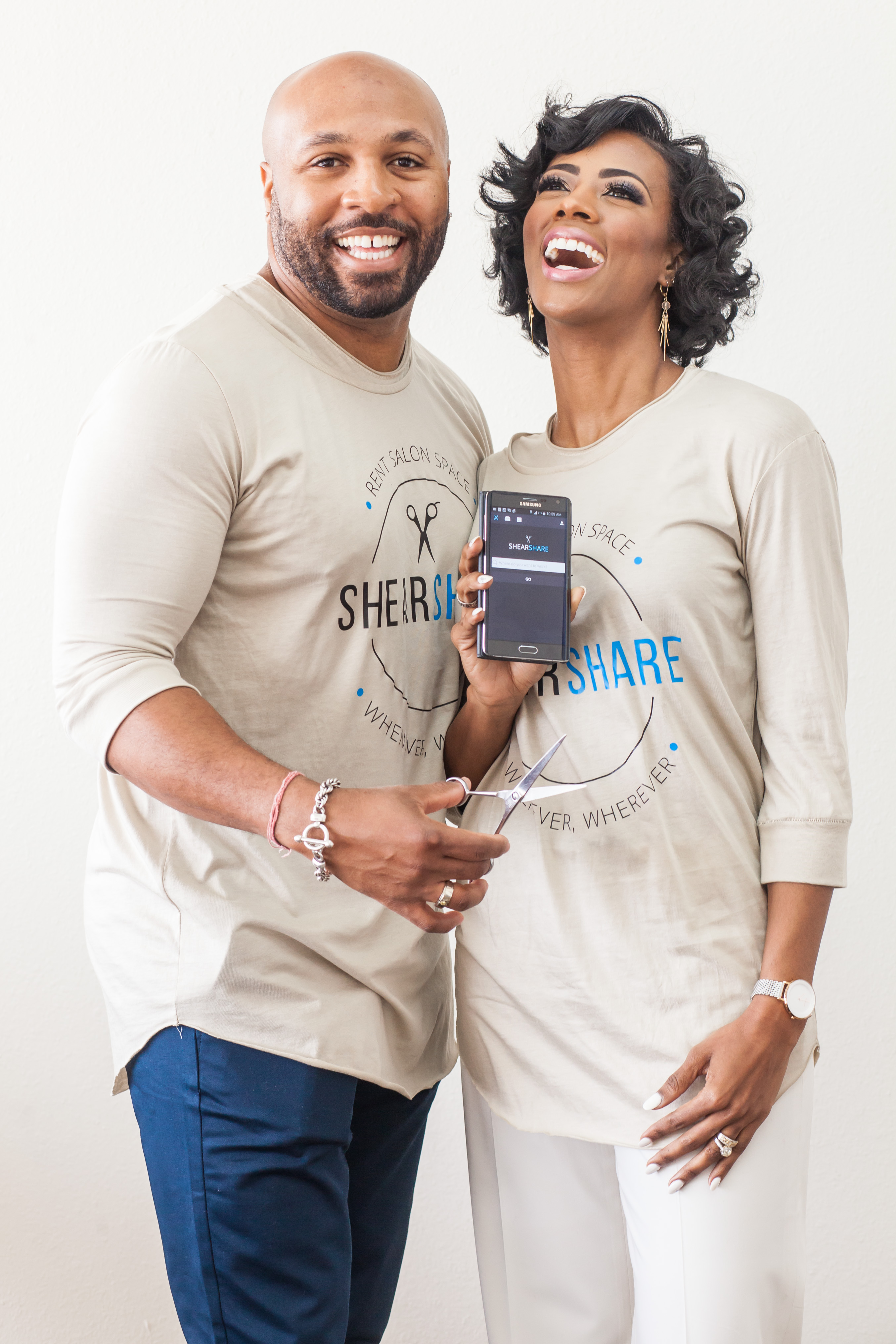
ShearShare co-founders Tye and Courtney Caldwell

Meanwhile, Courtney Caldwell spent over 20 years working for Oracle in technology marketing. But the two hadn’t really been exposed to the venture capital industry. So when they came up with the idea to start a service providing online matchmaking between salons and stylists — based on their own need to fill a chair at their salon — they didn’t really no where to turn.

Enter TD Lowe. A longtime investor on her own and with organizations like StartupGrind, Lowe introduced the couple to the world of venture capital and startups and the two were off to the races.

“We pioneered on-demand barbershop and space rentals,” Courtney said. “If a salon or barbershop has an open station a stylist can book it like they would a hotel room.”

According to the Caldwells, the beauty industry is the second largest industry for freelancers and independent contractors. Unlike other companies that are trying to serve stylists by offering them features like booking and appointments independent of salons — or services for salons alone — ShearShare is trying to serve both sides of the marketplace with the tools they need.

“We’re not a StyleSeat. We’re not a Squire,” said Courtney. What they are is expanding rapidly. The company has listings in over 600 cities ranging from chair that rents for $15 in Georgia to one that rents for $569 in the heart of Manhattan in New York City.

The company processes payments for the stylists directly through a partnership with a local payment solution called First American Payments based in Ft. Worth, Texas.

“Everyone is setting their sights on direct-to-consumer,” said Courtney. “This is a way we’re helping to keep people at work and refuel the individual economic recovery.”

The next step for the company is to begin launching more ancillary services for stylists. They’re pioneering an insurance policy for stylists that would cover them from on-the-job lawsuits.

“It’s becoming a huge opportunity for the stylist that just didn’t exist,” said Tye. And it all began when the two Caldwells couldn’t find any options when they searched for any terms related to renting space at a barbershop they said. “We reached out to a friend and told her about the opportunity that we’d been presented with and she said, ‘Guys… that’s a billion dollar idea.’”

That friend was Lowe. Who came in to advise the couple and show them the ropes of startup investing.

It’s at least an idea that’s worth tens of millions. That’s how much the startup Mayvenn has raised for its business providing hair extensions and other cosmetics to stylists.

Now, with its new funding, ShearShare is ready to expand, the couple said.

ShearShare’s backers include: Precursor Ventures, Revolution’s Rise of the Rest Seed Fund, Structure Capital, Backstage Capital, and 500 Startups, alongside new participants Bread and Butter Ventures, ArlanWasHere Investments (Arlan Hamilton’s fund in which Mark Cuban is the sole LP), Lightspeed Venture Partners Scouts Program ( with Veronica Juarez and Jason McBride leading), Jaylon Smith of the Dallas Cowboys through the Minority Entrepreneurship Institute, Thaddeus Young of the Chicago Bulls with Reform Venture, the Bumble Fund, Notley Ventures, Sachse Family Fund, and other global investors.

These investors are part of a new breed of investor that’s pushing venture investment into areas that were previously considered beyond the reach of typical firms.

As the chief executive of a beauty and lifestyle startup, Julie Fredrickson told TechCrunch three years ago, “Most of these brands are commensurately underfunded compared to tech companies in similar positions,” said Fredrickson. “There’s a chance for a totally new dominant player and no one’s really gunning for it.”

There’s a huge opportunity for businesses serving all aspects of the beauty industry to flourish, entrepreneurs and investors both said.

“Venture is obsoleting itself as private equity and family offices increasingly go downstream because they’re willing to seek venture-style returns in verticals that venture capital is not prepared or is less educated about,” according to Frederickson.


News: Twitter starts showing all U.S. users election misinformation warnings

Starting today, Twitter users in the U.S. will see two large notices at the top of their feeds that aim to “preemptively debunk” misinformation related to voting. The striking messages are designed to push back against the deluge of false claims about the 2020 election. One notice warns users that they “might encounter misleading information”

Starting today, Twitter users in the U.S. will see two large notices at the top of their feeds that aim to “preemptively debunk” misinformation related to voting. The striking messages are designed to push back against the deluge of false claims about the 2020 election.

One notice warns users that they “might encounter misleading information” about mail-in voting while the other attempts to head off online election-related chaos by cautioning that the results of the U.S. election may be delayed.

Delayed results are a very possible outcome in an election that will see more ballots than ever cast through the mail. States have differing rules about when mailed ballots can begin to be tallied, making it possible that official results may indeed take time to trickle in — a situation that it’s wise to normalize in advance.

The prompts will point users to Twitter Moments that collect authoritative information on both topics. The notices will also pop up in searches of relevant terms and hashtags.

Social media companies have scrambled to ready their platforms for the unique challenges of a deeply contentious U.S. election in the midst of a worsening national health crisis. While those efforts have been mixed — some weak, some more robust — serving proactive, attention-grabbing notices to everyone is a solid step up from the easy-to-miss misinformation “labels” that get tacked onto false claims across Twitter and Facebook.

News: Max Q: NASA makes key discovery for future of deep space exploration

Max Q is a weekly newsletter from TechCrunch all about space. Sign up here to receive it weekly on Sundays in your inbox. This past week, we unveiled the agenda for TC Sessions: Space for the first time. It’s our inaugural event focused on space startups and related technologies, and it’s happening December 16 and

Max Q is a weekly newsletter from TechCrunch all about space. Sign up here to receive it weekly on Sundays in your inbox.

This past week, we unveiled the agenda for TC Sessions: Space for the first time. It’s our inaugural event focused on space startups and related technologies, and it’s happening December 16 and 17. It’s entirely virtual, of course, and the good news is that means you can attend easily from anywhere in the world.

We’ve got an amazing lineup, including newsmakers we regularly cover here. NASA Administrator Jim Bridenstine will be there, as well as U.S. Space Force commanding office Jay Raymond, and Rocket Lab CEO Peter Beck, to name just a few. Tickets are available now, so sign up ASAP to get the best price possible.

SpaceX launched 120 Starlink satellites last week alone

SpaceX launched not one, but two separate Falcon 9 rockets loaded with Starlink satellites for its broadband internet service last week. The first took off on October 19, then just five days later, another full complement reached orbit. SpaceX has now launched nearly 1,000 of these, and it must be getting awfully close to kicking off its public beta of the consumer-facing internet service.

NASA snags rock sample from asteroid’s surface

OSIRIS-REx probe 'tagging' the surface of asteroid Bennu

Image Credits: NASA

NASA has managed to collect a sample from the surface of an asteroid in a first for the agency. The sample collection came courtesy of NASA’s OSIRIS-REx robotic exploration probe, which was built by partner Lockheed Martin. OSIRIS-REx still has some work to do at Bennu, the asteroid from which it collected the sample, but next year it’ll begin heading back with its precious cargo intended for study by scientists here on Earth.

NASA also found water on the sunny side of the Moon

NASA is full of special discoveries this week – scientists working on its SOFIA imaging project confirmed the presence of water on the surface of the Moon that’s exposed to sunlight. They’d suspected it was there previously, but this is the first confirmed proof, and while it isn’t a whole lot of water, it could still change the future of human deep space exploration.

Microsoft partners with SpaceX, unveils ‘Azure Space’

Image Credits: Microsoft

Microsoft looks primed to invest in space-based business in a big way with Azure Space, a new business unit it formed to handle all space-related businesses attached to its cloud data efforts. That includes a new type of deployable mobile datacenter that will be connected in part via SpaceX’s Starlink global broadband network, putting computing power near where it’s needed in a scalable way.

Intel’s local AI processor is now operating in space

Intel has loaded up a small satellite with a power-efficient edge AI processor, its Myriad 2 Vision Processing Unit. That’ll help the satellite do its own on-board classification of images of Earth that it takes, saving key bandwidth for what it transfers back to researchers on the ground. Local AI could help satellite networks in general operate much more efficiently, but it’s still in its infancy as a field.

Lockeed Martin selects Relativity for NASA mission

Image Credits: Relativity Space

Relativity Space has tons of promise in terms of its 3D-printed rockets, but it still hasn’t actually reached the launch stage. It did however secure a key government contract, with Lockheed Martin selecting its rocket for a forthcoming mission to test fluid management systems for NASA.

News: Good and bad board members (and what to do about them)

Ryan Caldbeck, co-founder and former CEO of consumer-brands-focused crowdfunding site CircleUp, recently published an email he’d written to a former director on the board of the company. According to Caldbeck, he wrote the letter after CircleUp had bought out the investor’s firm because he wanted to provide constructive feedback, given that this individual’s “involvement was

Ryan Caldbeck, co-founder and former CEO of consumer-brands-focused crowdfunding site CircleUp, recently published an email he’d written to a former director on the board of the company.

According to Caldbeck, he wrote the letter after CircleUp had bought out the investor’s firm because he wanted to provide constructive feedback, given that this individual’s “involvement was incredibly difficult for all of CircleUp and our board,” as he explained to this person, whose identity was shielded.

The saga begged questions about what happens behind the scenes at startups and about board composition specifically. But Caldbeck’s situation may be more anomalous than not, suggest some veterans of the industry who have common sense advice around how to avoid problematic board members and how to deal with them if they can’t be avoided.

First, and most obviously, get to know a potential board member as well as possible because who winds up as a director with your company can be a “life-changing decision” in both good and terrible ways, says Joel Peterson, a professor at Stanford’s business school, a former chairman of JetBlue Airways and the founding partner of Peterson Partners, a Salt Lake City-based firm that invests directly in startups and has stakes in many venture funds.

Peterson’s advice is to “interview investors just as they’re interviewing you,” including not only to get a sense for whether someone is knowledgeable and shares your same values but also to get a sense for how much time they have for your company. In his view, venture capitalists are “often the worst board members while angel investors are often really good because they really care about the entrepreneur and have a more hands-on connection with them while they’re developing the business.”

News: Freshworks (re-)launches its CRM service

Freshworks, the customer and employee engagement company that offers a range of products, from call center and customer support software to HR tools and marketing automation services, today announced the launch of its newest product: Freshworks CRM. The new service, which the company built on top of its new Freshworks Neo platform, is meant to

Freshworks, the customer and employee engagement company that offers a range of products, from call center and customer support software to HR tools and marketing automation services, today announced the launch of its newest product: Freshworks CRM. The new service, which the company built on top of its new Freshworks Neo platform, is meant to give sales and marketing teams all of the tools they need to get a better view of their customers — with a bit of machine learning thrown in for better predictions.

Freshworks CRM is essentially a rebrand of the company’s Freshsales service, combined with the company’s capabilities of its Freshmarketer marketing automation tool.

“Freshworks CRM unites Freshsales and Freshmarketer capabilities into one solution, which leverages an embedded customer data platform for an unprecedented and 360-degree view of the customer throughout their entire journey,” a company spokesperson told me.

The promise here is that this improved CRM solution is able to provide teams with a more complete view of their (potential) customers thanks to the unified view — and aggregated data — that the company’s Neo platform provides.

The company argues that the majority of CRM users quickly become disillusioned with their CRM service of choice — and the reason for that is because the data is poor. That’s where Freshworks thinks it can make a difference.

Freshworks CRM delivers upon the original promise of CRM: a single solution that combines AI-driven data, insights and intelligence and puts the customer front and center of business goals,” said Prakash Ramamurthy, the company’s chief product officer. “We built Freshworks CRM to harness the power of data and create immediate value, challenging legacy CRM solutions that have failed sales teams with clunky interfaces and incomplete data.”

The idea here is to provide teams with all of their marketing and sales data in a single dashboard and provide AI-assisted insights to them to help drive their decision making, which in turn should lead to a better customer experience — and more sales. The service offers predictive lead scoring and qualification, based on a host of signals users can customize to their needs, as well as Slack and Teams integrations, built-in telephony with call recording to reach out to prospects and more. A lot of these features were already available in Freshsales, too.

“The challenge for online education is the ‘completion rate’. To increase this, we need to understand the ‘Why’ aspect for a student to attend a course and design ‘What’ & ‘How’ to meet the personalized needs of our students so they can achieve their individual goals,” said Mamnoon Hadi Khan, the chief analytics officer at Shaw Academy. “With Freshworks CRM, Shaw Academy can track the entire student customer journey to better engage with them through our dedicated Student Success Managers and leverage AI to personalize their learning experience — meeting their objectives.”

Pricing for Freshworks CRM starts at $29 per user/month and goes up to $125 per user/month for the full enterprise plan with more advanced features.

News: DataFleets keeps private data useful, and useful data private, with federated learning and $4.5M seed

As you may already know, there’s a lot of data out there, and some of it could actually be pretty useful. But privacy and security considerations often put strict limitations on how it can be used or analyzed. DataFleets promises a new approach by which databases can be safely accessed and analyzed without the possibility

As you may already know, there’s a lot of data out there, and some of it could actually be pretty useful. But privacy and security considerations often put strict limitations on how it can be used or analyzed. DataFleets promises a new approach by which databases can be safely accessed and analyzed without the possibility of privacy breaches or abuse — and has raised a $4.5 million seed round to scale it up.

To work with data, you need to have access to it. If you’re a bank, that means transactions and accounts; if you’re a retailer, that means inventories and supply chains, and so on. There are lots of insights and actionable patterns buried in all that data, and it’s the job of data scientists and their ilk to draw them out.

But what if you can’t access the data? After all, there are many industries where it is not advised or even illegal to do so, such as in health care. You can’t exactly take a whole hospital’s medical records, give them to a data analysis firm, and say “sift through that and tell me if there’s anything good.” These, like many other data sets, are too private or sensitive to allow anyone unfettered access. The slightest mistake — let alone abuse — could have serious repercussions.

In recent years a few technologies have emerged that allow for something better, though: analyzing data without ever actually exposing it. It sounds impossible, but there are computational techniques for allowing data to be manipulated without the user ever actually having access to any of it. The most widely used one is called homomorphic encryption, which unfortunately produces an enormous, orders-of-magnitude reduction in efficiency — and big data is all about efficiency.

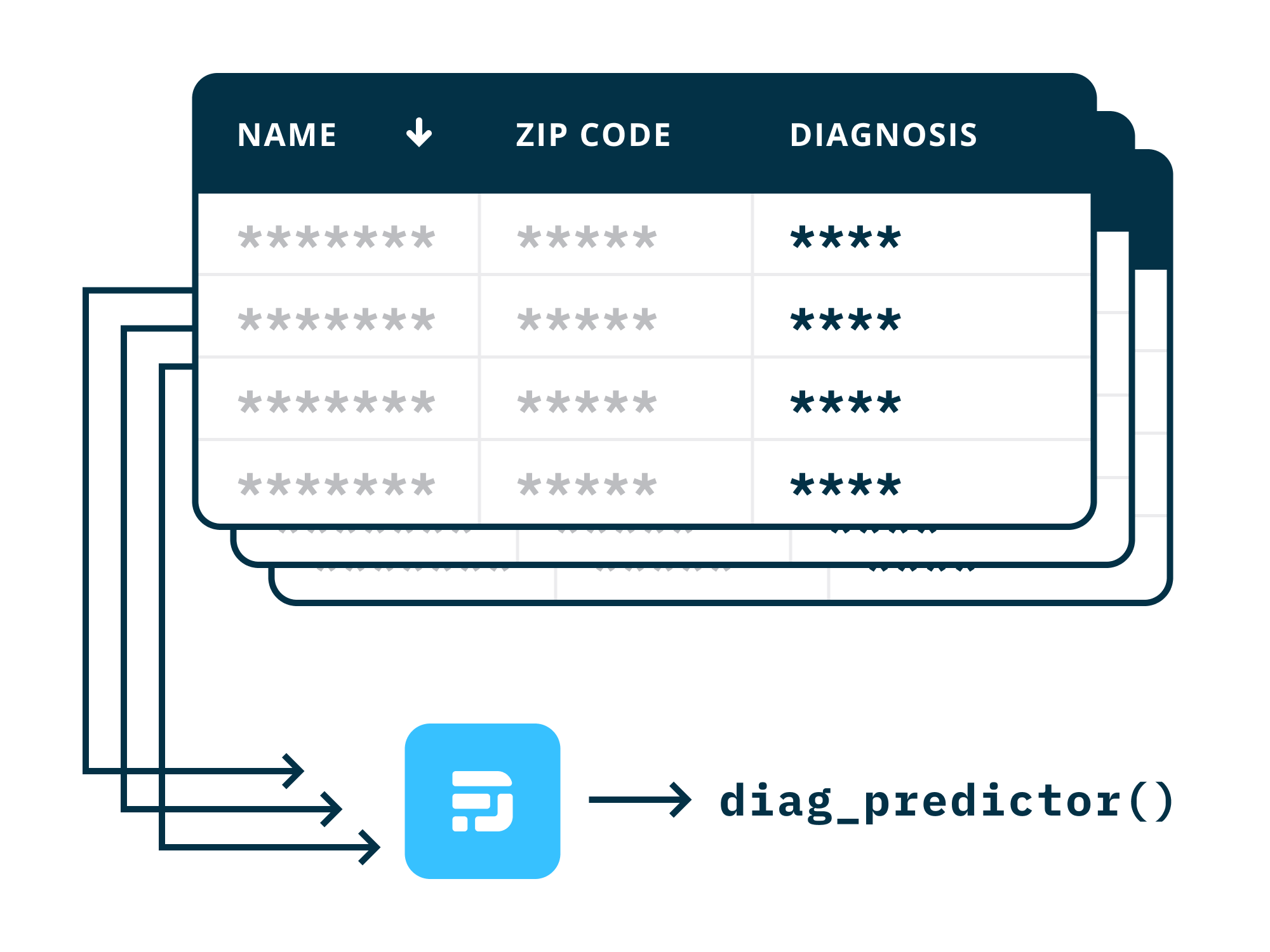
This is where DataFleets steps in. It hasn’t reinvented homomorphic encryption, but has sort of sidestepped it. It uses an approach called federated learning, where instead of bringing the data to the model, they bring the model to the data.

DataFleets integrates with both sides of a secure gap between a private database and people who want to access that data, acting as a trusted agent to shuttle information between them without ever disclosing a single byte of actual raw data.

Illustration showing how a model can be created without exposing data.

Image Credits: DataFleets

Here’s an example. Say a pharmaceutical company wants to develop a machine learning model that looks at a patient’s history and predicts whether they’ll have side effects with a new drug. A medical research facility’s private database of patient data is the perfect thing to train it. But access is highly restricted.

The pharma company’s analyst creates a machine learning training program and drops it into DataFleets, which contracts with both them and the facility. DataFleets translates the model to its own proprietary runtime and distributes it to the servers where the medical data resides; within that sandboxed environment, it runs grows into a strapping young ML agent, which when finished is translated back into the analyst’s preferred format or platform. The analyst never sees the actual data, but has all the benefits of it.

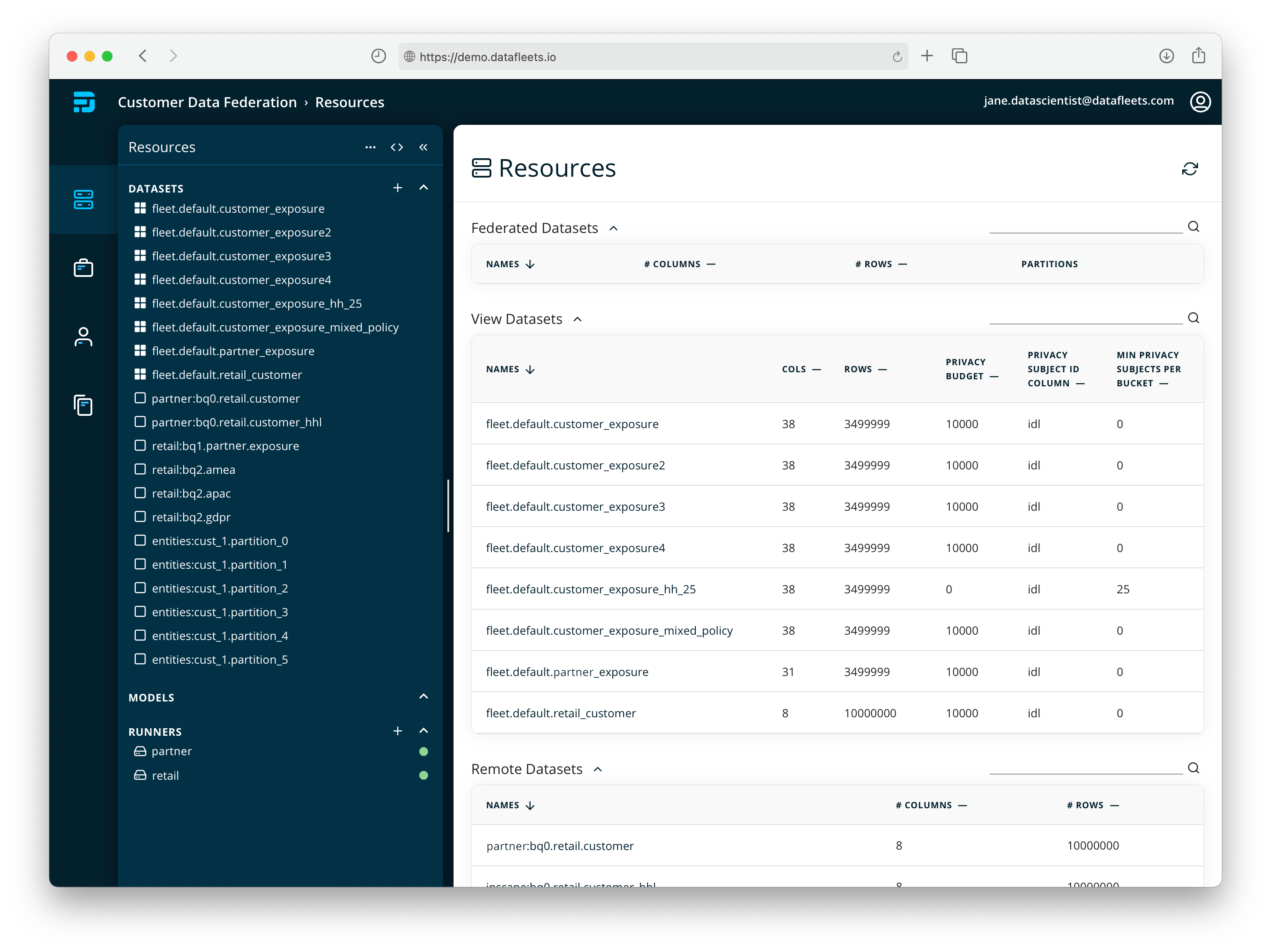
Screenshot of the DataFleets interface. Look, it’s the applications that are meant to be exciting.

It’s simple enough, right? DataFleets acts as a sort of trusted messenger between the platforms, undertaking the analysis on behalf of others and never retaining or transferring any sensitive data.

Plenty of folks are looking into federated learning; the hard part is building out the infrastructure for a wide-ranging enterprise-level service. You need to cover a huge amount of use cases and accept an enormous variety of languages, platforms, and techniques, and of course do it all totally securely.

“We pride ourselves on enterprise readiness, with policy management, identity access management, and our pending SOC 2 certification,” said DataFleets COO and co-founder Nick Elledge. “You can build anything on top of DataFleets and plug in your own tools, which banks and hospitals will tell you was not true of prior privacy software.”

But once federated learning is set up, all of a sudden the benefits are enormous. For instance, one of the big issues today in combating COVID-19 is that hospitals, health authorities, and other organizations around the world are having difficulty, despite their willingness, in securely sharing data relating to the virus.

Everyone wants to share, but who sends whom what, where is it kept, and under whose authority and liability? With old methods, it’s a confusing mess. With homomorphic encryption it’s useful but slow. With federated learning, theoretically, it’s as easy as toggling someone’s access.

Because the data never leaves its “home,” this approach is essentially anonoymous and thus highly compliant with regulations like HIPAA and GDPR, another big advantage. Elledge notes: “We’re being used by leading healthcare institutions who recognize that HIPAA doesn’t give them enough protection when they are making a data set available for third parties.”

Of course there are less noble, but no less viable, examples in other industries: wireless carriers could make subscriber metadata available without selling out individuals; banks could sell consumer data without violating anyone in particular’s privacy; bulky datasets like video can sit where they are instead of being duplicated and maintained at great expense.

The company’s $4.5M seed round is seemingly evidence of confidence from a variety of investors (as summarized by Elledge): AME Cloud Ventures (Jerry Yang of Yahoo!) and Morado Ventures, Lightspeed Venture Partners, Peterson Ventures, Mark Cuban, LG, Marty Chavez (President of the Board of Overseers of Harvard), Stanford-StartX fund, and three unicorn founders (Rappi, Quora, and Lucid).

With only 11 full time employees DataFleets appears to be doing a lot with very little, and the seed round should enable rapid scaling and maturation of its flagship product. “We’ve had to turn away or postpone new customer demand to focus on our work with our lighthouse customers,” Elledge said. They’ll be hiring engineers in the U.S. and Europe to help launch the planned self-service product next year.

“We’re moving from a data ownership to a data access economy, where information can be useful without transferring ownership,” said Elledge. If his company’s bet is on target, federated learning is likely to be a big part of that going forward.

News: Decrypted: How Twitter was hacked, GitHub DMCA backfires

One week to the U.S. presidential election and things are getting spicy. It’s not just the rhetoric — hackers are actively working to disrupt the election, officials have said, and last week they came with a concrete example and an unusually quick pointing of blame. On Wednesday night, Director of National Intelligence John Ratcliffe blamed

One week to the U.S. presidential election and things are getting spicy.

It’s not just the rhetoric — hackers are actively working to disrupt the election, officials have said, and last week they came with a concrete example and an unusually quick pointing of blame.

On Wednesday night, Director of National Intelligence John Ratcliffe blamed Iran for an email operation designed to intimidate voters in Florida into voting for President Trump “or else.” Ratcliffe, who didn’t take any questions from reporters and has been accused of politicizing the typically impartial office, said Iran had used voter registration data — which is largely public in the U.S. — to send emails that looked like they came from the far-right group the Proud Boys. Google security researchers also linked the campaign to Iran, which denied claims of its involvement. It’s estimated about 2,500 emails went through in the end, with the rest getting caught in spam filters.

The announcement was lackluster in detail. But experts like John Hultquist, who heads intelligence analysis at FireEye-owned security firm Mandiant, said the incident is “clearly aimed at undermining voter confidence,” just as the Russians attempted during the 2016 election.


THE BIG PICTURE

Twitter was hacked using a fake VPN portal, New York investigation finds

The hackers who broke into Twitter’s network used a fake VPN page to steal the credentials — and two-factor authentication code — of an employee, an investigation by New York’s Department of Financial Affairs found. The state tax division got involved after the hackers then hijacked user accounts using an internal “admin tool” to spread a cryptocurrency scam.

In a report published last week, the department said the hackers called several Twitter employees and used social engineering to trick one employee into entering their username and password on a site that looked like the company’s VPN portal, which most employees use to access the network from home during the pandemic.

Twitter Hack Update: We knew the attackers used the phone & pretended to be IT Support, but now we know the criminals specifically said they were calling about VPN issues, taking advantage of COVID-19 remote work strain. Sadly, these pretexts work often. https://t.co/kKe8XO3MCJ pic.twitter.com/fpE6Afcij1

— Rachel Tobac (@RachelTobac) October 20, 2020

“As the employee entered their credentials into the phishing website, the hackers would simultaneously enter the information into the real Twitter website. This false log-in generated a [two-factor authentication] notification requesting that the employees authenticate themselves, which some of the employees did,” wrote the report. Once onto the network using the employee’s VPN credentials, the hackers used that access to investigate how to access the company’s internal tools.

Twitter said in September that its employees would receive hardware security keys, which would make it far more difficult for a repeat phishing attack to be successful.

Open-source YouTube download tool hit by DMCA takedown, but backfires

News: Mailman’s new Gmail assistant aims to tame your inbox

A new startup, Mailman, recently launched an email assistant that helps Gmail users to get better control over their inbox. Unlike many email startups, which require users to switch to a new platform or even adopt a new email address, Mailman works along with your existing Gmail account to do things like block annoying emails,

A new startup, Mailman, recently launched an email assistant that helps Gmail users to get better control over their inbox. Unlike many email startups, which require users to switch to a new platform or even adopt a new email address, Mailman works along with your existing Gmail account to do things like block annoying emails, batch email delivery, configure VIPs who can bypass filters, and even silence your inbox for a period of time.

Image Credits: Mailman

The service is the latest in a long line of email startups that have arrived over the years, promising an upgraded email experience — the most recent being Basecamp’s Hey, a new app offering a hosted email service with an expanded set of tools to declutter your inbox.

But many people don’t want to switch to a new email platform or client app, and they don’t generally want to adopt a new email address. They just want their tame their existing inbox. That’s where Mailman comes in.

The service works by authenticating with your Google account, where you give it permission to manage mailbox labels as well as basic email settings (like moving mail to a snoozed folder). You also give Mailman the ability to view and modify but not delete email.

That latter permission is worth noting and considering carefully. Anyone with sensitive information in their inbox may not want to grant a third-party access to manage their email inbox. But arguably, any truly sensitive material shouldn’t be moving over email to begin with, as any security expert would tell you.

For what it’s worth, Mailman says it doesn’t store any data that’s not directly used by the customer in the Mailman interface and it doesn’t monetize your email data — the way that Gmail itself does. It also claims to only read the timestamp, sender’s address and subject line, not the body of your emails, when it assists you in managing your inbox. Mailman additionally claims to encrypt the data it stores in its database, on servers located in the U.S., Canada and India. And it’s GDPR-compliant — meaning you can delete all your data permanently with a click of a button.

Regardless, you’ll have to weigh the risks with the potential benefits of using any email add-on, due to its need to gain inbox access in order to function.

If you choose to proceed and Mailman is granted access to manage your inbox, you can then opt to use any of its features to stem the flow of email.

One of the biggest issues with email is that it continually arrives throughout the day, as soon as emails are sent. That means you end up responding to emails on the sender’s schedule instead of your own.

Mailman introduces a couple of options to address this problem.

If you would like to carve out some email-free time to work without being bothered by incoming email, you can set up a Do Not Disturb schedule that holds back your email during the window you specify.

Image Credits: Mailman

Another feature lets you choose to receive emails in batches at a set number of times per day, or at specific times you configure. In this case, Mailman holds back the emails from your inbox until these delivery slots — allowing you to set times where you’ll work on email, instead of allowing email to pull your focus throughout the day.

Image Credits: Mailman

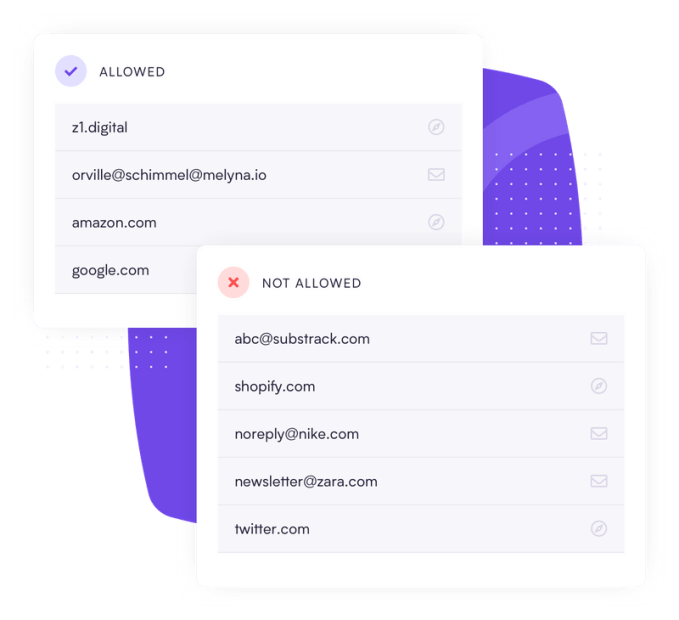
The service also lets you prioritize important email and block others. You can add senders, domains and even keywords to a “VIP” list that lets those emails bypass filters so you always see urgent emails. This could help you to ensure that you don’t miss critical emails from your boss or an important client, for example, even as you use other tools to tame your inbox.

Image Credits: Mailman

Unimportant emails, meanwhile, can be blocked automatically as Mailman can block newsletters, notifications, and emails from senders you’ve never interacted with before. It doesn’t delete these emails, however. Instead, you’ll receive a daily digest that lets you choose how to treat those emails in the future — whether they should be automatically blocked from now on, for example, or immediately sent through.

Over time, this can help train Mailman to ensure you’re getting your important email with fewer distractions.

You don’t have to use all the tools Mailman provides — you can pick and choose those you need while leaving others off, the company notes. And because all the filtering is being done within the Gmail service itself, you can continue to use whichever email client you prefer.

The startup was founded by serial entrepreneur Mohit Mamoria, now Mailman CEO, and Andrew Wilkinson, MetaLab’s founder who now invests and partners with startups through Tiny. Mailman is incubating under Tiny’s umbrella, where it gets help with marketing, UX, and early customer acquisition, among other things.

Explains Mamoria, he and Wilkinson were both in search of different ways to tame their inbox. Mamoria had built a script called Duggo to do it. When he saw a tweet asking about inbox tools from Wilkinson (below), he reached out.

How can I achieve this using Superhuman + Gmail:

I want to receive batches of email a few times a day vs email just flowing in constantly.

I just want new email 2-3 timed a day. Like an old school postman.

Any ideas?

— Andrew Wilkinson (@awilkinson) February 17, 2020

The two decided to collaborate and ended up launching Mailman into beta August 2020, where it has already gained just under 3,000 users. As of last week, Mailman became available to the public. It was announced via a Product Hunt post where it was endorsed by a number of fellow entrepreneurs and founders. Some have also contributed testimonials to the Mailman website.

To some extent, you can use Gmail’s own filters to manage your inbox today, but they aren’t as user friendly. And email services don’t offer tools to configure batch deliveries or quiet times, leaving users to tend to silence their interruptions by snoozing push notifications on their devices instead. Because of email apps’ failure to innovate, new services like Hey, Superhuman and others have popped up, hoping to deliver a better experience for power users.

Mailman, like some rivals, generates revenue through subscriptions — it costs $10 per month or $96 per year. That’s more affordable than the newly popular email service Superhuman, which manages Gmail through its $30 per month client, but it has been called out at too expensive.

The co-founders believe that Mailman has the potential to reach a broader audience than other inbox-taming startups because it respects that users want to keep their existing email and client app.

“Almost everybody who has tried to solve the inbox overload has gone in the direction of building an email client,” explains Mamoria. “[Basecamp’s] Hey went a step further to build an email service altogether. What they miss is that changing email clients or services is easier said than done. It requires huge behavior change and is usually the biggest hurdle to cross for an average user,” he says.

Mailman is available today and exclusively works with Google accounts. It may roll out support to other email providers in the future, but nothing is currently planned in that area.

News: Hubilo raises $4.5 million, led by Lightspeed, to focus on virtual events

Earlier this year, the founders of event analytics platform Hubilo pivoted to become a virtual events platform to survive the impact of COVID-19. Today, the startup announced it has raised a $4.5 million seed round, led by Lightspeed, and says it expects to exceed $10 million bookings run rate and host over one million attendees

Earlier this year, the founders of event analytics platform Hubilo pivoted to become a virtual events platform to survive the impact of COVID-19. Today, the startup announced it has raised a $4.5 million seed round, led by Lightspeed, and says it expects to exceed $10 million bookings run rate and host over one million attendees over the next few months.

The round also included angel investors Freshworks chief executive officer Girish Mathrubootham; former LinkedIn India CEO Nishant Rao; Slideshare co-founder Jonathan Boutelle; and Helpshift CEO Abinash Tripathy.

Hubilo’s clients have included the United Nations, Roche, Fortune, GITEX, IPI Singapore, Tech In Asia, Infocomm Asia and Clarion Events. The startup is headquartered in San Francisco, but about 12% of its sales are currently from Southeast Asia, and it plans to further scale in the region. It will also focus on markets in the United States, Europe, the Middle East and Africa.

Vaibhav Jain, Hubilo’s founder and CEO, told TechCrunch that many of its customers before the pandemic were enterprises and governments that used its platform to help organize large events. Those were also the first to stop hosting in-person events.

In February, “we knew that most, if not all, physical events were getting postponed or cancelled globally. To counter the drop in demand for offline events, we agreed to extend the contracts by six more months at no cost,” Jain said. “However, this was not enough to retain our clients and most of them either cancelled the contracts or put the contract on hold indefinitely.”

As a result, Hubilo’s revenue dropped to zero in February. With about 30 employees and reserves for only three months, Jain said the company had to chose between shutting down or finding an alternative model. Hubilo’s team created a MVP (minimum viable product) virtual event platform in less than a month and started by convincing a client to use it for free. That first virtual event was hosted in March and “since then, we’ve never looked back,” said Jain.

This means Hubilo is now competing with other virtual event platforms, like Cvent and Hopin (which was used to host TechCrunch Disrupt). Jain said his company differentiates by giving organizers more chances to rebrand their virtual spaces; focusing on sponsorship opportunities that include contests, event feeds and virtual lounges to increase attendee engagement; and providing data analytic features that include integration with Salesforce, Marketo and Hubspot.

With so many events going virtual that “Zoom fatigue” and “webinar fatigue” have now become catchphrases, event organizers have to not only convince people to buy tickets, but also keep them engaged during an event.

Hubilo “gamifies” the experience of attending a virtual event with features like its Leaderboard. This enables organizers to assign points for things like watching a session, visiting a virtual booth or messaging someone. Then they can give prizes to the attendees with the most points. Jain said the Leaderboard is Hubilo’s most used feature.

News: NASA discovers water on the surface of the sunlit portion of the Moon

NASA has made a groundbreaking discovery – confirming the presence of water on the surface of Moon, in the area that is exposed to sunlight. Previously, we knew that water was present as water ice on the dark part of the Moon, and that’s part of the reason that the next mission to the Moon

NASA has made a groundbreaking discovery – confirming the presence of water on the surface of Moon, in the area that is exposed to sunlight. Previously, we knew that water was present as water ice on the dark part of the Moon, and that’s part of the reason that the next mission to the Moon is to the lunar South Pole, where it’s believed that water ice could be present hidden in craters that aren’t ever exposed to direct sunlight.

This isn’t an entirely surprising discovery, because NASA scientists and researchers had previously found indications that water was potentially present on the Moon’s sunlight side. But what is new is confirmation, in the form of observational data by NASA’s Stratospheric Observatory for Infrared Astronomy (SOFIA) that deduce water molecules in the Moon’s Clavius Crater in its Southern Hemisphere.

As you might expect since it took this long to actual verify its presence, the lunar water isn’t very plentiful. NASA says they were able to detect between 100 and 412 parts per million in an area spanning a cubic meter of soil, which is around the equivalent of a standard 12-ounce bottle of water – to put that in context, NASA points out that “the Sahara desert has 100 times the amount of water” vs. what SOFIA was able to detect.

Even so, the fact that it’s able to survive intact in the relatively harsh conditions of the sun-exposed lunar surface is intriguing, and will merit further study. Scientists want to find out how the date gets there, and how it manages to actually accumulate. They’ll study that, and scope for potential future use by human explorers establishing a more permanent presence on the lunar surface, through future SOFIA missions looking at different craters and sunlit areas for other water deposits.

This is definitely a landmark discovery, and one that will likely prove integral to the future of human deep space exploration. Part of those longer-term goals include establishing a scientific base of operations on the Moon from which scientists can conduct research, and eventually reach further out to destinations including Mars. Using in-situ resources, including water, could make all of that possible much quicker and without requiring much more complicated workarounds, since it forms the basis for not only human survival, but also essential resources for additional missions from the Moon including rocket fuel for launches.

WordPress Image Lightbox Plugin