
Yearly Archives: 2020

News: SimilarWeb raises $120M for its AI-based market intelligence platform for sites and apps

Israeli startup SimilarWeb has made a name for itself with an AI-based platform that lets sites and apps track and understand traffic not just on their own sites, but those of its competitors. Now, it’s taking the next step in its growth. The startup has raised $120 million, funding it will use to continue expanding

Israeli startup SimilarWeb has made a name for itself with an AI-based platform that lets sites and apps track and understand traffic not just on their own sites, but those of its competitors. Now, it’s taking the next step in its growth. The startup has raised $120 million, funding it will use to continue expanding its platform both through acquisitions and investing in its own R&D, with a focus on providing more analytics services to larger enterprises alongside its current base of individuals and companies of all sizes that do business on the web.

Co-led by ION Crossover Partners and Viola Growth, the round doubles the total amount that the startup has raised to date to $240 million. Or Offer, SimilarWeb’s founder and CEO, said in an interview that it was not disclosing its valuation this time around except to say that his company is now “playing in the big pool.” It counts more than half of the Fortune 100 as customers, with Walmart, P&G, Adidas and Google, among them.

For some context, it hit an $800 million valuation in its last equity round, in 2017.

SimilarWeb’s technology competes with other analytics and market intelligence providers ranging from the likes of Nielsen and ComScore through to the Apptopias of the world in that, at its most basic level, it provides a dashboard to users that provides insights into where people are going on desktop and mobile. Where it differs, Offer said, is in how it gets to its information, and what else it’s doing in the process.

For starters, it focuses not just how many people are visiting, but also a look into what is triggering the activity — the “why”, as it were — behind the activity. Using a host of AI tech such as machine learning algorithms and deep learning — like a lot of tech out of Israel, it’s being built by people with deep expertise in this area — Offer says that SimilarWeb is crunching data from a number of different sources to extrapolate its insights.

He declined to give much detail on those sources but told me that he cheered the arrival of privacy gates and cookie lists for helping ferret out, expose and sometimes eradicate some of the more nefarious “analytics” services out there, and said that SimilarWeb has not been affected at all by that swing to more data protection, since it’s not an analytics service, strictly speaking, and doesn’t sniff data on sights in the same way. It’s also exploring widening its data pool, he added:

“We are always thinking about what new signals we could use,” he said. “Maybe they will include CDNs. But it’s like Google with its rankings in search. It’s a never ending story to try to get the highest accuracy in the world.”

The global health pandemic has driven a huge amount of activity on the web this year, with people turning to sites and apps not just for leisure — something to do while staying indoors, to offset all the usual activities that have been cancelled — but for business, whether it be consumers using e-commerce services for shopping, or workers taking everything online and to the cloud to continue operating.

That has also seen a boost of business for all the various companies that help the wheels turn on that machine, SimilarWeb included.

“Consumer behavior is changing dramatically, and all companies need better visibility,” said Offer. “It started with toilet paper and hand sanitizer, then moved to desks and office chairs, but now it’s not just e-commerce but everything. Think about big banks, whose business was 70% offline and is now 70-80% online. Companies are building and undergoing a digital transformation.”

That in turn is driving more people to understand how well their web presence is working, he said, with the basic big question being: “What is my marketshare, and how does that compare to my competition? Everything is about digital visibility, especially in times of change.”

Like many other companies, SimilarWeb did see an initial dip in business, Offer said, and to that end the company has taken on some debt as part of Israel’s Paycheck Protection Program, to help safeguard some jobs that needed to be furloughed. But he added that most of its customers prior to the pandemic kicking off are now back, along with customers from new categories that hadn’t been active much before, like automotive portals.

That change in customer composition is also opening some doors of opportunity for the company. Offer noted that in recent months, a lot of large enterprises — which might have previously used SimilarWeb’s technology indirectly, via a consultancy, for example — have been coming to the company direct.

“We’ve started a new advisory service [where] our own expert works with a big customer that might have more deep and complex questions about the behaviour we are observing. They are questions all big businesses have right now.” The service sounds like a partly-educational effort, teaching companies that are not necessarily digital-first be more proactive, and partly consulting.

New customer segments, and new priorities in the world of business, are two of the things that drove this round, say investors.

“SimilarWeb was always an incredible tool for any digital professional,” said Gili Iohan of ION Crossover Partners, in a statement. “But over the last few months it has become apparent that traffic intelligence — the unparalleled data and digital insight that SimilarWeb offers — is an absolute essential for any company that wants to win in the digital world.”

As for acquisitions, SimilarWeb has historically made these to accelerate its technical march. For example, in 2015 it acquired Quettra to move deeper into mobile analytics and it acquired Swayy to move into content discovery insights (key for e-commerce intelligence). Offer would not go into too much detail about what it has identified as a further target but given that there are quite a lot of companies building tech in this area currently, that there might be a case for some consolidation around bigger platforms to combine some of the features and functionality. Offer said that it was looking at “companies with great data and digital intelligence, with a good product. There are a lot of opportunities right now on the table.”

The company will also be doing some hiring, with the plan to be to add 200 more people globally by January (it has around 600 employees today).

“Since we joined the company three years ago, SimilarWeb has executed a strategic transformation from a general-purpose measurement platform to vertical-based solutions, which has significantly expanded its market opportunity and generated immense customer value,” said Harel Beit-On, Founder and General Partner at Viola Growth, in a statement. “With a stellar management team of accomplished executives, we believe this round positions the company to own the digital intelligence category, and capitalize on the acceleration of the digital era.”

News: Impact America Fund closes $55M to invest in startups targeting the world’s overlooked

The entire asset class of venture capital is built atop systemic racism. The numbers don’t lie: only 2% of partner-level VCs are Black, and 81% of venture capital firms don’t have a Black partner on board. The lack of diversity in check-writers doesn’t stay in board rooms: homogeneity trickles down to the founders who get

The entire asset class of venture capital is built atop systemic racism. The numbers don’t lie: only 2% of partner-level VCs are Black, and 81% of venture capital firms don’t have a Black partner on board. The lack of diversity in check-writers doesn’t stay in board rooms: homogeneity trickles down to the founders who get mentored and the startups that get funded, excluding an entire population of potentially revolutionary ideas.

Systemic racism is a market inefficiency, according to Kesha Cash, the founder of Impact America Fund. So, Cash, one of the few Black female general partners in venture capital, says she wants to invest in companies that work on solutions for the world’s overlooked and underserved.

Today, Impact America Fund (IAF) announced that it has closed a $55 million investment vehicle to serve this exact purpose. The raise will allow IAF to invest 20 to 25 checks, between the size of $250,000 to $3 million, in early-stage startups. The close marks one of the largest funds ever raised by a sole Black female general partner.

The fund has 67 limited partners, including a number of foundations, large wealth managers and UBS. Cash says that the raise took two years to complete. In June, when George Floyd was murdered by the police, a number of firms rushed to find ways to support Black entrepreneurs. “Society got to see it with their own eyes how big these problems are,” Cash said. The racial reckoning across the country sped up the tail end of IAF’s fundraise close and brought in a ton of inbound interest.

Still, Cash says that IAF had to clarify its focus throughout its fundraising process.

“We’re not just investing in Black and brown people, which I think is a very important thesis, but not our thesis,” Cash said. Instead, Cash says the door-opening conversation for fundraising hinged on a more macro conversation.

“While many of you have been approaching this through your grants and philanthropy, we actually believe there’s a way to continue to invest in software and venture capital businesses to scale and disrupt some of the underlying systemic issues that you and others may not be able to see but are perpetuating,” Cash remembers saying to potential investors. “If you go to that, that opens a lot of doors. That’s the fundraising conversation.”

So far, IAF’s newest fund has invested in 10 companies, including Mayvenn, which supports Black hair stylists; Care Academy, which works with home care employees; and SMBX, a small business bond marketplace.

“We’re trying to get to the root of the problem and create and disrupt systems,” she said.

IAF is also evolving from a structural standpoint. The firm used to be structured as a family office, with flexibility to invest in non-venture-backable businesses across a $10 million fund. The new fund will be a traditional venture capital firm with a 10-year investment return cycle.

Cash says that it could feel like an “anti-social justice move” to apply venture capital, an exclusive asset class, to the issue of racial inequity.

Kesha Cash, the general partner of Impact America Fund. Image Credits: Impact America Fund

The investor became a social justice activist, protesting against California Proposition 209, when she was an undergrad at UC Berkeley. Given her activism, her classmates were surprised when she interned at a Wall Street investment bank. But Cash says that, as a first-generation college student from a low-income household, she wanted to understand the dynamics between finance, money and deal structures.

“While I took down my faux locs and removed my nose ring to intern and then work full time on Wall Street, I didn’t forget my work as a social justice activist and made it my mission to learn and reimagine how finance could be used to empower the overlooked and under-resourced communities I care deeply about,” she said.

Cash thinks that access to capital could be the catalyst needed to give underserved communities the opportunity to experiment and innovate. Cash, who grew up low income and worked on Wall Street, sees an opportunity to bring the two worlds together.

“When we think about disruption and venture capital, people get to dream and make up a new world,” she said. “Well hell, I want to make up the new world for low-income Black and brown people in this country.”

News: Lightspeed Venture Partners backs Theta Lake’s video conferencing security tech with $12.7 million

Theta Lake, a provider of compliance and security tools for conferencing software like Cisco Webex, Microsoft Teams, RingCentral, Zoom and others, said it has raised $12.7 million in a new round of funding. Lightspeed Venture Partners led the round with commitments from Cisco Investments, angel investors from the collaboration and security space, and previous investors,

Theta Lake, a provider of compliance and security tools for conferencing software like Cisco Webex, Microsoft Teams, RingCentral, Zoom and others, said it has raised $12.7 million in a new round of funding.

Lightspeed Venture Partners led the round with commitments from Cisco Investments, angel investors from the collaboration and security space, and previous investors, Neotribe Ventures, Firebolt Ventures and WestWave Capital, the company said.

The company’s financing comes as the COVID-19 pandemic has created a surge of demand for remote work conferencing technologies — and services that can ensure the security of those communications.

Citing a Research and Markets report, the company estimates that the market will grow from $8.9 billion in 2019 to $23 billion by the end of this year.

Theta Lake said that the funding would be used to increase its sales and marketing capabilities and for research and development on new product features, according to a statement. 

The company’s tech already uses machine learning to detect security risks in video, visual, voice, chat and document content shared over video and collaboration tools.

As a result of its investment, Arif Janmohamed, a partner at Lightspeed Venture Partners, will join the Theta Lake Board of Directors, the company said. 

“The need for security and compliance solutions that fully cover modern collaboration tools should be obvious to everyone,” said Devin Redmond, Theta Lake’s co-founder and chief executive, in a statement. “That need pre-existed the pandemic, but now is more pressing than ever. The shift from physical work sites and employer-owned networks with tightly managed devices and applications, to a distributed workplace that lives inside your collaboration tools means organizations need new security and compliance coverage that lives inside that new workplace. 


News: AMD grabs Xilinx for $35 billion as chip industry consolidation continues

The chip industry consolidation dance continued this morning as AMD has entered into an agreement to buy Xilinx for $35 billion, giving the company access to customers requiring chips with high performance workloads like artificial intelligence. AMD sees this deal as combining two companies that complement each other’s strengths without cannibalizing its own markets. CEO

The chip industry consolidation dance continued this morning as AMD has entered into an agreement to buy Xilinx for $35 billion, giving the company access to customers requiring chips with high performance workloads like artificial intelligence.

AMD sees this deal as combining two companies that complement each other’s strengths without cannibalizing its own markets. CEO Lisa Su believes the acquisition will help make her company the high performance chip leader.

“By combining our world-class engineering teams and deep domain expertise, we will create an industry leader with the vision, talent and scale to define the future of high performance computing,” Su said in a statement.

In an article earlier this year, TechCrunch’s Darrell Etherington described Xilinx new satellite focused chips as offering a couple of industry firsts:

It’s the first 20nm process that’s rated for use in space, offering power and efficiency benefits, and it’s the first to offer specific support for high performance machine learning through neural network-based inference acceleration.

What’s more, the chips are designed to handle radiation and the rigors of launch, using a thick ceramic packaging. These kinds of applications should open up new markets for AMD as the two companies combine.

In a nod to shareholders of both companies, she said that this deal should benefit both. “This is truly a compelling combination that will create significant value for all stakeholders, including AMD and Xilinx shareholders who will benefit from the future growth and upside potential of the combined company.

So far stockholders aren’t impressed with AMD stock down over 4% in pre-trading, while Xilinx stock is up over 11% in pre-trading. It’s worth noting that Xilinx has a market cap of over $28 billion compared with AMD’s 96.5 billion, meaning AMD will be buying a company with significantly more value.

This deal comes on the heels of last month’s ARM acquisition by Nvidia for $40 billion. With two deals in less than two months totaling $75 million, the industry is looking at the bigger is better theory. Meanwhile Intel took a hit earlier this month after its earnings report showed weakness in its data center business.

While the deal has been approved by both company’s boards of directors, it still has to pass muster with shareholders and regulators, and is not expected to close until the end of next year.

When that happens Su will be chairman of the combined company, while Xilinx CEO President and CEO, Victor Peng, will join AMD as president, where he will be in charge of the Xilinx business and strategic growth initiatives.

News: Uber’s ‘robo-firing’ of drivers targeted in latest European lawsuit

Uber is facing another legal challenge in Europe related to algorithmic decision making. The App Drivers & Couriers Union (ADCU) filed a case, yesterday, with a court in the Netherlands seeking to challenge the ride hailing company’s practice of ‘robo-firing’ — aka the use of automated systems to identify fraudulent activity and terminate drivers based

Uber is facing another legal challenge in Europe related to algorithmic decision making.

The App Drivers & Couriers Union (ADCU) filed a case, yesterday, with a court in the Netherlands seeking to challenge the ride hailing company’s practice of ‘robo-firing’ — aka the use of automated systems to identify fraudulent activity and terminate drivers based on that analysis.

Under EU law individuals subject to solely automated decisions have a right to request a human review. Article 22 of the General Data Protection Regulation (GDPR) gives data subjects the right not to be subject to a solely automated decision where there’s a significant legal or similar effect.

The ADCU case contends that Uber drivers in the UK and Portugal have been “wrongly accused of ‘fraudulent activity as detected by Uber systems before being fired without right of appeal”.

“In each of the cases the drivers were dismissed after Uber said its systems had detected fraudulent activity on the part of the individuals concerned. The drivers absolutely deny that they were in any way engaged in fraud and Uber has never made any such complaint to the police. Uber has never given the drivers access to any of the purported evidence against them nor allowed them the opportunity to challenge or appeal the decision to terminate,” it writes in a press release about the action.

A spokeswoman for Uber said the cases of the drivers in question had been manually reviewed by specialist staff prior to the terminations.

However the ADCU’s contention is that Uber is using an overly broad definition of ‘fraud’ to undercut its obligations to workers’ rights by concealing performance-related dismals — noting that the company’s ‘Community Guidelines’ define ‘fraud’ to include declining work offered and strategically logging out to await higher surge pricing.

A segment of Uber’s guidelines on fraud states that it is “constantly on the lookout for fraud by riders and drivers who are gaming our systems”. The text goes on to specify that some of the behaviours which may cause an Uber driver to have their account deactivated include: “deliberately increasing the time or distance of a trip; accepting trips without the intention to complete, including provoking riders to cancel; creating dummy rider or driver accounts for fraudulent purposes; claiming fraudulent fees or charges, like false cleaning fees; and intentionally accepting or completing fraudulent or falsified trips”.

The union says driver 1, who was based in London, was summarily dismissed after Uber said their systems had detected “irregular trips associated with fraudulent activities— and was never given an explanation nor a right of appeal.

Driver 2, also based in London, was summarily dismissed after Uber claimed its systems detected the installation of and use of software which has the intention and effect of manipulating the Driver App’. Again it says the driver was given no further explanation of the allegations and was denied the right of appeal.

Driver 3, based in Birmingham, was similarly terminated without right of appeal after Uber said their systems had detected “a continued pattern of improper use of the Uber application…..& this created a poor experience for all parties.”

A fourth driver, based in Lisbon, Portugal, had their account deactivated after Uber claimed its systems detectedthe recurrent practice of irregular activities during use of the Uber App.

Uber declined to go into specific detail on the cases of the individual drivers involved in the ADCU challenge but said it does not see any new allegations based on the press release — adding that it’s awaiting any new information from the courts.

“Uber provides requested personal data and information that individuals are entitled to. We will give explanations when we cannot provide certain data, such as when it doesn’t exist or disclosing it would infringe on the rights of another person under GDPR. As part of our regular processes, the drivers in this case were only deactivated after manual reviews by our specialist team,” the company said in a statement.

We also asked the company if it manually reviews all the cases of drivers whom its algorithm has identified as engaged in fraudulent activity — but at the time of writing it had not responded to the question.

The ADCU is inviting other former Uber drivers from the UK and throughout the European Economic Area who have been similarly dismissed over alleged ‘fraudulent activity’ to register on its website to join the collective action which they’re hoping to part-fund via a crowdjustice campaign.

In July the union backed another challenge to Uber’s algorithms — in that case focused on the use of profiling and data-fueled algorithms to manage drivers, looping in the GDPR’s data access rights.

Last month the union also lodged a similar challenge to India-based ride-hailing platform Ola.

News: Deci raises $9.1M to optimize AI models with AI

Deci, a Tel Aviv-based startup that is building a new platform that uses AI to optimized AI models and get them ready for production, today announced that it has raised a $9.1 million seed round led by Emerge and Square Peg. The general idea here is to make it easier and faster for businesses to

Deci, a Tel Aviv-based startup that is building a new platform that uses AI to optimized AI models and get them ready for production, today announced that it has raised a $9.1 million seed round led by Emerge and Square Peg.

The general idea here is to make it easier and faster for businesses to take AI workloads into production — and to optimize those production models for improved accuracy and performance. To enable this, the company built an end-to-end solution that allows engineers to bring in their pre-trained models and then have Deci manage, benchmark and optimize them before they package them up for deployment. Using its runtime container or Edge SDK, Deci users can also then serve those models on virtually any modern platform and cloud.

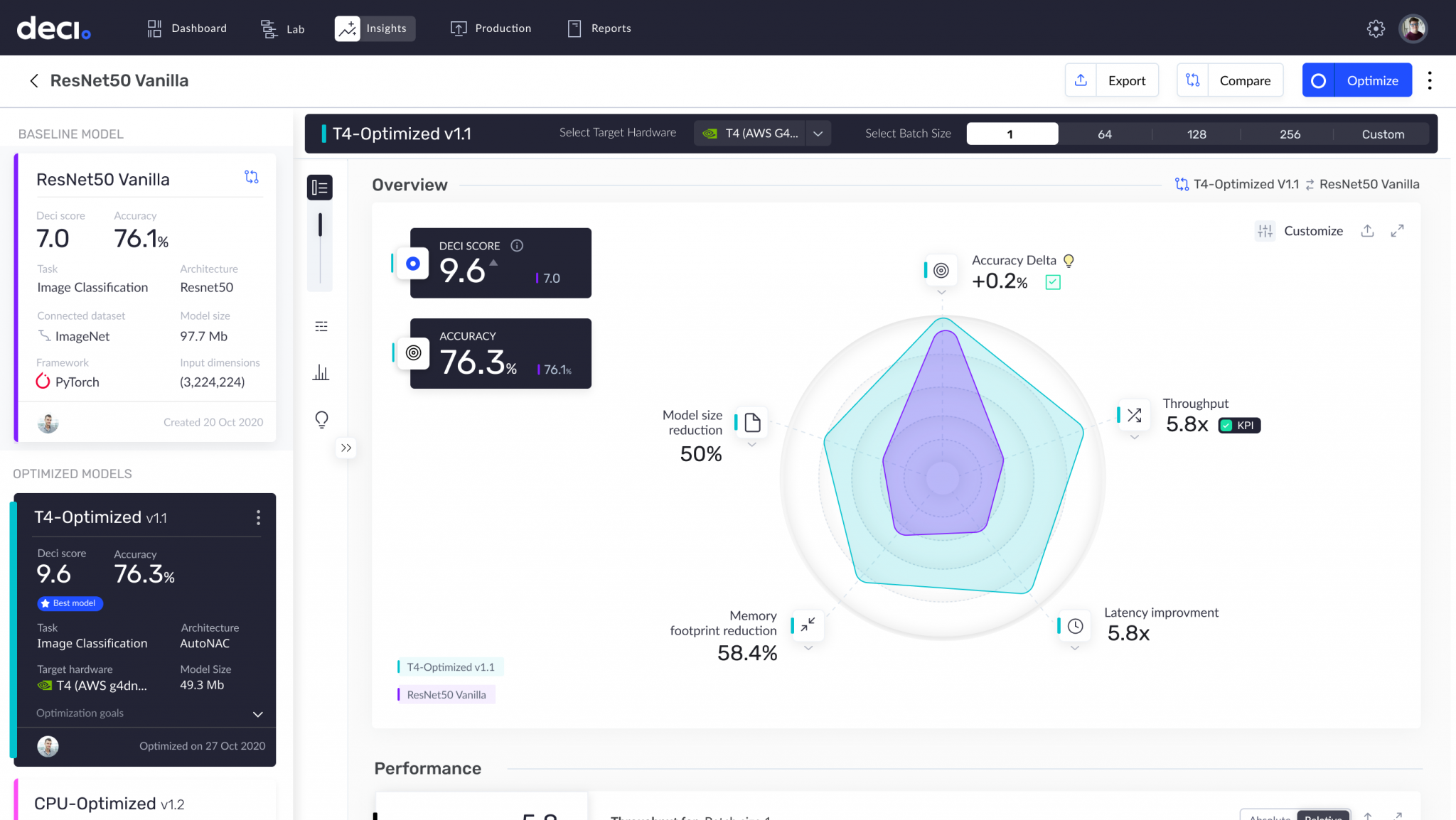
Deci’s insights screen combines all indicators of a deep learning model’s expected behavior in production, resulting in the Deci Score – a single metric summarizing the overall performance of the model.

The company was co-founded by co-founded by deep learning scientist Yonatan Geifman, technology entrepreneur Jonathan Elial, and professor Ran El-Yaniv, a computer scientist and machine learning expert at the Technion – Israel Institute of Technology.

“Deci is leading a paradigm shift in AI to empower data scientists and deep learning engineers with the tools needed to create and deploy effective and powerful solutions,” says Yonatan Geifman, CEO and co-founder of Deci. “The rapidly increasing complexity and diversity of neural network models make it hard for companies to achieve top performance. We realized that the optimal strategy is to harness the AI itself to tackle this challenge. Using AI, Deci’s goal is to help every AI practitioner to solve the world’s most complex problems.”

Deci’s lab screen enables users to manage their deep learning models’ lifecycles, optimize inference performance, and prepare models for deployment. Image Credits: Deci

The company promises is that, on the same hardware and with comparable accuracy, Deci-optimized models will run between five and ten times faster than before. It can make use of CPUs and GPUs for running its inference workloads and the company says that it is already working with customers in autonomous driving, manufacturing, communication and healthcare, among others.

“Deci‘s ability to automatically craft top-performing deep learning solutions is a paradigm shift in artificial intelligence and unlocks new opportunities for many businesses across different industries,” said Liad Rubin, Partner at Emerge. “We are proud to have partnered with such incredible founders and be part of Deci’s journey from day one.”


News: Leading Edge Equipment has a technology to improve solar manufacturing and $7.6 million to go to market

Only a few weeks after the successful public offering of Array Technologies proved that there’s a market for technologies aimed at improving efficiencies across the solar manufacturing and installation chain, Leading Edge Equipment has raised capital for its novel silicon wafer manufacturing equipment.  The $7.6 million financing came from Prime Impact Fund, Clean Energy Ventures and

Only a few weeks after the successful public offering of Array Technologies proved that there’s a market for technologies aimed at improving efficiencies across the solar manufacturing and installation chain, Leading Edge Equipment has raised capital for its novel silicon wafer manufacturing equipment. 

The $7.6 million financing came from Prime Impact Fund, Clean Energy Ventures and DSM Venturing and the company said it would use the technology to ramp up its sales and marketing efforts. 

For the last few years researchers have been talking up the potential of so-called kerfless, single-crystal silicon wafers. For industry watchers, the single-crystal versus poly-crystalline wafers may sound familiar, but as with many things with the resurgence of climate technology investment maybe this time will be different.

Silicon wafer production today is a seven-step process in which large silicon ingots created in heavily energy-intensive furnaces are sawed into wafers by wires. The process wastes large amounts of silicon, requires an incredible amount of energy and produces low-quality wafers that reduce the efficiency of solar panels.

Using ribbons to produce its wafers, Leading Edge’s manufacturing equipment uses the floating silicon method to reduce production to a single step, consuming less energy and producing almost no waste, according to the company.

Founded by longtime experts in the silicon foundry industry — Alison Greenlee, a quadruple-degreed graduate of the Massachusetts Institute of Technology who worked on floating silicon method that reduces waste in the manufacturing of silicon for solar cells; and Peter Kellerman, the progenitor of floating silicon method technologies.

The two founded Leading Edge Equipment to rejuvenate a project that had been mothballed by Applied Materials after years of research.

The two won $5 million in federal grants and raised an initial $6 million from venture capital firms in 2018 to kick off the technology.

Leading Edge expects that its equipment could become the standard for silicon substrate manufacturing.

Kellerman, now the emeritus chief technology officer, was replaced by Nathan Stoddard, a seasoned silicon manufacturing technology expert who has worked on teams that have brought three different solar wafer technologies from concept to pilot production. Stoddard, a former colleague of Greenlee’s at 1366 — one of the early companies devoted to new silicon production technologies — was won over by Greenlee and Kellerman’s belief in the old Applied Materials technology. 

The company claims that its technology can reduce wafer costs by 50 percent, increases commercial solar panel power by up to seven percent, and reduces manufacturing emissions by over 50 percent.

To commercialize the project, earlier this year the team brought in Rick Schwerdtfeger, a longtime innovator in solar technology who began working with CIGS crystals back in 1995. In the 2000s Schwerdtfeger spent his time in building out ARC Energy to scale next-generation furnace technologies. 

“After critical technology demonstrations and the development of a new commercial tool, we are now ready to launch this technology into market in 2021,” said Schwerdtfeger in a statement. “Having recently secured a 31,000 square foot facility and doubled the size of our team, we will use this new funding to prepare for our 2021 commercial pilots.”


News: Bogota’s Tül raises $4 million to improve the supply chain for construction in Latin America

With a new $4 million round, the Bogota-based supply chain logistics technology developer Tül is prepping to expand across the Latin American region. Founded by Enrique Villamarin Lafaurie and Juan Carlos Narváez, Tül’s technology connects construction manufacturers to the small businesses across Latin America that are responsible for handling half of the inventory for construction

With a new $4 million round, the Bogota-based supply chain logistics technology developer Tül is prepping to expand across the Latin American region.

Founded by Enrique Villamarin Lafaurie and Juan Carlos Narváez, Tül’s technology connects construction manufacturers to the small businesses across Latin America that are responsible for handling half of the inventory for construction jobs in the region, Lafaurie said.

Lafaurie previously spent ten years working in the construction industry for Cementos Argos, the Colombian company responsible for a huge chunk of cement sales in North and South America.

“We’re connecting big construction companies in the back to hardware companies at the front end. It’s a way where producers can connect to those stores and can talk to those stores and do promotions straight to those stores,” said Lafaurie. 

By digitizing what had been a primarily analog industry, the company has managed to hit a $10 million run revenue run rate and sign up 3,000 stores since its launch 8 months ago.

And that’s just in Colombia alone, said Lafaurie. The company will soon open up operations in Ecuador, which Lafaurie said was the second largest hardware market (per capita) in Latin America.

The company now counts nine employees on staff and expects to ramp up hiring significantly with the new capital.

“Colombia, was the most locked down country in the whole world. People were not allowed to leave their houses, but construction was deemed an essential business,” said Eric Reiner, an investor with Vine Capital Management, which led the company’s seed round. “Tül allowed hardware stores to ship products directly to the construction workers. With their logistics network they started a separate brand delivering sanitation equipment so that schools and laundromats could become sanitation stations.”

As Lafaurie describes it, Tül’s online service became a lifeline for the industry.

“The whole industry just shut down and we managed to keep those business open by not only helping them deliver straight to the jobsite, but by becoming the sanitation stations in the neighborhood. The outcome of that is very loyal customers to us that we helped,” he said. “We have huge retention of customers just from that.”

News: NeoLight’s jaundice treatment catches another $7 million to bring neonatal light therapy to the home

NeoLight, a startup company that’s working to bring hospital-grade neonatal care technologies to the home, has raised $7 million more in financing. Dignity Health and Honor Health Systems came in to support the company along with previous investors like the Pittsburgh Steelers quarterback Ben Roethlisberger and his wife Ashley and other, undisclosed investors.  Initially intended

NeoLight, a startup company that’s working to bring hospital-grade neonatal care technologies to the home, has raised $7 million more in financing.

Dignity Health and Honor Health Systems came in to support the company along with previous investors like the Pittsburgh Steelers quarterback Ben Roethlisberger and his wife Ashley and other, undisclosed investors. 

Initially intended for hospital use, the company pivoted to pitch its hardware to new parents since they’re now being encouraged to take newborns home as soon as possible so that they can be quarantined.

The company’s light therapies are designed to treat conditions like jaundice, which occurs in roughly 60% of newborns and can lead to brain damage if left untreated, according to a statement from the company.

“The challenge is that the doctor may not know if treatment is necessary until the  newborn is three or four days old, often after the baby has gone home from the  hospital,” company founder Vivek Kopparthi said in a statement.


News: India’s FreshToHome raises $121 million to grow its meat and vegetable e-commerce platform

FreshToHome, an Indian e-commerce startup that sells fresh vegetables, fish, chicken and other kinds of meat, has raised $121 million in a new financing round as the Bangalore-headquartered firm reports accelerated growth spurred by the coronavirus pandemic. The startup, which offers its service in several major Indian cities including Delhi, Mumbai, Pune, Bangalore, and Hyderabad,

FreshToHome, an Indian e-commerce startup that sells fresh vegetables, fish, chicken and other kinds of meat, has raised $121 million in a new financing round as the Bangalore-headquartered firm reports accelerated growth spurred by the coronavirus pandemic.

The startup, which offers its service in several major Indian cities including Delhi, Mumbai, Pune, Bangalore, and Hyderabad, is processing about 1.5 million orders a month, up from 420,000 monthly orders last year, said Shan Kadavil, co-founder and chief executive of FreshToHome, in an interview with TechCrunch.

The growing popularity of FreshToHome, which aims to “Uber-ize farmers and fishermen” for commodity exchange, comes as people become cautious about stepping outside of the homes and standing in queues in front of vegetable shops to reduce their exposure to the virus. FreshToHome provides contactless delivery of “100% fresh and 0% chemicals” vegetables and meats directly to consumers’ homes.

On the platform, farmers and fishermen bid for their latest yields (as mandated by local laws) electronically. This allow them to cut the middlemen which helps them and FreshToHome assume better control over the quality of the items and reduce the prices. (Much of the vegetable and meat sales in India is still unorganized.) The startup has also established its own supply chain network and transports items through trains and planes.

The new financing round for the startup — a Series C — was led by Investment Corporation of Dubai, the principal investment arm of the Government of Dubai, Investcorp, Ascent Capital, U.S. Government’s development finance institution (DFC), and the Allana Group. As far as Series C financing round for consumer-focused startups goes, FreshToHome’s $121 million round is the largest to date for an Indian startup.

This is also the first time DFC has bought an equity stake in an Indian startup. It has previously lent capital to Odisha-headquartered MilkMantra. Iron Pillar, which led FreshToHome’s Series B round, invested $19 million in the new financing round. FreshToHome has raised $154 million to date.

Kadavil, who previously headed India operations of gaming firm Zynga and is an advisor to several startups, said raising a new round at the height of a pandemic was not necessarily difficult for FreshToHome as there is a pent up demand from investors for this category and the startup has demonstrated impressive growth in recent quarters.

“FreshToHome is a leader in leveraging AI-based technology and business innovation to bring a superior value proposition to customers and suppliers in a large and important market,” said Khalifa Al Daboos, Deputy CEO of Investment Corporation of Dubai, in a statement.

The startup, which currently clocks an annual recurring revenue of $85 million, aims to hit $200 million next year. Kadavil said FreshToHome has become EBIDTA profitable (it is generating a profit if you exclude interest, taxes, depreciation and amortization costs) in several mature cities and will now expand to more geographies. It already operates in the UAE, and plans to expand to Saudi Arabia. It also plans to expand within India and become operational in Kolkata.

FreshToHome competes with a handful of startups, including Licious, which has raised more than $94.5 million to date, and to an extent with BigBasket.

WordPress Image Lightbox Plugin