Yearly Archives: 2020

News: Deep tech VC fund The Engine raises $230M for its second fund from MIT and new backer Harvard

Deep tech. Hard tech. Or, as The Engine dubs it, Tough Tech. Venture investing today is essentially identical to what happens on Wall Street, focused on data rooms, spreadsheets, SaaS churn models and cohort analysis. Yet, the history of venture capital firms is heavily interwoven with universities and their research. Some of the most famous

Deep tech. Hard tech. Or, as The Engine dubs it, Tough Tech.

Venture investing today is essentially identical to what happens on Wall Street, focused on data rooms, spreadsheets, SaaS churn models and cohort analysis. Yet, the history of venture capital firms is heavily interwoven with universities and their research. Some of the most famous VC funds like Kleiner Perkins got their start funding compelling research projects out of laboratories and financing their commercialization toward scale.

Technical risk is something many VCs like to avoid, but The Engine has built an entire brand and thesis around it. Centered around Kendall Square and the broader MIT ecosystem, The Engine debuted a couple of years ago with a focus on “tough tech” problems that are perhaps a touch too early for other VCs. That’s led to investments in companies like Boston Metal, which builds environmentally-friendly steel alloys, WoHo, which is rethinking modular building construction that we profiled last week, and Commonwealth Fusion Systems, which is developing fusion power.

Indeed, the firm’s portfolio page has to be one of the most interesting in the industry today.

The good news is that the firm’s ambitious funding strategy looks set to continue. It announced this morning that it has raised $230 million toward the firm’s second fund, which on top of the firm’s first fund brings it to a total of $435 million under management. In a press statement, the firm said that it has funded 27 portfolio companies out of its first fund. While MIT continues to be the anchor LP, Harvard joined for Fund 2, creating a cross-Cambridge, MA venture platform.

Katie Rae remains CEO and managing partner of the fund, and her team has expanded over the past few years as the firm has scaled up.

One interesting point that we haven’t noted previously is that MIT is building The Engine a 200,000 square foot building near its campus that will offer massive space for startups and portfolio companies to start and grow over time. That building is expected to open in 2022, hopefully when this whole pandemic situation allows for in-office collaboration again.

Boston has become something of a hub for deeper technical projects. Local startup Desktop Metal, which builds 3D printers that can print metal, is going through a SPAC process that values the company at roughly $2.5 billion. With this latest news from The Engine, it seems clear that Boston’s tough tech ecosystem will continue to have a pipeline of interesting and compelling companies.

News: Boom raises $7M Series A in bid to become the ‘Amazon for commercial photography’

Milan-headquartered scale-up Boom, which offers a two-sided tech platform to let companies book and manage commercial photo shoots, has raised $7 million in Series A funding. The round is led by Italy’s United Ventures, with the participation from Wellness Holding. It will be used to support the photo tech company’s next stage of growth as

Milan-headquartered scale-up Boom, which offers a two-sided tech platform to let companies book and manage commercial photo shoots, has raised $7 million in Series A funding.

The round is led by Italy’s United Ventures, with the participation from Wellness Holding. It will be used to support the photo tech company’s next stage of growth as it sets its sights on “5% market share” of the $80bn global digital photography market.

Specifically, Boom says it will invest in its proprietary plug & play technology for managing the commercial photography production pipeline, and build a presence in 180 countries, including opening offices and studios in London and New York. The platform combines a marketplace, logistics, photo online storage, APIs and a CRM, with Boom pitching itself as wanting to become the “Amazon for commercial photography”,

“Today, visual content is more vital than ever,” says Boom co-founder and CEO Federico Mattia Dolci. “Data shows that photography is the second most important key driver for successful online commerce after online payments. This was our opportunity”.

Dolci says that, while demand for high-quality content was huge, when the company was founded in 2008, “there was a lack of scalable solutions”. And scale is the name of the game, with estimates suggesting there was more than 2 trillion photos uploaded online in 2019.

“The largest online sellers have massive, ever-growing image libraries,” says the Boom CEO. “And the faster the market grew, the more we recognised a major digital supply-and-demand gap. We could see that countless internet giants were changing the way people shopped online, uploading billions of pictures on their websites and platforms every day, but these same brands had no access to a content provider that could keep up with their scaled-up, global, fast-paced environment. The whole system was expensive and obsolete”.

To address this, Boom has developed a “tech-first” oder system that enables companies and brands to easily commission “high quality, affordable content” on a global scale. The promise is that it offers a simple, streamlined, automated work-flow, coupled with a network of thousands of professional photographers, without compromising on quality. The platform matches a client photoshoot request with the best photographers in the area. It also employs automatic photo-editing to improve raw shots, so that if a brand wants to get access to photos instantly, the photographer can spend less time editing.

Meanwhile, Boom’s order system doesn’t just manage photoshoots. Clients can also book videographers, drone pilots, designers, and other creative assets using the innovative platform.

To that end, Boom claims in excess of 250 major corporate clients including the likes of Deliveroo, Vacasa, Uber Eats, OYO, Lavanda, Casavo, Westwing, Getyourguide and hundreds of SMEs across verticals. It has a presence in more than 80 countries and has processed 3 million images to date, averaging one shoot per minute, across real estate, travel, F&B, and e-commerce.

Adds Dolci: “Our customers can place an order and expect a delivery 24h later, whether the photoshoots take place in Milan, New York, or Sydney, and whether the order calls for one photoshoot or a thousand! We guarantee speed, efficiency, and quality consistency every single time”.

Noteworthy, Boom says it is profitable on a unit economics basis, bar re-investing in its tech and expansion plans, and aims to be fully profitable as early as 2022.

News: Daimler Trucks partners with Waymo to build self-driving semi trucks

Two automotive giants are teaming up to bring self-driving semi-trucks to market. Under this deal, Waymo and Daimler Trucks are partnering to build an autonomous version of the Freightliner Cascadia truck. This is Waymo’s first deal in the freight business. The truck would be equipped with level 4 autonomous technology, meaning it could drive itself

Two automotive giants are teaming up to bring self-driving semi-trucks to market. Under this deal, Waymo and Daimler Trucks are partnering to build an autonomous version of the Freightliner Cascadia truck. This is Waymo’s first deal in the freight business.

The truck would be equipped with level 4 autonomous technology, meaning it could drive itself without a human but only in pre-defined areas. It is expected to be available in the US “in the coming years.”

“We have the highest regard for Daimler’s engineering skills and broad global truck product portfolio,” said John Krafcik, Waymo CEO, in a released statement, “and so we look forward to scaling the Waymo Driver, together with our new partner, to improve road safety and logistics efficiency on the worlds’ roadways.”

This deal provides Daimler Trucks, the world’s largest maker of commercial vehicles, with Waymo Driver. This is a suite of vision sensors, software, and the computing system powering the platform.

In March 2019, Daimler Trucks purchased a majority stake in Torc, another company developing Level 4 self-driving technology for semi-trucks. Martin Duaum, Chairman of Daimler Truck AG notes the new partnership with Waymo is part of Daimler’s “dual strategy approach” by working with two partners to bring customers different options.

Numerous companies are approaching autonomous trucking as its seen as a massive opportunity ready for a technology overhaul.

“The market is massive; I think in the United States, $700-$800 billion a year is spent on the trucking industry. It’s continuing to grow every single year,” said Boris Sofman, Waymo Director of Engineering and Head of Trucking, earlier this month at TechCrunch Sessions: Mobility. “And there’s a huge shortage of drivers today, which is only going to increase over the next period of time. It’s just such a clear need. But it’s not going to be overnight — there’s still a really long tail of challenges that you can’t avoid. So the way we talk about it is the things that are hardest are just different.”

News: Course Hero buys Symbolab in a rare edtech acquisition

Months after its $80 million Series B fundraise, Course Hero has acquired Symbolab, an artificial intelligence-powered calculator that helps students answer and understand complex math questions. The price of the deal was undisclosed. The 9-person Symbolab team, based in Tel Aviv, will join Course Hero . The platforms will live under independent branding for the

Months after its $80 million Series B fundraise, Course Hero has acquired Symbolab, an artificial intelligence-powered calculator that helps students answer and understand complex math questions.

The price of the deal was undisclosed. The 9-person Symbolab team, based in Tel Aviv, will join Course Hero . The platforms will live under independent branding for the near future, according to Andrew Grauer, CEO of Course Hero.

Founded in 2011, Symbolab is an advanced calculator and question solver that is on track to answer 1 billion questions this year, Grauer says. The service has a deep focus on college-level math, and solves complex geometry problems with explanations and proofs.

Course Hero is a question and answer platform at its core. The addition of a calculator and company that holds a data-set on the most asked mathematics questions could give Course Hero a bigger edge on its math services, which the company says is one of its most popular subjects among its current students. The service will be offered to Course Hero subscribers as a deal-sweetener.

The model of using a computational engine to give solutions to stuck students is fairly common. In a remote schooling word, flexibility is key for students who might be lost in their classes. While teachers and tutors might only be available for a certain amount of hours, a technology service powered by AI could prove to be a 24/7 solution that students can rely on — and pay for.

Symbolab feels similar to Wolfram Alpha, a popular computational engine. While Grauer says that Wolfram Alpha is a “powerful tool” he thinks that Symbolab does a better job on depth and explanations. Big companies have added similar services too, such as Google, which acquired homework helper app Socratic in 2019, and Microsoft, which built Microsoft Solver in the same year.

Grauer had to decide between building or buying. The founder ultimately decided to acquire the technology because the true success of artificial intelligence only comes if a platform is able to compound data over time. Symbolab was founded nearly a decade ago, and back-end information is valuable. Grauer says he’s excited to approach the solver problem differently than Google and Microsoft.

“You can’t just [do this] in a short amount of time,” he said. “You’re looking for how do we get the right, accurate answer. But then, how am I going to get, not just accurate, but step by step solutions that are actually helpful.”

Consolidation remains rare in the sector that has historically been underfunded. Edtech acquisitions have been growing steadily but slowly. In 2018, edtech had less than 40 acquisitions. In that same year, fintech had 193 acquisitions, according to Crunchbase.

Still, amid edtech’s larger boom, this acquisition makes a good amount of sense. Course Hero recently raised its biggest tranche of money yet, passed $100 million in annual run revenue, and became profitable. Thus, the company likely had money in the bank to afford the deal. In 2012, Course Hero bought InstaEdu, an on-demand video platform.

Grauer says that he expects Course Hero to make more acquisitions across a variety of subject areas in the future. In edtech more broadly, he thinks that the next 5 to 10 years will have more acquisitions.

“If you look back 15 years, there just weren’t that many education technology businesses,” Grauer said. “Now, I think there’s enough of them that potentially have this scale, and both have metrics on the distribution side technology and built out product market fit during the expansion phase.”

News: Spying a pivot to ghost kitchens, Softbank’s second Vision Fund pours $120 million into Ordermark

“We’re building a decentralized ghost kitchen,” is a sentence that could launch a thousand investor calls, and Alex Canter, the chief executive officer behind Ordermark, knows it. The 29 year-old CEO has, indeed, built a decentralized ghost kitchen — and managed to convince Softbank’s latest Vision Fund to invest in a $120 million round for

“We’re building a decentralized ghost kitchen,” is a sentence that could launch a thousand investor calls, and Alex Canter, the chief executive officer behind Ordermark, knows it.

The 29 year-old CEO has, indeed, built a decentralized ghost kitchen — and managed to convince Softbank’s latest Vision Fund to invest in a $120 million round for that the company announced today.

“We have uncovered an opportunity to help drive more orders into restaurants through this offering we have called Nextbite,” Canter said. “Nextbite is a portfolio of delivery-only restaurant brands that exist only on UberEats, DoorDash, and Postmates.”

After hearing about Nextbite, Softbank actually didn’t take much convincing.

Investors from the latest Vision Fund first reached out to Canter shortly after the company announced its last round of funding in 2019. Canter had just begun experimenting with Nextbite at the time, but now the business is driving a huge chunk of the company’s revenues and could account for a large percentage of the company’s total business in the coming year.

“We believe Ordermark’s leading technology platform and innovative virtual restaurant concepts are transforming the restaurant industry,” said Jeff Housenbold, Managing Partner at SoftBank Investment Advisers, in a statement. “Alex and the Ordermark team have a deep understanding of the challenges that independent restaurants face. We are excited to support their mission to help independent restaurants optimize online ordering and generate incremental revenue from under-utilized kitchens.”

It’s an interesting pivot for a company that began as a centralized hub for restaurants to manage all of the online delivery orders coming in through various delivery services like GrubHub, Postmates and Uber Eats .

Canter is no stranger to the restaurant business. His family owns one of Los Angeles’ most famous delicatessens, the eponymous Canters, and Ordermark apocryphally started as a way to manage the restaurant’s own back-of-the-house chaos caused by a profusion of delivery service orders.

Now, instead of becoming the proprietor of one restaurant brand, Canter is running 15 of them. Unlike Cloud Kitchens, Kitchen United or Reef, Ordermark isn’t building or operating new kitchens. Instead, the company relies on the unused kitchen capacity of restaurants that the company has vetted to act as its quasi-franchisees.

Ordermark logos for some of the company’s delivery-only restaurant concepts. Image Credit: Ordermark

While most of the restaurant concepts have been developed internally, Ordermark isn’t above the occasional celebrity sponsorship. Its Nextbite service has partnered with Wiz Khalifa on a delivery-only restaurant called HotBox by Wiz, featuring “stoner-friendly munchies”.

The first brand Canter launched was The Grilled Cheese Society, which took advantage of unused kitchens at places like a Los Angeles nightclub and mom-and-pop restaurants across the East Coast to build out a footprint that now covers 100 locations nationwide.

It’s perhaps the growth of the HotBox brand that shows what kind of growth Nextbite could promote. Since the brand’s launch in early October, it has grown to a footprint that will reach 50 cities by the end of the month, according to Canter.

In some ways, Nextbite couldn’t exist without Ordermark’s delivery aggregation technology. “The way that Ordermark’s technology is designed, not only can we aggregate online orders into the device, but we can aggregate multiple brands into the device.”

For restaurants that sign up to be fulfillment partners for the Nextbite brands, there are few additional upfront costs and a fair bit of upside, according to Canter. Restaurants are making 30% margin on every order they take for one of Ordermark’s brands, Canter said.

To become a part of Nextbite’s network of restaurants the business has to be vetted by Ordermark. The company takes cues on what kinds of restaurants are performing well in different regions and develops a menu that is suited to match those trends. For instance, Nextbite recently launched a hot chicken sandwich brand after seeing the item rise in popularity on different digital delivery services.

Restaurants are chosen that can match the menu style of the delivery-only brand that Ordermark’s Nextbite business creates.

Behind those menus is Guy Simsiman, a Denver-based chef who is in charge of developing new menus for the company.

“We’re building things that we know can scale and we do a lot of upfront vetting to find the right types of fulfillment partners,” said Canter. “When a restaurant signs up to become a fulfillment partner, we’re vetting them and training them on what they need to do to … We’re guiding them to become fulfillment partners for these concepts. There’s a whole bunch of training that happens. Then there’s secret shopping and review monitoring to monitor quality.”

While Nextbite may be the future of Ordermark’s business, its overall health looks solid. The company is about to cross $1 billion worth of orders processed through its system.

“We are laser focused right now on helping our restaurants survive COVID and the best way we can do that is by doubling down on the incremental revenues of the Nextbite business,” said Canter when asked where the company’s emphasis would be going forward.

Nextbite is something we’ve been developing for a while now. We took it to market at the end of last year prior to COVID. When COVID kicked in every restaurant in America needed to be more creative. People were looking for alternative ways to supplement the loss in foot traffic,” he said. Nextbite provided an answer.

News: NASA and SpaceX set November 14 target date for first operational Crew Dragon launch

The first mission to officially carry astronauts to the International Space Station for a standard crew rotation is now tentatively set for November 14. NASA provided an updated date for the mission this week, after it shifted from an original planned timeframe of sometime in October. This is the first time that Crew Dragon, SpaceX’s

The first mission to officially carry astronauts to the International Space Station for a standard crew rotation is now tentatively set for November 14. NASA provided an updated date for the mission this week, after it shifted from an original planned timeframe of sometime in October. This is the first time that Crew Dragon, SpaceX’s human-rated capsule, will be flown in for an operational ‘shift-change’ mission at the ISS, after its historic Demo-2 mission earlier this year officially concluded its testing phase and certified it for NASA use.

This launch will carry three NASA astronauts, including Shannon Walker, Victor Glover and Mike Hopkins, as well as JAXA astronaut Soichi Noguchi of Japan to the ISS, where they’ll join the crew and carry out regular station operations, including upkeep and upgrades, as well as conducting experiments in partnership with researchers on Earth.

They’ll join the existing ISS crew, including Russian cosmonauts Sergey Ryzhikov and Sergey Kud-Sverchkov and NASA astronaut Kate Rubins. Once they arrive, the full crew size will be seven astronauts, which is up from the usual six, but this will help ensure that more time is spent on research and experimentation vs. the regular duties that the crew takes on just to ensure continued smooth operation of the station.

Crew-1 is set to launch aboard a Falcon 9 rocket from Cape Canaveral, and is targeting a 7:49 PM EST liftoff. That’s subject to change, of course, but for now, mark your calendars.

News: Zoom launches end-to-end encryption for free meetings — with a catch

Zoom, the video calling company that millions turned to during the pandemic, has finally launched end-to-end encrypted video calls for free accounts. The company said last week that it was readying the feature, months after it drew criticism for denying end-to-end encrypted calls to free users, effectively drawing a line between paid users whose conversations

Zoom, the video calling company that millions turned to during the pandemic, has finally launched end-to-end encrypted video calls for free accounts.

The company said last week that it was readying the feature, months after it drew criticism for denying end-to-end encrypted calls to free users, effectively drawing a line between paid users whose conversations could not be accessed by Zoom and those with free accounts whose conversations weren’t as private.

Zoom said the new end-to-end encryption feature, which makes it much harder for anyone outside of the video call — including Zoom — access to the conversation, will roll out as a technical preview starting in Zoom 5.4.0 for desktop and mobile apps.

Zoom acquired Keybase in May in part to bring its encryption technology to Zoom calls.

But there’s a catch — or a handful.

Because end-to-end encryption has to be enabled for every user joining the call, some other features will not be available. Users on an encrypted call won’t be able to use Zoom’s cloud recording, live transcription, and meeting reactions features, and participants won’t be able to join the call by phone or use one-to-one private chat. And, all participants have to use a Zoom app that supports end-to-end encryption, as the browser version will not work.

Any free account wanting to use end-to-end encryption will have to verify a phone number and add billing information — which Zoom says is necessary to prevent abuse.

Zoom’s chief information security officer Jason Lee said end-to-end encryption was a “highly requested feature from our customers, and we’re excited to make this a reality.” It’s better late than never.

News: Postmates is launching a new retail delivery feature as brick and mortar stores face 14% drop in sales

Postmates is now rolling out what could be the biggest update to the company’s service in a long time — adding a retail option for users to shop local stores and for local merchants to set up a virtual on-demand storefront in the app. Starting in Los Angeles — and building on yesterday’s test run

Postmates is now rolling out what could be the biggest update to the company’s service in a long time — adding a retail option for users to shop local stores and for local merchants to set up a virtual on-demand storefront in the app.

Starting in Los Angeles — and building on yesterday’s test run pop-up shop with the Los Angeles Rams — Postmates users will be able to shop local merchants listed in the company’s new retail tab in the Postmates app called, appropriately, “shop”.

It’s the first public launch of a new initiative headed up by Mike Buckley, a veteran Nike exec who Postmates poached in August to become the company’s senior vice president of business. At Nike, Buckley served as the vice president of digital commerce operations and new business models.

While Postmates has made some small steps in retail delivery (primarily electronics), Buckley said the new service greatly expands that footprint. Shops available to willing Los Angeles customers to cover everything from home goods, cosmetics, and clothes to even vinyl records.

Buckley said the company decided to launch its efforts in Los Angeles, because it was a market where Postmates had a good penetration of delivery workers and big market. “We wanted to create an experience where, as a consumer, if you went there you would feel there’s good coverage,” Buckley said. “Most of the LA metro area will have access to the tab. We started the test in Venice Beach in Abbott Kinney… that’s where you’d find the best coverage.. We have reasonable coverage throughout broader urban LA.”

Postmates new senior vice president of retail, Mike Buckley. Image Credit: Postmates

At launch, there will be nearly fifty retailers on the site including shops like Buck Mason, Le Labo, Parachute Home, the Venice Beach boutique, Coutula 12th Tribe, Timbuk2, Zadig & Voltaire, Supervinyl and Urbanic.  

Retailers can decide how many products they want to sell through the app, and the main goal, according to Buckley is to see what kind of products resonate with consumers for delivery.

For local merchants who have been hit hard by the lockdown orders put in place as a response to the COVID-19 pandemic, on-demand delivery options from Postmates could create a new line to wary would-be shoppers that still don’t feel like braving the checkout line at a small boutique.

As case counts spike in the U.S. the prospect of a return to lockdown looms large for some regions. That could have an impact on retail sales that were already projected to be dismal.

In fact, the online analytics service eMarketer projected a 10.5% decline in total US retail sales this year, and a 14.0% drop in brick-and-mortar sales… even before the second wave of the pandemic began surging in the U.S. earlier this month.

The new on-demand option could also provide retailers with another avenue to lure customer through timed flash sales, exclusive “drops” to Postmates users, and other retailing tricks that were Buckley’s stock and trade at Nike.

“That’s absolutely one of the ways we think we can drive engagement to these merchants and create calls to action with these merchants,” Buckley said. 

In some ways, the move into consumer retail shopping takes Postmates back to its earliest days, when the service allowed users to demand delivery of almost anything. “I think about this continuing… the company’s original vision of anything anytime anywhere… They had an aspiration to deliver all kinds of different products and food became the killer app given the frequency,” Buckley said. 

The ‘Shop’ button is going live for Los Angeles residents and will be restricted to Los Angeles throughout the fourth quarter before a wider rollout in the first quarter of 2021. Buckley expects the new service to be phased in at other big metro areas across the Southwest first before hitting markets on the East Coast. 

Within the Postmates ‘Shop’ tab shops will be able to sell their inventory and showcase products with configurable catalogues including high resolution images. Shops can also offer customers a choice between on-demand delivery, in-store pickup, or non-contact curbside pickup.

Delivery and service fees will apply to the shopping experience, but Postmates unlimited subscribers will get free delivery, according to the company.

“This year, COVID really changed the landscape of how we purchase essentials, spend time recreationally, and even how we treat ourselves,” said Heather DeLeon, Director of Sales, Anastasia Beverly Hills, one of the retailers using the new service, in a statement. “Shop is such an interesting opportunity because it lets people get their hands on our products in a completely new and exciting way.”

News: Salto raises $27M to let you configure your SaaS platforms with code

Salto, a Tel Aviv-based open-source startup that allows you to configure SaaS platforms like Salesforce, NetSuite and HubSpot with code, is coming out of stealth today and announced that it has raised a $27 million Series A round. This round was led by Bessemer Venture Partners, Lightspeed Venture Partners and Salesforce Ventures. The general idea

Salto, a Tel Aviv-based open-source startup that allows you to configure SaaS platforms like Salesforce, NetSuite and HubSpot with code, is coming out of stealth today and announced that it has raised a $27 million Series A round. This round was led by Bessemer Venture Partners, Lightspeed Venture Partners and Salesforce Ventures.

The general idea here — which is similar to the ‘infrastructure-as-code’ movement — is to allow business operations teams to automate the labor-intensive and error-prone ways they currently use to manage SaaS platforms. While others in this space are betting on no-code solutions for managing these systems, Salto is going the other way and is betting on code instead.

“We realized the challenges BizOps teams face are very similar to the problems encountered by software and DevOps engineers on a daily basis,” writes Salto co-founder and CEO Rami Tamir in today’s announcement. “So we adapted software development fundamentals and best practices to the BizOps field. There’s no need to reinvent the wheel; the same techniques used to make high-quality software can also be applied to keeping control over business applications.”

Image Credits: Salto

Salto makes the core of its service available as open source. This open-source version includes the company’s NaCI language, a declarative configuration language based on the syntax of HashiCorp’s hcl, a command-line interface for deploying configuration changes (and fetching the current configuration state of an application) and a VS Code extension.

In combination with Git, business operations teams can collaborate on writing these configurations and test them in staging environments. The company is essentially taking modern software development practices and applying them to business operations.

Image Credits: Salto

“Defining a company’s business logic as code can make a fundamental change in the way business applications are delivered,” writes Tamir. “We like to think about it as ‘company-as-code,’ much in the same way as ‘infrastructure-as-code’ transformed the way we manage data centers.”

Some of the use cases here are configuring custom Salesforce CPQ fields, and syncing profiles across Salesforce environments and maintaining audio logs for NetSuite. For now, the company only supports connections to Salesforce, HubSpot and NetSuite, with others following soon.

Like other open-source companies, Salto’s business model involved selling a hosted version of its service, which the company is also announcing today.

In terms of raising this new round, it surely helped that the founding team, which includes Benny Schnaider and Gil Hoffer, in addition to Tamir, previously sold the three companies they founded. Pentacom was acquired by Cisco earlier this year; Oracle acquired Ravello Systems in 2016 and Qumranet was acquired by Red Hat in 2008.

“Business agility is more important than ever today, and the alignment of external business services to real business needs is increasing in strategic importance,” said Alex Kayyal, Partner and Head of International at Salesforce Ventures . “BizOps teams are becoming more and more crucial to the success of companies. With Salto they are empowered to meet the tasks they are charged with, equipped with modernized methodologies and a greatly enhanced toolbox.”

News: The Freewrite Traveler is an outstanding, but expensive, dedicated portable writing laptop

As a hardware startup, Astrohaus stands apart because of its unique offerings focused specifically on writers and writing. Its debut product, the Freewrite, looked like an old-school travel typewriter with an e-ink screen. Now, it’s back with a new device it’s been working on for the past couple of years: The Freewrite Traveler. This more

As a hardware startup, Astrohaus stands apart because of its unique offerings focused specifically on writers and writing. Its debut product, the Freewrite, looked like an old-school travel typewriter with an e-ink screen. Now, it’s back with a new device it’s been working on for the past couple of years: The Freewrite Traveler. This more portable e-ink typewriter has a clamshell design and isn’t much larger than a Nintendo Switch, making it a flexible, go-anwyhere writing companion.

The basics

Astrohaus began teasing the Traveler a few years ago, before eventually launching an Indiegogo crowdfunding campaign in November 2018 to get it made. The crowdfunding was very successful, raising over $600,000 on the platform before the campaign ended, and then another $200,000+ in pre-orders after that. Like many hardware efforts, it encountered a few delays relative to its original delivery timeline, but now the Freewrite Traveler is shipping out to pre-order customers.
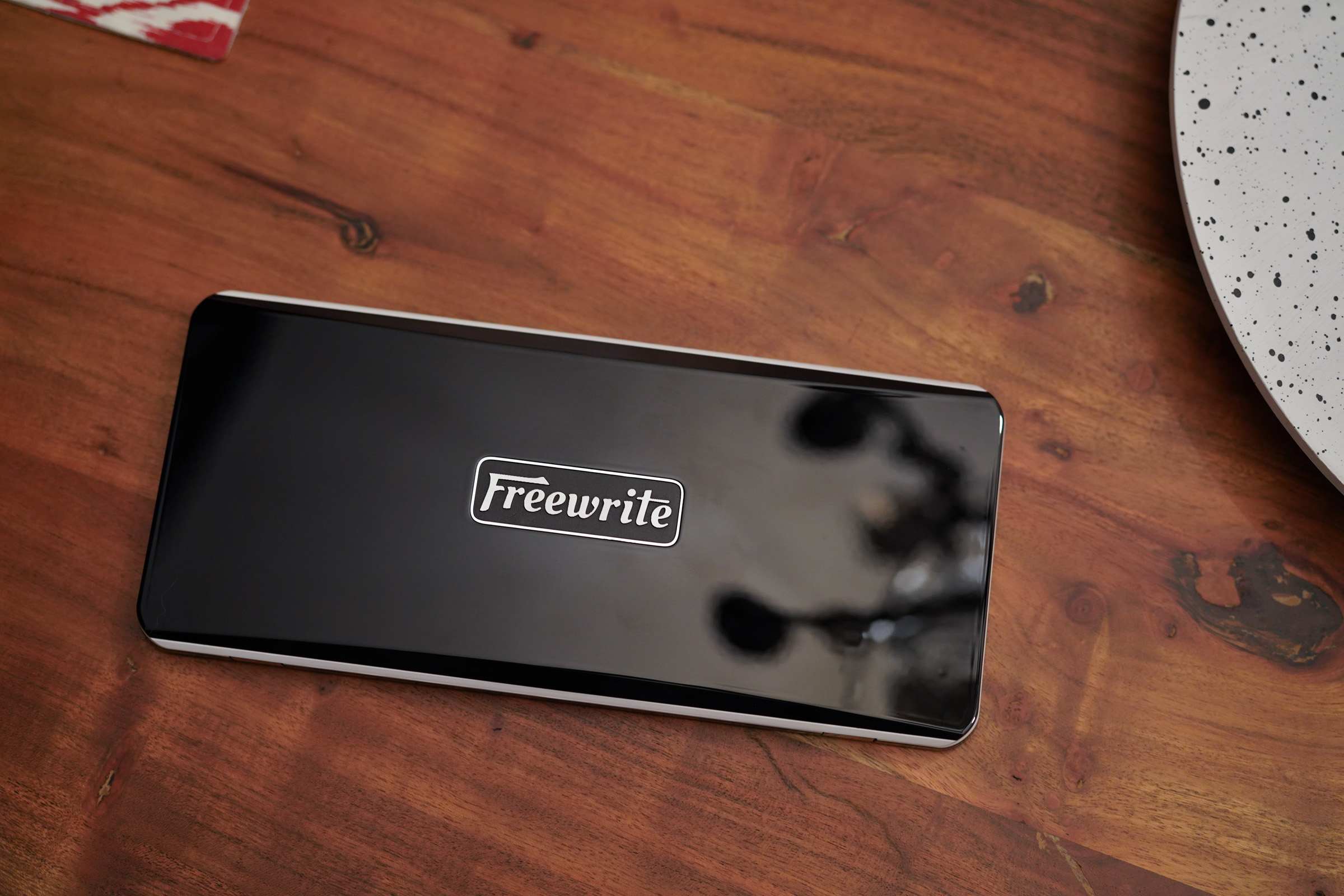
Image Credits: Darrell Etherington

In terms of specs, it has up to four weeks of battery life with regular usage, and weighs under two pounds, with a folding design that’s roughly half the surface area of most laptops. The screen on the top half is an e-ink display, and there’s a sub-screen for providing info like network status. The bottom half houses the keyboard, which boasts over 2mm of travel for a great keypress feel.

The case is plastic, as are most of the components, and the exterior is a glossy black. The Traveler connects via wifi, like the original Freewrite, and allows you to register an account to sync to up to three separate folders of documents. When out of wifi range, your work is stored locally, and it can sync to the cloud service of your choice via Freewrite’s integrations whenever you’re connected.

Design and features

The Traveler’s design is all about portability and convenience, while retaining the core usability features that make the original Freewrite such an ideal device for focused writing. The clamshell design is intentionally large enough to fit that full-sized keyboard comfortably, but keeps the screen small like with the original, which makes it more portable and ensures that distractions are kept to a minimum – aided by the fact that all you can do on it is type text, since there are no apps, browser or other functions.

Astrohaus has stayed very close to their original vision for the Traveler, with some minor tweaks including the hinge design. The end result is a light and durable-feeling portable digital typewriter, with a keyboard that feels excellent to type on – better than any laptop in my experience. The keyboard is really the star of the show here, since this is a purpose-built device created for typing. The travel feels ample, especially for a notebook-style device, and the raised, rounded keycap wells make it easy to touch type comfortably all day if you want.
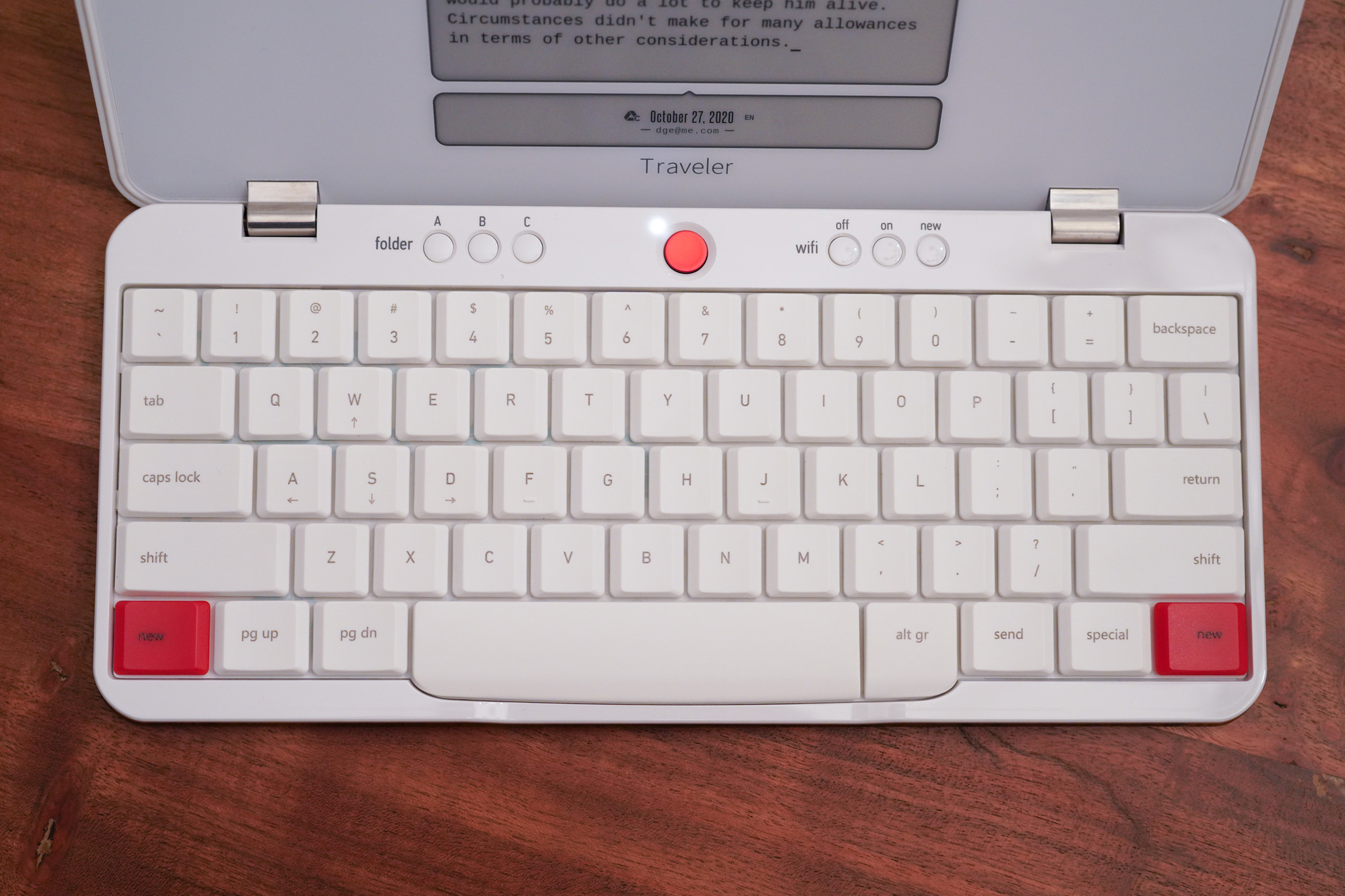
Image Credits: Darrell Etherington

The display, while small, provides excellent legibility and contrast, though it’s worth noting that you’ll have to supply your own light source, because as with the original Freewrite, there’s no backlight or frontlight built in, and e-ink doesn’t provide its own light like LED.

E-ink is incredibly power efficient, however, which is why you’ll get so much useful life out of the Traveler. In my testing, it’s been operating on its original charge for nearly two weeks now, which is in line with the Astrohaus estimates.

The Traveler’s case features a piano black glossy exterior, which looks great, but quickly picks up fingerprints. And existing Freewrite users might notice that the display has a slightly glossy sheen as well, where the original was fully matte. That’s because of a thin piece of optically transparent plastic that goes across the entire width of the clamshell to protect the e-ink display against the keyboard, according to Astrohaus. To me, it hasn’t been an issue in terms of usability or quality, just something to note in terms of differences.
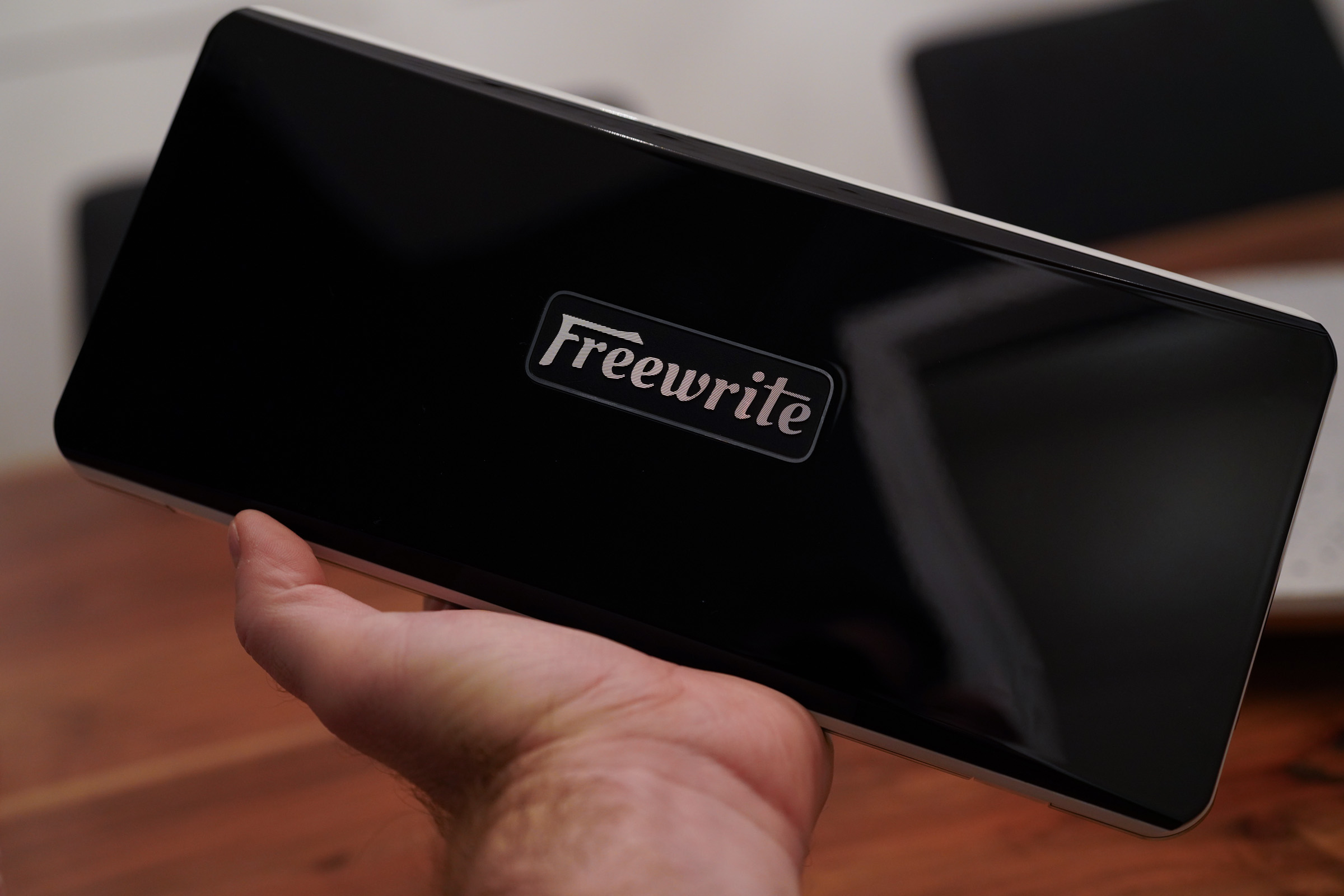
Image Credits: Darrell Etherington

Astrohaus has created a design that stands out, regardless of what you think of the piano black finish. The contrast of the black with the white interior gives it a unique, quirky and attractive design that helps ensure you’ll never confuse the Traveler with any other gadget. And the materials keep it lightweight and durable for easily taking it with you anywhere you might want to go.

The Traveler’s hinge allows it it to open up to roughly 135 degrees, which is a good position for laptop typing. It can also be positioned at any angle less than that for when you have it elevated at a table or desk.

Bottom line

The Freewrite Traveler is a unique device, with a special appeal for people who are hyper-focused on a writing tool that offers all the benefits of cloud-connectivity with none of the downsides of a multipurpose tool like a laptop or computer. It can sync to Dropbox, Evernote or Google Drive so that you can easily create a cross-device workflow for finishing up manuscripts and drafts, but on its own, the Traveler will ensure you remain focused on the task at hand – and enjoy yourself while doing so.

A portable, digital writing device like this one isn’t unique in the world – many distraction-free writing enthusiasts use the Pomera line of products from Japan for this purpose. But Astrohaus is unique in providing hardware tailor-made for North American and European markets, and they’ve done an amazing job at delivering on the potential of this device even in a field of relatively few competitors.

The Traveler is fairly expensive at $599, but there’s truly nothing else like it, if what you want is a laser-focused writing device that combines portability with great ergonomics, long-lasting battery and cloud storage convenience.


WordPress Image Lightbox Plugin