
Yearly Archives: 2020

News: Panoply raises $10M for its cloud data platform

Panoply, a platform that makes it easier for businesses to set up a data warehouse and analyze that data with standard SQL queries, today announced that it has raised an additional $10 million in funding from Ibex Investors and C5 Capital. This brings the total funding in the San Francisco- and Tel Aviv-based company to

Panoply, a platform that makes it easier for businesses to set up a data warehouse and analyze that data with standard SQL queries, today announced that it has raised an additional $10 million in funding from Ibex Investors and C5 Capital. This brings the total funding in the San Francisco- and Tel Aviv-based company to $24 million.

The company, which launched back in 2015, has mostly stuck to its original vision, which was always about democratizing access to data warehousing and the analytics capabilities that go hand-in-hand with that. Over the last few years, it also built more code-free data integrations into the platform that make it easier for businesses to pull in data from a wide variety of sources, including the likes of Salesforce, HubSpot, NetSuite, Xero, Quickbooks, Freshworks and others. It also integrates with other data warehousing services like Google’s BigQuery and Amazon’s Redshift and all of the major BI and analytics tools.

The company says it will use the new funding to expand its sales and marketing efforts.

“We aspire to make analysts’ lives simpler and more productive by making it easier for them to sync, store, and access their data, and this funding will go a long way toward that mission,” says CEO and co-founder Yaniv Leven in today’s announcement.

In some ways, Panoply was maybe just a bit early to the market. Today, though, there can be little doubt that we’re in a booming market for data warehousing and analytics services. There’s nary a business left, after all, that isn’t looking to gain more insights from the copious amounts of data they gather every single day now. That market is now more competitive than ever, too, with incumbents like Snowflake, Databricks and others (including all of the hyper clouds) all aiming for their slice of the market. Panoply and its investors clearly believe that the company’s all-in-one platform gives it a competitive edge, though.
News: Anima’s latest update draws on the popularity of design and no-code tools

Anima, the company that turns design prototypes into code, has today announced the launch of Anima 4.0, which will allow designers to create prototypes in Figma that are translated into components in React with the click of a button. The company was founded by Or Arbel (cofounder of Yo!), Avishay Cohen (who led R&D at

Anima, the company that turns design prototypes into code, has today announced the launch of Anima 4.0, which will allow designers to create prototypes in Figma that are translated into components in React with the click of a button.

The company was founded by Or Arbel (cofounder of Yo!), Avishay Cohen (who led R&D at Mobli) and Michal Cohen. It launched three years ago with a platform that allowed designers in Figma, Sketch and Adobe XD to translate their designs into HTML code. With today’s launch, those designs (in Figma only, for the moment) can be turned into React components, giving developers the ability to tweak and polish individual components in a coding language that they’re already using.

Enterprise design tools have absolutely blown up over the past several years. As opposed to a time where designers really only had the option to work in Photoshop and developers then had to spend time turning those static images into code, it’s fair to call the design landscape of 2020 crowded.

Platforms like Sketch, InVision, and Figma have aimed to close the gap between designers and developers, and in the lattermost case, designers and other designers, as well. Adobe has also answered the call of growing competition with the launch of Adobe XD.

Anima 4.0 represents yet another shift. The company is riding the wave of enterprise design tool growth, while simultaneously positioning itself in the realm of no-code, another high-growth vertical.

Arbel told TechCrunch that, around the time that Yo was shuttering, he knew that his next venture would be a product that charges money from day one. He also said that he and his cofounders had been frustrated for a long time by the disconnect between designers and developers.

Thus, Anima was born. It costs $40/month to use Anima, or approximately $370 annually. Arbel confirmed to TechCrunch that pricing wouldn’t change with the launch of Anima 4.0 but that it may in the future. The reason for that is that Anima originally took developers out of the picture, allowing designers to build out their designs and translate it automatically into running HTML code.

With this launch, Anima is looking to bring developers back into the fold, speaking to them in React (their native tongue, if you will). That opens the door to charging more per seat or introducing new revenue streams.

Arbel said that Anima was profitable before it ever received its first funding, which came in the form of a $120K check from Y Combinator in the summer of 2018. This year, the company raised $2.5 million in seed funding led by Hetz Ventures, Zohar Gilon, and Ed Lando.

Today, Anima is used by 300,000 designers, developers and product managers from companies like Google, Amazon, Starbucks, and Walmart, among others. Each week, the Anima community converts more than 4,000 designs into code.

The Anima team has grown from four at the onset of the pandemic to 17 now, with a 70/30 split between men and women.

“The greatest challenge is making developer-friendly code,” said Arbel. “Developers are not an easy audience — I know because I’m a developer myself. We’ve been hearing about code generation and. the like since the beginning of the internet, and endless amounts of products have tried and none of them have managed to produce developer-friendly code. They product huge amounts of code that is bloated and hard to understand. Now, there is finally technology can actually make that happen.”

News: Thanks to COVID-19 emissions and coal use may have peaked in 2019

If analysts from BloombergNEF are right, then all of the world’s most greenhouse gas polluting days are behind it, thanks to the COVID-19 pandemic. A sharp drop in energy demand caused by the global response to the coronavirus pandemic will remove 2.5 years of energy sector emissions between now and 2050, according to the latest

If analysts from BloombergNEF are right, then all of the world’s most greenhouse gas polluting days are behind it, thanks to the COVID-19 pandemic.

A sharp drop in energy demand caused by the global response to the coronavirus pandemic will remove 2.5 years of energy sector emissions between now and 2050, according to the latest New Energy Outlook from BloombergNEF.

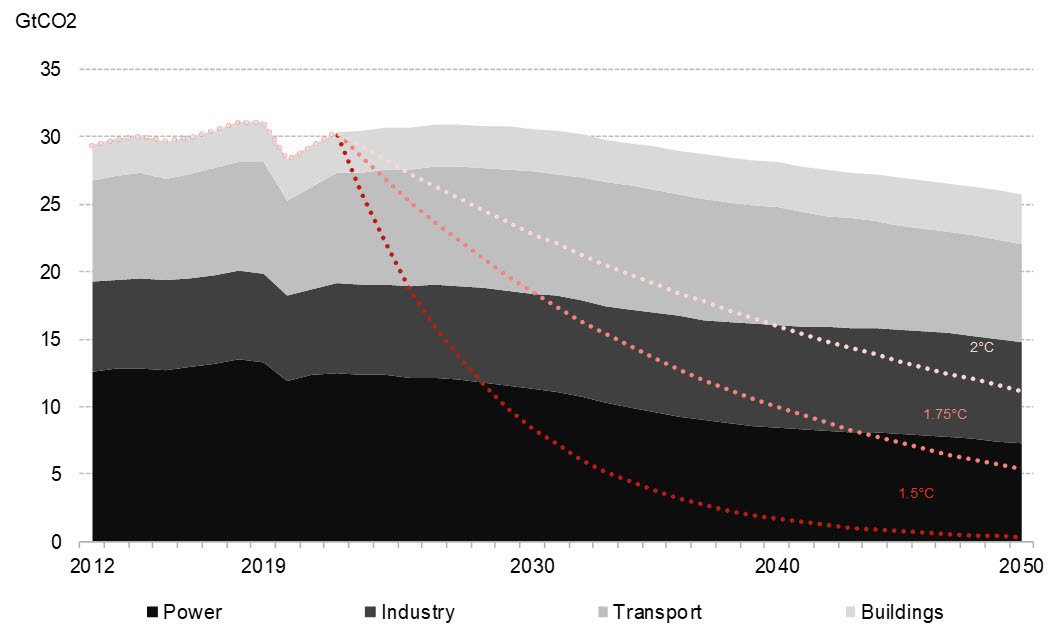
The latest models from the analysis firm tracking the evolution of the global energy system show that emissions from fuel combustion will likely have peaked in 2019.

The company’s models show that global emissions declined roughly 20% as a result of the international response to the COVID-19 pandemic, and while those emissions will rise again with economic recoveries, BloombergNEF’s models never see emissions reaching 2019 levels. And from 2027 emissions are projected to fall at a rate of 0.7% per year to 2050.

Bloomberg New Energy Finance chart predicting declines in global emissions. Image Credit: BloombergNEF

These rosy projections are based on the assumption of a massive construction boom for wind and solar power, the adoption of electric vehicles, and improved energy efficiency across industries.

Together, wind and solar are projected to account for 56% of global electricity generation by mid-century, and along with batteries will gobble up $15.1 trillion invested in new power generation over the next 30 years. The firm also expects another $14 trillion to be invested in the energy grid by 2050.

The rain on this new energy parade could come from India and China, which have long been reliant on coal power to keep their national economies humming. But even in these colossal coal consumers the Bloomberg report sees good news for people who like good news.

They expect coal-fired power to peak in China in 2027 and in India in 2030. By 2050, coal is projected to account for only 12% of global electricity consumption. But even with the surge in renewables gas-fired power ain’t dead. It remains the only fossil-fuel to continue to grow until 2050, albeit at an anemic 0.5% per-year.

No one should break out the champagne based on these projections, though, because the current trajectory still sees the globe on a course to hit a 3.3 degrees Celsius rise in temperature by 2100.

“The next ten years will be crucial for the energy transition,” said Bloomberg New Energy Finance chief executive, Jon Moore. “There are three key things that we will need to see: accelerated deployment of wind and PV; faster consumer uptake in electric vehicles, small-scale renewables, and low-carbon heating technology, such as heat pumps; and scaled-up development and deployment of zero-carbon fuels.”

And a three degree rise in temperature is bad. At that temperature huge swaths of the world would be unlivable because of widespread drought, rainfall in Mexico and Central America would decline by about half, Southern Africa could be exposed to a water crisis and large portions of nations would be covered by sand dunes (including chunks of Botswana and a large portion of the Western U.S.). The Rocky Mountains would be snowless and the Colorado River could be reduce to a stream, according to this description in Climate Code Red.

“To stay well below two degrees of global temperature rise, we would need to reduce emissions by 6% every year starting now, and to limit the warming to 1.5 degrees C, emissions would have to fall by 10% per year,” Matthias Kimmel, a senior analyst and co-author of the latest report, said in a statement.


News: SpaceX and LeoLabs partner up for tracking of Starlink satellite deployments

SpaceX and orbital object tracking startup LeoLabs have announced a new commercial partnership that will see LeoLab track SpaceX’s Starlink satellites during their initial deployment and orbital travel. The arrangement means that LeoLabs will immediately start tracking new Starlink satellites once they’re released in space following a launch, giving SpaceX immediate info in terms of

SpaceX and orbital object tracking startup LeoLabs have announced a new commercial partnership that will see LeoLab track SpaceX’s Starlink satellites during their initial deployment and orbital travel. The arrangement means that LeoLabs will immediately start tracking new Starlink satellites once they’re released in space following a launch, giving SpaceX immediate info in terms of placement and trajectory during the crucial initial few days of any new batch launch.

LeoLabs’ provides an advantage vs. any other options out there in terms of how fast it can acquire signal from a whole batch of newly orbital Starlink satellites, which SpaceX has been sending up in batches of 60. Here’s a brief synopsis of what exactly LeoLabs is doing for SpaceX through this arrangement, straight from the company itself:

LeoLabs tracks all Starlink satellites (up to 60 per launch) and rapidly generates data products on the front and back of the cluster to provide a bounding box on the train of satellites. This begins within the first few hours following launch and deployment. We continue to monitor the satellites in the following hours and days as they disperse and begin their orbit raising sequences.

The actual operational partnership has been active since March of this year, which means that LeoLabs has been tracking these deployments for a number of missions thus far. It’s also going to continue to do this for future launches going forward. Through their platform, SpaceX gets timely data on Starlink satellites and their orbits just a few hours post-launch, and the startup says it can typically deliver data within one hour of a Starlink satellite passing over one of its radar stations.

Image Credits: LeoLabs

LeoLabs has made headlines recently tracking potential collisions among objects in low Earth orbit, including most recently a near-collision with an 11-meter miss of two objects earlier this month. As low Earth orbit becomes more crowded – in no small part due to SpaceX’s planned massive increase in its Starlink fleet size – the company’s services are likely to only grow in demand in order to help with effective space traffic control.

News: Discuss portfolio management and great storytelling with GV’s M.G. Siegler on Extra Crunch Live today at 2pm ET/11 am

If anyone knows early-stage investing and startups, it’s M.G. Siegler. As a general partner at GV, he’s personally invested in his fair share of rocket ship companies early on in their lifecycles, including Anchor, Slack, Medium and Stripe. He’s also a TechCrunch alum and a former startup operator himself as a web dev. We’re thrilled

If anyone knows early-stage investing and startups, it’s M.G. Siegler. As a general partner at GV, he’s personally invested in his fair share of rocket ship companies early on in their lifecycles, including Anchor, Slack, Medium and Stripe. He’s also a TechCrunch alum and a former startup operator himself as a web dev. We’re thrilled to have Siegler joining us to talk about his investment experience and how his early career as a writer influenced his thinking about startup success on Extra Crunch Live on today live at 2 p.m. EDT/11 a.m. PDT.

Siegler’s career in startups began in 2005, working in web development at a startup agency focused on tech clients. He later reported on startups at both VentureBeat and later TechCrunch, before becoming a founded partner at CrunchFund and then eventually joining GV (then Google Ventures) to focus on early-stage companies. In addition to the companies listed above, Siegler has led investments in other successful early-stage companies including Universe, Giphy, The Players’ Tribune, CTRL-Labs and AltspaceVR.

At the outset of the current global pandemic, Siegler chatted with our own Lucas Matney about GV’s investment in mobile website-builder Universe and about how managing a portfolio changes in light of travel and social distancing restrictions. We’ll find out from Siegler what the ensuing months of living and working in the context of COVID-19 have changed about his perspective and about the early-stage companies he’s working with and scouting for potential investment.

More broadly, Siegler also has a unique perspective and ample experience when it comes to early-stage startups and storytelling. His work as a journalist focused specifically on looking at new and emerging technology companies and assessing their ability to communicate their ambitions, the problems they’re solving and the technology they’re building. He brings that experience to his assessment of the investment potential of startups and their founders, and their ability to tell good and compelling stories about what they’re doing and why.

All these topics, plus more questions from you, our audience. So join us if you’re an Extra Crunch member and get caught up on all the fintech goodness going on. And if you aren’t an Extra Crunch member, be sure to check out subscription options before we get started.

Meeting details are below the paywall.

Meeting Details

News: TCL announces a $400 5G handset

What’s most remarkable about the push for 5G is how quickly the prices came down on handsets sporting the next-gen wireless technology. The push toward affordable 5G devices is clearly as much an indicator as the current state of the smartphone space as anything — people just aren’t upgrading devices as quickly as the used

What’s most remarkable about the push for 5G is how quickly the prices came down on handsets sporting the next-gen wireless technology. The push toward affordable 5G devices is clearly as much an indicator as the current state of the smartphone space as anything — people just aren’t upgrading devices as quickly as the used to. And even more to the point, they’re reluctant to pay $1,000 when they do.

Qualcomm’s Snapdragon 765G has been a piece of that puzzle. And unsurprisingly, the mid-tier chip in found in TCL’s new $400 5G handset. Of course, TCL is positioning it as “under-$400” with that $399.99 price tag, which is technically correct — the best kind of correct.

It’s also not really right to say that the TCL 10 5G UW’s a”premium blend of performance, power, stylish design and 5G connectivity that until now has only been available on more expensive flagship smartphones.” Affordable 5G handsets isn’t an entirely new phenomenon — nor are affordable 5G handsets with decent specs and design. But even so, the price point is still notable at this stage in the 5G upgrade cycle — which, frankly, is why we’re writing about it here.

The price/5G combo is the main thing to like here, coming in at even less than, say, the OnePlus Nord, a recent high water mark in the 5G/price point combo. And there are a few other things that should appeal to potential buyers, as well, including a 4,500mAh battery coupled with reverse charging for other devices. There are three rear-facing cameras: a 48-megapixel main, an eight-megapixel ultra wide and a five-megapixel macro, the latter of of which is starting to appear on more phones.

It arrives October 29, and is, notably, a Verizon (TechCrunch’s parent company) exclusive here in the U.S., using the carrier’s mmWave technology.


News: 10 favorite startups from Techstars’ October 2020 class

A few weeks back, The Exchange dug through a number of Techstars demo days and parsed a few dozen startups to find a few favorites. Today, we’re back for more of the same, albeit with a different set of accelerators’ results to examine. As a reminder, the last time we dug through the various cohorts,

A few weeks back, The Exchange dug through a number of Techstars demo days and parsed a few dozen startups to find a few favorites. Today, we’re back for more of the same, albeit with a different set of accelerators’ results to examine.

As a reminder, the last time we dug through the various cohorts, we liked YearOne, MyFavorito, Livelii, Albo, Space Products and Innovation GmbH and SATIM.


The Exchange explores startups, markets and money. Read it every morning on Extra Crunch, or get The Exchange newsletter every Saturday.


This morning let’s take a look at the startups from Techstars’ Atlanta (full class here), Los Angeles (full class here), and New York City cohorts (full class here), with a final peek at what the so-called “Techstars & Western Union Accelerator” managed (full class here).

TechCrunch has also taken looks at startups from the latest Y Combinator batch (parth one, part two), Acceleprise, Envision and others. It’s a time-honored tradition around here — we think startups are inherently interesting. With that, let’s begin.

Favorites and standouts

I wanted to kick off with Atlanta this morning, and not merely because the Falcons are somehow worse than my Eagles. A startup accelerator in Atlanta feels exciting because, while we know that there is lots of startup activity coming out of the city, it’s still not a place I know well.

Unluckily for our goal of picking favorites, I liked nearly every startups’ demo. Meal Me is cool, and as a former San Francisco resident who didn’t cook, where was this when I lived there. Swivl is also worth checking out, because we should be able to expand who can really work with data. And Please Assist Me is pretty spot-on for my generation’s yuppies.

News: Google confirms post-Election Day political ad ban, partners with AP on election results

Google today announced several updates related to how it’s helping direct people to the polls, provide election results, and help people access real-time election news across its platforms and services, like Search, Assistant and YouTube. The company said it will again partner with the Associated Press (AP) to deliver authoritative information on election results on

Google today announced several updates related to how it’s helping direct people to the polls, provide election results, and help people access real-time election news across its platforms and services, like Search, Assistant and YouTube. The company said it will again partner with the Associated Press (AP) to deliver authoritative information on election results on both Google Search and Assistant. It also confirmed earlier reports that it won’t run political ads on its platform after the polls close on November 3.

Axios had first reported on Google’s plans to ban political ads after election day, citing an email sent to advertisers. The email had told advertisers they would not be able to run ads “referencing candidates, the election, or its outcome, given that an unprecedented amount of votes will be counted after election day this year.”

Google confirmed the move at the time of the original report by offering a statement.

Today, Google published the details of its decision in a company blog post, saying it has chosen to enforce its Sensitive Events policy as soon as the polls close on Nov. 3, given the possibility of “delayed election results this year” and to “limit the potential for ads to increase confusion post-election.”

The policy, specifically, says Google does not allow:

Ads that potentially profit from or exploit a sensitive event with significant social, cultural, or political impact, such as civil emergencies, natural disasters, public health emergencies, terrorism and related activities, conflict, or mass acts of violence

Google isn’t the only tech giant to take aim at political advertising in this heated election season. Facebook this month widened its ban on political ads, saying those ads would be blocked indefinitely after Nov. 3. Twitter made the decision to ban political ads last year.

In Google’s case, it’s calling its political ad ban a “temporary pause,” and says it’s directed towards an ads referencing “the 2020 election, the candidates or its outcome.”

The company also took the time today to note other voting and election-related initiatives it has underway, including its ongoing activities taking place in election seasons that help people find voter registration information and other election deadlines. It’s also directing users to voting locations and ballot drop boxes on Google Maps.

On YouTube, it’s pointed users to relevant election-related search results, voter registration information, and details on how to vote.

This year, Google noted it will partner with the AP to provide election results in Google Search and Assistant. The companies have worked together in the past elections, too.

Users will encounter a new election module with data provided by the AP when they either search for “election results” on Google Search or ask, “Hey Google, what are the current election results?” The data will include both federal and state level races across more than 70 languages, Google says.

YouTube, meanwhile, will feature real-time election streams from major news providers, and link to coverage on Google Search. Google News will also feature a 2020 U.S. Election section where users can follow both local and national news.

News: Lightyear scores $3.7M seed to digitize networking infrastructure procurement

Lightyear, a New York City startup that wants to make it easier for large companies to procure networking infrastructure like internet and SD-WAN, announced a $3.7 million seed round today. While it was at it, the company announced that it was emerging from stealth and offering its solution in public beta. Amplo led the round

Lightyear, a New York City startup that wants to make it easier for large companies to procure networking infrastructure like internet and SD-WAN, announced a $3.7 million seed round today. While it was at it, the company announced that it was emerging from stealth and offering its solution in public beta.

Amplo led the round with help from Susa Ventures, Ludlow Ventures, Mark Cuban, David Adelman and Operator Partners.

Company CEO and co-founder Dennis Thankachan says that while so much technology buying has moved online, networking technology procurement still involves phone calls for price quotes that could sometimes take weeks to get. Thankachan says that when he was working at a hedge fund specializing in telecommunications he witnessed this first hand and saw an opportunity for a startup to fill the void.

“Our objective is to make the process of buying telecom infrastructure, kind of like buying socks on Amazon, providing a real consumer-like experience to the enterprise and empowering buyers with data because information asymmetry and a lack of transparent data on what things should cost, where providers are available, and even what’s existing already in your network is really at the core of the problem for why this is frustrating for enterprise buyers,” Thankachan explained.

The company offers the ability to simply select a service and find providers in your area with costs and contract terms if it’s a simple purchase, but he recognizes that not all enterprise purchases will be that simple and the startup is working to digitize the corporate buying process into the Lightyear platform.

To provide the data that he spoke of, the company has already formed relationships with over 400 networking providers worldwide. The pricing model is in flux, but could involve a monthly subscription or a percentage of the sale. That is something they are working out, but they are using the latter during Beta testing to keep the product free for now.

The company already has 10 employees and flush with the new investment, it plans to double that in the next year. Thankachan says as he builds the company, particularly as a person of color himself, he takes diversity and inclusion extremely seriously and sees it as part of the company’s core values.

“Trying to enable people from non-traditional backgrounds to succeed will be really important to us, and I think providing economic opportunity to people that traditionally would not have been afforded several aspects of economic opportunity is the biggest ways to fix the opportunity gap in this country,” he said.

The company, which launched a year ago has basically grown up during the pandemic. That means he has yet to meet any of his customers or investors in person, but he says he has learned to adapt to that approach. While he is based in NYC, his investors are are in the Bay Area and so that remote approach will remain in place for the time being.

As he makes his way from seed to a Series A, he says that it’s up to him to stay focused and execute with the goal of showing product-market fit across a variety of company types. He believes if the startup can do this, it will have the data to take to investors when it’s time to take the next step.

News: Vimeo introduces free video messaging with Vimeo Record

Vimeo Record is a new product that allows teams to communicate through video messages. Vimeo CEO Anjali Sud said that while the pandemic has prompted many offices to embrace digital communication tools like Zoom, “There’s a whole host of work communication that needs asynchronous messaging.” Besides, sometimes a video can get your message across more

Vimeo Record is a new product that allows teams to communicate through video messages.

Vimeo CEO Anjali Sud said that while the pandemic has prompted many offices to embrace digital communication tools like Zoom, “There’s a whole host of work communication that needs asynchronous messaging.”

Besides, sometimes a video can get your message across more effectively, rather than “scheduling another call or writing a long email or Slack thread.”

Sud said that since she became CEO of the IAC-owned video platform in 2017, Vimeo has shifted its focus from being a destination site that competed with YouTube to providing video tools for businesses: “We really want to be the single corporate video solution for the modern organization.”

Vimeo Record is an extension of that strategy. During the pandemic, Vimeo’s revenue has already been growing 40% to 50% year-over-year each month, but Sud said this product been in the works since before then, reflecting the long-term trend that “more and more teams are distributed, and they need ways to communicate.”

Collaborate better remotely with Vimeo Record from Vimeo Staff on Vimeo.

So Vimeo created a Google Chrome extension that allows users to easily record their screen or their face, share and comment on those recordings, organize them into folders with different permissions and receive notifications when someone watches.

Sud said around 400 companies have already been beta testing the feature. Teams are using it to review design and code, to work together to resolve customer support tickets, to share messages from company leadership and more.

Asked whether there’s been a learning curve for recording effective video messages, Sud said, “The biggest barrier is just making it not feel intimidating. The easiest way [to do that] is for people to receive a video message themselves. If a colleague sends you something that’s not perfect, it lowers that intimidation factor.”

She also noted that Vimeo Record fits into the company’s freemium business model. Anyone can send unlimited messages for free, but Vimeo will charge for premium features like the ability to host videos on a third-party, custom-branded video platform.

“My team is using Vimeo Record to share product demos internally and to give our customers a preview of what’s launching soon,” said Mailchimp’s director of product marketing Trevor Wolfe in a statement. “We love it! It adds a personal touch that you just can’t replicate with email or a chatroom message.”

WordPress Image Lightbox Plugin